'.
__
n
"'7_~~.
E
':.1',,.
.
r;
2
7
?
5
"
,
.
SCIENCE
&
TECHNOLOGT
March,
1972
..
CD
The U.S. Center for Computer Sciences and Technology
--
Its Responsibilities and Visions
Computer Thinking
Forty Plus One Ways to Cut a Coat
Pictorial Reasoning Tests - Analysis and Answers
Dallas: Who? How? Why?
Vol.
21,
No.3
A "MARCH" LION
- Ruth M. Davis
-
G.
M. R
.
Graham
- Hughes Aircraft Co
.
-
Neil Macdonald
-
Mikhail Sagatelyan
S
N
TECH1aO
1P02121147F6 7301
S
'
3S2iS3Z22SitAiliS
*N
TECHNICAL SERVICES
00808
180
W
SAN CARLOS ST
•
Advertisement
ZINGO
•
•
•
•
•
•
•
•
•
•
• • •
•
•
•
•
•
•
•
•
•
•
•
••
•
•
•
000'
•
•
•
A New Game For Computers and / or People
•
•
•
•
•••
• •
•
•
•
•
•
•
•••
•
•
•
•
•
•
•
•
•••
• •
"Dice in quantity, instead of just singles or pairs, provide an exciting'Iearn-as-you-play' introduction to probability and statistics. They are much more inter-esting and much easier to toss, than pennies in quantity."
•
•
•
•
•
•
•
•
• • •
•
•
•
•
•
•
•
•
From time to time computer people hunt for games that are fun to investigate, fun to play with an-other person, and fun to play with a computer, which should be rather easily programmed to play the game.
Such a game is Zingo. The rules for playing it are as follows:
Rules of Zingo
1. Number of Players. There are two or more players, each using 21 dice (or some other chosen number of dice).
2. Choices. The players agree on a NUMBER to be PRODUCED from a throw of the dice and the allow-able arithmetical operations to produce it.
For example, in Advanced Zingo, the number to be produced might be 35, and the allowable operations might be addition, subtraction, multiplication, di-VISIon, raising to a power, and factorial. In Ele-mentary Zingo, the number to be produced might be 2, and the allowable operations might be addition and subtraction.
3. Throw. Each player then rolls his 21 dice, and obtains a THROW.
4. Production. Each player then arranges his dice in allowed arithmetical COMBINATIONS to PRODUCE the agreed NUMBER.
Thus in Advanced Zingo, suppose the NUMBER to be produced is 35. If a player's THROW of 21 dice in-cluded a two, a three, and a five, he could use those 3 dice to PRODUCE 35 because of the COMBINA-TION 2 to the 5th power plus 3 equals 35.
In Elementary Zingo, suppose the NUMBER to be pro-duced is 2. Then the player could use the two by itself to PRODUCE one 2, and the three and the five to PRODUCE a second 2 because of the COMBINATION 5 minus 3 equals 2.
5. Scoring. If a player uses up all the outcomes shown by his dice in his throw, by making combin-ations that produce the agreed number, he'scores 2 points, for "going out". If the number of his combinations exceeds the number of combinations of the other player (or all the other players), then he scores 3 additional points.
Thus there is a premium on using all of the dice in one's throw, and a premium on making more combina-tions than the other player (or players).
Incidentally 35 is a particularly interesting number to produce because it cannot be produced by
I
-two dice, but it can be produced by about 10 or 11 or 12 combinations of 3 of the numbers 1 to 6 using addi-tion, subtracaddi-tion, multiplicaaddi-tion, division, raising to a power, factorial, and square root. If a player finds that he cannot produce 7 combinations making 35, each of them using 3 dice, he is compelled to drop back to 6 combinations and is very likely ItO lose.
The Working Out of a Throw
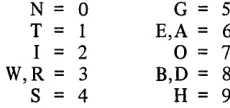
For example, suppose a throw of 21 di ce is as follows: 1 1 1 2 2 3 3 3 4 4 5 5 5 5 5 6 6 6 6 6 6 and the Agreed Number to be produced is 35. The possible combinations of "least cost" (which is 3) are shown in the following table:
USE OF THE THROW TO PRODUCE 35
(1) ( 2) (3) (4) Amount Total Dice Formula Combination of Use Used UE (6X6)-1
=
35 1, 6, 6 3 9 41+31+5=
35 3, 4, 5 2 6 25+3=
35 2, 3, 5 1 3 (2+5)X5=
35 2, 5, 5 1 3 Count, 7 Cost, 21For more information -- especially on the comput~
er program -- see the article "Zingo -- A New Com-puter Game" starting on page 33 of the February 1972 issue.
Any reader interested in obtaining dozens of dice for use in Zingo (and similar games and statistical experiments), may use the coupon below.
- - (may be copied on any piece of paper) To: Computers and Automation
815 Washington St., Newtonville, MA 02160 Yes, please send me package (s) of 50 small
dice (about 3/8-inch on an edge) for playing Zingo, and making other statistical investi-gations.
For each package, I enclose $2.30 plus 20 cents for handli ng (a total of $2.50 per package).
Total enclosed $ (Prepayment is necessary.) Name ________________________________________ __
Address" ______________________________________ __
DO YOU REALIZE THAT
• Every minute in the United States there are THREE burglaries?
• The total annual loss to Americans from burglary is over 500
million dollars a year? - AND CLIMBING?
ARE YOU EVER WORRIED ABOUT BURGLARS?
DO YOU WONDER if you will return some evening to find your home ransacked
and your valuables taken?*
- If so, why not take a look at our
BRAINIAC® HOMEOWNER'S PROTECTIVE KIT
K
40
This kit is designed to give you thorough, sensible information and materials relating to
LOCKS, BARS, ALARMS, SYSTEMS, and STRATEGY
to help you protect your home against a burglar, a fire, a flood.
THE BRAINIAC K40 KIT:
• Explains and illustrates clearly how you, with simple ordinary tools and simple economical devices, can protect your home against a burglar, a fire, a flood.
• Enables you to design and make for yourself a reliable, effective, protective system (in-cluding locks and alarms) -- not a toy system but a working system
• Gives you a vast saving over ordinary commercial protective systems (they are priced $300 to $3000 and higher)
• Contains all the special parts needed for most homes (but does not contain what you can buy easily at a local hardware store -- batteries, locks, etc.)
TAKE ADVANTAGE of our prepublication offer ••. save $10 ... send $38.50 check (or money order) with your order now (please do not send cash)
Publication of this kit is scheduled for June: price after publication: $48.50
RETURNABLE WITHIN SEVEN DAYS AFTER YOU RECEIVE IT FOR FULL REFUND IF NOT SATISFACTORY (if in salable condition)
HOW CAN YOU LOSE? WHY NOT EXAMINE IT?
(may be copied on any piece of paper)
-To: Berkeley Enterprises, Inc.
Publisher of "Computers and Automation" 815 Washington St., Newtonville, MA 02160
Yes, please send me the Brainiac Homeowner's Protective Kit K 40 as soon as it is ready. I enclose $38.50 ( ) check ( ) money order. (DO NOT SEND CASH, PLEASE)
I understand the kit is returnable within seven days after I receive it, for FULL REFUND if it is not satisfactory (if in salable condition.)
My name and address are attached.
CONTENTS (Preliminary List)
Detecting and Sensing Devices 20 leaf-spring contacts
1 magnetic contact 1 tilt-sensitive contact 1 pressure-sensitive contact 2 heat-sensitive contacts 1 water-sensitive contact
Indicating and Acting Devices 1 alarm siren
1 continuity tester, to make sure that an electrical circuit is complete
1 red lamp for showing "alarm" condition 1 green lamp for showing "safe" condition
Other Hardware
2 relays: one is a "sensitive" relay which is in a 1.5 volt "sensing" circuit; i f this circuit is interrupted, a second relay energizes a 6 volt alarm circuit
1 reset switch, so that the circuits can change back to the "sensing" condition
2 on-off switches
1 punched panel for experimentally wiring circuits 4 spring pins
40 feet of insulated wire
20 feet of foil strip, alumjnum or leadibolts, nuts, etc.
Books and Other Information
"Practical Ways to Prevent Burglary" by Val Moorman, paper-bound, 1971, 192 pp
"Protecting your Home against Burglary and other Hazards: Problems, Strategy, and Systems" by E. C. Berkeley (former member, City of Newton Crime Prevention Committee), paper-bound, 1972, 96 pp
"The Materials in the Kit -- Instructions and Explanations"
"Buyers' Guide to Products in the Anti-Burglary Field"
Bibliography
Editor
Vol.
21, No.3
March, 1972
Edmund C. Berkeley
Assistant Editors Barbara L. Chaffee Linda Ladd Lovett Neil D. Macdonald
Software Editor Stewart B. Nelson
Advertisillf: Director Art Director Publisher·s
Assistallt COlltributillf:
Editors
Advisof1l Com;nittee
Edmund C. Berkeley
RayW. Hass
Paul T. Moriarty
John Bennett Moses M. Berlin Andrew D. Booth John W. Carr III Ned Chapin
Alston S. Householder Leslie Mezei
Ted Schoeters Richard E. Sprague
James J. Cryan Alston S. Householder Bernard Quint
EditorialOffices Berkeley Enterprises,lnc.
815 Washington St., Newtonville, Mass. 02160 617-332-5453
Advertisinf: Contact
THE PUBLISHER Berkeley Enterprises,lnc.
815 Washington St., Newtonville, Mass. 02160 617-332-5453
"Computers and Automation" is pub-lished monthly, 12 issues per year, at 815 Washington St., Newtonville, Mass. 02160, by Berkeley Enterprises Inc. Printed in U.S.A. Second Class Postage paid at Boston, Mass.
Subscription rates: United States$18.50, for one year, $36.00 for two years. Canada: add 50 cents a year for postage; foreign, add $3.5~ a year for postage.
NOTE: The above rates include our pub-lication "The Computer Directory and Buy-ers' Guide"; see "Directory Notice", on the page stated in the Table of Contents. If you elect not to receive "The Computer Directory and Buyers' Guide", you may subtract $9.00 per year from your sub-scription rate.
Please address all mail to: Berkeley Enterprises Inc., 815 Washington St., Newtonville, Mass. 02160.
Postmaster: Please send all forms 3579 to Berkeley Enterprises Inc., 815 Washing-ton St., NewWashing-tonville, Mass. 0'2160.
"@ Copyright 1972, by Berkeley Enter-prises, Inc.
Change of address: If your address changes, please send us both your new address and your old address (as it ap-pears on the magazine address imprint), and allow three weeks for the change to be made.
computers
and automation
The Computer Industry
7
14
17
19
22
18
THE U.S. CENTER FOR COMPUTER SCIENCES [NT A] AND TECHNOLOGY - ITS RESPONSIBILITIES AND VISIONS
by Ruth M. Davis, Director, Center for Computer Sciences and Technology, National Bureau of Standards, Gaithersburg, Md.
An important and far-ranging report on the "computer technological supporting system" .. and the problems facing the computer world.
COMPUTER SYSTEM MODELS [T A]
by Salvatore C. Gatania, Univac Div., Sperry Rand Corp., Blue 8ell, Pa.
The requirements for general mathematical and simulation models . . . and a description of the models used to study the performance of pro-posed systems.
COMPUTER THINKING [T A]
by G. M. R. Graham, Brandon Applied Systems Ltd., London, England
The managing director of a computer consulting firm in Great Britain assesses changes in the com-puter industry from the 1960's into the 1970's.
3400 ORGANIZATIONS REQUIRED BY COURT [NT A] ORDER TO FURNISH CONFIDENTIAL DATA
TO IBM - II
by Richard E. Sprague, Norman R. Carpenter, and from
Business Week
FORTY PLUS ONE WAYS TO CUT A COAT [NT A]
by Staff,
Vectors
(magazine), Hughes Aircraft Co., Culver City, Calif.The application of computers, other modern devices, and systems analysis, to cutting materidl for the apparel industry.
"The 1972 Computer Directory and Buyers' Guide" [T G] Issue of "Computers and Automation" - Notice
The magazine of the design, applications, and implications
of information processing systems - and the pursuit of
truth in input, output, and processing.
The Selection of Personnel - for Computers and Other Purposes
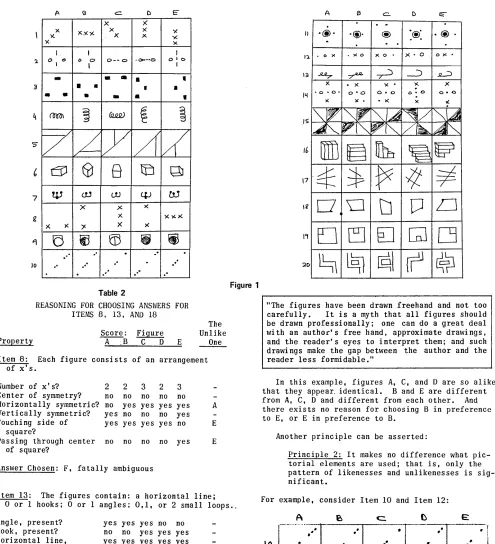
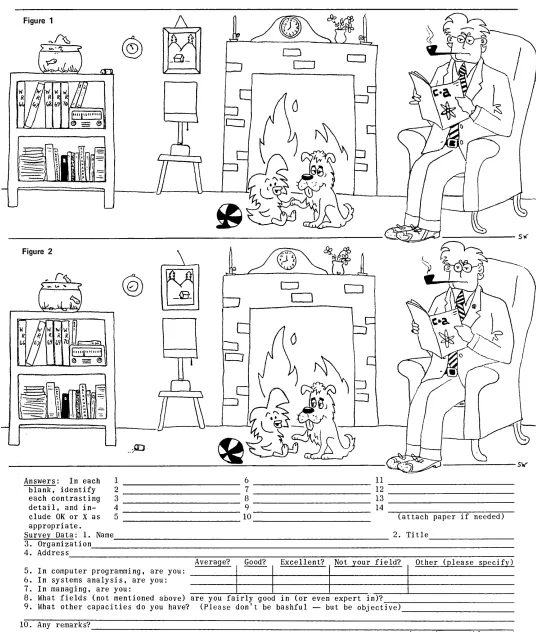
24 PICTORIAL REASONING TESTS - ANALYSIS AND ANSWERS
[NT A]
by Neil Macdonald, Assistant Editor, Computers and Automation
26 Pictorial Reasoning Test - C&A No.4
27 Pictorial Reasoning Test - C&A No.5
Computers and SOciety
6 ACHIEVING "PERSONAL" RESPONSE FROM A COMPUTER
by Edmund C. Berkeley, Editor, Computers and Automation
[NT F]
[NT F]
[NT E]
The Profession of Information Engineer and the Pursuit of Truth
28 DALLAS: WHO, HOW, WHY? [NT A] by Mikhail Sagatelyan, Moscow, USSR
A report published in Leningrad, USSR, by an ace Soviet reporter, about the circumstances of the assassination of President John F. Kennedy, and their significance from a Soviet point of view: Part I.
Common Sense, Wisdom, and Science in General
51
33
The C&A Notebook on Common Sense, Elementary and Advanced
Questions and Answers About "The C&A Notebook"
Burglary, Fire, Flood, and a Home Protective System
3 Brainiac Homeowner's Protective Kit
Computers, Games, and Puzzles
45 Advanced Numbles by Neil Macdonald
45 Numbles
by Neil Macdonald
2 ZINGO - A New Game for Computers and/or People
49 Problem Corner
by Walter Penney, COP
COMPUTERS and AUTOMATION for March, 1972
[NT G]
[NT G]
[NT G]
[T C]
[T C]
[NT F]
[1 C]
Front Cover Picture
"Lion" was produced by Jan Chlouba of Czechoslovakia, and was another of the entries in the Ninth Annual Computer Art Con-test of "Computers and Automa-tion" (see the August 1971 issue). The drawing was produced by an ALGOL program run on an Elliott 503 and drawn off-line on a Cal-comp plotter. Three basic curves were used: two hypocycloids and a transferred hypocycloid. A fixed parameter step was chosen and cor-responding points were connected.
Departments
39 Across the Editor's Desk -Computing and Data Processing Newsletter 38 Advertising Index
50 Calendar of Coming Events
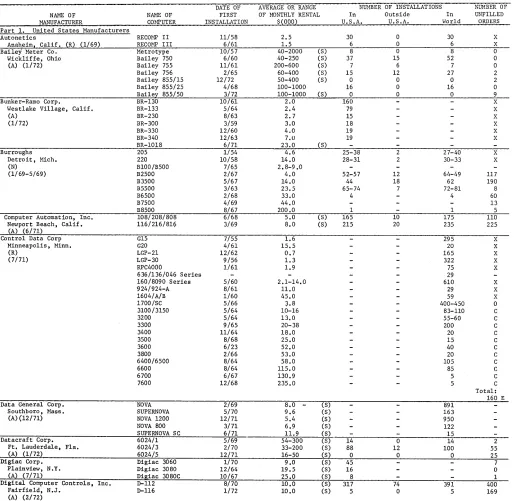
46 Monthly Computer Census
42 New Contracts 43 New Installations
Key
[A] Article
[C] Monthly Column [E] Editorial
[F] Forum
[G] The Golden Trumpet [NT] Not Technical
C-
a
EDITORIAL
Achieving "Personal" Response from a Computer
In this issue of Computers and Automation, we publish
an interesting and important report by Ruth M. Davis, Director of the Center for Computer Sciences and Tech-nology of the National Bureau of Standards. This report was given recently to a subcommittee of Congress respons-ible for overseeing the operations of the National Bureau of Standards.
Among a great many worthwhile remarks which Miss Davis makes in her useful report are some which are highly significant in understanding new uses of the computer:
• Some patients find it easier and more comfortable to give their medical history to the machine than to give it to the physician, apparently because they feel more private talking to a machine than talking to a person;
• Some students from minority groups find it easier to learn from a machine than from a human teacher, apparen tly because they are convinced that the ma-chine is more "fair" towards them than any human teacher can manage to be.
So it is not true, she says, that "a computer does only what a human being tells it to do" - but instead, some-thing new has been added, that is:
On some occasions, the computer is. more personal, more receptive, more satisfying to interact with, more patient, than almost all human beings.
For a long time some computer people have seen clearly the powers of computers. They have even asserted that since the computer is a revolutionary kind of machine, if it is well-programmed, it could eventually become more human than many human beings.
Here is the beginning of proof by actual experience of such a thesis.
It is appropriate to think of a good interactive computer program as representing the well-thought-out responses of a score of clever persons who have together devised the good interactive system, which then operates without
"human" mistakes. Such a program can always be polite, friendly, comfortable, and as instructive a's the best of human teachers endowed with an inhuman degree of patience!
It is rather hard for a human teacher to maintain his patience when a student makes just the same mistake again and again - and cannot seem to remember not to make it. For example, I have a friend who has been learn-ing conversational French for more than four years. Let us call him Martin Murphy. He has difficulty in pronounc-ing the sound "u" in French, as in the word "vu" meaning
"seen" . Even currently he is making the same mistake most of the time week after week, saying the French "u" as
if it were "u" in . English "June". I have no patience to hear him continue to mispronounce the "u". I become
disgusted and my attitude shows. I estimate that Martin has made exactly this same mistake at least 2000 times, say 10 times a week for 50 weeks for 4 years. 'Though Martin asks me to correct his French pronunciation, my patience in correcting him has worn thin. But the machine - and the day will come when the machine can correct one's pronunciation of a foreign tongue - can be inexhaustibly patient: the machine's patience will never wear thin. So along with the fiendish memory of the data banks and the criminal willingness of the computer to do the ex-act bidding of a dictator, it is good to remember some other places where the computer can be more patient than the best of human beings can manage to be, in fact, divinely patient.
As C. P. Snow, the English scholar, said in an article, "Science and the Advanced Society", published in Com-puters and Automation in April 1966:
The computer is the most remarkable machine by far, yet made by man.
EDITOR
The U.S. Center for Computer Sciences and Technology
Ruth M. Davis, Director
Center for Computer Sciences and Technology National Bureau of Standards
Gaithersburg, MD 20760
"Computer technology is changing so rapidly that its review, its assessment, its docu-mentation, its modification, and its control must all occur in real time."
(Based on a statement before the Subcommittee on Science, Research and Development of the House CommiLtee on Science and Astronautics)
The Center for Computer Sciences and Technology was established six years ago, by Congressional ac-tion. Simply stated, the Center serves as the sci-entific and technical conscience of the computer world. The Center is organized into five operating divisions and has a staff of 166. The Center's fis-cal year 1972 appropriated budget is approximately $2.1 million; other revenues are estimated at $1.8 million for other agency work; and $2.0 million from
the sale of computer services.
The "computer world" it serves is complex and sprawling, affecting every segment of our society, our economy and our government. The computer world now consists of far more than the equipment which we call the computer system. Rather, it is domina-ted by software, the schemata which makes possible the desired applications of any computer system.
Computer Technological Supporting System
Another crucial element of the computer world is what we call the computer technological supporting
system. This latter system consists of all the es-sential legal, economic, administrative, ethical and intellectual arrangements through which computer power is made available to customers. The importance and significance of technological supporting systems has been highlighted by this subcommittee in its re-ports and deliberations for the last several years. Indeed, at this moment in computer history such sup-porting systems and software have become the" Achi lles Heel" in all our attempts to channel the power of com-puters to serve our best interests. Thi s fact at tests to the rightness of the emphasis placed on the prob-lem of technological supporting systems by this sub-committee.
Another component of the computer world over which the Center for Computer Sciences and Technology watches is computer science and technology from which are de-rived improvements in computer applications and pro-ducts. We, as users and customers, see just products and applications. It is difficult to remember that their utility is a direct manifestation of the matu-rity of their supporting science. Because of the great technological explosion in the coinputer field during and immediately subsequent to World War II, computer science was overwhelmed by the surge of com-puter applications. This resulted in a takeover of the· computer field by vendors and implementors and a de-emphasis of mathematical, philosophical, and scientific study in computer science. Computers,
programming languages, and other computer related concepts were valued almost solely for their useful-ness as tools in specific applications rather than as objects of interest and study in their own right. Not surprisingly, we now have an imbalance between computer science and the industries and applications it supports. The current imbalance is highly visi-ble in that our ability to produce computer equip-ment and computer programs has far outstripped our ability to measure and judge their quality.
Problems
Every aspect of the computer world is beset with problems -- problems of the type associated with a technology changing so rapidly that its review, its assessment, its documentation, its modification and
Dr. Ruth M. Davis is the Director of the Center for Computer Sciences and Technology·of the National Bureau of Standards. Prior to that she was the first Director of the Lister Hill National Center for Biomedical Communications, DHEW. She went to DHEW from DDR&E, DOD, where she was Staff Assist-ant for Intelligence and Reconnaissance for six years, and in her first job established the first technical support group for Navy Shore-Based Com-mand and Control Systems, now known as NAVCOSSACT. She is Visiting Professor of Computer Sciences at the University of Pittsburgh and serves on the newly-established AAS Committee on Technology, In-dustry and Society. She obtained her Ph.D. in mathematics at the University of Maryland.
its control must all occur in real time; and these actions must occur in the same real time as does the production of computer software and equipment. The rapidity with which problems appear must be matched by the rate at which solutions are advanced. An in-crease in the gap between the rate at which problems are occurring and the rate at which solutions are in-troduced could seriously stress our government and society.
Mission: Decrease the Problems
The role of the Center for Computer Sciences and Technology, as the conscience of the computer world, calls for it to use its Congressional and Department-derived charter to attempt to decrease the problems now besetting the computer customer and, most impor-tantly, to predict and prevent the occurrence of ad-ditional problems, to the extent permitted by con-scious action.
The Center possesses its unique responsibilities and authorities partially through its Congressional mandate, P. L. 89-306 (Brooks Bill), enacted in 1965 to improve the Federal management and utilization of computer technology. Under authorities delegated to the Secretary of Commerce by P. L. 89-306 and policy guidance issued by the Office of Management and Bud-get, the Center is specifically responsible for pro-viding scientific and technological advi sory services to the Office of Management and Budget and the Gen-eral Services Administration to support the formula-tion of ADP management and procurement policies and to other Federal agencies to assist in the solution of specific automation problems. The Center is re-sponsible for recommending Federal Information Pro-cessing Standards and participating in the develop-ment of voluntary ADP standards, and for conducting research necessary to support the scientific'and tech-nical objectives of P. L. 89-306. Finally, the Cen-ter operates a compuCen-ter facility to meet the compu-ter services needs of NBS and to provide services to other Federal agencies on a reimbursable basis.
The Center also derives its responsibilities and authorities from the NBS Organic Act which allows it to share in the overall NBS responsibility for pro-moting strength in science and technology and apply-ing them effectively for public benefit. Thus, the Center serves both the producers and the consumers of computer products and services, and has a special obligation for ensuring that computer technology serves the American citizen in ways that enrich and improve his life without encroaching on his right to privacy and dignity.
Federal Computer Customers
One principal responsibility, then, of the Center is to s~rve the Federal computer customer. Of equiv-alent importance is the individual citizen when he becomes either a customer for computer services or the recipient of computer services. In the first in-stance -- that of being a customer -- he has made a conscious decision to use computers. In the second instance -- that of being a recipient he has gen-erally not made a conscious choice. The latter case is illustrated by most of us who inour private lives, suddenly begin to receive computer processed bills. Widely-based frustration results when, say, we find that time-honored methods for bringing errors in our bills to someone's attention no longer work when that someone is a computer. The problem is not the compu-ter: the problem is the management arrangement made
or, rather, not made -- for coupling the computer to the customer.
Software and Management
We have found that as the computer world has grown and matured, most of the problems and issues of com-puter utilization have been in the software and man-agement of computer resources. Further, the wide-spread and increasingly rapid proliferation of com-puters everywhere has caused computer problems and issues to be of Federal and national concern. One can only compliment the foresight of Congress when six years ago it established the Center and located it at the National Bureau of Standards. For we now realize that computer issues are national problems and that they are technologically-rooted problems.
A World of Services
We have attempted to act with equal foresight as we extend the program of the Center for Computer Sci-ences and Technology. Priorities for the allocation of our limited resources to Center projects reflect not Bureau of Standards priorities nor even Depart-ment of Commerce priori ties, but Federal and national priorities. As a result, the central theme of our program is that the computer world of today is a world of services and not of equipment. The customers for computers are interested in the services their puter systems will provide. Their interest in com-puter hardware is secondary. So also is their inter-est in indi vidual programs wri tten for compu ters. Qual-ity service provided so as to make American society comfortable with computer applications and products is our greatest need today.
Major Objectives
In line with national priorities, there are sever-al major objectives towards which the program of the Center is aimed. These are:
The utilization and application of computer ser-vices and technology to improve the productivity of the major service areas of our economy.
The improvement of computer services sothat they are of better quality and are less costly. Less costly implies both that the customer pays less and that computer manpower is more productive.
Increased beneficial application of automation technology for society through greater reliance on the computer as the hub of versati Ie automa-tion.
The development of performance guidelines and standards for computer products and services so that the computer marketplace is a better one for both buyer and seller.
Quality Control and Measurement
Within these broad objectives the resolution of outstanding issues and problems demands an immediate focus of our efforts on quality control and measure-ment of computer services and products, on increasing professionalism in the computer field, on intensify-ing the applications of automation technology, and on decreasing the enormous dissipation of skills in un-productive labor in the computer field.
Urgency
com-puter world. There are currently some 63,000 compu-ters in the United States and an additional 33,000 in the rest of the world. Their importance to a nation's capabili ty is apparent from the serious attention given to the advisibility of allowing the British to sell two ICL 1906A computers to the SovIet Union. The question received the direct attention of the President of the United States and the British Prime Minister. Two computers were considered to measur-ably improve the strategic position of a world power.
Accrediting a College: Does It Have a Computer?
Approximately one-half of the 2,500 colleges and uni versi ties of thi s country have computer faci li ties. A recent Congressional report questioned the advisi-bili ty of accrediting a college or universi ty not hav-ing computer facilities for students. Such concern has rarely been expressed over equipment facilities in schools.
Space and War
It is almost trite to point out that space explor-ation and defense are impossible without computers. The computer's demonstrated capability in unmanned
space systems causes some scientists to question the need for men in space as necessary companions to com-puters. The possibility that World War III has al-ready been fought with computers is not mere science fiction. There have not been the large scale wars feared, even anticipated two decades ago between coun-tries advanced in computer technology. We, and no doubt the other technologically advanced countries, used computers to simulate war plans, play war games, and formulate strategies and counterstrategies, thus maintaining a world balance of strategic power. Wars
that are occurring appear to be those characterized by human behavior we understand too little to simu-late.
Welfare and Insurance
Medi cal care, welfare, social security, and i nsur-ance payments on their present massive scale would be impossible without computers. The Social Security Administration has 35 computers on site in Bal timore. The Blue Cross/Shield organization processes its re-cords with 240 computers in 90 locations. Some ten percent of the approximately 7,000 hospitals in the country have computers used mainly for administrative functions.
The Federal Government possesses about 5300 com-puters. State Governments use more than 500 compu-ters. In addition toFederal, state and loca} gov-ernments, which account for some 18 percent of total computer usage, computers. are diffused broadly through the economy. Some 40 percent of all computer facil-ities are used in the manufacturing industries; the financial community, including insurance companies, accounts for another 16 percent; the remaining 26per-cent is distributed among the utilities, wholesale and retail trade, health care facilities, and data processing firms.
Pervasiveness of Computers
Virtually every American citizen is served by the computer almost daily in a variety of way - recei v-ing a computer-prepared Social Security check, get-ting mail with computer generated address labels, buy-ing goods whose manufacture was controlled by compu-ter, travelling on rapid transit vehicles whose sched-ules are computer controlled, obtaining medical treat-ment from a physician who uses a computer to aid in diagnosis and maintain patient records, or using a
telephone in a network where switching is controlled by computers.
Horror Stories
One cannot discuss the pervasiveness of the compu-ter without introducing the "horror stories" so ram-pant tOday. Two of the most frequently heard are, first, that computers are replacing man, and, second, that computers are dehumanizing and consti tute a threat to the individual's privacy. In the first instance, the charge cannot be dispelled by the simple statement that "The computer can only do what it is told to do by a person" because computers are indeed being pro-grammed to perform an increasing amount of "intelli-gent" tasks. Perhaps a more sensible view is that man coupled with the computer will outlast man with-out the computer.
The second horror story begins wi th "We I re no
longer individuals, we're just numbers" and typifies the attitude of those who say the computer is dehu-manizing.
People More Comfortable with Computers Than with Human Beings
Countering these reactions are others where phy-sicians have reported that patients, in certain in-stances, have shown a greater willingness to answer questions posed by a computer terminal than to answer questions by the physician. Similarly, studies by educators have shown recurrently that deprived chil-dren respond to "teaching" by computers more readily than that provided by human teachers. The hypothesis here is that these students feel intui tively that the computer is fair in its treatment of them. They have an inherent disbelief, because of their background, that they are getting such equali ty of treatment from the human teacher.
Costliness of Problems
With computers and their services so widespread and their customers so diverse and dispersed it is apparent that any accompanying problems are going to be extremely costly to the economy as a whole. Fur-ther, these problems are going to cause far-ranging discomfiture throughout industry, government and so-ciety. This has indeed happened. Computers have, in fact, become the major technological ingredient of progr-ess in the world of today and it is the problems accompanying their services and utilization which must demand our attention and resources. The urgen-cy of isolating and describing these problems so as to permi t some resolution has been felt by the Center for Computer Sciences and Technology.
Quality Control in Software
One serious problem is the inadequacy of computer software selection, procurement and management pro-cedures. There is probably no more elusi ve commodi ty bought and sold today than computer software. Soft-ware in this sense is the schemata which permits the successful use of computers. Included in software management are program production, measurement, test-ing, validation, documen~ation, control, transfera-bility, legal and proprietary rights of buyer and seller, maintenance, and costing.
of-fered in the tradition of an effective marketplace. Today, as sellers, we must insist that a prospective customer define the services he wants per unit time along with needed maintenance and reliability. Too many customers enter the computer marketplace with only the desire to replace their existing systemwith a computer system. Nothing begets an unstable mar-ket faster than an unsure customer.
Although the United States is the world's great-est producer of computer software, there is virtual-ly no quality control in the computer service indus-try. No one has yet paid adequate attention t.o soft-ware management in spi te of the fact that it is through software management that a whole new dimension of ef-ficiency is opened to the customers of computer ser-vices. A recent report by the General Accounting Office has stressed the seriousness of the software management problem and the associated lack of quality control.
Software Management
Software management is becoming increasingly com-plex because computer customers are being confronted by a rapidly growing number of alternatives in soft-ware products. Until quite recently, the customer had few alternatives available in the software area. But now, software is being produced in large quanti-ties by computer manufacturers, computer users, in-dependent software producers, research institutions, universities and others. The customer's selection, utilization and costing problems are complicated and further compounded by the lack of measuring sticks or product "guarantees" by the seller. The urgency of solving the problems of software management is un-derscored by the fact that initial software costs in-variably equal hardware costs for any application and that for a majority of applications initial software costs are estimated to run three to eight times hard-ware costs.
Software Documentation
Software documentation is the detailed descrip-tion of a computer program. Standardized documenta-tion procedures are crucial to good software manage-ment; without them the result is the kind of chaos that would occur in accounting if CPA's didn't have standardized nomenclature and conventions. Effec-tive documentation is essential to the buyer in eval-uating software for purchase and application to his problem. The Center has recently collected some 60 indexes, directories and catalogs containing descrip-tions of programs available for shared use in both the public and private sectors. This effort has un-derscored the urgent need for standardized ways of describing computer programs so that potential users can make decisions on a program's applicability to the solution of a given problem. The abi li ty to share computer software extensively is directly dependent upon the uniform documentation system for describing computer programs. If a reduction of only 5 percent of the $182 million spent by the Government in 1970 for programming and related services could be achieved through more effective program sharing, savings on the order of $9 million could be realized. The Cen-ter has placed high priority on the development of software documentation standards as an important part of the Center's program to improve the effectiveness of computer services and insure the customer equity in the computer marketplace.
Software Validation
Software validation is the process of determining the extent to which software conforms to certain
sta-10
ted conditions or requirements. The process is anal-ogous to that of determining whether a newly manufac-tured watch satisfies the conditions and accuracy re-quirements necessary to be called a chronometer. Soft-ware validation services, in their totality, are an essential ingredient of effective computer utiliza-tion; none exist today. The result of the software validation process is software certification -- de-signating which stated conditions or requirements the software has met.
The absence of software validation services has resulted in customers buying software without know-ing the extent to which the software conforms to sta-ted conditions and requirements. In most instances each customer performs his own validation of the same piece of software. An example wi thin the Federal com-puter environment will illustrate the problem. The FY 1970 GSA ADP i~ventory shows that Federal agencies bought 180 computer systems for which the vendor main-tains a COBOL compiler. Under present procurement practices, 720 COBOL validations were required, as-suming there were four bidders for each procurement. At an average cost of $3,000 per validation, the
to-tal expenditure for all the required validations on a decentralized basis would have been $2,160,000. Since there are only about 33 unique COBOL compilers maintained by computer vendors, the entire validation process could have been performed for about $99,000 -- 33 validations at $3,000 each -- or a savings of more than $2 million.
The ,Center has initiated an effort to determine the best means for instituting COBOL and FORTRAN validation services. The Center is working closely with the General Services Administration in serving Federal customers.
Performance Measurement of Computer Services
Presently, the computer industry has few meters or gauges for measuring either hardware or software performance. After twenty years, there are only some half-dozen computer hardware monitors which can pro-vide data on how various components of a computer system are performing; these have been developed, generally, within the last five years. Andyet, first tentative findings show that a 25 percent improvement in computer utilization can be expected from simple changes apparent from primitive analyses of the data produced by these hardware monitors. Grossly, this could mean a 25 percent decrease in the cost of com-puter services provided by a given installation. In the case of large computer systems whose annual oper-ating costs are on the order of $1.7 million, this would mean a savings of $420,000; total Government-wide savings for computers in this range could amount to about $192 million.
The Center has included in its technical program an effort to develop and provide to the computer cus-tomer a body of techniques and guidelines for meas-uring the performance of computer systems.
Standards
without having to convert the data or modify its own program. The desired compatibility among software packages is achieved when the operating system of one computer can run programs written for another (compatible) computer and achieve the same results.
The standards program of the Center for Computer Sciences and Technology attempts to achieve these objectives through support of and cooperation with the nation's voluntary ADP standardization activi ties, especially those of the American National Standards Institute (ANSI) and the International Organization for Standardization (ISO).
·To date. fifteen standards which are aimed at re-solving problems of ADP incompatibility have been is-sued as Federal Information Processing Standards. In addition. the Center is actively participating along with representatives from other Government agencies and industry in the standards committees of ANSI and ISO, where some 80 other ADP standards are in various stages of development. We intend to continue a vigor-ous technical participation in these standards activ-ities.
Professionalism in the Computer World
The effective utilization of computer technology to solve pressing national problems is directly de-pendent upon the availability of an adequate force of professional computer personnel capable of advancing computer science. Presently, there is a serious short-age of properly trained. experienced computer profes-sionals. Current estimates are that the total need for computer personnel of all types will double in the next five years. The Department of Labor has es-timated that there are currently about 500,000 compu-ter personnel in the United States; most of these are applications oriented personnel without formal educa-tion in computer science.
The trained professional manpower base capable of contributing to the advance of computer science is a small but increasing fraction of total computer per-sonnel. As of 1969. only 4343 computer science degre~s
had been awarded over the preceding five years; only 163 of these were at the Ph.D. level. As a result. the current ratio of application manpower without formal education in computer sciences to those who have formal degrees in computer science is at least 100:1. This imbalance is producing a drag effect on computer application and utilization.
The primary responsibility for developing computer professionals lies wi th our colleges and uni versi ties. Currently. there are 51 college or university compu-ter science programs leading to a Bachelor's degree, 40 at the Master's level, and 13 that award the Ph.D. The Center endorses all efforts leading to increased computer manpower skills and to a respectable computer science.
Dissipation of Skills
The dissipation of skills in the computer world today is enormous. This intolerable condition exists for several reasons. First of all, we cannot exchange software except in highly restrictive situations. Two customers both wanting a computer system to perform administrative tasks in their university will each pay total development and application costs for their computer system even though the needed services are identical. The culprit is lack of compatibility of computer equipment and software and our present in-ability to document and thus define a computer sys-tem. The result is duplicative costs for the same development and a waste of computer manpower. Our economy can afford neither.
Low Productivity
A second reason for low productivity of computer professionals results from the inability of the com-puter customer to specify the performance he requires from the service he is buying. When this problem is coupled with the present lack of performance measure-ment tools and techniques for computer products we have the almost ludicrous situation of a marketplace where the buyer does not know whether his "purchase" is satisfactory and where the seller does not know how to describe his product. The result is the well known horror story of the organization with an unac-ceptable computer system after two years of contrac-tual development and several million dollars outlay.
Still another reason for dissipation of expensive computer manpower skills is our inability to find ways of sharing the costly computer products and
re-sources we as a nation now possess. It is frustra-ting to know that superb computer programs for archi-tectural design at the Univeristy of Utah cannot be used at the University of Alaska without the expen-sive duplication of the entire Utah computer facility at the University of Alaska. The computer system in Ohio for retrieving legal information cannot be used today in Kentucky without duplication of equipment. We are taking the first steps towards removing the obstacles to ·remote sharing of costly computer resources developed through large manpow-er expenditures. The process of sharing is called teleprocessing and is accomplished through the networking of computers and customers by communi-cations.
The Center for Computer Sciences and Technology is active in attempting to eliminate all these problems resulting in wasted resources and unsat-isfied expectations. It has, as noted earlier, projects to increase compatibility of software and hardware and to develop and apply performance meas-urements to computer services. It is also devel-oping teleprocessing as a radically better way of utilizing computers.
Teleprocessing
Not everyone who needs computer services can afford a computer, and, conversely, not everyone who has a computer needs all the services he has available. Similarly, those who do own computers cannot afford to develop all the software and data banks they would like to have to be completely self-sufficient. Clearly, then, there is a need for effective methods which will permit communi-ties of customers to share expensive computer re-sources.
Resource sharing among computer customers is in-creasing but has not yet reached truly effective lev-els. Much of tOday's sharing is in the form of ex-changing computer software and data files but even here effectiveness of sharing is severly limited by the lack of compatibility between hardware and soft-ware. Our ultimate objective is a set of procedures which permit the effective and efficient sharing of hardware, software and data files without the neces-sity to physically move resources or perform any con-version or modification of resources.
Computer Networking
networking. Teleprocessing systems can be as sim-ple as a single computer to which several remotely located access terminals are connected via stand-ard telephone lines, or as complex as a nationwide network of large scale computer systems intercon-nected by highspeed dedicated communications lines.
The new and different applications and services afforded by teleprocessing can already be specu-lated. They represent breakthroughs for our soci-ety and perhaps are best characterized by terms such as "the electronic society" or "the checkless and cashless society", which have begun to appear regularly in the industry literature.
It is clear even at this early stage of its de-velopment that the future struct~re of teleproces-sing usage will be affected by Federal policies and that these policies may well be the determin-ing factor in future trends as teleprocessdetermin-ing is applied to increasing numbers of applications within our society.
Telecommunications Policy
The Office of Telecommunications Policy (OTP) was established just a year ago in recognition of the importan'ce of Federal policies on communica-tions practices and trends. On September 1st of this year, this office asked the National Bureau of Standards to assume a distinct and special role in assisting the OTP in carrying out its functions assigned by the President in the area of computers and Communications. In particular the NBS was asked to provide technical advice and analysis in teleprocessing matters.
We consider this an extremely important assign-ment and appropriate for the ,Center for Computer Sciences and Technology under its Congressional mandate.
Teleprocessing
We have already identified some 237 systems in our country employing teleprocessing. These are 'found in twenty major segments of our economy
in-cluding banking, welfare services, airline reser-vations, colleges and universities, agriculture extension services, and credit services.
Teleprocessing usually introduces cost savings. For example, hotels have estimated that the manual handling of a single reservation ranges from $1.50 to $4.50 in labor costs. With the teleprocessing reservation system, the cost per reservation has been reduced to from $.58 to 10 percent of the room rate.
The use of teleprocessing is growing. Within the U. S. the market value of the non-government network data service has grown from $100 million in 1968 to some $345 million in 1970 and is esti-mated to grow to some $2 bi Ilion by 1975. Thi s rep-resents a rate of growth of 40 percent per year compounded.
In 1970, teleprocessing techniques were employ-ed in systems representing about one-fifth of the total computer services market. By 1975, they are estimated to comprise at least one-third of that industry.
At least 150 firms are currently offering ser-vices based upon teleprocessing or computer net-work interconnections. Within the Washington,
D. C. area, it is now possible to access at least 43 time-sharing computer services by local tele-phone dialing.
At least 16 teleprocessing oriented ADP systems are currently centered in the Washington, D. C. area alone. The Center maintains an inventory of these. They range from the "on-campus" system at NASA Goddard making use of an IBM 360/95 to permit some 40 odd terminals within the Goddard Labora-tories to interact with each other, to the FBI's National Crime Information Center making use of an IBM 360/40 located in Washington, D. C., which is interconnected to over 3,000 law enforcement agen-cies in 49 states, and which is today handling more that 50,000 inquiries per day from these agencies.
Privacy
There are many concerns with the technology and economics of teleprocessing. Some of these con-cerns are so~io-ethical in nature and deal with questions of the privacy aspects of the informa-tion, and to the integrity of such informainforma-tion, especially when that information is transmitted from computer to computer. Very serious concerns exist with respect to the methodologies for veri-fying electronically stored information concerning an individual or business. Similar concerns arise regarding procedures for correcting erroneous in-formation, especially if that information has been disseminated to locations where it may be used to respond to inquiries. We have classified this problem of privacy of data as one of controlling the accessibility to computer maintained data bases.
Controlled Accessibility to Computer Data Bases
The pervasiveness of the computer has raised widespread fear of the computer as a threat to the privacy of the individual. Teleprocessing has es-calated such fears. ·Although the issue has been frequently exaggerate'd and charged wi th excessive emotion, there is a necessity for a rational ap-proach to the problem of security, privacy and confidentiality of information contained in com-puter data banks.
The problem of controlled accessibility of data bases has two major facets, the technical problems of protection by use of hardware or software tech-niques and the social or legal aspects of privacy and the protection of property rights. It appears that the technical aspects of the problem while significant are not insurmountable, although their adequate resolution will require analysis of the social or legal problem to determine what limita-tion on access must be provided for.
Social and Legal Problems
anything but when taken in the aggregate tend to circumstantially show some undesirable conduct.
In the case of protection of property, the problem involves not only the use of the data but the control of the data base.
The technical issues underlying all aspects of privacy of data are a major program thrust of the Center for Computer Sciences and Technology.
Beneficial Applications of Automation Technology
We mentioned earlier that one of the major ob-jectives of the Center was to increase beneficial applications of automation through greater reli-ance on computers.
The technology of automation is of prime impor-tance to manufacturing and in service areas such as education, health care, law enforcement and postal service. In a broad sense, it encompasses practically any device that reduces the amount of human effort - physical, mental, or both - neces-sary to achieve material objectives (i.e., to do work). In a more specific sense, it means mechan-ical or electronic control that takes the place of man-exercised control. The highest degree of auto-mation today is epitomized by digital computers. In this sense, computers not only control other machines and their processes: they communicate with them, receive information from them about pro-cesses as they occur, and use this information to correct or guide the process while it continues (feedback). Ma6hines under computer control may be turbogenerators in a regional power grid, micro-scopes, instructional displays, brake testing de-vices for trains, finger print recognition dede-vices, or aircraft traveling at twenty miles a minute.
Automation Needs Infusion of Technology
Automation in 1971 now needs an infusion of tech-nology. There is evidence that the use of automa-tion in industry and in service areas is slowing down. One of the reasons for this is simply the fact that in the technological stage in which it nowexists, automation has progressed in many industries to the point where the cost of labor is not the primary fac-tor in the cost of the finished product. For example, the total amount of labor remaining·in the manufac-ture of an American automobile is only about 100 hours. A lot of the present automation existing in both the service and manufacturing areas takes the form of fixed-purpose machinery. It does not permit basic changes without extensive changes in the equip-ment itself. Only high volume production can justify further costs for this rigid, fixed-type of machinery that is epitomized by industrial robotry today. With sales volume no longer expanding at its previous rate, there is little to encourage further automation sim-ply on the basis of economies of scale.
Most of the emerging developments in labor-saving machinery and in operations hazardous to man or oc-curring in remote environments dangerous to man are likely to arise through exploitation of the electron-ic computer and its associated develectron-ices. The type of automation epitomized by the use of the electronic computer, as a control device using communications as its controlling element, is known as" soft automation." I t is called" soft automation" because it depends upon software - that is, upon programming of the computer and its related devices. Products of soft automation can be changed and/or directed to entirely different tasks without any change of the computer equipment involved. In fact, even the welding devices, the
lifting cranes, the manipulators or the extensors or the other machinery that carry out the commands of the computer need not be replaced. It can simply be re-programmed to do different tasks using the same kind of fixed manipulative ability.
Increasing Productivity
There seems to be no question that automation in-creases productivity. There appears to be no ques-tion that automaques-tion technology, whether in its most simple or its most complex humanoid-like form, pro-vides better quality output than the replaced manual technology. The measurement of just how much produc-tivity is increased or how to quantify the increase in productivi ty is uncertain. I t is no more uncer-tain, however, than in most areas utilizing high tech-nology. Equivalently, productivity in the service area appears to be increased through the use of auto-/Dation technology. Hospi tals have installed remotely-controlled carts that, through remote controls, are programmed to carry material, food and drugs, to pre-determined floors and rooms. It is estimated that this will both increase productivity'in hospital ser-vice and decreas~ the cost of health care services. What is perhaps more important is that it will cer-tainly increase the quality as well as the availabil-ity of health services to patients in a hospital.
It seems clear that the Federal government should take an active role at least in the beginning stages of a new injection of technology into automation. The role of the Government has to be complemented or aug-mented by incentives for producti vi ty increases by in-dustry and by incentives to inin-dustry for increasing their research and development budget. The stakes for an increase in productivity are a concern of the Federal government. The National Bureau of Standards intends to mount a significant and well-organized ef-fort to pursue a program for productivity enhancement over broad segments of the economy through beneficial applications of automation technology.
The Major Technological Ingredient of Progress
Computer applications and products constitute the maj or technological ingredient of progress today. Computers enhance the intellectual capabilities of individuals; at times computers even replace people. Computers impact on"the dai ly acti vi ties of all of us. Computers are about to inject a new dimension into automation which wi 11 surely result in maj or increases in producti vi ty and in the quali ty of services offered society.
The use of computers and computer services is so widespread that accompanying problems are going to be extremely costly to our economy as a whole. These problems are already causing far-ranging discomfiture throughout industry, government, and society. The problems .are those of quali ty control of computer ser-vices, software management, sharing of expensive com-puterresources, dissipation of costly computer man-power skills, a marketplace without adequate perform-ance measures or standards and automation without ver-satility. These problems are all technology-based.
The Congressionally and Departmentally-deri ved char-ter of the Cenchar-ter for Compuchar-ter Sciences and Technology assigns it responsibility within the Federal govern-ment for resolving computer-based problems. The Cen-ter believes the solving of these problems to be es-sential i f society is to benefi t from and feel comfor-table with computers. We would like the recognition and resource's nec'essary to carry out our responsibil-ities. We have the motivation and the sense of
ur-gency 0
Computer System Models
Salvatore C. Catania
Univac Div.
Sperry Rand Corp.
Blue Bell, Pa.
"Once
a
system designer - whether
a
user or
a
manufacturer - decides to perform an
analysis to study the system being considered for
a
particular application, how does he
proceed?"
(Reprinted with permission from Univac Technology Review,
Spring 1971.)
The process of designing and configuring a
com-puter system has never been an easy task. And
now, with the ever increasing emphasis on
com-munications-oriented real-time systems, the
de-sign problem has become enormously complex.
Where can a user begin his study to determine the
feasibility of accomplishing his application on a
particular computer system? The only alternatives
avai.lable to him are benchmark testing or
mathe-matical modeling. Benchmark testing techniques,
while practical for evaluating small portions of
systems, are not particularly applicable to
study-ing total system concepts in large real-time
appli-cations. Thus, almost by default, simulation and
mathematical modeling techniques are the only
course open to both the user and the
manufac-turer in studying total system performance.
Once a system designer-whether a user or a
manufacturer-decides to perform an analysis to
study the system being considered for a particular
application, how does he proceed? How does he
gather the applications data, organize the data for
an analysis, gather the necessary hardware and
software timing information and derive the
models and methods to be used in the analysis in
a short amount of time? (Usually, of course, he
Salvatore Catania has an AB in Mathematics, an MS in Engineering, and a compre-hensive background in sys-tem simulation and analysis. At Univac he is responsible for system configuration simulation studies in the marketing environment.