- - - _ .. _._---_._._._-_._._. _._ .. ---_._---_._._---_._- ... -._-- ---_ .. _
-Clean and comfortable
when we ship it
Our computer tape is clean and error-free. We think that our supe-rior cleaning process makes it cleaner than anybody else's, but of course we're prejudiced. Point is, to be computer tape at all, it has to be clean and free from dropouts.
But we don't stop at merely making clean tape; we make sure that it gets to you clean and that you can keep it clean. Here's how:
Then, for the only sure protection in storage, we pack our tape in a unique all-plastic canister. It keeps tape clean because it cannot generate contam-ination and its positive seal prevents outside dirt from getting in; comfortable because it pro-tects against shock and humidity. This canister is even encased in an airtight poly bag during shipment. From then on, it's up to you.
o
Our exclusive environmental shipper which we call the Tape-Safe keeps dust out and your tape "clean and comfortable." Clean, because the polystyrene foam won't shed like cardboard; comfortable, because it cushions the tape in transit against shock and damaging fluctuations of temperature and humidity. Best of all, it's free with your minimum order of Ampex tape for I BM and I BM-compatible computers.
FREE! If you'd like a few suggestions on how to keep tape clean,
0
write Tape-Safe, AmpexCorpora-tion, 401 Broadway, Redwood City,
I
AM PEX
I
California 94063, for a copy of our . _ TRENDS Bulletin No. 12, "Care Career opportunities? Write Box D,·~
~D~~~:
K(~r», ~~LU<)O
0• 0 •
Storres
]I /Ll
miRRioJl1l bits
RIUl
siilllgRe
5-1I /
L~.I!
high
VlJJJlit,
fea-J:Ulrres
MlfJBIF of
]I2
years under JJJlormali
4o-lhourr
"YeeI(
operratnol11l
Now you can get the new ft-STORE ICM-500 in standard systems: 600 nanoseonds full cycle time Special
systems: cycle times as low as 500 nanoseconds. Up to 16,384 words with Ej4 bits/word; or up to 4096 words with 72 bits/word. (Over 3/4 of a million bits in little more than 15" of vet·tical rack space -- including power supply). You also get I/e construction for all major functions i ncl udi ng X- Y current drivers plus a choice of mechanical packaging.
Get the full story. And take advantage of our eight years' experience in solving core memory problems. Write today for our new brochure. Honeywell, Computer Control Division, Old Connecticut Path, Framingham, Massachusetts 01701.
'Patent applied for.
nrr
aD
ll1l®y\lJ¥®TI.TI.
Really serious
about a
better information
management
system?
c,
our new
. 3500 system
is ready,
if
you
are!
If
you are looking for better ways to handle information,
data communications, production control, scientific and
engineering problems, you will want to know more about
the new CONTROL DATA® 3500 computer system.
The CDC 3500 is a large-scale, multi-programming
system designed for general purpose and time-sharing
applications. It is the most advanced computer in our
compatible family of systems that includes the 3100, 3150
and 3300 -
hundreds of which are on the job throughout
the world today. Each offers the advantage of fully
com-puterized, automated information handling.
People-oriented peripherals
Along with the new 3500
computer system, Control
Data gives you a wide
choice of advanced
periph-eral products: Remote
en-try-and-di sp I ay stati ons
provide direct communication with the computer system.
DIGIGRAPHICS® light-pen systems make computer-aided
designs a reality. Remote-processing terminals extend
the
capabilitie~of the 3500 to remote plants, laboratories,
distribution facilities, etc.
All software is available now
Control Data's advanced operating system, known as
MASTER (mass-storage oriented, multi-programming
op-erating system), lets you efficiently handle mixed
busi-ness/scientific work loads in your organization. Your
costs are lower because MASTER makes maximum use
of all hardware features. Software includes compilers,
assemblers and job-oriented systems such as COBOL,
MASS STORAGE SORT, FORTRAN, PERT/TIME, PERT /
COST, ALGOL and COMPASS. All software is field-proven
and available now.
INTEBRID
circuitrySpecially developed by Control Data for use in the 3500,
INTEBRID® circuitry combines the advantages of both
monolithic-integrated and hybrid circuits. The results are
higher speed, reduced space requirements and greater
reliability.
If you are genuinely interested in a fully computerized
information management system for your company, the
coupon below will bring complete details.
r---~---·
CONTROL DATA
CORPORATIONCONTROL DATA CORPORATION, DEPT. H·117
8100 34th Ave. So., Minneapolis, Minn. 55440 Please furnish us with full details concerning your new CDC 3500.
NAME - _ _ _ _ _ _ _ _ _ _ _ _ TITLE _ _ _ _ _
FIRM _ _ _ _ _ _ _ _ _ _ _ _ _ _ _ _ _ _ _ _ _
4
Anyone Can Talk
To A Computer!
... even without knowing Fortran IV, Cobol II, or Gobbledygook V.
An 101 Computer Controlled Display System makes the computer speak your language and eliminates the conversion-computation-conversion bottleneck. With a light pen, keyboard, track ball or other man-input device you feed data directly to the computer in alphanumeric .or graphic form and your answer comes back in alphanumeric or graphic form-immediately usable without expen-sive and time-wasting conversion.
If your efficiency is bottlenecked by the con-stant need for data conversion, you need an 101 Computer Controlled Display System.
101 Computer Controlled Display Systems are ideally suited for such applications qS:
• Computer aided • Command and Control design • Program debugging • Manage,,}ent • Pattern recognition
information • Automatic Checkout • System Simulation • Information retrieval
• On-line problem solving
We'll send you more information at the drop of a postca rd.
III]
I
INFORMATION DISPLAYS, INC.
333 N. Bedford Road, Mt. Kisco, N. Y. 10549(914) 666-2936
CIRCLE 86 ON READER CARD
1967
volume 13 number 11
Publisher Editor
GARDNER F. LANDON ROBERT B. FOREST
Managing Editor & Art Director CLEVE MARIE BOUTELL
Associate Editors 'EDWARD K. YASAKI
WILLIAM J. ROLPH
Assistant Editors WENDY REID
JANET EYLER Eastern Editor
Midwestern Editor European Editor Contributing Editors
Washington Reporter Editorial Adviser Technical Consultant Production Manager Director of Circulation Circulation Fulfillment
Eastern District Managers
New England District Manager
& Vice President Midwest District Manager.
Western District Manager
& Senior Vice President
ANGELINE PANTAGES EDITH GOODMAN CHARLES WHITE HOWARD BROMBERG ROBERT V. HEAD PHIL HIRSCH ROBERT L. PATRICK LPWELL AMDAHL MARILEE PITMAN FRANK DeCARLO ALGENE TRAINA
JAMES M. MORRIS WARREN A. TIBBETTS 35 Mason Street, Greenwich, Conn. 06830 (203) 661-5400 WARREN A. TIBBETTS 112 West Haven Rd., Manchester, N.H., 03104 (603) NAtional 5-9498 JOHN BRENNAN 205 West Wacker Drive, Chicago, III. 60606 '(312) Financial 6-1026 HAMILTON S. STYRON 94 So. Los Robles Ave., Pasadena, CaL, 91101 (213) 795-9721 (213) 681-8486-from Los Angeles EDITORIAL OFFICES
94 So. Los Robles Ave. Pasadena, Calif. 91101
ma
Circulation audited by
Business Publications Audit American Business Press, Inc. Member,
DATAMATION is published monthly on or about the tenth day of every month by F. D, Thompson Publications, Inc., Frank D. Thompson, Chairman; Gardner F. Landon, Pres-ident; Gilbert Thayer, Senior Vice President. Executive, Circulation and Advertising offices, 35 Mason Street, Greenwich, Conn. 06830 (203) 661-5400. Editorial offices, 94 So. Los Robles Ave., Pasadena, California 91101. Published at Chicago, III. DATAMATION is circulated without charge by name and title to certain qualified individuals who are employed by companies involved with automatic information han-dling equipment. Available to others by subscription at the rate of $15.00 annually; single issues (when available) $1.50. Reduced rate for qualified students. Foreig~ s~b
scriptions are on a paid basis only at a rate of $25.00 annually. No subSCription agency is authorized by us to solicit or take orders for subscriptions. Controlled circulation paid at Columbus, O. and Chicago, III. Form 3579 to be sent to F, D. Thompson Publications, Inc., 205 W. Wacker Dr., Chicago, III. 60606. Copyright 1~67,
F. D. Thompson Publications, Inc. Microfilm copies of DATAMATION may be obtained from University Microfilms, Inc., 313 No. First St., Ann Arbor, Michigan.
Printed by Beslow Associates, Inc.
This issue 71,386 copies
For AMP circle 4 on Reader Card ~
ClRTRMRTICN
o
Remote-terminal solenoid card reader.
Shove a badge in the slot. Zok! Up to 264
data bits go into your computer. Instantly.
Redundant
contacts:doubl.~wiping.
A million cycles.
A million uses-job reporting,.instrum,entation,
(f)
(f)
if
FULL LENGTH TEST RESULTS
6
•
•
•
•
BRANDB
~
.
~ 4~~~~-r--~--~+----r--~----+---~-'·~--~
en
0::
o
a::
a::
w
•
•
w21--1----+--...
-~----I---I~~---BRANDe
...
~~BRANDA
~
0:
w
~
~~
15
20 25 30 35 40 45 50
FULL LENGTH PASSES
pici< your computer tape
6
TEST PROCEDURE
1. Equipment calibrated and adjusted, according to equip· ment manufacturer's specifi· cations, and cleaned, prior to testing each reel of tape. (No further cleaning allowed duro ing test).
2. A new unused 2400' length of tape which has been certi· fied at 800 BP I free of perma· nent errors is used for this test.
3. Write 3000 character (all bits) records in the start·stop mode at a density of 800 BPI. 4. Read while writing check· ing for all errors, in all tracks, which fall below the 50% dropout level.
5. Count all errors. No retries allowed. Error count includes temporary and permanent. 6. High speed rewind to the beginning of tape and repeat steps three and four until 50 passes (120,000 head feet) are completed.
o
The only meaningful way to evaluate computer tape performance and relia-bility is to test it, over a series of full-length passes, under actual operating conditions.o
The above graph reflects a recent performance study in which Computron's new TVP2 was compared directly with three leading "premium" tape brands. The curves above illustrate typical test results in terms of total errors (bits below 50% dropout level) for all tracks, during each of 50 passes.o
Note that Brand C showed a rapid error build-up over the first few passes then leveled off at a relatively high error rate. Similarly, Brand A showed high initial error build-up, which then dropped to a somewhat lower level. Brand B had good initial error characteristics, but exhibited rapid error build-up during the rema i nder of the test.o
Only TVP2 demonstrated a consistently low average error rate throughout the test. This is another example of TVP2'.s Total Value Performance.o
Consider this the next time you select your computeI'" tape.~
CCMPUTRCN INC
r::I
CROSBY DRIVE, BEDFORD, MASSACHUSETTS 01730\iiiiiiI
GENERAL ELECTRICI BASF GROUPJCIRCLE 5 ON READER CARD
DATAMATIoN
november
1967
volume 13 number 11
.
automatic
information
processing
C;
for business
industry &science
®
22 TRENDS IN AEROSPACE COMPUTER~,
by
R. L. Hooper and
L.
D. Amdahl.
~ A survey of the hardware and software characteristics of current U. S. aerospace digital systems, and a glance at future prospects.26 AEROSPACE SOFTWARE,
by
Vilas D. Henderson and R. Dean
Hartwick.
Stringent operational requirements that now exist will be more and more difficult to meet as hardware technology sustains major advances.30 SPACE SCIENCES DATA PROCESSING,
by
George
H.
Ludwig.
An over-all view of the data processing procedures used, on board and on the ground, for satellites within the Goddard Space Flight Center dp jurisdiction.
37 THE ROLE OF COMPUTERS IN MARINER V,
by
Edward K.
Yasaki.
Passing within 2,000 miles of Venus lait month, the Mariner Vexploratory space shot required a large battery of supporting computers and 11 man-years of programming effort.
42 TIME-SHARING TALLY SHEET,
by
Robert
L.
Patrick.
A review of several published studies concludes that there's a lot to be done.48
ECONOMICS OF TIME-SHARED COMPUTING SYSTEMS, byWalter F. Bauer and Richard
H.
Hill.
First of a two-part series dis-cussing the economic aspects of time-sharing, and intended for the manager who may be faced with deciding whether time-sharing. or separate computers are most suitable for his needs.55 PROTECTING COMPUTER PROGRAMS,
by
Allen
W.Puckett.
While protection of computer programs is necessary, the author claims patents are undesirable, and not in the best interest of programmers and software companies.
63 THE MISSll SYSTEM,
by
Everett
B.Turner.
A system for file manage-ment for the small company.67 NRMA CONFERENCE REPORT.
77 -
GElS
N~W MONITOR. A new operating system for the 600 series of large-scale computers that integrates requirements for on-line and remote batch and time-sharing systems, using a common data base.78 HONEYWELL ADDS TO 200 SERIES .
datamation departments
11 Calendar 119 New Products
13
Letters to the Editor133
New Literature17
Look Ahead147
Books21
The Editor's' Readout157
People83
News Briefs165
Datamart107 Washington Report
773
Index to Advertisers111
World Report. 778
The ForumIS
listed here,
.
yop can get a .
third-generation
computerto
. process your
:~I I
,---
.... /existing"
7044 programs.
American Oil Company Educational Testing Service General Telephone & Humble Oil & Refining
Whiting, Indiana Princeton, New Jersey Electronics Company
General Electric Company Sylvania Electrical Products Baytown Refinery
Atlantic Richfield Company Mountain View, California Baytown, Texas
Los Angeles, California Apollo Support Department Daytona Beach, Florida
Hercules Powder Company Mobil Research Laboratory A VCO Corporation General Electric Company Salt Lake City, Utah Princeton, New Jersey Lycoming Division Ordnance Department
Humble Oil & Refining Phillips Petroleum Compan~~ Stratford, Connecticut Pittsfield, Massachusetts Idaho Falls, Idaho \",--... ,/'
Company
Cleveland Trust Company General Electric Company Bayway Refinery The RAND Corporation
o
o
C;
But, you'll have
to spend 15,000
a month less.
The Standard IC-6000 is a third-generation computer that works directly with 7040/7044 series
programs without modification. Rentals are $22,500 a month or less. IC-6000 computers can
also be purchased. Write or call for complete information. Standard Computer Corporation, 1411
W. Olympic Blvd., Los Angeles, Calif. 90015, Phone 213·387·5267.
Standard
Research Analysis Corporation McLean, Virginia
Shell Development Company Emeryville, California Standard Oil of New Jersey Esso Research
Houston, Texas
Standard Oil Company of Ohio Cleveland, Ohio
Sun Oil Company Thiokol Chemical Company Philadelphia, Pennsylvania Brigham City, Utah
Texas Instruments, United' Nations
Incorporated New York, New York
Dallas, Texas
U. S. Bonneville Textron-Bell Helicopter Power Administration Fort Worth, Texas Portland, Oregon
Thiokol Chemical Company Western Electric Company Elkton, Maryland .Burlington, North Carolina
Western Electric Company Winston-Salem,
North Carolina Westinghouse Electric Company
WE JUST
Our new CRT computer terminal makes all other graphics systems suddenly look like Theda Bara vamping Rudolph Valentino. Nostalgic, maybe, but very, very obsolete. 0The difference is that the Adage Graphics Terminal is a fully-integrated
OBSOLETED
complete with operating software for communicating with the remote central general-purpose system. It has its own internal computer and is delivered computer and for local image control and console I/O.' 0 Hybrid processingtechniques exclusive with Adage (our Ambilog 200 hybrid computer is standard
EVERYBOD
IV
in every terminal) produce dynamic displays of 3-dimensional objects which reallyII
move continuously. Pictures are bright and clear. Even complex images don't flicker. 0 You can start-with the Model 10 Graphics Terminal at $75,000, and get 4K ofELSE
lS
30-bit core memory, CRT console, and Dataphone interface to the central computer.o For around . $250,000 the top-of-the-line Model 50 buys you 16K of core, extended arithmetic capability, and disk memory for local storage of image and program libraries. The console has aCOMPUTER
.
full complement of operator's controls for image translation, rotation, and scaling. Options include a hard copy display recorder and an analog input tablet. 0 Wouldyou like a demonstration? In your office? Write David Sudkin, Manager of Marketing
GRAPHICS
. your company letterhead. We will send you a 16mm demonstration film showing Services, at Adage, Inc., 1079 Commonwealth Avenue, Boston, Mass. 02215, on • the system in action. 0 The movie is on us. You bring the popcorn.CIRCLE 7 ON READER CARD
10 DATAMATION
~
•
HOW'A CHESHIRE
MAKES IZIPIEASY
('
calendar
DATE TITLE LOCATION SPONSOR/
CONTACT
Seminars in: Regency Hyatt House Mgt. Development Atlanta, Ga. ,nst., 130 West Nov. 27-28 Mgt. Info. Systems Lancaster, Wayne,
Nov. 29-30 Simulation Pa. 19087
Nov. 30 &
Dec. 1 Decision Tables
~
Nov. 27-29 Conf. on Adminis- Americana Hotel Amer. Mgt. Assn., trative Mgt. in New York, N. Y. 135 W. 50 St., Electronic Era N. Y., N.Y. 10020Nov. 27-28 Inst. on Computer Univ. of Wisconsin D. P. Hartman, Ajds to Systems Milwaukee UW-Milwaukee,
Effectiveness 600 Kilbourne
Nov. 28- Inst. on Computers Gramercy Inn American Univ., Dec. 1 & Hospital Admin. Washington, D. C. Ctr. for Tech. &
Adm., Washing-'on, D. C. 20006
Seminars on Time- ACM, 211 E. 43
Sharing St., N. Y., N.Y.
10017 Cost: $15-20
Dec. 4 Sheraton Cape Colony
Inn, Cocoa Bch., Fla.
C!
Dec. 5 Holiday InnTallahassee, Fla.
Dec. 6 Sheraton Motor Inn
Hu"ntsville, Ala.
Dec. 7 Sheraton Motor Inn
Memphis, Tenn.
Dec. 8 Howard johnson's
Motor Lodge, Shreveport, La.
Seminars on File ACM
Structures for On- Cost: $40-50 Line Systems
Dec. 11 Marriott Motor Hotel Atlanta, Ga.
Dec. 12 Royal Orleans Hotel New Orleans, La.
Dec. 14 Sheraton -Lincoln Hotel
4 Pieces automatically separated by lIP codes
Houston, Tex.
Dec. 15 Statler Hilton Hotel
Converting to ZIP codes?
Add
Dallas, Tex.
codes to your data processing
rec-Dec. 13-15 Inst. on Process Univ. of Wisconsin Institute Dir.,ords " .. then use fDP system for
addressing. A Cheshire applies the
Control Madison 53706 432 N. Lake St.
address form at speeds
to
25,000
Cost: $70per hour. Write for brochure Bonus
Jan. 18-19 First Annual Sheraton-Tampa Hotel Ira M. Kay,
. of Data Processing.
-CJ
Simulation Symposium Tampa, Fla. P. O. Box 1155, Dec. 4 reg. deadline !ampa 33601Cheshire
Jan. 22-26 Course in Computer UCLA Eng.lPhYskal A XEROX COMPANY Oriented Circuit Los Angeles 90024 ~ci. Ext., 6532
Design Boelter Hall 408 Washington Blvd., Mundelein, Illinois 60060 CIRCLE 8 ON READER CARD
Plug your information gap
There's something
new on the circuit: The Bryant XLO
1000 Controller. A complete memory system that plugs into almost any
0
computer made. One plug. And general or specific software to suit, including
handler and maintenance routines.
.
The Controller can operate in several different modes-serial or
parallel-with word transfer rates from 50 microseconds per word to 900 nanoseconds
per word. Talk to two central processors. And handle as many as eight
Bryant Auto-Lift Drums, PhD's or Disc Files. So you get fast, direct access
to up to 4 billion bytes of information.
If
you're adding on to your current system,
Bryant men can add the Controller and
memory devices for you. Just like they've
already done for many commercial, industrial
and military a pplica tions. .
Call your local Bryant representative or
write to 850 Ladd Rd., Walled Lake, Mich. 48088.
We'll make a Bryant Believer out of you, too
EX-CELL-O CORPORATION
CIRCLE 9 ON READER CARD
* .
o
letters
o
rpg
Sir:
After reading the verbose COBOL pro-gram in Mr . Leslie's article on RPG (June, p. 26), I am in agreement that there is a shortage of programmers. Simple programs like this are easily written in half- to three-quarters of an hour by anyone with COBOL experi-ence. If Mr. Damico took two hours
to author this gem, perhaps he should use RPG for all his programming needs, including resume generation.
KENT HUCKSTEP
San Diego, California
program budgeting
Sir:
The article, "Program Budgeting" (Sept., p. 37), by Charles J. Hitch-now president of the U niv. of Cali-fornia-was excellent. I have sub-scribed to Mr.Hitch's philosophy since I first investigated cost effec-tiveness in the early '60's.
I think it is unfortunate, however, that most long-range planning verbi-age borders on the nebulous. With decision planning so critical when related to present technology, it is a shame that our jargon confuses and intimidates middle- and upper-level "planning" management.
Just as with all endeavors, long-range planning-with "effectiveness" criteria-will make real strides when it is displayed and tested in prac-tice.
PHILIP P. CARVILLE
Oakland, California
more pI/I
Sir:
Hedley Voysey mentions ICI's tech-nical computing language K Auto-code. This· language is also imple-' mented on System/360 under OS and
provides an efficient alternative to
PLI I for technical computing. (On a
360/40 it compiles five times faster
than version 3, and it does not use Linkage Editor.) The language pro-vides procedures, file handling, sym-bol manipulation, good diagnostics and is backed up by an extensive library of mathematical and
engineer-ing programs. Further details may be obtained from: Information Officer, ICI Management Services, Harefield House, Fulshaw Hall, Wilmslow, Cheshire, England.
A. GIBBONS
Cheshire, England
Sir:
In PLII in the U.K. (Sept., p. 73), Hedley Voysey asks, "Is PL/I easy to ( 1 ) learn, ( 2 ) write, and ( 3 ) de-bug?" In many cases, for example the publication of algorithms and the production of very large programs with long lifetimes, a more significant question would be "Is PLI I easy to read?"
I am not trying to suggest that
PLI I is either easy or difficult to read,
b~t only that I would have been interested in the. answers, had the question been asked.
HENRY S. WARREN
Linwood, N.J.
information retrieval.
Sir:
Because of our interest in information retrieval, we were pleased to see the
article (Sept., p. 95) concerning the legal information retrieval system de-veloped by the Air Force, LITE.
From your report, one can feel it is meeting a real need in the legal community, but perhaps your com-ment "LITE . . . is the only operation-al, full-text computerized retrieval system. . . " should be amended to read" ... in the legal community."
In the chemical community, CAS has had an operational text search program on an IBM 1401 since early in 1965, searching Chemical Titles
and Chemical-Biological Activities. In
1966, these capabilities were made operational on a 360/40 ..
The computerized text search capa-bilities of Chemical-Biological Activ-ities have been twice demonstrated in
1967. At two conventions h~ld in Chicago-Federation of American Societies for Experimental Biology and American Chemical Society-we transmitted questions and answers via Dataphone between there and our Columbus office.
Several of our subscribers are searching these publications on a reg-. ular basis at their own installationsreg-.
We recognize the tremendous amount of achievement that needs dOIng in this area, but are therefore
All of these securities having been privately placed, this advertisement appears as a matter of record only.
Computer· Communications, Inc.
$1,000,000
6% Subordinated Debentures due 1975
with Stock Purchase Warrants
B
and
20,000 Shares
Common Stock
($10 Par Value)
:£:
BLAIR~CO.9INC.
o
FOR YOUR DATA COMMUNICATIONSThe Rixon 4800 bps SEBIT-48M Data Set. Cabinet and striping .
. optional.
IF
'THE
SPEED DOESN'T IMPRESS YOU
THE ECONOMY WILL
With 'an automobile you usually sacrifice economy for speed. Not so in data communications. The Rixon Sebit-48M Data Set which operates at 4800 bits per second proves that speed produces signifi-cant economies. You achieve higher throughput, increase off-line time, ease schedules and make more efficient use of communication circuits. These
benefits help you effectively reduce many of your
costs. The 48M, like all of Rixon's data sets, will interface with all EDP equipment and uses voice
grade telephone channels. We've just published a
brochure that details the economies that Rixon data
sets ,can give you. May we send you a copy.
o:u
0
~
[OJ
~
fED-lE'tC7TfRJa:IJM DtCS, DMa:;.
2120 INDUSTRIAL PARKWAY, SILVER SPRING, MD. 20904
301-622-2121
CIRCLE 11 ON READER CARD
14 DRTRMRTION
o
letters
proud of our operational system. DAVID R. HEYM
Chemical Abstracts Service Columbus, Ohio
patenting computer programs
Sir:
In the September Forum (p. 160), Mr. Jones presented an appeal for making computer programs patent-able. He implied that only the manu-facturers (with selfish interests) and the Patent Office itself opposed pat-enting programs. As a former pro-grammer and current supervisor of a programming group, I would like to voice my opposition with the follow-ing answers to his reasons for action: 1. The technology is so dynamic that patent action, investigation of
possi-ble infringements, etc. would slow the productivity of the field in general. 2. Programming needs the encour-agement provided by a creative en-vironment in which the participant concentrates on how to program well, rather than how to collect patents. . 3. Competent and industrious pro-grammers have the same protection
(job security and rapid advance-ment) and opportunity to profit
(among the best of today's salaries) as do most practitioners in other tech-nologies.
As a taxpayer I shudder to con-template the added federal payrolls that could be generated in order to examine today's explosion of com-puter programs'for patent action.
The computing community exhibits far more professionalism than Mr. Jones gives it' credit for. The best professionals in any field are creative primari1y because of their intense in-terest in the field, not because of the lure of inventive profits. Where would computing be today if people like John von Neumann had patented
November 1967
their revolutionary new techniques? In my opinion the only segment of the community that could profit from patented programs would be inde-pendent software firms-all others, including the large government instal-lations, would suffer.
. E. C. WITT
Knoxville, Tennessee
erma again
Sir:
Re:. Thomas Lang's letter (Oct., p. 14): In a large systems project like ERMA, it is always difficult to satisfac-torily identify just who made what contribution. The original design work was done by B of A and
SRI, though there was substantial re-work of both hardware and software when GE became involved in 1957. If
Mr. Lang had been around at the time, he would have been able' to observe that the ERMA system was not designed by «programmers," but by the com-bined efforts of bank officials, systems engineers, logical designers, trans-ducer specialists, mechanical engi-neers, etc.
He would also have noted that the GE 100 and the GE 210 were the
same machine. The computers
deliv-ered to B of A were designated as 100's and those subsequently installed at Security F{rst National and else-where were labeled 210's, but they were identical right down to the "as-terisk compare" and "tumble" instruc-tions. The reader is referred to the July-August 1967 issue of the Journal of the Systems and Procedures Asso-ciation, for a more thorough
discus-sion of the ERMA project. ROBERT V. HEAD
Los' Angeles, California
israeli edp .
Sir:
Dr. Frank Moser's article, "EDP Prog-ress in Israel" (Aug., p. 29), states "Control Data has a fairly limited market.in Israel since they aim main- ,-ly for the medium- to large-scale scientific systems."
Since opening our office in Israel in 1965, we have received orders for the two largest business processing com-puter applications in Israel. A CDC 3300 computer was ordered by the Israel Aircraft Industries and installed in September 1967,and two 3300's will be installed with the Israel Post Office in 1968.
The above orders,together with the currently installed 3400 and 1604 systems, give Control Data the lead over its competitors in Israel in the
medium- and large-scale market. D. F AMILIANT
Tel-Aviv, Israel
Put some sparkle into your copies. Tell your forms printer you want Port Huron Carbon Paper in all your carbon interleaved forms.
Port Huron One-Time
Carbon-designed particularly for snap-outs -continuous forms-machine or hand written.
Port Huron Car/Bond
Paper-ideal for up to fifteen clear copies from one EDP print out.
Port Huron Opti/Scan
Carbon-formulated for optical scanning systems programmed to read the document carbon copy.
Ask your supplier for information
or write direct for samples to run on
your equipment.
PORl HURON PAPER COMPANY
16
Anything
the nelM
the
SEL B10A
can
do,
BEL B108
can
do
tlMice .
as fast.
Over 50 SEL 810A, 16-bit computers have been supplied for data acquisition and control. Now meet the SEL 810B, with twice the speed of the A. Yet only . about 20% more in price. Same great features: all integrated circuits, 2 levels of priority interrupt, memory expandable to 32K, I/O typewriter, high-speed hardware multiply and divide, and real-time I/O structure. And the software package of the 810B has been proven in the A.
Fixed point execution times of the Bare: add/subtract-1.58 microseconds; multiply-4.74 microseconds; divide...,..6.32 microseconds; ~ycle time-790 nanoseconds. If you don't need the speed of the SEL 810B, buy the A. For either, call or write: Systems Engineering Laboratories, 6901 West Sunrise Blvd., Fort Lauderdale, Fla. 33310. Area Code 305 587-2900.
Systems Engineering Laboratories
See the 810B at FJCC Booth Dl-2-3-4.
CIRCLE 13 ON READER CARD
e mp
---
J-
i
-
j~
-
~~ ~
4
• ____ .i
; in:
NT •
:ATION •
, ter-tape
sup-1-a ustry.
up- time-
ader-nents nents
only
~ess;n9
\, CALIF. 911Gl .os Robles Ave
0
o
'I
-- _ ... - --- - - _ .. _---_ ... --- ---_ ...~-OOk~ahead
WESTERN UNION STILL
STRUGGLING INTo-coMPUTER AGE
As observers have long suspected, the major proponent
of the total information utility, Western Union, has
trimmed its ambitious plans to blanket the nation with
a dp/message switching network INFOMAC by 1970.
The
last two years have seen: about 100 dp people come
and go, most unhappily; money problems; the delivery
of 1108's slowed (the first is due in momentarily, but
plans for six more are getting vaguer all the time).
WU, undaunted, is definitely going ahead with
its Automated Computer Telex services (battling
Advanced Computer Techniques over its copyrighted
acronym ACT), and will integrate its telegraph
network with Telex.
Four' Univac 418 switching systems
replace electromechanical units.
Two, dedicated line
services, SICOM and INFOCOM, will be offered if and
when tariffs are blessed by FCC.
(See Washington
Report.) SICOM provides brokers with a private
network to link them with branches and exchange
floors and to computer-store records.
INFOCOM,
planned for April, gives SICOM service to anyone.
Hopefully dp will be phased in to the "manana"
utility.
In the meantime, WU continues to barter with AT&T
Dver the price of TWX.
WU-customer Law Research
o
Service is trying to fight off a copyright
infringe-ment suit by West Publishing (filed 1966), and suits
by some franchises for non-performance of contract.
And state employment agencies are seriously asking if
PIX personnel data bank service, partly WU-owned,
should be considered an illegal agency operating
o
sans license.
SOFTWARE SLIPPAGE
HITS UNIVAC
Like all operating systems, Univac's Exec 8 is months
behind schedule, due, the firm says, to the happy
problem of an unexpected high number of 1108 orders
~(l30-140
rumored).
Revision 3 of Unit Processor Exec
8 was out in August, seven months late.
This month
Revision 4, including Fortran V, appears, four months
late. UP Revision 5 should arrive early in '68, with
multiprocessor Exec 8 due out in the first quarter.
On schedule is 9200 and 9300 software and the 494
extended Omega multiprogramming system (due in Oct.)
GSA PLANS MASS TAPE ORDERS
AS
vENDORs
TRY TO QUALIFY
Mag tape makers, who have wondered about what they
feel are inadequate federal government tests and
wondered if the feds would centralize tape purchases,
may soon have some answers ••• and more questions.
GSA's plans for mass purchase of mag tape are
nearly final.
Early next January, they'll release
invitatio'ns to bid on a year's supply of 800-bpi tape
for a particular geographical area.
The bids will
apply only to purchases above a certain amount.
(The
How to save thousands
on an EDP investment.
Three ways.
We have three looseleaf reference ports. The industry standard for services -- two new ones and an years. Contains all of the da~
established industry standard -- above except for the, two volumes that can save you thousands of that deal with less~widely-used
dollars, or, more important, thou- systems.* Updated ten times sands of hours, in selecting and yearly. Subscription price, $900. using EDP equipment. • Special: A three-volume
edi-• Comprehensive: The new
ten-
tion. Provides detailed reports on volume edition of AUERBACH all systems not covered in the Standard EDP Reports. eight-volume edition. Includes Gives definitive data on all the valuable sections on systems anal-major EDP systems made by ysis techniques, selection proced-all the major U.S. manufac- ures, and state-of-the-art reports. turers. In-depth comparisons Updated bimonthly. Special in-of components, configuration troductory price, $320.capabilities, costs -- and lim- Take your choice, depending itations. (The IBM system/ on your needs. No matter which 360 report, for instance, runs you choose, you'll get more than over 400 pages.) your money's worth.
Provides detailed reports on The time anyone of these
o
..JVoving?
If you're going to have a new business address, please fill out the form at the right now and return it to us. We'll make sure that DATAMA-TION keeps up with you. To save time, we need your old address, just as it's printed on the mailing label, (or the whole label is better yet) as well as your new address.
Name __ _ Title _ _
Company_
Address_ City _ _
NEW AD
Name __ Title _ _
Company_
Address_ City _ _ What is e Your Sign
data processing systems that, services can save you in looking. until now, have defied classifi- for information is worth far more cation, comparison, and cata- than the cost of the service. One loging: small systems made week's rental of the wrong piece of by large manufacturers; large EDP equipment would cost you systems made by small manu- more .. In fact, just the secur!ty ~f
---~f~a~ctar~~Htr~l-ea~ute·~;~JG~""nr1har~~~uundedocre~,_---~---+~L----4;j
and scientific computers. backed up by AUERBACH's long Includes 16 supplements an- years of EDP experience, is worth nually. Special introductory sub- more than the SUbscription prices. scription price $1,140. For a closer look, just clip the Now, that is a lot of informa- coupon below and attach, it to tion. More information, perhaps your letterhead. We'll send you than you need. So we have tai- full details.
lored two other bundles of data *The additional two volumes are . for you. . available to current eight-volume • Standard: The eight-volume subscribers for a special intro-AUERBACH Standard EDP Re- ductory price of $240.
---AUERBACH Info, Inc.
121 North Broad Street, Philadelphia, Penna. 19107
I'd like to know more about the following edition of AUERBACH Standard EDP Reports
D Ten volum~s ($1,140.)
D Eight volumes ($900.)
AU ERBACH
D Three volumes ($320.)
e
Name ____________________________________________________ __
Title ___________________________________________ _
Company _________________________________________________ __ Street ______ ---.,-__________________________________________ _
City , State Zip _______ _
Mail this coupon today. Introductory offer expires December 15, 1967.
c
- - - -
,See us at the FJCC--Anaheim, Cal. Nov. 14, 15, 16.18 CIRCLE 14 ON READER CARD DATAMATIDN
define
your terms,
please
Whatever your work in in-,/ --" formation processing, you/II 'communicate better with the - help of this authoritative
glossary.
~
/
an intrc
DAr
This 62-p of technic essing. It tronics, cc This gloss as a refe
familiarit~
as a com responsib Please us
-DJ;
35 Mas Please ~
.'
c~
o
look ahead
THREE 360' S IN THE,
WINGS AND
!
CUE FOR ONE
TAPE STANDARD
CLEARS LAST (
11
HURDLE
November 1967
to give smaller suppliers a shot at a share of what
may amount to a total buy of 5 megabucks or more.
Reportedly, GSA hopes to pay less than $16 a reel, vs.
$23 or more now.
The request for bids will go to makers' plants
represented on the Produc,t Quality List.
Right now
that's four firms--CDC, IBM, Memorex and 3M.
But
three of them are really
~M,although others will be
able to qualify before bids open in Feb. or March.
Tape makers, including one qualifier, claim GSA
test procedures are obsolete, inadequate.
For
instance: temp. and humidity requirements reflect
unrealistic military needs; durability requirements
are not rigorous; there's no allowance for tests on
vacuum capstan drives; tests are for 200 bpi only.
And tests are run behind locked doors at the Nat'l
Security Agency:
vendors don't know what test gear
is used, how to correct failures.
GSA says it's upgrading the tests for both 200
and 800 bpi, hopes to establish a new clean
room~probably at NBS, pending Congressional approval of
the adp revolving fund appropriation.
The facility
would involve tape certification and acceptance, which
would later be replaced by quality assurance.
And GSA
stresses it's anxious to change test specs, is wide
open to suggestions.
-IBM now has three new members of the 360 family
backstage--with one about to be pushed into the
footlights.
Biggest--by far--and most talked about is now
known as the Model 85.
It's said to have up to 6
million bytes of main storage and use some of the Mod
91 lo'gic.
Performance should be 5 to 10 times that of
the 65 at about
l~times the price. Probable
announcement time is early January, with deliveries
scheduled to begin about 15 months later.
, Next smaller may be called the Model 58.
It
could be about twice the speed of the 50 but sell
down' with the present Mod 40.
It's apparently aimed
directly at the SDS Sigma 7 market.
Last, and least, is the relatively tiny Mod
7--reportedly as fast as the 20 but much cheaper.
Adoption of USASI's proposed 800 cpi mag tape standard
was virtually assured recently when IBM vp J.A.
Haddad, in a letter to USASI'sX3 computer committee
withdrew his company's opposition, informally.
But
formally the company is still opposed.
This month or next, USASI will recommend adoption
of the standard, probably by a 15-1 vote.
Soon after,
BOB will issue an executive order making USASCII
mandatory for all related federal applications 18-24
months later. The order will cover input-output
devices and communications eqUipment as well as mag
tape format.
Adoption of the code reportedly poses big
problems for IBM, whose 360 operates internally on
EBCDIC, which can't be mated to USASCII without
expensive hardware changes or processing delays.
The
360 also can operate on IBM's version of ASCII, which
poses less of a translation problem.
But IBM hasn't
VAt developed any USASClI-compatible software; even
after it does, the company might be at a disadvantage
in competition with other systems designed to process
and store USASCII without translation.
Some observers
(Continued on page
167)
ONE
S'GM~
C1Jt-I\PUTeR
'S eo,Ne
To
HAND~E
A\-.L
THE TEL,:eMeTRY
. fROM
PoS'6't>ON
f~'6HTS.
Poseidon will be one of the most advanced strategic
mis-siles in our inventory. Lockheed is developing it.
Telemetry from Poseidon test flights will be recorded
by three stations along the range at up to a 100-kc word
rate
(1million bits per second). The tapes will then be
processed in real time by a Sigma 7 computer system
located·at Sunnyvale, California.
In the foreground the Sigma 7 computer will have
adaptive control of the telemetry front end. In the
back-ground it will perform mathematical analyses and
com-parisons of the refined data.
The front end will decommutate the incoming streams,
minimize the noise, edit and compress the data, merge the
three tapes into one optimized record, and sort the
infor-mation into measurement strings with time correlation.
Concurrently, Lockheed engineers will be able to type
questions into the computer and obtain immediate
answers. They will have their test results 10 to 25 times
faster than they could get them from a conventional
telemetry system.
Sigma is the only system that cando decommutation,
data compression and merging all at once in real time.
Other systems can barely perform one of these functions
at a 100-kc word rate.
Sigma can do it because of the high-performance
tele-metry front end, the computer's enormous throughput
rate, and the specialized telemetry software.
Like all Sigma telemetry systems, this one is composed
of standard modules. Even the software is modular. Thus,
although the system is custom-tailored for Poseidon, there
are no subsystem interface problems, and virtually: no
special programming will be required.
All the operating software is provided, so that the
telemetry engineers can operate the system, using
FOR-TRAN statements and the SDS Telemetry Compiler.
We are
c~rrentlyputting together five Sigma 7
telem-etry systems for major missile and space programs, and
each one is custom-engineered through the use of
stand-ard hstand-ardware and software modules.
We developed the modular con-
5·
.
[J
5'
cept fro, m experience in prod. uCin-g
. ,
. ,
more than 500 special-purpose data
,
systems. All we needed to make it
'
,
work was a computer that could
manage the whole job.
Scientific Data Systems,Sigma makes it possible.
Santa Monica, California':!RCLE 87 ON READER CARD
20 DRTRMRTION
,~
I '
o
c.'·
editor's read.ut
LET'S CLEAR UP THE MYSTERY
Computer professionals who are curious about how the federal government tries to direct and control its use of information processing systems may want to read or at least skim through a recently published volume called Data Processing Management in the Federal Government. The 384-page document contains
the hearings before a House Government Activities Subcommittee of the Com-mittee on Government Operations, held three days last July.
The subcommittee is primarily concerned with the federal government's edp-activities and is headed up by Jack Brooks, a Texas Democrat and the father of what is known as the Brooks Bill, which set forth the organizational structure' and policies by which the government is attempting to more efficiently coordinate its huge edp investment.
The volume offers a peek into the painful process by which the people's elected representatives attempt to grasp a new complex technology and to see that it is sensibly directed and applied, although the primary emphasis is upon economy. Still, there are several instances where Congressmen begin to see the hopeful implications of using this new and mysterious tool to help them perform more efficiently and, perhaps, more wisely.
Here we see the Congressmen attempt to understand ·such shadowy and esoteric. concepts as the third generation, the significance of standards, Manage-ment Information Systems, time-sharing, etc., thrown at them by a bevy of spokesmen for the new technology from the Bureau of the Budget, General Services Administration, Civil Services Commission, National Bureau of Standards and other organizations and offices.
Despite the rather impressive array of titles and talents, the real star of the hearings is Congressman Brooks himself. Although Brooks decl~res himself "some-what held in awe by computers," he has obviously done some homework. He reminds one witness from the GSA that he hasn't covered software, and later asks him if he has examined "the feasibility of procuring software separately from hardware . . . ?" Then, he wonders if they' "have developed criteria for evaluating these various packages?" You know the answer. He wonders why the government can't get volume discounts. He wonders if enough good. edp training and orientation for people like himself and other government officials is being developed and offered. With the aid of his shrewd, hard-nosed assistant, Ernie Baynard, Jack Brooks has learned enough about edp to ask some' solid, tough
questions. .
And while it's reassuring to know that someone on the Hill has some insight
into our special, complex world, it would be even nicer if there were more of them. Early in the hearings, Congressman Randall of the Government Opera-tions Committee says, " . . . these computers are still something of a mystery to. me." And, he goes on, "I would hope, Mr. Chairman, that somewhere along the line, you or some of your staff can explain more to me about the operation of these [little black boxes], or how these things work." .
We would hope, too, that somewhere along the line some way is found to introduce our Congressmen, our Senators, our key government officials to the
m'ysteries of our little black boxes. I
TRENDS IN
AEROSPACE
COMPUTERS
by R. l. HOOPER
andl. D. AMDAHL
[
] The purpose of this article is to present a sur-vey of the hardware and software characteris-tics of current U.S. aerospace digital computer , -- systems, and then to describe our concepts of trends we would expect to see during the next few years. This article is intended to be of interest to computer professionals who are involved with general purpose computer systems, but wish to know "what's happening" in other application areas. ,
P. Dickson! describes a recent government survey which estimates that the Department of Defense will purchase 10,000-20,000 airborne digital computers during the' next five to seven years. The same article suggests up to 3,000 aerospace computers will be purchased for commercial purposes in the next five years.
These figures can be compared with over 45,000 general purpose computers 'installed today in the United States and a current annual shipping rate in the neighbor-hood of 13,000 general purpose systems. It is difficult to compare value of types of systems shipped, but in numbers of systems, the aerospace market represents a significant chunk of the total computer market. '
Aerospace computers have typically ranged in cost from $15,000 to $500,000 per system. The typical hardware cost per system has probably been in excess of $200,000, reflecting unusual reliability and packaging requirements. However, small computers in large production runs are expected to significantly reduce these costs in future systems.
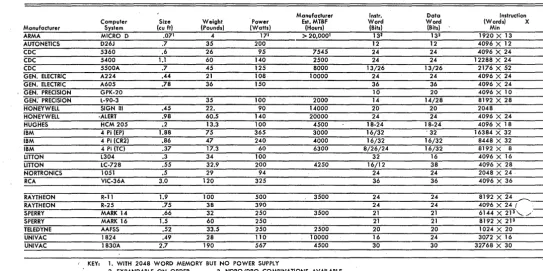
Aerospace co~puters, as defined here, are those stored program digital computers designed primarily to meet the needs of airborne or spaceborne applications. No attempt has been made to include all aerospace systems in the survey of current systems. Representative systems from a variety of manufacturers are described in Table I (p. 24).
Reliability, power consumption, weight, and size are those physical characteristics which are' generally of greatest concern to the aerospace computer system de-signer. In most cases, a computer system that fails in flight
1 Electronics, Feb. 20, 1967, pp 203 ff.
22
reach for the ground
cannot be repaired in flight, and the semi-automatic back up which exists may be unsatisfactory in terms of mission goals. Depending on the application, reliability may be of considerably' greater consequence than any of the other physical parameters. Typically, mean time between fail-ures of 2,000 to 20,000 hours are quoted. Power consump-tion, weight and size may have varying emphasis, depend-ing on the characteristics of the host vehicle. Obviously 300 watts, 1 cubic foot of space and 50 pounds have a different significance, depending on whether the host is a
C-135 or an unmanned satellite.
Performance, characteristics are the focus of this article, however, and in this area 'the parameters of concern are memory size and speed, word length, average instruction execution time, and input/output capability (there is frequently a requirement for high speed scanning of sensors and output of control signals) .
Mr. Hooper is the director of
systems programming at Com-'
pata, Inc. He was previously leader, design engineering, at
RCA, and programmIng man-ager at Packard Bell. He holds
a BA degree in mathematics
from Colby College.
DATAMATIDN
o
o
As physical characteristics become more satisfactory, performance characteristics get more and more emphasis by the system designer, who once asked, "Will it work for the length of the mission and can we fit it into the space available?" Now he is beginning to ask about things like programmability and software support.
Therefore, aerospace computers, which were once con-sidered a breed apart from ground-based general purpose computers, are coming more and more to resemble them functionally. That is the conclusion to be drawn from some of the representative systems shown in Table 1. Input/output and packaging areas seem to be two excep-tions to this rule. However, in terms of circuit technology, memory speed, memory capacity, register organization, instruction repertoire and software, there is a growing resemblance. This trend is also noticeable in the process and industrial control area where use of higher level languages, foreground and background processing; and standardized'I/O interfaces are becoming prevalent.
Circuits and packaging. Monolithic semiconductor cir.,
cuits are almost universally employed for arithmetic and control functions in the computers of Table 1. These circuits are usually packaged in the 14-pin flat-pack configuration .. Where emphasis has been on extremely small size, 50 to 100 or more flat packs have been attached to individual specially-designed multilayer boards. These multilayer boards may have a dozen or more layers of signal interconnection, and may in turn connect to a multilayer board for a higher level of interconnection.
With less emphasis on size and more emphasis on ease of repair, computers such as the Raytheon R-11 and the Univac 1830A offer pluggable circuit modules. Others, such as the Nortronics 1051, use a "stick" structure for utilizing small component groupings attached to a mother board.
Memory speed and capacity. The Univac 1830,
Ray-theon R-11, IBM 4 Pi (EP) and Litton L304 all can address memories of 131,072 words. The GE A605 can address 262,154 words. Typical capacities are 4K to 32K words. The Raytheon R-11 has a memory cycle 'of 950 nanoseconds; h'owever, typical memory cycles are from two to four microseconds. Some systems pull three or four
w~:>rds from memory at a time, with a resultant
improve-ment in program execution time.
Most of the computers of Table 1 use magnetic core memories; however, the Univac 1824 employs a thin
Mr. Amdahl, technical advisor
to DATAMATION, is president
of Compata, Inc. A participant in the design of several com-puters, he has a
as
inengi-neering and physics from S.
Dakota State and an MS in
physics from Kansas Univ.
magnetic film memory. Protection for fixed programs and constants is achieved in a variety of ways. Some comput-ers, such as the IBM 4 Pi, employ an additional memory protect bit with each word to prevent errant instruction execution from destroying protected words. Other comput-ers employ non-destructive readout (NDRO) memories that are implemented, for example, with multiple aperture cores or magnetic thin films. The NDRO memories. are usually electrically alterable in conjunction with support equipment. Still other computers employ permanent mem-ories that are implemented by techniques such as "missing core" and "rope" memories. Rope memories are con-structed with somewhat larger cores than usual, with a number of wires selectively laced through or around them as a function of the desired bit pattern. The missing core memories are more nearly like standard core planes with cores omitted according to the desired bit pattern. Rope memory is used in the Apollo Guidance Computer (not shown in Table 1), and missing core memory is used in the IBM Pi (EP) for storage of microprograms.
Register organization. The L304 and IBM 4 Pi (EP)
series both employ the general register concept. The L304 has eight registers for each of 64 interrupt levels. The 4 Pi (EP) has 16 registers. Many computers utilize an upper and lower accumulator, and provide three to seven active
(flip-flop) index registers.
Instruction repertoires. The GE 605, IBM 4 Pi (EP),
CDC 5400, 5500, Litton L304, Raytheon R-11 and Univac 1830A systems all have large capable instruction repertoires. Not only are single precision, binary fixed' point arithmetic instructions provided, but character han-dling, memory search and bit manipulation instructions as well.
Software. Compatibility with ground-based processors
(see below) immediately makes large software libraries
~vailable. In addition, JOVIAL is to be available for the
Litton L304 and Raytheon R-ll, FORTRAN for the R-ll and Univac 1830A, and PL/I for the 4 Pi (EP). All systems listed have an assembler (which runs on another comput-er), a simulator (likewise) and libraries of math function subroutines and diagnostic or fault detection routines. - Operating systems are developed for particular
applica-tions on a custom basis only. .
Compatibility. The Burroughs D840, GE A605, IBM 4
Pi and Univac 1830 are all "instruction compatible" with ground-based computers. This concept can sometimes take advantage of the software developed for the ground-based system, particularly if the instructiOri repertoires are nearly duplicates of each other. In addition, it may be unneces-sary to develop a separate simulator program for program debugging.
what are they used for?
In terms of applications, multipurpose use is becoming more common in aerospace computers. Previously, a single use was normal in all but a few cases. Greater reliability and capability have been the stimuli for the change in thinking here. Some multipurpose applications include E2A, ANEW, and AWACS. Today, more is being required of
compu~ers which occupy the same or less physical space
than their predecessors. The E2A aircraft is produced by Grumman and the on-board computer system supports navigation, display, tracking and I intercept functions. ANEW is the electronic system aboard the Lockheed P3C and assists in anti-submarine warfare. AWACS is a future Air Force System on a large jet such as the Douglas DC-8 or Boeing 707 and supports both Tactical Air Command and Air Defense Command requirements.