Fine-mapping inflammatory bowel disease loci to single variant
1
resolution
2
Hailiang Huang1,2*§, Ming Fang3,4*, Luke Jostins5,6*, Maša Umićević Mirkov7, Gabrielle
3
Boucher8, Carl A Anderson7, Vibeke Andersen9,10, Isabelle Cleynen11, Adrian Cortes5, François 4
Crins3,4, Mauro D'Amato12,13, Valérie Deffontaine3,4, Julia Dimitrieva3,4, Elisa Docampo3,4, 5
Mahmoud Elansary3,4, Kyle Kai-How Farh1,2,14, Andre Franke15, Ann-Stephan Gori3,4, Philippe
6
Goyette8, Jonas Halfvarson16, Talin Haritunians17, Jo Knight18, Ian C Lawrance19,20, Charlie W
7
Lees21, Edouard Louis3,22, Rob Mariman3,4, Theo Meuwissen23, Myriam Mni3,4, Yukihide
8
Momozawa3,4,24, Miles Parkes25, Sarah L Spain26,27, Emilie Théâtre3,4, Gosia Trynka7, Jack 9
Satsangi21, Suzanne van Sommeren28, Severine Vermeire11,29, Ramnik J Xavier2,30, International
10
IBD Genetics Consortium†, Rinse K Weersma28, Richard H Duerr31,32, Christopher G
11
Mathew26,33, John D Rioux8,34, Dermot PB McGovern17, Judy H Cho35, Michel Georges3,4§, Mark
12
J Daly1,2§, Jeffrey C Barrett7§
13
1Analytic and Translational Genetics Unit, Massachusetts General Hospital, Harvard Medical School, 14
Boston, Massachusetts, USA. 2Broad Institute of MIT and Harvard, Cambridge, Massachusetts, USA. 3Unit 15
of Medical Genomics, Groupe Interdisciplinaire de Génoprotéomique Appliquée (GIGA-R) Research 16
Center, University of Liège, Liège, Belgium. 4Faculty of Veterinary Medicine, University of Liège, Liège, 17
Belgium. 5Wellcome Trust Centre for Human Genetics, University of Oxford, Headington, UK. 6Christ 18
Church, University of Oxford, St Aldates, UK. 7Wellcome Trust Sanger Institute, Hinxton (Cambridge), 19
UK. 8Research Center, Montreal Heart Institute, Montréal, Québec, Canada. 9Medical Department, Viborg 20
Regional Hospital, Viborg, Denmark. 10Organ Center, Hospital of Southern Jutland Aabenraa, Aabenraa, 21
Denmark. 11Department of Clinical and experimental medicine, Translational Research in GastroIntestinal 22
Disorders (TARGID), Katholieke Universiteit (KU) Leuven, Leuven, Belgium. 12Clinical Epidemiology 23
Unit, Department of Medicine Solna, Karolinska Institutet, Stockholm, Sweden. 13Department of Liver and 24
Gastrointestinal Diseases, BioDonostia Health Research Institute San Sebastian, and IKERBASQUE 25
Basque Foundation for Science Bilbao, Bilbao, Spain. 14Illumina, San Diego, California, USA. 15Institute of 26
Clinical Molecular Biology, Christian-Albrechts-University of Kiel, Kiel, Germany. 16Department of 27
Gastroenterology, Faculty of Medicine and Health, Örebro University, Örebro, Sweden. 17F.Widjaja 28
Foundation Inflammatory Bowel and Immunobiology Research Institute, Cedars-Sinai Medical Center, Los 29
Angeles, California, USA. 18Data Science Institute and Lancaster Medical School, Lancaster University, 30
LA1 4YG, UK. 19Centre for Inflammatory Bowel Diseases, Saint John of God Hospital, Subiaco, WA, 31
Australia. 20Harry Perkins Institute for Medical Research, School of Medicine and Pharmacology, 32
University of Western Australia, Murdoch, WA, Australia. 21Gastrointestinal Unit, Wester General Hospital 33
University of Edinburgh, Edinburgh, UK. 22Division of Gastroenterology, Centre Hospitalier Universitaire 34
(CHU) de Liège, Liège, Belgium. 23Livestock and Aquacultural Sciences, Norwegian University of Life 35
Sciences, Ås, Norway. 24Laboratory for Genotyping Development, Center for Integrative Medical Sciences, 36
RIKEN, Yokohama, Japan. 25Inflammatory Bowel Disease Research Group, Addenbrooke's Hospital, 37
Cambridge, UK. 26Department of Medical and Molecular Genetics, King's College London, London, UK. 38
27Centre for Therapeutic Target Validation, Wellcome Trust Genome Campus, Hinxton (Cambridge), UK. 39
28Department of Gastroenterology and Hepatology, University of Groningen and University Medical Center 40
Groningen, Groningen, The Netherlands. 29Division of Gastroenterology, University Hospital Gasthuisberg, 41
Leuven, Belgium. 30Gastroenterology Unit, Massachusetts General Hospital, Harvard Medical School, 42
Boston, Massachusetts, USA. 31Division of Gastroenterology, Hepatology and Nutrition, Department of 43
Medicine, University of Pittsburgh School of Medicine, Pittsburgh, Pennsylvania, USA. 32Department of 44
Human Genetics, University of Pittsburgh Graduate School of Public Health, Pittsburgh, Pennsylvania, 45
USA. 33Sydney Brenner Institute for Molecular Bioscience, University of the Witwatersrand, 46
Johannesburg, South Africa . 34Faculté de Médecine, Université de Montréal, Montréal, Québec, Canada. 47
35Department of Genetics, Yale School of Medicine, New Haven, Connecticut, USA. 48
*These authors contributed equally to this work. 49
§These authors contributed equally to this work (corresponding authors). 50
Summary
52
The inflammatory bowel diseases (IBD) are chronic gastrointestinal inflammatory 53
disorders that affect millions worldwide. Genome-wide association studies have 54
identified 200 IBD-associated loci, but few have been conclusively resolved to specific 55
functional variants. Here we report fine-mapping of 94 IBD loci using high-density 56
genotyping in 67,852 individuals. We pinpointed 18 associations to a single causal 57
variant with >95% certainty, and an additional 27 associations to a single variant with 58
>50% certainty. These 45 variants are significantly enriched for protein-coding changes 59
(n=13), direct disruption of transcription factor binding sites (n=3) and tissue specific 60
epigenetic marks (n=10), with the latter category showing enrichment in specific immune 61
cells among associations stronger in CD and in gut mucosa among associations stronger 62
in UC. The results of this study suggest that high-resolution fine-mapping in large 63
samples can convert many GWAS discoveries into statistically convincing causal 64
variants, providing a powerful substrate for experimental elucidation of disease 65
The inflammatory bowel diseases (IBD) are a group of chronic, debilitating disorders of 67
the gastrointestinal tract with peak onset in adolescence and early adulthood. More than 68
1.4 million people are affected in the USA alone1, with an estimated direct healthcare 69
cost of $6.3 billion/year. IBD affects millions worldwide, and is rising in prevalence, 70
particularly in pediatric and non-European ancestry populations2. IBD has two subtypes,
71
ulcerative colitis (UC) and Crohn’s disease (CD), which have distinct presentations and 72
treatment courses. To date, 200 genomic loci have been associated with IBD3,4, but only a 73
handful have been conclusively ascribed to a specific causal variant with direct insight 74
into the underlying disease biology. This scenario is common to all genetically complex 75
diseases, where the pace of identifying associated loci outstrips that of defining specific 76
molecular mechanisms and extracting biological insight from each association. 77
The widespread correlation structure of the human genome (known as linkage 78
disequilibrium, or LD) often results in similar evidence for association among many 79
neighboring variants. However, unless LD is perfect (r2 = 1), it is possible, with a 80
sufficiently large sample size, to statistically resolve causal variants from neighbors even 81
at high levels of correlation (Extended Data Figure 1 and ref 5). Novel statistical 82
approaches applied to very large datasets that address this problem6 require that the 83
highly correlated variants are directly genotyped or imputed with certainty. Truly high-84
resolution mapping data, when combined with increasingly sophisticated and 85
comprehensive public databases annotating the putative regulatory function of DNA 86
variants, are likely to reveal novel insights into disease pathogenesis7-9 and the 87
mechanisms of disease-associated variants. 88
Genetic architecture of associated loci
We genotyped 67,852 individuals of European ancestry, including 33,595 IBD (18,967 90
CD and 14,628 UC) and 34,257 healthy controls using the Illumina™ Immunochip 91
(Extended Data Table 1). This genotyping array was designed to include all known 92
variants from European individuals in the February 2010 release of the 1000 Genomes 93
Project10,11 in 187 high-density regions known to be associated to one or more
immune-94
mediated diseases12. Because fine-mapping uses subtle differences in strength of 95
association between tightly correlated variants to infer which is most likely to be causal, 96
it is particularly sensitive to data quality. We therefore performed stringent quality 97
control to remove genotyping errors and batch effects (Methods). We imputed into this 98
dataset from the 1000 Genomes reference panel13,14 to fill in variants missing from the
99
Immunochip, or filtered out by our quality control (Extended Data Figure 2). We then 100
evaluated the 97 high-density regions that had previous IBD associations3 and contained 101
at least one variant that showed significant association (Methods) in this data set. The 102
major histocompatibility complex was excluded from these analyses as fine-mapping has 103
been reported elsewhere15.
104
We applied three complementary Bayesian fine-mapping methods that used 105
different priors and model selection strategies to identify independent association signals 106
within a region, and to assign a posterior probability of causality to each variant 107
(Supplementary Methods and Extended Data Figure 2). For each independent signal 108
detected by each method, we sorted all variants by the posterior probability of 109
association, and added variants to the ‘credible set’ of associated variants until the sum of 110
their posterior probability exceeded 95% – that is, the credible set contains the minimum 111
sets ranged in size from one to > 400 variants. We merged these results and 113
subsequently focused only on signals where an overlapping credible set of variants was 114
identified by at least two of the three methods and all variants were either directly 115
genotyped or imputed with INFO score > 0.4 (Methods and Figure 1). 116
In three out of 97 regions, a consistent credible set could not be identified; when 117
multiple independent effects exist in a region of very high LD, multiple distinct fine-118
mapping solutions may not be distinguishable (Supplementary Note). Sixty-eight of the 119
remaining 94 regions contain a single association, while 26 harbor two or more 120
independent signals, for a total of 139 independent associations defined across the 94 121
regions (Figure 2a). Only IL23R and NOD2 (both previously established to contain 122
multiple associated protein-coding variants16) contain more than three independent 123
signals. Consistent with previous reports3, the vast majority of signals are associated 124
with both CD and UC, though many of these have a significantly stronger association 125
with one subtype. For the purposes of enrichment analyses below, we compared 79 126
signals that are more strongly associated with CD to 23 signals that are more strongly 127
associated with UC (the remaining 37 were equally associated with both subtypes, 128
Supplementary Table 1). 129
Using a restricted maximum likelihood mixed model approach17, we evaluated the 130
proportion of total variance in disease risk attributed to these 94 regions and how much of 131
that is explained by the 139 specific associations. We estimated that 25% of CD risk was 132
explained by the specific associations described here, out of a total of 28% explained by 133
these loci (correspondingly for UC: 17% out of 22%). The single strongest signals in 134
contribute 24% (Extended Data Figure 3), highlighting the importance of secondary and 136
tertiary associations in GWAS results15,18. 137
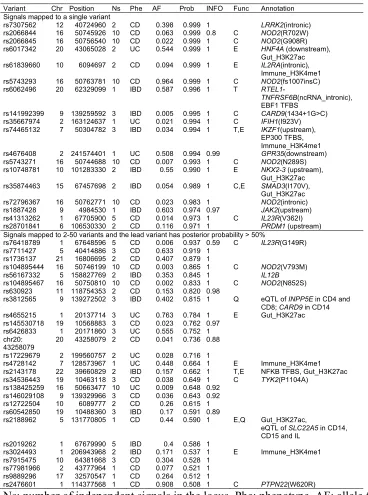
Associations mapped to a single variant
138
For 18 signals, the 95% credible set consisted of a single variant (‘single variant credible 139
sets’), and for 24 others the credible set consisted of two to five variants (Figure 2b). The 140
single variant credible sets included five previously reported coding variants: three in 141
NOD2 (fs1007insC, R702W, G908R), a rare protective allele in IL23R (V362I) and a 142
splice variant in CARD9 (c.IVS11+1G>C) 16,19. The remaining single variant credible sets 143
were comprised of three missense variants (I170V in SMAD3, I923V in IFIH1 and 144
N289S in NOD2), four intronic variants (in IL2RA, LRRK2, NOD2 and 145
RTEL1/TNFRSF6B) and six intergenic variants (located 3.7kb downstream of GPR35; 146
3.9kb upstream of PRDM1; within a EP300 binding site 39.9 kb upstream of IKZF1; 500 147
bp before the transcription start site of JAK2; 9.4kb upstream of NKX2-3; and 3.5kb 148
downstream from HNF4A) (Table 1). Of note, while physical proximity does not 149
guarantee functional relevance, the credible set of variants for 30 associated loci now 150
implicates a specific gene either because it resides within 50 kb of only that gene or has a 151
coding variant with >50% probability – improved from only 3 so refined using an earlier 152
HapMap-based definition. Using the same definitions, the total number of potential 153
candidate genes was reduced from 669 to 233. Examples of IBD candidate genes clearly 154
prioritized in our data are described in the Supplementary Box, and a customizable 155
browser (http://finemapping.broadinstitute.org/) is available to review the detailed fine-156
mapping results. 157
Associated protein coding variants
159
We first annotated the possible functional consequences of the IBD variants by their 160
effect on the amino acid sequences of proteins. Thirteen out of 45 variants (Figure 2c) 161
that have >50% posterior probability are non-synonymous (Table 1), an 18-fold 162
enrichment (enrichment P=2x10-13, Fisher’s exact test) relative to randomly drawn
163
variants in our regions (Figure 3a). By contrast, only one variant with >50% probability 164
is synonymous (enrichment P=0.42). All common coding variants previously reported to 165
affect IBD risk are included in a 95% credible set including: IL23R (R381Q, V362I and 166
G149R); CARD9 (c.IVS11+1G>C and S12N); NOD2 (S431L, R702W, V793M, N852S 167
and G908R, fs1007insC); ATG16L1 (T300A); PTPN22 (R620W); and FUT2 (W154X). 168
While this enrichment of coding variation (Figure 3a) provides assurance about the 169
accuracy of our approach, it does not suggest that 30% of all associations are caused by 170
coding variants; rather, it is almost certainly the case that associated coding variants have 171
stronger effect sizes, making them easier to fine-map. 172
173
Associated non-coding variants
174
We next examined conserved nucleotides in high confidence binding site motifs of 84 175
transcription factor (TF) families20 (Methods). There was a significant positive 176
correlation between TF motif disruption and IBD association posterior probability 177
(P=0.006, logistic regression) (Figure 3a), including three variants with >50% probability 178
(two >95%). In the RTEL1/TNFRSF6B region, rs6062496 is predicted to disrupt a TF 179
binding site (TFBS) for EBF1, a TF involved in the maintenance of B cell identity and 180
allele at rs74465132 creates a binding site for EP300 less than 40kbp upstream of IKZF1.
182
The third notable example of TFBS disruption, although not in a single variant credible 183
set, is detailed in the Supplementary Box for the association at SMAD3. 184
Recent studies have shown that trait associated variants are enriched for 185
epigenetic marks highlighting cell type specific regulatory regions9,22,23. We compared
186
our credible sets with ChIPseq peaks corresponding to chromatin immunoprecipitation 187
with H3K4me1, H3K4me3 and H3K27ac (shown previously22,23 to highlight enhancers, 188
promoters and active regulatory elements, respectively) in 120 adult and fetal tissues, 189
assayed by the Roadmap Epigenomics Mapping Consortium24 (Figure 3b). Using a 190
threshold of P=1.3x10⁻⁴ (0.05 corrected for 360 tests), we observed significant
191
enrichment of H3K4me1 in 6 immune cell types and for H3K27ac in 2 gastrointestinal 192
(gut) samples (sigmoid colon and rectal mucosa) (Figure 3b and Supplementary Table 2). 193
The subset of signals that are more strongly associated with CD overlap more with 194
immune cell chromatin peaks, whereas UC signals overlap more with gut chromatin 195
peaks (Supplementary Table 2). 196
These three chromatin marks are correlated both within tissues (we observe 197
additional signal in other marks in the tissues described above) and across related tissues. 198
We therefore defined a set of “core immune peaks” for H3K4me1 and “core gut peaks” 199
for H3K27ac as the set of overlapping peaks in all enriched immune cell and gut tissue 200
types, respectively. These two sets of peaks are independently significant and capture the 201
observed enrichment compared to “control peaks” made up of the same number of 202
ChIPseq peaks across our 94 regions in non-immune and non-gut tissues (Figure 3c,d). 203
excess over the baseline suggests that a substantial number of regions, particularly those 205
not mapped to coding variants, may ultimately be explained by functional variation in 206
recognizable enhancer/promoter elements. 207
208
Overlap with expression QTLs
209
Variants that change enhancer or promoter activity might change gene expression, and 210
baseline expression of many genes has been found to be regulated by genetic variation 25-211
27. Indeed, it has been suggested that these so-called expression quantitative trait loci
212
(eQTLs) underlie a large proportion of GWAS associations25,28. We therefore searched 213
for variants that are both in an IBD-associated credible set with 50 or fewer variants, and 214
the most significantly associated eQTL variant for a gene in a study29 of peripheral blood 215
mononuclear cells (PBMC) from 2,752 twins. Sixty-eight of the 76 regions with signals 216
fine-mapped to ≤ 50 variants harbor at least one significant eQTL (affecting a gene 217
within 1 Mb with P < 10-5). Despite this abundance of eQTLs in fine-mapped regions, 218
only 3 credible sets include the most significantly associated eQTL variants, compared 219
with 3.7 expected by chance (Methods). Data from a more recent study30 using PBMCs 220
from 8,086 individuals did not yield a substantively different outcome, demonstrating a 221
modest but non-significant enrichment (8 observed overlaps, 4.2 expected by chance, 222
P=0.06). Using a more lenient definition of overlap which requires the lead eQTL 223
variant to be in LD (R2 > 0.4) with an IBD credible set variant increased the number of
224
potential overlaps but again these numbers were not greater than chance expectation. 225
As PBMCs are a heterogeneous collection of immune cell populations, cell type-226
immune tissues may be missed. We therefore tested the enrichment of eQTLs that 228
overlap credible sets in five primary immune cell populations (CD4+, CD8+, CD19+, 229
CD14+ and CD15+), platelets, and three distinct intestinal locations (rectum, colon and 230
ileum) isolated from 350 healthy individuals (Methods). We observed a significant 231
enrichment of credible SNP/eQTL overlaps in CD4+ cells and ileum (Extended Data 232
Table 2): three and two credible sets overlapped eQTLs, respectively, compared to 0.4 233
and 0.3 expected by chance (P=0.005 and 0.020). An enrichment was also observed for 234
the naïve CD14+ cells from another study31: eight overlaps observed compared to 2.7 235
expected by chance (P=0.001). We did not observe enrichment of overlaps in stimulated 236
(with interferon or lipopolysaccharide) CD14+ cells from the same source (Extended 237
Data Table 2). 238
We investigated eQTL overlaps more deeply by applying two colocalization 239
approaches (one frequentist, one Bayesian, Methods) to the our cell-separated dataset 240
where primary genotype and expression data were available. We confirmed greater than 241
expected overlap with eQTLs in CD4+ and ileum described above (Figure 4 and 242
Extended Data Table 2). These CD4+ colocalized eQTLs also had stronger overlap with 243
CD4+ ChIPseq peaks than our other credible sets, further supporting a regulatory causal 244
mechanism. The number of colocalizations in other purified cell types and tissues was 245
largely indistinguishable from what we expect under the null using either method, except 246
for moderate enrichment in rectum (4 observed and 1.4 expected, P=0.039, Frequentist 247
approach) and colon (3 observed and 0.8 expected, P=0.04, Bayesian approach). Only 248
two of these colocalizations correspond to an IBD variant with causal probability > 50% 249
251
Discussion
252
We have performed fine-mapping of 94 previously reported genetic risk loci for IBD. 253
Rigorous quality control followed by an integration of three novel fine-mapping methods 254
generated lists of genetic variants accounting for 139 independent associations across 255
these loci. Our methods are concordant with an existing fine-mapping method6 (67 of 68 256
credible sets in single signal regions overlap, including exact matches for all single 257
variant credible sets), and provide extensions to support the phenotype assignment (CD, 258
UC or IBD) and the conditional estimation of multiple credible sets in loci with multiple 259
independent signals. The use of multiple methods allowed us to focus our downstream 260
analyses on loci where the choice of fine-mapping method did not substantially alter 261
conclusions about the biology of IBD. Our results improve on previous fine-mapping 262
efforts using a preset LD threshold32 (e.g. r2> 0.6) (Extended Data Figure 5) by formally 263
modeling the posterior probability of association of every variant. Much of this 264
resolution derives from the very large sample size we employed, because the number of 265
variants in a credible set decreases with increasing significance (P=0.0069). 266
The high-density of genotyping also aids in improved resolution. For instance, 267
the primary association at IL2RA has now been mapped to a single variant associated 268
with CD, rs61839660. This variant was not present in the Hapmap 3 reference panel and 269
was therefore not reported in earlier studies3,33 (nearby tagging variants, rs12722489 and
270
rs12722515, were reported instead). Imputation using the 1000 genomes reference panel 271
and the largest assembled GWAS dataset3 did not separate rs61839660 from its neighbors 272
reference. Only direct genotyping, available in the immunochip high-density regions, 274
permitted the conclusive identification of the causal variant. 275
Accurate fine-mapping should, in many instances, ultimately point to the same 276
variant across diseases in shared loci. Among our single-variant credible sets, we fine-277
mapped a UC association to a rare missense variant (I923V) in IFIH1, which is also 278
associated with type 1 diabetes (T1D)37 with an opposite direction of effect 279
(Supplementary Box). The intronic variant noted above (rs61839660, AF=9%) in IL2RA
280
was also similarly associated with T1D, again with a discordant directional effect38 281
(Supplementary Box). Simultaneous high-resolution fine-mapping in multiple diseases 282
should therefore better clarify both shared and distinct biology. 283
Resolution of fine-mapping can be further improved by leveraging LD from other 284
ethnicities34. However, the sample size from other ethnicities we have collected is small 285
compared with European samples (9,846 across East-Asian, South-Asian and Middle-286
Eastern). Limited access to matched imputation reference panels from all cohorts and the 287
fact that the smaller non-European sets are not from populations (e.g., African-derived) 288
with narrower LD also suggest that gains in fine-mapping accuracy would be limited at 289
this time. Ultimately this effort will be aided by more substantial investment in 290
genotyping non-European population samples and by developing and applying more 291
robust trans-ethnic fine-mapping algorithms. 292
A new release of the 1000 genomes (phase 3)35 and the UK10K36 project have
293
introduced new variants that were not present in the reference panel in our study. Our 294
major findings remain the same using this new reference panel: the 18 single-variant 295
and the 1,426 variants in IBD associations mapped to ≤50 variants are in high LD with 297
only 47 new variants (3.3% of the total size of these credible sets, Supplementary Table 298
1). Given that this release represents a near complete catalogue of variants with minor 299
allele frequency (MAF) > 1% in European populations, we believe our current fine 300
mapping results are likely to be robust, especially for common variant associations. High-301
resolution fine-mapping demonstrates that causal variants are significantly enriched for 302
variants that alter protein coding variants or disrupt transcription factor binding motifs. 303
Enrichment was also observed in H3K4me1 marks in immune related cell types and 304
H3K27ac marks in sigmoid colon and rectal mucosal tissues, with CD loci demonstrating 305
a stronger immune signature and UC loci more enriched for gut tissues (P values are 306
0.014, 0.0005 and 0.0013 respectively for H3K4me1, H3K27ac and H3K4me3; chi-307
square test). By contrast, overall enrichment of eQTLs is quite modest compared with 308
prior reports and not seen strongly in excess of chance in our well-refined credible sets (≤
309
50 variants). This result underscores the importance of high-resolution mapping and the 310
careful incorporation of the high background rate of eQTLs. It is worth noting that 311
evaluating the overlap between two distinct mapping results is fundamentally different 312
than comparing genetic mapping results to fixed genomic features, and depends on both 313
mappings being well resolved. While these data challenge the paradigm that easily 314
surveyed baseline eQTLs explain a large proportion of non-coding GWAS signals, the 315
modest excesses observed in smaller but cell-specific data sets suggest that much larger 316
tissue or cell-specific studies (and under the correct stimuli or developmental time points) 317
Resolving multiple independent associations may often help target the causal gene 319
more precisely. For example, the SMAD3 locus hosts a non-synonymous variant and a 320
variant disrupting the conserved transcription factor binding site (also overlapping the 321
H3K27ac marker in gut tissues), unambiguously articulating a role in disease and 322
providing an allelic series for further experimental inquiry. Similarly, the TYK2 locus has 323
been mapped to a non-synonymous variant and a variant disrupting a conserved 324
transcription factor binding site (http://finemapping.broadinstitute.org/). 325
One-hundred and sixteen associations have been fine-mapped to ≤ 50 variants. 326
Among them, 27 associations contain coding variants, 20 contain variants disrupting 327
transcription factor binding motifs, and 45 are within histone H3K4me1 or H3K27ac 328
marked DNA regions. The best-resolved associations - 45 variants having >50% posterior 329
probabilities for being causal (Table 1) – are similarly significantly enriched for variants 330
with known or presumed function from genome annotation. Of these, 13 variants cause 331
non-synonymous change in amino acids, three disrupt a conserved TF binding motif, ten 332
are within histone H3K4me1 or H3K27ac marked DNA regions in disease-relevant 333
tissues, and two colocalize with a significant cis-eQTL (Extended Data Figure 4a). Risk 334
alleles of these variants can be found throughout the allele frequency spectrum, with 335
protein coding variants having somewhat larger effects and more extreme risk allele 336
frequencies (Extended Data Figure 6a-c). 337
This analysis, however, leaves 21 non-coding variants (Extended Data Figure 4b), 338
all of which have >50% probabilities to be causal (five have >95%), that are not located 339
within known motifs, annotated elements, nor in any experimentally determined ChIPseq 340
compelling set of genuine associations (often intronic or within 10 kb of strong candidate 342
genes), we can make little inference about function. For example, the intronic single-343
variant credible set of LRRK2 has no annotation, eQTL or ChIPseq peak of note. This 344
underscores the incompleteness of our knowledge regarding the function of non-coding 345
DNA and its role in disease, and calls for comprehensive studies on transcriptome and 346
epigenome in a wide range of cell lines and stimulation conditions. That the majority of 347
the best-refined non-coding associations have no available annotation is perhaps sobering 348
with respect to how well we may currently be able to interpret non-coding variation in 349
medical sequencing efforts. It does suggest, however, that detailed fine-mapping of 350
GWAS signals down to single variants, combined with emerging high-throughput 351
genome-editing methodology, may be among the most effective ways to advance to a 352
References
354
1. Kappelman, M. D. et al. Direct health care costs of Crohn's disease and ulcerative 355
colitis in US children and adults. Gastroenterology135, 1907–1913 (2008). 356
2. Molodecky, N. A. et al. Increasing incidence and prevalence of the inflammatory 357
bowel diseases with time, based on systematic review. Gastroenterology142, 46– 358
54.e42– quiz e30 (2012). 359
3. Jostins, L. et al. Host–microbe interactions have shaped the genetic architecture of 360
inflammatory bowel disease. Nature491, 119–124 (2012). 361
4. Liu, J. Z. et al. Association analyses identify 38 susceptibility loci for 362
inflammatory bowel disease and highlight shared genetic risk across populations. 363
Nat Genet (2015). doi:10.1038/ng.3359 364
5. van de Bunt, M. et al. Evaluating the Performance of Fine-Mapping Strategies at 365
Common Variant GWAS Loci. PLoS Genet11, e1005535 (2015). 366
6. Maller, J. B. et al. Bayesian refinement of association signals for 14 loci in 3 367
common diseases. Nat Genet44, 1294–1301 (2012). 368
7. Yang, J. et al. FTO genotype is associated with phenotypic variability of body 369
mass index. Nature490, 267–272 (2012). 370
8. International Multiple Sclerosis Genetics Consortium (IMSGC) et al. Analysis of 371
immune-related loci identifies 48 new susceptibility variants for multiple sclerosis. 372
Nat Genet45, 1353–1360 (2013). 373
9. Onengut-Gumuscu, S. et al. Fine mapping of type 1 diabetes susceptibility loci and 374
evidence for colocalization of causal variants with lymphoid gene enhancers. Nat
375
Genet47, 381–386 (2015). 376
10. 1000 Genomes Project Consortium et al. An integrated map of genetic variation 377
from 1,092 human genomes. Nature491, 56–65 (2012). 378
11. 1000 Genomes Project Consortium. A map of human genome variation from 379
population-scale sequencing. Nature467, 1061–1073 (2010). 380
12. Jostins, L. Using Next-Generation Genomic Datasets In Disease Association. (The 381
University of Cambridge, 2012). 382
13. Howie, B. N., Donnelly, P. & Marchini, J. A flexible and accurate genotype 383
imputation method for the next generation of genome-wide association studies. 384
PLoS Genet5, e1000529 (2009). 385
14. Howie, B., Marchini, J. & Stephens, M. Genotype imputation with thousands of 386
genomes. G3 (Bethesda)1, 457–470 (2011). 387
15. Goyette, P. et al. High-density mapping of the MHC identifies a shared role for 388
HLA-DRB1*01:03 in inflammatory bowel diseases and heterozygous advantage in 389
ulcerative colitis. Nat Genet (2015). doi:10.1038/ng.3176 390
16. Rivas, M. A. et al. Deep resequencing of GWAS loci identifies independent rare 391
variants associated with inflammatory bowel disease. Nat Genet43, 1066–1073 392
(2011). 393
17. Yang, J. et al. Genome partitioning of genetic variation for complex traits using 394
common SNPs. Nat Genet43, 519–525 (2011). 395
18. Huang, H., Chanda, P., Alonso, A., Bader, J. S. & Arking, D. E. Gene-based tests 396
of association. PLoS Genet7, e1002177 (2011). 397
19. Momozawa, Y. et al. Resequencing of positional candidates identifies low 398
Nat Genet43, 43–47 (2011). 400
20. Kheradpour, P. & Kellis, M. Systematic discovery and characterization of 401
regulatory motifs in ENCODE TF binding experiments. Nucleic Acids Res42,
402
2976–2987 (2014). 403
21. Nechanitzky, R. et al. Transcription factor EBF1 is essential for the maintenance 404
of B cell identity and prevention of alternative fates in committed cells. Nat.
405
Immunol.14, 867–875 (2013). 406
22. Trynka, G. et al. Chromatin marks identify critical cell types for fine mapping 407
complex trait variants. Nat Genet45, 124–130 (2013). 408
23. Farh, K. K.-H. et al. Genetic and epigenetic fine mapping of causal autoimmune 409
disease variants. Nature518, 337–343 (2015). 410
24. Bernstein, B. E. et al. The NIH Roadmap Epigenomics Mapping Consortium. 28,
411
1045–1048 (2010). 412
25. Nica, A. C. et al. Candidate causal regulatory effects by integration of expression 413
QTLs with complex trait genetic associations. PLoS Genet6, e1000895 (2010). 414
26. Lappalainen, T. et al. Transcriptome and genome sequencing uncovers functional 415
variation in humans. Nature501, 506–511 (2013). 416
27. Wallace, C. et al. Statistical colocalization of monocyte gene expression and 417
genetic risk variants for type 1 diabetes. Human Molecular Genetics21, 2815– 418
2824 (2012). 419
28. Dubois, P. C. A. et al. Multiple common variants for celiac disease influencing 420
immune gene expression. Nat Genet42, 295–302 (2010). 421
29. Wright, F. A. et al. Heritability and genomics of gene expression in peripheral 422
blood. Nat Genet46, 430–437 (2014). 423
30. Westra, H.-J. et al. Systematic identification of trans eQTLs as putative drivers of 424
known disease associations. Nat Genet45, 1238–1243 (2013). 425
31. Fairfax, B. P. et al. Innate immune activity conditions the effect of regulatory 426
variants upon monocyte gene expression. 343, 1246949–+ (2014). 427
32. Ripke, S. et al. Biological insights from 108 schizophrenia-associated genetic loci. 428
Nature511, 421–427 (2014). 429
33. Franke, A. et al. Genome-wide meta-analysis increases to 71 the number of 430
confirmed Crohn's disease susceptibility loci. Nat Genet42, 1118–1125 (2010). 431
34. Spain, S. L. & Barrett, J. C. Strategies for fine-mapping complex traits. Human
432
Molecular Genetics24, R111–9 (2015). 433
35. 1000 Genomes Project Consortium et al. A global reference for human genetic 434
variation. Nature526, 68–74 (2015). 435
36. UK10K Consortium et al. The UK10K project identifies rare variants in health and 436
disease. Nature (2015). doi:10.1038/nature14962 437
37. Nejentsev, S., Walker, N., Riches, D., Egholm, M. & Todd, J. A. Rare variants of 438
IFIH1, a gene implicated in antiviral responses, protect against type 1 diabetes. 439
324, 387–389 (2009). 440
38. Huang, J., Ellinghaus, D., Franke, A., Howie, B. & Li, Y. 1000 Genomes-based 441
imputation identifies novel and refined associations for the Wellcome Trust Case 442
Control Consortium phase 1 Data. Eur. J. Hum. Genet.20, 801–805 (2012). 443
39. Roadmap Epigenomics Consortium et al. Integrative analysis of 111 reference 444
Acknowledgements We thank Mariya Khan and Bang Wong for their assistance in 446
designing illustrations, and Katie de Lange for helpful comments on the Supplementary 447
Methods. Support from the following grants: M.J.D. and R.J.X.: P30DK43351, 448
U01DK062432, R01DK64869, Helmsley grant 2015PG-IBD001 and CCFA. C.A.A. and 449
J.C.B: Wellcome Trust grant 098051. M.G.:WELBIO (CAUSIBD), BELSPO (BeMGI), 450
Fédération Wallonie-Bruxelles (ARC IBD@Ulg), and Région Wallonne (CIBLES, 451
FEDER). H.H.: ASHG/Charles J. Epstein Trainee Award. J.L.: Wellcome Trust 452
098759/Z/12/Z. D.M.: Olle Engkvist Foundation and Swedish Research Council (grants 453
2010-2976 and 2013-3862). R.K.W.: VIDI grant (016.136.308) from the Netherlands 454
Organization for Scientific Research. J.D.R.: Canada Research Chair, NIDDK grants 455
DK064869 and DK062432, CIHR #GPG-102170 from the Canadian Institutes of Health, 456
GPH-129341 from Genome Canada and Génome Québec, and Crohn’s Colitis Canada. 457
J.H.C.: DK062429, DK062422, DK092235, DK106593, and the Sanford J. Grossman 458
Charitable Trust. R.H.D.: Inflammatory Bowel Disease Genetic Research Chair at the 459
University of Pittsburgh, U01DK062420 and R01CA141743. E.D.: Marie-Curie 460
Fellowship. A-S.G: FNRS and Fonds Léon Fredericq fellowships. J.H.: Örebro 461
University Hospital Research Foundation and the Swedish Research Council (grant no. 462
521 2011 2764). C.G.M. and M.P.: NIHR Biomedical Research Centre awards to Guy's 463
& St Thomas' NHS Trust / King's College London and to Addenbrooke’s Hospital / 464
University of Cambridge School of Clinical Medicine. D.E.: German Federal Ministry of 465
Education and Research (SysInflame grant 01ZX1306A), DFG Excellence Cluster No. 466
306 “Inflammation at Interfaces”. A.F: professorship of Foundation for Experimental 467
Medicine (Zuerich, Switzerland). D.P.B.M.: DK062413, AI067068, U54DE023789-01, 468
305479 from the European Union, and The Leona M. and Harry B. Helmsley Charitable 469
Trust. Additional acknowledgements for the original data are in the Supplementary 470
Information. 471
472
Author Contributions Overall project supervision and management: M.J.D. J.C.B, M.G.
473
Fine-mapping algorithms: H.H., M.F., L.J. TFBS analyses: H.H., K.F. Epigenetic 474
analyses: M.U.M., G.T. eQTL dataset generation: E.L., E.T., J.D., E.D., M.E., R.M., 475
M.M., Y.M., V.D., A.G. eQTL analyses: M.F., J.D., L.J., A.C. Variance component 476
analysis: T.M., M.F. Contribution to overall statistical analyses: G.B. Primary drafting of 477
the manuscript: M.J.D., J.C.B, M.G., H.H., L.J. Major contribution to drafting of the 478
manuscript: M.F., M.U.M., J.H.C., D.P.B.M., J.D.R., C.G.M., R.H.D., R.K.W. The 479
remaining authors contributed to the study conception, design, genotyping QC and/or 480
writing of the manuscript. All authors saw, had the opportunity to comment on, and 481
approved the final draft. 482
483
Author Information The study protocols were approved by the institutional review
484
board (IRB) at each center involved with recruitment. Informed consent and permission 485
to share the data were obtained from all subjects, in compliance with the guidelines 486
specified by the recruiting center's IRB.The authors declare no competing financial 487
interests. Correspondence and requests for materials should be addressed to H.H. 488
([email protected]), M.G. ([email protected]), M.J.D. 489
([email protected]) or J.C.B. ([email protected]) 490
Table 1.Variants having posterior probability >50%. 492
Variant Chr Position Ns Phe AF Prob INFO Func Annotation Signals mapped to a single variant
rs7307562 12 40724960 2 CD 0.398 0.999 1 LRRK2(intronic) rs2066844 16 50745926 10 CD 0.063 0.999 0.8 C NOD2(R702W) rs2066845 16 50756540 10 CD 0.022 0.999 1 C NOD2(G908R) rs6017342 20 43065028 2 UC 0.544 0.999 1 E HNF4A (downstream),
Gut_H3K27ac rs61839660 10 6094697 2 CD 0.094 0.999 1 E IL2RA(intronic),
Immune_H3K4me1 rs5743293 16 50763781 10 CD 0.964 0.999 1 C NOD2(fs1007insC) rs6062496 20 62329099 1 IBD 0.587 0.996 1 T
RTEL1-TNFRSF6B(ncRNA_intronic), EBF1 TFBS
rs141992399 9 139259592 3 IBD 0.005 0.995 1 C CARD9(1434+1G>C) rs35667974 2 163124637 1 UC 0.021 0.994 1 C IFIH1(I923V) rs74465132 7 50304782 3 IBD 0.034 0.994 1 T,E IKZF1(upstream),
EP300 TFBS, Immune_H3K4me1 rs4676408 2 241574401 1 UC 0.508 0.994 0.99 GPR35(downstream) rs5743271 16 50744688 10 CD 0.007 0.993 1 C NOD2(N289S) rs10748781 10 101283330 2 IBD 0.55 0.990 1 E NKX2-3 (upstream),
Gut_H3K27ac rs35874463 15 67457698 2 IBD 0.054 0.989 1 C,E SMAD3(I170V),
Gut_H3K27ac rs72796367 16 50762771 10 CD 0.023 0.983 1 NOD2(intronic) rs1887428 9 4984530 1 IBD 0.603 0.974 0.97 JAK2(upstream) rs41313262 1 67705900 5 CD 0.014 0.973 1 C IL23R(V362I) rs28701841 6 106530330 2 CD 0.116 0.971 1 PRDM1 (upstream) Signals mapped to 2-50 variants and the lead variant has posterior probability > 50%
rs76418789 1 67648596 5 CD 0.006 0.937 0.59 C IL23R(G149R) rs7711427 5 40414886 3 CD 0.633 0.919 1
rs1736137 21 16806695 2 CD 0.407 0.879 1
rs104895444 16 50746199 10 CD 0.003 0.865 1 C NOD2(V793M) rs56167332 5 158827769 2 IBD 0.353 0.845 1 IL12B rs104895467 16 50750810 10 CD 0.002 0.833 1 C NOD2(N852S) rs630923 11 118754353 2 CD 0.153 0.820 0.98
rs3812565 9 139272502 3 IBD 0.402 0.815 1 Q eQTL of INPP5E in CD4 and CD8; CARD9 in CD14 rs4655215 1 20137714 3 UC 0.763 0.784 1 E Gut_H3K27ac rs145530718 19 10568883 3 CD 0.023 0.762 0.97
rs6426833 1 20171860 3 UC 0.555 0.752 1 chr20:
43258079 20 43258079 2 CD 0.041 0.736 0.88 rs17229679 2 199560757 2 UC 0.028 0.716 1
rs4728142 7 128573967 1 UC 0.448 0.664 1 E Immune_H3K4me1 rs2143178 22 39660829 2 IBD 0.157 0.662 1 T,E NFKB TFBS, Gut_H3K27ac rs34536443 19 10463118 3 CD 0.038 0.649 1 C TYK2(P1104A)
rs138425259 16 50663477 10 UC 0.009 0.648 0.92 rs146029108 9 139329966 3 CD 0.036 0.643 0.92 rs12722504 10 6089777 2 CD 0.26 0.615 1 rs60542850 19 10488360 3 IBD 0.17 0.591 0.89
rs2188962 5 131770805 1 CD 0.44 0.590 1 E,Q Gut_H3K27ac,
eQTL of SLC22A5 in CD14, CD15 and IL
rs2019262 1 67679990 5 IBD 0.4 0.586 1
rs3024493 1 206943968 2 IBD 0.171 0.537 1 E Immune_H3K4me1 rs7915475 10 64381668 3 CD 0.304 0.528 1
rs77981966 2 43777964 1 CD 0.077 0.521 1 rs9889296 17 32570547 1 CD 0.264 0.512 1
rs2476601 1 114377568 1 CD 0.908 0.508 1 C PTPN22(W620R)
Ns: number of independent signals in the locus. Phe: phenotype. AF: allele frequency. 493
Prob: posterior probability for being a causal variant. INFO: imputation. Func: functional 494
annotations -- coding (C), disrupting transcription factor binding sites (T), overlapping 495
epigenetic peaks (E) and colocalization with eQTL (Q). 496
Figure 1. Fine-mapping procedure and output using the SMAD3 region as an
498
example. a, 1) We merge overlapping signals across methods; 2) select a lead variant
499
(black triangle) and phenotype (color); and 3) choose the best model. Details for each 500
step are available in Methods. b, Example fine-mapping output. This region has been 501
mapped to two independent signals. For each signal, we report the phenotype it is 502
associated with (colored), the variants in the credible set, and their posterior probabilities. 503
504
Figure 2. Summary of fine-mapped associations. a, Independent signals. Sixty-eight
505
loci containing one association and 26 loci containing multiple associations. b, Number 506
of variants in credible sets. 18 associations were fine-mapped to a single variant, and 116 507
to ≤ 50 variants. c, Distribution of the posterior probability of the variants in credible sets 508
having ≤ 50 variants. 509
510
Figure 3. Functional annotation of causal variants. a, Proportion of credible variants
511
that are protein coding, disrupt/create transcription factor binding motif sites (TFBS) or 512
are synonymous, sorted by posterior probability. b, Epigenetic peaks overlapping 513
credible variants in cell and tissue types from the Roadmap Epigenomics Consortium39.
514
Significant enrichment has been marked with asterisks. Proportion of credible variants 515
that overlap (c) core immune peaks for H4K4me1or (d) core gut peaks for H3K27ac 516
(Methods). In panels a, c and d, the vertical dotted lines mark 50% posterior probability 517
and the horizontal dashed lines show the background proportions of each functional 518
category. 519
520
Figure 4.Number of credible sets that colocalize eQTLs. Distributions of the number
521
of colocalizations by chance (violins) and observed number of colocalizations with p-522
values (dots). Both the background and the observed numbers were calculated using the 523
Methods
525
Genotyping and QC
526
We genotyped 35,197 unaffected and 35,346 affected individuals (20,155 CD and 15,191 527
UC) using the Immunochip array. Genotypes were called using optiCall40 for 192,402 528
autosomal variants before QC.We removed variants with missing data rate >2% across 529
the whole dataset, or >10% in any one batch, and variants that failed (FDR < 10-5 in 530
either the whole dataset or at least two batches) tests for: a) Hardy-Weinberg equilibrium 531
in controls; b) differential missingness between cases and controls; c) different allele 532
frequency across different batches in controls, CD or UC. We also removed non-coding 533
variants that were present in the 1000 Genomes pilot stage but were not in the subsequent 534
Phase I integrated variant set (March 2012 release) and had not been in releases 2 or 3 of 535
HapMap as these mostly represent false positives from the 1000 Genomes pilot, which 536
often genotype poorly. Where a variant failed in exactly one batch we set all genotypes to 537
missing for that batch (to be reimputed later) and included the site if it passed in the 538
remainder of the batches. We removed individuals that had >2% missing data, had 539
significantly higher or lower (defined as FDR<0.01) inbreeding coefficient (F), or were 540
duplicated or related (PI_HAT ≥ 0.4, calculated from the LD pruned dataset described 541
below), by sequentially removing the individual with the largest number of related 542
samples until no related samples remain. We projected all remaining samples onto 543
principal component axes generated from HapMap 3, and classified their ancestry using a 544
Gaussian mixture model fitted to the European (CEU+TSI), African 545
(YRI+LWK+ASW+MKK), East Asian (CHB+JPT) and South Asian (GIH) HapMap 546
than 8 standard deviations from the European cluster. After QC, there were 67,852 548
European-derived samples with valid diagnosis (healthy control, CD or UC), and 161,681 549
genotyped variants available for downstream analyses. 550
Linkage-disequilibrium pruning and principal components analysis
551
From the clean dataset we removed variants in long range LD41 or with MAF < 0.05, and
552
then pruned 3 times using the ‘--indep’ option in PLINK (with window size of 50, step 553
size of 5 and VIF threshold of 1.25). Principal component axes were generated within 554
controls using this LD pruned dataset (18,123 variants). The axes were then projected to 555
cases to generate the principal components for all samples. The analysis was performed 556
using our in-house C code (https://github.com/hailianghuang/efficientPCA) and 557
LAPACK package42 for efficiency. 558
Controlling for population structure, batch effects and other confounders
559
We used 2,853 “background SNPs” present on the Immunochip but not known to be 560
associated with immune disorders to calculate the genomic inflation factor λGC. After
561
including the first five principal components calculated above as covariates, λGC = 1.29,
562
1.25 and 1.31 for CD, UC and IBD (adding additional principal components did not 563
further reduce λGC, Extended Data Table 3a). Because our genotype data were processed
564
in 15 batches with variable ratios of cases to controls, we conducted two analyses to 565
ensure possible batch effects were adequately controlled. First, we split the samples into a 566
“balanced” cohort with studies that have both cases and controls and an “imbalanced” 567
cohort with studies that have exclusively cases or controls (Extended Data Table 1). As 568
λGC under polygenic inheritance scales with the sample size43, we randomly
down-569
cohorts respectively. We tested for association in these subsets of our data (and included 571
batch ID as a covariate in the balanced cohort), and found the λGC from the balanced and
572
imbalanced cohorts to be within the 95% confidence interval of size matched values from 573
our full data, suggesting that batch effects are not systematically inflating our association 574
statistics (Extended Data Table 3b). We also performed a heterogeneity test for the odds 575
ratio (OR) of lead variants in each credible set using the balanced and imbalanced cohorts, 576
and observed no significant heterogeneity after Bonferroni correction (Supplementary 577
Table 3). 578
We next sought to disentangle the contributions of polygenic inheritance and 579
uncorrected population structure in our observed λGC. LD score regression44 is able to
580
differentiate these two effects, but requires genome-wide data, so is not possible in our 581
Immunochip dataset. Instead, we compared λGC and λ1000 values calculated using the
582
same set of background SNPs from the largest IBD meta-analysis with genome-wide 583
data45. For both CD and UC the λ1000 values in our Immunochip study (1.012 and 1.012)
584
were equal or less than those in the genome-wide study (1.016 and 1.012). Furthermore, 585
LD score regression on the genome-wide data shows that the majority of inflation is 586
caused by polygenic risk (LD score intercept = 1.09 for both CD and UC, compared to 587
λGC = 1.23 and 1.29). Together, these results show that our residual inflation is consistent
588
with polygenic signal and modest residual confounding. We tested what effect correcting 589
for the LD score intercept of 1.09 would have on posterior probabilities and credible sets 590
and found no major differences compared to uncorrected values. The full comparison of λ
591
values is shown in Extended Data Table 3c. 592
Imputation
Imputation was performed separately in each Immunochip autosomal high-density region 594
(185 total) from the 1000 Genomes Phase I integrated haplotype reference panel. To 595
prevent the edge effect, we extended each side of the high density regions by 50kbp. 596
Two imputations were performed sequentially (Extended Data Figure 2) using software 597
and parameters as described below. The first imputation was performed immediately 598
after the quality control, from which the major results were manually inspected (Manual 599
cluster plot inspection, Methods). The second imputation was performed afterremoving 600
variants that failed the manual cluster plot inspection. We used SHAPEIT46,47 (versions: 601
first imputation: v2.r644, second imputation: v2.r769) to pre-phase the genotypes, 602
followed by IMPUTE213,14 (versions: first: 2.2.2, second: 2.3.0) to perform the
603
imputation. The reference panels were downloaded from the IMPUTE2 website (first: 604
Mar 2012 release, second: Dec 2013 release). After the second imputation, there were 605
388,432 variants with good imputation quality (INFO > 0.4). These include 99.9% of 606
variants with MAF ≥0.05, 99.3% of variants with 0.05>MAF ≥0.01, and 63.0% of 607
variants with MAF < 0.01 (Extended Data Figure 6d-f), with similar success rates for 608
both coding and non-coding variants, making it unlikely that missing variants 609
substantially affect our fine-mapping conclusions. 610
Manual cluster plot inspection
611
Variants that had posterior probability greater than 50% or in credible sets mapped to ≤
612
10 variants were manually inspected using Evoker v2.248. Each variant was inspected by
613
three independent reviewers (ten reviewers participated) and scored as pass, fail or 614
maybe. Reviewers were blinded to the posterior probability of these variants. We 615
of 276 inspected variants passed this inspection, and 53 of 56 failed variants were 617
restored by imputation. There is no difference in MAF between the failed and the passed 618
variants (P=0.66). A further cluster plot inspection flagged two additional failed variants 619
after removing the failed variants from the first inspection and redoing the imputation and 620
analysis. Dramatic clustering errors accounted for 27/58 flagged variants, which were 621
eliminated from final credible sets. The remaining 31 had only minor issues, and the 622
imputed data for these remained in our final credible sets, with marginally smaller 623
posteriors (mean of the difference: 9.8%, P=0.06, paired t test). 624
Establishing a P value threshold
625
We used a multiple testing corrected P value threshold for associations of 1.35 x 10⁻⁶,
626
which was established by permutation. We generated 200 permuted datasets by randomly 627
shuffling phenotypes across samples and carried out association analyses for each 628
permutation across all variants in high-density regions that overlap IBD-associated loci3. 629
We stored (i) all the point-wise P values (𝛼"), as well as (ii) the “best” P values (𝛼#) of 630
each of the 200 permuted datasets. We then computed the empirical, experiment-wide P
631
value (𝛼$)(corrected for multiple testing) for each of the tests as its rank/200 with respect 632
to the 200 𝛼#. We then estimated the number of independent tests performed in the 633
studied regions, n, as the slope of the regression of log(1-𝛼$) on log(1-𝛼"), knowing that 634
𝛼$ = 1 − (1 − 𝛼")*, yielding a value of 37,056. The P value threshold was determined
635
as 0.05/n ≈ 1.35 x 10⁻⁶. 636
Detecting and fine-mapping association signals
637
We used three fine-mapping methods (Supplementary Methods) to detect independent 638
that contained at least one variant with p < 1.35 x 10⁻⁶. Our process for merging the 640
results of the three methods is described below and illustrated in Figure 1a. 641
1. We merged signals from different methods if their credible sets overlapped. To 642
ensure a conservative credible set, this new merged credible set included all variants 643
from all merged signals (the union of constituent credible sets). We assigned each 644
variant in the merged credible sets a posterior probability equal to the average of the 645
probabilities from the methods that reported this signal. To filter out technical 646
artifacts we required genotyped variants in small credible sets to pass manual cluster 647
plot inspection (see above) and all imputed variants to have INFO > 0.4. For signals 648
reported by only one or two methods that contain only imputed variants (i.e. no 649
directly genotyped variants), we additionally required at least one variant with INFO > 650
0.8 and MAF > 0.01. 651
2. We next assigned each signal to a provisional combination of lead variant and 652
phenotype (CD, UC or IBD) that maximized the marginal likelihood of equation 8 in 653
Supplementary Methods. 654
3. At loci with >1 signals, we built a multivariate model with all signals reported by all 655
three methods, and tested all possible combinations of adding signals reported by one 656
or two methods, as long as they still had p < 1.35 x 10⁻⁶ when jointly fitted in the 657
multi-signal model. We selected the combination with the highest joint marginal 658
likelihood (equation 8 in Supplementary Methods). 659
Phenotype assignment of signals
660
The provisional phenotype assignment carried out during the signal merging described 661
phenotypic assignment. We therefore recomputed the assignment ofeach signal as CD-663
specific, UC-specific or shared using the Bayesian multinomial model from fine-mapping 664
method 2, Empirical covariance prior with Laplace approximation49, as it is designed to 665
assess evidence of sharing in the presence of potentially correlated effect sizes. For the 666
lead variant for each credible set, we calculated the marginal likelihoods as in equation 667
13 from Supplementary Methods, restricting either βUC = 0 (for the CD-only model) or
668
βCD = 0 (for the UC-only model), as well as using the unconstrained prior (for the
669
associated-to-both model). We then calculated the log Bayes factor in favor of sharing, 670
i.e. the log of the ratio of marginal likelihoods between the associated-to-both model and 671
the best of the single-phenotype associated models. These sharing log Bayes factors are 672
given in Supplementary Table 1 (column ‘sharingBF’), and are a probabilistic assessment 673
of phenotype assignment: for instance, the log Bayes factor of 97.4 for the primary signal 674
at IL23R suggests a very high certainty that this signal is shared across both CD and UC, 675
whereas the log Bayes factor of 0.4 for the primary signal at FUT2 is more ambiguous. In 676
addition to providing the log Bayes factor itself, we also applied a log Bayes factor cut-677
off of 10 to select variants with strong evidence of being shared across phenotypes. 678
Final filters
679
These procedures generated some signals where all three methods largely agreed, and 680
some where they differed. While the signals where the methods disagree are of interest 681
for methods development, here we chose to focus on the most concordant signals, as they 682
are most straightforward to interpret biologically. We therefore discarded all signals 683
found by only one method (which completely removed one locus), and two loci where 684
model and the second-best model was < 10 (Supplementary Notes). After these filters 686
(Extended Data Figure 7) we considered 139 signals from 94 regions (containing a total 687
of 181,232 variants) to be confidently fine-mapped, and took them forward for 688
subsequent analysis. 689
Estimating the variance explained by the fine-mapping
690
We used a mixed model framework to estimate the total risk variance attributable to the 691
IBD risk loci, and to the signals identified in the fine-mapping. We used the GCTA 692
software package50 to compute a gametic relationship matrix (G-matrix) using genotype 693
dosage information for the genotyped variants in the high-density regions (which we will 694
call 𝐆-.). We then fit a variety of variance component models by restricted maximum 695
likelihood analysis using an underlying liability threshold model implemented with the 696
DMU package51. The first model is a standard heritability mixed-model that includes 697
fixed effects for five principal components (to correct for stratification) and a random 698
effect summarizing the contribution of all variants in the fine-mapping regions, such that 699
the liabilities across all individuals are distributed according to 700
𝑳 ∼ 𝑵 𝛽3𝑃𝐶3+ ⋯ + 𝛽8𝑃𝐶8, 𝜆3𝐆-.+ 1 − 𝜆3 𝐼 ,
701
where 𝜆3 is thus the variance explained by all variants in fine-mapping regions, which 702
we estimate. We then fitted a model that included an additional random effect for the 703
contribution of the lead variants that have been specifically identified (with G-matrix 704
𝐆"=>*?@A), such that the liability is distributed as 705
𝑳 ∼ 𝑵(𝛽3𝑃𝐶3+ ⋯ + 𝛽8𝑃𝐶8, 𝜆′3𝐆-.+ 𝜆C𝐆"=>*?@A+ 1 − 𝜆′3 – 𝜆C 𝐼 ). 706
The variance explained by the signals under consideration is then given by the reduction 707
models ( 𝜆3− 𝜆′3). We used this approach to estimate what fraction of this variance was 709
accounted for by (i) the single strongest signals in each region (as would be typically 710
done prior to fine-mapping), or (ii) all signals identified in fine-mapping. We used Cox 711
and Snell’s method52 to estimate the variance explained across individual signals 712
(Extended Data Figure 3b) for computational efficiency. 713
Overlap between transcription factor binding motifs and causal variants
714
For each motif in the ENCODE TF ChIP-seq data (http://compbio.mit.edu/encode-715
motifs/, accessed Nov 2014)20, we calculated the overall information content (IC) as the
716
sum of IC for each position53, and only considered motifs with overall IC ≥ 14 bits 717
(equivalent to 7 perfectly conserved positions). For every variant in a high-density region 718
we determined whether it creates or disrupts a motif at a high-information site (IC ≥ 1.8). 719
Overlap between epigenetic signatures and causal variants
720
For each combination of 120 tissues and three histone marks (H3K4me1, H3K4me3 and 721
H3K27ac) from the Roadmap Epigenome Project we calculated an overlap score, equal 722
to the sum of fine-mapping posterior probabilities for all variants in peaks of that histone 723
mark in that tissue. We generated a null distribution of this score for each tissue/mark by 724
shifting chromatin marks randomly (between 0bp and 44.53Mbp, the length of all high-725
density regions) and circularly (peaks at the end of the region shifted to the beginning of 726
the region) over the high-density regions while keeping the same inter-peak distances.
727
To summarize these correlated results across many cell and tissue types we defined a set 728
of “core” H3K4me1 immune and H3K27ac gut peaks as sets of overlapping peaks in 729
cells that showed the strongest enrichment. Intersects were made using bedtools v2.24.0 730
default settings54. We selected 6 immune cell types for H3K4me1 and 3 gut cell types for
H3K27ac (Supplementary Table 2). We also chose controls (Supplementary Table 2) 732
from non-immune and non-gut cell types with similar density of peaks in the fine-733
mapped regions as compared to immune/gut cell types to confirm the tissue-specificity of 734
the overlap. We used the phenotype assignments (described above) in dissecting the 735
enrichment for the CD and UC signals. Sixty-five CD and 21 UC signals that were 736
mapped to ≤ 50 variants were used in this analysis. 737
Published eQTL summary statistics
738
We used eQTL summary statistics from three published studies: 739
• Peripheral blood eQTLs from the GODOT study29 of 2,752 twins, reporting loci with 740
MAF>0.5%. Imputation was performed using the 1000 genomes reference panel11. 741
• Peripheral blood eQTLs from the Westra et al. study30 of 8,086 individuals, including
742
variants with MAF>5%. Imputation was performed using the HapMap 2 CEU 743
population reference panel55. 744
• CD14+ monocyte eQTLs from Table S2 in Fairfax et al.31, comprised of 432 745
European individuals, measured in a naïve state and after stimulation with interferon-746
γ (for 2 or 24 hours) or lipopolysaccharide, reporting loci with MAF>4% and 747
FDR<0.05. Imputation was performed using the 1000 genomes reference panel10. 748
Processing and quality control of new eQTL ULg dataset
749
A detailed description of the ULg dataset is in preparation (Momozawa et al., in 750
preparation). Briefly, we collected venous blood and intestinal biopsies at three locations 751
(ileum, transverse colon and rectum) from 350 healthy individuals of European descent, 752
average age 54 (range 17-87), 56% female. SNPs were genotyped on Illumina Human 753
subject to standard QC procedures using call rate, Hardy-Weinberg equilibrium, MAF ≥
755
0.05, and consistency between declared and genotype-based sex as criteria. We further 756
imputed genotypes at ~7 million variants on the entire cohort using the Impute2 software 757
package13 and the 1,000 Genomes Project as reference population (Phase 3 integrated 758
variant set, released 12 Oct 2014) 11,14. From the blood, we purified CD4+, CD8+, 759
CD19+, CD14+ and CD15+ cells by positive selection, and platelets (CD45-negative) by 760
negative selection. RNA from all leucocyte samples and intestinal biopsies was 761
hybridized on Illumina Human HT-12 arrays v4. After standard QC, raw fluorescent 762
intensities were variance stabilized56 and quantile normalized57 using the lumi R 763
package58, and were corrected for sex, age, smoking status, number of probes with 764
expression level significantly above background as fixed effects and array number 765
(sentrix id) as random effect. For each probe with measureable expression (detection P
766
value < 0.05 in >25% of samples) we tested for cis-eQTLs at all variants within a 500 767
kbp window. The nominal P value of the best SNP within a cis-window was Sidak-768
corrected for the window-specific number of independent tests. The number of 769
independent test in each window was estimated exactly in the same manner as for the 770
number of independent test for fine-mapping methods (Establishing a P value threshold, 771
Methods). We estimated false discovery rates (q-values) from the resulting P values 772
across all probes using the qvalue R package59. 480 cis-eQTL with FDR ≤ 0.10 for 773
which the lead SNPs (i.e. the SNP yielding the best P value for the cis-eQTL) mapped 774
within the 97 high-density regions (94 fine-mapped plus 3 unresolved) were retained for 775
further analyses. 776
Naïve colocalization using lead SNPs