© 2019, IRJET | Impact Factor value: 7.211 | ISO 9001:2008 Certified Journal
| Page 133
Improving Network Life Time Using High Populated Harmony Search
Algorithm in Distributed Acoustic Sensor
SWETHA. S
1, VANI. R.M
2, YUVALEKHA.R
3, P.VIJAYALAKSHMI
41,2,3,4
Panimalar Engineering College, Department of Computer Science and Engineering, Chennai-600123
---***---Abstract - Wireless Sensor Network (WSNs) has emerged inresearch areas with a great effect on practical application developments. They allow a narrow observation of the surroundings at a low cost. In hostile environments where human participants may be too dangerous sensor network may provide a robust service. A sensor network is designed to transmit data from an array of sensor nodes to a data repository on a server. The advances in the Micro-Electro-Mechanical System (MEMS), microprocessor and wireless communication technology have enabled the deployment of a large-scale wireless sensor network. This paper presented the Multi-Population Harmony Search Algorithm to increase network lifetime. Routing is a process of finding a path from a source node to its destination for data transmission. Routing in WSN is very challenging due to the resource constraint characteristics that distinguish these networks from other wireless networks like mobile ad hoc networks or cellular networks. Network lifetime takes a measure of sensor networks in an application specific way. The availability of nodes, the sensor coverage, and the connectivity have added in discussions on network lifetime. Simulations are performed in NS2.Performance analysis using xgraph and Perl Scripting Language.
Key Words: geographic opportunistic routing,
propagation delay, sensor networks.
1. INTRODUCTION
A spotless base detecting component hubs square measure esteemed to adjust applications for oceanographic information arrangement, contamination viewing, seaward investigation, calamity impedance, and engine helped route and military science police work applications. Various Unmanned or Self-ruling Submerged Vehicles (UUVs, AUVs), outfitted with the sensor will likewise discover application in the investigation of characteristic undersea assets and social occasion of logical information in synergistic checking missions. To make these applications reasonable, there's a longing to change submerged correspondences among submerged gadgets. Submerged detecting component hubs and vehicles ought to have self-design capacities, i.e., they should be prepared to organize their task by trading arrangement, area and development information, and to hand-off checked information to an inland station.
Declare ghastly acoustic systems administration is changing the empowerment innovation for these
applications. In this world Extraordinary Acoustic contraption Systems (UW-ASN) contains an eccentric court of sensors and vehicles turn along these lines are sent to swing get-at-capable function errands drop an at-risk gap. To bring through this objective, sensors and vehicles self-arrange in a self-sufficient system which may adjust to the attributes of the sea setting. Empty systems administration could be a legitimately transalpine abyss in any case in-ground correspondences are tested speaking to resistance II, right now, in 1945, Aide in Nursing covered phone was appropriate ordinarily they use to take near to submarines. Acoustic correspondences are the revolting energized overlay innovation in drawn systems.
Extra-low frequencies (30-300 Hz), that needs goliath reception apparatuses and high transmission control. Optical waves don't experience the ill effects of such high weakening anyway are loaded with dispersing. In addition, transmission of optical flags needs high precision in advice the slim optical gadget shafts. Along these lines, connects in submerged systems are bolstered acoustic remote interchanges.
The conventional methodology for sea bass or sea segment recognition is to send submerged sensors that record learning all through the recognition mission, so recoup the instruments. This methodology has the accompanying impediments:
1. Real-time checking is beyond the realm of imagination. This is fundamental especially in police work or in ecological recognition applications like insecure recognition. The recorded learning can't be gotten to till the instruments region unit recouped, which can happen numerous months when the beginning of the recognition mission.
2. No cooperation is doable between coastal administration frameworks and furthermore. This does not hinder any accommodating institutionalization of the instruments, nor is it achievable to reconfigure the framework when explicit occasions happen.
© 2019, IRJET | Impact Factor value: 7.211 | ISO 9001:2008 Certified Journal
| Page 134
4. The measure of data which will be recorded allthrough the recognition mission by each detecting component is limited by the ability of the onboard stockpiling gadgets (recollections, hard plates, and so on).
2. DESIGNS AND IMPLEMENTATION:
[image:2.595.39.284.197.382.2]2.1 SYSTEM ARCHITECTURE
Figure 2.1 System Architecture
In fig 2.1 Figure shows the two-dimensional underwater sensor networks. Two dimensional underwater networks area unit want to observe phenomena that can't be adequately discovered by suggests that of Davy Jones detector nodes, i.e., to perform cooperative sampling of the 2D ocean environment. In two-dimensional underwater networks, sensor nodes float at different depths in order to observe a given phenomenon. One doable resolution would be to connect every underneath water detector node to a surface buoy, by suggests that of wires whose length will be regulated therefore on regulate the depth of each sensor node. However, though this resolution permits straightforward and fast preparation of the detector network, multiple floating buoys might hinder ships navigating on the surface or they will be simply detected and deactivated by enemies in military settings. For these reasons, a different approach can be to anchor sensor devices to the bottom of the ocean. In this design, pictured within the figure higher than, each sensor is anchored to the ocean bottom and equipped with a floating buoy that can be inflated by a pump. The buoy pushes the detector towards the ocean surface. The depth of the detector will then be regulated by adjusting the length of the wire that connects the detector to the anchor, by suggests that of associate degree electronically controlled engine that resides on the sensor.
This figure demonstrates the two-dimensional submerged sensor systems. Two dimensional submerged systems zone unit wont to watch and watch marvels that
can't be enough found by proposes that of Davy Jones identifier hubs i.e., to perform agreeable examining of the 2D sea condition. In two-dimensional submerged systems, sensor hubs glide at various profundities so as to watch a given wonder. One possible goal is to interface each underneath water finder hub to a surface float, by proposes that of wires whose length will be controlled along these lines on direct the profundity of every sensor hub. Be that as it may, however this goals licenses direct and quick readiness of the indicator arrange, various skimming floats may obstruct ships exploring superficially or they will be basically recognized and deactivated by adversaries in military settings. The float pushes the identifier towards the sea surface. The profundity of the indicator will at that point be managed by changing the length of the wire that interfaces the identifier to the stay, by recommends that of partner degree electronically controlled motor that lives on the sensor.
2.2 ARCHITECTURE DIAGRAM
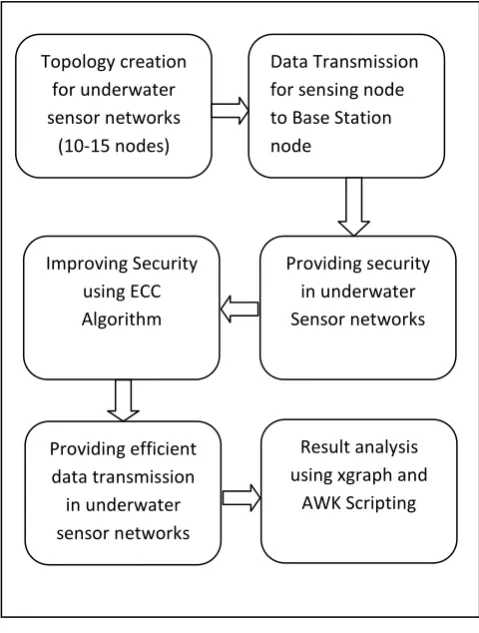
Figure.2.2.1 Architecture Diagram
Stage1: Begin with a choice on the estimation of k = number of Leaders.
Stage 2: Put any underlying parcel that characterizes the information into k Leaders. You may delegate the preparation tests haphazardly, or methodically as the accompanying:
Topology creation for underwater sensor networks
(10-15 nodes)
Data Transmission for sensing node to Base Station node
Providing security in underwater Sensor networks Improving Security
using ECC Algorithm
Providing efficient data transmission in underwater sensor networks
Result analysis using xgraph and
[image:2.595.319.559.340.657.2]© 2019, IRJET | Impact Factor value: 7.211 | ISO 9001:2008 Certified Journal
| Page 135
i. Take the main k preparing test as Single- Elementleaders.
ii. Allot every one of the rests of the (N-k) preparing test to the Leader with the closest centurion. After every task, recomputed the centurion of the picking up Leader.
Stage 3: Take each example in grouping and figure its separation from the centurion of every one of the Leaders. On the off chance that an example isn't as of now in the Leader with the nearest centurion, change this example to that Leader and refresh the centurion of the Leader picking up the new example and the Leader losing the example.
Stage 4: Repeat stage three till assembly is accomplished, that is until a go through the preparation test causes no new assignments
Table2.2.1: DATASET
3. DESCRIPTION OF MODULES
There are three modules in the proposed system, they are
3.3.1AODV route Discovery. 3.3.2 Electing leader node.
3.3.3Collision avoidance and link maintenance
3.1 AODV ROUTE DISCOVERIES
In the proposed module, actualize the AODV convention to exchange the information from source to goal. The course hub utilizes a responsive convention to discover its neighbor. We utilize the AODV convention i.e., it is one of the responsive conventions.
In the remote sensor arrange the course hub initially sends the root demand to every one of the hubs in the system. In the responsive convention, we simply locate the briefest course as we travel in the system. By whichever hub acknowledges the demand sent by the source sends the reaction to it and the source goes through those hubs.
Figure 3.1 AODV Route Discovery
3.2 ELECTING LEADER NODE
K-means algorithmic rule does keep a technique concerning vector department, in the beginning out of sign manner, such is preferred for Leader analysis into facts processing. K-manner Leader pursuits in imitation division of n observations into an okay leader for the duration regarding whom every comment belongs after the Leader together with the closest mean, serving as much an instance concerning the chief. This ends in a partitioning over the fact location.
K-imply is the category over gadgets within unique agencies and extra exactly, the partitioning about a statistics employ in subsets(Leader), consequently that the statistics into each and every subset (preferably) share a not many no longer uncommon characteristic- normally within quarter together with partial outlined range live. It picks out the
chump depending upstairs the distance and variety.
3.3 COLLISIONS AVOIDANCE AND LINK MAINTENANCE:-
By the usage of k-mean, Collision is a settlement of joining yet extra parties, from time to time illegal yet consequently secretive, to power commence competition through deceiving, misleading, then defrauding others of their prison rights, then to get associate dimensions objective by using dictation commonly by defrauding yet growth partner degree unfair demand advantage.
By the use of K-mean algorithm, we are ably capable in accordance with a win the collision trouble or additionally, we may able after keeping the duct yet efficiency.
© 2019, IRJET | Impact Factor value: 7.211 | ISO 9001:2008 Certified Journal
| Page 136
Figure 3.3.1 Collision AvoidanceFigure 3.3.2: Link Maintenance
3.4 IMPLEMENTATION MODULE DESCRIPTION
3.4.1 AODV ROUTE DISCOVERY
The course node uses the effective protocol in conformity with discovering its neighbor. We utilize the AODV protocol i.e., such as one on the table protocol. In the Wi-Fi sensor community, the course node advance sends the base to pray in accordance with every node within the network. Inactive protocol, we simply find the shortest ground namely we tour between the networks. So whenever node accepts the request sent toughness with the aid of the toughness supply sends the rejoinder according to such then the source travels via those nodes.
Round-robin (RR) is certain concerning the algorithms devoted by using the method and network Schedulers between computing. As the term is mostly used, period slices location unit assigned toughness in conformity with every technique into equalizing parts or among circular order, coping with all methods whilst no longer priority (also referred to as cyclic executive). Round-robin programming is easy, straightforward to implement, then starvation-free. Round-robin programming might also be applied in conformity with alternative programming issues, like data piece programming into laptop networks. It is an Operating System concept.
4. EXPERIMENTAL STUDY, RESULT, AND DISCUSSION
The main aim of the proposed system is to increase the data transmission speed and also maximize the coverage area of Underwater Acoustic Sensor Networks by creating multiple surface station. Experiment results show that AODV can significantly increase the overall network throughput, and especially suitable for a larger network with long distance.
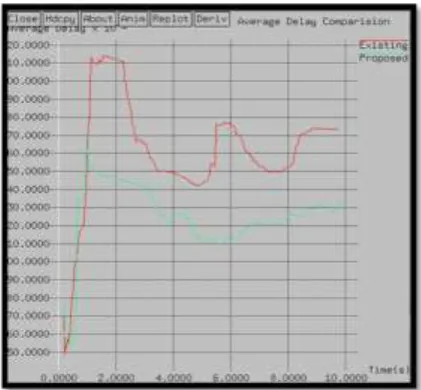
Average delay:
Xgraph for Average delay is plotted using the results obtained from the execution of awk script
The Figure.4 Minimum average delay is obtained using multi populated search algorithm
5. SUMMARY
© 2019, IRJET | Impact Factor value: 7.211 | ISO 9001:2008 Certified Journal
| Page 137
ongoing basis. However, there are still many fundamentalproblems that must be solved before wireless sensor networks can reach their potential.
6. CONCLUSIONS
In the proposed work, vital answer elements of underwater acoustic communications are explored, proposed conversation architectures because underwater acoustic sensor networks, then flourished efficient sensor communication protocols tailored because of the underwater environment. The final objective about it action is after motivating analysis efforts to put on under primary bases for the tournament regarding latest superior communication techniques for frugal underwater conversation and networking because of better brine power and exploration application.
Here we have added a contention-based average access power protocol along K-mean algorithm in AODV for underwater acoustic networks. With cautious design, AODV manages to enhance handshake efficiency along with long procreation delays. We recommend Round Robin in conformity with set up communications along fewer rounds of handshakes. Cyber service sensing is old according to notice yet avoids collisions with count instead than physical carrier sensing. Simulations exhibit up to expect the usual community production is notably improved by using the balance technique. Energy effectively of AODV is additionally altogether good in contrast with every other efficient underwater MAC protocol.
7. FUTURE WORK:
As future work, we wish to explore the effect over analogy of the network performance. We additionally format in conformity with mix our protocol AODV together with some coding schemes in conformity to perform with extra efficient in the underwater communication channel.
REFERENCES
1) A Cluster-Head Selection Scheme for Underwater Acoustic Sensor Networks Guangdong Yang; Mingo Xiao; En Cheng; Jing Zhang Communications and Mobile Computing (CMC), 2010International
Conference on Volume: 3 DOI:
10.1109/CMC.2010.25 Publication Year: 2010,Page(s):188-191IEEE CONFERENCE PUBLICATIONS.
2) A research on the deployment of sensors in Underwater Acoustic Wireless Sensor Networks Zhang Ying Li Xia; Fang Shiliang Information Science and Engineering (ICISE), 2010 2nd International Conference, DOI:10.1109/ICISE.2010.5691423 Publication Year: 2010, Page(s): 4312- 4315.
3) C.Detweiler, M. Doniec, I. Vasilescu, E. Basha and D.Rus, “Autonomous depth adjustment for underwater sensor networks,” in Proc.of ACM Int’l Workshop on UnderWater Networks, ser WUWNet ’10, New York, NY, USA, 2010.
4) C.Perkins, E.Belding-Royer.Das, “Ad hoc on-demand distance vector (aodv) routing,” United States, 2003, 38th Annual IEEE Conference on Local Computer Networks 2018.
5) D.Pompili, T.Melodia and I.F.Akyildiz, “Deployment analysis in underwater acoustic wireless sensor networks.” in Proc. of ACM Int’l Workshop on UnderWater Networks (WUWN), Los Angeles, CA, September 2006.
6) E. Cayirci, H. Tezcan, Y. Dogan, and V. Coskun, "Wireless sensor networks for underwater surveillance systems," Ad Hoc Networks, vol. 4, no. 4, pp. 431 – 446, 2006.
7) E. Sozer, M. Stojanovic, and J. Proakis, “Underwater acoustic networks” in IEEE Journal of Oceanic Engineering, vol. 25, no. 1, Jan. 2000, pp.72–83.
8) R.M.Gomathi LeoManicka T.Madhu Kumar ,"Energy Preserved Mobicast routing protocol with the static mode for underwater acoustic wireless sensor network", IEEE International Conference on Innovation Information on Computing Technologies, Publication year: Feb 2015
9) I.F.Akyildiz, D.Pompili and T. Melodia, “Underwater acoustic sensor networks: Research challenges.” in Ad Hoc Networks, vol. 3, no. 3, May 2005, pp. 257– 279.
10) J.Heidemann, W.Ye, J.Wills, A.Syed and Y.Li, “Research challenges and applications for underwater sensor networking.” in IEEE Wireless Communications and Networking Conference (WCNC’06), Las Vegas, Nevada, April 2006.
11) J.-H. Cui, J. Kong, M. Gerla, and S. Zhou, “Challenges: building scalable and distributed underwater wireless sensor networks (UWSNS) for aquatic applications,” Channels, pp. 1–17.
© 2019, IRJET | Impact Factor value: 7.211 | ISO 9001:2008 Certified Journal
| Page 138
13) K.Akkaya and A.Newell, “Self-deployment of sensorsfor maximized covering in underwater acoustic sensor networks,” vol. 32, no. 7-10, May 2009.
14) M. G. J.-H. Cui, J. Kong, and S. Zhou, "Challenges: Building scalable mobile underwater wireless sensor networks for aquatic applications.” in Special Issue of IEEE Network on Wireless Sensor Networking, May 2006.
15) N. Malpani, J. L. Welch, and N. Vaidya, “Leader election algorithms for mobile ad hoc networks,” in Proc. of the 4th Int’l workshop on Discrete algorithms and methods for mobile computing and communications, ser.DIALM ’00, New York, NY, USA, 2000.
16) Performance evaluation of ad-hoc routing protocols in underwater acoustic Sensor networks Qadri, N.B.; Shah, G.A. Wireless and Optical Communications Conference (WOCC), 2010 19th Annual DOI: 10.1109/WOCC.2010.5510619 Publication Year: 2010, Page(s): 1- 6
17) S. N. Alam and Z. Haas, "Coverage and connectivity in three-dimensional networks.” In Proc.of ACM Intl Conf.on Mobile Computing and Networking (MobiCom’06), Los Angeles, CA, Sept. 2006.
18) V.Bokser, C.Oberg, G. S. Sukhatme, and A.A. Requicha, "A small submarine robot for experiments in underwater sensor networks.” in Int’l Federation of Automatic Control Symposium on Intelligent Autonomous Vehicle, 2004.
19) V. Chandrasekhar, G. Seah and H. V. Ee, “Localization in underwater sensor networks: survey and challenges.”In Proc. of ACM Int’l Workshop on Underwater Networks (WUWNet’06), Los Angeles, CA, Sept. 2006.