740
Comparing MT Approaches for Text Normalization
Claudia Matos Veliz, Orph´ee De Clercq and V´eronique Hoste LT3, Language and Translation Technology Team - Ghent Univeristy
Groot-Brittanni¨elaan 45, 9000, Ghent, Belgium
Abstract
One of the main characteristics of social media data is the use of non-standard lan-guage. Since NLP tools have been trained on traditional text material, their perfor-mance drops when applied to social me-dia data. One way to overcome this is to first perform text normalization. In this work, we apply text normalization to noisy English and Dutch text coming from different genres: text messages, mes-sage board posts and tweets. We con-sider the normalization task as a Machine Translation problem and test the two lead-ing paradigms: statistical and neural ma-chine translation. For SMT we explore the added value of varying background cor-pora for training the language model. For NMT we have a look at data augmentation since the parallel datasets we are work-ing with are limited in size. Our results reveal that when relying on SMT to per-form the normalization, it is beneficial to use a background corpus that is close to the genre to be normalized. Regarding NMT, we find that the translations - or normalizations - coming out of this model are far from perfect and that for a low-resource language like Dutch adding ad-ditional training data works better than ar-tificially augmenting the data.
1 Introduction
Probably one of the most persistent characteris-tics of social media texts is that they are full of non-standard words (Eisenstein, 2013). Several sources of noise can influence the way people write. For example, the different kind of social media platforms available nowadays provide a
di-verse range of ways to communicate and particular forms of language variations (Ke et al.,2008). So-cial variables such as gender, age and race can also influence communication style (Schwartz et al., 2013;Blodgett et al., 2016). Location is also an important variable, since it can lead to the use of dialect and non-standard words. (Vandekerckhove and Nobels,2010;Blodgett et al.,2016).
Very typical for this User-Generated Con-tent (UGC) is the expression of emotions by the use of symbols or lexical variations of the words (Van Hee et al., 2017). This can be done in the form of flooding or the repetition of characters, capitalization, and the productive use of emoticons. In addition, the use of ho-mophonous graphemic variants of a word, abbre-viations, spelling mistakes or letter transpositions are very typical, since people tend to write as they speak and/or write as fast as possible.
One can imagine that all those characteristics contribute to an increased difficulty of automati-cally processing and analyzing UGC. Since Nat-ural Language Processing (NLP) tools have orig-inally been developed for and trained on standard language, these non-standard forms adversely af-fect language analysis using these tools. One of the computational approaches which has been sug-gested to tackle this problem is text normaliza-tion (Sproat et al.,2001). This approach envisages transforming the lexical variants to their canonical forms. In this way, standard NLP tools can be ap-plied in a next step, after normalization. Kobus et al. (2008) introduced three metaphors to re-fer to these normalization approaches: the spell checking, automatic speech recognition and ma-chine translation metaphors. In section2these ap-proaches are discussed in more depth.
statistical machine translation (SMT) and neu-ral machine translation (NMT), on English and Dutch parallel corpora with data coming from three genres (text messages, message board posts and tweets). For SMT we explore the added value of varying background corpora for training the language model. For NMT we have a look at data augmentation since the parallel datasets we are working with are limited in size. Our results reveal that when relying on SMT to perform the normalization it is beneficial to use a background corpus that is close to the genre to be normalized. Regarding NMT, we find that the translations - or normalizations - coming out of this model are far from perfect and that for a low-resource language, like Dutch, adding additional training data works better than artificially augmenting the data.
In the following section, we discuss related work on text normalization. In section3, we give more information about our parallel data and de-scribe the methodology we used to perform the SMT and NMT experiments. Section 4gives an overview of the results, whereas section 5 con-cludes this work and offers some prospects for fu-ture work.
2 Related Works
Previous research on UGC text normalization has been performed on diverse languages using dif-ferent techniques ranging from hand-crafted rules (Chua et al., 2018) to deep learning approaches (Ikeda et al.,2016;Sproat and Jaitly,2016;Lusetti et al., 2018). Kobus et al. (2008) introduced three metaphors to refer to these normalization ap-proaches: the spell checking, automatic speech recognition and translation metaphors.
In the spell checking metaphor, corrections from noisy to standard words occur at the word level. As in conventional spelling correction one has to deal with both non-word and real-word er-rors (Clark and Araki, 2011). The disadvantage of this approach is that all non-standard words (NSWs) have to be represented in the dictionary in order to obtain the corresponding normaliza-tion. Therefore, the success of this kind of sys-tems highly depends on the dictionary coverage. However, as UGC is a very generative language and new variants of canonical words and phrases appear constantly, it is very difficult and expensive to maintain a high coverage lexicon. Other works have approached the problem using a noisy
chan-nel model. In this model, the goal is to find the intended wordwgiven a wordxwhere the letters have been changed in some way. Correct words in the text remain untouched. This model is prob-ably the most popular and successful approach to spelling correction (Dutta et al., 2015; Goot, 2015). Although spelling correction is mostly per-formed on languages which are morphologically simple and with a fairly strict word order, like En-glish, there has been some progress for normal-ization applied to other languages as well, such as Russian (Sorokin,2017) and French (Beaufort and Roekhaut,2010).
Text found in social media shares features with spoken language and theautomatic speech recog-nition metaphorexploits this similarity. This ap-proach starts by converting the input message into a phone lattice, which is converted to a word lat-tice using a phoneme-grapheme dictionary. Fi-nally, the word lattice is decoded by applying a language model to it and using a best-path algo-rithm to recover the most likely original word se-quence. This metaphor has mainly been merged with the machine translation (infra) and spell checking (supra) metaphors to improve the qual-ity of the normalization. Kobus et al.(2008), for example, incorporated ideas from speech recogni-tion to text message normalizarecogni-tion and combined it with a machine translation system. Beaufort and Roekhaut(2010); Xue et al.(2011) andHan and Baldwin(2011) also combined the automatic speech recognition approach with spell checking and machine translation techniques.
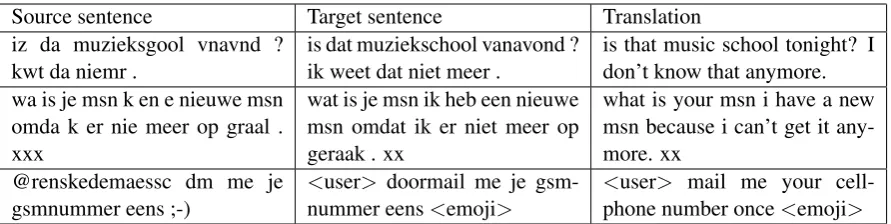
Source sentence Target sentence Translation iz da muzieksgool vnavnd ?
kwt da niemr .
is dat muziekschool vanavond ? ik weet dat niet meer .
is that music school tonight? I don’t know that anymore. wa is je msn k en e nieuwe msn
omda k er nie meer op graal . xxx
wat is je msn ik heb een nieuwe msn omdat ik er niet meer op geraak . xx
what is your msn i have a new msn because i can’t get it any-more. xx
@renskedemaessc dm me je gsmnummer eens ;-)
<user> doormail me je gsm-nummer eens<emoji>
<user> mail me your cell-phone number once<emoji>
Table 1: Source and target pairs as parallel data for a machine translation approach.
the normalization of English tweets: he first pre-processed the tweets to remove as much noise as possible and then used a machine translation ap-proach to convert them into standard English. MT approaches when used at the character level, also have the advantage of being effective when small training data is provided, thanks to their small vo-cabulary size. De Clercq et al. (2013) proposed a phrase-based method to normalize Dutch UGC comprising various genres. They performed ex-periments at several levels of granularity: charac-ter and word level. In a preprocessing step they handled emoticons, hyperlinks, hashtags and so forth. Then they worked in two steps: first at the word level and then at the character level. This ap-proach revealed good results across various genres of UGC; however a high number of phonetic al-ternations still remained unresolved. Schulz et al. (2016) made a modification to the previous work by combining the three metaphors (machine trans-lation, spell checking and speech recognition) in a multi-modular system and by using a novel ap-proach for decoding. This led to an improve-ment in the selection of the best normalization op-tion. Furthermore, they showed a performance im-provement of state-of-the-art NLP tools on UGC data when normalization is used as a previous step.
Recently, neural networks have proven to out-perform many state-of-the-art systems in sev-eral NLP tasks (Young et al., 2018). The encoder-decoder model for recurrent neural net-works (RNN) was developed in order to address the sequence-to-sequence nature of machine trans-lation and it obtains good results for this task (Sutskever et al., 2014; Cho et al., 2014; Bah-danau et al.,2014;Luong et al.,2015). The model consists of two neural networks: an encoder and a decoder. The encoder extracts a fixed-length representation from a variable-length input sen-tence, and the decoder generates a correct
trans-lation from this representation. Some works on text normalization have followed the same ap-proach. Ikeda et al. (2016) performed text nor-malization at the character level for Japanese text and proposed a method for data augmentation using hand-crafted rules. They proved that the use of the synthesised corpus improved the per-formance of Japanese text normalization. Man-dal and Nanmaran (2018) presented an architec-ture for automatic normalization of phonetically transliterated words to their standard forms in a code-mixed scenario improving the accuracy of a pre-existing sentiment analysis system by 1.5%. Lusetti et al.(2018) performed text normalization over Swiss German WhatsApp messages and com-pared it to a state-of-the-art SMT system. They showed that integrating language models into an encoder-decoder framework can reach and even improve the performance of character-level SMT methods for that language.
In this work, we also consider the normalization task as a MT problem and test both statistical and neural machine translation. For SMT, we explore the added value of varying background corpora for training the language model. For NMT, we inves-tigate whether we can overcome the limited data set size by using data augmentation.
3 Methodology
3.1 Parallel Corpora
We relied on existing Dutch (Schulz et al.,2016) and English (De Clercq et al.,2014) corpora that were manually normalized1(Table2). Three gen-res were included for both languages:
Tweets (TWE) which were randomly selected for both languages from the social network.
Message board posts (SNS) which were in both languages sampled from the social network Netlog, which was a Belgian social networking website targeted at youngsters.
Text messages (SMS) which were sampled from the Flemish part of the SoNaR corpus (Treurniet et al.,2012) for the Dutch language and from the NUS SMS corpus (Chen and Kan,2013) for English.
Genre # Sent. #Words %
English Ori Tgt
TWE 810 13477 13545 0.50
SNS 2592 26881 27713 3.00
SMS 1435 20663 22946 3.94
Dutch
TWE 842 13013 13024 0.08
SNS 770 11670 11913 2.04
SMS 801 13063 13610 4.19
Table 2: Parallel corpora data statistics in both lan-guages.
Table2shows the number of parallel sentences in each corpus and the number of words before and after normalization. Regarding the level of noise, we observe that the text messages required most normalization operations in both languages (an in-crease of 3.94% for English and one of 4.19% for Dutch). We also notice that the Dutch tweets re-quired hardly any normalization (0.08%). This can be explained by the fact that this platform has been mainly adopted by professionals in Belgium who write in a more formal style (Schulz et al.,2016).
3.2 SMT Approach
The core idea behind SMT relies on the noisy channel model. In this task, two basic components are integrated:
argmax
y∈W
P(y|x) = argmax
y∈W
P(x|y)P(y)
The translation model P(y|x) is responsible for the correctness of the translation from the source
x = x1, x2, ..., xm to the target sentence y =
1All data was normalized following the procedure
de-scribed inSchulz et al.(2016)
y1, y2, ..., yn. The language modelP(y)is respon-sible for the fluency of the sentence in the target language.W is the set of all target sentences.
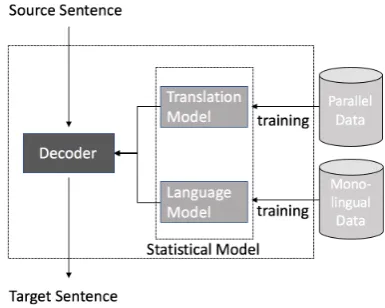
To achieve better context-sensitive source-target mappings, traditional SMT systems rely on phrase-level translation models. These models al-low to build a phrase table to store aligned phrase pairs in the source and target language. This is a difficult task since one word in one language may correspond to several words in the other language. However when translating from noisy to standard text we can assume that most of the words have a one-to-one mapping. Figure1illustrates the archi-tecture of an SMT system.
Figure 1: SMT architecture.
taken for Dutch, for which we used an in-house subtitles dataset, Europarl, and the combination of both.
Corpus Sentences
English
OPUS 22,512,649
Europarl 2,005,395
Combined OPUS+Europarl
Dutch
Subtitles 8,056,693
Europarl 2,000,113
Combined OPUS+Europarl
Table 3: Size (expressed in sentences) of the monolingual corpora used for training our LMs.
3.3 NMT Approach
Neural Machine Translation incorporates the ad-vantages of newly developed deep learning ap-proaches into the task. Sequence-to-Sequence (seq2seq) models have been used for a variety of NLP tasks including machine translation obtaining state-of-the-art results (Luong et al.,2015;Young et al.,2018). In this approach both input and out-put sentences are going in and out of the model. As described in the literature overview, the model consists of two neural networks: an encoder and decoder (See Figure 2). The encoder extracts a fixed-length representation from a variable-length input sentence (A B C D), and the decoder gener-ates a correct translation from this representation (X Y Z). In the figure<eos>marks the end of a sentence. The encoder-decoder model is trained on a parallel corpus consisting of aligned source sentences and their normalized forms (see Table 1).
Figure 2: Encoder-decoder architecture. The light-color nodes represent the encoder and the dark-color ones the decoder. Image taken from Luong et al.(2015).
Neural systems, however, require huge amounts of data in order to perform properly. The train-ing data we have available for text normalization amounts to only a few hundred sentences, as can be derived from Table2. Moreover, manually an-notating more training is highly time-consuming. Under these conditions, we decided to experimen-tally verify whether it is more beneficial to use a data augmentation technique (step A) which possi-bly resolves the data scarcity problem (Saito et al., 2017) or to annotate more data (step B). We tested this on the Dutch corpus and one particular genre, namely text messages (SMS). For step A, we aug-mented the parallel data by duplicating monolin-gual subtitles data on both the source and target side. For step B, we sampled and manually anno-tated ten thousand extra tokens from the Flemish part of the SoNaR corpus (Treurniet et al.,2012)2. We relied on OpenNMT3to train our encoder-decoder model. OpenNMT is an open source (MIT) initiative for neural machine translation and neural sequence modeling (Klein et al., 2017). The main system is implemented in the Lua/Torch mathematical framework, and can easily be ex-tended using Torch’s internal standard neural net-work components. We used the version of the sys-tem with the basic architecture which consists of an encoder using a simple LSTM recurrent neu-ral network. The decoder applies attention over the source sequence and implements input feeding (Luong et al.,2015).
3.4 Evaluation
For evaluating the results of the normalization we calculated Word Error Rate (WER), a commonly used machine translation evaluation metric. WER is derived from the Levenshtein distance ( Leven-shtein, 1966), working at the word level instead of the character level. It takes into account the number of insertions (INS), deletions (DEL) and substitutions (SUBS) that are needed to transform the suggested string into the manually normalized string. The metric is computed as follows:
W ER= IN S+DEL+SU BS
N
whereN in the number of words in the reference. Table 4 reports WER computed between the original and target parallel sentence pairs that were
2
Following the same annotation guidelines asSchulz et al.
(2016)
Figure 3: Normalization results at the token level. The left chart presents the results on the English datasets and the right one the results on the Dutch dataset.
used for training our models.
Word Error Rate (%)
Genre English Dutch
TWE 12.160 10.592
SNS 15.400 21.390
SMS 17.190 25.130
Table 4: WER values (in percentage) at the sen-tence level
WER values were calculated per sentence and averaged within the document. The higher the value, the more operations are needed to obtain the target sentence. Looking at the values, we again notice that genres requiring the most and least nor-malization are the text messages (SMS) and tweets (TWE), respectively.
4 Experiments
4.1 Varying Background Corpora for SMT
With the first round of experiments we want to research the influence of varying the monolin-gual data that are used to construct the language models. We trained LMs at the character level using unigrams and bigrams and at the token level. All LMs were built using the SRILM toolkit (Stolcke,2002) with Witten-Bell discount-ing which has proven to work well on small data sets (Tiedemann, 2012a;Mahmudul Hasan et al., 2012;De Clercq et al.,2013). To evaluate the per-formance of each LM, Word Error Rate (WER) was calculated.
The parallel data (Table 2) used for training the translation model were divided using 80% for training the model and 10% for development and testing, respectively. The target sentences from the training set were also added to the monolingual corpus for training the language model.
Despite several works reporting better results when using a character-level approach (De Clercq et al.,2014;Lusetti et al.,2018) our experiments revealed the best performance with SMT at the to-ken level. The bar charts in Figure3 present the results of SMT at the token level with the different LMs.
Regarding the monolingual background cor-pora, we notice that Europarl leads to the best re-sults for the tweets (TWE) genre which was ac-tually the genre with the least noise (see Section 3.1). Our experiment shows WERs of 4% and 6.3% for English and Dutch, respectively. This result was to be expected as the word usage in Europarl is mostly standard and therefore close to the word usage in the tweets. The same is true for the genre comprising the most noise, i.e text messages. The word usage in the Subtitles/OPUS dataset is less standard and closer to spoken lan-guage and, indeed, also in this case we obtained a WER of 9.5% for English using OPUS, and a WER of 12% for Dutch using a combination of the Subtitles dataset and Europarl.
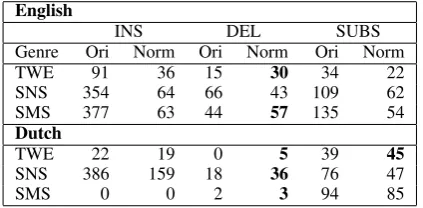
(SUBS) in the original sentence pairs (Ori) and af-ter normalization (Norm) (Table5).
English
INS DEL SUBS
Genre Ori Norm Ori Norm Ori Norm
TWE 91 36 15 30 34 22
SNS 354 64 66 43 109 62
SMS 377 63 44 57 135 54
Dutch
TWE 22 19 0 5 39 45
SNS 386 159 18 36 76 47
SMS 0 0 2 3 94 85
Table 5: Number of operations required before (Ori) and after (Norm) normalization.
Ideally, the number of operations after nor-malization should be reduced to zero. As can be derived from the table many operations were strongly reduced; however, many cases still need to be solved. We will have a closer look at some of these cases in the next section.
4.2 Error Analysis of the SMT Results
The number of remaining insertions is mostly linked to the problem of abbreviation expansions. Very common abbreviations likeloloromgare al-ways corrected, whereas others like r.e. andp.e.
forreligiousandphysical educationorcum on den
forcome on thenare not corrected since they never appear in the training data.
When we consider the deletions, we can ob-serve that flooding or repetition of characters is of-ten not solved with SMT. For example, tokens like
okkk, awwwww or sentences like immaaa dooiin fiiine ! remained unchanged. A straightforward way to overcome this problem could be to reduce the number of repetitions to two or three in some cases as a pre-normalization step. The second fac-tor that affects the number of deletions is the hy-pernormalization of some words. This leads to an increase in the number of operations since some-times we will have to perform more deletion oper-ations on the predicted sentences than on the orig-inal ones (these instances are indicated in bold in Table 5). This is for example the case with the name alwhich was incorrectly normalized to all
or the normalization ofi can ’t really think... into
i can not really not think. These problems also affect the number of substitutions. In general, we also notice that the normalization of Dutch presents a higher number of errors.
4.3 NMT Approach to UGC Normalization
As we explained before, neural approaches have obtained state-of-the-art results for the task of Ma-chine Translation. Neural approaches however, are well-known to require big amounts of paral-lel data in order to perform properly. Especially for Dutch, which can be considered a low-resource language, it is difficult to find freely available par-allel data and annotating new data is both money and time-consuming.
Under these conditions we decided to experi-mentally verify whether it is more beneficial to use a data augmentation technique (step A) which possibly resolves the data scarcity problem (Saito et al., 2017) or annotate more data (step B). We tested this on the Dutch corpus and one particular genre, the most noisy one, namely text messages (SMS).
For Step A, our idea was to make use of the monolingual subtitles corpus in both sides of the parallel data in order to augment the number of sentences available for training our model. Doing this, we obtain a bigger dataset consisting of the Dutch SMS parallel corpus and the Dutch Subti-tles dataset which is duplicated in the source and target data. That is a total of 8,057,334 parallel sentences for training.
src sent. wa gaat je doen ? xxx norm sent. wat gaat je doen ? xxx
src sent. oeiiii misterieus<emoji>xxx norm sent. oeiiii misterieus<emoji>xxx
src sent. dne dvd vn is ni goe ze . ge kunt nx zien . mt betale . x
norm sent. het dvd hem is niet niet het maar wat wat in ik . niet betale . x x x x x
Table 6: Original (src) and predicted (norm) sen-tences using the NMT approach.
Unfortunately, as can be derived from the ta-ble above, results following this approach are very poor. It is common in the output to find repeti-tion of words like in the third sentence (niet, wat
andx). Besides, some sentences that needed nor-malization like the second sentence in the table, were not normalized at all. For example, the words
con-sisted of sentences of the type<emoji>, de , , , . . . <emoji>. These are random repetitions of the most represented tokens likeik(Iin English), punctuation marks or<emoji>labels.
In order to corroborate our other hypothesis, we collected and manually normalized more data for step B. In order to check how this system works at different levels of granularity, we also performed experiments using bigram and unigrams of char-acters. Regarding the results, also for NMT the results are better at the word level than at the char-acter level, with WERs of 15% instead of 29% and 26% for bigram and unigram, respectively.
4.4 Error Analysis of the NMT Results
Using the new data configuration the system is ca-pable to correctly translate sentences like the first one in Table7.
src sent. aahn , ok ma cva dan kzal dan wel wa zoeken xp merci eh x
norm sent. ah , ok´e maar c¸a va dan ik zal dan wel wat
zoeken<emoji>merci h x
tgt sent. ah , ok´e maar c¸a va dan ik zal dan wel wat
zoeken<emoji>merci h x
src sent. zal dan eentjevmezelf sturen . zorgen we
morgenavond dan voor verrassingv
kareltje ?
norm sent. zal dan eentje van mag sturen . zorgen we morgenavond dan voor cocktail van droomt ?
tgt sent. zal dan eentje van mezelf sturen . zorgen we morgenavond dan voor verrassing voor kareltje ?
Table 7: Original (src), predicted (norm) and target (tgt) sentences using the NMT approach trained on the extended dataset.
However, the system still produces a large num-ber of odd normalizations. In the second sen-tence in Table7, for example, only the bold words should have been normalized. However, only one of those two words was correctly normalized, the other one was normalized but not into its correct form. On the other hand, the system also produces odd translations of words that already were in their standard form. For example the word mezelf is changed to mag and we got cocktail van droomt
instead of the desired normalization, ie. verrass-ing voor kareltje.
In general, while the results using this approach are very poor, the experiments revealed that hav-ing a bigger parallel trainhav-ing corpus could improve the performance of this system.
5 Conclusions and Future Work
In this article, we have presented two different approaches to text normalization of social media text: statistical and neural machine translation. We applied text normalization to English and Dutch text from different genres: text messages, message board posts and tweets. Best results were achieved at the token level for all genres and for both SMT and NMT.
For the SMT experiments, regarding the differ-ent corpora that were used to construct the LM, we found that Europarl gave the best results for the least noisy genre (tweets). The same is true for the noisiest genre (text messages). Considering our results, it seems to be important to make vari-ations in the background data for building the LM, depending on the amount of noise and vocabulary that is present in the genre. With respect to the re-maining errors we believe that following a modu-lar approach instead of only using SMT could lead to a much better performance.
Our NMT approach performs poorly due to the scarcity of the data, although we did find that for a low-resource language like Dutch adding addi-tional training data works better than artificially augmenting the data. The data augmentation tech-nique used, however, was very basic and we be-lieve that other techniques could lead to better results, such as hand-crafted rules for the pro-duction of abbreviations or the use of previously trained embedding in order to build similar sen-tences helping to generalize better.
Exploring those other data augmentation tech-niques is a first avenue for future work. Besides we also want to test the benefits of the integra-tion of a neural LM in the encoder-decoder model to help with the translation of out-of-vocabulary words.
References
AiTi Aw, Min Zhang, Juan Xiao, and Jian Su. 2006.
A phrase-based statistical model for SMS text nor-malization. Proceedings of the COLING/ACL on Main conference poster sessions - (July):33–40.
https://doi.org/10.1109/TCST.2005.854339.
Dzmitry Bahdanau, Kyunghyun Cho, and Yoshua
Ben-gio. 2014. Neural Machine Translation by Jointly
Learning to Align and Translate. arXiv preprint
pages 1–15. http://arxiv.org/abs/1409.0473.
Richard Beaufort and Sophie Roekhaut. 2010. A
Workshop on NLP for Similar Languages, Va-rieties and Dialects (VarDial). pages 18–28.
http://www.aclweb.org/anthology/W18-3902.
A. S. M. Mahmudul Hasan, Saria Islam, and M. Mah-mudul Rahman. 2012. A Comparative Study of Wit-ten Bell and Kneser-Ney Smoothing Methods for
Statistical Machine Translation. Journal of
Infor-mation Technology (JIT)1(June):1–6.
Soumil Mandal and Karthick Nanmaran. 2018.
Normalization of Transliterated Words in Code-Mixed Data Using Seq2Seq Model & Leven-shtein Distance. In Proceedings of the 2018 EMNLP Workshop W-NUT: The 4th Workshop on Noisy User-generated Text. Association for
Computational Linguistics, Brussels, Belgium,
pages 49–53. https://en.wikipedia.org/wiki/ISO
http://arxiv.org/abs/1805.08701.
Itsumi Saito, Jun Suzuki, Kyosuke Nishida, and
Kugatsu Sadamitsu. 2017. Improving Neural
Text Normalization with Data Augmentation at Character- and Morphological Levels. Proceed-ings of the The 8th International Joint Conference on Natural Language Processing pages 257–262.
http://aclweb.org/anthology/I17-2044.
Sarah Schulz, Guy De Pauw, Orph´ee De Clercq, Bart Desmet, V´eronique Hoste, Walter Daelemans, and
Lieve Macken. 2016. Multimodular Text
Normal-ization of Dutch User-Generated Content. ACM Transactions on Intelligent Systems and Technology
7(4):1–22.https://doi.org/10.1145/2850422.
Andrew H. Schwartz, Johannes C. Eichstaedt, Mar-garet L. Kern, Lukasz Dziurzynski, Stephanie M. Ramones, Megha Agrawal, Achal Shah, Michal Kosinski, David Stillwell, Martin E. P. Seligman,
and Lyle H. Ungar. 2013. Personality, Gender,
and Age in the Language of Social Media : The Open-Vocabulary Approach. PLoS ONE 8(9).
https://doi.org/10.1371/journal.pone.0073791.
Alexey Sorokin. 2017. Spelling Correction for
Mor-phologically Rich Language: a Case Study of Rus-sian. Proceedings of the 6th Workshop on Balto-Slavic Natural Language Processing(April):45–53.
https://doi.org/10.18653/v1/w17-1408.
Richard Sproat, Alan W. Black, Stanley Chen, Shankar Kumar, Mari Ostendorf, and Christopher Richards.
2001. Normalization of non-standard words.
Computer Speech and Language 15(3):287–333.
https://doi.org/10.1006/csla.2001.0169.
Richard Sproat and Navdeep Jaitly. 2016. RNN
Ap-proaches to Text Normalization: A Challenge. Com-puting Research Repository (CoRR) abs/1611.0.
http://arxiv.org/abs/1611.00068.
Andreas Stolcke. 2002. SRILM - an extensible
language modeling toolkit. In 7th Interna-tional Conference on Spoken Language Pro-cessing.. Denver, Colorado, pages 901–904.
https://doi.org/10.1.1.157.2429.
Ilya Sutskever, Oriol Vinyals, and Quoc V. Le.
2014. Sequence to Sequence Learning with
Neural Networks. In Advances in neural in-formation processing systems, pages 3104–3112.
http://arxiv.org/abs/1409.3215.
J¨org Tiedemann. 2012a. Character-Based Pivot Trans-lation for Under-Resourced Languages and
Do-mains. Proceedings of the 13th Conference of the
European Chapter of the Association for Computa-tional Linguisticspages 141–151.
J¨org Tiedemann. 2012b. Parallel Data, Tools and In-terfaces in OPUS.Proceedings of the Eight Interna-tional Conference on Language Resources and Eval-uation (LREC’12)pages 2214–2218.
Maaske Treurniet, Henk van den Heuvel, Nelleke Oost-dijk, and Orph´ee De Clercq. 2012. Collection of
a corpus of Dutch SMS. Proceedings of the Eight
Conference of International Language Resources and Evaluation.pages 2268–2273.
Cynthia Van Hee, Marjan Van De Kauter, Orphe De Clercq, Els Lefever, Bart Desmet, and Vronique Hoste. 2017. Noise or music? Investigating the use-fulness of normalisation for robust sentiment
analy-sis on social media data. Revue Traitement
Automa-tique des Langues58(1):63–87.
Reinhild Vandekerckhove and Judith Nobels. 2010. Code eclecticism : Linguistic variation and code al-ternation in the chat language of Flemish teenagers.
Journal of Sociolinguistics14(5):657–677.
Zhenzhen Xue, Dawei Yin, and Bd Davison. 2011.
Normalizing Microtext. Analyzing Microtextpages
74–79.
Tom Young, Devamanyu Hazarika, Soujanya Poria,
and Erik Cambria. 2018. Recent trends in deep
learning based natural language processing. ieee Computational intelligenCe magazine13(3):55–75.