2171
Inoculation by Fine-Tuning: A Method for Analyzing Challenge Datasets
Nelson F. Liu♠♥♣ Roy Schwartz♠♣ Noah A. Smith♠♣
♠Paul G. Allen School of Computer Science & Engineering,
University of Washington, Seattle, WA, USA
♥Department of Linguistics, University of Washington, Seattle, WA, USA
♣Allen Institute for Artificial Intelligence, Seattle, WA, USA
{nfliu,roysch,nasmith}@cs.washington.edu
Abstract
Several datasets have recently been con-structed to expose brittleness in models trained on existing benchmarks. While model perfor-mance on thesechallenge datasetsis signifi-cantly lower compared to the original bench-mark, it is unclear what particular weaknesses they reveal. For example, a challenge dataset may be difficult because it targets phenomena that current models cannot capture, or because it simply exploits blind spots in a model’s spe-cific training set. We introduceinoculation by fine-tuning, a new analysis method for study-ing challenge datasets by exposstudy-ing models (the metaphorical patient) to a small amount of data from the challenge dataset (a metaphor-ical pathogen) and assessing how well they can adapt. We apply our method to analyze the NLI “stress tests” (Naik et al.,2018) and the Adversarial SQuAD dataset (Jia and Liang, 2017). We show that after slight exposure, some of these datasets are no longer challeng-ing, while others remain difficult. Our results indicate that failures on challenge datasets may lead to very different conclusions about models, training datasets, and the challenge datasets themselves.
1 Introduction
NLP research progresses through the construction of dataset-benchmarks and the development of systems whose performance on them can be fairly compared. A recent pattern involveschallengesto benchmarks:1 manipulations to input data that re-sult in severe degradation of system performance,
but not human performance. These challenges
have been used as evidence that current systems are brittle (Belinkov and Bisk,2018;Mudrakarta et al., 2018; Zhao et al., 2018; Glockner et al.,
2018;Ebrahimi et al.,2018;Ribeiro et al., 2018,
[image:1.595.320.510.221.424.2]1Often referred to as “adversarial datasets” or “attacks”.
Figure 1: An illustration of the standard challenge eval-uation procedure (e.g., Jia and Liang,2017) and our proposed analysis method. “Original”refers to the a standard dataset (e.g., SQuAD) and“Challenge”refers to the challenge dataset (e.g., Adversarial SQuAD). Outcomes are discussed in Section2.
inter alia). For instance, Naik et al.(2018) gen-erated natural language inference challenge data by applying simple textual transformations to ex-isting examples from MultiNLI (Williams et al.,
2018) and SNLI (Bowman et al.,2015). Similarly,
Jia and Liang (2017) built an adversarial evalua-tion dataset for reading comprehension based on SQuAD (Rajpurkar et al.,2016).
What should we conclude when a system fails on a challenge dataset? In some cases, a challenge might exploit blind spots in the design of the origi-naldataset (dataset weakness). In others, the chal-lenge might expose an inherent inability of a par-ticular model family to handle certain natural lan-guage phenomena (model weakness). These are, of course, not mutually exclusive.
new method for analyzing the effects of challenge datasets (Figure1).2 Given a model trained on the original dataset, we expose it to a small number of examples from the challenge dataset, allowing learning to continue. To the extent that the weak-ness lies with the original dataset, then the inocu-lated model will perform well on both the original and challenge held-out data (Outcome 1 in Fig-ure1). If the weakness lies with the model, then inoculation will prove ineffective and the model’s performance will remain unchanged (Outcome 2). Inoculation can also decrease a model’s perfor-mance on the original dataset (Outcome 3). This case is not as clear as the first two, and could result from systematic differences between the original and challenge datasets, due to, e.g., predictive ar-tifacts in either dataset (Gururangan et al.,2018).
We apply our method to analyze six challenge datasets: theword overlap, negation, spelling er-rors, length mismatch and numerical reasoning NLI challenge datasets proposed by Naik et al.
(2018), as well as the Adversarial SQuAD reading comprehension challenge dataset (Jia and Liang,
2017). We analyze NLI datasets with the ESIM (Chen et al.,2017) and the decomposable attention (Parikh et al.,2016) models, and reading compre-hension with the BiDAF (Seo et al.,2017) and the QANet (Yu et al.,2018) models.
By fine-tuning on, in some cases, as few as 100 examples, both NLI models are able to recover al-most the entire performance gap on both theword overlapandnegationchallenge datasets (Outcome 1). In contrast, both models struggle to adapt to thespelling error andlength mismatchchallenge datasets (Outcome 2). On thenumerical reasoning challenge dataset, both models close all of the gap using a small number of samples, but at the ex-pense of performance on the original dataset (Out-come 3). For Adversarial SQuAD, BiDAF closes 60% of the gap with minimal fine-tuning, but suf-fers a 7% decrease in original test set performance (Outcome 3). QANet shows similar trends.
Our proposed analysis is broadly applicable, easy to perform, and task-agnostic. By gaining a better understanding of how challenge datasets stress models, we can better tease apart limitations of datasets and limitations of models.
2
Inoculationevokes the idea that treatable diseases have different implications (for society and for the patient) than untreatable ones. We differentiate the abstract process of in-oculation from our way of executing it (fine-tuning) since it is easy to imagine alternative ways to inoculate a model.
2 Inoculation by Fine-Tuning
Our method assumes access to an original dataset divided into training and test portions, as well as a challenge dataset, divided into a (small) train-ing set3 and a test set. After training on the orig-inal (training) data, we measure system perfor-mance on both test sets. We assume the usual observation—a generalization gap with consider-ably lower performance on the challenge test set.
We then proceed to fine-tune the model on the challenge training data, i.e., continuing to train the pre-trained model on the new data until develop-ment performance on the original developdevelop-ment set has not improved for five epochs.4 Finally, we measure performance of the inoculated model on both the original and challenge test sets. Three clear outcomes of interest are:5
Outcome 1 The gap closes, i.e., the inoculated system retains its (high) performance on the origi-nal test set and performs as well (or nearly so) on the challenge test set. This case suggests that the challenge dataset did not reveal a weakness in the model family. Instead, the challenge has likely re-vealed a lack of diversity in the original dataset.
Outcome 2 Performance on both test sets is
unchanged. This indicates that the challenge
dataset has revealed a fundamental weakness of the model; it is unable to adapt to the challenge data distribution, even with some exposure.
Outcome 3 Inoculation damages performance on the original test set (regardless of improvement on the challenge test set). The main difference be-tween Outcome 3 and Outcomes 1 and 2 is that here, by fine-tuning, the model is shifting towards a challenge distribution that somehow contradicts the original distribution. This could result from, e.g., a different label distribution between both datasets, or annotation artifacts that exist in one dataset but not in the other (see Sections3.2,3.3).
3 Not all Challenge Datasets are Alike
To demonstrate the utility of our method, we ap-ply it to analyze the NLI stress tests (Naik et al.,
3
The exact amount of challenge data used for fine-tuning might affect our conclusions, so we consider different sizes of the “vaccine” in our experiments.
4The use of the original development set is meant to both
prevent us from using more challenge data and verify that the learner does not completely forget the original dataset.
5The outcome may also lie between these extremes,
Category Premise Hypothesis
Word Overlap Possibly no other country has had such a turbu-lent history.
The country’s history has been turbulentand true is true.
Negation Possibly no other country has had such a turbu-lent history.
The country’s history has been turbulent and false is not true.
Spelling Errors Fix the engine, Dave Hanson, he called. Hanson receivedordetsnot to fixtehengine.
Length Mismatch Possibly no other country has had such a turbu-lent historyand true is true and true is true and true is true and true is true and true is true.
The countrys history has been turbulent.
Numerical Reasoning Tim has 350 pounds of cement in 100, 50, and 25 pound bags.
[image:3.595.72.526.64.206.2]Tim has less than 750 pounds of cement in 100, 50, and 25 pound bags.
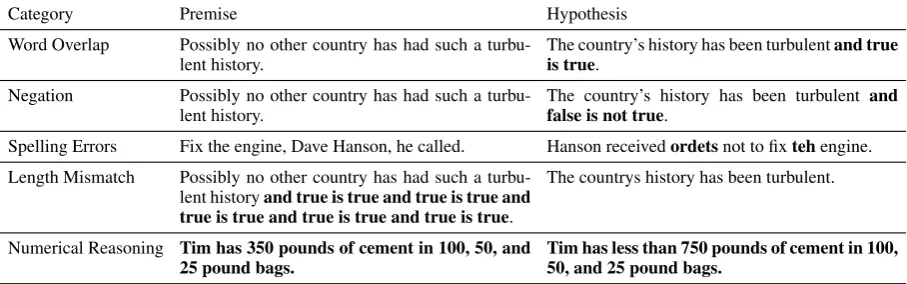
Table 1: Examples from each of the NLI challenge datasets analyzed, a subset of a broader suite of NLI stress tests proposed byNaik et al.(2018). Boldface denotes perturbations to original MultiNLI examples. Figure contents reproduced fromNaik et al.(2018).
Article:Super Bowl 50
Paragraph: Peyton Manning became the first quarter-back ever to lead two different teams to multiple Super Bowls. He is also the oldest quarterback ever to play in a Super Bowl at age 39. The past record was held by John Elway, who led the Broncos to victory in Super Bowl XXXIII at age 38 and is currently Denver’s Execu-tive Vice President of Football Operations and General Manager.Quarterback Jeff Dean had jersey number 37 in Champ Bowl XXXIV.
Question:What is the name of the quarterback who was 38 in Super Bowl XXXIII?
Figure 2: An example from the Adversarial SQuAD dataset, with the distractor sentencein blue. Figure re-produced fromJia and Liang(2017).
2018) and the Adversarial SQuAD dataset (Jia and
Liang, 2017). We fine-tune models on a varying
number of examples from the challenge dataset training split in order to study whether our method is sensitive to the level of exposure.6 Our results demonstrate that different challenge datasets lead to different outcomes. We release code for repro-ducing our results.7
3.1 Datasets
We briefly describe the analyzed datasets, but refer readers to the original publications for details.
NLI Stress Tests Naik et al.(2018) proposed six automatically-constructed “stress tests”, each fo-cusing on a different weakness of NLI systems. We analyze five of these stress tests (Table1).8
6
See AppendixAfor experimental process details.
7
http://nelsonliu.me/papers/ inoculation-by-finetuning
8The remaining challenge dataset—antonym—is briefly
discussed in Section3.3.
Theword overlapchallenge dataset is designed to exploit models’ sensitivity to high lexical over-lap in the premise and hypothesis by appending the tautology “and true is true”to the hypothe-sis. The negation challenge dataset is based on the observation that negation words (e.g., “no”, “not”) cause the model to classify neutral or en-tailed statements as contradiction. In this dataset, the tautology“and false is not true”is appended to the hypothesis sentence. The spelling errors
challenge dataset is designed to evaluate model ro-bustness to noisy data in the form of misspellings. The length mismatch challenge dataset is de-signed to exploit models’ inability to handle ex-amples with much longer premises than hypothe-ses. In this dataset, the tautology “and true is true” is appended five times to the end of the premise. Lastly, the numerical reasoning chal-lenge dataset is designed to test models’ ability to perform algebraic calculations, by introducing premise-hypothesis pairs containing numerical ex-pressions.
We analyze these challenge datasets using two models, both trained on the MultiNLI dataset:9the ESIM model (Chen et al., 2017) and the decom-posable attention model (DA;Parikh et al.,2016). To better address the spelling errors challenge dataset, we also train a character-sensitive version of the ESIM model. We concatenate the word rep-resentations with the 50-dimensional hidden states
9
Outcome 1
Outcome 2
Outcome 3
(a) Word Overlap (c) Spelling Errors (e) Numerical Reasoning
0 10 50 100 400 500 750 1K
# of Fine-Tuning Examples
55 60 65 70 75 80 Accuracy Original (ESIM) Original (DA) Challenge (ESIM) Challenge (DA)
0 10 50 100 400 500 750 1K
# of Fine-Tuning Examples
67 70 73 76 79 Accuracy Original (ESIM) Original (DA) Original (char-level) Challenge (ESIM) Challenge (DA) Challenge (char-level)
0 10 50 100 400 500 750 1K
# of Fine-Tuning Examples
20 40 60 80 100 Accuracy Original (ESIM) Original (DA) Challenge (ESIM) Challenge (DA)
(b) Negation (d) Length Mismatch (f) Adversarial SQuAD
0 10 50 100 400 500 750 1K
# of Fine-Tuning Examples
40 50 60 70 80 Accuracy Original (ESIM) Original (DA) Challenge (ESIM) Challenge (DA)
0 10 50 100 400 500 750 1K
# of Fine-Tuning Examples
60 65 70 75 80 Accuracy Original (ESIM) Original (DA) Challenge (ESIM) Challenge (DA)
0 10 50 100 400 500 750 1K
# of Fine-Tuning Examples
[image:4.595.79.511.54.338.2]45 55 65 75 85 F1 Original (BiDAF) Original (QANet) Challenge (BiDAF) Challenge (QANet)
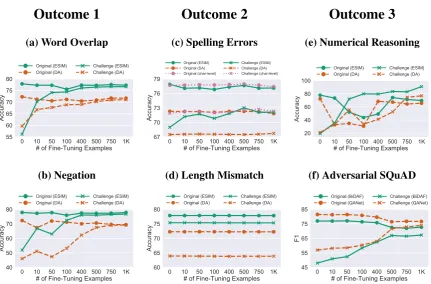
Figure 3: Inoculation by fine-tuning results. (a–e): NLI accuracy for the ESIM and decomposable attention (DA) models. (f): Reading comprehensionF1scores for the BiDAF and QANet models.
Fine-tuning on a small number of word overlap (a) and negation (b) examples erases the performance gap (Outcome 1). Fine-tuning does not yield significant improvement on spelling errors (c) and length mismatch (d), but does not degrade original performance either (Outcome 2). Fine-tuning on numerical reasoning (e) closes the gap entirely, but also reduces performance on the original dataset (Outcome 3). On Adversarial SQuAD (f), around 60% of the performance gap is closed after fine-tuning, though performance on the original dataset decreases (Outcome 3). On each challenge dataset, we observe similar trends between different models.
produced by running each token through a charac-ter bidirectional GRU (Cho et al.,2014).
Adversarial SQuAD Jia and Liang(2017) cre-ated a challenge dataset for reading comprehen-sion by appending automatically-generated dis-tractor sentences to SQuAD passages. The ap-pended distractor sentences are crafted to look similar to the question while not contradicting the correct answer or misleading humans (Figure 2). The authors released model-independent Adver-sarial SQuAD examples, which we analyze. For our analysis, we use the BiDAF model (Seo et al.,
2017) and the QANet model (Yu et al.,2018).
3.2 Results
We refer to difference between a model’s pre-inoculation performance on the original test set and the challenge test set as theperformance gap.
NLI Stress Tests Figure 3 presents NLI accu-racy for the ESIM and DA models on the word overlap, negation, spelling errors, length
mis-match and numerical reasoning challenge datasets after fine-tuning on a varying number of challenge examples.
For the word overlap and negation challenge datasets, both ESIM and DA quickly close the performance gap when fine-tuning (Outcome 1). For instance, on both of the aforementioned chal-lenge datasets, ESIM requires only 100 exam-ples to close over 90% of the performance gap while maintaining high performance on the orig-inal dataset. Since these performance gaps are closed after seeing a few challenge dataset exam-ples (<0.03% of the original MultiNLI training dataset), these challenges are likely difficult be-cause they exploit easily-recoverable gaps in the models’ training dataset rather than highlighting their inability to capture semantic phenomena.
is unaffected (Outcome 2).10 Interestingly, the character-aware ESIM model trained on spelling errors shows a similar trend, suggesting that the this challenge set is highlighting a weakness of ESIM that goes beyond the word representation.
On numerical reasoning, the entire gap is closed by fine-tuning ESIM on 100 examples, or DA on 750 examples. However, both models’ original dataset performance substantially decreases (Out-come 3; see discussion in Section3.3).
Adversarial SQuAD Figure3(f) shows BiDAF and QANet results after fine-tuning on a varying number of challenge samples.
Fine-tuning BiDAF on only 400 challenge ex-amples closes more than 60% of the performance gap, but also results in substantial performance loss on the original SQuAD development set; fine-tuning QANet yields the same trend (Outcome 3). In this case, the model likely takes advantage of the fact that the adversarial distractor sentence is always concatenated to the end of the paragraph.11
3.3 Discussion
Explaining the Numerical Reasoning Results
The relative ease with which the ESIM model overcomes the numerical reasoning challenge seems to contradict the findings of Naik et al.
(2018), who observed that “the model is unable to perform reasoning involving numbers or quan-tifiers . . .”. Indeed, it seems unlikely that a model will learn to perform algebraic numerical reason-ing based on as few as 50 NLI examples.
However, a closer look at this dataset provides a potential explanation for this finding. The dataset was constructed such that a simple 3-rule base-line is able to surpass 80% on the task (see Ap-pendixC). For instance, 35% of the dataset exam-ples contain the phrase “more than” or “less than” in their hypothesis, and 95% of these have the la-bel “neutral”. As a result, learning a handful of these rules is sufficient for achieving high perfor-mance on this challenge dataset.
This observation highlights a key property of Outcome 3: challenge datasets that are easily re-coverable by our method, at the expense of
perfor-10The length mismatch dataset is not particularly
challeng-ing for the ESIM model: its untuned performance on the chal-lenge set is only 2.5% lower than its original performance. Nonetheless, this gap remains fixed even after fine-tuning
11Indeed,Jia and Liang(2017) show that models trained
on Adversarial SQuAD are able to overcome the adversary by simply learning to ignore the last sentence of the passage.
mance on the original dataset, are likely not test-ing the full breadth of a ltest-inguistic phenomenon but rather a specific aspect of it.
Limitations of Our Method Our inoculation method assumes a somewhat balanced label dis-tribution in the challenge dataset training portion. If a challenge dataset is highly skewed to a specific label, fine-tuning will result in simply learning to predict the majority label; such a model would achieve high performance on the challenge dataset and low performance on the original dataset (Out-come 3). For such datasets, the result of our method is not very informative.12 Nonetheless, as
in the numerical reasoning case discussed above, this lack of diversity signals a somewhat limited phenomenon captured by the challenge dataset.
4 Conclusion
We presented a method for studying why
chal-lenge datasets are difficult for models. Our method fine-tunes models on a small number of challenge dataset examples. This analysis yields insights into models, their training datasets, and the chal-lenge datasets themselves. We applied our method to analyze the challenge datasets of Naik et al.
(2018) and Jia and Liang(2017). Our results in-dicate that some of these challenge datasets break models by exploiting blind spots in their training data, while others may challenge more fundamen-tal weaknesses of model families.
Acknowledgments
We thank Aakanksha Naik and Abhilasha
Ravichander for generating NLI stress test exam-ples from the MultiNLI training split, and Robin Jia for answering questions about the Adversarial
SQuAD dataset. We also thank the members
of the Noah’s ARK group at the University of Washington, the researchers at the Allen Institute for Artificial Intelligence, and the anonymous
reviewers for their valuable feedback. NL is
supported by a Washington Research Foundation Fellowship and a Barry M. Goldwater
Schol-arship. This work was supported in part by a
hardware gift from NVIDIA Corporation.
12For instance, the
antonymchallenge dataset ofNaik et al.
References
Yonatan Belinkov and Yonatan Bisk. 2018. Synthetic and natural noise both break neural machine transla-tion. InProc. of ICLR.
Samuel R. Bowman, Gabor Angeli, Christopher Potts, and Christopher D. Manning. 2015. A large anno-tated corpus for learning natural language inference. InProc. of EMNLP.
Qian Chen, Xiaodan Zhu, Zhenhua Ling, Si Wei, Hui Jiang, and Diana Inkpen. 2017. Enhanced LSTM for natural language inference. InProc. of ACL.
Kyunghyun Cho, Bart Van Merri¨enboer, Caglar Gul-cehre, Dzmitry Bahdanau, Fethi Bougares, Holger Schwenk, and Yoshua Bengio. 2014. Learning phrase representations using RNN encoder-decoder for statistical machine translation. In Proc. of EMNLP.
Javid Ebrahimi, Anyi Rao, Daniel Lowd, and Dejing Dou. 2018. Hotflip: White-box adversarial exam-ples for text classification. InProc. of ACL.
Matt Gardner, Joel Grus, Mark Neumann, Oyvind Tafjord, Pradeep Dasigi, Nelson F. Liu, Matthew Pe-ters, Michael Schmitz, and Luke Zettlemoyer. 2018. AllenNLP: A deep semantic natural language pro-cessing platform. InProc. of NLP-OSS.
Max Glockner, Vered Shwartz, and Yoav Goldberg. 2018. Breaking NLI systems with sentences that re-quire simple lexical inferences. InProc. of ACL.
Suchin Gururangan, Swabha Swayamdipta, Omer Levy, Roy Schwartz, Samuel R. Bowman, and Noah A. Smith. 2018. Annotation artifacts in nat-ural language inference data. InProc. of NAACL.
Robin Jia and Percy Liang. 2017. Adversarial exam-ples for evaluating reading comprehension systems. InProc. of EMNLP.
Pramod Kaushik Mudrakarta, Ankur Taly, Mukund Sundararajan, and Kedar Dhamdhere. 2018. Did the model understand the question? InProc. of ACL.
Aakanksha Naik, Abhilasha Ravichander, Norman Sadeh, Carolyn Penstein Ros´e, and Graham Neubig. 2018. Stress test evaluation for natural language in-ference. InProc. of COLING.
Ankur P. Parikh, Oscar T¨ackstr¨om, Dipanjan Das, and Jakob Uszkoreit. 2016. A decomposable attention model for natural language inference. In Proc. of EMNLP.
Pranav Rajpurkar, Jian Zhang, Konstantin Lopyrev, and Percy Liang. 2016. SQuAD: 100,000+ questions for machine comprehension of text. In Proc. of EMNLP.
Marco Tulio Ribeiro, Sameer Singh, and Carlos Guestrin. 2018. Semantically equivalent adversarial rules for debugging NLP models. InProc. of ACL.
Minjoon Seo, Aniruddha Kembhavi, Ali Farhadi, and Hannaneh Hajishirzi. 2017. Bidirectional attention flow for machine comprehension. InProc. of ICLR.
Adina Williams, Nikita Nangia, and Samuel R. Bow-man. 2018. A broad-coverage challenge corpus for sentence understanding through inference. InProc. of NAACL.
Adams Wei Yu, David Dohan, Minh-Thang Luong, Rui Zhao, Kai Chen, Mohammad Norouzi, and Quoc V. Le. 2018. Qanet: Combining local convolution with global self-attention for reading comprehension. In
Proc. of ICLR.
Appendices
A Experimental Setup Details
Generating challenge training sets When varying the size of the challenge dataset train split used for fine-tuning, we subsample inclusively. For example, the dataset used for fine-tuning on 5 examples is a subset of the dataset used for fine-tuning on 100 examples, which is a subset of the dataset used for fine-tuning on 1000 examples. Theword overlap,negation,spelling errorsand length mismatch NLI challenge datasets, as well as Adversarial SQuAD, include splits for training and evaluation. To generate the datasets used for fine-tuning, we subsample 1000 random examples from each of the challenge dataset train splits.13 The evaluation splits are used as-is.
Thenumerical reasoningNLI challenge dataset is unsplit. As a result, we generate the datasets used for fine-tuning by subsampling 1000 ran-dom examples from the entirety of the challenge dataset, and use the remaining examples for eval-uation.
Experimental details To train the ESIM model ofChen et al.(2017), the decomposable attention model ofParikh et al.(2016), the BiDAF model of
Seo et al.(2017), and the QANet model ofYu et al.
(2018), we use the implementations in AllenNLP (Gardner et al.,2018). The models are trained with the same hyperparameters as described in their re-spective papers.
For each training dataset size, we tune the learn-ing rate on theoriginaldevelopment set accuracy; the learning rate is halved whenever validation performance (F1 for SQuAD, accuracy for NLI) does not improve, and we employ early stopping with a patience of 5. This ensures that we are not implicitly using additional challenge dataset ex-amples. For each model and amount of challenge dataset examples used for fine-tuning, the reported challenge dataset performance is the performance of the learning rate configuration that yields the best challenge dataset performance. We leave all other hyperparameters (such as the batch size and choice of optimizer) unchanged from the model’s original training procedure.
For the Adversarial SQuAD experiments, we experiment with learning rates of 0.00001, 0.0001,
13For Adversarial SQuAD, we subsample from distinct
passages.
0.001 and 0.01. For the NLI stress test
ex-periments, we experiment with learning rates of 0.000001, 0.00001, 0.0001, 0.0004, 0.001, and 0.01.
B MultiNLI Mismatched Stress Test Results
(a) Word Overlap (b) Negation
0
10
50 100 400 500 750 1K
# of Fine-Tuning Examples
55
60
65
70
75
80
Accuracy
Original (ESIM) Original (DA)
Challenge (ESIM) Challenge (DA)
(a) Performance of the ESIM and DA models after fine-tuning on a variable number of word overlap chal-lenge dataset examples generated from the MultiNLI mis-matched development set.
0
10
50 100 400 500 750 1K
# of Fine-Tuning Examples
40
50
60
70
80
Accuracy
Original (ESIM) Original (DA)
Challenge (ESIM) Challenge (DA)
(b) Performance of the ESIM and DA models after fine-tuning on a variable number of negation challenge dataset examples generated from the MultiNLI mismatched de-velopment set.
(c) Spelling Errors (d) Length Mismatch
0
10
50 100 400 500 750 1K
# of Fine-Tuning Examples
67
70
73
76
79
Accuracy
Original (ESIM) Original (DA) Original (char-level)
Challenge (ESIM) Challenge (DA) Challenge (char-level)
(c) Performance of the ESIM (with and without an ad-ditional character-level component) and DA models after fine-tuning on a variable number of spelling error chal-lenge dataset examples generated from the MultiNLI mis-matched development set.
0
10
50 100 400 500 750 1K
# of Fine-Tuning Examples
60
65
70
75
80
Accuracy
Original (ESIM) Original (DA)
Challenge (ESIM) Challenge (DA)
(d) Performance of the ESIM and DA models after fine-tuning on a variable number of length mismatch chal-lenge dataset examples generated from the MultiNLI mis-matched development set.
(e) Numerical Reasoning
0 10 50 100 400 500 750 1K
# of Fine-Tuning Examples
2040 60 80 100
Accuracy
Original (ESIM) Original (DA)
Challenge (ESIM) Challenge (DA)
C Three Simple Rules for the Numerical Reasoning Dataset
The numerical reasoning dataset of Naik et al.
(2018) has 7,596 examples in total, with 2,532 in each of the “entailment”, “neutral”, and “contra-diction” categories. With only three rules, we can correctly classify around 82% of the examples.
1,235 examples (out of the 7,596 in total) can be correctly labeled as contradiction with the rule: “more than” or “less than” do not appear in the premise or the hypothesis.
2,664 examples (out of the 6,361 examples left to be considered) contain “more than” or “less than” in the hypothesis. Of these 2,664 exam-ples, 2,532 have the label “neutral”, 66 have the label “entailment”, and 66 have the label “con-tradiction”. So, if the hypothesis contains “more than” or “less than”, we predict “neutral”. This rule leads us to correctly classify 2,532 examples and incorrectly classify 132 examples.
Finally, we have 3,697 examples to be consid-ered. All 3,697 of these examples have “more than” or “less than” in the premise. 2,466 of these examples are labeled “entailment”, while 1,231 are labeled “contradicion”. By assigning the label “entailment” to examples that contain “more than” or “less than” in their premise, we correctly clas-sify 2,446 examples and incorrectly clasclas-sify 1,231 examples.