Split and Rephrase
Shashi Narayan† Claire Gardent‡ Shay B. Cohen† Anastasia Shimorina‡ †School of Informatics, University of Edinburgh, 10 Crichton Street, Edinburgh EH8 9AB, UK
‡CNRS, LORIA, UMR 7503, Vandoeuvre-l`es-Nancy, F-54500, France
[email protected] [email protected] [email protected] [email protected]
Abstract
We propose a new sentence simplifica-tion task (Split-and-Rephrase) where the aim is to split a complex sentence into a meaning preserving sequence of shorter sentences. Like sentence simplification, splitting-and-rephrasing has the potential of benefiting both natural language pro-cessing and societal applications. Because shorter sentences are generally better pro-cessed by NLP systems, it could be used as a preprocessing step which facilitates and improves the performance of parsers, semantic role labelers and machine trans-lation systems. It should also be of use for people with reading disabilities be-cause it allows the conversion of longer sentences into shorter ones. This paper makes two contributions towards this new task. First, we create and make available a benchmark consisting of 1,066,115 tu-ples mapping a single complex sentence to a sequence of sentences expressing the same meaning.1 Second, we propose five
models (vanilla sequence-to-sequence to semantically-motivated models) to under-stand the difficulty of the proposed task.
1 Introduction
Several sentence rewriting operations have been extensively discussed in the literature: tence compression, multi-sentence fusion, sen-tence paraphrasing and sensen-tence simplification.
Sentence compression rewrites an input sen-tence into a shorter paraphrase (Knight and Marcu, 2000; Cohn and Lapata, 2008; Filippova and
1The Split-and-Rephrase dataset is available here:
https://github.com/shashiongithub/ Split-and-Rephrase.
Strube,2008;Pitler,2010;Filippova et al.,2015; Toutanova et al.,2016). Sentence fusion consists of combining two or more sentences with over-lapping information content, preserving common information and deleting irrelevant details ( McK-eown et al., 2010;Filippova, 2010; Thadani and McKeown, 2013). Sentence paraphrasing aims to rewrite a sentence while preserving its mean-ing (Dras, 1999; Barzilay and McKeown, 2001; Bannard and Callison-Burch,2005;Wubben et al., 2010;Mallinson et al.,2017). Finally, sentence (or text) simplification aims to produce a text that is easier to understand (Siddharthan et al.,2004;Zhu et al.,2010;Woodsend and Lapata,2011;Wubben et al.,2012;Narayan and Gardent,2014;Xu et al., 2015;Narayan and Gardent,2016;Zhang and La-pata, 2017). Because the vocabulary used, the length of the sentences and the syntactic structures occurring in a text are all factors known to af-fect readability, simplification systems mostly fo-cus on modelling three main text rewriting opera-tions: simplifying paraphrasing, sentence splitting and deletion.
We propose a new sentence simplification task, which we dub Split-and-Rephrase, where the goal is to split a complex input sentence into shorter sentences while preserving meaning. In that task, the emphasis is on sentence splitting and rephras-ing. There is no deletion and no lexical or phrasal simplification but the systems must learn to split complex sentences into shorter ones and to make the syntactic transformations required by the split (e.g., turn a relative clause into a main clause). Ta-ble1 summarises the similarities and differences between the five sentence rewriting tasks.
Like sentence simplification, splitting-and-rephrasing could benefit both natural language processing and societal applications. Because shorter sentences are generally better processed by NLP systems, it could be used as a
Split Delete Rephr. MPre.
Compression N Y ?Y N
Fusion N Y Y ?Y
Paraphrasing N N Y Y
Simplification Y Y Y N
Split-and-Rephrase Y N Y Y
Table 1: Similarities and differences between sentence rewriting tasks with respect to splitting (Split), deletion (Delete), rephrasing (Rephr.) and meaning preserving (MPre.) operations (Y: yes, N: No, ?Y: should do but most existing approaches do not).
ing step which facilitates and improves the per-formance of parsers (Tomita,1985;Chandrasekar and Srinivas, 1997; McDonald and Nivre, 2011; Jel´ınek, 2014), semantic role labelers (Vickrey and Koller,2008) and statistical machine transla-tion (SMT) systems (Chandrasekar et al., 1996). In addition, because it allows the conversion of longer sentences into shorter ones, it should also be of use for people with reading disabilities (Inui et al., 2003) such as aphasia patients (Carroll et al.,1999), low-literacy readers (Watanabe et al., 2009), language learners (Siddharthan,2002) and children (De Belder and Moens,2010).
Contributions. We make two main contribu-tions towards the development of Split-and-Rephrase systems.
Our first contribution consists in creating and making available a benchmark for training and testing Split-and-Rephrase systems. This bench-mark (WEBSPLIT) differs from the corpora used to train sentence paraphrasing, simplification, compression or fusion models in three main ways. First, it contains a high number of splits and rephrasings. This is because (i) each complex sen-tence is mapped to a rephrasing consisting of at least two sentences and (ii) as noted above, split-ting a sentence into two usually imposes a syntac-tic rephrasing (e.g., transforming a relative clause or a subordinate into a main clause).
Second, the corpus has a vocabulary of 3,311 word forms for a little over 1 million training items which reduces sparse data issues and facilitates learning. This is in stark contrast to the relatively small size corpora with very large vocabularies used for simplification (cf. Section2).
Third, complex sentences and their rephrasings are systematically associated with a meaning rep-resentation which can be used to guide
learn-ing. This allows for the learning of semantically-informed models (cf. Section5).
Our second contribution is to provide five mod-els to understand the difficulty of the proposed Split-and-Rephrase task: (i) A basic encoder-decoder taking as input only the complex sen-tence; (ii) A hybrid probabilistic-SMT model tak-ing as input a deep semantic representation (Dis-course representation structures, Kamp 1981) of the complex sentence produced by Boxer ( Cur-ran et al., 2007); (iii) A multi-source encoder-decoder taking as input both the complex sentence and the corresponding set of RDF (Resource De-scription Format) triples; (iv,v) Two partition-and-generate approaches which first, partition the se-mantics (set of RDF triples) of the complex sen-tence into smaller units and then generate a text for each RDF subset in that partition. One model is multi-source and takes the input complex sentence into account when generating while the other does not.
2 Related Work
We briefly review previous work on sentence split-ting and rephrasing.
Sentence Splitting. Of the four sentence rewrit-ing tasks (paraphrasrewrit-ing, fusion, compression and simplification) mentioned above, only sentence simplification involves sentence splitting. Most simplification methods learn a statistical model (Zhu et al., 2010; Coster and Kauchak, 2011; Woodsend and Lapata, 2011; Wubben et al., 2012;Narayan and Gardent, 2014) from the par-allel dataset of complex-simplified sentences de-rived by Zhu et al. (2010) from Simple English Wikipedia2and the traditional one3.
For training Split-and-Rephrase models, this dataset is arguably ill suited as it consists of 108,016 complex and 114,924 simplified sen-tences thereby yielding an average number of sim-ple sentences per comsim-plex sentence of 1.06. In-deed,Narayan and Gardent(2014) report that only 6.1% of the complex sentences are in fact split in the corresponding simplification. A more detailed evaluation of the dataset byXu et al.(2015) fur-ther shows that (i) for a large number of pairs, the
2Simple English Wikipedia (http://simple.
wikipedia.org) is a corpus of simple texts targeting “children and adults who are learning English Language” and whose authors are requested to “use easy words and short sentences”.
[image:2.595.77.290.62.123.2]simplifications are in fact not simpler than the in-put sentence, (ii) automatic alignments resulted in incorrect complex-simplified pairs and (iii) mod-els trained on this dataset generalised poorly to other text genres. Xu et al.(2015) therefore pro-pose a new dataset, Newsela, which consists of 1,130 news articles each rewritten in four different ways to match 5 different levels of simplicity. By pairing each sentence in that dataset with the cor-responding sentences from simpler levels (and ig-noring pairs of contiguous levels to avoid sentence pairs that are too similar to each other), it is possi-ble to create a corpus consisting of 96,414 distinct complex and 97,135 simplified sentences. Here again however, the proportion of splits is very low. As we shall see in Section3.3, the new dataset we propose differs from both the Newsela and the Wikipedia simplification corpus, in that it con-tains a high number of splits. In average, this new dataset associates 4.99 simple sentences with each complex sentence.
Rephrasing. Sentence compression, sentence fusion, sentence paraphrasing and sentence sim-plification all involve rephrasing.
Paraphrasing approaches include bootstrapping approaches which start from slotted templates (e.g.,“X is the author of Y”) and seed (e.g.,“X = Jack Kerouac, Y = “On the Road””) to iteratively learn new templates from the seeds and new seeds from the new templates (Ravichandran and Hovy, 2002;Duclaye et al.,2003); systems which extract paraphrase patterns from large monolingual cor-pora and use them to rewrite an input text (Duboue and Chu-Carroll,2006;Narayan et al.,2016); sta-tistical machine translation (SMT) based systems which learn paraphrases from monolingual paral-lel (Barzilay and McKeown, 2001; Zhao et al., 2008), comparable (Quirk et al.,2004) or bilingual parallel (Bannard and Callison-Burch,2005; Gan-itkevitch et al.,2011) corpora; and a recent neural machine translation (NMT) based system which learns paraphrases from bilingual parallel corpora (Mallinson et al.,2017).
In sentence simplification approaches, rephras-ing is performed either by a machine transla-tion (Coster and Kauchak, 2011; Wubben et al., 2012;Narayan and Gardent,2014;Xu et al.,2016; Zhang and Lapata, 2017) or by a probabilistic model (Zhu et al., 2010; Woodsend and Lapata, 2011). Other approaches include symbolic ap-proaches where hand-crafted rules are used e.g., to
split coordinated and subordinated sentences into several, simpler clauses (Chandrasekar and Srini-vas,1997;Siddharthan,2002;Canning,2002; Sid-dharthan,2010,2011) and lexical rephrasing rules are induced from the Wikipedia simplification cor-pus (Siddharthan and Mandya,2014).
Most sentence compression approaches focus on deleting words (the words appearing in the compression are words occurring in the input) and therefore only perform limited paraphrasing. As noted by Pitler (2010) and Toutanova et al. (2016) however, the ability to paraphrase is key for the development of abstractive summarisation systems since summaries written by humans of-ten rephrase the original conof-tent using paraphrases or synonyms or alternative syntactic constructions. Recent proposals byRush et al.(2015) andBingel and Søgaard(2016) address this issue.Rush et al. (2015) proposed a neural model for abstractive compression and summarisation, and Bingel and Søgaard(2016) proposed a structured approach to text simplification which jointly predicts possible compressions and paraphrases.
None of these approaches requires that the in-put be split into shorter sentences so that both the corpora used, and the models learned, fail to ad-equately account for the various types of specific rephrasings occurring when a complex sentence is split into several shorter sentences.
Finally, sentence fusion does induce rephrasing as one sentence is produced out of several. How-ever, research in that field is still hampered by the small size of datasets for the task, and the difficulty of generating one (Daume III and Marcu, 2004). Thus, the dataset ofThadani and McKeown(2013) only consists of 1,858 fusion instances of which 873 have two inputs, 569 have three and 416 have four. This is arguably not enough for learning a general Split-and-Rephrase model.
3 The WEBSPLITBenchmark
We derive a Split-and-Rephrase dataset from the WEBNLG corpus presented in Gardent et al. (2017).
3.1 TheWEBNLGDataset
In the WEBNLG dataset, each item consists of a set of RDF triples (M) and one or more texts (Ti) verbalising those triples.
An RDF (Resource Description Format) triple is a triple of the form subject|property|object
where the subject is a URI (Uniform Resource Identifier), the property is a binary relation and the object is either a URI or a literal value such as a string, a date or a number. In what follows, we re-fer to the sets of triples representing the meaning of a text as its meaning representation (MR). Fig-ure1shows three example WEBNLG items with M1, M2, M3 the sets of RDF triples representing the meaning of each item, and{T1
1, T12},{T2}and
{T3}listing possible verbalisations of these mean-ings.
The WEBNLG dataset4consists of 13,308 MR-Text pairs, 7049 distinct MRs, 1482 RDF enti-ties and 8 DBpedia categories (Airport, Astronaut, Building, Food, Monument, SportsTeam, Univer-sity, WrittenWork). The number of RDF triples in MRs varies from 1 to 7. The number of distinct RDF tree shapes in MRs is 60.
3.2 Creating the WEBSPLITDataset
To construct the Split-and-Rephrase dataset, we make use of the fact that the WEBNLG dataset (i) associates texts with sets of RDF triples and (ii) contains texts of different lengths and complexity corresponding to different subsets of RDF triples. The idea is the following. Given a WEBNLG MR-Text pair of the form (M, T) where T is a sin-gle complex sentence, we search the WEBNLG dataset for a set {(M1, T1), . . . ,(Mn, Tn)} such that {M1, . . . , Mn} is a partition of M and
hT1, . . . , Tniforms a text with more than one sen-tence. To achieve this, we proceed in three main steps as follows.
Sentence segmentation We first preprocess all 13,308 distinct verbalisations contained in the WEBNLG corpus using the Stanford CoreNLP
4We use a version from February 2017 given to us
by the authors. A more recent version is available here: http://talc1.loria.fr/webnlg/stories/ challenge.html.
pipeline (Manning et al., 2014) to segment each verbalisationTiinto sentences.
Sentence segmentation allows us to associate each textTin the WEBNLG corpus with the num-ber of sentences it contains. This is needed to identify complex sentences with no split (the in-put to the Split-and-Rephrase task) and to know how many sentences are associated with a given set of RDF triples (e.g., 2 triples may be re-alised by a single sentence or by two). As the CoreNLP sentence segmentation often fails on complex/rare named entities thereby producing unwarranted splits, we verified the sentence seg-mentations produced by the CoreNLP sentence segmentation module for each WEBNLG verbali-sation and manually corrected the incorrect ones.
Pairing Using the semantic information given by WEBNLG RDF triples and the information about the number of sentences present in a WEBNLG text produced by the sentence seg-mentation step, we produce all items of the form
h(MC, C),{(M1, T1). . .(Mn, Tn)}isuch that:
• Cis a single sentence with semanticsMC.
• T1. . . Tn is a sequence of texts that contains at least two sentences.
• The disjoint union of the semantics
M1. . . Mn of the texts T1. . . Tn is the same as the semantics MC of the complex sentenceC. That is,MC =M1U. . .UMn.
This pairing is made easy by the semantic in-formation contained in the WEBNLG corpus and includes two subprocesses depending on whether complex and split sentences come from the same WEBNLG entry or not.
Within entries.Given a set of RDF triplesMC, a WEBNLG entry will usually contain several alter-native verbalisations for MC (e.g., T11 andT12 in Figure 1 are two possible verbalisations of M1). We first search for entries where one verbalisa-tionTC consists of a single sentence and another verbalisationT contains more than one sentence. For such cases, we create an entry of the form
h(MC, TC),{(MC, T)}isuch that,TC is a single sentence andT is a text consisting of more than one sentence. The second example item for WEB -SPLITin Figure1presents this case. It uses differ-ent verbalisations (T1
WEBNLG
M1 {Birmingham|leaderName|John Clancy (Labour politician), John Madin|birthPlace|Birmingham,
103 Colmore Row|architect|John Madin}
T1
1 John Clancy is a labour politican who leads Birmingham, where architect John Madin, who designed 103
Colmore Row, was born.
T2
1 Labour politician, John Clancy is the leader of Birmingham.
John Madin was born in this city. He was the architect of 103 Colmore Row.
M2 {Birmingham|leaderName|John Clancy (Labour politician)}
T2 Labour politician, John Clancy is the leader of Birmingham.
M3 {John Madin|birthPlace|Birmingham, 103 Colmore Row|architect|John Madin}
T3 John Madin was born in Birmingham.
He was the architect of 103 Colmore Row. WEBSPLIT
MC(=M1) {Birmingham|leaderName|John Clancy (Labour politician), John Madin|birthPlace|Birmingham,
103 Colmore Row|architect|John Madin}
C(=T1
1) John Clancy is a labour politican who leads Birmingham, where architect John Madin, who designed 103
Colmore Row, was born.
M2 {Birmingham|leaderName|John Clancy (Labour politician)}
T2 Labour politician, John Clancy is the leader of Birmingham.
M3 {John Madin|birthPlace|Birmingham, 103 Colmore Row|architect|John Madin}
T3 John Madin was born in Birmingham.
He was the architect of 103 Colmore Row.
MC(=M1) {Birmingham|leaderName|John Clancy (Labour politician), John Madin|birthPlace|Birmingham,
103 Colmore Row|architect|John Madin}
C(=T1
1) John Clancy is a labour politican who leads Birmingham, where architect John Madin, who designed 103
Colmore Row, was born.
M1 {Birmingham|leaderName|John Clancy (Labour politician), John Madin|birthPlace|Birmingham,
103 Colmore Row|architect|John Madin}
T2
1 Labour politician, John Clancy is the leader of Birmingham.
[image:5.595.74.521.61.398.2]John Madin was born in this city. He was the architect of 103 Colmore Row.
Figure 1: Example entries from the WEBNLG benchmark and their pairing to form entries in the WEB -SPLITbenchmark.
a WEBSPLIT item associating the complex sen-tence (T1
1) with a text (T12) made of three short sentences.
Across entries. Next we create
h(M, C),{(M1, T1). . .(Mn, Tn)}i entries by searching for all WEBNLG textsCconsisting of a single sentence. For each such text, we create all possible partitions of its semanticsMC and for each partition, we search the WEBNLG corpus for matching entries i.e., for a setS of(Mi, Ti)pairs such that (i) the disjoint union of the semantics
Mi inS is equal toMC and (ii) the resulting set of texts contains more than one sentence. The first example item for WEBSPLITin Figure1is a case in point.C(=T1
1)is the single, complex sentence whose meaning is represented by the three triples
M. hT2, T3i is the sequence of shorter texts C is mapped to. And the semanticsM2 andM3 of these two texts forms a partition overM.
Ordering. For each item
h(MC, C),{(M1, T1). . .(Mn, Tn)}i produced in the preceding step, we determine an order on T1. . . Tn as follows. We observed that the
WEBNLG texts mostly5follow the order in which the RDF triples are presented. Since this order corresponds to a left-to-right depth-first traversal of the RDF tree, we use this order to order the sentences in theTitexts.
3.3 Results
By applying the above procedure to the WEBNLG dataset, we create 1,100,166 pairs of the form
h(MC, TC),{(M1, T1). . .(Mn, Tn)}i where TC is a complex sentence andT1. . . Tnis a sequence of texts with semanticsM1, . . . Mnexpressing the same contentMCasTC. 1,945 of these pairs were of type “Within entries” and the rest were of type “Across entries”. In total, there are 1,066,115 dis-tincthTC, T1. . . Tnipairs with 5,546 distinct com-plex sentences. Comcom-plex sentences are associated with 192.23 rephrasings in average (min: 1, max: 76283, median: 16). The number of sentences in the rephrasings varies between 2 and 7 with an av-erage of 4.99. The vocabulary size is 3,311.
5As shown by the examples in Figure1, this is not always
4 Problem Formulation
The Split-and-Rephrase task can be defined as fol-lows. Given a complex sentence C, the aim is to produce a simplified textT consisting of a se-quence of textsT1. . . Tnsuch thatT forms a text of at least two sentences and the meaning ofCis preserved inT. In this paper, we proposed to ap-proach this problem in a supervised setting where we aim to maximise the likelihood of T givenC
and model parameters θ: P(T|C;θ). To exploit the different levels of information present in the WEBSPLIT benchmark, we break the problem in the following ways:
P(T|C;θ) =X
MC
P(T|C;MC;θ)P(MC|C;θ) (1)
=P(T|C;MC;θ),ifMCis known. (2)
= X
M1−n
P(T|C;MC;M1−n;θ)×
P(M1−n|C;MC;θ) (3)
where,MC is the meaning representation ofC andM1−nis a set{M1, . . . , Mn}which partitions
MC.
5 Split-and-Rephrase Models
In this section, we propose five different models which aim to maximiseP(T|C;θ) by exploiting different levels of information in the WEBSPLIT benchmark.
5.1 A Probabilistic, Semantic-Based Approach
Narayan and Gardent (2014) describes a sen-tence simplification approach which combines a probabilistic model for splitting and deletion with a phrase-based statistical machine translation (SMT) and a language model for rephrasing (re-ordering and substituting words). In particular, the splitting and deletion components exploit the deep meaning representation (a Discourse Representa-tion Structure, DRS) of a complex sentence pro-duced by Boxer (Curran et al.,2007).
Based on this approach, we create a Split-and-Rephrase model (aka HYBRIDSIMPL) by (i) in-cluding only the splitting and the SMT models (we do not learn deletion) and (ii) training the model on the WEBSPLITcorpus.
5.2 A Basic Sequence-to-Sequence Approach
Sequence-to-sequence models (also referred to as encoder-decoder) have been successfully applied
to various sentence rewriting tasks such as ma-chine translation (Sutskever et al.,2011;Bahdanau et al., 2014), abstractive summarisation (Rush et al.,2015) and response generation (Shang et al., 2015). They first use a recurrent neural network (RNN) to convert a source sequence to a dense, fixed-length vector representation (encoder). They then use another recurrent network (decoder) to convert that vector to a target sequence.
We use a three-layered encoder-decoder model with LSTM (Long Short-Term Memory, ( Hochre-iter and Schmidhuber,1997)) units for the Split-and-Rephrase task. Our decoder also uses the local-p attention model with feed input as in ( Lu-ong et al.,2015). It has been shown that the lo-cal attention model works better than the standard global attention model ofBahdanau et al.(2014). We train this model (SEQ2SEQ) to predict, given a complex sentence, the corresponding sequence of shorter sentences.
The SEQ2SEQmodel is learned on pairshC, Ti of complex sentences and the corresponding text. It directly optimisesP(T|C;θ)and does not take advantage of the semantic information available in the WEBSPLITbenchmark.
5.3 A Multi-Source Sequence-to-Sequence Approach
In this model, we learn a multi-source model which takes into account not only the input com-plex sentence but also the associated set of RDF triples available in the WEBSPLITdataset. That is, we maximiseP(T|C;MC;θ)(Eqn.2) and learn a model to predict, given a complex sentenceCand its semanticsMC, a rephrasing ofC.
As noted byGardent et al.(2017), the shape of the input may impact the syntactic structure of the corresponding text. For instance, an input contain-ing a path(X|P1|Y)(Y|P2|Z)equating the object of a property P1 with the subject of a property
P2 may favour a verbalisation containing a sub-ject relative (“x V1 y who V2 z”). Taking into account not only the sentenceC that needs to be rephrased but also its semanticsMCmay therefore help learning.
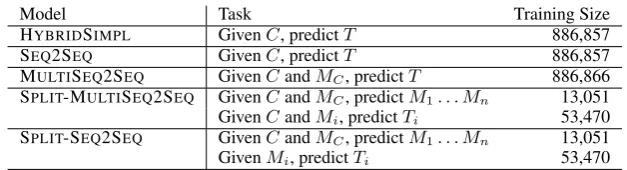
sev-Model Task Training Size HYBRIDSIMPL GivenC, predictT 886,857
SEQ2SEQ GivenC, predictT 886,857
MULTISEQ2SEQ GivenCandMC, predictT 886,866
SPLIT-MULTISEQ2SEQ GivenCandMC, predictM1. . . Mn 13,051
GivenCandMi, predictTi 53,470
SPLIT-SEQ2SEQ GivenCandMC, predictM1. . . Mn 13,051
[image:7.595.140.454.60.145.2]GivenMi, predictTi 53,470
Table 2: Tasks modelled and training data used by Split-and-Rephrase models.
eral strong single source baselines. We explore a similar “trilingual” setting wheref is a complex sentence (C), g is the corresponding set of RDF triples (MC) andhis the output rephrasing (T).
We encodeCandMCusing two separate RNN encoders. To encodeMC using RNN, we first lin-earise MC by doing a depth-first left-right RDF tree traversal and then tokenise using the Stanford CoreNLP pipeline (Manning et al.,2014). Like in SEQ2SEQ, we model our decoder with the local-p attention model with feed inlocal-put as in (Luong et al., 2015), but now it looks at both source en-coders simultaneously by creating separate con-text vector for each encoder. For a detailed expla-nation of multi-source encoder-decoders, we refer the reader toZoph and Knight(2016).
5.4 Partitioning and Generating
As the name suggests, the Split-and-Rephrase task can be seen as a task which consists of two sub-tasks: (i) splitting a complex sentence into sev-eral shorter sentences and (ii) rephrasing the in-put sentence to fit the new sentence distribution. We consider an approach which explicitly mod-els these two steps (Eqn. 3). A first model
P(M1, . . . , Mn|C;MC;θ)learns to partition a set
MCof RDF triples associated with a complex sen-tenceC into a disjoint set{M1, . . . , Mn}of sets of RDF triples. Next, we generate a rephrasing of
Cas follows:
P(T|C;MC;M1, . . . , Mn;θ) (4)
≈P(T|C;M1, . . . , Mn;θ) (5)
=P(T1, . . . , Tn|C;M1, . . . , Mn;θ) (6)
=Yn
i
P(Ti|C;Mi;θ) (7)
where, the approximation from Eqn.4to Eqn.5 derives from the assumption that the generation of
T is independent ofMC given(C;M1, . . . , Mn). We propose a pipeline model to learn parameters
θ. We first learn to split and then learn to generate from each RDF subset generated by the split.
Learning to split. For the first step, we learn a probabilistic model which given a set of RDF triples MC predicts a partition M1. . . Mn of this set. For a given MC, it returns the par-tition M1. . . Mn with the highest probability
P(M1, . . . , Mn|MC).
We learn this split module using items
h(MC, C),{(M1, T1). . .(Mn, Tn)}iin the WEB -SPLIT dataset by simply computing the probabil-ityP(M1, . . . , Mn|MC). To make our model ro-bust to an unseenMC, we strip off named-entities and properties from each RDF triple and only keep the tree skeleton ofMC. There are only 60 distinct RDF tree skeletons, 1,183 possible split patterns and 19.72 split candidates in average for each tree skeleton, in the WEBSPLITdataset.
Learning to rephrase. We proposed two ways to estimateP(Ti|C;Mi;θ): (i) we learn a multi-source encoder-decoder model which generates a text Ti given a complex sentence C and a set of RDF triplesMi ∈ MC ; and (ii) we approximate
P(Ti|C;Mi;θ) by P(Ti|Mi;θ) and learn a sim-ple sequence-to-sequence model which, givenMi, generates a textTi. Note that as described earlier,
Mi’s are linearised and tokenised before we input them to RNN encoders. We refer to the first model by SPLIT-MULTISEQ2SEQand the second model by SPLIT-SEQ2SEQ.
6 Experimental Setup and Results
This section describes our experimental setup and results. We also describe the implementation de-tails to facilitate the replication of our results.
6.1 Training, Validation and Test sets
80%), Validation set (554, 10%) and Test set (554, 10%).
Table 2 shows, for each of the 5 models, a summary of the task and the size of the train-ing corpus. For the models that directly learn to map a complex sentence into a meaning pre-serving sequence of at least two sentences ( HY -BRIDSIMPL, SEQ2SEQ and MULTISEQ2SEQ), the training set consists of 886,857 hC, Ti pairs with C a complex sentence and T, the corre-sponding text. In contrast, for the pipeline mod-els which first partition the input and then gen-erate from RDF data (SPLIT-MULTISEQ2SEQand SPLIT-SEQ2SEQ), the training corpus for learning to partition consists of 13,051hMC,hM1. . . Mnii pairs while the training corpus for learning to gen-erate contains 53,470hMi, Tiipairs.
6.2 Implementation Details
For all our neural models, we train RNNs with three-layered LSTM units, 500 hidden states and a regularisation dropout with probability 0.8. All LSTM parameters were randomly initialised over a uniform distribution within [-0.05, 0.05]. We trained our models with stochastic gradient de-scent with an initial learning rate 0.5. Every time perplexity on the held out validation set in-creased since it was previously checked, then we multiply the current learning rate by 0.5. We performed mini-batch training with a batch size of 64 sentences for SEQ2SEQ and MUL -TISEQ2SEQ, and 32 for SPLIT-SEQ2SEQ and SPLIT-MULTISEQ2SEQ. As the vocabulary size of the WEBSPLITdata is small, we train both en-coder and deen-coder with full vocabulary. We ran-domly initialise word embeddings in the begin-ning and let the model train them during traibegin-ning. We train our models for 20 epochs and keep the best model on the held out set for the testing pur-poses. We used the system of Zoph and Knight (2016) to train both simple sequence-to-sequence and multi-source sequence-to-sequence models6,
and the system ofNarayan and Gardent(2014) to train our HYBRIDSIMPLmodel.7
6We used the code available at https://github.
com/isi-nlp/Zoph_RNN.
7We used the code available at https:
//github.com/shashiongithub/ Sentence-Simplification-ACL14.
Model BLEU #S/C #Tokens/S
SOURCE 55.67 1.0 21.11
HYBRIDSIMPL 39.97 1.26 17.55
SEQ2SEQ 48.92 2.51 10.32
MULTISEQ2SEQ 42.18 2.53 10.69
SPLIT-MULTISEQ2SEQ 77.27 2.84 11.63
SPLIT-SEQ2SEQ 78.77 2.84 9.28
Table 3: Average BLEU scores for rephrasings, average number of sentences in the output texts (#S/C) and average number of tokens per output sentences (#Tokens/S). SOURCE are the complex sentences from the WEBSPLITcorpus.
6.3 Results
We evaluate all models using multi-reference BLEU-4 scores (Papineni et al.,2002) based on all the rephrasings present in the Split-and-Rephrase corpus for each complex input sentence.8 As
BLEU is a metric for n-grams precision estima-tion, it is not an optimal metric for the Split-and-Rephrase task (sentences even without any split could have a high BLEU score). We therefore also report on the average number of output simple sen-tences per complex sentence and the average num-ber of output words per output simple sentence. The first one measures the ability of a system to split a complex sentence into multiple simple sen-tences and the second one measures the ability of producing smaller simple sentences.
Table3shows the results. The high BLEU score for complex sentences (SOURCE) from the WEB -SPLITcorpus shows that using BLEU is not suffi-cient to evaluate splitting and rephrasing. Because the short sentences have many n-grams in mon with the source, the BLEU score for com-plex sentences is high but the texts are made of a single sentence and the average sentence length is high. HYBRIDSIMPLperforms poorly – we con-jecture that this is linked to a decrease in seman-tic parsing quality (DRSs) resulting from com-plex named entities not being adequately recog-nised. The simple sequence-to-sequence model does not perform very well neither does the multi-source model trained on both complex sentences and their semantics. Typically, these two mod-els often produce non-meaning preserving outputs (see example in Table4) for input of longer length. In contrast, the two partition-and-generate mod-els outperform all other modmod-els by a wide
mar-8We used https://github.com/moses-smt/
mosesdecoder/blob/master/scripts/
SOURCE Alan Shepard was born in New Hampshire and he served as the Chief of the Astronaut Office . HYBRIDSIMPL Alan Shepard was born in New Hampshire and he served as of the the chief astronaut office .
SEQ2SEQ Alan Shepard ’s occupation was a test pilot . Alan Shepard was born in New Hampshire .
Alan Shepard was born on Nov 18 , 1923 .
MULTISEQ2SEQ Alan Shepard served as a test pilot . Alan Shepard ’s birth place was New Hampshire .
SPLIT-MULTISEQ2SEQ Alan Shepard served as the Chief of the Astronaut Office . Alan Shepard was born in New
Hampshire .
SPLIT-SEQ2SEQ Alan Shepard served as the Chief of the Astronaut Office . Alan Shepard ’s birth place was
New Hampshire .
Table 4: Example outputs from different models.
gin. This suggests that the ability to split is key to a good rephrasing: by first splitting the input semantics into smaller chunks, the two partition-and-generate models permit reducing a complex task (generating a sequence of sentences from a single complex sentence) to a series of simpler tasks (generating a short sentence from a seman-tic input).
Unlike in neural machine translation set-ting, multi-source models in our setting do not perform very well. SEQ2SEQ and SPLIT -SEQ2SEQ outperform MULTISEQ2SEQ and SPLIT-MULTISEQ2SEQ respectively, despite using less input information than their counter-parts. The multi-source models used in machine translation have as a multi-source, two trans-lations of the same content (Zoph and Knight, 2016). In our approach, the multi-source is a complex sentence and a set of RDF triples, e.g.,
(C;MC) for MULTISEQ2SEQ and (C;Mi) for SPLIT-MULTISEQ2SEQ. We conjecture that the poor performance of multi-source models in our case is due either to the relatively small size of the training data or to a stronger mismatch between RDF and complex sentence than between two translations.
Table4shows an example output for all 5 sys-tems highlighting the main differences. HYBRID -SIMPL’s output mostly reuses the input words sug-gesting that the SMT system doing the rewriting has limited impact. Both the SEQ2SEQ and the MULTISEQ2SEQmodels “hallucinate” new infor-mation (“served as a test pilot”, “born on Nov 18, 1983”). In contrast, the partition-and-generate models correctly render the meaning of the input sentence (SOURCE), perform interesting rephras-ings (“X was born in Y”→“X’s birth place was Y”) and split the input sentence into two.
7 Conclusion
We have proposed a new sentence simplification task which we call “Split-and-Rephrase”. We
have constructed a new corpus for this task which is built from readily-available data used for NLG (Natural Language Generation) evaluation. Initial experiments indicate that the ability to split is a key factor in generating fluent and meaning pre-serving rephrasings because it permits reducing a complex generation task (generating a text consist-ing of at least two sentences) to a series of sim-pler tasks (generating short sentences). In future work, it would be interesting to see whether and if so how, sentence splitting can be learned in the absence of explicit semantic information in the in-put.
Another direction for future work concerns the exploitation of the extended WebNLG corpus. While the results presented in this paper use a ver-sion of the WebNLG corpus consisting of 13,308 MR-Text pairs, 7049 distinct MRs and 8 DBpedia categories, the current WebNLG corpus encom-passes 43,056 MR-Text pairs, 16,138 distinct MRs and 15 DBpedia categories. We plan to exploit this extended corpus to make available a corre-spondingly extended WEBSPLIT corpus, to learn optimised Split-and-Rephrase models and to ex-plore sentence fusion (converting a sequence of sentences into a single complex sentence).
Acknowledgements
References
Dzmitry Bahdanau, Kyunghyun Cho, and Yoshua Bengio. 2014. Neural machine translation by jointly learning to align and translate. CoRR, abs/1409.0473.
Colin Bannard and Chris Callison-Burch. 2005. Para-phrasing with bilingual parallel corpora. In Pro-ceedings of ACL.
Regina Barzilay and Kathleen R McKeown. 2001. Ex-tracting paraphrases from a parallel corpus. In Pro-ceedings of ACL.
Joachim Bingel and Anders Søgaard. 2016. Text sim-plification as tree labeling. InProceedings of ACL. Yvonne Margaret Canning. 2002. Syntactic
simplifica-tion of Text. Ph.D. thesis, University of Sunderland. John Carroll, Guido Minnen, Darren Pearce, Yvonne Canning, Siobhan Devlin, and John Tait. 1999. Sim-plifying text for language-impaired readers. In Pro-ceedings of EACL.
Raman Chandrasekar, Christine Doran, and Bangalore Srinivas. 1996. Motivations and methods for text simplification. InProceedings of COLING.
Raman Chandrasekar and Bangalore Srinivas. 1997. Automatic induction of rules for text simplification. Knowledge-Based Systems, 10(3):183–190.
Trevor Cohn and Mirella Lapata. 2008. Sentence com-pression beyond word deletion. InProceedings of COLING.
William Coster and David Kauchak. 2011. Learning to simplify sentences using wikipedia. InProceedings of Monolingual Text-To-Text Generation.
James R Curran, Stephen Clark, and Johan Bos. 2007. Linguistically motivated large-scale NLP with C&C and Boxer. InProceedings of ACL.
Hal Daume III and Daniel Marcu. 2004. Generic sen-tence fusion is an ill-defined summarization task. Technical report, DTIC.
Jan De Belder and Marie-Francine Moens. 2010. Text simplification for children. In Proceedings of the SIGIR Workshop on Accessible Search Systems. Mark Dras. 1999. Tree adjoining grammar and the
reluctant paraphrasing of text. Ph.D. thesis, Mac-quarie University, Australia.
Pablo Ariel Duboue and Jennifer Chu-Carroll. 2006. Answering the question you wish they had asked: The impact of paraphrasing for question answering. InProceedings of NAACL-HLT.
Florence Duclaye, Franc¸ois Yvon, and Olivier Collin. 2003. Learning paraphrases to improve a question-answering system. In Proceedings of the EACL Workshop on Natural Language Processing for Question Answering Systems.
Katja Filippova. 2010. Multi-sentence compression: Finding shortest paths in word graphs. In Proceed-ings of COLING.
Katja Filippova, Enrique Alfonseca, Carlos Col-menares, Lukasz Kaiser, and Oriol Vinyals. 2015. Sentence compression by deletion with LSTMs. In Proceedings of EMNLP.
Katja Filippova and Michael Strube. 2008. Depen-dency tree based sentence compression. In Proceed-ings of INLG.
Juri Ganitkevitch, Chris Callison-Burch, Courtney Napoles, and Benjamin Van Durme. 2011. Learning sentential paraphrases from bilingual parallel cor-pora for text-to-text generation. InProceedings of EMNLP.
Claire Gardent, Anastasia Shimorina, Shashi Narayan, and Laura Perez-Beltrachini. 2017. Creating train-ing corpora for nlg micro-planntrain-ing. InProceedings of ACL.
Sepp Hochreiter and J¨urgen Schmidhuber. 1997. Long short-term memory. Neural computation, 9(8):1735–1780.
Kentaro Inui, Atsushi Fujita, Tetsuro Takahashi, Ryu Iida, and Tomoya Iwakura. 2003. Text simplifica-tion for reading assistance: A project note. In Pro-ceedings of the workshop on Paraphrasing.
Tom´aˇs Jel´ınek. 2014. Improvements to dependency parsing using automatic simplification of data. In Proceedings of LREC.
Hans Kamp. 1981. A theory of truth and semantic representation. InFormal Methods in the Study of Language, volume 1, pages 277–322. Mathematisch Centrum.
Kevin Knight and Daniel Marcu. 2000. Statistics-based summarization-step one: Sentence compres-sion. InProceedings of AAAI-IAAI.
Thang Luong, Hieu Pham, and Christopher D. Man-ning. 2015. Effective approaches to attention-based neural machine translation. In Proceedings of EMNLP.
Jonathan Mallinson, Rico Sennrich, and Mirella Lap-ata. 2017. Paraphrasing revisited with neural ma-chine translation. InProceedings of EACL.
Christopher D. Manning, Mihai Surdeanu, John Bauer, Jenny Finkel, Steven J. Bethard, and David Mc-Closky. 2014. The Stanford CoreNLP natural lan-guage processing toolkit. In Proceedings of ACL System Demonstrations.
Kathleen McKeown, Sara Rosenthal, Kapil Thadani, and Coleman Moore. 2010. Time-efficient creation of an accurate sentence fusion corpus. In Proceed-ings of NAACL-HLT.
Shashi Narayan and Claire Gardent. 2014. Hybrid sim-plification using deep semantics and machine trans-lation. InProceedings of ACL.
Shashi Narayan and Claire Gardent. 2016. Unsuper-vised sentence simplification using deep semantics. InProceedings of INLG.
Shashi Narayan, Siva Reddy, and Shay B. Cohen. 2016. Paraphrase generation from Latent-Variable PCFGs for semantic parsing. InProceedings of INLG. Kishore Papineni, Salim Roukos, Todd Ward, and
Wei-Jing Zhu. 2002. BLEU: A method for automatic evaluation of machine translation. In Proceedings of ACL.
Emily Pitler. 2010. Methods for sentence compression. Technical report, University of Pennsylvania. Chris Quirk, Chris Brockett, and William B Dolan.
2004. Monolingual machine translation for para-phrase generation. InProceedings of EMNLP. Deepak Ravichandran and Eduard Hovy. 2002.
Learn-ing surface text patterns for a question answerLearn-ing system. InProceedings of ACL.
Alexander M. Rush, Sumit Chopra, and Jason Weston. 2015. A neural attention model for abstractive sen-tence summarization. InProceedings of EMNLP. Lifeng Shang, Zhengdong Lu, and Hang Li. 2015.
Neural responding machine for short-text conversa-tion. CoRR, abs/1503.02364.
Advaith Siddharthan. 2002. An architecture for a text simplification system. InProceedings of Language Engineering Conference. IEEE Computer Society. Advaith Siddharthan. 2010. Complex lexico-syntactic
reformulation of sentences using typed dependency representations. InProceedings of INLG.
Advaith Siddharthan. 2011. Text simplification using typed dependencies: A comparison of the robustness of different generation strategies. InProceedings of ENLG.
Advaith Siddharthan and Angrosh Mandya. 2014. Hy-brid text simplification using synchronous depen-dency grammars with hand-written and automati-cally harvested rules. InProceedings of EACL. Advaith Siddharthan, Ani Nenkova, and Kathleen
McKeown. 2004. Syntactic simplification for im-proving content selection in multi-document sum-marization. InProceedings of COLING.
Ilya Sutskever, James Martens, and Geoffrey E Hin-ton. 2011. Generating text with recurrent neural net-works. InProceedings of ICML.
Kapil Thadani and Kathleen McKeown. 2013. Super-vised sentence fusion with single-stage inference. In Proceedings of IJCNLP.
Masaru Tomita. 1985. Efficient Parsing for Natural Language: A Fast Algorithm for Practical Systems. The Springer International Series in Engineering and Computer Science. Springer US.
Kristina Toutanova, Chris Brockett, Ke M. Tran, and Saleema Amershi. 2016. A dataset and evaluation metrics for abstractive compression of sentences and short paragraphs. InProceedings of EMNLP. David Vickrey and Daphne Koller. 2008. Sentence
simplification for semantic role labeling. In Pro-ceedings of ACL-HLT.
Willian Massami Watanabe, Arnaldo Candido Junior, Vin´ıcius Rodriguez Uzˆeda, Renata Pontin de Mattos Fortes, Thiago Alexandre Salgueiro Pardo, and San-dra Maria Alu´ısio. 2009. Facilita: reading assistance for low-literacy readers. InProceedings of ACM. Kristian Woodsend and Mirella Lapata. 2011.
Learn-ing to simplify sentences with quasi-synchronous grammar and integer programming. InProceedings of EMNLP.
Sander Wubben, Antal van den Bosch, and Emiel Krahmer. 2012. Sentence simplification by mono-lingual machine translation. InProceedings of ACL. Sander Wubben, Antal Van Den Bosch, and Emiel Krahmer. 2010. Paraphrase generation as monolin-gual translation: Data and evaluation. In Proceed-ings of INLG.
Wei Xu, Chris Callison-Burch, and Courtney Napoles. 2015. Problems in current text simplification re-search: New data can help. Transactions of the As-sociation for Computational Linguistics, 3:283–297. Wei Xu, Courtney Napoles, Ellie Pavlick, Quanze Chen, and Chris Callison-Burch. 2016. Optimizing statistical machine translation for text simplification. Transactions of the Association for Computational Linguistics, 4:401–415.
Xingxing Zhang and Mirella Lapata. 2017. Sentence simplification with deep reinforcement learning. In Proceedings of EMNLP.
Shiqi Zhao, Haifeng Wang, Ting Liu, and Sheng Li. 2008. Pivot approach for extracting paraphrase pat-terns from bilingual corpora. In Proceedings of ACL.
Zhemin Zhu, Delphine Bernhard, and Iryna Gurevych. 2010. A monolingual tree-based translation model for sentence simplification. InProceedings of COL-ING.