KUNLP Grammatical Error Correction System
For CoNLL-2013 Shared Task
Bong-Jun Yi, Ho-Chang Lee, and Hae-Chang Rim Department of Computer and Radio Communications Engineering
Korea University
Anam-dong 5-ga, Seongbuk-gu, Seoul, South Korea {bjyi,hclee,rim}@nlp.korea.ac.kr
Abstract
This paper describes an English grammat-ical error correction system for CoNLL-2013 shared task. Error types covered by our system are article/determiner, prepo-sition, and noun number agreement. This work is our first attempt on grammatical error correction research. In this work, we only focus on reimplementing the tech-niques presented before and optimizing the performance. As a result of the imple-mentation, our system’s final F1-score by m2 scorer is 0.1282 in our internal test set.
1 Introduction
As the number of English learners is increas-ing world widely, the research topic of auto-mated grammar error correction is lively dis-cussed. However, automated grammar error cor-rection is a very difficult field and the result is not satisfactory. Therefore, the shared task about En-glish error correction has been annually held and many researchers are trying to solve this problem.
Helping Our Own (HOO) 2011is a pilot shared task for automated correction of errors in non-native English speakers’ papers. The shared task evaluates the performance of detection, recogni-tion, correction on thirteen types of English gram-matical errors by using F1-score. Because each error type has different characteristics, they have to use different approaches to correct appropriate error types.
InHOO 2012, only two types of errors, prepo-sition and determiner were handled. This shared task also evaluated the performance of detection, recognition, correction by using F1-score. The best result of the preposition error correction is 0.2371 in F1-score and the determiner error cor-rection is 0.3460 in F1-score. These are remark-able achievement.
This yearCoNLL 2013 shared task covers five types of errors based on the result ofHOO 2012. These error types are determiner, preposition, noun number, verb form, and subject-verb agree-ment. Because of the limited amount of time and manpower, we only focus on preposition, deter-miner and noun number.
2 Previous Works
Most methods for grammar error correction have tried to correct one type of errors. Researchers have never attempted to correct different types of errors at the same time.
In this work, we try to solve the error correction problem based on the previous research presenting good performance.
First, the preposition error correction is based on (Han et al., 2010). They tried to correct the most commonly used 10 preposition errors based on the classification approach. 10 prepositions are
about, at, by, for, from, in, of, on, to, with. They have implemented 11-way classifier to output 11 types of proper word(10 prepositions + ‘NULL’) for 11 types of source words. This work assumes that three kinds of corrections exist. If ‘NULL’ is taken as input and some preposition is produced, it is omission. If some preposition is taken as input and another preposition is produced, it is replace-ment. If some preposition is taken as input and ‘NULL’ is produced, it is commission. In the case of replacement, correction precision is 0.817 and recall is 0.132. Furthermore, they reported that the performance is much better when they train the model with well edited error tagged corpus.
(Felice and Pulman, 2008) also used a method based on classification. It is, nevertheless, unusual that they did not use error tagged learner’s corpus but error free British National Corpus. Without using an error tagged corpus, they have achieved 51.5% accuracy for error correction.
To improve low recall of Han’s method, to
struct large training data is the best way. However, it is very costly and hard work to obtain well edited error tagged corpus. By the way, error free corpus like news articles is relatively easy to acquire. We plan to utilize large error free corpus as the train-ing data to overcome the problem of low recall. That plan motivated by Felice’s work has not been tried on the proposed system. We will attempt to reimplement the system by utilizing the error free corpus in the near future.
3 System Description
Our system is composed of three components, preposition error corrector, article error corrector, and noun number error corrector. In this work, we do not consider complex cases of grammar er-rors, thus we assume that the order of correction does not influence the result of correction. And all components are based on the machine learning method.
3.1 Preposition Error Correction
In the training corpus, there are more article errors than preposition errors in number. However, the preposition error correction is much more difficult and the performance of correction is worse than the article error correction.
We select preposition error candidates for re-placement or commission or omission as follows.
• Replacement or Commission
– Preposition : tagged as ‘IN’ or ‘TO’ and dependency relation with its par-ent(DPREL) is identified as a ‘prep’
• Omission
– In front of a noun phrase : the preceding word of the noun phrase is not preposi-tion
– In front of a verb phrase : the preced-ing word of the verb phrase includpreced-ing ‘VBG’(verb, gerund/present participle) is not preposition
As described above, we use all
words(preposition and ‘NULL’ when omis-sion) in that place as source word for preposition correction.
We have implemented only one classifier that takes a source word as input and produces cor-rected preposition or ‘NULL’ as output. We use
No. Feature Name Description
1 s the source word
2 wd-1 the word preceding s
3 wd+1 the word following s
4 wd-1,2 s the two words preceding s and s
5 s wd+1,2 s and the two words
fol-lowing s
6 3GRAM the trigram, wd-1, s,
wd+1
7 5GRAM the five-gram, 2,
wd-1, s, wd+wd-1, wd+2
8 MOD the lexical head which the
preposition modifies
9 ARG the lexical head of the
preposition argument
10 MOD ARG MOD and ARG
11 MOD s MOD and s
12 s ARG s and ARG
13 MOD s ARG MOD, s, ARG
14 MODt ARGt POS tags of MOD and
ARG
15 MODt s the POS tag of MOD and
s
16 s ARGt s and the POS tag of ARG
17 MODt s ARGt MODt and s and ARGt
18 TRIGRAMt POS trigram
19 wd L 3 words preceding s
[image:2.595.306.532.61.478.2]20 wd R 3 words following s
Table 1: Set of features proposed by (Han et al., 2010)
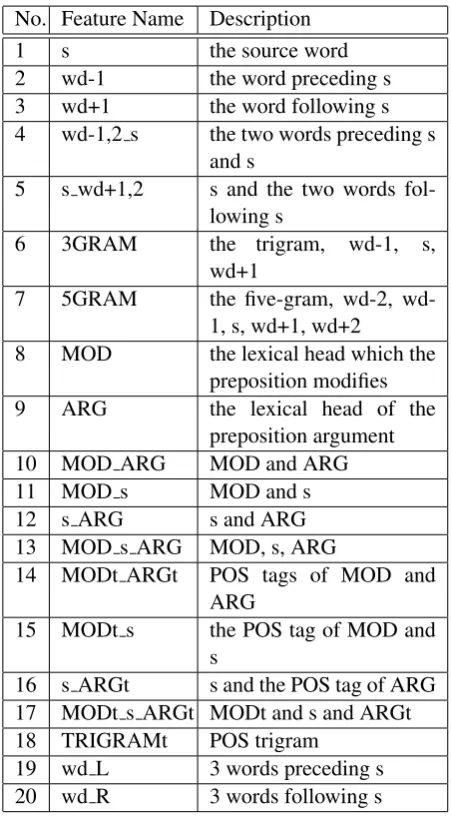
the part of feature set(Table 1) proposed by (Han et al., 2010) for learning. They are presented in the experiment part.
3.2 Article Error Correction
We have implemented the article error corrector just like the preposition error corrector. When we experiment the pilot article correction system just like the preposition correction system, it shows a good performance unexpectedly. There is a little difference in presenting set of features. In prepo-sition error corrector, we add postfix to the set of feature to keep sort of features(e.g. word ‘in’ as source word feature, postfix is ‘S’, final feature is ‘in S’). This method gives more discrimination ability to the classifier. But in case of article, using raw word lead to a better result.
3.3 Noun Number Error Correction
Noun number error indicates improper use of singular or plural form of nouns. For example, the singular form ‘problem’ should be corrected to the plural form ‘problems’ in the following sentence.
“They are educational and resource problem.”
As far as we know, there have been few at-tempts to correct noun number agreement errors. In this shared task, we propose a novel noun num-ber agreement correction system based on a ma-chine learning method trained with basic features. In order to extract nouns from the input sen-tences, we parse the sentence and extract the last noun in every noun phrase for the error correction candidates. If there is a coordinating conjunction in the noun phrase, we split the noun phrase into two parts and extract two candidates.
[S [NP Relevantinformation] [VP are [ADJP readily ROOT available [PP on [NP [NP the
internet] and [NParticle] [PP in [NP maga-zinesandnewspapers] .]]]
Figure 1: Extracting candidates for error correc-tion of noun number(candidates are indicated by bold)
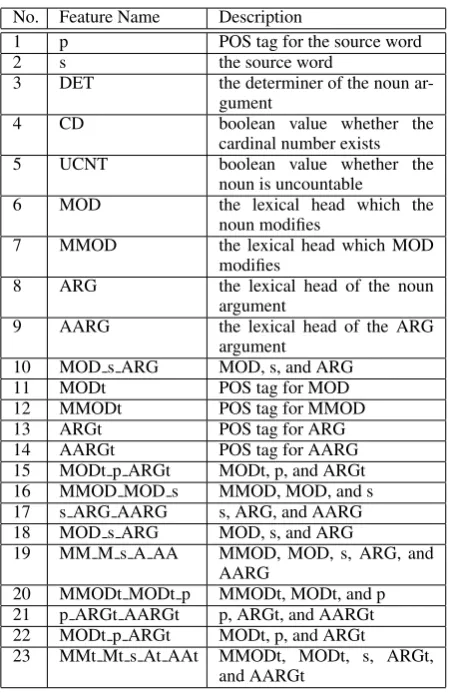
Figure 1 shows the example of selecting can-didates for the error correction of noun number. We classify a noun into four classes using fea-tures of Table 2 based on the machine learn-ing method. Four classes are NN(plural noun), NNP(plural proper noun), NNS(singular noun), and NNPS(singular proper noun). It is based on the observation that the common noun and the
No. Feature Name Description
1 p POS tag for the source word
2 s the source word
3 DET the determiner of the noun ar-gument
4 CD boolean value whether the
cardinal number exists 5 UCNT boolean value whether the
noun is uncountable
6 MOD the lexical head which the noun modifies
7 MMOD the lexical head which MOD modifies
8 ARG the lexical head of the noun argument
9 AARG the lexical head of the ARG argument
10 MOD s ARG MOD, s, and ARG
11 MODt POS tag for MOD
12 MMODt POS tag for MMOD
13 ARGt POS tag for ARG
14 AARGt POS tag for AARG
15 MODt p ARGt MODt, p, and ARGt 16 MMOD MOD s MMOD, MOD, and s 17 s ARG AARG s, ARG, and AARG 18 MOD s ARG MOD, s, and ARG
19 MM M s A AA MMOD, MOD, s, ARG, and AARG
20 MMODt MODt p MMODt, MODt, and p 21 p ARGt AARGt p, ARGt, and AARGt 22 MODt p ARGt MODt, p, and ARGt
[image:3.595.307.532.60.407.2]23 MMt Mt s At AAt MMODt, MODt, s, ARGt, and AARGt
Table 2: Set of features for learning noun number error correction
proper noun have many different characteristic. The set of features used for learning is shown in Table 2.
4 Experiments
4.1 Corpus
We use only NUS Corpus of Leaner En-glish(NUCLE)((Dahlmeier, 2013)) provided from CoNLL 2013 shared task. We construct the devel-opment set with first sentences for every 10 sen-tence and the test set with second sensen-tences and the training set with the rest of sentences. The system is trained to learn error correction with the training set and optimized with the development set and finally evaluated with the test set.
4.2 Preposition Correction Experiment
Number of feature 20 18 9
Raw Word
Precision 0.0571 0.1194 0.0196 Recall 0.0402 0.0402 0.1256 F1-score 0.0472 0.0602 0.0339 With
Feature Name
Precision 0.1034 0.1750 0.0208 Recall 0.0302 0.0352 0.1307 F1-score 0.0467 0.0586 0.0359
Table 3: The result of preposition error correction
we exclude wd L(19), wd R(20) and employ 18 kinds of features.
We will try to train the correction model by us-ing large amount of error free corpus in order to overcome the problem of low recall. To parse large corpus is very time consuming task. So, in this experiment, we select 9 features which can be ex-tracted without parsing, and test the possibility of using 9 features by training and testing the correc-tion model.
We have performed two different experiments. In the first experiment, we have used the word it-self as a feature. In the tables 3˜5, “Raw Word” represents the case when we use just the word itself. In the second experiment, we have used the feature name as the postfix of the feature. In the tables 3˜5, “With Feature Name” represents the case when we attach the feature name to the feature and use it as a feature. For all experi-ments, we have tried to differentiate the number of features. 20 features are same as Han’s work. 18 features are the case when we exclude 2 fea-tures(i.e. wd L(19), wd R(20)). 9 features are the case when we use only features which do not re-quire parsing.
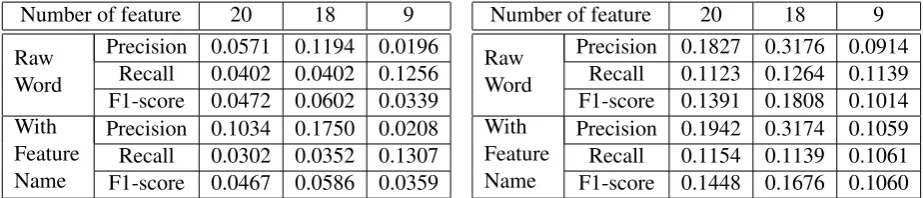
We have experimented with Maximum Entropy learning method, and fixed the iteration number to 200. Table 3 shows that the precision has highly increased although the recall has decreased when we add the feature name to the set of features used for learning.
When we use 18 features except wd L(3 words preceding s) and wd R(3 words following s), the error correction system achieves the best perfor-mance. According to the experimental result, we can achieve the better result when we use 18 fea-tures and the raw word. But we select final option using 18 features and the word with feature name because of optimization strategies that improve the precision.
Number of feature 20 18 9
Raw Word
Precision 0.1827 0.3176 0.0914 Recall 0.1123 0.1264 0.1139 F1-score 0.1391 0.1808 0.1014 With
Feature Name
[image:4.595.71.533.63.162.2]Precision 0.1942 0.3174 0.1059 Recall 0.1154 0.1139 0.1061 F1-score 0.1448 0.1676 0.1060
Table 4: The result of article error correction
Kinds of feature Basic
Basic& Indep-endent
Basic&
Com-plex
Raw Word
Precision 0.2462 0.1435 0.2469
Recall 0.0379 0.0811 0.0540
F1-score 0.0662 0.1036 0.0887 With
Feature Name
Precision 0.2413 0.1676 0.2875
Recall 0.0378 0.0838 0.0621
F1-score 0.0654 0.1117 0.1022
Table 5: The result of noun number error correc-tion
4.3 Article Correction Experiment
Table 4 shows that the feature name addition does not improve the precision in the case of article cor-rection, and the set of 18 features achieves the best performance for article correction. Therefore, we just use raw words for features and select 18 fea-tures for article correction.
4.4 Noun Number Correction Experiment
In Table 2, features of number 1˜5 belong to the basic feature set and features of number 6˜15 be-long to the independent feature set and features of number 16˜23 belong to the complex feature set. The experimental result with various combi-nations of feature sets shows that the set of basic and complex features achieves the best precision in spite of low recall as shown in Table 5. We use this option and experimentally select the iteration number 700.
5 Conclusions
the future work, we will try to utilize large amount of external resources such as well written error free corpus.
References
Daniel Dahlmeier, Hwee Tou Ng, Siew Mei Wu 2013.
Building a Large Annotated Corpus of Learner En-glish: The NUS Corpus of Learner English, Pro-ceedings of the 8th Workshop on Innovative Use of NLP for Building Educational Applications (BEA 2013), Atlanta, Georgia, USA.
Rachele De Felice and Stephen G. Pulman 2008. A classifier-based approach to preposition and deter-miner error correction in L2 English, Proceedings of the 22nd International Conference on Computa-tional Linguistics (Coling 2008), 169–176, Manch-ester, UK