Abstract—A nonlinear pricing scheme is proposed to mitigate the information problem in power scheduling and strategic behavior of individual generators. The proposed pricing scheme is modified from a two-part tariff in the mechanism design literature to be applicable with the power scheduling problem. Two constraints are enforced in the power scheduling problem to ensure that a) no generator would decline to participate in a scheduling mechanism and b) each generator would be best off by disclosing its cost data accurately, provided that all other generators are also accurately disclosing their cost data.
Index Terms—Electricity market, nonlinear pricing, power scheduling.
I. INTRODUCTION
concept of mechanism design problem relates information problem in regulatory mechanisms to economic outcomes. A mechanism is generally a system or a procedure that governs the market transactions. Under strategic circumstances, different market mechanisms induce market participants to behave differently, depending on their interests. Some might be revealing their private information accurately, while the others might be misreporting their private information. As a consequence, the market outcomes might be economically inefficient. For example, a system or market operator (e.g., an independent system operator) could hardly know market demand and the operating costs of the generation company (generator) or the transmission constraint may impact the market power of some generators. So certain generators may be able to raise their selling prices higher than their marginal costs and earn additional profits. By recognizing that some market participants may behave strategically, how could the market operator design a market mechanism to minimize information disadvantage and to accomplish desirable economic outcomes? The market operator may conduct a study, which is costly, to gain a good estimate of the operating costs. It may observe ex post the
operating costs by means of verification or auditing. If the generator misreported, it could be charged with penalty, given
Manuscript received December 30, 2008. This work was supported in part by Department of Electrical Engineering, Chiang Mai University, Thailand.
S. Nuchprayoon is with Department of Electrical Engineering Department, Chiang Mai University, Chiang Mai, Thailand (e-mail: [email protected]).
M.M. Begović is with School of Electrical and Computer Engineering, Georgia Institute of Technology, Atlanta, Georgia, USA (e-mail: [email protected]).
A. Chaichana is with Department of Electrical Engineering, Chiang Mai University, Chiang Mai, Thailand (e-mail: [email protected]).
that a discrepancy between the determined costs and the actual costs is properly identified.
Alternatively, a direct approach would be to utilize a custom-designed pricing scheme that could stimulate the generator to reveal its private information accurately.
Using either a game-theory approach [7] or nonlinear pricing schemes [1], [5], [12], one can solve the mechanism design problem. In electricity markets, the mechanism design problem is introduced by the so-called incentive regulation [6]. Nonlinear pricing scheme is proposed to either induce loads to reveal their demand of electricity [3] or induce generators to submit the marginal cost curves as the bidding curves under fixed-load condition and DC power flow model [9].
In this paper, it is assumed that the demand functions and fixed loads are common knowledge to all market participants. The market operator does not have the complete information of the operating cost data of individual generators, but possesses a good estimate of them. Thus, the mechanism design problem is considered only on the supply side.
The pricing scheme developed in this paper is essentially a two-part tariff. The first part is a price per unit of generation or consumption. The second part is an information rent, being paid to individual generators (by loads) in exchange for accurate disclosure of the operating cost data. In contrary to the existing work, the calculated price per unit of generation or consumption is based on the nodal pricing scheme [8] and AC power flow simulations. Besides, an implementation of the proposed mechanism and a proper payment allocation of the information rents between multiple generators and loads are discussed.
The paper is organized as follows: the concept of nonlinear pricing scheme, by means of a two-part tariff, is introduced to electricity markets in Section II. Then, the optimization problem of the proposed pricing scheme and its solutions are described in Section III. In Section IV, a practical implementation is discussed. Finally, the proposed pricing scheme is concluded in Section V.
II. ELECTRICITY MARKET MECHANISM
A market mechanism of power scheduling may be illustrated as shown in Fig. 1. At the beginning stage, the market operator inquires information on demand function or fixed load from the load and informs the generator. Note that it is not necessary for the market operator to inform the generator about such information. So a dashed arrow line is
Application of Nonlinear Pricing Scheme to the
Power Scheduling Problem
Somboon Nuchprayoon, Miroslav M. Begovi
ć
, and Artitaya Chaichana
used in the figure to represent flow of that piece of information. Then, the generators submit their bidding curves, which are supposed to be theirs marginal cost functions, to the market operator. The market operator then solves the power scheduling problem based on the given market information. To encourage accurate disclosure of the cost data from the generator; a desirable pricing scheme may be designed by using a two-part tariff, consisting of a price per unit of generation and an information rent which is dependent on the submitted bidding curves. The information rent, is equivalent to a subsidy or tax to a generator when it discloses its cost data lower or higher than the actual cost, respectively. Such a nonlinear pricing scheme must satisfy the following two constraints.
• The participation [11] or individual rationality [5] constraint dictates that each generator must be at least as well off engaging in the market as not engaging.
• The incentive compatibility [11] constraint dictates that each generator must prefer accurately revealing its private cost information.
Simply put, when a pricing scheme is incentive compatible, it is a profit-maximizing decision for the generator to reveal its operating cost accurately. As a result, the market operator rewards the generator by means of the information rent. It should be emphasized that the market operator is responsible only for generation scheduling, nodal price calculations, and payment allocation of the transmission rents (in case of multiple generators or loads). Ultimately, the generator would have to collect payments directly from the load. Note that, in case of a bilateral contract, the mechanism design could be done between contracting generator and load without any involvement from the market operator.
Fig. 1. Proposed market mechanism of electricity markets
III. INCENTIVE-COMPATIBLE PRICING SCHEME Let C be an operating cost function of a generator, where q
is a quantity of generated power. Define the operating cost function as:
2
2 1 0
2 1 )
(q s sq s q
C = + + , (1)
where s0, s1, and s2 are the operating cost coefficients. In the
power scheduling mechanism, a bidding curve is supposed to be derived from the marginal cost function so that only s1 and
s2 are of interest. In practice, the bidding curves of individual
generators are relatively flat so that the value of s2 is relatively
small, compared with the value of s1. For the sake of
simplicity, it is assumed here that s1 is the only cost parameter
that is unknown to the market operator and denote it as s.
A market-clearing price and output of the generator will be dependent of the claimed value of the unknown cost parameter (sˆ ). The actual operating cost (C
( )
sˆ,s ) is thusdependent of both the claimed and actual cost parameters, while the claimed operating cost (Cˆ
( )
sˆ,sˆ ) disclosed to themarket operator is a function of the claimed cost parameter only.
By implementing a two-part tariff, denote ρas the price per unit of generation and denote τ as information rent. It depends on the claimed value of the unknown cost parameter. The information rent is defined [1] as:
τ = − +
∫
s
s
u u q s q s p s s C s
ˆ
d ) ( ) ˆ ( ) ˆ ( ) ˆ , ˆ ( ˆ ˆ ) ˆ
( , (2)
where s is a maximum value of the unknown cost parameter
and u is an integration variable of the unknown cost
parameter. Note that s is determined by the market operator
and is equivalent to the ceiling value of the unknown cost parameter the generator can claim.
At equilibrium, the total generation profits (Π) and the net consumption gain (CG) are dependent of the claimed and the
actual cost values, as well as the information rent. The total generation profits are the operating profit plus the information rent. The net consumption gain is the consumer surplus less the information rent.
Π(sˆ,s)= p(sˆ)q(sˆ)−C(sˆ,s)+τ(sˆ), (3)
(ˆ) ( )d (ˆ) (ˆ) (ˆ)
) ˆ (
0
s s q s p q q p s CG
s q
τ − −
=
∫
. (4)By substituting the information rent in (2) into (3), the total generation profits become:
∫
+ −
= Π
s
s
u u q s s C s s C s s
ˆ
d ) ( ) , ˆ ( ) ˆ , ˆ ( ˆ ) , ˆ
[image:2.595.49.288.494.697.2]Π = − +
∫
s
s
u u q s q s s s s
ˆ
d ) ( ) ˆ ( ) ˆ ( ) , ˆ
( . (5)
Because the pricing scheme is incentive compatible, the optimal value of the claimed cost parameter at equilibrium is equal to the actual value of the unknown cost parameter (sˆ*=s). The total generation profits at equilibrium become:
∫
= Π = Π
s
s
u u q s s s
sˆ , ) ( , ) ( )d
( * . (6)
As a numerical example, assume that the inverse demand function is given as:
q d d q
D−1( )= 1− 2 ,
where d1 and d2 are the nonnegative demand coefficients,
which are common knowledge to both the market operator and generator. The generator has a constant marginal cost (s) which is unknown to the market operator. Upon solution, the market-clearing price, market output, and total generation profits are:
p(sˆ)=sˆ,
2
1 ˆ
) ˆ (
d s d s
q = − ,
2
2 2
1( ) ˆ 0.5( ˆ )
d
s s s s s s
d − + − +
=
Π .
It is clear that the claimed value of the marginal cost that maximizes the total generation profits is the actual value of the marginal cost, i.e. sˆ*=s. As a result, the total generation
profits become:
2 1
2
) 2
)( (
d s s d s
s− − −
=
Π .
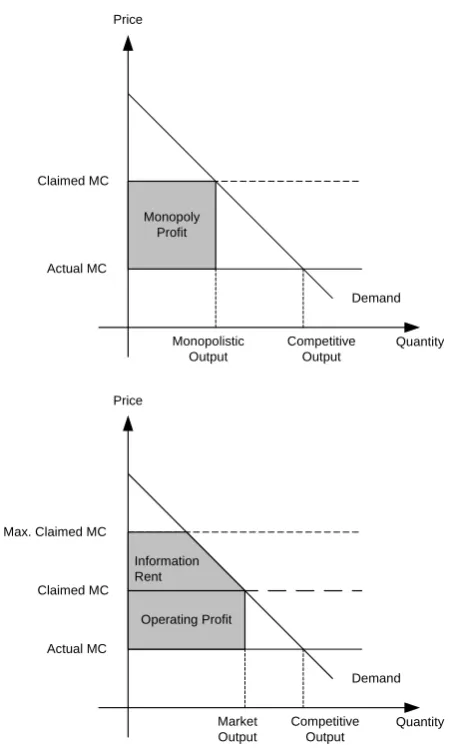
The proposed pricing scheme is illustrated in Fig. 2. Without an incentive mechanism, the generator would claim the marginal cost function in such a way that its operating profit is maximized. Using the incentive-compatible pricing scheme, the total generation profits are the sum of the operating profit and information rent, which are the first and second terms on the right-hand side of (5), respectively. The total generation profits will be maximized when the generator discloses its actual marginal cost function.
A. The Pricing Scheme under Fixed Quantity
When the amount of load is fixed, it means that a demand function does not exist. Hence, the consumption gain could not be determined. The objective function of the market operator is simply to minimize the operating cost. The market-clearing price in this case is the marginal cost of generation. If
the fixed load quantity is denoted as Q, the information rent in
(2) and the total generation profits become:
τ(sˆ)=ˆC(sˆ,sˆ)−p(sˆ)Q+(s−sˆ)Q (7)
Π(sˆ,s)=(s−s)Q. (8)
It is obvious that the total generation profits are independent on the claimed cost parameter. They depend on the difference between the maximum value and the actual value of the unknown cost parameter. The higher the maximum value of the unknown cost parameter, the higher the total generation profits.
Monopoly Profit
Information Rent
Operating Profit Monopolistic
Output
Competitive Output Actual MC
Actual MC Claimed MC Claimed MC
Max. Claimed MC
Competitive Output Market
Output Price
Price
Quantity Quantity Demand
Demand
Fig. 2. Total generation profits under conventional and incentive-compatible pricing schemes
B. The Pricing Scheme under Constrained Capacity
[image:3.595.314.541.247.622.2]incentive-compatibility constraints are not violated. If the constrained quantity (e.g., maximum generating capacity) is denoted as
q, redefine the information rent as:
τ = − +
∫
s
q p
u u q q q MC s s C q
) (
d ) ( )
( ) ˆ , ˆ ( ˆ )
( , (9)
where MC is the marginal cost of generation at the constrained
capacity level. As a result, the total generation profits become:
Π = − +
∫
s
q p
u u q q q MC q p q
) (
d ) ( ))
( ) ( ( )
( . (10)
It can be seen that the total generation profits are independent on the claimed cost parameter. It should be emphasized that the first term on the right-hand side of (10) is a rent arising from the constrained capacity. It is equivalent to the so-called
transmission rent or merchandising surplus.
C. The Proposed Pricing Scheme of Power Scheduling
The demand functions at all load buses are assumed to be linearly downward sloping and common knowledge. At any load bus k, the inverse demand function (Dk−1) can be written as a function of power demand (qk) as follows:
Dk−1(qk)=d1k+d2kqk, (11)
where d1k and d2k are the demand coefficients, which are
known to all market participants.
At any generator bus j, the marginal cost function or the
supply bid curve (Sj) can be written as a function of power
generation (qj) as follows:
Sj(qj)=s1j+s2jqj, (12)
where s1j and s2j are the marginal cost coefficients of power generation, which are unknown and known to the market operator, respectively.
Based on a pool model, the market operator could determine nodal prices, power generation, and load of all buses in a network by solving a power scheduling problem. The set of generation and transmission constraints are enforced as in the optimal power flow problem. In addition, the participation and incentive compatibility constraints are also enforced.
In the case of multiple generators and loads, the market operator has to calculate the rent that individual generators should earn and to calculate the rent that individual loads have to pay (based on their power consumption). To ensure that the sum of total generation profits will not exceed the monetary amount (M) that the loads could pay, it is necessary for the
market operator to set the maximum values of the unknown cost parameters properly. The monetary amount could be the
consumer surplus, the entire economic surplus, or the available budget. Hence, it is proposed that the following constraint should be enforced.
M
m
j j ≤
Π
∑
=1
, (13)
where m is the number of generators. Given such a constraint,
the market operator would have to estimate the maximum value of each unknown cost parameter based on the historical price data.
At equilibrium; load at bus k (qk), power generation at bus j (qj), and the information rent at bus j (τj) are:
(
k k)
k
k d p
d
q = 1 −
2
1
, (14)
(
j j)
j
j p s
s
q 1
2
ˆ 1
−
= , (15)
( )d ˆ (ˆ1 ,ˆ1 )
ˆ
1
1
j j j j j j s
s j j
j q u u p q C s s
j
j
+ − =
τ
∫
. (16)The total generation profits of generator bus j and the net
consumption gain of load bus k are:
∫
+ −
= Π
j
j
s
s
j j j j j j
j s s q q u u
1
1
ˆ 1
1 ) ( )d
ˆ
( , (17)
∑
∫
− − τ=
j j k
k k q
k k
Q q q p r r p CG
k
buses generator all 0
d )
( , (18)
where Q is the total system load and r is an integration
variable of load.
The total generation profits of each generator are directly proportional to the maximum value of its unknown cost parameter determined by the market operator. The higher the maximum value of the unknown cost parameter, the higher the total generation profits. It implies that the larger amount of consumer surplus will be transferred from the load to the generator by means of the information rent.
IV. PRACTICAL IMPLEMENTATION
generators and loads might be distorted. To assure that the unknown cost parameters are properly determined, it may be necessary to conduct a study on cost data of typical generators and to observe ex post the individual costs of generation. An
additional mechanism (such as imposing an extremely high penalty) is needed if, for instance, a generator is found of claiming excessively high cost data.
For example, recall the case of linearly downward-sloping demand function and constant marginal cost generator. Because of constant marginal cost, the producer surplus does not exist so that the information rent is also the generation profit. Under incentive-compatible pricing scheme, the generator discloses its marginal cost accurately. Hence, the entire economic surplus or net welfare (NW) and generation
profit can be written as:
2 2 1
2 ) (
d s d
NW = − ,
2 2 1 2 1
2
) ( ) (
d s d s
d − − −
=
Π .
Table I compares the net consumption gain and generation profit when the maximum value of claimed marginal cost is set from the actual value (s) to the maximum price willingly
paid by the load (d1). Both the consumer surplus and
generation profit are normalized by the net welfare. It is found that the consumer surplus gradually decreases as the market operator sets the maximum value of claimed marginal cost higher. When the market operator sets s=s, the generation
profit vanishes and the load takes the entire economic surplus. Such market outcomes are equivalent to those of competitive equilibrium. On the other hand, the generator takes the entire economic surplus and the net consumption gain vanishes when the market operator sets s=d1.
TABLE I
COMPARISON OF CONSUMPTION GAIN AND GENERATION PROFIT AS A
PERCENTAGE OF THE ENTIRE ECONOMIC SURPLUS
s Consumption gain (%) Generation profit (%)
s 100 0
4 / )
(d1+s 77 23
2 / )
(d1+s 25 75
1
d 0 100
It was suggested in [1] that the market operator may attempt to adjust the distribution of economic surplus by defining the objective function ( f ) of the power scheduling problem as:
1 0
, ≤α≤
Π α + =CG
f . (19)
When α = 0, there would no transaction at all because the market-clearing price is equal to the maximum price willingly paid by the load (determined from the given demand function). On the other hand, the market-clearing price and output will be identical to those of competitive equilibrium when α = 1, regardless of the maximum values of the unknown cost parameters. Meanwhile, the total generation
profits are at the maximum. As α approaches zero and the maximum values of the unknown cost parameter differ from their actual values, it is found that the market-clearing price will be higher, the market output and the total generation profits will decrease. Consequently, a deadweight loss [15] exists. If the distribution of economic surplus is not concerned, the market operator should set α = 1 so that the market outcomes are identical to those of competitive equilibrium and the deadweight loss is eliminated.
Market equilibrium under a single-load single-generator case is illustrated in Fig. 3. The inverse demand and marginal cost functions are given as:
D−1(q)=d1−d2q, MC(q)=s1+s2q.
When the market is constrained, it can be seen that the market-clearing price is decreasing and the market output is increasing as α approaches unity. The total generation profits are increasing as α approaches unity. Meanwhile, the deadweight loss is vanishing because the market outcomes approach the competitive equilibrium. If the market operator is concerned with the consumption gain of the load, α should be set at 0.5.
Then, it is assumed that there is a capacity constraint so that the market output is fixed when α ≥ 0.75. The market outcomes possess discontinuity as a result of the constrained capacity. It is found that the total generation profits and consumption gain are lower and higher, respectively, than those of the unconstrained case. Note that the deadweight loss is unchanged after the capacity is constrained because of fixed market output.
0 0.5 1
Pr
ic
e
α
0 0.5 1
0 0.2 0.4 0.6 0.8 1
G
enerat
ion
P
rof
it
(p.
u.
)
α
0 0.5 1
Ou
tp
u
t
α
0 0.5 1
0 0.1 0.2 0.3 0.4 0.5
Load G
ai
n (
p.
u.
)
α
0 0.5 1
0 0.2 0.4 0.6 0.8 1
D
eadw
e
ig
ht
Los
s
(p.
u.
)
α
Inverse demand function D-1(q) = d
1 - d2q Supply function S(q) = s1 + s2q
Unconstrained ouput capacity Constrained output capacity (occurs when α≥ 0.75) Competitive price: ρc = (d
1s2 + d2s1)/(d2 + s2)
Competitive output: q c = (d
1 - s1)/(d2 + s2)
Constrained capacity = 3(d
1 - s1)/4(d2 + s2)
Base value of economic surplus = (d1 - s1)2/[2*(d2 + s2)]
d
1
ρc
q c
0
[image:5.595.70.268.266.297.2]Given such market outcomes, it can be expected that a properly defined pricing mechanism could provide an incentive for the generator to not manipulate the market (by strategically limiting the market output). Nevertheless, it may still be a profitable situation for an explicit entity (such as a for-profit transmission provider) that collects the transmission rent arising from the constrained capacity.
V. CONCLUSION
A market mechanism of power scheduling is proposed to mitigate the information problem and strategic behavior of individual generators in electricity markets. The proposed mechanism is indeed a nonlinear pricing scheme that induces individual generators to disclose their operating cost data accurately. It is assumed that all market participants commonly know the demand functions or the amount of fixed loads. The proposed pricing scheme is modified to be functioning properly under a capacity-constrained condition. In addition, the proposed pricing scheme is also capable to adjust economic surplus shared by loads and generators. It is shown that the performance of the proposed pricing scheme depends on a discrepancy between the determined cost parameters and the actual cost parameters the market operator realizes. The better estimation on unknown cost parameters of individual generators, the higher (lower) economic surplus the loads (generators) gain.
VI. REFERENCES
[1] D. P. Baron and R. B. Myerson, “Regulating a Monopolist with Unknown Costs,” Econometrica, vol. 50, no. 4, pp. 911-930, 1982.
[2] L. Brown, M. Einhorn, and I. Vogelsang, “Toward Improved and Practical Incentive Regulation,” Journal of Regulatory Economics, vol. 3, pp. 323-338, 1991.
[3] M. Fahrioglu and F. L. Alvarado, “Designing Incentive Compatible Contracts for Effective Demand Management,” IEEE Transactions on Power Systems, vol. 15, pp. 1255-1260, Nov. 2000.
[4] J.-J. Laffont and D. Martimort, The Theory of Incentives: The Principal-agent Model, Princeton, NJ: Princeton University Press, 2002. [5] J.-J. Laffont and J. Tirole, “Using Cost Observation to Regulate Firms,”
Journal of Political Economy, vol. 94, no. 3, pp. 614-641, 1986. [6] R. B. Myerson, “Incentive Compatibility and the Bargaining Problem,”
Econometrica, vol. 47, no. 1, pp. 61-74, 1979.
[7] R. B. Myerson, “Analysis of Incentives in Bargaining and Mediation,” in H. Peyton Young (Ed.), Negotiation Analysis (pp. 67-85), Ann Arbor, MI: University of Michigan Press, 1991.
[8] F. C. Schweppe, M. C.Caramanis, R. D. Tabors, and R. E. Bohn, Spot Pricing of Electricity, Norwell, MA: Kluwer Academic Publishers, 1988.
[9] C. Silva, B. F. Wollenberg, and C. Z. Zheng, “Application of Mechanism Design to Electric Power Markets,” IEEE Transactions on Power Systems, vol. 16, pp. 862-869, Nov. 2001.
[10] J. Tirole, The Theory of Industrial Organization, Cambridge, MA: MIT
Press, 1988.
[11] H. R. Varian, Microeconomic Analysis (3rd ed.), New York, NY: W.W. Norton, 1992.