Recognizing Contextual Polarity in Phrase-Level Sentiment Analysis
Theresa Wilson
Intelligent Systems Program University of Pittsburgh
Pittsburgh, PA 15260 [email protected]
Janyce Wiebe
Department of Computer Science University of Pittsburgh
Pittsburgh, PA 15260 [email protected]
Paul Hoffmann
Intelligent Systems Program University of Pittsburgh
Pittsburgh, PA 15260 [email protected]
Abstract
This paper presents a new approach to phrase-level sentiment analysis that first determines whether an expression is neu-tral or polar and then disambiguates the polarity of the polar expressions. With this approach, the system is able to automat-ically identify the contextual polarity for a large subset of sentiment expressions, achieving results that are significantly bet-ter than baseline.
1 Introduction
Sentiment analysis is the task of identifying positive and negative opinions, emotions, and evaluations. Most work on sentiment analysis has been done at the document level, for example distinguishing pos-itive from negative reviews. However, tasks such as multi-perspective question answering and sum-marization, opinion-oriented information extraction, and mining product reviews require sentence-level or even phrase-level sentiment analysis. For exam-ple, if a question answering system is to successfully answer questions about people’s opinions, it must be able to pinpoint expressions of positive and negative sentiments, such as we find in the sentences below:
(1) African observersgenerally approved+of his victory while Western governmentsdenounced− it.
(2) A succession of officers filled the TV screen to say theysupported+
the people and that the killings were “not tolerable−.”
(3) “We don0t hate+ the sinner,” he says,
“but wehate−the sin.”
A typical approach to sentiment analysis is to start with a lexicon of positive and negative words and phrases. In these lexicons, entries are tagged with their a priori prior polarity: out of context, does the word seem to evoke something positive or some-thing negative. For example, beautiful has a positive prior polarity, and horrid has a negative prior polar-ity. However, the contextual polarity of the phrase in which a word appears may be different from the word’s prior polarity. Consider the underlined polar-ity words in the sentence below:
(4) Philip Clapp, president of the National Environ-ment Trust, sums up well the general thrust of the reaction of environmental movements: “There is no reason at all to believe that the polluters are sud-denly going to become reasonable.”
Of these words, “Trust,” “well,” “reason,” and “rea-sonable” have positive prior polarity, but they are not all being used to express positive sentiments. The word “reason” is negated, making the contex-tual polarity negative. The phrase “no reason at all to believe” changes the polarity of the proposition that follows; because “reasonable” falls within this proposition, its contextual polarity becomes nega-tive. The word “Trust” is simply part of a referring expression and is not being used to express a senti-ment; thus, its contextual polarity is neutral. Simi-larly for “polluters”: in the context of the article, it simply refers to companies that pollute. Only “well” has the same prior and contextual polarity.
Many things must be considered in phrase-level sentiment analysis. Negation may be local (e.g., not good), or involve longer-distance dependencies such as the negation of the proposition (e.g., does not look very good) or the negation of the subject (e.g.,
no one thinks that it’s good). In addition, certain
phrases that contain negation words intensify rather than change polarity (e.g., not only good but amaz-ing). Contextual polarity may also be influenced by modality (e.g., whether the proposition is asserted to be real (realis) or not real (irrealis) – no reason at all to believe is irrealis, for example); word sense (e.g., Environmental Trust versus He has won the peo-ple’s trust); the syntactic role of a word in the sen-tence (e.g., polluters are versus they are polluters); and diminishers such as little (e.g., little truth,
lit-tle threat). (See (Polanya and Zaenen, 2004) for a
more detailed discussion of contextual polarity in-fluencers.)
This paper presents new experiments in automat-ically distinguishing prior and contextual polarity. Beginning with a large stable of clues marked with prior polarity, we identify the contextual polarity of the phrases that contain instances of those clues in the corpus. We use a two-step process that employs machine learning and a variety of features. The first step classifies each phrase containing a clue as neutral or polar. The second step takes all phrases marked in step one as polar and disambiguates their contextual polarity (positive, negative, both, or neu-tral). With this approach, the system is able to auto-matically identify the contextual polarity for a large subset of sentiment expressions, achieving results that are significantly better than baseline. In addi-tion, we describe new manual annotations of contex-tual polarity and a successful inter-annotator agree-ment study.
2 Manual Annotation Scheme
To create a corpus for the experiments below, we added contextual polarity judgments to existing an-notations in the Multi-perspective Question Answer-ing (MPQA) Opinion Corpus1, namely to the an-notations of subjective expressions2. A subjective expression is any word or phrase used to express an opinion, emotion, evaluation, stance, speculation,
1The MPQA Corpus is described in (Wiebe et al., 2005) and
available at nrrc.mitre.org/NRRC/publications.htm.
2
In the MPQA Corpus, subjective expressions are direct
subjective expressions with non-neutral expression intensity,
plus all the expressive subjective elements. Please see (Wiebe et al., 2005) for more details on the existing annotations in the MPQA Corpus.
etc. A general covering term for such states is pri-vate state (Quirk et al., 1985). In the MPQA Cor-pus, subjective expressions of varying lengths are marked, from single words to long phrases.
For this work, our focus is on sentiment expres-sions – positive and negative expresexpres-sions of emo-tions, evaluaemo-tions, and stances. As these are types of subjective expressions, to create the corpus, we just needed to manually annotate the existing subjective expressions with their contextual polarity.
In particular, we developed an annotation scheme3for marking the contextual polarity of sub-jective expressions. Annotators were instructed to tag the polarity of subjective expressions as positive, negative, both, or neutral. The positive tag is for positive emotions (I’m happy), evaluations (Great idea!), and stances (She supports the bill). The neg-ative tag is for negneg-ative emotions (I’m sad), eval-uations (Bad idea!), and stances (She’s against the bill). The both tag is applied to sentiment expres-sions that have both positive and negative polarity. The neutral tag is used for all other subjective ex-pressions: those that express a different type of sub-jectivity such as speculation, and those that do not have positive or negative polarity.
Below are examples of contextual polarity anno-tations. The tags are in boldface, and the subjective expressions with the given tags are underlined.
(5) Thousands of coup supporters celebrated
(posi-tive) overnight, waving flags, blowing whistles . . .
(6) The criteria set by Rice are the following: the three countries in question are repressive
(nega-tive) and grave human rights violators (nega(nega-tive)
. . .
(7) Besides, politicians refer to good and evil (both) only for purposes of intimidation and exaggeration.
(8) Jerome says the hospital feels (neutral) no dif-ferent than a hospital in the states.
The annotators were asked to judge the contex-tual polarity of the sentiment that is ultimately be-ing conveyed by the subjective expression, i.e., once the sentence has been fully interpreted. Thus, the subjective expression, they have not succeeded, and
3The annotation instructions are available at
will never succeed, was marked as positive in the sentence, They have not succeeded, and will never succeed, in breaking the will of this valiant people. The reasoning is that breaking the will of a valiant people is negative; hence, not succeeding in break-ing their will is positive.
3 Agreement Study
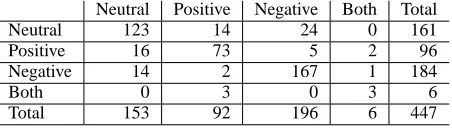
To measure the reliability of the polarity annotation scheme, we conducted an agreement study with two annotators, using 10 documents from the MPQA Corpus. The 10 documents contain 447 subjective expressions. Table 1 shows the contingency table for the two annotators’ judgments. Overall agreement is 82%, with a Kappa (κ) value of 0.72.
Neutral Positive Negative Both Total
Neutral 123 14 24 0 161
Positive 16 73 5 2 96
Negative 14 2 167 1 184
Both 0 3 0 3 6
[image:3.612.74.300.277.342.2]Total 153 92 196 6 447
Table 1: Agreement for Subjective Expressions (Agreement: 82%,κ: 0.72)
For 18% of the subjective expressions, at least one annotator used an uncertain tag when marking po-larity. If we consider these cases to be borderline and exclude them from the study, percent agreement increases to 90% and Kappa rises to 0.84. Thus, the annotator agreement is especially high when both are certain. (Note that all annotations are included in the experiments described below.)
4 Corpus
In total, 15,991 subjective expressions from 425 documents (8,984 sentences) were annotated with contextual polarity as described above. Of these sen-tences, 28% contain no subjective expressions, 25% contain only one, and 47% contain two or more. Of the 4,247 sentences containing two or more subjec-tive expressions, 17% contain mixtures of posisubjec-tive and negative expressions, and 62% contain mixtures of polar (positive/negative/both) and neutral subjec-tive expressions.
The annotated documents are divided into two sets. The first (66 documents/1,373 sentences/2,808 subjective expressions) is a development set, used
for data exploration and feature development. We use the second set (359 documents/7,611 sen-tences/13,183 subjective expressions) in 10-fold cross-validation experiments, described below.
5 Prior-Polarity Subjectivity Lexicon
For the experiments in this paper, we use a lexicon of over 8,000 subjectivity clues. Subjectivity clues are words and phrases that may be used to express pri-vate states, i.e., they have subjective usages (though they may have objective usages as well). For this work, only single-word clues are used.
To compile the lexicon, we began with a list of subjectivity clues from (Riloff and Wiebe, 2003). The words in this list were grouped in previous work according to their reliability as subjectivity clues. Words that are subjective in most contexts were marked strongly subjective (strongsubj), and those that may only have certain subjective usages were marked weakly subjective (weaksubj).
We expanded the list using a dictionary and a thesaurus, and also added words from the General Inquirer positive and negative word lists (General-Inquirer, 2000) which we judged to be potentially subjective. We also gave the new words reliability tags, either strongsubj or weaksubj.
The next step was to tag the clues in the lexicon with their prior polarity. For words that came from positive and negative word lists (General-Inquirer, 2000; Hatzivassiloglou and McKeown, 1997), we largely retained their original polarity, either posi-tive or negaposi-tive. We assigned the remaining words one of the tags positive, negative, both or neutral.
6 Experiments
The goal of the experiments described below is to classify the contextual polarity of the expressions that contain instances of the subjectivity clues in our lexicon. What the system specifically does is give each clue instance its own label. Note that the system does not try to identify expression bound-aries. Doing so might improve performance and is a promising avenue for future research.
6.1 Definition of the Gold Standard
We define the gold standard used to train and test the system in terms of the manual annotations described in Section 2.
The gold standard class of a clue instance that is not in a subjective expression is neutral: since the clue is not even in a subjective expression, it is not contained in a sentiment expression.
Otherwise, if a clue instance appears in just one subjective expression (or in multiple subjective ex-pressions with the same contextual polarity), then the class assigned to the clue instance is the class of the subjective expression(s). If a clue appears in at least one positive and one negative subjective expression (or in a subjective expression marked as both), then its class is both. If it is in a mixture of negative and neutral subjective expressions, its class is negative; if it is in a mixture of positive and neu-tral subjective expressions, its class is positive.
6.2 Performance of a Prior-Polarity Classifier
An important question is how useful prior polarity alone is for identifying contextual polarity. To an-swer this question, we create a classifier that sim-ply assumes that the contextual polarity of a clue in-stance is the same as the clue’s prior polarity, and we explore the classifier’s performance on the develop-ment set.
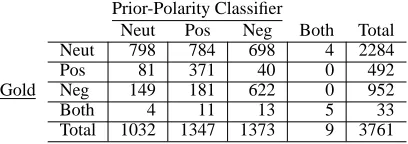
This simple classifier has an accuracy of 48%. From the confusion matrix given in Table 2, we see that 76% of the errors result from words with non-neutral prior polarity appearing in phrases with neu-tral contextual polarity.
6.3 Contextual Polarity Disambiguation
The fact that words with non-neutral prior polarity so frequently appear in neutral contexts led us to
Prior-Polarity Classifier
Neut Pos Neg Both Total
Neut 798 784 698 4 2284
Pos 81 371 40 0 492
Gold Neg 149 181 622 0 952
Both 4 11 13 5 33
Total 1032 1347 1373 9 3761
Table 2: Confusion matrix for the prior-polarity classifier on the development set.
adopt a two-step approach to contextual polarity dis-ambiguation. For the first step, we concentrate on whether clue instances are neutral or polar in context (where polar in context refers to having a contextual polarity that is positive, negative or both). For the second step, we take all clue instances marked as polar in step one, and focus on identifying their con-textual polarity. For both steps, we develop classi-fiers using the BoosTexter AdaBoost.HM (Schapire and Singer, 2000) machine learning algorithm with 5000 rounds of boosting. The classifiers are evalu-ated in 10-fold cross-validation experiments.
6.3.1 Neutral-Polar Classification
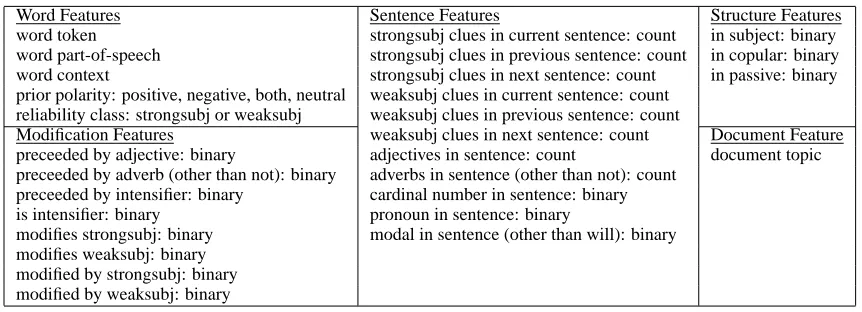
The neutral-polar classifier uses 28 features, listed in Table 3.
Word Features: Word context is a bag of three
word tokens: the previous word, the word itself, and the next word. The prior polarity and reliability class are indicated in the lexicon.
Modification Features: These are binary
rela-tionship features. The first four involve relarela-tionships with the word immediately before or after: if the word is a noun preceded by an adjective, if the ceding word is an adverb other than not, if the pre-ceding word is an intensifier, and if the word itself is an intensifier. A word is considered an intensifier if it appears in a list of intensifiers and if it precedes a word of the appropriate part-of-speech (e.g., an in-tensifier adjective must come before a noun).
[image:4.612.328.532.55.127.2]Word Features Sentence Features Structure Features word token strongsubj clues in current sentence: count in subject: binary word part-of-speech strongsubj clues in previous sentence: count in copular: binary word context strongsubj clues in next sentence: count in passive: binary prior polarity: positive, negative, both, neutral weaksubj clues in current sentence: count
reliability class: strongsubj or weaksubj weaksubj clues in previous sentence: count
Modification Features weaksubj clues in next sentence: count Document Feature preceeded by adjective: binary adjectives in sentence: count document topic preceeded by adverb (other than not): binary adverbs in sentence (other than not): count
preceeded by intensifier: binary cardinal number in sentence: binary is intensifier: binary pronoun in sentence: binary
modifies strongsubj: binary modal in sentence (other than will): binary modifies weaksubj: binary
[image:5.612.70.501.52.208.2]modified by strongsubj: binary modified by weaksubj: binary
Table 3: Features for neutral-polar classification
The human rights report
a poses
substantial challenge
to
US the
interpretation
of
good and
evil
det det
det
adj adj
obj subj
mod
mod
conj conj pobj pobj p
p
(pos) (neg) (pos)
(neg)
[image:5.612.78.293.246.400.2](pos)
Figure 1: The dependency tree for the sentence The human
rights report poses a substantial challenge to the US interpre-tation of good and evil. Prior polarity is marked in parentheses
for words that match clues from the lexicon.
an example. The modifies strongsubj/weaksubj fea-tures are true if the word and its parent share an adj, mod or vmod relationship, and if its parent is an instance of a clue from the lexicon with subj/weaksubj reliability. The modified by strong-subj/weaksubj features are similar, but look for rela-tionships and clues in the word’s children.
Structure Features: These are binary features
that are determined by starting with the word in-stance and climbing up the dependency parse tree toward the root, looking for particular relationships, words, or patterns. The in subject feature is true if we find a subj relationship. The in copular feature is true if in subject is false and if a node along the path is both a main verb and a copular verb. The in pas-sive features is true if a paspas-sive verb pattern is found on the climb.
Sentence Features: These are features that were
found useful for sentence-level subjectivity classifi-cation by Wiebe and Riloff (2005). They include counts of strongsubj and weaksubj clues in the cur-rent, previous and next sentences, counts of adjec-tives and adverbs other than not in the current sen-tence, and binary features to indicate whether the sentence contains a pronoun, a cardinal number, and a modal other than will.
Document Feature: There is one document
fea-ture representing the topic of the document. A doc-ument may belong to one of 15 topics ranging from specific (e.g., the 2002 presidential election in Zim-babwe) to more general (e.g., economics) topics.
Table 4 gives neutral-polar classification results for the 28-feature classifier and two simpler classi-fiers that provide our baselines. The first row in the table lists the results for a classifier that uses just one feature, the word token. The second row shows the results for a classifier that uses both the word to-ken and the word’s prior polarity as features. The results for the 28-feature classifier are listed in the last row. The 28-feature classifier performs signifi-cantly better (1-tailedt-test, p ≤ .05) than the two simpler classifiers, as measured by accuracy, polar F-measure, and neutral F-measure (β = 1). It has an accuracy of 75.9%, with a polar F-measure of 63.4 and a neutral F-measure of 82.1.
Word Features word token
word prior polarity: positive, negative, both, neutral Polarity Features
negated: binary negated subject: binary
modifies polarity: positive, negative, neutral, both, notmod modified by polarity: positive, negative, neutral, both, notmod conj polarity: positive, negative, neutral, both, notmod general polarity shifter: binary
negative polarity shifter: binary positive polarity shifter: binary
Table 6: Features for polarity classification
polarity improves recall so that it is only 4.4% lower, but this hurts precision, which drops to 4.2% lower than the 28-feature classifier’s precision. It is only with all the features that we get the best result, good precision with the highest recall.
The clues in the prior-polarity lexicon have 19,506 instances in the test set. According to the 28-feature neutral-polar classifier, 5,671 of these in-stances are polar in context. It is these clue inin-stances that are passed on to the second step in the contex-tual disambiguation process, polarity classification.
6.3.2 Polarity Classification
Ideally, this second step in the disambiguation process would be a three-way classification task, de-termining whether the contextual polarity is posi-tive, negative or both. However, although the major-ity of neutral expressions have been filtered out by the neutral-polar classification in step one, a number still remain. So, for this step, the polarity classifica-tion task remains four-way: positive, negative, both, and neutral.
Table 6 lists the features used by the polarity clas-sifier. Word token and word prior polarity are un-changed from the neutral-polar classifier. Negated is a binary feature that captures whether the word is being locally negated: its value is true if a negation word or phrase is found within the four preceeding words or in any of the word’s children in the de-pendency tree, and if the negation word is not in a phrase that intensifies rather than negates (e.g., not only). The negated subject feature is true if the sub-ject of the clause containing the word is negated.
The modifies polarity, modified by polarity, and conj polarity features capture specific relationships between the word instance and other polarity words
it may be related to. If the word and its parent in the dependency tree share an obj, adj, mod, or vmod relationship, the modifies polarity feature is set to the prior polarity of the word’s parent (if the parent is not in our prior-polarity lexicon, its prior polarity is set to neutral). The modified by polarity feature is similar, looking for adj, mod, and vmod relation-ships and polarity clues within the word’s children. The conj polarity feature determines if the word is in a conjunction. If so, the value of this feature is its sibling’s prior polarity (as above, if the sibling is not in the lexicon, its prior polarity is neutral). Figure 1 helps to illustrate these features: modifies polarity is negative for the word “substantial,” modified by po-larity is positive for the word “challenge,” and conj polarity is negative for the word “good.”
The last three polarity features look in a window of four words before, searching for the presence of particular types of polarity influencers. General po-larity shifters reverse popo-larity (e.g., little truth, lit-tle threat). Negative polarity shifters typically make the polarity of an expression negative (e.g., lack of understanding). Positive polarity shifters typically make the polarity of an expression positive (e.g., abate the damage).
The polarity classification results for this second step in the contextual disambiguation process are given in Table 5. Also listed in the table are results for the two simple classifiers that provide our base-lines. The first line in Table 5 lists the results for the classifier that uses just one feature, the word to-ken. The second line shows the results for the clas-sifier that uses both the word token and the word’s prior polarity as features. The last line shows the results for the polarity classifier that uses all 10 fea-tures from Table 6.
Mirroring the results from step one, the more complex classifier performs significantly better than the simpler classifiers, as measured by accuracy and all of the F-measures. The 10-feature classi-fier achieves an accuracy of 65.7%, which is 4.3% higher than the more challenging baseline provided by the word + prior polarity classifier. Positive F-measure is 65.1 (5.7% higher); negative F-F-measure is 77.2 (2.3% higher); and neutral F-measure is 46.2 (13.5% higher).
Acc Polar Rec Polar Prec Polar F Neut Rec Neut Prec Neut F
word token 73.6 45.3 72.2 55.7 89.9 74.0 81.2
word+priorpol 74.2 54.3 68.6 60.6 85.7 76.4 80.7
[image:7.612.124.488.53.97.2]28 features 75.9 56.8 71.6 63.4 87.0 77.7 82.1
Table 4: Results for Step 1 Neutral-Polar Classification
Positive Negative Both Neutral
Acc Rec Prec F Rec Prec F Rec Prec F Rec Prec F
[image:7.612.87.522.132.187.2]word token 61.7 59.3 63.4 61.2 83.9 64.7 73.1 9.2 35.2 14.6 30.2 50.1 37.7 word+priorpol 63.0 69.4 55.3 61.6 80.4 71.2 75.5 9.2 35.2 14.6 33.5 51.8 40.7 10 features 65.7 67.1 63.3 65.1 82.1 72.9 77.2 11.2 28.4 16.1 41.4 52.4 46.2
Table 5: Results for Step 2 Polarity Classification.
Experiment Features Removed AB1 negated, negated subject
AB2 modifies polarity, modified by polarity AB3 conj polarity
AB4 general, negative, and positive polarity shifters
Table 7: Features for polarity classification
take turns doing better or worse for precision and recall. Using just the word token, positive preci-sion is slightly higher than for the 10-feature clas-sifier, but positive recall is 11.6% lower. Add the prior polarity, and positive recall improves, but at the expense of precision, which is 12.6% lower than for the 10-feature classifier. The results for negative expressions are similar. The word-token classifier does well on negative recall but poorly on negative precision. When prior polarity is added, negative recall improves but negative precision drops. It is only with the addition of the polarity features that we achieve both higher precisions and higher recalls.
To explore how much the various polarity features contribute to the performance of the polarity classi-fier, we perform four experiments. In each experi-ment, a different set of polarity features is excluded, and the polarity classifier is retrained and evaluated. Table 7 lists the features that are removed for each experiment.
The only significant difference in performance in these experiments is neutral F-measure when the modification features (AB2) are removed. These ablation experiments show that the combination of features is needed to achieve significant results over baseline for polarity classification.
7 Related Work
Much work on sentiment analysis classifies docu-ments by their overall sentiment, for example deter-mining whether a review is positive or negative (e.g., (Turney, 2002; Dave et al., 2003; Pang and Lee, 2004; Beineke et al., 2004)). In contrast, our ex-periments classify individual words and phrases. A number of researchers have explored learning words and phrases with prior positive or negative polarity (another term is semantic orientation) (e.g., (Hatzi-vassiloglou and McKeown, 1997; Kamps and Marx, 2002; Turney, 2002)). In contrast, we begin with a lexicon of words with established prior polarities, and identify the contextual polarity of phrases in which instances of those words appear in the cor-pus. To make the relationship between that task and ours clearer, note that some word lists used to evaluate methods for recognizing prior polarity are included in our prior-polarity lexicon (General In-quirer lists (General-InIn-quirer, 2000) used for evalu-ation by Turney, and lists of manually identified pos-itive and negative adjectives, used for evaluation by Hatzivassiloglou and McKeown).
Some research classifies the sentiments of sen-tences. Yu and Hatzivassiloglou (2003), Kim and Hovy (2004), Hu and Liu (2004), and Grefenstette et al. (2001)4all begin by first creating prior-polarity lexicons. Yu and Hatzivassiloglou then assign a sen-timent to a sentence by averaging the prior semantic orientations of instances of lexicon words in the sen-tence. Thus, they do not identify the contextual po-larity of individual phrases containing clues, as we
4In (Grefenstette et al., 2001), the units that are classified are
do in this paper. Kim and Hovy, Hu and Liu, and Grefenstette et al. multiply or count the prior po-larities of clue instances in the sentence. They also consider local negation to reverse polarity. However, they do not use the other types of features in our experiments, and they restrict their tags to positive and negative (excluding our both and neutral cate-gories). In addition, their systems assign one sen-timent per sentence; our system assigns contextual polarity to individual expressions. As seen above, sentences often contain more than one sentiment ex-pression.
Nasukawa, Yi, and colleagues (Nasukawa and Yi, 2003; Yi et al., 2003) classify the contextual polarity of sentiment expressions, as we do. Thus, their work is probably most closely related to ours. They clas-sify expressions that are about specific items, and use manually developed patterns to classify polarity. These patterns are high-quality, yielding quite high precision, but very low recall. Their system classi-fies a much smaller proportion of the sentiment ex-pressions in a corpus than ours does.
8 Conclusions
In this paper, we present a new approach to phrase-level sentiment analysis that first determines whether an expression is neutral or polar and then disambiguates the polarity of the polar expressions. With this approach, we are able to automatically identify the contextual polarity for a large subset of sentiment expressions, achieving results that are sig-nificantly better than baseline.
9 Acknowledgments
This work was supported in part by the NSF under grant IIS-0208798 and by the Advanced Research and Development Activity (ARDA).
References
P. Beineke, T. Hastie, and S. Vaithyanathan. 2004. The sen-timental factor: Improving review classification via human-provided information. In ACL-2004.
M. Collins. 1997. Three generative, lexicalised models for sta-tistical parsing. In ACL-1997.
K. Dave, S. Lawrence, and D. M. Pennock. 2003. Mining the peanut gallery: Opinion extraction and semantic classifica-tion of product reviews. In WWW-2003.
The General-Inquirer. 2000.
http://www.wjh.harvard.edu/˜inquirer/spreadsheet guide.htm.
G. Grefenstette, Y. Qu, J.G. Shanahan, and D.A. Evans. 2001. Coupling niche browsers and affect analysis for an opinion mining application. In RIAO-2004.
V. Hatzivassiloglou and K. McKeown. 1997. Predicting the semantic orientation of adjectives. In ACL-1997.
M. Hu and B. Liu. 2004. Mining and summarizing customer reviews. In KDD-2004.
J. Kamps and M. Marx. 2002. Words with attitude. In 1st
International WordNet Conference.
S-M. Kim and E. Hovy. 2004. Determining the sentiment of opinions. In Coling 2004.
T. Nasukawa and J. Yi. 2003. Sentiment analysis: Capturing favorability using natural language processing. In K-CAP
2003.
B. Pang and L. Lee. 2004. A sentimental education: Sen-timent analysis using subjectivity summarization based on minimum cuts. In ACL-2004.
L. Polanya and A. Zaenen. 2004. Contextual valence shifters. In Working Notes — Exploring Attitude and Affect in Text
(AAAI Spring Symposium Series).
R. Quirk, S. Greenbaum, G. Leech, and J. Svartvik. 1985. A
Comprehensive Grammar of the English Language.
Long-man, New York.
E. Riloff and J. Wiebe. 2003. Learning extraction patterns for subjective expressions. In EMNLP-2003.
R. E. Schapire and Y. Singer. 2000. BoosTexter: A boosting-based system for text categorization. Machine Learning,
39(2/3):135–168.
P. Turney. 2002. Thumbs up or thumbs down? Semantic orien-tation applied to unsupervised classification of reviews. In
ACL-2002.
J. Wiebe and E. Riloff. 2005. Creating subjective and objec-tive sentence classifiers from unannotated texts. In
CICLing-2005.
J. Wiebe, T. Wilson, and C. Cardie. 2005. Annotating expres-sions of opinions and emotions in language. Language
Re-sources and Evalution (formerly Computers and the Human-ities), 1(2).
F. Xia and M. Palmer. 2001. Converting dependency structures to phrase structures. In HLT-2001.
J. Yi, T. Nasukawa, R. Bunescu, and W. Niblack. 2003. Senti-ment analyzer: Extracting sentiSenti-ments about a given topic us-ing natural language processus-ing techniques. In IEEE
ICDM-2003.