Online Methods for Multi-Domain Learning and Adaptation
Mark Dredze and Koby Crammer Department of Computer and Information Science
University of Pennsylvania Philadelphia, PA 19104 USA
{mdredze,crammer}@cis.upenn.edu
Abstract
NLP tasks are often domain specific, yet sys-tems can learn behaviors across multiple do-mains. We develop a new multi-domain online learning framework based on parameter com-bination from multiple classifiers. Our algo-rithms draw from multi-task learning and main adaptation to adapt multiple source do-main classifiers to a new target dodo-main, learn across multiple similar domains, and learn across a large number of disparate domains. We evaluate our algorithms on two popular NLP domain adaptation tasks: sentiment clas-sification and spam filtering.
1 Introduction
Statistical classifiers routinely process millions of websites, emails, blogs and other text every day. Variability across different data sources means that training a single classifier obscures differences and separate classifiers ignore similarities. Similarly, adding new domains to existing systems requires adapting existing classifiers.
We present new online algorithms for three multi-domain learningscenarios: adapting existing classi-fiers to new domains, learning across multiple simi-lar domains and scaling systems to many disparate domains. Multi-domain learning combines char-acteristics of both multi-task learning and domain adaptation and drawing from both areas, we de-velop a multi-classifier parameter combination tech-nique for confidence-weighted (CW) linear classi-fiers (Dredze et al., 2008). We focus on online algo-rithms that scale to large amounts of data.
Next, we describe multi-domain learning and re-view the CW algorithm. We then consider our three settings using multi-classifier parameter combina-tion. We conclude with related work.
2 Multi-Domain Learning
In online multi-domain learning, each instancexis drawn from a domaindspecific distributionx∼ Dd
over a vectors spaceRN and labeled with a domain
specific function fd with labely ∈ {−1,+1}(for binary classification.) On roundithe classifier re-ceives instancexi and domain identifierdi and pre-dicts labelyiˆ ∈ {−1,+1}. It then receives the true labelyi∈ {−1,+1}and updates its prediction rule. As an example, consider a multi-user spam fil-ter, which must give high quality predictions for new users (without new user data), learn on multi-ple users simultaneously and scale to thousands of accounts. While a single classifier trained on all users would generalize across users and extend to new users, it would fail to learn user-specific prefer-ences. Alternatively, separate classifiers would cap-ture user-specific behaviors but would not general-ize across users. The approach we take to solv-ing multi-domain problems is to combine domain-specific classifiers. In the adaptation setting, we combine source domain classifiers for a new tar-get domain. For learning across domains, we com-bine domain-specific classifiers and a shared classi-fier learned across all domains. For learning across disparate domains we learn which domain-specific and shared classifiers to combine.
Multi-domain learning combines properties of both multi-task learning and domain adaptation. As
in multi-task learning, we consider domains that are labeled with different classification functions. For example, one user may enjoy some emails that an-other user considers spam: differing in their classifi-cation function. The goal of multi-task learning is to generalize across tasks/domains (Dekel et al., 2006; Evgeniou and Pontil, 2004). Furthermore, as in do-main adaptation, some examples are draw from dif-ferent distributions. For example, one user may re-ceive emails about engineering while another about art, differing in their distribution over features. Do-main adaptation deals with these feature distribution changes (Blitzer et al., 2007; Jiang and Zhai, 2007). Our work combines these two areas by learning both across distributions and behaviors or functions.
3 Confidence-Weighted Linear Classifiers
Confidence-weighted (CW) linear classification (Dredze et al., 2008), a new online algorithm, main-tains a probabilistic measure of parameter confi-dence, which may be useful in combining parame-ters from different domain distributions. We sum-marize CW learning to familiarize the reader.
Parameter confidence is formalized by a Gaussian distribution over weight vectors with meanµ∈RN
and diagonal covariance Σ ∈ RN×N. The values µj andΣj,j represent knowledge of and confidence in the parameter for feature j. The smaller Σj,j, the more confidence we have in the mean parameter valueµj. In this work we consider diagonal covari-ance matrices to scale to NLP data.
A model predicts the highest probability label,
arg max
y∈{±1}Prw∼N(µ,Σ)[yi(w·xi)≥0] .
The Gaussian distribution over parameter vectorsw
induces a univariate Gaussian distribution over the scoreSi = w·xi parameterized byµ, Σand the instancexi:Si ∼ N µi, σ2i
, with meanµi =µ·xi and varianceσi2=x>i Σxi.
The CW algorithm is inspired by the Passive Ag-gressive (PA) update (Crammer et al., 2006) — which ensures a positive margin while minimizing parameter change. CW replaces the Euclidean dis-tance used in the PA update with the Kullback-Leibler (KL) divergence over Gaussian distribu-tions. It also replaces the minimal margin constraint with a minimal probability constraint: with some
given probabilityη∈(0.5,1]a drawn classifier will assign the correct label. This strategy yields the fol-lowing objective solved on each round of learning:
minDKL(N (µ,Σ)k N (µi,Σi)) s.t.Pr [yi(w·xi)≥0]≥η ,
where (µi,Σi) are the parameters on round i and
w ∼ N (µ,Σ). The constraint ensures that the re-sulting parameters µi+1,Σi+1
will correctly clas-sifyxi with probability at leastη. For convenience we write φ = Φ−1(η), where Φ is the cumula-tive function of the normal distribution. The opti-mization problem above is not convex, but a closed form approximation of its solution has the follow-ing additive form: µi+1 = µi + αiyiΣixi and
Σ−i+11 = Σ−i1+ 2αiφxix>i for,
αi=
−(1+2φµi)+ q
(1+2φµi)2−8φ µi−φσi2
4φσi2 .
Each update changes the feature weightsµ, and in-creases confidence (variance Σ always decreases). We employ CW classifiers since they provide con-fidence estimates, which are useful for classifier combination. Additionally, since we require per-parameter confidence estimates, other confidence based classifiers are not suitable for this setting.
4 Multi-Classifier Parameter Combination
The basis of our approach to multi-domain learning is to combine the parameters of CW classifiers from separate domains while respecting parameter confi-dence. A combination method takesM CW classi-fiers each parameterized by its own mean and vari-ance parameters {(µm,Σm)}M
weight vectors because of small number of exam-ples (first case), and vise-versa, small-variance indi-cates that the value of the weight is based on plenty of evidence. We favor combinations sensitive to this distinction.
Since CW classifiers are Gaussian distributions, we formalize classifier parameter combination as finding a new distribution that minimizes the weighted-divergence to a set of given distributions:
(µc,Σc) = arg min
M X
m
D((µc,Σc)||(µm,Σm) ; bm),
where (sinceΣis diagonal),
D((µc,Σc)||(µ,Σ) ; b) =
PN
f bfD((µcf,Σcf,f)||(µf,Σf,f)).
The (classifier specific) importance-weights bm ∈
RN+ are used to weigh certain parameters of some domains differently in the combination. WhenDis
the Euclidean distance (L2), we have,
D((µcf,Σcf,f)||(µf,Σf,f)) =
(µcf −µf)2+ (Σcf,f −Σf,f)2 .
and we obtain:
µcf = PM1
m bmf M X
m
bmf µmf ,
Σcf,f = P 1 m∈Mbmf
M X
m
bmf Σmf,f . (1)
Note that this is a (weighted) average of parameters. The other case we consider is whenDis a weighted
KL divergence we obtain a weighting ofµbyΣ−1:
µcf =
M X
m
(Σmf,f)−1bmf
!−1 M X
m
(Σmf,f)−1µmf bmf
(Σc)−1= M M X
m bmf
!−1 M X
m
(Σmf)−1bfm. (2)
While each parameter is weighed by its variance in the KL, we can also explicitly encode this behavior asbmf = a−Σmf,f ≥ 0, where ais the initializa-tion value for Σmf,f. We call this weighting “vari-ance” as opposed to a uniform weighting of param-eters (bmf = 1). We therefore have two combination methods (L2 and KL) and two weighting methods (uniform and variance).
5 Datasets
For evaluation we selected two domain adaptation datasets: spam (Jiang and Zhai, 2007) and sentiment (Blitzer et al., 2007). The spam data contains two tasks, one with three users (task A) and one with 15 (task B). The goal is to classify an email (bag-of-words) as either spam or ham (not-spam) and each user may have slightly different preferences and fea-tures. We used 700 and 100 training messages for each user for task A and B respectively and 300 test emails for each user.
The sentiment data contains product reviews from Amazon for four product types: books, dvds, elec-tronics and kitchen appliances and we extended this with three additional domains: apparel, music and videos. We follow Blitzer et. al. for feature ex-traction. We created different datasets by modify-ing the decision boundary usmodify-ing the ordinal ratmodify-ing of each instance (1-5 stars) and excluding boundary instances. We use four versions of this data:
• All- 7 domains, one per product type
• Books - 3 domains of books with the binary decision boundary set to 2, 3 and 4 stars
• DVDs- Same asBooksbut with DVD reviews
• Books+DVDs- CombinedBooksandDVDs
The All dataset captures the typical domain adap-tation scenario, where each domain has the same decision function but different features. Books
and DVDs have the opposite problem: the same features but different classification boundaries.
Books+DVDs combines both issues. Experiments use 1500 training and 100 test instances per domain.
6 Multi-Domain Adaptation
Train L2 KL
Target Domain All Src Target Best Src Avg Src Uniform Variance Uniform Variance
Spam
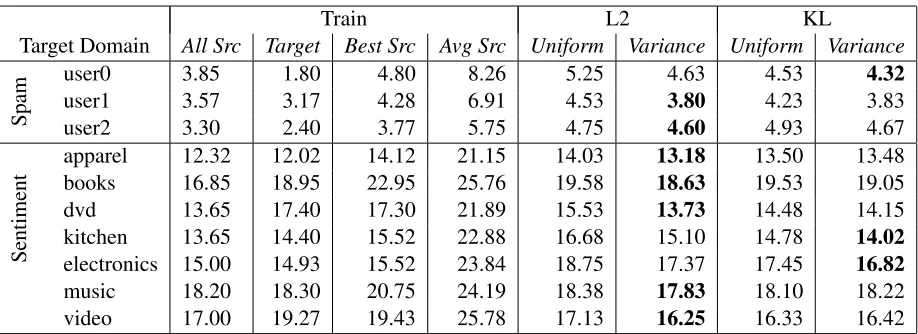
user0 3.85 1.80 4.80 8.26 5.25 4.63 4.53 4.32
user1 3.57 3.17 4.28 6.91 4.53 3.80 4.23 3.83
user2 3.30 2.40 3.77 5.75 4.75 4.60 4.93 4.67
Sentiment
apparel 12.32 12.02 14.12 21.15 14.03 13.18 13.50 13.48 books 16.85 18.95 22.95 25.76 19.58 18.63 19.53 19.05
dvd 13.65 17.40 17.30 21.89 15.53 13.73 14.48 14.15
[image:4.612.77.536.55.222.2]kitchen 13.65 14.40 15.52 22.88 16.68 15.10 14.78 14.02 electronics 15.00 14.93 15.52 23.84 18.75 17.37 17.45 16.82 music 18.20 18.30 20.75 24.19 18.38 17.83 18.10 18.22 video 17.00 19.27 19.43 25.78 17.13 16.25 16.33 16.42
Table 1: Test error for multi-source adaptation on sentiment and spam data. Combining classifiers improves over selecting a single classifier a priori (Avg Src).
We combine the existing user-specific classifiers into a single new classifier for a new user. Since nothing is known about the new user (their deci-sion function), each source classifier may be useful. However, feature similarity – possibly measured us-ing unlabeled data – could be used to weigh source domains. Specifically, we combine the parameters of each classifier according to their confidence us-ing the combination methods described above.
We evaluated the four combination strategies – L2 vs. KL, uniform vs. variance – on spam and sen-timent data. For each evaluation, a single domain was held out for testing while separate classifiers were trained on each source domain, i.e. no target training. Source classifiers are then combined and the combined classifier is evaluated on the test data (400 instances) of the target domain. Each classi-fier was trained for 5 iterations over the training data (to ensure convergence) and each experiment was repeated using 10-fold cross validation. The CW parameter φwas tuned on a single randomized run for each experiment. We include several baselines: training on target data to obtain an upper bound on performance (Target), training on all source do-mains together, a useful strategy if all source data is maintained (All Src), selecting (with omniscience) the best performing source classifier on target data (Best Src), and the expected real world performance of randomly selecting a source classifier (Avg Src).
While at least one source classifier achieved high performance on the target domain (Best Src), the correct source classifier cannot be selected without
target data and selecting a random source classifier yields high error. In contrast, a combined classifier almost always improved over the best source domain classifier (table 1). That some of our results improve over the best training scenario is likely caused by in-creased training data from using multiple domains. Increases over all available training data are very in-teresting and may be due to a regularization effect of training separate models.
The L2 methods performed best and KL improved 7 out of 10 combinations. Classifier parameter com-bination can clearly yield good classifiers without prior knowledge of the target domain.
7 Learning Across Domains
In addition to adapting to new domains, multi-domain systems should learn common behaviors across domains. Naively, we can assume that the domains are either sufficiently similar to warrant one classifier or different enough for separate clas-sifiers. The reality is often more complex. Instead, we maintain shared and domain-specific parameters and combine them for learning and prediction.
Spam Sentiment
Method Task A Task B Books DVD Books+DVD All
Single 3.88 8.75 23.7 25.11 23.26 16.57
Separate 5.46 14.53 22.22 21.64 21.23 21.89 Feature Splitting 4.16 8.93 15.65 16.20 14.60 17.45
MDR 4.09 9.18 15.65 15.12 13.76 17.45
MDR+L2 4.27 8.61 12.70 14.95 12.73 17.16
MDR+L2-Var 3.75 7.52 12.90 14.21 12.52 17.37
MDR+KL 4.32 9.22 13.51 13.81 13.32 17.20
MDR+KL-Var 4.02 8.70 14.93 14.03 14.22 18.40
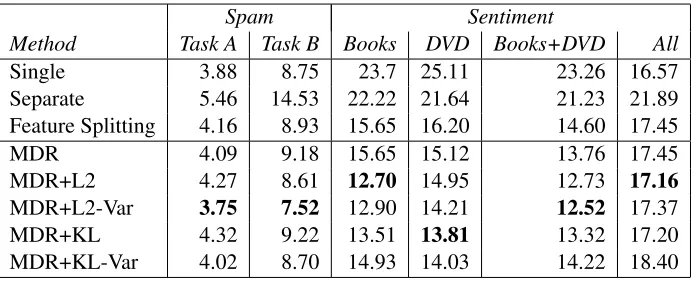
Table 2: Online training error for learning across domains.
Spam Sentiment
Method Task A Task B Books DVD Books+DVD All
Single 2.11 5.60 18.43 18.67 19.08 14.09
Separate 2.43 8.5 18.87 15.97 16.45 17.23
Feature Splitting 1.94 5.51 9.97 9.70 9.05 14.73
MDR 1.94 5.69 9.97 8.33 8.20 14.73
MDR+L2 1.87 5.16 6.63 7.97 7.62 14.20
MDR+L2-Var 1.90 4.78 6.40 7.83 7.30 14.33
MDR+KL 1.94 5.61 8.37 7.07 8.43 14.60
[image:5.612.134.481.56.197.2]MDR+KL-Var 1.97 5.46 9.40 7.50 8.05 15.50
Table 3: Test data error: learning across domains (MDR) improves over the baselines and Daum´e (2007).
We seek to learn domain specific parameters guided by shared parameters. Dekel et al. (2006) followed this approach for an online multi-task algo-rithm, although they did not have shared parameters and assumed that a training round comprised an ex-ample from each task. Evgeniou and Pontil (2004) achieved a similar goal by using shared parameters for multi-task regularization. Specifically, they as-sumed that the weight vector for problemdcould be represented aswc=wd+ws, wherewdare task spe-cific parameters andws are shared across all tasks. In this framework, all tasks are close to some under-lying meanwsand each one deviates from this mean bywd. Their SVM style multi-task objective mini-mizes the loss ofwcand the norm ofwdandws, with a tradeoff parameter allowing for domain deviance from the mean. The simple domain adaptation al-gorithm of feature splitting used by Daum´e (2007) is a special case of this model where the norms are
equally weighted. An analogous CW objective is:
min 1
λ1DKL
N µd,Σd
k N µdi,Σdi
+ 1
λ2DKL
(N (µs,Σs) k N(µsi,Σsi))
s.t.Prw∼N(µc,Σc)[yi(w·xi)≥0]≥η . (3)
µd,Σdare the parameters for domaind,(µs,Σs)
for the shared classifier and(µc,Σc) for the com-bination of the domain and shared classifiers. The parameters are combined via (2) with only two ele-ments summed - one for the shared parameterssand the other for the domain parametersd. This captures the intuition of Evgeniou and Pontil: updates en-force the learning condition on the combined param-eters and minimize parameter change. For conve-nience, we rewriteλ2 = 2−2λ1, whereλ1 ∈[0,1]. If classifiers are combined using the sum of the indi-vidual weight vectors andλ1 = 0.5, this is identical to feature splitting (Daum´e) for CW classifiers.
updated using the closed form solution to (3) as:
µs = µsi +λ2αyiΣcxi
(Σs)−1 = (Σsi)−1+ 2λ2αφxixTi
µd = µdi +λ1αyiΣcixi
(Σd)−1 = (Σdi)−1+ 2λ1αφxixTi
(4)
We call this objective Multi-Domain Regulariza-tion (MDR). As before, the combined parameters are produced by one of the combination methods. On each round, the algorithm receives instance xi and domaindifor which it creates a combined clas-sifier(µc,Σc)using the shared(µs,Σs)and domain specific parameters µd,Σd. A prediction is is-sued using the standard linear classifier prediction rule sign(µc·x) and updates follow (4). The ef-fect is that features similar across domains quickly converge in the shared classifier, sharing informa-tion across domains. The combined classifier re-flects shared and domain specific parameter confi-dences: weights with low variance (i.e. greater con-fidence) will contribute more.
We evaluate MDR on a single pass over a stream of instances from multiple domains, simulating a real world setting. Parameters λ1 and φ are iter-atively optimized on a single randomized run for each dataset. All experiments use 10-fold CV. In ad-dition to evaluating the four combination methods with MDR, we evaluate the performance of a sin-gle classifier trained on all domains (Single), a sep-arate classifier trained on each domain (Separate),
Feature Splitting(Daum´e) and feature splitting with optimized λ1 (MDR). Table 3 shows results on test data and table 2 shows online training error.
In this setting, L2 combinations prove best on 5 of 6 datasets, with the variance weighted combina-tion doing the best. MDR (optimizing λ1) slightly improves over feature splitting, and the combination methods improve in every case. Our best result is statistically significant compared to Feature Split-ting using McNemar’s test (p = .001) for Task B,
Books, DVD, Books+DVD. While a single or sepa-rate classifiers have a different effect on each dataset, MDR gives the best performance overall.
8 Learning in Many Domains
So far we have considered settings with a small number of similar domains. While this is typical of multi-task problems, real world settings present many domains which do not all share the same be-haviors. Online algorithms scale to numerous ex-amples and we desire the same behavior for numer-ous domains. Consider a spam filter used by a large email provider, which filters billions of emails for millions of users. Suppose that spammers control many accounts and maliciously label spam as legiti-mate. Alternatively, subsets of users may share pref-erences. Since behaviors are not consistent across domains, shared parameters cannot be learned. We seek algorithms robust to this behavior.
Since subsets of users share behaviors, these can be learned using our MDR framework. For example, discovering spammer and legitimate mail accounts would enable intra-group learning. The challenge is the online discovery of these subsets while learning model parameters. We augment the MDR frame-work to additionally learn this mapping.
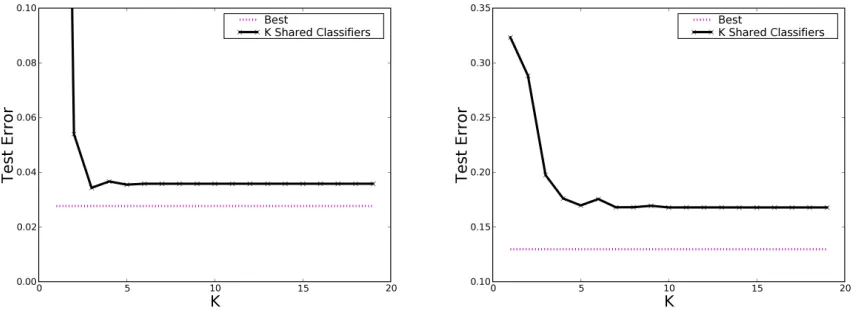
experi-Figure 1: Learning across many domains - spam (left) and sentiment (right) - with MDR usingkshared classifiers.
Figure 2: Learning across many domains - spam (left) and sentiment (right) - with no domain specific parameters.
mented with more complex techniques, this simple method worked well in practice. When a new do-main is added to the system, it takes fewer exam-ples to learn which shared classifier to use instead of learning a new model from scratch.
While this approach adds another free parameter (k) that can be set using development data, we ob-serve thatkcan instead be fixed to a large constant. Since only a single shared classifier is updated each round, the algorithm will favor selecting a previ-ously used classifier as opposed to a new one, using as many classifiers as needed but not scaling up tok. This may not be optimal, but it is a simple.
To evaluate a larger number of domains, we cre-ated many varying domains using spam and senti-ment data. For spam, 6 email users were created by
[image:7.612.91.519.282.442.2]two datasets. Parameters were optimized as before. Experiments were repeated for various settings of k. Since L2 performed well before, we evaluated MDR+L2 and MDR+L2-Var.
The results are shown in figure 1. For both spam and sentiment adding additional shared parameters beyond the single shared classifier significantly re-duces error, with further reductions as kincreases. This yields a 45% error reduction for spam and a 38% reduction for sentiment over the best baseline. While each task has an optimalk(about 5 for spam, 2 for sentiment), larger values still achieve low error, indicating the flexibility of using largekvalues.
While adding parameters clearly helps for many domains, it may be impractical to keep domain-specific classifiers for thousands or millions of do-mains. In this case, we could eliminate the domain-specific classifiers and rely on the k shared clas-sifiers only, learning the domain to classifier map-ping. We compare this approach using the best result from MDR above, again varyingk. Figure 2 shows that losing domain-specific parameters hurts perfor-mance, but is still an improvement over baseline methods. Additionally, we can expect better perfor-mance as the number of similar domains increases. This may be an attractive alternative to keeping a very large number of parameters.
9 Related Work
Multi-domain learning intersects two areas of re-search: domain adaptation and multi-task learning. In domain adaptation, a classifier trained for a source domain is transfered to a target domain using either unlabeled or a small amount of labeled target data. Blitzer et al. (2007) used structural correspondence learning to train a classifier on source data with new features induced from target unlabeled data. In a complimentary approach, Jiang and Zhai (2007) weighed training instances based on their similarity to unlabeled target domain data. Several approaches utilize source data for training on a limited number of target labels, including feature splitting (Daum´e, 2007) and adding the source classifier’s prediction as a feature (Chelba and Acero, 2004). Others have considered transfer learning, in which an existing domain is used to improve learning in a new do-main, such as constructing priors (Raina et al., 2006;
Marx et al., 2008) and learning parameter functions for text classification from related data (Do and Ng, 2006). These methods largely require batch learn-ing, unlabeled target data, or available source data at adaptation. In contrast, our algorithms operate purely online and can be applied when no target data is available.
Multi-task algorithms, also known as inductive transfer, learn a set of related problems simultane-ously (Caruana, 1997). The most relevant approach is that of Regularized Multi-Task Learning (Evge-niou and Pontil, 2004), which we use to motivate our online algorithm. Dekel et al. (2006) gave a sim-ilar online approach but did not use shared parame-ters and assumed multiple instances for each round. We generalize this work to both include an arbi-trary classifier combination and many shared classi-fiers. Some multi-task work has also considered the grouping of tasks similar to our learning of domain subgroups (Thrun and O’Sullivan, 1998; Bakker and Heskes, 2003).
There are many techniques for combining the out-put of multiple classifiers for ensemble learning or mixture of experts. Kittler et al. (Mar 1998) provide a theoretical framework for combining classifiers. Some empirical work has considered adding versus multiplying classifier output (Tax et al., 2000), using local accuracy estimates for combination (Woods et al., 1997), and applications to NLP tasks (Florian et al., 2003). However, these papers consider combin-ing classifier output for prediction. In contrast, we consider parameter combination for both prediction and learning.
10 Conclusion
hi-erarchical online clustering yield a better represen-tation than just selecting betweenkshared parame-ters? Additionally, how can prior knowledge about domain similarity be included into the combination methods? We plan to explore these questions in fu-ture work.
Acknowledgements This material is based upon work supported by the Defense Advanced Re-search Projects Agency (DARPA) under Contract No. FA8750-07-D-0185.
References
B. Bakker and T. Heskes. 2003. Task clustering and gat-ing for bayesian multi–task learngat-ing. Journal of Ma-chine Learning Research, 4:83–99.
John Blitzer, Mark Dredze, and Fernando Pereira. 2007. Biographies, bollywood, boom-boxes and blenders: Domain adaptation for sentiment classification. In As-sociation for Computational Linguistics (ACL). Rich Caruana. 1997. Multitask learning. Machine
Learning, 28:41–75.
Ciprian Chelba and Alex Acero. 2004. Adaptation of max- imum entropy classifier: Little data can help a lot. InEmpirical Methods in Natural Language Pro-cessing (EMNLP).
Koby Crammer, Ofer Dekel, Joseph Keshet, Shai Shalev-Shwartz, and Yoram Singer. 2006. Online passive-aggressive algorithms. Journal of Machine Learning Research, 7:551–585.
Hal Daum´e. 2007. Frustratingly easy domain adaptation. InAssociation for Computational Linguistics (ACL). Ofer Dekel, Philip M. Long, and Yoram Singer. 2006.
Online multitask learning. InConference on Learning Theory (COLT).
Chuong B. Do and Andrew Ng. 2006. Transfer learning for text classification. InAdvances in Neural Informa-tion Processing Systems (NIPS).
Mark Dredze, Koby Crammer, and Fernando Pereira. 2008. Confidence-weighted linear classification. In International Conference on Machine Learning (ICML).
Theodoros Evgeniou and Massimiliano Pontil. 2004. Regularized multi-task learning. In Conference on Knowledge Discovery and Data Mining (KDD). Radu Florian, Abe Ittycheriah, Hongyan Jing, and Tong
Zhang. 2003. Named entity recognition through clas-sifier combination. InConference on Computational Natural Language Learning (CONLL).
Jing Jiang and ChengXiang Zhai. 2007. Instance weight-ing for domain adaptation in nlp. In Association for Computational Linguistics (ACL).
J. Kittler, M. Hatef, R.P.W. Duin, and J. Matas. Mar 1998. On combining classifiers. Pattern Analy-sis and Machine Intelligence, IEEE Transactions on, 20(3):226–239.
N. Littlestone and M. K. Warmuth. 1994. The weighted majority algorithm. Information and Computation, 108:212–261.
Zvika Marx, Michael T. Rosenstein, Thomas G. Diet-terich, and Leslie Pack Kaelbling. 2008. Two algo-rithms for transfer learning. InInductive Transfer: 10 years later.
Rajat Raina, Andrew Ng, and Daphne Koller. 2006. Constructing informative priors using transfer learn-ing. InInternational Conference on Machine Learn-ing (ICML).
David M. J. Tax, Martijn van Breukelen, Robert P. W. Duina, and Josef Kittler. 2000. Combining multiple classifiers by averaging or by multiplying? Pattern Recognition, 33(9):1475–1485, September.
S. Thrun and J. O’Sullivan. 1998. Clustering learning tasks and the selective cross–task transfer of knowl-edge. In S. Thrun and L.Y. Pratt, editors,Learning To Learn. Kluwer Academic Publishers.