Proceedings of the 15th SIGMORPHON Workshop on Computational Research in Phonetics, Phonology, and Morphology, pages 43–53 43
String Transduction with Target Language Models
and Insertion Handling
Garrett Nicolai† and Saeed Najafi‡ and Grzegorz Kondrak‡
†Department of Computer Science ‡Department of Computing Science
Johns Hopkins University University of Alberta
[email protected] {snajafi, gkondrak}@ualberta.ca
Abstract
Many character-level tasks can be framed as sequence-to-sequence transduction, where the target is a word from a natural language. We show that leveraging target language mod-els derived from unannotated target corpora, combined with a precise alignment of the training data, yields state-of-the art results on cognate projection, inflection generation, and phoneme-to-grapheme conversion.
1 Introduction
Many natural language tasks, particularly those in-volving character-level operations, can be viewed as sequence-to-sequence transduction (Figure 1). Although these tasks are often addressed in iso-lation, they share a common objective — in each case, the output is a word in the target language.
The hypothesis that we investigate in this pa-per is that a single task- and language-independent system can achieve state-of-the-art results by leveraging unannotated target language corpora that contain thousands of valid target word types. We focus on low-data scenarios, which present a challenge to neural sequence-to-sequence mod-els because sufficiently large parallel datasets are often difficult to obtain. To reinforce transduc-tion models trained on modest-sized collectransduc-tions of source-target pairs, we leverage monolingual text corpora that are freely available for hundreds of languages.
Our approach is based on discriminative string transduction, where a learning algorithm assigns weights to features defined on aligned source and target pairs. At test time, an input sequence is con-verted into the highest-scoring output sequence. Advantages of discriminative transduction include an aptitude to derive effective models from small training sets, as wells as the capability to incorpo-rate diverse sets of features. Specifically, we build
เฟเทอร ์ feather+1PL;PRES Feder /fɛðɚ/
feather
Phoneme-to
-Grapheme Conversion Transliteration GenerationInflection ProjectionCognate
[image:1.595.307.528.224.378.2]Sequence-to-sequence Transduction
Figure 1: Illustration of four character-level sequence-to-sequence prediction tasks. In each case, the output is a word in the target language.
upon DIRECTL+ (Jiampojamarn et al., 2010), a string transduction tool which was originally de-signed for grapheme-to-phoneme conversion.
We present a new system, DTLM, that com-bines discriminative transduction with character and word language models (LMs) derived from large unannotated corpora. Target language mod-eling is particularly important in low-data scenar-ios, where the limited transduction models often produce many ill-formed output candidates. We avoid the error propagation problem which is in-herent in pipeline approaches by incorporating the LM feature sets directly into the transducer.
The contributions of this paper include the following. (1) A novel method of incorporat-ing strong target language models directly into discriminative transduction. (2) A novel ap-proach to unsupervised alignment that is partic-ularly beneficial in low-resource settings. (3) An extensive experimental comparison to pre-vious models on multiple tasks and languages, which includes state-of-the-art results on inflec-tion generainflec-tion, cognate projecinflec-tion, and phoneme-to-grapheme generation. (4) Publicly available implementation of the proposed methods. (5) Three new datasets for cognate projection.
2 Baseline methods
In this section, we describe the baseline methods, including the alignment of the training data, the feature sets of DirecTL+ (henceforth DTL), and reranking as a way of incorporating corpus statis-tics.
2.1 Alignment
Before a transduction model can be derived from the training data, the pairs of source and target strings need to be aligned, in order to identify atomic substring transformations. The unsuper-vised M2M aligner (Jiampojamarn et al., 2007) employs the Expectation-Maximization (EM) al-gorithm with the objective of maximizing the joint likelihood of its aligned source and target pairs. The alignment involves every source and target character. The pairs of aligned substrings may contain multiple characters on both the source and target sides, yieldingmany-to-many(M-M) align-ment links.
DTL excludes insertions from its set of edit op-erations because they greatly increase the com-plexity of the generation process, to the point of making it computationally intractable (Barton,
1986). Therefore, the M2M aligner is forced to avoid nulls on the source side by incorporating them into many-to-many links during the align-ment of the training data. Although many-to-many alignment models are more flexible than 1-1 models, they also generally require larger paral-lel datasets to produce correct alignments. In low-data scenarios, especially when the target strings tend to be longer than the source strings, this ap-proach often yields sub-optimal alignments (e.g., the leftmost alignment in Figure2).
w ɔ k ə z w ɔ _ k _ ə z w ɔ k ə z
[image:2.595.306.526.68.117.2]w a l k e r s w a l k e r s w a l k e r s
Figure 2: Examples of different alignments in phoneme-to-letter conversion. The underscore denotes a null substring.
2.2 Features
DTL is a feature-rich, discriminative character transducer, which searches for a model-optimal sequence of character transformation operations for its input. The core of the engine is a dy-namic programming algorithm capable of trans-ducing many consecutive characters in a single operation, also known as a semi-Markov model. Using a structured version of the MIRA algo-rithm (McDonald et al., 2005), the training pro-cess assigns weights to each feature, in order to achieve maximum separation of the gold-standard output from all others in the search space.
DTL uses a number of feature templates to as-sess the quality of an operation: source context, target 𝑛-gram, and joint 𝑛-gram features. Con-text features conjoin the rule with indicators for all source character𝑛-grams within a fixed window of where the rule is being applied. Target n-grams provide indicators on target character sequences, describing the shape of the target as it is being pro-duced, and may also be conjoined with the source context features. Joint 𝑛-grams build indicators on rule sequences, combining source and target context, and memorizing frequently-used rule pat-terns. An additional copy feature generalizes the identity function from source to target, which is useful if there is an overlap between the input and output symbol sets.
2.3 Reranking
The target language modeling of DTL is limited to a set of binary 𝑛-gram features, which are based exclusively on the target sequences from the par-allel training data. This shortcoming can be reme-died by taking advantage of large unannotated cor-pora that contain thousands of examples of valid target words.
reranker, with features including a word unigram corpus presence indicator, a normalized character language model score, and the rank and normal-ized confidence score generated by DTL. How-ever, such a pipeline approach suffers from er-ror propagation, and is unable to produce output forms that are not already present in the𝑛-best list. In addition, training a reranker requires a held-out set that substantially reduces the amount of train-ing data in low-data scenarios.
3 Methods
In this section, we describe our novel extensions: precision alignment, character-level target lan-guage modeling, and corpus frequency. We make the new implementation publicly available.1
3.1 Precision Alignment
We propose a novel alignment method that pro-duces accurate many-to-many alignments in two stages. The first step consists of a standard 1-1 alignment, with nulls allowed on either side of the parallel training data. The second step removes the undesirable nulls on the source side by merg-ing the correspondmerg-ing 0-1 links with adjacent 1-1 links. This alignment approach is superior to the one described in Section 2.1, especially in low-data scenarios when there is not enough evidence for many-to-many links.2
Our precision alignment is essentially a 1-1 alignment with 1-M links added when necessary. In a low-resource setting, an aligner is often un-able to distinguish valid M-M links from spurious ones, as both types will have minimal support in the training data. On the other hand, good 1-1 links are much more likely to have been observed. By limiting our first pass to 1-1 links, we ensure that only good 1-1 links are posited; otherwise, an insertion is predicted instead. On the second pass, the aligner only needs to choose between a small number of alternatives for merging the insertions, increasing the likelihood of a good alignment, and, subsequently, correct transduction.
Consider the example in Figure 2 where 5 source phonemes need to be aligned to 7 target letters. The baseline approach incorrectly links the
1http://github.com/GarrettNicolai/DTLM and /M2MP 2The improvement in the alignment quality is relative to
the performance of our transduction system, as we demon-strate in Section4.6— the alignments are not necessarily optimal from the linguistic point of view.
1: Algorithm:ForwardInsertionMerging
2: Input: (𝑥𝑇,𝑦𝑉)
3: Output:(𝛼𝑇+1,𝑉+1)
4: 𝐶𝐼= 0, 𝑃 𝐼= 0
5: for𝑡=0;𝑡≤𝑇 do
6: if𝑡 >0and𝑥𝑡==_then
7: 𝐶𝐼+=1
8: else
9: 𝑃 𝐼=𝐶𝐼
10: 𝐶𝐼= 0
11: for𝑣=0;𝑣≤𝑉 do
12: if𝑡−𝐶𝐼== 0then
13: 𝛼𝑡,𝑣= 1
14: 𝑐𝑜𝑛𝑡𝑖𝑛𝑢𝑒{insertions at the start of the word} 15: if𝑡 >0or𝑣 >0then
16: 𝛼𝑡,𝑣= 0
17: if𝑡 >0and𝑣 >0then
18: for𝑘= 0;𝑘≤𝑃 𝐼do
[image:3.595.308.523.64.264.2]19: 𝛼𝑡,𝑣+=𝛿(𝑥𝑡𝑡−𝐶𝐼−𝑘, 𝑦 𝑣 𝑣−𝐶𝐼−𝑘)* 𝛼𝑡−𝐶𝐼−𝑘−1,𝑣−𝐶𝐼−𝑘−1
Figure 3: The forward step of M2M, modified to merge insertions to adjacent characters.
letter ‘a’ with the phoneme /w/ (the leftmost align-ment in the diagram). Our first-pass 1-1 alignalign-ment (in the middle), correctly matches /O/ to ‘a’, while ‘l’ is treated as an insertion. On the second pass, our algorithm merges the null with the preceding 1-1 link. By contrast, the second insertion, which involves /@/, is merged with the substitution that follows it (the rightmost alignment).
Figure3demonstrates how we modify the for-ward step to merge insertions with adjacent sub-stituions; similar modifications are made for the backward step, expectation, and decoder. The in-put consists of a source stringx of length𝑇, and a target stringy of length 𝑉. Bothx andy may contain underscores, which represent nulls from the first alignment pass. The 𝛼 score represents the sum of the likelihoods of all paths that have been traversed through source character𝑡and tar-get character𝑣. In a 1-1 alignment, all𝛼scores ac-cumulate along the diagonal, while in a many-to-many alignment, other cells of the𝛼 matrix may be filled. Our precision alignment is a compromise between these two methods: we consider adjacent characters, but force the𝛼score to accumulate on the diagonal. By allowing insertions and deletions in the first pass, we force xand yto be of equal length. We then perform a 1-1 alignment, expand-ing the alignment size only when the source char-acter is a null.
have been encountered since the last substitution. The loop at line 18 executes the𝛼 score accumu-lation, where 𝛿 is the likelihood of a specific se-quence alignment, effectively merging insertions with adjacent substitutions. An extended example that illustrates the operation of the algorithm is in-cluded in the Appendix.
3.2 Character-level language model
In order to incorporate a stronger character lan-guage model into DTL, we propose an additional set of features that directly reflect the probabil-ity of the generated subsequences. We train a character-level language model on a list of types extracted from a raw corpus in the target lan-guage, applying Witten-Bell smoothing and back-off for unseen 𝑛-grams. During the generation process, the transducer incrementally constructs target sequences character-by-character. The nor-malized log-likelihood score of the current output sequence is computed according to the character language model.
For consistency with other sets of features, we convert these real-valued scores into binary indi-cators by means of binning. Development exper-iments led to the creation of bins that represent a normal distribution around the mean likelihood of words. Features fire in a cumulative manner, and a final feature fires only if no bin threshold is met. For example, if a sequence has a log-likelihood of -0.85, the feature for -0.9 fires, as does the one for -0.975, and -1.05, etc.
3.3 Corpus frequency counts
We also extend DTL with a feature set that can be described as a unigram word-level language model. The objective is to bias the model towards generating output sequences that correspond to words observed in a large corpus. Since an out-put sequence can only be matched against a word list after the generation process is complete, we propose to estimate the final frequency count for each prefix considered during the generation pro-cess. FollowingCherry and Suzuki(2009) we use a prefix trie to store partial words for reference in the generation phase. We modify their solution by also storing the count of each prefix, calculated as the sum of all of the words in which the prefix oc-curs.
As with our language model features, unigram features are binned. A unigram feature fires if the
pɪəs
DirecTL+
Language Model
Unigram Model
Candidate Prediction Score piess 4.07 pies 4.06 piuss 3.97
CandidateLM Score Bin Prediction Score pies -0.88 8 18.12 piers -0.94 9 14.97 pierce -0.97 9 13.21
Candidate Unigram count Bin Prediction Score pious 23.9 10 14.88 pierce 30.7 10 13.12 piece 283.7 8 12.95
2.09
pies
piers 1.90 pierce 1.90
pious 1.49 pierce 1.49 piece 1.64
[image:4.595.308.524.61.348.2]Candidate Prediction Score pierce 18.35 piers 18.27 press 16.93 pies 16.55 piece 14.05
Figure 4: An example of transduction with target lan-guage models. Black cells represent firing features.
count of the generated sequence surpasses the bin threshold, in a cumulative manner.
We found that the quality of the target uni-gram set can be greatly improved by language-based corpus pruning. Although unannotated cor-pora are more readily available than parallel ones, they are often noisier. Specifically, crowd-sourced corpora such as Wikipedia contain many English words that can unduly influence our unigram fea-tures. In order to mitigate this problem, we prepro-cess our corpora by removing all word unigrams that have a higher probability in an English corpus than in a target-language corpus.
Consider an example of how our new features benefit a transduction model, shown in Figure4. Note that although we portray the extensions as part of a pipeline, their scores are incorporated jointly with DTL’s other features. The top-𝑛
side of the diagram. Only when both sets of new features are incorporated does the system manage to produce the correct form, as seen at the bottom of the diagram.
4 Experiments
In this section, we present the results of our exper-iments on four different character-level sequence-to-sequence tasks: transliteration, inflection gen-eration, cognate projection, and phoneme-to-grapheme conversion (P2G). In order to demon-strate the generality of our approach, the exper-iments involve multiple systems and datasets, in both low-data and high-data scenarios.
Where low-data resources do not already exist, we simulate a low-data environment by sampling an existing larger training set. Low-data training sets consist of 100 training examples, 1000 de-velopment examples, and 1000 held-out examples, except for cognate projection, where we limit the development set to 100 training examples, and the held-out set to the remaining examples. An output is considered correct if it exactly matches any of the targets in the reference data.
4.1 Systems
We evaluate DTLM, our new system, against two strong baselines and two competitive tools. Pa-rameter tuning was performed on the same devel-opment sets for all systems.
We compare against two baselines. The first is the standard DTL, as described in Section2.2. The second follows the methodology of Nicolai et al. (2015), augmenting DTL with a reranker (DTL+RR), as described in Section 2.3. Both baselines use the default 2-2 alignment with dele-tions produced by the M2M aligner. We train the reranker using 10-fold cross validation on the training set, using the reranking method of
Joachims (2002). Due to the complexity of its setup on large datasets, we omit DTL+RR in such scenarios. Except where noted otherwise, we train 4-gram character language models using the CMU toolkit3 with Witten-Bell smoothing on the Uni-Morph corpora of inflected word forms.4 Word counts are determined from the first one million lines of the corresponding Wikipedia dumps.
We also compare against Sequitur (SEQ), a generative string transduction tool based on joint
3
http://www.speech.cs.cmu.edu/SLM
4unimorph.org
source and target𝑛-grams (Bisani and Ney,2008), and a character-level neural model (RNN). The neural model uses the encoder-decoder architec-ture typically used for NMT (Sutskever et al.,
2014). The encoder is a bi-directional RNN ap-plied to randomly initialized character embed-dings; we employ a soft-attention mechanism to learn an aligner within the model. The RNN is trained for a fixed random seed using the Adam optimizer, embeddings of 128 dimensions, and hidden units of size 256. We use a beam of size 10 to generate the final predictions. We experimented with the alternative neural approach of Makarov et al.(2017), but found that it only outperforms our RNN when the source and target sides are largely composed of the same set of symbols; therefore, we only use it for inflection generation.
4.2 Transliteration
Transliteration is the task of converting a word from a source to a target script on the basis of the word’s pronunciation.
Our low-resource data consists of three back-transliteration pairs from the 2018 NEWS Shared Task: Hebrew to English (HeEn), Thai to English (ThEn), and Persian to English (PeEn). These languages were chosen because they represent back-transliteration into English. Since the orig-inal forms were origorig-inally English, they are much more likely to appear in an English corpus than if the words originated in the source language. We report the results on the task’s 1000-instance de-velopment sets.
Since transliteration is mostly used for named entities, our language model and unigram counts are obtained from a corpus of named entities. We query DBPedia5 for a list of proper names, dis-carding names that contain non-English charac-ters. The resulting list of 1M names is used to train the character language model and inform the word unigram features.
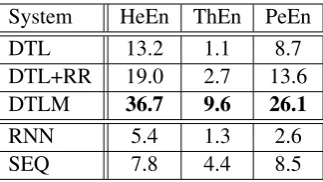
The results in Table 1 show that our pro-posed extensions have a dramatic impact on low-resource transliteration. In particular, the seam-less incorporation of the target language model not only simplifies the model but also greatly im-proves the results with respect to the reranking ap-proach. On the other hand, the RNN struggles to learn an adequate model with only 100 training ex-amples.
System HeEn ThEn PeEn
DTL 13.2 1.1 8.7
DTL+RR 19.0 2.7 13.6
DTLM 36.7 9.6 26.1
RNN 5.4 1.3 2.6
[image:6.595.101.263.61.152.2]SEQ 7.8 4.4 8.5
Table 1: Word-level accuracy on transliteration (in %) with 100 training instances.
System HeEn ThEn PeEn
DTL 21.9 37.0 23.6
DTLM 38.7 48.0 36.8
RNN 25.8 43.8 26.7
SEQ 25.5 44.9 31.2
Table 2: Word-level accuracy on transliteration (in %) with complete training sets.
We also evaluate a larger-data scenario. Using the same three languages, we replace the 100 in-stance training sets with the official training sets from the 2018 shared task, which contain 9,447, 27,273, and 15,677 examples for HeEn, TnEn, and PeEn, respectively. The language model and fre-quency lists are the same as for the low-resource experiments. Table 2 shows that DTLM outper-forms the other systems by a large margin thanks to its ability to leverage a target word list. Addi-tional results are reported byNajafi et al.(2018b).
4.3 Inflection generation
Inflection generation is the task of producing an inflected word-form, given a citation form and a set of morphological features. For example, given the Spanish infinitive liberar, with the tagV;IND;FUT;2;SG, the word-formliberarás
should be produced.
In recent years, inflection generation has at-tracted much interest (Dreyer and Eisner, 2011;
Durrett and DeNero, 2013; Nicolai et al., 2015;
Ahlberg et al., 2015). Aharoni and Goldberg
(2017) propose an RNN augmented with hard at-tention and explicit alignments for inflection, but have difficulty consistently improving upon the results of DTL, even on larger datasets. Fur-thermore, their system cannot be applied to tasks where the source and target are different lan-guages, due to shared embeddings between the en-coder and deen-coder.Ruzsics and Samardzic(2017) incorporate a language model into the decoder of
System Average
DTL 40.7
DTLM 49.0
CLUZH 40.9
Table 3: Word-level accuracy (in %) on inflection gen-eration with 100 training instances.
a canonical segmentation system. Our model dif-fers in that we learn the influence of the language model during training, in conjunction with DTL’s other features. Deutsch et al.(2018) place a hard constraint on the decoder, so that it only produces observed derivational forms. We instead imple-ment a soft constraint, encouraging candidates that look like real words, but allowing the model to generalize to unseen forms.
Our inflection data comes from the 2017 CoNLL–SIGMORPHON Shared Task on Rein-flection (Cotterell et al., 2017). We use the datasets from the low-resource setting of the in-flection generation sub-task, in which the train-ing sets are composed of 100 source lemmas with inflection tags and the corresponding inflected forms. We supplement the training data with 100 synthetic “copy” instances that simply trans-form the target string into itself. This modifica-tion, which is known to help in transduction tasks where the source and target are nearly identical, is used for the inflection generation experiments only. Along with the training sets from the shared task, we also use the task’s development and test sets, each consisting of 1000 instances.
Since Sequitur is ill-suited for this type of trans-duction, we instead train a model using the method of the CLUZH team (Makarov et al., 2017), a state-of-the-art neural system that was the winner of the 2017 shared task. Their primary submis-sion in the shared task was an ensemble of 20 indi-vidual systems. For our experiments, we selected their best individual system, as reported in their system paper. For each language, we train models with 3 separate seeds, and select the model that achieves the highest accuracy on the development set.
[image:6.595.367.467.62.122.2] [image:6.595.105.260.199.276.2]with the sparse corpora that such inventories sup-ply, we see notable gains over DTL. We also see large gains for languages such as Northern Sami and Navajo that have relatively small Wikipedias (fewer than 10,000 articles).
DTLM was also evaluated as a non-standard submission in the low-data track of the 2018 Shared Task on Universal Morphological Inflec-tion (Cotterell et al., 2018). The results reported by Najafi et al.(2018a) confirm that DTLM sub-stantially outperforms DTL on average. Further-more, a linear combination of DTLM and a neural system achieved the highest accuracy among all submissions on 34 out of 103 tested languages.
4.4 Cognate projection
Cognate projection, also referred to as cognate production, is the task of predicting the spelling of a hypothetical cognate in another language. For example, given the English word difficulty, the Spanish word dificultad should be produced. Previously proposed cognate projection systems have been based on SVM taggers (Mulloni,2007), character-level SMT models (Beinborn et al.,
2013), and sequence labeling combined with a maximum-entropy reranker (Ciobanu,2016).
In this section, we evaluate DTLM in both low-and high-resource settings. Our low-resource data consists of three diverse language pairs. The first set corresponds to a mother-daughter historical re-lationship between reconstructed Vulgar Latin and Italian (VL-IT) and contains 601 word pairs manu-ally compiled from the textbook ofBoyd-Bowman
(1980). English and German (EN-DE), close sib-lings from the Germanic family, are represented by 1013 pairs extracted from Wiktionary. From the same source, we also obtain 438 Slavic word pairs from Russian and Polish (RU-PL), which are written in different scripts (Cyrillic vs. Latin). We make the new datasets publicly available.6
The results are shown in Table 4. Of the sys-tems that have no recourse to corpus statistics, the RNN appears crippled by the small training size, while SEQ is competitive with DTL, espe-cially on the difficult EN-DE dataset. On the other hand, the other two systems obtain substantial im-provements over DTL, but the gains obtained by DTLM are 2-3 times greater than those obtained by DTL+RR. This demonstrates the advantage of incorporating the language model features directly
6http://github.com/GarrettNicolai/CognateData
System EN-DE RU-PL VL-IT
DTL 4.3 23.5 39.2
DTL+RR 7.1 32.8 43.6
DTLM 17.7 43.9 52.5
RNN 2.2 1.7 15.7
[image:7.595.339.495.61.150.2]SEQ 9.2 22.3 36.9
Table 4: Word-level accuracy (in %) on cognate pro-jection with 100 training instances.
System EN-ES EN-DE EN-RU
BZG-13 45.7 17.2 8.3
DTL 30.3 24.3 13.3
DTLM 56.8 33.5 45.9
[image:7.595.340.494.197.273.2]RNN 34.3 20.5 15.0
Table 5: Word-level accuracy (in %) on large-scale cognate projection.
into the training phase over simple reranking. Our high-resource data comes from a previous study of Beinborn et al. (2013). The datasets were created by applying romanization scripts and string similarity filters to translation pairs ex-tracted from Bing. We find that the datasets are noisy, consisting mostly of lexical loans from Latin, Greek, and English, and include many com-pound words that share only a single morpheme (i.e., informatics and informationswissenschaft). In order to alleviate the noise, we found it bene-ficial to disregard all training pairs that could not be aligned by M2M under the default 2-2 link set-ting.
Another problem in the data is the overlap be-tween the training and test sets, which ranges from 40% in EN-ES to 94% in EN-EL. Since we believe it would be inappropriate to report results on con-taminated sets, we decided to ignore all test in-stances that occur in the training data. (Unfortu-nately, this makes some of the test sets too small for a meaningful evaluation.) The resulting dataset sizes are included in the Appendix. Along with the datasets, Beinborn et al. (2013) provide the pre-dictions made by their system. We re-calculate the accuracy of their predictions (BZG-13), discard-ing any forms that were present in the traindiscard-ing set, and compare against DTL and DTLM, as well as the RNN.
DTLM correctly produces nearly half of poten-tial cognates, 3 times more than any of the other systems. We conclude that our results constitute a new state of the art for cognate projection.
4.5 Phoneme-to-grapheme conversion
Phoneme-to-grapheme (P2G) conversion is the task of predicting the spelling of a word from a se-quence of phonemes that represent its pronuncia-tion (Rentzepopoulos and Kokkinakis,1996). For example, a P2G system should convert [t r ae n z d ah k sh ah n] intotransduction. Unlike the op-posite task of grapheme-to-phoneme (G2P) con-version, large target corpora are widely available. To the best of our knowledge, the state of the art on P2G is the joint𝑛-gram approach ofBisani and Ney(2008), who report improvements on the re-sults ofGalescu and Allen (2002) on the NetTalk and CMUDict datasets.
Our low-resource dataset consists of three lan-guages: English (EN), Dutch (NL), and Ger-man (DE), extracted from the CELEX lexical database (Baayen et al.,1995).
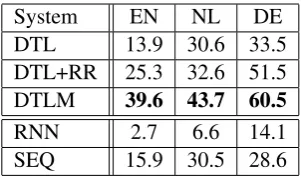
Table6shows that our modifications yield sub-stantial gains for all three languages, with consis-tent error reductions of 15-20%over the reranking approach. Despite only training on 100 words, the system is able to convert phonetic transcriptions into completely correct spellings for a large frac-tion of words, even in English, which is notorious for its idiosyncratic orthography. Once again, the RNN is hampered by the small training size.
We also evaluate DTLM in a large-data sce-nario. We attempt to replicate the P2G ex-periments reported by (Bisani and Ney, 2008). The data comes from three lexicons on which we conduct 10-fold cross validation: English NetTalk (Sejnowski and Rosenberg,1993), French Brulex (Mousty and Radeau, 1990), and English CMUDict (Weide,2005). These corpora contain 20,008, 24,726, and 113,438 words, respectively, in both orthographic and phonetic notations. We note that CMUDict differs from the other two lex-icons in that it is much larger, and contains pre-dominantly names, as well as alternative pronun-ciations. When the training data is that abundant, there is less to be gained from improving the align-ment or the target language models, as they are al-ready adequate in the baseline approach.
Table 7 shows the comparison of the results. The P2G results obtained by Sequitur in our
exper-System EN NL DE
DTL 13.9 30.6 33.5
DTL+RR 25.3 32.6 51.5
DTLM 39.6 43.7 60.5
RNN 2.7 6.6 14.1
[image:8.595.341.492.61.150.2]SEQ 15.9 30.5 28.6
Table 6: Word-level accuracy (in %) on phoneme-to-grapheme conversion with 100 training instances.
NetTalk Brulex CMU
DTL 61.0 68.0 48.3
DTLM 75.2 76.8 49.0
RNN 55.8 67.1 48.0
[image:8.595.328.502.198.273.2]SEQ 62.7 71.5 48.6
Table 7: Word-level accuracy (in %) on phoneme-to-grapheme conversion with large training sets.
iments are slightly lower than those reported in the original paper, which is attributable to differences in data splits, tuned hyper-parameters, and/or the presence of stress markers in the data. Sequitur still outperforms the baseline DTL, but DTLM substantially outperforms both Sequitur and the RNN on both the NetTalk and Brulex datasets, with smaller gains on the much larger CMUDict. We conclude that our results advance the state of the art on phoneme-to-grapheme conversion.
4.6 Ablation
Table 8 shows the results of disabling individ-ual components in the low-resource setting of the P2G task. The top row reproduces the full DTLM system results reported in Table 6. The remain-ing three show the results without the character-level LM, word unigram, and precision alignment, respectively. We observe that the accuracy sub-stantially decreases in almost every case, which demonstrates the contribution of all three compo-nents.
achiev-System EN NL DE
DTLM 39.6 43.7 60.5
-Language model 37.8 38.2 48.5
-Freq 22.0 37.1 56.7
[image:9.595.89.275.62.134.2]-Precision 34.9 43.7 46.7
Table 8: Ablation test on P2G data with 100 training instances.
ing 27.5% accuracy, while constraining M2M to 2-2 improves further, to 34.9%. The accu-racy increases to 39.6%when the precision align-ment is employed. We conclude that in the low-resource setting, our proposed precision alignment is preferable to bothMPALIGNERand the standard M2M alignment.
4.7 Error Analysis
The following error examples from three different tasks demonstrate the advantages of incorporating the character-level LM, word frequency, and pre-cision alignment, respectively. For the purpose of insightful analysis, we selected test instances for which DTLM produces markedly better output than DTL.
In inflection generation, the second person plu-ral form of knechten is correctly predicted as
knechtetet, instead of knechttet. In this case, our character language model derived from a large text corpus rightly assigns very low probability to the unlikely 4-gram sequence chtt, which violates German phonotactic constraints.
In the phoneme-to-grapheme conversion task, [tIlEm@tri] is transduced to telemetry, instead of
tilemetry. In English, a reduced vowel phoneme such as [I] may correspond to any vowel letter. In this example, DTLM is able to successfully lever-age the occurrence of the correct word-form in a raw corpus.
In cognate projection, the actual cognate of
Kenyan is kenianisch, rather than kenyisch. This prediction can be traced to the alignment of the adjectival suffix-anto-anischin the training data. The match, which involves a target substring of considerable length, is achieved through a merger of multiple insertion operations.
The errors made by DTLM fall into a few differ-ent categories. Occasionally, DTLM produces an incorrect form that is more frequent in the corpus. For example, DTLM incorrectly guesses a sub-junctive form of the verb versetzento be the
high-frequencyversetzt, rather than the unseen verset-zet. More important, the transducer is incapable of generalizing beyond source-target pairs seen in training. For example, consider the doubling of consonants in English orthography (e.g. betting). Unlike the RNN, DTLM incorrectly predicts the present participle ofrugas*ruging, because there is no instance of the doubling of ‘g’ in the training data.
5 Conclusion
We have presented DTLM: a powerful language-and task-independent transduction system that can leverage raw target corpora. DTLM is particularly effective in low-resource settings, but is also suc-cessful when larger training sets are available. The results of our experiments on four varied trans-duction tasks show large gains over alternative ap-proaches.
Acknowledgments
The first author was supported in part by the Defense Advanced Research Projects Agency’s (DARPA) Low Resource Emergent Incidents (LORELEI) program, under contract No. HR0011-15-C0113. Any opinions and conclu-sions expressed in this material are those of the authors, and do not necessarily reflect the views of the Defense Advanced Research Projects Agency (DARPA).
The second and third authors were supported by the Natural Sciences and Engineering Research Council of Canada (NSERC).
We thank the members of the University of Al-berta teams who collaborated with us in the con-text of the 2018 shared tasks on transliteration and morphological reinflection: Bradley Hauer, Rashed Rubby Riyadh, and Leyuan Yu.
References
Roee Aharoni and Yoav Goldberg. 2017. Morphologi-cal inflection generation with hard monotonic atten-tion. InProceedings of the 55th Annual Meeting of the Association for Computational Linguistics (Vol-ume 1: Long Papers), pages 2004–2015, Vancouver, Canada. Association for Computational Linguistics.
Malin Ahlberg, Markus Forsberg, and Mans Hulden. 2015.Paradigm classification in supervised learning
of morphology. InProceedings of the 2015
Lan-guage Technologies, pages 1024–1029. Association for Computational Linguistics.
Harald R. Baayen, Richard Piepenbrock, and Leon Gu-likers. 1995.The CELEX Lexical Database. Release 2 (CD-ROM). Linguistic Data Consortium, Univer-sity of Pennsylvania, Philadelphia, Pennsylvania.
G. Edward Barton. 1986. Computational complexity
in two-level morphology. In Proceedings of the
24th Annual Meeting of the Association for Compu-tational Linguistics, pages 53–59, New York, New York, USA. Association for Computational Linguis-tics.
Lisa Beinborn, Torsten Zesch, and Iryna Gurevych. 2013. Cognate production using character-based
machine translation. InProceedings of the Sixth
In-ternational Joint Conference on Natural Language Processing, pages 883–891, Nagoya, Japan. Asian Federation of Natural Language Processing.
Maximilian Bisani and Hermann Ney. 2008. Joint-sequence models for grapheme-to-phoneme conver-sion.Speech communication, 50(5):434–451.
Peter Boyd-Bowman. 1980.From Latin to Romance in sound charts. Georgetown University Press.
Colin Cherry and Hisami Suzuki. 2009.Discriminative
substring decoding for transliteration. In
Proceed-ings of the 2009 Conference on Empirical Methods in Natural Language Processing, pages 1066–1075. Association for Computational Linguistics.
Alina Maria Ciobanu. 2016. Sequence labeling for
cognate production. InKnowledge-Based and
Intel-ligent Information and Engineering Systems: Pro-ceedings of the 20th International Conference KES-2016, pages 1391–1399.
Ryan Cotterell, Christo Kirov, John Sylak-Glassman, Géraldine Walther, Ekaterina Vylomova, Arya D. McCarthy, Katharina Kann, Sebastian Mielke, Gar-rett Nicolai, Miikka Silfverberg, David Yarowsky, Jason Eisner, and Mans Hulden. 2018. The CoNLL– SIGMORPHON 2018 shared task: Universal mor-phological reinflection. In Proceedings of the CoNLL–SIGMORPHON 2018 Shared Task: Univer-sal Morphological Reinflection, Brussels, Belgium. Association for Computational Linguistics.
Ryan Cotterell, Christo Kirov, John Sylak-Glassman, Géraldine Walther, Ekaterina Vylomova, Patrick Xia, Manaal Faruqui, Sandra Kübler, David Yarowsky, Jason Eisner, and Mans Hulden. 2017.
CoNLL–SIGMORPHON 2017 shared task:
Uni-versal morphological reinflection in 52 languages.
InProceedings of the CoNLL–SIGMORPHON 2017 Shared Task: Universal Morphological Reinflection, pages 1–30, Vancouver. Association for Computa-tional Linguistics.
Daniel Deutsch, John Hewitt, and Dan Roth. 2018. A distributional and orthographic aggregation model
for english derivational morphology. In
Proceed-ings of the 56th Annual Meeting of the Association for Computational Linguistics (Volume 1: Long Pa-pers), pages 1938–1947. Association for Computa-tional Linguistics.
Markus Dreyer and Jason Eisner. 2011. Discovering morphological paradigms from plain text using a Dirichlet process mixture model. In Proceedings of the Conference on Empirical Methods in Natural Language Processing, pages 616–627. Association for Computational Linguistics.
Greg Durrett and John DeNero. 2013. Supervised learning of complete morphological paradigms. In
HLT-NAACL, pages 1185–1195.
Lucian Galescu and James F. Allen. 2002. Pronunci-ation of proper names with a joint n-gram model for bi-directional grapheme-to-phoneme conversion. InSeventh International Conference on Spoken Lan-guage Processing.
Sittichai Jiampojamarn, Colin Cherry, and Grzegorz Kondrak. 2010. Integrating joint n-gram features into a discriminative training network. In NAACL-HLT, pages 697–700, Los Angeles, CA. Association for Computational Linguistics.
Sittichai Jiampojamarn, Grzegorz Kondrak, and Tarek Sherif. 2007. Applying many-to-many alignments and hidden markov models to letter-to-phoneme
conversion. In Human Language Technologies
2007: The Conference of the North American Chap-ter of the Association for Computational Linguistics; Proceedings of the Main Conference, pages 372– 379. Association for Computational Linguistics.
Thorsten Joachims. 2002. Optimizing search engines using clickthrough data. In Proceedings of the eighth ACM SIGKDD international conference on Knowledge discovery and data mining, pages 133– 142. ACM.
Keigo Kubo, Hiromichi Kawanami, Hiroshi Saruwatari, and Kiyohiro Shikano. 2011. Un-constraned many-to-many alignment for automatic pronunciation annotation. In Proceedings of the Asia-Pacific Signal and Information Processing Association Annual Summit and Conference.
Peter Makarov, Tatiana Ruzsics, and Simon Clematide. 2017. Align and copy: UZH at SIGMORPHON 2017 shared task for morphological reinflection.
arXiv preprint arXiv:1707.01355.
Ryan McDonald, Koby Crammer, and Fernando Pereira. 2005. Online large-margin training of de-pendency parsers. InACL.
Andrea Mulloni. 2007. Automatic prediction of
cog-nate orthography using support vector machines.
In Proceedings of the ACL 2007 Student Research Workshop, pages 25–30, Prague, Czech Republic. Association for Computational Linguistics.
Saeed Najafi, Bradley Hauer, Rashed Rubby Riyadh, Leyuan Yu, and Grzegorz Kondrak. 2018a. Combin-ing neural and non-neural methods for low-resource morphological reinflection. In Proceedings of the CoNLL–SIGMORPHON 2018 Shared Task: Univer-sal Morphological Reinflection, Brussels, Belgium. Association for Computational Linguistics.
Saeed Najafi, Bradley Hauer, Rashed Rubby Riyadh, Leyuan Yu, and Grzegorz Kondrak. 2018b.
Com-parison of assorted models for transliteration. In
Proceedings of the Seventh Named Entities Work-shop, pages 84–88. Association for Computational Linguistics.
Garrett Nicolai, Colin Cherry, and Grzegorz Kondrak. 2015. Inflection generation as discriminative string
transduction. In Proceedings of the 2015
Confer-ence of the North American Chapter of the Associ-ation for ComputAssoci-ational Linguistics: Human Lan-guage Technologies, pages 922–931. Association for Computational Linguistics.
Panagiotis A. Rentzepopoulos and George K. Kokki-nakis. 1996. Efficient multilingual
phoneme-to-grapheme conversion based on HMM.
Computa-tional Linguistics, 22(3):351–375.
Tatyana Ruzsics and Tanja Samardzic. 2017. Neu-ral sequence-to-sequence learning of internal word
structure. InProceedings of the 21st Conference on
Computational Natural Language Learning (CoNLL 2017), pages 184–194, Vancouver, Canada. Associ-ation for ComputAssoci-ational Linguistics.
TJ Sejnowski and CR Rosenberg. 1993. NETtalk cor-pus. URL< ftp://svrftp. eng. cam. ac. uk/pub/comp. speech/dictionaries.
Ilya Sutskever, Oriol Vinyals, and Quoc V Le. 2014. Sequence to sequence learning with neural net-works. InAdvances in neural information process-ing systems, pages 3104–3112.