Low-dimensional Embeddings for Interpretable
Anchor-based Topic Inference
Moontae Lee
Dept. of Computer Science Cornell University
Ithaca, NY, 14853
David Mimno
Dept. of Information Science Cornell University Ithaca, NY, 14853
Abstract
The anchor words algorithm performs provably efficient topic model inference by finding an approximate convex hull in a high-dimensional word co-occurrence space. However, the existing greedy al-gorithm often selects poor anchor words, reducing topic quality and interpretability. Rather than finding an approximate con-vex hull in a high-dimensional space, we propose to find an exact convex hull in a visualizable 2- or 3-dimensional space. Such low-dimensional embeddings both improve topics and clearly show users why the algorithm selects certain words.
1 Introduction
Statistical topic modeling is useful in exploratory data analysis (Blei et al., 2003), but model infer-ence is known to be NP-hard even for the sim-plest models with only two topics (Sontag and Roy, 2011), and training often remains a black box to users. Likelihood-based training requires expensive approximate inference such as varia-tional methods (Blei et al., 2003), which are deter-ministic but sensitive to initialization, or Markov chain Monte Carlo (MCMC) methods (Griffiths and Steyvers, 2004), which have no finite conver-gence guarantees. Recently Arora et al. proposed the Anchor Words algorithm (Arora et al., 2013), which casts topic inference as statistical recovery using a separability assumption: each topic has a specific anchor word that appears only in the context of that single topic. Each anchor word can be used as a unique pivot to disambiguate the corresponding topic distribution. We then recon-struct the word co-occurrence pattern of each
non-anchor words as a convex combination of the co-occurrence patterns of the anchor words.
burger salad
pizza chickengood
told
popcorn stadium
views tire
movies screen sashimi
car called
hotel
yoga bagels
shopping dog
[image:1.595.307.526.297.451.2]movie
Figure 1: 2Dt-SNE projection of a Yelp review corpus and its convex hull. The words corre-sponding to vertices are anchor words for topics, whereas non-anchor words correspond to the inte-rior points.
This algorithm is fast, requiring only one pass through the training documents, and provides provable guarantees, but results depend entirely on selecting good anchor words. (Arora et al., 2013) propose a greedy method that finds an approxi-mate convex hull around a set of vectors corre-sponding to the word co-occurrence patterns for each vocabulary word. Although this method is an improvement over previous work that used im-practical linear programming methods (Arora et al., 2012), serious problems remain. The method greedily chooses the farthest point from the cur-rent subspace until the given number of anchors have been found. Particularly at the early stages
of the algorithm, the words associated with the farthest points are likely to be infrequent and id-iosyncratic, and thus form poor bases for human interpretation and topic recovery. This poor choice of anchors noticeably affects topic quality: the an-chor words algorithm tends to produce large num-bers of nearly identical topics.
Besides providing a separability criterion, an-chor words also have the potential to improve topic interpretability. After learning topics for given text collections, users often request a label that sum-marizes each topic. Manually labeling topics is ar-duous, and labels often do not carry over between random initializations and models with differing numbers of topics. Moreover, it is hard to con-trol the subjectivity in labelings between annota-tors, which is open to interpretive errors. There has been considerable interest in automating the labeling process (Mei et al., 2007; Lau et al., 2011; Chuang et al., 2012). (Chuang et al., 2012) pro-pose a measure ofsaliency: a good summary term should be both distinctive specifically to one topic and probable in that topic. Anchor words are by definition optimally distinct, and therefore may seem to be good candidates for topic labels, but greedily selecting extreme words often results in anchor words that have low probability.
In this work we explore the opposite of Arora et al.’s method: rather than finding an approximate convex hull for an exact set of vectors, we find an exact convex hull for an approximate set of vec-tors. We project the V ×V word co-occurrence matrix to visualizable 2- and 3-dimensional spaces using methods such ast-SNE (van der Maaten and Hinton, 2008), resulting in an input matrix up to 3600 times narrower than the original input for our training corpora. Despite this radically low-dimensional projection, the method not only finds topics that are as good or better than the greedy anchor method, it also finds highly salient, in-terpretable anchor words and provides users with a clear visual explanation for why the algorithm chooses particular words, all while maintaining the original algorithm’s computational benefits.
2 Related Work
Latent Dirichlet allocation (LDA) (Blei et al., 2003) modelsDdocuments with a vocabularyV
using a predefined number of topics byK. LDA views both{Ak}K
k=1, a set ofKtopic-word distri-butions for each topick, and{Wd}Dd=1, a set ofD
document-topic distributions for each documentd, and{zd}Dd=1, a set of topic-assignment vectors for word tokens in the documentd, as randomly gen-erated from known stochastic processes. Merging {Ak}ask-th column vector ofV ×KmatrixA, {Wd}asd-th column vector ofK×DmatrixW, the learning task is to estimate the posterior dis-tribution of latent variablesA,W, and{zd}given
V ×D word-document matrix Mˆ, which is the only observed variable where d-th column corre-sponds to the empirical word frequencies in the training documentsd.
(Arora et al., 2013) recover word-topic matrix
A and topic-topic matrixR = E[W WT]instead ofW in the spirit of nonnegative matrix factoriza-tion. Though the true underlying word distribu-tion for each document is unknown and could be far from the sample observationMˆ, the empirical word-word matrixQˆ converges to its expectation
AE[W WT]AT =ARAT as the number of docu-ments increases. Thus the learning task is to ap-proximately recoverA andR pretending that the empiricalQˆ is close to the true second-order mo-ment matrixQ.
The critical assumption for this method is to suppose that every topic k has a specific anchor wordskthat occurs with non-negligible probabil-ity (> 0) only in that topic. The anchor word sk need not always appear in every document about the topick, but we can be confident that the doc-ument is at least to some degree about the topick
if it containssk. This assumption drastically im-proves inference by guaranteeing the presence of a diagonal sub-matrix inside the word-topic ma-trixA. After constructing an estimate Qˆ, the al-gorithm in (Arora et al., 2013) first finds a set
S = {s1, ..., sK}ofK anchor words (K is user-specified), and recovers A and R subsequently based onS. Due to this structure, overall perfor-mance depends heavily on the quality of anchor words.
candidates in addition to (Gu and Eisenstat, 1996). We found no change in anchor selection using these algorithms, verifying the difficulty of the an-chor finding process. This difficulty is mostly be-cause anchors must be nonnegative convex bases, whereas the classified vectors from the subset se-lection algorithms yield unconstrained bases.
The t-SNE model has previously been used to display high-dimensional embeddings of words in 2D space by Turian.1 Low-dimensional
embed-dings of topic spaces have also been used to sup-port user interaction with models: (Eisenstein et al., 2011) use a visual display of a topic embed-ding to create a navigator interface. Although
t-SNE has been used to visualize the results of topic models, for example by (Lacoste-Julien et al., 2008) and (Zhu et al., 2009), we are not aware of any use of the method as a fundamental compo-nent of topic inference.
3 Low-dimensional Embeddings
Real text corpora typically involve vocabularies in the tens of thousands of distinct words. As the input matrix Qˆ scales quadratically with V, the Anchor Words algorithm must depend on a low-dimensional projection ofQˆ in order to be practi-cal. Previous work (Arora et al., 2013) uses ran-dom projections via either Gaussian ranran-dom ma-trices (Johnson and Lindenstrauss, 1984) or sparse random matrices (Achlioptas, 2001), reducing the representation of each word to around 1,000 di-mensions. Since the dimensionality of the com-pressed word co-occurrence space is an order of magnitude larger than K, we must still approxi-mate the convex hull by choosing extreme points as before.
In this work we explore two projection meth-ods: PCA andt-SNE (van der Maaten and Hinton, 2008). Principle Component Analysis (PCA) is a commonly-used dimensionality reduction scheme that linearly transforms the data to new coordi-nates where the largest variances are orthogonally captured for each dimension. By choosing only a few such principle axes, we can represent the data in a lower dimensional space. In contrast,t-SNE embedding performs a non-linear dimensionality reduction preserving the local structures. Given a set of points{xi}in a high-dimensional spaceX,
t-SNE allocates probability mass for each pair of points so that pairs of similar (closer) points
be-1http://metaoptimize.com/projects/wordreprs/
good
place
great love
chicken
store rice
shower response
to-gobroccoliteriyaki
yoga salon
[image:3.595.313.534.70.231.2]lettuce
Figure 2: 2D PCA projections of a Yelp review corpus and its convex hulls.
come more likely to co-occur than dissimilar (dis-tant) points.
pj|i = exp(−d(xi,xj) 2/2σ2
i)
P
k6=iexp(−d(xi,xk)2/2σ2i) (1)
pij = pj|i2+Npi|j (symmetrized) (2)
Then it generates a set of new points {yi} in low-dimensional space Y so that probability dis-tribution over points inY behaves similarly to the distribution over points in X by minimizing KL-divergence between two distributions:
qij = (1 +kyi−yjk
2)−1
P
k6=l(1 +kyk−ylk2)−1 (3)
min KL(P||Q) =X
i6=j
pijlogpqij
ij (4)
staff atmospherebarlove beer
hour chicken
location food highly wine mexican
yearskids
music screen
shop rice
rooms manager
called bbq
dim
shower ground
group
cheesecake
tires bagels
sashimi
waiter
enchilada
specials
hotel beers
donuts
glass
yoga peaks cupcakes
dive
movie dog
cookie chorizo
starbucks
shopping hummus
play
hair bottle
[image:4.595.76.291.77.234.2]prompt
Figure 3: 3Dt-SNE projection of a Yelp review corpus and its convex hull. Vertices on the convex hull correspond to anchor words.
In addition to the computational advantages, this approach benefits anchor-based topic model-ing in two aspects. First, as we now compute the exact convex hull, the number of topics depends on the dimensionality of the embedding, v. For example in the figures, 2D projection has 21 ver-tices, whereas 3D projection supports 69 vertices. This implies users can easily tune the granularity of topic clusters by varying v = 2,3,4, ... with-out increasing the number of topics by one each time. Second, we can effectively visualize the the-matic relationships between topic anchors and the rest of words in the vocabulary, enhancing both interpretability and options for further vocabulary curation.
4 Experimental Results
We find that radically low-dimensionalt-SNE pro-jections are effective at finding anchor words that are much more salient than the greedy method, and topics that are more distinctive, while maintain-ing comparable held-out likelihood and semantic coherence. As noted in Section 1, the previous greedy anchor words algorithm tends to produce many nearly identical topics. For example, 37 out of 100 topics trained on a 2008 political blog cor-pus have obama, mccain, bush, iraq or palin as their most probable word, including 17 just for obama. Only 66% of topics have a unique top word. In contrast, the t-SNE model on the same dataset has only one topic whose most probable word is obama, and 86% of topics have a unique
top word (mccain is the most frequent top word, with five topics).
We use three real datasets: business reviews from the Yelp Academic Dataset,2 political blogs
from the 2008 US presidential election (Eisen-stein and Xing, 2010), and New York Times ar-ticles from 2007.3 Details are shown in Table
1. Documents with fewer than 10 word tokens are discarded due to possible instability in con-structingQˆ. We perform minimal vocabulary cu-ration, eliminating a standard list of English stop-words4and terms that occur below frequency
cut-offs: 100 times (Yelp, Blog) and 150 times (NYT). We further restrict possible anchor words to words that occur in more than three documents. As our datasets are not artificially synthesized, we reserve 5% from each set of documents for held-out like-lihood computation.
Name Documents Vocab. Avg. length
Yelp 20,000 1,606 40.6
Blog 13,000 4,447 161.3 NYT 41,000 10,713 277.8
Table 1: Statistics for datasets used in experiments
Unlike (Arora et al., 2013), which presents results on synthetic datasets to compare perfor-mance across differentrecoverymethods given in-creasing numbers of documents, we are are inter-ested in comparing anchor finding methods, and are mainly concerned with semantic quality. As a result, although we have conducted experiments on synthetic document collections,5 we focus on
real datasets for this work. We also choose to com-pare only anchor finding algorithms, so we do not report comparisons to likelihood-based methods, which can be found in (Arora et al., 2013).
For both PCA and t-SNE, we use three-dimensional embeddings across all experiments. This projection results in matrices that are 0.03% as wide as the original V × V matrix for the NYT dataset. Without low-dimensional embed-ding, each word is represented by a V-dimensional vector where only several terms are non-zero due to the sparse co-occurrence patterns. Thus a
ver-2https://www.yelp.com/academic dataset 3http://catalog.ldc.upenn.edu/LDC2008T19
4We used the list of 524 stop words included in the Mallet
library.
5None of the algorithms are particularly effective at
[image:4.595.332.505.319.362.2]tex captured by the greedy anchor-finding method is likely to be one of many eccentric vertices in very high-dimensional space. In contrast, t-SNE creates an effective dense representation where a small number of pivotal vertices are more clearly visible, improving both performance and inter-pretability.
Note that since we can find anexactconvex hull in these spaces,6 there is an upper bound to the
number of topics that can be found given a partic-ular projection. If more topics are desired, one can simply increase the dimensionality of the projec-tion. For the greedy algorithm we use sparse ran-dom projections with 1,000 dimensions with 5% negative entries and 5% positive entries. PCA and
t-SNE choose (49, 32, 47) and (69, 77, 107) an-chors, respectively for each of three Yelp, Blog, and NYTimes datasets.
4.1 Anchor-word Selection
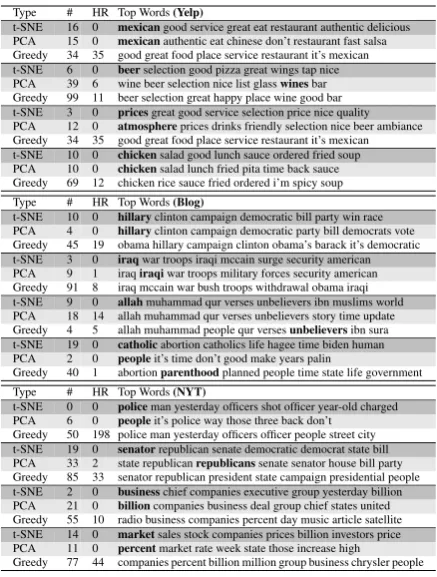
We begin by comparing the behavior of low-dimensional embeddings to the behavior of the standard greedy algorithm. Table 2 shows ordered lists of the first 12 anchor words selected by three algorithms: t-SNE embedding, PCA embedding, and the original greedy algorithm. Anchor words selected by t-SNE (police, business, court) are more general than anchor words selected by the greedy algorithm (cavalry, al-sadr, yiddish). Ad-ditional examples of anchor words and their asso-ciated topics are shown in Table 3 and discussed in Section 4.2.
# t-SNE PCA Greedy
1 police beloved cavalry
2 bonds york biodiesel
3 business family h/w
4 day loving kingsley
5 initial late mourners
6 million president pcl 7 article people carlisle
8 wife article al-sadr
9 site funeral kaye
10 mother million abc’s
11 court board yiddish
[image:5.595.307.526.60.349.2]12 percent percent great-grandmother
Table 2: The first 12 anchor words selected by three algorithms for the NYT corpus.
The Gram-Schimdt process used by Arora et al. greedily selects anchors in high-dimensional space. As each word is represented within V
-6In order to efficiently find an exact convex hull, we use
theQuickhullalgorithm.
Type # HR Top Words(Yelp)
t-SNE 16 0 mexicangood service great eat restaurant authentic delicious PCA 15 0 mexicanauthentic eat chinese don’t restaurant fast salsa Greedy 34 35 good great food place service restaurant it’s mexican t-SNE 6 0 beerselection good pizza great wings tap nice PCA 39 6 wine beer selection nice list glasswinesbar Greedy 99 11 beer selection great happy place wine good bar t-SNE 3 0 pricesgreat good service selection price nice quality PCA 12 0 atmosphereprices drinks friendly selection nice beer ambiance Greedy 34 35 good great food place service restaurant it’s mexican t-SNE 10 0 chickensalad good lunch sauce ordered fried soup PCA 10 0 chickensalad lunch fried pita time back sauce Greedy 69 12 chicken rice sauce fried ordered i’m spicy soup Type # HR Top Words(Blog)
t-SNE 10 0 hillaryclinton campaign democratic bill party win race PCA 4 0 hillaryclinton campaign democratic party bill democrats vote Greedy 45 19 obama hillary campaign clinton obama’s barack it’s democratic t-SNE 3 0 iraqwar troops iraqi mccain surge security american PCA 9 1 iraqiraqiwar troops military forces security american Greedy 91 8 iraq mccain war bush troops withdrawal obama iraqi t-SNE 9 0 allahmuhammad qur verses unbelievers ibn muslims world PCA 18 14 allah muhammad qur verses unbelievers story time update Greedy 4 5 allah muhammad people qur versesunbelieversibn sura t-SNE 19 0 catholicabortion catholics life hagee time biden human PCA 2 0 peopleit’s time don’t good make years palin
Greedy 40 1 abortionparenthoodplanned people time state life government Type # HR Top Words(NYT)
[image:5.595.88.276.506.640.2]t-SNE 0 0 policeman yesterday officers shot officer year-old charged PCA 6 0 peopleit’s police way those three back don’t Greedy 50 198 police man yesterday officers officer people street city t-SNE 19 0 senatorrepublican senate democratic democrat state bill PCA 33 2 state republicanrepublicanssenate senator house bill party Greedy 85 33 senator republican president state campaign presidential people t-SNE 2 0 businesschief companies executive group yesterday billion PCA 21 0 billioncompanies business deal group chief states united Greedy 55 10 radio business companies percent day music article satellite t-SNE 14 0 marketsales stock companies prices billion investors price PCA 11 0 percentmarket rate week state those increase high Greedy 77 44 companies percent billion million group business chrysler people
Table 3: Example t-SNE topics and their most similar topics across algorithms. The Greedy algo-rithm can find similar topics, but the anchor words are much less salient.
dimensions, finding the word that has the next most distinctive co-occurrence pattern tends to prefer overly eccentric words with only short, in-tense bursts of co-occurring words. While the bases corresponding to these anchor words could be theoretically relevant for the original space in high-dimension, they are less likely to be equally important in low-dimensional space. Thus project-ing down to low-dimensional space can rearrange the points emphasizing not only uniqueness, but also longevity, achieving the ability to form mea-surably more specific topics.
unigram distributionp(w).
p(w|z=kcavalry)∝p(z=kcavalry|w)p(w) ≈p(w)
This lack of specificity results in the observed sim-ilarity of topics.
4.2 Quantitative Results
In this section we compare PCA andt-SNE pro-jections to the greedy algorithm along several quantitative metrics. To show the effect of dif-ferent values of K, we report results for varying numbers of topics. As the anchor finding algo-rithms are deterministic, the anchor words in aK -dimensional model are identical to the firstK an-chor words in a(K+ 1)-dimensional model. For the greedy algorithm we select anchor words in the order they are chosen. For the PCA and t -SNE methods, which find anchors jointly, we sort words in descending order by their distance from their centroid.
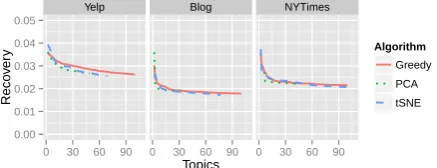
Recovery Error. Each non-anchor word is ap-proximated by a convex combination of the K
anchor words. The projected gradient algorithm (Arora et al., 2013) determines these convex coef-ficients so that the gap between the original word vector and the approximation becomes minimized. As choosing a good basis ofKanchor words de-creases this gap, Recovery Error (RE) is defined by the average`2-residuals across all words.
RE= 1
V
V
X
i=1 kQ¯i−
K
X
k=1
p(z1 =k|w1=i) ¯QSkk2
(5) Recovery error decreases with the number of
top-Yelp Blog NYTimes
0.00 0.01 0.02 0.03 0.04 0.05
0 30 60 90 0 30 60 90 0 30 60 90 Topics
Reco
v
er
y Algorithm
Greedy PCA
[image:6.595.306.527.293.378.2]tSNE
Figure 4: Recovery error is similar across algo-rithms.
ics, and improves substantially after the first 10–15 anchor words for all methods. Thet-SNE method has slightly better performance than the greedy al-gorithm, but they are similar. Results for recovery
with the original, unprojected matrix (not shown) are much worse than the other algorithms, sug-gesting that the initial anchor words chosen are es-pecially likely to be uninformative.
Normalized Entropy. As shown previously, if the probability of topics given a word is close to uniform, the probability of that word in topics will be close to the corpus distribution. Normalized Entropy (NE) measures the entropy of this distri-bution relative to the entropy of aK-dimensional uniform distribution:
NE= V1 XV
i=1
H(z|w=i)
logK . (6)
The normalized entropy of topics given word
dis-Yelp Blog NYTimes
0.25 0.50 0.75 1.00
0 30 60 90 0 30 60 90 0 30 60 90 Topics
Nor
maliz
edEntrop
y
Algorithm
Greedy PCA
[image:6.595.72.291.567.651.2]tSNE
Figure 5: Words have higher topic entropy in the greedy model, especially in NYT, resulting in less specific topics.
tributions usually decreases as we add more top-ics, although botht-SNE and PCA show a dip in entropy for low numbers of topics. This result in-dicates that words become more closely associated with particular topics as we increase the number of topics. The low-dimensional embedding methods (t-SNE and PCA) have consistently lower entropy.
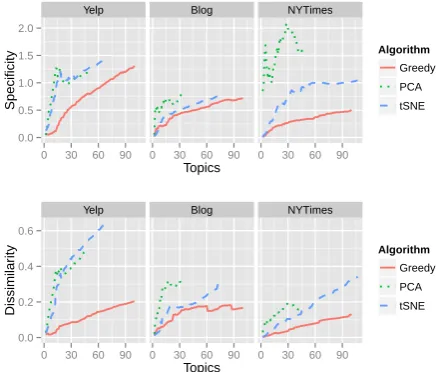
Topic SpecificityandTopic Dissimilarity. We want topics to be both specific (that is, not overly general) and different from each other. When there are insufficient number of topics,p(w|z)often re-sembles the corpus distributionp(w), where high frequency terms become the top words contribut-ing to most topics. Topic Specificity (TS) is de-fined by the average KL divergence from each topic’s conditional distribution to the corpus dis-tribution.7
T S = K1 XK
k=1
KL p(w|z=k)||p(w) (7)
7We preferspecificityto (AlSumait et al., 2009)’s term
One way to define the distance between multiple points is the minimum radius of a ball that cov-ers every point. Whereas this is simply the dis-tance form the centroid to the farthest point in the Euclidean space, it is an itself difficult opti-mization problem to find such centroid of distri-butions under metrics such as KL-divergence and Jensen-Shannon divergence. To avoid this prob-lem, we measure Topic Dissimilarity (TD) view-ing each conditional distributionp(w|z)as a sim-ple V-dimensional vector in RV. Recall aik =
p(w=i|z=k),
T D= max 1≤k≤Kk
1
K
K
X
k0=1
a∗k0 −a∗kk2. (8)
Specificity and dissimilarity increase with the
Yelp Blog NYTimes
0.0 0.5 1.0 1.5 2.0
0 30 60 90 0 30 60 90 0 30 60 90 Topics
Specificity
Algorithm
Greedy PCA tSNE
Yelp Blog NYTimes
0.0 0.2 0.4 0.6
0 30 60 90 0 30 60 90 0 30 60 90 Topics
Dissimilar
ity Algorithm
[image:7.595.307.527.249.335.2]Greedy PCA tSNE
Figure 6: Greedy topics look more like the corpus distribution and more like each other.
number of topics, suggesting that with few anchor words, the topic distributions are close to the over-all corpus distribution and very similar to one an-other. The t-SNE and PCA algorithms produce consistently better specificity and dissimilarity, in-dicating that they produce more useful topics early with small numbers of topics. The greedy algo-rithm produces topics that are closer to the corpus distribution and less distinct from each other (17 obamatopics).
Topic Coherenceis known to correlate with the semantic quality of topic judged by human anno-tators (Mimno et al., 2011). LetWk(T) beT most
probable words (i.e., top words) for the topick.
T C= X
w16=w2∈Wk(T)
logD(wD1, w(w2) + 1) (9)
Here D(w1, w2) is the co-document frequency, which is the number of documents inDconsisting of two words w1 andw2 simultaneously. D(w) is the simple document frequency with the word
w. The numerator contains smoothing count
in order to avoid taking the logarithm of zero. Coherence scores fort-SNE and PCA are worse
Yelp Blog NYTimes
−600 −550 −500 −450 −400
0 30 60 90 0 30 60 90 0 30 60 90 Topics
Coherence
Algorithm
[image:7.595.70.289.334.520.2]Greedy PCA tSNE
Figure 7: The greedy algorithm creates more co-herent topics (higher is better), but at the cost of many overly general or repetitive topics.
than those for the greedy method, but this result must be understood in combination with the Speci-ficity and Dissimilarity metrics. The most frequent terms in the overall corpus distributionp(w)often appear together in documents. Thus a model creat-ing many topics similar to the corpus distribution is likely to achieve high Coherence, but low Speci-ficity by definition.
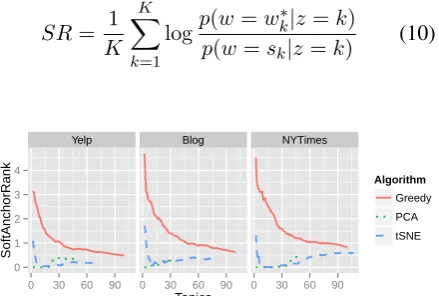
Saliency. (Chuang et al., 2012) define saliency for topic words as a combination of distinctive-ness and probability within a topic. Anchor words are distinctive by construction, so we can increase saliency by selecting more probable anchor words. We measure the probability of anchor words in two ways. First, we report the zero-based rank of anchor words within their topics. Examples of this metric, which we call “hard” rank are shown in Ta-ble 3. The hard rank of the anchors in the PCA and
prominent wordw∗
kand the anchor wordsk.
SR= K1 XK
k=1
logp(w=w∗k|z=k)
p(w=sk|z=k) (10)
Yelp Blog NYTimes
0 1 2 3 4
0 30 60 90 0 30 60 90 0 30 60 90 Topics
SoftAnchorRank
Algorithm
[image:8.595.72.292.89.237.2]Greedy PCA tSNE
Figure 8: Anchor words have higher probability, and therefore greater salience, int-SNE and PCA models (1 ≈one third the probability of the top ranked word).
Lower values of soft rank (Fig. 8 indicate that the anchor word has greater relative probability to occur within a topic. As we increase the num-ber of topics, anchor words become more promi-nent in topics learned by the greedy method, but
t-SNE anchor words remain relatively more prob-able within their topics as measured by soft rank.
Held-out Probability. Given an estimate of the topic-word matrix A, we can compute the marginal probability of held-out documents under that model. We use the left-to-right estimator in-troduced by (Wallach et al., 2009), which uses a sequential algorithm similar to a Gibbs sampler. This method requires a smoothing parameter for document-topic Dirichlet distributions, which we set to αk = 0.1. We note that the greedy
algo-Yelp Blog NYTimes
−6.65 −6.60 −6.55
−7.70 −7.65 −7.60 −7.55 −7.50 −7.45
−8.4 −8.3 −8.2 −8.1
0 25 50 75 100 0 25 50 75 100 0 30 60 90 Topics
HeldOutLL
Algorithm
Greedy PCA
tSNE
Figure 9: t-SNE topics have better held-out prob-ability than greedy topics.
rithm run on the original, unprojected matrix has better held-out probability values than t-SNE for the Yelp corpus, but as this method does not scale to realistic vocabularies we compare here to the
sparse random projection method used in (Arora et al., 2013). The t-SNE method appears to do best, particularly in the NYT corpus, which has a larger vocabulary and longer training documents. The length of individual held-out documents has no correlation with held-out probability.
We emphasize that Held-out Probability is sen-sitive to smoothing parameters and should only be used in combination with a range of other topic-quality metrics. In initial experiments, we ob-served significantly worse held-out performance for the t-SNE algorithm. This phenomenon was because setting the probability of anchor words to zero for all but their own topics led to large neg-ative values in held-out log probability for those words. As t-SNE tends to choose more frequent terms as anchor words, these “spikes” significantly affected overall probability estimates. To make the calculation more fair, we added10−5 to any zero entries for anchor words in the topic-word matrix
Aacrossallmodels and renormalized.
Becauset-SNE is a stochastic model, different initializations can result in different embeddings. To evaluate how steady anchor word selection is, we ran five random initializations for each dataset. For the Yelp dataset, the number of anchor words varies from 59 to 69, and 43 out of those are shared across at least four trials. For the Blog dataset, the number of anchor words varies from 80 to 95, with 56 shared across at least four trials. For the NYT dataset, this number varies between 83 and 107, with 51 shared across at least four models.
[image:8.595.71.291.563.649.2]4.3 Qualitative Results
Table 3 shows topics trained by three methods (t -SNE, PCA, and greedy) for all three datasets. For each model, we select five topicsat randomfrom the t-SNE model, and then find the closest topic from each of the other models. If anchor words present in the top eight words, they are shown in boldface.
the associatedt-SNE topic. As shown above, the standard algorithm tends to pick less useful anchor words at the initial stage; only the later, higher or-dered topics are specific.
The most clear distinction between models is the rank of anchor words represented by Hard Rank for each topic. Only one topic correspond-ing to (initial) has the anchor word which does not coincide with the top-ranked word. For the greedy algorithm, anchor words are often tens of words down the list in rank, indicating that they are unlikely to find a connection to the topic’s se-mantic core. In cases where the anchor word is highly ranked (unbelievers,parenthood) the word is a good indicator of the topic, but still less deci-sive.
t-SNE and PCA are often consistent in their se-lection of anchor words, which provides useful validation that low-dimensional embeddings dis-cern more relevant anchor words regardless of lin-ear vs non-linlin-ear projections. Note that we are only varying the anchor selection part of the An-chor Words algorithm in these experiments, recov-ering topic-word distributions in the same manner given anchor words. As a result, any differences between topics with the same anchor word (for ex-amplechicken) are due to the difference in either the number of topics or the rest of anchor words. Since PCA suffers from a crowding problem in lower-dimensional projection (see Figure 2) and the problem could be severe in a dataset with a large vocabulary,t-SNE is more likely to find the proper number of anchors given a specified granu-larity.
5 Conclusion
One of the main advantages of the anchor words algorithm is that the running time is largely inde-pendent of corpus size. Adding more documents would not affect the size of the co-occurrence ma-trix, requiring more times to construct the co-occurrence matrix at the beginning. While the inference is scalable depending only on the size of the vocabulary, finding quality anchor words is crucial for the performance of the inference.
(Arora et al., 2013) presents a greedy anchor finding algorithm that improves over previous lin-ear programming methods, but finding quality an-chor words remains an open problem in spec-tral topic inference. We have shown that previ-ous approaches have several limitations.
Exhaus-tively finding anchor words by eliminating words that are reproducible by other words (Arora et al., 2012) is impractical. The anchor words se-lected by the greedy algorithm are overly eccen-tric, particularly at the early stages of the algo-rithm, causing topics to be poorly differentiated. We find that using low-dimensional embeddings of word co-occurrence statistics allows us to ap-proximate a better convex hull. The resulting anchor words are highly salient, being both dis-tinctive and probable. The models trained with these words have better quantitative and qualita-tive properties along various metrics. Most im-portantly, using radically low-dimensional projec-tions allows us to provide users with clear visual explanations for the model’s anchor word selec-tions.
An interesting property of using low-dimensional embeddings is that the number of topics depends only on the projecting dimen-sion. Since we can efficiently find an exact convex hull in low-dimensional space, users can achieve topics with their preferred level of granularities by changing the projection dimension. We do not insist this is the “correct” number of topics for a corpus, but this method, along with the range of metrics described in this paper, provides users with additional perspective when choosing a dimensionality that is appropriate for their needs.
We find that the t-SNE method, besides its well-known ability to produce high quality lay-outs, provides the best overall anchor selection performance. This method consistently selects higher-frequency terms as anchor words, resulting in greater clarity and interpretability. Embeddings with PCA are also effective, but they result in less well-formed spaces, being less effective in held-out probability for sufficiently large corpora.
Acknowledgments
We thank David Bindel and the anonymous re-viewers for their valuable comments and sugges-tions, and Laurens van der Maaten for providing hist-SNE implementation.
References
Dimitris Achlioptas. 2001. Database-friendly random
projections. InSIGMOD, pages 274–281.
Loulwah AlSumait, Daniel Barbar, James Gentle, and Carlotta Domeniconi. 2009. Topic significance
ranking of lda generative models. InECML.
S. Arora, R. Ge, and A. Moitra. 2012. Learning topic
models – going beyond svd. InFOCS.
Sanjeev Arora, Rong Ge, Yonatan Halpern, David Mimno, Ankur Moitra, David Sontag, Yichen Wu, and Michael Zhu. 2013. A practical algorithm for
topic modeling with provable guarantees. InICML.
D. Blei, A. Ng, and M. Jordan. 2003. Latent dirichlet
allocation. Journal of Machine Learning Research,
pages 993–1022. Preliminary version inNIPS2001.
Christos Boutsidis, Michael W. Mahoney, and Petros Drineas. 2009. An improved approximation algo-rithm for the column subset selection problem. In
SODA, pages 968–977.
Jason Chuang, Christopher D. Manning, and Jeffrey Heer. 2012. Termite: Visualization techniques
for assessing textual topic models. InInternational
Working Conference on Advanced Visual Interfaces (AVI), pages 74–77.
Jacob Eisenstein and Eric Xing. 2010. The CMU 2008 political blog corpus. Technical report, CMU, March.
Jacob Eisenstein, Duen Horng Chau, Aniket Kittur, and Eric P. Xing. 2011. Topicviz: Semantic navigation
of document collections. CoRR, abs/1110.6200.
T. L. Griffiths and M. Steyvers. 2004. Finding
scien-tific topics. Proceedings of the National Academy of
Sciences, 101:5228–5235.
Ming Gu and Stanley C. Eisenstat. 1996. Efficient algorithms for computing a strong rank-revealing qr
factorization. InSIAM J. Sci Comput, pages 848–
869.
William B. Johnson and Joram Lindenstrauss. 1984. Extensions of lipschitz mappings into a hilbert
space. Contemporary Mathematics, 26:189–206.
Simon Lacoste-Julien, Fei Sha, and Michael I. Jordan. 2008. DiscLDA: Discriminative learning for
dimen-sionality reduction and classification. InNIPS.
Jey Han Lau, Karl Grieser, David Newman, and Tim-othy Baldwin. 2011. Automatic labelling of topic
models. InHLT, pages 1536–1545.
Qiaozhu Mei, Xuehua Shen, and ChengXiang Zhai. 2007. Automatic labeling of multinomial topic
models. InKDD, pages 490–499.
David Mimno, Hanna Wallach, Edmund Talley, Miriam Leenders, and Andrew McCallum. 2011. Optimizing semantic coherence in topic models. In
EMNLP.
D. Sontag and D. Roy. 2011. Complexity of inference
in latent dirichlet allocation. InNIPS, pages 1008–
1016.
L.J.P. van der Maaten and G.E. Hinton. 2008.
Visu-alizing high-dimensional data using t-SNE. JMLR,
9:2579–2605, Nov.
Hanna Wallach, Iain Murray, Ruslan Salakhutdinov, and David Mimno. 2009. Evaluation methods for
topic models. InICML.
Jun Zhu, Amr Ahmed, and Eric P. Xing. 2009.
MedLDA: Maximum margin supervised topic