249
Iterative Recursive Attention Model for
Interpretable Sequence Classification
Martin Tutek and Jan ˇSnajder
Text Analysis and Knowledge Engineering Lab
Faculty of Electrical Engineering and Computing, University of Zagreb Unska 3, 10000 Zagreb, Croatia
{martin.tutek,jan.snajder}@fer.hr
Abstract
Natural language processing has greatly ben-efited from the introduction of the attention mechanism. However, standard attention mod-els are of limited interpretability for tasks that involve a series of inference steps. We de-scribe an iterative recursive attention model, which constructs incremental representations of input data through reusing results of pre-viously computed queries. We train our model on sentiment classification datasets and demonstrate its capacity to identify and com-bine different aspects of the input in an easily interpretable manner, while obtaining perfor-mance close to the state of the art.
1 Introduction
The introduction of the attention mechanism ( Bah-danau et al.,2014) offered a way to demystify the inference process of neural models. By assigning scalar weights to different elements of the input, we are able to visualize and potentially understand why the model made the decision it made, or discover a deficiency in the model by tracing down a relevant aspect of the input being overlooked by the model. Specifically in natural language processing (NLP), which abounds with variable-length word sequence classification tasks, attention alleviates the issue of learning long-term dependencies in recurrent neu-ral networks (Bengio et al.,1994) by offering the model a glimpse into previously processed tokens.
Attention offers a good retrospective explanation of the classification decision by indicating what parts of the input contributed the most to the deci-sion. However, in many cases the final decision is best interpreted as a result of a series of inference steps, each of which can potentially affect its polar-ity. A case in point is sentiment analysis, in which contrastive clauses and negations act as polarity switches of the overall sentence sentiment. In such cases, attention will only point to the part of the
input sentence whose polarity matches that of the final decision. However, unfolding the inference process of a model into a series of interpretable steps would make the model more interpretable and allow one to identify its shortcomings.
As a step toward that goal, we propose an exten-sion of the iterative attention mechanism (Sordoni et al.,2016), which we call theiterative recursive attention model (IRAM), where the result of an attentive query is nonlinearly transformed and then added to the set of vector representations of the in-put sequence. The nonlinear transformation, along with reusing the representations obtained in previ-ous steps, allows the model to construct a recursive representation and process the input sequence bit by bit. The upshot is that we can inspect how the model weighs the different parts of the sentence and recursively combines them to give the final decision. We test the model on two sentiment anal-ysis tasks and demonstrate its capacity to isolate different task-related aspects of the input, while reaching performance comparable with the state of the art.
2 Related Work
Attention (Bahdanau et al.,2014) and its variants (Luong et al.,2015) have initially been proposed for machine translation, but are now widely adopted in NLP. Attention has proven especially useful in tasks that involve long text sequences, such as sum-marization (Rush et al., 2015; See et al., 2017), question answering (Hermann et al.,2015;Xiong et al.,2016;Cui et al.,2017), and natural language inference (Rockt¨aschel et al.,2015;Yin et al.,2016; Parikh et al.,2016), as well as purely attentional machine translation (Vaswani et al.,2017;Gu et al., 2017).
in-ner workings of recurrent neural networks through methods such as representing them as finite au-tomata (Weiss et al., 2017), extracting inference rules (Zanzotto and Ferrone, 2017), and analyz-ing saliency of inputs through first-order derivative information (Li et al.,2016;Arras et al.,2017).
Akin to the saliency analysis approaches, we opt not to condense the trained network into a finite set of rules. We differ from (Li et al.,2016;Arras et al., 2017) in that we attempt to decode the steps of the decision process of a recurrent network instead of demonstrating through saliency how the decision changes with respect to the inputs. In the context of sentiment analysis, the main benefit we see in representing the decision process of a recurrent net-work as a sequence of steps is that it offers a simple way to isolate sentiment-bearing phrases by ob-serving how they get grouped in a single iteration. Secondly, we aim for improved interpretability of functional dependencies such as negation, where we demonstrate that our method first attends on the negated phrase, constructing an intermediate repre-sentation, which is then recursively transformed in the next iteration.
Sordoni et al.(2016) introduced the iterative at-tention mechanism for question answering, where attention alternates between the question and the document, and the query is updated in each step by a GRU cell (Cho et al.,2014). The model combines the weights obtained throughout the iterations to select the final answer, similar to the attention sum reader ofKadlec et al.(2016) and pointer networks ofVinyals et al.(2015).
We believe there is much to gain from the itera-tive attention mechanism by eliminating the direct link between the intermediate representations and the output, allowing the model to construct its own sequential representation of the input. Our model only connects the last attention step to the output, removing the need for intermediate steps to contain all the information relevant for the final decision. Apart from (Sordoni et al., 2016), related work closest to ours consists of concepts of multi-head attention (Lin et al., 2017;Vaswani et al.,2017), in which all queries are generated at once, pair-wise attention (Cui et al.,2017;Xiong et al.,2016), where attention is applied to multiple inputs but is not applied iteratively and hierarchical iterative attention (Yang et al., 2016), where the authors first use a intra-sentence attention mechanism and then combine the intermediate representations with
inter-sentence attention. In contrast to their work, we do not predetermine the level on which the at-tention is applied – in each iteration the mechanism can focus on any element of the input sequence.
3 Model
Throughout the experiments, we will use two vari-ants of our model: (1) the vanilla model and (2) the full model. The vanilla model contains the bare minimum of components needed for the attention mechanism to function as intended. The purpose of the vanilla model is to eliminate any additional confounders for the performance and showcase the interpretability of the model. For the full model, we extend the vanilla model with additional deep learning components commonly employed in state-of-the-art models, to showcase the performance of the model when given capacity akin to competing models.
In both versions of the model, data is processed in three phases: (1) encoding phase, which con-textualizes the word representations; (2)attention phase, which uses iterative recursive attention to isolate and combine the different parts of the in-put; and (3)classification phase, where the learned representation is fed as an input to a classifier.
The vanilla and full model differ only in the en-coding phase, while our proposed attention mech-anism is employed only in the second phase. We begin with a detailed account of the proposed atten-tion mechanism and its regularizaatten-tion, and continue with a description of the remaining components, highlighting the differences between the vanilla and full models.
3.1 Iterative Recursive Attention
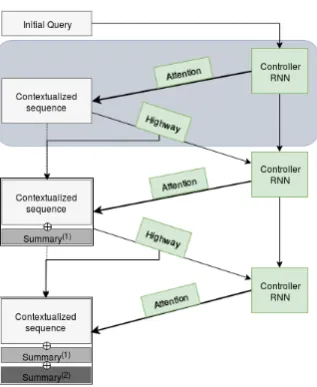
Fig.1shows the architecture of the iterative atten-tion mechanism. The mechanism uses a recurrent network, dubbed thecontroller, to refine the atten-tion query throughoutT iterations.
Inputs to the mechanism are an initial queryxˆ
and a set of hidden statesH = [hi, . . . , hN]
consti-tuting the input sequence, both obtained from the encoding step.
As the controller, we use a gated recurrent unit (GRU) (Cho et al., 2014) cell. The input to the controller is the transformed result of the previous query, while the hidden state is the previous query.
For the attention mechanism we use bilinear at-tention (Luong et al.,2015):
Figure 1: The iterative recursive attention model (IRAM). Green-colored components share their pa-rameters with components of the same type. High-lighted in gray is one iteration of IRAM.
where~q is the current query vector,W a param-eter of size Rdq×dh, whiled
q and dh are the
di-mensionalities of the query and the hidden state, respectively.
The attention weights are then used to compute the input summary in timesteptas a linear combi-nation of the hidden states:
ˆ
s(t)= N
X
i
a(t)i hi (2)
As we intend to use sˆ(t) in the next iteration of the attention mechanism, we need to allow the network the capacity to discern between the new additions and original inputs. To this end, we use a highway network (Srivastava et al.,2015), which gives the model the option to pass subsets of the summary as-is or transform them with a nonlin-earity. If the summary is not transformed with a nonlinearity, it ends up being merely a linear combination of the hidden states, and we gain no information from adding it to the sequence.
The final input summary is thus obtained as
s(t)=Highway(ˆs(t))and added to the set of hid-den statesH ={hi, . . . , hn, s(1), . . . , s(t)}.
3.2 Attention Regularization
Ideally, we want the model to focus on different task-related aspects of the input in each iteration. However, the model is in no way incentivized to learn to propagate information through the
sum-maries and can in principle focus on the same seg-ment in each step.
To prevent this from happening – and push the model to focus on different aspects of the input in every step – we regularize it by minimizing the pairwise dot products between all iterations of at-tention:
Lattn =
γ
2T
X
i6=j
[AAT]ij (3)
whereγ is a hyperparameter determining the regu-larization strength andA∈RT×N+T−1is a matrix
containing the attention weights generated in T
steps overN inputs by the iterative attention mech-anism. The matrix has N +T −1 columns to account for attention overT −1added summaries, as the summary generated in the last iteration can-not be attended over. In each row t, the matrix has T −t−1 trailing zeroes, corresponding to summaries that are not yet available in iterationt.
Concretely, the attention weight vector in rowt
of the matrixAconsists of:
At= [
Input sequence
z }| {
a1, . . . , aN,
Summaries int−< t
z }| {
aN+1, . . . , aN+t−1,0, . . .]
(4) resulting in each elementi, jof the regularization matrixAAT storing the dot product between atten-tion weights in iteraatten-tionsi, j. The regularization expression is a sum over all off-diagonal elements. The diagonal elements are dot products of attention weights in the same iteration so we ignore them. We scale by 12 to account for the symmetrical ele-ments inATAand by 1
T to account for the number
of dot product comparisons.
We note that, while this regularization penalty does encourage the model to focus on different ele-ments of the input sequence, there is still a trivial way for the model to minimize the penalty without learning a meaningful behavior. Since the atten-tion weight over the summary in iteraatten-tiontis zero in all iterationst− < t, the model can simply at-tend over any elements of the input sequence in the first iteration, and afterwards propagate the in-formation forward by fully attending only over the summary generated in the previous iteration. We will illustrate this behavior with concrete examples in Section4.
3.3 Vanilla Encoder
Figure 2: The full version of the iterative recursive attention model (IRAM). Green-colored compo-nents share their parameters with compocompo-nents of the same type; blue-colored components each have their own parameters.
label y. The encoder of the vanilla model maps the word indices to dense vector representations using pretrained GloVe vectors (Pennington et al., 2014). The sequence of word vectors is then fed as input to a bidirectional long-short term memory (BiLSTM) network (Hochreiter and Schmidhuber, 1997). The outputs of the BiLSTM are used as the input sequence to the iterative attention step, while the cell state in the last timestep is used as the initial query.
3.4 Full Encoder
There are three key differences between the full encoder and the vanilla encoder. The full encoder uses (1) character n-gram embeddings, (2) an addi-tional highway network, whose task is to fine-tune the word embeddings, and (3) an additional layer of BiLSTM, followed by a highway layer to con-struct the initial query. For extensions (1) and (2), we took inspiration from McCann et al. (2017), who also use both components. However, unlike McCann et al.(2017), who used a ReLU feedfor-ward network to fine-tune the embeddings for the task, we use a highway network, which we found performs better.
The pretrained character n-gram vectors ob-tained from (Hashimoto et al.,2016) are first
aver-aged over all character n-grams for a given word and then concatenated to the GloVe embedding. Further on, before feeding the sequence of word embeddings to a recurrent model, we use a two-layer highway network (Srivastava et al.,2015) to fine-tune the embeddings for the task, which is es-pecially beneficial when the input vectors are kept fixed.
To contextualize the input sequence and produce an initial attention query, we use a bidirectional long-short term memory (BiLSTM) network. We split the network conceptually into two parts: the lowerlctx layers are used to transform the input se-quence of word embeddings into a sese-quence of con-textualized word representations, while the upper
lquery layers are used to read and comprehend the now-transformed sequence and capture its relevant aspects into a single vector. The rationale for the split is that recurrent networks are often required to tackle two tasks at once: contextualize the input and comprehend the whole sequence. Intuitively, the split should incite a division of labor between the two parts of the network: contextualization net-work only has to memorize the local information specific to each word (e.g., verb tense, noun gen-der) in order to transform its representation, while comprehension network needs to model aspects of meaning pertaining to the entire sequence (e.g., the overall sentiment of the sentence, locations of sentiment bearing phrases).
We use a single(lctx+lquery)-layered BiLSTM, where we use the output of thelctx-th layer, while we use the cell state from the last layer as the se-quence representationxˆ.
Lastly, since the weights of the BiLSTM network are suited toward processing the input sequence rather than preparing the query vector, we add an additional highway layer designed to fine-tune the sentence representation into the initial query.
3.5 Classifier
As input to the classifier, we use the summary vec-tor obtained from the last step of iterative attention
at-tention mechanism with all of the aforementioned components.
4 Experiments
4.1 Datasets
We test IRAM on two sentiment classification datasets. The first is the Stanford Sentiment Tree-bank (SST) (Socher et al., 2013), a dataset de-rived from movie reviews on Rotten Tomatoes and containing 11,855 sentences labeled into five classes at the sentence level and at the level of each node in the constituency parse tree. The bi-nary version with the neutral class removed con-tains 56,400 instances, while the fine-grained ver-sion with scores ranging from 1 (very negative) to 5 (very positive) contains 94,200 text-sentiment pairs. The second dataset is the Internet Movie Database (IMDb) (Maas et al.,2011), containing 22,500 multi-sentence reviews extracted from pos-itive and negative reviews. We truncate each sen-tence from this dataset to a maximum length of 200 tokens.
Firstly, we demonstrate and analyze how each component in the vanilla model contributes to the performance and interpretability. We then analyze the full model and evaluate it on the aforemen-tioned datasets.
4.2 Experimental Setup
Unless stated otherwise, all weights are initialized from a Gaussian distribution with zero mean and standard deviation of0.01. We use the Adam opti-mizer (Kingma and Ba,2014) with the AmsGrad modification (Reddi et al.,2018) andα= 0.0003. We clip the global norm of the gradients to1.0and set weight decay to0.00003.
We use 300-dimensional GloVe word embed-dings trained on the Common Crawl corpus and
100-dimensional character embeddings. We follow the recommendation ofMu et al.(2017) and stan-dardize the embeddings. Dropout of0.1is applied to the word embedding matrix.
For both datasets, we setlctx = 2andlquery = 1. The highway network for fine-tuning the input em-beddings has two layers, while the ones fine-tuning the query and the summary have a single layer. All highway networks’ gate biases are initialized to
1, as recommended bySrivastava et al.(2015), as well as the biases of the LSTM forget gates.
[image:5.595.313.514.77.231.2]The maxout network uses two200-dimensional layers with a pool size of4.
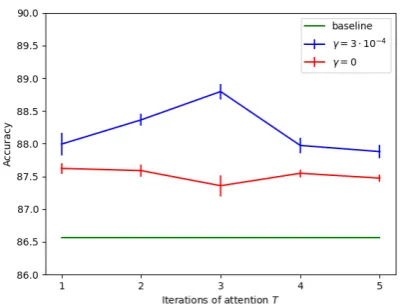
Figure 3: The effect of regularizationγacross dif-ferent values ofT
Throughout our experiments, we have experi-mented with selecting the batch size from{32,64}, dropout for the recurrent layers and the maxout classifier from{0.1,0.2,0.3,0.4}, and the LSTM hidden state size from{400,500,1000}. The word and character n-gram vectors are kept fixed for SST but are learned for the IMDb dataset. These param-eters are optimized using cross-validation, and the best configuration is ran on the test set. As IMDb has no official validation set, we randomly select 10% of the dataset and use it for all of the experi-ments. The values of other hyperparameters were selected through inexhaustive search.
4.3 Analysis of the Vanilla Model
The vanilla model defined in Section3.3has two main confounding variables: strength (and pres-ence) of attention regularization (γ) and the num-ber of iterations of the iterative recursive attention mechanism (T). We also would like to examine the difference in performance of the vanilla IRAM compared to some baseline sequence classifier. To this end, we implement a baseline model without the attention mechanism – a maxout classifier over the last hidden state of the encoder BiLSTM. To keep the running time of the experiments feasible, in this section we use only the binary SST dataset.
Figure 4: Attention sample forγ = 0andT = 3
Figure 5: Classification accuracy for different val-ues ofγ
the different behavior between the models can be seen through inspecting attention weights.
In Fig.4we can see that the attention mechanism, when not regularized, fails to use its capacity and simply attends over the same element in each time-step. The last two columns, which contain the summaries from the first two steps of the iterative attention mechanism, have an attention weight of
0, which means that the model does not pass any information through the summaries nor refine the query. This behavior initially prompted us to add the regularization penalty term.
Through inexhaustive search we isolated a crit-ical range of values forγ, for which we perform a detailed analysis of performance. For this ex-periment, we fixT = 3as it has exhibited better performance for the vanilla model.
Effect of the number of iterations. Apart from comparing the effect of the existence of regulariza-tion, in Fig.3we can also observe the effect of the number of timestepsT. IncreasingT beyond3has a diminishing effect on classification performance, something which we find to be consistent for the IMDB dataset as well.
We attribute this decrease in performance to the
SST
NSE (Munkhdalai and Yu,2017) 89.7
IRAM 90.1
BCN + CoVe (McCann et al.,2017) 90.3 bmLSTM (Radford et al.,2017) 91.8
SST-5
IRAM 53.7
BCN + CoVe (McCann et al.,2017) 53.7 BCN + ELMo (Peters et al.,2018) 54.7
IMDb
IRAM 91.2
TRNN (Dieng et al.,2016) 93.8 oh-LSTM (Johnson and Zhang,2016) 94.1
[image:6.595.79.279.210.363.2]Virtual (Miyato et al.,2016) 94.1
Table 1: Classification accuracy on the test sets
Removed component Accuracy
Full model 90.1
Vanilla model 88.7 – char n-grams 89.3 – query fine-tune 89.8 – embedding fine-tune 89.3
Table 2: Effect of removing components on perfor-mance
fact that SST is relatively simple, containing at most two contrastive aspects in each sentence, mak-ing any additional steps unnecessary. While the model could in theory exploit the pass-through mechanism, we believe that this operation adds some noise to the final representations and in turn affects performance slightly.
4.4 Analysis of the Full Model
We now evaluate the full model. Table1 shows the accuracy scores of our best models (forT = 3,
γ = 0.0003) and other state-of-the-art models on the test portions of the SST and IMDb datasets. Our model performs competitively with the best results on SST and SST-5 datasets. It is important to note that our model does not use transfer learning apart from the pretrained word vectors, which is not the case for the competing models.
[image:6.595.347.487.244.308.2](a) Simple unipolar sentence
(b) Sentence with a negation
[image:7.595.86.293.63.353.2](c) Contrastive multipolar sentence
Figure 6: Visualization of attention across sentence words (horizontal) and T=3 time steps (vertical). The lastT-1 columns contain the attention weights over the result of the previous attentive query.
4.5 Visualizing Attention
To gain an intuition about the working of IRAM, we visually analyzed its attention mechanism on a number of sentences from our dataset. We limit ourselves to examples from the test set of the SST dataset as the length of examples is manageable for visualization. We isolate three specific cases where the attention mechanism demonstrates interesting results: (1) simple unipolar sentences, (2) sentences with negations, and (3) multipolar sentences.
The least interesting case is the unipolar, as the attention mechanism often does not need multiple iterations. Fig.6ashows the attention mechanism simply propagating information, since sentiment classification is straightforward and does not re-quire multiple attention steps. This can be seen from most of the attention weight in the second and third steps being on the columns corresponding to the summaries.
The more interesting cases are sentences involv-ing negations and modifiers. Fig. 6b shows the handling of negation: attention is initially on all
words except on the negator. In the second step, the mechanism combines the output of the first step with the negation. We interpret this as flipping the sentiment – the model cannot rely solely on recog-nizing a negative word, and has to account for what that word negates through a functional dependence. These examples highlight one of the drawbacks of recurrent networks which we aim to alleviate. In case a standard attention mechanism is applied to a sentence containing a negator, the hidden repre-sentation of the negator has to scale or negate the intensity of an expression. Our model has the ca-pacity to process such sequences iteratively, first constructing the representation of an expression, which is then adjusted by the nonlinear transforma-tion and simpler to combine with the negator in the next step.
Lastly, Fig. 6cshows a contrastive multipolar sentence, where the model in the first step focuses on positive words, and then combines the negative words (tortured,unsettling) with the results of the first step. In such cases, the model succeeds to isolate the contrasting aspects of the sentence and attends to them in different iterations of the model, alleviating the burden of simultaneously represent-ing the positive and negative aspects. After both contrastive representations have been formed, the model has the capacity toweighthem one against other and compute the final representation.
5 Conclusion
The proposed iterative recursive attention model (IRAM) has the capacity to construct representa-tions of the input sequence in a recursive fashion, making inference more interpretable. We demon-strated that the model can learn to focus on various task-relevant parts of the input, and can propagate the information in a meaningful way to handle the more difficult cases. On the sentiment analysis task, the model performs comparable to the state of the art. Our next goals will be to try to use the iterative attention mechanism to extract tree-like sentence structures akin to constituency parse trees, evalu-ate the model on more complex datasets as well as extend the model to support an adaptive number of iterative steps.
Acknowledgment
References
Leila Arras, Gr´egoire Montavon, Klaus-Robert M¨uller, and Wojciech Samek. 2017. Explaining recurrent neural network predictions in sentiment analysis. In
Proceedings of the 8th Workshop on Computational Approaches to Subjectivity, Sentiment and Social Media Analysis, pages 159–168.
Dzmitry Bahdanau, Kyunghyun Cho, and Yoshua Ben-gio. 2014. Neural machine translation by jointly learning to align and translate. arXiv preprint arXiv:1409.0473.
Yoshua Bengio, Patrice Simard, and Paolo Frasconi. 1994. Learning long-term dependencies with gradi-ent descgradi-ent is difficult. IEEE transactions on neural networks, 5(2):157–166.
Kyunghyun Cho, Bart van Merri¨enboer, Dzmitry Bah-danau, and Yoshua Bengio. 2014. On the properties of neural machine translation: Encoder–decoder ap-proaches. Syntax, Semantics and Structure in Statis-tical Translation, page 103.
Yiming Cui, Zhipeng Chen, Si Wei, Shijin Wang, Ting Liu, and Guoping Hu. 2017. Attention-over-attention neural networks for reading comprehen-sion. InProceedings of the 55th Annual Meeting of the Association for Computational Linguistics (Vol-ume 1: Long Papers), volume 1, pages 593–602.
Adji B Dieng, Chong Wang, Jianfeng Gao, and John Paisley. 2016. TopicRNN: A recurrent neural net-work with long-range semantic dependency. In
ICLR 2016.
Ian J Goodfellow, David Warde-Farley, Mehdi Mirza, Aaron Courville, and Yoshua Bengio. 2013. Maxout networks. arXiv preprint arXiv:1302.4389.
Jiatao Gu, James Bradbury, Caiming Xiong, Vic-tor OK Li, and Richard Socher. 2017. Non-autoregressive neural machine translation. arXiv preprint arXiv:1711.02281.
Kazuma Hashimoto, Caiming Xiong, Yoshimasa Tsu-ruoka, and Richard Socher. 2016. A joint many-task model: Growing a neural network for multiple nlp tasks.arXiv preprint arXiv:1611.01587.
Karl Moritz Hermann, Tomas Kocisky, Edward Grefen-stette, Lasse Espeholt, Will Kay, Mustafa Suleyman, and Phil Blunsom. 2015. Teaching machines to read and comprehend. In Advances in Neural Informa-tion Processing Systems, pages 1693–1701.
Sepp Hochreiter and J¨urgen Schmidhuber. 1997. Long short-term memory. Neural computation, 9(8):1735–1780.
Rie Johnson and Tong Zhang. 2016. Supervised and semi-supervised text categorization using lstm for re-gion embeddings. In International Conference on Machine Learning, pages 526–534.
Rudolf Kadlec, Martin Schmid, Ondrej Bajgar, and Jan Kleindienst. 2016. Text understanding with the attention sum reader network. arXiv preprint arXiv:1603.01547.
Diederik P Kingma and Jimmy Ba. 2014. Adam: A method for stochastic optimization. arXiv preprint arXiv:1412.6980.
Jiwei Li, Xinlei Chen, Eduard Hovy, and Dan Jurafsky. 2016. Visualizing and understanding neural models in nlp. InProceedings of NAACL-HLT, pages 681– 691.
Zhouhan Lin, Minwei Feng, Cicero Nogueira dos San-tos, Mo Yu, Bing Xiang, Bowen Zhou, and Yoshua Bengio. 2017. A structured self-attentive sentence embedding. arXiv preprint arXiv:1703.03130.
Thang Luong, Hieu Pham, and Christopher D Manning. 2015. Effective approaches to attention-based neu-ral machine translation. InProceedings of the 2015 Conference on Empirical Methods in Natural Lan-guage Processing, pages 1412–1421.
Andrew L Maas, Raymond E Daly, Peter T Pham, Dan Huang, Andrew Y Ng, and Christopher Potts. 2011. Learning word vectors for sentiment analysis. In
Proceedings of the 49th annual meeting of the as-sociation for computational linguistics: Human lan-guage technologies-volume 1, pages 142–150. Asso-ciation for Computational Linguistics.
Bryan McCann, James Bradbury, Caiming Xiong, and Richard Socher. 2017. Learned in translation: Con-textualized word vectors. InAdvances in Neural In-formation Processing Systems, pages 6297–6308.
Takeru Miyato, Andrew M Dai, and Ian Good-fellow. 2016. Adversarial training methods for semi-supervised text classification. arXiv preprint arXiv:1605.07725.
Jiaqi Mu, Suma Bhat, and Pramod Viswanath. 2017. All-but-the-top: simple and effective postprocess-ing for word representations. arXiv preprint arXiv:1702.01417.
Tsendsuren Munkhdalai and Hong Yu. 2017. Neu-ral semantic encoders. In Proceedings of the con-ference. Association for Computational Linguistics. Meeting, volume 1, page 397. NIH Public Access.
Ankur P Parikh, Oscar T¨ackstr¨om, Dipanjan Das, and Jakob Uszkoreit. 2016. A decomposable attention model for natural language inference. arXiv preprint arXiv:1606.01933.
Matthew E Peters, Mark Neumann, Mohit Iyyer, Matt Gardner, Christopher Clark, Kenton Lee, and Luke Zettlemoyer. 2018. Deep contextualized word repre-sentations.arXiv preprint arXiv:1802.05365.
Alec Radford, Rafal Jozefowicz, and Ilya Sutskever. 2017. Learning to generate reviews and discovering sentiment. arXiv preprint arXiv:1704.01444.
Sashank J Reddi, Satyen Kale, and Sanjiv Kumar. 2018. On the convergence of Adam and beyond. In Inter-national Conference on Learning Representations.
Tim Rockt¨aschel, Edward Grefenstette, Karl Moritz Hermann, Tom´aˇs Koˇcisk`y, and Phil Blunsom. 2015. Reasoning about entailment with neural attention.
arXiv preprint arXiv:1509.06664.
Alexander M Rush, Sumit Chopra, and Jason Weston. 2015. A neural attention model for abstractive sen-tence summarization. In Proceedings of the 2015 Conference on Empirical Methods in Natural Lan-guage Processing, pages 379–389.
Abigail See, Peter J Liu, and Christopher D Manning. 2017. Get to the point: Summarization with pointer-generator networks. InProceedings of the 55th An-nual Meeting of the Association for Computational Linguistics (Volume 1: Long Papers), volume 1, pages 1073–1083.
Richard Socher, Alex Perelygin, Jean Wu, Jason Chuang, Christopher D Manning, Andrew Ng, and Christopher Potts. 2013. Recursive deep models for semantic compositionality over a sentiment tree-bank. In Proceedings of the 2013 conference on empirical methods in natural language processing, pages 1631–1642.
Alessandro Sordoni, Philip Bachman, Adam Trischler, and Yoshua Bengio. 2016. Iterative alternating neu-ral attention for machine reading. arXiv preprint arXiv:1606.02245.
Rupesh Kumar Srivastava, Klaus Greff, and J¨urgen Schmidhuber. 2015. Highway networks. arXiv preprint arXiv:1505.00387.
Ashish Vaswani, Noam Shazeer, Niki Parmar, Jakob Uszkoreit, Llion Jones, Aidan N Gomez, Łukasz Kaiser, and Illia Polosukhin. 2017. Attention is all you need. InAdvances in Neural Information Pro-cessing Systems, pages 6000–6010.
Oriol Vinyals, Meire Fortunato, and Navdeep Jaitly. 2015. Pointer networks. InAdvances in Neural In-formation Processing Systems, pages 2692–2700.
Gail Weiss, Yoav Goldberg, and Eran Yahav. 2017. Ex-tracting automata from recurrent neural networks us-ing queries and counterexamples. arXiv preprint arXiv:1711.09576.
Caiming Xiong, Victor Zhong, and Richard Socher. 2016. Dynamic coattention networks for question answering. arXiv preprint arXiv:1611.01604.
Zichao Yang, Diyi Yang, Chris Dyer, Xiaodong He, Alex Smola, and Eduard Hovy. 2016. Hierarchical attention networks for document classification. In
Proceedings of the 2016 Conference of the North American Chapter of the Association for Computa-tional Linguistics: Human Language Technologies, pages 1480–1489.
Wenpeng Yin, Hinrich Sch¨utze, Bing Xiang, and Bowen Zhou. 2016. ABCNN: Attention-based con-volutional neural network for modeling sentence pairs. Transactions of the Association of Computa-tional Linguistics, 4(1):259–272.