Index Terms—Web service, Service level agreement, Negotiation, Coordination
Abstract—Concurrently procuring multiple web services is a challenging task since service consumers and providers may have different quality of service (QoS) constraints. This work adopts concurrent service level agreement (SLA) negotiation for multiple web services procurement so that contracts for provisioning web services can be more effectively and efficiently established among consumers and service providers. The novel contributions of this work include i) devising commitment management strategies for negotiation participants to manage intermediate contract during negotiation, ii) designing an adaptive strategy profile for agent in an n-service market to determine how much concessions it should make at each negotiation round, and iii) proposing a regression-based coordination strategy for coordinating multiple concurrent SLA negotiations. Experimental results show that the coordination strategy in this work outperforms the existing works in terms of utility, negotiation speed and success rate.
I. INTRODUCTION
Web service provides a new way for developing distributed applications that can integrate many groups of services into a single solution. To date, most research in web service focuses on web service discovery [1][2], while studies in web negotiation are mostly on communication and protocol languages [3][4]. However, the recent emergence of service-oriented computing (SOC) for web service procurement problem [5][6][7], which allows web services to be allocated among service consumers and providers dynamically and automatically, points out the direction of the study on web service negotiation processes. SOC uses services as fundamental computing elements to develop distributed applications. In SOC systems for web service procurement problem, a consumption of a service usually implies that there is a service consumer acquires the service from a service provider. The buy and offer relationship between service consumers and providers in SOC is commonly governed by service level agreement (SLA). Especially for web service procurement problem, it is governed by webservice level agreement (WSLA). The SLA is a contractual obligation between the service consumer and
Manuscript received December 30, 2008. This work was supported by the DASAN Project (GIST International Faculty Start-up Fund) from the Gwangju Institute of Science and Technology, South Korea.
Benyun Shi is with Department of Information and Communications, Kwangju Institute of Science and Technology, South Korea. (e-mail: [email protected]).
Kwang Mong Sim is with Department of Information and Communications, Kwangju Institute of Science and Technology, South Korea. (e-mail: [email protected]).
provider, which specifies both the functionality of services to be offered and the constraint (such as response time, reliability, security, performance, etc.) of the quality of services (QoS). Since the service consumers and providers may have different requirements, intensions, and goals on the QoS (in most cases, they are conflict), agent-based negotiation is employed by this work to resolve the conflicts between service consumers and providers because i) negotiation as a mean of establishing service contracts has been well-studied in literatures and well-applied in real world [8], and ii) software agents have abilities of autonomous operation, interaction and cooperation.
Services are self-describing, platform-agnostic computing elements that support rapid, seamless, and low-cost composition of distributed applications. Hence, for a web service consumer in SOC, its required service can be composed to be multiple atomic services with different functionalities and QoS so that the consumer can negotiate with different kinds of atomic service providers concurrently and then aggregate them together to perform after the negotiation. In this case, concurrently negotiating for multiple services will be a very challenging task for the consumer, especially for each atomic service, it may have different kinds of QoS.
In traditional negotiation, once a contract is established, both negotiation parties are bounded to the contract, i.e., neither party can breach the contract. However, this may not be efficient for the concurrent SLA negotiation. From the perspective of the service provider, once a contract is reached, the service may be bounded for a very long time before being aggregated because the consumer need reach agreements for multiple atomic services. Hence, in this work, we adopt the idea of leveled commitment contracts [9], in which negotiation agents are allowed to renege on a contract during the negotiation. Furthermore, in SLA negotiation, allowing decommitments enables: i) a service consumer that is unsuccessful in acquiring all its required services (before its deadline) to release those services that are already acquired, so that service providers can assign them to other consumers and ii) an agent that has already reached an intermediate deal for a service to continue to search for a better contract before the entire concurrent negotiation terminates.
The main contribution of this work includes i) introducing the decommitment to the service level agreement negotiation, which has not been involved in previous research works on SLA negotiation, ii) designing and implementing an adaptive commitment management strategy (CMS) for agents to manage commitments during SLA negotiation, where both consumer and provider agents can renege on a contract during the negotiation, and iii) devising a regression-based coordination strategy to coordinate multiple concurrent
Coordination and Concurrent Negotiation for
Multiple Web Services Procurement
one-to-many negotiations.
The rest of the paper is organized as follows. The next section briefly specifies the problem of this work. Section III presents an adaptive negotiation strategy to manage commitments and determine concessions at each negotiation round. Section IV proposes a regression-based coordination strategy to coordinate the multiple one-to-many negotiations for each atomic service. After that, the experiments are carried out in section V. Finally, section VI concludes this work.
II. OVERVIEW OF THE PROBLEM
A. Problem Definition
In the rest of this work, each web service mentioned is supposed to be an atomic service, which means that it can only be provided to only one consumer by the service provider at the same time. This is reasonable because web service providers may have their own capability to provide services simultaneously (for instance, a search engine has its own capability to support online search service at the same time), which can be represented by multiple atomic service agents. Let
{
S S
1,
2,
,
S
n}
be the set of required services in a consumer’s service composition, andτ
cbe the deadline that the consumer should acquire all atomic services. For each atomic service Si, there may be multiple service providers, denoted{
}
1, , i
i i
n
Ρ Ρ be the set of ni service providers for service Si. During negotiation, both an agent’s preference for a service and the strategy it adopts are private information.
B. Negotiation Protocol
The QoS for each service may have multiple attributes, which may include the cost of using the service, response time of the service, accessibility and reliability of the service, and so on. Each agent has its own utility function about the QoS of a service, and the utility of QoS for each agent in this work are supposed to be in the range [0, 1]. We mainly focus on how an agent makes concessions and reaches agreements based on utility of QoS it received at each negotiation round. The coordination among the QoS attributes for a specific service is referred to strategies presented in [5].
At the beginning of the negotiation, both consumer agents and provider agents propose their initial proposals with utility 1. Then, at the following negotiation rounds, they make concessions to each other alternately until an intermediate contract has been reached based on the commitment management strategy in section III or the whole negotiation is terminated by the coordination strategy in section IV.
C. Concession Making Strategies
A web service agent’s time-dependent concession making strategies can be classified into: i) conservative (conceding slowly), ii) conciliatory (conceding rapidly), and iii) linear
(conceding linearly) [10]. Suppose service agent’s initial utility is 1 and reserve utility is 0, the consumer determines its concession between round t+1 and t by
1 ( )c ( )c
i c
c c
t t
U λ λ
τ τ
+
∆ = −
where
τ
c is the deadline for acquiring Ri, 0<λ
c< ∞is the concession making parameter. Three classes ofstrategies are specified as follows: Conservative (λ
c >1), Linear (λ
c =1), and Conciliatory (0<λ
c<1).III. COMMITMENT MANAGEMENT STRATEGY
A. CMSs for Single Service
Since a service can be requested by multiple consumers simultaneously, a service provider can renege on an intermediate deal established with a consumer. Similarly, there may be multiple service providers providing service with the same functionalities, a consumer can also break the intermediate contract that has been established. Commitment management strategy in this section, which consists of (i) computing the subjective probability that a provider will renege on an intermediate deal, (ii) determining the expected utility that a service provider’s proposal can generate, (iii) determining if a provider’s proposal is acceptable taking into account penalty payments (if any), and (iv) requesting and confirming contracts, is provided for agents to manage commitments and decommitments during negotiation. Additionally, the concession making strategy used by a service consumer to generate its (counter-)proposals can affect the results of the negotiation.
At each negotiation round t, a consumer estimates the probability ptijthat each service provider Pijwillrenege on a deal based on the utilities of all proposals it has received at t. Let i( )
{
i( ) 0}
j i
U t = U t < ≤j n be the set of calculated utilities that a consumer receives for Si at t, and Avg U t( i( ))be average of these utilities. Then, the variance of i( )
U t is 2
1 1
( ( )) ( ) ( ( ))
i
n
i i i
k k i
D U t U t Avg U t
n =
=
∑
− If ( i( ))
D U t is large (respectively, small), i( )
U t has a sparse (respectively, dense) distribution. The consumer’s subjective reneging probability ptij about service provider Pij reneging on an intermediate deal (if any) at t is calculated as follows:
{
( ( ))}
1 ,
max ( ( )), ( ) ( ( ))
0 i
c
t i i i
ij j
c
D U t
t
p D U t U t Avg U t
t τ
τ
− <
= −
=
where
τ
c is the deadline for a consumer to acquire all required services. If i( ) ( i( )) ( i( ))j
U t −Avg U t D U t ,
which means that, from the consumer’s point of view, this service may be competed furiously by other consumers. Hence, there is a very high probability that service provider Pij will renege on the deal in the future. Otherwise, if
( ) ( ( )) ( ( ))
i i i
j
U t −Avg U t D U t , then the subjective
probability of Pij reneging on deal is 0. If the difference between the utility of i's
j
Ρ proposal and the average utility is within the standard deviation ( i( ))
D U t , it is believed that Pij will not renege on a deal.
utility ( i( )) t j
E U t for the proposal of provider Pij at the current round t is given as follows:
( i( )) (1 t) i( ) t 0
t j ij j ij
E U t = −p ⋅U t +p ⋅
A commitment manager determines if a proposal from provider Pij is acceptable as follows:
1) If a consumer has no previous commitment, the proposal is acceptable if it generates an expected utility that is equal to or higher than the utility generated from the consumer’s counter-proposal.
2) If there is a commitment with another provider Pikat round
tik (tik < t), then the proposal from provider Pik is acceptable if the following are satisfied:
i.the expected utility ( i( )) t j
E U t must be higher than that of the intermediate deal
(
i( ))
t k ik
E U t
;ii.the utility U tij( ) must be higher than that of
( )
i k ikU t
after paying a penalty, i.e., i( ) i( ) i( )j k k ik
U t −
ρ
t >U t . Based on [12]:0 max 0
( ) ( ) ( ( ))
i i i c ik i i
k c k ik
c ik
t t
t U t
t
ρ ρ ρ ρ
τ
−
= × + ⋅ −
− where
ρ
0i is the initial penalty for Si (the penalty to pay suppose that (hypothetically) the deal is broken at contract time tik ) and ρmaxi ≥ρ0i is the final penalty (if the contract is broken at
c
τ
).If there are proposals that are acceptable, then the consumer will first send a request for contract to all corresponding service provider agents, then wait for the confirmations of contracts from the service provider agents. If the consumer receives one or more confirmations of contracts, it will accept the deal that generates the highest expected utility (if the consumer has already reached an intermediate deal with another provider, it will first renege on the deal before it accepts the new proposal), and send a confirmation of acceptance to the corresponding service provider. Otherwise, it makes a counter-proposal using its time-dependent concession making function and proceeds to the next round.
B. Adaptive CMS Profiles for Multiple Services
1) CMS Strategies and Market Types
Since supply and demand can vary for each type of service
Si, this work classifies the market type of each Si from the perspective of a consumer as i) Si-favorable market, ii)
Si-unfavorable market, and iii) Si-balanced market. In an
Si-favorable market (respectively, Si-unfavorable market), a
consumer agent is in an advantageous (respectively, disadvantageous) bargaining position because there are more (respectively, fewer) providers supplying Si and fewer (respectively, more) consumers competing for Si. While in an
Si-balanced market, a consumer is in a generally neutral
bargaining position because there are almost equal number of providers and consumers in the market. Previous work [11] has shown the following results: i) in an Si-favorable market (advantageous bargaining position for consumers), a consumer agent adopting conservative-CMS is most likely to obtain higher utilities; ii) in an Si-unfavorable market (disadvantageous bargaining position for consumers), a consumer agent adopting conciliatory-CMS is most likely to
reach agreements and obtain higher utilities, and iii) In an
Si-balanced market (generally neutral bargaining position for
consumers), a consumer agent adopting Linear-CMS is most likely to obtain higher utilities and reach agreements.
In SLA negotiation, a consumer agent attempting to acquire n types of services S1,...,Sn simultaneously is said to be in a n-service market.
Definition (n-service market): From the perspective of a
consumer, for n types of services S1,...,Sn, a n-service market is a n-tuple <T1,...,Tn>, where each Tiis either a Si-favorable
market, a Si-unfavorable market or a Si-balanced market.
Each commitment manager can adopt different classes of
CMSs to negotiate for each Si. Thus, during negotiation, there
is a strategy profile * 1 , , n
t t t
λ =<λ λ > for a consumer, where *
i
t t
λ
∈
λ
is the consumer’s concession making strategy for Si at t. To deriveλ
t* for a consumer, a fuzzy decision making approach is proposed in the following section.2) Fuzzy Decision Making Approach
The notions of bargaining positions, i.e., advantageous,
disadvantageous and generally neutral, are vague and hence,
it is prudent to adopt a fuzzy decision making approach for adaptively deriving an agent’s i
t
λ at each round t. After deriving each i
t
λ , an adaptive CMS profile can be defined by combining the commitment management steps with
* 1
, , n
t t t
λ =<λ λ >.
At round t, denote i( )
{
i( ) 0}
j i
U t = U t < ≤j n as the set of
calculated utilities that the consumer receives for Si. Denote ( ) ( ) (0 )
i i i
j t U tj Uj
∆ = − as the difference between the current utility of the consumer and its initial utility from service provider Pij, and δij( )t =U tij( −1))−U tij( ) as the difference between utilities in the previous and current rounds. In this work, a consumer agent attempts to determine its bargaining position for service Si at round t by
( )
( ) ( )
( ) i j i
m i
j j
t t
f t avg
t δ
⋅ =
∆ .
For example, if fmi( )t 1, the consumer is more likely to be in a disadvantageous bargaining position (e.g., the consumer is in an Si-unfavorable market). For fmi( )t 1 , there are two possible cases: (i) when many providers making smaller concessions at round t, and (ii) when many providers of Si renege on their deals. For (i), the average of
δ
ij( )t is likely to be relatively smaller. For (ii), for a provider Pij to renege on a deal, it must have received a better proposal from another consumer. Hence, i( )j t
δ
will be negative because Pij will make a higher proposal at round t than its proposal at t-1. In such a disadvantageous position, the consumer should adopt a Conciliatory-CMS to enhance its chance of reaching agreements. If i( ) 1m
The following membership function (Fig. 1) is used to assign the degree of membership for fmi( )t :
1 1
2 2
3 3
(1 )(1 ), ( ,1]
( ) (1 )(2 ), [0, 2]
( 1) (1 ), [1, )
p p x x
x p x p x x
p x p x
µ
+ − − ∈ −∞
= + − − ∈
− + − ∈ +∞
where p1 =1 when x∈(−∞,0], p1 =0 when x∈[0,1]; p2 =1 when
x∈[0,1], p2 =0 when x∈[1,2]; p3 =1 when x∈[1,2], p3 =0 when
x∈[2,+∞). In this work, the fuzzy set “disadvantageous” corresponds to i( ) 1
m
f t
−∞ < ≤ ; “advantageous” corresponds to
1
≤
f t
mi( )
< +∞
; and “generally neutral” corresponds to 0 i( ) 2m
f t
≤ ≤ .
De-fuzzification: The following membership function is used to derive a consumer agent’s concession making strategy i *
t t
λ
∈
λ
for Si at t: 21 1
2
(1 ) , in disadvantageous position ( ) (1 )(2 ), in generally neutral position
1 log (1 ), in advantageous position i
t q q
µ
λ µ µ µ
µ −
= + − −
− −
where q1=1 when the membership degree of being in an advantageous position is 0, and q1=0 when the membership degree of being in a disadvantageous position is 0.
Rule 1: When the fuzzy set is disadvantageous with
probability µ1 and generally neutral with probability µ2, the
value of λ is determined as follows:
{
2 2}
1 1 2
min 1, (1 ) i
t
λ = µ −µ +µ
Rule 2:When the fuzzy set is generally neutral with
probabilityµ2 and advantageous with probabilityµ3, the value
of λ is determined as follows:
{
3 2 3 2 2}
max 1,
(1 log (1
))
(2
)
i t
λ
=
µ
−
−
µ
−
µ
−
µ
IV. COORDINATION
A coordinator is used to determine whether to terminate all one-to-many negotiations processes based on the information obtained from each commitment manager component so that the consumer’s requirements and performance goals could be satisfied. In the service level agreement negotiation problem, three factors are essential for a consumer: (i) reserving all required services successfully, (ii) obtaining the cheapest services, and (iii) obtaining the required services rapidly. Since the failure of one negotiation for any particular service will result in the failure of the whole SLA negotiation for the consumer, ensuring a high negotiation success rate is the most important. This work adopts a regression-based
utility-oriented coordination (UOC) strategy for
coordinating concurrent multiple one-to-many negotiations. In the UOC strategy, agents always prefer higher utility when they can guarantee a high success rate.
During the co-allocation, once a service provider’s proposal is acceptable for a consumer (the proposal falls into
the QoS domain of the consumer), it will be placed into an
acceptable list for that service by the consumer. If any acceptable list is empty, the coordinator cannot complete the negotiation; otherwise, the coordinator decides whether to terminate all one-to-many negotiations based on its prediction of its utility of the coming round based on the information supplied from the commitment managers.
A. A Regression-based UOC Strategy
This section introduces a regression-based approach to predict utility of future possible proposals for the consumer agent. At any round t, if there is no intermediate contract in the sub-negotiation for service Si, the commitment manager in this sub-negotiation will predict all service providers’ possible proposals in a specific future negotiation round
, ( c)
t′ t< <t′
τ
, and then calculate the predicted change in utility it
U
∆ by taking the difference between the average predicted utility of all providers at the coming round
t
′
(i.e.,
{
i( ') 1
}
j i
j
avg U t
≤ ≤
j
n
) and the average utility of those providers at current round t (i.e.,{
i( ) 1
}
j i
j
avg U t
≤ ≤
j
n
). Hence, the predicted change in utility will be calculated as follows:{
( ) 1}
{
( )) 1}
i i i
t j i j i
j j
U avg U t′ j n avg U t j n
∆ = ≤ ≤ − ≤ ≤
where i( ) j
U t′ is the predicted utility of the proposal from service provider Pij at future negotiation round
t
′
. For the concurrent negotiation in this work, the roundt
′
is dynamically set to be(τ
c+t) / 2 , i.e., the middle of the current negotiation round t and the consumer’s deadline. This is because if roundt
′
is long after the current round t, the prediction accuracy cannot be guaranteed since the current market situation cannot accurately reflect situations at roundt
′
as the market changes over time. However, ift
′
is too close to the current round t, future events aftert
′
cannot be predicted and considered by the consumer.Otherwise, if an intermediate contract has been established between the consumer and the owner Pik in the sub-negotiation at round tik, then at current round t, the commitment manager calculates i
t
U
∆ by the possible utility loss at the following rounds:
( ( )) ( )
i i i
t k ik
U Avg U t U t
∆ = −
.
The agent then calculates
1 n
i
t i t
i
U w U
=
∆ =
∑
∆ wherew
iis the weight of service Siof the consumer. In the current stage of this work, it is assumed thatw
iis the same for all Si. Future enhancements of this work will adopt possibly different values of wi for different Si to model the different importance or scarcity of different services. If∆Ut<0, it seems likely that the consumer may possibly lose some utility in the coming round(s). Hence, the agent informs each sub-negotiation that has not yet reached an intermediate contract to accept the best proposal from its acceptable list,( )
x
µ
0 1
1
2 x
Disadvantageous
Generally neutral Advantageous
and then terminate the entire negotiation. B. Predict U tij( ')
In this section, a linear regression approach is proposed to predict i( ')
j
U t of each provider Pij (
1
≤ ≤
j
n
i ) at any negotiation round t.At each negotiation round, the consumer agent will receive proposals from providers of service Si. Denote { i(0), , i( )}
j j
U U t as the utility set the consumer received from Pij until round t. To predict next utility of provider Pij at round t, a model consisting of a constant and a linear trend about negotiation rounds is assumed for the utility set of Pij, i.e.,
( ) i
j t
U t = +
α β ε
t+whereα and β are the unknown parameters to be estimated from the historical utilities the consumer received from corresponding provider Pij, while
ε
t is the error term. Hence, the prediction function about Pij’s utility at round t can be estimated asi( )
j
U t = + ⋅α β t
Since the negotiation environment may change over time, the provider’s recent proposals will reflect current negotiation situation more accurately than its previous proposals. Thus, the parameters of
α
and β at round t are computed by the utility value at round t and its previous m-1 utility values, i.e., {U tij( − +m 1),,U tij( )}. Using these m values, the linear equation that minimizes the sum of squares of the differences of the utility values from the fitted line can be found. The parametersα
and β can be derived by the method of ordinary least squares, which minimizes the sum of squared error estimates for the given received proposal sets, i.e., 2
1
min ( ) ( )
t i j k t m
U k α β k
= − +
− + ⋅
∑
Let
1 t
I k t m
S k
= − +
=
∑
,1 ( ) t
i
D j
k t m
S U k
= − +
=
∑
, 21 t
II k t m
S k
= − +
=
∑
and
1
( ) t
i
ID j
k t m
S k U k
= − +
=
∑
⋅ , then,α
andβ
can be estimated as follows,
2
2 ( )
( ) II D I ID
II I
ID I D
II I
S S S S
mS S
mS S S
mS S
α
β
− =
−
−
=
−
The predicted utility of the next proposal can be computed by
( )
'
i j
U t
′ = + ⋅
α β
t
.
V. EMPIRICAL EVALUATION
A. Objectives
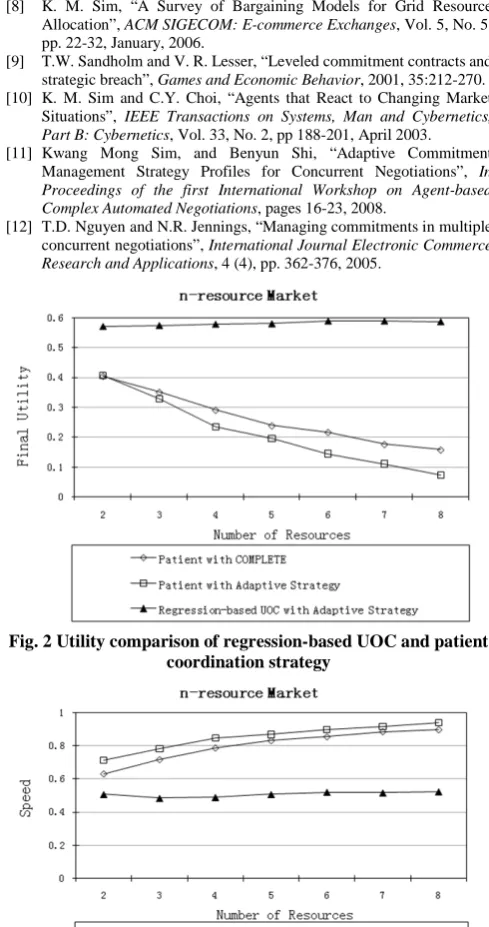
To evaluate the performance of the regression-based coordination strategy in this work, we compare our coordination strategy with the patient coordination strategy (i.e., the consumer terminates all concurrent negotiations
when it has acquired all required services without considering time constraint.) for different number of required atomic web services in an n-service market (i.e., for each atomic service market, it can be either favorable, unfavorable, or balanced for the service consumer), where the adaptive CMS profiles is used to manage the commitments during the negotiation. Furthermore, the comparisons of adaptive CMS
profile with the regression-based coordination strategy and a
static negotiation strategy with complete information (where
the consumer knows the market type for each atomic service market) coordinated by patient coordination strategy (i.e., patient with COMPLETE) are also done in this set of experiments. In a market with complete information, the consumer agent can adopt an appropriate negotiation strategy for each market type. For example, for the service Si, if it is in a favorable market, the consumer can adopt
Conservative-CMS as its negotiation strategy for this kind of
service. However, in this set of experiments, since the market type is known by the consumer in advance, the consumer will not change its negotiation strategy during the negotiation process. Thus, its strategy is static.
B. Performance Measures
Three performance measures: (i) utility, (ii) success rate of acquiring all required services, and/or (iii) negotiation speed
are used in the three sets of experiments.
1) Utility: For the purpose of experimentations, the utility
of a consumer (Uc) is as follows:
1
1
(
) , if all services acquired
0 , otherwise
Ni i c i c
U
U
N
=
− Γ
=
∑
where i c
U is the consumer’s utility function for service Si, and i
Γ is the total penalty that the consumer should pay for decommitments.
2) Negotiation speed: Negotiation speed is calculated
asSc=tc/
τ
c, where tc is the total number of rounds taken to complete negotiation and τc is the deadline. For each set of experiments, an average of Sc is determined for the 1000 runs.3) Success rate: A concurrent negotiation is considered
successful if a consumer can successfully negotiate for all of its required services; otherwise, the concurrent negotiation is considered unsuccessful. For each set of experiments, the success rate is defined as the ratio of the successful negotiations over 1000 runs.
C. Observations
coordination strategies, the coordinator can make a decision whether or not to terminate the whole negotiation based on the predicted utility changes received from commitment managers at each negotiation round.
Furthermore, it can also be observed that the results of “Patient with COMPLETE” is better than “Patient with Adaptive Strategy”. This is because by the adaptive strategy, the consumer always strive for high utility by dynamically adjusting its concessions at each round, hence, it may be harder for the agent with adaptive strategy to reach an agreement than the agent with COMPLETE (at least, it may take more times for the adaptive strategy to reach an agreement. Since the failure of any negotiation for one service will result in the failure of the whole negotiation and further reduce the success rate of the experiment, it can be observed in Fig. 4 that as the number of required services increases, the patient agent with adaptive strategy reached a much lower success rate than that with COMPLETE. Since the success rate for patient strategy is very low, it can be found that the final utility of “Patient with Adaptive” is lower than that of “Patient with COMPLETE”.
VI. CONCLUSION
In this work, concurrent negotiation is adopted for web services procurement. The novel contributions of this work include i) devising commitment management strategies for negotiation participants to manage intermediate contract during negotiation, ii) designing an adaptive strategy profile for agent in an n-service market to determine how many concessions it should make at each negotiation round, and iii) proposing a regression-based coordination strategy to coordinating multiple concurrent SLA negotiations. Experimental results show that the coordination strategy in this work outperforms the existing works in terms of utility, negotiation speed and success rate.
ACKNOWLEDGMENT
The authors would like to thank the anonymous referees for their comments and suggestions.
REFERENCES
[1] J. Brzostowski, R. Kowalczyk, “Efficient algorithm for estimation of
qualitative expected utility in possibilistic case-based reasoning”, in:
Proc. of the 21st Conference on Uncertainty in Artificial Intelligence, UAI 2005, Edinburgh, Scotland, July 2005.
[2] Junwei Cao , Daniel P. Spooner , Stephen A. Jarvis , Graham R. Nudd,
“Grid load balancing using intelligent agents”, Future Generation
Computer Systems, v.21 n.1, pp.135-149, 1 January 2005.
[3] Cardoso, J., “Stochastic Workflow Reduction Algorithm”, LSDIS Lab,
Department of. Computer Science, University of Georgia, USA.
[4] Karl Czajkowski , Ian T. Foster , Carl Kesselman , Volker Sander ,
Steven Tuecke, “SNAP: A Protocol for Negotiating Service Level Agreements and Coordinating Resource Management in Distributed
Systems”, Revised Papers from the 8th International Workshop on Job
Scheduling Strategies for Parallel Processing, pp.153-183, 2002.
[5] Yan, J., Kowalczyk, R., Lin, J., Chhetri, M. B., Goh, S. K., and Zhang,
J., “Autonomous service level agreement negotiation for service composition provision”, Future Gener. Comput. Syst. 23, 6, pp. 748-759, 2007.
[6] Paurobaly, S. and Jennings, N. R., “Developing Agent Web Service
Agreements”, In: IEE/WIC/ACM Int. Conf. on Intelligent Agent
Technology, Compiegne, France, 2005.
[7] Patankar, V. and Hewett, R., “Automated Negotiations in Web Service
Procurement”, In Proceedings of the 2008 Third international
Conference on internet and Web Applications and Services. IEEE Computer Society, Washington, DC, pp. 620-625, 2008.
[8] K. M. Sim, “A Survey of Bargaining Models for Grid Resource
Allocation”, ACM SIGECOM: E-commerce Exchanges, Vol. 5, No. 5,
pp. 22-32, January, 2006.
[9] T.W. Sandholm and V. R. Lesser, “Leveled commitment contracts and
strategic breach”, Games and Economic Behavior, 2001, 35:212-270.
[10] K. M. Sim and C.Y. Choi, “Agents that React to Changing Market
Situations”, IEEE Transactions on Systems, Man and Cybernetics,
Part B: Cybernetics, Vol. 33, No. 2, pp 188-201, April 2003.
[11] Kwang Mong Sim, and Benyun Shi, “Adaptive Commitment
Management Strategy Profiles for Concurrent Negotiations”, In
Proceedings of the first International Workshop on Agent-based Complex Automated Negotiations, pages 16-23, 2008.
[12] T.D. Nguyen and N.R. Jennings, “Managing commitments in multiple
concurrent negotiations”, International Journal Electronic Commerce
[image:6.595.302.547.52.516.2]Research and Applications, 4 (4), pp. 362-376, 2005.
[image:6.595.307.546.353.545.2]Fig. 2 Utility comparison of regression-based UOC and patient coordination strategy
Fig. 3 Negotiation speed comparison of regression-based UOC and patient coordination strategy
[image:6.595.308.539.587.743.2]