HICKMAN, Paul <http://orcid.org/0000-0002-3062-0003>, REEVE, Kesia <http://orcid.org/0000-0003-2877-887X>, KEMP, Peter, WILSON, Ian <http://orcid.org/0000-0001-8813-3382> and GREEN, Stephen
<http://orcid.org/0000-0002-7813-0564>
Available from Sheffield Hallam University Research Archive (SHURA) at:
http://shura.shu.ac.uk/18963/
This document is the author deposited version. You are advised to consult the publisher's version if you wish to cite from it.
Published version
HICKMAN, Paul, REEVE, Kesia, KEMP, Peter, WILSON, Ian and GREEN, Stephen (2014). Direct payment demonstration projects: Key findings of the programme evaluation. Final report. Project Report. London, Department for Work and Pensions.
Copyright and re-use policy
Direct Payment Demonstration
Projects: Key indings of the
programme evaluation
Final report
A report of research carried out by the Centre for Regional Economic and Social Research on behalf of the Department for Work and Pensions.
© Crown copyright 2014.
You may re-use this information (not including logos) free of charge in any format or medium, under the terms of the Open Government Licence.
To view this licence, visit www.nationalarchives.gov.uk/doc/open-Government-licence/ or write to the Information Policy Team, The National Archives, Kew, London TW9 4DU, or email: [email protected].
This document/publication is also available on our website at:
www.gov.uk/Government/organisations/department-for-work-pensions/about/ research#research-publications
If you would like to know more about DWP research, please email: [email protected]
First published 2014.
Summary
Contents
Acknowledgements ... 9
The Authors ...10
Glossary of terms and list of abbreviations...11
Executive summary ... 13
1 Introduction ... 18
1.1 About the report ... 18
1.2 What was the DPDP Programme? ... 18
1.3 How transferable are the DPDP indings to a Universal Credit context? ...21
1.4 What approach did the study team take to the research? ...22
1.5 What outputs have the study team produced? And where does this output ‘it’ amongst them? ... 23
1.6 What do I need to know about this report? ...24
1.7 What does existing research tell us about direct payment of Housing Beneit to social housing tenants? ... 25
1.8 How is the report structured? ... 26
1.9 What are the key terms used in the report? ... 27
2 Delivering direct payment ... 28
2.1 Introduction ... 28
2.2 What was the programme design process? And how well did it go? ... 28
2.3 At the beginning of the programme, how did landlords communicate with tenants? How well did this process go? ... 29
2.4 How were tenants selected to go onto direct payment? ... 29
2.5 How did landlords ind the direct payment transition stage? ... 30
2.6 How did Project Areas deliver and manage the DPDP? ... 31
2.7 Did landlords change their approach to rent collection and arrears recovery for the DPDP? ... 31
2.11 Who provided the support? ... 32
2.12 What has been the experience of Project Areas in terms of support provision? ... 33
2.13 What was the impact of support? Did it make any difference? ... 33
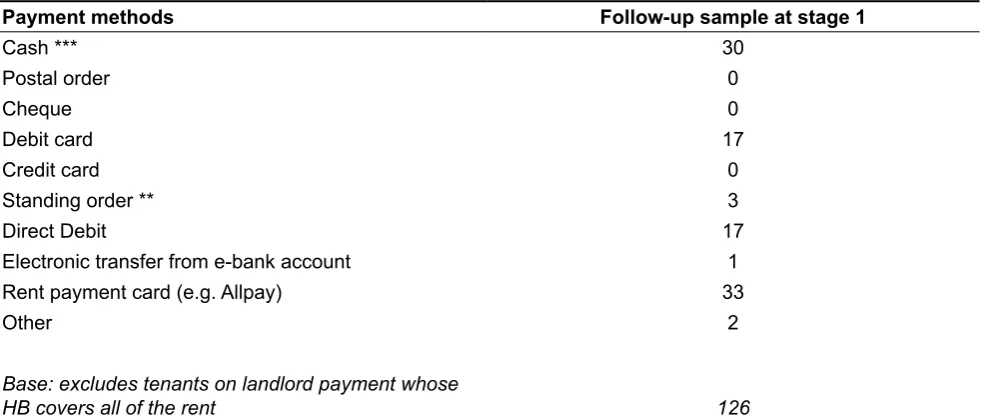
2.14 What payment methods were used by tenants to pay their rent? ... 34
2.15 How many tenants had bank accounts? And how did they use them? ... 34
2.16 What factors facilitated the effective delivery of direct payment? ... 35
2.17 What were the key challenges faced by landlords and other stakeholders?... 36
2.18 Summary ... 38
3 Managing direct payment: tenants ...40
3.1 Introduction ...40
3.2 How well equipped were tenants to make the transition to direct payment? ...40
3.3 How did tenants manage on direct payment? ...42
3.4 Did rent payment patterns luctuate, or were they relatively stable? ...44
3.5 Are some tenants more vulnerable to accruing arrears than others? What factors impact on tenants’ ability to manage direct payment? ... 45
3.6 What impact did support have? Did it make any ‘difference’? ... 50
3.7 Did other welfare reforms affect tenants’ ability to manage direct payment? ... 51
3.8 Summary ... 53
4 Underpayment in the DPDP ... 55
4.1 Introduction ... 55
4.2 How common is underpayment of rent? ... 55
4.3 How common is persistent underpayment? ... 56
4.4 Can underpayers be categorised into distinct types? ... 57
4.5 Why do tenants underpay? ... 59
4.6 What is the impact of underpayment of rent on landlord income? ... 60
4.7 Summary ... 62
5 The impact of direct payment on tenants ... 63
5.1 Introduction ... 63
5.3 Have tenants’ money management skills improved as a result of
being on direct payment? ... 65
5.4 Has direct payment resulted in tenants being incentivised to look for work? ... 65
5.5 Has direct payment resulted in tenants being more aware of the rent they pay? ... 66
5.6 Has direct payment impacted on tenants in other ways? ... 67
5.7 Has direct payment impacted on how tenants manage, prioritise and pay their bills and payments? Speciically, have they paid their rent at the expense of other bills and payments? ... 69
5.8 Summary ... 70
6 The impact of direct payment on landlords ... 72
6.1 Introduction ... 72
6.2 Was the impact of direct payment felt evenly across Project Areas? And did it play out in different ways? ... 72
6.2.1 Socio-political, legal, cultural and housing policy and practice context ... 73
6.2.2 Place ... 73
6.2.3 Organisational factors ... 74
6.2.4 Tenants ... 74
6.3 What have been the key impacts of direct payment on landlords and other local stakeholders? ... 76
6.4 What has been the impact of direct payment on landlords’ rental income? ... 77
6.5 Did the impact of direct payment on DPDP landlords change over time? ... 78
6.6 Did the impact of direct payment on landlord income vary by area or landlord type? ... 83
6.7 Did the ‘trigger point’ affect the value of arrears and the number of people entering arrears? And which ‘trigger point’ was the most effective? ... 85
6.8 Did arrears that accrued in the early stages of the DPDP get paid back? ... 87
6.8.1 In addition to arrears, are there other costs to landlords of implementing direct payment? ... 87
6.9 What was the total cost of direct payment? ... 89
7 Direct payment under UC for landlords ... 92
7.1 Introduction ... 92
7.2 Direct payment under UC ... 92
7.3 Summary ... 96
8 Key lessons to emerge from the DPDP for Universal Credit ... 98
8.1 Introduction ... 98
8.2 Key lessons ... 98
8.2.1 Social housing landlords ... 98
8.2.2 DWP and the Universal Credit programme team ...101
8.2.3 Support agencies, lenders and tenants ...102
Appendix Additional Rent Account Analysis ... 105
Endnotes ... 108
References ... 109
List of tables
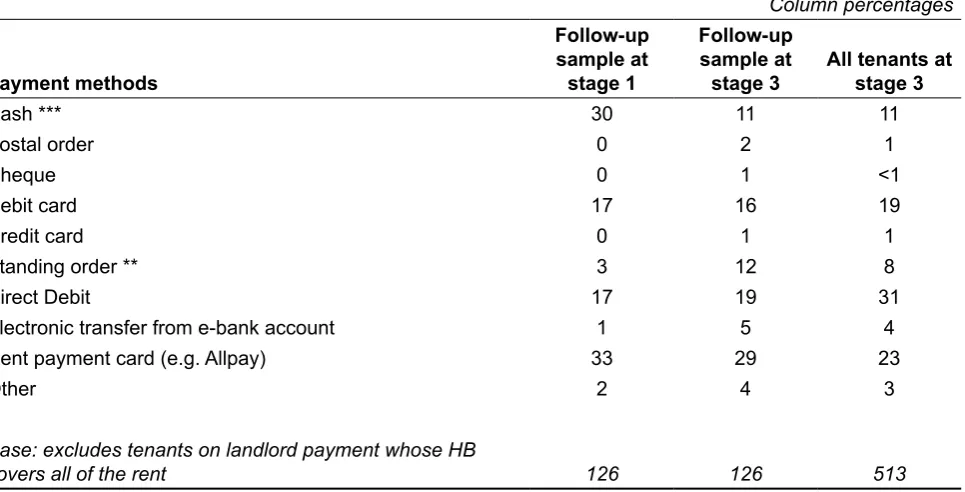
Table 1.1 Number of tenants transferred onto direct payment ...20Table 2.1 Methods tenants normally used to pay their rent ... 34
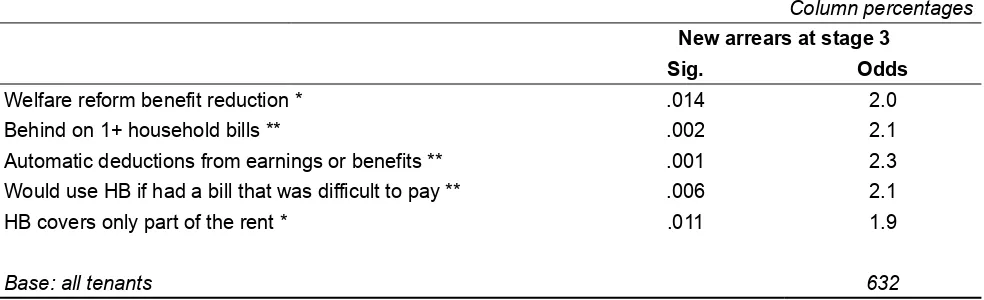
Table 3.1 Logistic regression odds of being in ‘new’ rent arrears at stage 3 ... 47
Table 4.1 Rent paid by payment type ... 62
Table 5.1 Methods tenants normally used to pay their rent ... 64
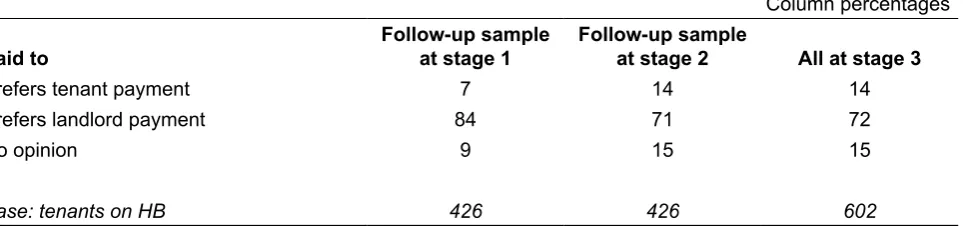
Table 5.2 To whom would tenants prefer their HB to be paid? ... 67
Table 6.1 Proportion of rent paid in all payment periods, and in all Direct Payment payment periods (i.e. counting only periods where HB was paid directly to the tenants) ... 84
Table 6.2 Proportion of tenants who had accrued arrears, or additional arrears by the end of the DPDP (counting all periods, and counting only periods where HB was paid direct to the tenant ... 84
Table A.1 Switchbacks broken down by rent payment period ... 107
List of igures
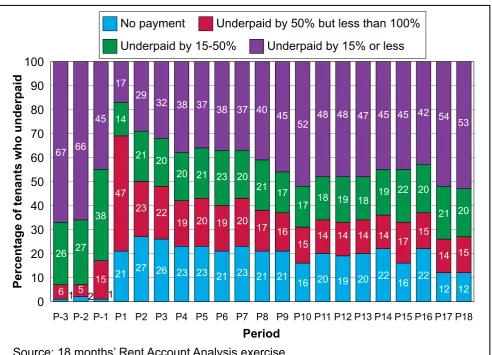
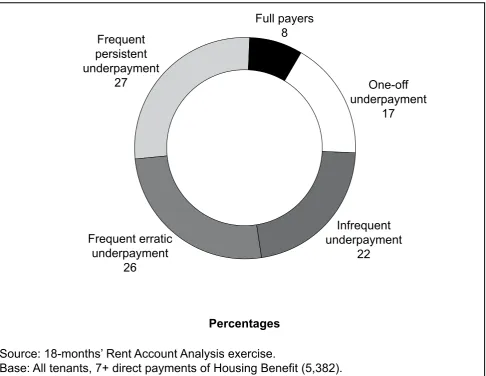
Figure 4.1 Distribution of underpayers by category of underpayment ... 56
Figure 4.2 Payment types (at 12 months) ... 58
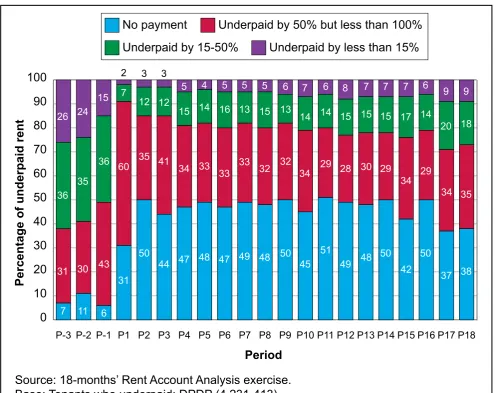
Figure 4.3 Underpayment types (at 18 months and deining underpayment to include non-payment) ... 59
Figure 4.4 Distribution of underpayment value by category of underpayment ... 61
Figure 6.1 Factors affecting the impact of direct payment on landlords ... 75
Figure 6.2 Payment rates: rebased ... 80
Figure 6.3 Period 1 payment rates for tenants on direct payment; rebased ... 83
Figure A.1 Cumulative shortfall of rent paid expressed as a percentage of rent charged while receiving direct payment ... 105
Acknowledgements
The Authors
Paul Hickman is Professor of Housing and Regeneration at the Centre for Regional Economic and Social Research at Shefield Hallam University. He was the Project Director for this evaluation of the Direct Payment Demonstration Projects.
Dr Kesia Reeve is a Principal Research Fellow at the Centre for Regional Economic and Social Research at Shefield Hallam University. She managed the evaluation and, like Paul Hickman, was involved in all aspects of the research.
Peter A. Kemp is a Professor of Public Policy in the Blavatnik School of Government, and a member of the Oxford Institute of Social Policy, at the University of Oxford. He was responsible for the questionnaire design, analysis and reporting of the tenant surveys.
Ian Wilson is a Senior Research Fellow at the Centre for Regional Economic and Social Research. He led the study team’s work on Rent Account Analysis.
Glossary of terms and list of
abbreviations
Baseline survey This was a household survey that was undertaken at the beginning of the evaluation in order to generate a ‘baseline’ position for tenants in the Project Areas. It involved 1,965 tenants being interviewed by researchers from Ipsos MORI between May and July 2012.
CRESR Centre for Regional Economic and Social Research at
Shefield Hallam University.
DD Direct Debit
DP Direct payment: the payment of Housing Beneit directly
to tenants.
DPDP Direct Payment Demonstration Project. The DPDPs, of
which there were six, were concerned with demonstrating the payment of Housing Beneit directly to social rented sector tenants. The six projects were: Edinburgh; Oxford; Shropshire; Southwark; Torfaen; and Wakeield.
DWP Department for Work and Pensions HB Housing Beneit
IM Ipsos MORI
In-scope Tenants in the Project Areas eligible for DPDP i.e. those of working age and not in temporary accommodation and short-term supported accommodation.
Landlord payment The payment of Housing Beneit directly to landlords.
Payments This represents all debits – rent payments and third party
payments, such as water bills – to rent accounts.
Project Area Direct Payment Demonstration Project Area RAA Rent Account Analysis
Rent arrears Rent arrears are accrued when rent payments over a
given period are less than the rent owed.
Rent payment rate This is the rate of period rent payments to rent owed with the value rent indicating the percentage of debits accounted for by credits in the period.
RSRS Removal of the Spare Room Subsidy
Safeguarding The process by which tenants who were assessed as being unsuitable for direct payment were removed from the DPDP programme.
Stage 3 tenant survey This was a survey of DPDP tenants undertaken at the end of the programme. It involved 650 tenants being interviewed by Ipsos MORI, 459 of whom had participated in the baseline and second surveys.
Stage 2 tenant survey This survey was undertaken towards the end of the irst year of the programme and involved 1,827 tenants being interviewed by Ipsos MORI, 1,218 of whom had been interviewed as part of the baseline survey.
Stakeholder Panel Panels were set up in each of the Project Areas comprising representatives from all the participating landlords. Their experiences were tracked over the DPDP programme.
Switchback The transferal of a tenant who had fallen into arrears on direct payment back to landlord payment after a switchback ‘trigger point’ (see below) had been ‘hit’.
Switch-forward The return to direct payment of a tenant who had been switched back.
Tenant Panel This comprised 48 tenants from the across the six Project Areas whose experiences were tracked over the course of the DPDP programme.
Trigger point The length of time that elapsed before tenants returned to landlord payment in the demonstration projects. The trigger period varied across the six demonstration projects.
Executive summary
This report is the inal output from the independent evaluation of the Direct Payment
Demonstration Project (DPDP) conducted by the Centre for Regional Economic and Social research at Shefield Hallam University in conjunction with Ipsos MORI and the University of Oxford. The evaluation team published eight other reports over the course of the evaluation that this report should be read alongside. They are:
• Direct Payment Demonstration Projects: Findings from a baseline survey of tenants in
ive Project Areas in England and Wales. This report, which was published in 2012, can
be downloaded at: www.gov.uk/government/uploads/system/uploads/attachment_data/ ile/193327/rrep822.pdf
• Direct Payment Demonstration Projects: Learning the lessons, six months in (2013)
www.shu.ac.uk/research/cresr/sites/shu.ac.uk/iles/direct-payments-learning-lessons.pdf
• Direct Payment Demonstration Projects: 12 months in extended learning report
(July 2014), DWP Research Report No. 876.
• Direct Payment Demonstration Projects: Key indings of the 12-months’ Rent Account
Analysis exercise (July 2014), DWP Research Report No. 879. www.gov.uk/government/
publications/the-direct-payment-demonstration-projects-dpdp
• Direct Payment Demonstration Projects: Report from the stage 2 survey of tenants (July
2014). Direct Payment Demonstration Projects: Report from the stage 2 survey of tenants, DWP Research Report No. 878. www.gov.uk/government/publications/the-direct-payment-demonstration-projects-dpdp
• Direct Payment Demonstration Projects: Rent underpayment (July 2014). Direct Payment
Demonstration Projects: Rent underpayment, DWP Research Report No. 877. www.gov.
uk/government/publications/the-direct-payment-demonstration-projects-dpdp
• Direct Payment Demonstration Projects: The longitudinal survey of tenants, DWP
Research Report No. 889 (2014). www.gov.uk/government/publications/the-direct-payment-demonstration-projects-dpdp
• Direct Payment Demonstration Projects: Key indings of the 18 months rent account
analysis exercise (December 2014), DWP Research Report No. 891.
In addition, a series of ive ‘learning reports’, produced for the Department for Work and Pensions (DWP) to inform the development of Universal Credit (UC), were made available to social housing landlords and other stakeholders who joined an online Learning Network facilitated by the Chartered Institute of Housing (www.cih.org/ directpaymentslearningnetwork).
The overall aim of the DPDP was to highlight key lessons and learning points in terms of the direct payment of Housing Beneit (HB) to feed into UC design ahead of its introduction. More speciically, the projects were concerned with: exploring the effects of direct payment on landlords and tenants; examining the effectiveness of the different types of support provided to tenants to help them prepare for and manage direct payment; and testing direct payment safeguard mechanisms for landlords. The six projects that comprised the DPDP were: Oxford; Shropshire; Southwark; Torfaen; Wakeield; and Edinburgh. Projects were live between June 2012 and December 2013.
Because of differences between the DPDP and UC programmes, not all the lessons to emerge from the DPDP are directly transferable to UC. But many are as there are numerous similarities between the two programmes, not least that direct payment is one of the two key central tenets of UC (the other being the combining of beneit payments into one single payment). The evaluation employed a mixed methods approach which involved four principal elements:
• tenant surveys: in addition to a distinct survey of underpayers, household surveys were
undertaken just before the DPDP went live (the baseline), at the end of the irst 12 months, and at the end of the DPDP programme;
• Rent Account Analysis: this involved the analysis of the rent accounts of all those tenants
who went onto direct payment in the DPDP and of a comparator sample at two points in time – 12 months into the DPDP programme and at its conclusion;
• qualitative work with tenants: in total, more than 180 in-depth interviews were carried
out with tenants, in addition to regular telephone ‘catch-up’ discussions with a panel of 48 tenants whose experiences were tracked over time;
• qualitative work with stakeholders: this comprised face-to-face and telephone
interviews and focus groups with key stakeholders in the DPDP programme, speciically representatives from the Project Areas, inancial institutions, national money management organisations and DWP, who were interviewed over the course of the study. Approximately 125 interviews were conducted with stakeholders over the course of the evaluation.
Overarching indings from the evaluation
The overarching indings from the evaluation are:
• When the DPDP programme was conceived there was concern that the rent arrears of
participating landlords would increase very dramatically. This did not happen – there was a consensus amongst local stakeholders and lenders that they had not increased as much as had been anticipated.
• But direct payment in the DPDP did have a inancial impact on landlords and tenants.
• Overall, tenants who went onto direct payment in the DPDP paid 95.5 per cent of all the
rent owed, compared with a comparator sample (not on direct payment) who paid 99.1 per cent of rent owed (a difference of 3.6 percentage points). However, this masks signiicant variation over time. The average payment rate immediately following migration to direct payment was just 67 per cent – an arrears rate of 33 per cent – but by tenants’ 18th direct payment it had risen to 99 per cent. Direct payment in the DPDP did, therefore, have a inancial impact on landlords (a total of £1.9m of rent owed was not paid over the 18 month period) but much of this burden was borne in the irst few months following migration.
• Controlling for other factors, overall, the net additional impact of direct payment was
5.5 percentage points less rent paid, i.e. tenants paid 5.5 percentage points less rent, on average, than they would have done had their HB been paid direct to their landlord. However, the net additional impact reduced dramatically over time from 15.7 percentage points less rent paid in the irst three payment periods, to 2.1 percentage points less rent paid in payment periods 16-18.
• Further analysis strongly suggests that the early arrears spike was not driven primarily by
factors speciic to the DPDP – e.g. the infancy of the policy and experimental nature of the DPDP programme – but is a pattern likely to repeat unless mitigating action is taken. The ‘spike’ may be less pronounced going forward, relecting the inluence DPDP has had on UC design, but focused intervention and close monitoring of rent accounts may be needed. On the last point, landlords will only be able to closely monitor rent accounts if they know which of their tenants are in receipt of UC.
• A decrease in payment rates of this order is less signiicant than initially feared but would,
for some landlords, represent a 100 per cent or more increase in their arrears rate. Financial surpluses may be eroded, with consequences for housing associations’ capacity to build, and the impact of late/underpayment on cash low could pose signiicant problems for small landlords. Larger landlords, meanwhile, face the prospect of a signiicant reduction in income once the few additional percentage points arrears are scaled up to tens of thousands of tenants. Large local authority landlords may ind this particularly dificult to accommodate in the context of austerity measures and public sector funding cuts.
• These considerations point to the beneit of a phased introduction of direct payment
so that inancial risk can be spread over time and the need for mitigating action during the transition to direct payment. This could be in the form of support to tenants, close monitoring of rent accounts, cautious assessments of tenants’ readiness for direct payment, on-going support assessment processes or other intervention. Improving payment rates during tenants’ irst three payments would reduce the negative impact of direct payments on tenants and on landlords’ income signiicantly.
• Tenants who switched back had much lower overall payment rates during their time on
• There are cost and resource implications of direct payment, over and above rent arrears.
Landlord transaction costs and rent collection costs increase, as does the resource required to manage direct payment. IT systems are likely to need upgrading or renewing, and some tenants need support to help them manage. However, tenants in the DPDP programme highlighted a number of beneits of being on direct payment – some reported that it had made them better at money management and some reported that it had made them more likely to look for work, hold down a job or increase their hours.
• The proportion of tenants with a bank account increased over the course of the
programme; with some tenants also reporting that they had a better standing with their bank (such as improved credit ratings), changes which are indicative of DPDP promoting greater inancial inclusion.
• When the DPDP programme was launched, there was a widely held view amongst
participating landlords that they ‘knew’ their tenants well. However, it soon became apparent that this was not the case – in order to prepare for and implement direct
payment, participating landlords had to develop relationships with tenants with whom they previously had little contact. They improved their knowledge and understanding of tenants, which has been a positive consequence of direct payment for landlords.
• In order to target rent collection activity effectively, to target support appropriately, to
make the right safeguarding decisions and to minimise the inancial risk associated with direct payment – for landlords and for tenants – it is imperative that the ‘risk factors’ associated with arrears are understood, and that tenants potentially vulnerable to arrears can be identiied. In the DPDP, tenants’ inancial circumstances emerged as a key driver of arrears. Tenants in precarious inancial situations – with low or luctuating incomes, or who had experienced negative income shocks, or who had existing debt – were most vulnerable to arrears under direct payment. Socio-demographic characteristics, in contrast, were not a signiicant driver of arrears. Good money management skills, particular payment methods and attitudes helped mitigate inancial precarity and so these factors also have a role to play. Similarly, advice and support can make a difference – and those who received support tended to appreciate it – but it is not a panacea for negative payment behaviour.
• The concept of ‘vulnerability’ may, therefore, be different in a direct payment context than
• Tenants’ payment behaviour is erratic making it dificult to accurately forecast payment
patterns, and past payment behaviour is not a good predictor of future payment patterns. The fact that only ten per cent of direct payment tenants in the DPDP paid all their rent – despite many managing well most of the time – illustrates this well. In total, 65 per cent of tenants could be described as displaying erratic payment patterns, including 17 per cent of tenants who failed to pay all their rent just once, 22 per cent who did so infrequently, and 26 per cent who did so frequently but erratically. Many tenants who managed well for months unexpectedly missed a payment, while others moved from full payment to underpayment to non-payment (and, sometimes, overpayment) over time. The amount by which tenants underpaid their rent also luctuated. Erratic payment patterns relect that the triggers of arrears/underpayment shift and change, and often relect an income shock, inancial emergency or unexpected life event that has inancial consequences. However, as stated above, the research did demonstrate that inancial circumstances do inluence the likelihood of getting into arrears.
• Strategic underpayment of rent (i.e. as a deliberate strategy to be removed from the
programme or secure an ‘interest-free’ loan) was very rare in the DPDP. Typically, tenants underpaid or failed to pay their rent to cover essentials such as food and fuel, because of an unexpected expense or by accident.
• The task of preparing for direct payment under DPDP took longer, and was more complex
than envisaged. Engaging with, gathering basic details from, and assessing tenants, forging relationships with support providers, helping tenants open bank accounts, and checking, testing and developing IT capabilities were resource-intensive activities. This early phase of the DPDP proved most challenging to local stakeholders but approximately six months after ‘go live’ (when the irst direct payment was made in the DPDP) stakeholders in the Project Areas were reporting being in ‘steady state’1. One of the main beneits of the process was
that by the end of DPDP landlords were much more aware of the support needs of their tenants. Furthermore, it had brought them into contact with more tenants.
• The research explored whether DPDP had triggered any ‘behaviour change’ amongst
tenants. It found behavioural change to be a slow process with there being little perceptible change in the irst year of the DPDP. However, as the DPDP continued, small, but signiicant changes in tenants’ attitudes, behaviours and money management skills started to emerge. There was evidence that some tenants had been incentivised to look for work as a result of direct payment, that participation in the DPDP had made tenants more aware of the rent they pay, and had made them better at, and more conident about managing their money. In addition, there was an increase in tenants using Direct Debit to pay their rent.
• The introduction of direct payment in the DPDP prompted participating landlords to
consider new ways of working and relect on organisational changes required to meet the demands – and the associated costs and resources – of the new regime. This included reconiguring income teams, commissioning new IT systems, developing and trialling new rent collection techniques, becoming more ‘customer focused’, and taking a more commercial approach to lettings and rent collection. However, it is important to remember that by the end of the programme DPDP landlords had a much clearer understanding of the support needs of their tenants. Direct payment demanded changes in staff roles and responsibilities and altered the expectations placed upon them, and scrutiny from CEOs, Boards, members and Councillors increased because of the potential impact of direct payment on income streams.
1 It is important to note that these indings are speciic to DPDP and in this respect, UC
1
Introduction
1.1
About the report
The Centre for Regional Economic and Social Research at Shefield Hallam University, in partnership with the University of Oxford and Ipsos MORI (IM), was commissioned by Department for Work and Pensions (DWP) to monitor and evaluate the Direct Payment Demonstration Projects (DPDPs). There were six demonstration projects: Edinburgh; Oxford; Shropshire; Southwark; Torfaen; and Wakeield. The irst direct payments (DPs) were made in the English and Welsh case studies in June 2012 and in the Scottish case study in August 2012. The DPDPs ended in February 2014. The primary purpose of the evaluation was to learn lessons, providing feedback into the design of both the programme and Universal Credit (UC).
This report is the inal output from the evaluation. It is concerned with pulling together all the analysis undertaken by the study team, which has been presented in the 13 other outputs produced by it. It pays particular attention to highlighting indings likely to be of most interest to stakeholders preparing for the roll out of direct payment as part of UC (social landlords, DWP, tenants) and others potentially affected by it, such as support agencies and lenders.
1.2
What was the DPDP Programme?
On 14 September 2011 Lord Freud, the Minister for Welfare Reform, announced that six DPDPs would be created to ‘test some key elements of social sector housing support under
Universal Credit while protecting social landlords’ inancial position’. This would involve two
signiicant changes for (the up to 2,000) working-age2 claimants in the participating projects:
• receiving Housing Beneit (HB) payments once every four weeks3 (broadly in-line with
monthly payments under UC) as opposed to weekly or fortnightly; and
• paying rent to tenants themselves.
Social housing landlords were invited to take part in the programme, which was originally planned to run for a year, and DWP received over 70 expressions of interest from local authorities and registered housing providers. From these, DWP received 23 applications. A range of criteria was used to select projects including geography: the sample selected ideally had to include partnerships from London, the North of England, the South of England, Scotland and Wales. It also had to ideally include at least one Large Scale Voluntary
Transfer (LSVT) housing association. Five successful partnerships in England and Wales were announced on 19 January 2012 and a sixth – in Scotland – joined the programme in May 2012. The six DPDPs4 were:
2 In addition to non-working-age tenants, it should also be noted that tenants in
temporary and supported accommodation on a short-term basis were also exempt from the programme.
• Oxford – Oxford City Council and Oxford Citizens Housing Association (OCHA), trading as
part of the GreenSquare Housing Group, Southern England;
• Shropshire – Shropshire Council, Bromford Group, Sanctuary Housing and The Wrekin
Housing Trust, West Midlands;
• Southwark – London Borough of Southwark and Family Mosaic, London;
• Torfaen – Torfaen Borough Council, Bron Afon Community Housing and Charter Housing,
South-east Wales;
• Wakeield – Wakeield Council and Wakeield and District Housing, Northern England; and • Edinburgh – City of Edinburgh Council and Dunedin Canmore Housing Association,
Scotland.
The overall aim of the DPDP was to highlight key lessons and learning points in terms of the direct payment of HB to feed into UC design ahead of its introduction from October 2013. More speciically, the projects were concerned with: exploring the effects of direct payment on landlords and tenants; examining the effectiveness of the different types of support provided to tenants to help them prepare for and manage direct payment; and testing direct payment safeguard mechanisms for landlords.
This was achieved by a support assessment process and varying across the projects the length of time (or switchback trigger period) for a return to landlord payment after tenants had fallen into arrears.5 Three of the projects had an eight-week (or equivalent) trigger
period (Oxford, Torfaen, and Wakeield); Edinburgh had a one-month trigger period, while Southwark and Shropshire had four-week and 12-week triggers respectively. In terms of the criteria to be used for determining when tenants were to be switched back and how arrears were to be measured and deined, there was a programme-wide agreement that it would happen when:
• ‘Trigger 1 – the tenant’s rent arrears arising during the Demonstration Project period
equalled the amount of (a month/4/8/12 weeks) rent for that tenant;
• Trigger 2 – the tenant had not paid any rent for (a month/4/8/12 weeks) during the
Demonstration Project period;
• Trigger 3 – the tenant had underpaid her/his rent by 15 per cent or more in each of the periods of 4 weeks in the preceding 12 weeks, falling within the Demonstration Project
period;
• Trigger 4 – the tenant had underpaid her/his rent by 15 per cent or more in the preceding
period of 12 weeks, falling within the Demonstration Project period.’6
In practice, more than two-thirds of the 1,031 ‘switchbacks’ that had occurred by March 2013 had been under the two underpayment triggers: 3 and 4.7 Relecting this, DWP asked
the research consortium to undertake bespoke research into this group when it decided to
5 It is important to note that, in many respects, including how tenants are assessed for
direct payment, the context under UC will be different to that in the DPDP. This issue is explored in-depth in the next section.
6 Written submission provided by a DWP Relationship Manager.
7 By the end of the programme, 1,993 tenants had been switched back
extend the DPDP programme and evaluation in May 2013, with the indings of this work being published in July 2014.8 Lord Freud explained that the rationale behind the decision
to extend the programme, which was to be extended by six months until December 2013, was to generate learning ‘to further develop the support needed for social housing tenants
moving onto Universal Credit’.9
Working alongside the DWP, the English, Welsh and Scottish projects began work preparing for direct payment in their areas in January 2012, with work beginning in Edinburgh in May 2012.i The English and Welsh projects went ‘live’ in June and July of 2012 when the irst
phase of tenants were moved onto direct payment, with Edinburgh following suit in August 2012. Relecting differences in the preparedness of tenants to move onto direct payment, it was decided to adopt a phased approach to moving tenants onto the programme, with those in the irst phase assessed as being most prepared to go onto it.10 Although the number of
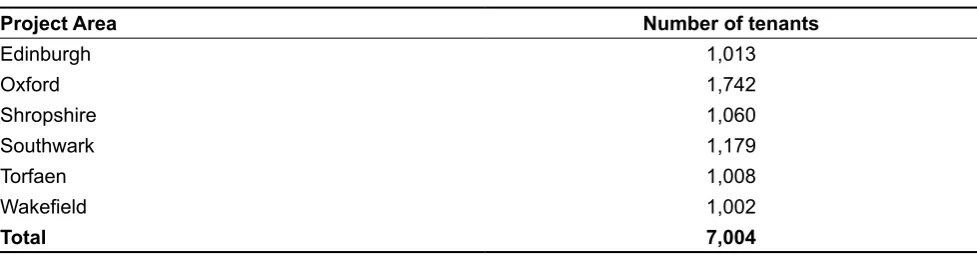
[image:21.595.55.544.377.505.2]phases varied by Project Area, all had undertaken their last one by the beginning of 2013. In all, by March 2013, a total of 7,004 tenants had gone onto direct payment. As Table 1.1 reveals, ‘in-scope’ numbers were fairly similar in ive of the areas (Edinburgh, Shropshire, Southwark, Torfaen, and Wakeield) with there being one ‘outlier’, Oxford, which put 1,742 tenants onto direct payment.
Table 1.1 Number of tenants transferred onto direct payment
Project Area Number of tenants
Edinburgh 1,013
Oxford 1,742
Shropshire 1,060
Southwark 1,179
Torfaen 1,008
Wakefield 1,002
Total 7,004
Source: DWP monitoring information, March 2013.
8 The report, Direct Payment Demonstration Projects: Rent underpayment, can be
downloaded at: www.gov.uk/government/publications/the-direct-payment-demonstration-projects-dpdp
9 See DWP Press Release of 16 May 2013, Direct Payment projects extended by 6
months, which is available at:
www.gov.uk/government/news/direct-payment-projects-extended-for-6-months
10 After the programme went ‘live’, Project Areas began undertaking other tasks: rent
1.3
How transferable are the DPDP indings to a
Universal Credit context?
The DPDP has provided important information and lessons about the impact of direct payment. The purpose of generating learning is so that direct payment can be rolled out successfully as part of UC. Before considering the implications of the indings summarised in this report – for landlords, for tenants, for other stakeholders and for the development of UC – it is useful to relect, therefore, on how transferable these indings are to a UC context. In answer to this question, the following differences need to be considered.
• UC has a far longer lead-in time than the DPDP, and learning has now accrued. The
purpose of the DPDP was to test direct payment ahead of roll-out as part of UC. Direct payment in the DPDP was introduced without the beneit of learning, while direct payment as part of UC will be introduced having considered a body of evidence and learning over a signiicant period of time.
• Support structures were not well developed when the direct payment went live in the
DPDP.11 Few tenants received advice or support before going onto direct payment in the
early months of the DPDP, and understanding about the type of support likely to be most effective was limited. The value of support has been considered further as part of UC policy development, a Personal Budgeting Support process developed which is being tested in the UC Pathinders, and a Local Support Services Framework developed, setting out an approach to build local partnerships to support people moving onto UC.
• Some of the budgeting strategies employed by tenants to manage direct payment will need
to be revised under UC. Receiving HB directly, but separately from other income sources, is very different to receiving it as part of a single monthly beneit payment. Ring-fencing income to expenditure (the ‘jam jar’ approach), juggling payments and income through the month (e.g. ‘borrowing’ from the HB for food but repaying the following week with the Child Beneit) and operating short budgeting cycles were all common techniques employed by tenants. Tenants will need to develop new inancial management and budgeting strategies, or ind ways to replicate current systems under UC (for example, opening several bank accounts or using internet banking to move money around). On the other hand, some tenants may ind budgeting easier once their income from beneits is rolled into one monthly payment.
• The process for assessing tenants’ readiness for direct payment under UC will be different
to that employed by the DPDP. Some tenants who were put onto direct payment in the DPDP, and who subsequently did not manage, are likely to be safeguarded under UC.
• In the DPDP, administration of HB was the responsibility of local authorities and data
sharing between them and landlords was commonplace. Under UC the responsibility for administering HB (or the housing component of UC) will pass to DWP. The close relationship between landlords and HB staff, their local presence and knowledge, and the sharing of information about claimants proved key to effective implementation of the DPDP. It is not clear what the consequences of this change will be.
• In the DPDP landlords knew which of their tenants were in receipt of HB (and direct
payment) and could monitor their rent accounts and target support and other interventions accordingly. At the time of writing it was not clear whether landlords will have this
information once HB is subsumed within UC.
• In the DPDP, Project Areas were testing different switchback ‘triggers’ – one month, four
weeks, eight weeks and 12 weeks. Some also employed additional triggers to capture persistent underpayers. Switchback triggers affect the amount of arrears that can accrue. Under UC the switchback trigger will be two months.12
• In the DPDP, landlords took the lead in engaging with tenants, assessing their readiness
for direct payment, identifying support needs, collecting bank details and so on. This placed considerable pressure on landlords in the early phases of implementation. Under UC, the role of landlords in these processes is limited and the responsibility will fall to DWP.
• Direct payment was not mandatory in the DPDP. Tenants were not given a choice to ‘opt
out’ but, in practice, a tenant could avoid direct payment by refusing to respond to requests for bank details. Under UC, a tenant’s beneit claim will not be processed and UC will not be paid if they do not engage. Engagement may, therefore, be easier and less resource intensive under UC. However, little is known about the characteristics of non-engagers in the DPDP so it is possible that their participation in the DPDP would have altered the results (for example, if they are particularly good money managers the overall impact on arrears may have been less, or if they are particularly vulnerable it may have been more). The context in which direct payment was implemented in the DPDP, and some of the
systems and processes employed, will be different when direct payment is rolled out as part of UC. The lessons to emerge from the DPDP are crucially important, but the ‘results’ – the ease or dificulty with which the programme was implemented, the arrears that accrued and the patterns of underpayment – will not be identical.
1.4
What approach did the study team take to the
research?
The study team employed a mixed methods approach which involved four principal elements:
• Tenant surveys. A key element of the study was three (face-to-face) household surveys:
– a ‘baseline’ (or irst stage) survey of 1,965 tenants in the six Project Areas was conducted between May and July 2012;
– a second stage, follow-up survey of 1,844 tenants (including 1,227 who were surveyed in the baseline survey) was undertaken between June and November 2013;
– a third and inal survey took place early in 2014, which involved 650 tenants being interviewed, 459 of whom had participated in the baseline and second surveys.
As part of the work on underpayment, the study team also undertook a telephone survey of trigger 3 and 4 ‘underpayers’. This involved 95 tenants being interviewed in the autumn of 2013. Owing to the relatively small number of completed interviews, the results of this survey should be treated with a degree of caution and be seen as indicative not authoritative.
12 See: The Government Response to the Communities and Local Government Select
• Rent Account Analysis (RAA). This entailed the analysis of the rent accounts of all those
tenants who went onto direct payment under DPDP and those of a comparator sample at two points in time – 12 months into the DPDP programme and its conclusion.
• Qualitative work with tenants. This encompassed a number of strands, including: a
panel of six tenants in each area who were interviewed face-to-face in June/July 2012, January/February 2013, June 2013, and January/ February 2014, and with whom regular telephone contact was maintained; a panel of two tenants in each area who had switched back to landlord payment, interviewed in January 2013, June 2013 and January 2014, and with whom regular telephone contact was maintained; and face-to-face interviews with at least 24 additional tenants across the six Project Areas in January 2014. In addition, the study team also undertook bespoke qualitative exercises, which involved interviewing in-depth members of groups of particular interest to it and DWP: ‘new’ tenants (i.e. those tenants who have been put onto the programme since August 2013) and ‘underpayers’. In all, more than 180 in-depth interviews were conducted with tenants over the course of the evaluation.
• Qualitative work with stakeholders. This included: telephone interviews with
representatives of national stakeholder organisations, such as lenders, credit rating agencies,13 and money management and budgeting advice organisations, conducted in
two waves at the beginning and towards the end of the evaluation; focus groups with DWP oficers (in February 2013 and January 2014); interactive feedback events, which brought together stakeholders from the six Project Areas (in January 2013, December 2013 and March 2014); and a local stakeholder panel comprising approximately six key oficers in each Project Area who reported on emerging issues, through face-to-face and telephone interviews and emails, between June 2012 and early 2014. In all, 125 in-depth interviews were conducted with stakeholders over the course of the evaluation.
1.5
What outputs have the study team produced?
And where does this output ‘it’ amongst
them?
In addition to ive (succinct) Learning Reports, which were published on the Chartered Institute of Housing-administered learning network associated with the DPDP programme,14
the study team has produced the following written outputs:
• Direct Payment Demonstration Projects: Findings from a baseline survey of tenants in ive
Project Areas in England and Wales. This report, which was published in 2012, highlighted
the key indings to emerge from the ‘baseline survey’. It can be downloaded from the DWP website at: www.gov.uk/government/uploads/system/uploads/attachment_data/ile/193327/ rrep822.pdf
• Direct Payment Demonstration Projects: Learning the lessons, six months in. This
report, which was published in May 2013, was the irst of three extended learning reports produced by the study team. It focused on highlighting the key learning to emerge from the irst six months of the programme being ‘live’. It drew solely on qualitative material
13 In all, 16 interviews were conducted with representatives of lending and credit rating
institutions.
garnered from stakeholders and tenants. The report can be downloaded from the DWP website at: www.shu.ac.uk/research/cresr/sites/shu.ac.uk/iles/direct-payments-learning-lessons.pdf
• Direct Payment Demonstration Projects: 12 months in extended learning report. This
report, which was published in July 2014, highlighted the key learning to emerge from the irst 12 months of the programme being ‘live’, i.e. from June 2012 until June 2013. While it made extensive reference to qualitative material gathered from a range of sources, it also drew on quantitative material, speciically data generated from the stage 2 survey and rent account data. The report can be downloaded from the DWP website at: www.gov.uk/ government/publications/the-direct-payment-demonstration-projects-dpdp
• Direct Payment Demonstration Projects: Key indings of the 12-months’ Rent Account
Analysis exercise. This report, which was published in July 2014, was the second of the
extended learning reports produced by the team. It highlighted the key issues to emerge from the 12 months’ RAA exercise. It analysed rent account data generated for the irst 12 months of the DPDP programme being ‘live’, i.e. from June 2012 until June 2013. The report can be downloaded from the DWP website at: www.gov.uk/government/publications/ the-direct-payment-demonstration-projects-dpdp
• Direct Payment Demonstration Projects: Report from the stage 2 survey of tenants. This
report, which was published in July 2014, highlighted the key indings of the second stage tenant survey. It can be downloaded from the DWP website at: www.gov.uk/government/ publications/the-direct-payment-demonstration-projects-dpdp
• Direct Payment Demonstration Projects: Rent underpayment. This report, which was
published in July 2014, was concerned with highlighting the key issues to emerge from the research into underpayment. It drew on data generated from: landlord rent accounts; a telephone survey of underpayers; and in-depth interviews with 20 tenants who took part in this survey. The report can be downloaded from the DWP website at: www.gov.uk/ government/publications/the-direct-payment-demonstration-projects-dpdp
• Direct Payment Demonstration Projects: The longitudinal survey of tenants. This report,
which has been published at the same time as this report, presents the key indings of the third stage tenant survey. In doing so, data gleaned from this survey is compared with that derived from the ‘baseline’ and second stage surveys.
• Direct Payment Demonstration Projects: Key indings of the 18-months’ Rent Account
Analysis exercise. This report, which has been published at the same time as this report,
presents the key indings to emerge from the 18 months’ RAA.
1.6
What do I need to know about this report?
Before highlighting the report’s key indings, it is important to note the following about it:
• This report synthesises the key indings to emerge from the evaluation that have relevance for
• Notwithstanding this, quite intentionally and for reasons of accessibility, the report does not
present all the analysis undertaken by the study team over the last three years but instead highlights its most important indings. It is therefore important to read the report alongside the others produced by the team.
• It pays particular attention to highlighting any learning to emerge from the last six months
of the programme and since the publication of the 12 Months In Extended Learning report. As such, it effectively acts as the last of the three extended learning reports produced by the team.
• Given its focus on highlighting learning, the report focuses on presenting programme-wide
level indings and learning. However, where there are signiicant differences at the area level, these are highlighted.
One of the primary objectives of the DPDP programme was to inform UC development.
However, because of differences between the programmes, not all the lessons to emerge from the DPDP are directly transferable to UC and in the context of this report, where this is the case this is lagged up. Nevertheless, as noted earlier, there are many similarities between the two programmes not least tenants receiving a monthly payment.
1.7
What does existing research tell us about
direct payment of Housing Beneit to social
housing tenants?
The existing literature on HB sheds relatively little light on direct payment in the context of social housing. This is despite there being a rich history of academics undertaking research on HB, which is relected in a number of excellent publications on the subject – see for example, King (1999), Kemp (2000), Priemus and Kemp (2004) and Stephens (2005). It is true that academic interest in HB has grown in recent times but the focus of this interest has been on the impact of the introduction of the Local Housing Allowance, a key element of which is the direct payment of HB to private tenants (see Beatty et al., 2012; Beatty et al., 2014a, 2014b, and 2014c). Furthermore, the growing literature on the impact of welfare reforms is relatively silent about the likely impact of the introduction of direct payment (see for example, Beatty and Fothergill, 2013a,b and c; NHF, 2012 and 2014; Wilcox, 2014). This silence is not surprising because landlord payment has been the norm for most social housing tenants. However, direct payment was trialled by London and Quadrant Housing Trust (LQHT) in 2002. The Trust included 800 tenants in a pilot testing out two approaches to direct payment that lasted for a year. One of the key indings of the pilot, which were never formally published, was that arrears increased from three per cent to seven per cent over the course of the programme, peaking at nine per cent (Donaldson, 2004). The pilot also found that there were additional transactional costs associated with the direct payment, which amounted to approximately £300,000, with further costs accruing as a result of ‘additional staff time [incurred] pursuing individual residents for their arrears’. (Donaldson, 2004, p21).
The other noteworthy research undertaken into direct payment in the social housing sector was undertaken by Peter Kemp and colleagues at the University of Oxford on behalf of the Joseph Rowntree Foundation. This important piece of research, which was conducted in 2007, examined how 82 claimants, 42 of whom were renting from social housing landlords, thought they would fare under direct payment. The study found that most study participants had a preference for landlord payment, although ‘many did not think that it would be
particularly dificult to adjust to receiving HB and paying full rent to their landlord’. (Irvine et
al., 2007, p4). While the study provides a valuable insight into how tenants might fare under
direct payment, highlighting groups which were likely to ind it more challenging, it sheds no light on how they do in practice.
This is something that the DPDP evaluation (and this report) does do, which, in addition to highlighting the key learning from the DPDP programme, seeks to add to knowledge of direct payment in the social housing sector. It does so by drawing on one of the most comprehensive and robust data sets ever compiled on the impact of HB reform, or indeed, any welfare reform.
Given this, it is hoped the report will be of interest for academics researching in the ields of HB and welfare reform. And with the roll-out of UC beginning to gain momentum, it should also be of interest and relevance to a wide range of stakeholders including Government, regulators of social housing in this country, social housing landlords, lenders, support agencies, and tenants.
1.8
How is the report structured?
1.9
What are the key terms used in the report?
Some of the language associated with the DPDP programme may seem a little opaque to people not familiar with it,15 so it is helpful here to provide deinitions of some of the key
terms used in this report, noting that a list of all the key terms used in the report can be found in a glossary at the beginning:
• Baseline (or irst stage) survey:This was a household survey that was undertaken at
the beginning of the evaluation in order to generate a ‘baseline’ position for tenants in the Project Areas. It involved 1,965 tenants being interviewed by researchers from Ipsos MORI between May and July 2012;
• Direct payment: the payment of Housing Beneit (HB) directly to tenants; • Landlord payment: The payment of HB directly to landlords;
• Payments: This represents all credits – rent payments and third party payments,
such as water bills – to rent accounts;
• Rent Account Analysis (RAA): The analysis of landlords’ rent accounts,
as highlighted earlier;
• Rent arrears: These are accrued when rent payments over a given rent payment period
are less than the rent owed;
• Rent payment periods: These are a construct devised by the study team to facilitate its
RAA. They comprise four week periods, or a month in the case of Edinburgh, over which landlords would expect tenant rent accounts to balance;
• Rent payment rate: This is the rate of period rent payments to rent owed, with the value
rent indicating the percentage of debits accounted for by credits in the period;
• Safeguarding: This was the process by which tenants who were assessed as being
unsuitable for direct payment were removed from the DPDP programme;
• Stage 2 tenant survey: This was a survey of DPDP tenants undertaken towards the end
of the irst year of the programme. It involved 1,827 tenants being interviewed by Ipsos MORI, 1,218 of whom had been interviewed as part of the baseline survey;
• Stage 3 tenant survey: This was a survey of DPDP tenants undertaken at the end of the
programme. It involved 650 tenants being interviewed by Ipsos MORI, 459 of whom had participated in the baseline and second surveys;
• Switchback: This was the transferral of a tenant who had fallen into arrears whilst on
direct payment back to landlord payment after a switchback ‘trigger point’ (see below) had been ‘hit’;
• (Switchback) trigger point: This was the length of time that elapsed before tenants
returned to landlord payment in demonstration projects. The trigger period varied across the six demonstration projects.
15 DPDP and UC share some key terms. However, they interpret some of them in (slightly)
2
Delivering direct payment
2.1
Introduction
This chapter outlines how the Direct Payment Demonstration Projects (DPDPs) delivered direct payment. In doing so, it explores their experiences of direct payment and the challenges they faced. While the chapter focuses on the landlord experience across the programme as a whole, it pays particular attention to their experiences during the DPDP transition stage, i.e. the stage where tenants were prepared for, and put onto, direct
payment. It is important to note that the chapter also explores the payment methods used by tenants to pay their rent, in doing so exploring the prevalence of bank accounts.
2.2
What was the programme design process?
And how well did it go?
With the aim of being a collaborative and participant-led programme, the DPDPs’ design and implementation process was not preordained by the Department for Work and Pensions (DWP). Many implementation decisions were taken and processes designed collaboratively through a series of design workshops with Project Areas. Input from Project Areas was invaluable, resulting in a programme of activity more feasible and less likely to face insurmountable challenges than if they had not been integral to the design process.
Project Areas were selected six months before the DPDPs went live, a timeframe that did not permit distinct and consecutive design and implementation phases. These phases effectively had to be ‘concertinaed’, raising resource and project planning issues as well as challenges with front-line delivery. For example:
• design and implementation work placed signiicant demands on Project Area stakeholders’
time. Some expressed the view that the burden would have been eased if DWP had prepared more extensively before bringing them on board;
• certain implementation activities had to be prioritised – for example, engaging with
tenants and assessing their readiness for direct payment – leaving others trailing. Support mechanisms were not, for example, fully in place when DPDP went ‘live’ in June 2012;
• front-line staff were sometimes unable to respond to tenant queries, for example, regarding
timescales for transferring onto direct payment. Nor were they always able to communicate suficient detail to local support agencies so they could accurately advise tenants who independently sought advice from them.
2.3
At the beginning of the programme, how did
landlords communicate with tenants? How
well did this process go?
It was not possible to implement the DPDPs without direct contact with tenants. Local authorities needed tenants’ bank account details to administer payment of HB and
landlords required information from tenants to help them identify those in need of support. This process began three months prior to ‘go live’. Engaging with tenants proved to be a more challenging element of the preparation for direct payment than anticipated. Despite numerous letters and a variety of personal contact methods (phone calls, home visits, texts), one-third of tenants had not engaged when the DPDPs went live. A few months later this igure had reduced substantially suggesting that a period of six months would have been a more realistic timeframe to engage, assess and process tenants ready for direct payment. But limited lead-in time is only part of the picture. Other factors which help explain the challenges encountered include:
• The non-mandatory nature of the DPDPs (in contrast to the way in which Universal
Credit (UC) will operate) contributed to non-engagement. For example, some tenants made a conscious decision not to respond to letters to avoid being transferred onto direct payment. And, over time, some Project Areas’ written communication became more forceful, and these tactics were effective in prompting some tenants to engage.
• The limitations of written communication. Most Project Areas initially relied on
letters to engage with tenants although all subsequently used various forms of personal communication. Project Areas found that using multiple methods of communication was important in terms of responding to tenant preferences and achieving good response rates. There is evidence that tenants prefer personal communication and that it is effective for engaging with them. However, very few landlords have the capacity or resources to contact all of their tenants personally.
2.4
How were tenants selected to go onto direct
payment?
In order to assess tenants’ readiness for direct payment, a support assessment matrix was devised which gathered information on criteria believed to indicate tenants’ readiness for direct payment.16 On the basis of this information, Project Areas generated scores for
their tenants, allowing them to identify those ready for direct payment and those in need of support. Project Areas agreed that an assessment tool was a useful way of assessing tenants’ readiness for direct payment but that the matrix used for the DPDPs was not particularly workable or effective. More speciically:
There was an expectation that landlords and local authority departments would hold much of the data needed to complete the matrix. However, departmental systems were not always compatible, data from other departments not readily accessible, landlord data revealed far less about their tenants than they and DWP had anticipated, and the data that did exist was not always compatible with the requirements of the matrix. Mining individual tenant records was too time-consuming for many landlords (although some did so) and primary data
collection – i.e. gathering information directly from tenants – resulted in imperfect information and was dependent upon being able to engage with tenants.
The criteria used were not accurate predictors of inancial capability and, therefore, of readiness for direct payment. As will be explored later in the report, tenants who accrued arrears were not always those whom landlords expected to struggle, and many tenants assessed as higher risk managed well. Landlords with a good working knowledge of their tenants reported that the scores generated did not always match their views of tenants’ inancial vulnerability. Their view often proved more accurate.
2.5
How did landlords ind the direct payment
transition stage?
By the end of the irst 12 months of the programme more than 7,000 tenants had received direct payment of HB across the six Project Areas17. This was no mean feat. It quickly
became apparent, during the project set-up phase, that the task of designing and preparing for direct payment was more extensive than anticipated. As was highlighted by the support assessment process, landlords did not hold the data about their tenants that DWP expected them to, and they did not know as much about their tenants’ circumstances as they thought they did. Gathering basic details and bank account numbers from tenants was a long and arduous task, there were IT issues to resolve, and relationships with local support providers and inancial product providers to develop. Meanwhile, programme design was still ongoing. During this intensive early phase of the project there were frustrations and challenges. Project Area stakeholders were surprised that more design work had not been done prior to selecting the DPDP Project Areas and felt DWP’s expectations and timescales were unrealistic. DWP, meanwhile, were surprised that social landlords were not able to draw down more information about their tenants to help with early engagement and assessment.18
Some mistakes were made (for example, administrative errors) and lessons quickly learnt. However, by June 2012 (August in the case of Edinburgh),19 when the DPDP was due
to ‘go live’ all Project Areas were ready to make their irst direct payment of HB. Fewer tenants were ready to be transferred onto the new system than originally projected and some elements of DPDP preparation had not been given full attention (developing support structures, for example) but the Project Areas and DWP had achieved a great deal in a limited timeframe.
This early phase of the DPDP proved the most challenging to local stakeholders. About six months after ‘go live’, stakeholders in the Project Areas reported being in ‘steady state’. Challenges remained and there was work still to be done but the process of administering direct payment and collecting rent was running relatively smoothly, allowing Project Areas
17 The remaining tenants in scope were not put onto direct payment because they failed
to engage (for example, they did not respond to efforts at contact, or did not provide bank details) or were assessed as not being ready for direct payment or needing support before moving to the new system.
18 See Direct Payment Demonstration Projects: Learning the lessons, 6 months in, DWP
to shift their attention to longer-term activities and challenges. This included working with tenants who had been safeguarded, developing support structures, and restructuring or expanding staff teams to meet the ongoing demands of direct payment. Having learnt lessons from the early phase of the DPDP programme some Project Areas, for example, restructured rent teams, separated the rent collection function and tenancy support function more clearly, increased capacity in some teams, particularly in income and tenancy support teams, reduced housing oficer ‘patch’ sizes, and employed a DPDP project manager. Once the administrative side of implementation was running smoothly, Project Areas were able to make, and test, these kinds of operational changes to determine those that were most effective locally.
2.6
How did Project Areas deliver and manage
the DPDP?
Each of the Project Areas had a project lead and manager, although not all managers were in place during the transition phase, which added to its complexity. Many of the participating landlords also appointed DPDP lead oficers. Some also appointed new staff to work on the programme, most of whom fulilled administrative and support functions. In addition to staff working directly on the programme, other staff members also contributed to its delivery. As a result, some landlords reported that the DPDP programme had had an adverse knock-on (or displacement) effect on the services provided to tenants outside the programme, as staff members spent a disproportionate amount of their resource on the DPDP programme – as will be explored in-depth in Chapter 6, direct payment was perceived by local stakeholders to be relatively resource intensive.
2.7
Did landlords change their approach to
rent collection and arrears recovery for the
DPDP?
When asked whether they had changed their approach to rent collection and rent arrears recovery under DPDP, half of landlords reported that they had not and were adopting a ‘business as usual’ approach. While in many respects this was an accurate relection of what happened – for example, they had sought to recover the monies owed to them by tenants who had fallen in arrears under DPDP and had evicted tenants who did not repay them20 – in
some respects this was most deinitely not the case. Speciically, and as will be explored in more depth later in the report, they had devoted more resources to rent collection and rent arrears than was normally the case. And they had also utilised new communication methods, such as SMS messaging, had more contact with their tenants, and devoted more resources to inding out about them.
The other half of landlords explicitly recognised that their approach to rent collection and arrears had changed, highlighting in particular the additional resources that they had needed to devote to the task.
20 It is important to note that landlords’ approach to eviction varied, with some being more
2.8
How did landlords support tenants for direct
payment? And what did this support entail?
In the context of the DPDP programme and the evaluation, support is a catch-all term used to describe two activities: advice and support, although the distinction between them is blurred, with landlords interpreting them in different ways. Advice tended to be provided on a one-off and ad hoc basis and conined to basic, functional tasks such as setting up a Direct Debit. Support, on the other hand, tended to be more systematic, was more likely to be continuous and related to ‘higher order’ tasks such as debt management and budgeting. Project Areas were tasked with providing tenants with support and advice in two contexts: preparing and making them ready for direct payment; and helping to ensure that once on direct payment, they remained so.
2.9
What role did support play in helping tenants
manage on direct payment?
For most tenants, support did not play a role in helping them to manage on direct payment: the stage 3 survey found that 84 per cent had not received any. This is broadly in line with data generated from the baseline survey, which found that only 24 per cent of tenants thought that they would require support to help them manage on direct payment.
2.10
Of those tenants who have received support,
what support did they receive?
Not unexpectedly, the areas where tenants had received support varied over the course of the programme. At the end of the irst 12 months of the programme, the most common areas were: managing rent payments (which was cited by 31 per cent of respondents to the second tenant survey who had received support and who were on direct payment at the time of the survey); household budgeting (23 per cent); using bank accounts (20 per cent); and opening bank accounts (19 per cent). However, at the end of the programme, the most commonly cited were: managing rent payments; using bank accounts; and money management.
2.11
Who provided the support?
The stage 2 survey21 revealed that two-thirds of support was provided by just two providers:
In terms of the nature and form of support provided by providers, qualitative data collected by the evaluation team suggests that landlords tended to offer basic, one-off support, such as providing advice on how to set-up a bank account or a Direct Debit, with more complex and comprehensive support being outsourced to specialist, external agencies. However, there is evidence to suggest that this dichotomy became less marked as the DPDP programme progressed as landlords increasingly undertook more complex support tasks.
2.12
What has been the experience of Project
Areas in terms of support provision?
Landlords found that providing support to tenants was relatively resource intensive and time consuming. This was because of the numbers of tenants who wanted support and the intensity of the support required. However, it is important to remember that by the end of the programme DPDP landlords had a much clearer understanding of the support needs of their tenants.
Many tenants who requested support did not take-it up, which was a source of frustration for Project Area oficers. There were a number of reasons for this. These include the form that support took, with ‘one-on-one’ personalised support having a higher take-up rate than collective approaches such as workshops, seminars, or surgeries. The time delay between support being commissioned and provided, which resulted in some tenants being unclear about what was being offered to them or feeling that they no longer required it, appeared to be another contributory factor. One local stakeholder argued that low take-up was also a result of some tenants requesting support as a ruse to delay their entry onto the DPDP programme: ‘We’ve had a high number of non-engagers. Some may have sought advice as