Abstract— An effective gear design balances strength, durability, reliability, size, weight and cost. However unexpected gear failure may occur even with adequate gear tooth design. Failure of the engineering structures is caused by crack, which depends on the design and operating conditions and can be avoided by analyzing and understanding the manner it originates. To develop design guidelines to prevent failure modes considering gear tooth fracture, by studying the crack propagation path in a spur gear. Crack propagation paths are predicted for a variety of gear tooth geometry at various crack initiation location. The effects of gear tooth thickness, pitch radius, and tooth pressure angle are considered. Analysis is being carried out using FEM with the principles of linear elastic fracture mechanics and mixed mode fracture criteria. The stress intensity factors are the key parameters to estimate the characteristics of a crack. Design charts & Design guidelines or fracture mechanics will be formed considering the effects or gear geometry, applied load, crack size and material property.
Keywords—Spur gear, Crack propagation path, LEFM, SIF FEM
I. INTRODUCTION
AILURE of the engineering structures is caused by cracks, which is depending on the design and operating conditions that extend beyond a safe size. Cracks present to some extent in all structures, either as a result of manufacturing defects or localized damage in service. The crack growth leads to a decrease in the structural strength. Thus, when the service loading to the failure of the structure. Fracture, the final catastrophic event takes place very rapidly and is preceded by crack growth, which develops slowly during normal service conditions.
Damage Tolerance (DT) assessment is a procedure that defines whether a crack can be sustained safely during the projected service life of the structure. DT assessment is therefore required as a basis for any fracture control plan, generating the following information upon which fracture control decision can be made: the effect of cracks on the structural residual strength, leading to the evaluation of their maximum permissible size, and the crack growth as a
Ananda Kumar Eriki, Senior Lecturer, School of Engineering Science and Technology, Nilai University College, Nilai, Negri Sembilan, 71800, Malaysia; fax: 606-8502339, (e-mail: [email protected]).
Ravichandra. R, Senior Lecturer, School of Engineering Science and Technology, Nilai University College, Nilai, Negri Sembilan, 71800, Malaysia; Tel: 606-8502338, (e-mail: [email protected]).
Mohd. Edilan Mustaffa, Head of Automotive Technology, University Kuala Lumpur Malaysia France Institute, Bangi, Selangor, 43650, Malaysia; Tel: 063-89262022 (e-mail: [email protected]).
function of time, leading to the evaluation of the life of the crack to reach their maximum permissible size from safe operational life of the structure is defined.
Fracture mechanics has developed into a useful discipline for predicting strength and life of cracked structures. Linear elastic fracture mechanics can be used in damage tolerance analysis to describe the behavior of crack. The fundamental assumption of linear elastic fracture mechanics is that the crack behavior is determined solely by the values of the stress intensity factors which area function of the applied load and the geometry of the cracked structure. The stress intensity factors thus play a fundamental role in linear elastic fracture mechanics applications. Fracture mechanics deals with the study of how a crack in a structure propagates under applied loads. It involves correlating analytical predictions of crack propagation and failure with experimental results.
[image:1.595.312.559.463.580.2]Calculating fracture parameters such as stress intensity factor in the crack region, which is used to estimate the crack growth, makes the analytical predictions. Some typical parameters are: Stress intensity factors (Open mode (a) KI, Shear mode (b) KII, Tear mode (c) KIII)
Figure 1: Three types of loading on a cracked body; (a) Mode I; (b) Mode II and (c) Mode III
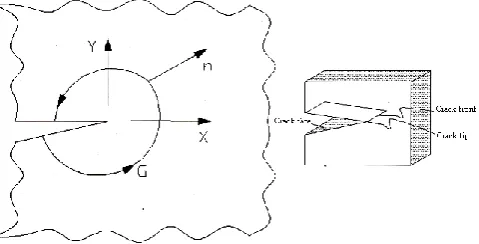
J-Integral: Path independent line integral that measures the strength of the singular stresses and strains near the crack tip. G=integral path; N=crack direction; x, y=coordinates.
Figure 2: J-integral,Crack tip and Crack face
Spur Gear Crack Propagation Path Analysis
Using Finite Element Method
Ananda Kumar Eriki, Member, IAENG, Ravichandra R, Member, IAENG and Mohd.Edilan Mustaffa
[image:1.595.307.547.641.763.2]Energy release rate is the amount of work associated with a crack opening or closure. The evaluation of the stress field around the crack tip to show that, for pure opening mode and in the limit of linear elastic fracture mechanics, the vanishing small fields fracture zone is surrounded by a linear elastic material with stress and strain fields uniquely determined, for any type of loading, geometry or structure size, by the stress intensity factor KI,. It flows that a critical value KIC must exist so that when the actual KI, is lower, no crack growth can take place. This reasoning may be extended to other fracture mode to obtain fracture criteria. Hence, for pure shear mode and tear mode, critical stress intensity factors KIIC, KIIIC may be defined such that the crack growth may occur when the critical value are reached. But these parameters give only information for pure mode loadings, and do not allow following the cracking process, which in general involve change from pure to mixed modes. For mixed modes, the straight approaches consist that fracture may initiate the value of KI, KII, KIII a critical condition.
II.MODELED IN SOLIDWORKS
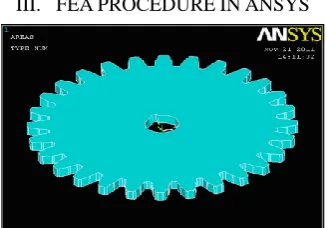
[image:2.595.306.549.577.727.2]The basic spur gear tooth geometry data was input to a tooth coordinate generation. The output was tooth coordinate data, which defines a single tooth sector or a gear. From that single tooth sector coordinate, the complete gear model was generated.
Figure 3: Isometric spur gear model using SolidWorks
The gear design parameters are: Number of teeth=28; Diametric pitch=201mm; Pitch radius=44mm; Pressure angle=20deg. The tooth load was placed at the highest point of single tooth contact (HPSTC), normal to the surface. Although the tooth load changes in magnitude and direction in actual gear operations, a static analysis with the load at the HPSTC has given accurate results with respect to crack propagation analysis. The gear inner diameter was fixed to ground for boundary conditions.
III. FEAPROCEDUREINANSYS
Figure 4: Finite element model for rim compliance effect on crack propagation;8diametral pitch, 28teeth,445mm pitch radius200, pressure angle, mb=0.9 with standard fillet
A.Pre-Processing
Ansys helps to build a complete finite element mode, including physical and material properties, loads and boundary conditions, and analysis the various behaviors of mechanical components and structure. Preprocessing comprises of building, meshing and loading the model created.
B.Meshing
Ansys offers a complete set of tools for automatic mesh generation including mapped meshing and free meshing can access geometric information in the form of point, curves and surface. With all parts of model defined, nodes, elements, restraints and loads, the analysis part of the model is ready to begin. The system can determine approximate value of stress, deflections, temperatures, pressures and vibrations nodes.
An analysis requires Nodal point, Elements connecting the nodal points, Material and physical properties, Boundary conditions which consist of loads and constraint, Analysis option: how the problem will evaluated.
After creation of solid modeling the model has converted to FEM model, i.e. generating of nodes and elements: Set element attributes, Set mesh control, Generate the mesh.
Before generating the mesh, definition of appropriate element attributes needed. The element attributes include Element type, Real constants, Material properties, Element coordinate system.
C.Element Types
Plane82-8 Node structural solid-a higher order version of the two dimensional, four-node element (plane 42) It provides more accurate results for mixed (quadrilateral triangular) automatic meshes and can tolerate irregular shapes without as much loss of accuracy. The 8node elements have compatible displacement shapes and are well suited to model curved boundaries. The 8-node element is defined by eight nodes having two degrees of freedom at each node, translations in the nodal x and y directions. The area of the element must the positive. The element must lie in global X-Y plane in plane 82 and Y-axis must be the axis of symmetry for axis symmetric analysis.
Figure 5: Element shape Nodes: I,J,K,L,M,N,OP
Degrees of freedom: UX, UY
[image:2.595.87.251.632.746.2]restrictions in terms of element shapes in case of mapped mesh it is not so. When using free mesh type element shape is allowed to take only triangular shapes for 2D and tetrahedral for 3D, for mapped mesh it is allowed to take quadrilateral and triangular for 2D and hexahedral for 3D. According to element size selection accuracy of results has varied.
D.Gear Mesh
[image:3.595.306.546.168.445.2]After the specifications of element attributes, and meshing Control, the mesh has been generated automatically by picking the areas, which is going to mesh. In a crack model structure, near the crack tip node “delete and fill” meshing method is used. In the “delete and fill” meshing method six node triangular elements are used.
Figure 6: Spur gear meshed model Element attributes:
Element name-PLANE 82; Element shape-2D six node triangular and 2D eight node quadrilateral elements; Nodes-I,J,K,L,M,N,O,P; Degree of freedom-UX, UY; Material property-EX=2e11; Poison’s ratio-NUXY-0.3.
E.Crack modeling
A crack can be represented in a boundary element model using two main approaches. The traditional approach requires the user to define a zone boundary along the crack surfaces and continue this through the body of the components being studied.
Figure7: Boundary element modes of edge crack
Where the problem is split into two zones and the edge crack is extended by a zone interface (dotted line) across to another external boundary.
Figure 8: Dual boundary element representations of crack
The second approach recently developed is to use dual boundary elements to represent the crack, the model of the edge crack using this approach. In this case the modeling is extremely simple and economical. The crack is represented by two elements occupying the same physical location, each element representing of face of the crack. The max
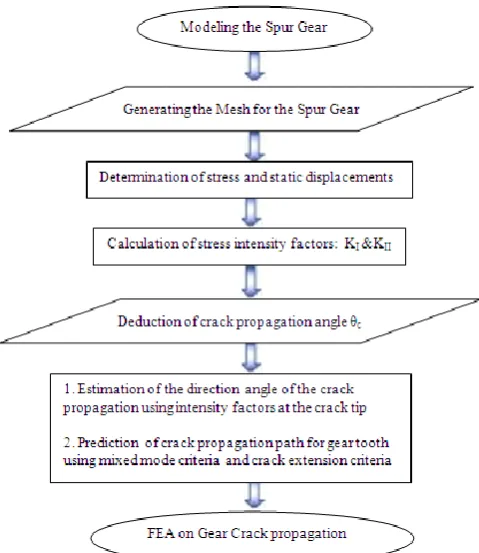
F.Methodology
Figure 9: Flow chart of crack propagation path prediction
G.Crack direction angle
Stress intensity factor values are KI,=22.5900 and KII,=2.6802, finding crack direction angle calculation
[
c]
/2
22.590/
4 2.6802
[1
1 8
22.590/2.6802
]] / 8 1 1 [ 4 ( / 2 /
2 2
c c
Tan Tan
0 50 . 44
380 . 52 2 /
c c
Tan
[image:3.595.49.270.231.380.2]
[image:3.595.76.267.670.766.2]Nomenclature
KI, KII & KIII Stress intensity factors
x, y Co-ordinates G Integral path N Crack direction a Crack length r Crack tip distance I, J, K, M, N, O, P Nodes
UX, UY Degrees of freedom EX Young’s modulus NUXY Poisson’s ratio
c
Crack dirction angleH.Crack-Extension criterion
The maximum principal stress criterion states that the growth of the crack will occur in a direction perpendicular to the maximum principal stress. Thus, the local crack growth direction is determined by the condition that the local shear stress is zero.
I. Incremental crack extension analysis
[image:4.595.330.522.313.433.2] [image:4.595.61.280.411.552.2]The incremental crack extension analysis assumes a piece wise linear discrimination of the unknown crack path. For each increment of the crack extension, the dual boundary element method is applied to carry out a stress analysis of the cracked structure and the J-integral is the technique used for the evaluation of the stress intensity factor.
Figure 11: Predicted crack propogation path in a spurgear The steps of this basic computational cycle, repeatedly executed for any number of crack extension increments are:
a) Carry out the stress analysis of structure, b) Compute the stress intensity factors,
c) Compute the direction of the crack extension increment
d) Extend the crack one increment along the direction e) Repeat all the above steps sequentially until a
specified number of crack extension increments are reached
In practice this requirement gives a unique direction irrespective of the length of the crack extension increment. Therefore the procedure adopted in this system is to use a predictor corrector technique to ensure the crack path is unique and independent of the crack extension increment used.
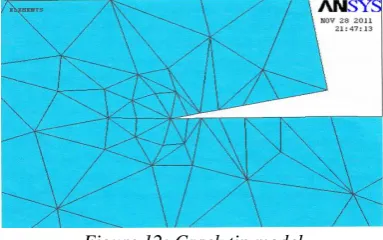
[image:4.595.308.535.663.760.2]IV. SIMULATIONOFCRACKGROWTH It provides a powerful productivity tool to evaluating the behavior of existing cracks. The boundary element method offers several advantages in crack growth simulation because high stress gradients at the crack tip can be accurately modeled and continues re-meshing required, to simulating the crack growth.
Figure 12: Crack tip model
A. Crack Propagation Computational Procedure
First define an initial crack by identifying the node of the crack mouth and coordinates of crack tip. The element in the surrounding area of the crack tip, insert a 6node triangular elements around the crack tip. Then fill the remaining area between the rosette and original mesh with conventional 8node quadrilateral elements. Mode I & Mode II stress intensity factor, KI & KII respectively can be calculated. The
stress intensity factor was determined from the finite element nodal displacements and forces using J-integral method. Mode I loading refer to loads applied normal to the crack plane, which tends to open the crack. Mode II refers to in plane shear loading. The stress intensity factors quantify the state of stress in the region near the crack tip. The stress intensity factors can also be used to predict the crack propagation angles used the mixed mode criteria.
After the initial crack is inserted in a mesh, the incremental crack extension analysis is used to simulate the crack propagation and calculate stress intensity factors, crack propagation angle. Then the places of new crack tip at the calculated angle and define crack incremental length. The model is re-meshed using the delete and fill. The procedure is repeated a number of times.
Figure 14: Vonmesis stress
In order to mixed mode crack growth an incremental type analysis is used where knowledge of both the direction and size of the crack increment extension is necessary. The crack growth algorithm incorporated in the calculation of direction angle for the crack extension. For each increment of crack extension, a stress analysis is performed using boundary element method and stress intensity factors are evaluated.
[image:5.595.324.538.254.412.2]The main objective of this paper is to predict the gear service life in fatigue, in the presence of an intial crack in the tooth foot. The FEM has been used to simulate the crack propagation based LEFM, and in the correlation displacement method to determine the relation between intensity factor and length of the crack.
Figure 15: Displacement Distribution
The incremental direction along the crack front for next extension is determined by calculated stress intensity factors. The crack front is re-meshed and the next stress analysis is carried out.
Figure 16: Failure Displacement with Crack
B.Computational cycle used to simulate crack growth
The tasks for the analysis:
a) Compute crack initiation location,
b) Compute the boundary element method of cracked structure,
c) Perform stress analysis of model
d) Compute stress intensity factors and crack growth direction
e) Compute the direction or angle or crack extension f) Construct incremental crack surface
The crack propagation path was predicted for spur gear using mixed mode criteria and crack extension criteria. Gear crack propagation path analysis will be carried out for a variety of gear tooth geometry at various crack initiation locations.
Figure 17: Failure stress with Crack
C.Abbreviations:
Mode I (KI): Opening or tensile mode, where the crack
surface move directly a part.
Mode II (KII): Sliding or in-plane shear mode, where the
crack surfaces slide over one another in a direction perpendicular to the leading edge of the crack
Mode III (KIII): Tensile mode or Anti-plane shear mode,
[image:5.595.311.539.505.682.2]wher the crack surfaces move relative to one another parallel to the leading edge of the crack.
Figure 18: Stress intensity factors and crack propagation
[image:5.595.74.261.644.776.2]V.CONCLUSION
As concluded that, spur gear crack propagation path was predicted using mixed mode criteria and crack extension criteria. Finite element spur gear model and crack model was developed, Crack propagation direction angle was calculated using intensity factors at the crack tip, Crack propagation path was predicted for gear tooth using mixed mode criteria and crack extension criteria, Finite element analysis has been carried out for gear crack propagation, Gear crack propagation path analysis will be carried out for a variety of gear tooth geometry at various crack initiation locations. The effects of gear tooth thickness, crack initiation locations and gear tooth geometry factors will be considered. Design charts for fracture mechanics will be formed considering the effects of gear geometry, applied crack size and material property.
This paper focused on deterministic mechanic modeling of subsurface crack propagation. For the life prediction of spur gear under realistic service conditions, a probabilistic approach considering variabilities in loading spectra, material properties and structural details is required and need further study. Also, other effects influencing the root and internal diameter are failure, such as manufacturing process parameters, residual stress and barake thermal loading need to be investigated in the future
REFERENCES
[1] Z. Chen, Y. Shao, “Dynamic simulation of spur gear with tooth
crack propagating along tooth width and crack depth”, Engineering
Failure Analysis 18 (2011) 2149-2164.
[2] S.Zouari, M. Maatar, “Following spur gear propagation in the tooth
foot by FEM” (2010) 10: 531-539.
[3] Fakher. Charri, Tahar F, Mohamed Haddar, “Analytical modeling of
spur gear tooth crack and influence on gearmesh stiffness”.
European Journal of Mechanics a/Solids 28 (2009) 461-468. [4] Wu S, Zuo KJ, Parey A. “Simulation of spur gear dynamics and
estimation of fault growth”. J Sound Vib (2008);317:608-24
[5] A. Belsak, Joze Flasker, “Detecting cracks in the tooth root of
gears”. Engineering Failure Analysis 14 (2007) 1466-1475.
[6] Y Liu, L. Liming, S. Mahadevan, “Analysis of subsurface crack propagation under rolling contact loading in railroad wheel using FEM” Engineering Fracture Mechanics 74 (2007) 2659-2674. [7] C. James Li, Hyungdae Lee, “Gear fatigue crack prognosis using
embedded model, gear dynamic model and fracture mechanics”,
Mechanical systems and signal processing 19 (2005) 836-846. [8] David G. Lewicki, “Gear crack propagation path studies-Guidelines
for Ultra-safe design” U.S Army Research Laboratory, Glenn