Abstract—.This paper presents a novel approach to the use of a genetic algorithm to evolve a three dimensional lookup table which acts as a robotic controller to balance a
beam. The lookup table translates three ball
position, ball speed and beam position, into the mot and direction required to maintain the ball in balance. population comprising these lookup tables
applying a genetic algorithm using tournament selection, two point crossover and a mutation rate of two percent different ranges of motor speeds within the
successfully evolved, each capable of maintaining the ball in balance for over five minutes.
Index Terms—Evolvable robotics, evolution of lookup table lookup table based robotic controllers,
controller, genetic algorithms
I. INTRODUCTION This paper investigates the use of a
(GA) to evolve a ball and beam controller by evolving a population of lookup tables (LUT) used to control the beam. The system developed for this paper (Fig
parts: i) the graphical user interface (GUI
the motion of the ball and beam with control and d logging capabilities, ii) the GA, which evolves a populati of LUTs, iii) the simulation, which models the characteristics of the ball-beam system and iv
which provides the new beam motor speed and depending on the current ball-beam state.
LUT config Fitness
Genetic Algorithm
Simulation
control
GUI Control &
Data logger
Fig 1. Block representation and connections between the four units were implemented on a computer.
Manuscript received July 19, 2011; revised August
Mark Beckerleg is with the School of Engineering, AUT University, New Zealand. phone: +64-9-9219999, fax: +64
John Collins is with the School of Engineering, AUT University, New Zealand. (e-mail [email protected])
Evolving a Three Dimensional Looku
Controller for a
approach to the use three dimensional lookup to balance a ball on a translates three ball-beam states, ball to the motor speed maintain the ball in balance. A lookup tables was evolved by using tournament selection, two-ssover and a mutation rate of two percent. Four
within the lookup table were of maintaining the ball in
robotics, evolution of lookup table, , ball and beam
This paper investigates the use of a genetic algorithm beam controller by evolving a used to control the beam. Fig 1) consists of four GUI), which displays the motion of the ball and beam with control and data which evolves a population which models the beam system and iv) the LUT, speed and direction
Look Up Table Simulation
o
u
tp
u
t
in
p
u
t
Block representation and connections between the four units that
August 12, 2011.
Mark Beckerleg is with the School of Engineering, AUT University, 9219999, fax: +64-9-9219973 (e-mail
John Collins is with the School of Engineering, AUT University, New
Typically a straight beam is used for a ball and beam apparatus, as it simplifies the control system algorithms that are required to balance the ball. However in this paper the beam is curved as this provides a more complex simulation model and algorithm and also means that the ball will never reach a static stable state with the motor
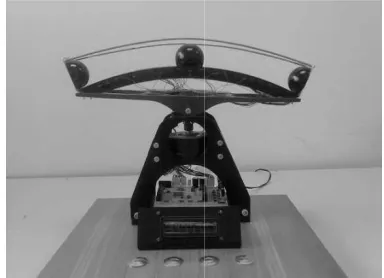
The simulation was modeled around a ball and system that was developed at AUT University for a student project (Fig 2). The physical beam was curved an
infrared detectors that could determine the position of the ball, and a stepper motor that could alter the angle of the beam. The angular velocity of the beam
the number of pulses fed into the The maximum angular velocity wa
maximum pulse rate that the stepper motor could respond to. This was 125 pulses per second
of 0.22 degrees per pulse gave a of the beam as 27.5 degrees per second.
Fig 2. The physical beam that the simulat on.
This paper is organized as follows. In section two background information about the ball and beam and use of LUT in evolutionary computation
Section three describes the mathematical model of the beam. In section four, the GA
reproduction and selection schemes
five, the simulation derivation and implementation detailed. Section six contains
process and section seven contains conclusions.
II. BACK G
Historically the ball and beam has been used as a standard laboratory apparatus to demonstrate control systems. It has also been used as a benchmark for res in control systems owing to its non
behaviour. Several different control systems such as
olving a Three Dimensional Looku
Controller for a Curved Ball and Beam System
Mark. Beckerleg, John. Collins
Typically a straight beam is used for a ball and beam the control system algorithms that are required to balance the ball. However in this paper the beam is curved as this provides a more complex simulation model and algorithm and also means that the ball will never reach a static stable state with the motor stopped.
ation was modeled around a ball and beam that was developed at AUT University for a student The physical beam was curved and had 19 infrared detectors that could determine the position of the and a stepper motor that could alter the angle of the The angular velocity of the beam was controlled by d into the stepper motor per second. m angular velocity was determined by the stepper motor could respond This was 125 pulses per second. The angular movement a maximum angular velocity per second.
that the simulated ball and beam was modeled
This paper is organized as follows. In section two, information about the ball and beam and the use of LUT in evolutionary computation is provided. the mathematical model of the the GA with its associated reproduction and selection schemes is explained. In section the simulation derivation and implementation is contains the results of the evolution contains the summary and
GROUND
beam has been used as a standard laboratory apparatus to demonstrate control systems. It has also been used as a benchmark for research to its non-linear dynamics and . Several different control systems such as
[image:1.595.328.520.406.545.2]proportional integral differential (PID) control [1, 2], fuzzy logic [3, 4], and neural networks [5, 6] have been studied using the ball and beam. The application of a GA to evolve ball and beam controllers has also been investigated. In particular a GA has been used in robotic controllers to evolve the rules and classes of a fuzzy logic controller [7, 8], the weightings and connectivity of artificial neural networks [9, 10], and the coefficients of a PID controller [11, 12]. However to the author’s knowledge the use of a LUT for the beam controller evolved by a GA has not been investigated.
LUT’s have been used in evolutionary computation in a variety of applications, although not as a robotic controller. Robotic simulations have been replaced by a LUT, reducing the amount of computation required when running the simulation and thus the evolution time [13, 14]. Researchers have evolved cellular automata by performing a GA on a LUT that held the cellular automata rules, to create two and three dimensional shapes [15]. Robotic controllers have been evolved with a LUT that was encoded with simulated DNA sequences in order to create robotic motion that drew motifs [16]. Research has also been performed on evolving the LUT found within a FPGA’s functional elements using custom software to avoid destructive configurations [17].
The use of a GA to evolve a robotic controller based on a LUT has been performed by the authors on two robotic systems including a mobile inverted pendulum [18] and the gait of a hexapod robot [19].
III. MATHEMATICAL MODEL
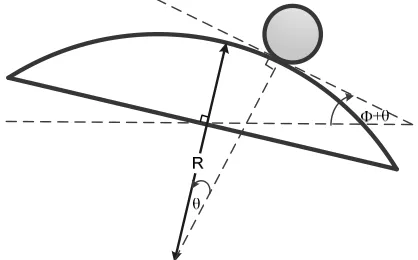
In the model of the beam (Fig 3), the beam position is measured as an angle φ from horizontal, and the ball position is measured as an angle θ from the centre of the beam. The full derivation for the mathematical model has previously been described by the authors [20]. The final equations for the ball acceleration are given in equations (1) and (2).
Fig 3. The ball and beam showing the relationships between the angles and motion.
(1)
(2)
Where
g - gravitational acceleration I – moment of inertia of the ball R - radius of curvature of the beam m - mass of the ball
r - radius of the ball
θ - ball position (angle from the centre) Ø - beam position (angle from horizontal) x – ball position
v – ball velocity b – beam position
a - acceleration of the ball
From physical experimentation on the beam, the value for acceleration (a) of the ball was determined as a factor of the ball position (x) and beam position (b) in equation (3).
Placing this into the mechanical modeling we can determine the new position of the ball, depending on its current position, velocity and acceleration in equation (4), and the new speed of the ball dependant on its current speed and acceleration in equation (5). The simulation was set to a time period of 1 ms in equations (6) and (7).
12 2.8 (3)
(4)
(5)
!"
#.$%
&!' (6)
#.$%
!" (7)
IV. GENETIC ALGORITHM
Evolutionary computation is an optimization process that autonomously searches through a sequence of possible solutions to a problem to find a solution that will adequately solve the problem. It is modelled on Darwinian evolution, ‘survival of the fittest’, where a population of solutions is evolved. Each solution is evaluated and given a fitness, and the solutions with a higher fitness are retained and used to create new solutions. These solutions are often referred to as individuals or chromosomes, and can be in many forms depending on the problem to be solved. A group of solutions is called a population. There are several forms of evolutionary computation, one of which is the GA.
The GA is a repetitive process with three parts including a) reproduction, where the genetic operators crossover and mutation are used to generate new individuals from the surviving population of individuals, b) fitness evaluation, which determines how well each individual within the population performs, and c) selection, which is the process that determines which individuals within the population (based on their fitness) will survive to the next generation.
A. Chromosome
The chromosome that was used for the ball and beam controller was a three dimensional LUT. The LUT’s axial co-ordinates connected to the current ball-beam states of ball position (nineteen positions), beam position (ten positions) and ball speed (three positions). The parameter at each co-ordinate within the LUT was the desired motor speed and direction required to move the beam into a position that would maintain the balance of the ball (Fig 4).
speed and direction. The parameters within the LUT were eleven discrete values ranging from 0 to 250, in steps of 25 giving a maximum of eleven motor speeds. If less speeds were required, these numbers were then broken into ranges, i.e. for two motor speeds, values less than 128 the motor was reversed, while numbers greater than 128 the motor was forward.
B
a
ll
P
o
s
it
io
n
Fig 4. Three dimensional LUT showing 19 ball positions, 10 beam positions, 3 ball speeds.
The search space of a chromosome is the total number of combinations that the chromosome can have. The fitness landscape is the fitness level of each one of these chromosomes. In this study, the search space within the three dimensional LUT was dependant on the number of locations within the LUT, and the number of speeds that were employed at each location. The experiments were repeated with four ranges of motor speeds. These were two (left and right), three (left, stopped and right), five (two left, stopped and two right) and eleven speeds (five left, stopped and five right).
The total search space that the GA was required to search through was calculated using equation [8] and illustrated in Table I. It can be seen that the search space rapidly increased as the number of speeds increased. The exponent 570 was derived from the size of the LUT (19x10x3).
()*+, ./+) ./))0.1234 56 789 ./))0.:;! [8] TABLE I SEARCH SPACE WITHIN THE LUT DEPENDENT ON THE NUMBER OF
MOTOR SPEEDS.
Speeds Search Space
2 3.9 x 10171
3 9.1 x 10271
5 2.6 x 10398
11 3.9 x 10593
B. Reproduction and Selection
The aim of the reproduction and selection scheme is to provide a high selection pressure, i.e. to move rapidly up the fitness landscape whilst maintaining population diversity. This is dependent on both the selection scheme and the reproduction method employed.
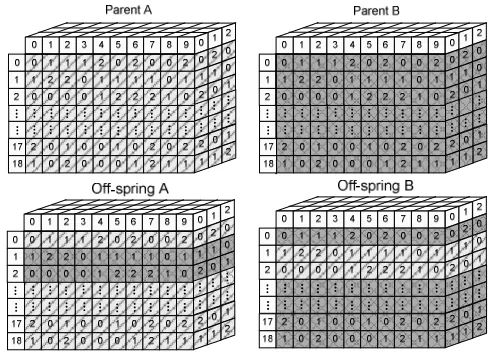
[image:3.595.311.555.53.230.2]The reproduction method used two point crossover with a mutation rate of 2%. Two point crossover selects two random points within both parent’s chromosomes and transposes the chromosome information at these points to create two new individuals. In this case the crossover points were selected only on the ball position axis (Fig 5).
Fig 5. Two point crossover cut along the ball position axis.
There are many selection schemes that can be used within a GA, such as roulette, rank based, or tournament, with each method having its advantages and disadvantages. The selection process used in this GA was tournament, where the population was divided into groups. One individual within that group was selected for reproduction, depending on its fitness compared to the others within that group. The larger the group size, the higher the selection pressure; however with a larger group size diversity could be quickly lost. In this GA, a group size of two individuals was used.
C. Fitness Criteria
The fitness was determined by how long the ball remained balanced on the beam before hitting either end-stop. At the start of each test, the beam was placed in the horizontal position and the ball was at rest. The simulation was then run until either the ball hit an end-stop or 60 seconds had passed. Each individual was tested seven times with the ball positioned at seven different locations on the beam, giving a total maximum fitness of 420 seconds.
V. SIMULATION
[image:3.595.96.239.150.251.2] [image:3.595.91.244.542.614.2]VI. GRAPHICAL USER INTERFACE
The GUI (Fig 6) provided simple control of the GA and allowed the maximum fitness, average fitness
of the simulation time to be recorded. The graphics of the beam could be physically turned on or off
motion of the ball and beam to be observed.
the graphics were enabled, the graphical drawing of the and beam on the display severely slowed computer program, therefore this feature disabled.
Fig 6. The graphical user interface
VII. RESULTS
Initial experiments used a two dimensional LUT used only the beam and ball positions. It was found that this information alone was not enough to provide a successful evolution. The LUT was modified to provide for a third parameter incorporating speed.
Two ranges of experiments were performed with two maximum stepper motor pulse rates. The first used 125 pulses per second which equated to a maximum beam angular velocity of 22.7 degrees per second.
speed of the actual beam motor and was at
which the beam could control the ball. The second was 250 pulses per second which equated to a maximum beam angular velocity of 45.4 degrees per second.
experiment, four ranges of motor speeds and eleven speeds) were evaluated.
The first experiments used eleven start positions between ±18 degrees from the top of the beam.
level for these experiments never reached the maximum fitness. Under investigation it was found that
not fast enough to prevent those ball extremes from hitting an end-stop. The
changed to seven ball start positions lying between ±12 degrees from the top of the beam, with
tested seven times at each start position. occurred when the ball was balanced for 60 a maximum fitness of 420 seconds.
NTERFACE
provided simple control of the GA and fitness, and duration . The graphics of the be physically turned on or off allowing the to be observed. However when graphical drawing of the ball and beam on the display severely slowed down the this feature was usually
Initial experiments used a two dimensional LUT which only the beam and ball positions. It was found that this information alone was not enough to provide a successful o provide for a third ranges of experiments were performed with two pulse rates. The first used 125 to a maximum beam angular velocity of 22.7 degrees per second. This is the speed of the actual beam motor and was at the limit at The second was 250 to a maximum beam angular velocity of 45.4 degrees per second. For each speeds (two, three, five The first experiments used eleven start positions lying between ±18 degrees from the top of the beam. The fitness never reached the maximum fitness. Under investigation it was found that the motor was balls starting at the The experiment was lying between ±12 of the beam, with each individual . A successful run 60 seconds; giving
A. Evolved motion of the ball.
The graphs presented in figures 7 to relationship between the fitness of the best individ the population and the number of generations ranges of motor speeds.
Fig 7. Two motor speeds, maximum angular velocity
Fig 8. Three motor speeds, maximum angular velocity of 22.7
Fig 9. Five motor speeds, maximum angular velocity of 22.7
Fig 10. Eleven motor speeds, maximum angular velocity of 22.7 second
Evolved motion of the ball.
in figures 7 to 10 show the relationship between the fitness of the best individual within the population and the number of generations for the four
angular velocity of 22.70 per second
angular velocity of 22.70 per second
maximum angular velocity of 22.70 per second
The graphs show a step function in the fitness level as the evolution had to independently evolve seven start positions. It can be seen that the experiments with two motor speeds evolved to successful solutions in less generations and time than the other speeds.
The motion of the ball and beam was observed various stages of the evolutionary process
graphical display. In the first stage, the ball would roll towards the beam end-stops with little reaction from the beam itself. In the next stage the beam would
ball movement, reversing the motion of the the ball would then roll to the opposite end
following stage in the process, the beam moved oscillating pattern, causing the ball to stay balanced in between two points. However after five to ten seconds ball would break free and gather too much
beam to prevent the ball from hitting an end stop. final stage of evolution, the beam was able to keep the ball trapped between two points for the full 60 seconds.
This characteristic oscillation of the beam was seen in all motor speed ranges. With only two speeds
in rapid oscillations to keep the ball steady. H larger number of speeds, the beam would
pace. Eventually the beam evolved to keep the ball motionless, with the use of an oscillation
seven start positions.
It can be seen from the graphs that there are two main plateaus in the fitness level near 320 and 360 seconds. These plateaus can be explained by the two start positions at the furthest point from the center of the beam. These most difficult points bring the ball to a stable oscillating condition, as the ball tends to gather a high speed and is difficult to capture. This plateau was more noticeable in the five and eleven motor speeds.
For the five and eleven motor speed range
not be balanced in the middle of the beam. Instead it would be gently moved to either end of the beam
centered around that point. This trait can be explained by the placement of the ball sensors on the beam.
beam was designed, the ball sensors were
with the sensors placed closer together at the ends of the beam and further apart in the middle of the be
because it was thought that determining the ball
and speed was more critical near the beam ends. Unintentionally however, this gave the evolved controller the best location of the ball and its speed
the beam. Subsequently the evolved controller used the end locations to balance the ball. This characteristic was not seen with the two and three motor speeds experiments.
Because a simulation was used, when with the ball motionless in the center of t the evolved solution kept the motor off, perfectly balanced for the duration of the test. the two speeds as the motor could not be stopped move the ball to a stable position.
B. Evolved chromosome
An investigation of successfully evolved
and the corresponding sequence of beam and ball motions showed different patterns for each evolved chromosome. This is because there were multiple ways of successfully ep function in the fitness level as the evolution had to independently evolve seven start positions. It can be seen that the experiments with two motor speeds evolved to successful solutions in less generations and time the ball and beam was observed in the evolutionary process using the the ball would roll with little reaction from the beam would react to the the motion of the ball; however end-stop. During the the beam moved in an causing the ball to stay balanced in after five to ten seconds the and gather too much speed for the beam to prevent the ball from hitting an end stop. In the the beam was able to keep the ball
ull 60 seconds.
This characteristic oscillation of the beam was seen in all With only two speeds, the beam moved lations to keep the ball steady. However with a ould move at a slower . Eventually the beam evolved to keep the ball oscillation pattern for all It can be seen from the graphs that there are two main plateaus in the fitness level near 320 and 360 seconds. can be explained by the two start positions at the furthest point from the center of the beam. These are the points bring the ball to a stable oscillating tends to gather a high speed and is plateau was more noticeable in the eleven motor speed range, the ball would of the beam. Instead it would either end of the beam, and kept This trait can be explained by the placement of the ball sensors on the beam. When the the ball sensors were unevenly spaced closer together at the ends of the and further apart in the middle of the beam. This was it was thought that determining the ball’s position and speed was more critical near the beam ends. his gave the evolved controller the best location of the ball and its speed near either end of equently the evolved controller used the end This characteristic was not
experiments. when a test was started in the center of the upright beam, the evolved solution kept the motor off, so the ball stayed perfectly balanced for the duration of the test. In the case of the two speeds as the motor could not be stopped, it would
evolved chromosomes corresponding sequence of beam and ball motions showed different patterns for each evolved chromosome. This is because there were multiple ways of successfully
balancing a ball. A successful evol part of the parameters in the LUT values of beam and ball position to a position on the beam, and beam point kept it in place.
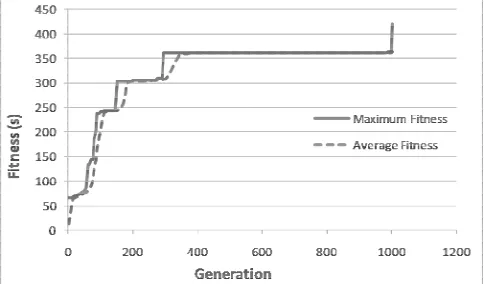
A comparison of the maximum and average fitness ( 11) shows the maximum fitness increased
average fitness converging when reached a plateau. At each plateau i the population had the same fitness, the
had been lost. However an investigation of chromosome revealed that this was not the case. backed by observation of the beam and ball motion a plateau points. The evolution produced
although no individual chromosome had found a solution that would balance the ball when started in either, or both its first and last start position. Eventually this
found and the evolution was completed.
Fig 11. Comparison between the maximum and average fitness, with eleven motor speeds and a maximum angular velocity of 22.7
C. Comparison of two maximum motor speeds
Several hundred experiments were performed on both maximum motor pulse rates and speed ranges. Table II provides a comparison of these results showing the
fitness, number of generations and time progress at the end of the evolution.
be seen that the faster motor and minimum number of motor speeds had the best results in terms of
generations and the time taken to come to a successful evolution. It was noted that the time taken for the five and eleven motor speeds to successfully evolve
acceptable despite the much larger
due to the constrained motion of the beam and the path that the ball took, with only a limited part of the chromosome being used for the beam control.
TABLE II COMPARISON OF THE AVERAGE FITNESS GENERATIONS AND THE AVERAGE TIME TAKEN T
Generation Av fitness Time (s) Generation
118 347726 197
268 364240 592
398 357240 3624
861 359427 25794
22.7 degrees/second
successful evolution did not use a large part of the parameters in the LUT, especially at the extreme values of beam and ball positions. The ball simply tracked beam oscillations around that maximum and average fitness (Fig s the maximum fitness increased in steps with the when the maximum fitness ch plateau it was thought that as all the population had the same fitness, the population diversity an investigation of each chromosome revealed that this was not the case. This was backed by observation of the beam and ball motion at the produced multiple solutions, although no individual chromosome had found a solution that would balance the ball when started in either, or both its Eventually this solution was e evolution was completed.
. Comparison between the maximum and average fitness, with eleven motor speeds and a maximum angular velocity of 22.70/sec
Comparison of two maximum motor speeds
experiments were performed on both or pulse rates and speed ranges. Table II se results showing the average number of generations and time the evolution was in progress at the end of the evolution. From this table it can be seen that the faster motor and minimum number of motor speeds had the best results in terms of the number of time taken to come to a successful that the time taken for the five and to successfully evolve was also larger search space. This was motion of the beam and the path that the ball took, with only a limited part of the chromosome being used for the beam control.
THE AVERAGE FITNESS, AVERAGE NUMBER OF AVERAGE TIME TAKEN TO EVOLVE
Generation Av fitness Time (s)
42 268456 35
56 327891 76
98 351811 297
103 349563 467
[image:5.595.305.547.281.423.2]A comparison of the four motor speeds within each maximum motor pulse rate is shown in fig
Fig 12. Four motor speeds with maximum beam angular velocity of per second
Fig 13. Four motor speeds with maximum beam angular velocity of per second
From these graphs it can be seen that doubling the motor pulse rate had a significant improvement
the system to evolve, especially at the five and eleven speed range. The fitness plateau at 320 and 360 seconds can clearly be seen. All the solutions had difficulty with either one or both of the extreme starting points.
VIII. CONCLUSION
It has been demonstrated that a robotic controller ball and beam system based on a three dimensional lookup table can be evolved. While both motor pulse rate
motor speed ranges were capable of being evolved to keep a ball balanced more than five minutes, the best evolutionary performance was achieved using a limited number of motor speeds and a higher motor pulse rate.
REFERENCES
[1] C. Ka and L. Nan, "A ball balancing demonstration of optimal and disturbance-accomodating control,"
Magazine, IEEE, vol. 7, pp. 54-57, 1987.
[2] F. G.-E. F.Gordillo, R.Ortega, and J.Aracil, "On the ball and beam problem: regulation with gu
performance and tracking periodic orbits," presented at the Proc of the International Symposium on Mathematical Theory of Networks and Systems, University of Notre Dame, IN, USA, 2002.
[3] E. P. Dadios, R. Baylon, R. De Guzman, A. Floren Lee, and Z. Zulueta, "Vision guided ball
system using fuzzy logic," in Industrial Electronics Society, 2000. IECON 2000. 26th Annual Confjerence of the IEEE
2000, pp. 1973-1978 vol.3.
A comparison of the four motor speeds within each maximum motor pulse rate is shown in figures 11 and 12.
maximum beam angular velocity of 22.70
beam angular velocity of 45.40
From these graphs it can be seen that doubling the motor improvement on the ability of the system to evolve, especially at the five and eleven speed range. The fitness plateau at 320 and 360 seconds can solutions had difficulty with either
It has been demonstrated that a robotic controller for a based on a three dimensional lookup both motor pulse rates and all motor speed ranges were capable of being evolved to keep a , the best evolutionary performance was achieved using a limited number of motor
C. Ka and L. Nan, "A ball balancing demonstration of optimal accomodating control," Control Systems
E. F.Gordillo, R.Ortega, and J.Aracil, "On the ball and beam problem: regulation with guaranteed transient performance and tracking periodic orbits," presented at the Proc of the International Symposium on Mathematical Theory of Networks and Systems, University of Notre Dame, IN, USA,
E. P. Dadios, R. Baylon, R. De Guzman, A. Florentino, R. M. Lee, and Z. Zulueta, "Vision guided ball-beam balancing
Industrial Electronics Society,
2000. IECON 2000. 26th Annual Confjerence of the IEEE,
[4] J. Iqbal, M. A. Khan, S. Tarar, M. Khan,
"Implementing ball balancing beam using digital image processing and fuzzy logic," in
Engineering, 2005. Canadian Conference on
2244.
[5] K. C. Ng and M. M. Trivedi, "Neural integrated fuzzy controll (NiF-T) and real-time implementation of a ball balancing beam (BBB)," in Robotics and Automation, 1996. Proceedings., 1996 IEEE International Conference on
[6] P. H. Eaton, D. V. Prokhorov, and D. C. Wunsch, II, "Neurocontroller alternatives for ;fuzzy; ball
with nonuniform nonlinear friction,"
Transactions on, vol. 11, pp. 423
[7] A. G. B. Tettamanzi, "An evoluti controller synthesis and optimization," in
Cybernetics, 1995. Intelligent Systems for the 21st Century., IEEE International Conference on
[8] K. Sung Hoe, P. Chongkug, and F. Harashima,
organized fuzzy controller for wheeled mobile robot using an evolutionary algorithm,"
Transactions on, vol. 48, pp. 467
[9] R. Bianco and S. Nolfi, Evolving the Neural Controller for a Robotic Arm Able to Grasp Objects on the Basis of Tactile Sensors, 2829 ed., 2003.
[10] K.-J. Kim and S.-B. Cho, "Dynamic selection of evolved neural controllers for higher behaviors of mobile robot," in
Computational Intelligence in Robotics and Automation, 2001. Proceedings 2001 IEEE International Symposium on
467-472.
[11] Z. Yi and Y. Xiuxia, "Design for beam controller based on chaos genetic algorithm," in
Acquisition, 2004. Proceedings. International Conference on
2004, pp. 448-451.
[12] G. K. M. Pedersen and M. V. Butz, "Evolving robust controller parameters using covariance matrix adaptation," presented at the Proceedings of the 12th annual conference on Genetic and evolutionary computation, Portland, Oregon, USA, 2010. [13] H. H. Lund and J. Hallam, "Evolving sufficient robot
controllers," in Evolutionary Computation, 1997., IEEE International Conference on
[14] H. H. Lund, "Co-evolving Control and Morphology with LEGO Robots.," in Proceedings of Workshop on Morp
Machines, 2001.
[15] A. Chavoya and Y. Duthen, "Using a genetic algorithm to evolve cellular automata for 2D/3D computational development," presented at the Proceedings of the 8th annual conference on Genetic and evolutionary computation, Sea Washington, USA, 2006.
[16] G. Greenfield, "Evolved Look
Controlled Robots," presented at the Proceedings of the 7th International Conference on Simulated Evolution and Learning, Melbourne, Australia, 2008.
[17] Y. Z. Renato A. Krohling, and Andy M. Tyrrell, "Evolving FPGA-based robot controllers using an evolutionary algorithm," 2002.
[18] M. Beckerleg and J. Collins, "An Analysis of the Chromosome Generated by a Genetic Algorithm Used to Create a Controller for a Mobile Inverted Pendulum,"
Intelligence, vol. 76, 2007.
[19] J. Currie, M. Beckerleg, and J. Collins, "Software Evolution Of A Hexapod Robot Walking Gait," in
Machine Vision in Practice, 2008. M2VIP 2008. 15th International Conference on
[20] M. Beckerleg and J. Collins, "Evolving Electronic Circuits for Robotic Control.," presented at the 15th International Conference on Mechatronics and Machine Vision in Practice, Auckland, New Zealand, 2008.
J. Iqbal, M. A. Khan, S. Tarar, M. Khan, and Z. Sabahat, "Implementing ball balancing beam using digital image processing and fuzzy logic," in Electrical and Computer
Engineering, 2005. Canadian Conference on, 2005, pp.
2241-K. C. Ng and M. M. Trivedi, "Neural integrated fuzzy controller time implementation of a ball balancing beam
Robotics and Automation, 1996. Proceedings., 1996
IEEE International Conference on, 1996, pp. 1590-1595 vol.2.
P. H. Eaton, D. V. Prokhorov, and D. C. Wunsch, II, "Neurocontroller alternatives for ;fuzzy; ball-and-beam systems with nonuniform nonlinear friction," Neural Networks, IEEE
vol. 11, pp. 423-435, 2000.
A. G. B. Tettamanzi, "An evolutionary algorithm for fuzzy controller synthesis and optimization," in Systems, Man and Cybernetics, 1995. Intelligent Systems for the 21st Century.,
IEEE International Conference on, 1995, pp. 4021-4026 vol.5.
K. Sung Hoe, P. Chongkug, and F. Harashima, "A self-organized fuzzy controller for wheeled mobile robot using an evolutionary algorithm," Industrial Electronics, IEEE
vol. 48, pp. 467-474, 2001.
Evolving the Neural Controller for a asp Objects on the Basis of Tactile
B. Cho, "Dynamic selection of evolved neural controllers for higher behaviors of mobile robot," in
Computational Intelligence in Robotics and Automation, 2001.
001 IEEE International Symposium on, 2001, pp.
Z. Yi and Y. Xiuxia, "Design for beam-balanced system controller based on chaos genetic algorithm," in Information
Acquisition, 2004. Proceedings. International Conference on,
G. K. M. Pedersen and M. V. Butz, "Evolving robust controller parameters using covariance matrix adaptation," presented at the Proceedings of the 12th annual conference on Genetic and evolutionary computation, Portland, Oregon, USA, 2010.
und and J. Hallam, "Evolving sufficient robot
Evolutionary Computation, 1997., IEEE
International Conference on, 1997, pp. 495-499.
evolving Control and Morphology with LEGO
Proceedings of Workshop on Morpho-functional
A. Chavoya and Y. Duthen, "Using a genetic algorithm to evolve cellular automata for 2D/3D computational development," presented at the Proceedings of the 8th annual conference on Genetic and evolutionary computation, Seattle,
G. Greenfield, "Evolved Look-Up Tables for Simulated DNA Controlled Robots," presented at the Proceedings of the 7th International Conference on Simulated Evolution and Learning,
to A. Krohling, and Andy M. Tyrrell, "Evolving based robot controllers using an evolutionary algorithm,"
M. Beckerleg and J. Collins, "An Analysis of the Chromosome Generated by a Genetic Algorithm Used to Create a Controller nverted Pendulum," Studies in Computational
J. Currie, M. Beckerleg, and J. Collins, "Software Evolution Of A Hexapod Robot Walking Gait," in Mechatronics and Machine Vision in Practice, 2008. M2VIP 2008. 15th
l Conference on, 2008, pp. 305-310.