AN IMPLEMENTABLE SEMANTICS FOR COMPARATIVE
CONSTRUCTIONS 1
Manny Rayner and Amelie Banks 2
Swedish Institute of Compu~ter Science
Box 1263
S-164 28 KISTA
Sweden
We describe a comprehensive treatment of the syntax and semantics of comparative constructions based on theoretical work by Pinkham, which can be implemented in a relatively straightforward fashion within a feature-based phrase-structure grammar. Comparatives are divided up into "clausal" and "phrasal" constructions; in contrast to most previous theories, however, phrasals are not regarded as reduced forms of clausals. We begin by defining a Montagovian semantics for phrasal comparatives that directly links interpretation rules to the surface syntactic structure; we 1then show how this solution can be made computationally more efficient by "factoring" the interpretation through an intermediate level of representa- tion, using a method similar to that used for dealing with scoping phenomena. Detailed examples are provided, showing how the method can correctly describe the semantics of a variety of superficially widely different comparative constructions. The ideas have all been implemented within a large-scale grammar for Swedish, a " t o y " version of which is presented, along with examples of the output.
1 INTRODUCTION
1.1 OVERVIEW
This paper is written with two different, though to some extent overlapping, audiences in mind. On the practical side, we address ourselves to the natural language interface constructor, who wants to expand the coverge of her system so as to incorporate comparative constructions; the state of the art has now progressed to the point where it is generally acknowledged that this 4s a problem that a serious system must attempt to deal with. In the following, we will thus attempt to describe our ideas in a sufficiently concrete fashion that they can be used as an implementation guide. Typical examples of comparatives according to the tradi- tional classification are the following:
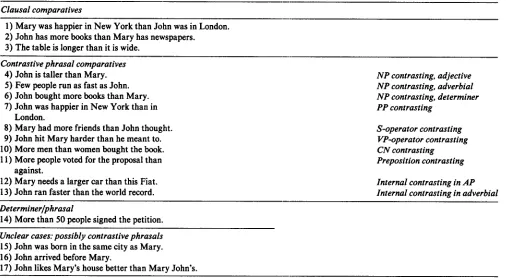
Clausal comparatives
1) Mary was happier in New York than John was in London.
2) John has more books than Mary has newspapers. 3) The table is longer than it is wide.
Comparative ellipsis
4) John is taller than Mary. 5) Few people run as fast as John. 6) John bought more books than Mary.
7) John was happier in New York than in London. 8) Mary had more friends than John thought. 9) John hit Mary harder than he meant to.
10) ]More men than women bought the book. 11) ]More people voted for the proposal than against. 12) John likes Mary's house better than Mary John's.
Unclear cases
13) More than 50 people signed the petition. 14) Mary needs a larger car than this Fiat. 15) .John ran faster than the world record. 16) John was born in the same city as Mary. 17) John arrived before Mary.
On tile theoretical side, we want to re-examine some funda- menta]L questions about the nature of the comparative construction, and in particular about the phenomenon gen- erally referred to as "comparative ellipsis"; by this, we mean comparative constructions like those listed above in which the element after the comparative marker is not a clause, and which traditionally have been explained in terms of various kinds of deletion rules. Here, we will argue that, in most common cases, it is by no means necessary to postulate syntactic deletion operations. We will claim, rather, that it is possible (and indeed simpler) to assign a syntactic representation to such constructions that closely follows the apparent surface constituent structure. We will then slhow how to define semantic interpretation rules for such s~ructures, which at no level reconstruct a representa- tion ,of' a syntactic clause, but rather operate on the princi- ple of directly comparing constituents of similar type. To highli~,ht the difference between our approach and the
Mammy Rayner and Amelie Banks An lmplementable Semantics for Comparative Constructions
traditional one, we will refer to constructions handled by this method as examples, not of comparative ellipsis, but rather of contrastive comparison.
Our opinion is that the issues we are raising are probably applicable to most grammatical frameworks subsumed un- der the feature-based phrase structure grammar paradigm; this includes established formalisms like LFG, GPSG, HPSG, P A T R - I I etc., and a vast number of more or less obscure formalisms in use around the world. At risk of offending everybody and pleasing nobody, we will make no particular attempt to align ourselves with any one of these theories; in Section 1.2, we will describe in general terms the properties we will expect a framework to possess, if it is to be capable of supporting the type of operations we will need. Basically, we will demand distinct levels of represen- tation for constituent structure, function-argument struc- ture, and logical form, related in the normal way; we will also require certain constructions to be treated as syntactic constituents. Most of this will be quite uncontroversial.
To clear the decks before moving into action, we now spend a couple of paragraphs making clear which questions we are not attempting to answer. We regard the lexical semantics of comparatives as being outside the scope of the paper; we are only interested in determining how the phrasal semantics can be derived from them. We explain exactly what we mean by this statement in Section 1.2. We will ignore complex comparative operators ("more than twice as much as"; " a t least two inches longer than three times as long as"); these are well dealt with in Ballard (1988), and in any case do not seem to pose fundamental difficulties. For similar reasons, we refrain from discussing determiners with phrasal comparatives, like "more than two" or " a t least half": here, the most comprehensive reference is perhaps Keenan and Stavi (1986). We also ignore certain idiosyncratic constructions ("as fast as ever"; "as much as usual"), which do not seem to fit any pattern known to us.
In our treatment of clausal comparatives, we will present two slightly different variants of a solution. The first is simple to implement, and appears capable of giving correct semantics to most normal examples; however, it fails to give both readings for the notorious Russell example, " I thought your yacht was longer than it is." The second solution, on the other hand, is capable of dealing with this kind of sentence, but needs a number of additional scoping rules. We say more about this in Section 4.
With regard to cross-linguistic coverage, we will restrict ourselves to English, Swedish, and a few other languages in which the comparative construction is syntactically similar in nature; this actually appears to include most European languages. Although we suspect that our results are proba- bly applicable to at least some languages outside this group, 3 we shall not make any further attempt to lend credibility to this claim.
The organization of the rest of the paper is as follows. In Section 2 we review previous work: in particular, we point out what we regard as the main weaknesses of the deletion method, and summarize earlier attempts to describe phrasal
comparatives by direct interpretation methods. The next two sections contain the main results of the paper.
In Section 3, we examine contrastive phrasal compara- tives. We begin by defining a Montagovian semantics for these, and then show how this can be improved by "factoring" it through an intermediate level of representa- tion, in which the "contrasting" relationship between phrases is left undefined. We then go on to show how this methodology can be used to provide a readily implement- ablesemantics for a wide variety of contrastive construc- tions, which also gives a simple explanation of the ambigu- ity of certain comparative sentences. Section 4 then goes on to describe our treatment of clausal comparatives, which is largely adapted from the work reported in Klein (1980) and Pinkham (1985).
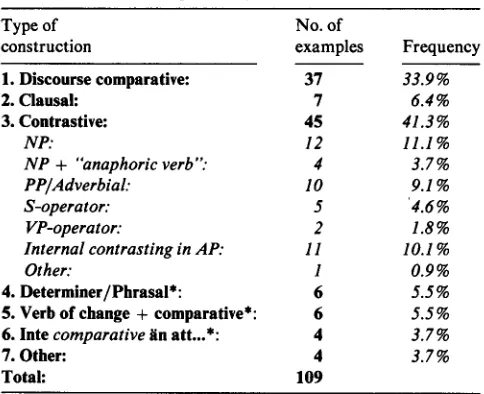
In Section 5 we briefly discuss noncoreference of com- pared objects; we also look at sentences containing the words "before" and "after," pointing out some differences between these and comparative sentences. A corpus analy- sis, which gives some indication of the relative frequencies of the various constructions, is presented in Section 6. In Section 7 we summarize our results.
The theoretical ideas advocated here were first developed and tested in practice within the framework of the S N A C K - 85 project (Rayner and Banks 1986; 1989). In Appendix 2 we give the complete program code for a "scaled-down" version of the system, which handles all the constructions described in the main body of the paper, and in Appendix 3 we show examples of the system's output.
1.2 THEORETICAL ASSUMPTIONS
1.2.1 GENERAL REMARKS ON THE THEORETICAL
FRAMEWORK
In this section, we attempt to summarize the theoretical assumptions needed to support our arguments. The main body of the paper is Section 3, which deals with phrasal comparatives: here we present our theory in two separate forms.
Version one is a Montague grammar, modified slightly to allow use of generalized quantifiers. This has the advantage of theoretical elegance, but as we shall see is computation- ally unattractive. We consequently recast it in a form more suitable for implementation purposes, which draws its inspi- ration from the well-known treatment of scoping phenom- ena originally described in Woods et al. (1972); later elaborations and refinements have been implemented in a number of systems, notably C H A T - 8 0 (Pereira 1983), T E A M (Grosz et al. 1986), and C L E (Moran 1988; Alshawi et al. 1989). We will continue to use this framework in Section 4, where we consider clausal comparatives, and now describe it in more detail.
Manny Rayner and Amelie Banks An Implementable Semantics for Comparative Constructions
Syntax. At this level, the structure of the sentence is represented as a phrase structure tree, where each node is associated with a set of features. We will make two assump- tions about the feature structure. First, we distinguish a special feature, which encodes the quasi-logical form of a constituent; not all nodes need possess this feature. Second, there will be some mechanism that permits the definition of long-range dependencies, by allowing features in different constituents to share information.
Quasi-logical form (QLF). This level encodes the predi- cate-argument structure of the phrase; the only demand we will make is that, like any other feature value, its value can be derived entirely by phrase structure rules with feature unification. (This is in spirit similar to a compositionality restriction, but is weaker.)
Logical form (LF). At this level, the sentence is associ- ated with an expression in a (generally higher-order) predi- cate calculus; the logical form of a sentence will be deriv- able from its quasi-logical form by application of rewriting rules representing scoping and other transformations. Since there is little agreement concerning the representation of logical forms, we now say a few words about the less usual features of our system.
First, we will find it convenient to treat events as objects, since this can often greatly simplify the semantics of adver- bial modification. For example, we will represent Gustav III ruled for 21 years as something like
3 e. event_type(e, rule)dlagent(e, cyastav_iii)/i dtu ation(e, 21 )
W e will also m a k e extcnsive usc of gcneralized quantifiers (Barwise and Cooper 1981 ); these will play a kcy role in our represcntation of comparatives. W e will not, however, usc Barwise and Cooper's notation, which involves combining a determiner and a set-descriptor to form a quantifier, but rather will take the equivalent approach of treating deter- miners as two-place higher-order predicates on sets. W e will use {N l~b(N)} for the determiner " A number N such that qb(N)": thus we write
no(rose, hx.send(john, x,mary))
for "John sent no roses to Mary,"
{N I N<SKroso,M~.send(john,x, mary))
for "John sent less than 5 roses to Mary," and
INI 3 N'.N<N'&{N']
(rose, Xx.rose(x)ddn(x,garden))} (rose,hx.send(iohn,x, mary))
for "John sent fewer roses to M a r y than there were roses in the garden." Formulas like the third one above will occur frequently in Section 3, and we advise the reader to spend a minute at this point making sure that she understands the notation.
1.2.2 SPECIFIC SYNTACTIC AND SEMANTIC ASSUMPTIONS
The basic scheme, or some not too distant relative, is the one used in many large-scale implemented systems; as
examples, we can quote T E A M (Grosz et al. 1987), P U N - D I T (Dahl et al. 1987), T A C I T U S (Hobbs et al. 1988), M O D L (McCord 1987), C L E (Alshawi et al. 1989), and S N A C K - 8 5 (Rayner and Banks 1986). It also has close links with theoretical work in situation semantics (Pollard and Sag 1988; Fenstad et al. 1987). We start by enumerat- ing tlhe basic syntactic constituents S, NP, VP, DET, AP, ADVF', PP; as far as our ontological commitments go, we need a set of THINGS, a set of EVENTS, and a set of DEGREES. We will assume that DEGREES are isomorphic to some kind of numbers.
An N P will consist of a D E T and a C N (we borrow this nonstandard term for N - b a r from Montague grammar). A DET will semantically correspond to a generalized deter- miner, and a C N to a subset of THINGS. An N P will thus become a generalized quantifier.
A VP consists of a VERB, followed by a list of VERB- A R G s (or just ARGs), by which we mean its obligatory and optional complements. An A R G is represented at Q L F level as a pair (arg-type, arg-value). We will need at least the following kinds of complements: NP, PP, S - C O M P (a suitab]~e S), V P - C O M P (a suitable VP), APs. Semanti- cally, a verb will be associated with a subset of EVENTS, which we can think of as a type of event, state, or situation. The V A L U E of each A R G will also be semantically repre- sented by a suitable object, and the A R G - T Y P E will translate to a relation between the verb-object and the representation of the A R G - V A L U E . We will require a special kind of Q L F node, called an abstraction, to repre- sent VPs, APs, and other constituents whose denotation is a function from individuals to propositions; one component of the abstraction node will be the abstracted variable.
A scalar adjective A translates to a two-place predicate A'(x, d) on OBJECTS × DEGREES, with the interpretation: the object x is A' to degree d. Similarly, a scalar adverb A translates to a two-place predicate A'(x, d) on EVENTS X DEGREES, with the interpretation: the event x is A' to degree d. We will assume that degree expressions like "more," "less,'" or " a t least twice as much as much as" translate to two-place predicates on DEGREES × DEGREES. Since we are assuming that DEGREES are numbers, it will also make sense to use a generalized quantifier as the second argu- men't to an adjective: for example, A(x, {N
IN <2})
will be interpreted as " x is (less than 2) A."We will also need to be able to form "slash categories" or something similar. In particular, the following will be required (in each example the " g a p " is represented as an underscore):
S / D E T (e.g. "John bought _ vases") S / N P (e.g. "John gave _ to M a r y " )
S / S - C O M P (e.g. "John probably believed _ ") S / V P - C O M P (e.g. "John presumably meant to _ ")
A rnore exact formulation of the basic question we are attacking is thus:
In terms of the above framework, state rules by which we can systematically calculate the denotation of a complex expression involving a comparative construction in terms of
Mammy Rayner and Amelie Banks An Implementable Semantics for Comparative Constructions
the denotation of its scalar adjectives and adverbs, the denotations o f its degree expressions, and the denotations of its other constituents.
2 PREVIOUS WORK ON COMPARATIVES
This section will summarize relevant previous work on comparatives; we begin by listing sources. So far, there has been a surprisingly small amount of work done in computa- tional frameworks: the only major attempts known to us that integrate syntactic and semantic processing are those reported in Ballard (1988) and Friedmann (1989). Limited syntactic/semantic coverage has appeared in some other systems (e.g. D I A L O G I C [Robinson 1982] and C L E [Alshawi et al. 1989]), and the Linguistic String Project (Sager 1981) has an advanced syntactic coverage.
On the theoretical front, we have been considerably influenced by Bresnan (1973), Hankamer (1973), Pinkham (1985), and Klein (1980), especially the last three; we were also surprised to discover at a late stage of our research that unpublished work by Heim (1985) and Krifka (1987) had pursued a course almost parallel to our own. We now go on to describe what we regard as relationships between these treatments and ours.
We will start by looking at clausal comparatives, where the immediate problem is clearly to account for the appar- ent "missing material" in the comparative clause. An early and still very influential study of comparative constructions is that of Bresnan (1972; 1973; 1977), working within trans- formational grammar; the key concept is the introduction of the rule of Comparative Subdeletion, which will for example derive sentences like la) and 2a) by deleting the bracketed material from the base forms 1 b) and 2b).
1 a) John bought more books than Mary bought.
1 b) John bought more books than Mary bought [x many books].
2a) John bought more books than Mary bought records. 2b) John bought more books than Mary bought [x many]
records.
Although Comparative Subdeletion explains many of the facts, it makes a number of erroneous predictions. A very long and thorough criticism was advanced in Pinkham (1985), where reasons are given to believe that it is prefera- ble to adopt an analysis that represents the "missing" material as (in English) null proforms; these are bound to the head of the comparison by a mechanism that Pinkham calls Quantifier Binding. Pinkham's view of the clausal comparative has many points in common with that pro- posed in Klein (1980), in the context o f a G P S G / M o n t a g u e grammar framework, although Klein only really considers sentences of the type in example 2); our own treatment will in this respect be similar to Pinkham's and Klein's.
Like Bresnan and Pinkham, but unlike Friedmann (1989), we will also regard the comparative clause as in general modifying the comparative head in the main clause, as opposed to treating the two clauses as parallel; we
discuss further in Section 4 the reasons behind this deci- sion.
Moving on to phrasal comparatives, there would appear to be two basic approaches. The earlier and more common one is to treat these as reduced forms of clausal compara- tives; for example, Hankamer (1971) introduces a rule of "C-ellipsis," which deletes material from the comparative clause under identity with material in the main clause. Thus for example, 3a) and 4a) would be regarded as reduced forms of 3b) and 4b), where the bracketed mate- rial has been deleted:
3a) John bought more books than Mary.
3b) John bought more books than Mary [bought x many books].
4a) John bought more books than Mary thought.
4b) John bought more books than Mary thought [that he bought x many books].
In a computational treatment, this means that the deletion rule has to be "reversed," so as to reconstruct the deleted material from the phrasal remnant: this is the method used in Sager (1981) and Friedmann (1989).
However, a number of researchers have showed that there are drawbacks to the "C-ellipsis" account. Although both Hankamer and Pinkham use C-ellipsis in their theo- ries, they also provide strong evidence for the existence of at least some comparatives that are not elliptic in nature (Hankamer 1973; Pinkham 1985). Three examples are shown in 5)-7), where Pinkham in each case argues that there are severe difficulties involved in deriving a sentence of this type from a clausal comparative; the natural choice in a transformational framework is to regard the italicized portions as base-generated phrasal.
5) I invited m o r e m e n than women. 6) John ran f a s t e r than the w o r l d record.
7) Mary looks taller than J o h n when she wears high heels.
Of particular interest here is Pinkham's treatment of exam- ples like 5), which are interpreted using a rule that she calls "distributive copying." 5) receives the logical form 5a), which after distributive copying becomes 5b). Although the details of the solution are not fully worked out (in particu- lar, the notation is never given a formal semantics), the intuitive idea is clearly that of duplicating a "shared" or "matrix" predicate, substituting in the two compared ele- ments in a suitable way.
5a) I INVITED (MORE [ql (ql men), q2 (q2 women)]) 5b) MORE [ql (I INVITED q l men), q2 (I INVITED q2
women)]
Mammy Ra~er and AmeHe ~ n k s An Implement~ble Semantics for Comparative Cons~ucfiomus
8a) More male than female students passed the exam. 8b) More male students than female students passed the
exam.
8c) More male students passed the exam than female students passed the exam.
We should also mention the work of M cCord (1981; 1985; 1987) on "focalizers"; the key notion we borrow is the use of rewriting rules on semantic representations, to produce a logical form in which contrasted items appear at the same level. Although McCord does not attempt, as we do, to justify his operations formally, the intuitions behind them
clearly overlap to a large extent with ours.
In our own treatment of phrasal comparatives, we take all these ideas to their logical conclusion: we dispense with the C-ellipsis rule altogether, and regard all nonclausal comparatives as essentially phrasal, interpreting them by a method analogous to Pinkham's distributive copying. The abstract scheme is concretely implemented in the form of rewriting rules, which are applied to an intermediate quasi- logical form. A solution along these lines, which builds on previously reported work (Banks 1986; Banks and Rayner 1987; Rayner and Banks 1988), is described in Section 3. As we complete this article, we discover that a similar approach for German comparatives has independently been suggested by Krifka (1987); Krifka also proceeds by using direct interpretation rules involving contrasting of com- pared constituents, although the details of his analysis are in some respects fairly different. The following is a typical example: 9a) is given the semantics represented by 9b), where pdO(d) is to be read as "the maximum d, for which O(d) holds," and KOMP(x, y, f) is defined by
KOMP(x, y, ~) ,~. <I,(x) > ~ y )
9a) Ich b a b e ihr b e s s e r e ZahNrtze I have him better d e n t i s t
e m p f o h l e n als du. r e c o m m e n d e d than you-NOM.
(I have r e c o m m e n d e d him a
better dentist than you [did]).
9b) KOMP(ich, du, hxpd[x hat ihr d-gute Zah~irtze empfohlen]).
3 PHRASAL COMPARATIVES
3.1 BASIC IDEAS
As we have already indicated, our strategy for handling phrasal comparatives will be to provide direct interpreta- tion rules, rather than to assume the existence of deletion rules and attempt to reconstruct a clausal comparative. In the preceding section, we referred to a number of authors who have pointed out weaknesses in the C-ellipsis theory; using their arguments and some of our own, we now describe our reasons for preferring our method to the traditional one.
Our fundamental argument will be Occam's razor: espe- cially from the implementation viewpoint, assuming that phrasals are derived from clausals has little real explana- tory power. Since the authors quoted above give good theoretical arguments to show that at least some phrasal compa:ratives are not the result of C-ellipsis, we are at any rate [going to have to provide direct interpretation rules for these cases. If it then turns out that these rules can be systematically extended so as to cover the other phrasal comparatives as well, we can dispense with C-ellipsis alto- gether and arrive at a simpler system. We claim that this is exactly what we have done.
It is worth looking a little more closely at the case in which the comparative complement is of the form than NP;
this is certainly the one that occurs most commonly in practice. The first point is well known, and was first de- scribed in detail in Hankamer (1971): in English (and in fact a good many other languages), it is possible to extract out of contrastive N P complements, but not from clausal comparative complements. For example, compare 10a) with 10b):
10a) ~Vho i does John run faster than tt? 10b) *:Who i does John run faster than t,. runs?
The relevance of this observation is obvious: if contrastive N P complements really are elliptic forms of clausal comple- ments, we would appear to need some mechanism by which something originally an extraction island could cease to be one when a reduction is performed. This would be a very unusual phenomenon, which it would certainly be prefera- ble to ~Lvoid introducing into a syntactic theory; rather than do this, it seems much simpler to treat the two construc- tions a:~ fundamentally different, as we have done.
Another fairly clear-cut piece of evidence can be found in Swedish, where a different possessive pronoun is used de- pending on whether the comparative is clausal or phrasal, as in 1 la) and 1 lb). Here, the point is that sin refers back to the ~ubject of the clause, while hans refers to a nonsub- ject N P in the same clause, or an N P in a different clause. Once :again, this would be strange if the comparative complement in 11 a) were a clausal remnant.
l la) Sven kSpte tier bScker ~in sin far. Sven bought more books than his father.
1 lb) Sven kSpte tier b~Scker ~in hans far gjorde.
Sven bought more books than his father did.
However, in practice the biggest problem seems to be that it is not easy to provide a satisfactory definition of the C- ellipsis deletion operation; to be more exact, we need to define the inverse of this operation, so as to reconstruct the comparative clause from the reduced form. A relatively simp][e example is 12a), which we quoted in Rayner and Banks (1988); the sentence is also discussed at length by Friedmann. Here, a naive definition of "deletion of identi- cal material" will result in reconstructing 12b); what we want is. rather 12c), which requires an N P to be regarded as "identicar' to a pronoun bound by it.
Manny Rayner and AmeHe Banks An lmplementable Semantics for Comparative Constructions
12a) Every tourist spent more in London than in New Y o r k .
12b) Every tourist spent more in London than every tourist spent in New York.
12c) Every tourist spent more in London than he spent in New York.
Friedmann's solution to the problem begins by reconstruct- ing a form like 12b), and then makes use of rewriting rules that "merge" the two occurrences of every tourist into a single quantifier that has wide scope over the whole sentence; the final result is essentially 12c). This idea is, however, open to several criticisms. To begin with, it has little linguistic motivation; more important, it is difficult to see how to extend it to handle harder cases without adding more ad hoc rules. For example, getting the normal ("sloppy") reading of 13a) by Friedmann-like analysis seems to involve transforming it to something like 13b), which rather begs the question of how to account for the different possessive pronouns in the two clauses. On a direct-interpretation account, however, the intended read- ing for sentences like 13a) can be derived in a natural way; we describe how this can be done in Section 3.4.6.
13a) Few men are as loyal to their country as George (is). 13b) Few are as loyal to their country as George is loyal to
his country.
The remainder of Section 3 will give a detailed description of our version of the direct-interpretation method. We start in Section 3.2 by showing how to construct a Montagovian semantics for a fragment containing phrasal constructions; the basic trick is to have a phrase structure rule that combines a syntactic structure with a pronoun-like "slot," a "filler" for the "slot," and an element of the same semantic type as the "filler," against which it is contrasted. This rule can then be linked in the normal way with a corresponding semantic rule, which defines the semantics of the composite structure in terms of the semantics of its constituents.
However, this has the same drawbacks as the original Montague treatment of scoping phenomena, namely that we are introducing phrase structure rules that lack syntac- tic motivation. Consequently, we introduce in Section 3.3 a computational version of the theory; here we perform inter- pretation in two stages, with the intermediate QLF level of structure interposed between phrase structure and logical form. At QLF level, comparative phrases are linked to the associated graded element, but not to the element they are compared against. A subsequent transformation of the Q L F structure introduces links between compared ele- ments, resulting in a form that can be converted into an LF. At the penultimate stage, we will have a higher-order four-place predicate, which takes the following arguments: the two contrasted elements, the way in which they are compared, and a parameterized "matrix" formula contain- ing two "slots," one for the degree, and one for the con- trasted element.
In Section 3.4 we give examples showing how our frame- work can be used to define the semantics of a variety of
phrasal comparative complements, and also touch briefly on the question of ambiguity in phrasal comparative eono structions. Finally, in Section 3.5 we say a few words about how the theoretical ideas presented above can be realized concretely within a unification-based grammar.
3.2 MONTAGOVIAN SEMANTICS FOR PHRASAL
COMPARATIVES
We now proceed to show how the intuitive picture sketched out in Section 3.1 can be expressed formally in terms of Montague grammar; the technical idea is essentially in- spired by the PTQ treatment of scoping phenomena 5 (Mon- tague 1972; Dowty et al. 1982, pp. 203-215). There are three slightly different variants of the method, one for constituents of type t (clauses), and two for constituents of type (e, t ) (VPs, APs). Since we are treating adverbials as properties of verb-objects, ADVPs will also fall into this second group.
For each variant, we have a rule-schema, parameterized by the syntactic type of the comparative complement; we call this constituent COMPLEMENT, and we also assume the existence of a "proform" that can stand for constituents of type COMPLEMENT. An example of such a proform will be written as c-proform i for some suitable i. We will also need a set of proforms to stand for determiners; we will write these as q-proform i. Finally, we will assume a syntactic class COMP-OPERATOR, which will include expressions like more, less, at least twice as much, and so on. The denotation of an expression in C O M P - O P E R A T O R will be a constant two-place relation between degrees.
We then add syntactic rules, to say that a constituent of type COMPLEMENT can be realized as c-proformi, and that its denotation is a variable e i of the appropriate type; similarly, a determiner can be realized as q-proformi, and its denotation will be a variable qi of the type associated with degree expressions. Since the semantic rules are all defined relative to a variable-substitution g, it naturally follows that the truth conditions for a phrase containing any of these proforms depends on the values assigned by g to the associated variables.
We are now in a position to define the syntactic rule- schema for composition of phrasal comparatives. We first take the simpler case, where the phrase is of clausal type; the input to the rule will be the following:
1) A phrase • of type S, containing occurrences of
c-proform i and q-proform i for some i and j. 2) Two phrases A ! and A 2 of type COMPLEMENT. 3) A phrase ~ of type COMP-OPERATOR.
and produces as output the phrase Comp(~, Al, A2, ,It) constructed by doing the following:
a) Replace c-proform i in • by the phrase A 1.
b) Replace q-proform| in ~ with the comparative operator xI,.
c) Concatenate than or as (depending on '~') + A 2 to the end.
d) Perform necessary morphological operations (e.g. change
Manny Rayner and Amelie Banks An lmplementable Semantics for Comparative Constructions
We let ~' be the denotation ofO, ~ ' the denotation o f ~ , etc. Since 4, contains instances of the pronouns e-proform i and q-proforml, 4,' will contain corresponding free variables el and q|. It will thus make sense to abstract over these: for convenience's sake, we will refer to Xei~,qjO' as ~". The associated semantic rule will then define the denotation of Comp(O, A l, A2, q ) to be the value of the expression
O"(AI', {N I ¢"(A2', {N' I ~"(N, N')})})
(*)
This formula is both central to the paper, and sufficiently obscure as to require some further explanation. To under- stand what it means in intuitive terms, we focus first on 4>". This can be viewed in the usual way as a predicate with two argument slots: the first filled by an object denoting a phrase of type COMPLEMENT, and the second by an object denoting a degree.
We now work "from the inside out." We thus begin with the subformula {N'[#'(N,N')}; remember that this is a generalized determiner (see Section 1.2). For example, if has t h e v a l u e m o r e , it will be t h e d e t e r m i n e r {N'I more(N,N') }, or to express this in more usual terms (less than N). Working outward to the next level, the subformula O"(A2', {N'[~"(N,N')}) is that formed by substituting the complement denotation A z' in the first argument place of 4," and the determiner denotation {N'[#'(N,N')} in the second. It is consequently a condition on N, which means that {N I ¢"(A~', {N'[ ~'(N,N')}) } is also a generalized determiner. The final formula is now constructed by once again substi- tuting suitable values into the argument slots for $", these now being A l' and {N [ ~"(A2',{N' [ g/(N,N') }) }.
To summarize: what we have described here is a rule- schema that allows us to construct what could be called a
comparative S, which contrasts two constituents of type
COMPLEMENT.
A small extension now gives us corresponding schemas for comparative constituents of type (e, t) (this includes VPs, APs, and relative clauses); it seems that there are actually two slightly different versions. The most obvious case is the one in which contrasting takes place, as previ- ously, between the comparative complement and some other constituent of similar type. Here, we can use the syntactic conditions for the rule above in unchanged form; since the type of ~' is (e, t) rather than t, the semantic part of the rule has to be rewritten slightly, as the old definition would no longer make the condition on N a truth-value. We solve this problem by substituting in a value x in ~" (reducing it to a truth-value), and later abstract x away again at the o u t e r m o s t level. T h e d e n o t a t i o n of Comp(~, Al, Az, ~ ) will then be
hx.O"(A{,{N I O"(A2',IN' I ~"(N, N')}, x)}, x) (**)
An important special case, which we will make use of in Sections 3.4.4 and 3.4.6, occurs when the comparative complement is an NP, and the "contrast" is between it and the entity referred to by the abstracted variable in 4>. Sentences 14)-16) illustrate this. In each, we claim that contrasting is occurring within the italicized portion.
14) A man taller than John was chosen for the team. 15) Most people don't expect to live as long as John (did).
16) People who travel to London as often as John usually have season tickets.
One way to deal with these constructions would be to make them all equivalent with the case represented by 16): for relative clauses, it is reasonable to maintain that contrast- ing is between the complement, and a "gap" linked to the relative pronoun. On this account, 14) and 15) are regarded as derived from something like 14a) and 15a).
14a) A man (who is) taller than John was chosen for the 'team.
15a) Most people don't expect (that they will) live as long as John.
Although this approach is certainly also feasible, it seems technically simpler to dispense with the null pronouns and instead use the following semantic analogue of the idea, essentially a type-raising trick. We let 4> be a constituent of type < e, t), containing an occurrence of q-proforml, • a C O M P - O P E R A T O R , and A z an N P ; we define
Compl (~, A z, ~ ) to be the phrase formed by substituting for q-proformi, and concatenating than/as A 2 to the end, and now want to define its denotation. We let e i be a parameter ranging over N P denotations, x be a parameter ranging over individuals, and A1' be the function XQ.Q(x); if we now define ~" to be the formula h c i h q i • e i ( ~ ' ) , the denotation of Compl(O, A z, ~ ) is given by yet another variant on our basic formula, namely
Xx.O"(A{,{N I O"(A2',IN' I ~I,'(N, N')})}) (***)
Readers who wish to see examples of derivations using the three :interpretation schemas defined above may now want to turn to Section 3.4; when they have returned, we will proceed to describe how our theoretical picture can be converted into one that is more readily implementable.
3.3 A COMPUTATIONAL VERSION
The analysis we have just presented gives a simple and compact formalization of our theory of phrasal compara- tives, but it is still not easily implementable as it stands. The reasons for this are exactly the same as those applying to the original PTQ treatment of scoping phenomena; essentially, the rules have insufficient syntactic motivation. However, the solution (as far as scoping goes) is by now standard, and has been successfully implemented in a number of well-known systems (e.g., Pereira 1983; Lesmo 1985; Grosz et al. 1986; Alshawi et al. 1989); the methodol- ogy can originally be traced back to Woods (1978). 6 The trick is to split interpretation into two stages, the first linked to the syntax and the second to the semantics; mediating between these, we have an intermediate level of representation, the quasi-logical form. This is produced compositionally from the syntax, and then subjected to rewriting rules before being converted into the final logical form. Normally, these rewriting rules formalize scoping transformations; here, we will also use them to describe the interpretation of nonclausal comparison. In Section 1.1, we
Mammy Rayner and
Amelie Banks An Implementable Semantics for Comparative Constructionssummarized briefly the basic properties we demanded of the Q L F level of formalism. We now describe those fea- tures that are specially concerned with comparative con- structions.
We start by defining the various kinds of nodes we will need in the QLF. These will be the following.
Node name Represents
c-complement
Comparative complement.c-operator
Comparative operator.c-degree
Comparative degree; includes the com-parative complement and compara- tive operator as subnodes.
q
Placeholder; the q-proform of the Mon-tagovian analysis.
c Placeholdcr; the c-proform of the Mon-
tagovian analysis.
comparison
Corresponds to Comp(&, A l, A 2, ~I,) andCompl(~, A z, ~ ) of the Montagovian analysis. The part of the tree under the node corresponds to cI,. The sub- nodes are: the "contrasted material" (An), the comparative complement (A2), the comparative operator (~'), and pointers to the relevant q and c nodes (qi, ci)
The fundamental idea should be fairly easy to grasp, if the reader has understood the previous section; the QLF is successively transformed through a number of stages, until it is in a form consonant with the Montagovian analysis of Section 3.2. We go through the stages in turn, illustrating each of them schematically; in Sections 3.4.1 and 3.4.2, we give examples of their application.
(Stage 0) In the original QLF, the comparative comple- ment and comparative operator turn up as
c-complement
and c-operator nodes, modifying the c-degree node repre- senting the comparative degree; the c-complement is not yet associated with the constituent it is contrasted against (see Figure 1).(Stage
1)
Rewriting rules replace the c-degree with a q placeholder, and save thec-complement, c-operator,
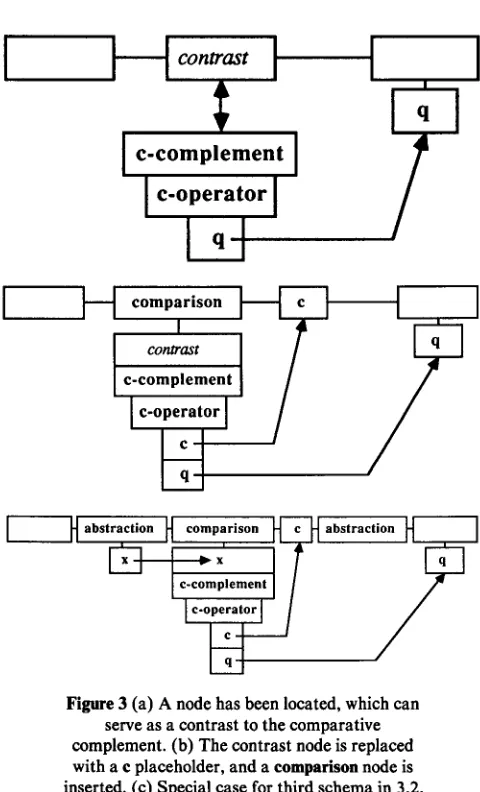
and associated q in a separate location; we call this the "compar- ative store," by analogy with Cooper's "quantifier store" (Figure 2; Cooper 1983; Engdahl 1985).(Stage 2) The contents of the "store" are moved upwards in the tree; at each higher node N, attempt to do one of i), ii) or iii). (The second and third alternatives are special cases) (Figure 3).
I c-degree I
[image:8.612.319.559.48.155.2][ c-operator I I c-complement [
Figure I Original QLF
I
H
I
I
c o m p a r a t i v e store
c-complement ]
c-operator
[
Figure 2An item is placed in the "store"
i) Find a suitable constituent below N to contrast the
c-complement
against. If such a constituent is found,replace it by a c placeholder, and insert a
comparison
node in the tree above N. Thecomparison
node is constructed from the following components: the c-com- plement, the contrasted constituent, thec-operator,
and the q and c placeholders.ii) (This is to deal with the third schema from Section 3.2) If N is an abstraction node (representing a constituent of type (e, t)), insert a c node above N, a
comparison
I - om 'emeot I
H
comparison
I
contra$t
c-complement
[ c-operator I
[
Habstracti°n H c°mparis°n ~abstracti°n ~
~ 1 I ~ x ~
[image:8.612.319.559.323.719.2] [image:8.612.62.306.636.733.2]Manny Rayner and Amelie Banks An Implementable Semantics for Comparative Constructions
node above the c, and a further abstraction node above that. The comparison node is constructed from the c-complement, c-operator, c and q; the "contrast" com- ponent is that corresponding to a pronoun with associ- ated variable x, where x is the abstracted variable in the new abstraction node.
iii) (See Section 3.4.3) I f N is a constituent of type t or (e, t), and e-complement is an S - O P E R A T O R , insert an s-operator node above N, and a comparison node above that; the body of the s-operator node will be a c placeholder. The comparison node has the same struc- ture as that in case i), except that the "contrasted material" slot contains the special value it-is-true-that.
(Stage 3) The tree is now in a form where the Montagovian analysis can be used directly; one of the formulas (*), (**), or (***) is applied to yield the logical form, the choice depending on which alternative was chosen in the preced- ing step. In the final stage, the portion of the Q L F under the comparison node is duplicated twice, and the q and c placeholders instantiated in each copy in an appropriate manner (see Figure 4).
3.4. APPLICATIONS OF THE THEORY
3.4.1 NP- AND PP-COMPARATIVES
Phrasal comparative constructions in which the compara- tive clause is an N P or PP appear to have fundamentally the same structure, and we shall consequently consider them under one heading. We will present a typical exam- ple, first using the Montagovian framework, and then reworking it in the computational one.
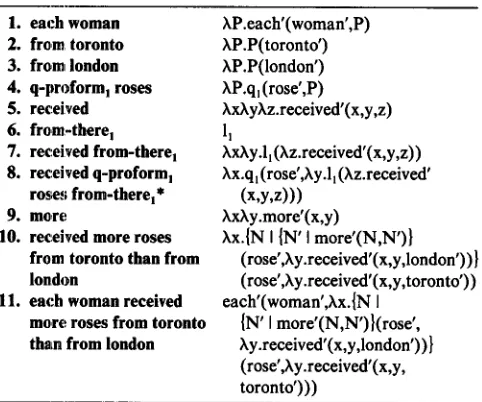
The following table represents a semantic derivation for the sentence each woman received more roses from toronto
than from london; we will analyze this as being composed of the subject each woman, and the comparative VP received more roses from toronto than from london. W e will use an instance of the second schema from 3.2, with COMPLEMENT equal to PP, and accordingly write c-proform i as from- there I. Received will be treated as a verb taking three argu- ments, with received'(x, y, z) interpreted as " x received y from z." For example, {16}(hr.rose'(r)& ted'(r), ~ r.received'
(amelie', r, toronto')) will correspond to amelie received 16
red roses from toronto, and (no'(rose', ~r.received'(amelie', r, graham')) will correspond to amelie received no roses from
graham. 7 (see Table 1).
H e°mpari'°n H s'°perat°r H
I
,tistr',ethat ?
I c-complement c-operator
W
Figure 4 Special case for 3.4.3.
Table 1. Montagovian Analysis of Contrasted PPs
1. each woman 2. from toronto
3. from london
4. q-l)roform I roses 5. received 6. from-there~
7. received from-therei 8. received q-proform I
roses from-there 1. 9. more
10. rec.eived more roses
from toronto than from
london
11. each woman received more roses from toronto than from london
XP.each'(woman',P) hP.P(toronto') hP.P(london') hP.ql(rose',P)
Xx~y~,z.received'(x,y,z) 11
Xx~y.ll (hz.received'(x,y,z)) ;~x.ql(rose',hy.1 l(hz.received'
(x,y,z)))
;~x~y.more'(x,y)
Xx.{N I {N' I more'(N,N')}
(rose'Ay.received'(x,y,london')) } (rose',;~y.received'(x,y,toronto')) each'(woman'Ax.{N I
{N' I more'(N,N')}(rose', hy.received'(x,y,london') ) } (rose',Xy.received'(x,y, toronto')))
*Remember that since q~ is a variable ranging over determiner denotations it takes two arguments, which should both be of the type (e,l~). Similarly, 1~ (an NP denotation) takes a single argument of the same type.
Figure 5 presents in outline the analysis of the same sentence: in the computational framework of Section 3.3, and should be compared with Figs. 1-4.
3.4.2 CN COMPARATIVES
Comparative constructions of the type illustrated in 17a) have been the object of considerable controversy. The orthodoJ~ position was that they were "parallel" construc- tions: 17a) would thus be a reduced form of 17b).
17a) More women than men read "Playgirl."
17b) M o r e women read " P l a y g i r l " t h a n men read "Playgirl."
Pinkham, as we have already mentioned, gives good rea- sons for supposing that this is not the ease, and that the construction is in base generated phrasal (pp. 121-123). We now show how her analysis can be recast in our framework: once again, we present our derivation first in terms of Montague g r a m m a r and then in the computa- tional version.
In Montague grammar, we instantiate the first schema from Section 3.2, this time with COMPLEMENT equal to CN; in the interests of readability we write c-proform t as of-that- kind i. The derivation appears in Table 2.
The corresponding treatment in the computational frame- work is another direct application of the method from Section 13.3, and appears in Figure 6.
3.4.3 "S-OPERATOR" AND "V-P-OPERATOR" COMPARATIVES
Our next type of construction is illustrated in 18a), 18b) and 18c).
18a) M a r y had more friends than John had expected.
[image:9.612.309.550.64.265.2] [image:9.612.49.288.593.724.2]Mmnmy Rayner and Amelie Bank~ An Implementable Semantics for Comparative Constructions
Tree-rewriting analysla of PP con~asting
I "each woman" ~ f r o m Toronto" ~
Original QLF
I
I
comp . vo
I
store L ~
comparative I"f~L°~, °n" l ~'
l
store
A suitable contrast is found for the comparative complement.
[image:10.612.227.553.50.481.2]"from Toronto" "from London"
Figure 5 Tree-rewriting analysis of PP-cxmtrasting
18b) Most people ate more biscuits than Mary said.
18e) John's yacht was longer than I thought.
To handle examples like these within our framework, we need a syntactic representation that does not involve ellip- sis. Our solution is to introduce a syntactic constituent that we call an S-OPERATOR: by this, we mean a constituent of the form S/S-COMP, that is to say, a clause with a
Table 2. Montagovian Analysis of CN Comparative
1. woman
2. mall
3. "Playgirl" 4. read "Playgirl" 5. q-proform~ of-that-
kind1
6. q-proforml of-that- kind ! read "Playgiri" 7. more women than men
read "Playgirl"
woman' man'
~,Q.Q(playgirl') kx.read(x,playgirl') ~,Q.q~(I~,Q)
ql(llAx.read(x,playgirl'))
{NI {N' I more'(N,N')} (man'Ax.read(x,playgirl'))} (woman',Xx.read
(x,playgirl'))
[(reads(x,y) is to be understood as "x habitually reads y")]
Tree-rewriting analysis of CN contrasting
Original QLF
comp tivol 17n
storeThe comparative complement and operator have been placed in the "store"
comparatiVestore I ~ "Playgirr'
A suitable contrast is found for the comparative complement.
[image:10.612.64.317.52.417.2]I "women" "ll~n"
Figure 6 Tree re-writing analysis of CN-~ntrasting
missing sentential complement. The italicized portions of the sentences above are accordingly deemed to be S- OPERATORs, and the contrast is with an implicit trivial S-OPERATOR that we can write as (it is true that). Note that there is an unbounded dependency here between the S and its missing constituent; we say a little more about this in Section 3.5.
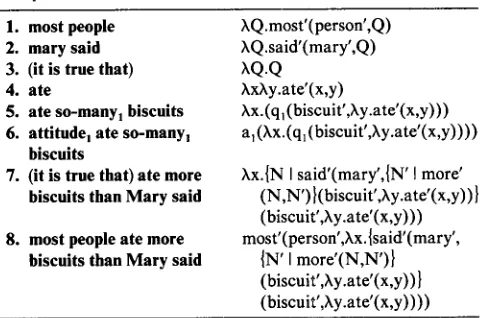
An example in the Montagovian framework is shown below; we use the second schema from Section 3.2, with COMPLEMENT instantiated to S-OPERATOR, and write
c-proform i as attitude l. There are in fact two tricky techni- cal points here, which we are forced by space limitations to gloss over.
[image:10.612.61.301.578.719.2]Manny Rayner and Amelie Banks An Implementable Semantics for Comparative Constructions
not discuss the matter further. Second, we allow applica- tion of the denotation of an S - O P E R A T O R to the denota- tion of a VP, which formally is of the wrong type. Here, our reasoning is that since an S - O P E R A T O R denotes a func- tion a from propositions to propositions, it will naturally induce a function a': Xx.P(x)---~ Xx.a(P(x)) from VP- denotations to VP-denotations; we will identify a and a' (see Table 3).
It is interesting to see that Krifka independently arrives at exactly the same conclusion; he writes our "it is true that" as the operator FAKT, and for example analyses 19a) below as 19b):
19a) Anna ist reicher als Otto glaubt. Anna is richer than Otto thinks.
19b) K O M P ( F A K T , O t t o glaubt,Xd.[Anna ist d-reich]
Analogously with the " S - O P E R A T O R " introduced above, we can also define a " V P - O P E R A T O R " to be a constituent of the syntactic category S / V P , i.e. something that can combine with a VP complement to yield an S; note that this includes subject NPs. We can then give a similar account for sentences like those illustrated in 20a) to c):
20a) M a r y opened more bottles than John told her to.
20b) Mary scored more points than I normally can.
20c) Mary needs to get a better result than she's so f a r managed.
We sketch a Montagovian derivation for the first of these: here we use the first schema from 3.2, this time with COMPLEMENT instantiated to V P - O P E R A T O R . Note that we give mary wide scope over the whole sentence, so as to get the pronoun bindings right (see Table 4).
Readers who wish to understand the implementation details for the computational version are referred to the relevant program code in Appendix 2. Parse-tree and logi- cal forms are given in example sentence 8 in Appendix 3.
3.4.4 CONTRASTING INSIDE ADJECTIVAL AND ADVERBIAL PHRASES
So far, all the examples of contrastive comparatives that we have shown have involved using one of our two schema to
Table 3. Montagovian Analysis of "S-OPERATOR" Comparative
1. most people 2. mary said 3. (it is true that) 4. ate
5. ate so-many I biscuits 6. attitude~ ate so-many~
biscuits
7. (it is true that) ate more biscuits than Mary said 8. most people ate more
biscuits than Mary said
XQ.most'(person',Q) XQ.said'(mary',Q) XQ.Q
XxXy.ate'(x,y)
hx.(ql (biscuit',Xy.ate'(x,y))) a~ (Xx.(q~ (biscuit',Xy.ate'(x,y))))
Xx.{N I said'(mary',{N' I more' (N,N')}(biscuit',Xy.ate'(x,y))} (biscuit',Xy.ate'(x,y))) most'(person',Xx.{said'(mary',
{N' I more'(N,N')} (biscuit',Xy.ate'(x,y)) } (biscuit',Xy.ate'(x,y))))
Table 4. Montagovian Analysis of "VP-OPERATOR" Comparative
1. nmry XQ.Q(mary')
2. h e~ XQ.Q(x~)
3. john told he I to kQ.told'(john',xl,Q(x0)
4. opened so-many I bottles kx.(q~(bottle',Xy.opened'(x,y))) 5. vp-ap I opened so-many I cl(Xx.(ql(bottle',Xy.opened'(x,y))))
bottles
6. he I opened more bottles {N I told'(john',xl,{N' I more'(N,N')} than john told he~ to (bottle',ky.opened'(Xl,y))))}
(bottle',ky.opened'(x~,y))
7. mary opened more hot- {N I told'(john',mary',{N' I more'
ties than john told her to (N,N')}(bottle',Xy.opened'
(mary,y))))} (bottle',Xy.opened' (mary,y))
construct a phrase that is either an S or a VP. In this sectior:, we will consider sentences where the contrasting operation is used internally within adverbial and adjectival phrases: Pinkham quotes constructions of this kind as some of the clearest instances of phrasal comparatives. We start in 21)--23) by giving some typical examples; 21) and 22) are taken from Pinkham (1985).
21) A man taller than John was chosen for the team. 22) He ran faster than the world record.
23) John needs a spanner bigger than the No. 4.
In each of these sentences, contrasting appears to occur within the italicized phrase; in 21), John need not have been chosen for the team, in 22) the world record certainly cannol run, and in 23) John presumably does not need the No. ,4. We would, however, derive all these conclusions if contrasting were at VP or clausal level, since we would then copy t]:e verb.
In accordance with Pinkham's suggestions, our approach will rather be to use a direct interpretation method based on predicate copying; we will in fact use the third schema from Section 3.2, defined by formula (***). This applies in a straightforward fashion to adjectival constructions like those i.n 21) and 23). Pinkham notes that a similar treat- ment is also possible for sentences like 22) if we take f a s t to be a predicate applying to the "running" event, although we imagine that some people m a y find this move unattrac- tive.
In 'Fable 5, we present a sketch of a Montagovian analysis for 21). Note that "Q tall" will be represented as Xx.tall(x, Q), where Q is a generalized determiner, and that formula (***) is used when deriving 5 from 3 and 4.
3.4.5 CONTRASTED PREPOSITIONS
The types of contrastive comparatives described in Sections 3.4.1 1:o 3.4.4 appear to account for the vast majority of those that occur in practice) There are also a few rare cases, one of which we here touch on briefly. As a final example, we consider the case of contrasted prepositions, as shown in 24) below. 9
24) There are more points for the proposal than against.
[image:11.612.313.556.71.230.2] [image:11.612.56.300.566.725.2]Manny Rayner and Amelie Banks An lmplementable Semantics for Comparative Constructions
Table 5. Montagovian Analysis of Contrasting in AP
2. player 3. john
4. q-proform I tall 5. taller than john
1. was chosen for the team was-chosen' player' XQ.Q(john') hx.tall'(x,ql)
hx.tall'(x,{D I tall'( john, {D' I more'(D,D')})}) 6. player taller than john hx.player'(x)&tall'(x,{D I tall'
( john,{O' l more'(D,D')})})
7. a player taller than john XQ.a'(hx.player'(x)&tall'(x,{D I tall' ( john,{D' I more'(D,D')})}),Q) 8. a player taller than john a'(Xx.playcr'(x)&tall'(x,{D I tall'
was chosen for the team ( john,{D' I more'(D,D')})}), was-chosen')
These can be treated in a completely straightforward man- ner in the computational version from Section 3.3; the key step will be the replacement of the A R G - T Y P E field of a suitable N P denotation with a C-placeholder. A Montagov- ian treatment of the construction is of course somewhat problematic with the framework we have so far adopted, since there is no sensible way to quantify over A R G - T Y P E of anything similar; some people may see in this fact an argument against Montagovian formalisms. (Parse-tree and logical form in example sentence 12 in Appendix 3).
3.4.6 AMBIGUITIES IN CONTRASTIVE CONSTRUCTIONS
It is well known that phrasal comparative constructions can easily give rise to ambiguities: sentences 25)-27) illustrate three typical possibilities. Here, we will discuss how our system fares when attempting to explain these.
25) Nobody talked more to John about Carol than Mary. 26) Few men give their wives more presents than George
(does).
27) John intends to buy more books than Mary.
We claim that most speakers find all these sentences ambig- uous, the first in three ways, and the others in two. The simplest case is 25), where we can paraphrase the various readings as 25a-c):
25a) Nobody talked more to John about Carol than Mary did.
(Mary talks a lot to John about Carol.)
25b) Nobody talked more to John than to Mary about Carol.
(John is less popular than Mary when people want to hold conversations about Carol.)
25c) Nobody talked more to John about Carol than they did about Mary.
(Everyone prefers discussing Carol to discussing Mary when they talk with John.)
In terms of the discussion from Section 3.4.1, ambiguity arises naturally as a result of the uncertainty concerning the identity of the element that " M a r y " is intended to be c o m p a r e d with. By successively choosing the N P s
"Nobody," "John," or "Carol," the reader can easily sat- isfy herself that each of the readings above can be derived. Sentence 26) also appears to be fairly clear: here, the distinction is essentially between the "strict" and "sloppy" readings, which can be represented as 26a) and 26b).
26a) Few men give their wives more presents than George gives them.
26b) Few men give their wives more presents than George gives his own wife.
On a Montagovian account, we will get 26a) if the pronoun
their is still unbound in the denotation of the VP give their wives q-proform I presents; if, on the other hand, it is bound to the variable representing the subject, we will get 26b).
The hardest case definitely seems to be sentence 27). Here we have at least two readings, which we represent as 27a) and 27b):
27a) John intends to buy more books than Mary will buy.
(John's plan is that, no matter how many books Mary has, he will buy more.)
27b) John intends to buy more books than Mary intends to buy.
(John and Mary both plan to buy specific numbers of books, that number being in John's case greater.)
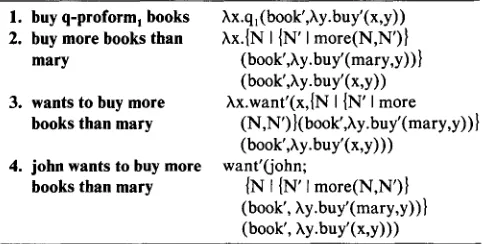
[image:12.612.60.300.65.211.2]We can obtain the first of these using formula (***) from Section 3.2, as can be seen from the schematic derivation in Table 6.
Unfortunately, there is no very satisfactory way to derive the wide scope reading 27b). The problem is that the comparative degree will end up in our account with lower scope than the modal operatorwants, irrespective of the level at which we carry out the contrasting operation; to derive 27b), however, it needs to have scope over the whole clause. Although one can define an ad hoc rule that raises the scope of the comparative quantifier, this goes very much against the spirit of our treatment; a slightly more attractive possibility may be to introduce alternative "wide- scope" versions of formulas (*), (**) and (***) from 3.2. For example, (*) would become
3 N,N'.4¢'(A~,{N}) & ~" (A2',{N'}) & ~'(N,N')
The problem is of course to find conditions defining when the wide-scope formulas are applicable. One idea might be
Table 6. "Narrow Scope" Interpretation of Sentence 27
1. buy q-proform I books 2. buy more books than
mary
3. wants to buy more books than mary 4. john wants to buy more
books than mary
~x.ql (book',~y.buy'(x,y)) ?,x.{N I {N' I more(N,N')} (book'),y.buy'(mary,y))} (book',Xy.buy'(x,y)) ~,x.want'(x,{N I {N' I more
(N,N')}(book',Xy.buy'(mary,y))} (book'),y.buy'(x,y)))
want'(john;
[image:12.612.316.557.604.726.2]Mammy Rayner and AmeHe Banks An Implementable Semantics for Comparative Constructions
to allow their use when the comparative occurs in an embedded S or VP (as it does here), but the whole topic clearly needs more study.
3.5 IMPLEMENTATION ISSUF~
We first discuss the syntactic level; the main implementa- tion problems here are caused by various kinds of long- range dependencies. Apart from normal "WH-movement" dependencies in questions and relative clauses, we have the following:
1. Dependency between comparative head and compara- tive complement. Normally, the head is separated from its associated complement in surface syntax, even though it conceptually forms a constituent with it.
2. Dependencies associated with missing complements in S- and VP-operators, which can be arbitrarily deeply nested. These appear to be very similar to WH- movement dependencies.
3. "Verb anaphora" dependencies: as is well known, cer- tain verbs (in English do, be, can, etc.) can act anaphor- ically for verb phrases. We treat a comparative comple- ment consisting of an N P together with one of these verbs as essentially equivalent with the N P on its own, except that it is forced to contrast against an N P which is a subject in a clause whose main verb is a suitable antecedent. The verbal antecedent relationship also ap- pears to lead to an unbounded dependency.
4. "Quantifier binding" in clausal comparatives; we dis- cuss this in Section 4.1.
All these forms of long-range dependency are handled by application of"threading" (Pereira 1983; Kartunnen 1986). Properly speaking, each distinct type of dependency ought to be associated with a distinct feature, which will be present in relevant constituents; by unifying features in different constituents against each other, information is propagated through the tree. In the XG-grammar in Appen- dix 2, we have cheated a little, by using the "extraposition list" feature to handle all of 1, 2, and 4 above. Although this can potentially lead to problems when dependencies "cross," we felt that the gain in simplicity made this compromise worthwhile. It is a simple matter to reorganize the gram- mar using different features.
The semantic part of the grammar follows very closely the discussion in Section 3.3. The syntax-tree is first trans- formed into QLF form by the predicate syn to qlt/2; the QLF is then searched to find potential comparisons. That is, it first tries to extract a c-complement and store it, then tries to find a suitable contrast and finally constructs the comparison node and inserts it.
4. CLAUSAL COMPARATIVES
We borrow most of the basic principles in our treatment of clausal comparatives from Pinkham. Firstly, just as with phrasals, we assume that the comparative clause is nor- mally a modifier to a degree expression in the main clause;
this assumption is also shared by Bresnan, though not by Friedrnann, who places the two clauses at the same level.
Secondly, we assume that the "missing material" in the comparative clause is a null degree expression; this may possibly occur together with a null copy of the material modified by the head degree, which can be an adjective (example 29), an adverb (30), or a CN (31, 32). If the head degree is modifying an adjective in nonpredicate position, then it is obligatory to copy the CN (32). This idea is more or less borrowed from the discussion in Pinkham (pp. 33-40). Adapting Pinkham's notation slightly, we write a null degree as Q, a null adjective or adverb as PRO^, and a null CN as PROcN.
Our third principle is that the denotation of the COMP- OPERATOR is realized as a relation between the head degree and the Q, and appears conjoined with the compara- tive clause; this means that the Q originally will have wide scope over the clause it occurs in. Examples 28)-32) illus- trate our analysis: in each, the first item is the sentence, the second a schematic representation of the QLF, and the third a schematic representation of the logical form. In the QLF,. we enclose the comparative degree expression in parentheses.
28) -lIohn bought more books than Mary bought records. 28a) John bought (more than Mary bought Q records)
books.
28b) John bought {NIMary bought {N'} records & more (N,N')} books.
29) .Irohn was happier in London than he was in N e w York. 29a) John was (more than he was Q P R O A in N e w York)
happy in London.
29b) John was {Dlhe was {D'} happy in N e w York & more(D,D')} happy in London.
30) John runs faster than Mary swims.
30a) John runs (more than Mary swims Q P R O A ) fast. 30b) John runs
IDI
Mary swims {D'} fast & more (D,D')}fast.
31) John bought more books than Mary could carry. 31a) John bought (more than Mary could carry Q PROcN )
books.
31b) John bought { N l M a r y bought {N'} books & more(N,N')} books.
32) John bought a more expensive vase than Mary bought. 32a) John bought a (more expensive than Mary bought Q
PRO A PROcN) vase.
32b) John bought a {D I Mary bought a {D'} expensive vase & more(D,D')} expensive vase.
It is fairly straightforward to implement a scheme of this kind in a framework that can handle long-range dependen- cies; in Section 4.1, we describe in more detail how this can be done. Before doing so, however, we take a brief look at the theoretical issues raised by our first and third assump- tions.
With regard to the first assumption, suppose that we chose Friedmann's alternative and allowed the main and