N A T U R A L L A N G U A G E G E N E R A T I O N F R O M P L A N S
C h r i s M e l l i s h I a n d R o g e r E v a n s
School o f Cognitive and C o m p u t i n g Sciences University of Sussex
Falmer
Brighton BN1 9 Q N United K i n g d o m
This paper addresses the problem of designing a system that accepts a plan structure of the sort generated by AI planning programs and produces natural language text explaining how to execute the plan. We describe a system that generates text from plans produced by the NONLIN planner (Tate 1976).
The results of our system are promising, but the texts still lack much of the smoothness of human-generated text. This is partly because, although the domain of plans seems a p r i o r i to provide rich structure that a natural language generator can use, in practice a plan that is generated without the production of explanations in mind rarely contains the kinds of information that would yield an interesting natural language account. For instance, the hierarchical organization assigned to a plan is liable to reflect more a programmer's approach to generating a class of plans efficiently than the way that a human would naturally "chunk" the relevant actions. Such problems are, of course, similar to those that Swartout (1983) encountered with expert systems. In addition, AI planners have a restricted view of the world that is hard to match up with the normal semantics of natural language expressions. Thus constructs that are primitive to the planner may be only clumsily or misleadingly expressed in natural language, and the range of possible natural language constructs may be artificially limited by the shallowness of the planner's representations.
1 INTRODUCTION
Planning is a central c o n c e p t in Artificial Intelligence, and the state o f the art in planning systems allows quite c o m p l e x plans to be p r o d u c e d with very little human guidance. If these plans are to be for human consump- tion, they must be explained in a way that is compre- hensible to a human being. T h e r e is thus a practical reason for considering ways o f generating natural lan- guage from plans. T h e r e are also theoretical reasons why plans are a good domain for studying natural language generation. Although there may be a great deal of material in a given plan, there is a kind of consensus among planning researchers on what sort o f information a plan is likely to contain. Thus it is possible that interesting general principles about producing explana- tions o f plans can be formulated, independently of the domains in which the plans are produced. This prop- erty, of providing a relatively formally defined and yet
domain-independent input, makes plans very attractive from a natural language generation point o f view.
This paper discusses a system that accepts a plan structure o f the sort generated by AI planning programs and produces natural language text explaining how to e x e c u t e the plan. Our objective in building this system has been to develop a clear model o f a possible archi- tecture for a language generation system that makes use o f simple, well-understood, and restricted computa- tional techniques. We feel that too much of the work in this area has been characterized by the use of arbitrary procedures, which often do not provide a clear basis for future work. We believe that by providing a simple yet nontrivial account of language generation, we can con- tribute at least by providing a " s t r a w m a n " with known limitations, with respect to which other work can be compared.
Describing plans represents in many ways an obvious
Copyright 1989 by the Association for Computational Linguistics. Permission to copy without fee all or part of this material is granted provided that the copies are not made for direct commercial advantage and the CL reference and this copyright notice are included on the first page. To copy otherwise, or to republish, requires a fee and/or specific permission.
0362-613 X/89/010233-249-$03. O0
Chris Mellish and Roger Evans Natural Language Generation from Plans
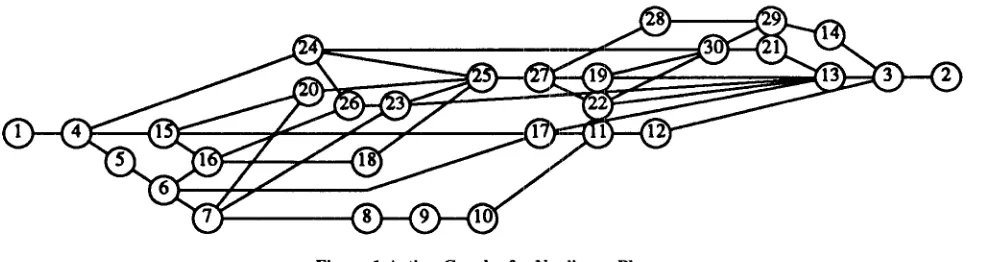
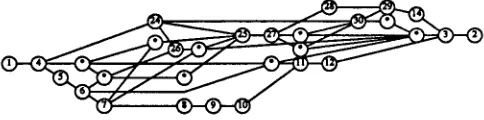
Figure I Action Graph of a Nonlinear Plan.
application of natural language generation, and our approach has been to tackle this problem in a fairly straightforward way, informed by the state of the art as we perceive it. The results from our system are prom- ising, but our texts lack much of the smoothness of human-generated explanations. An analysis of the rea- sons behind some of the system's failures points to a number of deep problems concerning the connection between AI plans and natural language explanations.
In the next section we briefly introduce the inputs and structure of the language generation system. We then run through the parts of the system by showing a worked example. The core of this paper concerns the mapping from plans to messages, which can be thought of as abstract descriptions of natural language dis- courses. We describe our repertoire of messages, how plan structures are mapped onto messages, and how messages are simplified. Finally we look at further examples of the system's output and analyze some of its failures and successes.
2 SYSTEM OVERVIEW 2.1 PLANS AND PLANNERS
For this project, we have adopted a traditional AI view of planning and plans. According to this view, the task of planning to achieve a goal is that of finding a set of (instantaneous) actions which, when performed, will transform the world as it is (the "initial state") to a new world (the "final state"), which is similar to the present world, but where in addition the goal is true.
We assume that the plans produced by our planner are nonlinear (almost standard with AI planners since NOAH; Sacerdoti 1975); that is, they only partially specify the order in which the actions are to be per- formed. Furthermore we assume that the time con- straints involved in a plan can be displayed in an action graph, where an action is represented by a point and a line going rightward from one action to another indi- cates that the first action must take place before the second (this is true of most, but not all, AI plans--see for instance Tsang 1986). Figure 1 shows an action graph for a nonlinear plan for building a house.
We further assume that plans are in general hierar-
chical. By this we mean that the planner operates in a hierarchical manner (almost standard in AI planners since ABSTRIPS; Sacerdoti 1973), first producing a plan :specified at a very abstract level, and then succes- sively refining it until the required level of detail is obtained. At each stage a process of criticism may impose new orderings between actions whose relative ordering seemed to be unconstrained at the previous levels of abstraction. For us, the history of this hierar- chical expansion must be present in the final plan, since we assume no explicit interaction with the planner itself while it is operating. (We shall return in Section 5 to the question of whether the hierarchical plan structure is in fact a sufficient description of the planner's processing.) For concreteness, we have based our system on the output of a single AI planning program, even though there are a number of planning systems that could produce a similar style of output. The input to our natural language generator, then, is the translation into Prolog of the set of datastructures created by Tate's (1976) NONLIN planner.
:2.2 SYSTEM STRUCTURE AND PARAMETRIZATION
We have set ourselves the goal of generating from a NONLIN plan a single natural language text that ex- plains the actions to be performed and why things have to be done this way. To a large extent the explanatory power of such an account depends on what information is represented in the plan in the first place. Although a system that produces a single monolog from a plan is more restricted than, say, an interactive system that can be a,;ked to explain parts of the plan selectively, a number of possible applications do suggest themselves (for instance, the automatic generation of instruction manuals), and the monolog task does provide us with an excellent way of studying the problems of automatically generating large texts.
We have attempted to factor out domain-dependence as much as possible in the generation system by having it rely heavily on knowledge expressed in a declarative fashion. Given a particular target natural language, a specific lexicon then needs to be provided for the domain in which the plans are to be generated (we have considered cookery, house building, car maintenance,
[image:2.612.58.550.64.195.2]Chris Mellish and Roger Evans Natural Language Generation from Plans
central heating installation, and the "blocks world"). This provides linguistic representations corresponding to the objects, states, and actions that will arise in generated plans. These lexical representations are sup- plemented by domain-dependent rewrite rules that can be used to reveal hidden additional structure in the planner's representation of the domain. Even with the target natural language fixed and a particular domain given, there are still in general many possible plans from which natural language could potentially be generated (indeed, many man-years of AI research were devoted to developing plans simply in the "blocks world").
Our natural language generation system can be thought of as consisting of four processing stages, centering on the construction and manipulation of an expression of our special
message language,
as follows:Message Planning Message Simplification
Compositional Structure Building Linearization and Output
Message Planning
is the interface between the genera- tor and the outside world. At this stage, the generator must decide "what to s a y , " i.e., which objects and relationships in the world are to be expressed in lan- guage and in roughly what order. The output of the message planner is an expression in the message lan- guage which, following McDonald, we will call themessage.
The idea is that message planning may be a relatively simple process and that the resulting message is then "cleaned u p " and simplified by localized rewrite operations on the expression ("Message Simplifica- tion").The message is a nonlinguistic object, and the task of
structure building
is to build a first description (a functional description much as in Functional Grammar; Kay 1979) of a linguistic object that will realize the intended message. We assume here that a "linguistical- ly motivated" intermediate representation of the text is of value (this is argued for, for instance, by McDonald 1983). Our structure builder is purelycompositional,
and so the amount of information that it can take into account is limited. We treat structure-building as a recursive descent traversal of the message, using rules about how to build linguistic structures that correspond to local patterns in the message. During this, a simple
grammatical constraint satisfaction
system is used, to enforce grammaticality and propagate the consequences of syntactic decisions. The recursive descent terminates when it reaches elements of the message for which there are entries in the system's lexicon.Once a structural description of a text has been produced, it is necessary to produce a linear sequence of words. Our structural descriptions contain only dom- inance information and no ordering information, and so a separate set of rules is used to produce a linearization. This is akin to the ID/LP distinction used in GPSG (Gazdar et al. 1985).
The resulting system is similar to McDonald's (1983) model, in that it is basically a direct production system that utilizes an intermediate syntactic representation. The system is also similar to McDonald's in its empha- sis on local processing, although there is no attempt to produce a psychological model in our work. Our con- straint satisfaction system is implemented efficiently by unification, however, so that the effects of local deci- sions can propagate globally without the need for ex- plicit global variables. This is used, for instance, to enforce a simple model of pronominalization (based on that of Dale 1986).
3 A WORKED EXAMPLE
AS an illustration of the various mechanisms contained within the system, we present in this section an example of the system in operation. The example is taken from a demonstration application, showing how the language generator might be attached to an expert system. The scenario is as follows: we have an expert system whose function is to diagnose car-starting faults. The expert system asks questions to which the user can either give an answer or type " h o w , " meaning " h o w can I find out the answer?" In this latter case, the expert system invokes a planner to work out what the user has to do, and passes the resultant plan to the language generator, which produces text giving instructions to the user. The expert system then asks its original question again.
In our demonstration system, the expert system is in fact just a binary decision tree. At each internal node there is a yes-no question and a planner goal, to be used if the user responds with " h o w . " At each leaf node there is a recommendation and a planner goal--here " h o w " is interpreted as " h o w do I carry out your recommendation?" To make the demonstration more varied, the system keeps track of what it has already told the user to do, so that, for example, accessing the carburetor jet will be described differently depending on whether the air filter (which is on top of the carburetor) has already been checked.
We pick up the example at a point where it has been ascertained that the battery is OK, but that there is no spark on the spark plugs. The next step is to test for a spark at the distributor. The system asks:
I s t h e r e a s p a r k a t t h e d i s t r i b u t o r ?
and we respond with " h o w . " The NONLIN plan goal associated with the above question is
{tested d i s t _ s p a r k }
that is, "make a plan to achieve the state in which we have tested the distributor spark." The planner assumes that we have done nothing already and are standing at the front of the car, looking at the engine.
3.1 THE PLAN
The plan produced by NONLIN for this example case is a totally ordered sequence of six actions as follows:
Chris Mellish and Roger Evans Natural Language Generation from Plans
{act {detached dirt_cover engine}} {act {detached coil_lead dist_cap}}
{act {located mech cab}} {act {started engine}}
{act {located m e c h frontofcar}} {act {observed spark colLlead}}
detach the dirt cover f r o m the engine detach the coil lead f r o m the distributor cap
go to the cab start the engine go to the front o f the car
observe whether there is a spark on the coil lead
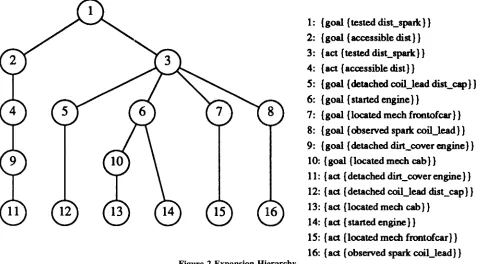
However, although this is the plan at its lowest level, the plan structure returned by N O N L I N also includes the hierarchical expansion history of the plan. The plan started out as just the original goal itself, and was successively expanded to greater levels of detail until the primitive actions given above were obtained. The expansion hierarchy for this plan is shown in Figure 2. 2
As well as this hierarchical structure (and the order- ing information not shown in this diagram), N O N L I N returns information about preconditions in the plan-- where they are needed and where they are established. So, for example, the condition {goal {located mech cab}} is required by node 14 and made true by node 13 (and made false again by node 15).
3.2 THE TEXT
All this information is extracted from N O N L I N ' s data structures, converted into Prolog clauses, and passed to the language generator. The generator looks for ways to break up and organize the information in the plan to produce comprehensible text. This process is described in more detail in Section 4, but to see what it does in this case, we shall concentrate on just one fragment of the above plan, namely nodes 3, 5, 6, 7, and 8. These nodes represent the expansion of the following N O N L I N operator:
actsclhema tested_4
p a t t e r n {act {tested dist_spark}} expansion
goal goal goal goal orderings
1 - * 2 - - ,
{goal {detached coiklead dist_cap}} {goal {started engine}}
{goal {located m e c h frontofcar}} {goal {observed s p a r k coil_lead}} 4
4 3 - * 4 conditions
u n s u p e r v i s e d {goal {accessible dist}} at self supervised {goal {detached coil_lead
dist_cap}} at 4 f r o m 1
supervised {goal {located m e c h frontofcar}} at 4 f r o m 3
supervised {goal {started engine}} at 4 f r o m 2
er.Ld;
This operator expands the high level action " d o some- thing that causes the distributor spark to have been tested" (that is, "test the distributor spark") into four subgoals (not actions, since if they are already in effect, nothing further needs to be done), the first three of which must preceed the last. Thus the plan here is to ensure that the coil lead is detached from the distributor cap, the engine is started, and the mechanic is at the front of the car, and then to observe whether there is a spark on the coil lead.
Tile subplan gives rise to the following piece of text:
T E S T I N G T H E D I S T R I B U T O R S P A R K
Testing the distributor spark involves detaching the coil lead from the distributor cap, starting the engine, going
?
?
®
Figure 2 Expansion Hierarchy.
1: (goal ( tested dist._spark) }
2: {goal {accessible dist} }
3: {act {tested distspark) }
4: {act {accessible dist} }
5: {goal {detached coil_lead dist_cap} }
6: { goal { started engine } }
7: [goal {located mech frontofcar} }
8: {goal {observed spark coil_lead} }
9: {goal {detached dirt_cover engine) }
1 O: { goal {located mech cab } }
l h {act {detached dirt_cover engine} }
12: {act [detached coil_lead dist_eap} }
13: { act {located mech cab } }
14: {act {started engine} }
15: (act {located mech frontofcar} }
16: {act {observed spark coil_lead} }
[image:4.612.64.555.468.732.2]Chris Mellish and Roger Evans Natural Language Generation from Plans
to the front o f the car and then observing whether the coil lead sparks.
I f you go to the front o f the car now you will not be at the wheel afterwards. However in order to start the engine you must be at it. Therefore before going to the front o f the car you must start the engine.
I f you start the engine now you will not be at the front o f the car afterwards. However in order to detach the coil lead from the distributor cap you must be at the front o f the car. Therefore before starting it you must
detach the coil lead from the distributor cap.
Detach the coil lead from the distributor cap. After this start the engine. After this go to the front o f the car. After this observe whether the coil lead sparks.
You have now finished testing the distributor spark.
Notice that this text is not just a description of the actions as specified by the plan operator. Nor is it the fully detailed plan of everything to be done. It is a description of the plan operator in the context of the current plan, embellished with additional useful infor- mation from that context. It includes references to actions at several different levels of abstraction, as well as information about ordering constraints present in the plan but not present in the basic plan operator.
3.3 THE MESSAGE
The first step in the generation of this text is to convert the plan data into an expression in the generator's intermediate message language. The message language and the strategies for carrying out this conversion are discussed more fully in Section 4; here we concentrate on those aspects particularly relevant to this text.
The overall strategy applied to our subplan is to construct an embedding: an introduction-body-conclu- sion structure in which the introduction explains how the action is expanded, the body explains how to execute the expansion, and the conclusion makes the point that by executing the expansion, the higher level action is acheived. This strategy is appropriate because the body of the expansion is relatively simple. For more complex examples, where it is not practical to attempt to describe the expansion merely as an introductory sentence of a paragraph, an alternative strategy would be employed.
This strategy decision gives us the general shape of the text, and the components of the embedding are straightforwardly constructed, by reference to the local " s h a p e " of the plan fragment. Here the actions are linearly ordered, which suggests presenting them in the order of execution. At the same time the message is embellished with the justifications for the action order- ing. In the above plan operator, the first three actions were unordered, but lower level considerations (con- cerning where the mechanic is at a given time) impose an ordering on them in the actual plan returned. Mes- sage elements are added to explain these ordering requirements, and in this case these necessarily appeal to the lower level actions of moving about.
The resulting message expression is too large for easy display, so we shall concentrate on a small part of it, the part corresponding to the three sentences:
I f you go to the front o f the car now you will not be at the cab afterwards. However in order to start the engine you must be at it. Therefore before going to the front o f the ear you must start the engine.
The initial message expression for this t e x t is: implies (
contra_seq ( hypo_result (
user,
achieve (goal (located (mech, front ofcar))), not (goal (located (mech, cab)))),
prereqs ( user,
then (wait ([ ]), achieve (goal (started (engine)))),
goal (located (mech, cab)))), neccbefore ( user,
then (walt ([ ]), achieve (goal (started (engine)))),
achieve (goal (located (mech, frontofcar))))) where expressions like goal(located(mech,frontofcar)) and g o a l ( s t a r t e d ( e n g i n e ) ) are straight NONLIN ex- pressions, translated literally into Prolog. This expres- sion can be read approximately as "the hypothetical result of going to the front of the car is that you will not be in the cab, and this contrasts with the prerequisite of being in the cab to start the engine. This combination implies you should start the engine before you go to the front of the car." And of course, that is more or less what the produced text says.
3.4 SIMPLIFYING THE MESSAGE
The above message contains a number of redundancies, which will lead to inelegant text if it is used for gener- ation. First of all, it contains various occurrences of w a i t ( [ ]) (the action of waiting for nothing). These are inserted because in general at certain points of the subplan being explained, one is forced to wait for the conclusion of actions being performed in other sub- plans; this time, however, there are no such critical actions in other parts of the plan. Second, the NONLIN expressions have been inserted verbatim, without any consideration of whether they could be expressed more elegantly in the message language. Message simplifica- tion concerns rewriting the message expression gener- ated by message planning into one that is "simpler" in some sense. This is achieved by applying rewrite rules to components of the whole message. Two kinds of rewrite rules are used: the first kind perform domain- independent structural simplifications to message ex- pressions, and the second domain- or language-depen- dent alterations. For example, the following two rules together dispose of the redundant w a i t ( [ ]) terms of the above message ([ ] denotes the empty action here): w a i t ( [ ]) --~ [ ].
then([ ]~X) --* X.
Chris Mellish and Roger Evans Natural Language Generation from Plans
T h e s e are to be read as rewrite rules, with the expres- sions on the left o f the "---~" being rewritten to the expressions on the right. Variables are d e n o t e d by names beginning with capital letters. The operation o f these rules is entirely domain-independent. One o f the d o m a i n - d e p e n d e n t rules rewrites m e c h (the mechanic) as u s e r , to indicate that the mechanic is the same as the p e r s o n to w h o m the instructions are being given. An- o t h e r set o f rules rewrites states into a form where the affected p e r s o n or object is explicit (this representation allows the system to collapse together multiple states involving the same person):
goal (located (X,Y)) --~ state (X, located (Y)).
M o r e substantial examples include the following rules for talking about moving around:
achieve (state (user, located ( Y ) ) ) --* go_to (user,Y). result (go_to (X,Y),state (user, located ( Y ) ) ) --~ do (go_to (X,Y)).
The first causes a phrase such as " g e t to be at the front o f the c a r " to be rewritten as " g o to the front o f the c a r . " The s e c o n d r e m o v e s r e d u n d a n c y in a sentence like " G o to the front o f the car and y o u will be at the front o f the c a r , " rewriting it as simply " G o to the front o f the c a r . "
Once all the rewrite rules have been applied, our simplified example message looks like this:
implies ( contra_seq (
hypo_result ( user,
go_to (user, function (front, car)), state (user, not (located (cab)))), prereqs (
user,
s t a r t (engine),
state (user, located ( c a b ) ) ) ) , neccbefore (user,
s t a r t (engine),
go_to (user, function (front, c a r ) ) ) )
3.5 COMPOSITIONAL STRUCTURE BUILDING
The next stage is to build a linguistic structure from this message expression. The structure-building c o m p o n e n t uses an o r d e r e d set o f rules for mapping from local message patterns to linguistic structures. It is similar to the s y s t e m described in C h e s t e r (1976) in the local nature o f its operation, but Chester builds sentences directly, r a t h e r than via structural representations. Mann et al. (1982) would call o u r system a " d i r e c t translation" system. A system built in this fashion has the advantage o f a v e r y simple control structure and has the potential o f having its principles expressed in mod- ular, independent rules.
Our linguistic structural descriptions are similar to the functional descriptions used in Functional G r a m m a r (Kay 1979; K a y 1984). F o r example, the following is a slightly simplified version o f the rule used to realize the hypo_result construct above:
hp!oo.result (Agent, Act, State) --* [ ss~nesentence,
conjn = [root = 'if], first =
Is,
agent = [ SAgent], pred = [active, m o r p h = pree, SAct,
adv = + [ap, adv_word=[root=now]]]], rest =
Is, pred =
[vp,
aux = [root = will], pred =
[vp, $State, m o r p h = inf, adv = + [ap,
adv_word= [ root = afterwards ] ] ] ] ] ]. In this rule, the left hand side of the ---> is a Prolog pattern to be matched with part of the message (symbols beginning with uppercase letters r e p r e s e n t variables, which are to match subexpressions o f the message). The rightlaand side is a functional description, describing the English phrase that is to r e n d e r that part. In these functional descriptions, expressions p r e c e d e d by dollar signs represent the places w h e r e further information will be contributed by the expansion of subparts of the message. Thus the " a g e n t " value is obtained by recur- sively matching the value of the variable A g e n t (that is, the first argument in the hypo__vesu.lt term) against the structure rules.
This rule is responsible for sentences like:
I f you start the engine now you will not be at the f r o n t o f the car afterwards.
The rule provides the basic template for the sentence: it is a combination o f two sentences using the conjunction " i f . " The first sentence is present tense active, with agent specified by the A g e n t argument and predicate by the A c t argument, and has an adverbial modifer " n o w . " The second sentence is a future tense e x p r e s s i o n o f the S t a t e given as argument, with adverbial modifier "af- t e r w a r d s . " The p r e s e n c e o f s a m e s e n t e n c e r ensures that the whole is a single sentence and that the two subclauses have the same focus.
Tile recursive structure building process " b o t t o m s o u t " when a message element is r e a c h e d for which a linguistic realization appears in the d o m a i n - d e p e n d e n t lexicon. Domain states and properties (Section 4.1) are provided with lexical entries that describe how to realize them as VPs. Such entries could be written as structure building rules in the same format as the a b o v e 1-~,po_result rule, but in practice it is c o n v e n i e n t to use a more compact notation:
lx (accessible, be, [attr: @ accessible]). lx (answer, answer, [obj: @ 'the question']). lx ( s t a r t (Z), start, [obJ: Z]).
Chris Mellish and Roger Evans Natural Language Generation from Plans
These entries indicate how each of accessible (a prop- erty), a n s w e r , and s t a r t ( Z ) (actions) can be realized in English, by providing a verb and a specification for the complements to follow it. In the first two, the comple- ment phrases are specified directly as constant strings (indicated by the '@' sign). In the last one, the filler of the obj role (the direct object) will be whatever phrase is used to realize the object Z being started. Additional rules provide possible fixed phrases to realize such domain objects:
r e f e r e n t ( e n g i n e , @ e n g i n e ) .
When a domain object like engine comes to be realized, either the fixed phrase provided (prefixed by 'the') will be used, or a pronoun with the appropriate gender and number will be chosen. It is clearly a limitation of our system that no other possibilities are currently allowed, but in some sense this reflects the fact that plans come with a great deal of information about the actions to be performed but very little information about the objects involved in them.
Structure building rules are ordered, so rules for more specific patterns can be placed before rules for less specific ones, without the latter having to explicitly provide negative conditions. In addition, rule applica- tion is deterministic, in that, once the left hand side of a rule has matched a piece of message and the right hand side structure (minus the parts that require recursive rule matching) has been successfully built, no other rule will ever be tried for that portion of the message.
As well as the usual specifications of features and values (for example, conjn and first used above), functional descriptions can also contain specifications of properties, such as s and s a m e s e n t e n e e , that the relevant construction must have. Some of these prop- erties (such as s) are intrinsic--essentially just features without values. Others are " m a c r o s " for bundles of simpler feature-value and property specifications. For example, saraesentence is defined as being shorthand for a bundle of feature-value pairs that limit the possi- bilities for focus movement in and around the structure described. A collection of such macros enables us to implement what is essentially Dale's (1986) model of how discourse structure constrains pronominalization, which was inspired by the work of Grosz (1977) and Sidner (1979). The use of a macro like ssanesentence (keyed off particular structures in the message) sets up an environment that will allow certain pronominaliza- tions but exclude others. The choice of whether to pronominalize or not is then made on a local basis. It is interesting to compare this scheme to that of McKeown (1982), which also makes focus decisions on a local basis. McKeown's approach, almost the opposite to ours, is to take certain focus priorities as primary and then to attempt to select material in accordance with these. Our approach, which involves considering focus only after the material has already been organized, regards pronominalization more as a last-minute lexical
Computational Linguistics Volume 15, Number 4, December 1989
optimization than as something that is planned in ad- vance. We have considered incorporating some means of focus annotation in the message, but it is not always clear at this level what the focus should be. We have thus preferred to allow message planning simply to place general constraints on focus movement.
As the message is traversed by the structure building rules, more and more information accumulates about the output functional description and its components. As is usual in unification grammar, in the written form structural descriptions are sideways open, that is, an object satisfying the description is required to have the features listed, but may have any other features in addition. Thus our structure building rules only provide the framework of the final functional description. The rest is filled in by a simple grammatical constraint satisfaction system. This enforces grammaticality and handles the propagation of feature values that are shared between different phrases (for instance, number agreement). The constraint satisfaction system is based on the use of a declarative "grammar specification" of the types of legal descriptions and the constraints they must satisfy. This specification is compiled into a rep- resentation that essentially treats every property and feature as a macro for a bundle of conclusions that follow from its being involved in a description.
3.6 CONSTITUENT ORDERING
The final task once the linguistic structure has been built is to determine the order in which the constituents are to be produced, and to locate the actual words to be used. Substructure ordering is determined by ordering rules. The ordering rules are applied to a structural description in much the same way that structure-building rules are applied to the message; that is, recursively and compo- sitionally. The left hand side of an ordering rule is a pattern that is matched against the structural descrip- tion. The right hand side of the first rule whose pattern matches is then taken as a template determining which parts of the description are to be realized as phrases and in what order. For example, here is a rule for VP ordering:
[ v p , m a i n v e r b = V, a d v = A, e o m p l s = C] --* [ V , C ~ ] .
This rule ensures that a verb is realized before its complements, which are realized before any adverbial modifiers, producing VPs like:
go to the front o f the car now
Each application of an ordering rule returns an ordered list of functional descriptions. These are then recur- sively subjected to ordering rules, to determine their relevant subphrases and the order these should be realized in. The recursion "bottoms o u t " when a func- tional description of type w o r d is reached. The end result is a list of word descriptions each containing features detailing aspects of the morphology. These are passed to the morphology component (currently ex-
Chris Mellish and Roger Evans Natural Language Generation from Plans
pressed as raw Prolog code), which will then output the appropriately inflected word.
4 PLANS AND MESSAGES
4.1 THE MESSAGE LANGUAGE
In some ways, a natural language generation system is like an optimizing compiler. Producing some sort of natural language from a symbolic input is not a task of great difficulty, but producing text that is smooth and readable is a challenge (and in general quite b e y o n d the state o f the art). With both tasks one has the option o f planning the text and simplifying its form either in a single pass or in multiple passes. In language genera- tion, M c D o n a l d ' s M U M B L E (McDonald 1983) pro- duces and simplifies linguistic structures within a single pass of the input. Although the modeling of human language p r o d u c t i o n may require a t h e o r y o f this kind in the end, the result is a system where it can be hard to separate out the different principles of structure build- ing and simplification, b e c a u s e these have all been conflated for reasons o f efficiency. We have thus opted for a multi-pass system. Multi-pass optimizing compil- ers need to have specialized internal languages (virtual machine codes) m o r e abstract than the output machine codes and in terms o f which optimizations can be stated. The analog in a natural language generation system would be a message language that could ex- press at a level more abstract than linguistic structure the goals and intended c o n t e n t o f a piece o f language to be generated. We can see elements o f such a language in the "realization specifications" o f McDonald and Con- klin (1982) and in the " p r o t o s e n t e n c e s " of Mann and M o o r e (1981). A crucial part o f our own system is the use o f a message language specialized for the explana- tion o f plans.
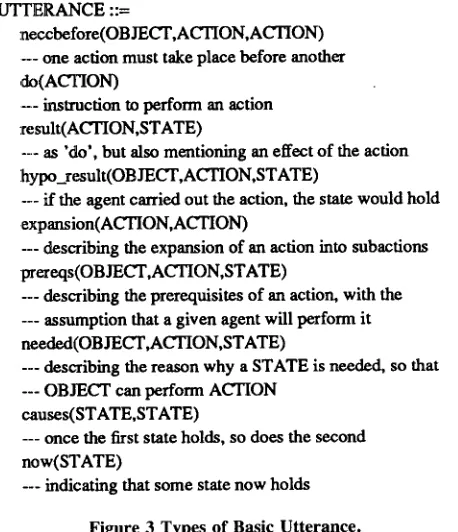
Our message language is a language specifically de- vised for expressing the objects that arise in plans and the kinds of things one might wish to say about them. The main types o f statements ( " u t t e r a n c e s " ) that can be made at present as part of our generated text are shown in Figure 3. T h e s e " u t t e r a n c e s " mention actions and states, which could be domain actions and states (as appearing in the plan) or c o m p l e x actions and states, f o r m e d according to the rules in Figure 4. T h e message language provides for the description of actions being carried out involving different agents and objects (both r e p r e s e n t e d as " o b j e c t s " - - F i g u r e 5), although N O N - L I N provides no indication about who is responsible for any given part o f a plan. Thus the agent of an action defaults to u s o r for an action that is properly part of the current subplan and s o m e o n e for an action that has been included in the description but is properly part of a n o t h e r subplan. In this way, each part o f the plan is explained from the point o f view o f the person executing it, with no assumption that the same person will be executing o t h e r parts of the plan. A message consists o f a n u m b e r o f " u t t e r a n c e s " linked together by various
240
UTTERANCE ::=
:neccbefore(OB JECT,ACTION,ACTION) --- one action must take place before another do(ACTION)
... instruction to perform an action
:result(ACTION,STATE)
.... as 'do', but also mentioning an effect o f the action
:hypo_result(OB JECT,ACTION,STATE)
--- if the agent carried out the action, the state would hold expansion(ACTION,ACTION)
--- describing the expansion of an action into subactions prer eqs(OB JECT,ACTION,STATE)
--- describing the prerequisites o f an action, with the --- assumption that a given agent will perform it needed(OBJECT,ACTION,STATE)
--- describing the reason why a STATE is needed, so that --- OBJECT can perform ACTION
causes(STATE,STATE)
--- once the first state holds, so does the second
now(STATE)
--- indicating that some state n o w holds
Figure 3 Types of Basic Utterance.
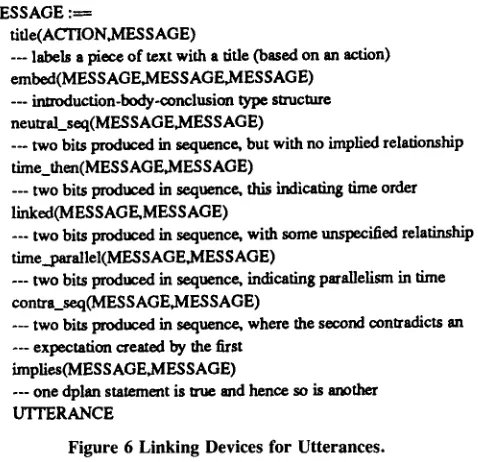
organizational devices. T h e s e indicate various kinds o f sequencing and embedding (Figure 6). Most are simply ways to string together two " u t t e r a n c e s , " with an appropriate conjunction being suggested, according to what kind of link there is b e t w e e n the two. The e m b e d construction is used to indicate a discourse segment which has an introductory section, a body and a con- cluding section. H e n c e it has three parts. T h e idea is that the explicit marking of such structures in the message language will enable linguistic decisions (for instance concerning pronominalization) to be made more intelligently. In general, the d o m a i n - d e p e n d e n t lexicon need only supply a single linguistic representa- tion for the simplest form of a domain action or prop- erty. The linguistic forms o f the more c o m p l e x forms allowed by the message language are then dealt with automatically by the system (Figure 7).
4.2 FROM PLAN TO MESSAGE
A plan with 30 or so actions contains a great deal of material, spelling out the n e c e s s a r y partial ordering b e t w e e n the actions and their preconditions and effects. A crucial task in message planning is cutting this material down into small enough pieces that can be rendered as independent pieces of text. In a domain- independent system for plan explanation, the only structure that such a " c h u n k i n g " can make use o f is the abstraction hierarchy and the local " s h a p e " of the action graph. E v e n this is unfortunately limited by the fact that the abstraction hierarchy m a y represent a view of the domain that is c o n v e n i e n t to the plan generator, but not the plan executer.
The abstraction hierarchy tells us how certain actions
[image:8.612.321.550.57.323.2]Chris Mellish and Roger Evans Natural Language Generation from Plans
A C T I O N ::=
then(ACTION,ACTION) --- two actions in sequence
achieve(STATE)
--- the action to achieve a state
wait(STATE)
--- waiting until a state holds
complete(ACTION)
--- finishing doing a prolonged action repeat(ACTION,STATE)
--- doing the action until the state holds delegate(OBJECT,ACTION)
--- have someone else do an action
parallel(ACTION,ACTION) - - doing two actions in parallel DOMAIN_ACTION
STATE ::=
and(STATE, STATE) --- both states hold state(OBJECT,PROPERTY) .-- an agent has a property not(state(OBJECT, PROPERTY)) --- an agent does not have a property PROPERTY ::=
andp(PROPERTY, PROPERTY) --- conjunction of properties enabled(ACTION)
--- able to perform an action done(ACTION)
--- having done an action
doing(ACTION) --- doing an action DOMAIN_PROPERTY
Figure 4 Actions, States, and Properties.
at a particular level o f the plan arise f r o m the e x p a n s i o n o f a single action at a m o r e a b s t r a c t level. Such a group of actions is an o b v i o u s candidate for explaining as a single chunk. Thus o u r basic strategy is to first of all talk about the plan at the m o s t a b s t r a c t level, then discuss the e x p a n s i o n o f the actions at that level, then discuss the e x p a n s i o n o f the actions involved in that, and so on. In general, then, at a n y time we are c o n c e r n e d with 1) selecting out the portion o f the plan that c o r r e s p o n d s
to the e x p a n s i o n o f a single a b s t r a c t action and OBJECT ::=
U S e r someone
function(FWORD,OB JECT) DOMAIN_OBJECT
Figure 5 Objects.
MESSAGE :~---
title(ACTION.MESSAGE)
--- labels a piece of text with a title (based on an action)
embed(MESSAGE,MESSAGE,MESSAGE) --- inn, oduction-body-conclusion type structure neutral_seq(MES SAGE,MESSAGE)
--- two bits produced in sequence, but with no implied relationship
time_then(MES S AGEoMES S AGE)
--- two bits produced in sequence, this indicating time order linked(MESSAGE, MESSAGE)
--- two bits prodtw.ed in sequence, with some unspecified relafinship time_parallel(MES SAGE,MES S AGE)
--- two bits produced in sequence, indicating parallelism in time contra_seq(MESSAGE.MESSAGE)
--- two bits produced in sequence, where the second conCadicts an
--- expectation created by the first implies(MESSAGE,MESSAGE)
--- one dplan statement is u'ue and hence so is another
UTTERANCE
Figure 6 Linking Devices for Utterances.
2) describing this, given that whole subsets o f the actions in it are to be treated as single actions. T h e first o f these is not trivial b e c a u s e , as the result of successive criticisms, the set o f actions in the e x p a n s i o n of a m o r e a b s t r a c t action m a y no longer be a simple c o n n e c t e d piece o f the plan. As an e x a m p l e o f this, Figure 8 is the action graph for a house-building plan, with the actions that are in the e x p a n s i o n of "installing the s e r v i c e s " blocked out.
To describe this set o f actions and their timing in the plan, it is n e c e s s a r y to describe other actions whose timing is closely coupled to them. The actions to be included in the explanation o f the e x p a n s i o n are ob- tained by a " c l o s u r e " o p e r a t i o n - - a p r o c e s s of tracing through all possible paths going f o r w a r d in time be- tween actions in the expansion. A n y other actions e n c o u n t e r e d on these paths are d e e m e d n e c e s s a r y to be included in the description. We call these actions "in- t r u d e r s . " Thus the actions described f o r m the minimal c o n v e x graph that includes the desired actions (Figure 9).
Once the lowest-level plan actions c o r r e s p o n d i n g to a single a b s t r a c t action h a v e b e e n isolated, the " s h a p e " of this part of the plan at the c u r r e n t level o f a b s t r a c t i o n needs to be determined. T h e current point in the ab- straction hierarchy specifies the set o f actions that can be mentioned in this part o f the text. I f one of these is an a b s t r a c t action, in general there will be a whole class of lowest-level actions that need to be described simply as parts of this action, w h o s e internal structure will be described later. The lowest-level actions are thus g r o u p e d into subsets, and what is to be explained are relationships b e t w e e n these subsets, rather than rela- tionships b e t w e e n primitive actions. Technically, the " c h u n k i n g " i m p o s e d by the current layer o f the ab- straction hierarchy defines an e q u i v a l e n c e relation, and
[image:9.612.328.567.56.287.2]Chris Meilish and Roger Evans Natural Language Generation from Plans
do( examineOftter_bolts ) ).
do(complete(examine(filter_bolts))).
do( de legate (someone ,examineOflter botts) ) ).
now( state( user ,enabled( examine(lifter_bolts ) ) ) ).
now(state(someone ~lone( examineOilter_ bolts) ) ) ).
now(state( user ~toing ( examine(filter_ bolts) ) ) ).
now(state(plug_leads ~ositioned) ).
do(achieve(state(plug_leads,posit ioned) ) ).
do(wait(state(plug leads,positioned) ) ).
causes(state( user ,done(achieve(state(plug leads,posit ioned) ) ) ),
state( user, enabled( examine(fdter_ boits) ) ) ).
Examine the filter bolts.
Finish examining the N t e r bolts. Have s o m e o n e examine the N t e r bolts. Y o u can n o w examine the filter bolts. T h e filter bolts have n o w been examined. Y o u are n o w examining the filter bolts. T h e plug leads are now in position.
Get the plug leads to be in position. Wait until the plug leads are in position. Once the plug leads are in position you can
examine the filter bolts.
Figure 7 Expressions Generated Using Two Lexical Entries.
we are interested in the
quotient plan
with respect to this relation. We can define the usual plan relationships between the relevant subsets of actions in a natural way. For instance, we say that one subset comes before another if and only if each element of the first comes before each element of the second. Because such a demanding criterion will apply quite rarely, in general there will be a great deal of parallelism in subplans whose actions are not at the most detailed level.Once a piece of the whole plan has been extracted and its " s h a p e " (relative to some given equivalence relation) established, rhetorical strategies are applied to decide how particular parts are to be presented. The message created depends directly on the structure of the justified plan. Thus, for instance, the expansion of a complex action gives rise to a section of text repre- sented by a message of the form:
title ( Action, e m b e d ( I n t r o ,
Body,
n o w ( s t a t e (user, done ( c o m p l e t e ( A c t i o n ) ) ) ) ) ) )
where A c t i o n is the action described, I n t r o is an introductory message, which describes the prerequi- sites of the main action and the set of actions in its expansion (unless there are too many of them) and Body describes the action graph expanding the main action. The main strategies for describing action graphs are the
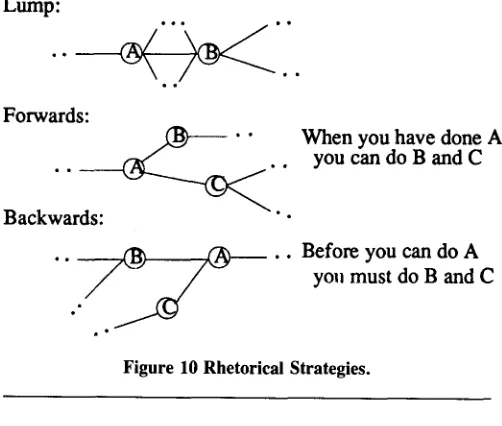
lump strategy, forwards description,
andbackwards
description
(Figure 10). The lump strategy applies if a piece of the action graph is a self-contained " l u m p "Figure 8 Distribution of Expression of an Abstract Action.
between two actions A and B, with no links between any actions inside the " l u m p " and any actions outside. If the subgraph between the actions is sufficiently complex (has more structure than two simple actions in parallel), the strategy suggests that its explanation should be postponed to a separate " s e c t i o n . " Mean- while the whole subgraph is incorporated into the current explanation as if it were a simple action (this is, of course, the same strategy that is applied for an action that is above the primitive level in the abstraction hierarchy). Forward description is deemed appropriate when the action graph is a right-branching structure; in this case the actions are generally dealt with in time order, giving a message of one of the forms:
time_then ( r e s u l t (Act, State) . . . . )
neutra]_seq (
r e s u l t (Act, State), embed ( c a u s e s (State,
state (user, enabled ( A c t s ) ) ) , ....
[])
where Act is the first action, State a state that it makes true, and " . . . " is the message derived from the subsequent actions. When the action graph is a left branching structure, however, the strategy of back- wards description is suggested. This gives rise to mes- sages of the form:
embed ( p r e r e q s ( u s e r ~ c t , P r e s ) ,
n o w ( s t a t e ( u s e r , enabled (
~9® ® ® ®
Figure 9 Closure of Expansion.
® ®
[image:10.612.368.562.50.218.2] [image:10.612.317.556.610.743.2] [image:10.612.53.295.653.713.2]Chris MeUish and Roger Evans Natural Language Generation from Plans
Lump:
~ 0
gQ
Q
O I
Forwards:
B a c k w a r d s :
~
m
I QQ
When you have done A you can do B and C
•
8 Q
•. Before you can do A you must do B and C
Figure 10 Rhetorical Strategies.
parallel (Act,
achieve (State))))) where Act is the first action, with preconditions Pres and effects State, and " . . . " is the message derived from the subsequent actions.
All of these kinds of messages require the insertion of preconditions and effects of actions. It is necessary for the system to compute those preconditions and effects that are actually relevent for the current plan, rather than simply the total sets of preconditions and effects. This amounts to determining the justifications for the action ordering chosen. The justification for action A coming before action B can be of one of two types. Either A is needed to create a state where a precondi- tion of B is true, or A comes before B because otherwise B would create a state where a precondition of A was not true. The two different possibilities give rise to different modes of presentation, but if the justification is redundant or not available from the plan, it is simply missed out.
4.3 IMPROVING THE MESSAGE
As the last section suggests, the initial version of the message is put together in a very direct way from the structure of the plan. As a result, it is often unneces- sarily cumbersome. Message simplification concerns rewriting the message expression generated by message planning into one that is "simpler" in some sense. Since the amount of material we wish to deal with could be large, we have avoided considering expensive global simplification techniques in favor of emphasizing local simplification techniques analogous to "peephole" op- timizing techniques in compiling. Of course, a crucial difference between language generation and compila- tion is that in the former there is no clear notion of what "optimality" is. In the absence of a formal and detailed psychological theory of discourse comprehension, re- searchers in natural language generation are reduced more or less to using their intuitions about whether one
way of phrasing something is "easier to understand" than another. We have regretfully had to follow the same course in designing and evaluating our own sys- tem.
The domain-independent simplification rules used by our message simplification system are treated equally, but conceptually they seem to be of four main types. Members of the first type tidy up special cases that could as easily be detected when the expression is constructed. Here is an example of such a rule ([ ] denotes the empty utterance):
(1) neutral_seq (X,[ ]) --* X.
Thus any utterance expression of type neutral_seq will be rewritten by this rule if its second component is empty. Such an expression is rewritten simply to its first component. Incorporating such rules into the simplifi- cation stage means that the message-planning compo- nent can be simpler and more perspicuous.
The second kind of rule expresses knowledge about planning and plan execution. Here are two such rules: (2) achieve (state (user, done (Act))) --* Act.
(3) parallel (X, wait (Y)) --* then (X, walt (Y)).
Rule (2) expresses the fact that the only way to create a state where you have done an action is to do the action. Rule (3) expresses the fact that waiting is an action that is always postponed until there is nothing else to do. Both of these principles are useful in finding the best way to express a given action.
A third kind of rule really reflects the linguistic coverage of the system in an indirect manner. If there is a special way available for saying a particular kind of thing, then that should be preferred to using a more general technique. Here is such a rule:
(4) prereqs (user, X, state (user, done (Y))) --* neccbefore (user, Y, X).
This rule is about a special case of the p r e r e q s structure arising in the message. When one is calling attention to the prerequisite(s) of an action X, a special case arises when the only prerequisite is the achievement of an- other action Y. In this case, the prerequisites statement amounts to saying simply that Y must happen before X. In general, one would expect that expressing the state- ment in this second way would result in a simpler piece of text than using a general-purpose strategy for ex- pressing prereqs statements. It is arguable that such rules should really exist as special-case structure build- ing rules. Such an approach would, however, preclude the use of simplification rules that made further use of the output of such rules.
Finally, there are rules that are motivated by notions of simplicity of structure. For instance, the rule: ( 5 ) time_parallel (do ( X ) , do ( Y ) ) --* do ( p a r a l l e l (X, Y)).
[image:11.612.59.310.57.270.2]Chris Meilish and Roger Evans Natural Language Generation from Plans
results in an expression with one fewer "connectives." Such rules should really be backed up by a (perhaps psychological) theory of the complexity of messages.
Here is an example of how a message language expression can be simplified using these rules.
neutr~.] ~eq (
prereqs (user,
achieve (state (user, done ( a l ) ) ) , state (user,
done (parallel (a2, wait (s))))), [])
is simplified by rule (1) to: prereqs (user,
achieve (state (user, done ( a l ) ) ) , state (user,
done (parallel (a2, wait(s))))) which is simplified by rule (2) to:
prereqs (user, el,
state (user, done (parallel (a2, wait(s))))) which is simplified by rule (3) to:
prereqs (user, el,
state (user, done (then (a2, walt(s))))) which is simplified by rule (4) to:
n e c c b e f o r e ( u s e r , t h e n ( a 2 , w a i t ( s ) ) , a l )
Here the simplification would result in the difference between a text like:
In order to get you to have washed the baby you must have undressed the baby and waited until the bath is full.
and one like the following:
You must undress the baby and then wait until the bath is full before you can wash the baby
The rewrite rules we have discussed so far in this section are independent of the domain in which the plan is made. Our system also allows for domain-dependent rules to be provided for a given planning domain. This provides a way of automatically rewriting every occur- rence of a given expression coming from the planner into another given expression. One purpose of this kind of rule is to provide a translation for states, which may be primitive objects to the planner but are required to be somewhat more complex by the generator. For exam- ple, in the car domain, there is a rule that rewrites the planner primitive p o s i t i o n e d (X) to be the complex term state (X, p o s i t i o n e d ) . Domain-dependent rewrite rules can also be used to show correspondances be- tween action and state names that seem independent but are in fact strongly connected. For instance, in the house-building plan, there is an action lay_basement_ floor and a domain state basement_floor_laid (not a legal message state). Not surprisingly, the second is an effect of the first and can only come about by the first
244
having been done. Given that we can deal with complex states and actions, we would do well to replace the second by a formula involving the first, in fact state (user', done (lay_basement_floor)). In this way we can simplify certain expressions in the message. For in- stance, the expression:
do (achieve (basement_floor_laid)) is equivalent to:
do (achieve (state (user, done (lay_basement_floor))) which simplifies to:
do ( ls~r_basement-floor )
by simplification rule (2) above. Given this domain- dependent rule and the simplifications thus enabled, the expression do (achieve (basement__floorAaid)) would be realized as something like "lay the basement floor," rather than "get the basement floor to be laid," which would arise from a more straightforward encoding of the state basement_floor_laid in terms of verbs and cases. Domain-dependent rewrite rules allow us, in princi- ple, infinitely to enrich the semantics of actions and state,~ represented in the plan. They thus provide one way of compensating for the shallowness of the plan- ner's representation. The basic framework on which the plan actions and states hang is, however, fixed by the planner and cannot be changed by the generator. Thus not all deficiencies of the planner can be rectified by this method. The extensive use of domain-dependent re- write rules is in any case unattractive, as it takes away from the domain-independence of the system. We will return to this topic later.
4.4 :KNOWLEDGE SOURCES IN MESSAGE CONSTRUCTION
Before we leave our discussion of how messages are constructed, it is useful to summarize the different knowledge sources that have an effect on the text generated from a plan. The gross organization of the message is determined by rhetorical strategies that look for patterns in the plan structure. Such strategies are specific only to the kind of plan that we are taking as input (i.e., hierarchical, nonlinear plans). Message sim- plification is usually responsible for the finer-grain structure of the message, as its rewrite rules operate strictly locally in the message. The domain-independent rewrite rules exploit the redundancy in the message language and express heuristics about how a given proposition might be expressed most simply. Such rules embody simple knowledge about planning and the facil- ities of the message language. Finally, domain-depen- dent rewrite rules enable some of the hidden structure in the planner's representation to be revealed.
Once a final message has been decided on, its real- ization as text makes use of structure building rules that depend on the natural language being used. At this point most of the significant decisions have already been made. The structure-building rules are able to make a
Chris Mellish and Roger Evans Natural Language Generation from Plans
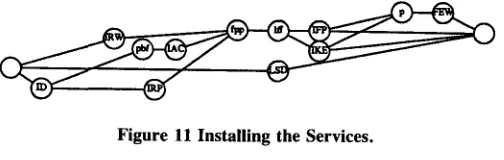
Figure 11 Installing the Services.
limited choice among possible syntactic structures and are able to introduce pronominalization where it seems appropriate, but their scope is heavily constrained by the message. During structure building, a domain-de- pendent lexicon makes available a verb entry for each domain state and action, as well as a fixed NP that can be used to denote each domain object. Although it is useful to assess the effectiveness of the system by considering the text output, many of the more interest- ing problems with the system are really already visible at the message stage.
5. DISCUSSION
5.1 FURTHER EXAMPLES
The system has been tested using a number of different domains with rather different characteristics, and the results have been correspondingly varied. One domain that seems to work fairly well is that of cookery recipes such as the following:
MAKING PAPRIKA POTATOES AND SMOKED SAUSAGES Melt the fat, fry the onion in it, add the flour to it and add the paprika to it. After this, stir the sauce until it boils. Meanwhile peel the potatoes and cut them into pieces. After this, add them to the sauce, cover the pan and make the sauce boil, stirring the sauce occasion- ally. Meanwhile cook the sausages. After this, add them to the sauce.
This text was actually produced from a " m o c k u p " of plausible planner output, rather than a real plan, and did not include enough information (about preconditions, effects, etc.) to warrant the system adding justifications about ordering. This does not seem to matter too much, probably because cookery recipes are traditionally pre- sented as instructions to be followed more or less blindly.
For an example where our techniques produce a less pleasing result, consider the "installing the services" extract from the house-building plan (discussed above) shown in Figure 11. In this action graph (which shows no preconditions or effects), we have indicated the actions with abbreviated names. Those actions in low- ercase are not actually part of installing the services (but are "intruder" actions that are nevertheless crucial to this part of the plan); they will be described elsewhere in the text. Here is the English produced for this plan fragment:
INSTALLING THE SERVICES
Installing the services involves finishing the electrical work and laying the storm drains.
You must paint the house before finishing the electrical work.
In order to paint the house you must have installed the finished plumbing and installed the kitchen equipment. You must lay the finished flooring before installing the finished plumbing and installing the kitchen equipment. You must fasten the plaster and plaster board before laying the finished flooring. In order to fasten the plaster and plaster board you must have installed the air conditioning and installed the rough plumbing and installed the rough wiring.
Install the drains and then install the air conditioning, installing the rough plumbing.
Meanwhile install the rough wiring,
You can now fasten the plaster and plaster board. You can now lay the finishedflooring.
You can now install the finished plumbing and install the kitchen equipment.
You can now paint the house.
You can now finish the electrical work. Meanwhile lay the storm drains.
You have now finished installing the services.
This account is basically comprehensible, but is repet- itive and quite hard to follow. One reason for the repetition is that the subject matter is really very boring and uninformative, and it would be quite a challenging task for a human being to produce interesting and readable text from the same information. We discuss below some other reasons why this text is less than optimal.
5.2 DEFICIENCIES IN PLANS
Although generating explanations from the output of an AI planner appears to be a promising application of natural language generation research, there are a num- ber of special problems that we have encountered with this task. Indeed, we can explain some of the deft- ciences in the text we have been able to generate purely in terms of deficiencies of the planner and/or its plans. Some problems stem from the use of plan operators not designed with text generation in mind, and can be solved within the scope of the planning system. More serious are problems that arise because of deficiencies in the planner methodology itself. In the development of our system we have encountered a number of these, ranging from trivial to quite fundamental. Some of these are properties of NONLIN in particular; others apply more generally to most AI planning systems. It is not appropriate to discuss the full details of these problems here, but we shall mention some of the main points.
GRANULARITY
One might ask why, unlike in the cookery recipe, there is no pronominalization in the text for installing the services. The coherence of the text would be improved
[image:13.612.62.314.58.138.2]