1088
©IJRASET: All Rights are Reserved
Need of 5G Wireless Technology in Internet of
Things (IOT) as a Catalyst for Technical
Revolution
B. Roshini Begum1, S. Dharani2, S. Reshmi3
1, 2
Student, 3Assistant Professor, Dept of computer science and applications, Sri Krishna Arts and Science College, Coimbatore-641008, India.
Abstract: 5G technology is visualized as a complicated mixture of technological implementation to the next-generation telecommunication networks. In the past 10 years, the Internet of Things has transformed the universal computing with abundant applications built throughout with the usage of sensor devices. An enormous development is made in the past few years and is forecasted to increase in the forthcoming years with huge number of devices on an average of 6 or 7 devices for an individual by the year 2020. Gadget to gadget communication accompanied with intuitive data are presumed to slowly and efficiently change the working environment of industries. In fact, to establish IoT services at scale efficiently, 5Gs critical satisfaction is mandatory. These incorporate improved network speeds and ability, lowered communication latency and adaptable service delivery methods. The exposure and adoption of cloud computing to with expansion of devices is expected to held forth revolution. These revolutions excite us to form a survey on existing work, sketch new techniques and discover new implementations associated with IoT.
Keywords: Internet of Things, IoT applications, cellular networks, 5g Radio Technology.
I. INTRODUCTION
Internet of Things is a prominent and assuring technology that tends to transform the global would through secured physical gadgets. The idea of IoT has emphasized researchers by making sure that wearable devices, detectors, phones, laptops, home appliances, etc are linked commonly which has the ability to interact. IoT enables gadget to gadget transmission between motley gadgets without any human interference or interaction. According to a research made by Ericsson it has forecast that 28 billion devices will be connected. It is estimated that about 7 billion devices are to be linked 2G, 3G and 4G cellular technologies. These devices will make an income of about 4.3 trillion dollars worldwide. Enabling modern IoT technology in the authorized spectrum bands to provide critical IoT usage. The challenge to be faced now is the answer to the critical question, "how fifth generation mobile network will meet the requirements of IoT?". Security is another challenge faced by Internet of Things today. Devices are becoming more universal and inescapable in everyday life.
II. REQUIREMENTS FOR IMPLEMENTING 5G WIRELESS TECHNOLOGY IN IOT 1) Developing IoT Applications: The main principles to be considered before developing IoT applications are
2) Safe Data Collection: It is important to protect the information and check the integrity and security of the initial settings in these devices.
3) High-performance Data Streaming: Thousands of electronic devices must have efficient streaming of large amount of information and it should be different from original packet transfers.
4) Creating a platform: The Internet of things platform consists of tools that systematize and process data from electronic gadgets.
5) Internet of Things Solution Cloud: For the quick distribution of data to a manual device, and also to assemble consolidated warehousing cloud solutions are usually used.
1089
©IJRASET: All Rights are Reserved
[image:2.612.125.423.85.341.2]
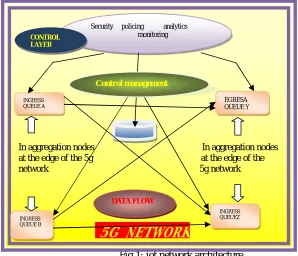
Fig 1: iot network architecture
7) IoT Design: In order to assure that the ordinary cellular LPWA systems are used to give efficient connectivity supply. Some of the key essentials taken into consideration of these massive services include low deployment cost, reasonable device cost, long lasting battery, expanded coverage area, scalability, security and privacy.
8) Existing IoT Communication Technology: Usage of MANET in pervasive environment provides a new anticipation in observing the extensive urban areas. The sensors that are used for IoT applications, have the capability to sense the environment. There is no uniform solution for IoT devices now. There are a number of different communication technologies that have been implied and are currently in operation.
9) 3GPP Cellular Solutions for IoT: Cellular Networks i.e the third generation and forth generation networks and more specifically the 3rd Generation Partnership-Project Long-Term Evolution networks are among the well recognized and encouraging networks that are currently being considered as a major topographical compatibility to attain the present IoT applications. These favorable and engaging technologies are efficient enough to offer broad extended area, competitively less costly but provides high security. 3rd generation partnership project in its want to assure that 4G broadband devices are highly supported.
10) 5G New Radio Enhancements for The IoT: Some of the characteristics and enhancements for 3GPP Release-14 are a) General Improvements to MTC
b) Improvements made in NB-IoT c) Needs of NB-IoT RF
Fig 2: 5g new radio technology benefits
In aggregation nodes In aggregation nodes at the edge of the 5g at the edge of the network 5g network
5G NETWORK
INGRESS QUEUE A
EGRESA QUEUE Y
INGRESS QUEUE B
INGRESS QUEUEZ
Security policing analytics monitoring
DATA FLOW
CONTROL LAYER
Control management
MASSIVE MISSION INTERNET OF CRITICAL THINGS CONTROL
ENHANCED LOW MOBILE DATA
BROADBAND SCHEME
5G
[image:2.612.194.430.584.715.2]1090
©IJRASET: All Rights are Reserved
Researches show that the 5G cellular networks has to serve the tremendous grouping of Internet of things with smart gadgets and sensors that might probably be a real representation to the world and helps to support the assignment of use cases, that require relevant reactions and automation of energetic processes across various fields of operation including vehicle-to-infrastructure(V2I), vehicle-to-vehicle (V2V) and lightning motion. The new 5th generation radio web is supposed to serve colossal and condemnatory use cases as the urge seems to increase widely with the advantage of using mobile networks. The 5th Generation New Radio has expanded to provide magnification in the areas of pliability and hierarchical regarding power consumption and spectrum bands.
III. ESSENTIAL FEATURES FOR ENABLING INTERNET OF THINGS
5th Generation networks are envisioned as a promising approach to the future networks to sustain the massive categorization of concurrently linked heterogeneous devices with up to date solutions based on livery devices, improved coverage area, less inertia, high adaptability and scalability. Three essential features for enabling internet of things include
A.Software-Defined Wireless Network
Digital mechanisms which are presently used for mobile inter-communications and exclusively for the increasing growth and demands of these applications. These hardware-based designs are emanating technologies for future generation of mobile network, introduced to increase the pliability of the web structure to lodge and prosecute the enormous in pouring of data. SDWSN is a brand new hopeful paradigm to attain Low-Rate wireless data by the fusion of Software-Defined Networking (SDN) model into existing Wireless Sensor Networks (WSN).
B.Network Function Virtualization
Network Function Virtualization is highly independent to SDN, envisioned as an authorized network for the upcoming generations. System calls for the IoT applications are not dependent on one another. This indicates that NFV can be boomingly implemented without taking SDN into account and vice versa. In addition, both the solutions can be merged to attain optimal performance output.
Device Category LTE-Cat-1 EC-GSM-IoT LTE Cat-M1 (eMTC)
3GPP Release Peak Data Rate
8
DL:10Mbps UL:5Mbps
13
For DL & UL: 74 kbps
13
DL: 1 Mbps UL: 1 Mbps
Bandwidth 20 MHz 0.2 MHz 1.08 MHz
MCL 140.7 dB 164dB,154dB 155.7 db
Transmit Power PSM
23 dBm PSM 33 or 23 dBm 20 dBm or 23 dBm
Security Supports 3GPP
(128-256bit
Supports 3GPP (128-256bit)
Supports 3GPP (128-256bit)
Spectrum Supports
licensed LTE Bands In-band
Supports licensed gsm bands
Supports licensed LTE Bands In-band
Table1: complexity reduction summary for lte iot user equipments[1]
C.Radio Signal Transmission
Present urge for MTC ensures that every single thing is in contact everywhere and at any moment, which has resulted in extreme change in both current mobile network and in the future generation of cellular networks such as the 5th Generation mobile network. The current network conditions for IoT operations will certainly produce an outcome in an enlarged moderate revenue for a particular user which would result in an outcome of newly imported devices.
1091
©IJRASET: All Rights are Reserved
IV. RESEARCH COMPLICATIONS AND FUTURE CHALLENGES
As a result of emergence of next generation wireless networks popularly known as 5th Generation telecommunication Standard there is increasing interest in technologies. The present demand for the networks urges us to ensure various new applications and services which would benefit the industrial and societal environment. Special consideration should be given in order to ensure proper security and quality of service to the end users. In this section of the paper, we try to point out some of the challenges hidden in implementing the next generation wireless networks.
A.Scalability
Network resource services are coming across a number of issues to uplift their networks up in terms of magnitude and capacity. It is seen as a major issue while taking LTE networks into consideration. Scalability in this case refers to giving best quality service to the end users without making any compromise to the existing users. When a massive number of devices globally gets connected to a single network provider then scalability becomes a major issue.
B.Network Management
To make sure that the network appliances, service and gadgets comparability Network Management Solutions (NMS) are deployed. Still, taking the Internet of things into consideration the want for the network management and their service are necessary.
C.Heterogeneity and Interoperability
Heterogeneous nature of Internet of Things is also a indispensable problem that causes interoperability between multiple devices more complicated to attain, more specifically with the exposure of upcoming transmission technologies which pave way to many homogenizing provocation including applications, services, standards and discoveries.
D.Security Issues
One of the most fundamental component required for the security of any network is the device's congruence and the appliances used to locate them. Since the organizing potential of MTC gadgets are restricted because of their resource contrived nature. These type of devices may not efficiently work on existing reliable sources. To overpower these provocations and assure secure communication between end-to-end devices, there is a want to explore and compile new authentication techniques to cultivate a shared infrastructure.
V. CONCLUSION
Internet of Things and the fifth generation of wireless technology are the most important components that are expected to shape the upcoming generation of the Internet. This paper analyses we have analyzed the prospective of 3GPP technologies and also the unique attributes of the present generation IoT standard. The previous generation of networking were designed specifically for broadband but it cannot be the same for the 5g networks. The future of Internet services are expected to give best quality service to the users. This seems to be very challenging because of the constrained nature of the Internet network.
REFERENCE
[1] Godfrey A. Akpakwu and Gerhard P. Hancke, "A Survey on 5G Networks for the Internet of Things: Communication Technologies and Challenges" in: 2017 IEEE International Conference 2017, pp. 1-56.
[2] Hossam Fattah, "5G LTE Narrowband Internet of Things (NB-IoT)" 1st Edition, CRC Press Published September 4, 2018.
[3] M. R. Palattella et al., "Internet of things in the 5G era: Enablers, architecture, and business models," IEEE Journal on Selected Areas in Communications, vol. 34, no. 3, pp. 510-527, 2016.
[4] E. Borgia, "The Internet of Things vision: Key features, applications and open issues," Computer Communications, vol. 54, no. 12, pp. 1-31, 2014. [5] R. Want, B. N. Schilit, and S. Jenson, "Enabling the internet of things," Computer, vol. 48, no. 1, pp. 28-35, 2015.
1092
©IJRASET: All Rights are Reserved
[7] I. W. Group, "Wireless medium access control and physical layer specifications for low-rate wireless personal area networks," IEEE Standard, vol. 802, no. 4, p. 2003, 2003.
[8] Z. Alliance, "ZigBee Specifications r13," 2006.
[9] I. W. Group, "IEEE Standard for Information technology-Telecommunications and information exchange between systems-Local and metropolitan area networks-Specific requirements Part Wireless LAN Medium Access Control (MAC) and Physical Layer (PHY) networks-Specifications," IEEE Std, vol. 802, no. 11, 2010.
[10] S. Andreev et al., "Understanding the IoT connectivity landscape: a contemporary M2M radio technology roadmap," IEEE Communications Magazine, vol. 53, no. 9, pp. 32-40, 2015.
[11] U. Raza, P. Kulkarni, and M. Sooriyabandara, "Low Power Wide Area Networks: An Overview," arXiv preprint arXiv:1606.07360, vol. 2, no. 1, 2017.
[12] T. Adame, A. Bel, B. Bellalta, J. Barcelo, and M. Oliver, "IEEE 802.11 AH: the WiFi approach for M2M communications," IEEE Wireless Communications, vol. 21, no. 6, pp. 144-152, 2014.
[13] A. Biral, M. Centenaro, A. Zanella, L. Vangelista, and M. Zorzi, "The challenges of M2M massive access in wireless cellular networks," Digital Communications and Networks, vol. 1, no. 1, 1-19, 2015.
[14] F. Ghavimi and H.-H. Chen, "M2M communications in 3GPP LTE/LTE-A networks: architectures, service requirements, challenges, and applications," IEEE Communications Surveys & Tutorials, vol. 17, no. 2, pp. 525-549, 2015.