Immune surveillance of spermatogenesis
Reproduction is one of the most serious biologi-cal problems that markedly influence the efficiency of livestock production. Immunology is a powerful tool for studying both normal fertility and infertility of farm animals.
There are two basic functions of the immune surveillance of man and animals with respect to sperm immunity during the spermatogenesis and fertilization process: support of the elimination of the vast majority of “waste” spermatozoa that fail to fertilize and preservation of the tiny minority of surviving spermatozoa that are able to fertilize the oocytes. The primordial forms of spermato-zoa arising in the seminiferous tubules of testes are preserved by the blood-testes barrier which is
formed by Sertoli cells ringing the seminiferous tubules (Hunter, 1989). During maturation in the epididymis the spermatozoa acquire their antigenic properties. Simultaneously, the spermatozoa are coated with some proteins of seminal plasma hav-ing the immunosuppressive activity toward lym-phocytes and macrophages involved in the immune reactions. The seminal plasma proteins accompany the migration of spermatozoa to the female genital tract (Matoušek, 1985).
The humoral immunity has an important role during the maturation and development of the func-tional properties of spermatozoa. Antibodies that recognize surface antigens of mature spermatozoa are present in sera of both sexes. The spermatozoa may be exposed to antisperm antibodies in semen and in cervical, ovarian follicular and fallopian fluid
Supported by the Science and Technology Assistance Agency of the Slovak Republic (Grant APVT-51-016502) and Science Grant Agency of the Ministry of Education and Slovak Academy Sciences of the Slovak Republic (Grant No. 2/3045/03).
Function of complement regulatory proteins
in immunity of reproduction: a review
J. VALENTOVIČOVÁ, M. SIMON, J. ANTALÍKOVÁ
Institute of Animal Biochemistry and Genetics, Slovak Academy of Sciences, Ivanka pri Dunaji, Slovak Republic
ABSTRACT:Humoral immunity has an important role during the maturation and development of the functional properties of spermatozoa. Spermatozoa may be exposed to antisperm antibodies in semen and in cervical, ovarian follicular and fallopian fluid. Antisperm antibodies can be complement-fixing or non-fixing and may affect the reproductive functions in a number of ways. Although the antisperm antibody alone can cause sperm agglutina-tion, complement fixation is required for their immobilization. Therefore, the complement activation might be a “keystone” for the better understanding of “sperm humoral immunity” and some types of infertility. Recently, three cell surface molecules (CD molecules – CD46, CD55, CD59) present on many tissues in male and female reproductive tracts and gametes have been identified. These proteins belong to the family of complement regulatory proteins which could regulate the function of a complement system by cleav-age of complement cascade in discrete sites of both activation ways (classical and alternative). In this review, the particular mechanisms of activity of complement regulatory proteins are presented as well as their function in a fertilization process and expression in human and animal tissues and organs.
(Haas et al., 1982; D’Cruz et al., 1990). Antisperm antibodies may be complement-fixing or non-fixing and they affect reproductive functions in a number of ways. Although antibodies alone can cause sperm agglutination, complement fixation is required for their immobilization (Mathur et al., 1981). Therefore the complement activation might be a “keystone” for the better understanding of “sperm humoral immunity” and some types of infertility. The mechanism by which complement activation on spermatozoa and seminal plasma is controlled attracts much scientific interest. Recently, several specific complement-regulatory proteins, present also in male and female reproductive tracts and on gametes, have been identified. These proteins belong to the CD molecules family.
Complement regulatory CD molecules (antigens)
CD molecules are antigens appearing in the cell membrane in a specific stage of their development. They remain there in a specific development period or they remain there as a characteristic marker till de-struction of the cell membrane. For these properties they are also marked as “differentiation antigens”.
To date, more than 200 surface antigens defined on human leucocytes are known and their number is still increasing. There is a large heterogeneity in the structure and functions of CD antigens. They comprise the receptors for antigens, MHC (Major Histocompatibility Complex) glycoproteins, adhe-sive molecules, receptors for immunoglobulins, re-ceptors for complement, rere-ceptors for lymphokines and other growth and differentiation factors, mem-brane enzymes or transport molecules and other molecules, with well-characterized structure and expression but the function of which has not been defined yet (Hořejší, 1991; Barclay et al., 1997).
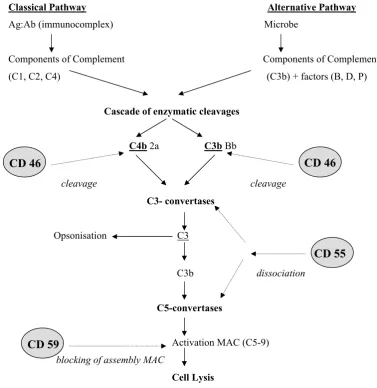
Majority of CD molecules are involved in the im-mune functions of organism. Some of them are also expressed on the sperm membrane (CD44, CD46, CD47, CD52, CD55, CD59 and CD117). Their role in sperm immunity is mostly unknown. It seems, however, that three CD molecules – CD46, CD55 and CD59 – expressed on spermatozoa (Rooney et al., 1992) are involved in the complement activa-tion and consequently, they could participate in the regulation of complement (C) – mediated killing of spermatozoa (Figure 1). Moreover, the complement regulatory proteins (CD46, CD55 and CD59) are
expressed on the fallopian tube endometrium, cer-vical mucosa, oocytes and embryos, and they may thus play an important role in protecting the trans-versing sperm and implanting blastocyst from com-plement-mediated damage (Fenichel et al., 1995; Jensen et al., 1995). There is some experimental evidence that CD molecules could protect human trophoblasts from a complement-mediated attack (Cunningham and Trichenor, 1995). Furthermore, CD46 may be involved in sperm binding to the zona pellucida of the female oocyte. Anti-CD46 mono-clonal antibody inhibits the human spermatozoa-oocyte interaction (Taylor et al., 1994).
In the last decade a lot of data concerning the chemical structure of the cell and tissue distribu-tion and the funcdistribu-tional properties of complement regulatory proteins have been acquired. These data allow us to construct a possible mechanism of com-plement regulation in the immune system generally and especially in the sperm immunity.
CD46 (MCP; membrane cofactor protein)
CD46 is a transmembrane glycoprotein with the molecular weight of about 50–60 kDa (Van den Berg et al., 1997), consisting of four homologous short consensus repeats: serine/threonine/proline (STP) – enriched region, an area of undefined function, transmembrane hydrophobic domain, cytoplasmic anchor and cytoplasmic tail (Liszewski et al., 1991). It is important to note that due to the alternative “splicing” of STP- and cytoplasmic regions, various isoforms of MCP are expressed on somatic cells but no polymorphism was found on sperm.
In man, the MCP is expressed by acrosome-reacted, but not acrosome-intact spermatozoa (Anderson et al., 1989). Interestingly, the CD46 expressed on sperm is a 42 kDa molecule. It means that this form is by 20 kDa smaller than the iso-forms expressed in other tissues and organs (Russel et al., 1992; Cervoni et al., 1993). MCP is not ex-pressed on unfertilized oocytes but it appears at the 6–8 cell stage embryo. This glycoprotein is present on all human peripheral blood cells and platelets, but not on erythrocytes; on fibroblasts, endothelial and epithelial cells, and on tissues of reproduc-tive system, including fallopian tube, uterine en-dometrium and placenta (Liszewski et al., 1991). It is also present in seminal fluid.
Classical Pathway Alternative Pathway
Ag:Ab (immunocomplex) Microbe
Components of Complement Components of Complement (C1, C2, C4) (C3b) + factors (B, D, P)
Cascade of enzymatic cleavages
C4b 2a C3b Bb
cleavage cleavage
C3- convertases
Opsonisation C3
C3b dissociation
C5-convertases
Activation MAC (C5-9) blocking of assembly MAC
Cell Lysis
CD 46
CD 46
CD 55
[image:3.595.113.491.88.477.2]CD 59
Figure 1. Functional activity of complement-regulatory proteins
Complement is a part of the mechanism of natural humoral immunity. This system is composed of more than 30 glycopro-teins which are present in the blood serum and on the surface of some cells. The primary functions of these proglycopro-teins are the production of inflammation, opsonisation of foreign materials for phagocytosis and mediation of direct cytotoxicity against various cells and microorganisms. Specific parts of the complement are activated gradually by a cascade mechanism – activation of the first component causes the arising of serine protease (proteolytic enzyme) which causes the cleavage of the subsequent component into two fragments (limited proteolysis). One of these fragments serves as an enzyme cleavage of subsequent component, etc. Some fragments do not serve as enzymes, they act as cofactors or they have bioregulatory functions. This system can be disrupted by the functional activity of CRP (CD46, CD 55, CD59) and further activity of the complement is interrupted. In Figure 1, the cleavage activity of complement regulatory proteins is presented and marked with linear arrows. Whereas CD46 cleaves C4b or C3b component of complement, CD55 affects the complement on the level of C3 or C5-convertases and causes their dissociation. CD59 prevents the assembly of the membrane attack complex and subsequently blocks the cell lysis
an autologous complement attack (Kinoshita and Seya, 1995). Within the complement, it serves as a cofactor for factor I, which mediates the C3b and C4b cleavage (Hourcade et al., 1989) (Figure 2). The resulting cleavage fragments are incapable of
forming convertase, thereby they inhibit further complement activation.
mono-clonal antibodies caused a significant decrease in the number of oocytes showing sperm binding and formation of pronuclei (Taylor et al., 1994). It was reported that the blocking of human sperm by CD46 suppressed sperm binding to human and hamster oocytes (Okabe et al., 1990; Taylor and Johnson, 1996). Kitamura et al. (1997) proposed a new category of infertility – a sperm-specific CD46 aberration. The same authors reported that the sperm lost the ability to adhere to oocytes due to the observed defects in the sperm CD46, thereby causing a failure of fertilization.
CD55 (decay accelerating factor, DAF)
DAF is a 70 kDa glycolipid- an anchored membrane-bound complement regulation protein. Similarly like all complement regulation proteins DAF is mainly composed of tandemly repeated motif (short consen-sus repeats) of about 60 to 70 amino acids in length. In humans, multiple isoforms exist including glyco-sylphosphatidylinositol (GPI)-anchored, transmem-brane and secreted forms with variable lengths of the serine/threonine-rich region.
Originally, DAF was described on human eryth-rocytes but later it was demonstrated on other circulating blood cells including neutrophils, lym-phocytes, monocytes, granulocytes and platelets. While MCP is not present on the outer plasma membrane of freshly ejaculated spermatozoa, very low levels of DAF were detected in this site. Both proteins are strongly expressed on the inner acro-somal membrane, which is exposed on the surface of the cell following an acrosome reaction (approx. 7 h after entry to the female reproductive tract) (He et al., 2000).
In oogenesis, DAF is already expressed on the plasma membrane of oocytes at the primordial fol-licle stage and continues to be expressed through-out follicular development. The DAF isoform on oocytes seems to be very different from that on spermatozoa (He et al., 2000).
[image:4.595.68.534.84.167.2]Liszewski et al. (1991) reported that MCP and DAF protect autologous cells from a complement-mediated attack by regulating the activation of C3/C5 convertases. DAF increases the dissocia-tion of C3/C5 convertases (Figure 3) whereas MCP facilitates their degradation by proteolysis of C3b and C4b (Lublin and Atkinson, 1989).
Figure 2. Mechanisms of CD 46 function
CD 46 binds to C4b (classical complement pathway) or C3b component of C (alternative pathway) and causes cleavage of these proteins and hence incapability of forming C3-convertases and inhibition of further complement activation
C4b + CD46 C4b CD46 C4b + CD46 C3-convertase
Figure 3. Mechanism of CD 55 function
Binding of CD 55 to C3-convertase results in dissociation of this proteinase, loss of the binding site for Bb factor and inter-ruption of complement activation
C3-convertase
C3b Bb + DAF C3b DAF + Bb + DAF + Bb
Dissociation of C3b C3b
[image:4.595.70.531.623.679.2]CD59 (protectin)
Similarly like DAF, CD59 is an 18–20 kDa mem-brane bound glycoprotein linked to the memmem-brane by a GPI-anchor. Unlike CD46 and CD55, CD59 can be transferred between cells via fluid phase vesicles (prostasomes) and non-membranous complexes, which can explain its presence in many body fluids including blood plasma, saliva, amniotic, seminal fluid and urine (Rooney et al., 1993b).
CD59 is expressed on leucocytes, erythrocytes, platelets, a variety of endothelial and epithelial cells, placenta and spermatozoa. The high levels of CD59 observed on all trophoblast subpopulations suggest that its MAC-inhibitory activity is of ex-treme importance in the maintenance of placental function (Rooney et al., 1993a).
On spermatozoa, CD59 is expressed on the caput on the surface of acrosome-intact spermatozoa (Rooney et al., 1992). Thus the CD59 molecule seems to be capable of protecting intact spermato-zoa in absence regulators of C3-convertases (CD46 and CD55) (Figure 4). CD59 is strongly expressed on the outer plasma membrane of spermatozoa and may prevent membrane attack complex (MAC)-mediated damage to uncapacitated spermatozoa in the female reproductive tract (Rooney et al., 1993a).
To get together the cleavage activity of the three complement regulatory proteins in the inactiva-tion of the complement, the whole procedure of complement regulation in both classic and alter-native way could be constructed. In Figure 1 the cleavage sites of complement regulation proteins are demonstrated.
Complement regulatory proteins of farm animals
A majority of studies concerning the complement regulatory proteins was performed in man. Due
to the intensive study, man is the single species where CD46, CD55 and CD59 were unequivocally identified. The question remains open whether the complement regulation proteins and a similar mechanism of complement activation exist in other species such as farm animals.
There are some evidences for the existence of CD46 in primates (Nickells and Atkinson, 1990). In the rabbit, tentative identification of CD46 on platelets was made based on its binding to affin-ity columns of rabbit C3 (Manthei et al., 1988). Analogous molecules to human MCP with pref-erential expression in testes and testicular germ cells were identified in guinea-pig (Hosokawa et al., 1997) and mice (Tsujimura et al., 1998). Moreover, the guinea-pig epididymal spermatozoa carry CD55 on their surface (He et al., 2000). More detailed studies were performed in pig with a panel of mon-oclonal antibodies raised against pig lymphocytes. N-terminal amino acid analysis through the first 28 residues showed a 43% homology with the hu-man complement regulatory molecule membrane cofactor protein. The purified protein showed co-factor activity for co-factor I-mediated cleavage of human and pig C3b, confirming its identity as the pig analogue of human MCP (Van den Berg et al., 1997). Moreover, the cofactor activity of pig MCP toward the human C3b is particularly important in the context of recent strategies for xenotransplan-tation. Transgenic pig expressing human comple-ment inhibitors on their tissues are bred as organ donors in the expectation that their organs will be less susceptible to hyperacute rejection in the hu-man recipient. MCP of pig is abundantly expressed throughout all tissues examined with particularly strong staining on the vascular endothelium. Unlike human analogues, CD 46 in the pig and orangutan MCP is abundantly expressed on erythrocytes (Van den Berg et al., 1997). Connective tissue elements within liver and testes are also strongly stained by anti-pig MCP antibodies (Peréz de la Lastra et al., 1999). Recently, the cattle CD46 molecule has also
Figure 4. Mechanism of CD 59 function
CD 59 blocks the assembly of MAC. It eliminates the binding of C 9 to C5b-8 complex and prevents the formation of the membrane attack complex that would mediate the cell lysis
been identified. It was shown that MCP could serve as a cellular receptor for bovine viral diarrhoea vi-rus (Maurer et al., 2004). However, no information is available about the expression of CD46 on mature and capacitated sperm or its presence in the liq-uids of male and female reproductive tracts. More complex study of the structure and function of the complement regulation proteins of farm animals could help us to understand better the immune protection and/or selection of spermatozoa as well as the interpretation of some types of infertility.
REFERENCES
Anderson D.J., Michalson J.S., Johnson P.M. (1989): Tro-phoblast/leukocyte-common antigen is expressed by human testicular germ cells and appears on the surface of acrosome-reacted sperm. Biol. Reprod., 41, 285– 293.
Barclay A.N., Brown M.H., Law S.K.A., Knight A.J., Tom-linson M.G.,van der Merwe P.A. (1997): The leukocyte antigen facts book. Academic Press, Oxford, U.K., 1– 613.
Cervoni F., Oglesby T.J., Fenichel P., Dohr G., Rossi B., Atkinson J.P., Hsi B.L. (1993): Expression of decay-ac-celerating factor (CD 55) of the complement system on human spermatozoa. J. Immunol., 151, 939–948. Cunningham D.S, Tichenor J.R. (1995):
Decay-accelerat-ing factor protects human trophoblast form comple-ment-mediated attack. Clin. Immunol. Immunopathol., 75,156–161.
D’Cruz O., Haas F.F., Lambert H. (1990): Evaluation of antisperm complement-dependent immune mediators in human follicular fluid. J. Immunol., 144, 3841– 3848.
Fenichel P., Donzeau M., Cervoni F., Menezo Y., Hsi B.L. (1995): Expression of complement regulatory proteins on human eggs and preimplantation embryos. Am. J. Reprod. Immunol., 33, 155–164.
Haas G.G., Weis-Wik R., Wolf D.P. (1982): Identification of antisperm antibodies on sperm of infertile men. Fertil. Steril., 38, 54–61.
He C., Nonaka M., Tada T., Koji W., Li W., Okada N., Okada H. (2000): Decay accelerating factor in guinea-pig reproductive organs. Immunology, 100, 91–98. Hořejší V. (1991): Surface antigens on human leucocytes.
Adv. Immunol., 49, 75–147.
Hosokawa M., Nonaka M., Okada N., Okada H. (1997): Molecular cloning of guinea-pig membrane cofactor protein, preferential expression in testis. J. Immunol., 15, 4946–4952.
Hourcade D., Holers V.M., Atkinson J.P. (1989): The regulators of complement activation (RCA). Adv. Im-munol., 45, 381–416.
Hunter A.G. (1989): Immunology and fertility in the bo-vine. J. Dairy Sci., 72, 3353–3362.
Jensen T.S., Björge L., Wollen A.L., Ulstein M. (1995): Identification of the complement regulatory proteins CD46, CD55, and CD 59 in human fallopian tube, en-dometrium, and cervical mucosa and secretion. Am. J. Reprod. Immunol., 34, 1–9.
Kinoshita T., Seya T. (1995): Complement regulatory proteins on nucleated cells. In: Erdei A. (ed.): New As-pects of Complement Structure and Function R. G. LANDES, Texas, USA. 35–38 pp.
Kitamura M., Matsumiya K., Yamanaka M., Takahara S., Hara T., Matsumoto M., Namiki M., Okuyama A., Seya T. (1997): Possible association of infertility with sperm-specific abnormality of CD46. J. Reprod. Immunol.,33, 83–88.
Liszewski M.K., Post T.W., Atkinson J.P. (1991): Mem-brane cofactor protein (MCP of CD 46): Newest mem-ber of regulators of the complement activation gene cluster. Annu. Rev. Immunol., 9, 431–455.
Lublin D.M., Atkinson J.P. (1989): Decay accelerating fac-tor: Biochemistry, molecular biology, and function. Annu. Rev. Immunol., 7, 35–58.
Manthei U., Nickells M., Barnes S.U., Ballard L.L., Cui W.Y., Atkindoon J.P. (1988): Identification of a C3b/iC3 binding protein of rabbit platelets and leukocytes: a CR1-like candidate for the immune adherence receptor. J. Immunol., 140, 1228–1235.
Mathur S., Williamson H.O., Derrick F.C., Madyartha P.R., Melchers J.T., Holtz G.L., Baker E.R., Smith C.L., Fundennberg H.H. (1981): A new microassay for sper-matocytotoxic antibody in couples with unexplained infertility. J. Immunol., 126, 905–911.
Matoušek J. (1985): Biological and immunological roles of proteins in the sperm of domestic animals. Anim. Reprod. Sci., 8, 1–40.
Maurer K., Krey T., Moening V., Thiel H., Rümenapf (2004): CD46 is a cellular receptor for bovine diarrhoea virus. J. Virol., 78, 1792–1799.
Nickells M.W., Atkinson J.P. (1990): Characterization of CR1 and membrane cofactor protein-like proteins of two primates. J. Immunol., 144, 4262–4268.
Okabe M., Magira M., Kawai Y., Matzno S., Mimura T., Mayumi T. (1990): A human sperm antigen possibly involved in binding and/or fusion with zona-free ham-ster eggs. Fertil. Steril., 63, 625–630.
inhib-Corresponding Author
Ing. Jana Valentovičová, Institute of Animal Biochemistry and Genetics, Slovak Academy of Sciences, Moyzesova 61, 900 28 Ivanka pri Dunaji, Slovak Republic
Tel. +421 245 943 151, e-mail: [email protected] itory protein in human seminal plasma: CD 59 is present on extracellular organelles (prostasomes), binds cell membranes and inhibits complement medi-atedlysis. J. Exp. Med., 177, 1409–1420.
Rooney I.A., Oglesby T.J., Atkinson J.P. (1993b): Comple-ment in human reproduction: Activation and control. Immunol. Res., 12, 276–294.
Rooney I.A., Davies A., Morgan B.P. (1992): Membrane-attack complex (MAC)- mediated damage to sperma-tozoa: Protection of the cells by the presences on their membranes of MAC inhibitory proteins. Immunology, 75, 499–506.
Russell S.M., Sparow R.L., McKenzie I.F.C., Purcell D.F. (1992): Tissue-specific and allelic expression of the complement regulator CD46 is controlled by alterna-tive splicing. Eur. J. Immunol., 22, 203–218.
Taylor C.T., Biljan M.M., Kingsland C.R., Johnson P.M. (1994): Inhibition of human spermatozoa-oocyte interac-tion in vitro by monoclonal antibodies to CD46 (mem-brane cofactor protein). Hum. Reprod., 9, 907–911.
Taylor C.T., Johnson P.M. (1996): Complement-binding proteins are strongly expressed by human pre-implan-tation blastocysts and cumulus cells as well as gametes. Mol. Hum. Reprod., 2, 52–59.
Tsujimura A., Shida K., Kitamura M., Nomura M., Takeda J., Tanaka H., Matsumoto M., Matsumiya K., Okuyama A., Nishimune J., Okabe M., Seya T. (1998): Molecular cloning of a murine homologue of membrane cofactor protein (CD46): preferential expression in testicular germ cells. Biochem. J., 330, 163–168.
Van Den Berg C.W., Pèrez De La Lastra J.M., Lanes D., Morgan B.P. (1997): Purification and characterisation of the pig analogue of human membrane cofactor pro-tein (CD46/MCP). J. Immunol., 158, 1703–1709. Pèrez De La Lastra J.M., Hanna (1999): Distribution of
membrane cofactor protein (MCP/CD46) on pig tis-sues. Relevance to xenotransplantation. Immunology, 98, 144–151.