INTRODUCTION
The retail market is in the important stage of its deve-lopment at present time. The attention of retail chains is moving from the extensive form of development to the intensive emphasis to quality and profitability of the goods categories (Záboj 2002). One of the trends of tail market is the co-operation between supplier and re-tailer through using the Category Management (CM). We can consider the management of goods categories as the regular element of the trade activity (Rumian 2002). CM is also a new way of marketing for new market thus mar-keting for the market characterised by a very exacting customer, modern information technologies in manufac-turers and trade firms as well and the strong position of the retailer (Perez de Leza 2003). The retailers in the Czech Republic are oriented in CM mostly for the space man-agement. They are more or less discovering the possibil-ities of projects including promotion activpossibil-ities. Some of the business subjects have not been interested in CM by this wide approach till now (Záboj 2003). Their inten-tion is rather to use some of the CM parts, e.g. the cre-ation of planograms. The experiences of the retail chain Globus is described by Petr Vyhnálek – managing direc-tor: “Among the CM partner, we specify the intensity of promotion – the number and relation of promotion
be-tween cheap and premium segment. Thus we do not specify in the frame of CM projects either the exact num-ber of actions or strict representation of promoted brands but we prepare some limits for the sourcing department” (Vyhnálek 2002). Marketing recommendations in the field of CM projects are prepared and planned by other pro-ducers – e.g. Pivovary Staropramen is a company already investing to sphere of detail analysis and research. “To be able to recommend in the promotion, there is neces-sary to have enough knowledge about selling data not only in the retail chain but in the whole market and its development. You also have to know who and why does shopping in the retail unit, to know shopper customs and behaviour”, says Petr Řežábek – off-trade develop-ment manager from Pivovary Staropramen and he truly added: “One thing is to create the promotion plan but it is very important to be able to value the results and to explain the contributions of this whole action” (Řežábek 2004).
The main object of the paper is to consider the deve-lopment of new phenomenon in management of suppli-er-customer relations between producer and retailer – Category Management. The partial aims represent recog-nising of presumptions for start-up of CM project, spe-cifying the stages of CM and determining the barriers of effective CM performance.
Analysis of using the Category Management in distribution process
Analýza využití Category Managementu v distribu
č
ním procesu
M. Z
ÁBOJMendel University of Agriculture and Forestry, Brno, Czech Republic
Abstract: The paper deals with the very actual sphere of new conceptions in frame of supplier-customer relations between trade firms and their suppliers. The common idea is management of the distribution channel by the method it would create consumer feeling that the retail shop satisfies his wants and gives him the greatest benefit with the most favourable price. Presumption for realisation of this goal becomes the implementation of a new phenomenon, so-called “Category Management” to current business processes using modern information technology.
Key words: supplier, category, category management, space management, planogram, retailer
Abstrakt: Příspěvek se zaměřuje na velmi aktuální oblast nových konceptů v rámci dodavatelsko-odběratelských vztahů
mezi obchodními firmami a jejich dodavateli. Společnou ideou je řízení distribučního řetězce způsobem, který by u spotř e-bitele vytvářel pocit, že maloobchod, do kterého chodí nakupovat, uspokojuje jeho potřeby a poskytuje mu nejvyšší užitek za nejvýhodnější cenu. Předpokladem pro splnění tohoto cíle se stává zavádění nového fenoménu tzv. „Category Manage-mentu“ do stávajících podnikových procesů, a to s využitím moderních informačních technologií.
Klíčová slova: dodavatel, kategorie, category management, space management, planogram, retailer
MATERIAL AND METHODS
To fulfil the described tasks, there are used the me-thods of analysis and synthesis of information obtained from either literature, interviews with representatives of relevant subjects or international conferences Category Management and Retail in Detail. It is necessary to men-tion that no publicamen-tion exists in the Czech books market engaged in CM due to the relatively new research prob-lem and that is why it was very difficult to gather the ne-cessary data.
Generally, by Perez de Leza (2003), in the last year the trade was influenced by another growth of demand due to the high increase of purchasing power. The scissors between inhabitant incomes and inflation are opened dra-matically. The incomes increase faster and inflation is lower than prediction. The growth of real purchasing power is probably 5–6%, moreover, the insolvency of consumers is increasing due to the variant types of hire purchase and consumers‘ loans. That is why, although the retail environment is more competitive, there is still a lot of money flowing to this sector. We could say that the other possibilities of the extensive growth of retail are still being discovered. Nowadays, the retail chains have the real problem in declining of profitability, produc-tivity and effectiveness of business performance (Tvr-doň, Krčová 2002). And CM is one of the possibilities how to solve this problem.
The retail chains are more interested in the complex project of management of selected goods category in-cluding evaluating of results from market research, data analysis and recommendations in all strategic parts (the range of products, price policy, sales promotion, goods presentation in stores). The basic goal of every CM project is adapting the category to buyer needs. In prac-tice it means to offer the requested assortment, accept-able pri-ces and motivating sales promotion. Moreover, in the frame of CM projects the suppliers (producers) together with buyers (retailers) try to increase transpar-ency of the selected goods section for consumers to pur-chase the product, which they really want to buy.
RESULTS AND DISCUSSION
Category Management is marketing measure of ECR (efficient consumer response) which in frame of manage-ment of the business unit with market segmanage-ment and own strategy puts emphasis on process of recognising of con-sumer preferences, through it operatively is setting up the selling goods, placement in store etc. CM is also the process of optimal management of category with orien-tation to customer and the category is definable, inde-pendent, controllable group of products understood by consumer/buyer as substitutable or connected with each other.
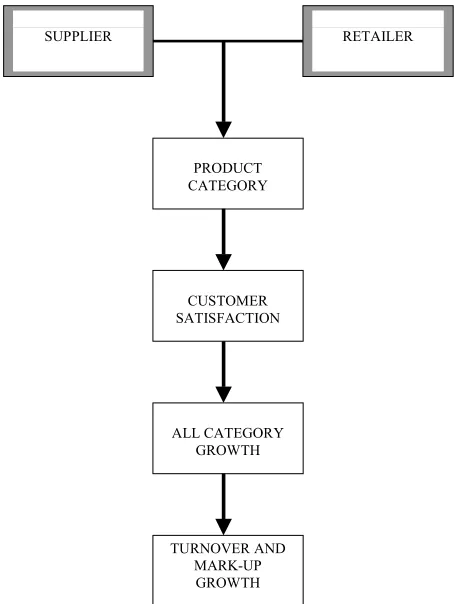
The orientation to customer means to offer the right products, at the right time, right quantity and quality, in the right place and with the best service. CM also repre-sents co-operation between producer and retailer due to the existence of suppliers/producers know-how about consumer behaviour in the given category and the retail-ers knowledge about purchasing behaviour of buyer in gi-ven store. The common aim of both the partners is to ensure increase of customer satisfaction leading to higher number of buyers of the given category, increasing their loyalty and the larger amount of their purchasing prod-ucts. The final effect is increasing the turnover of the giv-en category and market share of the givgiv-en retail chain in the category. The process of CM basically includes indi-vidual participants and levels illustrated in Figure 1.
The presumptions for starting-up of Category Management project
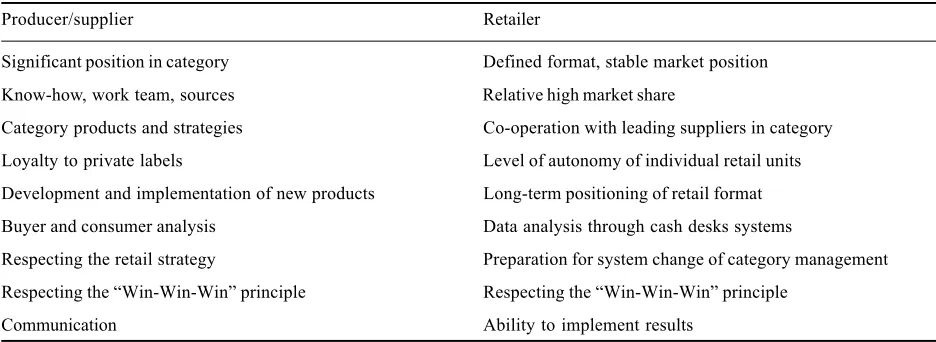
Process of CM is very time-demanding during its im-plementation. Successful using the CM also needs a very close collaboration of the partners. It means the common sharing of some business information and the require-ments in trust and objectivity in the project. CM must not carry the direct added costs because it is able to use the existing knowledge in the firms of producer and retailer. The overall presumptions for starting-up of CM project for producer and retailer are followed in Table 1.
One of the main criteria of supplier is his position in the market in the given segment. It should be important
SUPPLIER RETAILER
PRODUCT CATEGORY
CUSTOMER SATISFACTION
ALL CATEGORY GROWTH
[image:2.595.59.286.414.716.2]TURNOVER AND MARK-UP GROWTH
Figure 1. Process of Category Management
but it is not necessary to be a leader. Another factor in choosing of the partner for CM project is also know-how in CM and given category.
CM needs also labour and financial sources. Supplier and retailer should be prepared in the technical and per-sonal sectors. For example, the level of information tech-nologies could be to allow the data sharing in electronic form (EDI – electronic data interchange).
At the beginning, it is very important select the indepen-dent team. Each producer should be interested in growth of the whole category and not only in development of his own labels. It is ideal if the retailer has his own work team understanding CM projects. Then the retailer can ensure not only assortment optimising commonly with the sup-plier but also to prepare the promotion plan through ac-cepting strategies for the individual products.
Retailers and suppliers have to collaborate in such a way as to respect the principle “Win-Win-Win” in which not only both the partners obtain the profit but the consumer as well.
The phases of Category Management
Basis of the CM project is orientation to final consu-mer and buyer (she/he is not always the identical per-son). With the classic data evaluation, which is part of measurement of the project benefit, it is necessary to pro-vide also measurement of customers – buyers satisfac-tion. A professional research agency can realise this analysis directly in retail stores participating in CM project. Thus opportunities are not derived only from selling numbers but also from the opinions of buyers and final consumers. The individual phases are followed: 1. Selection of category, contract signing, schedules
ac-ceptation
2. Filling in primary forms
3. Realisation of quantitative and qualitative research 4. Research conclusions interpretation
5. Customer decision tree 6. Selling data analysis
7. Acceptation of assortment, price and promotion stra-tegy
8. Strict definition of the range of products, planograms creation
9. Acceptation of final versions 10. Implementation in stores 11. Evaluation, feedback, correction
Category Management project example could be search-ing for optimal goods placement in store. After the accep-tation of definition and role of category in the partner chain, the primary market and assortment analysis is rea-lised including the comparison with competitive stores. In the base of real selling data with using marketing informa-tion about overall market structure, applying the optimal-ity of assortment is followed on the level of subcategories. The key problem of the project is looking for the best goods presentation. Two basic possible concepts can be tested – the traditional arrangement based on classifica-tion of brands and the arrangement through subcatego-ries based on customer decision tree discovered by research. The sale analysis followed in newly arranged stores and through the comparison of results the more effective variant is then accepted and implemented. Nev-ertheless, the individual planograms can be elaborated for each store considering significant regional differences in consumption and purchase of products of the selected category. After the finishing of project, co-operation be-tween producer and retailer could not return to the origin system but it could be based on the close market informa-tion interchange (with emphasis on price optimum and searching for the most effective promotion forms). Mostly in a half-year period the total assessment of sales is per-formed with possibility of listing the new products and other modifications of planograms.
The barriers of the CM effectiveness
[image:3.595.56.524.76.247.2]A hundred percent reaching of the aim of Category Management project can be very difficult and both the
Table 1. The presumptions for start-up of Category Management
Producer/supplier Retailer
Significant position in category Defined format, stable market position Know-how, work team, sources Relative high market share
Category products and strategies Co-operation with leading suppliers in category Loyalty to private labels Level of autonomy of individual retail units Development and implementation of new products Long-term positioning of retail format Buyer and consumer analysis Data analysis through cash desks systems
Respecting the retail strategy Preparation for system change of category management Respecting the “Win-Win-Win” principle Respecting the “Win-Win-Win” principle
partners as a rule calculate with variances. Transparent determination of the goal is, of course, very important. All negotiations between buyer and supplier start through the discussion about expecting from mutual agreements. During these talks, it is possible to eliminate unrealisable expectations of merchandisers and suppli-ers and to agree with the common real aim.
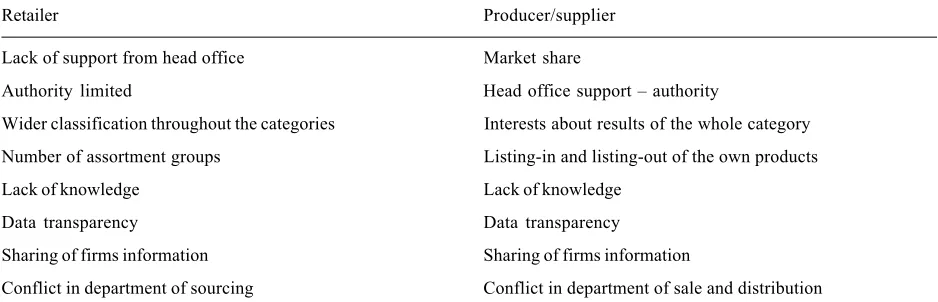
During the implementation of CM to relationship be-tween producer and retailer, the most burdensome prob-lem is the personal factor, namely in stores even in trade firms head offices. In joint project of Category Manage-ment, it is necessary still to communicate, share the in-formation, maintain the time schedule, etc. The reason of problems is often the organisation structure and then mo-tivation and knowledge of its elements – it means peo-ple. Moreover, sometimes the problem of CM project processing is the lack of quality of information. But some retail chains have very good information systems giving the selling data in week or day terms and on the level of individual stores. The main obstructions of the CM ef-fectiveness are summed in Table 2 regarding path retailer and producer.
A certain paradox is the fact that the biggest potential of development of turnover and first of all profit is in the categories where the strong and professional suppliers are missing. That is a problem because CM is based on the collaboration of professional merchandiser and pro-fessional supplier. If you look into categories performing this requirement, there are mainly food-packed goods. Just in the area of packed food, strong and professional firms exist like Nestlé, Henkel, Pražské pivovary (member of the multinational group INTERBREW) but packed food and chemist goods are not so attractive developing cat-egory for retailers because they represent something al-ready established here with suppliers and market is in this sector already segmented. But a huge potential of development is mainly in the categories of perishable food and some selected non-food goods, there the strong suppliers are missing. For a discussion about CM, it is necessary to invite not only suppliers but even con-sumers selecting in research projects and to obtain by this way their opinions. Just in goods categories where
the strong suppliers are missing, the retailer has the con-sumer as a partner instead of supplier and he invests more to research. Anyway, there is a big opportunity for firms supplying fresh food and some kinds of non-food goods, they could start to involve in market through us-ing this possibility with CM process assistance.
CONCLUSION
With a theoretical discussion about the importance of CM for Czech market, the first practical examples of us-ing that are in progress. One of the firms, which can give the provable results in this line, is Pražské pivovary, inc. This prior supplier offers to merchandisers the collabo-ration in management of the beer category already since 2000 and today the co-operation in CM projects is devel-oped not only with the main players in the retail market but even with the petrol station chains.
Henkel CR has the rich experiences with using CM in the Czech market started with CM already at the end of the 90-ties when the Czech subsidiaries of international chains started to be interested in closer form of collabo-ration. In the first years of multinational chains existing in the Czech market, the management focused on fast ex-pansion and thus CM was represented rather by space management. For the guarantee of further growth, the op-timising of individuals categories is necessary, namely optimising of assortment, price policy, placement and promotion and that is why the interest of chains for pro-fessional partnership in CM is increasing. The suitable example of CM application is also the co-operation of Henkel CR (washing and cleaning products division) with Tesco Stores CR.
[image:4.595.56.525.78.229.2]If we wanted to sum the benefits of CM, we have to differ the relevant subjects. For supplier, it is first of all sharing management of the given assortment, obtaining the selling data and trends verifying. Then for retailer it is maximising of turnover and profit by sale in the given range of products, assortments optimising and obtain-ing the general market data. Anyway, we must not target the final consumer as well because he finances the whole
Table 2. The barriers of CM project effectiveness
Retailer Producer/supplier
Lack of support from head office Market share
Authority limited Head office support – authority
Wider classification throughout the categories Interests about results of the whole category Number of assortment groups Listing-in and listing-out of the own products
Lack of knowledge Lack of knowledge
Data transparency Data transparency
Sharing of firms information Sharing of firms information
distribution chain. CM optimises the category by needs and preferences of the final consumer that is why cus-tomer satisfaction is the target. Consumer obtains better products supply, better orientation in purchase, better promotion and due to these factors, the possibility of the best shopping by his requirements.
In spite of successful implementation of CM principle, the possibility of its extending surely exists in some sec-tors. It means to overcome some barriers appearing in practice. The most usual obstruction of co-operation is the capacity preparation of both the partners for exten-sive and time demanding project regarding to delaying or unsuitable implementation of Category Management. The obstacles can even be negative experiences of retail chains with some suppliers using the CM as an instru-ment for reaching their own interests. To prevent these situations, the maximum objectivity is necessary for sup-plier of CM services based on the exact data from market research and selling outcomes. Next problem could be the relationship between supplier – CM executor and competitive products. In CM the whole category is man-aged and conflict of participants is possible. But when it works with fact data able to ground the project results, then this data could explain the relevant objections. Of-fering collaboration in CM project by two or more sup-pliers at the same time could make a difficult situation. In that case, the selective proceeding is in progress in retail chain or at the beginning more suppliers participate in CM process and then retailer can choose the best one through the good experiences.
In future, we can expect improving and accelerating the processes in the frame of CM and just several categories will stay outside of this principle. There is expected the same process in non-food goods sector and several suit-able models are possible. First, the producers of packed goods will start to expand to the fresh food category. The classic example is the Bonduelle starting as a canning factory then entering the market with frozen goods and today supplying fresh salads. Second, the producers of fresh food become more professional and competent partner for retailer. For example Olma is the firm contem-plating CM as a strategy instrument. Third, the enter of strong suppliers from abroad due to the EU enlargement. Logistic limits exist in perishable goods category but the Czech Republic is so near to Germany or Austria and new suppliers could enter the Czech market with competency in CM. They could make a big problem to domestic sup-pliers oriented now mainly to low prices due to low qual-ity. Fourth, the retailers will become dominant subjects that is why they will fully control given category and they will use suppliers only like suppliers of raw materi-als.
The practical sample of co-operation between suppli-ers and retailsuppli-ers is an ECR (Efficient Consumer Response) team founded three years ago due to the common activ-ities in CM. The team members arranging four meetings per year are retailers – Ahold, Carrefour, Globus, Makro/ Metro and Tesco Stores and producers – Balírny Douwe Egberts, Coca-Cola Beverages, Henkel, Kraft Foods,
L’Oréal, Nestlé, Poděbradka, Procter & Gamble and Uni-lever. Practice experiences in Makro in the implementa-tion of planograms took one and half year and the first results after the implementation need not be positive but in the medium and long-term view they should be. CM has an immediate impact on buyer to whom to listen more is necessary because the changes of shopping behav-iour are now very actual. The fulfilment of the common goal needs to assess and ensure the feedback from CM project after some time and then the project has to be actualised. Since the consumer behaviour in the given category can change very quickly and the range of prod-ucts could develop radically as well.
Co-operation between producers and retailers based on the effort to serve the customer better, faster and cheap-er brings the explicit results in the Czech Republic. That is why there is no doubt regarding continued develop-ment in CM. By analogy to the Western countries, it is possible to predict the transfer of CM principles from pilots’ projects to integration to ordinary marketing pro-cesses. We can also expect after the introducing the ac-cent to optimising of the assortment, placement in store and searching for the right prices, in the near future the collaboration of supplier and retailer will be still more re-alisable in products innovation and looking for new more attractive packages and retail covering. The experiences from advanced markets indicate that the most extensive potential is mainly in the section of mutual sales promo-tion (searching for new methods, cross promopromo-tion, etc.). The development in our country also tends to forming of joint teams between the most advanced retailers and pro-ducers oriented to the best satisfaction of the custom-er’s needs. In spite of the still common rule that the typical Czech customer has a very high price sensitivity, now generally the price is not considered the most important factor in shopping behaviour and in future major empha-sis will be put first of all on time ability of goods and cus-tomer’s loyalty to the retail firm. Thus the main aims are establishing of the relationship between supplier and re-tailer, creation of a better buying comfort, significant in-creasing of consumers loyalty which then would result in growth of turnover and profit of both the participating partners.
REFERENCES
Perez de Leza J. (2003): Proč výroba a obchod mohou a musí spolupracovat? Mezinárodní konference Category Mana-gement, Praha.
Rumian L. (2002): Proč by se maloobchodníci měli zajímat o Category Management? Mezinárodní konference Catego-ry Management, Praha.
Řežábek P. (2004): Category Management a nákup: soulad
či protiklad? Mezinárodní konference Retail in Detail, Brno.
Vyhnálek P. (2002): Perspektivy maloobchodního trhu z pohledu klíčového řetězce. In: Mezinárodní konference Retail in Detail, Praha.
Záboj M. (2002): Choosing the distribution channel for meat products. Agricultural Economics – Czech, 48, (7): 327–331. Záboj M. (2003): Obchodní operace. B.I.B.S, Brno; ISBN
80-86575-93-4.
Arrived on 7th July 2004
Contact address: