Received 2 February 2018 Accepted 21 February 2018
Edited by A. Van der Lee, Universite´ de Montpellier II, France
Keywords:NASICON structure; framework; crystal structure; BVS; CHARDI.
CCDC reference:1824957
Supporting information:this article has supporting information at journals.iucr.org/e
Elaboration, structural study and validation of a
new NASICON-type structure,
Na
0.72(Cr
0.48,Al
1.52)(Mo
2.77,Al
0.23)O
12Manel Sonni, Imen Jendoubi and Mohamed Faouzi Zid*
University of Tunis El Manar, Faculty of Sciences of Tunis, Laboratory of Materials, Crystal Chemistry and Applied Thermodynamics, 2092 ElManar II, Tunis, Tunisia. *Correspondence e-mail: [email protected]
The title compound, sodium chromium/aluminium molybdenum/aluminium dodecaoxide, Na0.72Cr0.48Al1.74Mo2.77O12, was prepared by solid-state reaction. Its crystal structure is related to NaSICON-type compounds. The framework is built up from M1O6 (M1 = Cr/Al) octahedra and M2O4 (M2 = Mo/Al) tetrahedra interconnected by corners. The three-dimensional framework contains cavities in which sodium cations are located. Two validation models (BVS and CHARDI) were used to confirm the proposed structural model. The mobility of Na+ions in the structure has been investigated by theoretical means.
1. Chemical context
The search for new and better solid electrolyte materials has grown considerably in recent years because of their amazing properties and their diverse applications in the field of solid-state chemistry. Indeed, many new molybdate phases with high ionic conductivity have been synthesized and structurally characterized by X-ray diffraction. A large number belong to the NASICON (‘Na super ionic conductor’) family, e.g. phosphate (Tkachev et al., 1984; Catti et al., 2004), arsenate (Harrison & Phillips, 2001), sulfate (Slater & Greaves, 1994) and molybdate (Sun et al., 2012; Kozhevnikova & Imekhe-nova, 2006) based systems. The NASICON family groups together a set of phases of the same structural type with the general formulaAM2(XO4)3(A= alkali,M= Ti, Fe, V, Co, Ni andX= P, As, Mo, W, S; Prabaharanet al., 2004). Apart from
their superionic properties, a number of NASICON
compounds have considerable potential for use in laser engineering, optics and electronics owing to their non-linear optical, electrical, magnetic and luminescent properties. It is in this context that we chose to exploreA–Cr–Mo–O systems (A
= monovalent ion). A new phase Na0.72(Cr0.48,Al1.52 )-(Mo2.77,Al0.23)O12was synthesized by solid-state reaction. We present here its crystal structure and its validation by the CHARDI (charge distribution) and BVS (bond-valence-sum) methods.
2. Structural commentary
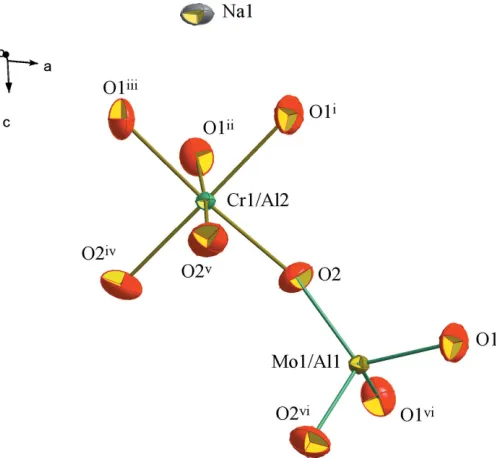
The structural unit of Na0.72(Cr0.48,Al1.52)(Mo2.77,Al0.23)O12 consists of one octahedron M1O6 (M1 = Cr1/Al2) and one tetrahedron M2O4 (M2 = Mo1/Al1) that share corners. The charge compensation is provided by Na+cations (Fig. 1). The main construction unit in the anionic framework of the compound Na0.72(Cr0.48,Al1.52)(Mo2.77,Al0.23)O12is formed by
two M1O6 octahedra interconnected by three M2O4 tetra-hedra located along the c axis. Geometrical parameters are given in Table 1. This assembly forms M12M23O18 units (Fig. 2). The junction between these units, provided by the formation of mixed bridges of theM1–O–M2 type, leads to a
three-dimensional framework with cavities parallel to the [100] and [010] directions in which the Na+cations are located (Fig. 3). Indeed, eachM1O6octahedron share its six corners with differentM2O4tetrahedra, leading toM1M26O24clusters (Fig. 4). The two validation models BVS (Brown & Altermatt, 1985; Brown, 2002; Adams, 2003) and CHARDI (Hoppeet al., 1989; Nespolo et al., 2001; Nespolo, 2001) confirm the
research communications
Acta Cryst.(2018). E74, 406–409 Sonniet al. Na
[image:2.610.341.529.69.256.2] [image:2.610.48.297.78.382.2]0.72(Cr0.48Al1.52)(Mo2.77Al0.23)O12
407
Table 1
Selected geometric parameters (A˚ ,).
Mo1—O2i 1.7358 (15) Cr1—O2v 1.9721 (16)
Mo1—O2 1.7359 (15) Cr1—O2vi 1.9721 (16)
Mo1—O1 1.7540 (16) Na1—O1ii 2.4987 (15)
Mo1—O1i 1.7540 (15) Na1—O1vii 2.4987 (15)
Cr1—O1ii 1.9668 (16) Na1—O1iii 2.4987 (15) Cr1—O1iii 1.9668 (16) Na1—O1viii 2.4987 (15)
Cr1—O1iv 1.9669 (16) Na1—O1iv 2.4987 (15)
Cr1—O2 1.9720 (16) Na1—O1ix 2.4987 (15)
O2i—Mo1—O2 109.56 (11) O1iv—Cr1—O2vi 88.68 (7) O2i—Mo1—O1 107.85 (8) O2—Cr1—O2vi 91.35 (7) O2—Mo1—O1 111.40 (8) O2v—Cr1—O2vi 91.35 (7) O2i—Mo1—O1i 111.40 (8) O1ii—Na1—O1vii 180.0 O2—Mo1—O1i 107.86 (8) O1ii—Na1—O1iii 65.74 (6) O1—Mo1—O1i 108.80 (11) O1vii—Na1—O1iii 114.26 (6) O1ii—Cr1—O1iii 87.18 (7) O1ii—Na1—O1viii 114.26 (6) O1ii—Cr1—O1iv 87.18 (7) O1vii—Na1—O1viii 65.74 (6) O1iii—Cr1—O1iv 87.18 (7) O1iii—Na1—O1viii 180.0 O1ii—Cr1—O2 92.79 (7) O1ii—Na1—O1iv 65.74 (6) O1iii—Cr1—O2 88.68 (7) O1vii—Na1—O1iv 114.26 (6) O1iv—Cr1—O2 175.86 (7) O1iii—Na1—O1iv 65.74 (6) O1ii—Cr1—O2v 88.68 (7) O1viii—Na1—O1iv 114.26 (6) O1iii—Cr1—O2v 175.86 (7) O1ii—Na1—O1ix 114.26 (6) O1iv—Cr1—O2v 92.79 (7) O1vii—Na1—O1ix 65.74 (6) O2—Cr1—O2v 91.35 (7) O1iii—Na1—O1ix 114.26 (6) O1ii—Cr1—O2vi 175.85 (7) O1viii—Na1—O1ix 65.74 (6) O1iii—Cr1—O2vi 92.79 (7) O1iv—Na1—O1ix 180.0
Symmetry codes: (i) xy;y;zþ3
2; (ii) xy 1 3;x
2 3;zþ
4 3; (iii)
xþ2 3;yþ
1 3;zþ
4
3; (iv) y 1 3;xþyþ
1 3;zþ
4
3; (v) xþy;x;z; (vi)
y;xy;z; (vii) xþyþ1 3;xþ
2 3;z
1
3; (viii) x 2 3;y
1 3;z
1 3; (ix)
yþ1 3;xy
1 3;z
1 3.
Figure 2
[image:2.610.315.565.392.509.2]Projection of anM12M23O18unit along theaaxis.
Figure 1
Structural unit of Na0.72(Cr0.48,Al1.52)(Mo2.77,Al0.23)O12. Displacement
ellipsoids are drawn at the 50% probability level. [Symmetry codes: (i)
2 3x,
1 3y,
1
3z; (ii) 1
3+xy, 2 3+x,
1
3z; (iii) 1 3+y,
1 3x+y,
4 3z;
(iv)x+y,x,z; (v)x,xz,z; (vi)xy,y,3 2z.]
Figure 3
[image:2.610.47.295.472.701.2]Projection of Na0.72(Cr0.48,Al1.52)(Mo2.77,Al0.23)O12along theaaxis.
Figure 4
[image:2.610.314.565.542.730.2]proposed structural model, in particular the distribution at mixed sites. The calculated load valuesQ(i) and valencesV(i) are in good agreement with the oxidation degrees weighted by the occupancy rates. The dispersion factor cat, which measures the deviation of the calculated cationic charges, is equal to 0.3% (Table 2). The variation of the bond-valence sum of sodium as a function of the distance travelled in different directions shows that the [011] and [111] directions are the most favorable directions for the mobility of sodium. The paths along these directions have the same shape when the distance travelled is about 13.5 A˚ and the maximum valence is about 1.4 valence units (Fig. 5). The representation of the Na migration path in the direction [011] is shown in Fig. 6.
3. Database survey
A comparison between the structures of the title compound and those of other NASICON-type compounds reveals that other compounds also crystallize in theR3cspace group with
similar unit-cell parameters. When compared to
NaZr2(AsO4)3(Coquerel et al., 1983) and Na4Co3Mo22.33O72 (Chakir et al., 2003), the only difference observed is the occupancy of the sites 6b, 12cand 18e. In NaZr2(AsO4)3, the sites are fully occupied, whereas in Na4Co3Mo22.33O72, the 6b site is not totally occupied, and the 12csite is occupied by both Co and Mo. In the title compound, the 6b site is partially occupied and the 12cand 18esites are mixed Cr/Al and Mo/Al sites, respectively.
4. Synthesis and crystallization
During the investigation of theA–Mo–Cr–O phase diagrams (A = Li, Na, Ag), the new compound Na0.72(Cr0.48,Al1.52 )-(Mo2.77,Al0.23)12 was established. The crystals were obtained
by grinding in an agate mortar the reagents NaNO3,
Cr(NO3)39H2O and (NH4)6Mo7O244H2O in a Na:Cr:Mo molar ratio of 1:1:4, respectively. The resulting mixture was calcined at 673 K to remove volatiles including NO2, NH3and H2O. The residual powder thus obtained was finely ground
Figure 7
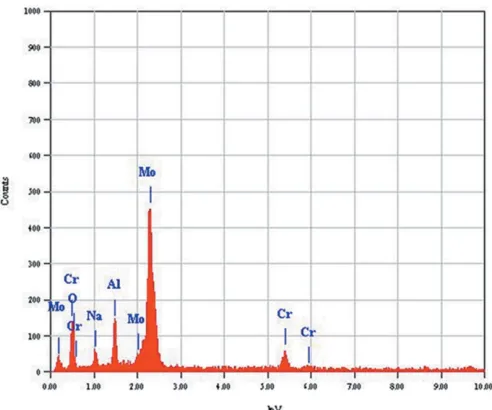
[image:3.610.46.565.119.168.2]EDX analysis of the sample confirming the presence of aluminium in Na0.72(Cr0.48,Al1.52)(Mo2.77, Al0.23)O12.
Table 2
CHARDI and BVS analyses for the cations in the Na0.72Cr0.48Al1.76Mo2.77O12compound.
q(i) = formal oxidation number; sof(i) = site occupancy; CN(i) = classical coordination number;Q(i) = calculated charge;V(i) = calculated valence; ECoN(i) = coordination number;dmean(i) = mean distance;dmed(i) = median distance.
Cation q(i)sof(i) Q(i) V(i) CN(i) ECoN(i) dmean dmed
Mo1/Al1 5.78 5.77 5.8426 4 4.00 1.7448 1.7443
M(Cr1/Al2) 3.000 2.99 2.9397 6 6.00 1.9694 1.9696
Na1 0.72 0.71 0.6893 6 6.00 2.4989 2.4989
[image:3.610.316.562.516.721.2]catis the dispersion factor for cationic charges wherecat= [i(qiQi)2/N1]1/2= 0.025.
Figure 5
Ionic pathway valence curves of the title compound.
Figure 6
[image:3.610.45.304.611.728.2]and then returned to the oven at a temperature close to the melting point at 973 K for three days to promote germination and crystal growth. After cooling, crystals of parallelepipedal shape and optimal size for data collection were obtained. A crystal of a good quality, selected under a polarizing micro-scope, was used for intensity measurements
5. Refinement
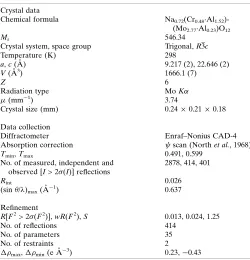
Crystal data, data collection and structure refinement details are summarized in Table 3. After processing the data, the structure was solved successfully in theR3cspace group, using
direct methods implemented in the SHELXS97 program
(Sheldrick, 2008). The molybdenum, chromium and oxygen atoms were located first. At this stage, an empirical -scan correction (Northet al., 1968) was applied. Difference-Fourier syntheses using the program SHELXL97 (Sheldrick, 2008), allowed the rest of the atoms in the cell to be localized. We obtained intense peaks close to Cr and Mo; the liberation of the occupancy factors led to values different from the full site occupancy (0.62530 for Mo and 0.24035 for Cr). The EDX
analysis (Fig. 7) of the sample confirmed the presence of aluminium and we then used EADP and EXYZ constraints as well as SUMP to refine Al1 with the Mo1 site and Al2 with the Cr1 site. After refinement and verification of the electrical neutrality, the final formula was Na0.72 (1)(Cr0.48 (1),Al1.52 (2)
)-(Mo2.77 (3),Al0.23 (2))O12. The remaining maximum and
minimum electron densities in the difference-Fourier map are acceptable and are at 0.78 A˚ from the Mo1 site and at 0.89 A˚ from the Mo2, respectively.
Acknowledgements
The authors wish to thank the Ministry of Higher Education and Scientific Research of Tunisia for the funding of the laboratory LMCTA LR15ES01.
References
Adams, S. (2003).softBV. University of Go¨ttingen, Germany. Brandenburg, K. (2006).DIAMOND. Crystal Impact GbR, Bonn,
Germany.
Brown, I. D. (2002).The Chemical Bond in Inorganic Chemistry – The
Bond Valence Model. Oxford University Press.
Brown, I. D. & Altermatt, D. (1985).Acta Cryst.B41, 244–247. Catti, M., Comotti, A., Di Blas, S. & Ibberson, R. M. (2004).J. Mater.
Chem.14, 835–839.
Chakir, M., Jazouli, A. E. & de Waal, D. (2003).Mater. Res. Bull.38, 1773–1779.
Coquerel, G., Gicquel-Mayer, C., Mayer, M. & Perez, G. (1983).Acta Cryst.C39, 1602–1604.
Duisenberg, A. J. M. (1992).J. Appl. Cryst.25, 92–96. Farrugia, L. J. (2012).J. Appl. Cryst.45, 849–854.
Harms, K. & Wocadlo, S. (1995).XCAD4. University of Marburg, Germany.
Harrison, W. T. A. & Phillips, M. L. F. (2001).Acta Cryst.C57, 2–3. Hoppe, R., Voigt, S., Glaum, H., Kissel, J., Mu¨ller, H. P. & Bernet, K.
(1989).J. Less-Common Met.156, 105–122.
Kozhevnikova, N. M. & Imekhenova, A. V. (2006).Zh. Neorg. Khim. 51, 4, 589–592.
Macı´cˇek, J. & Yordanov, A. (1992).J. Appl. Cryst.25, 73–80. Nespolo, M. (2001).CHARDI-IT. Laboratoire CRM2, Universite´ de
Lorraine, Nancy, France.
Nespolo, M., Ferraris, G., Ivaldi, G. & Hoppe, R. (2001).Acta Cryst.
B57, 652–664.
North, A. C. T., Phillips, D. C. & Mathews, F. S. (1968).Acta Cryst.
A24, 351–359.
Prabaharan, S. R. S., Fauzi, A., Michael, M. S. & Begam, K. M. (2004).
Solid State Ionics,171, 157–165.
Sheldrick, G. M. (2008).Acta Cryst.A64, 112–122. Sheldrick, G. M. (2015).Acta Cryst.C71, 3–8.
Slater, P. R. & Greaves, C. (1994).J. Mater. Chem.4, 1463–1467. Sun, Q., Ren, Q. Q. & Fu, Z. W. (2012).Electrochem. Commun.23,
145–148.
Tkachev, V. V., Ponomarev, V. I. & Atovmyan, L. O. (1984). Zh. Strukt. Khim.25, 128–134.
Westrip, S. P. (2010).J. Appl. Cryst.43, 920–925.
research communications
Acta Cryst.(2018). E74, 406–409 Sonniet al. Na
[image:4.610.45.295.90.350.2]0.72(Cr0.48Al1.52)(Mo2.77Al0.23)O12
409
Table 3
Experimental details.
Crystal data
Chemical formula Na0.72(Cr0.48Al1.52 )-(Mo2.77Al0.23)O12
Mr 546.34
Crystal system, space group Trigonal,R3c
Temperature (K) 298
a,c(A˚ ) 9.217 (2), 22.646 (2)
V(A˚3) 1666.1 (7)
Z 6
Radiation type MoK
(mm1) 3.74
Crystal size (mm) 0.240.210.18
Data collection
Diffractometer Enraf–Nonius CAD-4
Absorption correction scan (Northet al., 1968)
Tmin,Tmax 0.491, 0.599
No. of measured, independent and observed [I> 2(I)] reflections
2878, 414, 401
Rint 0.026
(sin/)max(A˚1) 0.637
Refinement
R[F2> 2(F2)],wR(F2),S 0.013, 0.024, 1.25
No. of reflections 414
No. of parameters 35
No. of restraints 2
max,min(e A˚ 3
) 0.23,0.43
Computer programs:CAD-4 EXPRESS(Duisenberg, 1992; Macı´cˇek & Yordanov, 1992),
XCAD4 (Harms & Wocadlo, 1995), SHELXS97 (Sheldrick, 2008), SHELXL2014
(Sheldrick, 2015), DIAMOND (Brandenburg, 2006), WinGX (Farrugia, 2012) and
sup-1
Acta Cryst. (2018). E74, 406-409
supporting information
Acta Cryst. (2018). E74, 406-409 [https://doi.org/10.1107/S2056989018003031]
Elaboration, structural study and validation of a new NASICON-type structure,
Na0.72(Cr0.48,Al1.52)(Mo2.77,Al0.23)O12
Manel Sonni, Imen Jendoubi and Mohamed Faouzi Zid
Computing details
Data collection: CAD-4 EXPRESS (Duisenberg, 1992; Macíček & Yordanov, 1992); cell refinement: CAD-4 EXPRESS
(Duisenberg, 1992; Macíček & Yordanov, 1992); data reduction: XCAD4 (Harms & Wocadlo, 1995); program(s) used to
solve structure: SHELXS97 (Sheldrick, 2008); program(s) used to refine structure: SHELXL2014 (Sheldrick, 2015);
molecular graphics: DIAMOND (Brandenburg, 2006); software used to prepare material for publication: WinGX
(Farrugia, 2012) and publCIF (Westrip, 2010).
Sodium chromium/aluminium molybdenum/aluminium dodecaoxide
Crystal data
Na0.72(Cr0.48·Al1.52)(Mo2.77·Al0.23)O12
Mr = 546.34 Trigonal, R3c a = 9.217 (2) Å c = 22.646 (2) Å V = 1666.1 (7) Å3
Z = 6
F(000) = 1526
Dx = 3.267 Mg m−3
Mo Kα radiation, λ = 0.71073 Å Cell parameters from 25 reflections θ = 12.1–14.8°
µ = 3.74 mm−1
T = 298 K Prism, red
0.24 × 0.21 × 0.18 mm
Data collection Enraf–Nonius CAD-4
diffractometer
Radiation source: fine-focus sealed tube ω/2θ scans
Absorption correction: ψ scan (North et al., 1968)
Tmin = 0.491, Tmax = 0.599
2878 measured reflections 414 independent reflections
401 reflections with I > 2σ(I) Rint = 0.026
θmax = 26.9°, θmin = 3.1°
h = −11→11 k = −2→11 l = −28→28
2 standard reflections every 120 reflections intensity decay: 0.8%
Refinement Refinement on F2
Least-squares matrix: full R[F2 > 2σ(F2)] = 0.013
wR(F2) = 0.024
S = 1.25 414 reflections 35 parameters 2 restraints
w = 1/[σ2(F
o2) + 4.1215P]
where P = (Fo2 + 2Fc2)/3
(Δ/σ)max = 0.001
Δρmax = 0.23 e Å−3
Δρmin = −0.42 e Å−3
Extinction correction: SHELXL2014 (Sheldrick, 2015),
Fc*=kFc[1+0.001xFc2λ3/sin(2θ)]-1/4
supporting information
sup-2
Acta Cryst. (2018). E74, 406-409
Special details
Geometry. All esds (except the esd in the dihedral angle between two l.s. planes) are estimated using the full covariance matrix. The cell esds are taken into account individually in the estimation of esds in distances, angles and torsion angles; correlations between esds in cell parameters are only used when they are defined by crystal symmetry. An approximate (isotropic) treatment of cell esds is used for estimating esds involving l.s. planes.
Refinement. Refinement of F2 against ALL reflections. The weighted R-factor wR and goodness of fit S are based on F2,
conventional R-factors R are based on F, with F set to zero for negative F2. The threshold expression of F2 > 2sigma(F2) is
used only for calculating R-factors(gt) etc. and is not relevant to the choice of reflections for refinement. R-factors based on F2 are statistically about twice as large as those based on F, and R- factors based on ALL data will be even larger.
Fractional atomic coordinates and isotropic or equivalent isotropic displacement parameters (Å2)
x y z Uiso*/Ueq Occ. (<1)
Mo1 0.28488 (2) 0.0000 0.7500 0.01214 (9) 0.921 (6)
Al1 0.28488 (2) 0.0000 0.7500 0.01214 (9) 0.080 (10)
Cr1 0.0000 0.0000 0.63854 (3) 0.0109 (2) 0.238 (11)
Al2 0.0000 0.0000 0.63854 (3) 0.0109 (2) 0.761 (19)
Na1 0.0000 0.0000 0.5000 0.0259 (9) 0.724 (8)
O1 0.48491 (19) 0.17851 (19) 0.74736 (7) 0.0326 (4)
O2 0.1686 (2) −0.0152 (2) 0.68761 (6) 0.0376 (5)
Atomic displacement parameters (Å2)
U11 U22 U33 U12 U13 U23
Mo1 0.01265 (11) 0.01229 (13) 0.01137 (12) 0.00614 (6) 0.00085 (4) 0.00169 (8)
Al1 0.01265 (11) 0.01229 (13) 0.01137 (12) 0.00614 (6) 0.00085 (4) 0.00169 (8)
Cr1 0.0117 (3) 0.0117 (3) 0.0092 (3) 0.00587 (14) 0.000 0.000
Al2 0.0117 (3) 0.0117 (3) 0.0092 (3) 0.00587 (14) 0.000 0.000
Na1 0.0322 (11) 0.0322 (11) 0.0132 (12) 0.0161 (6) 0.000 0.000
O1 0.0254 (8) 0.0218 (8) 0.0442 (9) 0.0071 (7) −0.0038 (6) 0.0003 (7)
O2 0.0364 (9) 0.0446 (11) 0.0278 (8) 0.0172 (8) −0.0093 (7) 0.0015 (7)
Geometric parameters (Å, º)
Mo1—O2i 1.7358 (15) Na1—O1ii 2.4987 (15)
Mo1—O2 1.7359 (15) Na1—O1vii 2.4987 (15)
Mo1—O1 1.7540 (16) Na1—O1iii 2.4987 (15)
Mo1—O1i 1.7540 (15) Na1—O1viii 2.4987 (15)
Cr1—O1ii 1.9668 (16) Na1—O1iv 2.4987 (15)
Cr1—O1iii 1.9668 (16) Na1—O1ix 2.4987 (15)
Cr1—O1iv 1.9669 (16) Na1—Al2x 3.1373 (7)
Cr1—O2 1.9720 (16) Na1—Cr1x 3.1373 (7)
Cr1—O2v 1.9721 (16) O1—Al2iii 1.9668 (16)
Cr1—O2vi 1.9721 (16) O1—Cr1iii 1.9668 (16)
Cr1—Na1 3.1374 (7) O1—Na1xi 2.4987 (15)
O2i—Mo1—O2 109.56 (11) O1iii—Na1—O1iv 65.74 (6)
O2i—Mo1—O1 107.85 (8) O1viii—Na1—O1iv 114.26 (6)
sup-3
Acta Cryst. (2018). E74, 406-409
O2i—Mo1—O1i 111.40 (8) O1vii—Na1—O1ix 65.74 (6)
O2—Mo1—O1i 107.86 (8) O1iii—Na1—O1ix 114.26 (6)
O1—Mo1—O1i 108.80 (11) O1viii—Na1—O1ix 65.74 (6)
O1ii—Cr1—O1iii 87.18 (7) O1iv—Na1—O1ix 180.0
O1ii—Cr1—O1iv 87.18 (7) O1ii—Na1—Al2x 141.20 (4)
O1iii—Cr1—O1iv 87.18 (7) O1vii—Na1—Al2x 38.80 (4)
O1ii—Cr1—O2 92.79 (7) O1iii—Na1—Al2x 141.19 (4)
O1iii—Cr1—O2 88.68 (7) O1viii—Na1—Al2x 38.81 (4)
O1iv—Cr1—O2 175.86 (7) O1iv—Na1—Al2x 141.19 (4)
O1ii—Cr1—O2v 88.68 (7) O1ix—Na1—Al2x 38.81 (4)
O1iii—Cr1—O2v 175.86 (7) O1ii—Na1—Cr1x 141.20 (4)
O1iv—Cr1—O2v 92.79 (7) O1vii—Na1—Cr1x 38.80 (4)
O2—Cr1—O2v 91.35 (7) O1iii—Na1—Cr1x 141.19 (4)
O1ii—Cr1—O2vi 175.85 (7) O1viii—Na1—Cr1x 38.81 (4)
O1iii—Cr1—O2vi 92.79 (7) O1iv—Na1—Cr1x 141.19 (4)
O1iv—Cr1—O2vi 88.68 (7) O1ix—Na1—Cr1x 38.81 (4)
O2—Cr1—O2vi 91.35 (7) Al2x—Na1—Cr1x 0.0
O2v—Cr1—O2vi 91.35 (7) O1ii—Na1—Cr1 38.80 (4)
O1ii—Cr1—Na1 52.76 (5) O1vii—Na1—Cr1 141.20 (4)
O1iii—Cr1—Na1 52.76 (5) O1iii—Na1—Cr1 38.81 (4)
O1iv—Cr1—Na1 52.76 (5) O1viii—Na1—Cr1 141.19 (4)
O2—Cr1—Na1 124.30 (5) O1iv—Na1—Cr1 38.81 (4)
O2v—Cr1—Na1 124.30 (5) O1ix—Na1—Cr1 141.19 (4)
O2vi—Cr1—Na1 124.30 (5) Al2x—Na1—Cr1 180.0
O1ii—Na1—O1vii 180.0 Cr1x—Na1—Cr1 180.0
O1ii—Na1—O1iii 65.74 (6) Mo1—O1—Al2iii 144.66 (9)
O1vii—Na1—O1iii 114.26 (6) Mo1—O1—Cr1iii 144.66 (9)
O1ii—Na1—O1viii 114.26 (6) Al2iii—O1—Cr1iii 0.0
O1vii—Na1—O1viii 65.74 (6) Mo1—O1—Na1xi 126.81 (8)
O1iii—Na1—O1viii 180.0 Al2iii—O1—Na1xi 88.43 (6)
O1ii—Na1—O1iv 65.74 (6) Cr1iii—O1—Na1xi 88.43 (6)
O1vii—Na1—O1iv 114.26 (6) Mo1—O2—Cr1 158.35 (10)