Technology and Applications for Collaborative Learning
in Virtual Reality
Scott W. Greenwald (co-chair), MIT Media Lab, [email protected] Alexander Kulik (co-chair), Bauhaus-Universität Weimar, [email protected]
André Kunert, Bauhaus-Universität Weimar, [email protected] Stephan Beck, Bauhaus-Universität Weimar, [email protected] Bernd Fröhlich, Bauhaus-Universität Weimar, [email protected]
Sue Cobb, University of Nottingham, [email protected] Sarah Parsons, University of Southampton, [email protected] Nigel Newbutt, University of the West of England, [email protected] Christine Gouveia, McGraw-Hill Education, [email protected]
Claire Cook, McGraw-Hill Education, [email protected] Anne Snyder, McGraw-Hill Education, [email protected]
Scott Payne, McGraw-Hill Education, [email protected] Jennifer Holland, Google Inc., [email protected]
Shawn Buessing, Google Inc., [email protected] Gabriel Fields, MIT Media Lab, [email protected] Wiley Corning, MIT Media Lab, [email protected] Victoria Lee, MIT Sloan School of Management, [email protected]
Lei Xia, MIT Sloan School of Management, [email protected] Pattie Maes, MIT Media Lab, [email protected]
Abstract: In this symposium we explore the immense potential for virtual reality to be applied in educational settings. We discuss recent technological developments against a backdrop of several decades of research. Six presentations, including four from academic authors and two from the commercial sector, will explore user requirements, new technologies, and practical issues in collaborative VR applications for learning.
Focus and issues addressed
Virtual reality has long been touted for its potential to revolutionize education, with myriad advantages cited: access to remote experts, access to experiences that depend on scarce or access-limited resources (e.g. going to the moon), and access to experiences that are physically impossible (e.g. such as standing inside a molecule), to name a few. A new generation of consumer hardware has made this vision more in-reach than ever. In this symposium our interest is to understand what advantages of virtual reality in an educational context could or should bring it into practice in the classroom, and what factors will determine when and how this will happen.
concepts in an immersive virtual environment. By bringing all of these threads of research together in a symposium, we hope to gain a clearer understanding of the landscape of challenges and opportunities related to virtual reality in formal and informal learning settings.
Then and now: Positioning a new wave of research on VR and learning
Scott W. Greenwald, Victoria Lee, and Alexander Kulik
This presentation provides a brief history of the technology and applications of virtual reality in the past several decades, including many involving training, education, and collaboration. The first wave of modern virtual reality took place during the 1960s. Philco Corporation created the first head-mounted display named “Headsight” which had a screen and tracking system and was linked to a closed-circuit TV. The intent behind “Headsight” was to train military personnel in tasks such as landing a high-speed aircraft, chemical and hazardous tests which could be watched from afar, or controlling a highly maneuverable submarine (Philco Corp, 2016). Although it was not connected to a computer, “Headsight” pioneered the practice of leveraging virtual reality technology for learning and training purposes. Soon thereafter, Ivan Sutherland developed the first head mounted stereo display to link with a computer instead of a camera to display images (Sutherland, 1968).
In the mid-1970s Myron Krueger created an interactive physical environment called “Videoplace” (Krueger). Instead of head-mounted displays, “Videoplace” used projectors and video cameras to support interaction, through the onscreen silhouettes of users. “Videoplace” demonstrated the potential of virtual environments for artistic and creative expression. Around the same time, the Wright-Patterson Air Force Base in Ohio continued what “Headlight” had begun, experimenting with virtual reality simulations for training and education. By the late 1980s, they had launched the “Super Cockpit” program, a virtual cockpit to train pilots (Lowood, 2016). Shortly after “Super Cockpit”, NASA’s Johnson Space Center began using head mounted display-based VR simulations to prepare astronauts. Although virtual reality was not widely adopted commercially following projects such as these, it played a crucial role in learning and training in these and several other niche areas, including further military applications, medical research, and other academic research.
Collaborative virtual environments (CVE) have a long history as well. Churchill and Snowdon published a thorough introduction to the topic in 1998 (Churchill 1998). They detailed the nature of collaborative and cooperative activities, and analyzed the realization of such behavior within networked virtual environments, using several examples from the time. Referring to research on behavioral psychology, they emphasized the relevance of nonverbal communication and indicated how this could be achieved in shared virtual environments - even using desktop-based systems with third-person viewpoints. Apparently, many learning goals can be effectively achieved in such settings (Dede, 1995; Cobb et al. 2010). Dede even argued that the synthetic and anonymous qualities of these early CVEs could have a positive effect on constructivist learning. However, this type of system was adopted more widely in entertainment rather than learning applications. Puppeteering a 3D avatar and monitoring others on a computer screen is less direct and intuitive than equivalent activities in an immersive 3D space. The attentional load required to operate the interface ties up cognitive resources that could otherwise be used for primary activities, such as learning. However, early collaborative immersive VR systems generally did not support embodied interaction and head-tracked egocentric viewing. One reason was that head-mounted displays hindered the perception of one’s own body and those of others, while large 3D displays generally supported only a single stereo view.
A few early research prototypes implemented collocated collaborative augmented reality systems, where the virtual 3D content is spatially aligned with the physical interaction space. The “Studierstube”, for example, used see-through head mounted displays for this purpose. A group of users could see the same 3D model and interact with it in context of their real environment (Szalavari et al., 1998; Schmalstieg et al., 2002). Hua et al. equipped multiple users with head-mounted projectors (Hua et al. 2003). The walls of their interaction space were covered with retroreflective materials such that each user saw their own personal perspective. Both projects also explored the use of multiple independent viewing windows to support varying levels of collaborative coupling.
These and other systems have powered more recent studies that seek to better understand human behavior, learning, and collaboration. A few examples include: how a virtual learning environment benefits education (Huang et. al.; 2010), how virtual reality encourages helping behavior and interpersonal understanding (Ahn et. al., 2013), or the effectiveness of virtual reality and overcoming phobias (Garcia-Palacios et al., 2002).
In the past several years, virtual reality technology has experienced a resurgence. Innovations in the design and manufacturing of the relevant devices has led to the availability of cheap and robust VR hardware, including wide field-of-view, high-resolution headsets and submillimeter precision tracking technology. As of 2016, there were 43 million active users of virtual reality and that number is forecasted to grow, reaching 171 million by 2018 (Statista, 2016). When the era of personal computing expanded in the 1990s, a new generation of users, developers, and researchers emerged, and we propose that there is a parallel with what is happening now with virtual reality. Given the prior success of virtual reality in education and training for niche applications, we believe that the broader exploration of use cases, enabled by the new generation of hardware coupled with the power of the internet, will result in many more successes. It will empower educators and learners with new tools and a new medium, improving communication, collaboration, and co-creation.
Collaborative virtual reality for joint learning experiences
Alexander Kulik, André Kunert, Stephan Beck, Bernd Fröhlich
Virtual reality systems promote situated learning through the immersive experience of interactive objects, environments and processes. Egocentric 3D viewing supports self-paced data exploration and bears the potential to increase the users’ identification with the topic at hand. However, head-mounted displays also decouple users’ from the perception of their own body and their immediate physical and social environment. This in turn can hinder the comprehension of the displayed content. For example, it is commonly understood that depth perception is disturbed in virtual environments. However, representations of self and the immediate physical environment have been shown to ameliorate this effect (Interrante et al., 2008; Mohler et al., 2010; Phillips et al., 2010). Perhaps, comprehension can be understood as the establishment of robust relations between oneself and the topic of interest.
Moreover, learning is largely driven by exchange with peers. This can be particular relevant, if it comes to the interpretation of complex and ambiguous information. The immediate exchange between students can help to consider multiple perspectives and also to confirm the most probable interpretations. Direct interaction and mixed-initiative communication promote the ongoing discourse on a topic. We also learn by doing. Therefore, virtual environments for learning should be highly interactive. Ideally, multiple learners can interact jointly with the virtual environment and thereby reinforce their understandings. Support for joint action, however, must consider several planned and emergent coordination processes, all of which build on the spatiotemporal coherency of the shared interaction space (Knoblich et al., 2011). Gutwin and Greenberg highlighted how people achieve the necessary workspace awareness in physical environments through consequential communication, feedthrough, and intentional communication (Gutwin & Greenberg, 2002).
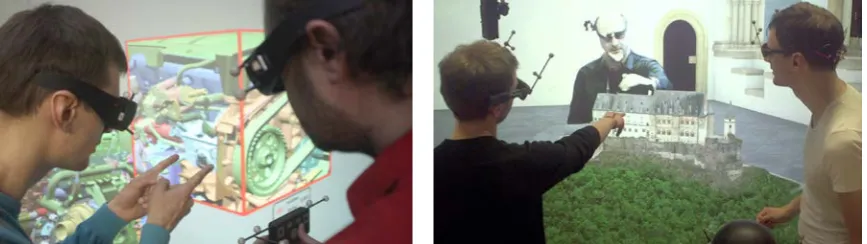
We believe that the unmitigated perception of self and others is a prerequisite for effective comprehension, learning and exchange. Therefore, we developed projection-based virtual reality systems that do not limit the users’ perception of their immediate surroundings (i.e. workspace awareness), but that additionally provide them with multiple individual viewpoints towards a shared 3D scene (Kulik et al., 2011). The result is a coherent mixed reality of virtual objects, environments, and multiple collaborating users. We observe that direct mutual exchange about the digital content increases their relevance for users and supports mutual confirmation (Figure 1). Our studies show that users can build on body language and deictic gestures just as they do with real world objects and that collaborative visual search increases the understanding of all involved users (Salzmann et al., 2009; Kulik et al., 2011).
Figure 1. Two users discussing details of a combustion engine using a box-shaped cross section
view.
Figure 2. Collaborative wayfinding in a telepresence setting. The remote user is captured and represented
[image:4.595.76.291.384.528.2]as a 3D video avatar in the virtual environment. (Vianden Castle model courtesy of ArcTron 3D) As most collaborative actions, also learning requires certain levels of individual autonomy. It has been shown, for example, that brainstorming sessions can be ineffective if the setting does not allow participants to work alone and take individual responsibility (Sawyer, 2008, pp. 64-66). Therefore, interfaces for multi-user cooperation should support fluent transitions between individual activities and varying levels of collaborative coupling. Loose coupling can increase the diversity of contributions, while tight coupling is required to achieve mutual agreement and convergence towards intermediate resolutions. Support for territoriality as an emergent social behavior seems to be a pragmatic, yet powerful, design principle in that regard (Scott et al., 2004). User interfaces for collaborative learning should thus provide multiple interaction areas and support dynamic spatial restructuring (Figure 3; Kunert et al., 2014).
Figure 3. A large 3D powerwall (back) and a multitouch 3D tabletop (front) serve as independent multi-user 3D viewports into a shared virtual world. A virtual 3D display, or portal (center, with white frame), offers additional perspectives. The physical and virtual viewports serve for private interaction and
group exchange.
Their combination in a coherent workspace supports fluent transitions between tightly and loosely coupled
cooperation. Here, a multi-scale 3D scan of prehistoric rock art and its environment
(Valcamonica, Italy) is explored.
Designing collaborative virtual environments for interaction and learning in
children with autism.
Sue Cobb, Sarah Parsons, Nigel Newbutt
stakeholder involvement shaped the design and practice of using the virtual worlds in the classroom, was built in and the nature of working with autistic children.
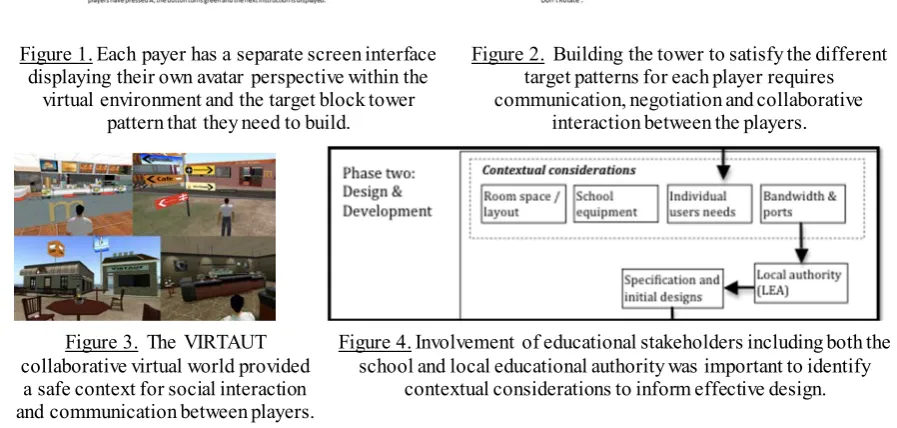
Figure 1. Each payer has a separate screen interface displaying their own avatar perspective within the
[image:5.595.312.511.134.205.2]virtual environment and the target block tower pattern that they need to build.
Figure 2. Building the tower to satisfy the different target patterns for each player requires communication, negotiation and collaborative
interaction between the players.
Figure 3. The VIRTAUT collaborative virtual world provided a safe context for social interaction and communication between players.
Figure 4. Involvement of educational stakeholders including both the school and local educational authority was important to identify
contextual considerations to inform effective design.
In each of the projects the design process involved a variety of stakeholders each with different perspectives and objectives for the project outcomes. We will describe and reflect on the application of the 3T model of learner-centred design that determines CVE design based upon relevant learning Theory, Technology affordances and Thoughts (stakeholder-informed requirements) as a suitable framework to inform the design and development of educational technologies (Parsons and Cobb, 2014). In addition, the process of co-design identified various technological challenges with applying VRTs in situ (Newbutt, 2013). We will consider the opportunities and challenges of designing innovative technologies for special education, and specifically the affordances of VRTs for autistic user groups. In doing so we will consider ways to navigate these challenges and some best practice we have identified in design CVEs across the projects identified above. We hope to also highlight aspects of the design process that led to supporting interactions and learning in VR spaces. Future directions and priorities for research in this area will be presented.
“Nice to Have” to “Can’t Do Without”: Aligning simulations and VR with current
needs in the K-12 classroom
Christine Gouveia, Claire Cook, Anne Snyder, and Scott Payne
How can immersive VR technologies be meaningfully and effectively incorporated into K-12 classroom instruction? To explore this question, we turn to a recent innovation that is closely related to immersive VR -- simulation-based lab activities for science instruction -- as an example of a technology that has been successfully integrated. Using these simulations as a case study, we examine the factors that have led to this success, and consider how they may inform the future of immersive VR technologies in a classroom context (Merchant et al., 2014; De Jong et al., 2013; Rutten et al., 2012; Toth et al., 2014).
[image:5.595.70.519.205.419.2]are those which bear on equity and access for K-12 learners. We argue that it is this parallelism between the pedagogical and practical which is key for an innovative alternative to take hold broadly and have staying power in a classroom context.
As developers continue to create and extend more sophisticated VR technologies, we survey the essential realities of the K-12 classroom that are important to consider, in order to ensure that emerging and evolving VR technologies solve a problem for users -- such that they will be broadly embraced and viewed as enabling essential learning experiences, rather than as fringe “add-ons” to more traditional curricula. We then invite participants to join us in examining what is perhaps the most important question of all: what problems can immersive VR technologies solve for K-12 teachers?
Principles, challenges, and lessons learned through developing a commercial
platform for virtual reality in the classroom
Jennifer Holland and Shawn Buessing
Google Expeditions is a virtual reality teaching tool that lets you lead or join immersive virtual trips all over the world — get up close with historical landmarks, dive underwater with sharks, even visit outer space! Built for the classroom and small group use, Google Expeditions allows a teacher acting as a “guide” to lead classroom-sized groups of “explorers” through collections of 360° and 3D images while pointing out interesting sights along the way. We’ll talk specifically about:
● Principles of educational content that we are finding effective for teachers of students
● Talk through why it’s not easy to just repurpose legacy educational content into VR form and why many traditional educational publishers will have to rethink how they approach it
● Share specific examples and usage patterns in schools and countries ● Talk about specific hardware challenges with large group use of VR
Exploring same-time, same-place collaboration in room-scale virtual reality
Scott W. Greenwald, Wiley Corning, Gabriel Fields, Lei Xia
This presentation will summarize our explorations of same-time, same-place interaction in room-scale virtual reality with a focus on learning. As a baseline form of interaction, users are represented using minimal avatars in the virtual space in positions exactly corresponding to their actual physical positions. The avatars consist of semi-realistic representations of the headset and handheld controllers. The positions and orientations of these are updated to match their physical ones at 90Hz, giving their movement a very life-like appearance. My team has explored two different research questions related to this style of interaction. Firstly, we seek to understand the capacity of this medium (as described) to carry symbolic and emotive signals, typically carried not only by body gestures and movement, but also facial gestures and expressions. Second, we explore how one or more users can interact with and learn from simulation-based environments. This combination of questions is driven by the hypothesis that the combination of social and exploratory learning is particularly powerful in virtual reality.
interaction. One shared capability is the play/pause button that allows users to freeze the action of the system temporarily.
In our informal pilot studies, we identified some requirements related to the usage of such systems as a central element of curricular education. Although it is motivating and fun to interact with such a "playground," learners often require guidance in order to discover noteworthy phenomena or principles. We are exploring how to build scaffolding to balance guidance with self-direction for this use case.
References
Agrawala, M., Beers, A. C., McDowall, I., Fröhlich, B., Bolas, M., & Hanrahan, P. (1997, August). The two-user Responsive Workbench: support for collaboration through individual views of a shared space. In Proceedings of the 24th annual conference on Computer graphics and interactive techniques (pp. 327-332). ACM Press/Addison-Wesley Publishing Co..
Ahn, S.J., Le, A.M.T., & Bailenson, J.N. (2013). The effect of embodied experiences on self-other merging, attitude, and helping behavior. Media Psychology, 16 (1), 7-38.
Arthur, K., Preston, T., Taylor, R., Brooks, F., Whitton, M., & Wright, W. (1998, May). Designing and building the pit: a head-tracked stereo workspace for two users. In 2nd International Immersive Projection Technology Workshop (pp. 11-12).
Beck, S., Kunert, A., Kulik, A., and Fr ̈ohlich, B. (2013). Immersive group-to- group telepresence. Visualization and Computer Graphics, IEEE Transactions on Graphics, 19(4):616–625.
Bimber, O., Fröhlich, B., Schmalstieg, D., & Encarnação, L. M. (2006, July). The virtual showcase. In ACM SIGGRAPH 2006 Courses (p. 9). ACM.
Churchill, E.F. & Snowdon, D. Virtual Reality (1998) 3: 3. doi:10.1007/BF01409793
Cobb, S, Millen, L, Glover, T, Hawkins, T, Patel, H, Eastgate, R, Parsons, S and Garib-Penna, S. . (2010). Collaborative VE: Experience Report and Prototypes. FP7 Deliverable report 4.1.2 for the COSPATIAL project. Available at http://cospatial.fbk.eu/deliverables [last accessed 23.10.15]
Dede, C. (1995). The evolution of constructivist learning environments: Immersion in distributed, virtual worlds. Educational technology, 35(5), 46-52.
De Jong, T., Linn, M. C., & Zacharia, Z. C. (2013). Physical and virtual laboratories in science and engineering education. Science, 340(6130), 305–308.
Fröhlich, B., Hochstrate, J., Hoffmann, J., Klüger, K., Blach, R., Bues, M., & Stefani, O. (2005). Implementing multi-viewer stereo displays.
Garcia-Palacios, A., Hoffman, H., Carlin, A., Furness, T., & Botella, C. (2002). Virtual reality in the treatment of spider phobia: a controlled study. Behaviour Research And Therapy, 40(9), 983-993. http://dx.doi.org/10.1016/s0005-7967(01)00068-7
Gutwin, C. and Greenberg, S. (2002). A descriptive framework of workspace awareness for real-time groupware. Comput. Supported Coop. Work, 11(3):411–446.
Huang, H. M., Rauch, U., & Liaw, S. S. (2010). Investigating learners’ attitudes toward virtual reality learning environments: Based on a constructivist approach. Computers & Education, 55(3), 1171-1182. Interrante, V., Ries, B., Lindquist, J., Kaeding, M., and Anderson, L. (2008). Elucidating factors that can facilitate
veridical spatial perception in im- mersive virtual environments. Presence: Teleoperators and Virtual Envi- ronments, 17(2):176–198.
Kitamura, Y., Konishi, T., Yamamoto, S., & Kishino, F. (2001, August). Interactive stereoscopic display for three or more users. In Proceedings of the 28th annual conference on Computer graphics and interactive techniques (pp. 231-240). ACM.
Knoblich, G., Butterfill, S., and Sebanz, N. (2011). Chapter three - psycholog- ical research on joint action: Theory and data. In Ross, B. H., editor, Advances in Research and Theory, volume 54 of Psychology of Learning and Motivation, pages 59 – 101. Academic Press.
Krueger, M. (1991). Artificial reality II (1st ed.). Reading, Mass.: Addison-Wesley.
Kulik, A., Kunert, A., Beck, S., Reichel, R., Blach, R., Zink, A., & Froehlich, B. (2011). C1x6: a stereoscopic six-user display for co-located collaboration in shared virtual environments. ACM Transactions on Graphics (TOG), 30(6), 188
Kunert, A., Kulik, A., Beck, S., and Fr ̈ohlich, B. (2014). Photoportals: Shared references in space and time. In Proceedings of the 17th ACM Conference on Computer Supported Cooperative Work & Social Computing, CSCW ’14, pages 1388–1399, New York, NY, USA. ACM.
Mulder, J. D., & Boscker, B. R. (2004, March). A modular system for collaborative desktop vr/ar with a shared workspace. In Virtual Reality, 2004. Proceedings. IEEE (pp. 75-280). IEEE.
Mohler, B. J., Creem-Regehr, S. H., Thompson, W. B., and Bu ̈lthoff, H. H. (2010). The effect of viewing a self-avatar on distance judgments in an hmd-based virtual environment. Presence: Teleoperators and Virtual En- vironments, 19(3):230–242.
Newbutt, N. (2013). Exploring Communication and Representation of the Self in a Virtual World by Young People with Autism. PhD Assistive Technology, University College Dublin, Education.
Newbutt, N. (2014). Representations of self in a classroom virtual world: A case-study of pupils on the autism spectrum. In: Felicia, P (Ed) Game-Based Learning: Challenges and Opportunities, Cambridge Scholars Publishing, p. 165.
Parsons, S and Cobb, S (2014). Reflections on the role of the ‘users’: challenges in a multidisciplinary context of learner-centred design for children on the autism spectrum. International Journal of Research and Method in Education. 37 (4), 421-441.
Parsons, S (2015). Learning to work together: Designing a multi-user virtual reality game for social collaboration and perspective-taking for children with autism. International Journal of Child-Computer Interaction, 6, 28-38.
Philco Corp,. (2016). Remotely controlled remote viewing system. United States.
Phillips, L., Ries, B., Kaeding, M., and Interrante, V. (2010). Avatar self- embodiment enhances distance perception accuracy in non-photorealistic immersive virtual environments. In 2010 IEEE Virtual Reality Conference (VR), pages 115–1148. IEEE.
Rutten, N., van Joolingen, W. R., & van der Veen, J. T. (2012). The learning effects of computer simulations in science education. Computers & Education, 58(1), 136–153.
Salzmann, H., Moehring, M., and Froehlich, B. (2009). Virtual vs. real-world pointing in two-user scenarios. In 2009 IEEE Virtual Reality Conference, pages 127–130. IEEE.
Sawyer, K. (2008). Group genius: The creative power of collaboration. Basic Books.
Schmalstieg, D., Fuhrmann, A., Hesina, G., Szalavári, Z., Encarnaçao, L. M., Gervautz, M., & Purgathofer, W. (2002). The studierstube augmented reality project. Presence: Teleoperators and Virtual Environments, 11(1), 33-54.
Sebanz, N., Knoblich, G., and Prinz, W. (2003). Representing others’ actions: just like one’s own? Cognition, 88(3):B11–B21.
Statista. (2016). Number of active virtual reality users worldwide from 2014 to 2018 (in millions). http://www.statista.com/statistics/426469 (retrieved 11/19/2016).
Sutherland, I. E. (1968). "A head-mounted three dimensional display". Proceedings of AFIPS 68, pp. 757-764 Szalavári, Z., Schmalstieg, D., Fuhrmann, A. et al. Virtual Reality (1998) 3: 37. doi:10.1007/BF01409796 Toth, E. E., Ludvico, L. R., & Morrow, B. L. (2014). Blended inquiry with hands-on and virtual laboratories: the
role of perceptual features during knowledge construction. Interactive Learning Environments, 22(5), 614–630.