Redetermination of the cubic struvite
analogue Cs[Mg(OH
2)
6](AsO
4)
Matthias Weil
Institute for Chemical Technologies and Analytics, Division of Structural Chemistry, Vienna University of Technology, Getreidemarkt 9/164-SC, A-1060 Vienna, Austria Correspondence e-mail: [email protected]
Received 18 December 2008; accepted 18 December 2008
Key indicators: single-crystal X-ray study;T= 293 K; mean(Mg–O) = 0.003 A˚; Rfactor = 0.016;wRfactor = 0.038; data-to-parameter ratio = 13.9.
In contrast to the previous refinement from photographic data [Ferrari et al. (1955). Gazz. Chim. Ital. 84, 169–174], the present redetermination of the title compound, caesium hexaaquamagnesium arsenate(V), revealed the Cs atom to be on Wyckoff position 4dinstead of Wyckoff position 4bof space group F43m. The structure can be derived from the halite structure. The centres of the complex [Mg(OH2)6]
octahedra and the AsO4tetrahedra (both with 43msymmetry)
are on the respective Na and Cl positions. The building units are connected to each other by O—H O hydrogen bonds. The Cs+cations (43msymmetry) are located in the voids of this arrangement and exhibit a regular cuboctahedral 12-coordination to the O atoms of the water molecules. The O atom bonded to As has 2mmsite symmetry (Wyckoff position 24f) and the water-molecule O atom has m site symmetry (Wyckoff position 48h).
Related literature
The crystal structure of struvite, NH4[Mg(OH2)6](PO4), was
reported by Whitaker & Jeffery (1970a,b). Crystal growth of struvite-type compounds using the gel diffusion technique was reported by Banks et al. (1975). For isotypic structures, see: Carver et al.(2006) for Cs[Fe(OH2)6](PO4) and Massaet al.
(2003) for the cubic form of dimorphic Cs[Mg(OH2)6](PO4).
Isotypic struvite-type phases as well as analogues were recently surveyed by Weil (2008).
Experimental
Crystal data
Cs[Mg(OH2)6](AsO4)
Mr= 404.24 Cubic,F43m a= 10.1609 (5) A˚
V= 1049.05 (9) A˚3
Z= 4
MoKradiation = 6.75 mm1
T= 293 (2) K 0.180.180.18 mm
Data collection
Enraf–Nonius CAD-4 diffractometer
Absorption correction: integration (SHELXTL; Sheldrick, 2008)
Tmin= 0.341,Tmax= 0.382 3332 measured reflections
208 independent reflections 207 reflections withI> 2(I)
Rint= 0.037 3 standard reflections
frequency: 200 min intensity decay: none
Refinement
R[F2> 2(F2)] = 0.016
wR(F2) = 0.038
S= 1.14 208 reflections 15 parameters 1 restraint
H atoms treated by a mixture of independent and constrained refinement
max= 0.50 e A˚3 min=0.48 e A˚3
Absolute structure: Flack (1983), 90 Friedel pairs
Flack parameter: 0.01 (4)
Table 1
Selected bond lengths (A˚ ).
Cs1—O1i
3.6239 (5)
Mg1—O1 2.064 (3)
As1—O2 1.681 (3)
Symmetry code: (i)xþ1;yþ1;zþ1.
Table 2
Hydrogen-bond geometry (A˚ ,).
D—H A D—H H A D A D—H A
O1—H1 O2ii 0.79 (2) 1.86 (2) 2.650 (2) 176 (4)
Symmetry code: (ii)x;yþ1 2;zþ
1 2.
Data collection: CAD-4 Software (Enraf–Nonius, 1989); cell refinement: CAD-4 Software; data reduction: HELENA imple-mented inPLATON(Spek, 2003); method used to solve structure: coordinates taken from an isotypic compound; program(s) used to refine structure:SHELXL97(Sheldrick, 2008); molecular graphics:
ATOMS (Dowty, 2004); software used to prepare material for publication:SHELXL97.
Supplementary data and figures for this paper are available from the IUCr electronic archives (Reference: HB2885).
References
Banks, E., Chianelli, R. & Korenstein, R. (1975).Inorg. Chem.14, 1634–1639. Carver, G., Dobe, C., Jensen, T. B., Tregenna-Piggott, P. L. W., Janssen, S., Bill,
E., McIntyre, G. J. & Barra, A. L. (2006).Inorg. Chem.45, 4695–4705. Dowty, E. (2004). ATOMS for Windows. Shape Software, Kingsport,
Tennessee, USA.
Enraf–Nonius (1989).CAD-4 Software. Enraf–Nonius, Delft, The Nether-lands.
Ferrari, A., Calvaca, L. & Nardelli, M. (1955).Gazz. Chim. Ital.84, 169–174. Flack, H. D. (1983).Acta Cryst.A39, 876–881.
Massa, W., Yakubovich, O. V. & Dimitrova, O. V. (2003).Acta Cryst.C59, i83– i85.
Sheldrick, G. M. (2008).Acta Cryst.A64, 112–122. Spek, A. L. (2003).J. Appl. Cryst.36, 7–13. Weil, M. (2008).Cryst. Res. Technol.43, 1286–1291.
Whitaker, A. & Jeffery, J. W. (1970a).Acta Cryst.B26, 1429–1440. Whitaker, A. & Jeffery, J. W. (1970b).Acta Cryst.B26, 1440–1444. Acta Crystallographica Section E
Structure Reports Online
supporting information
Acta Cryst. (2009). E65, i2 [doi:10.1107/S1600536808043171]
Redetermination of the cubic struvite analogue Cs[Mg(OH
2)
6](AsO
4)
Matthias Weil
S1. Comment
Numerous compounds with general formula A[B(OH2)6]XO4, where A = alkali metal, NH4 or Tl, B = Mg or first row
transition metal, and X = P or As, are known to crystallize in the orthorhombic struvite (NH4[Mg(OH2)6](PO4)) structure
in space group Pmn21 (Whitaker & Jeffrey, 1970a, b). The title compound, (I), Cs[Mg(OH2)6](AsO4), is an isoformular
analogue of struvite, but crystallizes in the cubic crystal system. All these structures can be described in terms of
closed-packed layers with different stacking sequences (Massa et al., 2003). Phases that are isotypes of struvite, as well as
struvite analogues were recently surveyed by Weil (2008). In comparison with the previous refinement from photographic
data (Ferrari et al., 1955), the present redetermination of Cs[Mg(OH2)6](AsO4) revealed a different location of the Cs
atom, the localization of the H atom and anisotropic displacement parameters for all non H-atoms.
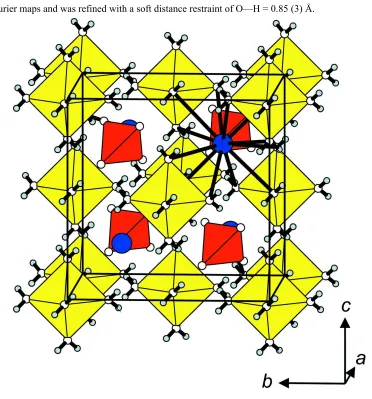
The structure can be described as a derivative of the NaCl structure type (Massa et al., 2003). The centres of the regular
complex [Mg(H2O)6] octahedra are situated on the respective Na positions, and the centres of the regular AsO4 tetrahedra
are situated on the Cl positions (Fig. 1). Thus one [Mg(H2O)6] octahedron is surrounded by six AsO4 tetrahedra in an
octahedral arrangement, and vice versa. The corresponding Mg—O and As—O distances are in the normal range (Table
1). These building units are linked via medium-strong hydrogen bonds (Table 2). Details and differences of the hydrogen
bonding schemes in cubic, hexagonal and orthorhombic struvite-type structures were discussed in detail by Massa et al.
(2003). The Cs+ cations are located in the voids of this arrangement and exhibit a regular cuboctahedral 12-coordination
to the oxygen atoms of the water molecules (Table 1).
S2. Experimental
Colourless octahedral crystals of Cs[Mg(OH2)6](AsO4) with an edge-length up to 1 mm were grown by means of the gel
diffusion technique, following a slightly modified procedure as that given by Banks et al. (1975). Aqueous solutions of
0.025 M MgSO4 and 0.02 M Na4edta (edta = ethylenediaminetetraacetate) were adjusted to pH 10 with NaOH.
Commercially available gelatine foils (5 g) were dissolved in the hot resulting 100 ml solution and allowed to form a gel
inside a large test tube overnight. When the gel had set, an equivalent amount of a solution of 0.025 M CsH2AsO4 (50 ml)
was carefully poured over the gel. This solution was then adjusted to pH 9 with NaOH. The test tube was covered with
parafilm and the crystal growth proceeded at the gel-liquid interface and into the gel. Crystals large enough for
conventional x-ray analysis grew within one week at room temperature. They were separated mechanically from the gel
and were washed with a water/ethanol/acetone (1/3/1) mixture.
S3. Refinement
The coordinates of the isotypic compound Cs[Fe(OH2)6](PO4) (Carver et al., 2006) were taken as starting parameters. The
Cs atom in the original structure determination (Ferrari et al., 1955) was positioned on Wyckoff site 4b (1/2, 1/2, 1/2),
difference Fourier maps and was refined with a soft distance restraint of O—H = 0.85 (3) Å.
Figure 1
The crystal structure of Cs[Mg(H2O)6](AsO4) projected approximately along [001]. [Mg(OH2)6] octahedra are yellow,
PO4 tetrahedra are red, Cs atoms are blue O atoms are white and H atoms are grey. For one of the Cs+ cations the Cs–O
bonds are indicated.
Caesium hexaquamagnesium orthoarsenate(V)
Crystal data
Cs[Mg(H2O)6](AsO4) Mr = 404.24
Cubic, F43m Hall symbol: F -4 2 3 a = 10.1609 (5) Å V = 1049.05 (9) Å3 Z = 4
F(000) = 768
Dx = 2.559 Mg m−3
Mo Kα radiation, λ = 0.71073 Å Cell parameters from 25 reflections θ = 11.4–12.7°
µ = 6.75 mm−1 T = 293 K
Data collection
Enraf–Nonius CAD-4 diffractometer
Radiation source: fine-focus sealed tube Graphite monochromator
ω/2θ scans
Absorption correction: integration (SHELXTL; Sheldrick, 2008) Tmin = 0.341, Tmax = 0.382 3332 measured reflections
208 independent reflections 207 reflections with I > 2σ(I) Rint = 0.037
θmax = 30.9°, θmin = 3.5° h = −14→14
k = −14→14 l = −14→14
3 standard reflections every 200 min intensity decay: none
Refinement
Refinement on F2 Least-squares matrix: full R[F2 > 2σ(F2)] = 0.016 wR(F2) = 0.038 S = 1.14 208 reflections 15 parameters 1 restraint
Primary atom site location: isomorphous structure methods
H atoms treated by a mixture of independent and constrained refinement
w = 1/[σ2(F
o2) + 5.0469P] where P = (Fo2 + 2Fc2)/3 (Δ/σ)max < 0.001
Δρmax = 0.50 e Å−3 Δρmin = −0.48 e Å−3
Extinction correction: SHELXL, Fc*=kFc[1+0.001xFc2λ3/sin(2θ)]-1/4 Extinction coefficient: 0.00144 (17)
Absolute structure: Flack (1983), 90 Friedel pairs
Absolute structure parameter: 0.01 (4)
Special details
Geometry. All e.s.d.'s (except the e.s.d. in the dihedral angle between two l.s. planes) are estimated using the full covariance matrix. The cell e.s.d.'s are taken into account individually in the estimation of e.s.d.'s in distances, angles and torsion angles; correlations between e.s.d.'s in cell parameters are only used when they are defined by crystal symmetry. An approximate (isotropic) treatment of cell e.s.d.'s is used for estimating e.s.d.'s involving l.s. planes.
Refinement. Refinement of F2 against ALL reflections. The weighted R-factor wR and goodness of fit S are based on F2, conventional R-factors R are based on F, with F set to zero for negative F2. The threshold expression of F2 > σ(F2) is used only for calculating R-factors(gt) etc. and is not relevant to the choice of reflections for refinement. R-factors based on F2 are statistically about twice as large as those based on F, and R- factors based on ALL data will be even larger.
Fractional atomic coordinates and isotropic or equivalent isotropic displacement parameters (Å2)
x y z Uiso*/Ueq
Cs1 0.7500 0.7500 0.7500 0.0599 (3)
Mg1 0.0000 0.0000 0.0000 0.0250 (6)
As1 0.2500 0.2500 0.2500 0.0201 (2)
O1 0.2031 (3) 0.0000 0.0000 0.0508 (8)
O2 0.34550 (19) 0.34550 (19) 0.34550 (19) 0.0269 (7)
H1 0.249 (3) 0.045 (2) 0.045 (2) 0.053 (12)*
Atomic displacement parameters (Å2)
U11 U22 U33 U12 U13 U23
Cs1 0.0599 (3) 0.0599 (3) 0.0599 (3) 0.000 0.000 0.000
Mg1 0.0250 (6) 0.0250 (6) 0.0250 (6) 0.000 0.000 0.000
As1 0.0201 (2) 0.0201 (2) 0.0201 (2) 0.000 0.000 0.000
O2 0.0269 (7) 0.0269 (7) 0.0269 (7) −0.0036 (7) −0.0036 (7) −0.0036 (7)
Geometric parameters (Å, º)
Cs1—O1i 3.6239 (5) Mg1—O1xiii 2.064 (3)
Cs1—O1ii 3.6239 (5) Mg1—O1xiv 2.064 (3)
Cs1—O1iii 3.6239 (5) Mg1—O1xv 2.064 (3)
Cs1—O1iv 3.6239 (5) Mg1—O1xvi 2.064 (3)
Cs1—O1v 3.6239 (5) Mg1—O1xvii 2.064 (3)
Cs1—O1vi 3.6239 (5) Mg1—O1 2.064 (3)
Cs1—O1vii 3.6239 (5) As1—O2 1.681 (3)
Cs1—O1viii 3.6239 (5) As1—O2xviii 1.681 (3)
Cs1—O1ix 3.6239 (5) As1—O2xix 1.681 (3)
Cs1—O1x 3.6239 (5) As1—O2xx 1.681 (3)
Cs1—O1xi 3.6239 (5) O1—H1 0.79 (2)
Cs1—O1xii 3.6239 (5)
O1i—Cs1—O1ii 47.49 (8) O1iii—Cs1—O1xi 72.12 (8)
O1i—Cs1—O1iii 47.49 (8) O1iv—Cs1—O1xi 47.49 (8)
O1ii—Cs1—O1iii 47.49 (8) O1v—Cs1—O1xi 90.991 (13)
O1i—Cs1—O1iv 164.89 (10) O1vi—Cs1—O1xi 119.429 (8)
O1ii—Cs1—O1iv 119.430 (7) O1vii—Cs1—O1xi 72.12 (8)
O1iii—Cs1—O1iv 119.429 (7) O1viii—Cs1—O1xi 119.429 (7)
O1i—Cs1—O1v 119.429 (8) O1ix—Cs1—O1xi 47.49 (8)
O1ii—Cs1—O1v 164.89 (10) O1x—Cs1—O1xi 164.89 (10)
O1iii—Cs1—O1v 119.429 (7) O1i—Cs1—O1xii 72.12 (8)
O1iv—Cs1—O1v 72.12 (8) O1ii—Cs1—O1xii 119.429 (7)
O1i—Cs1—O1vi 119.429 (8) O1iii—Cs1—O1xii 90.991 (13)
O1ii—Cs1—O1vi 119.429 (8) O1iv—Cs1—O1xii 119.429 (8)
O1iii—Cs1—O1vi 164.89 (10) O1v—Cs1—O1xii 47.49 (8)
O1iv—Cs1—O1vi 72.12 (8) O1vi—Cs1—O1xii 90.991 (13)
O1v—Cs1—O1vi 72.12 (8) O1vii—Cs1—O1xii 47.49 (8)
O1i—Cs1—O1vii 90.991 (13) O1viii—Cs1—O1xii 119.429 (7)
O1ii—Cs1—O1vii 119.430 (7) O1ix—Cs1—O1xii 164.89 (10)
O1iii—Cs1—O1vii 72.12 (8) O1x—Cs1—O1xii 72.12 (8)
O1iv—Cs1—O1vii 90.991 (13) O1xi—Cs1—O1xii 119.429 (8)
O1v—Cs1—O1vii 47.49 (8) O1xiii—Mg1—O1xiv 180.0
O1vi—Cs1—O1vii 119.429 (8) O1xiii—Mg1—O1xv 90.0
O1i—Cs1—O1viii 90.991 (13) O1xiv—Mg1—O1xv 90.0
O1ii—Cs1—O1viii 72.12 (8) O1xiii—Mg1—O1xvi 90.0
O1iii—Cs1—O1viii 119.430 (7) O1xiv—Mg1—O1xvi 90.0
O1iv—Cs1—O1viii 90.991 (13) O1xv—Mg1—O1xvi 180.0
O1v—Cs1—O1viii 119.429 (8) O1xiii—Mg1—O1xvii 90.0
O1vi—Cs1—O1viii 47.49 (8) O1xiv—Mg1—O1xvii 90.0
O1vii—Cs1—O1viii 164.89 (10) O1xv—Mg1—O1xvii 90.0
O1i—Cs1—O1ix 119.429 (7) O1xvi—Mg1—O1xvii 90.0
O1ii—Cs1—O1ix 72.12 (8) O1xiii—Mg1—O1 90.0
O1iv—Cs1—O1ix 47.49 (8) O1xv—Mg1—O1 90.0
O1v—Cs1—O1ix 119.429 (8) O1xvi—Mg1—O1 90.0
O1vi—Cs1—O1ix 90.991 (13) O1xvii—Mg1—O1 180.0
O1vii—Cs1—O1ix 119.429 (8) O2—As1—O2xviii 109.5
O1viii—Cs1—O1ix 72.12 (8) O2—As1—O2xix 109.471 (1)
O1i—Cs1—O1x 72.12 (8) O2xviii—As1—O2xix 109.5
O1ii—Cs1—O1x 90.991 (13) O2—As1—O2xx 109.5
O1iii—Cs1—O1x 119.430 (7) O2xviii—As1—O2xx 109.5
O1iv—Cs1—O1x 119.429 (8) O2xix—As1—O2xx 109.5
O1v—Cs1—O1x 90.991 (13) Mg1—O1—Cs1xxi 97.56 (5)
O1vi—Cs1—O1x 47.49 (8) Mg1—O1—Cs1xxii 97.56 (5)
O1vii—Cs1—O1x 119.429 (7) Cs1xxi—O1—Cs1xxii 164.89 (10)
O1viii—Cs1—O1x 47.49 (8) Mg1—O1—H1 126 (3)
O1ix—Cs1—O1x 119.429 (7) Cs1xxi—O1—H1 85.6 (3)
O1i—Cs1—O1xi 119.430 (7) Cs1xxii—O1—H1 85.6 (3)
O1ii—Cs1—O1xi 90.991 (13)
Symmetry codes: (i) −y+1, z+1, −x+1; (ii) z+1, −x+1, −y+1; (iii) −x+1, −y+1, z+1; (iv) −y+1/2, z+1/2, −x+1; (v) z+1/2, −x+1, −y+1/2; (vi) −x+1, −y+1/2,
z+1/2; (vii) y+1/2, z+1, x+1/2; (viii) y+1, z+1/2, x+1/2; (ix) x+1/2, y+1/2, z+1; (x) z+1, x+1/2, y+1/2; (xi) z+1/2, x+1/2, y+1; (xii) x+1/2, y+1, z+1/2; (xiii) −y, z, −x; (xiv) y, z, x; (xv) z, −x, −y; (xvi) z, x, y; (xvii) −x, −y, z; (xviii) −x+1/2, y, −z+1/2; (xix) x, −y+1/2, −z+1/2; (xx) −x+1/2, −y+1/2, z; (xxi) x−1/2,
y−1/2, z−1; (xxii) x−1/2, y−1, z−1/2.
Hydrogen-bond geometry (Å, º)
D—H···A D—H H···A D···A D—H···A
O1—H1···O2xix 0.79 (2) 1.86 (2) 2.650 (2) 176 (4)