Yes, the CAPM is Testable
Abstract
1. Introduction
One of the central results of the Sharpe (1964), Lintner (1965) and Black
(1972) (henceforth SLB) Capital Asset Pricing Model (CAPM) is that the
relationship between beta and expected returns is linear, exact, and has
a slope equal to the expectation of the (e¢ cient) market portfolio excess
return. Despite its appeal, this prediction has found little support in more
than three decades of empirical studies. This is probably not surprising.
Empirical tests usually employ observed variables, while none of the variables
involved in empirical tests of the CAPM are directly observable.
Cross-sectional tests of the CAPM involve replacing true variables with estimates
and proxies. Expected returns are proxied by average realized returns, betas
are estimated from a sample of time series returns, and the market portfolio
is proxied by an index. Averaging realized returns and estimating betas
introduce estimation error and, hence, a¤ect the power of empirical tests.
However, they do not change the fundamental behaviour of the SLB model.
On the other hand, employing indexes other than the true market portfolio
appears to fundamentally change the behaviour of the SLB model (Roll,
1977; Roll and Ross, 1994; and Kandel and Stambaugh, 1995).
Kandel and Stambaugh (1995), henceforth KS, found that Ordinary Least
Squares (OLS) estimates of beta-return relation bear no relation to the
prox-imity of an ine¢ cient index to the e¢ cient frontier. More importantly, KS
show that while OLS estimates are of little use, Generalised Least Squares
(GLS) estimates are functions of known quantities that are exactly related
to the position of the index within the mean-variance frontier. These can be
used to assess how close the used index is to the e¢ cient frontier. But while
the GLS quantities derived in KS are useful for testing the e¢ ciency of a
this paper is to extend the results of KS and show that, if the CAPM is the
true generating process, these GLS quantities can be used to test it.
KS investigated the e¤ect of using an ine¢ cient proxy on the CAPM
un-der the assumption that some version of the CAPM holds. This assumption
may not be correct, as expected returns may well be described by, say, some
unknown multifactor model. In such a case, the KS results no longer hold
because we now have an additional source of misspeci…cation, namely the
omission of some relevant risk factor(s). The second aim of this paper is to
show that there is a simple way to test the CAPM even when the
assump-tion that the CAPM is the true generating process is incorrect. I achieve this
by using the coe¢ cient of determination from both OLS and GLS methods,
which can help distinguish cases of ine¢ cient indexes from cases of omitted
unobserved variables.
This paper is closely related to Grauer and Janmaat (2009) and
Murtaza-shvili and Vozlyublennaia (2012). These authors provide useful simulation
results and brie‡y review the literature related to what Grauer and Janmaat
(2009) call the …rst stream of literature, which is mainly concerned with the
power of empirical tests of the CAPM. However, while the present paper has
empirical implications, it falls within what Grauer and Janmaat (2009) call
the second stream, which focuses on population parameters and the
funda-mental economic behaviour of the CAPM.
The rest of the paper begins with a summary of the full procedure
pro-posed in this paper in Section 2. In Section 3 the true cross-sectional relation
between expected returns and beta computed from any index is outlined.
Sec-tion 4 removes potential ambiguity by giving a clear idea of what is meant
by a ‘correctly speci…ed’ or ‘true’ model. In Section 5 I show how we can
a direct test of the CAPM under the assumption that the CAPM is the true
generating process. Section 6 deals with potential non-CAPM models, and
proposes a simple procedure to simultaneously assess the e¢ ciency of the
index and the presence of omitted factors. Section 7 provides a simulation
experiment to demonstrate the behaviour of the OLS and GLS statistics.
The …nal section concludes.
2. Summary of the Proposed Test
In this paper I will employ the following notation, which is similar to the
one used in Roll and Ross (1994), henceforth RR,1
R is the expected returns vector for N individual assets,
V is the N N covariance matrix of returns,
1 is the unit vector,
Bold lower case letters (i,m, qand p) are portfolio weights vectors,
i = ( 1i 2i N i)0 =Vi= 2i,
ri =i0R is the expected return of portfolio i,
2
i =i0Viis the variance of portfolio i.
The testing procedure I propose is simple. It is based on the idea that
both OLS and GLS R2 will only attain the maximum value of one if there
were no omitted factors and the index used to compute beta is e¢ cient.
A general true process generating expected returns can be written as
R=rzm1+ p p+ ep+d
where rzm is the true market portfolio’s zero beta rate, p is a parameter,
and the vector p is computed against a possibly ine¢ cient portfoliop. Even
1Like RR and KS, I assume that expected returns and the covariance matrix of these
without measurement errors, cross-sectional tests of the CAPM have to
con-tend with two unobserved error terms. Both terms are generally correlated
with the regressor ( p) and hence lead to systematic biases. The …rst error
term, ep, is due to possible ine¢ ciency of the index used to compute p.
The second term, d, is due to the possibility that the CAPM is not the true generating process.
If expected returns are explained by an e¢ cient portfolio beta, then
d =0. We can only ensure that d=0 if both OLS and GLS R2 attain
their maximum value. The …rst step, therefore, in testing the CAPM would
involve testing the null
H01 :R2gls =R
2
ols = 1:
If this hypothesis is accepted, this would con…rm that some form of beta
model holds and that the index used in computing beta is e¢ cient. The next
step consists of testing the hypothesis that the sum of GLS-estimated slope,
p(gls), and intercept, rzp(gls), are equal to the expected index return, rp.
In other words, the second step tests the following null
H02 :rzp(gls) + p(gls) rp = 0
Failing to reject this second hypothesis would con…rm that the index is
indeed the market portfolio and that, consequently, the CAPM holds.
3. Ine¢ cient Indexes and the True Relation between Expected Re-turns and Beta
In this section I o¤er a simple representation of the relation between beta
holds, there exists an e¢ cient market portfolio,m, for which expected returns have the following exact linear relation
R=rzm1+ m m (1)
where rzm is portfolio m’s zero beta rate, and m = rm rzm is the risk
premium. The vector m = ( 1m 2m N m)0 is computed against the
e¢ cient market portfolio m. If we were to observe m, model (1) can be
used to …nd the exact zero beta rate and the risk premium. However, given
V, observing m is dependent upon observing the e¢ cient portfolio m. In
practice, though, it is almost impossible to observem. Suppose that instead we use an observable, but possibly ine¢ cient, index p. Two questions arise: (i) what would the true relation between beta computed on the observed
index and expected returns be; and (ii) can we still test the CAPM given
that we are using possibly the wrong index? The answer to the last question
is yes. This is achieved by …rst …nding out whether or not we are using an
e¢ cient index and then proceeding to assess whether the e¢ cient index is
the market portfolio. This is discussed in subsequent sections. Before that,
I will attempt to answer the …rst question.
We can write the possibly ine¢ cient portfoliop as a deviation from the e¢ cient market portfolio, that is
m=p+Dp (2)
Replacing in (1) gives
R = rzm1+ m2 m
Vm
= rzm1+ m
2
m
Vp+ m 2
m VDp
= rzm1+ p p+ep (3)
where p = m 2p= 2m and ep = ( m= 2m)VDp is the (unobserved) pricing
error vector. This result is identical to that of Ashton and Tippett (1998,
p.1333) except that they write ep in terms of N 2 arbitrage portfolios.
Clearly, the relation between p and R is less than perfect because of the presence of the pricing error ep.
The inability to observe the e¢ cient market portfolio, m, and the use of an ine¢ cient proxy, p, is equivalent to assessing the relation between p
and R. Thus, when the CAPM holds, the true model governing the relation between mandRis (1), while the true model governing the relation between
p and R is (3). Both (1) and (3) are true models, but the reason why we
are interested in (3) is our utilization of the ine¢ cient index p.
An objection might be that there exists an in…nite number of
‘true’mod-els,
R=rzm1+ p p+ep; (4)
where p and ep are appropriately chosen. For example, p = p p and
ep = ep + (1 ) p p, for any arbitrary , are all deviations from (3).
However, this is trivial since they all simplify algebraically to (3), which is
the unique true relation between p and R.
The point that any arbitrary model (4) reduces to (3) seems to have been
missed by KS. These authors assume that expected returns are given by
error vector. This model is identical to (4) with = [rzm p]0 and X = [1
p]. The true parameter relating p toR is p and not an arbitrary p (or,
alternatively, ).
A question that arises is whether there can be models where the true
parameter relating p toR is di¤erent from p. In other words, is it possible to have a model like (4) that reduces to (1) without passing through (3)?
The answer is yes, but such a model would be inadmissible in a world of
CAPM as it would imply that the index used in the test is not fully funded.
One interesting example is the deviation suggested by Ferguson and
Shock-ley (2003), who assume that the true market portfolio consists of a weighted
sum of the economy’s debt claims (D) and the economy’s equity claims (p)
m= p+ (1 )D
where 0< <1.
In our notation, pis an (observed) ine¢ cient index andD is the omitted portfolio with D01= 1. Replacing the value ofm in equation (1) yields
R=rzm1+ p p +
(1 ) 2D m
2
m
D (5)
Thus, the implicit assumption in this model is that the index used in
computing betas is not fully funded ( p rather thanp) and this violates the budget constraint in the CAPM optimization problem.
A simple conclusion from model (3) is that the true cross-sectional slope
( p) between expected returns and beta computed against any portfolio is
always positive. However, although the true slope is non-zero, the empirical
estimate of p may not be so. Assuming we can measure p precisely,
esti-mating rzm and p in model (3) su¤ers from the omitted regressor problem
Whenpis on the upper half of the e¢ cient frontier,epwill be uncorrelated with p but correlated with the vector 1. Thus, the GLS/OLS estimators
of rzm are still biased, but they will both produce a perfect …t (as we shall
see later). The reason is that betas computed from e¢ cient portfolios are
perfectly correlated.2 So although the estimators are biased with respect
to the true model (1), any beta computed against an e¢ cient portfolio has
a perfect linear relation with the cross-section of expected returns. I will
exploit this divergence to derive a criterion for testing the CAPM.
Whenpis not on the e¢ cient frontier, the empirical power of p to explain expected returns may or may not depend on the position ofp relative to the e¢ cient frontier. A signi…cant …nding by KS is that the choice of OLS versus
GLS is critical. Although both methods yield biased estimates with respect
to the true model, under OLS the empirical power of p suggested by the
estimates (including the R2) bears no relation to the proximity of portfolio
p to the e¢ cient frontier. The bias can be arbitrarily large or small.
On the other hand, under GLS the power of p to explain expected
returns is strictly related to the position of portfolioprelative to the e¢ cient frontier. The bias in both parameters is known exactly. Hence, one can use
this GLS feature to assess the position of the proxy not only with respect to
the e¢ cient frontier but also with respect to the true market portfolio.
It is worth noting, however, that while KS have successfully explained the
bias of the GLS estimator, they do not seem to have explained the behaviour
of the OLS bias satisfactorily. Appendix 1 revisits KS analysis, with a view
to providing a better explanation of the OLS bias.
4. Terminology: “Correctly Speci…ed” and “True” Model
2If bothmandpare e¢ cient,
p and mwill be perfectly correlated because they are
Before discussing the proposed tests it is useful to remove potential
am-biguity that can arise from the use of the terms ‘correctly speci…ed model’
and ‘true model’. The latter is related to the real world, so when we say
that the CAPM is true (or, alternatively, that the CAPM holds), we simply
mean that the data are actually generated by a CAPM model. The former is
related to the empirical world. So when we say that the (empirical) model is
correctly speci…ed, we simply mean that the empirical model’s speci…cation
coincides with the real data generating process.
In our context, a true expected return generating process can be written
in the following general form R=rzm1+ m m+d. This model allows for
any cross sectional speci…cation, such as APT or other multifactor models,
through the vector d. When d=0 I say that the CAPM holds, or the CAPM is true. This simply means that the assumption that ‘the CAPM is
the process that has generated the observed expected returns’is correct. An
empirical CAPM model of the form R = rzm1+ m m +", where " is the usual disturbance term,3 will be said to be correctly speci…ed. But this only
happens when we observe the market portfolio (i.e. when we use m as a
regressor).
Incorrect speci…cation, or misspeci…cation, takes place for two reasons.
Either we wrongly assume that the observed portfolio is the market portfolio
(ep 6= 0); and/or we wrongly assume that the CAPM holds (d6= 0). Thus, the (possibly non-CAPM) true model will be R = rzm1+ p p+ep +d,
whereas the empirical model will beR=rzm1+ p p+", but the disturbance term will no longer have zero mean or be uncorrelated with the regressor p
(since "=ep+d).
3This term is usually assumed to have zero mean and to be uncorrelated with
regres-sor(s). In this paper I assume away statistical or measurement errors, so in this case of
Any inference carried out on the CAPM therefore crucially depends on
whether the assumptions that the ‘CAPM is true’ and that ‘the portfolio
used to compute beta is the true market portfolio’ are correct. If both
as-sumptions are correct, then we would only have to contend with small sample
or measurement errors (which are assumed away in this paper). However,
when one or both of these assumptions are incorrect, then we would have to
contend with the meaningfulness of the empirical estimation and inference.
In the next section, I will show that the CAPM can be tested in the
simpler case where the assumption that the CAPM holds is correct (d=0), but the only potential problem is the possibility that the index is not the
market portfolio (ep 6=0). However, the inference will generally be invalid if the CAPM assumption is violated. Fortunately, there is a way to ensuring
that d=0 before proceeding with the formal test of the CAPM. This is discussed in Section 6.
5. Testing the CAPM under the Assumption that the CAPM Holds
In this section I extend the results of KS, who show that the GLS method
provides a useful statistic, namely the GLS R2, that can be used to assess
the e¢ ciency of a given portfolio. I emphasise the point that KS build their
results under the assumption that the CAPM is true. I will use the same
assumption in this section to (i) show that the e¢ ciency of a portfolio is a
necessary but not su¢ cient condition for testing the CAPM; and (ii) derive
a necessary and su¢ cient condition for testing the CAPM.
I start by showing the usefulness of GLS. The GLS bias, derived by KS
(p.167), is given by
0
@ ^rzm(gls)
^m(gls) 1 A=
0 @ rzm
m
1
A+ 1 p 0 @ m
2
g
2
m
m
where p = (rp rg)=(rm rg), and rg is the expected return of the Global
Minimum Variance Portfolio (GMVP). For ine¢ cient portfolios above the
GMVP (rp > rg), the intercept is always overestimated and the slope is
al-ways underestimated. Also, for rp > rg, both GLS estimates will be positive.
The slope bias is completely determined by portfolio p’s position in mean-variance space, but the intercept bias is only partially determined by p.
Thus, for a given portfolio, di¤erent asset universes will produce identical
slope biases but di¤erent intercept biases.
As KS argue, the OLS estimator o¤ers no clues as to where portfolio p
is situated relative to the e¢ cient frontier. Relying on OLS can therefore
be misleading. On the other hand, the GLS result is strictly related to the
position of the ine¢ cient portfolio in mean-variance space. The question
then is how useful is GLS in testing the CAPM? The answer is that the raw
quantities obtained from GLS are only useful for testing the e¢ ciency of a
given index. To see this, note that in the absence of sampling error, the GLS
output contains three quantities: the intercept, rzm+ (1 p)(rg rzm), the
slope p(rm rzm), and the GLSR2 given by4
2
p =Rgls2 = 1
(R X gls)0V 1(R X gls) (R 1 )0V 1(R 1 )
where = (R0V 11)=(10V 11).
All three quantities depend on the measure of the relative e¢ ciency of
portfoliop, p. Although the intercept is uninformative, the sign of the GLS
slope tells us the position of the index relative to the GMVP. A positive
value of the slope indicates that the index is above the GMVP and vice
versa. The R2
gls informs us how close the index is to the frontier. Thus, only
by combining the information contained in the slope and the R2gls can we determine the exact position of the ine¢ cient index.
4The proof that 2
However, determining the e¢ ciency of a given index is not su¢ cient for
testing the CAPM. Suppose the slope was positive and 2p = 1. This would only tell us that portfolio p is e¢ cient, but this would not be su¢ cient evidence in favour of the CAPM. In other words, the e¢ ciency of an index
is a necessary but insu¢ cient condition for the CAPM to hold.
Although any e¢ cient portfolio will provide perfect linearity and hence
perfect …t, the CAPM requires that the slope equals the market expected
return in excess of the zero beta rate, and that the intercept equals the zero
beta rate. However, if an index, say q, is e¢ cient the GLS regression would give two positive numbers
q gls =
0
@ r^zq(gls)
^q(gls) 1 A=
0 @ rzq
rq rzq
1 A
If the index is the market portfolio we would also be given two positive
numbers
m gls =
0
@ ^rzm(gls)
^m(gls) 1 A=
0
@ rzm rm rzm
1 A
Both q and m will satisfy 2m = 2q = 1. Telling the di¤erence between
q and m is the key to the testability of the CAPM. Using the relationship betwen the GMVP and any e¢ cient portfolio, we have
rg =rzq+ (rq rzq)
2
g
2
q
rg =rzm+ (rm rzm)
2
g
2
m
Combining these two equations gives
rq =rzq +
2
q
2
g
(rzm rzq) +
2
q
2
m
From (3)
R = rzm1+
2 q m 2 m q+ m 2 m
(Vm Vq)
= (rzm+ q m2 m
)1+ 2
q m
2
m q
= rzq1+(rq rzq) q (7)
where q is a constant and results from the fact that q and m are perfectly
correlated. Suppose we estimate a model using the e¢ cient portfolioq. Using (7) we have
^
rzq(gls) + ^q(gls) = rzq+
2
q
2
m(rm rzm)
Subtracting (6) from above yields
^
rzq(gls) + ^q(gls) rq =
2
q
2
g(rzm rzq)
which only equals zero if q=m.
Thus, GLS can help us not only to determine the e¢ ciency of a given
index, but also to test the CAPM. It exploits the fact that under the null
(q=m)
^
rzq(gls) + ^q(gls) rq = 0
So, one can test whether the sum of slope and intercept are equal to the
expected index return. Note that when the index is e¢ cient, OLS and GLS
are identical in the absence of sampling error. Thus, in principle, both
meth-ods could be useful in testing the CAPM. However, empirical investigators
use sample estimates of returns, betas and the covariance matrix. That is,
empiricists use feasible GLS rather than GLS. So, as Shanken (1992) and
samples”(KS, p.170). Nevertheless, in practice the choice between OLS and
GLS will depend on considerations other than the population moments.
Al-though it is beyond the scope of this paper to discuss these practical choices,
it should be noted that most econometric textbooks describe to some length
the conditions under which some estimators might be preferable to others.
6. Omitted Factors
The previous analysis was based on the assumption that the SLB CAPM
holds. The only source of potential problems considered so far has been the
use of an ine¢ cient index. This follows the tradition of RR, KS and Ferguson
and Shockley (2003) who do not consider the case where the CAPM does not
hold. However, since my results support the testability of the CAPM when
it is true, I need to assess whether the CAPM can also be rejected when it
is false.
Appendix 2 shows that there is no loss of generality if we focused on
vertical departures from the market portfolio. Thus, let X = [1 p] and
= [rzm m]0, and consider the general (possibly non-CAPM) model
R=X +ep+d
where d is not proportional to the vector1, and ep 6= d.5 This is the case
of both omitting relevant factors and using a possibly ine¢ cient index to
compute betas. When d6=0; the previous results on GLS bias no longer hold, even if ep = 0.6 Thus, we are now faced with two potential sources
of bias, and we cannot identify whether the source of bias is due to the
ine¢ ciency of the index or due to misspeci…cation.
The bias for the OLS and GLS estimators is given by, respectively
5e
p+d=0implies that the CAPM holds and thatpis e¢ cient.
6However, whendis orthogonal toXthe OLS will be unbiased, and whendis
ols = + (X0X) 1X0(ep+d) gls = + (X0V 1X) 1X0V 1(ep +d)
It is clear that the bias would only vanish whenep =0(that is, the index used to compute beta is the market portfolio) and d is orthogonal toX (for the OLS case), or V 1X (for the GLS case). Note that the bias will remain if the index was e¢ cient but not equal to the market portfolio (that is, if ep
was proportional to the vector 1). Thus, omitting factor sensitivities may worsen the spuriousness problem because there are now two sources of bias.
More importantly, the GLS bias is no longer related to the position of the
index relative to the e¢ cient frontier. This is simply because d may not be related to V 1 and X in the same way as ep.
As a result, R2
gls loses its strict relation with the index position relative
to the e¢ cient frontier and, like R2ols, may behave erratically. But this is not the only consequence of admitting potential misspeci…cation. In KS, and
under the assumption that the CAPM is true generating process, R2ols = 1
or R2
gls = 1 can only happen when the index is e¢ cient. A surprising result
here is that the R2 can attain its maximal value even when the index is ine¢ cient. This is because there are now two sources of bias, ep and d,
which can combine to give R2 = 1.
To see this, note that from the de…nition of the R2
ols (Appendix 1) and R2gls, the vectors of interest are, respectively
Qols=R X ols = [I X(X0X) 1X0] (ep+d) Qgls =R X gls = [I X(X0V 1X) 1X0V 1] (ep+d)
These are the pricing errors obtained from the OLS and GLS estimation,
respectively. Because bothR2involve quadratic terms,R2ols= 1andR2gls = 1
when (i) ep=0, or ep is proportional to the vector1, and (ii)d =0, that is, the index used to compute beta is e¢ cient and there are no omitted factor
sensitivities (i.e. the CAPM is true).
However, there is a possibility thatR2 = 1even when the above conditions
are not met. For the OLS, when d is orthogonal to X (i.e. X0d = 0) the pricing error vector simpli…es to
Qols = I X(X0X) 1X0 ep+d
Thus, d= [X(X0X) 1X0 I]e
p implies Qols =0.7
Similarly, when d is orthogonal to XV 1 (i.e. X0V 1d = 0) the pricing
error vector simpli…es to
Qgls = I X(X0V 1X) 1X0V 1 ep+d
So, d= [X(X0V 1X) 1X0V 1 I]ep implies Qgls = 0.
Thus, one could unawarily use both an ine¢ cient index while omitting
relevant variables from the empirical model and still obtain a perfect OLS or
GLS …t. Fortunately, we cannot obtain a perfect …t for both, for even in the
unlikely event thatdwas orthogonal to both matrices (i.e. X0d=X0V 1d=
0) it would not be able to satisfy Qols =Qgls = 0. The reason is that8
X(X0X) 1X0 6=X(X0V 1X) 1X0V 1
Thus, when the CAPM is not the true generating process (d6=0), using an e¢ cient index actually ensures that both OLS and GLS R2 will be less
7We exclude the case where e
p is a linear combination of the columns of X, because
that would implyd= 0. This also applies to the GLS case below.
8Except for the trivial case where the covariance matrix is proportional to the identity
than 1, regardless of whether or not d is orthogonal to X or XV 1. This highlights the danger of carrying out inference under the assumption that the
CAPM holds. Were we to do that in the presence of an omitted sensitivity,
we could conclude, wrongly, that the index is ine¢ cient on the basis of the
GLSR2as suggested by KS. Unexpectedly, when the index is ine¢ cient there
is a possibility that one of theR2 will equal 1. Again, were we to believe one
of theR2 we would wrongly conclude that the index is e¢ cient, when in fact
it is not. Fortunately, there is a unique case where we can ensure that the
index is e¢ cient and that the CAPM is the true model, namely when both
OLS and GLS R2 attain the maximum value of 1.9
Thus, one major conclusion emerges: the CAPM is testable even under
potential misspeci…cation (ine¢ cient index and omitted factor loadings). It
is well known that omitted variables create inference problems because we
do not know whether the estimates are biased or not. Econometricians are
aware of this problem and generally tolerate it, especially when the
omit-ted regressor is orthogonal to, or at least uncorrelaomit-ted with, the right hand
side variables. Most empirical models in economics accept the less than
per-fect relation between regressor(s) and regressee, and often focus on obtaining
unbiased estimates. One further advantage with economic models is that
regressors are observed (or assumed to be observed). Thus, an R2 that is
smaller than 1 is not a cause for concern. In CAPM language, this is
equiva-lent to saying that (i) the CAPM holds; (ii) the CAPM predicts an imperfect
relation between beta and expected returns; and (iii) the market portfolio is
observable. Were we to have these facilities, we would then only be interested
in the market risk premium, hoping that omitted factors sensitivities were
9Note that, here, e¢ cient means that the portfolio is on the minimum variance frontier.
uncorrelated with the market beta. The R2 would be of no consequence.
Unfortunately, when testing the CAPM the econometrician does not
ben-e…t from such facilities. Even with no measurement errors, the
econometri-cian still needs to show that the observed index is e¢ cient, that it is the
market portfolio, and that there are no omitted factor sensitivities (i.e. the
CAPM holds). RR argue that the …rst requirement cannot be attained using
OLS even if we assumed that the CAPM holds. KS show that index e¢
-ciency can be assessed via GLS when the CAPM holds, but do not explore
the property of GLS in a non-CAPM world. Understandably, given the
pes-simism against the testability of the CAPM, assessing whether the index is
the market portfolio and whether there are no omitted variables has not been
dealt with previously. In this paper, I o¤er a positive answer to the sceptics:
the CAPM is testable. Of course, like RR and KS I do assume measurement
errors away. What happens when there are measurement errors is a di¤erent,
and certainly more challenging, undertaking. The aim of this paper is much
more modest. I have simply attempted to establish a theoretical principle,
namely the CAPM is testable.
7. A Simulation Experiment
Although we know the exact behaviour of the GLS slope, we are far less
informed about the OLS coe¢ cients. All we know is that they are biased
and that the bias is arbitrary and is not related to the proximity of the index
to the e¢ cient frontier. Since it is not possible to assess the scale and sign of
the OLS bias theoretically, it should be useful to infer the behaviour of the
OLS estimates via a simulation experiment.
The simulation is carried out in two main steps. The …rst step involves
mean-variance universe and randomly generate deviations from the market
return, and calculate the OLS and GLS estimates of parameters and R2.
First, to generate a mean-variance frontier, a positive de…nite
variance-covariance matrix, V, is randomly drawn such that the GMVP’s standard deviation lies between 2% and 6%. GivenV, I randomly draw a set of market weights, m, such that the market portfolio’s standard deviation is less than 30%. More speci…cally, I …rst obtain beta, m = Vm=m0Vm, and then obtain a set of compatible expected returns, R= 1+ 2 m. The zero beta
rate 1 is drawn from a uniform distribution with a range of 0.4% to 0.6%.
The excess market return 2 is drawn from a uniform distribution with a
range of 0.65% to 0.85%: The market return and variance are then obtained as rm =m0R, and 2m =m0Vm. I redrawmand repeat the procedure until
m is less than 30%.10
Next I generate random deviations from the market portfolio to obtain
an ine¢ cient portfolio p. Since it is di¢ cult to obtain vertical deviations fromm, I generate the e¢ cient portfolio,q, that has the same variance asp. The comparison is then made between p and q. Thus, for each replication the true model is R = rzq + q q, where q = rq rzq. The OLS and
GLS estimates are obtained using p instead of q. The coe¢ cients are
then compared with the true values rzq and q. I also calculate p and the
coe¢ cients of determination for each replication.
To minimise the chance that the results are driven by an arbitrary choice
of the e¢ cient frontier, I maximise the number of asset universes used in
10To give an idea about the kind of frontiers I use in this simulation, I generated 5000
the simulation. I generate 1000 di¤erent frontiers, and for each of these I
generate 1000 deviations from the market portfolio. These deviations are
computed such that a wide range of portfolio ine¢ ciency is produced. This
gives 1 million replications, producing GLS and OLS biases.
A. Comparing the Slopes.
The basis for comparing the slopes is the relative bias, which is given
by ^q q
q . However, to get an idea about how distant the estimate is from
the true value I use a slight modi…cation, 1 + ^q q
q . This shows the bias
as a proportion of the true slope. For example, a value of 0.40 means that
^q = 0:4 q, that is, the OLS coe¢ cient underestimates the true parameter by 60%.
The GLS and OLS biases will behave according to, respectively,
1 + ^q(gls) q
q = p
1 + ^q(ols) q
q =
cov^ ( p; q)
v^ar( p)
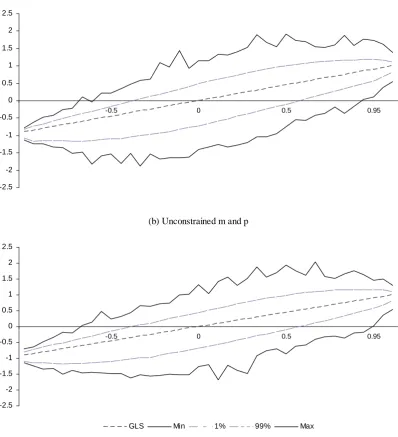
Figure 1 shows these biases for two cases, each of which depends on
whether or not a constraint of positive portfolio weights is imposed. These
are (a) constrainedmandp, and (b) unconstrainedmandp.11 This ensures
that the results are not driven by short positions (RR, 1994; Grauer, 1999).
As expected, the GLS bias is exact in p. The constrained and
uncon-strained cases are very similar and con…rm the arbitrariness of the OLS bias.
The spread around the true slope is large even for highly e¢ cient indexes.
Zero estimated slopes are not expected to be uncommon, and for indexes
that are roughly less than 80% e¢ cient we should even expect negative OLS
slopes. Yet, large estimates cannot be ruled out.
11The cases where only one of the two portfolios is constrained were very similar
B. Comparing the Intercepts.
The GLS intercept has an exact relation with p, but is not exclusively
determined by it. However, it is possible to derive a bias criterion such that
it is exactly linear in p. Using the GLS bias result, and equation (A66),
p.180 of KS, I obtain
^
rzq(gls) rzq
rg rzq = 1 p
Unfortunately, this cannot be compared with a similar OLS criterion.
Using the OLS bias result gives
^
rzq(ols) rzq
rg rzq =
rq rzq
rg rzq q p
cov^ ( p; q)
v^ar( p)
So, although the GLS intercept will not depend on the frontier, the OLS
criterion will depend on three frontier parameters. The OLS bias would
appear to be arbitrary by construction. However, the above OLS criterion
simpli…es to a relative measure that will not depend on the frontier
^
rzq(ols) rzq
rq rzq = q p
cov^ ( p; q)
v^ar( p)
This gives a bias relative to the e¢ cient index return rather than the
GMVP return. The OLS and GLS bias criteria are therefore not directly
comparable. Nervertheless, there is a clear di¤erence. The weighted GLS
bias should be exactly linear with the e¢ ciency of the index. On the other
hand, the weighted OLS bias is expected to be unrelated to the e¢ ciency of
the index.
Figure 2(a) plots the relative OLS bias for the constrained case (positive
m and p). For highly ine¢ cient indexes, the OLS method seems to always overestimate the intercept. However, for more e¢ cient indexes the bias can
^
rzq(ols), cannot be ruled out. In the above experiment, around 600 intercepts
(out of the million replications) were negative.
Figure 2(b) shows a plot of the OLS relative bias when the market and
ine¢ cient portfolios are allowed to have short positions. The relation between
relative e¢ ciency and intercept seems ‡atter than that of the constrained
case, but the bias is still arbitrary.
In both constrained and unconstrained cases there is an obvious tendency
for the OLS to over-estimate the intercept. The 1st and 99th percentiles
suggest that the vast majority of cases have positive bias. As expected, the
GLS relative bias is exactly linear and is therefore not reported. Clearly, the
GLS estimate of the intercept is always biased upwards and hence always
positive.
C. The R-Squared.
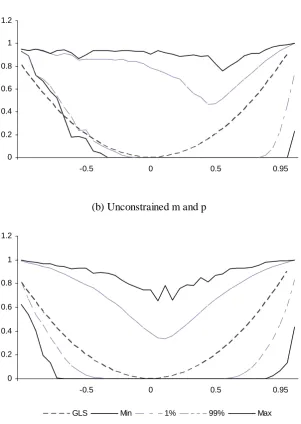
The R2 results for the experiment are plotted in Figure 3. Both
con-strained (positive m and p) and unconstrained cases are shown. The GLS shows the expected exact curve, but the OLS bias appears to depend on the
constraint. While the unconstrained bias is smoother and fairly symmetric,
the constrained percentiles are tilted to the right. However, both cases give
the same message. The OLS varies widely with relative portfolio e¢ ciency,
p. If we take the extremes, zero R2ols are very common and can be found
for indexes that are more than 95% e¢ cient in the constrained case. Large
values for the R2
ols are also common at all levels of ine¢ ciency. In general
it is clear that the OLS does not provide guidance as to the e¢ ciency of a
given portfolio.
D. Nearly E¢ cient Portfolios.
As mentioned earlier, one advantage of the bias derived in this paper is
the bias formulas we expect the slope bias and R2
ols to converge to zero and
one respectively, as the index gets arbitrarily close to the upper half of the
e¢ cient frontier. This is shown in Figure 4, where the OLS slope bias and
R2
ols for the 4000 most e¢ cient simulated portfolios are plotted. The slope
bias is still substantial for portfolios that are 99.3% e¢ cient. However, we
can also see that the OLS slope estimates get closer to the true slope as
the portfolio e¢ ciency gets arbitrarily close to 100%, but we would not be
comfortable with portfolios that are less than 99.99% e¢ cient. For example,
a 99.8% e¢ cient portfolio can produce a slope that is anywhere between less
than 90% and almost 110% the true slope.12 This clearly casts doubt on the
usefulness of OLS even with nearly e¢ cient indexes. TheR2olsshows a similar pattern. Figure 4 shows that R2
ols of less than 0.96 can still be obtained for
indexes that are between 99.7% and 99.8% e¢ cient. Again, for very nearly
e¢ cient portfolios, the R2
ols is very close to its maximum value.
[Insert Figures 1-4 around here]
E. Omitted Factors.
The above simulations are based on the assumption that the true data
generating process is the CAPM (d=0). The R2
gls is exactly related to the
e¢ ciency of the index as expected, while the R2
ols seems to converge to its
maximum value as the index gets arbitrarily close to the e¢ cient frontier.
With potential omitted factors, the interest lies in the behaviour of both
coe¢ cients of determination. To show this, expected returns are generated
as before, except that one additional term is added to the CAPM, R =
rzq + q q+d. I generate omitted sensitivities, d = d , by taking seven
12These values are true for this particular experiment. Di¤erent simulations may
di¤erent values for the scale, , starting at zero (CAPM) and then increasing
to 0.001, 0.01, 0.05, 0.1, 0.5 and 1. For each value of a random vectord is drawn from a uniform distribution with a range of 0% to 1%, and then the
whole simulation procedure is repeated (that is, 1000 di¤erent frontiers by
1000 deviations from the market portfolio). This gives one million replication
for each of the seven scales, .
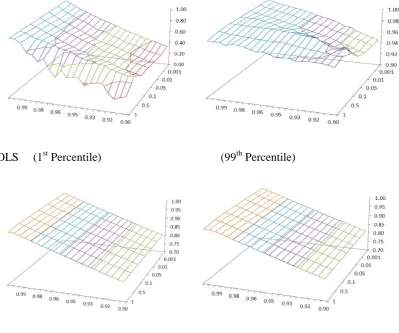
The results are shown in Figure 5. The …rst pair of plots show the 1st and
99th percentiles for theR2
ols for each of the seven scales of omission. Because
OLS is highly sensitive to repackaging, the …rst percentile is as low as 29.3%
for indexes that are 90% e¢ cient. The addition of omitted variable has some
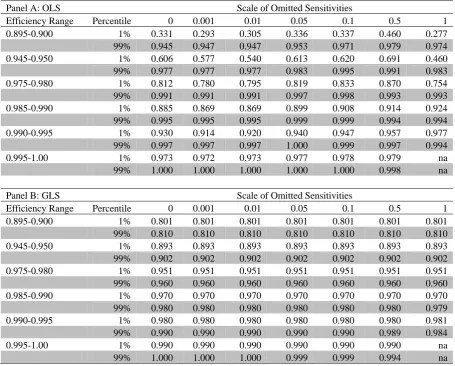
e¤ect, especially for indexes below 96% e¢ ciency. Table 1 shows the values
of the R2
ols percentiles. In general theR2ols tends to decrease with increasing
importance of omitted sensitivities. More importantly, the Rols2 can reach the maximum value even for indexes that are not perfectly e¢ cient. This is
shown under = 0:05where the 99th percentile equals exactly 1 for indexes whose e¢ ciency is between 99% and 99.5%. Although the general trend is
for the Rols2 to increase with increasing index e¢ ciency, the 1st percentile remains relatively low (between 97.2% and 97.9%). We also get a glimpse on
the e¤ect of more important omission at the highest scales ( = 0:5and 1). All 99th percentiles decrease relative to other lower scales. Unfortunately, I
have been unable to obtain highly e¢ cient indexes with higher scales and I
leave this intersting behaviour for a future investigation.
The GLS statistics are far less sensitive to repackaging, and show a much
smoother relation with the index e¢ ciency and the omission scale. Table
1 reveals that the di¤erence between the 1st and 99th percentiles is around
1% for all cases. The increase in the …rst …ve scale values does not seem to
be shown at the third decimal place). However, the two highest scales have
a clear impact on the 1st and 99th percentiles for the two highest levels of
e¢ ciency. For up to 99.5% index e¢ ciency, the 99th percentile goes down
from 98.9% to 98.4% when the omission scale increases from 0.5 to 1.
Sim-ilarly, when the omission scale increases from 0.1 to 0.5, the 99th percentile
decreases from 99.9% to 99.4% for the highest e¢ ciency indexes. As before,
the increase in index e¢ ciency increases the R2
gls overall.
To sum up, the impact of omitted sensitivities on the coe¢ cients of
de-termination depends on how important these sensitivities are to expected
returns. For low importance, the GLS is generally insensitive and will
de-pend mainly on the e¢ ciency of the index. The OLS is highly sensitive
and can help reject the CAPM even for very highly e¢ cient indexes. As
these omissions become more and more important, the limited results of the
simulation indicate that both R2
ols and R2gls will start to decrease sharply.
[Insert Figure 5 around here]
[Insert Table 1 around here]
8. Conclusions
Testing the CAPM has long been problematic. The use of an ine¢ cient
index is by no means its only limitation, but the possibility that the indexes
used typically in empirical tests of the CAPM are ine¢ cient undermines even
the question of whether we are really testing the CAPM or a model other
than the CAPM. The most challenging question to previous empirical studies
of cross-sectional tests of the CAPM has been whether the CAPM is testable
at all. Even assuming estimation problems away, one is still faced with two
major uncertainties: the ine¢ ciency of the market index and the possibility
In this paper I propose a new way of testing the CAPM, even in the
presence of orthogonal omitted factor sensitivities. I show that the CAPM
is testable both when the CAPM holds and when it does not. The trick
is to use both OLS and GLS. The only way that both R2 can attain their
maximum value is when we use an e¢ cient index and there are no omitted
variables. Once it is ascertained that the CAPM is true and that the index is
e¢ cient, one can then proceed to formally test the CAPM using an extension
of KS results.
The results of this paper are based on the assumption that there are no
sampling errors. This assumption helps to isolate the fundamental behaviour
of the model at hand. In practice, though, the OLS and GLS estimates will
be subject to additional uncertainty due to measurement errors in expected
returns and betas. The literature has come up with many suggestions as to
how to deal with the error in variable (beta) problem, and these seem to have
been generally accepted. Also, the trade-o¤ between OLS and GLS is well
known in the econometric literature. There is less agreement, though, on
how to deal with the question of “error in expected return” (Merton, 1980;
Elton, 1999), and this remains a problem for all cross sectional tests of asset
pricing models.
In addition, testing the CAPM now requires a pre-test involvingR2
ols and R2gls. The next step is, therefore, to derive the statistical properties of Rols2
and R2
gls under both the CAPM and the non-CAPM alternative. A recent
paper by Kan, Robotti and Shanken (2013) provides some asymptotic results
of the individual cross-sectional R2. An interesting extension of their work
would be to derive asymptotic properties of a test involving a combination
of R2
ols and Rgls2 . For example, the pre-test advocated in this paper would
References
Ashton, D., and M. Tippett, 1998, Systematic risk and empirical research,
Journal of Business Finance and Accounting 25, 1325-1355.
Black, F., 1972, Capital market equilibrium with restricted borrowing,
Jour-nal of Business 45, 444-455.
Elton, E.J., 1999, Expected Return, Realized Return, and Asset Pricing
Tests, Journal of Finance 54, 1199-1220.
Ferguson, M.F., and R.L. Shockley, 2003, Equilibrium “Anomalies”, Journal
of Finance 58, 2549-2580.
Grauer, R.R., 1999, On the cross-sectional relation between expected returns,
betas, and size, Journal of Finance 54, 773-789.
Grauer, R.R. and J.A. Janmaat, 2009, On the power of cross-sectional and
multivariate tests of the CAPM, Journal of Banking & Finance, 33, 775–787.
Kan, R., C. Robotti and J. Shanken, 2013, Pricing Model Performance and
the Two-Pass Cross-Sectional Regression Methodology, Journal of Finance,
68, 2617-2649.
Kandel, S., and R.F. Stambaugh, 1995, Portfolio ine¢ ciency and the
cross-section of expected returns, Journal of Finance 50, 157-184.
Lintner, J., 1965, The valuation of risk assets and the selection of risky
investments in stock portfolios and capital budgets, Review of Economics
and Statistics 47, 13-37.
Merton, R.C., 1980, On estimating the expected return on the market: An
Murtazashvili I., and N. Vozlyublennaia, 2012, The performance of
cross-sectional regression tests of the CAPM with non-zero pricing errors, Journal
of Banking & Finance 36, 1057–1066.
Roll, R., 1977, A critique of asset pricing theory’s tests; Part 1: On past
and potential testability of the theory, Journal of Financial Economics 4,
129-176.
Roll, R., 1980, Orthogonal portfolios, Journal of Financial and Quantitative
Analysis, 15, 1005-1023.
Roll, R., and S.A. Ross, 1994, On the cross-sectional relation between
ex-pected returns and betas, Journal of Finance, 49, 101-121.
Shanken, J., 1992, On the estimation of beta-pricing models, The Review of
Financial Studies 5,1-33.
Sharpe, W.F., 1964, Capital asset prices: A theory of market equilibrium
Appendix 1. The KS Analysis: OLS versus GLS
KS analyse the bias in both OLS and GLS estimators when the betas are
computed using an ine¢ cient portfolio. However, they do not o¤er ways to
directly compare the true OLS estimates, , with the true GLS estimates,
. First, the OLS bias is based on an arbitrary parameter vector . They
assume that expected returns are given by R = X +f, where is some two-element vector, X = [1 p], and f is an error vector. Although this is similar to equation (3), it is not related to the true process (1) as neither
norf are explicitly linked to the true mean-variance parameters. Thus, the OLS estimator is compared to an arbitrary ‘true’ parameter vector, rather
than one that is implied by a theoretical model. While this is useful in
demonstrating that the bias can be arbitrarily small or large, it does not allow
us to compare it with the GLS estimator . In this latter case, KS show that
the GLS estimator is related to the returns of the e¢ cient portfolio with the
same variance as portfoliop, the zero beta portfolio, and the global minimum variance portfolio. But in both cases, there is a lack of a true theoretical
model to compare the performance of these two estimation methods.
Relating the two estimation methods to the same reference model makes
it possible to relate the bias to a single set of true parameters. It is worth
noting also that the OLS bias I derive in the next subsection is valid for
ine¢ cient as well as e¢ cient portfolios. In contrast, the bias derived in KS
is only valid for strictly ine¢ cient portfolios.
A. The OLS Bias.
Without loss of generality, I focus on ine¢ cient portfolios that have the
same variance as their e¢ cient portfolio. In other words, I only focus on
‘vertical’departures, p, from an e¢ cient portfolio, m, such that 2
p = 2m.13
LetX= [1 p] so that model (3) can be written as
R=X +ep
where = [rzm m]0, m = p = rm rzm, and ep= ( m= 2m)(Vm Vp) = m( m p).
The general form of the OLS estimator is given by ols= +(X0X) 1X0ep.
Appendix 2 shows that this is equal to
0
@ ^rzm(ols) ^m(ols)
1 A=
0 @ rzm
m
1 A+ m
0
@ m p
cov^ ( p; m)
v^ar( p)
c^ov( p; m)
v^ar( p) 1 1 A
were , v^ar and cov^ are the sample (cross-sectional) mean, variance and covariance respectively. The second term of the right-hand side is the bias
and is generally only equal to zero whenp=m.14 However, the value of this bias can be arbitrarily small or large and does not depend on the degree of
e¢ ciency of portfolio p.
There are at least two arguments why this bias may not be related to
portfoliop’s position in mean-variance space. First, there is an in…nite num-ber of portfolios that have the same variance and mean as p. Thus, there are always some portfolios that can produce betas yielding arbitrary values
for the bias. Second, we can use the repackaging argument. Since
repackag-ing does not alter portfolio p’s location in mean-variance space, repackaging the assets produces the same ‘ine¢ cient’ betas, but di¤erent market betas
and hence di¤erent average market betas and covariance/variance ratios.
Be-cause the bias is a¤ected by repackaging we cannot systematically quantify
the behaviour of the bias.
that of the market is una¤ected.
14Strictly speaking, the bias should be the expectation of the second term of the
More precisely, KS show that one can repackage the assets (i.e. change
their means and variances) without changing the ine¢ cient portfolio’s
posi-tion or its betas. In other words, there exists a matrixA such thatA1 =1, and A p = p (equations A19 and A20, p.174). However, for the e¢ cient portfolio, A m 6= m.15
Multiplying both sides of the identity m=p+Dp by V, and dividing by 2
m = 2p we obtain m = p +up, where up = VDp= 2m. Multiplying
throughout by the repackaging matrix gives A m = p +Aup. Thus, the
relationship between the two betas depends on repackaging, which produces
di¤erent market betas for each repackaging. Di¤erent market betas means
di¤erent m and c^ov( p; m), which leads to the arbitrariness of the OLS bias.
B. The OLS R-Squared.
Propositions 1 and 2 (page 160 and 163) of KS state that, if the market
index is ine¢ cient, the OLSR2 can have essentially any value (0< R2
ols <1).
I con…rm their result but use simpler algebra.
The OLSR2 is given by
R2
ols= 1
(R X ols)0(R X ols) (R 1N0R1)0(R 10R
N 1)
Thus, the behaviour of the R2
ols depends on the term R X ols =
[I X(X0X) 1X0]ep. The R2ols will always be less than one, unless p is
e¢ cient. This is simply because [I X(X0X) 1X0]e
p cannot equal a vector
of zero since ep is not perfectly correlated with any of the columns of X.16
To see this more precisely, rewrite the OLS bias as
15To see this, note that an e¢ cient portfolio produces an exact relation between beta
and expected returns, R = rzm1+ m m. Multiplying both sides by A gives AR =
rzm1+ mA m:If A m = m then AR would have to be equal toR, which implies no
repackaging (A=I).
16Whenpis e¢ cient thee
m
0
@ m p
c^ov( p; m)
v^ar( p)
cov^ ( p; m)
v^ar( p) 1 1 A m 0 @ a b 1 A
The OLSR2 is less than one as long as e
p X(X0X) 1X0ep is non-zero.
We have
ep X(X0X) 1X0ep = ep m 1 p
0 @ a
b
1
A=ep m a1+b p
= m( m p) m a1+b p
= m m (1 +b) p a1 6= 0N
The result holds because m and p are not perfectly correlated. In
deriving the above result I used the fact that ep = m( m p), which
obtains because m and p have the same variance. The arbitrariness of the
R2
ols follows from the above repackaging argument.
Appendix 2. The OLS bias.
The OLS estimator is given by
OLS = (X0X) 1X0R= + (X0X) 1X0ep
We have
(X0X) 1 = 1
N 0
p p (10 p)2 0
@ 0p p 10 p 10
p N
1 A
and
X0e
p = m
0
@ 10( m p)
0
p( m p)
The bias is given by
(X0X) 1X0ep = m
N 0p p (10
p)2
0
@ 0p p 10 p 10 p N
1 A
0
@ 10( m p)
0
p( m p)
1 A
= m
N 0p p (10
p)2
0
@ 10 m 0p p 10 p 0p m
10 p(10 m 10 p) +N ( 0p m 0p p) 1 A
= m
v^ar( p) 0
@ mv^ar( p) pcov^ ( p; m) cov^ ( p; m) v^ar( p)
1 A
= m
0
@ m p
cov^ ( p; m)
v^ar( p)
c^ov( p; m)
var^ ( p) 1 1 A
When p is ine¢ cient and 2
p 6= 2m, we have the same model except
= [rzm p]0, p = m 2p= 2m, and ep= m( m p 2p= 2m) = m( m p).
While the matrix (X0X) 1 is unchanged, the vector X0ep is now given by
X0e
p = m
0
@ 10( m p)
0
p( m p)
1 A
Repeating the same steps gives
(X0X) 1X0e
p = m
0
@ m p
cov^ ( p; m)
var^ ( p)
cov^ ( p; m)
var^ ( p)
2
p= 2m
1 A
The intercept bias is the same, while the slope bias is now
^m(ols) = p+ m cov^ ( p; m)
v^ar( p)
2
p=
2
m
= m+ m c^ov( p; m)
var^ ( p)
2
p=
2
m+ (
2
p=
2
m 1)
= m+ m c^ov( p; m)
var^ ( p) 1
which is identical to the case where 2
35
(a) Constrained m and p
-2.5 -2 -1.5 -1 -0.5 0 0.5 1 1.5 2 2.5
-0.5 0 0.5 0.95
(b) Unconstrained m and p
-2.5 -2 -1.5 -1 -0.5 0 0.5 1 1.5 2 2.5
-0.5 0 0.5 0.95
[image:35.595.99.498.162.600.2]GLS Min 1% 99% Max
Figure 1. The relative bias of GLS and OLS slope estimates. The data are based on 1000 simulated frontiers, each with 1000 departures from the market portfolio (1 million replications). The plotted percentiles are based on 39 categories of efficiency, for values
of ψp between -1 and up to, but excluding, 1. The graphs show the minimum, the
maximum, and the 1st and 99th percentiles. The straight line is the GLS relative bias. The
vertical axis is the relative bias, which is plotted against the relative measure of
efficiency, ψp. In the constrained case both the market and the inefficient portfolios have
36
(a) Constrained m and p
-2 -1.5 -1 -0.5 0 0.5 1 1.5 2 2.5 3
-0.5 0 0.5 0.95
(b) Unconstrained m and p
-1 -0.5 0 0.5 1 1.5 2
-0.5 0 0.5 0.95
[image:36.595.101.498.135.573.2]Min 1% 99% Max
Figure 2. The relative bias of OLS intercept estimates. The data are based on 1000 simulated frontiers, each with 1000 departures from the market portfolio (1 million replications). The plotted percentiles are based on 39 categories of efficiency, for values
of ψp between -1 and up to, but excluding, 1. The graphs show the minimum, the
maximum, and the 1st and 99th percentiles of the OLS bias. The vertical axis is the
relative bias, which is plotted against the relative measure of efficiency, ψp. In the
37
(a) Constrained m and p
0 0.2 0.4 0.6 0.8 1 1.2
-0.5 0 0.5 0.95
(b) Unconstrained m and p
0 0.2 0.4 0.6 0.8 1 1.2
-0.5 0 0.5 0.95
[image:37.595.99.401.145.570.2]GLS Min 1% 99% Max
Figure 3. The OLS and GLS R-squared. The data are based on 1000 simulated frontiers, each with 1000 departures from the market portfolio (1 million replications). The plotted
percentiles are based on 39 categories of efficiency, for values of ψp between -1 and up
to, but excluding, 1. The graphs show the minimum, the maximum, and the 1st and 99th
38
Figure 4. OLS slope bias and OLS R-squared for the top 4000 efficient portfolios (constrained m and p). The data are based on the 1 million replications described in
Figures 1 and 3. The horizontal axis shows the values of ψp (the efficiency of the index
39
OLS (1st Percentile) (99th Percentile)
[image:39.595.91.491.133.466.2]GLS (1st Percentile) (99th Percentile)
Figure 5. OLS and GLS R-squared for the nearly efficient portfolios (constrained m and p). The vertical axis represents the R-Squared. The omitted variable scale takes the values (0, 0.001, 0.01, 0.05, 0.1, 0.5, 1). For each scale, the most efficient portfolios are obtained
from 1 million replications as described in Figures 1 and 3. The values of ψp (the
40
Table 1. R-Squared statistics for selected efficiency and omitted sensitivity levels.
Panel A: OLS Scale of Omitted Sensitivities
Efficiency Range Percentile 0 0.001 0.01 0.05 0.1 0.5 1 0.895-0.900 1% 0.331 0.293 0.305 0.336 0.337 0.460 0.277
99% 0.945 0.947 0.947 0.953 0.971 0.979 0.974 0.945-0.950 1% 0.606 0.577 0.540 0.613 0.620 0.691 0.460
99% 0.977 0.977 0.977 0.983 0.995 0.991 0.983 0.975-0.980 1% 0.812 0.780 0.795 0.819 0.833 0.870 0.754
99% 0.991 0.991 0.991 0.997 0.998 0.993 0.993 0.985-0.990 1% 0.885 0.869 0.869 0.899 0.908 0.914 0.924
99% 0.995 0.995 0.995 0.999 0.999 0.994 0.994 0.990-0.995 1% 0.930 0.914 0.920 0.940 0.947 0.957 0.977
99% 0.997 0.997 0.997 1.000 0.999 0.997 0.994 0.995-1.00 1% 0.973 0.972 0.973 0.977 0.978 0.979 na
99% 1.000 1.000 1.000 1.000 1.000 0.998 na
Panel B: GLS Scale of Omitted Sensitivities
Efficiency Range Percentile 0 0.001 0.01 0.05 0.1 0.5 1 0.895-0.900 1% 0.801 0.801 0.801 0.801 0.801 0.801 0.801
99% 0.810 0.810 0.810 0.810 0.810 0.810 0.810 0.945-0.950 1% 0.893 0.893 0.893 0.893 0.893 0.893 0.893
99% 0.902 0.902 0.902 0.902 0.902 0.902 0.902 0.975-0.980 1% 0.951 0.951 0.951 0.951 0.951 0.951 0.951
99% 0.960 0.960 0.960 0.960 0.960 0.960 0.960 0.985-0.990 1% 0.970 0.970 0.970 0.970 0.970 0.970 0.970
99% 0.980 0.980 0.980 0.980 0.980 0.980 0.979 0.990-0.995 1% 0.980 0.980 0.980 0.980 0.980 0.980 0.981
99% 0.990 0.990 0.990 0.990 0.990 0.989 0.984 0.995-1.00 1% 0.990 0.990 0.990 0.990 0.990 0.990 na