Influence of protected organic acid blends
and diets with different nutrient densities
on growth performance, nutrient digestibility
and faecal noxious gas emission in growing pigs
S.D. Upadhaya
1, K.Y. Lee
2,
I.H. Kim
11Dankook University, Cheonan, Republic of Korea
2Morningbio Co., Ltd., Cheonan, Choongnam, Republic of Korea
ABSTRACT: This study was conducted to evaluate the effects of dietary supplementation of protected organic acid blends including medium chain fatty acids and different nutrient density diets on growth performance, nutrient digestibility and faecal noxious gas content in growing pigs. A total of 80 crossed [(Landrace × Yorkshire) × Duroc] growing pigs with an initial body weight (BW) of 22.61 ± 2.32 kg were used in a six-week trial. Pigs were randomly allocated into one of four treatment groups in a 2 × 2 factorial arrangement with two levels of nutrient density (high and low) and protected organic acid (0% and 0.1%) according to their sex and BW (five replicates with two gilts and two barrows per pen). Pigs fed high nutrient density diets had increased (P < 0.05) average daily gain (ADG0 and gain: feed (G : F) than those fed low nutrient density diets. Likewise, pigs fed protected organic acid diets exhibited increased (P < 0.05) ADG compared with pigs fed no additional protected organic acids. An interactive effect (P = 0.03) between organic acid and nutrient density was observed on feed conversion by pigs. Dry matter (DM) digest-ibility tended to improve (P = 0.08) in pigs fed high nutrient density diets compared with low nutrient density diets. However, nitrogen (N) and energy (E) digestibility was not influenced by the nutrient density. Likewise, protected organic acid supplementation did not influence (P > 0.05) DM, N or E digestibility. Organic acid supplementation reduced (P < 0.05) H2S content from faeces on Day 1, Day 3, Day 5 and Day 7 of incubation. Low nutrient density diets led to a reduction (P < 0.05) in H2S gas content on Day 1 of incubation. No interactive effect on faecal noxious gas content was observed between nutrient density and organic acid. In conclusion, dietary supplementation of protected organic acids with a high nutrient diet improved growth performance and reduced H2S acid emission.
Keywords: digestibility; growing pig; growth performance; microflora; protected organic acid List of abbreviations
ADG = average daily gain, ADFI = average daily feed intake, BW = body weight, DM = dry matter, E = energy, G : F = feed efficiency, H2S = hydrogen sulphide, MCFA = medium chain fatty acid, N = nitrogen
Organic acids are weak acids with at least one carboxylic group and a carbon chain with one to seven carbon atoms. Organic acids have been considered as potential substitutes for antibiotics. According to Canibe et al. (2001), organic acids can positively influence the microflora in the gastro-intestinal tract, thus improving nutritional uptake and the health of pigs. Different organisms produce organic acids naturally and they are also produced by metabolism.
Previous reports indicated that organic acid sup-plements in pig diets had beneficial effects on swine performance (Mroz et al. 2006; Wang et al. 2009a), as well as in poultry (Wang et al. 2009b; Wang et al. 2010). Different combinations of organic acids blends and inorganic acids have been used increasingly in diets for weaning as well as growing-finishing pigs and sows due to their beneficial and synergistic effects.
have beneficial effects on intestinal micro-ecology in piglets (Zentek et al. 2013). This was associated with a much higher antimicrobial strength of the acid in its undissociated form. With the develop-ment of coating technologies, protecting acids by matrix coating or encapsulation for targeted deliv-ery to different gut segments has gained consider-able attention. A study by Bosi et al. (1999) showed that protected organic acids are more effective in retarding absorption of dietary acids and allowing more effective delivery of the acids to the distal ile-um, cecile-um, and colon of piglets. To our knowledge, most researchers that have evaluated the effects of organic acid blends have used concentrations of more than 0.2% and have utilised the same dietary nutrient concentration for all treatments.
Previous studies on probiotics indicated that their uptake was affected by the nutrient density of the diet (Meng et al. 2010). Thus, we hypothesised that there could be interaction between nutrient density and organic acid supplementation. Furthermore, studies on the administration of protected organic acid supplements to growing pigs are limited.
Thus, the objectives of this study were to evalu-ate the effects of protected organic acid blends, including medium-chain fatty acids at lower con-centrations than in previous studies, on growth performance. We also assessed nutrient digesti-bility and faecal gas emissions in growing pigs fed diets of different nutrient densities.
MATERIAL AND METHODS
The experimental protocols describing the man-agement and care of animals were reviewed and approved by the Animal Care and Use Committee of Dankook University.
Source of organic acids. The matrix-coated organ-ic acid blends used in the experiment described here were provided by Morningbio Co., Ltd. (Cheonan, Korea). This protected organic acid blend consists of medium-chain fatty acids and composite organic ac-ids. The active ingredients are 17%fumaric acid, 13% citric acid, 10% malic acid, and 1.2% medium chain fatty acid (capric and caprylic acid) and carrier (60%). The organic acid blends used in this experiment were protected by a matrix coating with a lipid base.
Experimental animals. In total, 80 cross-bred [(Landrace × Yorkshire) × Duroc] growing pigs with an initial BW of 22.61 ± 2.32 kg were used in a six-week trial. Pigs were allocated randomly into one
of four treatments in a 2 × 2 factorial arrangement with two levels of nutrient density (high and low; Table 1) and protected organic acid (0% and 0.1%) according to sex and BW (five replicates with two gilts and two barrows per pen). All pigs were al-lowed ad libitum access to feed and water through a self-feeder and nipple drinker throughout the experimental period. The diets used in this ex-periment were formulated to meet or exceed NRC (2012). All pigs were housed in an environmentally controlled room. Room temperature and humidity were maintained at 25 °C and 60%, respectively.
Sampling and measurements. Body weight and feed intake were measured initially and at the end of Week 6 of the experimental period and feed con-sumption was recorded on a pen basis during the experiment to determine average daily gain (ADG), average daily feed intake (ADFI), and gain/feed ratio. Chromium oxide was added to the diet as an in-digestible marker at 0.20% of the diet for seven days prior to faecal collection at the 6th week for calculation of dry matter (DM), nitrogen (N), and energy (E) digestibility. Faecal samples were col-lected at random from at least two pigs in each pen (one gilt and one barrow; 10 pigs per treatment). All feed and faecal samples were stored immediately at –20 °C until analysis. All samples were freeze-dried and finely ground, to allow passage pass through a 1-mm screen. DM, N, and E digestibility were determined in accordance with the methods es-tablished by the AOAC (2000). Chromium levels were determined via UV absorption spectropho-tometry (UV-1201, Shimadzu, Kyoto, Japan) and the apparent total tract digestibility (ATTD) of DM and N were calculated using indirect methods, as described by Williams et al. (1962). The digestibility was calculated using the following formula:
Digestibility (%) = {1 – [(Nf × Cd)/(Nd× Cf)]} × 100 where:
Nf = nutrient concentration in faeces (% DM)
Nd = nutrient concentration in diet (% DM)
Cf = chromium concentration in faeces (% DM)
Cd = chromium concentration in faeces (% DM)
Nitrogen was measured using a Kjeltec 2300 Analyzer (Foss Tecator AB, Hoeganaes, Sweden). The gross energy was determined by measuring the heat of combustion in the samples using a Parr 6100 oxygen bomb calorimeter (Parr instrument Co., Moline, USA).
anal-ysis of noxious gas content according to the method described by Cho et al. (2008). In total, 300 g of ex-creta were incubated in 2.6 l sealed plastic boxes in duplicate. The samples were permitted to ferment for a period of 30 h at 32 °C. After the fermenta-tion period, a Gas Detector instrument (GV-100S; Gastec Corp., Kanagawa, Japan) was used for gas detection. In these measurements, the plastic boxes were punctured, and headspace air was sampled ~2.0 cm above the samples at a rate of 100 ml/min. Levels of ammonia, H2S, and total mercaptans (Gastec Detector Tube No. 3La, No. 4LL, and No.70L, respectively; Gastec Corp.) were measured at Day 1, Day 3, Day 5, and Day 7 of incubation.
Statistical analyses. Data were analysed as a com-pletely randomised block design with 2 × 2 factorial arrangement using GLM procedures (SAS Institute, 1996). The main effect included dietary nutrient den-sity and protected organic acid administration as well as any interaction between organic acids and
dietary nutrient density. For all response criteria, the pen served as the experimental unit. The initial BW was used as a covariate for ADG and ADFI. Before carrying out statistical analysis of the mi-crobial counts, logarithmic conversion of the data was performed. Variability in data was expressed as the standard error of the mean and P-values < 0.05 were considered to indicate statistical significance.
RESULTS
Growth performance and nutrient digestibility
Pigs fed the high nutrient density diets showed increased (P < 0.05) ADG and G : F versus those fed the low nutrient density diets. Likewise, pigs fed protected organic acid diets exhibited higher ADG than pigs fed no additional protected organic acids (Table 2). An interactive effect (P = 0.03) between Table1. Composition of experimental diet for growing pigs (as-fed basis)a
Ingredients (%) High nutrient Low nutrient
OA– OA+ OA– OA+
Corn 56.75 56.65 62.48 62.38
Soybean meal 35.39 35.39 32.18 32.18
Tallow 5.63 5.63 3.12 3.12
Limestone 0.84 0.84 0.84 0.84
Salt 0.20 0.20 0.20 0.20
Tri-calcium phosphate 0.70 0.70 0.72 0.72
Lysine 0.14 0.14 0.11 0.11
Organic acid – 0.10 – 0.10
Vitamin premixb 0.20 0.20 0.20 0.20
Mineral premixc 0.10 0.10 0.10 0.10
Calculated composition (g/kg)
ME (MJ/kg) 14.65 14.65 14.24 14.24
CP (%) 20.0 20.0 19.0 19.0
Lysine (%) 1.3 1.3 1.2 1.2
Calcium (%) 0.65 0.65 0.65 0.65
Total phosphorous (%) 0.55 0.55 0.55 0.55
Analyzed composition (g/kg)
GE (MJ/kg) 17.93 17.93 17.28 17.28
CP (%) 19.56 19.56 18.35 18.35
Calcium (%) 0.63 0.63 0.61 0.61
Total phosphorous (%) 0.53 0.53 0.51 0.51
aHigh and low nutrient: high or low in energy, CP, and Lys. High or low diet was supplemented with 0 or 0.1%organic acid bProvided per kg diet: 20 000 IU of vitamin A, 4000 IU of vitamin D3, 80 IU of vitamin E, 16 mg of vitamin K3, 4 mg of
thiamine, 20 mg of riboflavin, 6 mg of pyridoxine, 0.08 mg of vitamin B12, 120 mg of niacin, 50 mg of Ca-pantothenate, 2 mg of folic acid, and 0.08 mg of biotin
organic acid and nutrient density was observed in feed conversion.
DM digestibility tended to improve (P = 0.08) in pigs fed high nutrient density diets compared with low nutrient density diets. However, N and E digestibility were apparently unaffected by nutrient density. Likewise, protected organic acid supple-mentation did not affect DM, N, or E digestibility (P > 0.05; Table 2).
Faecal noxious gas content
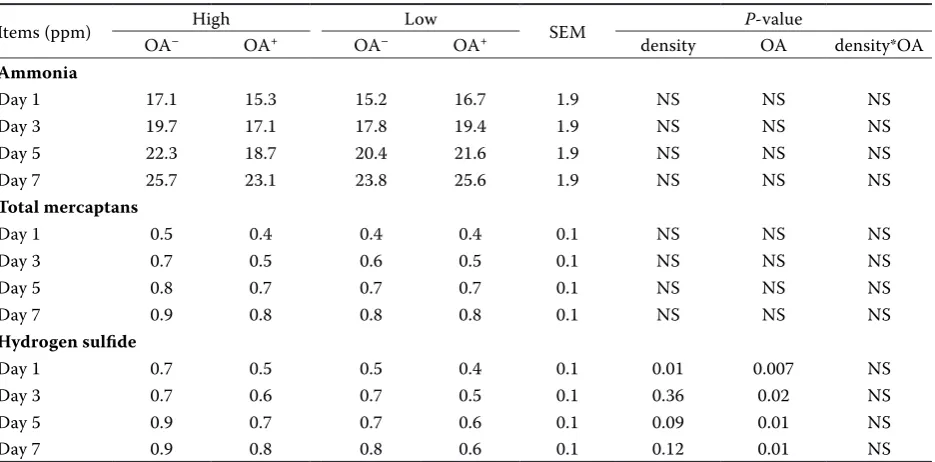
[image:4.595.68.531.114.258.2]Organic acid supplementation reduced (P < 0.05) H2S content from faeces on Day 1, Day 3, Day 5, and Day 7 of incubation. The low nutrient density diet led to reduced (P < 0.05) H2S gas content on Day 1 of incubation. No interactive effect on faecal noxious gas emission was observed between nutri-ent density and organic acid inclusion (Table 3).
Table 3. Effect of organic acids supplementation with different nutrient density on faecal gas emission in growing pigs1
Items (ppm) OA– High OA+ OA– Low OA+ SEM density P-valueOA density*OA
Ammonia
Day 1 17.1 15.3 15.2 16.7 1.9 NS NS NS
Day 3 19.7 17.1 17.8 19.4 1.9 NS NS NS
Day 5 22.3 18.7 20.4 21.6 1.9 NS NS NS
Day 7 25.7 23.1 23.8 25.6 1.9 NS NS NS
Total mercaptans
Day 1 0.5 0.4 0.4 0.4 0.1 NS NS NS
Day 3 0.7 0.5 0.6 0.5 0.1 NS NS NS
Day 5 0.8 0.7 0.7 0.7 0.1 NS NS NS
Day 7 0.9 0.8 0.8 0.8 0.1 NS NS NS
Hydrogen sulfide
Day 1 0.7 0.5 0.5 0.4 0.1 0.01 0.007 NS
Day 3 0.7 0.6 0.7 0.5 0.1 0.36 0.02 NS
Day 5 0.9 0.7 0.7 0.6 0.1 0.09 0.01 NS
Day 7 0.9 0.8 0.8 0.6 0.1 0.12 0.01 NS
1High = high nutrient density diet minus (–) or plus (+) 0.1% protected organic acid. Low = low nutrient density diet minus (–) or plus (+) 0.1% protected organic acid
[image:4.595.65.533.480.711.2]SEM = standard error, NS = non-significant, density*OA = interaction between density of diets and organic acid blends Table 2. Effect of organic acids supplementation with different nutrient density on growth performance and nutrient digestibility in growing pigs1
Items High Low SEM P-value
OA– OA+ OA– OA+ density OA density*OA
Growth performance
ADG (g) 630 645 615 630 6.06 0.02 0.02 NS
ADFI (g) 1417 1465 1503 1449 25.00 NS NS 0.06
G/F 0.445 0.440 0.409 0.435 0.007 0.01 0.10 0.03
Nutrient digestibility
DM (%) 74.00 74.60 73.83 73.54 0.33 0.08 NS NS
N (%) 72.05 72.02 71.52 71.24 0.50 NS NS NS
E (%) 71.32 71.82 71.31 71.27 0.37 NS NS NS
1High = high nutrient density diet minus (–) or plus (+) 0.1% protected organic acid. Low = low nutrient density diet minus
(–) or plus (+) 0.1% protected organic acid
DISCUSSION
Effects of protected organic acids
The matrix-coated organic acid used in the cur-rent study is a blend of organic acids and MCFA. It contains fumaric acid, citric acid, malic acid, and medium-chain fatty acids. The supplementation of diet with organic acids has been reported to im-prove growth performance by reducing gastroin-testinal pH leading to modification of the ingastroin-testinal microflora (Burnell et al. 1988).
We observed that when pig feed was supplemented with 0.1% protected organic acid, average daily gain and feed efficiency improved versus pigs fed a diet without added organic acids. The improvement in ADG could be due to the antimicrobial activity of organic acids, which helps in the reduction of patho-genic microbial load, thereby reducing the metabolic demands of microbes and increasing the availability of dietary energy and nutrients to the host animals. In agreement with our findings, some researchers have shown positive effects with single or blends of dietary acidifiers. For example, Overland et al. (2008) reported that supplementation with a single acidifier such as formic acid or sorbic acid improved growth rate and feed efficiency. Likewise, Walsh et al. (2007) demonstrated that the addition of 0.4% organic acid blends, such as fumaric, lactic, propionic, citric, and benzoic acids, improved growth performance. In con-trast, other reports indicate a lack of response or even negative effects with single acidifiers, such as fumaric, citric, or formic acid (Radecki et al. 1988; Manzanilla et al. 2004), or blends of acidifiers, such as formic acid, lactic acid, and volatile fatty acids (Lee et al. 2007). These apparently inconsistent results and variable responses may be due to several factors, such as the stage of growth, diet complexity, types of acids, inclu-sion level of acids, and the health status of the pigs.
Feed additives, such as organic acids and some phytogenic substances, have the potential to im-prove total tract digestibility of DM, N, and E be-cause of improved pre-caecal digestion, leading to reduced influx of bacterially fermented substrates into the hindgut. This may reduce the total quantity of faecal protein and hence increase the digestibility of nitrogen and also of DM and E, as an indirect consequence. However, in the present study, nitro-gen and energy digestibility were apparently not im-proved by organic acid supplementation, consistent with the findings of Kil et al. (2006) and Radecki et al. (1988), who reported that DM and CP were not
improved by the addition of organic acids such as formic, fumaric, or lactic acid. In contrast, other researchers have observed favourable effects on nutrient digestibility with organic acid supplemen-tation (Franco et al. 2005). The variation in results could be due to the age of the animals, composition of diet, and amount of organic acid supplemented (Ravindran and Kornegay 1993). The dosage of or-ganic acids in the current study might have been too low to observe a significant impact on nitrogen and energy digestibility.
We found that pigs fed the protected organic acids exhibited a reduced emission of noxious gases such as H2S, compared to the pigs fed diets without extra organic acids. The reduction in these odorous gases could possibly be due to a reduction of the pathogenic bacterial population in the gastrointestinal tract or due to enhancement of beneficial microbial activ-ity, leading to changes in end products of microbial fermentation and a shift in the ecosystem towards a more anabolic status. Our preliminary experiments showed that the 0.1% organic acid blends numerically increased the lactobacillus population and reduced the E. coli population in growing pigs and significantly increased lactobacillus numbers in finishing pigs.
Effects of nutrient density
The levels of faecal noxious gases such as H2S were higher in the high nutrient density diet, in agreement with our previous report, (Yan and Kim 2013), in which we found that a high nutri-ent density diet increased the concnutri-entration of ammonia and H2S gas. However, ammonia and total mercaptan emissions were unaffected by nutrient density in the current study. A possible reason for the high faecal noxious gas content in the high nutrient density diet could be that corn in the high nutrient diet was replaced with soybean meal. Soybean meal contains non-starch carbo-hydrate,which is not easily digested by pigs. This leads to an increase in the viscosity of digesta, thus modifying gut transit time and altering the morphological and physiological functions of the gut. This, in turn, influences the microbial popula-tion, which might have elicited an increase in the influx of fermentable substrate into the hindgut system, leading to the formation of more faecal matter with more noxious gases.
Interactive effects between organic acids and nutrient density
An interactive effect (P = 0.03) between organic acid and nutrient density was observed in feed con-version by the pigs. There appeared to be some interaction in feed intake also. This may be because of the optimisation of beneficial microflora, due to the inclusion of protected organic acids. Moreover, the microflora could then improve the conversion of feed to body mass. However, no interaction was observed in nutrient digestibility in response to or-ganic acid supplementation with the high nutrient density diet. No comparison could be made with other studies because there are only a small number of reports on factors that may affect the response to organic acids. However, diet was considered by Si et al. (2006) to be the main factor that influenced the antimicrobial effect of plant extracts in vitro.
In conclusion, we suggest that energy and nutri-ent density influence the effects of organic acids in the growth performance of pigs.
REFERENCES
AOAC (2000): Official Methods of Analysis. 16th ed. Association of Official Analytical Chemists, Washing-ton, DC.
Bosi P, Jung HJ, Han IK, Perini S, Cacciavillani JA, Casini L, Creston D, Gremokolini C, Mattuzzi S (1999): Effects of dietary buffering characteristics and protected and unprotected acids on piglet growth, digestibility and characteristic of gut content. Asian-Australasian Jour-nal of Animal Sciences 7, 1104–1110.
Burnell TW, Cromwell GL, Stahly TS (1988): Effects of dried whey and copper sulfate on the growth responses to organic acid in diets for weanling pigs. Journal of Animal Science 66, 1100–1108.
Canibe N, Engberg RM, Jensen BB (2001): An overview of the effect of organic acids on gut flora and gut health. In: Proceedings Workshop on Alternatives to Feed Antibiotics and Anticoccidials in the Pig and Poultry Meat Production, Gut Environment and Feed Additives. October 13–16, 2001, Oslo, Norwey. Cho JH, Chen YJ, Min BJ, Yoo JS, Wang Y, Kim IH (2008):
Effects of reducing dietary crude protein on growth performance, odor gas emission from manure and blood urea nitrogen and IGF-1 concentrations of serum in nursery pigs. Animal Science Journal 79, 453–459. Franco LD, Fondevila M, Lobera MB, Castrillo C (2005):
Effect of combinations of organic acids in weaned pig diets on microbial species of digestive tract contents and their response on digestibility. Journal of Animal Physiology and Animal Nutrition 89, 88–93.
Kil DY, Piao LG, Long HF, Lim JS, Yun MS, Kong CS, Ju WS, Lee HB, Kim YY (2006): Effects of organic or in-organic acid supplementation on growth performance, nutrient digestibility and white blood cell counts in weaning pigs. Asian-Australasian Journal of Animal Sciences 19, 252–261.
Lee, DN, Liu SR, Chen YT, Wang RC, Lin YS, Weng CF (2007): Effects of diets supplemented with organic acids and nucleotides on growth, immune responses and digestive tract development in weaned pigs. Jour-nal of Animal Physiology and Animal Nutrition 91, 508–518.
Manzanilla EG, Perez JF, Martin M, Kamel C, Baucells F, Gasa J (2004): Effect of plant extracts and formic acid on the intestinal equilibrium of early-weaned pigs. Journal of Animal Science 82, 3210–3218.
Meng QW, Yan L, Ao X, Zhou TX, Wang JP, Lee JH, Kim IH (2010): Influence of probiotics in different energy and nutrient density diets on growth performance, nutrient digestibility, meat quality, and blood charac-teristics in growing-finishing pigs. Journal of Animal Science 88, 3320–3326.
Ze-browska T (eds.): Biology of Nutrition in Growing Animals. Vol. 4. Elsevier Limited. 81–133.
NRC – National Research Council (2012): Nutrient re-quirements of swine. 11th ed. National Academy Press, Washington, DC.
Overland M, Kjos NP, Borg M, Skjerve E, Sorum H (2008): Organic acids in diets for entire male pigs. Ef-fect on skatole level, microbiota in digesta, and growth performance. Livestock Science 115, 169–178. Radecki SV, Juhl MR, Miller ER (1988): Fumaric and
citric acids as feed additives in starter pig diets: Effect on performance and nutrient balance. Journal of An-imal Science 66, 2598–2605.
Ravindran V, Kornegay ET (1993): Acidification of weaner pig diets: a review. Journal of the Science of Food and Agriculture 62, 313–322.
SAS (1996): SAS User’s Guide. Release 6. 12th ed. SAS Institute Inc, Cary, NC, USA.
Si W, Gong J, Chanas C, Cui S, Yu H, Caballero C, Friend-ship RM (2006): In vitro assessment of antimicrobial activity of carvacrol, thymol and cinnamaldehyde to-wards Salmonella serotype Typhimurium DT104: ef-fects of pig diet and emulsification in hydrocolloids. Journal of Applied Microbiology 101, 1282–1291. Walsh MC, Sholly DM, Hinson RB, Saddoris KL, Sutton
AL, Radcliffe JS, Odgaard R, Murphy J, Richert BT (2007): Effects of water and diet acidification with and without antibiotics on weanling pig growth and micro-bial shedding. Journal of Animal Science 85, 1799–1808. Wang JP, Yoo JS, Lee JH, Jang HD, Kim HJ, Shin SO,
Seong SI, Kim IH (2009a): Effect of phenyllactic acid on growth performance, nutrient digestibility, micro-bial shedding and blood profiles in pigs. Journal of Animal Science 87, 3235–3243.
Wang JP, Yoo JS, Lee JH, Zhou TX, Jang HD, Kim HJ, Kim IH (2009b): Effects of phenyllactic acid on production performance, egg quality parameters and blood char-acteristics in laying hens. Journal of Applied Poultry Research 18, 203–209.
Wang JP, Lee JH, Yoo JS, Kim IH (2010): Effects of phe-nyllactic acid on growth performance, intestinal mi-crobiota, relative organ weight, blood characteristics, and meat quality of broiler chicks. Poultry Science 89, 1549–1555.
Williams CH, David DJ, Iismaa O (1962): The determi-nation of chromic oxide in faeces samples by atomic absorption spectrophotometry. Journal of Agricultural Science 59, 381–385.
Yan L, Kim IH (2013): Effect of probiotics supplementa-tion in diets with different nutrient densities on growth performance, nutrient digestibility, blood character-istics, fecal microbial population and fecal noxious gas content in growing pigs. Journal of Applied Animal Research 41, 23–28.
Yan L, Wang JP, Kim HJ, Meng QW, Ao X, Hong SM, Kim IH (2010): Influence of essential oil supplementation and diets with different nutrient densities on growth performance, nutrient digestibility, blood characteris-tics, meat quality and fecal noxious gas content in grower-finisher pigs. Livestock Science 128, 115–122. Zentek J, Ferrara F, Pieper R, Tedin L, Meyer W, Vahjen
W (2013): Effects of dietary combination of organic acid and medium chain fatty acids on gastrointestinal tract micro ecology and bacteria metabolites in the digestive tract of weanling piglets. Journal of Animal Science 91, 3200–3210.
Received: 2014–06–09 Accepted after corrections: 2014–10–30
Corresponding Author:
In Ho Kim, Dankook University, Department of Animal Resource and Science, No.29 Anseodong, Cheonan, Choongnam, 330-714 Republic of Korea