Professional learning through the collaborative design
of problem-solving lessons
Geoff Wake1•Malcolm Swan1•Colin Foster1
The Author(s) 2015. This article is published with open access at Springerlink.com
Abstract This article analyses lesson study as a mode of professional learning, focused on the development of mathematical problem solving processes, using the lens of cultural-historical activity theory. In particular, we draw attention to two activity systems, the classroom system and the lesson-study system, and the importance of making artefacts instrumental in both. We conceptualise the lesson plan as a boundary object and use this to illustrate how professional learning takes place through the introduction of carefully designed artefacts that draw on teachers’ professional knowledge of potential student approaches, and to the nature of progression in problem-solving processes. We identify the roles of instrumentalisation and instrumentation in supporting professional learning as these artefacts are prepared for use before a lesson and as they are again used as catalysts for reflection in post-lesson discussions. These artefacts are seen to effectively facilitate the socially situated learning of all participants. We conclude that the design of artefacts as boundary objects that support teaching and professional learning in their respective activity systems may be fundamental to the success of lesson study as a collaborative venture.
Keywords Cultural-historical activity theoryLesson studyProblem solvingTask design
& Geoff Wake
Malcolm Swan
Colin Foster
1
Introduction
This article addresses the role that designed artefacts can play in the professional learning of teachers when embedded in a lesson-study process. Our intention is to explore how this process might facilitate the professional learning of individuals and communities of teachers and academics. In doing this, we draw on cultural-historical activity theory (CHAT) to make sense of the interplay between research lesson classrooms and lesson-study planning groups (which include both teachers and academics from Higher Education who have multiple roles as lesson designers, researchers, and authors of this article). This provides insight into how the lesson plan and specially designed features of this play a critical role that supports the development and enactment of problem-solving lessons and teacher learning in relation to this.
The research reported here is situated within a broader project (Wake et al.2013,2014; Foster et al.2014) that has two aims:
1. To better understand how models of professional learning for secondary school
teachers, based on lesson study, may be developed and sustained within current and changing systems and structures of school governance and funding mechanisms; 2. To develop, using an action research methodology, tools that assist collaborative
partnerships to implement lesson study on mathematical problem solving, in ways that are effective, sustainable, and scalable.
The analysis central to this article arises from our ongoing efforts to address the second of these aims. In particular, we report here on research focused on the question: How do we support and facilitate teachers in their dual roles of teacher and learner? In seeking to address this question, we are engaged in participatory action research (Kindon et al.2007) into how we might better facilitate lesson-study groups to plan for collaborative classroom problem solving, and thus inform our collective understanding of how didactical design intentions are realised in implementation. This form of research is driven by:
a collective commitment to investigating an issue; a desire to engage in self and collective reflection to gain clarity about the issue; a joint decision to engage in collective action that leads to a useful solution that benefits the people involved; the building of alliances between researchers and participants in the planning, imple-mentation and dissemination of the research process (McIntyre2008).
The lesson-study process
Fundamental to the various models of lesson study that have proliferated around the world in recent years (Fernandez and Yoshida 2004) is the concept of professional learning focused on teacher enquiry into teaching, learning, and classroom practice. Teachers collaborate and learn through cycles of enquiry into their practice, and this provides unique opportunities for researchers to investigate how teachers learn through the process of developing, adapting, mediating, and reflecting on lesson plans. Throughout our study, we
have been fortunate to be able to work with colleagues from IMPULS in Japan1 who,
operating in their own culture of well-established lesson-study communities, were at the same time, in reaction to developments in the Japanese curriculum, beginning to tackle similar issues to us in relation to problem solving. Lesson study based on the Japanese model has become increasingly widely known and adapted for use across geographical and cultural boundaries since the publication of Stigler and Hiebert’s bookThe Teaching Gap (1999). The model is perhaps particularly attractive as it has the potential to meet the requirements that we know facilitate effective professional learning (Joubert and Suther-land 2009); namely, that it is sustained over substantial periods of time, collaborative within mathematics departments/teams, informed by outside expertise, evidence-based, research-informed, and attentive to the development of the mathematics.
As Doig and Groves (2012) point out, there is a need to adapt rather than adopt the Japanese model when working in another culture. However, in our work, we maintained what we saw as crucial aspects of the Japanese model. Teachers first met with a ‘knowledgeable other’ to identify one or more specific research questions to be answered in the lesson and prepare a detailed lesson plan that included anticipating student responses and learning trajectories. The research lesson was then observed by a community of the teachers and academics, and this was immediately followed with an extended post-lesson discussion in which the research questions were explicitly addressed, assisted by a ‘knowledgeable other’. Fundamental to our model, therefore, were (i) the focus on learning with materials (kyozaikenkyu), as planned and enacted by the teacher, (ii) the mathematical experiences and learning of students, and (iii) the expertise brought to the communities by ‘knowledgeable others’ (koshi) (Lewis et al.2006). Throughout the activity of the lesson-study group, the lesson plan as a document was central. Developed as a communicative
production, it embodied a shared understanding of teaching and learning intentions.
Indeed, the lesson plan provided individuals in the group and the group as a whole with an image of the intended lesson (Roth and Radford2011). Further, in the post-lesson dis-cussion, the group reflected on the enactment of the plan in relation to this prior image.
We wanted to expand notions of professional learning, recognising that for teachers, as for other workers, it is a process that includes ongoing, moment-by-moment reflection on action (Scho¨n 1983). Lesson study, like other forms of formalised professional develop-ment activities, attempts to make specific aspects of professional learning explicit and provides both time and space in which this can occur and be shared with colleagues, as opposed to day-to-day professional learning that is often individual, ad hoc, and tacit.
While the lesson-study process may lead to the collaborative development of a revised version of the lesson plan and a further lesson-study cycle (planning, research lesson, post-lesson discussion), we do not regard an improved individual post-lesson plan as the main
1
outcome. Rather, we consider the process as facilitating teachers’ (and our own) learning about didactical design more generally, beyond that of a single and particular lesson. Thus, our intention is to investigate how best to support teacher groups involved in iterative cycles of action research into their design of lessons for mathematical problem solving.
Problem solving
In our research, a mathematical problem is defined as a task for which a solution method is not known in advance by the solver (NCTM2000). The OECD PISA series of international comparative studies that quantify student performance on a range of tests in mathematics, and also science and literacy, have raised the profile of problem solving around the world. The framework used by these studies to define the mathematics domain (OECD2003), in addition to content, identifies competencies and context and how these blend together in the mathematics tasks which are given to students, thus recognising the mathematical practices in which students then engage. In seeking to help students become better mathematical problem solvers, our lesson-study communities are therefore attempting to focus on developing mathematical processes rather than mathematical concepts. In short, we are attempting to enable students to use the mathematical content they already know in non-routine problems. In England, this was elaborated in the National Curriculum for Mathematics of 2007 (Qualifications and Curriculum Authority 2007), which organised these ‘key processes’ using a problem-solving cycle incorporating the terms ‘representing’ (translating problems into mathematical form), ‘analysing’, ‘interpreting’, and ‘evaluat-ing’, with overarching competencies identified as ‘communicating’ and ‘reflecting’. It has been the experience of the teachers in our study that it has been very hard to focus on these mathematical problem-solving processes in lessons. National and school-based constraints mean that day-to-day classroom practice is almost entirely concept-oriented (Foster et al.
2014). Indeed, in early stages, our research identified limitations in teachers’ understanding of the key processes as potentially detrimental to students’ learning. This situation is not unique to the UK; for instance, it lies at the heart of our collaboration with the Japanese group IMPULS.
In the next section, we introduce a theoretical lens, cultural-historical activity theory, and the associated constructs of artefact, tool, and instrument, to identify how aspects of our lesson-study process facilitate professional learning. Important here are ideas relating to interacting Activity Systems and the boundaries between these. Following this, we illustrate how these ideas provide insight into our research question through one of our case studies. In the final sections of the paper, we draw conclusions in which we highlight important features of collaborative design of lessons for problem solving that facilitate professional learning for teachers and academics.
A cultural-historical activity theoretic perspective
Underpinning our theoretical thinking regarding lesson study as an effective mode of professional learning is cultural-historical activity theory. We use the theoretical tools that CHAT provides to better understand how we, as designers of professional learning, working with teachers as co-designers of lessons, might facilitate the professional learning process.
CHAT considers how the activity of a community, viewed as an activity system, is
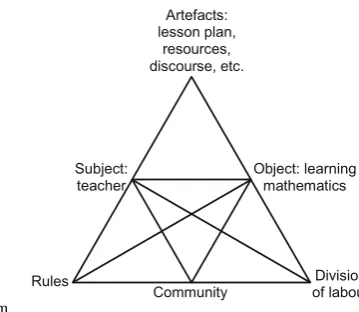
how the actions of an individual (subject) in pursuit of a goal-directed outcome are mediated by artefacts/tools as ‘instruments’. This is represented by the top triangle in Fig.1. Distinctions between the use of these terms are explored in some detail below, as they have significance in our conceptualisation of professional learning in the lesson-study process. Luria, Leont’ev, and followers, in considering the unit of analysis to be extended to a collective of individuals, identify the additional mediating influences of the commu-nity, with its division of labour and rules and norms, as indicated by the lower triangles in Fig.1(see Engestro¨m and Cole1997).
Thus, the mathematics classroom, considered as an activity system, has both teacher and students working towards the learning of mathematics: the object of their activity. If we consider the teacher as subject in this activity system, then we consider that their actions are mediated by a number of artefacts used at their discretion. For example, the teacher will have planned to use a range of resources and oral questions, will have sequenced different phases of the lesson according to their understanding of what will best facilitate learning of the particular group of students, and so on. Drawing a clear distinction between the use of the terms artefact and tool is not of particular importance here, and we note that there is not general agreement amongst scholars about their exact meaning in relation to Vygotsky’s intentions (for discussion of this, see Daniels2001, pp. 17–20). Here, for convenience, we use the term artefact throughout to encompass all such mediating factors; these include, for example, material objects, ideas, and language. In many instances in the classroom, access to artefacts is controlled by the teacher, for example the written tasks that are selected by the teacher to stimulate learning, the texts, manipulatives, technology, mathematical techniques, and representations. How the mediating artefacts are made instrumental in action, and how the teacher facilitates students in developing their conceptual under-standing so that this might occur, is central to teaching and learning.
We wish to draw attention to the notion of instrument and its role as explicated and contextualised in the case of mathematics by Drijvers and Trouche (2008). They make the distinction between artefacts as having only thepotential to support actions, whereas it becomes instrumental in its use when the user has a mental scheme that supports both technical and conceptual abilities to realise this potential in a specific situation. For example, a graphing calculator as an artefact can be considered as a material object incorporating graphing facilities that has the potential to be used to plot bivariate data and give the equation of the line of best fit. For this to become instrumental in use in a
Artefacts: lesson plan,
resources, discourse, etc.
Subject: teacher
Rules
Object: learning mathematics
Division of labour Community
[image:5.439.119.299.55.211.2]particular situation, the user must understand both the potential and the appropriateness of doing so and have the technical expertise and conceptual understanding to do this. In our study, the lesson-planning team’s research questions in general focus on this issue: how can we enable students to bring artefacts to instrumental use as they tackle unstructured problems?
The lower triangles in Fig.1illustrate how the teacher’s actions are situated within the classroom community and highlight key factors that will affect the joint activity of the group. For example, there is a cleardivision of labourin the classroom, with the teacher having overall responsibility to ensure that the outcomes of the group’s activity meet expectations with regard to learning. However, the power relationship between teachers and pupils varies from one classroom to the next, with students having more or less autonomy towards their learning. Thus, the group as a whole develops a sense of com-munity, which we might perceive as more or less collaborative, with the group’s activity being constrained by explicit and implicit rules. For example, lessons are scheduled at certain times and are of predetermined length; curricula and schemes of work need to be complied with, assessment tasks worked on, and so on. Implicit rules include shared understandings of expectations of teachers, students, their parents, and the public more widely, including expectations regarding the form, style, and types of mathematical knowledge that are to be developed. Thus, implicit and explicit rules govern patterns of behaviour of the community in lessons on a day-to-day basis. In relation to this, we found that the introduction of lessons that focused entirely on mathematical problem-solving processes ran contrary to the expected norms in the classrooms of our study, and students had to reorient their expectations regarding the format of mathematics lessons. Thus, we consider that the actions of all individuals, as members of a community working towards a shared outcome, are affected by issues ofdivision of labour,community, andrules.
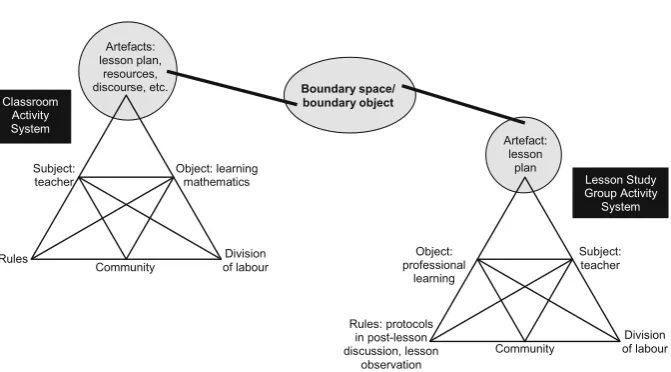
Teachers in their professional lives are members of multiple communities: they are involved in many Activity Systems, determined by, amongst other factors, the structural organisation of their school and the educational system more widely. For example, mathematics teachers in secondary schools are frequently organised to work collectively in distinct departments in pursuit of the learning of mathematics. They also participate in wider communities, such as professional associations. In such communities, individual teachers are involved in different actions from those that they carry out in classrooms; for example, they may have a role in developing a scheme of work that organises the cur-riculum for the group of teachers with whom they work. Lesson study brings into the shared experience of teachers and other academics a new Activity System with the object of professional learning. The joint activity of the lesson-study group defines its ‘mem-bership’: in our model of lesson study, this includes teachers from schools across the cluster, including the classroom teacher of the research lesson and ourselves as both co-designers of the research lesson and researchers. Individuals in the group take different roles during the distinct phases of activity that occur cyclically over time: developing the lesson plan, teaching and observing the research lesson, taking part in the post-lesson discussion, and (sometimes) refining the lesson plan. This new Activity System has its own distinctive division of labour, sense of community, and rules that mediate both the joint activity and individual actions of participants.
boundary crossing. Because members of the lesson-study community are active in each of the communities of classroom and lesson-study group, they can be considered asboundary crossers between the two. Here, we draw on the notion of boundary as expressed by Akkerman and Bakker (2011, p. 133) ‘as a sociocultural difference leading to a discon-tinuity in action or interaction’. In their review of research into boundary crossing and boundary objects, they argue that from a sociocultural perspective, all learning involves boundaries, although they recognise that researchers use the term in different ways. Here, we emphasise the importance of discontinuity at the boundary between Activity Systems as crucial in facilitating reflection on individual actions and joint activity in each, leading to professional learning for all participants. Indeed, in sociocultural terms, learning may be considered as being located in the changing relationships between an individual and the social activities in which they engage (Beach 1999). In other words, the professional learning of the teachers requires their engagement in, and boundary crossing between, the Activity Systems of the research lesson classroom and the meetings of the lesson-study group. We note that it is the object of activity that defines the boundaries of the activity system rather than geographical or temporal location. So, for example, when members of the lesson-study group observe teaching and learning in the research classroom, members’ actions (other than those of the class teacher) are directed towards goals associated with the lesson-study group (i.e. the group’s research questions) rather than those of the mathe-matics class, although that is where they are physically located. Our challenge is to understand how we might best support learning at the boundaries of classroom and lesson-study group Activity Systems; indeed, how we might design for effective boundary crossing.
The lesson plan plays a critical role in facilitating this boundary crossing and conse-quent learning and, as such, may be considered a boundary object. Star and Griesemer (1989) define a boundary object as a single object that has different meanings in different Activity Systems, while retaining a common essence. They identify such objects as inhabiting ‘several intersecting worlds’ and being ‘both plastic enough to adapt to local needs and the constraints of the several parties employing them, yet robust enough to
Artefacts: lesson plan,
resources, discourse, etc.
Subject: teacher
Rules
Object: learning mathematics
Division of labour Community
Division of labour Community
Rules: protocols in post-lesson discussion, lesson
observation
Subject: teacher Object:
professional learning
Artefact: lesson
plan
Boundary space/ boundary object
Classroom Activity System
Lesson Study Group Activity
System
[image:7.439.55.391.48.234.2]maintain a common identity across sites’ (Star and Griesemer1989, p. 393). We see the lesson plan as being just such an object, as it is at the nexus of understanding of teaching and learning intentions, and as such has an important role to play in both the classroom and the work of the lesson-study group as well as being a catalyst for professional learning. In the classroom, the lesson plan acts as a mediating instrument by providing a script around which the research lesson is organised, whereas in the activity of the lesson-study group, it has other roles to play. At the beginning, the production of a lesson plan is the central activity of the group. The resulting artefact encapsulates the values, understandings, beliefs, and intentions of the group, with pedagogic tools, such as questioning for formative assessment, identified. In the post-lesson discussion, it acts as a mediating device for the discussion of the group, encapsulating the group’s image of the intended lesson. It facil-itates the group’s discussion of these intentions, in the light of their observations of the resulting enactment in the classroom. The lesson plan, as a boundary object, therefore, facilitates reflection on action and perspective-making and taking (Boland and Tenkasi
1995) on issues in relation to teaching and learning. Engestro¨m et al. (1995) show how such artefacts are commonly involved where activity systems interact, as textual artefacts emerge in ways that facilitate boundary crossing over time.
Case study:
Outbreak
We now detail one case study that illustrates the three important phases of the lesson-study cycle (planning, research lesson and post-lesson discussion) before analysing this through the theoretical lens and constructs we have introduced above.
Planning
The school planning team of three teachers, supported by the authors of this article, collaboratively devised the lesson plan. The lesson was inspired by Outbreak,a mathe-matical problem-solving project (Knights and Zorn2008). This is based on some of the dilemmas that health officials face when confronted with the outbreak of a deadly viral infection. Students are asked to develop a strategy to contain the spread of the disease. The lesson-planning team developed a lesson that involved students in deciding how to allocate two different vaccines amongst the population of a town. In this task, students were to be given the cost of each vaccine (£8, £6.50), their percentage effectiveness (90 and 70 % respectively), and a total budget (£5 m). They were also to be provided with additional data relating to the population of 946,000, which was broken down into occupations such as ‘medical workers’ and ‘farmers and food producers’, with the numbers in each category given. Students were to recommend how many of each vaccine should be bought and who should get them. The basis on which students were to make these decisions was not to be specified; this was to be left open for students.
Collaborative lesson planning began 3 weeks before the research lesson was due to take place. In advance, we (the authors) had suggested a framework for structuring a problem-solving lesson, drawing on the Japanese model: hatsumon(the teacher gives the class a problem to initiate discussion);kikan-shido(the students tackle the problem in groups or individually);neriage (a whole-class discussion in which alternative strategies are
com-pared and contrasted and in which consensus is sought); and finally the matome, or
teach the lesson, proposed a specific research focus on two problem-solving processes that he felt that his students particularly needed to develop:strategic planningand communi-cation. The research questions for this lesson were then agreed by the planning team to be: Which classroom teaching interventions are effective in developing students’ capacity to (a) plan strategically? (b) communicate their reasoning and methods more effectively?
To explore these questions, the lead teacher proposed that he should modify the con-straints of the task part way through the lesson to see whether this would encourage students to adapt their existing strategies or whether they would simply start again. He also believed that this approach might give new insight into the problem and encourage greater discussion and collaboration. To develop students’ planning strategies, he would also develop questions to encourage metacognitive behaviours that might help students to step back and evaluate their progress from time to time. These ideas were further developed with two of his colleagues. Together, they proposed to change the values of effectiveness and cost of the two vaccines as shown in Table1.
An early draft of the lesson plan was sent to the authors of this article for comment. We made three major suggestions:
• We were at first unclear as to why a change in constraints was necessary, and
challenged this, suggesting that it might be overambitious.
• We suggested that as part of the planning process, the teachers try to anticipate the possible solution strategies that the class might use.
• We challenged the teachers to be explicit about how they would recognise student
progress in their two research foci: strategic planning and communication.
The first suggestion encouraged the teachers to clarify their reasons for changing the constraints, and the teachers decided to retain this aspect. The teacher of the research lesson commented after the lesson on his reasons for doing so:
I feel the right decision was taken during planning to slightly update the task for the students during the research lesson as this added another dimension to the lesson. I feel the change made it more realistic and it also meant that all of the students when working in pairs needed to start from scratch and apply their collective thoughts to a modified version of the original task, meaning that no student’s original attempt would just be replicated if there was a dominant member of a pair (Teacher, Out-breaklesson).
[image:9.439.46.393.72.135.2]In response to the second suggestion, the teachers said that they found it difficult to anticipate student reasoning, and so they adopted a strategy to provide them with evidence. They decided to introduce the class to the initial problem in advance of the research lesson and allow students 20 min to tackle the task individually, unaided (the pre-lesson phase). They then collected the student responses and analysed these in order to inform the later stages of the planning of the research lesson, making decisions, for example, about student groupings. The teachers also developed a detailed list of key issues that had arisen, and
Table 1 How teachers planned to modify the constraints part way through the lesson
Initial problem Modification to the constraints
Vaccination A Vaccination B Vaccination A Vaccination B
Effectiveness 90 % 70 % 100 % 70 %
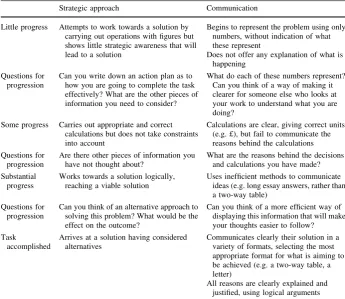
produced questions showing how the teacher of the research lesson might respond to each (Table2). The teacher used this table to write suitable questions on each student’s work at the end of the pre-lesson phase, to prompt them to reflect more deeply on the approach they were taking. (No grades or evaluative statements were written on students’ work.) In response to the third challenge, we worked with the teachers to try to describe how progression might be recognised, using a progression table (Table3). Drawing on our
Table 2 Anticipated issues: teachers’ observations and predictions of the difficulties students would have with the problem and possible feedback questions
Anticipated issues Suggested questions and prompts
Students start detailed calculations before planning an approach
For example, they start at the top of the list and calculate the cost of vaccinating medical workers, then move to next row, etc
Describe in words a plan for tackling this problem What are the key decisions you have to make? Which information are you going to focus on at the
start; which will you ignore?
Students ignore one or more constraints
For example, they forget that they only have £5 million budget, or that they only need 946,000 vaccines
Do you have enough resources for your solution? Have you made enough vaccine for everyone? Have you wasted any money?
Have you wasted any vaccine?
Students do not justify decisions made
For example, they state a solution with no explanation
Why have you chosen to allocate the vaccines in this way?
How can you be sure this is the best solution?
Students leap to conclusions
For example, they quickly assume that only vaccine A should be used because it is most effective; or only vaccine B should be used because it is cheapest
Have you taken all the issues into account? Could you vaccinate more people if you used some
of vaccine B?
Could you save more lives if you used more of vaccine A?
Students do not understand the concept of a budget
For example, they assume a good solution will be a cheap solution and do not realise they need to spend the whole budget to save the most lives
What is your main objective when trying to solve the problem?
Are there any more lives that you could possibly save?
Students overwhelmed by the large numbers
For example, if they spend £4.8 million of the budget, they might believe that is close enough to their maximum and not appreciate that with £200,000 you could save many more lives
How much money do you have remaining in your budget?
How many more vaccines would you be able to purchase with this amount of money?
Students do not grasp the meaning of their calculations
For example, students might perform a sensible calculation but not understand what their answer represents
What does this figure represent? Is it how much money is left over or how much money has been spent? Does it represent a number of people?
Students only write numbers with no justifications Where have these figures come from? Do you know
what they represent? Are you able to justify why you have used these numbers?
Students do not understand the effectiveness of each vaccination
For example, students might not be able to grasp the idea of something being 70 % effective
If 1000 people were given vaccination B, how many would be likely to survive?
Students are confused between numbers representing money and people
For example, students might perform a calculation and get the solution 12,500, but not know whether this is people or money
Can you think of a way of distinguishing between numbers that represent different values? How can you distinguish between values that
previous work in lesson design, we provided a structure for this and co-constructed the content in collaboration with the teachers in the lesson-study group. This table was particularly useful in focusing attention on the research questions.
[image:11.439.46.392.80.379.2]The final plan of the lesson contained the following elements: a description of the class; the research aims of the lesson; the anticipated issues and progression tables; an outline of the lesson itself, giving times, activities, interventions and questions, and anticipated responses from students. Broadly, the plan followed the structure shown in Fig.3.
Table 3 Progression table: an outline of different levels of achievement with suggested questions to support students’ progress
Strategic approach Communication
Little progress Attempts to work towards a solution by carrying out operations with figures but shows little strategic awareness that will lead to a solution
Begins to represent the problem using only numbers, without indication of what these represent
Does not offer any explanation of what is happening
Questions for progression
Can you write down an action plan as to how you are going to complete the task effectively? What are the other pieces of information you need to consider?
What do each of these numbers represent? Can you think of a way of making it clearer for someone else who looks at your work to understand what you are doing?
Some progress Carries out appropriate and correct calculations but does not take constraints into account
Calculations are clear, giving correct units (e.g. £), but fail to communicate the reasons behind the calculations Questions for
progression
Are there other pieces of information you have not thought about?
What are the reasons behind the decisions and calculations you have made? Substantial
progress
Works towards a solution logically, reaching a viable solution
Uses inefficient methods to communicate ideas (e.g. long essay answers, rather than a two-way table)
Questions for progression
Can you think of an alternative approach to solving this problem? What would be the effect on the outcome?
Can you think of a more efficient way of displaying this information that will make your thoughts easier to follow? Task
accomplished
Arrives at a solution having considered alternatives
Communicates clearly their solution in a variety of formats, selecting the most appropriate format for what is aiming to be achieved (e.g. a two-way table, a letter)
All reasons are clearly explained and justified, using logical arguments
1. Individually, students recall the problem and respond to the teacher's comments.
2. In pairs, students compare their methods. Students share progress so far with a partner, including the reasoning behind the decisions made.
3. New challenge introduced. The constraints of the problem are changed and students are given a poster to facilitate sharing. The teacher assesses conversations and intervenes with the prepared questions.
4. Whole-class sharing (neriage) in which the teacher selects pairs of students to present their ideas and reasoning, while others in the class assess this
5. Summarising and reflecting in which the teacher focuses on the strategic differences between solutions and draws out from the class some general learning points. For example: "It is better to address the total vaccines available before deciding who receives them, rather than allocating them, then finding that the budget has been exceeded." "A table is a powerful way of organising data, but may not be the only way."
The lesson
The students were a high-attaining class aged 11–12 within a mixed 11–18 comprehensive school in the Midlands region of England, and the lesson lasted 60 min. Overall, the plan was adhered to closely. For the first 4 min of the research lesson, the teacher asked students to recall the problem they tackled previously. He displayed a diagram of someone giving an injection: ‘Talk to the person next to you about the task from last lesson. What was the task? Can you remember any of the facts and figures?’ Students discussed the task in pairs. The teacher then gave out both the task and the students’ initial responses. For the next 5 min, he asked students to read the feedback questions and respond to these in writing.
Then, the teacher asked students to put down their pens: ‘Explain your thoughts to your partner: What you’ve done, how you’ve done it and how far you got’. Students had good descriptive conversations, but the teacher felt they could justify their decisions more carefully, so he prompted them to do this (this was anticipated in row 3 of Table2). After a little more time developing their approaches, the teacher introduced the changed con-straints, explaining that vaccine A had now become 100 % effective, but was more expensive, while vaccine B had the same effectiveness but was cheaper (Table1; Fig.4): ‘What I want you to do now is just discuss with your partner first of all what’s changed but how does this change the overall picture, so how does this impact our solution, how does this change the problem’.
Immediately, one student exclaimed: ‘I did all that work for no reason!’ The teacher responded that this was just what would happen in reality: ‘No! In real life things change all the time’. While some students began the problem again, others adjusted their initial solution by looking at the differences between the costs. Students were allowed to work at the problem, uninterrupted, for 20 min. At this point, the teacher decided to review one of the strategies that was being used. Six pairs of students had decided to vaccinate exactly 50 % of the people in each category. The teacher probed their reasoning and asked whether they had considered how much money would be left. He used this example to prompt everyone to explain their reasoning more clearly on their poster: ‘Put down all the steps you were taking’.
Students were now given a further 11 min to work on the problem before the final plenary discussion. The teacher continued to encourage students to take account of the budget available. Towards the end of the lesson, the teacher held a 5-min whole-class discussion. He pointed out the range of approaches in evidence and selected two solutions to discuss with the class. He presented a tabular approach that one pair had started and suggested that this might be an approach others could take up. He then asked a second pair of students to describe their approach. They explained how they had allocated money in the ratio of 1:4 to the vaccines A and B and calculated how many people would be saved. They
Dear Colleagues
Thank you for your hard work on improving the situation so far. I write to you with good news about the vaccination programme:
Vaccination A is now 100 % effective, but the price has risen to £12.00
Vaccination B is still as effective, but we have managed to get the price down to £5.20 You will need to update your sheet to take into account this new information. Think carefully how this affects your approach and good luck.
Research and Development Department
then tried to vaccinate more people using the same approach and realised that everyone could be vaccinated. The teacher commended the pair on keeping in mind both the goal (maximising the number of survivors) and the budget. Others, he pointed out, had focused on prioritising who was to be vaccinated and had lost sight of the budget. This is where the lesson ended.
The post-lesson discussion
The post-lesson discussion lasted 75 min and was held in the same classroom immediately following the lesson. It involved the 18 people who had observed the lesson: the three teachers from the school, two teachers from other schools, three HE researchers (the authors of this article); two representatives from project funders; four Japanese visitors (a teacher, an administrator, an HE representative, and a translator); two PhD students and two academics. The discussion was chaired by one of us (Wake), and the role of ‘knowledgeable other’ was taken by another (Swan).
Much of the discussion focused on the specific interventions the teacher made and how these had affected the students’ strategic planning and communication—the research foci for this lesson. Examples of questions that had been seen to encourage strategic planning behaviours were instructions to stop and talk: ‘Put your pens down and tell each other what you are doing’; questions that focused attention on constraints: ‘How do youknowwhen the money will run out?’, ‘Could you do better than vaccinateeveryonewith B?’ It was noted that such interventions had the effect of making students reconsider the whole direction of their work. Interventions that also had this effect were teacher instructions that promoted redrafting and explanation (e.g. ‘Put down all the steps you were taking’).
It was evident that the teacher had internalised both the anticipated issues table (Table2) and the progression table (Table3). In fact, the teacher apologised that he had not made more use of the questions in the anticipated issues table, but this was challenged by observers who pointed out that most of the questions asked in the lesson were close variants of the ones in the table. He had also clearly used the progression table to select the student approaches to be discussed in the final plenary. One was chosen to focus on planning, in particular of the need to focus on the constraints of the problem; the other was chosen to focus on communication, in particular the power of organising and presenting the approach using a structured table.
professional lives, and they rated participation in lesson study in general, and this research lesson in particular, as particularly formative for them.
Analysis
In our analysis from a CHAT perspective, we find the ideas associated with artefacts, instruments, and boundary objects (introduced earlier) fundamental in understanding the facilitation of the learning of students in the classroom and the professional learning of the lesson-study group.
In the planning phase, the final lesson plan as a documentary artefact turned out to be considerably more substantial than the usual plans that teachers might typically produce for a lesson. Indeed, Japanese colleagues liken a lesson plan to a research proposal that guides the group’s investigations into their didactical design. The ‘Outbreak’ plan was 10 pages, incorporating the anticipated issues and progression tables, in addition to much further detail, including careful sequencing of planned teacher actions. The identification of research questions in the lesson plan is important in defining the pedagogies that the planning group envisage will lead to the desired learning outcomes. For example, the strategy of asking pairs of students to explain the strategic approaches they had used in the pre-lesson phase was designed to encourage planning activity by the students and enable the lesson-study group to gather evidence for analysis in the post-lesson discussion. Likewise, the introduction of the change in constraints in a planned intervention during the lesson is an example of an artefact that was designed to be made instrumental in its use by the teacher in the lesson. During the lesson, the teacher had to assess exactly when to make this intervention, based on his judgment of students’ progress, with this decision being informed by his comparison of outcomes with those in the anticipated issues table of the lesson plan.
Such examples of the selection and integration of artefacts into the lesson during the planning phase correspond to the didactical configuration and exploitation modes in the theory of instrumental orchestration as elaborated by Drijvers et al. (2010). In this theory, lessons are seen as orchestral performances, with the didactical performance phase relating to the lesson implementation. During the lesson, the artefacts that the lesson-planning group had identified and written into their lesson plan, considered as a script for the lesson, were made instrumental in their use, either by the teacher (e.g. the anticipated issues table) or by the students (e.g. the modified vaccine information). Such careful planning allows for instrumental genesis, in Drijver et al.’s terms, that is, the artefact becomes an instrument that both shapes the thinking of the user (the instrumentation process) and is in itself shaped by the user (the instrumentalisation process).
communicate this. In relation to these two aspects of problem solving, the group also considered what questions they might ask to assist students in progressing from one level to the next. The completion of these tables provides key moments of instrumental genesis in the work of the lesson-study group Activity System which are important in stimulating (in this case professional) learning. The learning is not only individual but also collabo-rative and communal: Beach (1999) considers the new relationships that the individual develops with the social activity of a group as being important in identity development and learning. Teachers in the interviews we conducted often refer to such personal develop-ment and value the richness of the discussion facilitated by the different professional experiences that members of the group contribute.
The anticipated issues and progression tables, therefore, serve not only to support actions in the classroom activity system; they also, in the lesson-study group, act as catalysts for reflection on, and development of, professional knowledge in anticipation of how to respond to likely student behaviours. In the case of the progression table, this is in relation to key processes, as highlighted by the research question for the lesson, and in the case of the anticipated issues table, this is in relation to student actions more widely. Consequently, these tables as artefacts have important roles to play as part of the lesson plan considered as a boundary object, facilitating teacher actions in, and group reflections on, the research lesson. Blank anticipated issues and progression tables can be considered as a general class of artefact (document) that invokes instrumentalisation and instrumen-tation processes as the planning team goes about bringing each into instrumental use in their preparation for specific problem-solving lessons. The use of the professional under-standing that is embodied in the tables as they are tailored to a specific lesson in the post-lesson discussion facilitates reflection on their use in the classroom by a teacher of the group, and, importantly, beyond this during further cycles of enquiry as new bespoke versions are designed: involvement in ongoing cycles of enquiry in lesson study allows for professional learning in relation to a particular lesson to be generalised so as to inform the specifics of future lessons. Thus, we see the anticipated issues and progression tables as having distinct and particularly effective roles to play within the overall lesson plan and in facilitating lesson-study group activity in each phase of its activity.
As we illustrate in the account of our case study, the anticipated issues and progression tables and overall lesson plan play important roles as artefacts in supporting and facilitating both teaching of students and learning of teachers. Each has an important but different role to play in the two activity systems: in the lesson-study group, they prompt collaborative thinking regarding student responses and potential student learning, and in the classroom, they provide the teacher with insight into the collective wisdom of the group as to how to respond to this. Thus, these artefacts as boundary objects facilitate boundary crossing in ways that are designed to enable professional learning. Further, we highlight the structure of the lesson plan in this context: as in the case of the anticipated issues and progression tables, an outline lesson plan has been introduced by the university team to support the planning of specific lessons. We have found that the cyclical use, moving from general to specific forms, is particularly powerful in prompting reflection on the interplay between professional knowledge and practice.
discussed here have helped us to do so in ways that encourage genuine collaboration between teachers and academics. This is demonstrated in the case study by the instance when the planning of the change in constraints during the lesson was initiated by the lead teacher and defended robustly when questioned by the university team.
We have already drawn attention to the interaction of the two activity systems of classroom and lesson-study group, and have to this point neglected our own interaction as researchers. In this article, we have emphasised the importance of the artefacts that we have identified in facilitating professional learning in the lesson-study process. However, we consider these as necessary but not sufficient for professional learning to take place. Also of importance is the input of expertise regarding (i) the lesson-study process and (ii) problem solving, as well as sensitivity to the emerging needs of the lesson-study group in relation to professional learning in these areas. This expertise has largely been provided by the research team in the first phase of our research, but our withdrawal and support of alternative provision is fundamental to the research questions regarding scalability, sus-tainability, and support that underpin our ongoing work.
Conclusions
As academics with both research and design roles, our own professional learning has been facilitated by our involvement as part of the lesson-planning team, allowing us to understand better how tasks are enacted in classrooms by teachers in pursuit of learning outcomes in relation to problem solving. In this article, however, we demonstrate how our understanding of the different activity systems that are part of the lesson-study process has provided insight into how to support professional learning by the design of artefacts that facilitate instrumentalisation and instrumentation processes by the lesson-study group. As we have indicated, the research lesson plan may be considered as a document of this type, and at a finer grain size, we highlight how the level of detail required in completion of the anticipated issues and progression tables facilitates similar processes and prompts more in-depth thinking in relation to teaching and learning. Our future research intends to focus further on how teachers move from their general understanding of the issues that these tables address to their particular application for specific lessons. We also intend to consider whether, in collaboration with teacher colleagues, we might design other documents of this type that might support other aspects of professional learning. We recognise that ensuring that lesson-study groups are supported by external, research-informed expertise presents a particular challenge, and this is central to thinking in our current work. As part of this, we are developing a toolkit to support professional learning through lesson study, and the research and the theoretical understanding we present and develop here have an important role to play in providing insight into how to proceed.
Acknowledgments The work described in this article was funded by the Bowland Charitable Trust and the Nuffield Foundation. We are grateful to our IMPULS colleagues from Tokyo Gakugei University for their expert involvement and to all of the teachers who took part in the project.
Open Access This article is distributed under the terms of the Creative Commons Attribution 4.0 Inter-national License (http://creativecommons.org/licenses/by/4.0/), which permits unrestricted use, distribution, and reproduction in any medium, provided you give appropriate credit to the original author(s) and the source, provide a link to the Creative Commons license, and indicate if changes were made.
References
Akkerman, S. F., & Bakker, A. (2011). Boundary crossing and boundary objects.Review of Educational
Research, 81(2), 132–169.
Beach, K. D. (1999). Consequential transitions: A sociocultural expedition beyond transfer in education.
Review of Research in Education, 24, 101–139.
Boland, R. J., & Tenkasi, R. V. (1995). Perspective making and perspective taking in communities of knowing.Organization Science, 6(4), 350–372.
Daniels, H. (2001).Vygotsky and pedagogy. Abingdon, UK: RoutledgeFalmer.
Doig, B., & Groves, S. (2012). Japanese lesson study: Teacher professional development through com-munities of inquiry.Mathematics Teacher Education and Development, 13(1), 77–93.
Drijvers, P., Doorman, M., Boon, P., Reed, H., & Gravemeijer, K. (2010). The teacher and the tool: Instrumental orchestrations in the technology-rich mathematics classroom.Educational Studies in
Mathematics, 75(2), 213–234.
Drijvers, P., & Trouche, L. (2008). From artifacts to instruments: A theoretical framework behind the orchestra metaphor. In G. W. Blume & M. K. Heid (Eds.),Research on technology and the teaching
and learning of mathematics (cases and perspectives(Vol. 2, pp. 363–392). Charlotte: Information
Age.
Engestro¨m, Y. (2001). Expansive learning at work: Toward an activity theoretical reconceptualization.
Journal of Education and Work, 14(1), 133–156.
Engestro¨m, Y., Engestro¨m, R., & Ka¨rkka¨inen, M. (1995). Polycontextuality and boundary crossing in expert cognition: Learning and problem solving in complex work activities.Learning and Instruction: An
International Journal, 5, 319–336.
Fernandez, C., & Yoshida, M. (2004). Lesson study: A Japanese approach to improving mathematics
teaching and learning. Mahwah, NJ: Lawrence Erlbaum Associates.
Foster, C., Wake, G., & Swan, M. (2014). Mathematical knowledge for teaching problem solving: Lessons from lesson study. In S. Oesterle, P. Liljedahl, C. Nicol & D. Allan (Eds.),Proceedings of the Joint
Meeting of PME 38 and PME-NA 36(Vol. 3, pp. 97–104). Vancouver: PME.
Joubert, M., & Sutherland, R. (2009).A perspective on the literature: CPD for teachers of mathematics. Sheffield: NCETM. Retrieved June 2015 fromwww.ncetm.org.uk/enquiry/15009.
Kindon, S., Pain, R., & Kesby, M. (2007).Participatory action research approaches and methods:
Con-necting people, participation and place. London: Routledge.
Knights, C. & Zorn, J. (2008).Outbreak.Bowland maths.Retrieved June 2015 fromwww.bowlandmaths. org.uk/projects/outbreak.html.
Lewis, C., Perry, R., & Murata, A. (2006). How should research contribute to instructional improvement? The case of lesson study.Educational Researcher, 35(3), 3–14.
McIntyre, A. (2008).Participatory action research. London: Sage Publications Ltd.
National Council of Teachers of Mathematics (NCTM). (2000). Principles and standards for school
mathematics. Reston, VA: NCTM.
OECD (Organisation for Economic Co-operation and Development). (2003).The PISA 2003 assessment
framework—mathematics, reading, science and problem solving knowledge and skills. Paris: OECD.
Qualifications and Curriculum Authority. (2007).Mathematics: Programme of study for key stage 3 and
attainment targets. London: Qualifications and Curriculum Authority.
Roth, W.-M., & Radford, L. (2011).A cultural-historical perspective on mathematics teaching and learning
(Vol. 2). Rotterdam: Sense Publishers.
Scho¨n, D. A. (1983).The reflective practitioner: How professionals think in action. New York: Basic Books. Shimizu, Y. (1999). Aspects of mathematics teacher education in Japan: Focusing on teachers’ roles.
Journal of Mathematics Teacher Education, 2(1), 107–116.
Star, S. L., & Griesemer, J. R. (1989). Institutional ecology, ‘‘translations’’ and boundary objects: Amateurs and professionals in Berkeley’s Museum of Vertebrate Zoology, 1907–1939.Social Studies of Science, 19(3), 387–420.
Stigler, J. W., & Hiebert, J. (1999).The teaching gap: Best ideas from the world’s teachers for improving
education in the classroom. New York: Free Press.
Wake, G., Foster, C., & Swan, M. (2013). A theoretical lens on lesson study: Professional learning across boundaries. In A. M. Lindmeier & A. Heinze (Eds.),Proceedings of the 37th Conference of the
International Group for the Psychology of Mathematics Education(Vol. 4, pp. 369–376). Kiel: PME.