-KMJBHF> 9>?MFJ> 6BABGKQBJ
, ;EBNFN 9P?IFOOBA CKM OEB .BDMBB KC 7E. >O OEB
<JFQBMNFOT KC 9O ,JAMBRN
&$%'
0PHH IBO>A>O> CKM OEFN FOBI FN >Q>FH>?HB FJ 8BNB>M@E+9O,JAMBRN*0PHH;BSO
>O*
EOOL*##MBNB>M@E!MBLKNFOKMT"NO!>JAMBRN">@"PG#
7HB>NB PNB OEFN FABJOFCFBM OK @FOB KM HFJG OK OEFN FOBI*
EOOL*##EAH"E>JAHB"JBO#%$$&'#'(%)
MIXED EFFECT MODELS IN DISTANCE SAMPLING
Cornelia Sabrina Oedekoven
Thesis submitted for the degree of DOCTOR OF PHILOSOPHY in the Schools of Mathematics and Statistics
UNIVERSITY OF ST ANDREWS ST ANDREWS
JANUARY 2013
c
Diese Arbeit ist meinen Eltern Herta und Peter Oedekoven gewidmet, von denen eine(r) das Talent hatte, Klassenbeste(r) im Statistikkurs an der Universit¨at zu K¨oln zu sein, und der/die andere die Ausdauer, sich durch den selben Statistikkurs zu k¨ampfen, um weiterhin gemeinsam Kurse besuchen zu k¨onnen.
This thesis is dedicated to my parents Herta and Peter Oedekoven, of whom one had the skills to be the best student in their statistics class at University of Cologne and one had the perseverance to struggle through the same statistics class so that they could continue their classes together.
Herta und Peter Oedekoven
Abstract
Recently, much effort has been expended for improving conventional distance
sam-pling methods, e.g. by replacing the design-based approach with a model-based
ap-proach where observed counts are related to environmental covariates (Hedley and
Buckland, 2004) or by incorporating covariates in the detection function model
(Mar-ques and Buckland, 2003).
While these models have generally been limited to include fixed effects, we propose
four different methods for analysing distance sampling data using mixed effects
mod-els. These include an extension of the two-stage approach (Buckland et al., 2009),
where we include site random effects in the second-stage count model to account for
correlated counts at the same sites. We also present two integrated approaches which
include site random effects in the count model. These approaches combine the
analy-sis stages for the detection and count models and allow simultaneous estimation of all
parameters. Furthermore, we develop a detection function model that incorporates
random effects.
We also propose a novel Bayesian approach to analysing distance sampling data which
tainty. Lastly, we propose using hierarchical centering as a novel technique for
improv-ing model miximprov-ing and hence facilitatimprov-ing an RJMCMC algorithm for mixed models.
We analyse two case studies, both large-scale point transect surveys, where the
in-terest lies in establishing the effects of conservation buffers on agricultural fields. For
each case study, we compare the results from one integrated approach to those from
the extended two-stage approach. We find that these may differ in parameter
es-timates for covariates that were both in the detection and the count model and in
model probabilities when model uncertainty was included in inference. The
perfor-mance of the random effects based detection function is assessed via simulation and
when heterogeneity in the data is present, one of the new estimators yields improved
results compared to conventional distance sampling estimators.
Acknowledgements
• Many thanks to my supervisors
I am most thankful to my supervisors Steve Buckland and Monique Macken-zie for fruitful discussions during out meetings, for being a great inspiration in terms of statistical methods and teaching, and, particularly to Steve, for amaz-ingly quick and kind revisions of the various chapter drafts with, oftentimes, same day returns.
• Many thanks to my colleagues within CREEM
Ruth King for her advice on Bayesian methods. Len Thomas for various dis-cussions on different statistical and ecological topics. Yuan Yuan for her help with the Latex text editor. Rhona Rodgers for her organisational skills. Phil Le Feuvre for his IT skills and rescuing me out of two hard drive meltdowns. The open door policy of all staff (including senior staff) at CREEM in general.
• Many thanks to my colleagues outside CREEM
Jeff Laake, NOAA, for his advice on chapter 6. David Miller, University of Rhode Island, for advice on variance estimation within program Distance. William Browne, University of Bristol, for his thoughts that inspired me to the methods from chapter 5. Kristine Evans and Loren W. Burger, Mississippi State University, for allowing me to use the indigo bunting and the covey data as case studies and Kristine for insights into the data collection process for both case studies.
• Many thanks to my friends at CREEM
Glenna Evans, Calum Brown, Danielle Harris, Yuan Yuan, Darren Kidney,
Data acknowledgements
The National CP-33 Monitoring Program was funded by the Multistate Conservation Grant Program (Grant MS M-1-T), which is supported by the Wildlife and Sport Fish Restoration Program and managed by the Association of Fish and Wildlife Agencies and US Fish and Wildlife Service. Further support was provided by the US Department of Agriculture (USDA) Farm Service Agency and USDA Natural Resources Conservation Service Conservation Effects Assessment Project. Collabo-rators included the AR Game and Fish Commission, GA Department of Natural Re-sources (DNR), IL DNR/Ballard Nature Center, IN DNR, IA DNR, KY Department of Fish and Wildlife Resources/KY Chapter of The Wildlife Society, MS Depart-ment of Wildlife, Fisheries and Parks, MO DepartDepart-ment of Conservation, NE Game and Parks Commission, NC Wildlife Resources Commission, OH DNR, SC DNR, TN Wildlife Resources Agency, TX Parks and Wildlife Department, Southeast Quail Study Group and Southeast Partners In Flight.
Institutional funding acknowledgements
For this PhD project I was supported by a studentship jointly funded by the University of St Andrews and EPSRC, through the National Centre for Statistical Ecology.
Table of Contents
Declarations ii
Dedication iv
Abstract v
Acknowledgements vii
Table of Contents ix
1 Introduction 1
1.1 Conventional distance sampling . . . 1
1.2 Recent developments in distance sampling . . . 4
1.3 Developments of distance sampling methods proposed in this thesis . 7 2 Fitting random effects models to distance sampling data using a two-stage approach 10 2.1 Introduction . . . 10
2.2 The two-stage approach . . . 12
2.2.1 Heterogeneity in Detection Probabilities . . . 17
2.2.2 Model Selection . . . 19
2.2.3 Estimating the Precision . . . 19
2.3 Case study 1: point transect surveys of indigo buntings . . . 20
2.3.1 The data . . . 20
2.3.2 Analysis using the two-stage approach . . . 21
2.3.3 Results . . . 24
2.4 Case study 2: point transect surveys of northern bobwhite coveys . . 26
2.4.1 The data . . . 26
2.4.2 Analysis using the two-stage approach . . . 27
2.4.3 Results . . . 28
3.2 Integrated likelihood . . . 33
3.2.1 The unconditional likelihood of observed distances . . . 34
3.2.2 Formulating the integrated likelihood . . . 37
3.2.3 Modelling heterogeneity in detection probabilities . . . 39
3.2.4 Model selection . . . 40
3.2.5 Estimate of precision . . . 40
3.3 Case study 1: point transects of indigo buntings . . . 40
3.3.1 Analysis using the integrated likelihood approach . . . 41
3.3.2 Results . . . 42
3.3.2.1 Model selection . . . 42
3.3.2.2 Comparing contending models from the integrated ap-proach . . . 43
3.3.2.3 Comparing best models from the integrated and two-stage approach . . . 46
3.4 Discussion . . . 49
4 Building hierarchical models with an integrated likelihood for dis-tance sampling data 53 4.1 Introduction . . . 53
4.2 An integrated likelihood for distance sampling data . . . 56
4.3 The Bayesian approach . . . 61
4.3.1 Hierarchical models . . . 61
4.3.2 MCMC algorithm . . . 62
4.3.3 Model selection: reversible jump MCMC . . . 63
4.4 Case study 2: point transect surveys of northern bobwhite coveys . . 66
4.4.1 Analysis using the Bayesian approach . . . 66
4.4.2 Results . . . 69
4.5 Discussion . . . 74
5 Using hierarchical centering to facilitate a reversible jump MCMC algorithm for random effects models 80 5.1 Introduction . . . 80
5.2 Hierarchical centering . . . 84
5.2.1 Effects of hierarchical centering on RJMCMC dynamics . . . . 88
5.2.2 RJ updating methods using hierarchical centering . . . 91
5.2.2.1 Hierarchical centering using predefined proposal dis-tributions . . . 91
5.2.2.2 Hierarchical centering using updated proposal
distri-butions . . . 92
5.3 Case study: point transects of indigo buntings . . . 92
5.3.1 Data and Methods . . . 92
5.3.2 Results . . . 96
5.4 Discussion . . . 100
6 Incorporating random effects in the detection function for line tran-sect data 103 6.1 Introduction . . . 103
6.2 The detection function without random effects - conventional distance sampling methods . . . 107
6.2.1 Estimating the variance . . . 108
6.3 The half-normal detection function with random effects . . . 109
6.3.1 The Pr estimator . . . 110
6.3.1.1 Estimating the variance . . . 112
6.3.2 The (1/Pr)estimator . . . 112
6.3.2.1 Estimating the variance . . . 113
6.4 Simulation study . . . 114
6.4.1 Generating simulated data . . . 114
6.4.1.1 Visualising heterogeneity in detection probabilities . 116 6.4.2 Analysis . . . 117
6.4.3 Results . . . 120
6.4.3.1 Parameter estimates . . . 120
6.4.3.2 Bias in abundance estimates using estimated param-eter values . . . 121
6.4.3.3 Coverage rates . . . 122
6.4.3.4 Performance of variance estimators . . . 123
6.5 Simulations without random effects . . . 123
6.6 Discussion . . . 125
7 Final discussion 128 7.1 General discussion . . . 128
7.1.1 Relaxing the assumption of independent counts for covariate models . . . 129
7.1.2 Covariate models for designed distance sampling experiments . 131 7.1.3 Integrated likelihood methods for distance sampling data . . . 133
7.1.4 Bayesian analysis of distance sampling data . . . 135
7.1.5 A new method for fitting flexible detection functions . . . 137
A Deriving the integrated likelihood for chapter 3 140
B.2 Estimating the variance of abundance . . . 144 B.3 Log-based confidence intervals for abundance . . . 144
C Obtaining approximations of derivatives via finite differences for
chapter 6 146
C.1 Derivatives used forvard( ˆPa) . . . 146 C.2 Derivatives used forvard( ˆPr) . . . 147 C.3 Derivatives for vard(1d/Pr) . . . 148
List of Figures
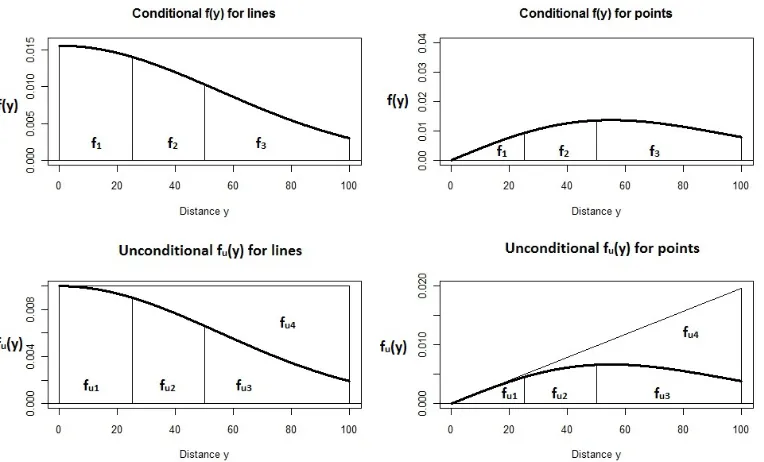
3.1 Examples for a conditional and unconditional likelihood with a
half-normal model using the same scale parameter (σ = 55) plotted between
0 and w = 100 including three distance intervals. The f1, f2, f3 and
fu1, fu2, fu3, fu4 refer to the cell probabilities. For the conditionalf(y) :
P3
i=1fi = 1, while for the unconditional fu(y) :P4i=1fui = 1. . . 37
6.1 Half-normal detection functions for which the scale parameter was
modelled with random effects. Shown are the functions resulting from
the minimum, maximum, 2.5 and 97.5 percentiles and the mean of
randomly sampled 200 coefficients be. In addition, the mean of all
detection functions is plotted in green. . . 118
2.1 Maximum likelihood estimates (MLE), analytic (ASE) and bootstrap
(BSE) standard errors for model parameters obtained by the two-stage
approach for best models. Shape parameters for the one-parameter
hazard-rate detection function were fixed. . . 25
2.2 Models and their probabilities resulting from bootstrap analysis. Each
count model included a fixed effect intercept and a random effect for
site in addition to shown covariates (JD = Julian day). Model
prob-abilities refer to the percentage of times the respective models were
chosen during 999 bootstrap iterations. . . 29
2.3 Maximum likelihood estimates (MLE), bootstrap standard errors (BSE)
and 95% confidence intervals (CI) using the two-stage approach for the
models with the highest probabilities (see Table 2.2 for model
proba-bilities). Units of measurements were metres for the detection function
model and square metres for the count model. . . 30
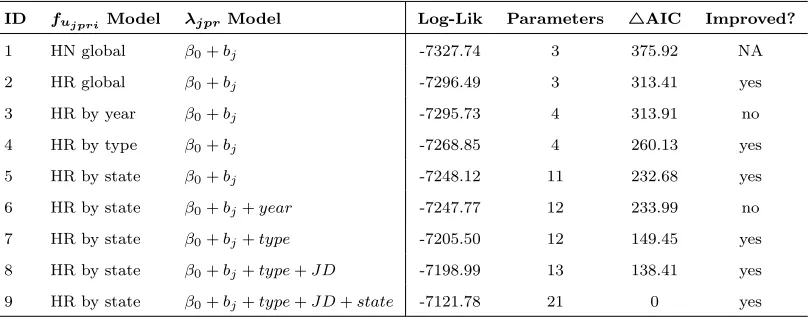
3.1 Models included in the forward stepwise model selection for the
inte-grated approach including the half-normal (HN) and the global and
stratified hazard-rate (HR) detection functions for fujpri and the
in-clusion of four covariates for λjpr in addition to the intercept β0 and
the random effects bj. 4AIC is given in relation to the overall best
model (model 9). Improved? refers to whether in this iterative model
selection process starting with model 1 the respective model yielded
an improved AIC compared to the previous and whether it should be
retained. . . 43
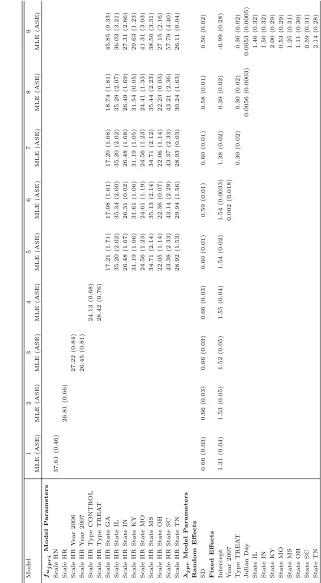
3.2 Maximum likelihood estimates (MLE) and analytical standard errors
(ASE) for parameters of contending models for the integrated approach
(models 1 through 9, Table 1). For the fujpri model, HN and HR refer
to the half-normal and hazard-rate detection functions respectively. . 45
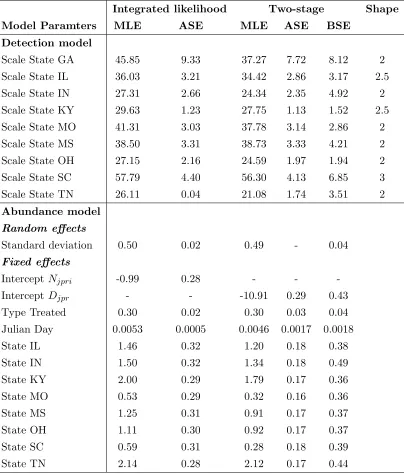
3.3 Maximum likelihood estimates (MLE), analytic (ASE) and bootstrap
(BSE, two-stage approach only) standard errors for model parameters
obtained by the integrated and the two-stage approach for best models.
Shape parameters for the one-parameter hazard-rate detection function
were fixed. . . 47
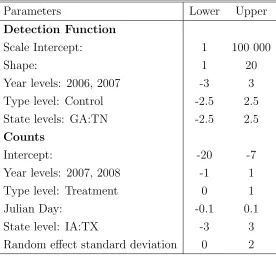
4.1 Lower and upper bounds for uniform prior distributions for all model
parameters. The different states included GA, IA, IL, IN, KY, MO,
MS, NC, SC, TN and TX. . . 67
the RJMCMC algorithm. All parameters were categorical, except for
continuous Julian day. . . 69
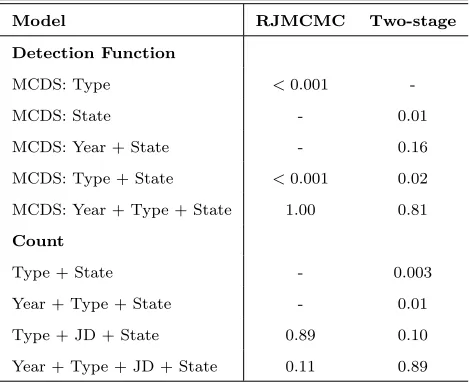
4.3 Models and their probabilities resulting from RJMCMC and bootstrap
analyses. Each count model included a fixed effect intercept and a
random effect for site in addition to shown covariates (JD = Julian
day). Model probabilities refer to the percentage of times the respective
models were chosen during 90 000 iterations (after 10 000 iterations of
burn-in) for RJMCMC and during 999 bootstrap iterations. . . 70
4.4 Mean, standard deviation (SD) and 95% credible intervals (CRI) from
the RJMCMC analysis along with maximum likelihood estimates (MLE),
bootstrap standard errors (BSE) and 95% confidence intervals (CI)
us-ing the two-stage approach for the models with the highest
probabil-ities (see Table 4.3 for model probabilprobabil-ities). Units of measurements
were metres for the detection function model and square metres for
the count model. . . 72
5.1 Means and standard deviations (SD) of normal proposal distributions
for model parameters as well as their lower and upper boundaries for
uniform prior distributions. HN and HR refer to the half-normal and
the hazard-rate detection functions respectively. . . 95
5.2 Posterior model probabilities for the analyses of the indigo bunting
data. GZM and the HC analyses did not include state in the initial
model. GZM-state and HC-state did include state in the initial model. 96
5.3 Mean and 95% credible intervals for models with highest posterior
support from the respective analyses. State level GA is absorbed in
the intercept. . . 98
5.4 Effective sample sizes for model parameters from the four RJMCMC
analyses. . . 100
6.1 Settings for the four sets of simulations: K and N respectively refer
to the total number of lines and animals in the study area, w is the
truncation distance, β0 and σb are the detection function parameters
and πa is the proportion of the study area covered. Also shown are
the resulting means (and standard deviations) of the total number of
detections, detections per line and lines with detections. Note that the
size of the study area A varied between sets with A = 2wK/πa. . . . 116
6.2 Mean (and standard deviation) of parameters estimates obtained from
1000 simulations using the half-normal detection function with and
without random effects (RE). . . 121
6.3 Average bias of abundance estimates (and standard errors) yielded by
different estimators. The estimators involving Pa did not include a
random effect in the detection function, those involving Pr did. . . . 122
6.4 Coverage rates of log-normal 95% confidence intervals around estimates
of abundance in the study area yielded by the different estimators. . . 123
6.5 Assessing performance of variance estimators by comparing the
stan-dard deviation of the 1000 abundance estimates (sd) to the mean of the
standard errors associated with the individual abundance estimates ( ¯se).124
ulations without random effects yielded by the estimators in the left
column. . . 125
Chapter 1
Introduction
1.1
Conventional distance sampling
Distance sampling is a tool for assessing wildlife abundance that is commonly used
when the interest lies in evaluating how many individuals (or clusters of individuals)
of the species of interest occur in a defined study area (e.g. Buckland et al., 2000;
Ca˜nadas and Hammond, 2006; Marques et al., 2007). Although the methods are also
applicable to plants (Buckland et al., 2007), we will generally speak of animals in the
following.
Distance sampling comprises a suite of methods, e.g. line transect sampling (e.g.
Burnham et al., 1980), point transect sampling (e.g. Buckland, 2006), cue counting
(e.g. Borchers et al., 2009) or trapping point transects (e.g. Buckland et al., 2006;
Potts et al., 2012). We focus on line or point transects in the following.
Tradition-ally, each of these methods requires that samplers such as lines or points are placed
within the study area according to some sampling design and that an observer makes
detections of the species of interest along or at these samplers.
These methods share an underlying concept which recognises that some of the animals
within the search area are not detected and that the proportion of those that were
missed can be estimated by collecting additional information. This additional
infor-mation usually consists of the distance to the detection, i.e. perpendicular distance
from the line for line transects or radial distance from the point for point transects
(Buckland et al., 2001).
These distances are used to estimate a detection function which models the decay
in detection probabilities with increasing distance from the sampler. This detection
function may then be used to estimate the average detection probability within the
search area, which is used to scale up the number of observed detections to an
esti-mate of the number of individuals in the search area (or number of clusters in the
case that detections are made of clusters of individuals). The latter is converted into
an estimate of abundance in the study area using a design-based approach where the
number of individuals in the search area is divided by the proportion of the study
area that was searched. Estimators of abundance or density of the study species are
summarised in Buckland et al. (2001). These conventional distance sampling (CDS)
methods rely on several assumptions (Buckland et al., 2001; Burnham et al., 1980):
I. All animals on the line or point are detected with certainty. If some animals on
the line are missed, due to perception or availability bias, resulting abundance
estimates are likely to be negatively biased.
II. Samplers are located according to a survey with an element of randomisation.
Meeting this assumption has two main consequences.
A: It insures that the area that was searched is a good representation of the
3
an encounter rate estimate in the search area to an encounter rate estimate in
the study area.
B: Placement of samplers in the study area is independent from the distribution
of animals. Estimators for the average detection probability in the search area
incorporate a function that describes the expected distribution of animals in the
search area with respect to increasing distance from the line or point. Using
CDS methods, we assume that this distribution is on average uniform for lines
and linearly increasing for points, which requires that this assumption is met.
III. Distances are measured without error. Measurement errors may lead to biased
abundance estimates by over- or underestimating the average detection
proba-bility.
IV. Observation process is a snapshot and animals are detected at their initial
lo-cation. For line and point transects, bias in the estimate of average detection
probability may arise due to animal movement whether the movement is random
or responsive to the observer.
V. Detections are independent.
In addition to these assumptions, reliable estimation of abundance using distance
sampling methods requires that:
i. The detection function is sufficiently flexible to capture the decay in detection
probability well and allow unbiased estimation of the average detection
probabil-ity - often referred to as the pooling robustness property. For CDS methods, a
from a suite of contending models including different key functions, possibly in
combination with adjustment terms (Buckland et al., 2001).
ii. The detection function has a ‘shoulder’, i.e. that animals out to some distance
from the line are detected with certainty - often referred to as the shape criterion.
iii. The number of samplers is large and that the samplers constitute a good
rep-resentation of the study area. This allows reliable scaling up from number of
animals in the search area to abundance in the study area. In addition, this
en-sures that the distribution of animals with respect to the samplers is on average
as described under assumption II.
iv. Samplers are independent from each other.
1.2
Recent developments in distance sampling
Over the past decade or so, a lot of effort has been invested into developing distance
sampling methods that allow one or more of these assumptions to be relaxed. With
reference to the above lists, these include:
I. Mark-recapture distance sampling
Borchers et al. (1998) developed mark-recapture distance sampling methods
(MRDS) for line transect surveys where detection on the line is not certain.
These authors combined mark-recapture and distance sampling methods where
two independent observers simultaneously conduct the transect survey and set
up mark-recapture trials for each other. This allows the number of animals
5
heterogeneity in the detection models and explored different levels of
indepen-dence between the two observers (e.g. Borchers et al., 2006; Buckland et al.,
2010). Laake et al. (2011) developed MRDS methods for point transects.
II. Modelling non-independent distribution of animals with respect to samplers
Marques et al. (2010) and Marques et al., in press, developed estimators that
replace the assumed distribution of animals with respect to increasing distance
from the samplers for CDS methods with a model of the estimated distribution of
animals with respect to the linear feature from which the survey was conducted.
III. Models for measurement errors in distance sampling
Borchers et al. (2010) developed estimators for a detection function for distance
data with systematic and with stochastic measurement errors. Marques (2004)
proposed estimators for density in the case of multiplicative errors in distance
measurements.
IV. Dealing with animal movement
Fewster et al. (2008) applied MRDS methods to double observer line transect
data to show that animal movement may constitute a problem for species of high
mobility. DiTraglia (2007) proposed adjusted line transect estimators which
in-corporate movement models. Buckland (2006) showed that for some songbirds,
point transects using the snapshot method may produce results with less bias.
Spear et al. (1992) and Spear and Ainley (1997a,b) proposed methods for
cor-recting abundance estimates for directionally flying seabirds obtained from strip
transects by taking into account the birds’ flight speed and direction in relation
V. Covariate models for observed counts at the samplers
Hedley and Buckland (2004) replaced the design-based approach from CDS with
a model-based approach using spatial models that relate animal density to
spa-tial and/or habitat covariates. These models may then be used to make
predic-tions on animal densities throughout the study area, including those parts that
were not surveyed. These methods do not require that the survey followed a
random design.
The two-stage approach (Buckland et al., 2009) may be used for those studies
where the interest lies in the relationship between animal densities and the
co-variates, e.g. for designed experiments where a treatment was applied to part of
the study area.
i. Increasing the flexibility of detection functions
Marques and Buckland (2003, 2004) increased the flexibility of detection functions
by modelling heterogeneity in detection probabilities between detected objects.
Their approach incorporates covariates affecting detection probabilities in the
scale parameter of the half-normal or hazard-rate detection function.
Miller and Thomas, unpublished manuscript, proposed using mixture models.
These are composed of two or more detection functions which are scaled using a
7
1.3
Developments of distance sampling methods
proposed in this thesis
While this list of developments in distance sampling methodology is far from
exhaus-tive, it demonstrates the need to supplement or replace some of the methods within
CDS. However, in most cases (with the exception of Potts (2011) and Yuan et al.,
unpublished manuscript) these approaches do not make use of random effects in their
models. The main objective of this thesis is to develop estimators, likelihood
formula-tions and algorithms for incorporating random effects, for which we generally assume
normality with a zero-mean and unknown standard deviation, into models applied to
distance sampling data. In particular, we address two main areas of incorporating
random effects: the covariate model for counts or densities on the plot (chapters 2 to
5) and the detection function model (chapter 6).
In chapter 2 we begin by describing an extended version of the two-stage approach
(Buckland et al., 2009) where we include random effects in the count model to
accom-modate correlated measurements, e.g. due to closeness of samplers in space or repeat
sampling at the same line or point. Hence, we present methods that do not rely
on assumption V. (the assumption of random placement of samplers) or on item iv.
(independence of samplers) from the above lists. In addition, we incorporate models
for heterogeneity in detection probabilities using MCDS, addressing item i. (flexible
detection functions). Each of these items is further addressed in chapters 3 and 4.
However, like the original approach described by Buckland et al. (2009), the extended
two-stage approach from chapter 2 has the disadvantage that the second-stage density
latter does not propagate into the density model. We address this issue in chapters
3 and 4 by proposing integrated likelihoods that combine the likelihood components
of the first and second stage into one.
For the integrated likelihood approach presented in chapter 3, counts at the sampler
are divided into countsni by distance interval i= 1, ..., I. The Poisson model for ni
comprises two components: a mixed effect log-linear Poisson model for the expected
number of animals within the search area of the sampler N which is adjusted for
im-perfect detection using the estimated proportion of N that was detected within the
ith interval. The latter is estimated using the unconditional likelihood of observed
distances (Royle et al., 2004). This approach is applicable to interval distance data or
exact distance data. For the latter, however, the exact distance measurements need
to be converted into interval data.
In chapter 4, we propose integrated likelihood formulations that are applicable to
both exact and interval distance data. Here, counts are adjusted for imperfect
detec-tion within the search area by incorporating the effective area into the mixed effect
log-linear Poisson model as an offset. This approach uses the conditional probability
density function of observed distances (Buckland et al., 2001).
Recognising that these integrated likelihoods may be difficult to maximise in some
cases, we present a novel Bayesian approach to distance sampling in chapter 4 which
uses the integrated likelihood formulations presented in the same chapter. This
ap-proach uses a random walk single-update Metropolis-Hasting algorithm (Hastings,
1970; Metropolis et al., 1953) to update model parameters. Model uncertainty may
be assessed using an RJMCMC algorithm (Green, 1995).
9
difficulties one may encounter using hierarchical models for an RJMCMC algorithm.
The difficulties we refer to may arise when the random effects coefficients absorb the
effect of one or more of the fixed effect covariates and prevent the acceptance of these
covariates into the model as the effects are already accounted for. We use
hierarchi-cal centering to reparameterise the model: the generally assumed zero-mean of the
random effect is replaced with a model incorporating the intercept and one or more
covariates from the Poisson model. Now, the random effects coefficients are supposed
to absorb the effects of the covariates included in the centering, given that they have
an effect, and models with these covariates are favoured over those without.
In chapter 6, we address item i. from the above list (flexibility in detection functions)
and present a new detection function model that models heterogeneity in detection
probabilities between different detections by including random effects in the scale
parameter of the half-normal key function. Two estimators for abundance and
as-sociated variance are described and assessed via simulation in comparison to CDS
methods.
For each of the chapters, we analyse case studies or simulated data and contrast
re-sults from competing methods. In chapter 7, we conclude with a general discussion
Fitting random effects models to
distance sampling data using a
two-stage approach
2.1
Introduction
Traditionally, inference on abundance from distance sampling data relies on a
model-based component (the estimation of the detection function to account for imperfect
detection) and a design-based component (estimation of the encounter rate in the
study area based on encounter rate estimates along the transect lines or points,
Buck-land et al., 2001). The design-based component assumes that transect lines or points
are randomly distributed within the study area. There is currently much interest in
replacing the design-based component by a modelling approach, for which random
line location is not assumed, and which allows animal density to be related to
spa-tial covariates such as habitat (Burt et al., 2003; Buckland et al., 2004; Hedley and
11
Buckland, 2004; Royle et al., 2004; K´ery et al., 2005). Commonly, the abundance is
modelled as a function of covariates using a generalized linear model (GLM) or
gen-eralized additive model (GAM) but may also be modelled as a spatial point process
(Johnson et al., 2010).
Increasingly, large-scale experimental studies are needed to assess the effects of some
intervention on numbers of species of conservation interest. The intervention might be
a change in agricultural or forestry practice that may have unintended consequences
on population abundance, or it might be the introduction of a management practice
that is intended to increase population abundance. Buckland et al. (2009) describe
a two-stage model-based approach for analysing distance sampling count data from
such studies. In the first stage, a detection function model is fitted to the distance
data, from which an offset is estimated to account for imperfect detection within the
surveyed strip or circle. In the second stage, this offset is incorporated in a count
model using a log-link and a Poisson error structure in a GLM. The problem arising
then is that an assumption has to be made that the estimate of the detection
func-tion in the first stage represents the true detecfunc-tion funcfunc-tion. However, non-parametric
bootstrapping may be used to quantify precision of parameter estimates, allowing
un-certainty from fitting the detection function to propagate into the second stage.
Buckland et al. (2009) recommended that when the study consists of a large number
of sites, these should be included as a random effect. This has the advantage that
inference is not limited to those sites included in the study (McCulloch and Searle,
2001). Only one site parameter is then required (as opposed to the j−1 parameters
for j sites if treated as fixed), and the approach accommodates positive correlation
We adopt the suggestion of Buckland et al. (2009), and include site random effects
into the two-stage approach using a generalized linear mixed model (GLMM) for the
counts. In contrast with a GLM, the likelihood of a GLMM includes a random effect
component (McCulloch and Searle, 2001). Although other distributions have been
suggested for random effects (e.g. Kom´arek and Lesaffre, 2008), most commonly a
normal distribution is assumed. In this chapter, we present an extended version of
the two-stage approach of Buckland et al. (2001) which includes random effects in
the second stage count model for which we assume normality with a zero-mean and
unknown standard deviation σb. Our approach is presented for line and point
tran-sect data and applicable to either exact or interval distance data. In the following
section, we present the likelihoods for comparison to the following chapters where
these formulations are modified. We then analyse two case studies, point transects
of indigo buntings (Passerina cyanea L.) and point transects of northern bobwhite
(Colinus virginianus L.) coveys. Results from these analyses are presented here and
are compared to results from analyses in chapters 3 and 4 in the results sections of
those chapters.
2.2
The two-stage approach
Consider a wildlife study carried out at a number of sites, at each of which point or
line transects are placed according to some design. Each site is surveyed at least once
following a distance sampling protocol (Buckland et al., 2001). For line transects the
observer travels down the line and records the perpendicular distances to the line for
13
the point for a fixed amount of time and records the distances from the point to the
detections. Distances can be recorded either exactly or in intervals. We assume that
animals on the line or point are certain to be detected.
If all animals within the search radius were detectable with certainty, then counts
at the line or point could be modelled via a log-link using a GLMM with a Poisson
or negative binomial error structure. Including site as a random effect allows counts
from the same site to covary. For the two-stage approach, we consider the total
count njpr at visit r to line or pointp of site j to be a Poisson random variable with
E(njpr) = λjpr which can be modelled by a linear predictor via a log-link function
using a GLMM:
λjpr = exp β0+bj+ K
X
k=1
xkjprβk
!
. (2.1)
Hereβ0 represents the fixed effect intercept, bj the random effect coefficient for sitej
with bj ∼N(0, σb2), xkjpr the value of the kth fixed effect covariate measured during
the respective visits to that line (point), andβk the associated coefficients.
In this formulation (eqn (2.1)) we assume perfect detection on the plot. As this is
generally not the case, we need a formulation to allow for detectability decreasing
with distance from the line or point. Hence, in the first stage, a probability density
function f(y) is fitted to the observed detection distances where y represents the
distances from the line or point to the observed detections given that the animal is
in the strip of half-width w centered on the line (lines) or in the circle of radius w
around the point (points) (Buckland et al., 2001). It describes the probability that
an animal was in interval (y,y+dy) given that it was detected within distance wof
the line or point, where Rw
f(y) = wπ(y)g(y) R
0
π(y)g(y)dy
. (2.2)
The function π(y) describes the expected distribution of animals (whether detected
or not) with distance from the line or point. When lines or points are randomly
positioned,π(y) = 1/w for line transects and π(y) = 2y/w2 for point transects where
w is the truncation distance as before.
The detection function g(y) may be modelled using a key function and adjustment
terms (Buckland et al., 2001). However, for simplicity, we omit adjustment terms from
the equations presented here and will revert to this topic in chapter 6. Commonly
used key functions include the half-normalg(y) = exp (−y2/2σ2) and the hazard-rate
g(y) = 1−exp(−(y/σ)−τ).
The parameters of the detection function (denoted byθ in the following) are the scale parameter σ and, additionally for the hazard-rate model, the shape parameter τ. If
distances were measured exactly, the parameter estimates are found by maximizing
the following likelihood, which is conditional on the number of detectionsn (Buckland
et al., 2004, p. 16):
Ly(θ) = n
Y
e=1
f(ye) (2.3)
whereye refers to the eth detection.
When detections are made in distance intervals, let fi be the probability that a
detected animal is in interval i. The ith interval is delineated by the cutpoints ci−1
and ci where c0 = 0 unless the data are left-truncated (Buckland et al., 2001), and
15
integrating f(y) between the cutpoints of the intervals where:
fi = ci
R
ci−1
f(y)dy
w
R
0
f(y)dy
. (2.4)
Then, parameters withinθcan be estimated by maximising the multinomial likelihood (Buckland et al., 2004, ch. 2):
LyG(θ) =
n! I Q i=1
ni!
I Y i=1
fini (2.5)
where fi is the probability that the detected animal falls in interval i, n the total
number of detections andni the number of detections in theith interval with I being
the outermost interval. Note that in this formulation detections from all sites are
assumed to arise from a single detection function. See below for modelling
hetero-geneity.
f(y) can be used to estimate the effective area ν which is defined as the area
be-yond which as many animals were seen as were missed within (Buckland et al., 2001).
For line transects, the effective strip half-width µ = Rw
0 g(x)dx= 1/f(0) and the
effective area ν = 2ljprµ, where ljpr is the length of the line surveyed at the
re-spective visit to the line (this changes to νjpr = 2ljprµ in case the lengths of the
individual lines differ). Similarly for point transects, the effective area at a point is
ν= 2π w
R
0
yg(y)dy = 2π/h(0), whereh(0) is the slope off(y) evaluated at distance 0.
Consequently, the observed countnjpr divided by an estimate of the effective area at
the line or point ν is a valid estimator of density Djpr at the line or point. Hence,
the count model from eqn (2.1), giving:
λjpr =E(njpr) = exp β0 +bj+ K
X
k=1
xkjprβk+ ln (ν)
!
. (2.6)
Note that the offset is an estimate, whereas offsets are treated as known constants.
Hence, uncertainty about estimating the detection function parameters does not
nat-urally propagate into the count model. We address this issue in section 2.2.3.
Using the formulation for the expected counts including the offset estimated from the
first-stage detection model from eqn (2.6), the likelihood for the second-stage count
model is given by (modified from McCulloch and Searle, 2001):
Ly,n(β, σb|θ) = J Y j=1 ∞ Z −∞ Pj Y p=1 Rj Y r=1
(λjpr)njprexp (−λjpr) njpr!
1 q
2πσ2
b
exp − b
2
j
2σ2
b
!
dbj (2.7)
which is conditional on the parameter estimates forθ from the first stage. Parameter vector β combines the coefficients for the fixed effect covariates and intercept from eqn (2.6). J equals the total number of sites and Pj andRj refer to the total number
of lines (or points) at the jth site and total number of visits to the jth site,
respec-tively. Pj and Rj may vary between different sites. The integral in eqn (2.7) denotes
that we integrate out the random effects for which normality is assumed. Inside the
integral we have two main components: the product of the Poisson likelihoods for
all observed counts at thejth site (inside the square brackets) and the normal
den-sity for the random effects coefficient bj. The random effects are integrated out by
integrating the product of these components over all possible values for bj, i.e. from
17
However, mixed-effect Poisson models of this form including an offset can be fitted
using theglmer function of thelme4 package (Bates, 2009b) in R. This function uses
the adaptive Gauss-Hermite approximation to evaluate the integral in calculating the
marginalized log-likelihood (Bates, 2009a). The number of quadrature points can be
manually chosen with the argumentnAGQ. If the default is used, wherenAGQ equals
one, the approximation corresponds to Laplace (e.g. MacKay, 2003, ch. 27). Lesaffre
and Spiessens (2001), however, recommend using 10 quadrature points. Larger values
may increase the accuracy in the evaluation at the cost of computing time
(Rabe-Hesketh et al., 2002). To determine how many quadrature points to choose, a model
can be fitted with varying values fornAGQ while using the same model of covariates.
For a range of values, the approximated marginalized likelihood may stabilize. Out
of this range, it is recommended to choose a small value fornAGQ and use the same
value for all models.
2.2.1
Heterogeneity in Detection Probabilities
When there is no heterogeneity in the detection probabilities, it is sufficient to include
detections from all sites in one detection function and estimate one common effective
area. However, detection probabilities may vary between different lines or points or
even between different detections. There are two main strategies within distance
sam-pling to account for heterogeneity in detection probabilities (Buckland et al., 2001,
ch. 3.7). One strategy is post-stratification where the observed distances are divided
into different strata based on one of the available covariates. A best fitting detection
the effective area included in the count model.
A generally more parsimonious approach is multiple covariate distance sampling
(MCDS) (Marques and Buckland, 2003, 2004; Marques et al., 2007). Here, the scale
parameter is modelled as a function of covariates and the conditional density of the
observed distances given the associated covariates z becomes f(y|z). This allows us to model detection probability not only as a function of increasing distance from the
point or line but also with respect to covariates affecting detection conditions and
detectabilities of animals. We thus have (Buckland et al., 2004, p. 33):
f(y|z) = wπ(y)g(y,z) R
0
π(y)g(y,z)dy
. (2.8)
The conditional likelihood is thus
Ly(θ) = n
Y
e=1
f(ye|ze). (2.9)
Using the same key functions as above, the scale parameter of the detection function
is now modelled as the exponential of a linear function of these covariates:
σ(z) = δ0×exp
Q
X
q=1
zqδq
, (2.10)
where δ0 and the δq represent the intercept and the coefficients for the Q
covari-ates. In turn, the effective area can now be expressed for each visit r to line
(point) p of site j using covariates z: for line transects νjpr = 2ljpr/Fnjpr, where Fnjpr =
h Pnjpr
e=1 f(0|ze)
i
/njpr. For point transects, νjpr = 2π/Hnjpr, where Hnjpr =
h Pnjpr
e=1 h(0|ze)
i
19
AIC can be used to compare models from the different strategies. When using
strat-ification, the sum of AIC values from all different strata can be compared to the AIC
value from the MCDS model as long as both analyses are based on exactly the same
data.
2.2.2
Model Selection
For the first-stage detection function, a best fitting model may be found by
compar-ing AIC values uscompar-ing Distance software (e.g. Distance 6, Thomas et al., 2010; Newson
et al., 2010). However, an automatic model selection for the detection function based
on AIC values can be set up in R, e.g. by using calls to the MCDS engine of the
Distance software or by using functions from the mrds package. Similarly for the
second-stage count model, a best fitting model may be found using AIC values.
2.2.3
Estimating the Precision
The precision of parameter estimates can be estimated using a non-parametric
boot-strap routine (Buckland et al., 2009). For each bootboot-strap iteration sites are resampled
with replacement until the original number of sites is obtained. Each time a site is
picked, all visits to that site are included to avoid the assumption of independence
be-tween visits to the same site. Models for the detection function and for the counts are
fitted to the bootstrapped data. Here two main strategies can be followed. To obtain
precision estimates conditional on the best fitting models (for detection and counts)
for the original data, the same models selected for the original data are refitted to
bootstrap standard errors and 95% percentile confidence intervals. To incorporate
model selection uncertainty into inference, the best fitting models for both stages are
found independently within each bootstrap iteration (Buckland et al., 1997). This
can be done by fitting the same set of models that were fitted to the original data
to the bootstrapped data and applying the same model selection routine during each
iteration. Model probabilities are given by the proportion of times the respective
models were selected.
2.3
Case study 1: point transect surveys of indigo
buntings
2.3.1
The data
The National CP-33 Monitoring Program coordinated by the Mississippi State
Uni-versity, Department of Wildlife, Fisheries, and Aquaculture was set up to monitor
beneficial effects of herbaceous buffers around agricultural fields on bird densities in
several Southeastern and Midwestern states (Evans et al., 2013). To set up a
monitor-ing scheme, a minimum of 40 CP-33 contracts per state were randomly selected from
all CP-33 contracts. Buffered treatment fields within these contracts were selected
for monitoring of several priority species. Here, we analyse indigo bunting data.
During the breeding seasons of 2006-2007, point transect surveys were conducted from
one point per field located in the buffer at the edge of the field. Unbuffered control
points on the edge of fields of the same agricultural use, located 1-3km away, were
surveyed concurrently to ensure similar conditions for observing and calling rates of
21
each site was surveyed between 1-4 times per survey year. The objective was to
eval-uate whether buffers result in higher bird densities.
Observers recorded all male indigo buntings (all singles) detected visually or aurally
in a 10-minute period in predetermined intervals (0-25, 25-50, 50-100, 100-250,
250-500,>500m). Information on wind speed (in km/hr), fog (scaled 0-2 with increasing
amounts of fog) and cloud cover (as a percentage) were collected simultaneously. We
assume that indigo buntings distribute themselves independently of point locations.
Only those sites surveyed at least once in each of the two survey years were included.
An additional criterion was that each state included in the analysis contained>50
de-tections. The 446 sites satisfying these criteria were located in nine states (Georgia,
Illinois, Indiana, Kentucky, Missouri, Mississippi, Ohio, South Carolina and
Ten-nessee).
2.3.2
Analysis using the two-stage approach
The first stage involved fitting a collection of detection function models to the
dis-tance data and selecting the best by minimum AIC. As disdis-tances were collected in
intervals, we used the multinomial likelihood given in eqn (2.5) to find parameter
es-timates for the respective models. Upon visual inspection of the detection functions
fitted by Distance (Thomas et al., 2010), the data were truncated at 100m as
de-tection probabilities were generally below the recommended 0.1 beyond this distance
regardless of the choice of model.
assessing model fit, we only considered one parameter models for the detection
func-tion. These included the half-normal or hazard-rate models where, for the latter, the
shape parameter was fixed (see below). For the same reason, modelling heterogeneity
in detection probabilities was limited to post-stratification withyear,type (i.e. control
or treatment point) and state as potential covariates. For the stratified models, the
multinomial likelihood for interval distance data from eqn (2.5) changed to:
LyGstrat(θ) = S
Y
s=1
ns! I
Q
i=1
nsi! I
Y
i=1
fsinsi (2.11)
where ns is the total number of detections in stratum s and nsi the number of
de-tections in the ith interval of stratum s. The fsi represent the cell probabilities for
intervali in stratum s and were obtained by integrating the conditionalf(y) for each
stratums between cutpoints of the intervals (see eqn (2.4) on page 15 for details).
To determine an appropriate value for the shape parameter, model fit and AIC
val-ues were compared for each stratum using three different valval-ues: 2.0, 2.5 and 3.0.
Lower and higher values were considered in preliminary analyses. Lower values were
excluded as detection functions were spiked near distance zero with a rapid decline in
detection probabilities as distances increased. Higher values were excluded, although
AIC scores were lower in two cases, as under these models detection probabilities
were nearly uniform out to unreasonable distances and standard errors for the scale
parameter increased.
Using these three values for the shape parameters, 2.0 was selected for the global
and for both strata of each of the detection models stratified by type or year. For
23
chosen for two and one state, respectively.
Overall, post-stratification bystate using a hazard-rate key function returned a lower
AIC value than other models. Using the estimates for θ, the effective area was cal-culated using νjpr = 2π
Rw
0 yg(y)dy for each of the nine states and incorporated into
the second-stage count model as an offset.
For the second stage count model, eqn (2.7) was maximised using theglmer function
in R. Here,Rj ranged from 2 to 8 visits per site. As each site comprised two points,
one control and one treatment,p equalled 1 or 2. The argument nAGQ was set to 10
for all models fitted with glmer. Potential fixed effects for the count model included
the factor covariates year, type (control or treatment point) and state as well as the
continuous variable Julian day. For the latter, we compared the fit of regression
splines using the B-spline basis from the splines package in R with the fit of a one
parameter linear term. The latter returned better AIC values and was hence used for
formulating the contending models. A total of 16 combinations - all possible
combi-nations of the four covariates - were included in the model selection. In these models,
the parameter of interest was the covariatetype. A significant type term in the model
would indicate a difference in bird densities between the control and treated plots.
The random effects termbj was assumed normal with bj ∼N(0, σbj2).
A non-parametric bootstrap using site as the resampling unit as described in section
2.2.3 was conducted to obtain precision estimates for all parameters. The strategy
followed here was to take the best models identified for the real data and fit these to
bootstrapped data. Hence, precision estimates are conditional on these models and
2.3.3
Results
During the two survey years included in this study, 2006 and 2007, a total of 2924
counts at control or treatment points of 446 sites were made. During these counts, a
total of 3785 indigo buntings were detected within the three innermost distance
inter-vals. Parameter estimates as well as analytical (ASEs) and bootstrap standard errors
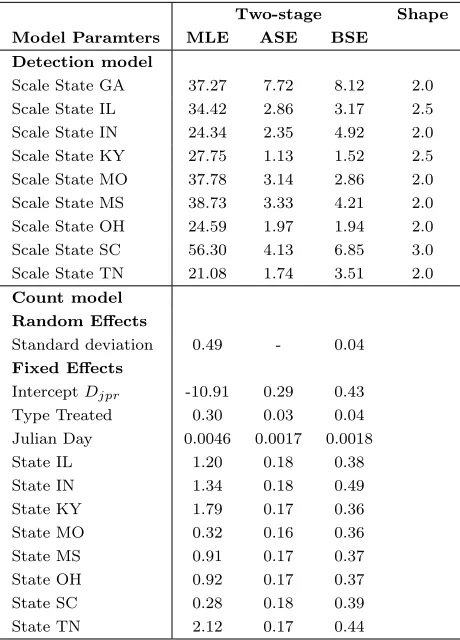
(BSEs) for the best detection and count models are given in Table 2.1. Estimates for
the scale parameter of the hazard-rate detection function stratified by state ranged
between 21.08 (ASE=1.74, BSE=3.51, fixed shape parameter=2.0) for Tennessee and
56.30 (ASE=4.13, BSE=6.85, fixed shape parameter=3.0) for South Carolina.
To calulate a baseline expected number of male indigo buntings within the plot areaa
using the best model, we set the covariates totype = Control,Julian day = 174 (the
mid-point of all days surveyed) andstate = GA. We used the coefficients from Table
2.1 while applying the following transformations (reversing the log-link function of
the Poisson model and convertingbirds/m2 tobirds/a): exp(−10.91 + 0.0046×174 +
0.5×0.492)×a. The last component inside the bracket represents the contribution
of the random effects term and a = πw2. The resulting expected baseline of indigo
bunting numbers within the plot was 1.43 (BSE=0.59) (or 43.51 (BSE=18.91) birds
perkm2).
The remaining fixed effect coefficients represent proportional changes with respect
to this baseline. The type coefficient for the count model was 0.30 (ASE=0.03,
BSE=0.04) indicating a 35% increase of bird densities on treated fields compared
to control fields. For both models, BSEs were generally larger than ASEs except for
the scale parameters of the detection function for two out of the nine states where
25
[image:44.612.190.420.247.567.2]an integrated likelihood approach in chapter 3.
Table 2.1: Maximum likelihood estimates (MLE), analytic (ASE) and bootstrap (BSE) standard errors for model parameters obtained by the two-stage approach for best models. Shape parameters for the one-parameter hazard-rate detection function were fixed.
Two-stage Shape Model Paramters MLE ASE BSE
Detection model
Scale State GA 37.27 7.72 8.12 2.0
Scale State IL 34.42 2.86 3.17 2.5
Scale State IN 24.34 2.35 4.92 2.0
Scale State KY 27.75 1.13 1.52 2.5
Scale State MO 37.78 3.14 2.86 2.0
Scale State MS 38.73 3.33 4.21 2.0
Scale State OH 24.59 1.97 1.94 2.0
Scale State SC 56.30 4.13 6.85 3.0
Scale State TN 21.08 1.74 3.51 2.0
Count model Random Effects
Standard deviation 0.49 - 0.04
Fixed Effects
InterceptDjpr -10.91 0.29 0.43
Type Treated 0.30 0.03 0.04
Julian Day 0.0046 0.0017 0.0018
State IL 1.20 0.18 0.38
State IN 1.34 0.18 0.49
State KY 1.79 0.17 0.36
State MO 0.32 0.16 0.36
State MS 0.91 0.17 0.37
State OH 0.92 0.17 0.37
State SC 0.28 0.18 0.39
2.4
Case study 2: point transect surveys of
north-ern bobwhite coveys
2.4.1
The data
As part of a study to assess the potential benefits of herbaceous buffers around
agri-cultural fields, Mississippi State University, Department of Wildlife, Fisheries, and
Aquaculture set up a monitoring program using point transects in a number of
Mid-western and Southeastern states in the US (Evans et al., 2013). Similar to case study
1, survey points located at the edge of the field were paired up: one point on a
buffered treatment field and the other on a non-buffered control field of the same
agricultural use and within 1−3km of the treatment point. Each pair of points will
be referred to as a site in the following. Repeat visits were made to each point during
fall of three survey years (2006-2008), and each detected northern bobwhite covey
was recorded along with their estimated radial distance to the point. To facilitate
unbiased distance estimation, observers used satellite images of the point location
and surroundings to mark each detected covey. As this survey did not include
ob-taining estimates of cluster size for each covey, we consider cluster densities (rather
than densities of individuals).
Only those states were included in the analysis that contained more than 50
de-tections of coveys: Georgia, Illinois, Indiana, Iowa, Kentucky, Missouri, Mississippi,
North Carolina, South Carolina, Tennessee and Texas. Within these states, 447 sites
were visited between 1 and 3 times in each survey year. After defining a truncation
distance of 500m following recommendations of Buckland et al. (2001), the analysed
27
during 2534 counts.
2.4.2
Analysis using the two-stage approach
As distance were measured exactly during the surveys, the first step included fitting
a detection function to observed distances by maximising the likelihood in eqn (2.3).
Preliminary investigation of the distance data indicated that the hazard-rate
detec-tion funcdetec-tion provided a much better fit than the half-normal. In addidetec-tion to the
global model, we included seven different multiple covariate models where the scale
parameter of the hazard-rate detection function was modelled as a function of one,
two or three of the covariates, all possible combinations of including the covariates
state, year and/or type. For these models, the likelihood changed to eqn (2.9) from
page 18.
In a second step, the effective area was incorporated into the density model for λjpr
for which the likelihood is given in eqn (2.7). Parameter estimates were obtained
using the glmer function of the lme4 package (Bates, 2009b) in R. The number of
quadrature points was set to 10 using the argument nAGQ of this function,
follow-ing recommendations of Lesaffre and Spiessens (2001). We explored 16 models that
included a fixed intercept and a random effect for site and combinations of the four
covariates state, type, year and Julian day. Best fitting models for both steps were
found by minimum AIC values.
As the effective area represents an estimate but is included in the model as if it
was a known constant, non-parametric bootstrapping was used to estimate
estimates. To implement a non-parametric bootstrap routine with 999 repeats, an
automatic model selection was set up in R that included calls to the MCDS engine
from the Distance software (Thomas et al., 2010) for the first step. For each
boot-strap iteration, sites were resampled with replacement until the original number of
sites was obtained (Buckland et al., 2009). To include model uncertainty in inference,
the strategy followed here was to select best fitting models based on minimum AIC
values for each bootstrap iteration (Buckland et al., 1997).
2.4.3
Results
The preferred detection model from the analysis of the original data was the
hazard-rate function that included the covariates year, type and state in the model for the
scale parameter. The preferred count model included all available covariates, i.e.year,
type, Julian day and state. The same models were preferred for the bootstrap
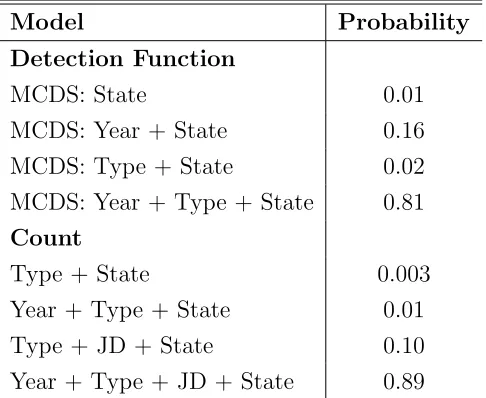
anal-ysis although three other models were selected for both the detection and the count
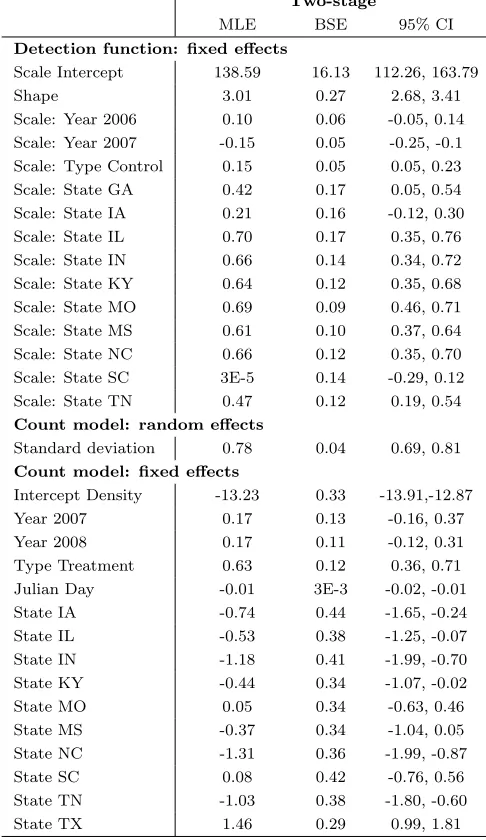
model with smaller probabilities (Table 2.2). Maximum likelihood estimates as well
as bootstrap standard errors (BSEs) and 95% confidence intervals are given in Table
2.3. The type coefficient was 0.63 (ASE=0.12) indicating an 88% increase in covey
densities on treated fields compared to control fields. These results will be discussed
29
Table 2.2: Models and their probabilities resulting from bootstrap analysis. Each count model included a fixed effect intercept and a random effect for site in addition to shown covariates (JD = Julian day). Model probabilities refer to the percentage of times the respective models were chosen during 999 bootstrap iterations.
Model Probability
Detection Function
MCDS: State 0.01
MCDS: Year + State 0.16
MCDS: Type + State 0.02
MCDS: Year + Type + State 0.81
Count
Type + State 0.003
Year + Type + State 0.01
Type + JD + State 0.10
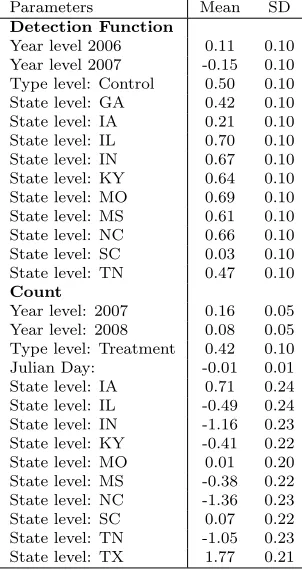
Table 2.3: Maximum likelihood estimates (MLE), bootstrap standard errors (BSE) and 95% confidence intervals (CI) using the two-stage approach for the models with the highest probabilities (see Table 2.2 for model probabilities). Units of measure-ments were metres for the detection function model and square metres for the count model.
Two-stage
MLE BSE 95% CI
Detection function: fixed effects
Scale Intercept 138.59 16.13 112.26, 163.79
Shape 3.01 0.27 2.68, 3.41
Scale: Year 2006 0.10 0.06 -0.05, 0.14
Scale: Year 2007 -0.15 0.05 -0.25, -0.1
Scale: Type Control 0.15 0.05 0.05, 0.23
Scale: State GA 0.42 0.17 0.05, 0.54
Scale: State IA 0.21 0.16 -0.12, 0.30
Scale: State IL 0.70 0.17 0.35, 0.76
Scale: State IN 0.66 0.14 0.34, 0.72
Scale: State KY 0.64 0.12 0.35, 0.68
Scale: State MO 0.69 0.09 0.46, 0.71
Scale: State MS 0.61 0.10 0.37, 0.64
Scale: State NC 0.66 0.12 0.35, 0.70
Scale: State SC 3E-5 0.14 -0.29, 0.12
Scale: State TN 0.47 0.12 0.19, 0.54
Count model: random effects
Standard deviation 0.78 0.04 0.69, 0.81
Count model: fixed effects
Intercept Density -13.23 0.33 -13.91,-12.87
Year 2007 0.17 0.13 -0.16, 0.37
Year 2008 0.17 0.11 -0.12, 0.31
Type Treatment 0.63 0.12 0.36, 0.71
Julian Day -0.01 3E-3 -0.02, -0.01
State IA -0.74 0.44 -1.65, -0.24
State IL -0.53 0.38 -1.25, -0.07
State IN -1.18 0.41 -1.99, -0.70
State KY -0.44 0.34 -1.07, -0.02
State MO 0.05 0.34 -0.63, 0.46
State MS -0.37 0.34 -1.04, 0.05
State NC -1.31 0.36 -1.99, -0.87
State SC 0.08 0.42 -0.76, 0.56
State TN -1.03 0.38 -1.80, -0.60
Chapter 3
An integrated likelihood approach
for modelling distance sampling
data with mixed effects
3.1
Introduction
In this chapter, we deal with some of the shortcomings of the two-stage approach
presented in chapter 2 and provide an alternative method, the integrated likelihood
approach. As for the two-stage approach, the motivation for the integrated likelihood
approach also was to replace the design-based component of conventional distance
sampling with a model where animal densities or counts are related to covariates
such as habitat.
However, the shortcoming of the two-stage approach described by Buckland et al.
(2009), and equivalently of the extended version described in chapter 2, is that it
treats the offset, and hence the detection function from the first stage, as known.
Hence, nonparametric bootstrapping needs to be used to quantify precision of
param-eter estimates, to allow uncertainty from fitting the detection function to propagate
into the second stage.
Royle et al. (2004), on the other hand, developed an integrated likelihood for point
transect data where distances were measured in intervals. These authors combined
a covariate model for the latent variable Np (the true but unknown abundance of
animals at the point) with the cell probabilitiesfi (derived from the detection
func-tion) to model the observed counts npi in the ith distance interval at the pth point.
An advantage of the approach of Royle et al. (2004) is that all model parameters for
both theNp and thefi are estimated in one step. However, Royle et al. (2004) only
assumed a global half-normal detection function where the distance information was
pooled across all points for the respective distance intervals.
Here, we extend the approach of Royle et al. (2004) in the following ways. We model
heterogeneity in detection probabilities and include model selection for thefi model
as well as for the Np. We also extend Royle et al.’s Poisson model by including a
random effect for site in the abundance model to account for correlated counts at the
same sites. This was motivated by our case study 1, the point transects of indigo
buntings, where a large number of sites was included in the analyses and the number
of repeat visits to the same site varied.
In the following we begin by describing our extended version of the integrated
like-lihood of Royle et al. (2004) for both line and point transects (section 3.2), analyse
our case study of indigo buntings using this integrated likelihood and contrast results
with those using the two-stage approach from chapter 2 (section 3.3), and discuss
33
3.2
Integrated likelihood
As in the previous chapter, we begin by considering a wildlife study that was carried
out at a number of sites, at each of which point or line transects were placed according
to some design and that each site was surveyed at least once following a distance
sampling protocol (see Buckland et al., 2001 or chapter 2 for further details).
If all animals within the search area were detectable with certainty, then observed
counts within the search distance around the line or point would equal the true number
of animals within the search distance around the line (point) and could be modelled
via a log-link using a generalised linear mixed model (GLMM) with a Poisson error
structure (E(Njpr) =λjpr) whereNjpr is the total number of animals present within
the search area ajpr at visitr to line (point) p of site j. The search area ajpr equals
2wljpr for lines (ljpr = length of the respective line) and πw2 for points; in both cases
wrepresents the truncation distance. Combining adjacent lines or points as sites and
including site as a random effect allows (repeat) counts from the same site to covary
without causing bias for the remaining parameters in the model. Theλjpr may then
be modelled by a linear predictor via a log-link function using:
λjpr = exp β0+bj + K
X
k=1
xkjprβk
!
. (3.1)
Here, β0 represents the fixed effect intercept, bj the random effect for site j with
bj ∼ N(0, σb2), xkjpr the observed covariate values for the k = 1,2, ..., K fixed effects
and βk the associated coefficients. In the following β0, ..., βK may be summarised as