https://www.scirp.org/journal/odem ISSN Online: 2333-357X
ISSN Print: 2333-3561
DOI: 10.4236/odem.2019.74014 Nov. 1, 2019 176 Occupational Diseases and Environmental Medicine
Knowledge and Practice on Tuberculosis
among Prison Workers from Seremban Prison
G. Selvaganapathi1*, Jinat Ahmed2, A. G. Mathialagan3, M. Dinesh4, N. Azra2, T. Harikrishnan5,
S. Vanita6, M. N. M. Nazmul2, Agus Iwan Foead3
1Seremban Prison, Malaysian Prison Department, Home Ministry, Putrajaya, Malaysia 2Perdana University Graduate School of Medicine, Perdana, Malaysia
3Perdana University Royal College of Surgeons Ireland, Serdang, Malaysia 4SP Care Group, Health Care, Rawang, Malaysia
5Department of Rehabilitation Medicine, Hospital Tunku Ampuan Rahimah, Klang, Malaysia 6Klinik Sri Pulai Sdn Bhd, Seremban, Malaysia
Abstract
Background: Prisons are always overcrowded, and congestion leads to close relationships, and subsequently, increases the likelihood of airborne illnesses including Tuberculosis (TB). The purpose of this study was to identify the level of knowledge of TB transmission, and TB preventive practices of prison workers in a Malaysian prison. Methods: A cross-sectional study was con-ducted with convenience sampling technique utilizing a validated question-naire. 280 prison workers employed at the Seremban Prison were invited to participate in the study. The study period was from January 2019 to June 2019. Inclusion criteria included age above 18 years old and English literacy. The questionnaire was divided into 3 parts which were sociodemographic details, knowledge on TB transmission and TB preventive practices. The analysis was done in SPSS version 24.0 using appropriate statistical tests. De-scriptive statistics was used to evaluate the knowledge level of TB transmis-sion, and TB preventive practices of prison workers at Seremban prison. Re-sults: Around 190 questionnaires were obtained usable registering a response rate of 68.5%. This study showed that around 66% of prison workers had moderate knowledge while around 26% had good knowledge of TB transmis-sion. In terms of practice, around 93.7% of prison workers applied good TB prevention practice. Conclusion: This study showed that the majority of the respondents had moderate knowledge regarding TB transmission. However, their disease preventive practices were at acceptable levels which implied that existing prison standard operating procedures play an important on instilling these practices. Nonetheless, prison management should take important ac-How to cite this paper: Selvaganapathi, G.,
Ahmed, J., Mathialagan, A.G., Dinesh, M., Azra, N., Harikrishnan, T., Vanita, S., Naz-mul, M.N.M. and Foead, A.I. (2019) Knowl-edge and Practice on Tuberculosis among Prison Workers from Seremban Prison. Occupational Diseases and Environmental Medicine, 7, 176-186.
https://doi.org/10.4236/odem.2019.74014
Received: September 10, 2019 Accepted: October 29, 2019 Published: November 1, 2019
Copyright © 2019 by author(s) and Scientific Research Publishing Inc. This work is licensed under the Creative Commons Attribution International License (CC BY 4.0).
DOI: 10.4236/odem.2019.74014 177 Occupational Diseases and Environmental Medicine tion by providing education and training to increase TB knowledge among prison workers to ensure that this practice is always upheld in both prison and community settings.
Keywords
Knowledge, Practice, Prevention, Tuberculosis, Prison Worker, Prison, Malaysia
1. Introduction
Tuberculosis (TB) is one of the most common worldwide infectious diseases and one of the leading causes of death in the world, with an overall 1.7 million TB-related deaths reported in 2016, despite accessibility of TB treatment. In 2016, the World Health Organization (WHO) estimated a total of 10.4 million incident TB cases globally, 10% of whom were living with HIV infection. The burden of TB is the highest in the South-East Asian and African regions, which accounted for 70% of the global TB incidence in 2016 [1]. In fact, since 1993, TB has been declared as a “global emergency” by the World Health Organization until now [2] [3].
In Malaysia, TB is the second most frequently reported communicable disease (after dengue fever) and is the leading cause of death from communicable dis-eases, with a mortality rate of 5.56 per 100,000 persons [4]. In 2017(5), estimated TB burden by Malaysia per 1,000,000 for mortality (HIV & TB only) was 0.93 and incidence (HIV & TB) was 5.7. By gender estimate, TB incidence in Malay-sia has shown male (18 cases per 1,000,000) at higher levels than female (11 case per 100,000). A number of cases registered and notified as TB cases in 2017 ac-count for around 26,168 cases. Malaysia has witnessed an increase in the inci-dence of TB, from 65 cases per 100,000 in 2000 to 92 per 100,000 in 2016 by the global TB report [5].
DOI: 10.4236/odem.2019.74014 178 Occupational Diseases and Environmental Medicine The high burden of TB within prison poses a threat to the general population, as the disease can be transmitted to correctional staff who are in daily close con-tact with prisoners. Furthermore, inmates who are incarcerated for a short pe-riod of time and who do not receive adequate treatment may transmit the dis-ease on their return to the community [12]. In a recent systematic review, a large fraction of TB cases in the general population was attributable to acquisition of TB inside prison. This has been estimated at 1 in 11 TB cases in high-income countries and 1 in 16 cases in low-/middle-income countries. Another study es-timated that for each 1% increase in the incarceration rate in European and Central Asian countries, there was a 0.34% increase in TB incidence in the gen-eral population [13].
Despite recent findings of high prevalence rates of both latent and active TB in Malaysian prisons, routine intensified TB screening and treatment are not cur-rently practiced, and diagnosis of active TB remains passive. Environmental conditions, such as overcrowding and poor ventilation, further facilitate the transmission and spread of TB in these settings. To counter these precipitating factors for TB transmission, it is important that prison workers have good knowledge on TB transmission and apply excellent preventive practices associ-ated with TB diseases to ensure low risk of TB incidence among prison workers. However, there has been minimal studies evaluating TB knowledge and practice on prison workers in Malaysia. So this study undertook the objective of determine the level of TB transmission knowledge and TB preventive practices among prison workers in a selected prison in Malaysia.
2. Materials and Methods
This cross-sectional study was conducted in Seremban Prison in Malaysia from January 2019 to June 2019. Seremban Prison was selected because it was one of the oldest prisons in Malaysia and it functions also as a prison for drug abuse offenders. The study population was full-time Seremban prison workers such as correctional officers which included all the ranks from the Prison Wardens up to Assistant Commissioner of Prisons (KA 48), healthcare personnel and adminis-trative staff. The sample size was calculated and the required sample size was 162 respondents with a 95% confidence level. Convenience sampling was used due to the restriction in time, place, and logistics. The inclusion Criteriawere: 1) The respondent was required to be above 18 years old. 2) The respondent could read, write and speak English. iii. The respondent was willing to participate. The ques-tionnaires were distributed using convenience sampling to all the prison em-ployees who met the inclusion criteria. The participants were given a brief ex-planation of the study and required to fill up the consent form before answering the questionnaires.
DOI: 10.4236/odem.2019.74014 179 Occupational Diseases and Environmental Medicine which evaluated TB knowledge on prison workers and prisoners [14]. The Ethiopian study developed the questionnaire based on the general guidelines of WHO KAP questionnaires design and adapted to suit TB KAP exploration with evaluation on factor analysis and reliability [15]. For the purpose of our study, we undertook the responsibility to additionally re-evaluate content validity and face validity. The validity findings of our study were consistent with the earlier study and a pilot test by 30 respondents gave a similar average Cronbach alpha value of 0.887, confirming adequate reliability. This finalized version was used for data collection in the general sample population.
Data analysis was done using ‘Statistical Package for Social Sciences’ (SPSS) Version 22.0. The descriptive tests were computed using this software. The re-search proposal was reviewed and cleared by the Ethics Committee of Perdana University. Informed consent was obtained from each study subject.
3. Results
This chapter describes the characteristics of the study sample’s knowledge, atti-tude and practice among prisoner workers on TB disease. Between January, 2019 to Jun 2019 at Seremban Prison, Seremban Negeri Sembilan, 280 questionnaires were given out to all prison workers which include all gender and position (uni-form and administrative department) and around 190 questionnaires were re-turned usable for the study. This gave a response rate of 68.5%.
3.1. Socio-Demographic Variables among Respondents
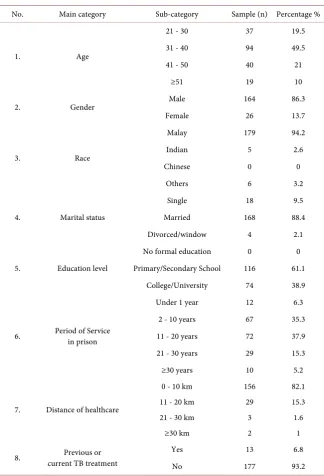
The sociodemographic profile of the current study respondents has been de-picted in Table 1. The respondents’ age distribution was 21 - 30 [19.5% (n = 37)], 31 - 40 [49.5% (n = 94)], 41 - 50 [21% (n = 40)], and ≥50 [10% (n = 19)] years old. The distribution of sexes among the respondents was 86.3% (n = 164) and 13.7% (n = 26) for males and females respectively. The distribution of the respondents’ ethnicity was Malay [94.2% (n = 179)], Indian [2.6% (n = 5)] and others [3.2% (n = 6)]. The pattern of the respondents’ martial was single [9.5% (n = 18)], married [88.4% (168)] and discover/window [2.1% (n = 4)]. Consid-ering the respondents’ educational level, [61.1% (n = 116)] had pri-mary/secondary education, and [38.9% (n = 74)] had university/college educa-tion. The respondents’ period of services was 11 - 20 years [37.9% (n = 72)], 2 - 10 years [35.3% (n = 67)], 21 - 30 years [15.3% (n = 29)], more than 30 years [5.2% (n = 10)], and less than 1 years [6.3% (n = 12)]. [82.1% (n = 156)] of the respondents lived 0 - 10 km, [15.3% (n = 29)] lived in 11 - 20 km, [1.6% (n = 3)] lived in 21 - 30 km and [1% (n = 2)] other respondents more than 30km. The distribution of the respondents’ previous history of TB, [83% (n = 83)] were not been diagnosis, and [93.2% (n = 177)] were been diagnosis.
3.2. Knowledge about Tuberculosis (TB)
DOI: 10.4236/odem.2019.74014 180 Occupational Diseases and Environmental Medicine
Table 1. Respondents demographic data (N = 190).
No. Main category Sub-category Sample (n) Percentage %
1. Age
21 - 30 37 19.5
31 - 40 94 49.5
41 - 50 40 21
≥51 19 10
2. Gender Male 164 86.3
Female 26 13.7
3. Race
Malay 179 94.2
Indian 5 2.6
Chinese 0 0
Others 6 3.2
4. Marital status
Single 18 9.5
Married 168 88.4
Divorced/window 4 2.1
5. Education level
No formal education 0 0
Primary/Secondary School 116 61.1
College/University 74 38.9
6. Period of Service in prison
Under 1 year 12 6.3
2 - 10 years 67 35.3
11 - 20 years 72 37.9
21 - 30 years 29 15.3
≥30 years 10 5.2
7. Distance of healthcare
0 - 10 km 156 82.1
11 - 20 km 29 15.3
21 - 30 km 3 1.6
≥30 km 2 1
8. current TB treatment Previous or Yes 13 6.8
No 177 93.2
DOI: 10.4236/odem.2019.74014 181 Occupational Diseases and Environmental Medicine
Table 2. Overall knowledge on TB level among prison workers (n = 190).
No. Main Category Sub-category Sample (n) Percentage (%)
1. Knowledge
Poor 14 7.4
Moderate 126 66.3
Good 50 26.3
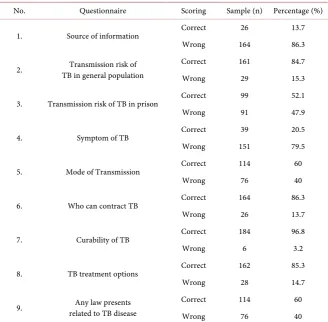
Table 3. Knowledge of TB among the prison workers.
No. Questionnaire Scoring Sample (n) Percentage (%)
1. Source of information Correct 26 13.7
Wrong 164 86.3
2. TB in general population Transmission risk of Correct 161 84.7
Wrong 29 15.3
3. Transmission risk of TB in prison Correct 99 52.1
Wrong 91 47.9
4. Symptom of TB Correct 39 20.5
Wrong 151 79.5
5. Mode of Transmission Correct 114 60
Wrong 76 40
6. Who can contract TB Correct 164 86.3
Wrong 26 13.7
7. Curability of TB Correct 184 96.8
Wrong 6 3.2
8. TB treatment options Correct 162 85.3
Wrong 28 14.7
9. related to TB disease Any law presents Correct 114 60
Wrong 76 40
(n = 164) compared with only a small number of correct answers 13.7% (n = 26). Most of the respondent were not able to identify all the symptoms of TB [79.5% (n = 151)] compared to the minority with correct answers [20.5% (n = 39)]. However, respondents were able to give correct answer to some important ques-tions in regards to mode of transmission 60% (n = 114), high risk to be contact with TB 86.3% (n = 143), TB curability 96.8% (n = 184) and treatment options for TB around 85.3% (n = 162).
3.3. Prevention Practice on TB
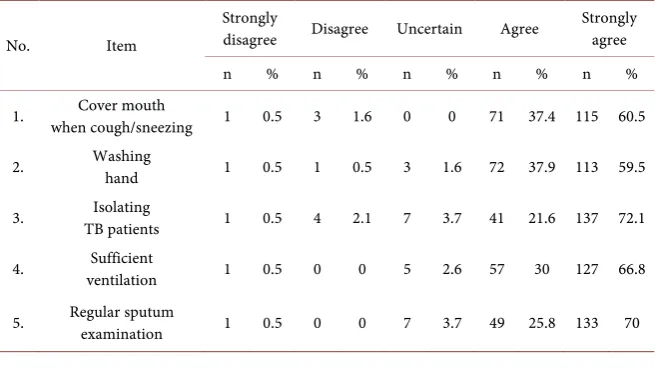
[image:6.595.210.539.188.510.2]DOI: 10.4236/odem.2019.74014 182 Occupational Diseases and Environmental Medicine scored less than 20 marks were considered to have poor practice. As shown in Table 4, many of the respondents had good knowledge which accounted for 93.7% (n = 178), and only 6.3% (n = 12) had poor knowledge regarding the topic. In terms of specific question analysis as shown in Table 5, majority re-spondents did answered questions such as covering mouth when coughing or sneezing with strongly agreement of 60.5. Similarly, most respondents had strong awareness on the importance of hand washing methods with more than 80% in agreement. The pattern showed respondents supported statement for isolating patient if present with TB. Almost all the respondent’s response for suf-ficient ventilation was in strong agreement ranging from 66.8% and agreement at 30%. Majority of respondents also supported regular sputum examination with strong agreement around 70% and agreement 25.8%.
4. Discussion
[image:7.595.210.538.465.516.2]The purpose of this study was to examine the knowledge level and prevention practice on TB among prison workers in Seremban Prison. The study indicated that high proportions of respondent had moderate knowledge of TB transmis-sion. However, most of the respondents exhibited good practice level in terms of TB prevention. The findings differ slightly from another local study done in Tapah prison in Malaysia which showed good knowledge and good practice among prison workers [16]. Another study done in Brazil which compared knowledge of prison workers, prisoners and public health workers found that there was very good knowledge, attitude and practice among prison workers and public health workers but low knowledge and practice among prisoners [17].
Table 4. Overall prevention practice level among prison workers (n = 190).
No. Main category Sub category Sample (n) Percentage (%)
1. Practice Good 178 93.7
[image:7.595.211.539.548.735.2]Poor 12 6.3
Table 5. Descriptive of prevention practice (n = 190).
No. Item
Strongly
disagree Disagree Uncertain Agree Strongly agree
n % n % n % n % n %
1. when cough/sneezing Cover mouth 1 0.5 3 1.6 0 0 71 37.4 115 60.5
2. Washing hand 1 0.5 1 0.5 3 1.6 72 37.9 113 59.5
3. TB patients Isolating 1 0.5 4 2.1 7 3.7 41 21.6 137 72.1
4. Sufficient
ventilation 1 0.5 0 0 5 2.6 57 30 127 66.8
DOI: 10.4236/odem.2019.74014 183 Occupational Diseases and Environmental Medicine The differences with the above studies could be due to a number of factors in this study. Moderate knowledge among prison workers could be due to inade-quate training and health education. Dengue is a major concern in Malaysia as it is the leading cause of death due to communicable diseases. Huge resources and budget have been allocated for dengue management to create awareness and preventive health education [18], [19]. Unfortunately, the same emphasis was not given to tuberculosis prevention, particularly in high risk areas such as prisons. Under National Strategic Plan for Tuberculosis Control (NSPT) (2016-2020), there was a consensus about prisons as a major source of TB transmission to general population and the need to strengthen preventive meas-ures on these institutions. However, the implementation of major initiative was impacted due to the reduced budget capacity caused by volatility in oil prices [20]. Additionally respondents had not received any training in the previous year nor undertaken any TB health education course which would have im-proved their knowledge levels [21], [22]. The findings of the study identify the pressing need for TB training for all prison workers. The participants did not seem to fully comprehend the real risk of TB exposure, and most were afraid of becoming infected with TB. Concerns and stigma related to TB emerged par-ticularly among prison workers from prison without TB related training. Irra-tional work practices and fear might lead to a higher risk of exposure [23].
Interestingly although prison workers had moderate level of knowledge on TB transmission but they had good preventive practice at their occupational setting. This could be due to the standard operating procedures (SOP) in place for TB disease prevention as required by law for prison settings under a country [24], [25]. Based on Malaysian law, any government or non-government agencies should obey or comply to Occupational Safety and Health Act 1994 (OSHA 1994) whereby institutions have a duty of care towards their employees safety and health, and to that of others at their workplace [26], [27], [28]. Among the guidelines present that prison workers should follow are Guideline for workplace the control of Tuberculosis and Ministry of Health Malaysia guideline for control of TB and a customized guideline for prisons that was developed as a collaborative effort by Ministry of Health and Department of Prison Malaysia
[29], [30]. Major role for this policy or SOP for employees or employers is to
protect fundamental rights and ensure them following the rule in order to pro-tect the staff’s safety and health. Frequent monitoring and auditing by internal and external management have also ensured the prison workers follow the policy or SOP which subsequently has ensured the practice is maintained at excellent standards [31], [32], [33].
5. Conclusion
adher-DOI: 10.4236/odem.2019.74014 184 Occupational Diseases and Environmental Medicine ence to existing SOP’s in prison. However, the moderate knowledge implies that the prison workers do not understand the importance of TB transmission and prevention, hence these practices may not be practiced at community levels. So, an important finding of this study is to increase educational intervention and knowledge empowerment of prison workers in prisons in Malaysia.
6. Limitation
One of the main limitations of this study would be its sample population. The study population was small and was limited to a cohort of prison staff in Serem-ban prison only, therefore the results of the study will not be generalized to all prison staff on knowledge, attitude and practice on tuberculosis in part of Negeri Sembilan or Malaysia prison as the situation in other districts may differ from what prevails in Seremban prison. Additionally, convenience sampling was ad-ministered rather than random sampling which would have given a stronger generalizability.
Conflicts of Interest
The authors declare no conflicts of interest regarding the publication of this paper.
References
[1] WHO (2017) Global Tuberculosis Report 2017.
[2] World Health Organization, Tuberculosis Unit (1994) Tuberculosis Notification Update, December 1993. World Health Organization.
[3] Daniel, T.M. (2006) The History of Tuberculosis. Respiratory Medicine, 100, 1862-1870.https://doi.org/10.1016/j.rmed.2006.08.006
[4] Thomas, S., Beh, L. and Nordin, R.B. (2011) Health Care Delivery in Malaysia: Changes, Challenges and Champions. Journal of Public Health in Africa, 2, e23.
https://doi.org/10.4081/jphia.2011.e23
[5] Reports.
https://extranet.who.int/sree/Reports?op=Replet&name=/WHO_HQ_Reports/G2/P
ROD/EXT/TBCountryProfile&ISO2=my&outtype=pdf
[6] Baussano, I., Williams, B.G., Nunn, P., Beggiato, M., Fedeli, U. and Scano, F. (2010) Tuberculosis Incidence in Prisons: A Systematic Review. PLoS Medicine, 7, e1000381. https://doi.org/10.1371/journal.pmed.1000381
[7] Anderson, C., Story, A., Brown, T., Drobniewski, F. and Abubakar, I. (2010) Tu-berculosis in UK Prisoners: A Challenge for Control. Journal of Epidemiology & Community Health, 64, 373-376.https://doi.org/10.1136/jech.2009.094375
[8] Al-Darraji, H.A.A., Tan, C., Kamarulzaman, A. and Altice, F.L. (2015) Prevalence and Correlates of Latent Tuberculosis Infection among Employees of a High Secu-rity Prison in Malaysia. Occupational and Environmental Medicine, 72, 442-447.
https://doi.org/10.1136/oemed-2014-102695
[9] Maher, D., Grzemska, M., Coninx, R. and Reyes, H. (1998) Guidelines for the Con-trol of Tuberculosis in Prisons. 90.
DOI: 10.4236/odem.2019.74014 185 Occupational Diseases and Environmental Medicine
Pulmonary Tuberculosis among Prisoners in Malaysia: An Overlooked Risk for Tuberculosis in the Community. Tropical Medicine & International Health, 21, 1049-1058. https://onlinelibrary.wiley.com/doi/full/10.1111/tmi.12726
[11] Al-Darraji, H.A.A., Kamarulzaman, A. and Altice, F.L. (2014) Latent Tuberculosis Infection in a Malaysian Prison: Implications for a Comprehensive Integrated Con-trol Program in Prisons. BMC Public Health, 14, 22.
https://doi.org/10.1186/1471-2458-14-22
http://bmcpublichealth.biomedcentral.com/articles/10.1186/1471-2458-14-22
[12] The PLoS Medicine Editors (2010) The Health Crisis of Tuberculosis in Prisons Ex-tends beyond the Prison Walls. PLoS Medicine, 7, e1000383.
https://doi.org/10.1371/journal.pmed.1000383
[13] Stuckler, D., Basu, S.,Mckee, M. and King, L. (2008) Mass Incarceration Can Ex-plain Population Increases in TB and Multidrug-Resistant TB in European and Central Asian Countries. Proceedings of the National Academy of Sciences of the United States of America, 105, 13280-13285.
https://www.researchgate.net/publication/23194885_Mass_incarceration_can_expla in_population_increases_in_TB_and_multidrug-resistant_TB_in_European_and_c
entral_Asian_countries
[14] Adane, K., Spigt, M., Johanna, L., Noortje, D., Abera, S.F. and Dinant, G.-J. (2017) Tuberculosis Knowledge, Attitudes, and Practices among Northern Ethiopian Pris-oners: Implications for TB Control Efforts. PLoS ONE, 12, e0174692.
https://doi.org/10.1371/journal.pone.0174692
[15] Stop TB Partnership (World Health Organization) (2008) Advocacy, Communica-tion and Social MobilizaCommunica-tion for TB Control: A Guide to Developing Knowledge, Attitude and Practice Surveys. Stop TB Partnership, Geneva.
http://whqlibdoc.who.int/publications/2008/9789241596176_eng.pdf
[16] Haque, A., Haque, H.M., Hannan, A., Abdul Aziz, B., Nabilah, F., et al. (2019) Knowledge and Attitude Concerning Tuberculosis among the Employees of a Prison of Malaysia: A Cross-Sectional Study. International Journal of Pharmaceuti-cal Research & Allied Sciences, 7, 169-178.
[17] Ferreira Júnior, S., de Oliveira, H.B., Marin-Léon, L., Ferreira Júnior, S. and Marin-Léon, L. (2013) Knowledge, Attitudes and Practices on Tuberculosis in Pris-ons and Public Health Services. Revista Brasileira de Epidemiologia, 16, 100-113.
https://doi.org/10.1590/S1415-790X2013000100010
[18] Nantha, Y.S. (2014) A Review of Tuberculosis Research in Malaysia.The Medical journal of Malaysia, 69, 88-102.
[19] Department of Statistics Malaysia Official Portal.
https://www.dosm.gov.my/v1/index.php?r=column/cthemeByCat&cat=152&bul_id =NU5hZTRkOSs0RVZwRytTRE5zSitLUT09&menu_id=U3VPMldoYUxzVzFaYm
NkWXZteGduZz09
[20] Abd Rahman, N.H. and Salwa Mokhtar, K. (2015) Challenges of National TB Con-trol Program Implementation: The Malaysian Experience. Procedia-Social and Be-havioral Sciences, 172, 578-584.
https://www.researchgate.net/publication/273501182_Challenges_of_National_TB_
Control_Program_Implementation_The_Malaysian_Experience
[21] Mehtar, S. (2008) Lowbury Lecture 2007: Infection Prevention and Control Strate-gies for Tuberculosis in Developing Countries-Lessons Learnt from Africa. The Journal of Hospital Infection, 69, 321-327.
DOI: 10.4236/odem.2019.74014 186 Occupational Diseases and Environmental Medicine
[22] Ministry of Health, Malaysia (2012) Guideline on Prevention and Management of Tuberculosis for Healthcare Workers in Ministry of Health, Malaysia.
[23] Tuberculosis I of M (US) C on ROE to, Field MJ (2001) Occupational Risk of Tu-berculosis. National Academies Press, Washington DC.
https://www.ncbi.nlm.nih.gov/books/NBK222463/
[24] Jensen, P.A.,Lambert, L.A., et al. (2005) Guidelines for Preventing the Transmis-sion of Mycobacterium tuberculosis in Health-Care Settings.Morbidity and Mor-tality Weekly Report,54, 1-141.
https://www.cdc.gov/mmwr/preview/mmwrhtml/rr5417a1.htm
[25] World Health Organization (2019) WHO Guidelines on Tuberculosis Infection Prevention and Control: 2019 Update.
http://www.ncbi.nlm.nih.gov/books/NBK539297/
[26] https://www.theunion.org/official-documents/AR2004_en.pdf
[27] Maher, D. (2003) Guidelines for Workplace TB Control Activities: The Contribu-tion of Workplace TB Control Activities to TB Control in the Community. Interna-tional Labour Organization, World Health Organization, Geneva.
http://books.google.com/books?id=VlNZAAAAYAAJ
[28] (2012) Malaysia, Kementerian Kesihatan, Bahagian Perkembangan Perubatan. Management of Tuberculosis.
[29] Malaysia Prisons Department.
http://www.prison.gov.my/portal/page/portal/english/khidmat_en
[30] Maher, D., Grzemska, M., Coninx, R. and Reyes, H. (1998) Guidelines for the Con-trol of Tuberculosis in Prisons. 90.
[31] Scano, F., Cadman, H., Stop TB Initiative (World Health Organization), World Health Organization, HIV Department, World Health Organization, et al. (2009) WHO policy on TB Infection Control in Health-Care Facilities, Congregate Set-tings, and Households. http://www.ncbi.nlm.nih.gov/books/NBK179249/
[32] Correctional Facilities (2018) TB in Specific Populations. CDC.
https://www.cdc.gov/tb/topic/populations/correctional/default.htm