eScholarship provides open access, scholarly publishing services to the University of California and delivers a dynamic research platform to scholars worldwide.
Peer Reviewed Title:
What Associative Learning in Insects Tells Us about the Evolution of Learned and Fixed Behavior
Journal Issue:
International Journal of Comparative Psychology, 28
Author:
Hollis, Karen L., Mount Holyoke College Guillette, Lauren M., University of St Andrews
Publication Date:
2015
Permalink:
http://escholarship.org/uc/item/3v15313t
Author Bio:
Department of Psychology, Professor
Keywords:
Insect learning, evolution of learning, associative learning in insects
Local Identifier:
uclapsych_ijcp_25706
Abstract:
eScholarship provides open access, scholarly publishing services to the University of California and delivers a dynamic research platform to scholars worldwide.
Copyright Information:
2015, 28 José E. Burgos Special Issue Editor
Peer-reviewed
Please send correspondence to Dr. Karen L. Hollis. (Email: [email protected]).
What Associative Learning in Insects Tells Us about
the Evolution of Learned and Fixed Behavior
Karen L. Hollis
1& Lauren M. Guillette
21
Mount Holyoke College, Massachusetts, USA
2University of St Andrews, Fyfe, United Kingdom
Contemporary models for the evolution of learning suggest that environmental predictability plays a critical role in whether learning is expected to evolve in a particular species, a claim originally made over 50 years ago. However, amongst many behavioral scientists who study insect learning, as well as amongst neuroscientists who study the brain architecture of insects, a very different view is emerging, namely that all animals possessing a nervous system should be able to learn. More specifically, the capacity for associative learning may be an emergent property of nervous systems such that, whenever selection pressures favor the evolution of nervous systems, for whatever reason, the capacity for associative learning follows ipso facto. One way to reconcile these disparate views of learning is to suggest that the assumed default in these evolutionary models, namely the non-learning phenotype, is incorrect: The ability to learn is, in fact, the default but, under certain conditions, selection pressures can override that ability, resulting in hard-wired, or considerably less plastic, responses. Thus, models for the evolution of learning actually may be models for the conditions under which inherent plasticity is overridden. Moreover, what have been revealed as the costs of learning in insects may, instead, be costs associated with cognitive abilities that go beyond forming simple associations – cognitive abilities that researchers are just now beginning to reveal.
The ability of animals, vertebrates and invertebrates alike, to use learned cues enables them to find food and hosts, locate and court mates, avoid predators and poisons, locate new territories, protect already-established territories, repel rivals, and recognize their young, to name but a few of the many situations critical to survival (Domjan, 2005; Dugatkin, 2014). Relying on learned cues long has been understood to make accomplishing these tasks faster, more efficient, or more effective, compared to situations in which no such cues are available (e.g., Hollis, 1982, 1997; Staddon, 1983). Given the biological importance of these tasks, the fitness benefits of learning would appear to be so large as to dwarf any costs. However, the supposed costs of learning – machinery and start-up costs typically are proposed – could, at least theoretically, be too high a price to pay under certain conditions. Nonetheless, what appears to be a different view of learning is emerging, a view that is very much at odds with current models for the evolution of learning, namely that the ability to learn is an emergent property of all nervous systems. That is, learning is inherent in the way that neural cells communicate with one another, with the way that neural cell networks are built, a view espoused by neuroscientists (e.g., Fernando et al., 2009; Greenspan, 2007) as well as many insect researchers (e.g., Dukas, 2008; Raine, 2009).
2
they rely, instead, on hard-wired responses (e.g., Dunlap & Stephens, 2009)? How might we reconcile what appear to be the disparate views of neuroscientists and evolution of learning theorists? In this paper we offer a brief overview of the ways in which theorists have approached the evolution of learning; we provide a snapshot of the research on associative learning in insects; we explore the neuroscientific conundrum that lies at the heart of evolution of learning models; and, finally, we propose a solution to that conundrum. Elsewhere we have described this same discrepancy between neuroscientific research and models for the evolution of learning (Hollis & Guillette, 2011); the current paper is our attempt to update what is known about associative learning in insects, to provide current information about other cognitive abilities that insects possess, and to refine our proposal about how to reconcile the disparate views of neuroscientists and theorists who propose evolution of learning models.
The Evolution of Learning and the “Predictability” Requirement
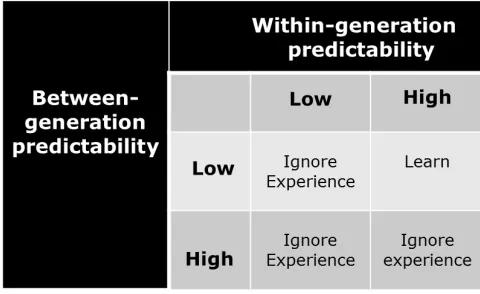
Early theorizing about the conditions that would favor the evolution of learning emphasized a changing but relatively predictable environment, conditions that would guarantee that the benefits of predictability would exceed the costs that learning would impose. For example, Johnston (1982) identified six potential costs of learning: (1) delayed reproductive effort, which could translate into lowered reproductive success; (2) increased parental investment in each offspring, which could lower the number of offspring produced; (3) increased juvenile vulnerability, sometimes labeled start-up costs, which could place additional burdens on parents; and, (4) developmental fallibility, which could have adverse effects on both parents and offspring, depending on the severity of the errors or omissions. Two additional costs proposed by Johnston (1982) that are especially relevant to our argument – and to which we return later in this paper – are: (5) greater complexity of the genome; and, (6) greater complexity of the central nervous system. Given these costs, learning would be expected to evolve only when the environment changed sufficiently so that hard-wired responses would eventually become a handicap, but did not change so much that learned cues would eventually become unreliable. At about this same time, the notion of predictability figured prominently in theoretical papers highlighting the adaptive nature of associative learning (e.g., Domjan, 1987; Domjan & Hollis, 1988; Hollis, 1982; Moore, 1973; Staddon, 1983). Stephens (1991, 1993), however, challenged the view that predictability arose from a single global source, preferring instead to differentiate between two very different origins, namely within-generation predictability, that is, whether what is learned today can be used tomorrow, and between-generation predictability, that is, whether the environment is similar across generations (see Figure 1). According to this model, learning is favored only when between-generation predictability is low – that is, the environment of offspring differs dramatically from that of their parents – but within-generation predictability is high and, thus, learned cues remain reliable.
3
[image:5.612.187.427.153.300.2]
models is the default condition. Interestingly, the history of associative learning research in insects, to which we turn next, not only parallels the history of associative learning research in vertebrates, but also provides some insights about this view that the capacity to learn emerges only under the appropriate environmental conditions.
Figure 1.Stephens’ model for the evolution of learning. Stephens’ model for the evolution of learning. Predictability arises from two separate sources, namely within-generation predictability, that is, whether what is learned today can be used tomorrow, and between-generation predictability, that is, whether the environment is similar across between-generations. This model, originally proposed by Stephens (1991, 1993) later was revised by Dunlap & Stephens (2009) who modeled and subsequently tested the effects of these two sources of predictability, labeling them Variable 1 (V1) and Variable 2 (V2). Adapted from Stephens, 1991, 1993.
Associative Learning in Insects
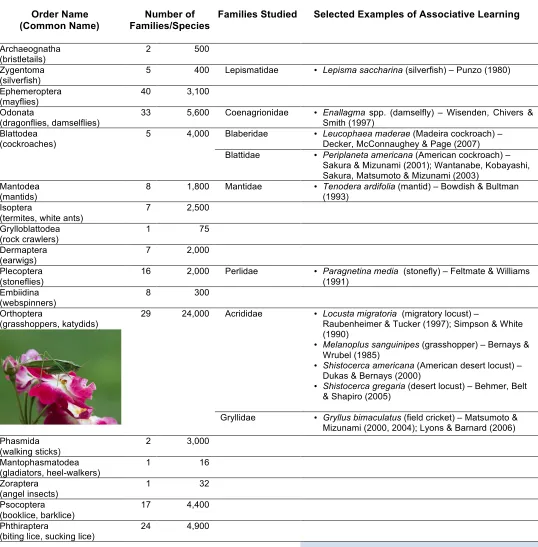
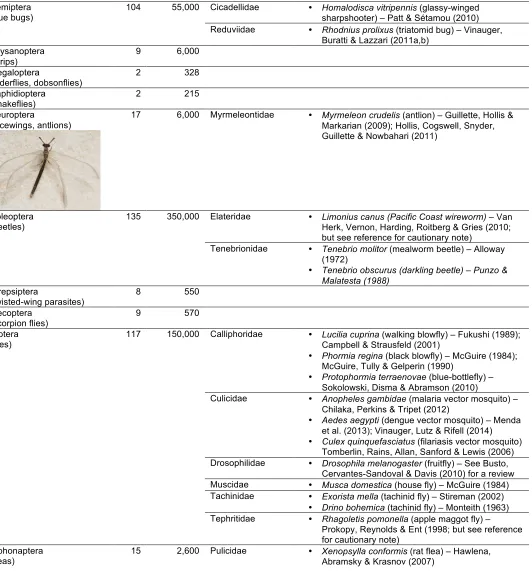
From Macphail’s (1982) justifiably cautious review of vertebrate learning research, in which the absence of appropriately controlled experiments forced him to cast doubt on the learning capacities of some fish and amphibians, to later assumptions that certainly all vertebrates can learn, research with insects has followed a highly similar course. As Table 1 shows, associative learning in insects has been demonstrated in multiple families representing nearly half of all thirty currently recognized orders of insects – many more families than we reported just a few years ago (Hollis & Guillette, 2011). Clearly, the ability to use associatively learned cues, which initially appeared to be limited to bees, ants, and fruit flies (Menzel, 1968; Menzel, Erber, & Masuhr, 1974; Murphy, 1967, 1969; Quinn, Harris, & Benzer, 1974; Schneirla, 1941, 1943; Spatz, Emanns, & Reichert, 1974) and was thought a cognitive novelty in all but a few species as few as 25 years ago, is now accepted as commonplace (for reviews of insect learning, see Dukas, 2008; Giurfa, 2013; Giurfa & Sandoz, 2012; North & Greenspan, 2007; Papaj, 2003; Papaj & Lewis, 1993).
4
[image:6.612.33.571.120.667.2]
Table 1
. Associative Learning in Insects (Class: Insecta)
Order Name (Common Name)
Number of Families/Species
Families Studied Selected Examples of Associative Learning
Archaeognatha
(bristletails) 2 500
Zygentoma (silverfish)
5 400 Lepismatidae • Lepisma saccharina (silverfish) – Punzo (1980)
Ephemeroptera (mayflies)
40 3,100
Odonata
(dragonflies, damselflies)
33 5,600 Coenagrionidae • Enallagma spp. (damselfly) – Wisenden, Chivers &
Smith (1997) Blattodea
(cockroaches) 5 4,000 Blaberidae • Leucophaea maderaeDecker, McConnaughey & Page (2007) (Madeira cockroach) –
Blattidae • Periplaneta americana (American cockroach) –
Sakura & Mizunami (2001); Wantanabe, Kobayashi, Sakura, Matsumoto & Mizunami (2003)
Mantodea
(mantids) 8 1,800 Mantidae • Tenodera ardifolia (1993) (mantid) – Bowdish & Bultman
Isoptera
(termites, white ants)
7 2,500
Grylloblattodea
(rock crawlers) 1 75
Dermaptera (earwigs)
7 2,000
Plecoptera (stoneflies)
16 2,000 Perlidae • Paragnetina media (stonefly) – Feltmate & Williams
(1991) Embiidina
(webspinners)
8 300
Orthoptera
(grasshoppers, katydids)
29 24,000 Acrididae • Locusta migratoria (migratory locust) –
Raubenheimer & Tucker (1997); Simpson & White (1990)
• Melanoplus sanguinipes (grasshopper) – Bernays & Wrubel (1985)
• Shistocerca americana (American desert locust) – Dukas & Bernays (2000)
• Shistocerca gregaria (desert locust) – Behmer, Belt & Shapiro (2005)
Gryllidae • Gryllus bimaculatus (field cricket) – Matsumoto &
Mizunami (2000, 2004); Lyons & Barnard (2006) Phasmida
(walkingsticks)
2 3,000
Mantophasmatodea
(gladiators, heel-walkers) 1 16
Zoraptera
(angel insects) 1 32
Psocoptera (booklice, barklice)
17 4,400
Phthiraptera
(biting lice, sucking lice)
5
Table 1 (cont.)
. Associative Learning in Insects (Class: Insecta)
Hemiptera
(true bugs) 104 55,000 Cicadellidae • Homalodisca vitripennissharpshooter) – Patt & Sétamou (2010) (glassy-winged
Reduviidae • Rhodnius prolixus (triatomid bug) – Vinauger,
Buratti & Lazzari (2011a,b) Thysanoptera
(thrips) 9 6,000
Megaloptera
(alderflies, dobsonflies) 2 328
Raphidioptera (snakeflies)
2 215
Neuroptera
(lacewings, antlions)
17 6,000 Myrmeleontidae • Myrmeleon crudelis (antlion) – Guillette, Hollis &
Markarian (2009); Hollis, Cogswell, Snyder, Guillette & Nowbahari (2011)
Coleoptera
(beetles) 135 350,000 Elateridae • Limonius canus (Pacific Coast wireworm) – Herk, Vernon, Harding, Roitberg & Gries (2010; Van
but see reference for cautionary note)
Tenebrionidae • Tenebrio molitor (mealworm beetle) – Alloway
(1972)
• Tenebrio obscurus (darkling beetle) – Punzo &
Malatesta (1988)
Strepsiptera
(twisted-wing parasites)
8 550
Mecoptera (scorpion flies)
9 570
Diptera
(flies) 117 150,000 Calliphoridae • Lucilia cuprinaCampbell & Strausfeld (2001) (walking blowfly) – Fukushi (1989);
• Phormia regina (black blowfly) – McGuire (1984); McGuire, Tully & Gelperin (1990)
• Protophormia terraenovae (blue-bottlefly) – Sokolowski, Disma & Abramson (2010)
Culicidae • Anopheles gambidae (malaria vector mosquito) –
Chilaka, Perkins & Tripet (2012)
• Aedes aegypti (dengue vector mosquito) – Menda et al. (2013); Vinauger, Lutz & Rifell (2014) • Culex quinquefasciatus (filariasis vector mosquito)
Tomberlin, Rains, Allan, Sanford & Lewis (2006)
Drosophilidae • Drosophila melanogaster (fruitfly) – See Busto,
Cervantes-Sandoval & Davis (2010) for a review
Muscidae • Musca domestica (house fly) – McGuire (1984)
Tachinidae • Exorista mella (tachinid fly) – Stireman (2002)
• Drino bohemica (tachinid fly) – Monteith (1963)
Tephritidae • Rhagoletis pomonella (apple maggot fly) –
Prokopy, Reynolds & Ent (1998; but see reference for cautionary note)
Siphonaptera (fleas)
15 2,600 Pulicidae • Xenopsylla conformis (rat flea) – Hawlena,
Abramsky & Krasnov (2007) •
[image:7.612.43.575.113.684.2]6
Table 1 (cont.)
. Associative Learning in Insects (Class: Insecta)
Lepidoptera (moths, butterflies)
120 160,000 Arctiidae • Diacrisia virginica (wooly bear caterpillar) –
Dethier (1980)
• Estigmene congrua (wooly bear caterpillar) – Dethier (1980)
Nymphalidae • Danaus plexippus (monarch butterfly) –
Rodrigues, Goodner & Weiss (2010)
Papilionidae • Battus philenor (pipevine swallowtail) –
Weiss (1997); Allard & Papaj (1997)
Pieridae • Pieris rapae (small cabbage white butterfly) –
Snell-Rood & Papaj (2009)
• Pieris brassicae (largecabbage white butterfly) Smallegange, Everaarts & van Loon (2006)
Sphingidae • Manduca sexta (tobacco hornworm) –
Blackiston, Silva Casey & Weiss (2008)
Tortricidae • Cydia pomonella (codling moth) –
Pszczolkowski & Brown (2005) Trichoptera
(caddisflies) 46 13,000 Limnephilidae • Hesperophylax occidentalisBrodie (2009) (caddisfly) – Gall &
Hymenoptera (ants, bees, wasps)
73 150,000 Apidae • Apis mellifera (European honey bee) – Menzel
(1968); Blazer, Couvillon & Bitterman (2006); Arenas, Giurfa, Farina & Sandoz (2009) • Bombus terrestris (bumblebee) – Blackawton et
al. (2010)
Braconidae • Aphidius ervi (parasitoid wasp) –
Gutiérrez-Ibáñez, Villagra & Niemeyer (2007)
• Microplitis croceipes (parasitoid wasp) – Rains, Utley & Lewis (2006); Lewis & Takasu (1990) • Biosteres arisanus (parasitoid wasp) – Dukas &
Duan (2000)
• Asobara ssp. (parasitoid wasp) – Vet & van Opzeeland (1984)
See Stireman (2002) for many additional species
Eucoilidae • Leptopilina heterotoma (parasitoid wasp) –
Papaj, Snellen, Swaans & Vet (1994)
Figitidae • Leptopilina boulardi (parasitoid wasp) – Kaiser,
Pérez-Maluf, Sandoz & Pham-Delègue (2003)
Formicidae • Formica spp. (ant) – Schneirla (1941)
• Camponotus aethiops (carpenter ant) – Guerrieri & d'Ettorre (2010)
Ichneumonidae • Itoplectis conquisitor (parasitic wasp) – Arthur
(1966)
• Exeristes roborator (parasitic wasp) – Wardle (1990)
• Venturia canescens (parasitic wasp) –
Desouhant, Navel, Foubert, Fischbein, Théry & Bernstein (2010)
Pteromalidae • Nasonia vitripennis (parasitoid wasp) – Oliai &
King (2000); Baeder & King (2004)
7
However, other studies reveal associative learning capabilities in many more diverse members of Hymenoptera, reinforcing the view of widespread associative capacities. For example:
• Aphid parasitoid wasps, Aphidus ervi Haliday, are able to retain a preference for a particular odor that they learned as larvae, exhibiting that odor preference much later as adults when, under natural conditions, they would be searching for a host to deposit their eggs (Gutiérrez-Ibáñez, Villagra, & Niemeyer, 2007). A carefully controlled, additional study by Gutiérrez-Ibáñez et al. demonstrates unequivocally that this preference is learned as larvae and retained, rather than due to some form of chemical residue that the larvae carry over to adulthood, as suggested by Corbet (1985).
• Another parasitoid wasp, the tiny Microplitis croceipes (Order Hymenoptera), not only can use learned odor cues to locate food at the astonishing sensitivity of four parts per billion (Rains, Utley, & Lewis, 2006), but also can learn to discriminate between food and host cues under food deprivation and then transfer this learning to situations in which they find themselves well-fed but in need of a host (Lewis & Takasu, 1990).
• Biosteres arisanus (Order Hymenoptera), yet another parasitoid wasp, also shows long-term retention of learned host cues, an ability that gives them, not only an increased ability to locate and parasitize host eggs, but also to produce more offspring capable of reaching adulthood (Dukas & Duan, 2000).
• In a study designed and conducted by the 8-10-year-olds of Blackawton Public School, bumblebees, Bombus terrestris (Order Hymenoptera), demonstrated that they were able to use very complex color patterns – e.g., a 4x4 block paper matrix of two colors, in which only a single spatial arrangement of the two colors was correct – to guide their search for food (Blackawton et al., 2011). Clearly, bumblebees can learn to attend to a more complex arrangement of cues than simple color alone.
Although hymenopterans are one of the most well-studied orders of insects in investigations of associative learning (perhaps surprisingly, as the order Hymenoptera does not contain the largest number either of families or species), several other orders are well represented, as Table 1 shows. For example:
• Beyond what is perhaps the most widely-studied insect, namely Drosophila melanogaster (see Busto, Cervantes-Sandoval, & Davis, 2010, for a review), other dipterans also are able to form learned associations. Mosquitoes (Order Diptera), two species of which we mentioned earlier (Hollis & Guillette, 2011) but listed provisionally because of the lack of appropriate learning control groups (i.e., Kaur, Lai, & Giger, 2003; Seger, 2010), now can be regarded as unambiguous entries. Anopheles gambidae, a malaria vector (Chilaka, Perkins, & Tripet, 2012), and Aedes aegypti, a dengue and yellow fever vector (Menda et al., 2013; Vinauger, Lutz, & Rifell, 2014), are capable of associating learned cues with blood meals and, in at least the case of A. gambidae, can retain this information for at least 72 hours (Chilaka, Perkins, & Tripet, 2012).
8
learned response for up to three days and, even more dramatically, the learned response is preserved through metamorphosis from the hopper to adult stage (Goldsmith, Hepburn, & Mitchell, 1978).
• Similar to locusts’ learned discriminations, cockroaches, Periplaneta americana (Order Blattodea), are able to use learned cues to find food and avoid poisons (Wantanabe, Kobayashi, Sakura, Matsumoto, & Mizunami, 2003; Watanabe & Mizunami, 2005). Moreover, they can transfer this learning across very different environments and retain the discrimination for at least four days.
• In a demonstration of another long retention test, moths, Cydia pomonella (Order Lepidoptera), were able to form a learned aversion to their preferred host fruit as first instar larvae and still avoid the fruit after they had molted and emerged as second instar larvae (Pszczolkowski & Brown, 2005).
• An important newcomer to the list is Rhodnius prolixus (Order Hemiptera), a blood-sucking insect of Latin America and vector of Chagas disease. R. prolixus, sometimes called the kissing bug because it feeds on people’s faces, is one of only two hemipterans that have been studied thus far, despite the fact that Hemiptera, the order of true bugs, is one of the largest, with 104 families and 55,000 different species. Like many of the other species mentioned above, R. prolixus is capable of both appetitive and aversive associative conditioning (Vinauger, Buratti, & Lazzari, 2011a, b; Vinauger, Lallement, & Lazzari, 2013).
• Finally, larval antlions, (Myrmeleontidae spp., Order Neuroptera) are worth mentioning because they don’t match the profile of any of the other insects studied thus far. That is, unlike all the other insects used in associative learning experiments to date, antlions are sit-and-wait predators (see Figure 3) that dig conical pits in sandy soil and wait for food, in the form of other small crawling insects, to stumble into the pit trap (Hollis & Guillette, 2011). Although antlions do not engage in any form of active search (or avoidance), behavior that once thought to be an important indicator of which insect species would be expected to possess the capacity for learning (e.g., Bernays, 1993), and although they possess elaborate sensory structures that enable them to detect their prey well in advance (Mencinger, 1998; Mencinger-Vračko & Devetak, 2008), antlions are capable of using learned cues to prepare for the arrival of their prey. This ability to anticipate prey arrival increases extraction rate and extraction efficiency, which in turn enables them to grow faster and pupate into adults sooner, thus shortening their vulnerable larval stage and reaching the reproductive stage sooner (Guillette, Hollis, & Markarian, 2009; Hollis, Cogswell, Snyder, Guillette, & Nowbahari, 2011; see Hollis, Harrsch, & Nowbahari, 2015, for a review).
A Neuroscientific Conundrum
9
[image:11.612.151.467.87.409.2]
Figure 2.A photographic montage of pit-digging antlions (Myrmeleon spp.). Close-up view of a pit-building larval antlion exposed on the sand surface (top left) and in the process of burying itself under the sand (top right). Bottom: Typical funnel-shaped antlion pits in sand. The winding furrows on the right side of the photograph are the characteristic tracks made by antlions as they search for a suitable pit location; these tracks give rise to antlions’ common name, doodlebugs. Adapted from Hollis et al., 2011.
10
Reconciling Neuroscience with Models for the Evolution of Learning: A Proposal
In the context of assertions that learning is an emergent property of neural circuitry and neural
mechanisms, and is demonstrated in an ever-expanding list of organisms (see also Mery, 2013), how do we make sense, then, of theories and models that attempt to explain or predict the evolution of learning, implying, as this phrasing suggests, that learning emerges only when particular environmental conditions are met, and that possession of a nervous system is not a sufficient condition in itself? Although the thrust of these models is the evolution of learning qua learning, one possibility is that they actually are exploring the conditions under which plasticity is overridden. That is, although models such as those proposed by Mery and Kawecki (2002) and Dunlap and Stephens (2009) demonstrate quite convincingly how varying amounts of environmental predictability produce the capacity either for inflexible or for learned behavioral responses, testing of the models’ predictions necessarily involves extant species. How, then, can we be certain which of the two phenotypes is the default condition? Of course, the view of learning as an emergent property of neural circuits does not change Dunlap and Stephen’s (2009) conclusion that “some types of environment change favor learning while others select against it” (p. 3201); rather, what changes is the current emphasis on the “evolution of learning” rather than, we propose instead, on the “evolution of behavioral inflexibility.”But this way of reconciling neuroscientific findings with models for the evolution of learning must deal with two issues. One issue is the claim that learning involves costs (e.g., Johnston, 1982; see Burns, Foucaud, & Mery, 2010, for a review). Although Snell-Rood and Papaj (2009) have demonstrated in cabbage white butterflies, Pieris rapae, that whatever the costs are, they are likely to be so low that, even in an environment in which inflexible responses are favored, the ability to learn could be maintained. Nonetheless, other research supports the idea that learning carries costs (Raine, 2009; see Burns, Foucaud & Mery, 2010, for a review). Our answer is that these supposed costs are not those of simple associative learning, per se, which emerges ipso facto from simple neural circuitry. Rather, they are costs associated with cognitive abilities that are based on, but likely surpass, the capacity for simple associative learning possessed by the insects in these studies. One potential (albeit controversial) candidate is observational learning, a form of social learning in which individuals copy the behavior of conspecific demonstrator models. Observational learning has been observed in several insect species, namely flower choice in foraging bumblebees (Leadbeater & Chittka, 2005, 2008, 2009; Worden & Papaj, 2005), both oviposition site selection and mate choice selection in female fruit flies (Battesti, Moreno, Joly, & Mery, 2012; and, Mery et al., 2009, respectively), and antipredator behavior in crickets (Coolen, Dangles, & Casas, 2005). Although this ability to copy the behavior of another individual is thought to originate in simple associative learning (Giurfa, 2012; Dawson, Avarguès-Weber, Chittka, & Leadbeater, 2013; Giurfa, 2012; Heyes, 2012), an additional cognitive module might be required that enables the organism to attend to the social stimulus and the contingency that the social stimulus is experiencing.
But whether or not observational learning requires something more than simple associative learning, other clearly more complex cognitive abilities have been demonstrated in insects and it is these abilities, we propose, that bear the actual costs erroneously ascribed to simple associative learning. These cognitive abilities, which are just beginning to be explored in invertebrates, include numerosity (Chittka & Geiger, 1995; Dacke & Srinivasan, 2008; reviewed in Pahl, Si, & Zang, 2013),spatial cognition (Menzel, 2014), concept formation (e.g., Avarguès-Weber, d’Amaro, Metzler, & Dyer, 2014; Avarguès-Weber, Dyer, & Giurfa, 2011; Avarguès-Weber & Giurfa, 2013; Giurfa, Zhang, Jenett, Menzel & Srinivasan, 2001; Muszynski & Couvillon, 2015) and configural categorization (see Menzel & Giurfa, 2006, for a review). Very likely, especially given this expanding list, many other cognitive abilities that have been studied in vertebrates still await discovery in invertebrates.
11
condition? The distinction is subtle but, we argue, important. By recognizing that nervous systems are built to form associations, we necessarily shift our perspective, focusing on a very different set of questions. For example, we begin to look for a profile of species, or of behavioral systems within a species, that overrides, rather than promotes, learning: What species do not use associative learning in any aspect of their search, say, for food, and what is it about their behavioral ecology that is similar to other species that do not need to learn the characteristics of rivals, predators or mates? Can we begin to construct an ecological profile of what those non-learning behavioral systems look like? Are they similar in both vertebrates and invertebrates? This kind of approach already has been adopted, very successfully, by neuroscientists who study the way in which the brain disables costly memory under food shortage in Drosophila (Plaçais & Preat, 2013), or the way in which desert locusts’ ability to form learned aversions is blocked when population densities increase (Simões, Niven, & Ott, 2013). This shift in perspective is critically important: Only by asking the right questions can we begin to understand the evolution of behavior.
References
Allard, R. A., & Papaj, D. R. (1997). Learning of visual cues by pipevine swallowtail butterflies: A test using artificial leaf models. Journal of Insect Behavior, 9, 961-967.
Alloway, T. M. (1972). Retention of learning through metamorphosis in the grain beetle (Tenebrio molitor). American Zoologist, 12, 471-477. doi:10.1093/icb/12.3.471
Alonso, W. J., & Schuck-Paim, C. (2006). The ‘ghosts’ that pester studies on learning in mosquitoes: guidelines to chase them off. Medical and Veterinary Entomology, 20, 157-165. doi:10.1111/j.1365-2915.2006.00623.x
Arenas, A., Giurfa, M., Farina, W. M., & Sandoz, J. C. (2009). Early olfactory experience modifies neural activity in the antennal lobe of a social insect at the adult stage. European Journal of Neuroscience, 30, 1498-1508. doi:10.1111/j.1460-9568.2009.06940.x
Arthur, A. P. (1966). Associative learning in Itoplectis conquisitor (Say) (Hymenoptera: Ichneumonidae). Canadian Entomologist, 98, 213-223.
Avarguès-Weber, A., d’Amaro, D., Metzler, M., & Dyer, A. G. (2014). Conceptualization of relative size by honeybees. Frontiers in Behavioral Neuroscience, 8, 80. doi:10.3389/fnbeh.2014.00080
Avarguès-Weber, A., Dyer, A. G., & Giurfa, M. (2011). Conceptualization of above and below relationships by an insect. Proceedings of the Royal Society B, 278, 898-905. doi:10.1098/rspb.2010.1891
Avarguès-Weber, A., & Giurfa, M. (2013). Conceptual learning by miniature brains. Proceedings of the Royal Society B, 280, 20131907.
Baeder, J. M., & King, B. H. (2004). Associative learning of color by males of the parasitoid wasp Nasonia vitripennis (Hymenoptera: Pteromalidae) Journal of Insect Behavior, 17, 201-213.
doi:10.1023/B:JOIR.0000028570.93123.dc
Battesti, M., Moreno, C., Joly, D., & Mery, F. (2012). Spread of social information and dynamics of social transmission within Drosophila groups. Current Biology, 22, 309-313. doi:10.1016/j.cub.2011.12.050 Behmer, S. T., Belt, C. E., & Shapiro, M. S. (2005) Variable rewards and discrimination ability in an insect
herbivore: what and how does a hungry locust learn? Journal of Experimental Biology, 208, 3463-3473. doi:10.1242/jeb.01767
Bergman, A., & Feldman, M. (1995). On the evolution of learning: Representation of a stochastic environment. Theoretical Population Biology, 48, 251-276.
Bernays, E. A. (1993). Aversion learning and feeding. In D. R. Papaj, & A. C. Lewis (Eds.), Insect Learning (pp. 1-17). New York: Routledge, Chapman and Hall.
Bernays, E. A., & Wrubel, R. P. (1985). Learning by grasshoppers: association of colour/light intensity with food. Physiological Entomology, 10, 359–369.
doi:10.1111/j.1365-3032.1985.tb00058.x
12
Littlejohns, A., Littlejohns, G.M., Lotto, M., McKeown, J., O'Toole, A., Richards, H., Robbins-Davey, L., Roblyn, S., Rodwell-Lynn, H., Schenck, D., Springer, J., Wishy, A., Rodwell-Lynn, T., Strudwick, D., & Lotto, R.B. (2011). Blackawton bees. Biology Letters, 7, 168-172. doi:10.1098/rsbl.2010.1056 Blackiston, D. J., Silva Casey, E., & Weiss, M. R. (2008). Retention of memory through metamorphosis: Can a
moth remember what it learned as a caterpillar? PLoS ONE 3(3): e1736. doi:10.1371/journal.pone.0001736
Blaser, R. E., Couvillon, P. A., & Bitterman, M. E. (2006). Blocking and pseudoblocking in honeybees. Quarterly Journal of Experimental Psychology, 59, 68-76. doi:10.1080/17470210500242938 Blaser, R. E., Couvillon, P. A., & Bitterman, M. E. (2008).Within-subjects experiments on blocking and
facilitation in honeybees (Apis mellifera). Journal of Comparative Psychology, 122, 373-378. Borenstein, E., Feldman, M. W., & Aoki (2008). Evolution of learning in fluctuating environments: When
selection favors both social and exploratory individual learning. Evolution, 62, 586-602.
Bowdish, T. I., & Bultman, T. L. (1993). Visual cues used by mantids in learning aversion to aposematically colored prey. American Midland Naturalist, 129, 215-222.
Brembs, B., Lorenzetti, F. D., Reyes, F. D., Baxter, D. A., & Byrne, J. H. (2002). Operant reward learning in Aplysia: Neuronal correlates and mechanisms. Science, 296, 1706-1709.
Burns, J. G., Foucaud, J., & Mery, F. (2010). Costs of memory: lessons from ‘mini’ brains. Proceedings of the Royal Society, B, 278, 923-929. doi:10.1098/rspb.2010.2488
Busto, G. U., Cervantes-Sandoval, I., & Davis, R. L. (2010). Olfactory learning in Drosophila. Physiology, 25, 338-346. doi:10.1152/physiol.00026.2010
Campbell, H. R., & Strausfeld, N. J. (2001). Learned discrimination of pattern orientation in walking flies. Journal of Experimental Biology, 204, 1-14.
Carew, T. J., Menzel, R., & Shatz, C. J. (Eds.) (1998). Mechanistic relationships between development and learning. Chichester, England: John Wiley & Sons.
Cassenaer, S., & Laurent, G. (2012). Conditional modulation of spike-timing-dependent plasticity for olfactory learning. Nature, 482, 47–52. doi:10.1038/nature10776
Chilaka, N., Perkins, E., & Tripet, F. (2012). Visual and olfactory associative learning in the malaria vector Anopheles gambiae sensu stricto. Malaria Journal 2012, 11:27
Chittka, L., & Geiger, K. (1995). Can honey-bees count landmarks? Animal Behaviour, 49, 159-164. doi:10.1016/0003-3472(95)80163-4
Coolen, I., Dangles, O., & Casas, J. (2005). Social learning in noncolonial insects? Current Biology, 15, 1931– 1935. doi:10.1016/j.cub.2005.09.015
Corbet, S. A. (1985). Insect chemosensory responses – a chemical legacy hypothesis. Ecological Entomology, 10, 143–153. doi:10.1111/j.1365-2311.1985.tb00543.x
Couvillon, P. A., Hsiung, R., Cooke, A. M., & Bitterman, M. E. (2005). The role of context in the inhibitory conditioning of honeybees. Quarterly Journal of Experimental Psychology, 58B, 59-67.
doi:10.1080/02724990444000050
Dacke, M., & Srinivasan, M. V. (2008). Evidence for counting in insects. Animal Cognition, 11, 683-689. doi:10.1007/s10071-008-0159-y
Dawson, E. H., Avarguès-Weber, A., Chittka, L. Leadbeater, E. (2013). Learning by observation emerges from simple associations in an insect model. Current Biology, 23, 727–730. doi:10.1016/j.cub.2013.03.035 Decker, S., McConnaughey, S., & Page, T. L. (2007). Circadian regulation of insect olfactory learning.
Proceedings of the National Academy of Science, 104, 15905-15910. doi:10.1073/pnas.0702082104 Desouhant, E., Navel, S., Foubert, E., Fischbein, D., Théry, M., & Bernstein, C. (2010). What matters in the
associative learning of visual cues in foraging parasitoid wasps: colour or brightness? Animal Cognition, 13, 535-543. doi:10.1007/s10071-009-0304-2
Dethier, V. G. (1980). Food-aversion learning in two polyphagous caterpillars, Diacrisia virginica and Estigmene congrua. Physiological Entomology, 5, 321–325. doi:10.1111/j.1365-3032.1980.tb00242.x Domjan, M. (1987). Comparative psychology and the study of animal learning. Journal of Comparative
13
Domjan, M. (2005). Pavlovian conditioning: A functional perspective. Annual Review of Psychology, 56, 179-206.
Domjan, M., & Hollis, K. L. (1988). Reproductive behavior: A potential model system for adaptive
specializations in learning. In Bolles, R. C. & Beecher, M. D. (Eds.), Evolution and learning (pp. 213-237). Hillsdale, NJ: Lawrence Erlbaum Associates.
Dugatkin, L. A. (2014). Principles of animal behavior, 3rd ed. New York: Norton.
Dukas, R. (2008). Evolutionary biology of insect learning. Annual Review of Entomology, 53, 145-160. doi:10.1146/annurev.ento.53.103106.093343
Dukas, R., & Bernays, E. A. (2000). Learning improves growth rate in grasshoppers. Ecology, 97, 2637-2640. doi:10.1073/pnas.050461497
Dukas, R., & Duan, J. J. (2000). Potential fitness consequences of associative learning in parasitoid wasps. Behavioral Ecology, 11, 536-543. doi:10.1093/beheco/11.5.536
Dunlap, A., & Stephens, D. W. (2009). Components of change in the evolution of learning and unlearned preference. Proceedings of the Royal Society B, 276, 3201-3208. doi:10.1098/rspb.2009.0602 Feltmate, B. W., & Williams, D. D. (1991). Path and spatial learning in a stonefly nymph. Oikos, 60, 64-68. Fernando, C. T., Liekens, A. M. L., Bingle, L. E. H., Beck, C., Lenser, T., Stekel, D. J., & Rowe, J. E. (2009).
Molecular circuits for associative learning in single-celled organisms. Journal of the Royal Society Interface, 6, 463-469. doi:10.1098/rsif.2008.0344
Fukushi, T. (1989). Learning and discrimination of coloured papers in the walking blowfly, Lucilia cuprina. Journal of Comparative Physiology A, 166, 57-64. doi:10.1007/BF00190210
Gall, B. G., & Brodie, Jr., E. D. (2009). Behavioral avoidance of injured conspecific and predatory chemical stimuli by larvae of the aquatic caddisfly Hesperophylax occidentalis. Canadian Journal of Zoology, 87, 1009-1015.
Giurfa, M. (2012). Social learning in insects: A higher-order capacity? Frontiers in Behavioral Neuroscience, 6. 57. doi:10.3389/fnbeh.2012.00057
Giurfa, M. (2013). Cognition with few neurons: higher-order learning in insects. Trends in Neurosciences, 36, 285-294.
Giurfa, M., & Sandoz J. C. (2012). Invertebrate learning and memory: Fifty years of olfactory conditioning of the proboscis extension response in honeybees. Learning and Memory, 19, 54–6610.
Giurfa, M., Zhang, S. W., Jenett, A., Menzel, R., & Srinivasan, M. V. (2001). The concepts of ‘sameness’ and ‘difference’ in an insect. Nature, 410, 930-933. doi:10.1038/35073582
Goldsmith, C. M., Hepburn, H. R., & Mitchell, D. (1978). Retention of an associative learning task after metamorphosis in Locusta migratoria migratorioides. Journal of Insect Physiology, 24, 737-741. doi:10.1016/0022-1910(78)90071-9
Greenspan, R. J. (2007). Afterword: Universality and brain mechanisms. In G. North & R. J. Greenspan (Eds.), Invertebrate Neurobiology (pp. 647-649). Cold Spring Harbor, NY: Cold Spring Harbor Laboratory Press. doi:10.1101/087969819.49.647
Guerrieri, F. J., & d’Ettorre, P. (2010). Associative learning in ants: Conditioning of the maxilla-labium extension response in Camponotus aethiops. Journal of Insect Physiology, 56, 88-92.
Guillette, L. M., & Hollis, K. L. (2010). Learning in insects, with special emphasis on pit-digging larval antlions (Neuroptera: Myrmeleontidae). In D. Devetak, S. Lipovšek, & A. E. Arnett (Eds.),
Proceedings of the Tenth International Symposium on Neuropterology, Piran, Slovenia, 22-25 June 2008 (pp. 159-170). Maribor, Slovenia: University of Maribor.
Guillette, L. M., Hollis, K. L., & Markarian, A. (2009). Learning in a sedentary insect predator: Antlions (Neuroptera: Myrmeleontidae) anticipate a long wait. Behavioural Processes, 80, 224-232. doi:10.1016/j.beproc.2008.12.015
Gutiérrez-Ibáñez, C., Villagra, C. A., & Niemeyer, H. M. (2007). Pre-pupation behaviour of the aphid parasitoid Aphidius ervis (Haliday) and its consequences for pre-imaginal learning.
Naturwissenschaften, 94, 595-600. doi:10.1007/s00114-007-0233-3
14
Heyes, C. (2012). What’s social about social learning? Journal of Comparative Psychology, 126, 193–202. doi: 10.1037/a0025180
Hollis, K. L. (1982). Pavlovian conditioning of signal-centered action patterns and autonomic behavior: A biological analysis of function. Advances in the Study of Behavior, 12, 1-64. doi:10.1016/S0065-3454(08)60045-5
Hollis, K. L. (1997). Contemporary research on Pavlovian conditioning: A "new" functional analysis. American Psychologist, 52, 956-965.
Hollis, K. L., Cogswell, H., Snyder, K., Guillette, L. M., & Nowbahari, E. (2011). Specialized learning in antlions (Neuroptera: Myrmeleontidae), pit-digging predators, shortens vulnerable larval stage. PLoS ONE, 6(3): e17958. doi:10.1371/journal.pone.0017958
Hollis, K. L., & Guillette, L. M. (2011). Associative learning in insects: Evolutionary models, mushroom bodies, and a neuroscientific conundrum. Comparative Cognition & Behavior Reviews, 6, 24-45. Doi:10.3819/ccbr.2011.6004
Hollis, K. L., Harrsch, F. A., & Nowbahari, E. (2015). Ants vs. Antlions: An insect model for studying the role of learned ad hard-wired behavior in coevolution. Learning & Motivation, 50, 68-82.
Holy, T. E. (2012). Neuroscience: Reward alters specific connections. Nature, 482, 39–41. doi:10.1038/482039a
Irwin, D. E., & Price, T. (1999). Sexual imprinting, learning and speciation. Heredity, 82, 347-354. Johnston, T. D. (1982). Selective costs and benefits in the evolution of learning. Advances in the Study of
Behavior, 12, 65-106. doi:10.1016/S0065-3454(08)60046-7
Kaiser, L., Pérez-Maluf, R., Sandoz, J. C., & Pham-Delègue, M. H. (2003). Dynamics of odour learning in Leptopilina boulardi, a hymenopterous parasitoid. Animal Behaviour, 66, 1077-1084.
doi:10.1006/anbe.2003.2302
Kandel, E. R., & Hawkins, R. D. (1992). The biological basis of learning and individuality. Scientific American, 1992, 79–86.
Kaur, J. S., Lai, Y. L., & Giger, A. D. (2003). Learning and memory in the mosquito Ades aegypti shown by conditioning against oviposition deterrence. Medical and Veterinary Entomology, 17, 457-460. doi:10.1111/j.1365-2915.2003.00455.x
Lachnit, H., Giurfa, M., & Menzel, R. (2004). Odor processing in honeybees: Is the whole equal to, more than, or different from the sum of its parts? Advances in the Study of Behavior, 34, 241-264.
doi:10.1016/S0065-3454(04)34006-4
Leadbeater, E., & Chittka, L. (2005). A new mode of information transfer in foraging bumblebees? Current Biology, 15, R447-R448. doi:10.1016/j.cub.2004.12.076
Leadbeater E., & Chittka, L. (2008). Social transmission of nectar-robbing behaviour in bumble-bees.
Proceedings of the Royal Society B: Biological Sciences, 275, 1669-167410. doi:1098/rspb.2008.0270 Leadbeater E., & Chittka, L. (2009). Bumblebees learn the value of social cues through experience. Biology
Letters, 5, 310-312. doi:10.1098/rsbl.2008.0692
Lee, J. C., & Bernays, E. A. (1990). Food tastes and toxic effects: associative learning by the polyphagous grasshopper Schistocerca americana (Drury) (Orthoptera: Acricicae). Animal Behaviour, 39, 163-173. doi:10.1016/S0003-3472(05)80736-5
Leslie, J. H., & Nedivi, E. (2011). Activity-regulated genes as mediators of neural circuit plasticity. Progress in Neurobiology, 94, 223-237.
Lewis, W. J., & Takasu, K. (1990). Use of learned odours by a parasitic wasp in accordance with host and food needs. Nature, 348, 635-636. doi:10.1038/348635a0
Lyons, C., & Barnard, C. J. (2006) A learned response to sperm competition in the field cricket, Gryllus bimaculatus (de Geer). Animal Behaviour, 72, 673-680. doi:10.1016/j.anbehav.2005.12.006 Macphail, E. (1982). Brain and intelligence in vertebrates. New York: Oxford University Press.
Matsumoto, Y., & Mizunami, M. (2000). Olfactory learning in the cricket Gryllus bimaculatus. Journal of Experimental Biology, 203, 2581-2588.
15
McGuire, T. R. (1984). Learning in three species of Diptera: The blow fly Phormia regina, the fruit fly, Drosophila melanogaster, and the house fly, Musca domestica. Behaviour Genetics, 14, 479-526. doi:10.1007/BF01065445
McGuire, T. R., Tully, T., & Gelperin, A. (1990). Conditioning odor-shock associations in the black-blowfly, Phormia regina. Journal of Insect Behavior, 3, 49-59. doi:10.1007/BF01049194
Mencinger, B. (1998). Prey recognition in larvae of the antlion Euroleon nostras (Neuroptera: Myrmeleontidae). Acta Zoologica Fennica, 209, 157-161.
Mencinger-Vračko, B., & Devetak, D. (2008). Orientation of the pit-building antlion larva Euroleon
(Neuroptera, Myrmeleontidae) to the direction of substrate vibrations caused by prey. Zoology, 111, 2-8. doi:10.1016/j.zool.2007.05.002
Menda, G., Uhr, J. H., Wyttenbach, R. A., Vermeylen, F. M., Smith, D. M., Harrington, L. C., & Hoy, R. R. (2013). Associative learning in the dengue vector mosquito, Aedes aegypti: avoidance of a previously attractive odor or surface color that is paired with an aversive stimulus. Journal of Experimental Biology, 216, 218-223.
Menzel, R. (1968). Das Gedächtnis der Honigbiene für Spektralfarben. Zeitschrift für vergleichende Physiologie, 60, 82-102.
Menzel, R. (2014). The insect mushroom body, an experience-dependent recording device. Journal of Physiology-Paris, 108, 84-95. doi:10.1016/j.jphysparis.2014.07.004
Menzel, R., Erber, J., & Masuhr, T. (1974). Learning and memory in the honey bee. In L. Barton-Browne (Ed.), Experimental analysis of insect behaviour (pp. 195-217). Berlin, Germay: Springer Verlag. Menzel, R., & Giurfa, M. (2006). Dimensions of cognition in an insect, the honeybee. Behavioral and
Cognitive Neuroscience Reviews, 5, 24-40. doi:10.1177/1534582306289522
Mery, F. (2013). Natural variation in learning and memory. Current Opinion in Neurobiology, 23, 52–56. Mery, F., & Kawecki, T. J. (2002). Experimental evolution of learning ability in fruit flies. Proceedings of the
National Academy of Science, USA, 99, 14274-14279. doi:10.1073/pnas.222371199
Mery, F., & Kawecki, T. J. (2004). The effect of learning in experimental evolution of resource preference in Drosophila melanogaster. Evolution 58, 757-767. doi:10.1111/j.0014-3820.2004.tb00409.x
Mery, F., Varela, S. A. M., Danchin, E., Blanchet, S., Parejo, D., Coolen, I., & Wagner, R. H. (2009). Public versus personal information for mate copying in an invertebrate. Current Biology, 19, 730–734. doi:10.1016/j.cub.2009.02.064
Moore, B. R. (1973). The role of directed Pavlovian reactions in simple instrumental learning in the pigeon. In R. A. Hinde & J. Stevenson-Hinde (Eds.), Constraints on learning: Limitations and predispositions (pp. 159-188). London: Academic Press.
Monteith, L. G. (1963). Habituation and associative learning in Drino bohemica Mesn. (Diptera: Tachinidae). Canadian Entomologist, 95, 418–26.
Murphy, R. M. (1967). Instrumental conditioning in the fruitfly, Drosophila melanogaster. Animal Behaviour, 15, 153-161.
Murphy, R. M. (1969). Spatial discrimination performance of Drosophila melanogaster: Some controlled and uncontrolled correlates. Animal Behaviour, 17, 43-46.
Muszynski, N. M., & Couvillon, P. A. (2015). Relational learning in honeybees (Apis mellifera): Oddity and nonoddity discrimination. Behavioural Processes, 115, 81-93.
Nakahashi, W. (2010). Evolution of learning capacities and learning levels. Theoretical Population Biology, 78, 211-224.
North, G., & Greenspan, R. J. (2007). Invertebrate Neurobiology. Cold Spring Harbor, NY: Cold Spring Laboratory Press.
Oliai, S. E., & King, B. H. (2000). Associative learning in response to color in the parasitoid wasp, Nasonia vitripennis (Hymenoptera: Pteromalidae.) Journal of Insect Behavior, 13, 55-69.
doi:10.1023/A:1007763525685
16
Patt, J. M., & Sétamou, M. (2010). Recognition of novel volatile cues by the nymphs of the glassy-winged sharpshooter, Homalodisca vitripennis (Cicadellidae). Journal of Insect Behavior, 23, 290-302. doi: 10.1007/s10905-010-9214-z
Papaj, D. R. (2003). Learning. In V. H. Resh & R. T. Cardé (Eds.), Encyclopedia of insects (pp. 624-627). San Diego, CA: Academic Press.
Papaj, D. R., & Lewis, A. C. (Eds.). (1993). Insect learning. New York: Routledge, Chapman and Hall. Papaj, D. R., Snellen, H., Swaans, K., & Vet, L. E. M. (1994). Unrewarding experiences and their effect on
foraging in the parasitic wasp Leptopilina heterotoma (Hymenoptera: Eucoilidae). Journal of Insect Behavior, 7, 465-481. doi:10.1007/BF02025444
Perry, C. J., & Barron, A. B. (2013). Neural mechanisms of reward in insects. Annual Review of Entomology, 58, 543-562. doi: 10.1146/annurev-ento-120811-153631
Plaçais, P.-Y., & Preat, T. (2013). To favor survival under food shortage, the brain disables costly memory. Science, 339, 440-442. doi: 10.1126/science.1226018
Prokopy, R. J., Reynolds, A. H., & Ent, L-J. V. D. (1998). Can Rhagoletis pomonella flies (Diptera: Tephritidae) learn to associate presence of food on foliage with foliage color? European Journal of Entomology, 95, 335-341.
Pszczolkowski, M. A., & Brown, J. (2005). Single experience learning of host fruit selection by lepidopteran larvae. Physiology & Behavior, 86, 168-175. doi:10.1016/j.physbeh.2005.07.007
Punzo, F. (1980). Analysis of maze learning in the silverfish, Lepisma saccharina (Thysanura: Lepismatidae). Journal of the Kansas Entomological Society, 53, 653-661.
Punzo, F., & Malatesta, R. J. (1988). Brain RNA synthesis and the retention of learning through
metamorphosis in Tenebrio obscurus (Insecta: Coleoptera). Comparative Biochemistry and Physiology Part A: Physiology, 91, 675-678. doi:10.1016/0300-9629(88)90947-4
Quinn, W. G., Harris, W. A., & Benzer, S. (1974). Conditioned behavior in Drosophila melanogaster. Proceedings of the National Academy of Sciences, USA, 71, 708-712.
Raine, N. E. (2009). Cognitive ecology: Environmental dependence of the fitness costs of learning. Current Biology, 19, R486-R488. doi:10.1016/j.cub.2009.04.047
Rains, G. C., Utley, S. L., & Lewis, W. J. (2006). Behavioral monitoring of trained insects for chemical detection. Biotechnology Progress, 22, 2-8. doi:10.1021/bp050164p
Rashid, A. J., Cole, C. J., & Josselyn, S. A. (2014). Emerging roles for MEF2 transcription factors in memory. Genes, Brain and Behaviour, 13, 118-125.
Raubenheimer, D., & Blackshaw, J. (1994). Locusts learn to associate visual stimuli with drinking. Journal of Insect Behavior, 7, 569-575. doi:10.1007/BF02025450
Raubenheimer, D., & Tucker, D. (1997). Associative learning by locusts: pairing of visual cues with consumption of protein and carbohydrate. Animal Behaviour, 54, 1449-1459.
doi:10.1006/anbe.1997.0542
Resh, V. H., & Cardé, R. T. (Eds.). (2003). Encyclopedia of Insects. New York, NY: Elsevier Science, Academic Press.
Rodrigues, D., Goodner, B. W., & Weiss, M. R. (2010). Reversal learning and risk-averse foraging behavior in the monarch butterfly, Danaus plexippus (Lepidoptera: Nymphalidae). Ethology, 116, 270–280. doi:10.1111/j.1439-0310.2009.01737.x
Sakura, M., & Mizunami, M. (2001). Olfactory learning and memory in the cockroach Periplaneta americana. Zoological Science, 18, 21-28. doi: 10.2108/zsj.18.21
Schneirla, T. C. (1941). Studies on the nature of ant learning: I. The characteristics of a distinctive initial period of generalized learning. Journal of Comparative Psychology, 32, 41-82.
Schneirla, T. C. (1943). The nature of ant learning: II. The intermediate stage of segmental adjustment. Journal of Comparative Psychology, 34, 149-176.
Seger, K. (2010). Associative learning of an odor to a sugar-meal by Anopheles gambiae (Diptera: Culicidae). Retrieved from The Knowledge Bank at OSU. http://hdl.handle.net/1811/47367/
17
Simpson, S. J., & White, P. R. (1990). Associative learning and locust feeding: evidence for a ‘learned hunger’ for protein. Animal Behaviour, 40, 506-513. doi:10.1016/S0003-3472(05)80531-7
Smallegange, R. C., Everaarts, T. C., & van Loon, J. J. A. (2006). Associative learning of visual and gustatory cues in the large cabbage white butterfly, Pieris brassicae. Animal Biology, 56, 157-172.
doi:10.1163/157075606777304159
Snell-Rood, E. C., & Papaj, D. R. (2009). Patterns of phenotypic plasticity in common and rare environments: a study of host use and color learning in the cabbage white butterfly, Pieris rapae. American
Naturalist, 173, 615–631. doi:10.1086/597609
Sokolowski, M. B. C., Disma, G., & Abramson, C. I. (2010). A paradigm for operant conditioning in blow flies (Phormia terrae novae Robineau-Desvoidy, 1830). Journal of the Experimental Analysis of Behavior, 93, 81–89. doi:10.1901/jeab.2010.93-81
Spatz, H. C., Emanns, A., & Reichert, H. (1974). Associative learning of Drosophila melanogaster. Nature, 248, 359-361.
Staddon, J. E. R. (1983). Adaptive behavior and learning. Cambridge, U.K.: Cambridge University Press. Stephens, D. W. (1991). Change, regularity, and value in the evolution of animal learning. Behavioural
Ecology, 2, 77-89. doi:10.1093/beheco/2.1.77)
Stephens, D. W. (1993). Learning and behavioral ecology: Incomplete information and environmental predictability. In D. R. Papaj & A. Lewis (Eds.), Insect learning: Ecological and evolutionary perspectives (pp. 195-217). New York, NY: Chapman and Hall.
Stireman, J. O. (2002). Learning in the generalist Tachinid parasitoid Exorista mella Walker (Diptera: Tachinidae). Journal of Insect Behavior, 15, 689-706. doi:10.1023/A:1020752024329
Tomberlin, J. K., Rains, G. C., Allan, S. A., Sanford, M. R., & Lewis, W. J. (2006). Associative learning of odor with food- or blood-meal by Culex quinquefasciatus Say (Diptera: Culicidae).
Naturwissenschaften, 93, 551-556. doi:10.1007/s00114-006-0143-9
Van Herk, W. G., Vernon, R. S., Harding, C., Roitberg, B. D., & Gries, G. (2010). Possible aversion learning in the Pacific Coast wireworm. Physiological Entomology, 35, 19–28.
doi:10.1111/j.1365-3032.2009.00705.x
Vet, L. E. M., & van Opzeeland, K. (1984). The influence of conditioning on olfactory microhabitat and host location in Asobara tabida (Nees) and A. rufescens (Foerster) (Braconidae: Alysiinae) larval
parasitoids of Drosophilidae. Oecologia, 63, 171-177. doi:10.1007/BF00379874
Vinauger, C., Buratti, L., & Lazzari, C. R. (2011a). Learning the way to blood: first evidence of dual olfactory conditioning in a blood-sucking insect, Rhodnius prolixus. I. Appetitive learning. Journal of
Experimental Biology, 214, 3032-3038.
Vinauger, C., Buratti, L., & Lazzari, C. R. (2011b). Learning the way to blood: first evidence of dual olfactory conditioning in a blood-sucking insect, Rhodnius prolixus. II. Aversive learning. Journal of
Experimental Biology, 214, 3039-3045.
Vinauger, C., Lallement, H., & Lazzari, C. R. (2013). Learning and memory in Rhodnius prolixus: habituation and aversive operant conditioning of the proboscis extension response. Journal of Experimental Biology, 216, 892-900.
Vinauger, C., Lutz, E. K., & Rifell, J. A. (2014). Olfactory learning and memory in the disease vector mosquito Aedes aegypti. Journal of Experimental Biology, 217, 2321-2330.
Wardle, A. R. (1990). Learning of host microhabitat colour by Exeristes roborator (F.) (Hymenoptera: Ichneumonidae). Animal Behaviour, 39, 914-923.
doi:10.1016/S0003-3472(05)80956-X
Watanabe, H., & Mizunami, M. (2005). Classical conditioning of activities of salivary neurons in the cockroach. Journal of Experimental Biology, 209, 766-799.
Watanabe, H., Kobayashi, Y., Sakura, M., Matsumoto, Y., & Mizunami, M. (2003). Classical olfactory conditioning in cockroach Periplaneta americana. Zoological Science, 20, 1447-1454. doi: 10.2108/zsj.20.1447
18
Wisenden, B. D., Chivers, D. P., & Smith, R. J. F. (1997). Learned recognition of predation risk by Enallagma damselfly larvae (Odonata, Zygoptera) on the basis of chemical cues. Journal of Chemical Ecology, 23, 137-151. doi:10.1023/B:JOEC.0000006350.66424.3d
Worden, B. D., & Papaj, D. R. (2005). Flower choice copying in bumblebees. Biology Letters, 1, 504-507. doi:10.1098/rsbl.2005.0368
Submitted: February 13th, 2015
Revision submitted: May 20th, 2015