Segmenting Temporal Intervals for Tense and Aspect
Tim Fernando
Trinity College Dublin, Ireland [email protected]
Abstract
Timelines interpreting interval temporal logic formulas are segmented into strings which serve as semantic representations for tense and aspect. The strings have bounded but refinable granularity, suit-able for analyzing (im)perfectivity, dura-tivity, telicity, and various relations includ-ing branchinclud-ing.
1 Introduction
A sentence in the simple past, such as (1a), ut-tered at (speech) time S can be pictured as a time-line (1b), describing an event E (Ernest explain-ing) prior to S.
(1) a. Ernest explained.
b. E S (depicting E≺S)
We can view the event E in (1b) as an unbroken point, wholly to the left of S, E≺S. By contrast, in the timeline (2a) for the progressive (2b), E splits into three boxes, the middle of which contains also areference timeR (Reichenbach, 1947).1
(2) a. E E,R E (depicting R@E)
b. Ernest explaining
The relation of R inside E, R @ E, breaks E apart, moving us away from conceptualizing E as a point. Indeed, it has become common practice in linguistic semantics since (Bennett and Partee, 1972) to evaluate temporal formulas at intervals, rather than simply points. Interval temporal logics are, however, notoriously more complex than or-dinary (pointwise) temporal logics (Halpern and Shoham, 1991; Marcinkowski and Michaliszyn,
1Boxes are drawn instead of the usual curly braces{,}
around the elements of a set to reinforce a reading of (1b) and (2a) as comic strips, with time standing still within a box, but between boxes, progressing from left to right.
2013). That said, for linguistic applications to tense and aspect, the present paper derives strings such as (1b) and (2a) from timelines for interval temporal logic, in effect reducing these timelines to finite models of ordinary temporal logic. This reduction rests on certain assumptions that require explanation and defense.
We begin with temporal formulas, which for the sake of brevity, we hereafter callfluents. A fluent such as E, R or S can occur as a whole, as E and S do in (1b), or as segmented, as E does in (2a). We formulate the notions ofwholeandsegmented
model-theoretically in section 2, defining a map ϕ 7→ ϕ◦ on fluentsϕ through which the picture
(2a) is sharpened to (3) with E◦segmented.
(3) E◦ E◦,R E◦ (segmented E◦, whole R)
The mapϕ7→ϕ◦is essentially a universal grinder
(the right half of an adjoint pair with a universal packager, max)
whole segmented ≈
count mass
pointing to well-known “parallels between the mass-count distinction in nominal systems and the aspectual classification of verbal expressions” (Bach, 1986a). The aspectual classification to which the whole/segmented contrast pertains is that of perfectives and imperfectives
whole segmented ≈
perfective imperfective
as opposed to Aktionsart. A variant of the Aristotle-Ryle-Kenny-Vendler aspectual classes (Dowty, 1979) which can be reduced to durativ-ity and telicdurativ-ity (Comrie, 1976; Moens and Steed-man, 1988; PulSteed-man, 1997) is analyzed in section 3 through strings that arise naturally in the investi-gation of grinding in section 2.
Some restraint on grinding is called for, as the simplest strings are the most coarse-grained. Sec-tion 4 enshrines this restraint as a principle, whilst
accommodating refinements as required. The idea is that strings can be refined by enlarging some contextually supplied set X of (interesting) flu-ents: the largerX is, the finer the grain becomes. An inverse system of string functionsπX indexed by different finite setsXof fluents is constructed, and applied for an account of relations between strings as well as branching time. The relations here go beyond the familiar order ≺ for tense, stretching to the progressive and the perfect, from a variety of perspectives.
2 Segmented versus whole fluents
Fix a setΦof fluents. Fluents inΦare interpreted relative to a Φ-timeline, a tripleA = hT,≺,|=i consisting of a linear order≺on a non-empty set T of (temporal) points, and a binary relation |=
between intervalsI (over≺) and fluents ϕ ∈ Φ. An interval is understood here to be a nonempty subsetIofT with no holes — i.e.t∈Iwhenever t1 ≺ t ≺ t2 for some pair of pointst1, t2 inI.2
I |=ϕis pronounced “ϕholds atI” or “I satisfies ϕ” (inA).
A fluentϕis said to be A-segmented if for all intervals I andI0 such that I ∪I0 is an interval, ϕholds atI and atI0 precisely if it does at their union
I |=ϕandI0|=ϕ ⇐⇒ I∪I0 |=ϕ.
A simple way for a fluentϕto beA-segmented is by holding at an intervalI precisely if it holds at all points ofI
I |=ϕ ⇐⇒ (∀t∈I){t} |=ϕ
in which case we sayϕisA-pointed.3 A fluent is
A-singularif at most one interval satisfies it. Gen-eralizingA-singular fluents, we call a fluentϕA -wholeif for all intervalsI andI0 such thatI ∪I0 is an interval,
I |=ϕandI0 |=ϕ implies I =I0.
That is, any number of intervals may satisfy aA -whole fluent so long as no two form an interval. AA-whole fluentϕdefines aquantizedpredicate (Krifka, 1998) insofar asnotwo distinct intervals can satisfyϕif one is a subset of the other. But the
2
Not much would be lost were we to take an intervalI, as in (Halpern and Shoham, 1991), to be a pair of pointst, t0
withtt0, or, as in (Allen, 1983),t≺t0.
3For finiteT,A-segmented is the same asA-pointed.
ban on pairs of intervals satisfyingϕis wider un-derA-wholeness. For example, overT ={1,2}, a fluent holding at exactly{1}and{2}isnotwhole, even though{{1},{2}}is quantized.
A-wholeness shares half ofA-segmentedness: a fluentϕisA-summableif for all intervalsIandI0 inAsuch thatI∪I0 is an interval,
I |=ϕandI0|=ϕ implies I∪I0|=ϕ.
Apart from the restriction thatI∪I0is an interval,
A-summability coincides with additivity in (Bach, 1981), illustrated in (4).
(4) Ed slept from 3 to 5pm, Ed slept from 4 to 6pm |− Ed slept from 3 to 6pm
The other half of A-segmentedness (differentiat-ing it fromA-wholeness) is the subinterval prop-erty (Bennett and Partee, 1972), enjoyed by states and activities.
(5) Ed slept from 3 to 6 |− Ed slept from 3 to 5
A fluent ϕ is A-subinterval-persistent (A-sip) if for all intervalsIandI0 inA,
I ⊆I0 andI0 |=ϕ implies I |=ϕ .
It is useful to associate with any fluentϕa fluent ϕ◦that holds precisely at subintervals of intervals
satisfyingϕ
I |=ϕ◦ ⇐⇒ (∃I0 ⊇I)I0 |=ϕ .
We sayϕisA-equivalent toψand writeϕ ≡A ψ
if for every intervalI,
I |=ϕ ⇐⇒ I |=ψ.
Clearly,ϕisA-sip iffϕ≡Aϕ◦. Also,ϕ◦isA-sip
and we can say more ifϕisA-whole.
2.1 An adjoint pair
The mapϕ 7→ ϕ◦ is one half of a pair for
break-ing down and buildbreak-ing up fluents. To describe the other half, more definitions are helpful. Given a fluentϕand a relation r between intervals, let us form the modal fluenthriϕthat holds at an interval r-related to one satisfyingϕ
I |=hriϕ ⇐⇒ (∃I0)IrI0andI0|=ϕ.
Noteϕ◦ is justh⊆iϕ. Apart from⊆, other useful
examples of relations r between intervalsI andI0 includefull precedence≺
and a relationmcalledmeetin (Allen, 1983) and
abutmentin (Hamblin, 1971).
I mI0 ⇐⇒ I ≺I0andI∪I0 is an interval.
Now, letmibe the inverse ofm
I miI0 ⇐⇒ I0mI
and max be a function on fluents that maps a fluent ψto its conjunction with¬hmiiψand¬hmiψ
max(ψ) = ψ∧ ¬hmiiψ∧ ¬hmiψ.
Proposition 1.
(a) For all A-whole ϕ, ϕ◦ isA-segmented and
ϕ≡Amax(ϕ◦).
(b) For allA-segmentedψ, max(ψ)isA-whole andψ≡A(max(ψ))◦.
As to the promised adjunction, let us agree to write ϕAfor the set of intervals satisfyingϕ
ϕA = {I|I |=ϕ}
(soϕ ≡A ψiffϕA = ψA) from which we define
two pre-orders on fluents
ψ⊆Aψ0 ⇐⇒ ψA⊆ψ0A
ϕ⊆Aϕ0 ⇐⇒ (∀I ∈ϕ
A)(∃I0 ∈ϕ0A)I ⊆I0
that apply toA-segmented fluentsψandA-whole fluentsϕrespectively, for the equivalence
max(ψ)⊆Aϕ ⇐⇒ ψ⊆Aϕ◦
making max left (lower) adjoint to (of)·◦.
Next, we turn to linguistic applications and the correspondences
whole segmented ≈
count mass ≈
perfective imperfective.
The notion that imperfectives are mass and perfec-tives count is argued in (Herweg, 1991), building on (Galton, 1984; Galton, 1987) for a concept of
pofective event-typevery close to that ofA-whole fluent above. Perfectives contrast with imperfec-tives according to (6).
(6) a. viewed from outside, completed, closed
b. viewed from inside, ongoing, open-ended
Towards formalizing (6), let us say an intervalIis
insidean intervalI0, writtenI @ I0, ifI0 extends to the left and also to the right ofI
I @I0 ⇐⇒ (∃t0 ∈I0){t0} ≺Iand
(∃t00∈I0)I ≺ {t00}
(calledduringin (Allen, 1983)). Next, we intro-duce anA-whole fluent V for viewpoint to picture a perfective view (6a) of E and an imperfective view (6b) as (7a) and (7b) respectively.
(7) a. V◦ E,V◦ V◦ (depicting E@V)
b. E◦ E◦,V E◦ (depicting V@E)
The idea now is to spell out what strings such as (7a) and (7b) mean.
2.2 Segmentations and strings
Asegmentation (seg)is a sequenceI=I1I2· · ·In of intervals such that
IimIi+1for1≤i < n
or equivalently,
n [ i=1
Ii is an interval, andIi≺Ii+1for1≤i < n.
Given a sequenceI =I1I2· · ·In of intervals and an intervalI, we writeI%I to mean
Iis a seg andI = n [ i=1
Ii,
in which case we say I is a seg(mentation) of I. We extend satisfaction|=to segsI1· · ·In and
stringsα1· · ·αmof finite subsetsαi ofΦ, requir-ing that the lengths be the same and thatIi satisfy every fluent inαi
I1· · ·In|=α1· · ·αm ⇐⇒ n=mand (∀ϕ∈αi)Ii|=ϕfor1≤i≤n.
For example, if E and V are A-singular (or just
A-whole)
(∃I)I|= E◦ E◦,V E◦ ⇐⇒ (∃I |=E) (∃J |=V)J @I.
Next, I |= s extends from a string s to a set L of strings, withLholding atIif some string inL does
We then defineϕto beA-segmentable asLif an intervalIinAsatisfiesϕiff every, or equivalently, some seg ofI satisfiesL
I |=ϕ ⇐⇒ (∀I%I)I|=L ⇐⇒ (∃I%I)I|=L .
Proposition 2. If ϕ is A-summable, ϕ◦ is A -segmentable as the infinite language
ϕ◦ + = ϕ◦ + ϕ◦ ϕ◦ +
ϕ◦ ϕ◦ ϕ◦ +· · ·
of strings ϕ◦ n, n≥ 1. Moreover, the following five conditions are pairwise equivalent.
(i) ϕisA-segmented
(ii) ϕisA-segmentable as ϕ◦ +
(iii) ϕisA-segmentable as ϕ+
(iv) ϕisA-sip andA-summable
(v) ϕ≡Amax(ϕ)◦.
As for A-whole fluents, we bound the strings in ϕ◦ +, adding¬hmiiϕ◦ to the initial boxes and
¬hmiϕ◦to the final boxes to form the language
L(ϕ) = ϕ◦,¬hmiiϕ◦,¬hmiϕ◦ +
ϕ◦,¬hmiiϕ◦ ϕ◦ ∗
ϕ◦,¬hmiϕ◦ .
Proposition 3. The following conditions (i)-(iv) are pairwise equivalent.
(i) ϕisA-whole
(ii) ϕ≡Amax(ϕ◦)
(iii) ϕisA-segmentable asL(ϕ)
(iv) I|= ϕ ϕ◦ + ϕ◦ ϕ fornosegI.
3 Durative and/or telic strings
For any integern >1, an interval may have a wide variety of segmentations of lengthn, Propositions 2 and 3 notwithstanding. Even if
I |=V∧ hAiE,
a segI1I2 ofI need not satisfy
V◦,h⊇iE V◦ + V◦ V◦,h⊇iE
(as E may straddle the line betweenI1andI2), and
if E isA-singular, the string
V◦ E,V◦ V◦
holds in only one out of a possible multitude of segs ofI with length 3. The choice of a seg can be a delicate matter. A string of sets of fluents ex-presses such a choice. The present section links that choice to aspect, stepping from a fluentϕto a setL of strings of finite sets of fluents, without
requiring thatLhold at every seg of every interval satisfyingϕ. That is, the account of aspect given below makes essential use of the string represen-tations over and above the fluents from which the strings are formed. Fluents/intervals describe ob-jective matters of fact; strings/segmentations em-body, in addition, particular perspectives on these matters.
A concrete linguistic illustration is provided by the notion that some events are punctual — i.e., lacking in internal structure. (Comrie, 1976) dis-cusses the example of cough, noting that “the inherent punctuality of cough would restrict the range of interpretations that can be given to im-perfective forms of this verb” to an iterative read-ing (of a series of coughs), as opposed to a sread-ingle cough, which he refers to assemelfactive. Comrie concedes, however, that, in fact, one can imagine
a situation where someone is comment-ing on a slowed down film which incor-porates someone’s single cough, as for instance in an anatomy lecture: here, it would be quite appropriate for the lec-turer to comment on the relevant part of the film and now the subject is cough-ing, even in referring to a single cough, since the single act of coughing has now been extended, and is clearly durative, in that the relevant film sequence lasts for a certain period of time. (page 43)
The earlier contention that coughingcan only be read iteratively suggests that the intervals spanned by single coughs are too small for our “normal” segmentations. These segmentations consist of intervals too big for “punctual” events, leading to a representation of aϕ-semelfactive as hAiϕ rather than say, (8), with a middle box ϕ◦ of
in-ternal structure supporting the progressive.
The special context provided above by an anatomy lecture overturns this restriction, making (8) avail-able after all. The punctual-durative distinction is evidently not cast in stone. But just what is du-rative? The simple proposal this section explores is that what is durative is a string α1α2· · ·αn of
setsαi of fluents withn ≥ 3. Between the first boxα1 and the last boxαnis a stringα2· · ·αn−1
representing internal structure that, for n ≥ 3, is non-empty.4
Apart from the length n of a string α1· · ·αn,
there is also the matter of what fluents to box in a string, describing the interior as well as the im-mediate exterior of the situation the string repre-sents. (The string in (8) is just an example to flesh out or otherwise revise.) Of particular relevance to temporal extent are any fluents chosen to mark the boundaries of the situation. An example in (9) is the fluent ψ which makes the string “telic” by appearing in all its boxes negated, except for the rightmost box, which it marks.
(9) ϕ◦,¬ψ ϕ◦,¬ψ ψ
Whether or not the intervals described byα1 and
αncount as part of the situation represented by the string is independent of (10).
(10) a. α1· · ·αnisdurativeif it has lengthn≥3
b. α1· · ·αnistelicif the negation of some
ψinαnappears inαifor1≤i < n.
While (10a) saysα1· · ·αnhas internal structure,
(10b) says α1· · ·αn culminates in some fluent
ψ ∈αn. (10b) is even more representational than (10a) in that it depends not only on segmenting an interval but on the choice of fluents we put into a string describing that segmentation. As Krifka notes, the telic-atelic distinction lies not “in the na-ture of the object described, but in the description applied to the object” as
one and the same event of running can be described by running (i.e. by an atelic
4
Segmentations of the full linear orderTinto 2 or 3 inter-vals are central to the interpretation ofevent radicalsin (Gal-ton, 1987). Aformal occurrenceis defined there to be a pair
B, Aof intervals such that eitherAB %T orAIB %T
whereI is the complementT −(A∪B). The intuition is thatBisbefore, andAafter the situation with temporal ex-tentT −(A∪B). The first boxα1 and last boxαnof a
stringα1· · ·αnabove (withn≥3) represent final and initial
subintervals ofBandA, respectively (constituting external structure). The middle bitα2· · ·αn−1 describes a segmen-tation ofT−(A∪B). Segs generalize formal occurrences, elaborating on internal as well as external structure.
predicate) or by running a mile (i.e. a telic, or delimited, predicate)
(Krifka, 1998, page 207).5 Krifka goes on to lo-cate telicity not in objects but in setsP of objects meeting the condition in (11a), based on a proper part relation<on objects induced by a sum oper-ation⊕according to (11b).
(11) a. P isquantizedif there arenox, y∈P such thatx < y b. x < y ⇐⇒ x6=yandx⊕y =y Under (11), the predicaterun a mileis quantized, whereas the predicaterunis not, even though one and the same run may belong to both predicates. But what aboutrun to the post office? Surely, the second half of any run to the post office is also a run to the post office. A telic string may fail to be quantized because its left boundary (inception) has not been specified.
3.1 Subsumption and superposition
Some notation from (Fernando, 2004) will come in handy in what follows. Given stringssands0of sets, we sayssubsumess0and writess0if they have the same length and are related component-wise by inclusion
α1· · ·αnα01· · ·α 0
m ⇐⇒ n=mand αi ⊇α0i for1≤i≤n.
For instance,
ϕ,¬ψ ϕ,¬ψ ϕ,¬ψ ψ ϕ ϕ ϕ .
We extend subsumptionto languagesL existen-tially (just as we did with|=)
sL ⇐⇒ (∃s0 ∈L)ss0
so that a stringsis durative iffs +and telic iffs ¬ψ +ψ for someψ. A binary operation on strings of the same length complementing sub-sumptionissuperposition&obtained by com-ponentwise union
α1· · ·αn&α01· · ·α0n= (α1∪α01)· · ·(αn∪α0n).
5
Notice that the condition (10b) for telicity is not met by (8), but by the string
ϕ◦,¬hmiiϕ◦,hmiϕ◦ ϕ◦,hmiϕ◦ ϕ◦,¬hmiϕ◦
providedhmiϕ◦is understood to be the negation of¬hmiϕ◦.
For instance, ϕ ϕ ϕ & ¬ψ ¬ψ ψ =
ϕ,¬ψ ϕ,¬ψ ϕ, ψ and for strings s and s0 of the same length,
ss0 ⇐⇒ s=s&s0
s&s0 = least-upper bound ofsands0 .
We extend&to setsLandL0of strings (of possi-bly different lengths) by collecting superpositions of strings fromLandL0 of the same length
L&L0 = {s&s0|s∈L, s0 ∈L0
and length(s)=length(s0)}
(a regular language provided L andL0 are (Fer-nando, 2004)). Notice that
{s}&{s0}={s&s0} if length(s)= length(s0)
and the durative strings in L can be obtained by superposingLwith +
L& + = {s∈L|s +}.
3.2 Application to Aktionsart
Semelfactives, activities (= processes), achieve-ments (= culminations) and accomplishachieve-ments (= culminated processes) are commonly differenti-ated on the basis of durativity and telicity (Moens and Steedman, 1988; Pulman, 1997).
(12) a. A semelfactive is non-durative and atelic
b. An activity is durative but atelic
c. An achievement is non-durative but telic
d. An accomplishment is telic and durative
Under the present approach based on strings, (12) can be sharpened to (13).
(13) a. Aϕ-semelfactive h⊃iϕ
b. Aϕ-activity ϕ ϕ ϕ +(presupposing ϕisA-segmented) c. Aψ-achievement ¬ψ ψ
d. An accomplishment built from aϕ-activity culminating inψ
ϕ,¬ψ ϕ,¬ψ ϕ,¬ψ+ ψ
(presupposingϕisA-segmented)
(Bach, 1986a) argues that processes are mass and events are count, raising the question: how does the A-segmented/whole opposition sit with our account (13) of semelfactives, activities, achievements and accomplishments? Bach’s pro-cesses are the activities in (13b), represented by the durative strings in the language ϕ+that aA -segmented fluentϕ isA-segmentable as. Where
A-whole fluents fit in (13) is, however, not im-mediately obvious. But as pointed out by (Com-rie, 1976) for coughs and by (Krifka, 1998) for (mile-long) runs, there is an element of perspective (over and above pure, objective facts) that makes Aktionsart pliable. An achievement may, for stance, be coerced into an accomplishment to in-terpret the progressive in (14).
(14) The train was arriving when Anna went to or-der a drink.
A seg II0 satisfying an achievement ¬ψ ψ might, for some segmentationI1I2I3 ofI, be
re-fined to the segI1I2I3I0satisfying an
accomplish-ment ϕ,¬ψ ϕ,¬ψ ϕ,¬ψ ψ with preparatory process/activity ϕ ϕ ϕ, for someA-segmented ϕ.
As representations, strings are slippery in a way that fixed pairsA,I are not; a shorter string might describe a larger interval than a longer string does. Strings are not so much finished objects as makeshift representations subject to refinement. So shouldA-whole fluents go into these strings? The simplest examples of A-whole-fluents are
A-singular fluents (harking back to Davidson’s events as particulars). Conceptualizing event time at some level of abstraction as an interval is rea-son enough to form a fluent picking out that inter-val. And with anA-singular fluentϕcomes theA -segmented fluentϕ◦, and the fluents¬hmiiϕ◦ and
¬hmiϕ◦ from which to form the language L(ϕ)
whichϕisA-segmentable as (Proposition 3). (Dowty, 1979) explores the hypothesis that
the different aspectual properties of the various kinds of verbs can be explained by postulating a single homogeneous class of predicates – stative predicates – plus three or four sentential operators and connectives
(15) states λe.P(e)
activities λe.(DO(P))(e)
achievements λe.(BECOME(P))(e)
accomplishments λe.∃e1, e2.[e=e1⊕Se2
∧(DO(P))(e1)∧Cul(e) =e2]
Dowty’s CAUSE operator is reworked in (15) with a sum operation ⊕S producing singular entities, and a culmination function Cul. The resulting ac-complishmenteis the sume1⊕Se2of its
prepara-tory process (activity)e1 and culminatione2. To
bring (13) in line with (15), we put
DO(P) ≈ P P P + BECOME(P) ≈ ¬P P
and require thatP beA-segmented. Defining
du(L) = L& +
cu(L, ψ) = (L&¬ψ +) ψ
yields
P P P + = du( P +)
¬P P = cu( , P)
and for accomplishments as culiminated activities,
cu(du(ϕ+), ψ) = ϕ,¬ψ ϕ,¬ψ ϕ,¬ψ +ψ
= du( ϕ,¬ψ)ψ .
Left out of (13) are the states in (15), which can be compared toA-segmented fluents in the present framework. As noted in (Dowty, 1986), one might also require that stative fluents be inertial, for which see (Fernando, 2008).
4 Desegmenting and branching time
Why segment an interval? The two reasons given above are (1) to get a handle on durativity and telicity, and (2) to unwind an interval fluent such as E∧hAiR to a string E◦ E◦,R E◦ interpreted
against segmentations (i.e. finite timelines). Nei-ther reason justifies grinding indefinitely. The thrust of the present section is to leave segs as coarse as possible, segmenting only if necessary, leading to a notion of time that may branch.
4.1 Desegmenting viaπ
Quantifying the modelAout of the notion ofA -segmentability and weakening the connection be-tween intervals and segs, let us agree that a lan-guage L depicts ϕ if for all models A, L is A -satisfiable precisely ifϕis
(∃segI)I|=L ⇐⇒ (∃intervalI)I |=ϕ.
Trivially, ϕ depicts ϕ, but there are more inter-esting examples. Unwinding the modal operator hiand conjunction∧in the fluent S∧hiϕ,
ϕ S + ϕ S depicts S∧ hiϕ.
The language ϕ S + ϕ S reduces the infinite language ∗ ϕ ∗ S ∗depicting S∧hiϕto two strings. This reduction illustrates the possibility that under suitable assumptions on a languageL depictingϕ, the strings inLcan be simplified in two ways:
(w1) any initial or final empty boxes can be stripped off, and
(w2) all repeating blocksαn (forn≥ 1) of a box αcan be compressed toα.
More precisely, we implement (w1) by a function
unpaddefined on stringssby
unpad(s) =
unpad(s0) ifs= s0 or elses=s0
s otherwise
so thatunpad(s) neither begins nor ends with . For (w2), all blocksαn+1 insare compressed in
bc(s)toα
bc(s) =
bc(αs0) ifs=ααs0 α bc(βs0) ifs=αβs0with
α6=β
s otherwise
so that ifbc(s) = α1· · ·αnthenαi 6= αi+1 fori
from 1 ton−1. We then composebcwithunpad
forπ
π(s) = unpad(bc(s)).
One can check that
Clearly, π(s) is never longer thans, andπ(s) =
π(π(s))for all stringss.
As for the “suitable assumptions” on L under which L can be reduced to {π(s)|s ∈ L}, it is helpful to consider the fluent R∧ h@iϕ. Can we unwind h@i in R,h@iϕ? Assuming ϕ◦ is A
-summable for all modelsA,
ϕ◦ R,ϕ◦ ϕ◦ depicts R ∧ h@iϕ.
Now, let us call a strings = α1· · ·αn of setsαi
of fluentsA-reducibleif every fluent appearing in two consecutive string positionsαiαi+1 ins(for
some 1 ≤ i < n) is A-summable. (For exam-ple, ϕ◦ R,ϕ◦ ϕ◦ is A-reducible, provided ϕ◦
isA-summable.) Let us say a segI refinesa seg I1· · ·Inif for allifrom 1 ton,Ii is the union of
some subsequence ofI.
Proposition 4. For any A-reducible string s, ev-ery seg I that satisfies s refines some segI0 that
satisfiesπ(s). Consequently, if for alls∈L,sis
A-reducible andπ(s) ∈L, thenLisA-satisfiable iff{π(s)|s∈L}is
(∃segI)I|=L ⇐⇒ (∃segI)I|={π(s)| s∈L}.
4.2 Relativizingπto a finite setXof fluents Next, we fix a notion of bounded granularity through a finite setX of fluents of interest, which we can expand to refine granularity or contract to coarsen granularity. An instructive example for orientation is the representation of a calendar year of twelve months as the string
smo = Jan Feb Mar · · · Dec
of length 12, or, were we also interested in days
d1,d2. . .,d31, the string
smo,dy = Jan,d1 Jan,d2 · · · Jan,d31
Feb,d1 · · · Dec,d31
of length 365 (for a non-leap year). Un-like the points in the real line R, a box can split, as Jan in smo does (30 times) to
Jan,d1 Jan,d2· · · Jan,d31 in smo,dy, on in-troducing daysd1, d2,. . ., d31 into the picture. Reversing direction and generalizing frommo =
{Jan,Feb,. . .Dec}to any setXof fluents, we de-fine the functionρX on strings (of sets) to compo-nentwise intersect withX
ρX(α1· · ·αn) = (α1∩X)· · ·(αn∩X)
throwing out non-X’s from each box (keeping only the elements ofX) so that
ρmo(smo,dy) = Jan31 Feb28· · · Dec31.
Next, we composeρX andπ for the functionπX mapping a stringsof sets to
πX(s) = π(ρX(s)) = unpad(bc(ρX(s)))
so that for example,
πmo(smo,dy) = π( Jan
31
Feb28· · · Dec 31) = smo
and
π{E◦}(E◦ R,E◦ E◦ ) = π(E◦ E◦ E◦ )
= E◦ .
In general, a descriptionsX of granularityX can be refined to onesX0 of granularityX0 ⊇X pro-videdπX mapssX0 tosX. More precisely, given some large setΦof fluents, letFin(Φ)be the set of finite subsets ofΦ. A functionf with domain
Fin(Φ) mapping X ∈ Fin(Φ) to a string f(X)
over the alphabet2X is said to beπ-consistentif wheneverX⊆X0 ∈Fin(Φ),
f(X) = πX(f(X0)).
Let us writeILπ(Φ)for the set of allπ-consistent functions. “IL” here stands not for intensional logic but for inverse limit — to be precise, the in-verse limit of the restrictions ofπX to(2X
0
)∗ for X ⊆ X0 ∈ F in(Φ) (all computable by finite-state transducers). That said, ILπ(Φ) is inten-sional: time branches under the relation ≺Φ
be-tweenf, f0 ∈ILπ(Φ)given by
f ≺Φf0 ⇐⇒ f =6 f0and(∀X ∈Fin(Φ))
f(X)is a prefix off0(X)
(where s is a prefix of s0 if s0 = ssˆ for some possibly empty string s). The intuition is that aˆ
box inf(X), with past given by the remainder of f(X)(leading to that box). More precisely,≺Φis
tree-like in the sense of (Dowty, 1979).
Proposition 5.≺Φis transitive and left linear: for everyf ∈IL(Φ),
(∀f1≺Φf)(∀f2 ≺Φ f)f1 ≺Φ f2or
f2 ≺Φ f1orf1=f2.
Moreover, no element ofILπ(Φ)is≺Φ-maximal.
Maximal chains, calledhistoriesin (Dowty, 1979), figure prominently in possible worlds semantics. While we can pick one out inILπ(Φ)to represent an actual history, it is far from obvious what sig-nificance maximal ≺Φ-chains have in the present framework, which is closer in spirit to situation
semantics (Bawise and Perry, 1983), updated in
(Cooper, 2005; Ginzburg, 2005).
Tha handbook chapter (Thomason, 1984) opens with the declaration
Physics should have helped us to re-alise that a temporal theory of a phe-nomenonX is, in general, more than a simple combination of two components: the statics of X and the ordered set of temporal instants. The case in which all functions from times to world-states are allowed is uninteresting; there are too many such functions, and the the-ory has not begun until we have begun to restrict them. And often the princi-ples that emerge from the interaction of time with the phenomena seem new and surprising.
For a non-empty setW of worlds, and a linearly ordered set T of time instants, Thomason com-pares T × W-frames, not unlike that in (Mon-tague, 1973), unfavorably to tree-like frames, of which≺Φabove is an example, when paired with
a ⊆-maximal ≺Φ-chain. The crudeness of the
cartesian product×aside, one may ask where T comes from, as Bach pointedly does in page 69 of (Bach, 1981), to say nothing ofW. The answer from ILπ(Φ) involves strings formed from flu-ents. The projective system(πX)X∈F in(Φ) gives
for every finite subset X of Φ, a choice of X-approximations in (2X)∗, including for X =
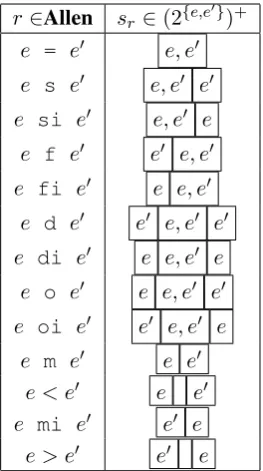
{e, e0} with e 6= e0, 13 strings sr corresponding to the Allen interval relationsr between intervals e and e0 (Allen, 1983); see Table 1 (Fernando,
r∈Allen sr∈(2{e,e0})+
e = e0 e, e0 e s e0 e, e0 e0 e si e0 e, e0 e e f e0 e0 e, e0 e fi e0 e e, e0 e d e0 e0 e, e0 e0 e di e0 e e, e0 e
e o e0 e e, e0 e0 e oi e0 e0 e, e0 e
e m e0 e e0 e < e0 e e0 e mi e0 e0 e
[image:9.595.351.483.61.297.2]e > e0 e0 e
Table 1: The Allen relations in(2{e,e0})+
2012). Under the projections πX, these strings are most naturally viewed as indices for evalu-ating an expression ϕ as an extension or
deno-tation, as prescribed by Carnap-Montague
inten-sions (Fernando, 2011). In (Bach, 1986b), an
event type such as KISSING induces a function EXT(KISSING) that maps histories to subparts that are temporal manifestations of KISSING, treating input histories as indices and output mani-festations as extensions. Under the current frame-work, EXT(KISSING) can for anyX ∈ Fin(Φ), be given as a binary relation between strings in
(2X)∗thatX-approximate indices and extensions.
5 Conclusion
Segmentations arise naturally in the view from (Klein, 2009) that
struc-ture is much more complex. (page 75)
The simplest case described by the passage is il-lustrated by the picture (16) of the clause-internal event (or situation) time E preceding the clause-external speech (utterance) time S.
(16) E S + E S depicting E∧h≺iS
Slightly more complicated is the picture (3) of event time E with R inside it.
(3) E◦ E◦,R E◦ (segmented E◦, whole R)
Whereas E in (16) is unbroken and whole, the “differentiation” in (3) puts E through a universal grinder·◦described in section 2, alongside notions
ofA-whole andA-segmented fluents, the contrast between which surfaces in pairs such as (17) and (18).
(17) Ernest was explaining6|−Ernest explained
(18) Ernest was laughing|−Ernest laughed
The non-entailment (17) is clear from (19).
(19) Ernest was explaining when he was made to stop.
To extract a rigorous account of (17) versus (18) from the assumption that explaining is whole and laughing is segmented (as fluents) would require stepping beyond lexical/internal aspect (consid-ered in sections 2 and 3 above) to grammati-cal/external aspect, hinted at in (3), as well as tense. Some details compatible with the present approach can be found in (Fernando, 2008).6 Suf-fice it to say that additional temporal parameters from tense and aspect enlarge the setXof fluents that, under the inverse limitILπ(Φ)in section 4, refines granularity. While we have taken pains to show how to interpret a string of subsets ofΦ in
6
An alternative would be to follow along (Galton, 1984; Galton, 1987). There are likely to be many ways to fill in the details. In the case of the perfect, for instance, the basic approach outlined here is, as far as I can tell, neutral between extended now accounts (Pancheva, 2003) augmented with (7)
(7) a. V◦ E,V◦ V◦ (depicting E@V)
b. E◦ E◦,V E◦ (depicting V@E)
and consequent-state approaches (Moens and Steedman, 1988; Kamp and Reyle, 1993; Pulman, 1997) that might be augmented with inertia (Dowty, 1986) and forces (Fernando, 2008).
a segmentation (essentially, a finite, ordered par-tition of an interval from a Φ-timeline), no Φ -timeline is used to define ILπ(Φ), resulting in a notion of time that branches (away from any single segmentation or timeline). There is sure to be junk in ILπ(Φ)to throw out; but what use tense and aspect might have for timelines not represented in
ILπ(Φ), I fail to see (apart from linking tempo-rality up with other linguistic mechanisms such as quantification). Work on tense and aspect has led to extensions of ordinary temporal logic in three directions.
(20) a. addition of temporal parameters (e.g. R)
b. expansion of points to intervals
c. recognition of events and states
Stringing together finite sets of fluents, we attend to (20c) in sections 2 and 3 above, and to (20a) in section 4, putting the distinction (20b) between points and intervals down to the setX of fluents under consideration.7
References
James F. Allen. 1983 Maintaining knowledge about temporal intervals. Communications of the ACM, 26:832–843.
Emmon Bach. 1981. On time, tense and aspect: an essay in English metaphysics. In Peter Cole, editor,
Radical Pragmatics, pages 63 – 81. Academic Press.
Emmon Bach. 1986a. The algebra of events. Linguis-tics and Philosophy, 9:5–16.
Emmon Bach. 1986b. Natural language metaphysics. In R. Barcan Marcus, G.J.W. Dorn, and P. Weingart-ner, editors,Logic, Methodology and Philosophy of Science VII, pages 573 – 595. Elsevier.
Jon Bawise and John Perry. 1983. Situations and Atti-tudes. Bradford, MIT Press.
Michael Bennett and Barbara Partee. 1972. Toward the logic of tense and aspect in English. Indiana Univer-sity Linguistics Club, Bloomington, IN.
Bernard Comrie. 1976.Aspect. Cambridge University Press.
Robin Cooper. 2005. Austinian truth, attitudes and type theory. Research on Language and Computa-tion, 3(4):333–362.
7
David R. Dowty. 1979. Word Meaning and Montague Grammar. Reidel, Dordrecht.
David R. Dowty. 1986. The effects of aspectual class on the temporal structure of discourse: semantics or pragmatics? Linguistics and Philosophy, 9(1):37– 61.
Tim Fernando. 2004. A finite-state approach to events in natural language semantics.Journal of Logic and Computation, 14(1):79–92.
Tim Fernando. 2008. Branching from inertia worlds.
J. Semantics, 25(3):321–344.
Tim Fernando. 2011. Regular relations for tempo-ral propositions. Natural Language Engineering, 17(2):163–184.
Tim Fernando. 2012. A finite-state temporal ontol-ogy and event-intervals. Proceedings of the 10th In-ternational Workshop on Finite State Methods and Natural Language Processing, pages 80–89, Donos-tia/San Sebastian (ACL archive).
Antony Galton. 1984. The logic of aspect: an ax-iomatic approach. Clarendon Press.
Antony Galton. 1987. The logic of occurrence. In Temporal Logics and Their Applications, pages 169–196. Academic Press.
Jonathan Ginzburg. 2005. Situation semantics: the ontological balance sheet. Research on Language and Computation, 3(4):363–389.
Joseph Halpern and Yoav Shoham. 1991. A proposi-tional modal logic of time intervals. Journal of the Association for Computing Machinery, 38(4):935– 962.
Charles L. Hamblin. 1971. Instants and intervals,
Studium Generale, 24:127–134.
Michael Herweg. 1991. A critical examination of two classical approaches to aspect. J. Semantics, 8:363– 402.
Hans Kamp and Uwe Reyle. 1993. From Discourse to Logic. Kluwer.
Wolfgang Klein. 2009. How time is encoded. In W. Klein and P. Li, editors, The Expression of Time, pages 39–81. Mouton De Gruyter.
Manfred Krifka. 1998. The origins of telicity. In S. Rothstein, editor, Events and Grammar, pages 197–235. Kluwer.
Jerzy Marcinkowski and Jakub Michaliszyn. 2013. The undecidability of the logic of subintervals. Fun-damenta Informaticae20:124.
Marc Moens and Mark Steedman. 1988. Temporal on-tology and temporal reference. Computational Lin-guistics, 14(2):15–28.
Richard Montague. 1973. The proper treatment of quantification in ordinary English. In K.J.J. Hin-tikka, J.M.E. Moravcsik, and P. Suppes, editors, Ap-proaches to Natural Language, pages 221–42. D. Reidel, Dordrecht.
Ben Moszkowski. 1986. Executing Temporal Logic Programs. Cambridge University Press.
Hirokazu Nishimura. 1980. Interval Logics with Ap-plications to Study of Tense and Aspect in English. Publ. Research Institute for Mathematical Sciences, Kyoto University 16:417-459.
Roumyana Pancheva. 2003. The aspectual makeup of Perfect participles and the interpretations of the Perfect. In A. Alexiadou and M. Rathert and A. von Stechow, editors,Perfect Explorations, pages 277– 306. Mouton de Gruyter.
Stephen G. Pulman. 1997. Aspectual shift as type coercion. Transactions of the Philological Society, 95(2):279–317.
Hans Reichenbach. 1947.Elements of Symbolic Logic. MacMillan Company, NY.
Susan Rothstein. 2004. Structuring Events: A Study in the Semantics of Lexical Aspect. Blackwell.