Chinese Semantic Role Labeling
using High-quality Syntactic Knowledge
Gongye Jin Daisuke Kawahara Sadao Kurohashi
Graduate School of Informatics, Kyoto University Yoshida-Honmachi, Sakyo-ku, Kyoto, 606-8501, Japan
[email protected] {dk,kuro}@i.kyoto-u.ac.jp
Abstract
This paper presents an application of Chi-nese syntactic knowledge for semantic role labeling (SRL). Besides basic mor-phological information, syntactic struc-tures are crucial in SRL. However, it is difficult to learn such information from limited, small-scale, manually annotated training data. Instead of manually increas-ing the size of annotated data, we use a large amount of automatically extracted syntactic knowledge to improve the per-formance of SRL.
1 Introduction
Semantic role labeling (SRL) is regarded as a task that is intermediate between syntactic parsing and semantic analysis in natural language processing (NLP). The main goal of SRL is to extract a propo-sition from a sentence about who does what to
whom, when, whereandwhy. By using semantic roles, the complex expression of a sentence is then interpreted as an event and its participants (i.e., predicates and arguments such as agent, patient, locative, temporalandmanner). Unlike syntactic level surface cases (i.e., dependency labels such as subject and object), semantic roles can be regarded as a deep case representation for predicates. Be-cause of its ability to abstract the meaning of a sen-tence, SRL has been applied to many NLP appli-cations, including information extraction (Chris-tensen et al., 2010), question answering (Pizzato and Moll´a, 2008) and machine translation (Liu and Gildea, 2010).
Semantically annotated corpora, such as FrameNet (Fillmore et al., 2001) and PropBank (Kingsbury and Palmer, 2002), make this type of automatic semantic structure analysis feasible by using supervised machine learning methods. Au-tomatic SRL processing has two major drawbacks:
firstly, the scale of the training data is quite limited and although manually annotated data such as PropBank is available as training data for learning semantic role prediction models, it is still hard to learn lexical preferences due its limited size. Increasing the size and coverage of this resource for improving the quality of learned models is a time consuming task. Secondly, similar to syntactic analysis such as syntactic dependency parsing, whose performance is highly dependent on preceding analysis such as POS tagging, automatic SRL systems are based on syntactic structures along with lower level information including POS tags and lexical information. As a result, SRL suffers from error propagation from the lower levels of the whole framework. Although some studies use automatic analysis of unlabeled data to enrich the training data to solve the first problem (F¨urstenau and Lapata, 2009), accumulated errors in such automatic analysis inevitably causes negative effects. Especially, for some hard-to-analyze languages such as Chinese, which is difficult to analyze morphologically, the performance of SRL is always limited due to the above two problems.
In this paper, we focus on Chinese SRL and address the problems mentioned above by using high-quality knowledge automatically extracted from a large-scale corpus. Instead of using high level automatic analyses such as semantic roles, we use lower level syntactic knowledge because lower level analyses are less erroneous compared to higher level analyses. The additional knowl-edge can provide not only a rich lexicon but also syntactic information, both of which play crucial roles in SRL. In order to show that automatically extracted syntactic knowledge is beneficial, we use predicate-argument structures and case frames (which will be introduced in later sections) in our experiments to validate our claim.
The rest of this paper is organized as follows.
Section 2 contains related work. Section 3 de-scribes the high-quality dependency selection pro-cess. Section 4.1 presents a detailed description of our approach, conducted on three languages, along with the results followed by a discussion in Sec-tion 4.2. Finally, SecSec-tion 5 contains our conclu-sions and future work.
2 Related work
The CoNLL-2009 shared task (Hajiˇc et al., 2009) features a substantial number of studies on SRL that used Propbank as one of the resources. These work can be categorized into two types: joint learning of syntactic parsing and SRL (Tang et al., 2009; Morante et al., 2009), which learns a unique model for syntactic parsing and SRL jointly. This type of framework has the ability to use SRL infor-mation in syntactic parsing for improvement, but has a much larger search space during the joint model learning. The other type is called SRL-only task (Zhao et al., 2009; Bj¨orkelund et al., 2009), which uses automatic morphological and syntactic information as the input in order to judge which token plays what kind of semantic role. Our work focuses on the second category of SRL. Our framework is based on those used by Bj¨orkelund et al. (2009) and Yang and Zong (2014).
There were also several studies using semi-supervised methods for SRL. One basic idea of semi-supervised SRL is to automatically annotate unlabeled data using a simple classifier trained on original training data (F¨urstenau and Lapata, 2009). Since there is a substantial amount of er-ror propagation in SRL frameworks, the additional automatic semantic roles are not guaranteed to be of good quality. Contrary to this approach, we only rely on syntactic level knowledge which does not suffer too much from error propagation. Also, some studies assume that sentences that are syn-tactically and lexically similar are likely to share the same frame-semantic structure (F¨urstenau and Lapata, 2009). This allows them to project se-mantic role information to unlabeled sentences us-ing alignments. However, computation of these alignments requires additional information such as word similarity, whose quality is language depen-dent. Less sparse features capturing lexical in-formation of words can be also used for semi-supervised learning of SRL. Such lexical represen-tation can be learned from unlabeled data (Bengio et al., 2003). Deschacht and Moens (2009) used
word similarity learned from unlabeled data as ad-ditional features for SRL. Word embeddings have also been used in several NLP tasks including SRL (Collobert et al., 2011). Instead of using word-level lexical information, our work uses syntactic knowledge as syntactic level lexical information. Zapirain et al. (2009) used selectional preferences to improve SRL. This study is similar to our ap-proaches but the quality of selectional preferences was not concerned at all.
In syntactic level of NLP, rich knowledge such as predicate-argument structures and case frames are strong backups for various kinds of tasks. A case frame, which clarifies relations between a predicate and its arguments, can support tasks ranging from fundamental analysis, such as syn-tactic dependency parsing and word similarity cal-culation, to multilingual applications, such as ma-chine translation. Japanese case frames have been successfully compiled (Kawahara and Kurohashi, 2006), where each argument is represented as its case marker in Japanese such as ‘ga’, ‘wo’, and ‘ni’. For the case frames of other languages such as English and Chinese, because there are no such case markers that can help clarify syntac-tic structures, instead of using case markers like in Japanese, syntactic surface cases (i.e., subject, object, prepositional phrase, etc.) are used for argument representation (Jin et al., 2014). Case frames can be automatically acquired using a dif-ferent method such as Chinese Restaurant Process (CRP) (Kawahara et al., 2014) for different lan-guages. In our work, we employ such syntactic level knowledge, which use surface cases as argu-ment representation, to help SRL task. We refer to this kind of knowledge as syntactic knowledge in this paper.
3 Proposed method for SRL
3.1 SRL task description
In previous studies, SRL pipeline1can be divided
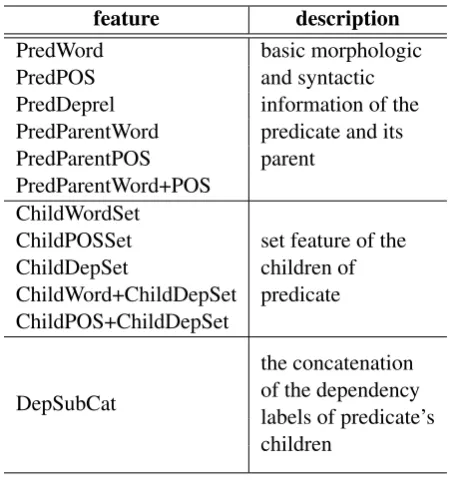
feature description
PredWord basic morphologic
and syntactic information of the predicate and its parent
PredPOS PredDeprel PredParentWord PredParentPOS PredParentWord+POS ChildWordSet
set feature of the children of predicate ChildPOSSet
ChildDepSet
ChildWord+ChildDepSet ChildPOS+ChildDepSet
DepSubCat
[image:3.595.70.296.61.305.2]the concatenation of the dependency labels of predicate’s children
Table 1: Features for PD
icate. We used the part of the feature set pro-posed by Bj¨orkelund et al. (2009) and some ad-ditional features. Table 1 lists the feature sets used in the PD step. During the prediction, there will be some predicates which have not been seen be-fore in training data. We label the sense of those unseen predicates using the default sense, which is ‘01’ in our work.
Different from syntactic dependency parsing, given a predicate in a sentence, each token has a possibility to hold a semantic relation with the given predicate. Each token is regarded as an ar-gument candidate. The AI step is mainly to recog-nize these semantic arguments from the argument candidates. In the AC step, which is the last step in the SRL pipeline, each semantic argument is la-beled with a semantic role. However, there was some work in which AI and AC step are executed jointly by inducing a new label ‘null’, which indi-cates that the token is not a semantic argument of the predicate. As far as we know, there is small amount of debate involving the merging of the AI step and the AC step, especially on whether such merging is beneficial or not. The joint method seems to have an ability to reduce the error prop-agation from the AI step to the AC step. How-ever, at the same time, since the training sam-ples with label ‘null’ will consequently outnumber other labels, there is still a drawback during learn-ing. In our work, we apply a separate framework that carries out the AI and AC step in a pipeline
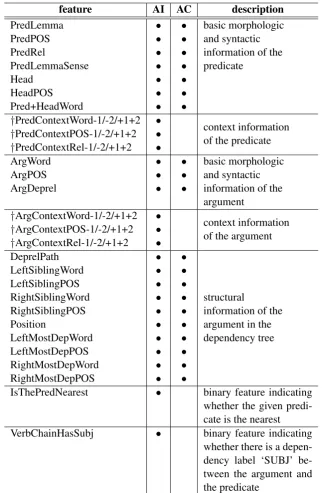
since it is much more intuitive. We use features from Bj¨orkelund et al. (2009) and Yang and Zong (2014) along with some new features in AI and AC step. Table 2 lists the features used in each step, in which we use the mark†to indicate the proposed features.
3.2 Syntactic knowledge acquisition
We constructed two types of syntactic knowledge namely, predicate-argument structures and case frames.
3.2.1 High-quality predicate-argument structure extraction
Predicate-argument structures (PAS) have been basically acquired from syntactic analyses which varies from phrase chunking to syntactic depen-dency parsing. For example, English PAS in surface case was acquired in a large scale using a chunking-based system (Kawahara and Kuro-hashi, 2010). Some phenomena in Chinese, such as omission and complex grammar, make it in-tractable to automatically extract PAS only using shallow syntactic analysis, such as chunking. Syn-tactic dependency parsing is applied for Chinese PAS extraction. Arguments are represented by their syntactic dependency labels (i.e., subject, ob-ject, etc.)
Due to various factors, Chinese syntactic depen-dency parsing is relatively worse in performance compared to that of English, Japanese, etc. How-ever, using an existing treebank, it is possible to train a classifier to acquire high-quality PAS by only using highly reliable syntactic dependencies. As a result, we applied syntactic dependency pars-ing to large-scale raw corpora and adopted the high-quality syntactic dependency selection ap-proach (Jin et al., 2014). Their apap-proach first trains a base parser using a part of the Chinese treebank and then applies syntactic dependency parsing on the raw text of another part of the same treebank. According to the gold-standard annotations, both postive and negative samples are then collected to train a binary classifier, which selects those depen-dencies more likely to be correct. We also follow their method for the compilation of high-quality PAS, which can provide a massive amount of syn-tactic knowledge.
3.2.2 High-quality case frame compilation
feature AI AC description
PredLemma • • basic morphologic
and syntactic information of the predicate
PredPOS • •
PredRel • •
PredLemmaSense • •
Head • •
HeadPOS • •
Pred+HeadWord • •
†PredContextWord-1/-2/+1+2 • context information of the predicate †PredContextPOS-1/-2/+1+2 •
†PredContextRel-1/-2/+1+2 •
ArgWord • • basic morphologic
and syntactic information of the argument
ArgPOS • •
ArgDeprel • •
†ArgContextWord-1/-2/+1+2 • context information of the argument †ArgContextPOS-1/-2/+1+2 •
†ArgContextRel-1/-2/+1+2 •
DeprelPath • •
structural
information of the argument in the dependency tree
LeftSiblingWord • •
LeftSiblingPOS • •
RightSiblingWord • •
RightSiblingPOS • •
Position • •
LeftMostDepWord • •
LeftMostDepPOS • •
RightMostDepWord • •
RightMostDepPOS • •
IsThePredNearest • binary feature indicating whether the given predi-cate is the nearest VerbChainHasSubj • binary feature indicating
[image:4.595.137.460.60.554.2]whether there is a depen-dency label ‘SUBJ’ be-tween the argument and the predicate
Table 2: Features for AI and AC (†marks stand for the features we proposed)
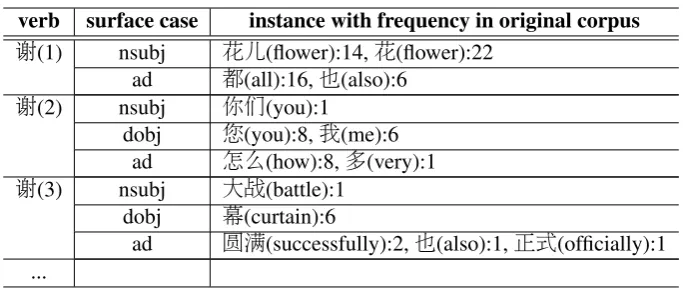
for various kinds of tasks (Kawahara and Kuro-hashi, 2006). For each predicate, all the PAS are clustered into different case frames to reflect different semantic usages. We show an exam-ple of case frames for the verb ‘谢’ in Table 3, which has multiple meanings. ‘谢(1)’ is the case frame used to represent the sense of ‘withering of flower’. Similarly, the sense of ‘谢’ which means ‘to thank’, the applicable case frame is ‘谢(2)’. ‘谢(3)’ is the case frame for the sense of ‘curtain call’. In other words, case frames are knowledge that solves word sense disambiguation (WSD) by
clustering the PAS. We applied the CRP method described by Kawahara et al. (2014) for clustering the high-quality PAS to compile high-quality case frames.
3.3 Using syntactic knowledge for SRL
verb surface case instance with frequency in original corpus
谢(1) nsubj 花儿(flower):14,花(flower):22
ad 都(all):16,也(also):6
谢(2) nsubj 你们(you):1
dobj 您(you):8,我(me):6 ad 怎么(how):8,多(very):1
谢(3) nsubj 大战(battle):1 dobj 幕(curtain):6
ad 圆满(successfully):2,也(also):1,正式(officially):1 ...
Table 3: Examples of Chinese case frames
!"(Pudong)
#$(promulgate)
%&(implement)
'((involve)
)*(multiple) +,(field)
-(of)
./(file) A1
A1
[image:5.595.128.470.59.206.2]A0
Figure 1: Example of dependency and semantic relations. Solid arrows denote syntactic cies and dotted arrows denote semantic dependen-cies.
of argument can actually form a direct syntactic re-lation between the predicate when we change the expression of the sentence in other ways. In other words, this kind of argument may hold a direct syntactic relation with the predicate in real world natural languages. This is a frequent phenomenon in multi-verb sentences. Take the sentence in Fig-ure 1 as an example.
This sentence can be translated as “promulgated and implemented files involving multiple fields.” “文件(file)” is a child of “颁布(promulgate)” in the dependency tree and labeled as semantic role “A1” of “颁布(promulgate)”. Even though “文
件(file)” does not have a direct dependency rela-tion with “实行(implement)”, it is still regarded as a semantic role “A1” of “实行(implement)”. Similarly, “文件(file)” has also a semantic role “A0” of the verb “涉及(involve)” with no direct dependency relation. However, both direct syntac-tic dependencies “实行(implement) 文件(files)” and “文件(file)涉及(involve)” appear frequently in real world text. Such patterns in surface cases captured from large-scale corpora would be im-portant clues for SRL.
In addition, some special surface cases such as “BA” and “LB/SB” explicitly indicate accusative case and nominative case, which for most of the time is labeled as “A1” and “A0” respectively in PropBank-style SRL specification. “用/以(use)” is a preposition that strongly indicates the seman-tic role “MNR” and “在(at)” is a preposition that always stands for the semantic role “LOC” or “TMP”. Therefore, it is promising to use large-scale syntactic knowledge as an additional re-source.
We created three kinds of additional feature sets extracted from the above mentioned syntactic knowledge for SRL. Firstly, we used large-scale automatically acquired surface case predicate-argument structures. For each predicate-predicate-argument pair, we measured their point-wise mutual infor-mation (PMI). Secondly, we used the frequency of an argument candidate being a certain syntac-tic role. Finally, by considering the effect of word sense ambiguity, for each predicate sense, we cal-culated the frequency of an argument being a cer-tain syntactic role of a predicate from the corre-sponding case frames. For all of the additional fea-tures, we used binned frequency (i.e., high, middle and low).
w/o selection select 50% select 20%
[image:6.595.182.417.62.93.2]UAS 0.677 0.824 0.920
Table 4: Precision of selected dependencies under different criteria
method precision recall F1
baseline 81.61% 76.40% 78.92
baseline + syntactic knowledge (100%) 81.41% 76.57% 78.92 baseline + syntactic knowledge (50%) 81.57% 76.59% *79.00 baseline + syntactic knowledge (20%) 81.80% 76.63% **79.14
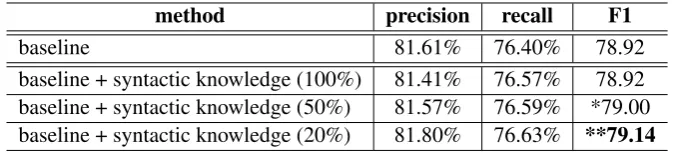
Table 5: Evaluation results of Chinese SRL. The ** mark and * mark mean that the result is regarded as significant (with a p value<0.01 and a p value<0.05 respectively) using McNemar’s test.
structures, we used the method proposed by Kawa-hara and Kurohashi (2001). This ensures that each case frame id is aligned to its most similar verb sense in PropBank.
4 Experiments
4.1 Experimental settings
For large-scale syntactic knowledge acquisition, 30 million sentences from Chinese Gigaword 5.0 (LDC2011T13)2were used.
For the high-quality dependency selection ap-proach in the knowledge construction pipeline, the Stanford parser was used to apply syntactic depen-dency parsing on the raw texts from Chinese Gi-gaword. The training section of Chinese Treebank 7.0 was used to train the dependency parser and the official development section was used to train a classifier for high-quality dependency selection. Judging whether the automatic dependencies are reliable can be regarded as a binary classification problem, for which we utilized support vector ma-chines (SVMs). Specifically, we employed SVM-Light3 with a linear kernel to select high-quality
dependencies from large-scale automatic depen-dency parses on the Chinese Gigaword for syntac-tic knowledge construction. Using official evalu-tion secevalu-tion of CTB 7.0, we evaluated the quality of thoses selected dependencies using unlabeled attachment score (UAS), which calculates the per-centage of correctly indentified dependency heads. For SRL, we used the Chinese section of CoNLL-2009 shared task data for experiments. Automatically obtained morphological and syn-tactic information (the columns begin with “P”) 2We only used sentences written in simplified characters in Chinese Gigaword.
3http://svmlight.joachims.org/
was used. PD and AI, AC step are regarded as multi-class classification problems. We employed OPAL4 to solve this problem. We set the options
as follows: polynomial kernel with degree 2; pas-sive aggrespas-sive I learner; 20 iterations. The SRL system without using additional syntactic knowl-edge was used as a baseline. To examine the ef-fect of different quality of syntactic knowledge, we used different set of PAS which was extracted under different dependency selection thresholds (20%, 50%, w/o selection). The official script provided on the CoNLL-2009 shared task website was used for evaluation.
4.2 Experimental results
Tabel 4 shows the quality of selected dependencies using different selection criteria. The precision of automatic syntactic depdencies increases when we lower the recall.
Table 5 shows our experimental results using the syntactic knowledge-based features. Syntactic knowledge (x%) indicates that the top x% (accord-ing to the classifier) of the automatically extracted syntactic knowledge was used. ‘100%’ means that dependency selection step was not performed.
Our baseline system outperforms as well as the best system in CoNLL-2009 shared task. As we can see from the result, using large-scale syntac-tic knowledge can help improve the performance of SRL. Syntactic knowledge extracted from au-tomatic parses without any selection (100%) con-tains a lot of noise and hence is not beneficial at all. However, filtering noisy syntactic knowl-edge leads to an significant improvement in Chi-nese SRL task. This shows that selecting hiqh-quality dependencies is an important aspect of
[image:6.595.130.467.121.198.2]high-quality SRL.
5 Conclusion
In this paper, we have used high-quality syntac-tic knowledge to improve Chinese SRL. The re-sult showed that this kind of knowledge has a pos-itive effect on the SRL performance. The quality of syntactic knowledge turns out to be an impor-tant factor in such a semi-supervised learning ap-proach.
In the future, we plan to make use of other low level knowledge such as word embeddings (Col-lobert et al., 2011) or word clusters (Koo et al., 2008), which can be complementary to our syntac-tic level knowledge. Since recent SRL approaches are mostly point-wise, i.e., features are extracted from pairs of the predicate and an argument can-didate. We plan to design a higher order system to capture more global features. Also, reranking is widely utilized in many SRL systems and we plan to combine our surface case knowledge with a reranker, in order to further improve Chinese SRL. Finally, we plan to experiment on different lan-guages and compare the effectiveness of syntactic knowledge for different languages.
References
Yoshua Bengio, R´ejean Ducharme, Pascal Vincent, and Christian Jauvin. 2003. A neural probabilistic lan-guage model. 3:1137–1155, February.
Anders Bj¨orkelund, Love Hafdell, and Pierre Nugues. 2009. Multilingual semantic role labeling. In Pro-ceedings of the Thirteenth Conference on Computa-tional Natural Language Learning (CoNLL 2009): Shared Task, pages 43–48, Boulder, Colorado, June. Association for Computational Linguistics.
Janara Christensen, Mausam, Stephen Soderland, and Oren Etzioni. 2010. Semantic role labeling for open information extraction. InProceedings of the NAACL HLT 2010 First International Workshop on Formalisms and Methodology for Learning by Read-ing, pages 52–60, Los Angeles, California, June. As-sociation for Computational Linguistics.
Ronan Collobert, Jason Weston, L´eon Bottou, Michael Karlen, Koray Kavukcuoglu, and Pavel Kuksa. 2011. Natural language processing (almost) from scratch. 12:2493–2537, August.
Koen Deschacht and Marie-Francine Moens. 2009. Semi-supervised semantic role labeling using the la-tent words language model. InProceedings of the 2009 Conference on Empirical Methods in Natural Language Processing, pages 21–29, Singapore, Au-gust. Association for Computational Linguistics.
Charles J. Fillmore, Charles Wooters, and Collin F. Baker. 2001. Building a large lexical databank which provides deep semantics. In Benjamin Tsou and Olivia Kwong, editors,Proceedings of the 15th Pacific Asia Conference on Language, Information and Computation, Hong Kong.
Hagen F¨urstenau and Mirella Lapata. 2009. Semi-supervised semantic role labeling. InProceedings of the 12th Conference of the European Chapter of the ACL (EACL 2009), pages 220–228, Athens, Greece, March. Association for Computational Linguistics. Jan Hajiˇc, Massimiliano Ciaramita, Richard
Johans-son, Daisuke Kawahara, Maria Ant`onia Mart´ı, Llu´ıs M`arquez, Adam Meyers, Joakim Nivre, Sebastian Pad´o, Jan ˇStˇep´anek, Pavel Straˇn´ak, Mihai Surdeanu, Nianwen Xue, and Yi Zhang. 2009. The conll-2009 shared task: Syntactic and semantic dependen-cies in multiple languages. In Proceedings of the Thirteenth Conference on Computational Natural Language Learning (CoNLL 2009): Shared Task, pages 1–18, Boulder, Colorado, June. Association for Computational Linguistics.
Gongye Jin, Daisuke Kawahara, and Sadao Kurohashi. 2014. A framework for compiling high quality knowledge resources from raw corpora. In Proceed-ings of the Ninth International Conference on Lan-guage Resources and Evaluation (LREC’14), pages 109–114.
Daisuke Kawahara and Sadao Kurohashi. 2001. Japanese case frame construction by coupling the verb and its closest case component. In Proceed-ings of the Human Language Technology Confer-ence, pages 204–210.
Daisuke Kawahara and Sadao Kurohashi. 2006. A fully-lexicalized probabilistic model for Japanese syntactic and case structure analysis. In Proceed-ings of HLT-NAACL 2006, pages 176–183.
Daisuke Kawahara and Sadao Kurohashi. 2010. Ac-quiring reliable predicate-argument structures from raw corpora for case frame compilation. In Proceed-ings of LREC 2010, pages 1389–1393.
Daisuke Kawahara, Daniel Peterson, Octavian Popescu, and Martha Palmer. 2014. Inducing example-based semantic frames from a massive amount of verb uses. In Proceedings of the 14th Conference of the European Chapter of the As-sociation for Computational Linguistics, pages 58–67, Gothenburg, Sweden, April. Association for Computational Linguistics.
Paul Kingsbury and Martha Palmer. 2002. From tree-bank to proptree-bank. InLanguage Resources and Eval-uation.
Ding Liu and Daniel Gildea. 2010. Semantic role fea-tures for machine translation. InProceedings of the 23rd International Conference on Computational Linguistics (Coling 2010), pages 716–724, Beijing, China, August. Coling 2010 Organizing Committee. Roser Morante, Vincent Van Asch, and Antal van den Bosch. 2009. Joint memory-based learning of syn-tactic and semantic dependencies in multiple lan-guages. In Proceedings of the Thirteenth Confer-ence on Computational Natural Language Learning (CoNLL 2009): Shared Task, pages 25–30, Boulder, Colorado, June. Association for Computational Lin-guistics.
Luiz Augusto Pizzato and Diego Moll´a. 2008. In-dexing on semantic roles for question answering. In Coling 2008: Proceedings of the 2nd workshop on Information Retrieval for Question Answering, pages 74–81, Manchester, UK, August. Coling 2008 Organizing Committee.
Buzhou Tang, Lu Li, Xinxin Li, Xuan Wang, and Xi-aolong Wang. 2009. A joint syntactic and semantic dependency parsing system based on maximum en-tropy models. InProceedings of the Thirteenth Con-ference on Computational Natural Language Learn-ing (CoNLL 2009): Shared Task, pages 109–113, Boulder, Colorado, June. Association for Computa-tional Linguistics.
Haitong Yang and Chengqing Zong. 2014. Multi-predicate semantic role labeling. InProceedings of the 2014 Conference on Empirical Methods in Nat-ural Language Processing (EMNLP), pages 363– 373, Doha, Qatar, October. Association for Compu-tational Linguistics.
Be˜nat Zapirain, Eneko Agirre, and Llu´ıs M`arquez. 2009. Generalizing over lexical features: Selec-tional preferences for semantic role classification. In
Proceedings of the ACL-IJCNLP 2009 Conference Short Papers, pages 73–76, Suntec, Singapore, Au-gust. Association for Computational Linguistics. Hai Zhao, Wenliang Chen, Chunyu Kity, and Guodong