Proceedings of the NAACL HLT 2010 Workshop on Computational Approaches to Analysis and Generation of Emotion in Text, pages 35–44,
A Corpus-based Method for Extracting Paraphrases of Emotion Terms
Fazel Keshtkar
University of Ottawa Ottawa, ON, K1N 6N5, Canada
Diana Inkpen
University of Ottawa Ottawa, ON, K1N 6N5, Canada
Abstract
Since paraphrasing is one of the crucial tasks in natural language understanding and gener-ation, this paper introduces a novel technique to extract paraphrases for emotion terms, from non-parallel corpora. We present a bootstrap-ping technique for identifying paraphrases, starting with a small number of seeds. Word-Net Affect emotion words are used as seeds. The bootstrapping approach learns extraction patterns for six classes of emotions. We use annotated blogs and other datasets as texts from which to extract paraphrases, based on the highest-scoring extraction patterns. The results include lexical and morpho-syntactic paraphrases, that we evaluate with human judges.
1 Introduction
Paraphrases are different ways to express the same information. Algorithms to extract and automati-cally identify paraphrases are of interest from both linguistic and practical points of view. Many ma-jor challenges in Natural Language Processing ap-plications, for example multi-document summariza-tion, need to avoid repetitive information from the input documents. In Natural Language Genera-tion, paraphrasing is employed to create more var-ied and natural text. In our research, we ex-tract paraphrases for emotions, with the goal of us-ing them to automatically-generate emotional texts (such as friendly or hostile texts) for conversations between intelligent agents and characters in educa-tional games. Paraphrasing is applied to generate text with more variety. To our knowledge, most cur-rent applications manually collect paraphrases for
specific applications, or they use lexical resources such as WordNet (Miller et al., 1993) to identify paraphrases.
This paper introduces a novel method for ex-tracting paraphrases for emotions from texts. We focus on the six basic emotions proposed by Ek-man (1992): happiness, sadness, anger, disgust,
surprise, andfear.
We describe the construction of the paraphrases extractor. We also propose a k-window algorithm for selecting contexts that are used in the paraphrase extraction method. We automatically learn patterns that are able to extract the emotion paraphrases from corpora, starting with a set of seed words. We use data sets such as blogs and other annotated cor-pora, in which the emotions are marked. We use a large collection of non-parallel corpora which are described in Section 3. These corpora contain many instances of paraphrases different words to express the same emotion.
An example of sentence fragments for one emotion class,happiness, is shown in Table 1. From them, the paraphrase pair that our method will extract is:
"so happy to see" "very glad to visit".
In the following sections, we give an overview of related work on paraphrasing in Section 2. In Sec-tion 3 we describe the datasets used in this work. We explain the details of our paraphrase extraction method in Section 4. We present results of our evalu-ation and discuss our results in Section 5, and finally in Section 6 we present the conclusions and future work.
his little boy was so happy to see him princess and she were very glad to visit him
Table 1: Two sentence fragments (candidate contexts) from the emotion classhappy, from the blog corpus.
2 Related Work
Three main approaches for collecting paraphrases were proposed in the literature: manual collection, utilization of existing lexical resources, and corpus-based extraction of expressions that occur in similar contexts (Barzilay and McKeown, 2001). Manually-collected paraphrases were used in natural language generation (NLG) (Iordanskaja et al., 1991). Langk-ilde et al. (1998) used lexical resources in statistical sentence generation, summarization, and question-answering. Barzilay and McKeown (2001) used a corpus-based method to identify paraphrases from a corpus of multiple English translations of the same source text. Our method is similar to this method, but it extracts paraphrases only for a particular emo-tion, and it needs only a regular corpus, not a parallel corpus of multiple translations.
Some research has been done in paraphrase ex-traction for natural language processing and genera-tion for different applicagenera-tions. Das and Smith (2009) presented a approach to decide whether two sen-tences hold a paraphrase relationship. They ap-plied a generative model that generates a paraphrase of a given sentence, then used probabilistic infer-ence to reason about whether two sentinfer-ences share the paraphrase relationship. In another research, Wang et. al (2009) studied the problem of extract-ing technical paraphrases from a parallel software corpus. Their aim was to report duplicate bugs. In their method for paraphrase extraction, they used: sentence selection, global context-based and co-occurrence-based scoring. Also, some studies have been done in paraphrase generation in NLG (Zhao et al., 2009), (Chevelu et al., 2009). Bootstrapping methods have been applied to various natural lan-guage applications, for example to word sense dis-ambiguation (Yarowsky, 1995), lexicon construction for information extraction (Riloff and Jones, 1999), and named entity classification (Collins and Singer, 1999). In our research, we use the bootstrapping ap-proach to learn paraphrases for emotions.
3 Data
The text data from which we will extract paraphrases is composed of four concatenated datasets. They contain sentences annotated with the six basic emo-tions. The number of sentences in each dataset is presented in Table 2. We briefly describe the datasets, as follows.
3.1 LiveJournal blog dataset
We used the blog corpus that Mishne collected for his research (Mishne, 2005). The corpus contains 815,494 blog posts from Livejournal1, a free we-blog service used by millions of people to create weblogs. In Livejournal, users are able to option-ally specify their current emotion or mood. To se-lect their emotion/mood users can choose from a list of 132 provided moods. So, the data is annotated by the user who created the blog. We selected only the texts corresponding to the six emotions that we mentioned.
3.2 Text Affect Dataset
This dataset (Strapparava and Mihalcea, 2007) con-sists of newspaper headlines that were used in the SemEval 2007-Task 14. It includes a development dataset of 250 annotated headlines, and a test dataset of 1000 news headlines. We use all of them. The an-notations were made with the six basic emotions on intensity scales of [-100, 100], therefore a threshold is used to choose the main emotion of each sentence.
3.3 Fairy Tales Dataset
This dataset consists in 1580 annotated sentences (Alm et al., 2005), from tales by the Grimm brothers, H.C. Andersen, and B. Potter. The annotations used the extended set of nine basic emotions of Izard (1971). We selected only those marked with the six emotions that we focus on.
3.4 Annotated Blog Dataset
We also used the dataset provided by Aman and Sz-pakowicz (2007). Emotion-rich sentences were se-lected from personal blogs, and annotated with the six emotions (as well as a non-emotion class, that we ignore here). They worked with blog posts and collected directly from the Web. First, they prepared
1
Dataset Happiness Sadness Anger Disgust Surprise Fear
LiveJournal 7705 1698 4758 1191 1191 3996
TextAffect 334 214 175 28 131 166
Fairy tales 445 264 216 217 113 165
[image:3.612.113.499.71.144.2]Annotated blog dataset 536 173 115 115 172 179
Table 2: The number of emotion-annotated sentences in each dataset.
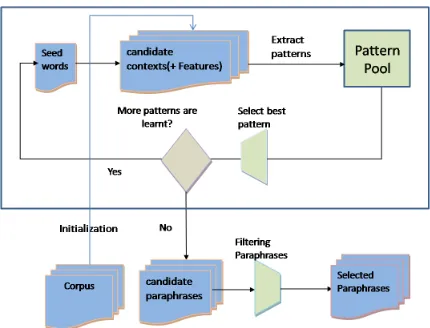
Figure 1: High-level view of the paraphrase extraction method.
a list of seed words for six basic emotion categories proposed by Ekman (1992). Then, they took words commonly used in the context of a particular emo-tion. Finally, they used the seed words for each category, and retrieved blog posts containing one or more of those words for the annotation process.
4 Method for Paraphrase Extraction
For each of the six emotions, we run our method on the set of sentences marked with the correspond-ing emotion from the concatenated corpus. We start with a set of seed words form WordNet Af-fect (Strapparava and Valitutti, 2004), for each emo-tion of interest. The number of seed words is the fol-lowing: for happiness 395, for surprise 68, for fear 140, for disgust 50, for anger 250, and for sadness 200. Table 3 shows some of seeds for each category of emotion.
Since sentences are different in our datasets and they are not aligned as parallel sentences as in (Barzilay and McKeown, 2001), our algorithm constructs pairs of similar sentences, based on the local context. On the other hand, we assume that,
if the contexts surrounding two seeds look similar, then these contexts are likely to help in extracting new paraphrases.
Figure 1 illustrates the high-level architecture of our paraphrase extraction method. The input to the method is a text corpus for a emotion category and a manually defined list of seed words. Before boot-strapping starts, we run thek-window algorithm on every sentence in the corpus, in order to construct
candidate contexts. In Section 4.5 we explain how the bootstrapping algorithm processes and selects the paraphrases based on strong surrounding con-texts. As it is shown in Figure 1, our method has several stages: extracting candidate contexts, using them to extract patterns, selecting the best patterns, extracting potential paraphrases, and filtering them to obtain the final paraphrases.
4.1 Preprocessing
During preprocessing, HTML and XML tags are eliminated from the blogs data and other datasets, then the text is tokenized and annotated with part of speech tags. We use the Stanford part-of-speech tagger and chunker (Toutanova et al., 2003) to iden-tify noun and verb phrases in the sentences. In the next step, we use a sliding window based on the
k-window approach, to identify candidate contexts that contain the target seeds.
4.2 Thek-window Algorithm
We use the k-window algorithm introduced by Bostad (2003) in order to identify all the tokens surrounding a specific term in a window with size of ±k. Here, we use this approach to ex-tract candidate patterns for each seed, from the sentences. We start with one seed and truncate all contexts around the seed within a window of
[image:3.612.72.287.177.341.2]Happiness: avidness, glad, warmheartedness, exalt, enjoy, comforting, joviality, amorous, joyful, like, cheer, adoring, fascinating, happy, impress, great, satisfaction, cheerful, charmed, romantic, joy, pleased, inspire, good, fulfill, gladness, merry
Sadness: poor, sorry, woeful, guilty, miserable, glooming, bad, grim, tearful, glum, mourning, joyless, sadness, blue, rueful, hamed, regret, hapless, regretful, dismay, dismal, misery, godforsaken, oppression, harass, dark, sadly, attrition
Anger: belligerence, envious, aggravate, resentful, abominate, murderously, greedy, hatred, disdain, envy, annoy, mad, jealousy, huffiness, sore, anger, harass, bother, enraged, hateful, irritating, hostile, outrage, devil, irritate, angry
Disgust: nauseous, sicken, foul, disgust, nausea, revolt, hideous, horror, detestable, wicked, repel, offensive, repulse, yucky, repulsive, queasy, obscene, noisome
Surprise: wondrous, amaze, gravel, marvel, fantastic, wonderful, surprising, marvelous, wonderment, astonish, wonder, admiration, terrific, dumfounded, trounce
Fear: fearful, apprehensively, anxiously, presage, horrified, hysterical, timidity, horrible, timid, fright, hesitance, affright, trepid, horrific, unassertive, apprehensiveness, hideous, scarey, cruel, panic, scared, terror, awful, dire, fear, dread, crawl, anxious, distrust, diffidence
Table 3: Some of the seeds from WordNet Affect for each category of emotion.
the longest candidate contexts will have the form w1, w2, w3, w4, w5, seed, w6, w7, w8, w9, w10, w11.
In the next subsection, we explain what features we extract from each candidate context, to allow us to determine similar contexts.
4.3 Feature Extraction
Previous research on word sense disambiguation on contextual analysis has acknowledged several local and topical features as good indicators of word prop-erties. These include surrounding words and their part of speech tags, collocations, keywords in con-texts (Mihalcea, 2004). Also recently, other fea-tures have been proposed: bigrams, named entities, syntactic features, and semantic relations with other words in the context.
We transfer the candidate phrases extracted by the slidingk-window into the vector space of features. We consider features that include both lexical and syntactic descriptions of the paraphrases for all pairs of two candidates. The lexical features include the sequence of tokens for each phrase in the paraphrase pair; the syntactic feature consists of a sequence of part-of-speech (PoS) tags where equal words and words with the same root and PoS are marked. For example, the value of the syntactic feature for
the pair ‘‘so glad to see’’ and ‘‘very
happy to visit’’ is “RB1 J J1 T O V B1”
and ”RB1 J J2 T O V B2”, where indices indicate
Candidate context: He was further annoyed by the jay bird ’PRP VBD RB VBN IN DT NN NN’,65,8,’VBD RB’,?,was, ?,?,?,He/PRP,was/VBD,further/RB,annoyed,by/IN,the/DT, jay/NN,bird/NN,?,?,jay,?,’IN DT NN’,2,2,0,1
Table 4: An example of extracted features.
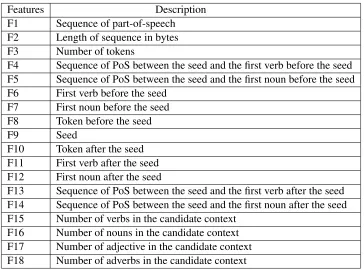
word equalities. However, based on the above ev-idences and our previous research, we also investi-gate other features that are well suited for our goal. Table 5 lists the features that we used for paraphrase extraction. They include some term frequency fea-tures. As an example, in Table 4 we show extracted features from a relevant context.
4.4 Extracting Patterns
de-Features Description
F1 Sequence of part-of-speech
F2 Length of sequence in bytes
F3 Number of tokens
F4 Sequence of PoS between the seed and the first verb before the seed F5 Sequence of PoS between the seed and the first noun before the seed F6 First verb before the seed
F7 First noun before the seed
F8 Token before the seed
F9 Seed
F10 Token after the seed F11 First verb after the seed F12 First noun after the seed
F13 Sequence of PoS between the seed and the first verb after the seed F14 Sequence of PoS between the seed and the first noun after the seed F15 Number of verbs in the candidate context
[image:5.612.125.489.69.339.2]F16 Number of nouns in the candidate context F17 Number of adjective in the candidate context F18 Number of adverbs in the candidate context
Table 5: The features that we used for paraphrase extraction.
fined as:
Strength(x) =count(x+)/count(x) (1)
In Equation 1, count(x+) is the number of times context x surrounded a seed in a positive example and count(x) is frequency of the context x. This allows us to score the potential pattern.
4.5 Bootstrapping Algorithm for Paraphrase Extraction
Our bootstrapping algorithm is summarized in Fig-ure 2. It starts with a set of seeds, which are consid-ered initial paraphrases. A set of extraction patterns is initially empty. The algorithm generates candidate contexts, from the aligned similar contexts. The can-didate patterns are scored by how many paraphrases they can extract. Those with the highest scores are added to the set of extraction patterns. Using the ex-tended set of extraction patterns, more paraphrase pairs are extracted and added to the set of para-phrases. Using the enlarged set of paraphrases, more extraction patterns are extracted. The process keeps iterating until no new patterns or no new paraphrases are learned.
Our method is able to accumulate a large lexi-con of emotion phrases by bootstrapping from the manually initialized list of seed words. In each it-eration, the paraphrase set is expanded with related phrases found in the corpus, which are filtered by using a measure of strong surrounding context sim-ilarity. The bootstrapping process starts by select-ing a subset of the extraction patterns that aim to extract the paraphrases. We call this set the pattern pool. The phrases extracted by these patterns be-come candidate paraphrases. They are filtered based on how many patterns select them, in order to pro-duce the final paraphrases from the set of candidate paraphrases.
5 Results and Evaluation
un-Algorithm 1: Bootstrapping un-Algorithm.
For each seed for an emotion
Loop until no more paraphrases or no more contexts are learned. 1- Locate the seeds in each sentence
2- Find similar contexts surrounding a pair of two seeds 3- Analyze all contexts surrounding the two seeds to extract
the strongest patterns
[image:6.612.75.455.89.168.2]4- Use the new patterns to learn more paraphrases
Figure 2: Our bootstrapping algorithm for extracting paraphrases.
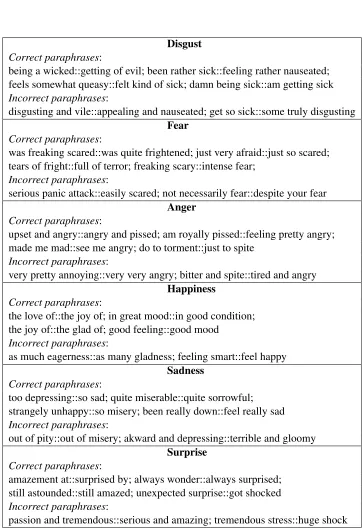
derIncorrect paraphrases. Our algorithm learnt 196 extraction patterns and produced 5926 pairs of para-phrases. Table 7 shows the number of extraction pat-terns and the number of paraphrase pairs that were produced by our algorithm for each class of emo-tions. For evaluation of our algorithm, we use two techniques. One uses human judges to judge if a sample of paraphrases extracted by our method are correct; we also measures the agreement between the judges (See Section 5.1). The second estimates the recall and the precision of our method (See Sec-tion 5.2. In the following subsecSec-tions we describe these evaluations.
5.1 Evaluating Correctness with Human Judges
We evaluate the correctness of the extracted para-phrase pairs, using the same method as Brazilay and McKeown (2001). We randomly selected 600 para-phrase pairs from the lexical parapara-phrases produced by our algorithm: for each class of emotion we selected 100 paraphrase pairs. We evaluated their correctness with two human judges. They judged whether the two expressions are good paraphrases or not.
We provided a page of guidelines for the judges. We defined paraphrase as ”approximate conceptual equivalence”, the same definition used in (Barzilay and McKeown, 2001). Each human judge had to choose a ”Yes” or ”No” answer for each pair of para-phrases under test. We did not include example sen-tences containing these paraphrases. A similar Ma-chine Translation evaluation task for word-to-word translation was done in (Melamed, 2001).
Figure 3 presents the results of the evaluation: the correctness for each class of emotion according to judge A, and according to judge B. The judges were graduate students in computational linguistics,
na-tive speakers of English.
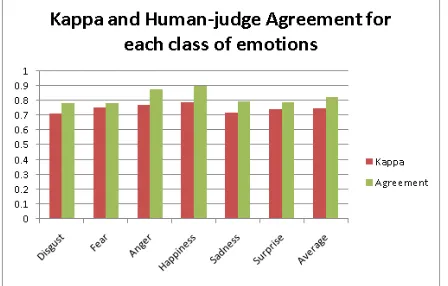
We also measured the agreement between the two judges and the Kappa coefficient (Siegel and Castel-lan, 1988). If there is complete agreement between two judgesKappais 1, and if there is no agreement between the judges thenKappa = 0. TheKappa values and the agreement values for our judges are presented in Figure 4.
[image:6.612.315.538.478.605.2]The inter-judge agreement over all the para-phrases for the six classes of emotions is 81.72%, which is 490 out of the 600 paraphrases pairs in our sample. Note that they agreed that some pairs are good paraphrases, or they agreed that some pairs are not good paraphrases, that is why the numbers in Figure 4 are higher than the correctness numbers from Figure 3. TheKappacoefficient compensates for the chance agreement. The Kappa value over all the paraphrase pairs is 74.41% which shows a significant agreement.
Figure 3: The correctness results according the judge A and judge B, for each class of emotion.
5.2 Estimating Recall
Disgust Correct paraphrases:
being a wicked::getting of evil; been rather sick::feeling rather nauseated; feels somewhat queasy::felt kind of sick; damn being sick::am getting sick
Incorrect paraphrases:
disgusting and vile::appealing and nauseated; get so sick::some truly disgusting
Fear Correct paraphrases:
was freaking scared::was quite frightened; just very afraid::just so scared; tears of fright::full of terror; freaking scary::intense fear;
Incorrect paraphrases:
serious panic attack::easily scared; not necessarily fear::despite your fear
Anger Correct paraphrases:
upset and angry::angry and pissed; am royally pissed::feeling pretty angry; made me mad::see me angry; do to torment::just to spite
Incorrect paraphrases:
very pretty annoying::very very angry; bitter and spite::tired and angry
Happiness Correct paraphrases:
the love of::the joy of; in great mood::in good condition; the joy of::the glad of; good feeling::good mood
Incorrect paraphrases:
as much eagerness::as many gladness; feeling smart::feel happy
Sadness Correct paraphrases:
too depressing::so sad; quite miserable::quite sorrowful; strangely unhappy::so misery; been really down::feel really sad
Incorrect paraphrases:
out of pity::out of misery; akward and depressing::terrible and gloomy
Surprise Correct paraphrases:
amazement at::surprised by; always wonder::always surprised; still astounded::still amazed; unexpected surprise::got shocked
Incorrect paraphrases:
[image:7.612.124.486.101.630.2]passion and tremendous::serious and amazing; tremendous stress::huge shock
Class of Emotion # Paraphrases Pairs # Extraction Patterns
Disgust 1125 12
Fear 1004 31
Anger 670 47
Happiness 1095 68
Sadness 1308 25
Surprise 724 13
[image:8.612.164.452.72.184.2]Total 5926 196
Table 7: The number of lexical and extraction patterns produced by the algorithm.
Figure 4: TheKappacoefficients and the agreement be-tween the two human judges.
paraphrasing relations with words which appeared in our corpus. Moreover, to compare directly with an electronic thesaurus such as WordNet is not fea-sible, because WordNet contains mostly synonym sets between words, and only a few multi-word ex-pressions. We decided to estimate recall manually, by asking a human judge to extract paraphrases by hand from a sample of text. We randomly selected 60 texts (10 for each emotion class) and asked the judge to extract paraphrases from these sentences. For each emotion class, the judge extracted expres-sions that reflect the emotion, and then made pairs that were conceptually equivalent. It was not feasi-ble to ask a second judge to do the same task, be-cause the process is time-consuming and tedious.
In Information Retrieval,PrecisionandRecallare defined in terms of a set of retrieved documents and a set of relevant documents2. In the following sec-tions we describe how we compute thePrecisionand
Recallfor our algorithm compared to the manually
2
http://en.wikipedia.org/wiki/
Category of Emotions Precision Recall
Disgust 82.33% 92.91%
Fear 82.64% 88.20%
Anger 93.67% 80.57%
Happiness 82.00% 90.89%
Sadness 82.00% 89.88%
Surprise 79.78% 89.50%
Average 84.23% 88.66%
Table 8: Precision and Recall for a sample of texts, for each category of emotion, and their average.
extracted paraphrases.
From the paraphrases that were extracted by the algorithm from the same texts, we counted how many of them were also extracted by the human judge. Equation 2 defines the Precision. On av-erage, from 89 paraphrases extracted by the algo-rithm, 74 were identified as paraphrases by the hu-man judge (84.23%). See Table 8 for the values for all the classes.
P=#Correctly Retrieved P araphrases by the Algorithm
All P araphrases Retrieved by the Algorithm (2)
For computing theRecallwe count how many of the paraphrases extracted by the human judge were correctly extracted by the algorithm (Equation 3).
R=#Correctly Retrieved P araphrases by the Algorithm
All P araphrases Retrieved by the Human J udge (3)
5.3 Discussion and Comparison to Related Work
[image:8.612.75.299.231.374.2]iden-tification of general paraphrases from multiple En-glish translations of the same source text. We can compare the pros and cons of our method compared to their method. The advantages are:
• In our method, there is no requirement for the corpus to be parallel. Our algorithm uses the entire corpus together to construct its boot-strapping method, while in (Barzilay and McK-eown, 2001) the parallel corpus is needed in or-der detect positive contexts.
• Since we construct the candidate contexts based on the k-window approach, there is no need for sentences to be aligned in our method. In (Barzilay and McKeown, 2001) sentence alignment is essential in order to recognize identical words and positive contexts.
• The algorithm in (Barzilay and McKeown, 2001) has to find positive contexts first, then it looks for appropriate patterns to extract para-phrases. Therefore, if identical words do not occur in the aligned sentences, the algorithm fails to find positive contexts. But, our al-gorithm starts with given seeds that allow us to detect positive context with the k-window method.
A limitation of our method is the need for the initial seed words. However, obtaining these seed words is not a problem nowadays. They can be found in on line dictionaries, WordNet, and other lexical re-courses.
6 Conclusion and Future Work
In this paper, we introduced a method for corpus-based extraction of paraphrases for emotion terms. We showed a method that used a bootstrapping tech-nique based on contextual and lexical features and is able to successfully extract paraphrases using a non-parallel corpus. We showed that a bootstrapping algorithm based on contextual surrounding context features of paraphrases achieves significant perfor-mance on our data set.
In future work, we will extend this techniques to extract paraphrases from more corpora and for more types of emotions. In terms of evaluation, we will use the extracted paraphrases as features in machine
learning classifiers that classify candidate sentences into classes of emotions. If the results of the classifi-cation are good, this mean the extracted paraphrases are of good quality.
References
Cecilia Ovesdotter Alm, Dan Roth, and Richard Sproat. 2005. Emotions from text: machine learning for text-based emotion prediction. InProceedings of the Hu-man Language Technology Conference Conference on Empirical Methods in Natural Language Processing (HLT/EMNLP 2005).
Saima Aman and Stan Szpakowicz. 2007. Identifying expressions of emotion in text. In TSD, pages 196– 205.
Regina Barzilay and Kathleen McKeown. 2001. Extract-ing paraphrases from a parallel corpus. InProceeding of ACL/EACL, 2001, Toulouse.
Thorstein Bostad. 2003.Sentence Based Automatic Sen-timent Classification. Ph.D. thesis, University of Cam-bridge, Computer Speech Text and Internet Technolo-gies (CSTIT), Computer Laboratory, Jan.
Jonathan Chevelu, Thomas Lavergne, Yves Lepage, and Thierry Moudenc. 2009. Introduction of a new para-phrase generation tool based on Monte-Carlo sam-pling. In Proceedings of ACL-IJCNLP 2009, Singa-pore, pages 249–25.
Michael Collins and Yoram Singer. 1999. Unsupervised models for named entity classification. Inproceedings of the Joint SIGDAT Conference on Empirical Meth-ods in Natural Language Processing and Very Large Corpora.
Dipanjan Das and Noah A. Smith. 2009. Paraphrase identification as probabilistic quasi-synchronous recognition. In Proceedings of ACL-IJCNLP 2009, Singapore, pages 468–476.
Paul Ekman. 1992. An argument for basic emotions. Cognition and Emotion, 6:169–200.
L. Iordanskaja, Richard Kittredget, and Alain Polguere, 1991. Natural Language Generation in Artificial In-telligence and Computational Linguistics. Kluwer Academic.
Carroll E. Izard. 1971. The Face of Emotion. Appleton-Century-Crofts., New York.
Irene Langkilde and Kevin Knight. 1998. Generation that exploits corpus-based statistical knowledge. In COLING-ACL.
Ilya Dan Melamed. 2001. Empirical Methods for Ex-ploiting Parallel Texts. MIT Press.
George Miller, Richard Beckwith, Christiane Fellbaum, Derek Gross, and Katherine Miller, 1993. Introduc-tion to Wordnet: An On-Line Lexical Database. Cog-nitive Science Laboratory, Princeton University, Au-gust.
Gilad Mishne. 2005. Experiments with mood classifica-tion in blog posts. ACM SIGIR.
Ellen Riloff and Rosie Jones. 1999. Learning dictio-naries for information extraction by multi-level boot-strapping. In Proceedings of the Sixteenth National Conference on Artificial Intelligence, page 10441049. The AAAI Press/MIT Press.
Sidney Siegel and John Castellan, 1988.Non Parametric Statistics for Behavioral Sciences. . McGraw-Hill. Carlo Strapparava and Rada Mihalcea. 2007.
Semeval-2007 task 14: Affective text. InProceedings of the 4th International Workshop on the Semantic Evaluations (SemEval 2007), Prague, Czech Republic, June 2007. Carlo Strapparava and Alessandro Valitutti. 2004.
Wordnet-affect: an affective extension of wordnet. In Proceedings of the 4th International Conference on Language Resources and Evaluation (LREC 2004), Lisbon, May 2004, pages 1083–1086.
Kristina Toutanova, Dan Klein, Christopher Manning, and Yoram Singer. 2003. Feature-rich part-of-speech tagging with a cyclic dependency network. In Pro-ceedings of HLT-NAACL, pages 252–259.
Xiaoyin Wang, David Lo, Jing Jiang, Lu Zhang, and Hong Mei. 2009. Extracting paraphrases of tech-nical terms from noisy parallel software corpora. In Proceedings of ACL-IJCNLP 2009, Singapore, pages 197–200.
David Yarowsky. 1995. Unsupervised word sense dis-ambiguation rivaling supervised methods. In Proceed-ings of the 33rd Annual Meeting of the Association for Computational Linguistics, pages 189–196.