A Practical Algorithm for Intersecting Weighted Context-free Grammars
with Finite-State Automata
Thomas Hanneforth
Linguistics Dept.
University of Potsdam, Germany
Abstract
It is well known that context-free parsing can be seen as the intersection of a context-free language with a regular language (or, equivalently, the intersection of a context-free grammar with a finite-state automaton). The present article provides a practical efficient way to compute this intersection by converting the grammar into a special finite-state automa-ton (the GLR(0)-automaautoma-ton) which is subse-quently intersected with the given finite-state automaton. As a byproduct, we present a gen-eralisation of Tomita’s algorithm to recognize several inputs simultaneously.
1 Introduction
At the least since the paper of Billot and Lang (1989) which defined parsing as the intersection of a context-free language (given by a grammar) with a regular language (the “input”, which can be seen as a simple finite-state automaton) the importance of the notion of intersection for parsing purposes be-came apparent. Intersection is first of all defined on the language level: Intersect the (possibly infinite) set of strings which the grammar generates with the (possibly infinite) set of strings the finite-state au-tomaton accepts. Since this may not be done effec-tively due to the infiniteness of the involved sets, the operation has to be lifted to the more compact level of the devices generating the sets.
In principle, there are at least two ways to inter-sect a context-free grammarGwith a finite-state au-tomatonA:
1. ConvertGinto a suitable pushdown automaton (PDA)M and intersect A withM to get M0. Then extract the result grammarG0 fromM0.
2. IntersectGandAdirectly.
With respect to 1., it is well known that the class of pushdown automata is closed under intersec-tion with finite-state automata (henceforth FSA) (cf. Hopcroft and Ullman (1979)). The standard con-struction assumes a deterministic FSA (see next sec-tion) and operates both automata in parallel: When-ever the PDA makes a move on a certain input sym-bola, this move is combined with a corresponding move of the FSA on a (see Hopcroft and Ullman (1979) for details of the construction).
Method 1 works most efficiently in case of gram-mars in Greibach normal form (GNF). Remember that a context-free grammar is in GNF if each of its rules conforms to the formatA→aB1. . . Bkwhere
ais an alphabet symbol,Ais a nonterminal (phrase) symbol andB1. . . Bkis a possibly empty sequence
of nonterminals. Given a grammar in GNF, it is very easy to construct a pushdown automaton from it: when the PDA hasAon its stack and next reads ana, it replacesAbyB1. . . Bk. Every context-free
grammar can be converted into a weakly equivalent grammar in GNF (cf. Hopcroft and Ullman (1979)), but this changes the trees generated by the grammar and may lead to a substiantial increase in grammar size.
Method 2 was presented in Bar-Hillel et al. (1964) and works in the following way: Consider a gram-mar ruleX0→ X1X2. . . Xk. Then choose an
arbi-trary state sequencep0. . . pkfrom the state setQof
the FSA and create a new grammar rule
hp0, X0, pki →
hp0, X1, p1i hp1, X2, p2i . . . hpk−1, Xk, pki .
(1)
Leaving the grammar fixed, the time complexity of this method is in O(|Q|r+1) where r is the length
of the longest right-hand side of a grammar rule. The drawback of the method is that it creates a great amount of useless nonterminals and rules. Neder-hof and Satta (2008) improved the algorithm by adding simultaneous top-down and bottom-up filter-ing mechanisms to prevent the creation of useless symbols which of course does not change its worst-case complexity. This upper bound can be reduced toO(|Q|3)by binarising the grammar rules (which
naturally changes the generated trees). However, it is not clear how the algorithm behaves in practice on grammars with several thousands of rules ubiquitu-ous in natural language processing.
In the present paper, we propose another algo-rithm based on the creation of a GLR(0) automa-ton which is subsumed by method 1 above. The rest of the paper is organised as follows: Section 2 briefly defines the relevant notions. Section 3 de-fines GLR(0) automata and presents an algorithm how to intersect them with FSAs. In Section 4 we report some experiments conducted with a big gram-mar extracted from a treebank.
2 Preliminaries
An alphabet Σis a finite set of symbols. A string x = a1. . . an over Σ is a finite concatenation of
symbols ai taken from Σ. The length of a string
x =a1. . . an– symbolically|x|– isn. The empty
string is denoted by εand has length zero. LetΣ∗ denote the set of all finite-length strings (including ε) overΣ.
A finite-state automaton (FSA) A is a 5-tuple
hQ,Σ, q0, δ, FiwithQbeing a finite set of states;Σ,
analphabet,q0 ∈Q, the start state;δ :Q×Σ7→2Q,
the transition function; andF ⊆Q, the set of final states.
Given two statesp, q ∈ Q, apathfromptoq inA – symbolicallyp
A q – is a sequences0s1. . . sk of
states, such that s0 = p, sk = q, and for all 1 ≤
i ≤ k: ∃a ∈ Σ : si ∈ δ(si−1, a). Given a path
π = p
A q, definelabels(π)as the concatenation
of the symbols labeling the transitions alongπ. For an empty pathπ=s0,labels(π) =ε. The length of
pathπ = s0s1. . . sk– symbolically|π|– isk. We
usep k
A q to denote a path fromptoq of lengthk
inA.
An FSA is called deterministic if for all symbol-state pairs q, a, |δ(q, a)| ≤ 1. For a determin-istic FSA, we may modify δ to be a partial func-tion Q×Σ 7→ Q. When appropriate, we useδ as a total function by adding a special element ⊥ to Qdenoting failure. For deterministic FSA, we use sometimes the notationp−→a q to denote transitions: p−→a qifδ(p, a) =q.
Defineδ∗ : Q×Σ 7→ Gas the reflexive and tran-sitive closure ofδ: ∀q ∈ Q, δ∗(q, ε) = q and∀q ∈ Q, a∈Σ, w∈Σ∗:δ∗(q, aw) =δ∗(δ(q, a), w). Given a (deterministic) FSAA = hQ,Σ, q0, δ, Fi,
thelanguageL(A)ofAis defined as:L(A) ={x∈
Σ∗|δ∗(q0, x)∈F}.
AsemiringKis a 5-tuple(W,⊕,⊗,0,1)such that 1. W is a non-empty set, thecarrier setof the semiring, 2. (W,⊕,0)is a commutative monoid, 3. (W,⊗,1) is a monoid, 4. ⊗distributes over⊕, and 5. 0is an annihilator for⊗: ∀x ∈ W :x ⊗ 0 = 0 ⊗ x = 0 . In the following, we will identify a semiringK
with its carrier setW. Common semirings are the tropical semiring T = hR, min,+,∞,0i and the probabilistic semiringP =hR,+,·,0,1i.
A weighted context-free grammar (WCFG) G over a semiring K is a 4-tuple hN,Σ, S, Pi: N is a finite set, the non-terminals, Σis an alphabet, S ∈ N the start symbol, andP a finite set of pairs
hA → β, ci ∈ (N ×(Σ∪N)∗)× K, the set of weighted rules. A WCFG without rule weights is called acontext-free grammar(CFG).
In particular, ifKis the probabilistic semiring and if we define an additional condition onσ:
∀A∈N : X
hA→β,ci∈P
c= 1 , (2)
then G is called a probabilistic context-free gram-mar (PCFG) (see also Nederhof and Satta (2008)). Fig. 1 shows a toy PCFG.
1:S→NP VP/1.0 2:NP→DET N/0.6
3:NP→NE/0.3 4:NP→NP PP/0.1
5:PP→P NP/1.0 6:VP→V/0.5
7:VP→V NP/0.4 8:VP→VP PP/0.1
Let G = hΣ, N, S, Pi be a context-free grammar, and letV beN∪Σ. Define a relation⇒ ⊆V∗×V∗ as follows: α ⇒ β if α = xAγ, β = xψγ, x ∈
Σ∗, γ∈V∗andA→ψ∈P.
Let⇒∗ be equal toSk≥0 ⇒k. Aleftmost derivation
of a stringw ∈ Σ∗ is a sequence of elements from
⇒ such that S ⇒ X1. . . Xk ⇒ . . . ⇒ w. We
abbreviate this toS ⇒∗ w. Thelanguageof a CFGG – symbollicallyL(G)– is defined asL(G) ={w∈
Σ∗ |S ⇒∗ w}. Finally, given a CFGGand an FSA A, define the intersection of G and A as follows: G∩ =G∩AifL(G)∩L(A) =L(G∩).
The notion of a derivation and the language of a CFG carry over to WCFGs, as well as the notion of intersection. See Nederhof and Satta (2008) for details.
3 The Intersection Algorithm
The main idea to compute the intersection of a weighted context-free grammarGwith a finite-state automatonAis stated in Algorithm 1.
Algorithm 1:INTERSECTION OF AWCFGAND ANFSA
Input: WCFGG=hN,Σ, S, Piover semiringK Input: FSAA=hQ,Σ, q0, δ, Fi
Output: WCFGG∩=hN∩,Σ, S∩, P∩iover semiringKwith N∩⊆N×QandP∩⊆(N∩×(N∩∪Σ)∗)× K 1 Construct GLR(0) automatonMforG
2 ComputeM∩, the intersection ofMandA 3 ExtractG∩fromM∩
In line 1, the WCFG is converted into a GLR(0) automaton. Given a WCFG G = hN,Σ, S, Pi
overK, aGLR(0) automaton (forGeneralised LR) M = hQ,∆, q0, F, δ, τioverK is a finite-state
au-tomaton withQ, F andq0 defined as for FSAs; ∆
is N ∪Σ. Since M is required to be determinis-tic, δ :Q×∆ 7→ Qis a partial transition function which maps – when defined – a stateqand a symbol a∈ ∆to a follow state. τ :Q 7→ 2P is a mapping
from states to subsets of grammar rules (indices).1 GLR(0) automata are computed from grammars by an algorithm adapted from a standard algorithm
1In the original definition of LR(k) automata, τ is a
par-tial functionQ7→P. The presence of multiple reduce actions would indicate an ambiguity (areduce/reduce conflict) which entails that the language of the underlying grammarGis not a LR(k)-language. See Aho and Ullman (1972).
[image:3.612.317.548.130.279.2](cf. Aho et al. (1986, p. 216ff.)) which will be explained in greater detail in Section 3.1.
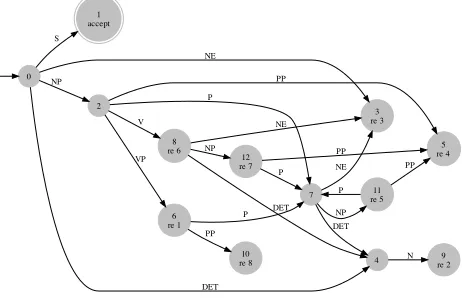
Fig. 2 gives a example GLR(0) automaton for the grammar from Fig. 1. A GLR(0) recognizer is
Figure 2:The GLR(0) automaton for the grammar in Fig. 1. “ren” means: “reduce with rulen”. A transition from statepto stateqcorresponds to a (terminal or nontermi-nal) shift operation.
trolled by a GLR(0) automatonM. Given some in-put string w, it creates another GLR(0) automaton M0 as a result by repeatedly applying its two main operations:2
• Shift: When the recognizer reads an input sym-bola ∈ Σin stateq, it adds a transitionq −→a
δ(q, a)toM0.
• Reduce: When while processing an input string, the parser reaches a state q for which τ(q) is defined, for each rule A → α ∈
τ(q), find all predecessor states p such that
labels(p q) = α.3 Then add a transition p−→A δ(p, A)toM0 (which may be interpreted as a nonterminal shift).δ(p, A)is also called a GOTO state.
The GLR(0) recognizer starts in stateq0 and scans
the input string from left to right. It applies the oper-ationsshiftandreduceuntil either an accepting state
2Actually, the LR(k) method was invented for parsing
deter-ministic languages like programming languages. In these cases it is not necessary to create an output automaton. Instead, a sim-ple stack is used on which state symbols are pushed and from which they a popped during a reduction.
f ∈F is reached (in which casefis also marked as final inM0) or the GLR(0) automaton blocks which causes an error to be signaled.
Continuing with Algorithm 1, line 2 intersects the GLR(0) automatonM with the FSAA, resulting in a GLR(0) automatonM∩.
Finally, in line 3, the WCFG G∩ generating L(G)∩L(A)is extracted fromM∩.
The following subsections explain all three steps in greater detail.
3.1 Efficient Construction of GLR(0) Automata
The construction of a GLR(0) automatonMis based on the computation of the collection of LR(0) item sets. Here, the crucial notion is that one of a dot-ted rule. A dotted rule is a WCFG rule with a dot somewhere in its right-hand side. This dot in-dicates which part of the rule was already success-fully applied and which part has yet to be matched. An example with respect to the grammar in Fig. 1 is: NP → NP• PP. A dotted rule is also called a LR(0) item. To compute M, we start with a set containing only the LR(0) itemS0 → •S whereS0 is a new super start symbol. Then the main op-eration of the algorithm – closure – is applied to it. Basically, given a grammarG = hN,Σ, S, Pi,
closure({A → α • Bβ}) (with A, B ∈ N and α, β ∈ (N ∪Σ)∗) computes on the basis ofGthe symbols which are expected next given that the au-tomaton’s expectation is to read aB.4
In our example case,
q0=closure({S0 → •S}) =
S0→ •S
S→ •NP VP
NP→ •DET N
NP→ •NE
(3)
Theδ-function ofM is computed as follows:
δ(q, B) =closure({A→αB•β|A→α•Bβ∈q}) . (4)
For example, δ(q0,NE) = closure({NP →
NE•}) ={NP→NE•}.
Let the state set Q ofM be the set of all LR(0) item sets that can be reached by recursively applying δandclosuretoq0and all item sets originating from
it.
4Due to space limitations, we cannot state the definition of
the closure algorithm. Please refer to Aho et al. (1986, p. 223) for the details.
If a state q contains an item A → α •, the rule A → α is added to τ(q). M reaches an accepting statef if the item set contains the LR(0) itemS0 → S•.
For grammars not having the LR(0) property (for example, ambiguous grammars), the construction introduces conflicts, see Aho and Ullman (1972). Nevertheless, the algorithm leads to deterministic GLR(0) automata for all grammars.
The naive approach representing LR(0) states as sets of dotted rules leads to increased computation times for bigger grammars, for example those ex-tracted from treebanks. For example, the gram-mar extracted from the TiGer treebank (Brants et al. (2002)) has over 14,300 rules.
A better approach is replacing the dotted rule by a pair consisting of the rule index and the current po-sition of the dot. But even then quite big item sets may result since treebank grammars often have sev-eral thousand rules for expanding a single nontermi-nal symbol.5 Since the right hand sides of grammar rules expanding a given nonterminal symbol often share common prefixes, left-factoring the grammar (cf. Aho et al. (1986)) is an option when the struc-ture of the parse tree is not of concern. In general, this is not the case in using (weighted) grammars for parsing natural languages.
Instead of altering the grammar, we prefer a more sophisticated representation of the dotted rules. All right hand sidesαi of a set of rules{B → αi}
ex-pandingB can be combined into a disjunctive reg-ular expressionr = α1+α2 +. . .+αk. r can be
converted into a deterministic weighted finite-state machine by standard techniques (cf. Hopcroft and Ullman (1979)). The result is a trie-like left-factored automatonAB representing the right hand sides of
the rules forB. For the final states ofAB, we define
a functionρ :Q→ I, whereI is the set of rule in-dices of the WCFG. For a given final stateqofAB
(representing a fully found right hand side α of a rule expandingB),ρ(q) =iif∃c∈ K:hB →α, ci
is theithrule of the grammar.
Fig. 3 shows the rule FSAAVP for the toy
gram-mar shown in Fig. 1.
An LR(0) item is then represented as a pairhB, qi
5For example, the TiGer grammar used in Section 4 contains
[image:5.612.312.545.111.575.2]
Figure 3: The rule trie containing the right hand sides of VP of the grammar in Fig. 1. Double circles indicate final states and state the rule index after /.
whereB is a nonterminal andq a state in the FSA AB associated with B. When during the closure
operation a pairhB, qi is processed, the transitions q −→Xi p leavingq inAB are enumerated and new
items hXi, q0Xii (ifXi ∈ N) are added to the
clo-sure items set.
3.2 Intersecting LR(0) Automata with Finite-state Automata
Algorithm 2 computes the intersection ofM andA. The algorithm maintains a breadth-first queueL of state pairs∈QM ×QA. In line 4, a pair consisting
of the two start states is inserted intoL. In thewhile -loop between lines 5 and 31, a state pairhqM, qAiis
removed fromL. Then, two types of actions are ap-plied to the current state pairhqM, qAi: Reductions
and shifts. Line 9 checks whetherM defines reduc-tions for stateqM. If true, thefor-loop between lines
10 and 23 considers each ruleB → α with weight c. In line 11, the set of all ancestor nodes for cur-rent statehqM, qAiis computed for which there are
paths π of length|α| to hqM, qAi (simultaneously,
we also record the labels of the paths between an an-cestor state andhqM, qAi). By definition of the
con-struction of a GLR(0) automaton, labels(π)equals α(disregarding the indices).
Then, the for-loop between lines 12 and 23 op-erates over each ancestor state hq, q0i of hq
M, qAi
and constructs new states and transitions which cor-respond to the GOTO-actions of the GLR(0) recog-nizer for nonterminal symbols. Before doing that, a rulehBqA →α0, ciis added to the reduce actions of
statehqM, qAiin line 13. Note thatα0 differs from
the originalαin ruleB → αin the indices carried by the nonterminals.6 The subsequent steps are:
• In line 14, a new statehδM(q, B), qAiis created
6We will discuss the necessity of indexed nonterminalsB
qA
below.
Algorithm 2:INTERSECTION OF AGLR(0) AU -TOMATON AND ANFSA
Input: GLR(0) automaton
M=hQM,∆M, q0M, FM, δM, τMiover a semiring
K
Input: Deterministic FSAA=hQA,Σ, q0A, δA, FAi
Output: GLR(0) automaton
M0=hQ
M0,∆M0, q0M0, FM0, δM0, τM0ioverK
1 q0M0 ← hq0M, q0Ai 2 QM0← {q0M0}
3 FM0← ∅
4 Enqueue(q0M0, L)
5 whileL6=∅do
6 hqM, qAi ←Dequeue(L) 7 ifqM ∈FM∧qA∈FAthen 8 FM0←FM0∪ {hqM, qAi}
9 ifτM(qM)6=⊥then
// Perform reductions 10 forhB→α, ci ∈τM(qM)do 11 Vα← {hq, q0,labels(π)i | hq, q0i ∈
QM0∧π=hq, q0i|α|
M0hqM, qAi}
12 forhq, q0, α0i ∈Vαdo 13 τM0(hqM, qAi)←
τM0(hqM, qAi)∪ {hBqA→α0, ci}
14 ifhδM(q, B), qAi∈/QM0then
15 QM0 ←QM0∪ {hδM(q, B), qAi}
16 δM0(hq, q0i, BqA)← hδM(q, B), qAi
17 ∆M0←∆M0∪ {BqA}
18 Enqueue(hδM(q, B), qAi, L)
19 else
20 ifδM0(hq, q0i, BqA) =⊥then
21 δM0(hq, q0i, BqA)←
hδM(q, B), qAi
22 ifhδM(q, B), qAi∈/Lthen
23 Enqueue(hδM(q, B), qAi, L)
// Perform shifts 24 fora∈Σdo
25 ifδM(qM, a)6=⊥ ∧δA(qA, a)6=⊥then 26 ∆M0←∆M0∪ {a}
27 p← hδM(qM, a), δA(qA, a)i 28 δM0(hqM, qAi, a)←p
29 ifp /∈QM0then
30 QM0←QM0∪ {p}
31 Enqueue(p, L)
32 returnM0
and checked whether it is present in the state set (and inserted if it is not). Here,δM(q, B)
denotes the GOTO-stateM defines for nonter-minalB. Note that the second componentqAof hδM(q, B), qAiis copied from the current state
pairhqM, qAi(the input index does not “move”
• In line 20, it is checked whether a transition leaving ancestor statehq, q0iwith symbolB
qA
already exists. Here, there are two subcases to consider:
1. hδM(q, B), qAi is a new state
which entails that the transition
hq, q0i−−→ hBqA δ
M(q, B), qAialso does not
exist (lines 15–18). This happens when
hδM(q, B), qAiis encountered for the first
time. hδM(q, B), qAiis added to the state
set (line 15) and a new transition leading to it is added to δM0 (line 16). Finally,
BqA is added to the alphabet ofM0 (line
17) and the new state hδM(q, B), qAi is
inserted into the queue (line 18).
2. hδM(q, B), qAi already existed, but not hq, q0i −−→ hBqA δ
M(q, B), qAi (lines 21–
23). Here, we repeatedly encoun-tered hδM(q, B), qAi during processing.
This happens in case of local ambigui-ties where there exist multiple trees for some subpart of A headed by the same nonterminal. In terms of the graph structure of M0, we create a reentrant node hδM(q, B), qAi with more than one
incoming transition (line 21). Since
hδM(q, B), qAimay trigger further
reduc-tions (its ancestor set was changed), it is reinserted into the queue (when not al-ready present).
The shift operations performed in thefor-loop be-tween lines 24 and 31 are similar to the case of the intersection of two FSAs: For every transition leav-ing qA labeled ait is tried to find a corresponding
transition leavingqM. If this transition exists, a new
state pair hδM(qM, a), δA(qA, a)i is added toQM0
andL, if not already present (line 30). In addition, a transition hqM, qAi −→ ha δM(qA, a), δA(qA, a)i is
created (line 28).
Unsurprisingly, Algorithm 2 is simply a general-isation of Tomita’s GLR algorithm (cf. Tomita and Ng (1991)) to the recognition of the language of an FSA instead of the recognition of a single sentence (which can be seen as a simple, linear FSA with a single final state). In the general case treated here, Amay have several final states and may contain an
infinite number of paths. Because of that, the non-terminal symbols ofM0are indexed with the current state qA ofA. In that way, M0 keeps track of the
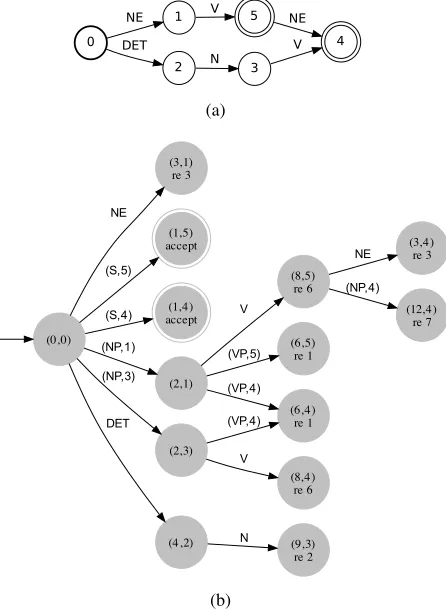
different reductions made for different paths inA. Fig. 4(b) shows the result of applying Algorithm 2 to the GLR(0) automaton of Fig. 2 and the FSA of Fig. 4(a).
(a)
(b)
Figure 4: (a)A deterministic FSA representing three sen-tences of the PCFG of Fig. 1.(b)The result of Algorithm 2 applied to the automata in Fig. 2 and Fig. 4(a). States are labeled with pairshqM, qAi.
3.2.1 Complexity.
The outerwhile-loop of Algorithm 2 is bounded by O(|QM ×QA|). Since M andA are both
de-terministic, only a small subset of QM ×QA will
be actually created in the average case. Concerning theshift-actions (for-loop lines 24–31), each pair is inserted exactly once into the queue. Looking at the
reduce-actions (lines 9–23), a state pair may be rein-serted into the queue in case a new incoming transi-tion is added forhδM(q, B), qAi(line 23). The
[image:6.612.317.540.167.472.2]pos-S’→S4/1 S’→S5/1
S4→NP1VP4/1 S4→NP3VP4/1
S5→NP1VP5/1 NP1→NE/0.3
NP3→DET N/0.6 NP4→NE/0.3
VP4→V NP4/0.4 VP4→V/0.5
[image:7.612.81.271.56.129.2]VP5→V/0.5
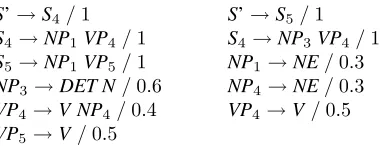
Figure 5: Rule set of the grammar extracted from Fig. 4(b).
sible reductions taking place athqM, qAiwhich is in
turn bounded by|N|, the number of nonterminals of G. The most expensive step is found in line 11. Letr be the length of the longest right-hand side of a rule inG. The number of state pairshq, q0icreated in line 11 and subsequently considered in thefor-loop lines 12–23 is bounded byO(|QM ×QA|r)(the number
of ancestors increases exponentially with respect to the distancer). By applying the memoisation tech-niques proposed in Kipps (1991), this bound can be strengthend toO(|QM ×QA|2). Putting everything
together, the overall complexity of Algorithm 2 is in
O(|QM ×QA|3).
3.3 Extracting Grammar Rules
The last step, the extraction ofG∩ =G∩Ais easy and stated in Algorithm 3.
Algorithm 3:EXTRACTINGG∩.
Input: A GLR(0) automaton
M=hQM,∆M, q0M, FM, δM, τMioverK
Output: A WCFGG∩=hN,∆M\N, S0, PioverK 1 N← {Xi∈∆M|i∈N} ∪ {S0}
2
P ← {hS0→Xi,1i | ∃Xi∈N:δM(q0
M, Xi)∈FM} ∪
[
q∈QM∧τM(q)6=⊥ τM(q)
Algorithm 3 simply extracts the grammar rules from the statesq for whichτM(q)is defined.
Addition-ally, a new start symbol S0 is introduced and triv-ially weighted rulesS0 → X
i are added to the rule
set such thatXiis labeling a transition fromq0M to a
final state. Fig. 5 shows the grammar extracted from the automaton shown in Fig. 4(b).
Automaton A1 A2 A3
|Q| 8 56 173
[image:7.612.315.541.122.212.2]|δ| 9 64 259
Table 1: Sizes of the input FSA.
Phase Operation Time
(ms) Avg.time per sent
|Q| |δ|
1 Constr. of
M 3,520 - 17,279 1,226,776
2 M∩A1 47 47 1,841 14,005 2 M∩A2 3,198 320 18,355 389,140 2 M∩A3 17,847 178 50,332 1,097,768
Table 2: Results of the experiments with the TiGer gram-mar.
4 Experiments
We implemented the algorithm from the last section in the C++ programming language within thefsm2
framework (see Hanneforth (2009)). The grammar used for the experiments has been extracted from the TiGer treebank (cf. Brants et al. (2002)). It contains 14,379 rules7, and the sizes of the alphabet and the nonterminal sets are 51 and 25, resp. The length of the longest right-hand side of a rule is 17. For the FSA operand of the intersection algorithm, we created three minimal FSA accepting 1, 10 and 100 sentences (tag sequences) randomly taken from the TiGer corpus. The sizes of the automata are sum-marised in Table 1.
Table 2 shows the results of the experiments which were carried out on a 2.8 GHz CPU. The columns
|Q|and|δ|contain the sizes of the automata result-ing from the operation mentioned before.
Since treebank grammars tend to avoid recursive rules and therefore assign flat structures to input strings, they create a lot of readings with spurious ambiguities. Johnson (1998) reports that approx-imately 9% of the rules of the Penn treebank are never used in a maximum likelihood setting since these rules are subsumed by combinations of other rules with a higher combined probability. We expect even better intersection timings in the face of more linguistically realistic grammars.
7Disregarding discontinous constructions like verb–particle
5 Conclusion
Above, we presented a theoretical and practical al-gorithm to intersect weighted grammars with FSAs which can be used for parsing or language model training purposes (cf. Nederhof (2005)). No gram-mar transformation (for example, binarisation) is necessary to achieve optimal cubic complexity. In-stead, the binarisation is implicit by using the dotted rule technique. However, the algorithm may suffer from a big grammar dependent constant for artificial grammars (see Johnson (1991) for details). This is due to the implicit subset construction present in the construction ofM’sδ-function in Eq. (4). An option to investigate for these artificial grammars would be considering the construction ofnon-deterministic
GLR(0) automata.
References
Alfred V. Aho and Jeffrey D. Ullman. 1972. The Theory of Parsing, Translation, and Compiling. Prentice-Hall, Inc., Upper Saddle River, NJ, USA.
A. V. Aho, R. Sethi, and J. D. Ullman. 1986.Compilers: Principles, Techniques, and Tools. Addison-Wesley, Reading, Mass.
Y. Bar-Hillel, M. Perles, and E. Shamir. 1964. On Formal Properties of Simple Phrase Structure Gram-mars. In Y. Bar-Hillel, editor, Language and Infor-mation: Selected Essays on their Theory and Applica-tion, pages 116–150. Addison-Wesley, Reading, Mas-sachusetts.
S. Billot and B. Lang. 1989. The Structure of Shared Forests in Ambiguous Parsing. InProceedings of the Twenty-Seventh Annual Meeting of the Association for Computational Linguistics, pages 143–151, Vancou-ver (British Columbia). Association for Computational Linguistics (ACL).
Sabine Brants, Stefanie Dipper, Silvia Hansen, Wolfgang Lezius, and George Smith. 2002. The TIGER Tree-bank. InProceedings of the Workshop on Treebanks and Linguistic Theories.
Thomas Hanneforth. 2009.fsm2- A Scripting Language Interpreter for Manipulating Weighted Finite-state Au-tomata. In Anssi Yli-Jyr¨a et al. (eds): Finite-State Methods and Natural Language Processing, 8th Inter-national Workshop, pages 13–30, Berlin. Springer. John E. Hopcroft and Jeffrey D. Ullman. 1979.
Intro-duction to Automata Theory, Languages and Compu-tation. Addison-Wesley.
M. Johnson. 1991. The Computational Complexity of GLR Parsing. In M. Tomita, editor, Generalized LR Parsing, pages 35–42. Kluwer, Boston.
Mark Johnson. 1998. PCFG Models of Linguis-tic Tree Representations. Computational Linguistics, 24(4):613–632.
J. R. Kipps. 1991. GLR Parsing in TimeO(n3). In
M. Tomita, editor,Generalized LR Parsing, pages 43– 60. Kluwer, Boston.
Mark-Jan Nederhof and Giorgio Satta. 2008. Probabilis-tic Parsing. In G. Bel-Enguix, M. Dolores Jimenez-Lopez, and C. Martin-Vide, editors, New Develop-ments in Formal Languages and Applications, pages 229–258. Springer.
Mark-Jan Nederhof. 2005. A General Technique to Train Language Models on Language Models. Com-putational Linguistics, 31:173–186, June.