Mining coreference relations between formulas and text using Wikipedia
Minh Nghiem Quoc1, Keisuke Yokoi2, Yuichiroh Matsubayashi3Akiko Aizawa1 2 3 1Department of Informatics, The Graduate University for Advanced Studies
2 Department of Computer Science, University of Tokyo
3 National Institute of Informatics
{nqminh, kei-yoko, y-matsu, aizawa}@nii.ac.jp
Abstract
In this paper, we address the problem of discovering coreference relations between formulas and the surrounding text. The task is different from traditional coref-erence resolution because of the unique structure of the formulas. In this paper, we present an approach, which we call‘CDF (Concept Description Formula)’, for min-ing coreference relations between formu-las and the concepts that refer to them. Using Wikipedia articles as a target cor-pus, our approach is based on surface level text matching between formulas and text, as well as patterns that represent relation-ships between them. The results showed the potential of our approach for formulas and text coreference mining.
1 Introduction 1.1 Motivation
Mathematical content is a valuable information source for many users: teachers, students, re-searchers need access to mathematical resources for teaching, studying, or obtaining updated infor-mation for research and development. Although more and more mathematical content is becom-ing available on the Web nowadays, conventional search engines do not provide direct search of mathematical formulas. As such, retrieving math-ematical content remains an open issue.
Some recent studies proposed mathematical re-trieval systems that were based on structural sim-ilarity of equations (Adeel and Khiyal, 2008;
Yokoi and Aizawa, 2009; Nghiem et al., 2009). However, in these studies, the semantics of the equations is still not taken into account. As mathematical equations follow highly abstract and also rewritable representations, structural similar-ity alone is insufficient as a metric for semantic similarity.
Based on this observation, the primary goal of this paper is to establish a method for extracting implicit connections between mathematical for-mulas and their names together with the descrip-tions written in natural language text. This en-ables keywords to be associated with the formu-las and makes mathematical search more power-ful. For example, it is easier for people searching and retrieving mathematical concepts if they know the name of the equation“a2 + b2 = c2” is the“Pythagorean Theorem”. It could also make mathematics more understandable and usable for users.
1.2 Related Work
Ponzetto and Poesio (2006) attempted to include semantic information extracted from WordNet and Wikipedia into their coreference resolution model. Shnarch et al. (2009) presented the ex-traction of a large-scale rule base from Wikipedia designed to cover a wide scope of the lexical reference relations. Their rule base has compa-rable performance with WordNet while provid-ing largely complementary information. Yan et al. (2009) proposed an unsupervised relation ex-traction method for discovering and enhancing relations associated with a specified concept in Wikipedia. Their work combined deep linguis-tic patterns extracted from Wikipedia with surface patterns obtained from the Web to generate vari-ous relations. The results of these studies showed that Wikipedia is a knowledge-rich and promising resource for extracting relations between repre-sentative terms in text. However, these techniques are not directly applicable to the coreference res-olution between formulas and texts as we mention in the next section.
1.3 Challenges
There are two key challenges in solving the coref-erence relations between formulas and texts using Wikipedia articles.
• First, formulas have unique structures such as prior operators and nested functions. In addition, features such as gender, plural, part of speech, and proper name, are unavail-able with formulas for coreference resolu-tion. Therefore, we cannot apply standard natural language processing methods to for-mulas.
• Second, no labeled data are available for
the coreference relations between formu-las and texts. This means we cannot ap-ply commonly used machine learning-based techniques without expensive human annota-tions.
1.4 Our Approach and Key Contributions
In this paper, we present an approach, which we callCDF (Concept Description Formula), for
mining coreference relations between mathemat-ical Formulas and Concepts using Wikipedia ar-ticles. In order to address the previously men-tioned challenges, the proposedCDFapproach is featured as follows:
• First, we consider not only the concept-formula pairs but extend the relation with de-scriptions of the concept. Note that a “con-cept” in our study corresponds to a “name” or a “title” of a formula, which is usually quite short. By additionally considering words ex-tracted from the descriptions, we have a bet-ter chance of detecting keywords, such as mathematical symbols, and function or vari-able names, used in the equations.
• Second, we apply an unsupervised frame-work in our approach. Initially, we extract highly confident coreference pairs using sur-face level text matching. Next, we collect promising syntactic patterns from the de-scriptions and then use the patterns to extract coreference pairs. The process enables us to deal with cases where there exist no common words between the concepts and the formu-las.
The remainder of this paper is organized as fol-lows: In section 2, we present our method. We then describe the experiments and results in sec-tion 3. Secsec-tion 4 concludes the paper and gives avenues for future work.
2 Method
2.1 Overview of the Method
In this section, we first explain the terms used in our approach. We then provide a framework of our method and the functions of the main mod-ules.
Given a set of Wikipedia articles as input, our system outputs a list of formulas along with their names and descriptions. Herein
Wikipedia articles, section headings, or writ-ten in bold or italic. Additional NPs that con-tain at least one content word are also consid-ered.
• Description: A description D is a phrase that describes the concept. In Wikipedia, de-scriptions often follow a concept after the verb “be”.
• Formula: A formula F is a mathematical formula. In Wikipedia extracted XML files, formulas occur between the< math >and < /math >tags. They are encoded in TEX format.
• Candidate: A candidate is a triple of con-cept, description and formula. Our system will judge if the candidate is qualified, which means the concept is related to the formula.
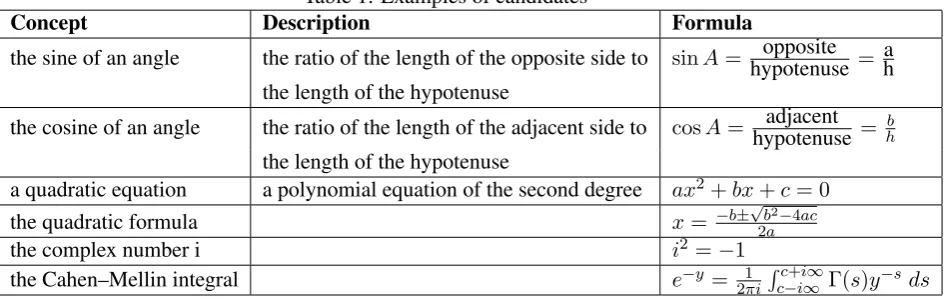
Figure 1 shows a section of a Wikipedia article and the concepts, descriptions and formulas in this section. Table 1 shows the extracted candidates. Details of how to extract the concepts, descrip-tions and formulas and how to form candidates are described in the next sections.
Sine, cosine and tangent
The sine of an angle is the ratio of the length of the opposite side to the length of the hypotenuse. In our case
sinA= opposite
hypotenuse= a h
Note that this ratio does not depend on size of the particular right triangle chosen, as long as it contains the angle A, since all such triangles are similar.
The cosine of an angle is the ratio of the length of the adjacent side to the length of the hypotenuse. In our case
cosA= adjacent
hypotenuse= b h
The tangent of an angle is the ratio of the length of the opposite side to the length of the adjacent side (called so because it can be represented as a line segment tangent to the circle). In our case
tanA=opposite
adjacent= a b
The acronym "SOHCAHTOA" is a useful mnemonic for these ratios.
TITLE
PARAGRAPH
PARAGRAPH
PARAGRAPH FORMULA
FORMULA
FORMULA
CONCEPT DESCRIPTION
DESCRIPTION CONCEPT
DESCRIPTION CONCEPT
Figure 1: Examples of extracted paragraphs
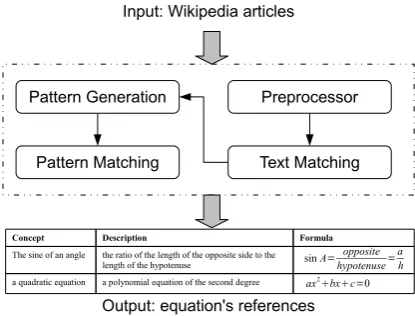
The framework of the system is shown in Fig-ure 2. The system has four main modules.
• Text Preprocessor: processes Wikipedia ar-ticles to extract CDF (Concept Description Formula)candidates.
Input: Wikipedia articles
Preprocessor
Pattern Matching Text Matching
Output: equation's references Pattern Generation
Concept Description Formula
The sine of an angle the ratio of the length of the opposite side to the length of the hypotenuse
a quadratic equation a polynomial equation of the second degree
sinA= opposite hypotenuse=
a h ax2
[image:3.595.307.515.75.233.2]bxc=0
Figure 2: Framework of the proposed approach
• Text Matching: extracts reliable and qual-ified candidates using surface level text matching.
• Pattern Generation: generates patterns
from qualified candidates.
• Pattern Matching: extends the candidate
list using the generated patterns.
2.2 Text Preprocessor
This module preprocesses the text of the Wikipedia article to extract CDF candidates. Based on the assumption that concepts, their de-scriptions and formulas are in the same paragraph, we split the text into paragraphs and select para-graphs that contain at least one formula.
On these selected paragraphs, we run Sentence Boundary Detector, Tokenizer and Parser from OpenNLP tools. 1 Based on the parse trees, we
extract the noun phrases (NPs) and identify NPs representing concepts or descriptions using the definitions in Section 2.1.
Following the general idea in Shnarch et al. (2009), we use the“Be-Comp”rule to identify the description of a concept in the definition sentence. In a sentence, we extract nominal complements of the verb ‘to be’, assign the NP that occurs after the verb ‘to be’ as the description of the NP that occurs before the verb. Note that some concepts have descriptions while others do not.
Table 1: Examples of candidates
Concept Description Formula
the sine of an angle the ratio of the length of the opposite side to sinA= hypotenuseopposite = ah
the length of the hypotenuse
the cosine of an angle the ratio of the length of the adjacent side to cosA= hypotenuseadjacent = hb
the length of the hypotenuse
a quadratic equation a polynomial equation of the second degree ax2+bx+c= 0
the quadratic formula x= −b±√2ba2−4ac
the complex number i i2=−1
the Cahen–Mellin integral e−y = 21πiRcc−+ii∞∞Γ(s)y−s ds
The “Be-Comp”rule can also identify if a for-mula is related to the concept.
After that, we group each formula F in the same paragraph with concept C and its descrip-tion D to form a candidate (C, D, F). Table 1 presents candidate examples. Because we only choose paragraphs that contain at least one for-mula, every concept has a formula attached to it. In order to judge the correctness of candidates, we use the text-matching module, described in the next section.
2.3 Text Matching
In this step, we classify candidates using surface text. Given a list of candidates of the form (C,D, F), this module judges if a candidate is qualified by using the surface text in concept, description and formula. Because many formulas share the same variable names or function names (or part of these names) with their concepts (e.g. the first two candidates in Table 1), we filter these candidates using surface text matching.
We define the similarity between concept C, description D and formula F by the number of overlapped words, as in Eq. 1.
sim(F,CD) = |TF∩TC| min{|TC|,|TF|}
+ |TF∩TD| min{|TD|,|TF|}
(1) TF,TCandTDare sets of words extracted from F,CandD, respectively.
Candidates with sim(F,CD)no larger than a
threshold θ1 (1/3 in this study) are grouped into the groupCtrue. The rest are filtered and stored in
C0. In this step, function words such as articles, pronouns, conjunctions and so on in concepts and descriptions are ignored. Common operators in formulas are also converted to text, such as ‘+’ ‘plus’, ‘–’ ‘minus’, ‘\frac’ ‘divide’.
Using only concepts for text matching with for-mulas might leave out various important relations. For example, from the description of the first and second formula in Table 1, we could extract the variable names“opposite”, “adjacent”and “hy-potenuse”.
By adding the description, we could get a more accurate judgment of whether the concept and the formula are coreferent. In this case, we can consider the concept, description and the formula form a coreference chain.
After this step, we have two categories, Ctrue andC0.Ctruecontains qualified candidates while C0 contains candidates that cannot be determined by text matching. The formulas inC0 have little or no text relation with their concepts and descrip-tions. Thus, we can only judge the correctness of these candidates by using the text around the con-cepts, descriptions and formulas. The surrounding text can be formed into patterns and are generated in the next step.
2.4 Pattern Generation
In this step, we use the qualified instances in Ctrueto generate patterns. These patterns are used in the next step to judge the candidates inC0. Pat-terns are generated as follows. First, the concept, description and formula are replaced by CONC, DESC and FORM, respectively. We then simply take the entire string between the first and the last appearance of CONC, DESC and FORM.
[image:5.595.95.268.229.377.2]Table 2 presents examples of patterns extracted from groupCtrue.
Table 2: Examples of extracted patterns
Pattern
CONC is DESC: FORM
CONC is DESC. In our case FORM CONC is DESC. So, ..., FORM CONC FORM
CONC is denoted by FORM CONC is given by ... FORM CONC can be written as ... : FORM FORM where CONC is DESC FORM satisfies CONC
Using a window surrounding the concepts and formulas often leads to exponential growth in pat-terns, so we limit our patterns to those between any conceptC, descriptionDor formulaF.
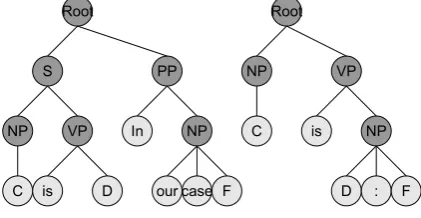
The patterns we obtained above are exactly the shortest paths from theCnodes to theirFnode in the parse tree. Figure 3 presents examples of these patterns in parse trees.
S
NP
C VP
is D
Root
NP
C
VP
is NP
D : F
Root
PP
In NP
[image:5.595.74.285.513.622.2]our case F
Figure 3: Examples of extracted patterns
2.5 Pattern Matching
In this step, we use patterns obtained from the previous step to classify more candidates in C0. We use the string distance between the patterns,
where candidates’ patterns having a string dis-tance to any of the patterns extracted in the previ-ous step no larger than the thresholdθ2 are added intoCtrue.
3 Experiments 3.1 Data
We collected a total of 16,406 mathematical doc-uments from the Wikipedia Mathematics Portal. After the preprocessing step, we selected 72,084 paragraphs that contain at least one formula. From these paragraphs, we extracted 931,716 candi-dates.
Because no labeled data are available for use in this task, we randomly chose 100 candidates: 60 candidates fromCtrue after the text matching step, 20 candidates added to Ctrue after pattern matching with θ2 = 0, and 20 candidates added toCtrueafter pattern matching withθ2 = 0.25for our evaluation. These candidates were annotated manually. The sizes of the sample sets for human judgment (60, 20 and 20) were selected approx-imately proportional to the sizes of the obtained candidate sets.
3.2 Results
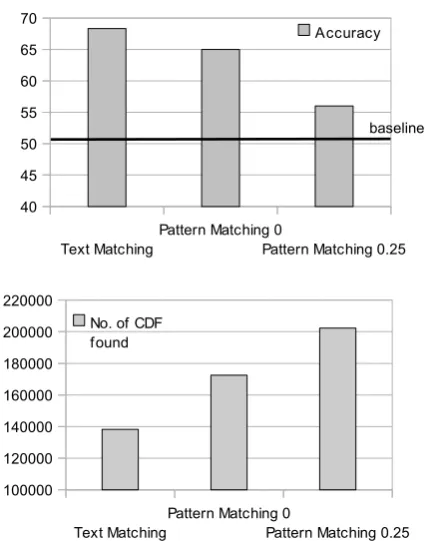
After the text matching step, we obtained 138,285 qualified candidates in the Ctrue group and 793,431 candidates inC0. InCtrue, we had 6,129 different patterns. Applying these patterns toC0 by exact pattern matching (θ2 = 0), we obtained a further 34,148 qualified candidates. We obtained an additional 30,337 qualified candidates when we increased the thresholdθ2 to 0.25.
For comparison, we built a baseline system. The baseline automatically groups nearest for-mula and concept. It had 51 correctly qualified candidates. The results—displayed in Table 3 and depicted in Figure 4—show that our proposed method is significantly better than the baseline in terms of accuracy.
Table 3: Results of the system
Module No. correct/ No. of
total CDF found
Text Matching 41 / 60 138,285
Pattern Matching 52 / 80 172,433 θ2= 0
Pattern Matching 56 / 100 202,270 θ2= 0.25
method is a promising starting point for solving coreference relations between formulas and sur-rounding text.
4 Conclusions
In this paper, we discuss the problem of discov-ering coreference relations between formulas and the surrounding texts. Although we could only use a small number of annotated data for the eval-uation in this paper, our preliminary experimental results showed that our approach based on sur-face text-based matching between formulas and text, as well as patterns representing relationships between them showed promise for mining math-ematical knowledge from Wikipedia. Since this is the first attempt to extract coreference rela-tions between formulas and texts, there is room for further improvement. Possible improvements include: (1) using advanced technology for pat-tern matching to improve the coverage of the re-sult and (2) expanding the work by mining knowl-edge from the Web.
References
Eyal Shnarch, Libby Barak and Ido Dagan. 2009.
Extracting Lexical Reference Rules from Wikipedia
Proceedings of the 47th Annual Meeting of the ACL and the 4th IJCNLP of the AFNLP, pages 450–458
Yulan Yan, Naoaki Okazaki, Yutaka Matsuo, Zhenglu Yang and Mitsuru Ishizuka. 2009. Unsupervised Relation Extraction by Mining Wikipedia Texts Us-ing Information from the Web Proceedings of the 47th Annual Meeting of the ACL and the 4th IJC-NLP of the AFIJC-NLP, pages 1021–1029
Simone Paolo Ponzetto and Massimo Poesio. 2009.
State-of-the-art NLP Approaches to Coreference
Text Matching
Pattern Matching 0
Pattern Matching 0.25 40
45 50 55 60 65 70
Accuracy
Text Matching
Pattern Matching 0
Pattern Matching 0.25 100000
120000 140000 160000 180000 200000 220000
No. of CDF found
[image:6.595.72.294.84.208.2]baseline
Figure 4: Results of the system
Resolution: Theory and Practical Recipes Tutorial Abstracts of ACL-IJCNLP 2009, page 6
Minh Nghiem, Keisuke Yokoi and Akiko Aizawa. 2009.Enhancing Mathematical Search with Names of Formulas The Workshop on E-Inclusion in Math-ematics and Science 2009, pages 22–25
Keisuke Yokoi and Akiko Aizawa. 2009. An Ap-proach to Similarity Search for Mathematical Ex-pressions using MathML 2nd workshop Towards a Digital Mathematics Library, pages 27–35
Hui Siu Cheung Muhammad Adeel and Sikandar Hayat Khiyal. 2008. Math Go! Prototype of a Content Based Mathematical Formula Search En-gine Journal of Theoretical and Applied Informa-tion Technology, Vol. 4, No. 10, pages 1002–1012 Simone Paolo Ponzetto and Michael Strube. 2006.
Exploiting Semantic Role Labeling, WordNet and Wikipedia for Coreference Resolution In Proceed-ings of HLT-NAACL-06, pages 192–199
Jim Giles. 2005. Internet Encyclopaedias Go Head to Head Nature Volume: 438, Issue: 7070, pages 900–901
World Wide Web Consortium. Mathematical Markup Language (MathML) version 2.0 (second edition)