Registers in the System of Semantic Relations in plWordNet
Marek Maziarz Maciej Piasecki Ewa Rudnicka Institute of Informatics Wrocław University of Technology
Wrocław, Poland [email protected]
[email protected] [email protected]
Stan Szpakowicz Institute of Computer Science
Polish Academy of Sciences Warsaw, Poland
&
School of Electrical Engineering and Computer Science
University of Ottawa Ottawa, Ontario, Canada [email protected]
Abstract
Lexicalised concepts are represented in wordnets by word-sense pairs. The strength of markedness is one of the factors which influence word use. Stylistically unmarked words are largely context-neutral. Technical terms, obsolete words, “of-ficialese”, slangs, obscenities and so on are all marked, often strongly, and that limits their use con-siderably. We discuss the position of register and markedness in wordnets with respect to semantic relations, and we list typical values of register. We illustrate the discussion with the system of regis-ters in plWordNet, the largest Polish wordnet. We present a decision tree for the assignment of mark-ing labels, and examine the consistency of the edit-ing decisions based on that tree.
1 Introduction
A dense network of lexico-semantic relations is the feature that best differentiates a wordnet from other types of dictionaries and thesauri. Word-nets are organised into synsets and lexical units (LUs), whose meaning is crucially determined just by such relations. The inventories of relations, usually based on the findings in lexical semantics, seem largely comparable across wordnets, but spe-cific definitions and strategies of applications vary. Wordnets also vary in the amount of typical dictio-nary information encoded. An apt example of such variation is the treatment of stylistic registers, as well as broad semantic domains, to which a given synset or LU belongs.
Lexico-semantic relations are the principal de-terminant of lexical meaning in plWordNet. Mark-ing often constrains those relations; some of them cannot hold between LUs of incompatible regis-ters. Semantics can constrain derivationally based relations, e.g., femininity is limited to the nouns denoting animals and humans. Among verbs there are also relations limited to the particular as-pect or verb class, like hyponymy or inchoativity (Maziarz et al., 2013, section 4).
Registers, semantic domains and verb classes are attributes. It is far from obvious how to put at-tributive information into an inherently relational structure of a wordnet. Princeton WordNet (PWN) represents semantic domains by synsets in two roles: elements of the lexical system and meta-information which characterises those elements. To associate a synset with a domain, a domain re-lation links it with another synset which represents that domain. Attributes of LUs can also be rep-resented by sub-dividing those LUs into classes. This mechanism has been present in PWN from the beginning. There are,e.g., separate bases for parts of speech or semantic domains, represented by the so-called lexicographers’ files.
ap-plications, and ensure the consistency of the lin-guists’ decisions.
Section 2 of the paper recaps the model of the semantic relation system in plWordNet. Section 3 serves as an overview of related work insofar as it contributes to our intended use of the marking labels for the enrichment of the wordnet-based de-scription of lexical meaning. Section 4 presents the details of the markedness labelling in plWord-Net. Section 5 reports on a small, carefully ar-ranged experiment meant to determine how con-sistent marking can be expected given a precise procedure in the form of a decision tree. Section 6 offers a few conclusions based on our experience, and briefly discusses our expectations for the on-going development of plWordNet.
2 Constitutive relations and registers
A wordnet is founded on synonymy. Its basic unit, the synset, is a group oflexical units(LUs).1 Al-though synonymy is undoubtedly key, wordnets vary as to how it is defined and applied. The cre-ators of PWN (Miller et al., 1993; Fellbaum, 1998) adopt a very strict definition of synonymy usu-ally attributed to Leibniz,2 but realistically make it context-dependent. The effect is a take on syn-onymy which is linguistically satisfying but insuf-ficiently accurate: the wordnet authors’ intuition largely dictates what LUs go into a synset. More-over, a synset is often understood as a set of syn-onymous LUs, while synsyn-onymous LUs are under-stood as elements of the same synset. Such circu-larity is hard to make operational.
The interdependence of the notions of syn-onymy and synset, and the subjectivity of autho-rial judgement, can be avoided. Maziarz et al. (2013) propose a different perspective. The LU, rather than the synset, becomes the basic structure in plWordNet. As Vossen (2002) notes, the cen-tral relations – synonymy, hyponymy, hypernymy, meronymy and holonymy – are lexical: they hold between words, not between concepts. A PWN synset denotes a lexicalized concept, and con-ceptual relations link synsets, but those relations have a lexico-semantic origin. Our model derives synset content and synonymy from a carefully constructed set of constitutive relations between
1We understand thelexical unitinformally as a
lemma-sense pair.
2“Two words are said to be synonyms if one can be used in
a statement in place of the other without changing the mean-ing of the statement.”
LUs. The construction is discussed in (Maziarz et al., 2013); the focus of this paper is on the prop-erties which help constitutive lexico-semantic re-lations determine synsets.
The constitutive relations in plWordNet are hy-ponymy, hypernymy, meronymy and holonymy, plus verb-specific relations of presupposition, pre-ceding, cause, processuality, state, iterativity and inchoativity (Maziarz et al. (2011) discuss the de-tails), and adjective-specific relations of value (of an attribute), gradation and modifier (Maziarz et al., 2012b). They are supplemented by constitu-tive features: verb aspect and semantic class, and register.
A wordnet describes lexical meaning primarily via semantic relations, so it is important for a con-stitutive relation to be fairly widespread in the net-work. A high degree of sharing among groups of LUs is necessary because a constitutive rela-tion underlies grouping LUs into synsets. It also helps if a constitutive relation is well established in linguistics: linguists who are wordnet editors will encounter fewer misunderstanding. Finally, a con-stitutive relations which accords with the wordnet practice will make for better compatibility among wordnets (Maziarz et al., 2013).
Verbs of different aspect participate in different lexico-semantic relations,e.g.,a hypernym cannot be replaced by the other element of its aspectual pair. The value of aspect thus constrains selected verb relations (Maziarz et al., 2012a). Semantic verb classes also restrict links for some verb rela-tions. The verb classification is based on a Vend-lerian typology. A hierarchy of verb classes has been implemented in plWordNet as a hypernymy hierarchy of artificial lexical units, each naming a different class. Verbs in a given class are hy-ponyms of the corresponding artificial LU.
Stylistic registers have been introduced into plWordNet relation definitions; they appear in guidelines and in some substitution tests. With ev-ery editing decision a linguist must recognise the registers of the LUs and synsets to be linked. The marking labels represent pragmatic features of LU usage, so it seems natural to have register values encoded explicitly.
synonymy. Once synset membership has been de-cided, its elements are understood to be in the re-lation of synonymy.
It now becomes crucial to recognise accurately the connectivity afforded by the constitutive re-lations. Linguists who build the wordnet are as-sisted by conditions in the definitions of relations (such conditions often refer to registers and se-mantic classes) and by substitution tests. Vossen (2002) discusses tests for semantic correspon-dence, which did not take into account the differ-ences in register or usage, often essential for the possibility of contextual interchangeability.
Lexical units which have nearly the same sense but significantly differ in register are put into sep-arate synsets, but the proximity is not lost: those synsets become linked by inter-register synonymy. That relation is weaker than synonymy with re-spect to sharing. Synsets linked by inter-register synonymy share a hypernym, but not hyponym sets, and clearly have different register values.
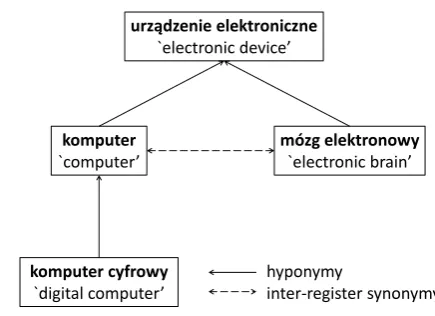
Consider an example: komputer ‘computer’ has an obsolete inter-register synonymmózg elek-tronowy ‘electronic brain’. Figure 1 shows hy-ponymy to urz ˛adzenie elektroniczne ‘electronic device’, which is shared.3 There is, however, a hyponym komputer cyfrowy‘digital computer’, a specialist term which should not be linked to the obsolete term for a computer.4 The terms kom-puterandmózg elektronowyhave the same deno-tation but different linguistic contexts of use.
The model and the development of plWord-Net comply with a form of minimal commitment principle: make as few assumptions as possible about the construction process. First of all, the model avoids references to theories of cognition and specific theories of lexical semantics. By min-imising the theoretical underpinning and ground-ing all editground-ing decisions on the language data ob-servable in a corpus, we try to focus on the lexical system regardless of the reasons why it is organ-ised as it is. We thus hope to make the wordnet theory-neutral and ready for use in a wide range of applications.
Minimal commitment does not preclude a map-pingto an ontology. Such a mapping supplements the linguistic dependencies recorded in the word-net with a theoretical interpretation: the
cogni-3
In plWordNet, a hyponymy link from X to Y means “X is a hyponym of Y” rather than “X has a hyponym Y”.
4The substitution test “If it isa digital computer, then it
must bean electronic brain.” sounds distinctly funny.
komputer
`computer’
mózg elektronowy
`electronic brain’
urządzenie elektroniczne
`electronic device’
komputer cyfrowy
`digital computer’
hyponymy
[image:3.595.312.530.69.227.2]inter-register synonymy
Figure 1: Inter-register synonymy between LUs from different registers.
tive principles of the ontology. The wordnet de-scribes lexico-semantic relation of varying, possi-bly complex, background and origin, while the on-tology mapping shows a possible relation between the lexical system and the internal cognitive struc-ture of concepts. A potential plus is the possibility of considering different ontologies as the mapping target, and so different interpretations of the lexi-cal dependencies.
3 Markedness in lexicography and in Princeton WordNet
Svensén (2009) notes that lexicographers refer as marked to the part of the vocabulary with addi-tional pragmatic features which narrow the usage to a specific context or group of speakers. Such distinction includes, but is not limited to, differ-ent stylistic registers. Svensén adopts the classi-fication of “diasystematic marking in a contem-porary general purpose dictionary” (Hausmann, 1989), organised along 11 criteria: time, place, na-tionality, medium, socio-cultural, formality, text type, technicality, frequency, attitude and norma-tivity. An unmarked centre and a marked periph-ery5 are established for each criterion. The main peripheries include “archaism-neologism; region-alism, dialect word; foreign word; spoken-written sociolects; formal-informal; poetic, literary, jour-nalese; technical language; rare; connoted; and incorrect”. In a dictionary, the location of a lex-ical item in a periphery is signalled by a label, e.g., arch ‘archaic’, AmE ‘American English’ or
5or peripheries, because for some criteria there can be
poet‘poetic’.
Wordnets vary with respect to the ways and de-gree of coding markedness. PWN signals marked-ness with a specialDOMAIN-MEMBER OF A DO-MAIN relation with three sub-types: TOPIC, RE-GION and USAGE. It can be established between synsets in the same grammatical category or be-tween cateories. The subtype names correspond to the criteria of marking (Hausmann, 1989). Sur-prisingly, noun synsets play the role of specific la-bels within particular subtypes. PWN 3.0 has 438 labels pertaining toDOMAIN TERM TOPIC, 166 la-bels to DOMAIN TERM REGION, and 29 labels to DOMAIN TERM USAGE.
A closer look at the specific label instances within the selected domains shows that some of them belong to different peripheries of Sven-sén (2009) / Hausmann (1989). The TOPIC do-main includes such labels as, e.g., ‘archeology’, ‘Arthurian legend’ or ‘auto racing’. The USAGE domain includes,e.g.,‘archaism’, ‘African Amer-ican Vernacular English’ and ‘colloquialism’. RE-GIONseems to be built most consistently: in prin-ciple it concerns dialectal names. It could thus be treated as an equivalent of the ‘regionalism-dialect word’ periphery. Yet, some of those links sig-nal only geographical membership, but not dialec-tal variation. Consider, for example, the relation DOMAIN TERM REGIONbetween{Polynesia}and
{Austronesia}. It is clearly not the case that Poly-nesiais a dialect word used mainly in, or coming from, Austronesia.
Polish lexicography distinguishes groups of marking (register) labels not unlike those we showed above: diachronic, stylistic, emotional, terminological (professional, scientific), diastratic, diatopic (geographical), diafrequential (Dubisz, 2006; Engelking et al., 1989). The consistency of marking is low. Lexicographers point out mis-takes and dubious decisions in the dictionary-making process (Kurkiewicz, 2007).6 Not only
6
Considermetal‘one listening to heavy metal music’ and wywiad‘interview’. Dubisz (2006) labels the formeryouth language, the latter –journalism. ˙Zmigrodzki (2012) assignsmusicto the former and no label to the latter.
This is not only the malady of Polish lexicography. In En-glish and German dictionaries, words also carry assorted reg-ister labels. Svensén (2009, p. 316) notes: “Different dictio-naries may use different labels, and the categories represented by the labels may have different ranges in different dictionar-ies. Moreover, there may be differences in labelling practice, so that, in one dictionary, fewer or more lexical items are re-garded as formal or informal, correct or incorrect, etc., than in another one (Haussman 1989: 650).”
do dictionaries label the same lexical units differ-ently (Engelking et al., 1989), but the label lists vary significantly (exemplum (Dubisz, 2006) and (Kurkiewicz, 2007)). There also are too many la-bels (ca. 20-30 main and more than 100 secondary categories), so it is virtually impossible to mark the semantico-pragmatic constraints with any de-gree of consensus.
Several sets of criteria have emerged during the lexicographic debates in Poland. We find the set proposed by Buttler and Markowski (1998) to be the most interesting. Three semantico-pragmatic features are posited: official,specialist,
emotional (or emotionally marked, or
expressive). Their +/- (present/absent values) define a space in which all language variants or styles can be placed. Thus, general lan-guage could be characterised by {-official,
-specialist, -emotional}, and liter-ary style by {+official, -specialist,
-emotional}.
4 Registers in plWordNet
Although in plWordNet 2.0 registers did influence relations, they were not introduced explicitly. In order to gain high consistency, we have decided to mark labels explicitly, and to create detailed guide-lines for the lexicographers.
The set of plWordNet marking labels is in-spired by Buttler and Markowski (1998) and by Kurkiewicz (2007). As does the Great Dictionary of Polish (Kurkiewicz, 2007; ˙Zmigrodzki, 2012), we aim to lower the overall number of labels by about an order of magnitude. In the end, we have distinguished nine marking labels, with general (unmarked) language as the tenth register:7
• obsolete – this label marks LUs which are outdated, typically used only by elderly or (rarely) middle-aged people;
• regional– LUs from a dialect, well known to (but not used by) almost all Poles;
• terminological {+off, +spec, -emo} – LUs used by specialists, scientists, engineers,
For example,Oxford English Dictionary(Simpson, 2013) equips the wordmalady with the labelliterary, while Cambridge Dictionaries Online(Heacock, 1995 2011) con-sider itformal. The wordfreakisinformalin (Simpson, 2013), but has no label (!) in (Heacock, 1995 2011).
7We abbreviate the three features from (Buttler and
Markowski, 1998) asoff= official,spec= specialist,emo
and generally professionals;
• argot/slang{-off, +spec, +emo} – LUs used by a particular social group or a small/local community;
• literary{+off,-spec,±emo} – this label marks high style vocabulary, especially LUs used only in literature or in speeches;
• official{+off,-spec,-emo} – LUs used on official and formal occasions, mainly in communication between citizens and repre-sentatives of state institutions;8
• vulgar{-off,-spec, +emo} – crude vo-cabulary, LUs with very restricted acceptable usage;
• popular {-off, -spec, +emo} – LUs which might be used in a familiar context, but normally not acceptable in other situations;
• colloquial{-off,-spec,+emo} – vocab-ulary used informally, in a free style, but with low acceptability in official situations;
• general {±off, -spec, -emo} – LUs which could be used virtually in every situ-ation.
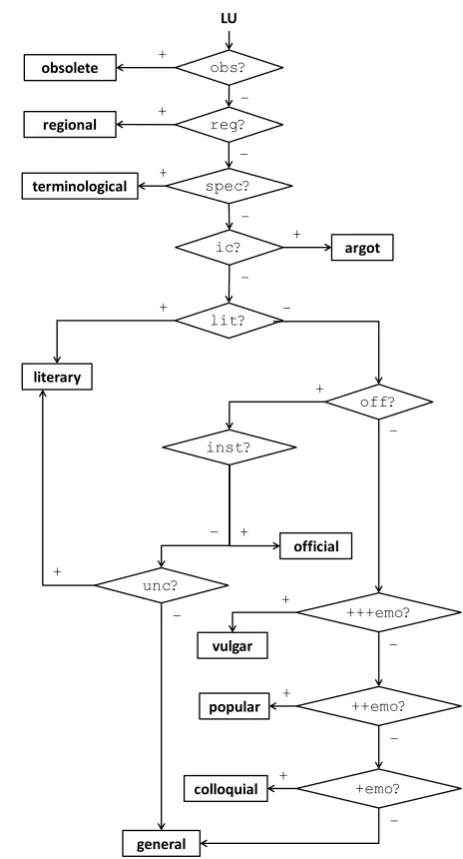
To help plWordNet editors maintain consis-tency, we have designed a series of substitution tests in the form of a decision tree. The editor systematically inspects the semantic features
±spec, ±off and ±emo for a given LU, as well as more specific pragmatic features. The tree appears in Figure 2. Consider Example 1 (the prerequisite is italicised, the actual test is set in roman):
Example 1(regional)
Test. The LUpyra‘potato’may have equivalents in other regions of Poland or in general language. The Poles know the LU pyra and recognise it as re-gional.9
The test is applied right after the diachronic cri-terion (Figure 2,obs). If the prerequisite and the test proper both hold, the LUpyrais marked as
8
Such language develops around any bureaucracy.
9It is used in Greater Poland.
LU
obsolete
regional
+
–
terminological
argot
literary
–
+
+
official
–
general
vulgar
popular
colloquial
obs?
reg?
spec?
ic? +
+
– –
+ –
+
off?
+++emo?
–
+
–
+
+
+
– lit?
inst?
unc?
–
– ++emo?
+emo?
Figure 2: Substitution tests for markedness in plWordNet. Legend: +++emo = emotionally marked LU unacceptable in most situations (that includes vulgarity),++emo= emotionally marked LU acceptable only in familiar situations,+emo= emotionally marked LU acceptable in some famil-iar situations and when talking to strangers,ic= LU from a slang or argot,inst = LU used only in communication with state institutions, lit = LU used only in literature,obs= used by the el-derly, off = language suitable for official situa-tions,reg= regional LU,spec = LU used only by specialists,unc= LU unsuitable for common communication.
[image:5.595.309.541.65.495.2]Example 2 shows a two-step test: consider a (possibly) vulgar noun first in an unofficial situation of talking to a stranger, and then in a very official situation.
Example 2(vulgar)
Test 1.Imagine that you meet a stranger in the street and talk a while. You have just used the LU skurwiel ‘son of a bitch’. Your interlocutor will most likely think that you are crude.
Test 2. Imagine yourself in the mid-dle of a very official or public situa-tion (you are in the presence of an el-der, your superior, president of the Pol-ish Republic, a professor, a bPol-ishop, or you are being interviewed on TV news). You have just used the LU skurwiel
‘son of a bitch’. Your interlocutor – or TV viewer – will most likely think that you are crude.
The substitution tests are applied in a cascade of filters. An LU which passes through all filters must land in the final bin – the general register.
5 The stability of the substitution tests
To ensure that the marking labels introduced in Section 4 can be applied with sufficient consis-tency, we examined the inter-rater agreement be-tween two plWordNet editors who independently marked a sample of LUs. They were given a docu-ment with detailed guidelines and complete tests, and a spreadsheet with 385 noun LUs randomly drawn from plWordNet (a simple random sample, proper names and gerunds excluded).
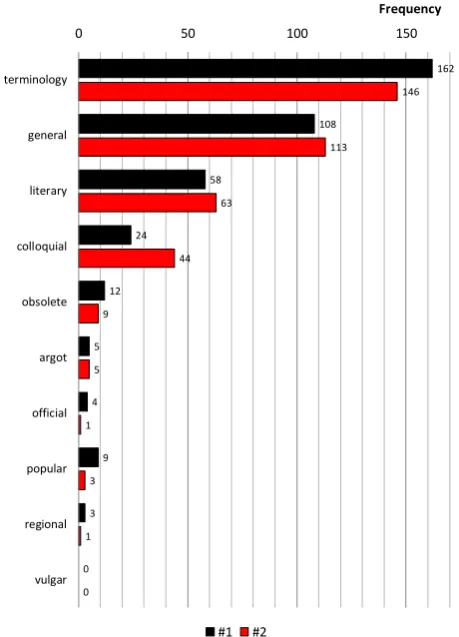
Figure 3 presents the histograms of the counts of marking labels in the 385-LU sample. The most frequently assigned registers are terminology, gen-eral language, and literary and colloquial styles. These four account for more than 90% of the sam-ple. Both editors found terminology to be the most frequent register, and neither found thevulgar la-bel necessary. If we were to extrapolate, we could venture a broad guess on the approximate distribu-tion of register values of LUs in plWordNet:
• 2
5 in the terminology register,
• 1
3 in the general register,
• 1
6 in the literary style,
162
108
58
24
12
5
4
9
3
0
146
113
63
44
9
5
1
3
1
0
0 50 100 150
terminology
general
literary
colloquial
obsolete
argot
official
popular
regional
vulgar
Frequency
[image:6.595.309.539.68.387.2]#1 #2
Figure 3: Counts of stylistic register values in a 385-LU sample from plWordNet, with two raters.
• 121 in the colloquial style,
• 1
12 in the remaining registers.
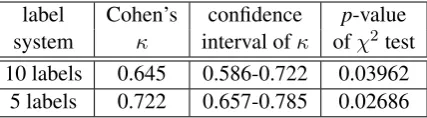
The annotators are in reasonable agreement, as measured by Cohen’s kappa: κ = 0.645 with the confidence interval 0.586-0.722 (Table 1).10 Ac-cording to Landis and Koch (1977, p. 165), the confidence interval covers two values of agree-ment strength: moderate and substantial.
It is commonly assumed that onlyκ≥0.8 guar-antees reliable results in computational linguistics, andκin 0.67-0.8 is tolerable. Reidsma and Car-letta (2007) show that this rule of thumb does not always work. Sometimes lowerκ makes the re-sults reliable, sometimes even κ ≥0.8 does not suffice. The authors recommend checking whether differences between annotators are systematic or random,11so we have decided also to put our data
10The confidence interval was calculated by simple
per-centile bootstrap (DiCiccio and Efron, 1996; DiCiccio and Romano, 1988) suitable for Cohen’sκ(Artstein and Poesio, 2008).
label Cohen’s confidence p-value system κ interval ofκ ofχ2test 10 labels 0.645 0.586-0.722 0.03962
[image:7.595.76.290.62.121.2]5 labels 0.722 0.657-0.785 0.02686
Table 1: Inter-rater agreement of two annotators assigning marking labels to nouns from plWord-Net. Confidence intervals are calculated by the percentile bootstrap method, n = 10000 resam-plings, α = 0.05. P-values are calculated for the
χ2tests of independence. The 10-label system was described in Section 4. The 5-label system equates compatible labels, as described in this section.
through a non-parametricχ2test of independence. Thep-value is 0.03962, so we do not reject the null hypothesis that the plWordNet editors’ choices are distributed similarly at 1% significance level.
The Cohen’s κ value will increase if there are fewer marking labels. One fairly obvious way of doing that is to consider ascompatiblethose mark-ing label bins whose definitions are close; see the decision tree in Figure 2:
• general≈literary≈colloquial,
• official≈terminology≈argot,
• vulgar≈popular.
This boosts Cohen’s kappa to 0.722 with a very good confidence interval of 0.657-0.785. Now the
κis in the area of substantial agreement of Landis and Koch. Theχ2 test for the new labelling sys-tem again leads us to the fortunate assumption that distributions of editor choices are similar at 1% significance level (so none of the editors has any bias). Fewer labels, narrow and high inter-rater agreement, but somewhat less information. . .
6 Conclusions
The model proposed for plWordNet bases the grouping of lexical units (LUs) into synsets on constitutive relations. In order to match the lan-guage data even more accurately, we enriched the definitions of some of the semantic relations. We added constraints which refer to verb aspect, verb semantic classes and registers. Those features play a central role in shaping the wordnet relation struc-ture, so we named them constitutive features.12
the latter it not a threat.
12It is
attributiveinformation in an inherentlyrelational system, but there is no contradiction. This information only
Registers appear to be particularly important, be-cause they characterise all parts of speech covered by plWordNet, and they link the pragmatics of us-age in a simple manner with the lexico-semantic description in the relational paradigm. That is why registers in plWordNet will now explicitly charac-terise LUs.
A review of the linguistic study of registers has suggested a set of ten registers, including the de-fault unmarked register. We have also designed rules for register identification in the form of a decision tree, and made them a mandatory ele-ment of the guidelines for wordnet editors. We ran an annotation experiment in which two lin-guists independently assigned register values to a representative sample. We conclude that LUs can be given register labels with acceptable inter-annotator agreement.
Our wordnet model follows the minimal com-mitment principle. We only consider a small set of homogeneous and quite carefully specified ba-sic notions. The whole system of semantic rela-tions and synsets in a wordnet is directly derived from the linguistic lexico-semantic relations and from language data. The structure of the wordnet is closer to language facts, because it is derived from the lexico-semantic relations between LUs which can largely be observed directly in corpus data. That is why the adopted wordnet model fa-cilitates semi-automated wordnet expansion using knowledge extracted from corpora. The system-atic introduction of registers allows us to take into account elements of pragmatics without giving up the conceptual simplicity of the model.
Acknowledgment
Co-financed by the Polish Ministry of Education and Science, Project CLARIN-PL, and the Eu-ropean Innovative Economy Programme project POIG.01.01.02-14-013/09.
References
Ron Artstein and Massimo Poesio. 2008. Inter-Coder Agreement for Computational Linguistics.
Compu-tational Linguistics, 34(4):555–596.
Danuta Buttler and Andrzej Markowski. 1998. Słown-ictwo wspólnoodmianowe, ksi ˛a˙zkowe i potoczne współczesnej polszczyzny [The general, bookish and colloquial vocabulary of contemporary Polish].
J˛ezyk a Kultura [Language and Culture], 1:179– 203.
Thomas J. DiCiccio and Bradley Efron. 1996. Boot-strap Confidence Intervals. Statistical Science, 11(3):189–212.
Thomas J. DiCiccio and Joseph P. Romano. 1988. A Review of Bootstrap Confidence Intervals. Journal of the Royal Statistical Society. Series B
(Method-ological), 50(3):338–354.
Stanisław Dubisz. 2006. Wst˛ep [introduction]. In Stanisław Dubisz, editor, Uniwersalny słownik j˛ezyka polskiego PWN. Wersja 3.0 (elektroniczna na CD) [A universal dictionary of Polish. Version
3.0 (electronic on CD)]. Polish Scientific Publishers
PWN.
Anna Engelking, Andrzej Markowski, and El˙zbieta Weiss. 1989. Kwalifikatory w słownikach – próba systematyzacji [Qualifiers in dictionaries – an at-tempt to systematise]. Poradnik J˛ezykowy
[Lan-guage Guide], pages 300–309.
Christiane Fellbaum, editor. 1998.WordNet – An
Elec-tronic Lexical Database. The MIT Press.
Franz Josef Hausmann. 1989. Die Markierung im allgemeinen einsprachigen Wörterbuch: eine Über-sicht. In Franz Josef Hausmann, Oskar Reichmann, Herbert Ernst Wiegand, and Ladislav Zgusta, edi-tors, Wörterbücher. Ein internationales Handbuch
zur Lexikographie, volume 5.1, pages 649–657. De
Gruyter.
Paul Heacock, editor. 1995-2011. Cambridge
Dictio-naries Online. Cambridge University Press.
Juliusz Kurkiewicz. 2007. Kwalifikatory w
wielkim słowniku j˛ezyka polskiego [Qualifiers in the great dictionary of Polish]. In Piotr ˙ Zmi-grodzki and Renata Przybylska, editors, Nowe
stu-dia leksykograficzne [New lexicographic studies].
Wydawnictwo Lexis.
J. Richard Landis and Gary G. Koch. 1977. The Measurement of Observer Agreement for Categor-ical Data. Biometrics, 33(1):159–174.
Marek Maziarz, Maciej Piasecki, Stanisław Szpakow-icz, Joanna Rabiega-Wi´sniewska, and Bo˙zena Ho-jka. 2011. Semantic Relations between Verbs in Polish Wordnet 2.0. Cognitive Studies, 11.
Marek Maziarz, Maciej Piasecki, and Stan
Sz-pakowicz. 2012a. An Implementation of a
System of Verb Relations in plWordNet 2.0. In Christiane Fellbaum and Piek Vossen, ed-itors, Proc. 6th International Global Wordnet
Conference, pages 181–188, Matsue, Japan,
January. The Global WordNet Association.
hwww.globalwordnet.org/gwa/proceedings/gwc2012.pdfi.
Marek Maziarz, Stanisław Szpakowicz, and Maciej Pi-asecki. 2012b. Semantic Relations among Adjec-tives in Polish WordNet 2.0: A New Relation Set, Discussion and Evaluation.Cognitive Studies, 12.
Marek Maziarz, Maciej Piasecki, and Stanisław Sz-pakowicz. 2013. The chicken-and-egg problem in wordnet design: synonymy, synsets and constitu-tive relations. Language Resources and Evaluation, 47(3):769–796.
George A. Miller, Richard Beckwith, Christiane Fell-baum, Derek Gross, and Katherine J. Miller. 1993. Introduction to WordNet: an on-line lexi-cal database. Unpublished, one of “Five Papers” hftp://ftp.cogsci.princeton.edu/pub/wordnet/5papers.psi.
Dennis Reidsma and Jean Carletta. 2007. Reliabil-ity measurement without limits. Computational
Lin-guistics, 1(1):1–8.
John Simpson. 2013. Oxford English Dictionary. Ox-ford University Press. hwww.oed.com/i.
Bo Svensén. 2009. A handbook of lexicography: the
theory and practice of dictionary-making.
Cam-bridge University Press.
Piek Vossen. 2002. EuroWordNet General Document Version 3. Technical report, University of Amster-dam.
Piotr ˙Zmigrodzki, editor. 2012. Wielki słownik j˛ezyka polskiego: Zasady opracowania [A great dictionary
of Polish: The principles of compilation]. Institute