research papers
178
https://doi.org/10.1107/S2053229618018314 Acta Cryst.(2019). C75, 178–188Received 23 August 2018 Accepted 24 December 2018
Edited by A. L. Spek, Utrecht University, The Netherlands
Keywords:-stacking; hydrogen bonding; noncolvalent interactions; metallosupra-molecular assembly; crystal structure; coordi-nation compound; group IIB.
CCDC references:1861558; 1861557; 1861556; 1861555; 1861554; 1861553
Supporting information:this article has supporting information at journals.iucr.org/c
The role of
p
–
p
stacking and hydrogen-bonding
interactions in the assembly of a series of
isostruc-tural group IIB coordination compounds
Taraneh Hajiashrafi,a* Roghayeh Zekriazadeh,aKeith J. Flanagan,bFarnoush Kia,a Antonio Bauza´,cAntonio Fronteracand Mathias O. Sengeb*
aDepartment of Chemistry, Faculty of Physics and Chemistry, Alzahra University, PO Box 1993891176, Tehran, Iran, bSchool of Chemistry, SFI Tetrapyrrole Laboratory, Trinity Biomedical Science Institute, Trinity College Dublin, The
University of Dublin, 152–160 Pearse Street, Dublin 2, Ireland, andcDepartment of Chemistry, University of the Balearic Islands, Carretera de Valldemossa km 7.5, 07122 Palma de Mallorca, Illes Balears, Spain. *Correspondence e-mail: [email protected], [email protected]
The supramolecular chemistry of coordination compounds has become an important research domain of modern inorganic chemistry. Herein, six iso-structural group IIB coordination compounds containing a 2-{[(2-methoxy-phenyl)imino]methyl}phenol ligand, namely dichloridobis(2-{(E )-[(2-methoxy-phenyl)azaniumylidene]methyl}phenolato-O)zinc(II), [ZnCl2(C28H26N2O4)],
1, diiodidobis(2-{(E)-[(2-methoxyphenyl)azaniumylidene]methyl}phenolato-O )-zinc(II), [ZnI2(C28H26N2O4)],2, dibromidobis(2-{(E
)-[(2-methoxyphenyl)azan-iumylidene]methyl}phenolato-O)cadmium(II), [CdBr2(C28H26N2O4)], 3,
di-iodidobis(2-{(E)-[(2-methoxyphenyl)azaniumylidene]methyl}phenolato-O )cad-mium(II), [CdI2(C28H26N2O4)],4, dichloridobis(2-{(E
)-[(2-methoxyphenyl)aza-niumylidene]methyl}phenolato-O)mercury(II), [HgCl2(C28H26N2O4)], 5, and
diiodidobis(2-{(E)-[(2-methoxyphenyl)azaniumylidene]methyl}phenolato-O )-mercury(II), [HgI2(C28H26N2O4)], 6, were synthesized and characterized by
X-ray crystallography and spectroscopic techniques. All six compounds exhibit an infinite one-dimensional ladder in the solid state governed by the formation of hydrogen-bonding and – stacking interactions. The crystal structures of these compounds were studied using geometrical and Hirshfeld surface analyses. They have also been studied using M06-2X/def2-TZVP calculations and Bader’s theory of ‘atoms in molecules’. The energies associated with the interactions, including the contribution of the different forces, have been evaluated. In general, the – stacking interactions are stronger than those reported for conventional–complexes, which is attributed to the influence of the metal coordination, which is stronger for Zn than either Cd or Hg. The results reported herein might be useful for understanding the solid-state architecture of metal-containing materials that contain MIIX2 subunits and aromatic organic
ligands.
1. Introduction
Over the last two decades, the supramolecular chemistry of metal-containing compounds has attracted intense attention, due not only to their fascinating structures (Holliday & Mirkin, 2001; Brammer, 2004), but also their potential appli-cations in diverse fields such as medicine (McKinlay et al., 2010; Reedijk, 2009), ion and molecular recognition (Custel-ceanet al., 2012; Busschaertet al., 2015) and catalysis (Wanget al., 2013; Wiesteret al., 2011).
The ultimate goal of supramolecular chemistry is to understand the inherent complexities of the association mechanisms of molecular and ionic building blocks organized through noncovalent intermolecular interactions with pre-scribed properties and functions (Lehn, 1995; Steed &
Atwood, 2013). In the context of metallosupramolecular chemistry (Braga & Grepioni, 2000; Braga et al., 1998), hydrogen bonding (Reedijk, 2013; Azhdari Tehrani et al., 2016) and halogen bonding (Khavasi et al., 2015; Khavasi & Azhdari Tehrani, 2013; Liet al., 2016) have been widely used so far to drive the self-assembly of coordination compounds, because of their directionality and versatility (Politzer et al., 2010; Desiraju, 1998). However, there are some reports that provide evidence suggesting the crucial role of nondirectional intermolecular interactions, such as–stacking (Khavasi & Azizpoor Fard, 2010; Janiak, 2000; Khavasi & Sadegh, 2014; Semeniuc et al., 2010), for designing the supramolecular architecture of metal-containing species in the solid state. In this regard, supramolecular chemists and crystal engineers have explored and studied the use of noncovalent interactions as a key tool for constructing supramolecular architectures of metal-containing building units in the solid state in which X-ray crystallography could provide a detailed picture of the supramolecular structure (Desiraju, 2014; Blake et al., 1999; Ðakovic´ et al., 2018). These studies reveal an undeniable contribution of such noncovalent interactions to the organi-zation and stabiliorgani-zation of the ultimate crystal structures. These studies also revealed that the ultimate supramolecular architecture of self-assembled metal-containing compounds could be affected by various factors, such as ligand and metal geometries (Khavasi et al., 2012; Hajiashrafi et al., 2013), counter-ions (Schottel et al., 2006; Zeng et al., 2010) and reaction conditions (Khavasi & Mohammad Sadegh, 2010; Mahataet al., 2009).
In continuation of our research aimed at understanding the role of noncovalent interactions in the fabrication and self-assembly of metal-containing building blocks (Hajiashrafi et al., 2013, 2016; Kielmann & Senge, 2018), a series of coordi-nation compounds, namely [ZnL2Cl2] (1), [ZnL2I2] (2),
[CdL2Br2] (3), [CdL2I2] (4), [HgL2Cl2] (5) and [HgL2I2] (6),
where L is 2-{[(2-methoxyphenyl)azaniumylidene]methyl}-phenolate, have been synthesized and characterized using X-ray crystallography and different spectroscopic techniques (see Scheme 1). Geometrical, Hirshfeld surface analysis and theoretical calculations reveal the importance of–stacking interactions, as well as hydrogen bonding, in governing the crystal packing of this series of isostructural metal-containing compounds.
2. Experimental
2.1. Materials and apparatus
Chemicals and reagents were purchased from commercial sources. 2-Hydroxybenzaldehyde, 2-methoxyaniline and an-hydrous MII halides, whereM is Zn, Cd and Hg, were pur-chased from Sigma–Aldrich and Merck, and used as received. The Schiff base ligand 2-{[(2-methoxyphenyl)imino]methyl}-phenol (L) was prepared according to a previously reported method (Songet al., 2013). The IR spectra were recorded on a Nicolet FT–IR 100 spectrometer in the range 500–4000 cm 1
N) were performed using an ECS 4010 CHN-O made in Costech, Italy. Melting points were measured by an Electro-thermal 9100 melting-point apparatus and corrected. The measurements were carried out using 10 mg of a powdered sample sealed in aluminium pans with a mechanical crimp.
2.2. Computational methods
The geometries of the complexes included in this study were computed at the M06-2X/def2-TZVP level of theory using the crystallographic coordinates within TURBOMOLE 7.0
(Ahlrichs et al., 1989). We have used the crystallographic coordinates instead of the optimized complexes because we are interested in estimating the binding energies of several assemblies as they stand in the crystal structure, instead of investigating the most favourable geometry for a given complex. The interaction energies were calculated with correction for the basis set superposition error (BSSE) by using the Boys–Bernardi counterpoise technique (Boys & Bernardi, 1970). The ‘atoms-in-molecules’ (AIM) analysis of the electron density was performed at the same level of theory using theAIMAllprogram (Keith, 2013).
2.3. Synthesis and crystallization
The ligand 2-{[(2-methoxyphenyl)imino]methyl}phenol (L) was utilized previously for the preparation of a number of coordination compounds (Songet al., 2013; Gonget al., 2014; Reddyet al., 2003a,b; Li & Yuan, 2012).Lwas synthesized by reacting 2-hydroxybenzaldehyde (0.53 ml, 5 mmol) with 2-methoxyaniline (0.56 ml, 5 mmol) in ethanol. After stirring for 30 min at 323 K, the ligand precipitated from the reaction mixture as an orange powder which was filtered off, washed several times with cold ethanol and normal hexane, and then dried under vacuum.
The six coordination compounds [ZnL2Cl2] (1), [ZnL2I2]
(2), [CdL2Br2] (3), [CdL2I2] (4), [HgL2Cl2] (5) and [HgL2I2]
(6) were synthesized by combining a solution of MX2
research papers
[image:3.610.46.564.90.735.2]180
Hajiashrafiet al. Isostructural group IIB coordination compounds Acta Cryst.(2019). C75, 178–188 Table 1Experimental details.
1 2 3
Crystal data
Chemical formula [ZnCl2(C28H26N2O4)] [ZnI2(C28H26N2O4)] [CdBr2(C28H26N2O4)]
Mr 590.78 773.68 726.73
Crystal system, space group Triclinic,P1 Triclinic,P1 Triclinic,P1
Temperature (K) 100 100 100
a,b,c(A˚ ) 9.1926 (2), 10.6101 (2), 14.8057 (3) 9.2709 (19), 10.020 (2), 16.248 (4) 9.2772 (3), 10.0935 (3), 16.1021 (5)
,,(
) 94.188 (1), 97.716 (1), 114.409 (1) 98.56 (4), 100.50 (4), 110.09 (3) 97.699 (2), 100.586 (2), 111.149 (2)
V(A˚3) 1289.80 (5) 1356.7 (6) 1348.92 (8)
Z 2 2 2
Radiation type MoK MoK MoK
(mm 1) 1.20 3.22 3.81
Crystal size (mm) 0.260.120.11 0.140.070.03 0.270.130.10
Data collection
Diffractometer Bruker SMART APEXII area
detector
Bruker APEXII area detector Bruker APEXII area detector
Absorption correction Multi-scan (SADABS; Bruker,
2016)
Multi-scan (TWINABS; Bruker, 2012)
Multi-scan (TWINABS; Bruker, 2012)
Tmin,Tmax 0.691, 0.747 0.612, 0.746 0.538, 0.745
No. of measured, independent and observed [I> 2(I)] reflections
93163, 11965, 9331 7281, 7281, 4608 10130, 10130, 8342
Rint 0.053 0.116 0.020
(sin/)max(A˚ 1) 0.822 0.606 0.634
Refinement
R[F2> 2(F2)],wR(F2),S 0.035, 0.084, 1.02 0.067, 0.195, 0.99 0.040, 0.126, 1.03
No. of reflections 11965 7281 10130
No. of parameters 336 337 337
No. of restraints 0 174 0
H-atom treatment H-atom parameters
constrained
H-atom parameters constrained
H-atom parameters constrained
max,min(e A˚ 3) 0.77, 0.71 2.19, 1.18 1.04, 0.70
4 5 6
Crystal data
Chemical formula [CdI2(C28H26N2O4)] [HgCl2(C28H26N2O4)] [HgI2(C28H26N2O4)]
Mr 820.71 726.00 908.90
Crystal system, space group Triclinic,P1 Triclinic,P1 Triclinic,P1
Temperature (K) 100 100 100
a,b,c(A˚ ) 9.3200 (3), 10.0498 (3), 16.6239 (5) 9.2456 (4), 10.1510 (4), 15.8499 (6) 9.2783 (14), 10.0060 (15), 16.695 (3)
,,(
) 99.140 (1), 100.528 (1), 109.332 (1) 96.5447 (15), 99.7441 (15),
112.6735 (14)
98.777 (1), 100.296 (1), 109.396 (1)
V(A˚3) 1403.58 (8) 1326.25 (9) 1400.4 (4)
Z 2 2 2
Radiation type MoK MoK MoK
(mm 1) 3.01 6.04 7.74
Crystal size (mm) 0.400.260.14 0.170.140.08 0.380.190.13
Data collection
Diffractometer Bruker SMART APEXII area
detector
Bruker APEXII area detector Bruker APEXII area detector
Absorption correction Numerical (SADABS; Bruker,
2016)
Multi-scan (TWINABS; Bruker, 2012)
Multi-scan (TWINABS; Bruker, 2012)
Tmin,Tmax 0.416, 0.667 0.630, 0.746 0.441, 0.746
No. of measured, independent and observed [I> 2(I)] reflections
110757, 13807, 10917 22779, 22779, 21098 11185, 11185, 10132
Rint 0.055 0.012 0.071
(sin/)max(A˚ 1) 0.838 0.668 0.650
Refinement
R[F2> 2(F2)],wR(F2),S 0.033, 0.067, 1.03 0.022, 0.052, 1.03 0.032, 0.112, 1.08
No. of reflections 13807 22779 11185
No. of parameters 336 337 337
No. of restraints 0 0 0
H-atom treatment H-atom parameters
constrained
H-atom parameters constrained
H-atom parameters constrained
max,min(e A˚ 3
) 1.04, 1.33 1.29, 0.60 1.48, 1.78
the filtrate at room temperature, crystals of complexes 1–6
suitable for X-ray crystallography were obtained (Hope, 1994; Senge, 2000). The coordination compounds were character-ized using X-ray crystallography, FT–IR spectroscopy and elemental analysis.
2.3.1. Analytical data for L. M.p. 330 K. FT–IR (KBr,
/cm 1, selected bands): 3445 (w, broad), 1246 (s), 3061 (w), 1615 (s), 792 (s), 849 (m).
2.3.2. Analytical data for 1. Yield 52%. M.p. 505–507 K. FT–IR (KBr,/cm 1, selected bands): 3679 (w), 3447 (w), 1637 (s), 1525 (m), 1382 (s), 1025 (m), 800 (m), 750 (m). Analysis calculated for C28H26Cl2N2O4Zn (%): C 56.92, H 4.44, N 4.74;
found: C 56.86, H 4.42, N 4.70.
2.3.3. Analytical data for 2. Yield 70%. M.p. 520–522 K. FT–IR (KBr,/cm 1, selected bands): 3676 (w), 3447 (w), 1614 (s), 1542 (m), 1385 (s), 1019 (m), 805 (m), 754 (m). Analysis calculated for C28H26I2N2O4Zn (%): C 43.47, H 3.39, N 3.62;
found: C 43.36, H 3.42, N 3.58.
2.3.4. Analytical data for 3. Yield 54%. M.p. 543–545 K. FT–IR (KBr, /cm 1, selected bands): 3674 (w), 3445 (m), 1620 (s), 1530 (m), 1484 (m), 1383 (s), 1020 (m), 794 (m), 753 (m). Analysis calculated for C28H26Br2CdN2O4(%): C 46.28,
H 3.61, N 3.85; found: C 46.24, H 3.40, N 3.82.
2.3.5. Analytical data for 4. Yield 46%. M.p. 461–463 K. FT–IR (KBr, /cm 1, selected bands): 3679 (w), 3447 (m), 1637 (s), 1520 (m), 1380 (m), 1025 (m), 796 (m), 741 (m). Analysis calculated for C28H26CdI2N2O4(%): C 40.98, H 3.19,
N 3.41; found: C 40.88, H 3.12, N 3.44.
2.3.6. Analytical data for 5. Yield 65%. M.p. 438–440 K. FT–IR (KBr, /cm 1, selected bands): 3675 (w), 3435 (m), 1622 (s), 1534 (m), 1378 (m), 1028 (m), 794 (m), 750 (m). Analysis calculated for C28H26Cl2HgN2O4 (%): C 46.32, H
3.61, N 3.86; found: C 46.28, H 3.62, N 3.92.
[image:4.610.47.564.304.720.2]2.3.7. Analytical data for 6. Yield 70%. M.p. 383–385 K. FT–IR (KBr, /cm 1, selected bands): 3675 (w), 3446 (m), 1630 (s), 1523 (m), 1382 (m), 1018 (m), 796 (m), 738 (w).
Figure 1
Analysis calculated for C28H26HgI2N2O4(%): C 37.00, H 2.88,
N 3.08; found: C 36.94, H 2.80, N 3.10.
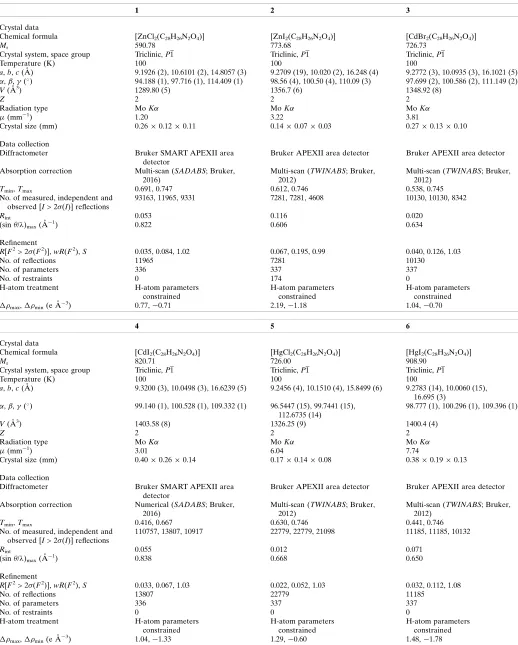
2.4. Refinement
Crystal data, data collection and structure refinement details are summarized in Table 1. C- and N-bound H atoms were placed in their expected calculated positions and refined as riding, with N—H = 0.88 A˚ and C—H = 0.95–0.99 A˚, and withUiso(H) = 1.5Ueq(C) for methyl H atoms and 1.2Ueq(N,C)
otherwise. In the structure of 2, the C and N atoms were restrained to have similar isotropic displacement parameters. Atoms N1A, N1Band C14Bwere restrained to have close to isotropic displacement parameters. The structure was solved as a rotational twin rotated from the first domain by 179.8 about the reciprocal axis 0.002 1.000 0.001 and the real axis 0.434 1.000 0.197. The twin law to converthklfrom the first to this domain (SHELXL TWIN matrix) was 0.999 0.004 0.001, 0.866 0.998 0.395, 0.007 0.003 0.999. The structure of
3was solved as a rotational twin rotated from the first domain by 179.7about the reciprocal axis 0.003 0.997 1.000 and the real axis 0.311 1.000 0.257. The twin law to converthkl
from the first to this domain (SHELXL TWIN matrix) was 1.001 0.001 0.004, 0.498 0.590 0.407, 0.487 1.593 0.589. The structure of 5 was solved as a rotational twin rotated from the first domain by 179.9 about the reciprocal axis 0.001 1.000 0.999 and the real axis 0.345 1.000 0.274. The twin law to convert hkl from the first to this domain (SHELXL TWIN matrix) was 1.000 0.001 0.001, 0.541 0.570 0.431, 0.543 1.570 0.570. The structure of6was solved as a rotational twin rotated from the first domain by 149.8about the reciprocal axis 1.000 0.235 0.787 and the real axis 1.000 0.533 0.319. The twin law to convert hkl from the first to this domain (SHELXLTWIN matrix) was 0.534 0.949 0.308, 0.116 0.693 0.359, 1.269 0.145 0.569.
3. Results and discussion 3.1. Crystal structure analysis
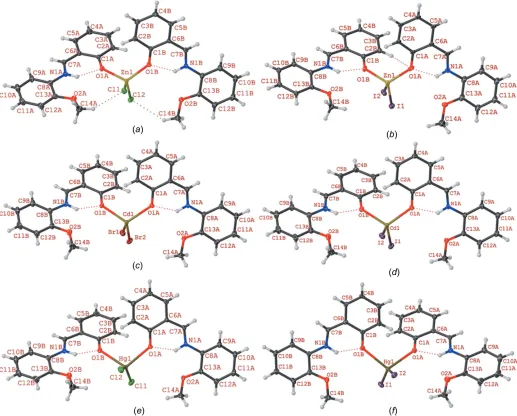
X-ray crystallography revealed that compounds 1–6 are isostructural and crystallize in the triclinic space group P1 (Fig. 1 and Table 1). The asymmetric units of these structures contain twoLligands, two halide ions and a metal ion of group IIB. Crystal structure analysis reveals that in compounds1–6,
theMIIion is in a distorted trigonal pyramidal geometry, with four-coordinate geometry indices, 4 (Yang et al., 2007), of
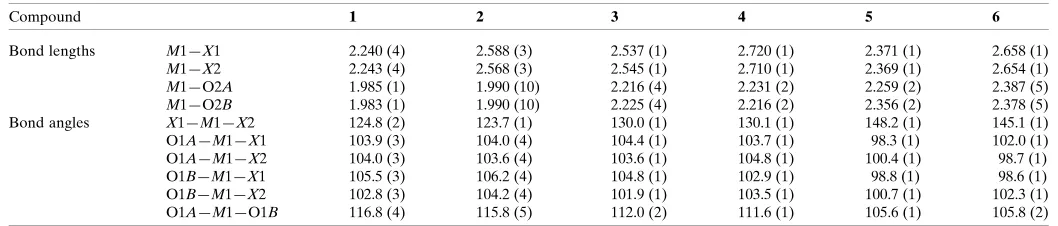
0.83, 0.85, 0.83, 0.84, 0.75, and 0.77, respectively. Selected bond lengths and angles are listed in Table 2 and are in agreement with the values reported for similar compounds (Shkol’nikova
et al., 1970; Gong et al., 2014). The trigonal pyramidal geometry aroundMIIis made up of two halide ions and two phenolate O atoms from two differentLligands. It should be noted that N-salicylideneanilines may exist in different tautomeric forms and the tautomeric isomerization reaction between the enol and keto forms is accompanied by intra- and intermolecular proton transfer (Du¨rr & Bouas-Laurent, 2003; Cohen & Schmidt, 1962; Cohenet al., 1964; Tsuchimotoet al., 2016). The Schiff base ligand L shows a self-isomerization induced by an intramolecular proton transfer from the hy-droxy O to the imine N atom through an O—H N hydrogen bond (Hoshino et al., 1988; Alarco´n et al., 1999). Thus, the ligand is a zwitterion with the negative and positive charges located at atoms O1Band N1B, respectively (Charlandet al., 1989; Redshawet al., 2013; Tsuchimotoet al., 2016; Kargiliet al., 2014). This is supported by the geometry of the ligand and the unambiguous location of the H atom attached to atom N1B. The ligand almost keeps it coplanarity upon coordina-tion; the dihedral angles between the planes of the two aromatic rings of ligand L lie in the range 4.10–10.68 for compounds 1–6 (see supporting information), which is a consequence of intramolecular N—H O hydrogen bonding. In this form, Lcan act as a monodentate ligand, where it is coordinated to the metal ion via the phenolate O atom. It should be noted that at basic pH, theLligand may act as a tridentate ligand through the imine N, phenolate O and methoxy O atoms (Gonget al., 2014; Songet al., 2013; Reddyet al., 2003a).
As shown in Fig. 2, the crystal packing of compounds1–6
consists of mononuclear units which are connected in the crystallographic a direction through a combination of –
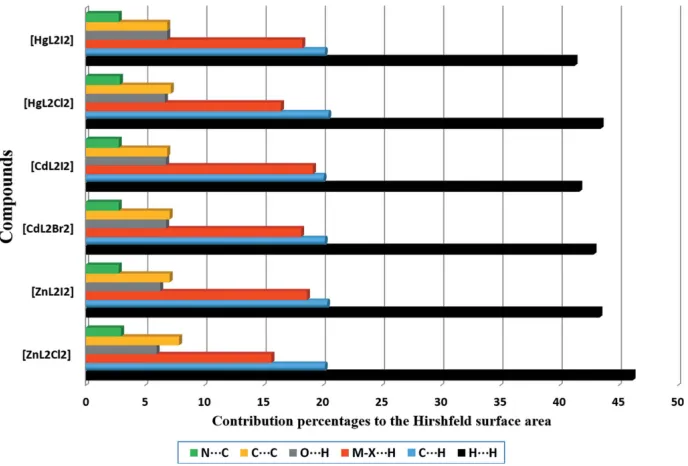
stacking interactions involving the C N group of the ligand and C—H interactions. These units are then linked to other units via C—H X (X = Cl, Br and I) hydrogen-bonding interactions in the bc plane. The intermolecular contacts involved in the crystal packing of compounds1–6can be quantified via Hirshfeld surface analysis (Spackman & Jayatilaka, 2009; Mackenzieet al., 2017). The analysis shows that in compounds 1–6, the H H interactions have the
research papers
[image:5.610.41.570.92.205.2]182
Hajiashrafiet al. Isostructural group IIB coordination compounds Acta Cryst.(2019). C75, 178–188 Table 2Selected bond lengths (A˚ ) and angles () for compounds1–6.
Compound 1 2 3 4 5 6
Bond lengths M1—X1 2.240 (4) 2.588 (3) 2.537 (1) 2.720 (1) 2.371 (1) 2.658 (1)
M1—X2 2.243 (4) 2.568 (3) 2.545 (1) 2.710 (1) 2.369 (1) 2.654 (1)
M1—O2A 1.985 (1) 1.990 (10) 2.216 (4) 2.231 (2) 2.259 (2) 2.387 (5)
M1—O2B 1.983 (1) 1.990 (10) 2.225 (4) 2.216 (2) 2.356 (2) 2.378 (5)
Bond angles X1—M1—X2 124.8 (2) 123.7 (1) 130.0 (1) 130.1 (1) 148.2 (1) 145.1 (1)
O1A—M1—X1 103.9 (3) 104.0 (4) 104.4 (1) 103.7 (1) 98.3 (1) 102.0 (1)
O1A—M1—X2 104.0 (3) 103.6 (4) 103.6 (1) 104.8 (1) 100.4 (1) 98.7 (1)
O1B—M1—X1 105.5 (3) 106.2 (4) 104.8 (1) 102.9 (1) 98.8 (1) 98.6 (1)
O1B—M1—X2 102.8 (3) 104.2 (4) 101.9 (1) 103.5 (1) 100.7 (1) 102.3 (1)
highest priority (the highest contribution to the Hirshfeld surface) and the C—H ,M—X H and–interactions have the next highest priorities, respectively. Also, it has been found that the probability of hydrogen-bonding M—X H interactions involving metal-bound halogen increases for a given metal on going from a lighter to a heavier halogen atom. Selected contribution percentages are shown as a histogram in Fig. 3.
3.2. Theoretical study
Six ML2X2 (M = Zn, Cd or Hg and X = Cl, Br or I)
complexes have been synthesized and characterized by X-ray diffraction analysis (see Fig. 1). The ligand is
mono-coordinated to the metal centre and presents an extended
-system that comprises two phenyl rings and an imino group that connects both aromatic moieties.
The solid-state architecture of all six structures is governed by the formation of -stacking interactions between the aromatic ligands. In particular, each ligand forms infinite one-dimensional (1D) ladders in the crystal packing, as detailed for compounds1,3and5in Fig. 4 as representative systems.
We have focused the theoretical study on a comparison of the energetic features shown by the-stacking and hydrogen-bonding interactions (depending on the type of metal) observed in the crystal packing of compounds1–6described above. In particular, we have analyzed the–and C—H X
[image:6.610.111.500.71.270.2]noncovalent interactions that are crucial to understanding Figure 2
[image:6.610.137.481.498.731.2]Representation of the self-assembly of compounds 1–6, showing the association of discrete units through – stacking interactions in the crystallographicadirection and C—H X(X= Cl, Br and I) hydrogen bonding in thebcplane.
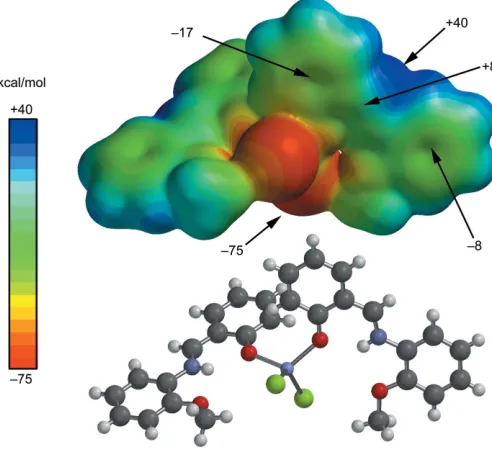
their solid-state architectures. First of all, in order to study the donor–acceptor ability of the ML2X2 complexes, we have
computed the molecular electrostatic potential (MEP) surface of a model system (compound1), which is shown in Fig. 5. As expected, the most negative electrostatic potential corre-sponds to the region of the Cl ligands ( 75 kcal mol 1). The MEP surface also reveals that the N—H group is totally inaccessible since it is involved in an intramolecular hydrogen bond with the O atom of the ligand. Consequently, the most positive part is located in the region of the exocyclic C—H group at the molecular plane, also influenced by the aromatic C—H groups (40 kcal mol 1). Therefore, hydrogen-bonding interactions between these groups (C—H X) should be electrostatically favoured. Furthermore, perpendicular to the molecular plane, we found that each aromatic ring presents negative MEP values ( 17 and 8 kcal mol 1); therefore, face-to-face–stacking interactions are not electrostatically favoured (electrostatic repulsion). Remarkably, the electro-static potential over the -system of the linker (C N) is
positive, thus explaining the large displacement observed in the antiparallel -stacking interactions highlighted in Fig. 4 and further discussed below.
In isostructural Zn compounds1–3, we have computed the interaction energies of the self-assembled -stacked dimers (shown in Fig. 6a) that are responsible for the formation of the 1D ladders shown in Fig. 3. The self-assembled dimers are stabilized by a combination of hydrogen bonds and –
stacking interactions involving the C N group of the ligand. The dimerization energies in1and2(E1 = 33.0 kcal mol 1 andE2 = 31.4 kcal mol 1, respectively) are very large due to the contribution of both hydrogen-bonding (red dashed lines in Fig. 6) and – interactions (blue dashed lines in Fig. 6), where the former involves the most positive (C—H groups, see Fig. 5) and the most negative (belts of the halide ligands) potential regions of the metal compound. In an effort to calculate the contribution of the different forces that govern the formation of the self-assembled dimers, we have computed additional theoretical models where the halide ligands that establish the hydrogen bonds have been replaced by hydride ligands (see Fig. 6b) and consequently the hydrogen-bonding interactions between the halide ligands and the C—H groups are not formed. As a result, the interaction energies are reduced to E3 = 24.8 kcal mol 1 and E4 =
22.5 kcal mol 1 in 1 and 2, respectively. Therefore, the contribution of both symmetrically equivalent hydrogen-bonding interactions can be roughly estimated by the differ-ence (they are 8.2 and 8.9 kcal mol 1for1 and2, respec-tively) and it is similar in both compounds. Furthermore, we have used additional dimers where the ZnCl2group in1or the
ZnI2 group in2 has been removed (see Fig. 6c) in order to
evaluate the influence of the metal coordination on the interaction energy. The resulting interaction energies are
research papers
[image:7.610.45.295.74.476.2]184
Hajiashrafiet al. Isostructural group IIB coordination compounds Acta Cryst.(2019). C75, 178–188 Figure 4Partial view of the X-ray crystal structures in compounds (a)1(Zn), (b)3
(Cd) and (c)5(Hg).
Figure 5
[image:7.610.316.562.490.715.2]almost identical for both complexes (E5 = 14.0 kcal mol 1 andE6 = 14.1 kcal mol 1 for1 and2, respectively) and reveal the strong influence of the metal coordination on the
– stacking interaction. This is likely due to the stronger dipole–dipole interaction in the antiparallel arrangement of the assembly. It is also worthy to mention that the –
interaction energy computed for these compounds is large compared to other -stacking interactions (i.e. benzene dimer). This is due to the special arrangement of the two
-systems where the C N bond is located over the aromatic ring (see the on-top representation in Fig. 6). This fact is in very good agreement with the MEP surface represented in Fig. 5 and explains the large interaction energy since two electrostatically enhanced (CN) interactions are estab-lished.
In Cd compounds3and4, the-stacking binding mode is very similar to that described before for1and2. As mentioned above, hydrogen-bonding and – interactions control the dimer formation (see Fig. 7a). The computed interaction energies of the self-assembled dimers are almost identical (E7 = 30.9 kcal mol 1andE8 = 29.9 kcal mol 1for3
[image:8.610.49.564.70.273.2]and4, respectively), indicating that the halide (Br or I) has a minimal influence on the binding energy. Compared to1and2, the interaction energies are less favourable, thus revealing a larger influence of the Zn ion on the binding energy of the assembly compared to Cd. Also, in both compounds, we have computed theoretical models where the Br or I ligands have been replaced by H atoms and consequently the hydrogen bonds are not formed (see Fig. 7b). As a result, the interaction energies are reduced toE9 = 22.7 kcal mol 1andE10 = Figure 6
[image:8.610.48.565.519.720.2](a) Interaction energies of the self-assembled-stacked dimers observed in the solid state of compounds1and2. (b)/(c) Interaction energies in several theoretical models of1and2. (d) On-top representation of the-stacking interaction. All distances are in A˚ .
Figure 7
21.6 kcal mol 1 in 3 and 4, respectively. Therefore, this contribution (both hydrogen bonds) can be roughly estimated by the difference ( 8.2 and 8.3 kcal mol 1 for
3 and 4, respectively). These values are very close to those found for compounds 1and2, thus indicating that the contribution of the hydrogen bonds is not influenced by the type of transition metal (Zn or Cd). Furthermore, we have used an additional dimer, where the CdBr2and CdI2groups have been removed.
The interaction energies are further reduced to E9 = 13.3 kcal mol 1 andE6 = 13.6 kcal mol 1 for 3and4, respectively, which is in agreement with the Zn complexes, revealing a strong influence of the metal coordination on the strength of the-stacking interaction.
For Hg compounds 5 and 6, we have performed an equivalent study (see Fig. 8). The computed interaction energies of the self-assembled dimers are almost identical (E13 = 28.3 kcal mol 1andE14 = 25.1 kcal mol 1for5
and6, respectively), indicating that Hg has a smaller effect on the interaction energy than Cd and Zn. Also, in both Hg compounds, we have computed theoretical models where the Cl or I ligands have been replaced by H ligands and consequently the hydrogen bonds are not formed (see Fig. 8b). As a result, the interaction energies are reduced toE15 = 19.9 kcal mol 1andE16 = 17.5 kcal mol 1in5and6, respectively. Therefore, this contribution (both hydrogen bonds) can be roughly estimated as 8.4 and 7.6 kcal mol 1
research papers
[image:9.610.50.565.70.273.2]186
Hajiashrafiet al. Isostructural group IIB coordination compounds Acta Cryst.(2019). C75, 178–188 Figure 8(a) Interaction energies of the self-assembled-stacked dimers observed in the solid state of compounds5and6. (b)/(c) Interaction energies in several theoretical models of5and6. All distances are in A˚ .
Figure 9
[image:9.610.105.505.499.723.2]for5and6, respectively. These values are in agreement with those found for compounds 1–4, thus confirming that the interaction energy of the hydrogen bonds is not influenced by the type of transition metal (Zn/Cd/Hg). Furthermore, we have used an additional dimer, where the HgCl2 and HgI2
groups have been eliminated. Consequently, the interaction energies are further reduced toE17 = 13.0 kcal mol 1and
E18 = 12.7 kcal mol 1for5and6, respectively; which is in agreement to the rest of complexes commented on above and confirms the strong influence of the metal coordination on the strength of the-stacking interaction.
In order to provide additional evidence for the existence of the C—H Xhydrogen-bond and–stacking interactions, we have analyzed the self-assembled -stacked dimer of compound3(as an exemplifying model) using Bader’s theory of ‘atoms in molecules’ (AIM) (Bader, 1991), which provides an unambiguous definition of chemical bonding. The AIM theory has been successfully used to characterize and under-stand a great variety of interactions, including those described herein. In Fig. 9 we show the AIM analysis of compound3. It can be observed that the–interaction is characterized by the presence of three bond critical points that interconnect three C atoms of each aromatic ligand. The interaction is further characterized by several ring and cage critical points. Furthermore, the distribution of critical points reveals the existence of two symmetrically disposed sets of C—H Br hydrogen-bonding interactions. Each one is characterized by a bond critical point and a bond path connecting one H atom of the C—H groups with the Br ligand, thus confirming the formation of the trifurcated hydrogen bonds. The value of the Laplacian at the bond critical points is positive, as is common in closed-shell interactions.
4. Conclusion
We herein reported the syntheses and structural character-ization of six new metal complexes based on the 2-{[(2-methoxyphenyl)imino]methyl}phenol ligand. All compounds exhibited an infinite 1D ladder in the solid state governed by the formation of hydrogen-bonding and – stacking inter-actions in the solid state. The crystal structure of these compounds was studied using geometrical and Hirshfeld surface analyses. They have also been studied using M06-2X/ def2-TZVP calculations and Bader’s theory of ‘atoms in molecules’. The energies associated with the interactions, including the contribution of the different forces, have been evaluated. In general, the – stacking interactions are stronger than those reported for conventional–complexes, that is attributed to the influence of the metal coordination, which is stronger for Zn than for either Cd or Hg. The results reported herein might be useful for understanding the solid-state architecture of metal-containing materials that contain
MIIX
2subunits and organic aromatic ligands.
Acknowledgements
The authors gratefully acknowledge financial support from the
Tecnologies de la Informacio´ (CTI) at the UIB for computa-tional facilities.
Funding information
Funding for this research was provided by: Research Council of Alzahra University; Science Foundation Ireland (SFI grant No. IvP 13/IA/1894); MINECO/AEI of Spain (project No. CTQ2017-85821-R, FEDER funds, to AF and AB).
References
Ahlrichs, R., Ba¨r, M., Ha¨ser, M., Horn, H. & Ko¨lmel, C. (1989).Chem. Phys. Lett.162, 165–169.
Alarco´n, S., Pagani, D., Bacigalupo, J. & Olivieri, A. (1999).J. Mol. Struct.475, 233–240.
Azhdari Tehrani, A., Abedi, S. & Morsali, A. (2016).Cryst. Growth Des.17, 255–261.
Bader, R. F. (1991).Chem. Rev.91, 893–928.
Blake, A. J., Champness, N. R., Hubberstey, P., Li, W.-S., Withersby, M. A. & Schro¨der, M. (1999).Coord. Chem. Rev.183, 117–138. Boys, S. F. & Bernardi, F. D. (1970).Mol. Phys.19, 553–566. Braga, D. & Grepioni, F. (2000).Acc. Chem. Res.33, 601–608. Braga, D., Grepioni, F. & Desiraju, G. R. (1998).Chem. Rev.98, 1375–
1406.
Brammer, L. (2004).Chem. Soc. Rev.33, 476–489.
Bruker (2012).TWINABS. Bruker AXS Inc., Madison, Wisconsin, USA.
Bruker (2015).SAINT. Bruker AXS Inc., Madison, Wisconsin, USA. Bruker (2016).APEX3andSADABS. Bruker AXS Inc., Madison,
Wisconsin, USA.
Busschaert, N., Caltagirone, C., Van Rossom, W. & Gale, P. A. (2015). Chem. Rev.115, 8038–8155.
Charland, J., Gabe, E., Khoo, L. & Smith, F. (1989).Polyhedron,8, 1897–1901.
Cohen, M. & Schmidt, G. (1962).J. Phys. Chem.66, 2442–2446. Cohen, M., Schmidt, G. & Flavian, S. (1964).J. Chem. Soc. pp. 2041–
2051.
Custelcean, R., Bonnesen, P. V., Duncan, N. C., Zhang, X., Watson, L. A., Van Berkel, G., Parson, W. B. & Hay, B. P. (2012).J. Am. Chem. Soc.134, 8525–8534.
Ðakovic´, M., Soldin, Zˇ ., Kukovec, B.-M., Kodrin, I., Aakero¨y, C. B., Baus, N. & Rinkovec, T. (2018).IUCrJ,5, 13–21.
Desiraju, G. (1998).Chem. Commun.pp. 891–892. Desiraju, G. R. (2014).Angew. Chem. Int. Ed.53, 604–605.
Dolomanov, O. V., Bourhis, L. J., Gildea, R. J., Howard, J. A. K. & Puschmann, H. (2009).J. Appl. Cryst.42, 339–341.
Du¨rr, H. & Bouas-Laurent, H. (2003). InPhotochromism: Molecules and Systems. Amsterdam: Elsevier.
Gong, D., Wang, B., Jia, X. & Zhang, X. (2014).Dalton Trans. 43, 4169–4178.
Hajiashrafi, T., Kharat, A. N., Love, J. A. & Patrick, B. O. (2013). Polyhedron,60, 30–38.
Hajiashrafi, T., Ziarani, G. M., Kubicki, M., Fadaei, F. T. & Schenk, K. J. (2016).Polyhedron,119, 260–266.
Holliday, B. J. & Mirkin, C. A. (2001).Angew. Chem. Int. Ed.40, 2022–2043.
Hope, H. (1994).Prog. Inorg. Chem.41, 1–19.
Hoshino, N., Inabe, T., Mitani, T. & Maruyama, Y. (1988).Bull. Chem. Soc. Jpn,61, 4207–4214.
Janiak, C. (2000).J. Chem. Soc. Dalton Trans.pp. 3885–3896. Kargili, H., Alpaslan, G., Macit, M., Erdo¨nmez, A. & Bu¨yu¨kgu¨ngo¨r,
O. (2014).Opt. Spectrosc.116, 179–186.
Keith, T. A. (2013).AIMAll. Version 13.05.06. TK Gristmill Software, Overland Park, KS, USA.
Khavasi, H. R. & Azizpoor Fard, M. (2010).Cryst. Growth Des.10, 1892–1896.
Khavasi, H. R., Barforoush, M. M. & Fard, M. A. (2012). CrystEngComm,14, 7236–7244.
Khavasi, H. R. & Mohammad Sadegh, B. M. (2010).Inorg. Chem.49, 5356–5358.
Khavasi, H. R., Norouzi, F. & Azhdari Tehrani, A. (2015). Cryst. Growth Des.15, 2579–2583.
Khavasi, H. R. & Sadegh, B. M. M. (2014).Dalton Trans.43, 5564– 5573.
Kielmann, M. & Senge, M. O. (2018).Angew. Chem. Int. Ed.58, 418– 441.
Lehn, J.-M. (1995). InSupramolecular Chemistry. Weinheim: VCH. Li, B., Zang, S.-Q., Wang, L.-Y. & Mak, T. C. (2016).Coord. Chem.
Rev.308, 1–21.
Li, L. & Yuan, F. (2012).Synth. React. Inorg. Met.-Org. Nano-Met. Chem.42, 994–998.
Mackenzie, C. F., Spackman, P. R., Jayatilaka, D. & Spackman, M. A. (2017).IUCrJ,4, 575–587.
Mahata, P., Prabu, M. & Natarajan, S. (2009).Cryst. Growth Des.9, 3683–3691.
McKinlay, A. C., Morris, R. E., Horcajada, P., Fe´rey, G., Gref, R., Couvreur, P. & Serre, C. (2010).Angew. Chem. Int. Ed.49, 6260– 6266.
Politzer, P., Murray, J. S. & Clark, T. (2010).Phys. Chem. Chem. Phys.
12, 7748–7757.
Reddy, P. A., Nethaji, M. & Chakravarty, A. R. (2003a).Eur. J. Inorg. Chem.pp. 2318–2324.
Reddy, P. A., Nethaji, M. & Chakravarty, A. R. (2003b).Inorg. Chem. Commun.6, 698–701.
Redshaw, C., Walton, M., Clowes, L., Hughes, D. L., Fuller, A. M., Chao, Y., Walton, A., Sumerin, V., Elo, P. & Soshnikov, I. (2013). Chem. Eur. J.19, 8884–8899.
Reedijk, J. (2009).Eur. J. Inorg. Chem.pp. 1303–1312. Reedijk, J. (2013).Chem. Soc. Rev.42, 1776–1783.
Schottel, B. L., Chifotides, H. T., Shatruk, M., Chouai, A., Pe´rez, L. M., Bacsa, J. & Dunbar, K. R. (2006).J. Am. Chem. Soc.128, 5895– 5912.
Semeniuc, R. F., Reamer, T. J. & Smith, M. D. (2010).New J. Chem.
34, 439–452.
Senge, M. O. (2000).Z. Naturforsch. Teil B,55, 336–344. Sheldrick, G. M. (2015a).Acta Cryst.C71, 3–8.
Sheldrick, G. M. (2015b).Acta Cryst.A71, 3–8.
Shkol’nikova, L., Obodovskaya, A. & Shugam, E. (1970).J. Struct. Chem.11, 47–53.
Song, X., Wang, Z., Zhao, J. & Hor, T. A. (2013).Chem. Commun.49, 4992–4994.
Spackman, M. A. & Jayatilaka, D. (2009).CrystEngComm,11, 19–32. Steed, J. W. & Atwood, J. L. (2013). InSupramolecular Chemistry.
London: John Wiley & Sons.
Tsuchimoto, M., Yoshida, N., Sugimoto, A., Teramoto, N. & Nakajima, K. (2016).J. Mol. Struct.1105, 152–158.
Wang, Z. J., Clary, K. N., Bergman, R. G., Raymond, K. N. & Toste, F. D. (2013).Nat. Chem.5, 100–103.
Wiester, M. J., Ulmann, P. A. & Mirkin, C. A. (2011).Angew. Chem. Int. Ed.50, 114–137.
Yang, L., Powell, D. R. & Houser, R. P. (2007).Dalton Trans.pp. 955– 964.
Zeng, F., Ni, J., Wang, Q., Ding, Y., Ng, S. W., Zhu, W. & Xie, Y. (2010).Cryst. Growth Des.10, 1611–1622.
research papers
supporting information
Acta Cryst. (2019). C75, 178-188 [https://doi.org/10.1107/S2053229618018314]
The role of
π–π
stacking and hydrogen-bonding interactions in the assembly of a
series of isostructural group IIB coordination compounds
Taraneh Hajiashrafi, Roghayeh Zekriazadeh, Keith J. Flanagan, Farnoush Kia, Antonio Bauz
á
,
Antonio Frontera and Mathias O. Senge
Computing details
For all structures, data collection: APEX3 (Bruker, 2016); cell refinement: SAINT (Bruker, 2015); data reduction: SAINT
(Bruker, 2015); program(s) used to solve structure: SHELXT (Sheldrick, 2015b); program(s) used to refine structure:
SHELXL2014 (Sheldrick, 2015a); molecular graphics: OLEX2 (Dolomanov et al., 2009); software used to prepare
material for publication: OLEX2 (Dolomanov et al., 2009).
Dichloridobis(2-{(E)-[(2-methoxyphenyl)azaniumylidene]methyl}phenolato-κO)zinc(II) (Compound_1)
Crystal data
[ZnCl2(C28H26N2O4)]
Mr = 590.78 Triclinic, P1
a = 9.1926 (2) Å
b = 10.6101 (2) Å
c = 14.8057 (3) Å
α = 94.188 (1)°
β = 97.716 (1)°
γ = 114.409 (1)°
V = 1289.80 (5) Å3
Z = 2
F(000) = 608
Dx = 1.521 Mg m−3
Mo Kα radiation, λ = 0.71073 Å Cell parameters from 9828 reflections
θ = 2.5–34.0°
µ = 1.20 mm−1
T = 100 K Block, yellow
0.26 × 0.12 × 0.11 mm
Data collection
Bruker SMART APEXII area detector diffractometer
Radiation source: standard sealed X-ray tube, Siemens, KFF Mo 2K -90 C
Graphite monochromator
Detector resolution: 7.9 pixels mm-1
ω scans
Absorption correction: multi-scan (SADABS; Bruker, 2016)
Tmin = 0.691, Tmax = 0.747
93163 measured reflections 11965 independent reflections 9331 reflections with I > 2σ(I)
Rint = 0.053
θmax = 35.7°, θmin = 2.1°
h = −15→15
k = −17→17
l = −24→24
Refinement
Refinement on F2
Least-squares matrix: full
R[F2 > 2σ(F2)] = 0.035
wR(F2) = 0.084
S = 1.02
11965 reflections
336 parameters 0 restraints
Primary atom site location: dual Hydrogen site location: inferred from
neighbouring sites
supporting information
sup-2
Acta Cryst. (2019). C75, 178-188
w = 1/[σ2(F
o2) + (0.037P)2 + 0.6038P]
where P = (Fo2 + 2Fc2)/3
(Δ/σ)max = 0.001
Δρmax = 0.77 e Å−3
Δρmin = −0.71 e Å−3
Special details
Geometry. All esds (except the esd in the dihedral angle between two l.s. planes) are estimated using the full covariance matrix. The cell esds are taken into account individually in the estimation of esds in distances, angles and torsion angles; correlations between esds in cell parameters are only used when they are defined by crystal symmetry. An approximate (isotropic) treatment of cell esds is used for estimating esds involving l.s. planes.
Fractional atomic coordinates and isotropic or equivalent isotropic displacement parameters (Å2)
x y z Uiso*/Ueq
Zn1 0.78269 (2) 0.33923 (2) 0.71660 (2) 0.01225 (4)
Cl1 0.58971 (4) 0.39395 (3) 0.64597 (2) 0.01828 (6)
Cl2 1.05003 (4) 0.46074 (3) 0.72121 (2) 0.01983 (6)
O1A 0.75873 (12) 0.35079 (10) 0.84784 (6) 0.01486 (16)
O1B 0.73799 (11) 0.15246 (9) 0.65301 (6) 0.01458 (16)
O2B 1.01441 (12) 0.27418 (10) 0.49592 (7) 0.01827 (18)
O2A 0.63225 (13) 0.63174 (11) 0.84985 (7) 0.02096 (19)
N1B 0.78530 (13) 0.02994 (11) 0.50462 (7) 0.01276 (17)
H1B 0.8193 0.1044 0.5463 0.015*
N1A 0.73008 (13) 0.51596 (11) 0.97988 (8) 0.01443 (18)
H1A 0.7160 0.4892 0.9204 0.017*
C1B 0.60814 (15) 0.03742 (12) 0.65300 (8) 0.01257 (19)
C1A 0.81909 (14) 0.29733 (12) 0.91128 (8) 0.01229 (19)
C6A 0.83502 (15) 0.34584 (12) 1.00664 (8) 0.01243 (19)
C6B 0.56362 (15) −0.08101 (12) 0.58464 (8) 0.01256 (19)
C7B 0.65395 (15) −0.07798 (13) 0.51344 (8) 0.0135 (2)
H7B 0.6165 −0.1596 0.4695 0.016*
C2A 0.87012 (16) 0.19149 (13) 0.89030 (9) 0.0161 (2)
H2A 0.8635 0.1585 0.8278 0.019*
C2B 0.50596 (15) 0.02403 (13) 0.71897 (9) 0.0149 (2)
H2B 0.5319 0.1006 0.7653 0.018*
C7A 0.79231 (15) 0.45396 (13) 1.03586 (8) 0.0141 (2)
H7A 0.8099 0.4833 1.1001 0.017*
C5B 0.42209 (15) −0.20542 (13) 0.58441 (9) 0.0150 (2)
H5B 0.3934 −0.2833 0.5386 0.018*
C9B 0.85462 (16) −0.07663 (14) 0.37295 (9) 0.0168 (2)
H9B 0.7741 −0.1668 0.3771 0.020*
C5A 0.89772 (16) 0.28629 (14) 1.07591 (9) 0.0168 (2)
H5A 0.9085 0.3192 1.1390 0.020*
C10B 0.95009 (17) −0.05883 (16) 0.30531 (9) 0.0210 (3)
H10B 0.9365 −0.1372 0.2639 0.025*
C13B 0.99865 (15) 0.17174 (14) 0.42983 (8) 0.0152 (2)
C8B 0.87793 (15) 0.03839 (13) 0.43438 (8) 0.0137 (2)
C3B 0.36930 (16) −0.09889 (14) 0.71670 (9) 0.0159 (2)
H3B 0.3030 −0.1051 0.7617 0.019*
H9A 0.7179 0.6228 1.1467 0.023*
C4B 0.32585 (15) −0.21493 (13) 0.64943 (9) 0.0157 (2)
H4B 0.2314 −0.2986 0.6489 0.019*
C8A 0.68327 (16) 0.62282 (13) 1.00706 (9) 0.0156 (2)
C12A 0.58437 (17) 0.79013 (15) 0.95712 (11) 0.0212 (3)
H12A 0.5507 0.8329 0.9095 0.025*
C12B 1.09137 (17) 0.18984 (16) 0.36023 (9) 0.0190 (2)
H12B 1.1710 0.2799 0.3551 0.023*
C4A 0.94279 (18) 0.18186 (15) 1.05275 (10) 0.0200 (2)
H4A 0.9826 0.1412 1.0994 0.024*
C11B 1.06531 (17) 0.07378 (17) 0.29848 (9) 0.0212 (3)
H11B 1.1275 0.0856 0.2508 0.025*
C13A 0.63154 (16) 0.68325 (14) 0.93594 (9) 0.0171 (2)
C14B 1.1425 (2) 0.41087 (15) 0.49745 (11) 0.0254 (3)
H14A 1.1247 0.4457 0.4394 0.038*
H14B 1.2472 0.4054 0.5051 0.038*
H14C 1.1428 0.4747 0.5489 0.038*
C3A 0.92945 (18) 0.13554 (14) 0.95946 (10) 0.0197 (2)
H3A 0.9620 0.0640 0.9435 0.024*
C11A 0.58748 (18) 0.83271 (16) 1.04881 (11) 0.0243 (3)
H11A 0.5563 0.9055 1.0636 0.029*
C14A 0.54557 (19) 0.66647 (16) 0.77481 (10) 0.0231 (3)
H14D 0.5446 0.6152 0.7167 0.035*
H14E 0.5994 0.7672 0.7726 0.035*
H14F 0.4337 0.6407 0.7839 0.035*
C10A 0.63522 (18) 0.77081 (16) 1.11873 (11) 0.0244 (3)
H10A 0.6347 0.8003 1.1808 0.029*
Atomic displacement parameters (Å2)
U11 U22 U33 U12 U13 U23
Zn1 0.01434 (7) 0.01084 (6) 0.01021 (6) 0.00409 (5) 0.00255 (5) 0.00064 (4)
Cl1 0.02136 (14) 0.01873 (13) 0.01582 (13) 0.01077 (12) 0.00027 (10) 0.00101 (10)
Cl2 0.01624 (13) 0.02080 (14) 0.01455 (12) 0.00027 (11) 0.00358 (10) 0.00072 (10)
O1A 0.0187 (4) 0.0185 (4) 0.0116 (4) 0.0114 (3) 0.0037 (3) 0.0040 (3)
O1B 0.0136 (4) 0.0111 (4) 0.0169 (4) 0.0030 (3) 0.0049 (3) −0.0005 (3)
O2B 0.0204 (5) 0.0149 (4) 0.0175 (4) 0.0043 (3) 0.0078 (3) 0.0018 (3)
O2A 0.0278 (5) 0.0268 (5) 0.0172 (4) 0.0195 (4) 0.0053 (4) 0.0057 (4)
N1B 0.0133 (4) 0.0133 (4) 0.0120 (4) 0.0061 (4) 0.0028 (3) 0.0009 (3)
N1A 0.0143 (5) 0.0150 (4) 0.0158 (4) 0.0079 (4) 0.0033 (4) 0.0015 (4)
C1B 0.0127 (5) 0.0121 (5) 0.0132 (5) 0.0058 (4) 0.0018 (4) 0.0015 (4)
C1A 0.0118 (5) 0.0129 (5) 0.0123 (5) 0.0052 (4) 0.0029 (4) 0.0020 (4)
C6A 0.0133 (5) 0.0133 (5) 0.0120 (5) 0.0068 (4) 0.0024 (4) 0.0021 (4)
C6B 0.0132 (5) 0.0108 (4) 0.0131 (5) 0.0048 (4) 0.0018 (4) 0.0010 (4)
C7B 0.0142 (5) 0.0130 (5) 0.0130 (5) 0.0060 (4) 0.0016 (4) 0.0012 (4)
C2A 0.0188 (6) 0.0161 (5) 0.0157 (5) 0.0101 (4) 0.0034 (4) 0.0001 (4)
C2B 0.0147 (5) 0.0153 (5) 0.0152 (5) 0.0068 (4) 0.0037 (4) 0.0008 (4)
supporting information
sup-4
Acta Cryst. (2019). C75, 178-188
C5B 0.0147 (5) 0.0122 (5) 0.0158 (5) 0.0041 (4) 0.0010 (4) 0.0021 (4)
C9B 0.0158 (5) 0.0206 (6) 0.0147 (5) 0.0096 (5) 0.0010 (4) −0.0012 (4)
C5A 0.0198 (6) 0.0176 (5) 0.0136 (5) 0.0089 (5) 0.0016 (4) 0.0035 (4)
C10B 0.0192 (6) 0.0312 (7) 0.0146 (5) 0.0143 (5) 0.0016 (4) −0.0030 (5)
C13B 0.0143 (5) 0.0192 (5) 0.0132 (5) 0.0082 (4) 0.0028 (4) 0.0029 (4)
C8B 0.0129 (5) 0.0187 (5) 0.0112 (5) 0.0085 (4) 0.0022 (4) 0.0020 (4)
C3B 0.0143 (5) 0.0183 (5) 0.0173 (5) 0.0080 (4) 0.0056 (4) 0.0056 (4)
C9A 0.0158 (6) 0.0238 (6) 0.0177 (6) 0.0104 (5) 0.0012 (4) −0.0054 (5)
C4B 0.0134 (5) 0.0139 (5) 0.0188 (5) 0.0043 (4) 0.0029 (4) 0.0050 (4)
C8A 0.0139 (5) 0.0150 (5) 0.0185 (5) 0.0073 (4) 0.0026 (4) −0.0005 (4)
C12A 0.0190 (6) 0.0178 (6) 0.0290 (7) 0.0099 (5) 0.0053 (5) 0.0019 (5)
C12B 0.0176 (6) 0.0262 (6) 0.0154 (5) 0.0103 (5) 0.0058 (4) 0.0064 (5)
C4A 0.0253 (7) 0.0199 (6) 0.0188 (6) 0.0141 (5) 0.0008 (5) 0.0057 (5)
C11B 0.0182 (6) 0.0344 (7) 0.0134 (5) 0.0137 (6) 0.0041 (4) 0.0020 (5)
C13A 0.0157 (5) 0.0161 (5) 0.0205 (6) 0.0075 (4) 0.0048 (4) 0.0018 (4)
C14B 0.0284 (7) 0.0163 (6) 0.0260 (7) 0.0018 (5) 0.0122 (6) 0.0035 (5)
C3A 0.0240 (6) 0.0175 (6) 0.0222 (6) 0.0137 (5) 0.0030 (5) 0.0025 (5)
C11A 0.0191 (6) 0.0202 (6) 0.0334 (8) 0.0105 (5) 0.0020 (5) −0.0050 (5)
C14A 0.0273 (7) 0.0262 (7) 0.0217 (6) 0.0167 (6) 0.0044 (5) 0.0074 (5)
C10A 0.0199 (6) 0.0273 (7) 0.0247 (7) 0.0124 (6) −0.0001 (5) −0.0094 (5)
Geometric parameters (Å, º)
Zn1—Cl1 2.2404 (4) C9B—C10B 1.3912 (19)
Zn1—Cl2 2.2427 (4) C9B—C8B 1.3899 (18)
Zn1—O1A 1.9854 (9) C5A—H5A 0.9500
Zn1—O1B 1.9832 (9) C5A—C4A 1.3707 (19)
O1A—C1A 1.3076 (14) C10B—H10B 0.9500
O1B—C1B 1.3078 (15) C10B—C11B 1.389 (2)
O2B—C13B 1.3550 (16) C13B—C8B 1.4050 (18)
O2B—C14B 1.4376 (17) C13B—C12B 1.3981 (18)
O2A—C13A 1.3516 (16) C3B—H3B 0.9500
O2A—C14A 1.4387 (17) C3B—C4B 1.4053 (18)
N1B—H1B 0.8800 C9A—H9A 0.9500
N1B—C7B 1.3067 (16) C9A—C8A 1.3949 (18)
N1B—C8B 1.4152 (16) C9A—C10A 1.399 (2)
N1A—H1A 0.8800 C4B—H4B 0.9500
N1A—C7A 1.3077 (16) C8A—C13A 1.4008 (19)
N1A—C8A 1.4197 (16) C12A—H12A 0.9500
C1B—C6B 1.4314 (17) C12A—C13A 1.4012 (19)
C1B—C2B 1.4187 (17) C12A—C11A 1.392 (2)
C1A—C6A 1.4338 (17) C12B—H12B 0.9500
C1A—C2A 1.4147 (17) C12B—C11B 1.394 (2)
C6A—C7A 1.4151 (17) C4A—H4A 0.9500
C6A—C5A 1.4213 (17) C4A—C3A 1.404 (2)
C6B—C7B 1.4212 (17) C11B—H11B 0.9500
C6B—C5B 1.4191 (17) C14B—H14A 0.9800
C2A—H2A 0.9500 C14B—H14C 0.9800
C2A—C3A 1.3802 (19) C3A—H3A 0.9500
C2B—H2B 0.9500 C11A—H11A 0.9500
C2B—C3B 1.3814 (18) C11A—C10A 1.382 (2)
C7A—H7A 0.9500 C14A—H14D 0.9800
C5B—H5B 0.9500 C14A—H14E 0.9800
C5B—C4B 1.3742 (18) C14A—H14F 0.9800
C9B—H9B 0.9500 C10A—H10A 0.9500
Cl1—Zn1—Cl2 124.837 (14) O2B—C13B—C12B 125.28 (12)
O1A—Zn1—Cl1 103.90 (3) C12B—C13B—C8B 119.56 (12)
O1A—Zn1—Cl2 104.04 (3) C9B—C8B—N1B 123.25 (12)
O1B—Zn1—Cl1 105.46 (3) C9B—C8B—C13B 120.69 (11)
O1B—Zn1—Cl2 102.79 (3) C13B—C8B—N1B 116.05 (11)
O1B—Zn1—O1A 116.75 (4) C2B—C3B—H3B 119.2
C1A—O1A—Zn1 125.54 (8) C2B—C3B—C4B 121.66 (12)
C1B—O1B—Zn1 125.06 (8) C4B—C3B—H3B 119.2
C13B—O2B—C14B 117.28 (11) C8A—C9A—H9A 120.6
C13A—O2A—C14A 117.02 (11) C8A—C9A—C10A 118.83 (14)
C7B—N1B—H1B 116.9 C10A—C9A—H9A 120.6
C7B—N1B—C8B 126.13 (11) C5B—C4B—C3B 118.97 (12)
C8B—N1B—H1B 116.9 C5B—C4B—H4B 120.5
C7A—N1A—H1A 117.3 C3B—C4B—H4B 120.5
C7A—N1A—C8A 125.41 (11) C9A—C8A—N1A 122.96 (12)
C8A—N1A—H1A 117.3 C9A—C8A—C13A 120.83 (12)
O1B—C1B—C6B 120.27 (11) C13A—C8A—N1A 116.19 (11)
O1B—C1B—C2B 122.41 (11) C13A—C12A—H12A 120.5
C2B—C1B—C6B 117.32 (11) C11A—C12A—H12A 120.5
O1A—C1A—C6A 119.79 (11) C11A—C12A—C13A 119.10 (14)
O1A—C1A—C2A 122.76 (11) C13B—C12B—H12B 120.5
C2A—C1A—C6A 117.45 (11) C11B—C12B—C13B 119.03 (13)
C7A—C6A—C1A 122.46 (11) C11B—C12B—H12B 120.5
C7A—C6A—C5A 117.50 (11) C5A—C4A—H4A 120.3
C5A—C6A—C1A 120.04 (11) C5A—C4A—C3A 119.33 (12)
C7B—C6B—C1B 122.20 (11) C3A—C4A—H4A 120.3
C5B—C6B—C1B 120.17 (11) C10B—C11B—C12B 121.24 (13)
C5B—C6B—C7B 117.60 (11) C10B—C11B—H11B 119.4
N1B—C7B—C6B 124.13 (11) C12B—C11B—H11B 119.4
N1B—C7B—H7B 117.9 O2A—C13A—C8A 115.56 (11)
C6B—C7B—H7B 117.9 O2A—C13A—C12A 124.76 (13)
C1A—C2A—H2A 119.6 C8A—C13A—C12A 119.68 (13)
C3A—C2A—C1A 120.85 (12) O2B—C14B—H14A 109.5
C3A—C2A—H2A 119.6 O2B—C14B—H14B 109.5
C1B—C2B—H2B 119.6 O2B—C14B—H14C 109.5
C3B—C2B—C1B 120.87 (12) H14A—C14B—H14B 109.5
C3B—C2B—H2B 119.6 H14A—C14B—H14C 109.5
N1A—C7A—C6A 124.08 (11) H14B—C14B—H14C 109.5
supporting information
sup-6
Acta Cryst. (2019). C75, 178-188
C6A—C7A—H7A 118.0 C2A—C3A—H3A 119.2
C6B—C5B—H5B 119.5 C4A—C3A—H3A 119.2
C4B—C5B—C6B 121.01 (12) C12A—C11A—H11A 119.4
C4B—C5B—H5B 119.5 C10A—C11A—C12A 121.10 (13)
C10B—C9B—H9B 120.2 C10A—C11A—H11A 119.4
C8B—C9B—H9B 120.2 O2A—C14A—H14D 109.5
C8B—C9B—C10B 119.53 (13) O2A—C14A—H14E 109.5
C6A—C5A—H5A 119.6 O2A—C14A—H14F 109.5
C4A—C5A—C6A 120.74 (12) H14D—C14A—H14E 109.5
C4A—C5A—H5A 119.6 H14D—C14A—H14F 109.5
C9B—C10B—H10B 120.1 H14E—C14A—H14F 109.5
C11B—C10B—C9B 119.87 (13) C9A—C10A—H10A 119.8
C11B—C10B—H10B 120.1 C11A—C10A—C9A 120.43 (14)
O2B—C13B—C8B 115.16 (11) C11A—C10A—H10A 119.8
Zn1—O1A—C1A—C6A 161.78 (9) C2B—C1B—C6B—C5B 0.11 (17)
Zn1—O1A—C1A—C2A −18.43 (17) C2B—C3B—C4B—C5B 0.01 (19)
Zn1—O1B—C1B—C6B 161.25 (9) C7A—N1A—C8A—C9A −6.4 (2)
Zn1—O1B—C1B—C2B −18.45 (16) C7A—N1A—C8A—C13A 174.92 (12)
O1A—C1A—C6A—C7A −2.03 (18) C7A—C6A—C5A—C4A −179.52 (13)
O1A—C1A—C6A—C5A 178.83 (11) C5B—C6B—C7B—N1B 179.18 (12)
O1A—C1A—C2A—C3A −178.39 (13) C9B—C10B—C11B—C12B 2.1 (2)
O1B—C1B—C6B—C7B −1.78 (18) C5A—C6A—C7A—N1A −178.46 (12)
O1B—C1B—C6B—C5B −179.60 (11) C5A—C4A—C3A—C2A −0.8 (2)
O1B—C1B—C2B—C3B 179.73 (12) C10B—C9B—C8B—N1B 179.37 (12)
O2B—C13B—C8B—N1B 2.38 (16) C10B—C9B—C8B—C13B −1.12 (19)
O2B—C13B—C8B—C9B −177.17 (11) C13B—C12B—C11B—C10B −0.4 (2)
O2B—C13B—C12B—C11B 177.94 (12) C8B—N1B—C7B—C6B −179.17 (11)
N1A—C8A—C13A—O2A 0.17 (17) C8B—C9B—C10B—C11B −1.3 (2)
N1A—C8A—C13A—C12A −179.56 (12) C8B—C13B—C12B—C11B −2.06 (19)
C1B—C6B—C7B—N1B 1.32 (19) C9A—C8A—C13A—O2A −178.54 (12)
C1B—C6B—C5B—C4B −0.20 (18) C9A—C8A—C13A—C12A 1.7 (2)
C1B—C2B—C3B—C4B −0.1 (2) C8A—N1A—C7A—C6A 178.78 (12)
C1A—C6A—C7A—N1A 2.4 (2) C8A—C9A—C10A—C11A −0.4 (2)
C1A—C6A—C5A—C4A −0.3 (2) C12A—C11A—C10A—C9A 1.1 (2)
C1A—C2A—C3A—C4A −0.5 (2) C12B—C13B—C8B—N1B −177.62 (11)
C6A—C1A—C2A—C3A 1.40 (19) C12B—C13B—C8B—C9B 2.83 (19)
C6A—C5A—C4A—C3A 1.2 (2) C13A—C12A—C11A—C10A −0.4 (2)
C6B—C1B—C2B—C3B 0.03 (18) C14B—O2B—C13B—C8B 176.51 (12)
C6B—C5B—C4B—C3B 0.14 (19) C14B—O2B—C13B—C12B −3.48 (19)
C7B—N1B—C8B—C9B −10.54 (19) C11A—C12A—C13A—O2A 179.28 (13)
C7B—N1B—C8B—C13B 169.93 (12) C11A—C12A—C13A—C8A −1.0 (2)
C7B—C6B—C5B—C4B −178.11 (12) C14A—O2A—C13A—C8A 165.83 (12)
C2A—C1A—C6A—C7A 178.17 (12) C14A—O2A—C13A—C12A −14.5 (2)
C2A—C1A—C6A—C5A −0.96 (18) C10A—C9A—C8A—N1A −179.64 (13)
Hydrogen-bond geometry (Å, º)
D—H···A D—H H···A D···A D—H···A
N1B—H1B···O1B 0.88 1.96 2.6481 (14) 134
N1A—H1A···O1A 0.88 1.96 2.6424 (14) 134
C7B—H7B···Cl1i 0.95 2.70 3.6118 (13) 160
C7A—H7A···Cl2ii 0.95 2.69 3.5913 (13) 159
C14B—H14C···Cl2 0.98 2.79 3.5845 (16) 138
C14A—H14D···Cl1 0.98 2.71 3.5406 (16) 143
Symmetry codes: (i) −x+1, −y, −z+1; (ii) −x+2, −y+1, −z+2.
Diiodidobis(2-{(E)-[(2-methoxyphenyl)azaniumylidene]methyl}phenolato-κO)zinc(II) (Compound_2)
Crystal data
[ZnI2(C28H26N2O4)]
Mr = 773.68 Triclinic, P1
a = 9.2709 (19) Å
b = 10.020 (2) Å
c = 16.248 (4) Å
α = 98.56 (4)°
β = 100.50 (4)°
γ = 110.09 (3)°
V = 1356.7 (6) Å3
Z = 2
F(000) = 752
Dx = 1.894 Mg m−3
Mo Kα radiation, λ = 0.71073 Å Cell parameters from 4135 reflections
θ = 4.4–51.3°
µ = 3.22 mm−1
T = 100 K Plate, yellow
0.14 × 0.07 × 0.03 mm
Data collection
Bruker APEXII area detector diffractometer
Radiation source: standard sealed X-ray tube, Siemens, KFF Mo 2K -90 C
Graphite monochromator
Detector resolution: 7.9 pixels mm-1
ω and φ scans
Absorption correction: multi-scan (TWINABS; Bruker, 2012)
Tmin = 0.612, Tmax = 0.746
7281 measured reflections 7281 independent reflections 4608 reflections with I > 2σ(I)
Rint = 0.116
θmax = 25.5°, θmin = 2.2°
h = −10→10
k = −12→12
l = −19→19
Refinement
Refinement on F2
Least-squares matrix: full
R[F2 > 2σ(F2)] = 0.067
wR(F2) = 0.195
S = 0.99 7281 reflections 337 parameters 174 restraints
Primary atom site location: dual
Hydrogen site location: inferred from neighbouring sites
H-atom parameters constrained
w = 1/[σ2(F
o2) + (0.1055P)2]
where P = (Fo2 + 2Fc2)/3
(Δ/σ)max < 0.001
Δρmax = 2.19 e Å−3
Δρmin = −1.18 e Å−3
Special details
supporting information
sup-8
Acta Cryst. (2019). C75, 178-188
Refinement. The carbon and nitrogen atoms were fixed using the similarity restraint for Uij (SIMU). Atoms N1A, N1B, and C14B were fixed using the ISOR restraint. The structure was solved as a rotational twin rotated from first domain by 179.8 degrees about reciprocal axis 0.002 1.000 0.001 and real axis 0.434 1.000 0.197. Twin law to convert hkl from first to this domain (SHELXL TWIN matrix): -0.999 0.004 -0.001, 0.866 0.998 0.395, 0.007 0.003 -0.999.
Fractional atomic coordinates and isotropic or equivalent isotropic displacement parameters (Å2)
x y z Uiso*/Ueq
C1A 0.334 (2) 0.3133 (16) 0.8865 (11) 0.0165 (17)
C1B 0.130 (2) 0.0695 (17) 0.6410 (10) 0.0129 (15)
C2A 0.396 (2) 0.2136 (16) 0.8566 (11) 0.0167 (17)
H2A 0.3964 0.1941 0.7976 0.020*
C2B 0.035 (2) 0.0640 (17) 0.7007 (10) 0.0131 (16)
H2B 0.0540 0.1491 0.7425 0.016*
C3A 0.457 (2) 0.1434 (17) 0.9096 (11) 0.0166 (17)
H3A 0.4988 0.0757 0.8867 0.020*
C3B −0.086 (2) −0.0684 (17) 0.6971 (10) 0.0129 (16)
H3B −0.1476 −0.0722 0.7380 0.015*
C4A 0.461 (2) 0.1669 (17) 0.9945 (12) 0.0164 (17)
H4A 0.5043 0.1156 1.0299 0.020*
C4B −0.120 (2) −0.1964 (18) 0.6350 (10) 0.0125 (16)
H4B −0.2036 −0.2844 0.6340 0.015*
C5A 0.402 (2) 0.2647 (16) 1.0300 (11) 0.0165 (17)
H5A 0.4031 0.2802 1.0893 0.020*
C5B −0.030 (2) −0.1933 (18) 0.5759 (10) 0.0126 (15)
H5B −0.0511 −0.2793 0.5342 0.015*
C6A 0.339 (2) 0.3415 (16) 0.9766 (11) 0.0164 (16)
C6B 0.095 (2) −0.0591 (17) 0.5779 (10) 0.0127 (15)
C7A 0.286 (2) 0.4453 (16) 1.0157 (12) 0.0165 (18)
H7A 0.2929 0.4567 1.0755 0.020*
C7B 0.179 (2) −0.0640 (17) 0.5121 (10) 0.0127 (17)
H7B 0.1475 −0.1546 0.4723 0.015*
C8A 0.172 (2) 0.6273 (19) 1.0156 (12) 0.0191 (17)
C8B 0.373 (2) 0.0414 (18) 0.4378 (11) 0.0155 (17)
C9A 0.165 (2) 0.6426 (19) 1.1017 (11) 0.0191 (17)
H9A 0.1964 0.5837 1.1361 0.023*
C9B 0.347 (2) −0.0865 (18) 0.3801 (11) 0.0156 (17)
H9B 0.2717 −0.1770 0.3831 0.019*
C10A 0.110 (2) 0.7469 (18) 1.1353 (12) 0.0195 (17)
H10A 0.0986 0.7564 1.1925 0.023*
C10B 0.430 (2) −0.0809 (17) 0.3198 (11) 0.0158 (17)
H10B 0.4100 −0.1677 0.2791 0.019*
C11A 0.073 (2) 0.8366 (19) 1.0856 (11) 0.0193 (17)
H11A 0.0415 0.9105 1.1105 0.023*
C11B 0.544 (2) 0.0498 (17) 0.3160 (11) 0.0155 (17)
H11B 0.6030 0.0498 0.2740 0.019*
C12A 0.081 (2) 0.8227 (18) 1.0019 (12) 0.0193 (17)
C12B 0.573 (2) 0.1793 (17) 0.3719 (10) 0.0154 (17)
H12B 0.6483 0.2691 0.3679 0.018*
C13A 0.137 (2) 0.7151 (18) 0.9662 (11) 0.0193 (17)
C13B 0.489 (2) 0.1732 (17) 0.4339 (10) 0.0153 (17)
C14A 0.098 (3) 0.776 (2) 0.8298 (12) 0.037 (6)
H14A 0.1086 0.7446 0.7719 0.056*
H14B 0.1618 0.8807 0.8517 0.056*
H14C −0.0139 0.7584 0.8274 0.056*
C14B 0.637 (2) 0.4251 (17) 0.5024 (11) 0.017 (4)
H14D 0.6157 0.4646 0.4518 0.026*
H14E 0.7343 0.4063 0.5057 0.026*
H14F 0.6489 0.4959 0.5544 0.026*
I1 0.06551 (14) 0.45980 (12) 0.65185 (7) 0.0183 (3)
I2 0.58382 (14) 0.53025 (12) 0.73369 (7) 0.0185 (3)
N1A 0.2297 (17) 0.5259 (14) 0.9761 (9) 0.015 (3)
H1A 0.2267 0.5179 0.9211 0.018*
N1B 0.2921 (16) 0.0437 (13) 0.5033 (8) 0.010 (3)
H1B 0.3227 0.1268 0.5411 0.012*
O1A 0.2721 (14) 0.3821 (12) 0.8366 (8) 0.017 (3)
O1B 0.2479 (14) 0.1894 (12) 0.6433 (7) 0.015 (3)
O2A 0.1519 (15) 0.6952 (12) 0.8862 (8) 0.021 (3)
O2B 0.5048 (13) 0.2897 (11) 0.4952 (7) 0.014 (3)
Zn1 0.2884 (3) 0.38214 (19) 0.71687 (14) 0.0131 (4)
Atomic displacement parameters (Å2)
U11 U22 U33 U12 U13 U23
C1A 0.021 (4) 0.006 (3) 0.021 (4) 0.002 (3) 0.008 (3) 0.004 (3)
C1B 0.011 (4) 0.015 (3) 0.013 (3) 0.006 (3) 0.001 (3) 0.001 (3)
C2A 0.021 (4) 0.006 (3) 0.022 (4) 0.002 (3) 0.008 (3) 0.004 (3)
C2B 0.011 (4) 0.015 (3) 0.013 (3) 0.006 (3) 0.001 (3) 0.001 (3)
C3A 0.021 (4) 0.006 (3) 0.022 (4) 0.002 (3) 0.008 (3) 0.005 (3)
C3B 0.011 (4) 0.015 (3) 0.012 (3) 0.006 (3) 0.002 (3) 0.001 (3)
C4A 0.021 (4) 0.006 (3) 0.022 (4) 0.002 (3) 0.009 (3) 0.004 (3)
C4B 0.011 (4) 0.014 (3) 0.012 (3) 0.006 (3) 0.002 (3) 0.002 (3)
C5A 0.021 (4) 0.006 (3) 0.021 (4) 0.002 (3) 0.009 (3) 0.004 (3)
C5B 0.011 (4) 0.014 (3) 0.012 (3) 0.006 (3) 0.002 (3) 0.001 (3)
C6A 0.021 (4) 0.006 (3) 0.021 (4) 0.002 (3) 0.009 (3) 0.005 (3)
C6B 0.011 (4) 0.014 (3) 0.013 (3) 0.006 (3) 0.001 (3) 0.001 (3)
C7A 0.021 (4) 0.007 (3) 0.021 (4) 0.002 (3) 0.008 (3) 0.005 (3)
C7B 0.011 (4) 0.014 (3) 0.013 (3) 0.006 (3) 0.001 (3) 0.001 (3)
C8A 0.011 (4) 0.023 (4) 0.022 (4) 0.010 (3) 0.002 (3) −0.001 (3)
C8B 0.016 (4) 0.017 (3) 0.014 (4) 0.007 (3) 0.005 (3) 0.004 (3)
C9A 0.011 (4) 0.023 (4) 0.022 (4) 0.010 (3) 0.002 (3) −0.002 (3)
C9B 0.016 (4) 0.017 (3) 0.014 (4) 0.006 (3) 0.005 (3) 0.004 (3)
C10A 0.012 (4) 0.024 (4) 0.023 (4) 0.010 (3) 0.002 (3) −0.002 (3)
C10B 0.017 (4) 0.017 (3) 0.014 (4) 0.007 (3) 0.005 (3) 0.003 (3)
supporting information
sup-10
Acta Cryst. (2019). C75, 178-188
C11B 0.016 (4) 0.017 (3) 0.014 (4) 0.007 (3) 0.005 (3) 0.004 (3)
C12A 0.012 (4) 0.023 (4) 0.023 (4) 0.010 (3) 0.002 (3) −0.001 (3)
C12B 0.016 (4) 0.017 (3) 0.014 (4) 0.007 (3) 0.005 (3) 0.004 (3)
C13A 0.012 (4) 0.023 (4) 0.023 (4) 0.010 (3) 0.002 (3) −0.001 (3)
C13B 0.016 (4) 0.017 (3) 0.013 (4) 0.007 (3) 0.005 (3) 0.004 (3)
C14A 0.063 (17) 0.032 (11) 0.027 (11) 0.026 (12) 0.016 (12) 0.009 (9)
C14B 0.018 (4) 0.016 (4) 0.018 (4) 0.007 (3) 0.005 (3) 0.002 (3)
I1 0.0170 (7) 0.0182 (6) 0.0184 (7) 0.0077 (5) 0.0005 (6) 0.0024 (5)
I2 0.0132 (7) 0.0233 (7) 0.0141 (6) 0.0012 (5) 0.0029 (5) 0.0044 (5)
N1A 0.015 (3) 0.014 (3) 0.015 (3) 0.0062 (17) 0.0030 (15) 0.0032 (14)
N1B 0.009 (3) 0.010 (3) 0.009 (3) 0.0029 (16) 0.0028 (14) 0.0020 (14)
O1A 0.011 (7) 0.013 (6) 0.027 (7) 0.008 (5) 0.000 (6) 0.002 (5)
O1B 0.010 (7) 0.013 (6) 0.016 (6) 0.003 (5) 0.002 (5) −0.004 (5)
O2A 0.029 (8) 0.016 (6) 0.020 (7) 0.008 (6) 0.007 (6) 0.008 (5)
O2B 0.015 (7) 0.007 (5) 0.020 (6) 0.000 (5) 0.013 (6) 0.001 (5)
Zn1 0.0137 (10) 0.0132 (10) 0.0115 (9) 0.0043 (9) 0.0032 (7) 0.0021 (7)
Geometric parameters (Å, º)
C1A—C2A 1.39 (2) C8B—N1B 1.41 (2)
C1A—C6A 1.44 (2) C9A—H9A 0.9500
C1A—O1A 1.31 (2) C9A—C10A 1.39 (2)
C1B—C2B 1.42 (2) C9B—H9B 0.9500
C1B—C6B 1.42 (2) C9B—C10B 1.35 (2)
C1B—O1B 1.307 (19) C10A—H10A 0.9500
C2A—H2A 0.9500 C10A—C11A 1.38 (2)
C2A—C3A 1.35 (2) C10B—H10B 0.9500
C2B—H2B 0.9500 C10B—C11B 1.39 (2)
C2B—C3B 1.40 (2) C11A—H11A 0.9500
C3A—H3A 0.9500 C11A—C12A 1.36 (2)
C3A—C4A 1.36 (2) C11B—H11B 0.9500
C3B—H3B 0.9500 C11B—C12B 1.38 (2)
C3B—C4B 1.41 (2) C12A—H12A 0.9500
C4A—H4A 0.9500 C12A—C13A 1.44 (2)
C4A—C5A 1.38 (2) C12B—H12B 0.9500
C4B—H4B 0.9500 C12B—C13B 1.38 (2)
C4B—C5B 1.38 (2) C13A—O2A 1.32 (2)
C5A—H5A 0.9500 C13B—O2B 1.362 (18)
C5A—C6A 1.42 (2) C14A—H14A 0.9800
C5B—H5B 0.9500 C14A—H14B 0.9800
C5B—C6B 1.43 (2) C14A—H14C 0.9800
C6A—C7A 1.41 (2) C14A—O2A 1.44 (2)
C6B—C7B 1.44 (2) C14B—H14D 0.9800
C7A—H7A 0.9500 C14B—H14E 0.9800
C7A—N1A 1.29 (2) C14B—H14F 0.9800
C7B—H7B 0.9500 C14B—O2B 1.453 (18)
C7B—N1B 1.27 (2) I1—Zn1 2.558 (3)
C8A—C13A 1.35 (2) N1A—H1A 0.8800
C8A—N1A 1.43 (2) N1B—H1B 0.8800
C8B—C9B 1.39 (2) O1A—Zn1 1.979 (12)
C8B—C13B 1.41 (2) O1B—Zn1 1.988 (11)
C2A—C1A—C6A 117.4 (16) C10B—C9B—H9B 120.4
O1A—C1A—C2A 123.1 (16) C9A—C10A—H10A 120.0
O1A—C1A—C6A 119.4 (15) C11A—C10A—C9A 120.1 (17)
C2B—C1B—C6B 118.5 (15) C11A—C10A—H10A 120.0
O1B—C1B—C2B 121.5 (15) C9B—C10B—H10B 119.4
O1B—C1B—C6B 120.0 (14) C9B—C10B—C11B 121.1 (16)
C1A—C2A—H2A 119.2 C11B—C10B—H10B 119.4
C3A—C2A—C1A 121.5 (17) C10A—C11A—H11A 118.9
C3A—C2A—H2A 119.2 C12A—C11A—C10A 122.1 (17)
C1B—C2B—H2B 120.5 C12A—C11A—H11A 118.9
C3B—C2B—C1B 119.1 (15) C10B—C11B—H11B 119.3
C3B—C2B—H2B 120.5 C12B—C11B—C10B 121.5 (16)
C2A—C3A—H3A 119.0 C12B—C11B—H11B 119.3
C2A—C3A—C4A 121.9 (17) C11A—C12A—H12A 120.8
C4A—C3A—H3A 119.0 C11A—C12A—C13A 118.4 (16)
C2B—C3B—H3B 118.8 C13A—C12A—H12A 120.8
C2B—C3B—C4B 122.3 (16) C11B—C12B—H12B 121.4
C4B—C3B—H3B 118.8 C11B—C12B—C13B 117.3 (15)
C3A—C4A—H4A 119.7 C13B—C12B—H12B 121.4
C3A—C4A—C5A 120.6 (17) C8A—C13A—C12A 118.6 (16)
C5A—C4A—H4A 119.7 O2A—C13A—C8A 118.3 (15)
C3B—C4B—H4B 120.2 O2A—C13A—C12A 123.0 (16)
C5B—C4B—C3B 119.6 (16) C12B—C13B—C8B 121.4 (15)
C5B—C4B—H4B 120.2 O2B—C13B—C8B 113.5 (14)
C4A—C5A—H5A 120.5 O2B—C13B—C12B 125.1 (14)
C4A—C5A—C6A 119.0 (16) H14A—C14A—H14B 109.5
C6A—C5A—H5A 120.5 H14A—C14A—H14C 109.5
C4B—C5B—H5B 120.3 H14B—C14A—H14C 109.5
C4B—C5B—C6B 119.4 (15) O2A—C14A—H14A 109.5
C6B—C5B—H5B 120.3 O2A—C14A—H14B 109.5
C5A—C6A—C1A 119.5 (15) O2A—C14A—H14C 109.5
C7A—C6A—C1A 123.0 (16) H14D—C14B—H14E 109.5
C7A—C6A—C5A 117.5 (16) H14D—C14B—H14F 109.5
C1B—C6B—C5B 121.1 (15) H14E—C14B—H14F 109.5
C1B—C6B—C7B 123.0 (15) O2B—C14B—H14D 109.5
C5B—C6B—C7B 115.9 (15) O2B—C14B—H14E 109.5
C6A—C7A—H7A 117.6 O2B—C14B—H14F 109.5
N1A—C7A—C6A 124.8 (17) C7A—N1A—C8A 124.4 (15)
N1A—C7A—H7A 117.6 C7A—N1A—H1A 117.8
C6B—C7B—H7B 117.5 C8A—N1A—H1A 117.8
N1B—C7B—C6B 124.9 (16) C7B—N1B—C8B 125.5 (14)
N1B—C7B—H7B 117.5 C7B—N1B—H1B 117.2
supporting information
sup-12
Acta Cryst. (2019). C75, 178-188
C13A—C8A—C9A 122.8 (16) C1A—O1A—Zn1 124.5 (11)
C13A—C8A—N1A 115.1 (15) C1B—O1B—Zn1 123.4 (10)
C9B—C8B—C13B 119.5 (15) C13A—O2A—C14A 118.8 (13)
C9B—C8B—N1B 122.4 (14) C13B—O2B—C14B 116.2 (12)
C13B—C8B—N1B 118.1 (15) I1—Zn1—I2 123.65 (7)
C8A—C9A—H9A 121.1 O1A—Zn1—I1 104.0 (4)
C10A—C9A—C8A 117.8 (17) O1A—Zn1—I2 103.6 (4)
C10A—C9A—H9A 121.1 O1A—Zn1—O1B 115.8 (4)
C8B—C9B—H9B 120.4 O1B—Zn1—I1 106.2 (4)
C10B—C9B—C8B 119.2 (16) O1B—Zn1—I2 104.2 (3)
C1A—C2A—C3A—C4A 0 (3) C9A—C8A—C13A—O2A 177.8 (17)
C1A—C6A—C7A—N1A 0 (3) C9A—C8A—N1A—C7A −3 (3)
C1B—C2B—C3B—C4B −1 (2) C9A—C10A—C11A—C12A 3 (3)
C1B—C6B—C7B—N1B 0 (3) C9B—C8B—C13B—C12B 2 (3)
C2A—C1A—C6A—C5A −2 (2) C9B—C8B—C13B—O2B −178.7 (15)
C2A—C1A—C6A—C7A 176.9 (16) C9B—C8B—N1B—C7B −7 (3)
C2A—C1A—O1A—Zn1 −11 (2) C9B—C10B—C11B—C12B −2 (3)
C2A—C3A—C4A—C5A 0 (3) C10A—C11A—C12A—C13A −3 (3)
C2B—C1B—C6B—C5B −2 (2) C10B—C11B—C12B—C13B 2 (3)
C2B—C1B—C6B—C7B 177.3 (16) C11A—C12A—C13A—C8A 3 (3)
C2B—C1B—O1B—Zn1 −9 (2) C11A—C12A—C13A—O2A −178.6 (17)
C2B—C3B—C4B—C5B 1 (2) C11B—C12B—C13B—C8B −2 (3)
C3A—C4A—C5A—C6A −1 (3) C11B—C12B—C13B—O2B 178.6 (16)
C3B—C4B—C5B—C6B −1 (2) C12A—C13A—O2A—C14A −5 (3)
C4A—C5A—C6A—C1A 2 (2) C12B—C13B—O2B—C14B −9 (2)
C4A—C5A—C6A—C7A −177.2 (15) C13A—C8A—C9A—C10A 4 (3)
C4B—C5B—C6B—C1B 2 (2) C13A—C8A—N1A—C7A 171.6 (17)
C4B—C5B—C6B—C7B −178.0 (15) C13B—C8B—C9B—C10B −2 (3)
C5A—C6A—C7A—N1A 178.4 (16) C13B—C8B—N1B—C7B 175.7 (16)
C5B—C6B—C7B—N1B 179.6 (16) N1A—C8A—C9A—C10A 178.3 (16)
C6A—C1A—C2A—C3A 1 (3) N1A—C8A—C13A—C12A −178.6 (16)
C6A—C1A—O1A—Zn1 169.1 (11) N1A—C8A—C13A—O2A 3 (2)
C6A—C7A—N1A—C8A 177.8 (16) N1B—C8B—C9B—C10B −179.3 (16)
C6B—C1B—C2B—C3B 2 (2) N1B—C8B—C13B—C12B 179.8 (16)
C6B—C1B—O1B—Zn1 170.6 (11) N1B—C8B—C13B—O2B −1 (2)
C6B—C7B—N1B—C8B −178.3 (16) O1A—C1A—C2A—C3A −179.1 (16)
C8A—C9A—C10A—C11A −4 (3) O1A—C1A—C6A—C5A 178.3 (15)
C8A—C13A—O2A—C14A 172.8 (17) O1A—C1A—C6A—C7A −3 (3)
C8B—C9B—C10B—C11B 2 (3) O1B—C1B—C2B—C3B −177.9 (15)
C8B—C13B—O2B—C14B 171.9 (14) O1B—C1B—C6B—C5B 177.7 (15)
C9A—C8A—C13A—C12A −4 (3) O1B—C1B—C6B—C7B −3 (2)
Hydrogen-bond geometry (Å, º)
D—H···A D—H H···A D···A D—H···A
C2B—H2B···O1A 0.95 2.54 3.34 (2) 143