Abstract—A coupled-inductor Cockcroft-Walton-switched- capacitor (CICWSC) inverter is proposed by combining a non- overlapping circuit and sinusoidal pulse-width-modulation (SPWM) controller for boost DC-AC conversion and closed- loop regulation. The power part between source VS and of VO is composed of three sub-circuits, including: (i) coupled-inductor booster (CI booster), (ii) Cockcroft-Walton-switched-capacitor doubler (CWSC doubler),and(iii) half-bridge DC-link, so as to obtain an AC output range:+[(n+1)/(1-D)]VS ~-[(n+1)/(1-D)]VS , where D is the duty cycle and n is the turn ratio of coupled inductor. While D=0.5, n=2, the practical range of VO can be obtained as: +6VS~-6VS. Here, the SPWM is employed not only to enhance regulation capability for the different amplitude and frequency of VO, but also to reinforce robustness to source or loading variation.Finally,the closed-loop CICWSC is designed and simulated by SPICE for cases of steady-state and dynamic responses.All results are illustrated to show the efficacy of the proposed scheme.
Index Terms—coupled-inductor, Cockcroft-Walton-switched- capacitor, sinusoidal pulse-width-modulation, boost DC-AC conversion.
I. INTRODUCTION
n recent years, step-up power converters are widely used as power modules in the portable electronic equipments, e.g. notebooks, smart phones, and pads…etc. The power modules of those products are always asked for some good features: small volume, light weight, high conversion efficiency, and strong regulation capability. Due to magnetic elements used, traditional converters always have a large volume and heavy weight. Thus, more manufactures and researchers pay much attention to this topic, especially for requiring step-up DC- DC/DC-AC converters realized on a compact chip by mixed- mode VLSI technology.
The switched-capacitor (SC) converter is one of the good solutions for high-gain DC-DC/DC-AC conversion. Up to now, the various SC types have been suggested. In 1976, Dickson charge pumping was proposed based on a diode- capacitor chainstructure [1]. In 1990s, Ioinovici proposed a SC with two capacitor cells working complementarily [2-3]. In 2007, Chang presented a CPLD-based implementation of SC step-down DC-DC converter for the multiple output choices [4]. In 2011-2013, Chang et al. proposed a series of
Manuscript received December 1, 2017. This work is supported in part by Ministry of Science and Technology of Taiwan, R.O.C., under Grant MOST 106-2221-E-324-003. Yuen-Haw Chang and Kai-Lin Hsu are with the Department of Computer Science and Information Engineering, Chaoyang University of Technology, Taichung, Taiwan, R.O.C. Post code: 413. (email:
[email protected], [email protected]).
multistage multiphase SC step-up/down DC-DC/DC-AC converter/inverter [5-8]. In 2014, Chang et al. proposed a 2-stage 4-phase SC-based boost DC-AC inverter by using sinusoidal PFM control [9]. In 2015, Chang et al. proposed a closed-loop high-gain switched-capacitor-inductor-based boost DC-AC inverter [10].
To obtain a higher voltage gain, it is one of the good ways by using the turn ratio and/or extra winding stage of the coupled inductor. Nevertheless, the stress on transistors and the volume of magnetic device must be considered. In 2015, Chen et al. proposed a coupled-inductor boost integrated flyback converter including high-voltage gain and ripple-free input current [11]. Bahrami et al. suggested a modified step-up boost converter with coupled-inductor and super-lift techniques [12]. Chen et al. proposed a novel switched- coupled-inductor step-up converter and its derivatives [13]. Wu et al. proposed a nonisolated high step-up DC-DC converter adopting switched-capacitor cell [14]. Nouri et al. proposed an interleaved high-gain step-up DC-DC converter based on three-winding high-frequency coupled-inductor and voltage-multiplier cell [15]. In 2016, Chang et al. proposed a novel coupled-inductor switched- capacitor inverter for high-gain boost DC-AC conversion [16]. In 2017, Chang et al. proposed a novel coupled-inductor switched-capacitor inverter for high-gain boost DC-AC conversion [17]. In this paper, the authors make an attempt on combining Cockcroft- Walton SC circuit with one coupled inductor to propose a closed-loop CICWSC inverter for boost DC-AC conversion and regulation.
II. CONFIGURATION OF CICWSCINVERTER
Fig. 1 shows the coupled-inductor Cockcroft-Walton- switched-capacitor (CICWSC) inverter proposed, and it contains two major parts: power and control part for achieving the boost DC-AC conversion and closed-loop regulation. These two parts are discussed as follows.
A. Power Part
The power part of this inverter as in the upper half of Fig. 1 contains a coupled-inductor booster (CI booster), a Cockcroft -Walton-switched-capacitor doubler (CWSC doubler), and a half-bridge DC-link, in cascaded connection between supply
VS and output VOUT . Firstly, the front-stage circuit composed
of CI booster and CWSC doubler is in charge of step-up DC-DC conversion. It includes switch S1, diodes D1-D4,
coupled-inductor L1, L2, clamping capacitor C1, pumping
capacitors C2, C3, and C4, where it is assumed that same
capacitance C (C2=C3=C4=C). The coupled-inductor L1 and
A Closed-Loop Coupled-Inductor
Cockcroft-Walton-Switched-Capacitor Inverter
for Boost DC-AC Conversion
Yuen-Haw Chang and Kai-Lin Hsu
L2 is modeled as an ideal transformer with a turn ratio of n
(n=N2/N1). The main function of this front stage is to raise the
voltage gain up to [2(n+1)/(1-D)] at most from supply VS to
capacitor voltage (VC2+VC4), where D (0<D<1) is the duty
cycle and DTS is the period of charging this coupled inductor
in a switching cycle TS (TS=1/fS, fS is the switching frequency).
Secondly, the rear-stage circuit: half-bridge DC-link is to handle DC-AC inverter. It include switches SA, SB, half-
bridge capacitors C2, C4, filter capacitor CL, and load RL.
With the help of SA and SB in the half-bridge, the maximum
range of the AC output VOUT can reach: +[(n+1)/(1-D)]VS ~
-[(n+1)/(1-D)]VS. Fig. 2 shows the theoretical waveforms
within an output cycle TO (TO=1/fO, fO is the output
frequency). Here, for the convenience of explanation, one TO
contains 11 (or above actually) switching cycle TS. Each TS
has two phases: Phases I and II with the different periods DTS
and (1-D)TS. The detailed operations are discussed as
follows. 1) Phase I:
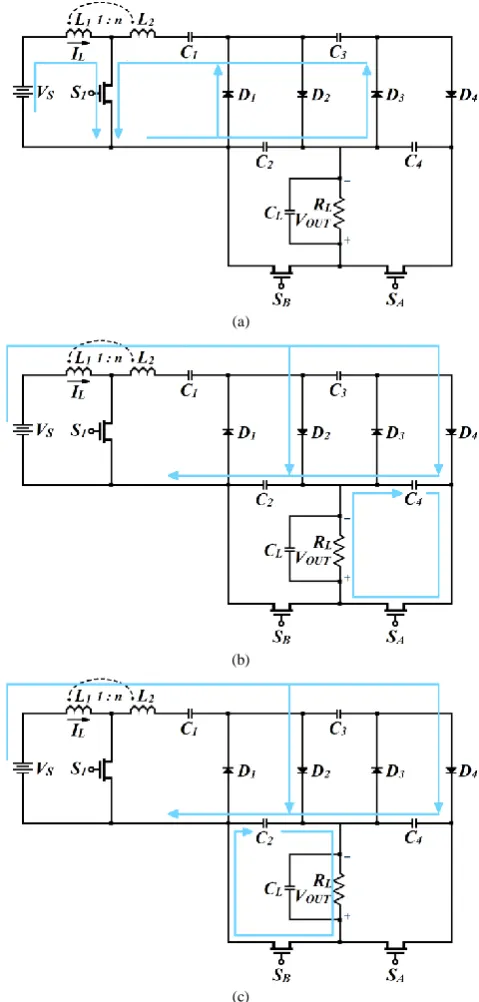
During this time interval, turn ON S1 and turn OFF SA, SB. Then, diodes D1, D3 are turned ON, and D2, D4 are
OFF. The relevant topology is shown in Fig. 3(a). The inductor L1 is charged by supply VS, and simultaneously
the energy is transferred from the primary side of this
coupled inductor to the secondary side for making the inductor voltages as: VL1=+VS, VL2=-nVS.And then, the
clamping capacitor C1 is charged by VL2 so as to lift VC1
towards the value of nVS. Also, the pumping capacitor C3 is charged with the total loop volatge of VL2, VC1, VC2
so as to boost VC3 towards [(n +1)/(1- D)]VS.
2) Phase II:
During this time interval, SA or SB is turned ON and S1
is turned OFF. Then, diodes D2, D4 are turned ON, and D1, D3 are turned OFF. According to the theory of the
booster, the steady-state voltage VL1 across L1 is going
towards the value of -[D/(1-D) ]VS based on duty cycle D, and thus the voltage VL2 across L2 in the secondary
side is approaching the value of +[nD/(1-D)] VS.
(i) While SA is ON:
The relevant topology is shown in Fig. 3(b). The capacitors C2 and C4 are charged by VS, VL1, VL2, VC1 in series, and together plus VC3 and VC2,
respectively. At the same time, C4 is discharged to
supply the energy to CL and RL.
(Output range of VOUT: 0~
+
Fig. 2. Theoretical waveforms of closed-loop CICWSC Inverter.
(a)
(b)
(c)
Fig. 3. Topologies for Phase (a) I, (b) II (SA:ON), and (c) II (SB:ON).
(ii) While SB is ON:
The relevant topology is shown in Fig. 3(c). The capacitors C2 and C4 are charged by VS, VL1, VL2, VC1 in series, and together plue VC3 and VC2,
respectively. At the same time, C2 is discharged to
supply the energy to CL and RL.
(Output range of VOUT: 0~−
𝑛+1 1−𝐷 VS)
Based on the cyclical operations of Phase I and II, the overall step-up gain can reach to the value of (n+1)/(1-D) (from VS to VC2 or VC4). Further, with the help of the half-
[image:3.595.57.283.67.732.2]B. Control Part
The control part of CICWSC inverter is composed of a phase generator and a SPWM controller as in the lower half of Fig. 1. The operations of these two blocks are discussed as follows. Firstly, an adjustable voltage VD is compared with a
ramp function VRP to produce a non-symmetrical clock signal U0. And then, this clock is sent to the non-overlapping circuit
so as to obtain a set of phase signals Φ1 and Φ2. Here, Φ1 is
taken as the driver signal of S1. Thus, D is exactly the ON-time
ratio (duty cycle) of S1, and DTS (period of Phase I) can be
regulated by the value of VD. Secondly, from the controller
signal flow, the output voltage VOUT is attenuated and fed
back into the OP-amp low-pass filter (LPF) for high- frequency noise rejection. Next, by using an extra DC-shift of
VC, the output signal VO is obtained and compared with the
desired output VREF via 4 comparators U1, U2, U3 and U4, and
following by using logic-AND to produce a set of control signals U12, U34 for realizing SPWM. When e>0 and |e| is
raising (e=VREF -VO), the pulse width of U12 is getting bigger.
When e<0 and |e| is raising, the pulse width of U34 is getting
bigger. And then, via the interlock circuit (avoid SA and SB
being 1 simultaneously) plus coming into the phase of Φ2, SA
and SB can be obtained for the SPWM control. The main goal
is to keep VO on following VREF (sinusoidal reference) to
enhance the regulation capability of this proposed inverter. To summarize, based on VO and VREF, the relevant rules of
producing the control/driver signals are listed as below. 1) Φ1, Φ2: non-overlapping antiphase signals from U0;
S1=Φ1.
2) If VD >VRP, then U0=1; If VD<VRP, then U0=0.
3) If VREF >VRP, then U1=1; If VREF<VRP, then U1=0;
If VRP >VO, then U2=1; If VRP<VO, then U2=0;
If VO >VRP, then U3=1; If VO<VRP, then U3=0;
If VRP>VREF, then U4=1;If VRP <VREF, then U4=0.
4) If U1=1 and U2=1, then U12=1 (otherwise U12=0);
If U3=1 and U4=1, then U34=1 (otherwise U34=0).
5) If U12=1 and Φ2=1, then U12S=1 (otherwise U12S=0);
If U34=1 and Φ2=1, then U34S=1 (otherwise U34S=0).
6) SPWM control signals: (^: logic-AND)
SA= U12S, for VREF >VO; SB= U34S, for VREF <VO.
(Interlock : SA ^SB ≠ 1)
III. EXAMPLES OF CICWSCINVERTER
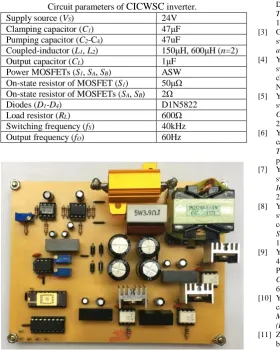
In this paper, the proposed CICWSC is simulated by SPICE, and all the circuit parameters are listed in TABLE I. There are 3 cases for steady-state responses and 4 cases for dynamic responses in total. Then, these results are illustrated to verify the efficacy of the proposed inverter.
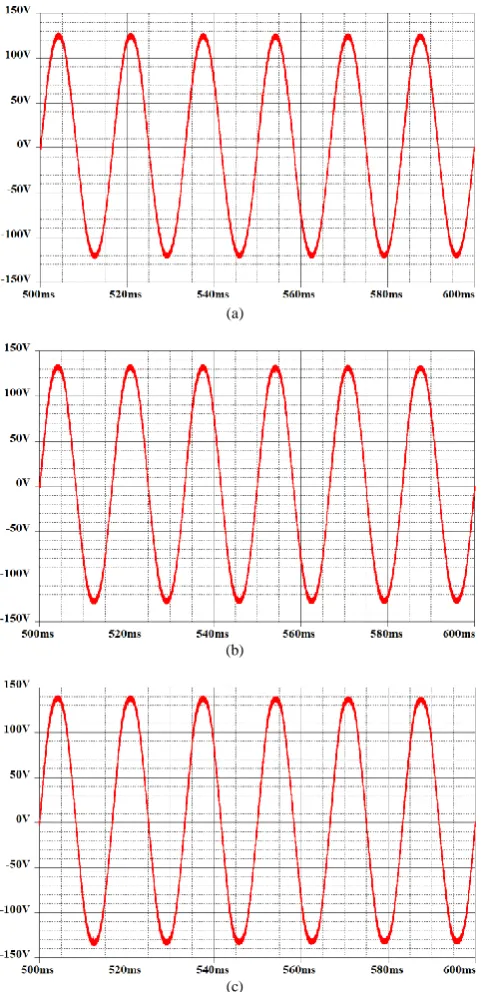
1) Steady-State Responses: Case 1: fO=60 Hz, Vm=125V
Let the supply source VS be DC 24V, load RL be
(a)
(b)
[image:4.595.309.550.49.546.2](c)
Fig. 4. Output VOUT for VREF: (a) fO =60Hz, Vm =125V; (b) fO=60Hz,
Vm=135V; (c) fO =60Hz, Vm=145V.
600Ω, and the peak value and output frequency of
VREF are Vm=125V, fO=60Hz. The waveform of VOUT is obtained as in Fig. 4(a). VOUT has the
practical peak value of 125V (i.e. 88.4VRMS), and
the practical output frequency is about 60Hz. The efficiency is 60.9% and THD is 1.726%..
Case 2: fO=60 Hz, Vm=135V
Let the supply source VS be DC 24V, load RL be
600Ω, and the peak value and output frequency of
VREF are Vm=135V, fO=60Hz. The waveform of VOUT is obtained as in Fig. 4(b). VOUT has the
practical peak value of 134V (i.e. 94.7VRMS), and
Case 3: fO=60 Hz, Vm=145V
Let the supply source VS be DC 24V, load RL be
600Ω, and the peak value and output frequency of
VREF are Vm=145V, fO=60Hz. The waveform of VOUT is obtained as in Fig. 4(c). VOUT has the
practical peak value of 140V (i.e. 99VRMS), and the
practical output frequency is about 60Hz. The efficiency is 74.8% and THD is 3.072%.
2) Dynamic Responses:
Since the voltage of battery is getting low as the battery is working long time, or the bad quality of battery results in the impurity of source voltage, such a variation of source voltage
VS must be considered, as well as variation of load RL and/or
reference VREF (fO or Vm).
Case 1: VS variation
Assume that VS is normally at DC 24V, and then
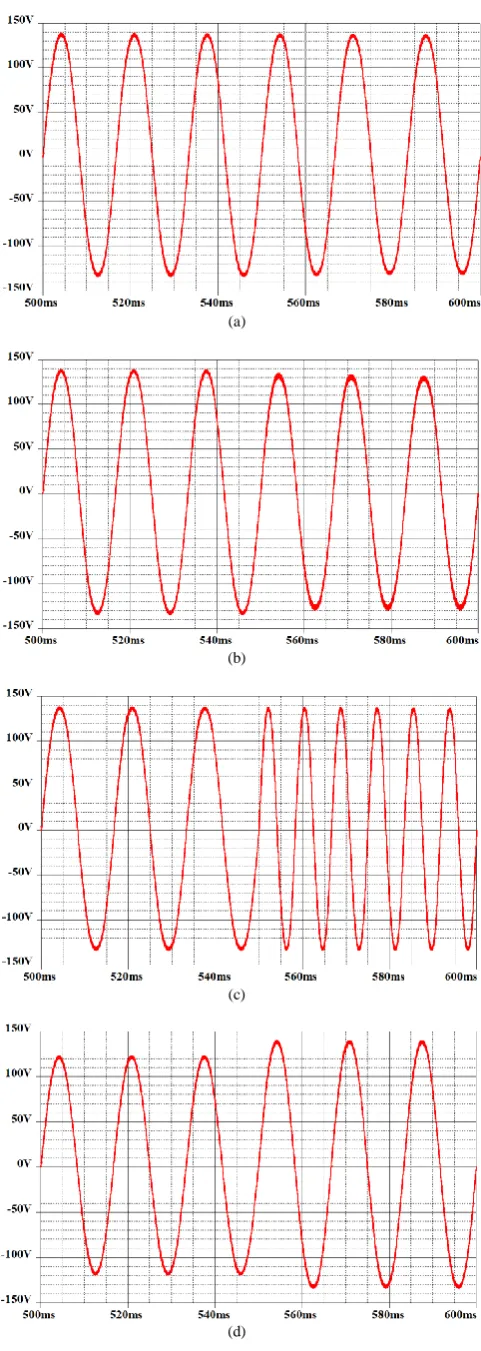
it has an instant voltage drop: 24V→23V on 550ms (VREF: fO=60Hz, Vm=145V). The waveform of VOUT
is shown as in Fig. 5(a). Obviously, VOUT has a
slight decrease into about 138V. Case 2: RL variation
Assume that RL is 600Ω normally, and it suddenly
changes from 600Ω to 300Ω on 550ms (VREF: fO=
60Hz, Vm=145V). Fig. 5(b) shows the transient
waveform of VOUT at the moment of loading
variation. Obviously, VOUT has a small drop but can
still be following VREF.
Case 3: fO variation
Assume that the frequency fO of VREF is 60Hz
normally. After a period of 550ms, and it suddenly changes from 60Hz to 120Hz. Fig. 5(c) shows the transient waveform of VOUT at the moment of
variation: fO =60Hz→120Hz (Vm=145V). Obviously, VOUT is still able to follow VREF even the frequency
of VREF changes.
Case 4: Vm variation
Assume that Vm is 125V normally, After a period
of 550ms, and it changes from 125V to 145V. Fig. 5(d) shows the transient waveform of VOUT at the
moment of variation: Vm=125V→145V. Obviously, VOUT is still able to follow VREF even the amplitude
of the desired VREF changes.
According to the above results, it is obvious that VOUT is
following VREF for the cases, including VS source variation, RL loading variation, fO frequency variation, Vm amplitude
variation. These results show that this proposed inverter has good closed-loop dynamic performances.
(a)
(b)
(c)
[image:5.595.308.549.45.721.2](d)
TABLEI
Circuit parameters of CICWSC inverter.
Supply source (VS) 24V
Clamping capacitor (C1) 47μF
Pumping capacitor (C2-C4) 47uF
Coupled-inductor (L1, L2) 150μH, 600μH (n=2)
Output capacitor (CL) 1μF
Power MOSFETs (S1, SA, SB) ASW On-state resistor of MOSFET (S1) 50μΩ On-state resistor of MOSFETs (SA, SB) 2Ω
Diodes (D1-D4) D1N5822
Load resistor (RL) 600Ω
Switching frequency (fS) 40kHz
Output frequency (fO) 60Hz
Fig. 6. Prototype circuit of CICWSC inverter.
IV. CONCLUSIONS
A novel CICWSC inverter is proposed by combining a non-overlapping circuit and SPWM controller for the high- gain boost DC-AC conversion and closed-loop regulation. Finally, the CICWSC is designed and simulated, and all results are illustrated to show the efficacy of the proposed scheme.The advantages of the scheme are listed as follows. (i) This CICWSC needs just one coupled-inductor element (inductor). Except this, other components (i.e. SC) will be able to be made in IC fabrication future. (ii) This proposed inverter can provide a high voltage gain (from VS to half-
bridge total capacitor voltage) of [2(n+1)/(1-D)] at most. (iii) For a higher gain, it can be realized with increasing the turn ratio of coupled inductor and/or extending the number of pumping capacitors. (iv) The SPWM technique is adopted not only to enhance output regulation capability for the different desired output, but also to reinforce the output robustness against source/loading variation. At present, the prototype circuit of this inverter is implemented in the laboratory as shown in the photo of Fig. 6. Some experimental results will be obtained and measured for the verification of the proposed inverter.
REFERENCES
[1] John F. Dickson, “On-chip high-voltage generation in MNOS integrated circuits using an improved voltage multiplier technique,” IEEE Journal of Solid-State Circuits, vol. 11, no. 3, pp. 374-378, Jun. 1976.
[2] On-Cheong Mak, Yue-Chung Wong and Adrian Ioinovici, “Step-up DC power supply based on a switched-capacitor circuit,” IEEE Transactions on Industrial Electronics, vol. 42, no. 1, pp. 90-97, Feb. 1995.
[3] Guangyong Zhu and Adrian Ioinovici, “Steady-state characteristics of switched-capacitor electronic converters,” Journal of Circuits, Systems and Computers, vol. 7 , no. 2, pp. 69-91, 1997.
[4] Yuen-Haw Chang, “CPLD-based closed-loop implementation of switched-capacitor step-down DC-DC converter for multiple output choices,” IET Electric Power Applications, vol. 1, issue 6, pp. 926-935, Nov. 2007.
[5] Yuen-Haw Chang, “Design and analysis of multistage multiphase switched-capacitor boost DC-AC inverter,” IEEE Transactions on Circuitsand Systems I: Regular paper,vol. 58, no. 1, pp. 205-218, Jan. 2011.
[6] Yuen-Haw Chang, “Variable-conversion-ratio multistage switched- capacitor-voltage-multiplier/divider DC-DC converter,” IEEE Transactions on Circuits and Systems I: Regular paper, vol. 58, no. 8, pp. 1944-1957, Aug. 2011.
[7] Yuen-Haw Chang and Ming-Zong Wu, “Generalized mc x nc -stage switched-capacitor-voltage-multiplier-based boost DC-AC inverter,” International Journal of Electronics, vol. 99, no. 1, pp. 29-53, Jan. 2012.
[8] Yuen-Haw Chang and Yun-Jie Huang, “Closed-loop 7-Level switched-capacitor boost DC-AC inverter with sinusoidal PFM control,” International MultiConference of Engineers and Computer Scientists 2013 (IMECS'2013),vol. 2, Hong Kong,pp. 641-646, Mar. 13-15, 2013.
[9] Yuen-Haw Chang, Chin-Ling Chen and Po-Chien Lo, “2-Stage 4-Phase Switched-Capacitor Boost DC-AC Inverter with Sinusoidal PFM Control,” International MultiConference of Engineers and Computer Scientists 2014 (IMECS'2014), vol. 2, Hong Kong, pp. 673-678, Mar. 12-14, 2014.
[10] Yuen-Haw Chang, Yu-Kai Lin, “A closed-loop high-gain switched- capacitor-inductor-based boost DC-AC inverter,” International MultiConference of Engineers and Computer Scientists 2015 (IMECS'2015), vol. 2, Hong Kong, pp. 694-699, Mar. 18-20, 2015. [11] Zhangyong Chen, Qun Zhou and Jianping Xu, “Coupled-inductor
boost integrated flyback converter with high-voltage gain and ripple- free input current,” IET power Electronics, vol. 8, pp. 213-220, Feb. 2015.
[12] Hamid Bahrami, Hossein Iman-Eini, Babak Kazemi, Alireza Taheri, “Modified step-up boost converter with coupled-inductor and super-lift techniques,” IET power Electronics, vol. 8, pp. 898-905, Jun. 2015. [13] Shih-Ming Chen, Man-Long Lao, Yi-Hsun Hsieh, Tsorng-Juu Liang,
Kai-Hui Chen, “A novel switched-coupled-inductor DC-DC step-up converter and its derivatives,” IEEE Transactions on Industry Applications, vol. 51, no. 1, pp. 309-314, Jan. 2015.
[14] Gang Wu, Xinbo Ruan, Zhihong Ye, “Nonisolated high step-up DC-DC converters adopting switched-capacitor cell,” IEEE Transactions on Industrial Electronics, vol. 32, no. 1, pp. 383-393, Jan. 2015.
[15] Tohid Nouri, Seyed Hossein Hosseini, Ebrahim Babaei and Jaber Ebrahimi, “Interleaved high step-up DC-DC converter based on three-winding high-frequency coupled inductor and voltage multiplier cell,” IET Power Electronics, vol. 8, no. 2, pp. 175-189, Feb. 2015. [16] Yuen-Haw Chang, Jyun-Jia Liao, “A novel coupled-inductor switched-
capacitor inverter for high-gain boost DC-AC conversion,” International MultiConference of Engineers and Computer Scientists 2016 (IMECS'2016), vol. 2, Hong Kong, pp. 603-608, Mar. 16-18, 2016.
[image:6.595.46.327.60.411.2]