119
Change in the Rate and Pattern of
Religious Intermarriage in the
Republic of Ireland
RICHARD O’LEARY* Nuffield College, Oxford
Abstract: Earlier attempts to estimate the rate and to establish the patterns of religious intermarriage
in the Republic of Ireland have been limited by a lack of data. This paper presents new findings on intermarriage using previously unavailable Census of Population and survey data. In addition, it is argued that post-Vatican II changes in Roman Catholic Church teaching on intermarriage have had an observable impact on intermarriages with respect to the types of wedding ceremony and conversions.
I INTRODUCTION
arlierarticles in this journal have addressed the issue of “mixed marriages”
E
in the Republic of Ireland (Walsh, 1970, 1975; Lee, 1985). These refer to Roman Catholic-Protestant marriages. Given that Protestants account for no more than 3 per cent of the total population in the Republic of Ireland, mixed marriages are inevitably relatively few in number. However, the issue of religious intermarriage has assumed much greater importance than would be expected from the small numbers involved. This is in part because of the concerns of theminority religious communities in the Republic of Ireland about the demographic effects of intermarriage, through the children of such marriages dispro-portionately being raised as Catholics.1 These concerns were recently considered by an Irish Government Commission, the Forum for Peace and Reconciliation (see Sexton and O’Leary, 1996). The pattern of intermarriage, in terms of conversions and the participation of intermarried couples in Catholic Church rituals, is also of interest to those concerned about the experience of religious minorities in a society where until recently the overwhelming majority of the population were practicing Catholics.
The earlier research on intermarriage, notably Walsh (1970; 1975) attempted to establish the rate of and some patterns of religious intermarriage. The difficulties surrounding this area of research are considerable and will be discussed in greater detail in the data section of this paper. Within the constraints of the data available at the time, and using an innovative method, Walsh (1975) made a number of claims pertaining to the rate and pattern of intermarriage. Walsh relied on the information on religion and marital status in the published volumes of the Censuses of Population combined with marriage registration records on type of ceremony. Using this data he claimed that in the 1960s in the Republic of Ireland a significant proportion of members of the Church of Ireland were marrying Catholics. In addition, he claimed that a significant proportion of Church of Ireland members married their Catholic partners in Catholic ceremonies. Walsh concluded by calling for further research and advocated a sample survey, designed to measure the proportion of Catholics and Protestants who marry outside their religious group and the extent to which one partner in a mixed marriage is likely to change his or her religion to that of the other partner (1975, p. 554).
The present paper benefits from the availability of both tabulations from the Census of Population and the collection of suitable survey data. The use of Census of Population data to study religious intermarriage is itself problematic but it is argued in this paper that the problems can be overcome. Using this data we will re-assess Walsh’s earlier claims about the rate of intermarriage and the types of marriage ceremony. Having presented the empirical findings we will proceed to consider the relevance of changes in Catholic Church teaching on inter-marriage. Earlier research by Lee (1985) examined the impact of the 1908 Catholic decree Ne Temere. Lee describes how Ne Temere made the presence of a Catholic priest a necessary condition of the validity of any marriage involving a Catholic (1985, p. 15). He concluded that it had a considerable impact on the practice of religious intermarriage. Lee maintains that after Ne Temere a
Catholic-Protestant couple wishing to marry could no longer leave the site of the ceremony to custom or to personal preference (1985, p. 25). In this paper we consider the impact of particular post-Vatican II (1962-1965) Catholic reforms on the practice of religious intermarriage, with respect to the types of wedding ceremony and conversions.
II DATA
Establishing the trend in the rate of intermarriage over time is by no means a straightforward task. The marriage registration certificates required under state law do not obtain information on the religious denomination of the partners, therefore, religious intermarriages cannot be identified in this way. Furthermore, the Churches publish very few details of the religious intermarriages known to them. In any case, the representative nature of Church data has to be estab-lished. Previous attempts by Walsh (1970) to establish the rate of intermarriage were based on his indirect method of comparing published state statistics of the number of weddings in Protestant ceremonies with the Protestant marriage rate obtained from the Census of Population. We will present estimates for the rate of intermarriage which are based on special tabulations from the Census of Population, 1991. Information on Catholic-Protestant intermarriage based directly on Census of Population or random sample survey data was not available prior to the present research. We will in this section describe in detail the suitability of these data.
Census of Population Data
The main advantage of accessing the Census of Population is that it identifies the religion of each person in a household and in this way religious intermarriages can be identified. A second advantage is that it provides information on a large number of persons. This is particularly important when studying a small minority. There are four potential disadvantages when relying on Census data to estimate the rate of religious intermarriage. These are: (i) non-response to the question on religious affiliation, (ii) hidden prior movement between religious group of origin and current religious classification, (iii) the precise meaning of the unspecified “Christian” category, (iv) the difficulty of using cross-sectional Census data to examine changes in intermarriage over time. We will discuss in turn all of these disadvantages.
Non-response
cent of the population declined to give a response to the question on religious affiliation.
Movement Between Religious Group of Origin and Current Religious Classification The use of Census data to ascertain religious group affiliation could be misleading where there is a considerable degree of movement by adult individuals between religious group of origin and current religious classification. This occurs in two main ways: conversions between the Catholic and Protestant denomin-ations and movement into the “no religion” category.
Conversion by one partner in a religious intermarriage could make the marriage appear to be religiously homogamous. In the Republic of Ireland denominational switching is very low among the population generally (Mac Greil, 1996). However, in the past when conversion did occur it appears to have been associated with religious intermarriages (Nic Ghiolla Phadraig, 1976). To quantify the likely effect of hidden conversions on the identification of religious intermarriages in the Census, we accessed appropriate survey data based on a random sample. As we will see later, this enables us to adjust our Census-based estimates to take account of the hidden conversions.
In the 1991 Census the “no religion” category was small (2 per cent). However, couples who by religious group of origin form religious intermarriages may be disproportionately found in the “no religion” category, possibly either indicating the unimportance of religion for them or a strategy for coping with religious difference in a marriage. Our examination of survey data on intermarried couples indicates that approximately one in ten intermarriages may be hidden by the fact that at least one partner no longer declares a religious affiliation (O’Leary, 1998).
The Meaning of the Unspecified “Christian” Religious Category
included unspecified Christians in the Protestant group. In our analysis, by Protestant we refer only to members of the three largest Protestant denomin-ations i.e. members of the Church of Ireland, Presbyterians and Methodists.
Using Census Data to Estimate Changes over Time in the Rate of Intermarriage In using the Census to estimate the rate of intermarriage we must consider the limitations imposed by using cross-sectional data to infer changes over time. Using the rate of intermarriage among older age groups to estimate the rate of entry into intermarriages in earlier decades could be problematic because of migration, conversions and variation in age at marriage. Each of these problems will now be discussed.
The tabulations obtained from the Census only refer to married persons in the population in 1991. The rate of intermarriage found in the population at any point in time is the product of the earlier rate of entry into intermarriage plus migration and conversions. Given that some couples would have married outside the state and later migrated to Ireland, it was decided to obtain tabulations distinguishing those born in the Republic of Ireland (called the native born) and those who were not (called the non-native born).
We found that a large minority of intermarried couples involve a partner who was not born in the Republic of Ireland (O’Leary, 1998). However, the intermarried couples are for the most part of two types — the first type are where both partners are native born, while in the second type the Catholic partner is native born and the Protestant partner is not. The vast majority of native born Protestants who are intermarried are married to native born Catholics. Therefore, we will restrict our analysis to the native born Protestant population. In this way the rate of intermarriage among different age cohorts of native born Protestants can provide a more accurate estimate of their rate of entry into intermarriage.
We have no information on the level of emigration by intermarried couples. According to Fulton (1991, p. 201) couples were known to go to England to marry. However, there is no evidence that couples were physically threatened or that emigration because of intermarriage was usual. For the period up to the mid-1960s there were also high levels of emigration for economic reasons and so the reasons for emigration may be multiple and indistinguishable.
Variation in Age at Marriage
The Census data did not include age at marriage. Therefore, we use birth cohort to estimate when married persons entered their marriages. This method will work best where most people marry within a short age range. Irish marriages are quite suitable in this respect. In the absence of divorce in Ireland until the mid-1990s, relatively few marriages are second marriages formed at older ages. Data on the age at which women marry is available in published statistics on marriage ceremonies. Information on the ages of the bride and groom in marriage ceremonies does not identify their religious group but it does identify the type of religious ceremony.
[image:6.499.72.434.429.605.2]Of marriages solemnised in a Protestant ceremony the majority involve Protestant brides. Therefore, the age of brides in Protestant ceremonies serves as a guide to the age on marriage of Protestant brides generally. The average age for all brides in Ireland, the vast majority of whom are Catholic, is typically a year younger than that for brides in Protestant ceremonies. The following Table 1 gives the percentage distribution of marriages solemnised in a Protestant ceremony (Church of Ireland or Presbyterian only available) according to the age of bride at eight year periods since 1958. A large majority of the brides were aged 20-29 years when they got married. Brides in their twenties accounted for over two-thirds (70.8 per cent) of all brides in 1958 rising to three-quarters (77.4 per cent) of all brides in 1990. The average age of brides was 27 years although it dipped to 25 years in the mid-1970s.
Table 1: Percentage Distribution of Marriages According to Age Group of Bride (Where Marriages were Solemnised in a Protestant Church) by Year of
Ceremony
Year of Ceremony
Age Group of 1958 1966 1974 1982 1990
Bride in Years
% % % % %
< 20 5.7 8.2 8.0 7.3 2.5 20-24 40.8 50.8 53.5 44.3 30.3 25-29 30.0 25.4 26.2 31.4 47.1 30-34 10.1 7.1 7.1 10.2 13.0 35-39 6.7 3.3 2.6 3.3 3.6 40-44 2.9 2.2 1.1 1.2 1.5 45+ 3.8 3.0 1.6 2.2 2.0 Total 100.0 100.0 100.0 100.0 100.0 Average age 27.5 25.9 25.3 26.3 27.5
Given what we know about the age distribution of brides, we can estimate for different birth cohorts of native born married women in the 1991 Census of Population the period in which they typically got married. This is calculated as follows. We take the mid-point of the birth cohort of the female partner; for example, in the case of the 1957-61 cohort this is the year 1959. Given that three-quarters of females marry when aged 20-29, we add to the mid-point the lower marrying age of 20 years and the upper marrying age of 29 years. This gives us our estimate that couples where the female partner was born in 1957-61 typically married in the period between 1979 and 1988.
To sum up, we have acknowledged the disadvantages encountered in using Census of Population data to estimate the rate of entry into intermarriage. We have argued that the problems can be overcome by distinguishing native born Protestants, adjusting for conversions estimated from surveys, and taking advantage of the fact that in Ireland the vast majority of persons marry within a short age range.
Survey Data
The second type of data sought was survey data based on a national random sample. This was considered more desirable than using church contacts as it was hoped to collect information on intermarried couples who would represent the broad range of persons in this category. Survey data could also provide information on religious group of origin and not just on current religious affiliation. This information would allow us to quantify the disadvantage of being reliant on current religious affiliation in the Census data.
Typically Irish national random sample surveys contain 1,000 respondents but this size survey is inadequate for an examination of a small minority. However, the Living in Ireland Household Panel Survey 1995 is unusually large (over three-and-a-half thousand households) and through which it was possible to identify a small number of intermarried couples (n=41) to whom a supplementary questionnaire on marriage was issued. Details of the sampling frame and response rate for the Living in Ireland survey are given in Callan et al. (1996, pp. 129-131). Additional intermarried couples were identified through a monthly Consumer Survey in 1995, with a sampling frame based on the electoral register as was used for the Living in Ireland survey. The information on type of wedding ceremony is obtained from the combination of intermarried couples who completed the marriage questionnaire (n=56) found in these two random sample surveys. Despite the small number of couples, the importance of this data is that these couples are drawn from random samples and should therefore be representative of intermarried couples (further details in O’Leary, 1998).
level of conversions among intermarried couples (n=54) in the population at that time. The Living in Ireland Household Panel Survey was used to estimate the level of conversions among the population in 1995.
III FINDINGS
The Rate of Intermarriage
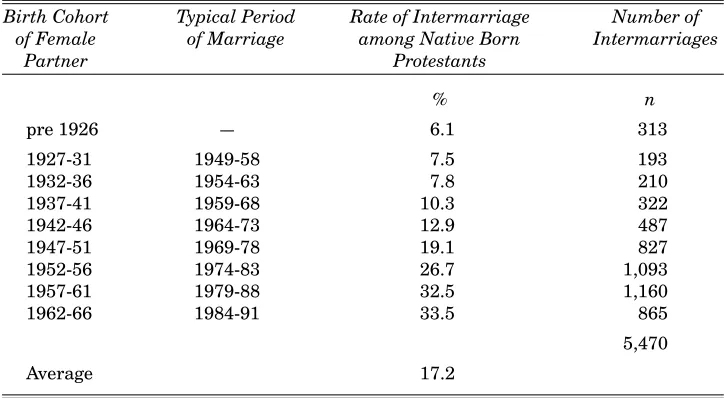
[image:8.499.71.434.339.538.2]Table 2 gives the percentage of native born Protestants who are religiously intermarried as a percentage of all married Protestants.2 The rate is given for Protestants by the birth cohort of the female3 partner as recorded in the 1991 Census. We see that the rate of intermarriage for different birth cohorts varies considerably from the average of 17 per cent. The rate of intermarriage in the 1927-31 cohort is a very low 7.5 per cent. However, it is progressively higher for couples in the younger birth cohorts, rising to 32 per cent in the 1957-1961 birth cohort.4 Bearing in mind that we are dealing with native born Protestants we can reasonably infer that the level of entry into intermarriage was much lower among Protestants in the earlier cohorts.
Table 2: Rate of Intermarriage in the Protestant Population in 1991, by Birth Cohort of the Female Partner
Birth Cohort Typical Period Rate of Intermarriage Number of
of Female of Marriage among Native Born Intermarriages
Partner Protestants
% n
pre 1926 — 6.1 313 1927-31 1949-58 7.5 193 1932-36 1954-63 7.8 210 1937-41 1959-68 10.3 322 1942-46 1964-73 12.9 487 1947-51 1969-78 19.1 827 1952-56 1974-83 26.7 1,093 1957-61 1979-88 32.5 1,160 1962-66 1984-91 33.5 865 5,470 Average 17.2
Source: Calculated from Special Tabulations from the Census of Population, 1991.
2. i.e. Protestants married to either a Protestant or Catholic.
3. This is because the age group given in the census tabulations for couples refers to the female partner.
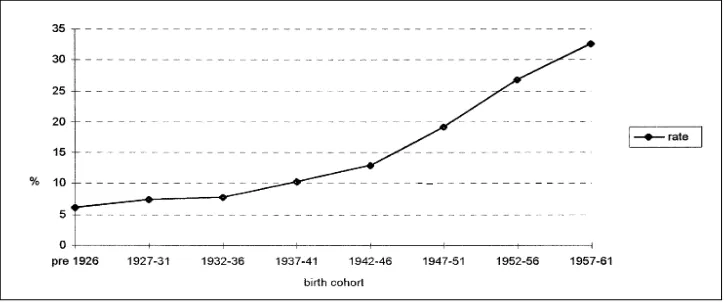
The information in the second data column of Table 2 is reproduced in Figure 1. Referring back to our correspondence between birth cohort and typical period of marriage, it appears that intermarriage has been increasing over time. The increase is especially noticeable among persons born later than 1936, i.e. persons who typically married in about the 1960s. We see that there is a noticeable upsurge in the rate of intermarriage from 7.8 per cent among the 1932-36 cohort to 19.1 per cent among the 1947-51 cohort.
Figure 1: The Rate of Intermarriage in the Native Born Protestant Population in 1991, by Female Birth Cohort
intermarriage. This rate rose sharply in the 1960s and 1970s. By the 1980s about two in every five native born Protestants may have entered an inter-marriage. These rates are even higher for the non-native born and for residents of Dublin (not shown here). Given the trend, the rate is likely to be even higher by the late 1990s.
Type of Wedding Ceremony
Walsh (1975) also claimed on the basis of his calculations that a significant proportion of Church of Ireland members married their Catholic partners in Catholic ceremonies. It might be thought that this practice was very likely given the strict rules of the Catholic Church, whereby up to 1970 it only recognised as valid those marriages entered into by Catholics which were solemnised by the Catholic Church. However, the existence of such rules should not let us assume that they were universally obeyed. For example, among Catholic-Protestant intermarriages in England, Hornsby-Smith (1987) found a sizeable minority of the marriages had not been solemnised by the Catholic Church. Furthermore, we will try to quantify the changing extent of this practice over time by using specially collected survey data.
[image:10.499.86.435.476.580.2]Table 3 shows where the wedding ceremonies of intermarried couples took place as they reported in the 1995 survey. We see that just over a sixth (18 per cent) of intermarried couples were married in registry offices. However, of these ten couples, six were clearly identifiable as having met and married abroad. Of the remaining four couples only one of the marriages had taken place before 1976. This suggests that up to the early 1970s it was uncommon for intermarried couples in Ireland to have a registry office wedding. Additional support for this view lies in the fact that for the whole country, for example in 1963, there were only 78 civil wedding ceremonies (179 by 1973). We have no idea how many of these were intermarriages or native born couples.
Table 3: Place of Wedding Ceremony, as Reported in 1995
Place of Ceremony
% (n) Catholic Church 57 (32) Protestant Church 25 (14) Registry Office 18 (10) Total 100
n (couples) (56)
Source: Supplements to the Living in Ireland Household Panel and Consumer Surveys,
1995.
A quarter of the intermarriages were in Protestant ceremonies. The earliest of these took place in 1968 but that wedding was in Canada. Of couples who wed in Ireland, the earliest Protestant ceremony was in 1974. Almost three-fifths (57 per cent) of all wedding ceremonies took place in Catholic ceremonies. Of twenty marriages which took place before 1974, 15 were in Catholic ceremonies, 4 were in registry offices and one was in a Protestant Church. Four of the five non-Catholic wedding ceremonies were between persons who were resident abroad at the time of marriage. Therefore, it appears that the great majority of intermarriages in Ireland prior to the early 1970s were indeed in Catholic ceremonies.
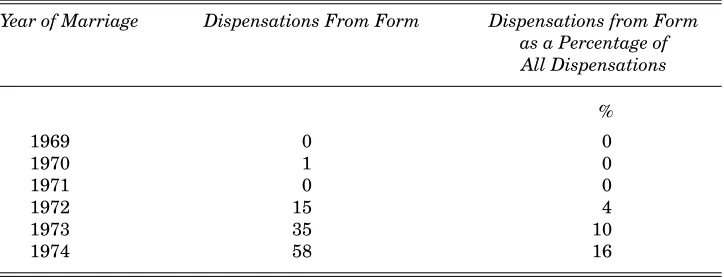
[image:11.499.66.428.350.489.2]The fact that it was unusual, prior to the early 1970s, for an intermarriage to be solemnised in a Protestant ceremony is borne out by figures for dispensations from canonical form granted by the Catholic Church to allow Catholics to validly marry in a non-Catholic ceremony. We see in Table 4 for the Diocese of Dublin that while successful requests by intermarrying couples to be allowed marry in a Protestant church were unknown in 1969, in 1970 one was granted, 15 in 1972, 35 in 1973, 58 in 1974.
Table 4: Annual Number of Intermarriage Dispensations from Form, Dublin Diocese, 1969-1974
Year of Marriage Dispensations From Form Dispensations from Form as a Percentage of All Dispensations
%
1969 0 0
1970 1 0
1971 0 0
1972 15 4 1973 35 10 1974 58 16
Source: Roman Catholic Diocese of Dublin.
IV DISCUSSION
urbanisation and growth in the levels of participation in education. These changes have eroded the social barriers between Catholics and Protestants. Religious segregation has been greatly reduced in schools, clubs and workplaces, which has facilitated the opportunities for intermarriage. Encouraged by the promotion of ecumenism, inter-group relations have improved, both at the level of individuals and between the leaderships of the Catholic and Protestant denominations.
Our findings also allow us to make a methodological observation on the best ways of establishing the rate of intermarriage. Walsh (1975) advocated the use of ecclesiastical records for this purpose. Given our finding that prior to the early 1970s it was unusual not to have an intermarriage ceremony in the Catholic Church, then up to that time Catholic records (the intermarriage dispensations) might provide some measure of the extent of intermarriage. However, given our finding on the high level of conversions up to the early 1970s, the reliability of these Catholic intermarriage dispensations is reduced because of the possibility of conversion prior to the intermarriage, thereby making the seeking of a dispensation unnecessary. Intermarriage dispensations also have the dis-advantage of not distinguishing indigenous intermarrying couples.
We have also found that there was a major shift from the practice whereby intermarriages were almost entirely solemnised in the Catholic Church to one where a growing minority take place in Protestant ceremonies. Furthermore, the practice of conversions within intermarriages has declined. While the improvement in inter-group attitudes is also likely to have facilitated these particular changes, we wish to highlight that the changes in the rules of the Catholic Church have affected intermarriage, as regards both the extent of conversions and the type of wedding ceremonies chosen by intermarrying couples. It is reasonable to assume that knowledge of the Catholic Church rules on intermarriage was widespread among persons who entered intermarriages. Among Protestants the saliency of their concerns and knowledge about Catholic Church teaching has been well documented (Bowen, 1983; White, 1975). Changes in regulations were also publicised by instructions issued by the Bishops of the Church of Ireland. Among Catholics, knowledge of the regulations prior to entering an intermarriage may have been less. However, given that the great majority of intermarriages were solemnised in a church, intermarrying Catholics were sure to be made aware of the regulations by the clergy. The changes in Catholic Church regulations were not implemented overnight as Catholic priests and bishops only slowly came to terms with them. This is evident in the gradual increase in dispensations from canonical form, allowing ceremonies to take place in the Protestant Church.
“work prudently for the conversion of the non-Catholic spouse” (Canon 1062). Given that until the early 1970s the great majority of intermarrying couples were married in the Catholic Church and that Irish Catholics were so devout, this is likely in large part to explain why we found that among intermarried couples in 1973 (who typically had married in the 1950s and 1960s) half of them had converted, and nearly always to Catholicism. Following the Second Vatican Council, the Vatican in 1966 published a new document, Matrimonnii Sacramentum, on intermarriage. This document announced the dropping of the requirement that Catholics in intermarriages seek the conversion of the Protestant partner. We could expect this to reduce the flow of conversions within intermarriages, as was evident in the finding that intermarriages were uncommon in the population in 1995(who typically had married in the 1970s and 1980s). There is some additional support, from Catholic Church records of adult conversions, for this interpretation of the effect of the reform of Church teaching. According to Catholic Church records, the annual number of adult conversions to Catholicism in Ireland fell in the early 1970s, from 259 in 19715 to 98 in 1975, at which point they stabilised at around 100 for the rest of the decade. It is unlikely that this fall reflects a wider process of secularisation since church attendance was very high and fairly stable in the early 1970s (certainly for Catholics for whom data is available). Instead, the fact that the number of conversions stabilised around 1975 suggests that the decline in conversions may have, at least in part, been a response to a particular event, namely the removal from Catholic Church law of the requirement to procure conversions.
The Papal Letter of 1970, Motu Proprio Matrimonii Mixta, relaxed the pro-cedure in relation to the form of wedding ceremony available to intermarrying couples. The local diocesan Catholic bishop was allowed to grant a dispensation from canonical form, allowing a wedding to validly take place in a church other than a Catholic one. However, this was only to be allowed “in cases of grave difficulty”. Nevertheless, the direct effect of the Motu Proprio Matrimonia Mixta was evident in Table 4 in the increasing number of dispensations, allowing a marriage to be solemnised other than in a Catholic ceremony. While Lee (1985, p. 25) remarked that after the 1908 decree Ne Temere, an intermarrying couple could not leave the site of the ceremony to custom or to personal preference (1985, p.25), it appears that by the 1970s this was decreasingly the case. However, we only begin to notice intermarrying couples choosing the option of having a Protestant wedding ceremony after the Catholic Church permitted Catholics to do so.
Finally, returning to the issue of the rising rate of intermarriage, while this
may attract interest, not least of the Protestant denominations themselves, we should not lose sight of the fact that given the tiny size of the Protestant population (3 per cent) the rate is still surprisingly low and is indicative of the continued relevance of religious barriers and a degree of denominational segregation in Irish society.
REFERENCES
ANNUAL REPORTS ON VITAL STATISTICS, 1958, 1966, 1974, 1982, 1990. Dublin:
The Stationery Office.
BOWEN, KURT, 1983. Protestants in a Catholic State: Ireland’s Privileged Minority, Dublin: Gill and Macmillan.
CALLAN, TIM, BRIAN NOLAN, BRENDAN J. WHELAN, CHRISTOPHER T. WHELAN, JAMES WILLIAMS, 1996. Poverty in the 1990s: Evidence from the 1994 Living in
Ireland Survey, Dublin: Oak Tree Press.
FULTON, JOHN, 1991. The Tragedy of Belief: Division, Politics and Religion in Ireland, Oxford: Clarendon Press.
HORNSBY-SMITH, MICHAEL, 1987. Roman Catholics in England: Studies in Social
Structure Since the Second World War, Cambridge: Cambridge University Press.
LEE, RAYMOND, 1985. “Intermarriage, Conflict and Social Control in Ireland: the Decree Ne Temere”, The Economic and Social Review, Vol. 17, No.1. pp1-27.
MAC GREIL, MICHAEL, 1996. Prejudice in Ireland Revisited, Maynooth: Survey and Research Unit, St Patrick’s College.
NIC GHIOLLA PHADRAIG, MAIRE, 1976. A Survey of Religious Practice, Attitudes
and Beliefs in the Republic of Ireland, 1973-74, Report No. 4, Maynooth: Research
and Development Unit of the Catholic Church.
O’LEARY, RICHARD, 1998. Religious Inter-marriage in the Republic of Ireland, Unpublished D.Phil thesis, University of Oxford.
SEXTON, JEREMIAH, AND RICHARD O’LEARY, 1996. “An Analysis of the Factors Affecting the Decline in the Population of the Minority Religious Communities in the Republic of Ireland” in Building Trust in Ireland: Studies Commissioned by the Forum
for Peace and Reconciliation, Belfast: Blackstaff Press.
WALSH, BRENDAN, 1970. Religion and Demographic Behaviour in Ireland, General Research Series Paper No. 55, Dublin: The Economic and Social Research Institute. WALSH, BRENDAN, 1975. “Trends in the Religious Composition of the Population in the Republic of Ireland”, The Economic and Social Review, Vol. 6, No. 4, pp. 543-555. WHITE, JACK, 1975. Minority Report: The Protestant Community in the Irish Republic,