Early Involvement in Product Development
How to involve Inventi early in new product
development processes of its customers
Early Involvement in
Product Development
How to involve Inventi early in the new product
development processes of its customers
Master Thesis
Autumn 2009
Maarten H. J. van Beek
Master Business Administration, Innovation Management University of Twente
School of Management and Governance Commissioned by: Inventi B.V., Neede
I PREFACE
Preface
With this master thesis I accomplish my study Business Administration. In January of 2009 I got in touch with Nedap and especially the innovative character of Nedap attracted me. I decided to apply for a master assignment at Nedap. The market group Retail Support formulated an interesting assignment and I started. After a few months, due to an internal reorganization, the assignment was not longer relevant. Fortunately, after a search within Nedap, I came into contact with Ton Scharenborg. Together we formulated a new assignment. In this case, Inventi, a subsidiary of Nedap, provided the assignment. I am grateful to Inventi and especially Ton Scharenborg for providing this assignment.
Although the new assignment was totally different, it was certainly not less interesting. Good ideas are needed for innovation. However, the transformation from an idea to a product, which can be produced in high volumes, is also essential. Without a good production process successful introduction of innovation is impossible. The research I conducted can contribute to the success of Nedap’s future products. The practical character of the research attracted me and I hope Inventi will benefit from the results from now on.
It took me several years to complete my study at the University of Twente. Ten years ago I finished the ‘MAVO’ secondary school. Afterwards, I passed the ‘HAVO, ‘HBO’ and finally the university. It was difficult to cope with the foreign languages, especially English. Never before I experienced the language difficulties so strong as during this final master thesis. Therefore, I am extra proud of the achieved result, in English. However this result was not possible without the support of Onno van der Kroft. I am thankful for all his comments on my English writing and his additional support as well.
I am very glad to have accomplished this thesis. In this period of my life I learnt to explore new areas and topics, which will be useful for my further career. My curiousness will always drive me to explore new areas and topics.
The research period was a very informative and enjoyable experience. Looking back I can say that the Inventi team consists of very dedicated and professional people. I would like to thank all employees of Inventi for their openness and patience. I especially appreciate their interest and cooperation in the interviews. I am grateful to Herbert, Johan and Miranda for being a sparring partner and the daily talks.
Furthermore, I would like to thank all interviewees of Nedap for the investment of their valuable time and energy. It was a unique experience to get a closer look in this innovative company. If I will have some troubles coping with a bureaucratic maze of procedures later on in my carrier, I will definitively think back to the period I spent at Nedap and its informal organizational structure.
During my graduation process, professional support was crucial. I am grateful to Ton Scharenborg, Waling Bandsma, Holger Schiele and Rick Middel for their valuable feedback and support during my master assignment. This thesis could not be accomplished without their advices. I wish Ton Scharenborg and Inventi all the best for the realization of the intended early involvement.
III MANAGEMENT SUMMARY
Management summary
The company Inventi is in charge of all kind of production orders for Nedap market groups. Inventi is responsible for its own performance. However, it has limited influence on its production process design and the selected components in the product designs. To get more influence on the product and production process designs, Inventi wishes to get earlier involved in the new product development processes of Nedap market groups. The involvement has to result in an increase of the product manufacturability, improvement of the production’s quality performance and advantages of using preferred components.
A qualitative research has been executed in order to give an advice.
In the first place, literature has been explored to get a better understanding of the concepts of ‘new product development’ and ‘early supplier involvement’. These insights have been used to investigate the possible involvement of Inventi in the product development projects of market groups. The new product development process has been divided into five steps: functional specifications, basic design, detailed engineering, production process design and start of production/ramp-up. During these development steps, Inventi can perform tasks. Furthermore, Inventi can provide resources, which are needed in development tasks. Moreover, the responsibilities of the development project can be distributed. The three dimensions of early supplier involvement are tasks, resources and responsibilities.
In the second place, the market groups’ preferences have been collected. In order to investigate the wished involvement of Inventi among the market groups, three market groups have been selected. Agri, Energy Systems and Retail Support are good representatives of all market groups. These have been selected based on kind of products, organization of the market group and the current relationship with Inventi. Employees related to purchasing, engineering and market group management have been interviewed within each market group. A total number of eleven interviews have been conducted.
In the third place, Inventi’s expectations regarding its involvement have been researched. Four employees of different functions have been interviewed. The three dimensions of supplier involvement took up the central position in the interviews.
The market groups’ demand for Inventi’s contributions is mainly related to component selection, design for manufacturability and test development. Inventi has to consult market groups in their development projects and has to provide its preferences.
Inventi’s wished integration in the market groups’ project teams will not be supported by the market groups. However, several instruments will be available for Inventi to get the intended influence in product design and component selection. Inventi will be involved on market groups demand. This results in a more informal way of cooperation, which is called the direct ad hoc contact approach.
Inventi has to perform the following tasks: (1) developing print layouts, (2) making prototypes and providing related feedback, (3) being involved in or performing test equipment development, (4) developing the (PCB) production process design and (5) performing a check before the start of production to control the results of previous NPD steps.
In the last place, Inventi can form a technology-expert-team. It has to organize seminars or meetings to communicate technology, design for manufacturability and testing related knowledge. This knowledge can be transferred in between product development projects. The knowledge can be used in the early stages of product development processes. Furthermore, this two-way communication will support Inventi in developing its future strategy.
The responsibilities of the new product development processes have to be distributed. In general, the market groups will maintain their responsibilities for the product design. This includes the functional specification, the basic design and the detailed engineering steps. Inventi will be responsible for the production process. This consists of the elaboration of the production process design and the start of production/ramp-up step.
V TABLE OF CONTENTS
Table of contents
Preface ... I Management summary... III
1 Inventi’s organisation and activities ... 1
1.1 Introduction to Inventi ... 1
1.2 Strategy of Inventi ... 2
1.3 Inventi’s human resources... 2
1.4 Operations of Inventi ... 3
1.5 Relationship between Inventi and Nedap ... 4
2 The research and methodology... 5
2.1 Inventi’s situation ... 5
2.2 Research focus ... 6
2.3 Research questions ... 7
2.4 Research approach... 8
2.5 Research methodology... 8
2.5.1 Exploring literature...8
2.5.2 Qualitative research ...9
2.5.3 Selection of units...10
2.5.4 Interviewing employees of Inventi and market groups ...12
2.5.5 Data analysis ...13
2.6 Conclusion and structure of report ... 13
3 Theoretical framework ... 15
3.1 New product development ... 15
3.2 Supplier involvement in product development processes... 16
3.3 Problems of supplier involvement in product development ... 18
3.4 Implementation of supplier involvement ... 18
3.5 Three dimensions of supplier involvement ... 19
3.5.1 Tasks in product development ...19
3.5.2 Resource allocation...19
3.5.3 Responsibility distribution...20
3.6 New product development project coordination ... 20
3.6.1 Project integration coordination...20
3.6.2 Disconnected sub project coordination ...20
3.6.3 Direct ad hoc coordination ...21
3.7 New product development steps... 21
3.7.1 Functional specifications ...23
3.7.2 Basic design...23
3.7.3 Detailed engineering...24
3.7.4 Production process design ...25
3.7.5 Start of production and ramp-up ...25
3.8 Preconditions for successful supplier involvement... 25
3.8.1 Information flow...25
3.8.2 Level of trust ...26
3.8.3 Top management commitment ...26
4 Research results of task distribution ... 29
4.1 Functional specifications ... 29
4.2 Basic design ... 31
4.2.1 Component selection tasks in basic design...31
4.2.2 Design for manufacturability related tasks in basic design...33
4.3 Detailed engineering... 34
4.3.1 Design for manufacturability related tasks in detailed engineering...34
4.3.2 Test development tasks in detailed engineering...36
4.4 Production process design ... 36
4.4.1 Tasks related to production process development...36
4.4.2 Test development tasks in production process design ...38
4.5 Start of production and ramp-up ... 38
4.6 Overview; differences in intended task distribution per development step ... 39
5 Research results of resource allocation ... 41
5.1 Functional specifications ... 41
5.2 Basic design ... 43
5.2.1 Component selection related resources in basic design...43
5.2.2 Design for manufacturing related resources in basic design...44
5.3 Detailed engineering... 44
5.3.1 Component selection related resources in detailed engineering...45
5.3.2 Design for manufacturing related resources in detailed engineering...46
5.3.3 Testing related resources ...46
5.4 Production process design ... 46
5.5 Start of production and ramp-up ... 47
5.6 Overview; differences in intended resource allocation per development step ... 47
6 Research results of responsibility distribution ... 49
6.1 Functional specifications and basic design ... 50
6.2 Detailed engineering... 50
6.3 Production process design and production ramp-up... 51
6.4 Overview; differences in intended responsibility distribution... 53
7 Bridging the gaps and selecting the appropriate coordination approach ... 55
7.1 Approaches to bridge the gaps ... 55
7.1.1 Design for manufacturability ...55
7.1.2 Component selection ...58
7.1.3 Test strategy, plan and equipment...61
7.1.4 Project independent knowledge transfer...61
7.1.5 Production process development...63
7.1.6 Start of production and documentation...64
7.2 Selection of coordination approach for the intended cooperation ... 65
7.2.1 Inventi’s and market groups’ preferred coordination approach...66
7.2.2 Ideal type coordination approach...67
7.2.3 Implications of selected coordination approach on preconditions ...68
8 Conclusion and recommendations ... 69
8.1 Conclusion ... 69
8.2 Recommendations... 70
VII TABLE OF CONTENTS
References ... 73
Lists ... 76
List of Abbreviations ... 76
List of Definitions ... 76
List of Figures ... 77
List of Tables ... 77
Appendices ... 78
Appendix I Nedap N.V. and the founding of Inventi
Appendix II Overview of interviews and introductions to market groups Appendix III Interview protocol
1 INVENTI’S ORGANISATION AND ACTIVITIES
1
Inventi’s organisation and activities
Inventi is a manufacturer of printed circuit boards and performs additional assembly tasks as well. Early involvement in product development processes of its customers is important to Inventi. Inventi expects significant cost reductions and quality improvements when product designs will be adjusted to its preferences. The adjustments entail both selection of components in product designs and adjustments of product design. These adjustments can be realized through involvement in the product development processes of Inventi’s customers. However, Inventi does not know which involvement is possible, which involvement the customers prefer and how these involvement should be coordinated. The problem definition and research approach will be presented in chapter 2.
This chapter will give an introduction to Inventi, the company’s strategy, the human resource policy and the organization characteristics will be presented. In the last paragraph, the specific relationship between Inventi and its customers will be discussed.
1.1
Introduction to Inventi
Inventi is a manufacturer located in Neede, The Netherlands. The production company was founded in 2007 by Nedap N.V. (Hereafter Nedap N.V. is denoted as “Nedap”. See for more information Textbox 1). As a subsidiary, Inventi is charged with the production of several related products. Inventi is operating independently, which allows Inventi to produce both for Nedap and other companies. Currently Inventi is only producing for Nedap. Although Nedap is a single company, it can be subdivided by
Inventi into several customers, based on the Nedap market groups (see appendix I). Inventi does not have an own product development team; it is producing on customers demand. Inventi produces a wide range of products, which varies from cow belts for activity measurement and identification for farmers to Electronic Control Units for convertible tops of cars (see for a quick view of the products; Figure 1). Although the purposes of the products are very divers, they have some characteristics in common. All products consist of one or more printed circuit
boards on which electric components are attached. These printed circuit boards are assembled in some kind of casing and finally packed in boxes. The production series are medium sized (≈100-5000), but relatively constant.
Textbox 1: Nedap N.V. Nedap N.V.
NV Nederlandsche Apparatenfabriek ‘Nedap’ is an internationally operating company with more than 600 employees and has its head quarters in Groenlo, the Netherlands. Nedap focuses on developing and supplying innovative and sustainable solutions in the fields of security and electronic control units as well as automation, management and information for organizations.
1.2
Strategy of Inventi
The general aim of Inventi is: “ensuring that customers would like to outsource their production to Inventi” (Inventi, 2007). The strategy to achieve this is to “encourage employees to initiate bright ideas in order to maintain long-term relations with the customers.” Employees take up a central position in the strategy, because they should maintain the relationships and initiate ideas. More information about the employees will be provided in the next paragraph, 1.3. Important pillars of Inventi’s market approach are price, good quality and delivery reliability. These criteria are order qualifiers, which are minimum screening criteria that allow a firm’s products or services to be considered. The management emphasizes that Inventi needs to guarantee competitive prices, good quality and a high level delivery reliability, which is primordial for competing with the cheapest producers. The executives are aware that this is not realizable through simply hard working (if the wages in Romania are ten times lower, you cannot work ten times faster). Inventi can accomplish this, as the company’s name suggests, in an inventive way through automation, tools and encouragement of employees.
Inventi’s order winners, criteria that differentiate the products or services of one firm from another, are related to flexibility and maintaining close relationships with customers. These order winners represent Inventi’s strategy to keep long-term relationships with the customers. Inventi wishes to be a partner, who is easily accessible to Nedap market groups and Inventi does not want to maintain a very formal supplier-buyer relationship. The specific relationship between Inventi and Nedap will be discussed in paragraph 1.5.
1.3
Inventi’s human resources
[image:14.595.75.444.62.252.2]Approximately fifty people are at work for Inventi, however none of them is formally working for Inventi. Inventi hires all the human resources it needs. Generally there are three different sources of employees, all for specific tasks. The first source is Nedap. Nedap is permanently seconding employees to Inventi. They manage the daily operations and determine tactical and strategic policy. The second Figure 1: Produced products and its utilizations
Impression of Inventi’s order portfolio and the products purposes: Power supplies for printers and medical devises, battery chargers, electrical control units for convertible tops, and light controls for e.g. greenhouses or UV disinfection.
Hameland
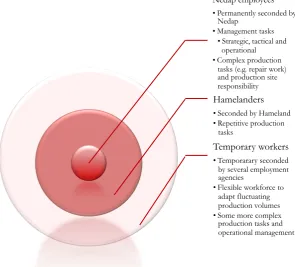
3 INVENTI’S ORGANISATION AND ACTIVITIES source is ‘Hamelanders’. This term refers to people, working for Hameland who need additional care in their work situation (see Textbox 2). The Hamelanders perform production tasks with a repetitive character. Temporary workers are the last source of labour. They are young people who had all kind of problems in education and other areas and form a flexible workforce to adjust to changes in production volumes. They are also charged with the more complex production tasks and some of them can even instruct Hamelanders. Although this group consists of temporary workers, many of them have worked for years at Inventi/Nedap. See below (Figure 2) for an overview of the employee groups.
The strategy focuses on maintaining long-term relationships with customers and low cost producing. This causes a dilemma for the employees. On the one hand they should maintain close contact with the customers and initiate bright ideas. On the other hand they should concentrate on producing cost efficiently.
The founders of Inventi chose an innovative approach by employing minimum wage earners, namely Hamelanders and temporary workers. Furthermore, Inventi encourages its employees to initiate bright and stimulating ideas to improve the product quality and the production process. This requires close contact with the customers and motivated employees. In the philosophy of Inventi, employees have to be stimulated to use their potential, which should not be underestimated. The motto is: “challenges enrich life”. Nedap employees may be expected to take more initiatives than Hamelanders or temporary workers. Nevertheless, these groups are also encouraged to initiate ideas. Finally this should result in a flexible production site, which produces quality products for reasonable prices.
1.4
Operations of Inventi
Currently, the production can be divided into several production methods. There are facilities for automatic and manual production. Because of the repetitive character of the manual tasks,
Nedap employees • Permanently seconded by
Nedap
• Management tasks • Strategic, tactical and
operational • Complex production
tasks (e.g. repair work) and production site responsibility
Hamelanders
• Seconded by Hameland • Repetitive production
tasks
Temporary workers
• Temporarary seconded by several employment agencies
[image:15.595.151.447.243.510.2]• Flexible workforce to adapt fluctuating production volumes • Some more complex production tasks and operational management
this work is suitable for Hamelanders. Instructions for all specific production processes are available to the Hamelanders. These instructions visualize for instance the exact position of components on the printed boards. The limited capabilities of the low wage workforces generally result in some extra guidelines to production processes. Therefore, organizing the production into small steps is necessary to ensure the required product quality. Furthermore, Inventi stresses the importance of automation. Customers are encouraged to take as much as possible advantage of the automated production facilities of Inventi.
The Inventi management had established some guidelines with regard to production orders. In the first place, a minimum production level of a product has to be realized (≈ 1,000 – 100,000 per year). In the second place, the manufacturing process should allow production in small, repetitive steps in order to facilitate production by Inventi’s workforce. In the third place, Inventi aims to be entirely or partly involved in the selection of components. The customer’s designers should be encouraged to select standard or familiar components in their design. This will result in a lower cost price. Inventi emphasizes that this is crucial to ensure its competitive market position.
1.5
Relationship between Inventi and Nedap
5 THE RESEARCH AND METHODOLOGY
2
The research and methodology
In this chapter Inventi’s current position as well as the problems it is facing will be discussed. After specifying the problem, the research questions and the research model will be presented.
2.1
Inventi’s situation
Inventi is producing all kind of production orders for Nedap market groups. As already mentioned in the previous chapter, Inventi management established requirements with regard to these new production orders. Production volumes, the kind of production processes and the selection of components should be taken into account.
Currently, new production orders do not meet all of these requirements. At the moment, Inventi is taking over production processes, which are already operational at Nedap. The production processes are simply transferred or copied from Nedap to Inventi, which impedes Inventi to transform the production processes completely. However, in the near future Inventi expect to start production of new products1 as well. In order to make use of the specific
production site efficiently, Inventi stresses the importance of taking the manufacturability into account during the development stage of the product. Furthermore Inventi has no equal say in the selection of components in the development stage of the products of its customers. The selection of components especially refers to electronic components. The core of the problem Inventi has been facing can be stated as follows:
In order to get more influence on its own performance, Inventi wishes to get more involved in the product development process of its customers. The intended involvement in this process can lead to more influence on production process design (e.g. making the production process suitable for Hamelanders) and on the component selection (standardized components). As a result the management expect more control over Inventi’s performance and a higher willingness of the customers to outsource production to Inventi, which is the general aim of Inventi. The cost price of Inventi’s products and Inventi’s current influence on the cost price are discussed below.
The cost price of the product is almost completely determined in the product development process of Inventi’s customers. According to Anderson (2004), by the time a product has been designed, only 8% of the total product budget has been spent. By that time, the designer has determined 80% of the cost price of the product (see Figure 3). Inventi cannot influence this percentage, however it could contribute to the determination of the product’s cost in the development stage of the product. During the set up of production, Inventi spend a major part of the product’s budget. Specific tools (carriers) have to be made, the production site has to be adjusted for the production process and instructions have to be written. Furthermore, the chosen components in the development stage of the products
1 The production of new products means that a specific product, developed by a Nedap market group, will be produced by Inventi. Between the development and production stage at Inventi, this product will not be produced somewhere else.
Although Inventi is responsible for its own performance, it has limited influence on its production process design and the selected components in the product design.
account for the main part of the cost price, approximately 70%. Most components can be substituted, which could have some advantages for Inventi. Inventi expect advantages like reducing purchasing costs and realizing a stronger bargain position, if the company manages to reduce the number of unique components in the product designs. Using familiar components2
will result in higher purchasing volumes and will finally result in more purchasing power. However a developer should take these substitutes into account during the development process. When the design is finished a component cannot simply be replaced by a substitute of another brand.
As a result of these two points, Inventi can only influence the total cost price marginally. Nevertheless Nedap requires Inventi to minimize this cost price.
Inventi’s expected benefits of the early involvement are summarized in the following points: • Increasing the manufacturability of the products.
• Improving the production’s quality performance. • Benefiting from the use of familiar components.
The intended involvement and expected benefits only refers to cooperation with Nedap market groups. Inventi made a strategic choice to produce only for Nedap in the near future and is not willing to adjust its organization to the expectations of any other potential customer.
2.2
Research focus
Inventi considers realization of this early involvement as a challenge. Inventi should convince the customers of the benefits of the mentioned early involvement. Early involvement is primordial for enabling full control of production and purchasing processes and improving these processes and consequently its financial results. Early involvement can be realized through many ways, but which aspects are important for Inventi? What role can Inventi have in the product development processes? How could early involvement help to meet the expectations of both the customers and Inventi’s management and what are the preconditions?
The central question can be deducted from the above-mentioned situation.
The core elements of the central research question are defined below. Table 1: Definitions of core elements of the central question
Core element Definition
Early involvement Supplier involvement in new product development. The ability to influence the product design and production process design during the product development process.
Product development process Process of improving existing products or developing new kinds of products.
Inventi’s customers Nedap market groups
2 Familiar components are components that are already used at the production site of Inventi. If a developer selects a familiar component, this component will be used in at least two products (one existing product and the new
7 THE RESEARCH AND METHODOLOGY
2.3
Research questions
This research aims at answering the central question. To provide an answer, it has to be divided into sub-questions. In the first place, the concepts of ‘early supplier involvement’ and ‘new product development processes’ have to be explored. Literature will provide a framework to explore the expectations of both companies. Understanding of the important dimensions of successful involvement will lead to a comprehensive view of the situation, which will help to fulfil Inventi’s needs. Therefore it is needed to determine the important dimensions by exploring literature. This results in the first research question.
1. How can suppliers contribute to new product development in general and how can the involvement be coordinated?
In the second place, the possibilities of Inventi to participate in NPD processes of its customers, needs to be examined. Furthermore, the level of efforts Inventi is prepared to invest in early involvement needs to be determined. Also the prospected kind of support Inventi expects to deliver into the development processes of its customers has to be inventoried. This results in the second research question:
2. Which aspects of early involvement in product development are important from Inventi’s perspective and how does Inventi wish to realize this involvement?
In the third place, the characteristics and the expectations of Inventi’s customers have to be specified. To what extent will they accept Inventi to be involved in their NPD processes and which resources are they willing to share? Maybe, it is equally important to point out which elements are not suitable for collaboration and which conditions are required. This results in the third research question:
3. Which aspects of early involvement in product development are important for Inventi’s customers and what are the preconditions for early involvement in their NPD processes?
In this research only Nedap market groups will be taken into account as customers, because Inventi expects to produce in the near future only for Nedap and is not willing to adjust its organization to the expectations of any other potential customer. This decision will be further discussed in paragraph 2.5.
After the exploration of possibilities, impossibilities, intentions and preconditions of involving Inventi in product development of both Inventi and its customers, the results need to be compared. Causes of the differences should be discussed and the aspects where the companies’ intentions meet each other, need to be mentioned. This results in the fourth research question:
4. What are the differences and similarities between Inventi and its customers regarding early involvement?
An approach to implement the intended involvement can be formed when both perspectives are pointed out clearly and the differences and similarities are identified. The approach will support Inventi to get involved in its customers’ product development processes. This results in the fifth and last research question:
These research questions are used to answer the central research question: What should Inventi do to be involved in early product development phases of its customers? The answer to the questions will lead to recommendations for Inventi to get successfully involved in the product development processes of its customers in the future.
In the next paragraph the approach to answer these questions will be presented.
2.4
Research approach
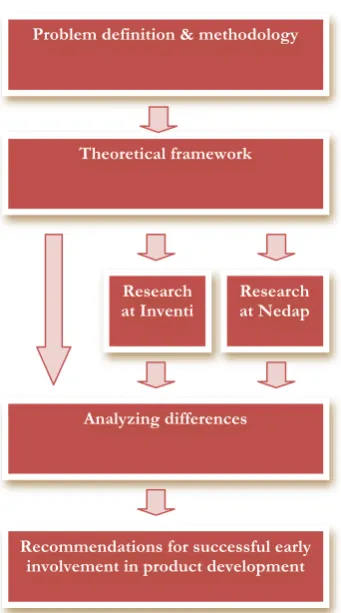
During the research the following approach will be used to answer the central question (see Figure 4).
This research consists of several steps. First, the problem and its settings will be defined as well as the methodology for the research. The second step comprises the development of a theoretical framework on supplier involvement in product development. This framework will form the basis for the following steps.
The situation will be explored by using the theoretical framework. It will be executed at Inventi and Nedap. The following step is analysing the differences between Inventi and Nedap and relating this to the theoretical framework. Eventually these steps will lead to recommendations, which will provide an answer to the central research question.
In order to give a professional and well-balanced advice, the first design ideas can be proposed to the customers and Inventi before realisation of the final advice.
2.5
Research methodology
In the following paragraphs the used methodology of the research will be discussed. First, the reasons for a qualitative research are mentioned. Then, the units of analysis will be presented. The selection of the market groups will be motivated and a short introduction of these groups will be given. Furthermore, the selected employees of Inventi will be mentioned. Finally the methods of interviewing and data analyses are described.
2.5.1 Exploring literature
The research has a deductive character. This implies the use of a general theory, which can be applied to a more specific situation (Babbie, 2007). In this case, the specific situation will be the cooperation between Inventi and the Nedap Market groups. To use general theories, these have to be explored first. The theoretical research aims at answering the first research question: How can suppliers contribute to new product development in general and how can the involvement be coordinated?
Theoretical framework Problem definition & methodology
Analyzing differences Research at Inventi
Recommendations for successful early involvement in product development
[image:20.595.364.535.206.513.2]Research at Nedap
9 THE RESEARCH AND METHODOLOGY Theories are needed to explore Inventi’s possibilities and impossibilities of involvement in product development. To find relevant theories the following key words or phrases are mainly used:
• Early Supplier Involvement
• Coordination of supplier involvement • Success factors of ESI
• New product development
• Collaboration in product development • Design for manufacturability
The collected literature is selected on relevance and appropriateness for Inventi’s situation. The relevant theory will be provided in chapter 3.
Theories, which discuss supplier involvement from the supplier’s perspective, are rare. Most literature is written from the buyer perspective. Therefore, the used literature will be selected and transformed to meet the supplier’s needs and expectations.
2.5.2 Qualitative research
In order to explore the expectations of both Inventi and its customers, a qualitatively oriented research will be used to conduct the research. In this study the different customers should be explored. The research should result in a better insight in the customers’ processes, expectations and Inventi’s capabilities. Therefore the research has a descriptive character. Furthermore, the research will be prescriptive in the form of recommendations. The general aim of the research is advising the management of Inventi and providing a document to support Inventi’s management in the communication of their vision on early involvement. Compared to a survey or an experiment, qualitative research has some advantages (Babbie, 2007). In the first place, a qualitative approach can be used for exploring social processes, like NPD processes. In the second place, the research is flexible. The research can be adjusted to a specific situation or new insights. In the third place, conducting a qualitative research is relatively cheap.
Conducting a qualitative field research generally results in a high internal validity, but the external validity is in general lower. The internal validity is more relevant for this research. Generalizing to other settings is not the central purpose of the research. Inventi aims to get more involved in the NPD processes of its current customers and is primarily not interested in willingness of companies in general to involve suppliers.
According to Yin (2003) there are six sources of evidence in case studies. These sources are: documentation, archival records, interviews, direct observations, participant observation and physical artefacts. Interviews will be the main source of input in this research, but it can be supported by documentation, for instance a formalized NPD process. The interviewees as well as the supporting documents are indicated in Table 2. The other sources of evidence are less applicable in this research and therefore not used. There is not any archival material available about previous projects, simply because of a lack of previous projects. Moreover, observations are not applicable because information is needed about expectations for the future. The selected sources will provide the information needed in this research.
people (Flick, 2004). The main purpose of triangulation in this research will be the enhancement of validation of data, which are obtained during the research of market groups and Inventi. Triangulation is used through interviewing different employees (collecting data from different people) and analysing the supporting documents (collecting data from different sources).
2.5.3 Selection of units
The second and third research question will be answered by analysing Inventi and its customers based on the insights from literature. However, first the cases for research should be selected properly to ensure the validity and reliability of the research. As already mentioned in this chapter, this study will consider the Nedap market groups as Inventi’s customers. Although Inventi has the freedom to attract customers outside Nedap, in the near future it will only concentrate on Nedap market groups. Inventi is prepared to adjust its processes to the needs of Nedap market groups. However, for other possible customers the process will not be adjusted. Presently, Nedap divides its activities into over ten market groups. Inventi is not producing for all these market groups, but in principle Inventi can perform production tasks for all market groups. Although the market groups operate in completely different markets, they all need more or less, the kind of production facilities Inventi offers.
Considering the cases for analysis, it is relevant to explore both current customers and the market groups who outsource their production elsewhere. It is possible that the reasons to outsource elsewhere are related to the topic of this research; supplier involvement in NPD processes.
Preliminary Research
In order to determine the number of market groups to involve in this research and the related functions a preliminary research was needed. Three people were interviewed to get more insights in Inventi and the Nedap market groups. The interviews were semi-structured. Questions vary from what they expect from supplier involvement to how product development processes are currently managed. Afterwards all cases of analyses were determined. The respondents of this preliminary research were selected to get a broad view of the cooperation between Inventi and the market groups. The first case was Inventi. An employee responsible of one of Inventi’s production sites was interviewed. The involved production site is the site where components are manually attached. The second case was the market group Retail Support. Recently Inventi has started to produce for Retail Support. The employee of Retail Support, who is charge of production, has been interviewed. The last case was the market group Energy Systems. Inventi maintains a long-term relationship with Energy Systems. A hardware engineer of Energy Systems was interviewed.
The results of these interviews are insights in the extent of differences between market groups and functions. Based on this information, the selection of units for interviewing with regard to Inventi and its customers will be discussed in the following two paragraphs.
Nedap market groups
After the first interviews it became clear that these market groups are operating in totally different markets and have a different NPD approach. However, the expectations about Inventi’s input in their product development processes are comparable. This is the reason to limit the number of market groups to analyze. It is expected that analyzing more than three market groups will not lead to more useful information. The selected market groups will reflect all market groups. However, it is important to ensure that the selected market groups represent the whole spectrum of market groups. Aspects in the selection are:
11 THE RESEARCH AND METHODOLOGY • The market group’s organization. Inventi’s involvement has to fit the market groups’
organizations. Each market group may have another way of organizing and structuring product development.
• The current relation with Inventi. Current customers of Inventi are familiar with Inventi’s capabilities. New customers might have other expectations of a supplier than the current customers.
[image:23.595.68.527.204.452.2]The selected market groups for investigation and their basic characteristics are summarized in the following table:
Table 2: Selected market groups with characteristics
Energy Systems Retail Support Agri Market Renewable energy and
stand-alone energy islands
All kind of retail
organizations Farmers
Relationship with Inventi
Long-term relationship. Started in the early days of Inventi.
New relationship. Approximately a few months.
Inventi is production only a few products of Agri.
NPD
organization Formalized Not formalized Formalized
Interviewees - Hardware Engineer - Business Controller - Market group
Manager - Salesman
- Manager Manufacturing - Hardware engineer - Engineer/
coordinator
- Market group manager - Manager
manufacturing - Manufacturing Contact person - R&D Coordinator Supporting
documents NPD procedure - Project evaluation documents
Table 2 also provides the selected employees. These employees will be interviewed. The employees are selected because they are in charge of the market groups’ product development processes or they will be involved in the cooperation. Therefore, both strategic and operational cooperation aspects will be integrated in the research.
An overview of the interviewees and introductions to the selected market groups will be provided in appendix II.
Inventi
The methods for analyzing Inventi are comparable with the methods used for analyzing the three selected market groups. Interviews will be held with Inventi employees who are responsible for the cooperation with customers. The selected employees are:
Function Selection reason
Overall manager Inventi To establish Inventi’s vision on its involvement in NPD processes.
Manager production site
(Protec) To determine Inventi’s possibilities with regard to prototyping and production process development. Manager production site I To get insights in the communication possibilities and
preferences of manufacturability aspects in product designs. Purchaser Inventi To get insights in the communication possibilities and
[image:23.595.66.512.625.751.2]The interviews can be supported by documents, for example agreements between Inventi and market groups.
2.5.4 Interviewing employees of Inventi and market groups
The goal of the interviews is to get more insight in the preferences of the customers and the used processes. The interviews were semi-structured in order to answer some specific questions deducted from the theoretical framework (the theoretical framework will be provided in chapter 3. In order to obtain as much information as possible a semi-structured method is chosen. During the interviews the researcher does not only focus on the interview questions. In order to obtain as much relevant and useful information as possible, also additional information will be included. Moreover, the sequence of questions could be changed depending on the development of the interview.
In order to prepare the interviews, guidelines provided by Meulenberg (1990) are used. The questions are carefully selected and special attention is given to the aspect listening.
The interviews are used to answer the second and third research question:
Which aspects of early involvement in product development are important from Inventi’s perspective and how does Inventi wish to realize this involvement?
Which aspects of early involvement in product development are important for Inventi’s customers and what are the preconditions for early involvement in their NPD processes?
The order of answering the first two research questions is not critical. However, answering one question will influence the process of answering the second question. Important factors for Inventi can be integrated in the way of answering the second question. Answering the first two questions the other way around, will have comparable effects. In practice the research will be executed similarly. New knowledge or insights can directly be applied in answering the questions.
The interviews were held in a face-to-face setting in the natural environment of the interviewee. It is important to use a quiet location, which is not accessible to other employees. This resulted in a setting where the interviewee can speak freely. Before the interview, the protocol as well as the purpose of the interview was explained. As far as possible the confidentiality is guaranteed. However, the employees of Nedap and Inventi are familiar with each other. Names are not mentioned in the reports, but function names are unavoidable. Furthermore the interviewees were asked to agree with recording the interview. Two interviewees refused, but notes of important aspect were made.
The interview protocol can be found in appendix III. In total a number of fifteen interviews have been executed in which the length varied between forty minutes and hundred and twenty minutes. In each market group and in Inventi three or more interviews have been held.
13 THE RESEARCH AND METHODOLOGY After the interviews, interviews reports are written. The structure of the report and methods of reporting are adopted from Meulenberg (1990). The following table present the structure of the interview reports (Table 3).
Table 3: Structure of interview reports (Meulenberg, 1990)
Part Functions
Introduction -Topic
-Name interviewee -Function of interviewee -Date
-Duration -Place
Core -The conversation is written in the third person singular form. -Citations are only be made if relevant.
End -The conversations have been characterized -Remarks are made
-Possible further appointments
The reporting method of Meulenberg (1990) provides some advantages over writing the conversation literally. First of all, the method is quicker, and secondly, it leaves room for notes about atmosphere and non-verbal conversation.
2.5.5 Data analysis
An answer to the fourth research question can be given by comparing the results of the market groups and Inventi. After writing the interview reports, relevant phrases will be selected. For all three market groups and Inventi, these phrases are categorised into themes. For example, all phrases about the selection of unique components in the interviews with Agri employees were bundled into the theme ‘strategic components’. Analysis of these bundled phrases, resulted in the market groups’ and Inventi’s perspectives on the different aspects. The results of the interviews and analysis of supporting documents will be presented in the chapters 4,5 and 6. The fourth research question is: What are the differences and similarities between Inventi and its customers regarding early involvement? This will also be discussed in chapters 4, 5 and 6. The bottlenecks for early involvement of Inventi will be reflected during this analysis.
Subsequently, an answer can be provided to the fifth and last research question. The last research question is: How can the gaps between Inventi’s and the customers’ expectations be bridged in order to provide a satisfactory solution?
Based on the analysis and theoretical aspects, advice will be given to the management of Inventi. This advice will provide Inventi information about the necessary actions to take. Furthermore, the central question will be answered. The central question is: What should Inventi do to be involved in early product development phases of its customers?
2.6
Conclusion and structure of report
In order to determine the ways of stimulation in early involvement in new product development processes, a research is required. In the first place, a theoretical framework is needed to conduct the research. The theoretical framework will be presented chapter 3. In the second place, the expectations of the market groups and Inventi regarding Inventi’s early involvement have to be investigated. A qualitative oriented research will be performed. The main source of information will be interviews with several employees of market groups and Inventi. The results will be presented in chapters 4,5 and 6.
Based on the found similarities and differences between Inventi’s and the market groups’ expectations, an approach can be formulated to bridge the gaps. This approach will be presented in chapter 7.
15 THEORETICAL FRAMEWORK
3
Theoretical framework
The theoretical framework aims at answering the first research question. This chapter is the result of a systematic and extensive exploration of existing theories, which are related to the research topic. The first research question is:
Q1 How can suppliers contribute to new product development in general and how can the involvement be coordinated?
Before investigating how suppliers can contribute to new product development processes, a better understanding of the concept new product development is needed. Furthermore, the importance of involving suppliers in this development needs to be discussed.
This theoretical framework will provide a foundation on which the research is based and the advice will be built. The framework consists of three parts. In the first place a general introduction on new product development will be presented. In the second place, supplier involvement in new product development processes will be broadly discussed. The concept of early supplier involvement will be introduced and the benefits will be discussed. Furthermore, three dimensions of supplier involvement will be introduced and cooperation approaches will be presented. By introducing the new product development process, the possible involvement per development stage will be discussed. Finally, three preconditions for successful involvement will be mentioned and an overview of all discussed aspects will be provided.
3.1
New product development
The economic success of a manufacturing company depends on its ability to translate market needs quickly into products that meet these needs. This is not only marketing related, not only design related or only manufacturing related. It is a common product development problem related to all these functions (Ulrich & Eppinger, 2000). Successful new product development can be seen as: ‘the result of (a) careful planning of a superior product for an attractive market and (b) the execution of that plan by a competent and well-coordinated cross-functional team that operates with (c) the blessings of senior management’ (Brown & Eisenhardt, 1995).
The focus in this research will be on the execution of the physical development of the product, which is mentioned as ‘b’ in the above citation.
The ultimate goal of new product development (NPD) in a for-profit organization is to develop commercially successful products. However, to make this more specific Ulrich & Eppinger (2000) argue for five commonly used dimensions to assess the performance of a product development effort:
• Product quality • Product cost • Development time • Development cost • Development capability
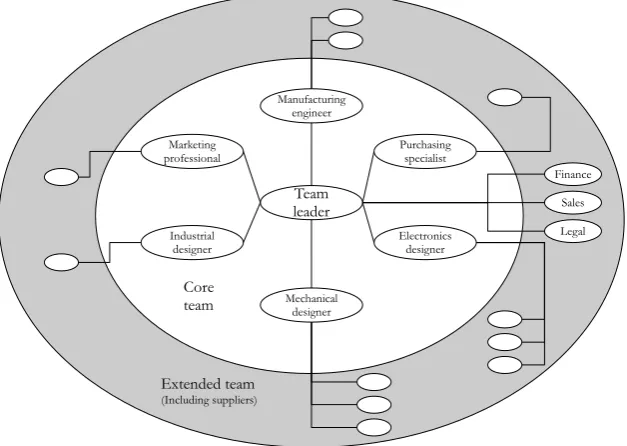
In NPD projects often interdisciplinary project teams are formed. Figure 5 visualizes a typical product development team for an electromechanical product of modest complexity(Ulrich & Eppinger, 2000). Communication among project team members as well as communication with outsiders stimulates the performance of development teams. Thus, “the better members are connected with each other and with key outsiders, the more successful the development process will be” (Brown & Eisenhardt, 1995).
Figure 5: Example of composition of a product development team for an electromechanical product of modest complexity (adopted from Ulrich & Eppinger, 2000)
The core team members are representatives from the marketing function, the design function and the manufacturing function within a company. However, a company can decide to outsource its production tasks. This development automatically implies losing vital production knowledge from the development team. An underestimation of manufacturing aspects in the product design can result in a higher cost price or an insufficient product quality. The selected supplier can introduce knowledge of production processes in the project team to ensure the manufacturability of the product.
It is an old paradigm that companies must generate their own ideas and then develop, build, market, distribute, service, finance, and support them on their own (Chesbrough, 2004). The new open innovation paradigm assumes that firms can and should use external as well as internal ideas, as they wishes to advance their technology (Chesbrough, 2004). According to this new paradigm, suppliers can be involved in the NPD processes of its customers.
The concepts of this involvement will be broadly discussed in the following paragraphs.
3.2
Supplier involvement in product development processes
Suppliers can participate in product development processes of its customers. The involvement can range from small design suggestions related to components selection or production methods to taking over the complete responsibility of the development of (a part of) a product. The involvement of suppliers in product development is defined by several authors as “Early Supplier Involvement”. Echtelt, Wynstra, van Weele, & Duysters, (2006) define Supplier Involvement as follows: “Supplier involvement refers to the resources (capabilities, investments, information, knowledge, ideas) that suppliers provide, the tasks they carry out and the responsibilities they assume regarding the development of a part, process or service for the benefit of a buyer’s current and/or future product development projects.” The term suppliers refer at suppliers outside the business unit who are involved in the
!"#$ %"#&"'
(")*#+,)#% &"-,.+"' (#+/0#)1/',+.
"+.,+""'
2/')*#-,+. -3"),#%,-1
4%")1'5+,)-&"-,.+"' (#'6"1,+.
3'50"--,5+#%
7+&/-1',#% &"-,.+"'
8,+#+)" 9#%"-:".#%
;5'" 1"#$ 4<1"+&"&=1"#$
[image:28.595.83.397.160.383.2]17 THEORETICAL FRAMEWORK business or its technical processes. This participation or involvement may occur at any point in the new product development model (Handfield, Ragatz, Petersen, & Monczka, 1999). Early Supplier Involvement (ESI) refers to supplier involvement, which starts in the early stages of new product development.
Early supplier involvement enables the supplier to be involved in the product development process of its customers. This allows the supplier to inform the designers about specific production processes, which may result in significant cost reduction, simplified designs, reduction of duration of the design process and product improvement.
Benefits of early supplier involvement in new product development can be divided into short-term and long-short-term benefits.
Short-term benefits are realized within one new product development project, for instance better product designs and decreased material costs. These examples are related to an increased output of the cooperation, however a decrease of input is also beneficial (Wynstra, van Weelde, & Weggemann, 2001). For instance the total development costs of a product can be decreased. Realizing a decrease of input or an increase of output is beneficial for both companies. Cost reduction will lead to higher margins on sales and an increased output will lead to a better market position, which will result in higher sales figures for both companies.
[image:29.595.60.572.454.710.2]Long-term benefits are more related to the whole supplier-buyer relationship, which result from common development projects. For example, this enables the supplier to plan its production facility investments, based on future demands. Key benefits are summarized in the table below. In table 4, benefits of ESI are related to the commonly used NPD performance dimensions. Together, the ESI benefits have a positive impact on all the mentioned performance dimensions of Ulrich & Eppinger (2000), which justifies the popularity of ESI. The related NPD performance dimensions are mentioned in the third column of Table 4.
Table 4: Long-term and short-term benefits of supplier involvement
Benefit Related NPD performance indicator (Ulrich et al, 2000) Author e.g.
Possibility for supplier to plan Ragatz et al. (1997), Handfield et al. (1999)
Creation of time to develop the needed capabilities
Development capability Ragatz et al. (1997) Long-term
Access to technological knowledge
Development capability Wynstra et al. (2001), Sobrero & Roberts (2002)
Decrease of product cost Product cost (Ragatz et al. (1997), Clark (1989), Peterson et al. (2005) Decrease of development cost Development cost (Ragatz et al. (1997), Clark
(1989), Peterson et al. (2005) Increase of product quality Product quality Peterson et al. (2005), Ragatz et
al. (1997), Clark (1989) Reduction of development
cycle time Development time Wynstra et al. (2001), Ragatz et al. (1997), Clark (1989) Increase of sales and
profitability
Peterson et al. (2005) Short-term
Standardization Development cost / product costs
3.3
Problems
of
supplier
involvement
in
product
development
The benefits of early involvement are widely acknowledged, but down sides should not be underestimated. Implementing early supplier involvement implies several aspects and challenges. Although supplier and buyer can benefit from ESI, some developers experience discomfort when external suppliers are included in the development team and sensitive information is discussed (Petersen, Handfield, & Ragatz, 2005).
Wynstra et al (2001) distinguished three types of problems in supplier involvement in new product development.
The first problem comprises relationship aspects. This problem can be caused by for example a lack of communication, a lack of trust or diverging expectation. The second problem of supplier involvement concerns the supplier, who can be incapable of cooperation. The third source of problems is related to the buying company. The buying company can have an unclear NPD process/strategy or its employees can impede successful involvement. Developers can experience the cooperation as a threat to their jobs and can initiate all kind of tricks to turn the cooperation into a failure.
3.4
Implementation of supplier involvement
The advantages of supplier involvement are made clear as well as the related problems. It is also necessary to explore the way of involving a supplier and making use of its know-how.
The involvement of a supplier in product development processes can be characterized by several dimensions. Supplier involvement is in literature viewed as ‘the assets the supplier allocates’ (Ragatz, Handfield, & Scannell, 1997) or as ‘the contributions suppliers provide’ (Lakemond, 2001) or as ‘the information suppliers provide and their participation in decision making’ (Handfield, Ragatz, Petersen, & Monczka, 1999).
In the before mentioned definition of early supplier involvement Echtelt et al. (2006) made a distinction between the supplier’s provided resources, tasks and responsibilities. These dimensions cover the views mentioned in this paragraph and indicate accurately the different aspects of supplier involvement. From both, supplier’s and buyer-company’s perspective, these dimensions are relevant. It excludes for example the selection of suppliers to involve, which is only relevant for the buying company (Wynstra, van Weelde, & Weggemann, 2001). The three dimensions and the reasons to choose them will be presented in paragraph 3.5.
The three dimensions show how a supplier can participate in a new product development project. However, what is the best way to coordinate the supplier’s provided resources and the distribution of tasks? Lakemond, Berggren, & van Weele (2006) distinguish three coordination approaches, ranging from an integrated project team to a disconnected approach. Each coordination approach is suitable for specific situations. The allocation of resources, tasks and responsibilities can entail different situations. The three approaches will be presented in paragraph 3.6.
19 THEORETICAL FRAMEWORK
3.5
Three dimensions of supplier involvement
The following three dimensions will be used to investigate the possible degree of involvement in each development stage:
• NPD tasks carried out by the supplier
• Resources allocated by the supplier to NPD projects • Responsibilities of the supplier in the NPD process
After a short introduction of the three dimensions, the dimensions will be discussed in paragraph 3.5.1, 3.5.2 and 3.5.3.
The dimensions cover the extent of the possible involvement of the supplier. The transformation from a superior product idea into a product, which suits a high volume production process, consists of many tasks. In the first place, a supplier can perform a selection of these tasks. The allocation of tasks to a supplier can, for instance, contribute to the manufacturability of the product or ensure the procurement of selected components. The first dimension tasks is used to describe the tasks carried out by the supplier in the development process.
In the second place, some resources are needed in performing NPD tasks. Both capital and knowledge resources are essential. A supplier can provide some of these resources, which can be referred to as the second dimension resource allocation.
In the third place, if a supplier performs development tasks, the responsibilities of the supplier have to be specified, which is reflected in the third dimension responsibilities. The three dimensions used in this research are defined below.
3.5.1 Tasks in product development
The dimension tasks refers to the allocation of tasks to both supplier and buyer. A supplier can perform a selection of the total number of activities, which are needed in a product development process. Specific tasks are related to each step in the development process. In this study, only tasks, which can be performed by the supplier, will be taken into account. Specific tasks, which both companies assume to be performed by the buying company, will not be mentioned in the results.
The distribution of these tasks should be identified per NPD step. For example, a buyer can develop the basic design and perform the detailed engineering while the supplier carries out the subsequent tasks of designing the production process and production ramp-up. The supplier can also perform only specific tasks, like prototyping.
3.5.2 Resource allocation
The tasks mentioned in the previous paragraph can be linked to the variety of resources, which a supplier can allocate during product development. This is reflected in the second dimension of supplier involvement. A supplier can allocate several resources to NPD projects. These resources can be related to financial, knowledge, human or capital sources. The allocation of resources can be a critical condition for a successful involvement. The supplier can use its resources to support the NPD processes of its customers. For example, the supplier’s prototyping capability, which the customer may not have, can be critical in achieving short test cycles and can therefore speed up the overall project cycle time (Echtelt, Wynstra, van Weele, & Duysters, 2006). Furthermore, a supplier can provide specific information, ideas and knowledge in order to align the functional performance of a product with its manufacturability
3.5.3 Responsibility distribution
The last dimension of supplier involvement is the distribution of responsibilities between buyer and supplier. The distribution of responsibilities can vary during the sequence of development steps. For instance, the buyer can be totally responsible for the basic design while the supplier can be responsible for specific test equipment related to the production process design step. Furthermore, the responsibilities can be distributed for a part of a product. For example, a buyer develops a camera while the supplier develops a specific lens for that camera. In this case, the supplier can have the full responsibility of the lens, without having any influence on the development of other parts.
The distribution of tasks and related responsibilities implies a varying degree of participation in the decision-making process. The supplier’s responsibilities are related to the tasks and deliverables it has to account for.
3.6
New product development project coordination
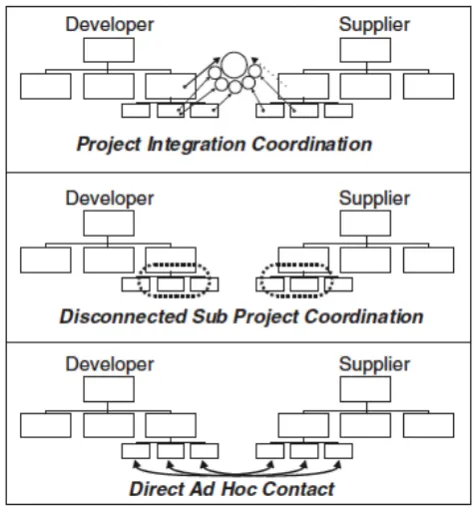
In order to coordinate the cooperation during a project Lakemond, Berggren, & van Weele (2006) distinguish three coordination approaches. The cooperation can act like an integrated project approach, a more ad hoc contact approach or the supplier can execute a disconnected sub project.
The different approaches fulfil different coordination needs. They are suitable under different conditions and imply different levels of coordination costs. A driver of differentiated coordination approaches is the degree of task dependence. The dependence is usually higher when the allocated tasks to the supplier are more complex. The technological novelty also increases the dependence of the companies e.g. if the expected contributions of a supplier are related to knowledge about complex technologies. A high level of dependence requires a higher degree of inter-organizational coordination.
A higher degree of diverging expectations and long-term collaboration objectives are drivers for a more integrated coordination approach. The use of a more integrated coordination approach results in a solution for the relationship problem, diverging expectations in supplier involvement projects (Wynstra, van Weelde, & Weggemann, 2001).
The three approaches will be presented in the following sub-paragraphs. Moreover, the three approaches are visualized in Figure 6.
3.6.1 Project integration coordination
In the first place, the cooperating companies can form a joint product development team. Employees with different disciplines of both companies take position in the team. The product will be developed jointly. Development teams can be co-located, which facilitates activities with a strong need for knowledge-oriented exchange by ease of face-to-face communication. However, co-location is not a necessity, project integration can also be established by use of modern communication techniques.
A project integration coordination approach creates a basis for easily sharing resources. Tasks can be performed jointly and responsibilities can be shared.
3.6.2 Disconnected sub project coordination
In the second place, the companies can decide to disconnect parts of the project and to keep the developers apart. Each sub project team takes account for its own part of the development tasks. This is for example possible at a modular product design3, which results in a low level of
architectural interfaces. The relatively little dependence between the task of the supplier and the
21 THEORETICAL FRAMEWORK task of the developing company reduces the need for coordination during the project. Ideally, communication is only needed at the beginning and at the end of the supplier’s task. The supplier performs its development e