warwick.ac.uk/lib-publications
Original citation:Winsper, Catherine, Tang, Nicole K. Y., Marwaha, Steven, Lereya, Suzet Tanya, Gibbs, Melanie, Thompson, Andrew D. and Singh, Swaran P.. (2017) The sleep phenotype of Borderline Personality Disorder : a systematic review and meta-analysis. Neuroscience & Biobehavioral Reviews, 73. pp. 48-67.
Permanent WRAP URL:
http://wrap.warwick.ac.uk/84465
Copyright and reuse:
The Warwick Research Archive Portal (WRAP) makes this work by researchers of the University of Warwick available open access under the following conditions. Copyright © and all moral rights to the version of the paper presented here belong to the individual author(s) and/or other copyright owners. To the extent reasonable and practicable the material made available in WRAP has been checked for eligibility before being made available.
Copies of full items can be used for personal research or study, educational, or not-for-profit purposes without prior permission or charge. Provided that the authors, title and full bibliographic details are credited, a hyperlink and/or URL is given for the original metadata page and the content is not changed in any way.
Publisher’s statement:
© 2017, Elsevier. Licensed under the Creative Commons Attribution-NonCommercial-NoDerivatives 4.0 International http://creativecommons.org/licenses/by-nc-nd/4.0/
A note on versions:
The version presented here may differ from the published version or, version of record, if you wish to cite this item you are advised to consult the publisher’s version. Please see the ‘permanent WRAP URL’ above for details on accessing the published version and note that access may require a subscription.
1
The sleep phenotype of Borderline Personality Disorder: A
systematic review and meta-analysis
Catherine Winsper, PhD; a* Nicole KY Tang, DPhil; b Steven Marwaha, Ph.D., MRCPsych,
MSc, MBBS; a, c Suzet Tanya Lereya, PhD; d Melanie Gibbs, MSc; e Andrew Thompson,
MD, MBBS; a MedSci, FRCPsych, Swaran P Singh, DMa
a Division of Mental Health and Wellbeing, Warwick Medical School, University of
Warwick; b Department of Psychology, University of Warwick; c Coventry and Warwickshire
Partnership Trust England, UK; d Evidence Based Practice Unit (EBPU), University College
London and the Anna Freud Centre, London, UK; e Centre for Applied Social and
Psychological Development, Canterbury Christchurch University
*Correspondence concerning this article should be addressed to Catherine Winsper, Mental
Health and Wellbeing, Warwick Medical School, University of Warwick, Coventry, CV4
7AL, UK. Tel +44 (0) 2476 574 886; Fax: +44 (0) 2476 528 375; email
Declaration of Interest: C.W; N.K.Y.T; S.M; S.T.L; M.G; A.T; & S.P.S report no conflict
of interest.
Word count
Abstract: 170 (170 words max)
2
Aim: To delineate the sleep profile of Borderline Personality Disorder (BPD).
Method: A meta-analysis to synthesise findings on the objective and subjective sleep
characteristics of BPD.
Results: We identified 32 studies published between 1980 and December 2015.
Meta-analysis indicated significant differences between BPD and healthy control groups across
objective sleep continuity (sleep onset latency, total sleep time, sleep efficiency) and
architecture (rapid eye movement latency/density, slow wave sleep) measures, and
self-reported sleep problems (nightmares, sleep quality). Findings were independent of depression
(in clinical and community populations), and concomitant psychotropic medication use.
There were few significant differences between BPD and clinical (majority depressed)
control groups.
Conclusion: BPD is associated with comparable sleep disturbances to those observed in
depression. These disturbances are not solely attributable to comorbid depression. Given
growing evidence that sleep disturbance may exacerbate emotional dysregulation and suicide
risk, treatments for BPD should explicitly address sleep problems. Future studies should
utilise prospective designs to ascertain whether (and in which circumstances) sleep problems
predate or follow the onset of the disorder.
3 1. Introduction
Borderline Personality Disorder (BPD) is a chronic mental disorder, which often first
manifests in adolescence (Kaess, Brunner, & Chanen, 2014; Winsper et al., 2016; Winsper et
al., 2015). It comprises a wide range of debilitating symptoms including mood instability,
inappropriate anger, impulsive behaviour, disturbances in self-identity, unstable relationships,
abandonment fears, and self-harm (Lieb, Zanarini, Schmahl, Linehan, & Bohus, 2004).
Studies indicate that individuals with BPD may experience sleep disturbances in
comparison to healthy (Bastien, Guimond, St-Jean, & Lemelin, 2008; Benson, King, Gordon,
Silva, & Zarcone, 1990) and depressed (De la Fuente et al., 2004) controls. Nevertheless, the
sleep profile of BPD has received relatively limited clinical and research attention (Winsper
& Tang, 2014). A greater understanding of sleep disturbance in BPD may help enrich
treatment protocols, which currently place rather limited emphasis on sleep difficulties
(National Institute for Clinical Excellence, 2009; Selby, 2013). Furthermore, elucidating the
extent to which BPD is independently associated with sleep problems may provide a more
coherent picture of the phenomenological and biological nature of this complex disorder
(Goodman, New, Triebwasser, Collins, & Siever, 2010; Simor & Horváth, 2013).
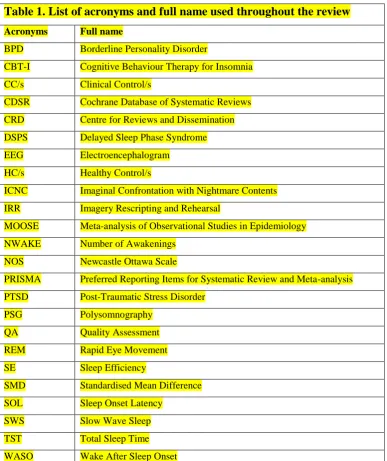
Narrative reviews have considered aspects of sleep in BPD (please see Table 1 for a
list of acronyms and associated full names used throughout the review). Hafizi (2013)
concluded that BPD is associated with several sleep abnormalities, including disturbances in
continuity, reduced Rapid Eye Movement (REM) latency (though findings were
inconsistent), and nightmares. Similarly, Simor and Horváth (2013) reported that sleep
fragmentation, alterations in Slow Wave Sleep (SWS) – though again results were mixed,
shortened REM latency, and dysphoric dreaming are prevalent in BPD. In a narrative
synthesis of 12 polysomnography (PSG) studies, Oltmanns and Oltmanns (2015a) reported
4
(TST), decreased sleep efficiency (SE), longer sleep onset latency (SOL) and more frequent
arousals. The authors concluded that BPD may be independently associated with sleep
disturbances.
[Insert Table 1 about here]
While these narrative reviews are informative, inconsistent results across studies make robust
conclusions regarding sleep in BPD difficult to formulate (Hafizi, 2013). Inconsistencies are
likely to be attributable to small samples sizes resulting in underpowered analyses (Harty,
Forkner, Thompson, Stuewig, & Tangney, 2010), and variations in study methodology (e.g.,
methods of assessment, differing sample characteristics) which may moderate (or mask)
pertinent group differences. Finally, the lack of systematic search procedures may have led to
the omission of important studies inflating risk of biased conclusions (Cipriani & Geddes,
2003).
To address these issues, we conducted a systematic review and meta-analysis of sleep
studies in BPD populations. Our main aim was to quantitatively examine the sleep profile
(i.e., continuity, architecture, and nightmares) of individuals with BPD, and determine
whether it can be distinguished from that of individuals with other (and no) mental disorders.
Specifically, we addressed the following research questions:
Do individuals with BPD significantly differ from healthy and clinical controls on
objective measures of sleep continuity (i.e., SOL, TST, WASO, NWAKE, SE) and
5
Are effect sizes for group differences in sleep moderated by study features (i.e.,
co-morbid depression status, sample frame, sleep assessment, gender, age, and study
quality)?
Do individuals with BPD significantly differ from controls on subjective measures of
sleep (e.g., nightmares, sleep quality)?
Is there a subjective-objective discrepancy in the sleep measures of individuals with
BPD?
2. Method
2.1. Search and selection of studies
Prior to formulating the protocol, C.W conducted a pilot search to ensure that a systematic
review pertaining to the research questions had not been previously published or registered.
The Cochrane Database of Systematic Reviews (CDSR), the Centre for Reviews and
Dissemination (CRD), and www.pubmed.gov (Sayers, 2008) were accessed for the scoping
search. We used MOOSE: Meta-analysis of Observational Studies in Epidemiology (Stroup
et al., 2000) and PRISMA: Preferred Reporting Items for Systematic Review and
Meta-analysis (Moher et al., 2015) guidelines as a framework. Methods of Meta-analysis and inclusion
criteria were specified in advance and documented in the protocol (Liberati et al., 2009).
We searched Embase, PsycINFO, and PubMed from 1980 (when BPD was first introduced as
a disorder in the DSM-III) to December 2015. Search terms were agreed by the authors
following consultation of relevant published reviews and the pilot search. We used the
grouped terms (borderline* OR BPD OR “emotionally unstable personality disorder”) and
6
wakefulness OR polysomnograph* OR EEG OR circadian*). Reference lists of retrieved
articles and review papers were inspected to enhance search sensitivity. T.L & C.W
independently searched 100% of the abstracts for full text retrieval. C.W and M.G
independently searched 100% of the full text articles for inclusion in the review.
2.2. Inclusion criteria
First, we defined criteria for studies to be included in the overall review, which were applied
to the systematic narrative synthesis and meta-analytic sections. Second, we applied further
inclusion criteria for the meta-analysis.
To be included in the overall review studies had to:
1) Be published in English;
2) Be primary research in a peer reviewed journal;
3) Report group comparisons between participants with BPD and healthy or clinical
controls on any sleep characteristic, or report associations between BPD symptoms
and any sleep characteristic;
4) Be based on adolescent or adult samples (defined as 11 years of age or older);
5) Include a clinical, high-risk (e.g., prison) or community population;
6) Report either an objective (e.g., EEG) or subjective (e.g., self-report) assessment of
sleep.
To be included in the meta-analysis, studies had to also:
7) Use a validated assessment of BPD (i.e., questionnaire, structured interview, clinical
diagnosis);
8) Report data (e.g., group means, standard deviations) to allow for the calculation of an
7
2.3. Exclusion criteria
1) Case reports;
2) Studies of sleep problems in personality disorders in general rather than BPD
specifically
2.4. Data extraction
A data extraction form was developed prior to manuscript review. It included: author details,
country of study, sample characteristics (i.e., age, sex, and sample frame), study design, BPD
and sleep assessments, and effect sizes and associated variance for the sleep variables. The
data extraction sheet also included a quality assessment (QA) tool based on the
Newcastle-Ottawa Scale (NOS), which can be adapted for non-randomised cross-sectional and
case-control studies (Wells et al., 2000). The NOS is based on a star system in which each case
control study is assessed on three broad domains: selection (maximum of 4 stars);
comparability (maximum of 2 stars) and exposure (maximum of 3 stars). We used the
adapted scale by Herzog et al. (2013) for cross sectional studies, covering the similar domains
of selection (maximum of 5 stars); comparability (maximum of 2 stars); and outcome
(maximum of 3 stars). The content validity and inter-rater reliability of the NOS have been
established (Wells et al., 2000). As we expected to identify a limited number of relevant
articles, we did not exclude studies according to a study quality threshold. Instead, we used
moderator analysis to determine whether study quality impacted on pooled results.
2.5. Meta-analysis
Meta-analysis for each sleep variable was conducted by computing weighted summary
measures using Stata version 13 (Stata Corp, College Station, TX, USA). Due to
methodological and sample variations, we expected studies to be heterogeneous, and that
sleep disturbances would vary more than expected by chance alone. Thus, we selected the
8
calculate summary estimates. We compared BPD groups to healthy and clinical controls. As
most (but not all) clinical control groups were depressed patients, we repeated the analysis
with depressed only controls as a sensitivity test. In view of the potential effects of
psychotropic medications on sleep (Whitney et al., 1998), we conducted a second sensitivity
test excluding studies in which patients were taking psychotropic or sleep medication at the
time of testing.
The standardised mean difference (SMD) was the principal summary measure. The
SMD is particularly appropriate for the synthesis of studies assessing the same concept (e.g.,
subjective sleep quality) with a variety of continuous scales (e.g., Pittsburgh Sleep Quality
Index, Schlaffragebogen B scale). Heterogeneity was quantitatively assessed using the
I-squared statistic to ascertain whether pooled studies represented a homogeneous distribution
of effect sizes. Evidence regarding publication bias was assessed using funnel plots. Funnel
plots are scatter graphs, which plot the effect sizes of individual studies (horizontal axis)
against a measure of study size (vertical axis). Publication bias (reported in Table 3) is
indicated by asymmetrical funnel plots, e.g., if smaller studies showing no statistical effect
remain unpublished there will be a gap in the right (or left for negative effects) bottom side of
the graph (Sterne & Harbord, 2004).
2.6. Subgroup analysis and meta-regressions
We addressed research question two (i.e., study factors associated with heterogeneity) using
subgroup analyses and meta-regression. We selected factors previously suggested to
influence sleep including: comorbid depression status (Holsboer-trachsler & Seffritz, 2000),
age (Ohayon, Carskadon, Guilleminault, & Vitiello, 2004), gender (Mongrain, Carrier, &
Dumont, 2005), sample type (Topf & Thompson, 2001), and sleep assessment tool (Hornung
et al., 2008). We performed subgroup analysis by categorical factors including: comorbid
9
comorbid depression); sample type (0=inpatients; 1=outpatients; 2=prison population); sleep
assessment (0=lab polysomnography; 1=less optimal/indirect sleep assessment method); and
gender (0=mixed sample; 1 = all females; 2 = all males). We then performed meta-regression
to estimate the extent to which each of these variables (and age and QA score entered as
continuous variables) explained the observed heterogeneity in pooled SMD estimates
(Higgins & Thompson, 2002).
3. Results
3.1. Search results
Of the 972 abstracts scanned, we identified 49 articles for full text retrieval. Interrater
agreement was very good (Kappa=0.87). C.W. and T.L discussed any discrepancies, which
were largely due to uncertainty regarding whether the study reported relevant sleep variables
(e.g., in some cases it wasn’t clear whether EEG measures referred to sleep specifically). If
there was any doubt over whether an abstract should be included for full text retrieval, we
made the decision to include it. Of the 49 full text articles inspected, 32 were identified for
inclusion in the review. Interrater agreement was excellent (Kappa=0.90). Of these 32
studies, 20 were also eligible for inclusion in the meta-analysis, 14 (two studies were
included in the MA and narrative synthesis) were synthesised narratively (see Figure 1).
Reasons for non-inclusion in the meta-analysis included: the reporting of overlapping data
(De la Fuente et al., 2004); insufficient data to convert into a common effect size (Bromundt
et al., 2013); and the uniqueness of the sleep factor (Dagan, Stein, Steinbock, Yovel, &
Hallis, 1998), i.e., it wasn’t assessed in a minimum of two studies.
10
See Table 2 for details and main results of studies. Two studies were prospective (Lereya,
Winsper, Tang, & Wolke, 2016; Selby, Ribeiro, & Joiner Jr, 2013), the remainder were
cross-sectional. Twenty-four studies (inpatients, n=11; outpatients, n=13) used clinical samples,
five community samples (1 nationally representative sample, 1 large community cohort of
young adolescents, 1 student sample, 1 older population, and 1 sample recruited for
self-reported difficulties with dysregulated behaviours), and three prison populations. Eleven
studies reported an objective sleep measure, fifteen a subjective sleep measure, and six both
objective and subjective measures. Nearly all studies examining objective sleep measures
used polysomnography in laboratory conditions. One study utilised a portable
electroencephalogram sleep recording device (Hornung et al., 2008), while two utilised wrist
actigraphy (Bromundt et al., 2013; Huỳnh, Guilé, Breton, & Godbout, 2015).
Most studies with clinical control groups included depressed patients with the
exception of one group of prisoners with Antisocial Personality Disorder (Lindberg et al.,
2003), one group of patients with insomnia (Bastien et al., 2008), and one group of adolescent
outpatients with bipolar disorder (Huỳnh et al., 2015). Most studies reported a psychotropic
medication wash-out period (usually of 2 weeks) prior to sleep assessment; five did not report
a wash-out period (Huỳnh et al., 2015; Plante, Frankenburg, Fitzmaurice, & Zanarini, 2013b;
Selby et al., 2013; Simor, Csóka, & Bódizs, 2010; Taherifard, Abolghasemi, & Hajloo,
2015). Adult samples were used in most studies; only three had adolescent samples (Dagan et
al., 1998; Huỳnh et al., 2015; Lereya et al., 2016).
[Insert Table 2 about here]
3.2. Quality assessment
The findings from the quality assessment are reported in Supplementary Tables 1 & 2.
11
on representativeness of sample and response rate (which was often not reported in studies,
precluding assessment). Most studies performed well on comparability of cases and controls
by either matching control groups carefully, or controlling for pertinent confounders.
3.3. Meta-analysis results
3.3.1 Studies with objective sleep assessments
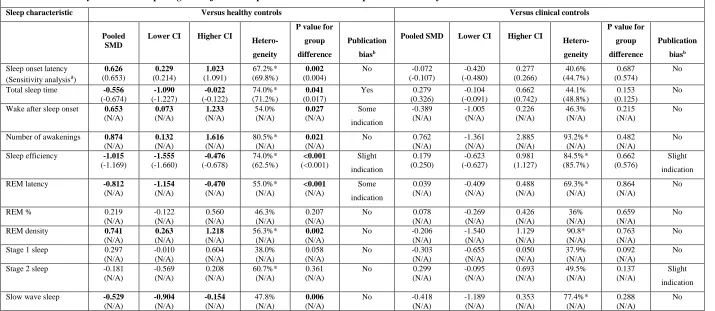
Detailed results (including the Standardised Mean Difference: SMD, confidence intervals,
heterogeneity statistics, sensitivity analysis, p-values, and publication bias) are reported in
Tables 3 and 4. Please see Figures 2, 3 & 4 for summary forest plots. Below we outline the
direction of results.
BPD versus healthy control groups
Individuals with BPD had significantly longer SOL and WASO, and greater NWAKE and
REM density than healthy control groups. They also had significantly shorter TST and REM
latency, and lower SE than healthy control groups. Groups did not differ in % of REM sleep,
and stage-1 or stage-2 sleep (Figure 2).
[Insert Table 3 here]
[Insert Figure 2 here]
There was significant heterogeneity across studies for SOL, TST, NWAKE, SE, REM
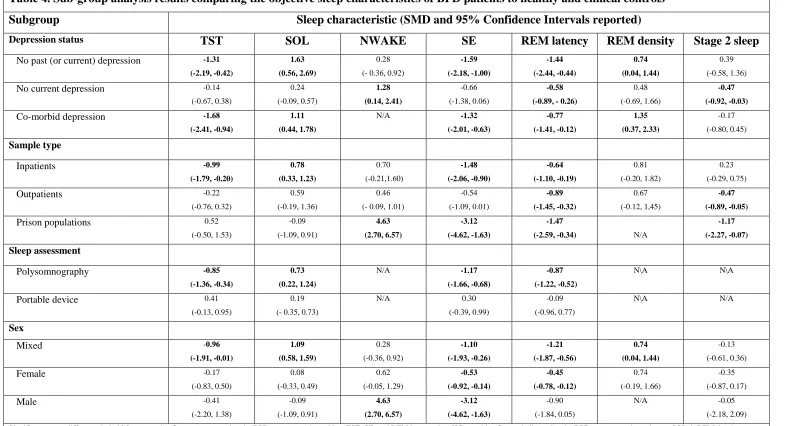
latency, REM density and stage-2 sleep. In sub-group analyses (Table 4), many significant
differences between BPD and healthy groups remained robust across depression status (i.e.,
no history, no current, comorbid) groups (see Figure 3); differences were mainly robust in
inpatient groups (TST, SOL, SE, and REM latency); those assessed with polysomnography
(TST, SOL, SE, and REM latency); and mixed sex samples (TST, SOL, SE, REM latency,
12
[Insert Table 4 here]
(Insert Figure 3 here]
There were few significant predictors of heterogeneity in the meta-regression analyses. Sleep
assessment tool (i.e., the use of polysomnography significantly predicted a negative SMD of
TST) and sample type (i.e., the SMD of SOL was significantly greater in the mixed sex
sample than the female only sample, and the SMD of NWAKE was significantly greater in
the male sex group than the mixed sex samples) significantly accounted for heterogeneity for
some of the sleep indices (see Supplementary Table 3).
BPD versus clinical controls
Individuals with BPD did not significantly differ from all clinical control groups or depressed
only groups on any of the sleep indices (see Table 3 and Figure 4).
[Insert Figure 4 here]
There was significant heterogeneity across studies for SE, SWS, and REM latency.
Sub-group analyses for these indices indicated some subtle differences according to study factors
(full results on request from authors). For SE, BPD individuals who had never been
depressed, and outpatients, had significantly higher SE than CCs. In contrast, BPD
individuals who were prisoners had significantly lower SE than CCs. For SWS, BPD
individuals without co-morbid depression and those who were prisoners had significantly less
slow wave sleep than CCs. For REM latency, BPD patients who had never been depressed
had longer REM latencies than CCs, while REM latency was significantly shorter in BPD
13
There were few significant predictors of heterogeneity in the meta-regression analyses.
Sample type (i.e., the SMD of SE was significantly lower in the prison population than the
inpatient groups) and study quality (i.e., the SMD of SE was higher in the studies of higher
quality) significantly moderated effect size for some of the sleep indices (full results on
request from authors).
3.3.2. Studies with self-reported sleep assessments
Studies considering self-reported sleep characteristics examined nightmares, sleep quality,
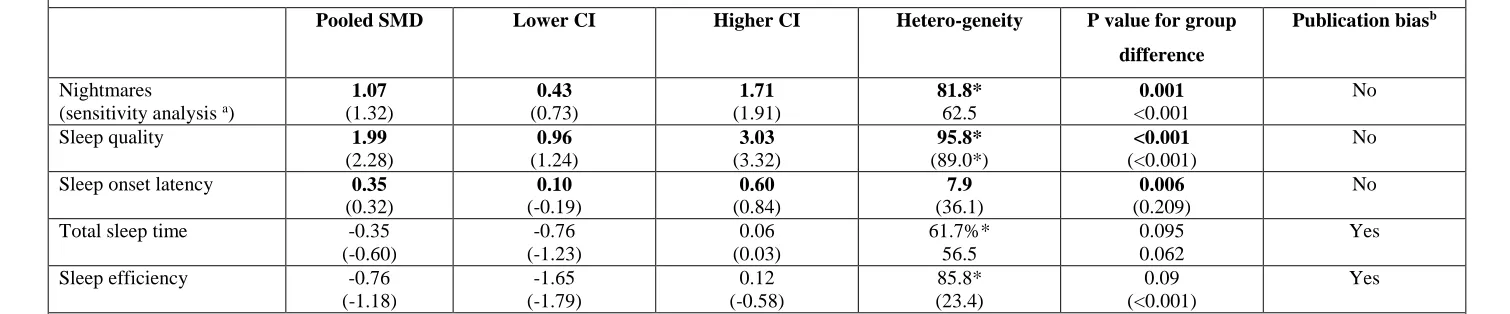
SOL, TST, and SE. See Table 5 and Figure 5 for a summary of the meta-analysis findings.
[Insert Figure 5 here]
[Insert Table 4 here]
Individuals with BPD reported significantly more nightmares, significantly poorer sleep
quality, and significantly longer SOL than controls. Groups did not differ in self-reported
TST or SE. There was significant heterogeneity across studies for nightmares, sleep quality,
TST, and SE. We did not conduct meta-regressions due to the small number of studies.
Sub-group analysis indicated that BPD patients without co-morbid depression, and both inpatients
and outpatients experienced significantly more nightmares than controls. Subjective sleep
quality was worse in BPD patients without co-morbid depression, and in both inpatients and
outpatients (full results on request from authors).
3.4. Summary of results from the narrative synthesis
We narratively summarised results from studies that could not be quantitatively combined.
Below we outline the pattern of findings. Please refer to Table 2 for more details on
14 3.4.1. Circadian rhythm abnormalities
The circadian rhythm (or “body clock”) is an endogenously-driven roughly 24-hour cycle,
which tells our bodies when to sleep, and regulates other physiological process. Three studies
indicated irregularities in circadian rhythms in BPD. Individuals with BPD appear more
susceptible to delayed sleep phase syndrome: DSPS (Dagan et al., 1998); experience greater
variability in Relative Amplitude, i.e., the distribution of activity between day and night
(Bromundt et al., 2013); and experience wider sleep variability between weekdays and
weekends (Huỳnh et al., 2015).
3.4.2. Nightmares
Findings from the narrative synthesis were consistent with the meta-analysis, demonstrating
significant associations between nightmares and BPD in clinical (Lloyd, Overall, Kimsey, &
Click Jr, 1983) and community (Claridge, Davis, Bellhouse, & Kaptein, 1998; Lereya et al.,
2016) populations. Furthermore, although preliminary, there was evidence for a prospective
association between nightmares and BPD symptoms over both short (Selby et al., 2013) and
long (Lereya et al., 2016) periods of time. These studies suggest that nightmares may
exacerbate daytime dysregulation contributing to worsening symptoms (Selby et al., 2013),
and possibly the development of BPD (Lereya et al., 2016).
3.4.3. Self-reported sleep-quality and maladaptive sleep cognitions
Also consistent with the meta-analysis, there was evidence for a significant association
between subjective poor sleep quality/insomnia symptoms and BPD in clinical (Bromundt et
al., 2013; Sansone, Edwards, & Forbis, 2010), prison (Harty et al., 2010), and community
(Oltmanns, Weinstein, & Oltmanns, 2014; Selby, 2013) populations. Plante, Frankenburg,
Fitzmaurice, and Zanarini (2013a) found that maladaptive cognitions about sleep (i.e.,
15
sleep; and attitudes about sleep medication) distinguished those who continued to meet BPD
criteria from those who didn’t.
4. Discussion
We examined the specific sleep profile of individuals with BPD by pooling the results of
studies comparing BPD patients to healthy and clinical controls. Further, we conducted
sub-group analyses to determine the extent to which sub-group differences were moderated by
pertinent study factors. Studies not suitable for meta-analysis were synthesised narratively.
4.1. Summary of findings
4.1.1. Do individuals with BPD significantly differ from healthy and clinical controls on
objective sleep measures, and are pooled results moderated by study factors?
The meta-analysis indicated robust differences between BPD and HC groups across sleep
continuity measures (i.e., SOL, TST, SE, WASO, and NWAKE). Our results extend previous
reviews (Hafizi, 2013; Oltmanns & Oltmanns, 2015a) by quantitatively demonstrating
significant differences between BPD and HC groups across all sleep continuity measures.
Sub-group analyses indicated some variations according to study-based characteristics.
Differences were robust in sub-groups of BPD patients without any history of (SOL,
TST, and SE) or concurrent (NWAKE) depression. This lends some support to the previous
suggestion that sleep continuity problems are independently associated with BPD, rather than
being a consequence of comorbid depression (Oltmanns & Oltmanns, 2015a). Subgroup
analysis also demonstrated that differences between BPD and HC groups were significant in
studies utilising polysomnography (rather than wrist actigraphy or other non-lab-based
devices), and in inpatient populations. The more robust findings in polysomnography studies
are perhaps unsurprising as this technique is often considered as the gold standard of sleep
16
could be partly attributable to the severity of BPD symptoms, which may be associated with
more pronounced objective sleep problems (Bastien et al., 2008).
Results were less consistent for sleep architecture. BPD groups did not significantly
differ from HCs in stage 1 or 2 sleep, or percentage of REM sleep. They did, however,
demonstrate significantly less SWS. This result contrasts with previous reviews, which did
not identify a difference in SWS between BPD and HCs (Oltmanns & Oltmanns, 2015a), or
suggested a potential increase in SWS in BPD (Simor & Horváth, 2013). Discrepant
conclusions across reviews are likely partly due to a lack of power in individual studies (i.e.,
null findings, which when combined in meta-analysis reveal significant associations).
Also in contrast to conclusions from previous reviews (Oltmanns & Oltmanns,
2015a), we found that patients with BPD experienced significantly shorter REM latency than
HCs. This finding was robust across several sub-groups, including depression status, sample
type, and sex. Our finding of increased REM density in BPD is consistent with previous
reports on BPD (Oltmanns & Oltmanns, 2015a), while reduced REM latency and increased
REM density have also been robustly associated with depression (Palagini, Baglioni,
Ciapparelli, Gemignani, & Riemann, 2013). Findings from the sub-group analyses (i.e.,
significant abnormalities in BPD groups with no history of, or current, depression), however,
support that abnormalities in REM latency and density may not be directly attributable to
comorbid depression in BPD.
Comparisons with clinical controls (CCs)
Meta-analyses of objective sleep studies indicated no overall significant differences between
BPD groups and CCs across sleep measures. For most of the sleep indices, heterogeneity
across studies was non-significant precluding sub-analysis. However, where sub-group
analysis was indicated, it revealed some potential subtle differences between groups. BPD
17
than CCs. This could be attributable to the severity of BPD (i.e., outpatients and those
without a history of depression could have a less severe form of BPD). We also found that
BPD patients without current comorbid depression and prisoners experienced significantly
less SWS than CCs. This may be associated with increased alcohol consumption in patients
with BPD (Lester, Rundell, Cowden, & Williams, 1973) or an overlap between BPD and
psychotic symptoms (De la Fuente et al., 2004). Our hypotheses remain tentative, however,
as these findings were not robust across the majority of BPD groups.
In a previous review comparing the endophenotypes of BPD and Major Depressive
Disorder (MDD), it was concluded that BPD and depressed patients exhibit differing sleep
profiles (Goodman et al., 2010). Our quantitative synthesis of all available studies does not
support this conclusion. Overall, BPD and depressed patients appear to share similar
disturbances in sleep continuity and architecture, which may suggest potential overlapping
biological processes in this domain.
4.1.2. Do individuals with BPD significantly differ from controls on subjective measures of
sleep?
Converging evidence demonstrates that inpatients, outpatients, and community populations
with BPD (or BPD symptoms) report significantly more nightmares than HCs. Again,
associations appear independent of comorbid depression. Complex associations between
trauma, nightmares, and BPD are indicated (Claridge et al., 1998; Lereya et al., 2016; Semiz,
Basoglu, Ebrinc, & Cetin, 2008). Recent prospective evidence suggests that nightmares could
exacerbate reactions to early trauma increasing risk of subsequent BPD (Lereya et al., 2016).
These intriguing findings are consistent with contemporary developmental theories for BPD,
which highlight the potentiation of emotional and behavioural dysregulation across
18 4.1.3. Is there a subjective-objective discrepancy in the sleep findings for BPD?
Consistent with the objective sleep measures, patients with BPD reported significantly poorer
sleep quality and significantly longer SOL than HCs. In contrast to the objective results, they
did not differ from HCs on subjective measures of TST and SE. Previously, it was suggested
that individuals with BPD (common to those suffering from paradoxical insomnia) show
marked discrepancies between subjective and objective sleep measures (Bastien et al., 2008),
i.e., they report worse sleep quality than HCs while objectively demonstrating similar sleep
patterns (Bastien et al., 2008; Philipsen et al., 2005). Our findings do not support that
individuals with BPD are likely to over-estimate their sleep problems. They are, however,
likely to engage in maladaptive cognitions about their sleep, which could potentially impede
recovery (Plante et al., 2013a).
4.1.4. Strengths and Limitations
Our review has strengths. First, we utilised systematic search procedures to reduce risk of
bias and ensure comprehensive coverage of the literature. Second, by utilising meta-analysis
(and thus increasing statistical power) we were able to reveal patterns in the research
literature that could not be detected through narrative synthesis. This has enabled us to move
knowledge forward regarding the specific sleep profile of BPD.
It is also important to highlight the considerable limitations of the available evidence
and hence the meta-analytical approach we took. First, although interest in sleep and BPD is
growing (Oltmanns & Oltmanns, 2015a), there were a limited number of studies eligible for
inclusion in the meta-analysis. Consequently, we had limited power to detect significant
moderators of effect size in the meta-regression analyses, making it difficult to definitively
ascertain the independent effects of study factors. This was also apparent in the sub-group
analyses, where some categories were represented by very few studies. Relatedly, while
19
quality assessment due to the limited numbers. Our metaregression analysis did not (overall)
indicate any major effect of study quality on effect size. However, as most studies scored
poorly in terms of representativeness and response rate, this could impact on the
generalisability of our results.
Second, we undertook multiple analyses to explain the observed heterogeneity across
studies, which could have resulted in type I errors. Nevertheless, we pre-planned and
grounded our analyses (and research questions) within the extant literature to avoid data
dredging and reduce the probability of false positives (Thompson & Higgins, 2002).
Third, some of our findings may have been subject to publication bias. This could
have resulted in an over estimation of group differences, especially for TST where the funnel
plot indicated that bias could have played a role.
Fourth, while it is interesting that many of the objective sleep findings were robust
independent of comorbid depression, the exclusion of BPD patients with depression will have
limited the generalisability of the results from these clinical subgroups, as comorbid
depression is relatively common in BPD (Oltmanns & Oltmanns, 2015a; Zimmerman &
Mattia, 1999). Nevertheless, significant sleep- BPD associations were also found in
community (Oltmanns et al., 2014; Selby, 2013) and prison (Harty et al., 2010) studies
following statistical adjustment for depression symptoms. Further, sub-analyses demonstrated
that BPD patients both with and without comorbid depression evinced similar sleep
disturbances. This converging evidence supports the independence of sleep-BPD associations
across diverse populations.
Fifth, some studies concentrated on the effects of comorbid or past history of
depression (Akiskal, Yerevanian, Davis, King, & Lemmi, 1985), or just controlled for
depression symptoms (Oltmanns et al., 2014), rather than a full range of psychiatric
20
associated with both BPD (Zimmerman & Mattia, 1999) and sleep disturbance (Kobayashi,
Boarts, & Delahanty, 2007; Plante & Winkelman, 2008). Nevertheless, the majority of
studies did exclude participants with other psychiatric disorders (e.g., psychotic disorder,
bipolar disorder, substance abuse, PTSD) or controlled for other psychiatric symptoms, e.g.,
substance abuse, PTSD (Harty et al., 2010; Selby et al., 2013), adding support to the
independence of observed associations between BPD and sleep disturbance.
Sixth, although most studies included in our meta-analysis incorporated a medication
wash-out period, in most cases this lasted for a maximum of two weeks. Thus, it is possible
that medication taken prior to the study may have had a residual impact on the sleep
disturbances assessed (Battaglia, Ferini-Strambi, Smirne, Bernardeschi, & Bellodi, 1993). In
a study by Cowdry and Gardner (1988), for example, BPD patients receiving
benzodiazepines experienced an increase in serious dyscontrol.
Finally, due to a lack of prospective studies, we were unable to ascertain from the
extant literature whether sleep problems predate the development of BPD or are a
consequence of the disorder. There is limited evidence to support that sleep problems may be
evident before the development of the disorder and contribute to its aetiology (Lereya et al.,
2016; Selby et al., 2013). There is also tentative evidence to suggest that ongoing sleep
problems can contribute to the chronicity of the disorder (Plante et al., 2013b). It should be
noted, however, that associations between sleep disturbance and BPD are likely to be
bi-directional, as a number of symptoms and behaviours (e.g., impulsivity, substance abuse,
chaotic lifestyle) central to BPD are known to disrupt sleep patterns (Fleischer, Schäfer,
Coogan, Häßler, & Thome, 2012; Winsper & Tang, 2014).
4.1.5. Clinical and research implications
Results from this review provide clues regarding the biopsychosocial basis of BPD. It appears
21
objectively measured) not accounted for by concomitant depression (or other psychiatric
disorders). This conclusion is supported by converging evidence from clinical studies
utilising BPD patients with and without comorbid Axis I disorders (e.g., Battaglia et al.,
1993; De La Fuente et al., 2001), and larger studies controlling for the effects of depression
symptoms and substance dependence on BPD-sleep associations (Harty et al., 2010;
Oltmanns et al., 2014; Selby, 2013).
BPD and depressed patients appear to share similar objective sleep disturbances,
which could indicate an overlap in biological processes. Harty et al. (2010) suggest that sleep
problems in BPD may represent a more general impairment in self-regulation, and that sleep
and impaired psychological self-regulation in BPD are underpinned by a common biological
substrate. It has been proposed that sleep disturbances and emotional dysregulation are
transdiagnostic processes which are aetiological and maintaining factors for a range of
psychopathologies (Fairholme et al., 2013). As hypothesised in the “emotional cascades”
theory of BPD, daytime dysregulation may spill over into the night-time increasing risk of
sleep disturbance, which in turn may further contribute to dysregulation in a positive
feedback loop (Selby et al., 2013). Increased amygdala responsiveness to dream stimuli
(Nielsen & Stenstrom, 2005) leading to hyper-activity of the limbic system (Yoo, Gujar, Hu,
Jolesz, & Walker, 2007) may represent one potential physiological mechanism contributing
to this cycle.
More prospective cohort studies from childhood onwards are now needed to ascertain
whether sleep problems are a marker, cause, or consequence of BPD, and to elucidate the
aetiological pathways involving sleep, dysregulation and BPD. Studies incorporating a range
of psychopathological outcomes (e.g., BPD, depression, psychosis, bipolar disorder, anxiety)
simultaneously may help shed further light on the specific nature of sleep problems in BPD
22
and micro-longitudinal (McCall et al., 2010) designs to investigate the proximal impact of
sleep disruptions on BPD symptoms at the biological (Yoo et al., 2007) and phenotypical
(Anderson & Platten, 2011) level. It should be highlighted that the BPD diagnosis (in the
categorical form used in many of the included studies) comprises a heterogeneous group of
individuals. Indeed, the requirement for five out of nine symptoms means that there are
numerous ways to meet the BPD diagnosis (Linehan, Cochran, & Kehrer, 2001). Hafizi
(2013) suggests that specific types of sleep problem may be associated with specific BPD
symptoms (e.g., nightmare disorder with self-harm and suicide, short sleep length with
affective instability). Thus, to further our understanding of sleep disturbance in this complex
disorder, future studies may examine associations between specific sleep problems and
individual symptoms (or symptom clusters) of BPD.
Sleep problems may not only worsen symptom course in BPD (Selby et al., 2013) but
also heighten risk of suicide (Balestrieri et al., 2006; Winsper & Tang, 2014) and self-harm
(Semiz et al., 2008) in this vulnerable population. Hence, mental health professionals should
routinely assess the degree to which patients with BPD are experiencing sleep difficulties.
Sedative-hypnotic regimens should be approached with caution (National Institute for
Clinical Excellence, 2009), as patients with BPD may be likely to use medications in excess,
thus exacerbating suicide risk (Plante et al., 2013a; Winsper & Tang, 2014).
This review highlights several potential treatment approaches for sleep problems in
BPD. Cognitive Behaviour Therapy for insomnia (CBT-I) is an effective treatment (Harvey,
2015), which may help reduce maladaptive sleep related cognitions and potentially aid
recovery in BPD (Plante et al., 2013a). Considering the high incidence and potential
aetiological role of nightmares in BPD (Selby et al., 2013), imagery rescripting and rehearsal
(IRR) and imaginal confrontation with nightmare contents (ICNC) may be other
23
2013). Timed light exposure, planned, regular sleep schedules, and interpersonal and social
rhythms therapy (Harvey, 2015) are further options for disturbed circadian rhythms in BPD
(Bromundt et al., 2013; Dagan et al., 1998; Huỳnh et al., 2015).
In view of the centrality of dysregulation to BPD and sleep disturbance (Marwaha,
Balbuena, Winsper, & Bowen, 2015), an integrated treatment approach focusing on
promoting sleep hygiene (Huỳnh et al., 2015; NICE, 2009) and reducing daytime rumination
24 Table 1. List of acronyms and full name used throughout the review
Acronyms Full name
BPD Borderline Personality Disorder
CBT-I Cognitive Behaviour Therapy for Insomnia
CC/s Clinical Control/s
CDSR Cochrane Database of Systematic Reviews
CRD Centre for Reviews and Dissemination
DSPS Delayed Sleep Phase Syndrome
EEG Electroencephalogram
HC/s Healthy Control/s
ICNC Imaginal Confrontation with Nightmare Contents
IRR Imagery Rescripting and Rehearsal
MOOSE Meta-analysis of Observational Studies in Epidemiology
NWAKE Number of Awakenings
NOS Newcastle Ottawa Scale
PRISMA Preferred Reporting Items for Systematic Review and Meta-analysis
PTSD Post-Traumatic Stress Disorder
PSG Polysomnography
QA Quality Assessment
REM Rapid Eye Movement
SE Sleep Efficiency
SMD Standardised Mean Difference
SOL Sleep Onset Latency
SWS Slow Wave Sleep
TST Total Sleep Time
25 Table 2. Details and Main Results of Studies Reporting on the Sleep Characteristics of Individuals with BPD diagnosis or symptoms
Author/ Synthesis (Design) Year/ Country % female Sample (N, controls) Sample frame Age (SD) In years Sleep assessment /medication
Co-morbidity BPD assessment tool
Main results
(Akiskal et al.) MA 1985 USA 50% 43% 43% 38% 24 BPD 30 depression 14 HCs 16 other PDs
Outpatients (Sleep disorders centre) 36 (11) 46 (12) 36 (16) 45 (13) Polysomnography/ No psychoactive drugs for 2 weeks
Excluded: Definite or probable depressive episodes during the preceding year; narcolepsy and sleep apnea
DSM-III criteria for BPD
BPD patients had significantly shorter REM latency than healthy and PD controls. They did not significantly differ in REM latency from depressed controls. (Asaad, Okasha, & Okasha) MA 2002 Egypt 60% 60% 60% 20 BPD 20 depression 20 healthy controls
Outpatients 27.04 (7.53) 27.83 (7.65) 27.8 (4.62)
Polysomnography; Questionnaire/ No psychotropic drugs for 2 weeks
Excluded: Past or current affective disorder or other psychiatric disorder; sleep apnea
ICD-10 “emotionally unstable PD
BPD patients significantly differed from HCs on SOL (longer), SE (lower), SWS (less), REM % (greater), REM latency (shorter) & REM density (higher). BPD patients significantly differed from depressed controls on SOL (shorter), SE (higher), NWAKE (less), REM latency (longer), REM density (lower).
(Bastien et al.) MA 2008 Canada 100% 67% 73% 12 BPD 15 good sleepers 15 psycho* insomnia 15 para* insomnia
Outpatients 33.3 (10.7) 34.1 (9.9) 36.6 (7,1)
Polysomnography; Sleep diary; ISI/ No psychotropic drugs or sleep promoting medication
Excluded: Axis I psychiatric disorder or alcohol/drug abuse during past year; other sleep disorder, e.g., apnea
DSM-IV criteria for BPD DIB-R (≥7)
BPD patients had significantly longer SOL, less TST, and lower SE than good sleepers (GS). BPD patients had more stage 4 sleep than controls with insomnia. Subjective reports of sleep difficulties did not differ between patients with BPD and GS. Controls with insomnia had significantly poorer subjective sleep than BPD patients and GS.
(Battaglia et al.) MA 1993 Italy 60% 60% 10 BPD 10 healthy controls
Inpatients 25.4 (4.5) 24.8 (3.5)
Polysomnography/ 2 weeks without medication
Excluded: Past or current depression, bipolar disorder, cyclothymia, dysthymia, schizophrenia
DSM-III criteria for BPD
BPD patients had significantly longer SOL, more WASO and number of awakenings, lower SE, and shorter REM latency than HCs.
(Bell, Lycaki, Jones, Kelwala, & Sitaram) MA
1983 USA
67% 56%
8primary BPD 11 primary depression
Inpatients 29.7 (3.9) 36.5 (13.2)
Polysomnography/ 2 weeks without medication
All had co-morbid depression DSM-III criteria for BPD
There were no significant differences in SOL, SE, REM % or latency, TST or WASO between BPD and depressed only groups.
(Benson et al.) MA 1990 USA 0% 0% 10 BPD (veterans) 15 HCs
Inpatients 32.7 (7.6) 30.5 (7.6)
Polysomnography/ 2 weeks medication free
No history of, or co-morbid, major depressive disorder
DSM-III criteria for BPD
BPD patients had significantly less TST, more stage 1 sleep and less stage 4 sleep than HCs. The groups did not differ in REM latency.
(Bromundt et al.) N
2012 Switzerland
100% 14 BPD 10 healthy controls
Outpatients 30.1 (6.0) 25.7 (4.8)
Wrist actimetry; PSQI; MEQ; SPAQ/ 10/14 BPD patients on stable medication
Not reported (though BPD group had significantly higher depression and anxiety symptoms); no sleep apnea
DSM-IV criteria for BPD BPI (>8)
BPD patients exhibited a wider range in Relative Amplitude (RA) than HCs (p=0.019). BPD patients with high RA had regular sleep-wake cycles, while those with low RA group had irregular rhythms and more BPD symptoms. Morning LT significantly improved daytime alertness (F [1, 12] = 9.33, p = 0.010), and attenuated atypical depression scores (t [13] = 2.55, p = 0.024) in patients with BPD.
(Claridge et al.) N
1998 Canada
100% 60 women (study1) 66 women (study2) 203 women (study3) Student population 20.4 (range=18-30 years) 21.2 Nightmare Distress Scale (13 item self-report); Dream and Nightmare Enquiry/ not reported
Not reported STB Study 1: BPD symptoms were significantly correlated with ND (r=0.42, p< 0.001) and remained a significant predictor of nightmares following control for sexual abuse and neglect.
Study 2: BPD symptoms were significantly correlated with adult (r =0.31, p< 0.01), but not childhood (r =0.07) nightmare content.
Study 3: ND was significantly positively correlated with BPD symptoms (r=0.49, p< 0.001) following control for abuse and neglect.
(Dagan et al.) N 1998 Israel
48% 52 adolescents mixed diagnoses 11 BPD
Inpatients 17.4 (2) Sleep wake habits Interview/ all on medication
4 of the 5 BPD patients with DSPS had no co-morbidities
MCMI PDQ-R
50% of adolescent patients with Delayed Sleep Phase Syndrome had BPD (Odds Ratio=7.67; 95% CI=1.70, 34.48).
26
(De la Fuente, Bobes, Vizuete, & Mendlewicz) MA 2001 France 70% 75% 70% 20 BPD 20 depression 20 HCs
Inpatients 32.4 (6.9) 38.5 (7.6) 35.5 (5.8)
Polysomnography/ 10 days medication free
Excluded: Other Axis I disorders
DSM-III criteria for
BPD DIB-R (≥7)
BPD patients had significantly less TST, longer SOL, and a greater % of wakefulness than HCs. BPD patients had a longer duration of REM sleep, less stage 3, stage 4 and SWS than both control groups.
BPD patients had more stage 2 sleep than depressed controls. (De la Fuente et
al.)* N
2004 France 70% 70% 75% 75% 20 BPD 20 RBD 20 MD 20 HCs
Inpatients 32.4 (6.9) 36.6 (7.6) 35.9 (3.4) 35.5 (5.8)
Polysomnography/ 10 days medication free
Excluded: Other Axis I disorders
DSM-III criteria for
BPD DIB-R (≥7)
Patients with BPD experienced significantly less stage 3 sleep and SWS, and significantly longer REM duration than patients with RBD. They did not significantly differ on SOL; TST; stage 1 or 2 sleep; or REM latency.
(Harty et al.) N 2010 USA
30% 513 jail inmates Prisoners 32 (10) 5 item index self-report index/ not reported
Not reported (though analysis controlled for depression symptoms and substance dependence)
PAI-BOR scale BPD symptoms were significantly correlated with self-reported sleep problems (r=.43). This significant correlation held following control for cognitive, affective and physiological depression (r=.20), and substance dependence (r=.39).
(Hornung et al.) MA 2008 Germany 100% 100% 15 BPD 15 HCs
Inpatients 26.1 (6.1) 25.6 (6.8)
Portable recording device; sleep questionnaire/ no medication 3 days
3 of the BPD patients had co-morbid depression
DSM-IV criteria for BPD
BPD patients reported significantly poorer sleep quality and less restorative value of sleep in comparison to HCs. They did not significantly differ in objective measures of SOL, TST, WaSO, sleep stage or REM latency.
(Huỳnh et al.) MA/N 2015 Canada 83% 67% 65% 18 BPD 6 BD 20 HCs
Outpatients 16 (1.1) 16.7 (1.0) 14.7 (1.0) Actigraph/ most patients on psychotropic medication
Excluded: Euthymic (i.e., current depression symptoms), mania, psychotic features, bipolar
DSM-IV criteria for BPD DIB-R (≥8)
On school/work days, adolescents with BPD spent a significantly lower % of time asleep than bipolar controls (p=0.04). Time awake in bed did not significantly differ between BPD & HCs. On schedule-free days, youths with BPD and bipolar disorder spent more time in bed than HCs (ns). Adolescents with BPD demonstrated more inter-daily total sleep time variability than bipolar and HC groups.
(Lahmeyer et al.) MA 1987 USA 53% 50% 21 BPD 20 depression
Outpatients 29.0 (3.4) 35.2 (4.8)
Polysomnography/ 14 days without medication
Excluded: Major affective disorders and schizophrenia
DSM-III criteria DIB (≥7)
BPD patients had significantly less stage 1 sleep than depressed controls and significantly greater SE. The 2 groups did not differ on TST, SOL or REM (&, density and latency) indices.
(Lereya et al.) N
2016 UK
51.4% 6,050 Community
population of young adolescents
11.8 Mother reported/ not reported
Not reported, but controlled for emotional and behavioural dysregulation within the analysis
UK-CI-BPD Chronic nightmares significantly predicted BPD (OR=1.67; 95% CI=1.18, 2.38). This association was mediated by daytime emotional and behavioural dysregulation (β =0.016, p<0.001). Associations between early emotional temperament (β=0.001, p=0.018); abuse (β=0.015, p=0.018); maladaptive parenting (β=0.002, p=0.021), and subsequent BPD were all mediated by nightmares.
(Lindberg et al.) MA 2003 Finland 0% 0% 0% 10 ASPD 6 ASPD with BPD 11 HCs Prisoners (charged with violent crimes) 28.1 (3.40) 34.8 (4.45) 32.5 (3.44) Polysomnography/ 2 weeks medication free
Excluded: Axis I disorder (other than drug/alcohol abuse), other personality disorders
DSM-IV criteria for BPD
Groups did not differ on TST, SOL, SWS, stage 1 sleep or REM measures. The BPD group had significantly more awakenings and significantly lower SE than ASPD and HCs. BPD and ASPD groups had significantly more stage 4 sleep than HCs.
(Lloyd et al.) N 1983 USA
66% 27 BPD; 178 mixed disorders
Outpatients 20-59 years MMPI-168/ not reported
Not reported DSM-III criteria Outpatients with BPD were significantly more likely to report nightmares every few nights than controls (p< .01).
(Mahmood, Tripodi, Vaughn, Bender, & Schwartz) N
2012 USA
100% 475 BPD 330 controls
Prisoners 33.5 (8.5) One item: ”have trouble sleeping in prison”/ not reported
Not reported though BPD was correlated with anxiety and depression
SCID-II Female prisoners with BPD were more likely to experience self-reported sleep problems following control for demographic variables; though the difference did not quite reach statistical significance: OR=1.33; 95% CI = 0.90, 1.94.
(McNamara et al.) MA 1984 USA 100% 70% 100% 10 BPD 10 depression 10 HCs Inpatients (2 outpatients) 28.1 (3.8) 27.4 (5.1) 27.8 (4.5) Polysomnography/ 2 weeks medication free
BPD patients had variety of Axis I co-morbidities (6 had major depression)
DIB (≥7) The BPD group significantly differed from HCs on TST (less), SE (less), and REM latency (shorter) and REM density (greater).
(Oltmanns et al.) N
2014 USA
57% 633 older adults Community sample
62.3 (2.8) ISI (self-report questionnaire)/ not reported
Not reported, but controlled for depression within the analysis
SIDP-IV MAPP
BPD pathology was significantly predictive of insomnia symptoms following control for major depression, body mass index, race, gender, and other personality disorders: β=0.23, p<0.001.
27
(Philipsen et al.) MA 2005 Germany 100% 100% 20 BPD 20 HCs
Outpatients 28.6 (6.9) 28.6 (7.1)
Polysomnography; SF-A, PSQI/ 2 weeks medication free
Excluded: Any other psychiatric disorder within six months of the sleep assessment; sleep apnea
DSM-IV criteria for BPD, SCID-II
BPD patients experienced significantly less stage 2-sleep than HCs. They did not differ on other objective sleep measures (SOL; TST; SE; SWS; REM). Self-reported sleep quality was significantly worse in BPD patients.
(Plante et al.) N 2013a 83% 80%
105 recovered BPD; 118 non-recovered BPD
Outpatients 41.2 (5.4) 44.2 (6.0)
DBAS-16/ Some using sleep medications
Non-recovered group had range of co-morbidities including major depression, panic disorder and PTSD
SCID-I DIB-R DIPD-R
Following adjustment for age, sex, depression, anxiety and primary sleep disorders, non-recovered BPD patients reported significantly more maladaptive sleep-related cognitions than the recovered group: p=0.0009.
(Plante et al.) MA 2013b 83% 80%
105 recovered BPD; 118 non-recovered BPD
Outpatients 41.2 (5.4) 44.2 (6.0)
PSQI/ Some using sleep medications
Non-recovered group had range of co-morbidities including major depression, panic disorder and PTSD
SCID-I DIB-R DIPD-R
Non-recovered BPD patients had significantly worse sleep quality, longer SOL, increased odds of using sleep medication, and more daytime dysfunction than recovered BPD patients.
(Reynolds et al.) MA 1985 USA 100% 70% 70% 100% 10 BPD (retrospective)* 10 BPD (prospective) 10 depression 10 HCs
Inpatients 28.1 (3.8) 25.4 (6.4) 27.4 (5.1) 27.8 (4.5)
Polysomnography/ 2 weeks medication free
All BPD had co-morbid affective disorder
DIB (≥7) The BPD group (prospective) had significantly less TST, significantly longer SOL and significantly lower SE than HCs. They did not significantly differ from depressed patients on sleep assessments.
(Sansone et al.) N 2010 USA
74.6% 76 outpatients Outpatients 41.6 (13.8) PSQI/ Excluded: Psychotic illness PDQ-4 SHI
Poor sleep quality was significantly associated with BPD symptoms (p< 0.05)
(Schredl et al.) MA
2012 Germany
100% 100%
27 BPD (18 no PTSD) 20 HCs
Outpatients 29.3 (7.7) 24.3 (3.8)
Polysomnography; SF-B, LISST/no medication for 3 months
Excluded: Lifetime schizophrenia or bipolar I disorder, current drug/alcohol abuse or major depression
IPDE BPD patients experienced significantly more awakenings and time awake, shorter REM latency, and greater REM density than HCs. BPD patients reported much lower sleep quality and feelings of being refreshed than HCs. BPD patients also reported significantly more parasomnias and nightmares than HCs.
(Selby et al.) MA/N
2013a USA
66% 16 BPD patients 31“dysregulated” controls
Community and undergraduate
Not reported Questionnaire/ Some participants taking psychotropic medication
Not reported though associations controlled for MDD diagnosis
SCID-II BPD patients experienced more frequent nightmares. BPD diagnosis interacted with baseline trait rumination to prospectively predict number of nightmares. Daytime emotional dysregulation prospectively predicted nightmares. These associations remained following adjustment for sleep quality, depression and Post-Traumatic Stress Disorder.
(Selby) N 2013 USA Not reported
5,692 adults Community Not reported Questionnaires/ not reported
Not reported though associations adjusted for Axis I disorders
IPDE BPD was significantly associated with chronic sleep disturbances (i.e., difficulty initiating sleep, difficulty maintaining sleep, and waking earlier than desired). BPD symptoms interacted with sleep problems to predict social, emotional, cognitive, and self-care impairment.
(Semiz et al.) MA 2008 Turkey 45% 43% 88 BPD 100 HCs
Inpatients 21.7 (3.6) 22.3 (3.9)
VDAS; PSQI/ No medication for 4 weeks
Excluded: Psychotic or mood disorder or PTSD in the past year
SCID BPD patients experienced significantly more nightmares and dream anxiety, and significantly poorer sleep quality and daytime functioning than controls. BPD patients with nightmare disorder experienced greater psychopathology (i.e., self-harm, substance abuse, dissociation) than those without nightmare disorder.
(Simor et al.) MA 2010 Hungary 83% 83% 23 BPD 23 HCs
Outpatients NR VDAS; DQQ/ 6/23 BPD patients on antidepressants
Excluded: Other Axis II disorder or PTSD
SCID-II BPD patients experienced significantly more dream disturbances, in terms of nightmares; bad dreams; night-terror symptoms, and dream anxiety. Dream disturbances were positively correlated with neuroticism. (Taherifard et al.)
MA
2015 Iran
0% 50 BPD 50 ASPD 50 HCs
Outpatients 28.5 (4.33) 29.72 (5.07) 25.88 (3.97)
PSQI/not reported Not reported IDI for BPD BPD patients had significantly lower sleep quality than controls.
28 Table 3. Meta-analysis results comparing the objective sleep characteristics of BPD patients to healthy and clinical controls
Sleep characteristic Versus healthy controls Versus clinical controls
Pooled SMD
Lower CI Higher CI
Hetero-geneity
P value for
group
difference
Publication
biasb
Pooled SMD Lower CI Higher CI
Hetero-geneity
P value for
group
difference
Publication
biasb
Sleep onset latency (Sensitivity analysisa)
0.626 (0.653) 0.229 (0.214) 1.023 (1.091) 67.2%* (69.8%) 0.002 (0.004)
No -0.072 (-0.107) -0.420 (-0.480) 0.277 (0.266) 40.6% (44.7%) 0.687 (0.574) No
Total sleep time -0.556
(-0.674) -1.090 (-1.227) -0.022 (-0.122) 74.0%* (71.2%) 0.041 (0.017)
Yes 0.279 (0.326) -0.104 (-0.091) 0.662 (0.742) 44.1% (48.8%) 0.153 (0.125) No
Wake after sleep onset 0.653
(N/A) 0.073 (N/A) 1.233 (N/A) 54.0% (N/A) 0.027 (N/A) Some indication -0.389 (N/A) -1.005 (N/A) 0.226 (N/A) 46.3% (N/A) 0.215 (N/A) No
Number of awakenings 0.874
(N/A) 0.132 (N/A) 1.616 (N/A) 80.5%* (N/A) 0.021 (N/A)
No 0.762 (N/A) -1.361 (N/A) 2.885 (N/A) 93.2%* (N/A) 0.482 (N/A) No
Sleep efficiency -1.015
(-1.169) -1.555 (-1.660) -0.476 (-0.678) 74.0%* (62.5%) <0.001 (<0.001) Slight indication 0.179 (0.250) -0.623 (-0.627) 0.981 (1.127) 84.5%* (85.7%) 0.662 (0.576) Slight indication
REM latency -0.812
(N/A) -1.154 (N/A) -0.470 (N/A) 55.0%* (N/A) <0.001 (N/A) Some indication 0.039 (N/A) -0.409 (N/A) 0.488 (N/A) 69.3%* (N/A) 0.864 (N/A) No
REM % 0.219
(N/A) -0.122 (N/A) 0.560 (N/A) 46.3% (N/A) 0.207 (N/A)
No 0.078 (N/A) -0.269 (N/A) 0.426 (N/A) 36% (N/A) 0.659 (N/A) No
REM density 0.741
(N/A) 0.263 (N/A) 1.218 (N/A) 56.3%* (N/A) 0.002 (N/A)
No -0.206 (N/A) -1.540 (N/A) 1.129 (N/A) 90.8* (N/A) 0.763 (N/A) No
Stage 1 sleep 0.297 (N/A) -0.010 (N/A) 0.604 (N/A) 38.0% (N/A) 0.058 (N/A)
No -0.303 (N/A) -0.655 (N/A) 0.050 (N/A) 37.9% (N/A) 0.092 (N/A) No
Stage 2 sleep -0.181 (N/A) -0.569 (N/A) 0.208 (N/A) 60.7%* (N/A) 0.361 (N/A)
No 0.299 (N/A) -0.095 (N/A) 0.693 (N/A) 49.5% (N/A) 0.137 (N/A) Slight indication
Slow wave sleep -0.529
(N/A) -0.904 (N/A) -0.154 (N/A) 47.8% (N/A) 0.006 (N/A)
No -0.418 (N/A) -1.189 (N/A) 0.353 (N/A) 77.4%* (N/A) 0.288 (N/A) No
* Significant heterogeneity across studies; a Sensitivity analysis excluding studies with patients on psychotropic medication at the time of testing; b publication bias estimated with funnel plots; NA= All studies
29 Table 4. Sub-group analysis results comparing the objective sleep characteristics of BPD patients to healthy and clinical controls
Subgroup Sleep characteristic (SMD and 95% Confidence Intervals reported)
Depression status TST SOL NWAKE SE REM latency REM density Stage 2 sleep
No past (or current) depression -1.31 (-2.19, -0.42)
1.63
(0.56, 2.69)
0.28 (- 0.36, 0.92)
-1.59 (-2.18, -1.00) -1.44 (-2.44, -0.44) 0.74 (0.04, 1.44) 0.39 (-0.58, 1.36)
No current depression -0.14
(-0.67, 0.38) 0.24 (-0.09, 0.57) 1.28 (0.14, 2.41) -0.66 (-1.38, 0.06) -0.58
(-0.89, - 0.26)
0.48
(-0.69, 1.66)
-0.47
(-0.92, -0.03)
Co-morbid depression -1.68
(-2.41, -0.94)
1.11
(0.44, 1.78)
N/A -1.32
(-2.01, -0.63) -0.77 (-1.41, -0.12) 1.35 (0.37, 2.33) -0.17 (-0.80, 0.45) Sample type
Inpatients -0.99
(-1.79, -0.20) 0.78 (0.33, 1.23) 0.70 (-0.21,1.60) -1.48 (-2.06, -0.90) -0.64 (-1.10, -0.19) 0.81 (-0.20, 1.82) 0.23 (-0.29, 0.75)
Outpatients -0.22
(-0.76, 0.32)
0.59
(-0.19, 1.36)
0.46
(- 0.09, 1.01)
-0.54 (-1.09, 0.01) -0.89 (-1.45, -0.32) 0.67 (-0.12, 1,45) -0.47 (-0.89, -0.05)
Prison populations 0.52
(-0.50, 1.53) -0.09 (-1.09, 0.91) 4.63 (2.70, 6.57) -3.12 (-4.62, -1.63) -1.47
(-2.59, -0.34) N/A
-1.17
(-2.27, -0.07)
Sleep assessment
Polysomnography -0.85
(-1.36, -0.34)
0.73
(0.22, 1.24)
N/A -1.17
(-1.66, -0.68)
-0.87
(-1.22, -0.52)
N\A N\A
Portable device 0.41
(-0.13, 0.95)
0.19
(- 0.35, 0.73)
N/A 0.30
(-0.39, 0.99)
-0.09
(-0.96, 0.77)
N\A N/A
Sex
Mixed -0.96
(-1.91, -0.01) 1.09 (0.58, 1.59) 0.28 (-0.36, 0.92) -1.10 (-1.93, -0.26) -1.21 (-1.87, -0.56) 0.74 (0.04, 1.44) -0.13 (-0.61, 0.36)
Female -0.17
(-0.83, 0.50) 0.08 (-0.33, 0.49) 0.62 (-0.05, 1.29) -0.53 (-0.92, -0.14) -0.45 (-0.78, -0.12) 0.74 (-0.19, 1.66) -0.35 (-0.87, 0.17)
Male -0.41
(-2.20, 1.38) -0.09 (-1.09, 0.91) 4.63 (2.70, 6.57) -3.12 (-4.62, -1.63) -0.90 (-1.84, 0.05)
N/A -0.05
(-2.18, 2.09)
30 Table 5. Meta-analysis results comparing the self-reported sleep characteristics of BPD patients to controls
Pooled SMD Lower CI Higher CI Hetero-geneity P value for group
difference
Publication biasb
Nightmares
(sensitivity analysis a)
1.07
(1.32)
0.43
(0.73)
1.71
(1.91)
81.8*
62.5
0.001
<0.001
No
Sleep quality 1.99
(2.28)
0.96
(1.24)
3.03
(3.32)
95.8*
(89.0*)
<0.001
(<0.001)
No
Sleep onset latency 0.35
(0.32)
0.10
(-0.19)
0.60
(0.84)
7.9
(36.1)
0.006
(0.209)
No
Total sleep time -0.35
(-0.60)
-0.76 (-1.23)
0.06 (0.03)
61.7%* 56.5
0.095 0.062
Yes
Sleep efficiency -0.76
(-1.18)
-1.65 (-1.79)
0.12 (-0.58)
85.8* (23.4)
0.09 (<0.001)
Yes
* Significant heterogeneity across studies; Significant group difference in bold face; a Sensitivity analysis excluding studies with patients on psychotropic medication at the
31 References
Akiskal, H. S., Yerevanian, B. I., Davis, G. C., King, D., & Lemmi, H. (1985). The nosologic
status of borderline personality: clinical and polysomnographic study. Am J
Psychiatry, 142(2), 192-198.
Anderson, C., & Platten, C. R. (2011). Sleep deprivation lowers inhibition and enhances
impulsivity to negative stimuli. Behavioural brain research, 217(2), 463-466.
Asaad, T., Okasha, T., & Okasha, A. (2002). Sleep EEG findings in ICD-10 borderline
personality disorder in Egypt. Journal of Affective Disorders, 71(1), 11-18.
Balestrieri, M., Rucci, P., Sbrana, A., Ravani, L., Benvenuti, A., Gonnelli, C., . . . Cassano,
G. B. (2006). Lifetime rhythmicity and mania as correlates of suicidal ideation and
attempts in mood disorders. Comprehensive psychiatry, 47(5), 334-341.
Bastien, C. H., Guimond, S., St-Jean, G., & Lemelin, S. (2008). Signs of insomnia in
borderline personality disorder individuals. Journal of clinical sleep medicine: JCSM:
official publication of the American Academy of Sleep Medicine, 4(5), 462.
Battaglia, M., Ferini-Strambi, L., Smirne, S., Bernardeschi, L., & Bellodi, L. (1993).
Ambulatory polysomnography of never-depressed borderline subjects: a high-risk
approach to rapid eye movement latency. Biological psychiatry, 33(5), 326-334.
Bell, J., Lycaki, H., Jones, D., Kelwala, S., & Sitaram, N. (1983). Effect of preexisting
borderline personality disorder on clinical and EEG sleep correlates of depression.
Psychiatry research, 9(2), 115-123.
Benson, K. L., King, R., Gordon, D., Silva, J. A., & Zarcone, V. P. (1990). Sleep patterns in
borderline personality disorder. Journal of Affective Disorders, 18(4), 267-273.
Blum, N., John, D. S., Pfohl, B., Stuart, S., McCormick, B., Allen, J., . . . Black, D. W.
(2008). Systems Training for Emotional Predictability and Problem Solving
(STEPPS) for outpatients with borderline personality disorder: a randomized
controlled trial and 1-year follow-up. American Journal of Psychiatry.
Bromundt, V., Wirz-Justice, A., Kyburz, S., Opwis, K., Dammann, G., & Cajochen, C.
(2013). Circadian sleep-wake cycles, well-being, and light therapy in borderline
personality disorder. Journal of personality disorders, 27(5), 680-696.
Cipriani, A., & Geddes, J. (2003). Comparison of systematic and narrative reviews: the
example of the atypical antipsychotics. Epidemiologia e psichiatria sociale, 12(03),