http://wrap.warwick.ac.uk
Original citation:Hedir, Guillaume, Bell, Craig, O’Reilly, Rachel K. and Dove, Andrew P.. (2015)
Functional degradable polymers by radical ring-opening copolymerization of MDO and vinyl bromobutanoate : synthesis, degradability and post-polymerization modification. Biomacromolecules . Article number 150626001214007
Permanent WRAP url:
http://wrap.warwick.ac.uk/69016
Copyright and reuse:
The Warwick Research Archive Portal (WRAP) makes this work of researchers of the University of Warwick available open access under the following conditions.
This article is made available under the Creative Commons Attribution 4.0 International license (CC BY 4.0) and may be reused according to the conditions of the license. For more details see: http://creativecommons.org/licenses/by/4.0/
A note on versions:
The version presented in WRAP is the published version, or, version of record, and may be cited as it appears here.
Functional Degradable Polymers by Radical Ring-Opening
Copolymerization of MDO and Vinyl Bromobutanoate: Synthesis,
Degradability and Post-Polymerization Modi
fi
cation
Guillaume G. Hedir,
†Craig A. Bell,
†,‡,§Rachel K. O
’
Reilly,
*
,†and Andrew P. Dove
*
,††Department of Chemistry, University of Warwick, Gibbet Hill, Coventry, CV4 7AL, United Kingdom
‡Australian Institute for Bioengineering and Nanotechnology and§Centre for Advanced Imaging, The University of Queensland, St.
Lucia, Queensland 4072, Australia
*
S Supporting InformationABSTRACT: The synthesis of vinyl bromobutanoate (VBr), a new vinyl acetate monomer derivative obtained by the palladium-catalyzed vinyl exchange reaction between vinyl acetate (VAc) and 4-bromobutyric acid is reported. The homopolymerization of this new monomer using the RAFT/ MADIX polymerization technique leads to the formation of novel well-defined and controlled polymers containing pendent bromine functional groups able to be modified via postpolymerization modification. Furthermore, the copoly-merization of vinyl bromobutanoate with 2-methylene-1,3-dioxepane (MDO) was also performed to deliver a range of novel functional degradable copolymers, poly(MDO-co-VBr). The copolymer composition was shown to be able to be tuned
to vary the amount of ester repeat units in the polymer backbone, and hence determine the degradability, while maintaining a control of thefinal copolymers’molar masses. The addition of functionalities via simple postpolymerization modifications such as azidation and the 1,3-dipolar cycloaddition of a PEG alkyne to an azide is also reported and proven by1H NMR spectroscopy,
FTIR spectroscopy, and SEC analyses. These studies enable the formation of a novel class of hydrophilic functional degradable copolymers using versatile radical polymerization methods.
■
INTRODUCTIONAliphatic polyesters represent the major class of polymers currently used in the biomedicalfield as a consequence of their ability to degrade in physiological conditions.1,2 Their degradability allows them to be used in a vast range of applications from implantable and injectable drug delivery devices to tissue engineering scaffolds for bone replacement. Synthesis of aliphatic polyesters is most commonly achieved via the ring-opening polymerization (ROP) of cyclic lactones (e.g.
ε-caprolactone (CL), lactide, and glycolide) using a metal catalyst and an initiator.3−7This technique is used to produce poly(ε-caprolactone) (PCL), possibly the most studied and applied polyester as a consequence of its excellent mechanical, thermal, and biocompatible properties, thus making it an ideal candidate as a tissue engineering scaffold.8−11To diversify the range of properties targeted for biomedical applications, much effort has recently been focused on the development of degradable aliphatic polyesters bearing functional groups.9,12−15 Three different approaches have been investigated to date for the incorporation of functionality into PCL: (1) synthesis of new CL monomers containing functional groups,13,15−17 (2) chain-end modifications via the incorporation of functional groups into the ROP initiator and/or the postpolymerization
modification of theω-hydroxyl polymer chain-end,14,18−20and (3) the copolymerization of CL with other mono-mers.16,17,21−25 Although these approaches have so far been successful in the aim of introducing additional functionalities into PCL, they have shown some limitations, for example, the arduous and yield-lowering protection/deprotection steps required during functional monomer synthesis, poor functional group compatibility with the catalyst and polymerization conditions, and the poor match of reactivity ratios of each monomers for copolymerization approaches.14,15,18−20,22−26
In the last decades, initial studies by Bailey and co-workers that have been greatly expanded by numerous other groups have reported an alternative route for the synthesis of PCL-like polymers by radical ring-opening polymerization (rROP) of the 7-membered cyclic ketene acetal (CKA), 2-methylene-1,3-dioxepane (MDO).27−39This approach leads to a polymer that contains the same repeat units (without the presence of branching) as conventional PCL synthesized by the ROP of CL (Scheme 1) and opens a new way of synthesizing functional
Received: April 10, 2015
Revised: May 14, 2015
Article
pubs.acs.org/Biomac
© XXXX American Chemical Society A DOI: 10.1021/acs.biomac.5b00476
BiomacromoleculesXXXX, XXX, XXX−XXX
This is an open access article published under a Creative Commons Attribution (CC-BY)
degradable PCL-type polymers by copolymerization of MDO with functional vinyl monomers.32Indeed, the copolymeriza-tion of MDO with common vinyl monomers such as styrene (St),31methyl methacrylate (MMA),33methyl acrylate (MA),34 propargyl acrylate (PA),35,40glycidyl methacrylate (GMA),36,37
α-methylene-γ-butyrolactone,41and vinyl acetate (VAc)29,38,39 has been reported and provides a successful way of making functional degradable polymers. The copolymerization of vinyl acetate (VAc) and MDO first reported by Bailey and co-workers38 and later studied by Agarwal and co-workers39and Albertsson and co-workers29 was of particular interest as a consequence of its ability to form copolymers with a random incorporation of ester units in the polymer backbone as a result of the similar reactivity ratios between MDO and VAc. Most of these previously reported copolymerizations were performed using conventional free radical polymerization where no control over the molar mass of the resultant polymers could be achieved. Despite previous reports, only a few recent studies were focused on the use of reversible-deactivation radical polymerization (RDRP) techniques as a way to form controlled polymers from CKAs with targeted molecular weights as well as more complex polymer architectures.42−48Our group recently reported the copolymerization of MDO and VAc using reversible addition−fragmentation chain transfer (RAFT) polymerization (also known as MADIX, macromolecular design via interchange of xanthates) as a successful way to obtain well-defined and controlled functional copolymers of poly(MDO-co -VAc) as well as the ability to form poly(NVP)-b-poly(MDO-co -VAc) nanoparticles.49
The controlled copolymerization of MDO with further vinyl monomers can be seen as a promising new way to form functional degradable copolymers bearing a wider range of functionalities. For this task, vinyl acetate derivatives containing functional groups which can be modified after polymerization are likely to be ideal candidates as reactivity ratios of MDO and VAc have been proven to lead to random incorporations of ester repeat units in the polymer backbone.29,39,49 Such vinyl acetate derivative monomers can be easily synthesized by vinyl exchange reactions between vinyl acetate and carboxylic acid compounds, typically in the presence of a palladium catalyst.50−53 The vinyl exchange reactions used for the synthesis of vinyl acetate derivative monomers have been reported to suffer from low yields which mainly depend on the amount of palladium catalyst and the temperature at which they are performed.52 In a recent report, Drockenmuller and co-workers reported the synthesis of vinyl levulinate (VL) via palladium-catalyzed vinyl exchange between levulinic acid and vinyl acetate in high yield (above 70%) by reducing the concentration of catalyst and VAc.50The optimized palladium-catalyzed vinyl exchange reaction represents an important chemistry for utilization in the field of polymers and biomacromolecules sciences as it enables access to a potentially limitless class of vinyl acetate derivative monomers that contain different functional groups. These new monomers, which can
be copolymerized with cyclic ketene acetal monomers such as MDO, will enable access to a new range of functional degradable polymers.
Herein we report the synthesis of a novel vinyl acetate derivative, vinyl bromobutanoate, alongside its homopolymeri-zation as well as its copolymerihomopolymeri-zation with MDO to produce well-defined and functional polymers via the RAFT/MADIX polymerization technique. Additionally, we demonstrate the degradability of the copolymers in basic medium as well as the postpolymerization modifications of the polymers via azidation and 1,3-dipolar cycloaddition reactions to extend the range of targeted functionalities and provide access to hydrophilic degradation polymers.
■
EXPERIMENTAL SECTIONMaterials. Vinyl acetate (99%), 4-bromobutyric acid (98%), palladium acetate (Pd(OAc)2, 98%), potassium hydroxide (KOH,
90%), and sodium azide (NaN3, 97%) were purchased from
Sigma-Aldrich and used as received, unless otherwise mentioned. Alumina, activated basic (Al2O3: Sigma-Aldrich, Brockmann I, standard grade,
∼150 mesh, 58 Å), and magnesium sulfate (MgSO4: anhydrous, Fisher
Scientific, LR grade) were used as received. The following solvents were used as received; dichloromethane (CH2Cl2: VWR International,
AR grade), N,N-dimethylformamide (DMF: Sigma-Aldrich, HPLC grade). The following monomers were deinhibited before use by distillation over CaH2; vinyl acetate (VAc: Sigma-Aldrich, >99%;
distillation pressure: 0.015 atm, 90−92 °C). 2-Methylene-1,3-dioxepane (MDO) was synthesized using the previously described method of Bailey et al.38 and the CTA O-hexyl S-methyl 2-propionylxhanthate (1) was synthesized using the procedure described in our previous report.49
Monomer Synthesis.A solution of 4-bromobutanoic acid (15.50 g, 92.8 mmol), KOH (0.52 g, 9.28 mmol), and Pd(OAc)2(1.04 g, 4.64
mmol) in vinyl acetate (VAc; 79.90 g, 928 mmol) was stirred at 60°C for 16 h. The solution was thenfiltered over Celite and thoroughly washed with petroleum ether in order to remove the excess of catalyst. The excess of vinyl acetate and solvent (petroleum ether) were evaporated under reduced pressure using rotary evaporation. The crude product was purified and isolated by column chromatography (100% CH2Cl2) before being dried over anhydrous MgSO4 then
reduced to dryness using rotary evaporation to yield to a colorless liquid (12.2 g, 63.2 mmol, 68%).1H NMR (CDCl
3, ppm)δ7.26 (t,
COOCHCH2, 1H,1J= 6 Hz,2J= 14 Hz), 4.89 (d, COOCHCHH,
2H,3J= 2 Hz,2J= 14 Hz), 4.58 (COOCHCHH, 2H,1J= 2 Hz,2J= 5
Hz), 3.47 (t, CH2CH2Br, 2H,J= 6 Hz), 2.60 (t, CH2CH2COOCH,
2H,J= 5 Hz), 2.22 (m, CH2CH2CH2Br, 2H,1J= 6 Hz,2J= 7 Hz).
13C NMR (CDCl
3, ppm) δ 186.8 (CH2CHCOO), 141.3
(CH2CHCOO), 98.2 (CH2CHCOO), 32.9 (CH2CH2CH2Br), 34.1
(CH2CH2CH2Br), 27.5 (CH2CH2CH2Br). Anal. Calcd for C6H9BrO2:
C, 37.33%; H, 4.70%. Found: C, 36.99%; H, 4.65%.
Homopolymerization of VBr. Prior to polymerization vinyl bromobutanoate was dried and distilled over CaH2 before being
degassed by three freeze pump thaw cycles. In an inert environment, VBr (0.60 g, 3.10×10⁻³mol),1(8.20 mg, 3.10×10⁻⁵mol), AIBN
(0.50 mg, 3.10×10⁻⁶mol) were placed into an ampule and sealed.
The resulting solution was stirred and heated to 60°C for 16 h before the polymerization was quenched by plunging the ampule into an ice bath. An aliquot was taken prior to precipitation in order to determine the monomer conversions using1H NMR spectroscopy. The polymer
was dissolved in CHCl3 and precipitated several times in hexane,
collected, and dried under vacuum at room temperature overnight.1H
NMR (CDCl3, ppm)δ: 5.09−4.72 ppm (m, CH2CHbackbone, 1H),
4.58 (t, SCOCH2CH2 end-group, 2H, 2J = 18 MHz), 3.69 (s,
CH3CCOCH end-group. 3H), 3.49 (t, BrCH2CH2CO, 2H,3JH−H= 12
MHz), 2.48 (t, COCH2CH2Br, 2H, 3JH−H = 12 MHz), 2.17 (m,
BrCH2CH2CH2, 2H), 1.98−1.60 (m, CHCH2OCO backbone, 1H,
CH3OCOCHCH3end-group, 1H, CH3OCOCHCH3end-group, 3H),
1.46−1.13 (m, CH2CH2CH2CH3 end-group, 2H, CH2CH2CH2CH3
Scheme 1. Analogy between the Formation of PCL from ROP of CL- and PCL-Substitute from Radical Ring-Opening Polymerization (rROP) of MDO
Biomacromolecules
DOI: 10.1021/acs.biomac.5b00476
BiomacromoleculesXXXX, XXX, XXX−XXX
end-group, 2H, CH2CH2CH2CH3 end-group, 2H), 0.91 (t,
CH2CH2CH2CH3 end-group, 3H, 3JH−H= 8 MHz). Conversion by 1H NMR spectroscopy: VBr conv. = 35%,M
n(SEC, CHCl3) = 5.2
kDa,ĐM= 1.20,Mn(1H NMR) = 5.9 kDa.
Copolymerization of MDO and VBr. Prior to polymerization VBr and MDO monomers were dried and distilled over CaH2before
being degassed by three freeze pump thaw cycles. In an inert environment, MDO (0.126 g, 1.10×10⁻³mol), VBr (0.50 g, 2.60×
10−3mol),1(9.20 mg, 3.70×10⁻⁵mol), AIBN (0.610 mg, 3.70×
10−6mol), and benzene (15 wt%) were placed into an ampule and
sealed. The resulting solution was stirred and heated to 60°C for 9 h before the polymerization was quenched by plunging the ampule into an ice bath. An aliquot was taken prior to precipitation in order to determine the monomer conversions using 1H NMR spectroscopy. The polymer was dissolved in a small amount of CHCl3 and
precipitated several times in hexane until no further monomer residue was observed. The colorless solid was dried under vacuum overnight.
1H NMR (CDCl
3, ppm) δ 5.28−4.64 (m, CH2CHOCO backbone,
1H), 4.58 (t, SCOCH2CH2end-group, 2H,2J= 18 MHz), 4.16−3.91
(m, COOCH2CH2CH2 backbone, 2H), 3.69 (s, CH3CCOCH
end-group. 3H), 3.50 (t, BrCH2CH2CH2CO, 2H,3JH−H= 12 MHz), 3.18
(t, COOCH2CH2CH2SC, 2H, 3JH−H = 12 MHz), 2.65−2.15 (m,
CHCOOCH2CH2 backbone, 2H, COCH2CH2Br, 2H), 2.17 (m,
BrCH2CH2CH2, 2H), 1.98−1.40 (m, CHCH2OCO backbone, 1H,
CH2CHOCOCH2backbone, 2H, CH3OCOCHCH3 end-group, 1H,
CH3OCOCHCH3end-group, 3H), 1.46−1.13 (m, CH2CH2CH2CH3
end-group, 2H, CH2CH2CH2CH3end-group, 2H, CH2CH2CH2CH3
e n d - g r o u p , 2 H , C H2C O O C H2C H2CH2, 2 H ) , 0 . 9 1 ( t,
CH2CH2CH2CH3 end-group, 3H,2J = 8 MHz).13C NMR (CDCl3,
p p m ) δ 2 1 6. 1 ( SCS OC H2C H2C H2 e n d - g r o u p ) , 17 6 . 3
(CH3OCOCHCH3 end-group), 174.3 (OCOCH2CH2CH2Br), 170.9
(COOCH2CH2CH2 backbone), 100.0 (CH2COCH2CH2CH2
ring-r e t a i n e d ) , 7 1 . 3 ( C H2CH O C O C H2C H2C H2B r ) , 6 4 . 7
(COOCH2CH2CH2backbone), 51.3 (CH3OCOCHCH3end-group),
39.1 (COOCH2CH2CH2 backbone), 33.4 (OCOCH2CH2CH2Br),
32.1 (OCOCH2CH2CH2Br), 29.8 (OCOCH2CH2CH2Br), 28.3
(COOCH2CH2CH2backbone), 17.9 (CH3OCOCHCH3end-group),
14.2 ppm (CH2CH2CH2CH3 end-group). Conversion by 1H NMR
spectroscopy: VBr conv. = 24%, MDO conv. = 19%, Mn (SEC,
CHCl3) = 3.7 kDa,ĐM= 1.44,Mn(1H NMR) = 4.8 kDa.
Chain Growth Experiments. Poly(VBr) was synthesized according to the procedure described previously, (Mn(1H NMR) =
4.1 kDa,Mn(SEC, CHCl3) = 3.4 kDa,ĐM= 1.20). Homopolymer
poly(VBr) (0.50 g, 0.14 mmol), VAc (0.15 g, 1.74 mmol), AIBN (0.40 mg, 2.43×10⁻³ mmol) were dissolved in benzene (40 wt %) and
placed into a sealed ampule before being degassed by 3 freeze pump thaw cycles. The polymer mixture was then heated at 60°C for 5 h to afford the diblock poly(VBr)-b-poly(VAc). The polymer was purified by precipitation into cold hexane three times and dried in vacuo,Mn
(1H NMR, CDCl
3) = 9.12 kDa,Mn(SEC, CHCl3) = 6.8 kDa,ĐM=
1.24.
Postpolymerization Modifications Using Azidation. Poly-(MDO-co-VBr) was synthesized according to the procedure previously described, (Mn(1H NMR) = 5.2 kDa,Mn(SEC, CHCl3) = 4.5 kDa,
ĐM= 1.53). Copolymer poly(MDO-co-VBr) (0.21 g, 0.041 mmol) was
dissolved in DMF (10 mL) and NaN3(0.07 g, 1.07 mmol) was added
to the mixture before being stirred at room temperature for 2 days. DMF was removed under vacuum and the polymer was redissolved in a small amount of toluene before being precipitated into cold hexane. The polymer was dried in vacuo,Mn(1H NMR, CDCl3) = 4.5 kDa,Mn
(SEC, CHCl3) = 4.8 kDa,ĐM= 1.50. 1H NMR (CDCl
3, ppm)δ5.28−4.72 (m, CH2CHOCO backbone,
1H), 4.58 (t, SCOCH2CH2end-group, 2H,2J= 18 MHz), 4.17−3.95
(m, COOCH2CH2CH2 backbone, 2H), 3.67 (s, CH3OCOCH
end-group, 3H), 3.41 (t, N3CH2CH2CH2, 2H,3JH−H= 12 MHz), 2.65−
2.50 (m, CHCOOCH2CH2CH2, 2H), 2.41 (m, N3CH2CH2CH2, 2H),
2.03−1.63 (m, N3CH2CH2CH2), 1.60−1.48 (m, CH2CHOCO
backbone, 2H), 1.45−1.12 (m, COOCH2CH2CH2backbone, 2H, m,
SCOCH2CH2CH2 end-group, 2H, m, CH2CH2CH3 end-group, 2H,
m, CH2CH2CH3 end-group, 2H), 0.91 (t, CH2CH2CH3 end-group,
3H,2J= 8 MHz). IR,ν/cm−1: 2954 (C−H alkyl chains), 2095 (N 3
azide stretch), 1724 (CO carbonyl stretch), 1441 (C−H stretch), 1252 (C−O stretch).
Postpolymerization Modifications Using 1,3-Dipolar Cyclo-addition.Poly(MDO-co-VN3) was synthesized using the procedure
previously described (Mn(1H NMR) = 10.1 kDa),Mn(SEC, CHCl3)
= 6.9 kDa, ĐM = 1.57). The azide copolymer, poly(MDO0.24-co
-VN3(0.76))50(0.17 g, 0.017 mmol) was dissolved in DMF (1.5 mL) and
ethyl propiolate (0.06 g, 0.61 mmol) was added. The mixture was stirred for 15 min before being heated to 80°C for 48 h. The solvent, DMF, was removed under vacuum and the polymer was redissolved in a small amount of CHCl3before being recovered by precipitation in
hexane and dried in vacuo,Mn(SEC, CHCl3) = 8.4 kDa,ĐM= 1.53. 1H NMR (CDCl
3, ppm) δ 8.45−8.27 (m, NNCHC triazole, 1H),
5.43−4.66 (m, CH2CHOCO backbone, 1H), 4.51 (m, CH2CH2NCH
pendent group, 2H), 4.30 (m, CH3CH2OCO pendent group, 2H),
4.15−3.92 (m, COOCH2CH2CH2 backbone, 2H), 3.68 (s,
CH3CCOCH end-group, 3H), 2.60−2.48 (m, CHCOOCH2
back-bone, 2H), 2.40−2.00 (m, COCH2CH2CH2N pendent group, 2H, m,
COCH2CH2CH2N pendent group, 2H), 1.98−1.47 (m,
COOCH2CH2CH2CH2 backbone, 2H, m COOCH2CH2CH2CH2
backbone, 2H, COOCH2CH2CH2CH2, 2H, CH2CHOCOCH2
back-bone, 2H), 1.33 (m, CH3CH2OCO pendent group, 3H), 0.91 (m,
CH2CH2CH2CH2CH3end-group, 3H).
Degradation Experiments. In a typical experiment, 500 mg of copolymer was placed in a 10 mL vial and dissolved in a small amount of CH2Cl2. A solution of KOH in methanol (0.1 M, 6 mL) was then
added to the vial and stirred at 40°C. Samples were taken at different time points and the solvents were removed under vacuum. The polymer residues were redissolved in CHCl3andfiltered in order to
remove the residual salt and the solution was analyzed by SEC (CHCl3).
Characterization.1H NMR spectra were recorded at 400 MHz in
CDCl3 on a Bruker DPX-400 spectrometer at 293 K. 13C NMR
spectra were recorded at 125 MHz in CDCl3on a Bruker DPX-500
spectrometer at 293 K. Chemical shifts are reported asδin parts per million (ppm) and referenced to the chemical shift of the residual solvent resonances (CDCl31H:δ= 7.26 ppm;13C:δ= 77.16 ppm).
Size exclusion chromatography (SEC) analyses were performed on a system composed of a Varian 390-LC-Multi detector using a Varian Polymer Laboratories guard column (PLGel 5μM, 50×7.5 mm), two mixed D Varian Polymer Laboratories columns (PLGel 5μM, 300× 7.5 mm) and a PLAST RT autosampler. Detection was conducted using a differential refractive index (RI) and an ultraviolet (UV) detector set to 280 nm. The analyses were performed in CHCl3
(HPLC grade) at 303 K and containing 2% triethyl amine at aflow rate of 1.0 mL/min. Polystyrene (PS; 162−2.4 ×10⁵ g mol−1) or
poly(methyl methacrylate) (PMMA) standards were used for calibration. Molecular weights and dispersities were determined using Cirrus v3.3 SEC software. IR spectroscopy was carried out using a PerkinElmer Spectrum 100 FT-IR. A total of 16 scans from 600 to 4000 cm−1 were taken, and the spectra corrected for
background absorbance.
■
RESULTS AND DISCUSSIONFollowing the demonstration of the potential to use the RAFT/ MADIX polymerization technique to obtain well-defined and controlled functional degradable poly(MDO-co-VAc) copoly-mers,49 our focus was to extend the range of functionalities contained in such polymers by using different vinyl acetate derivative monomers. As mentioned in our previous report49 the use of the commercially available chloride derivative monomer of VAc, vinyl chloroacetate (VClAc) presented an attractive way to increase the functionality range of poly(VAc) as the presence of the additional chloride group on the monomer allows for postpolymerization modification using azidation and “click” chemistry. However, after further investigation of the suitability of VClAc for the synthesis of
Biomacromolecules Article
DOI: 10.1021/acs.biomac.5b00476
BiomacromoleculesXXXX, XXX, XXX−XXX
degradable functional copolymers with MDO it was found that the copolymerization was limited to low monomer conversion; we propose that the poor stability of the propagating MDO radical and the subsequent chain transfer to VClAc monomer detrimentally affected the polymerization. This led to the formation of long-chain branching in the resulting copolymer observed as a high molecular shoulder by SEC analysis at VClAc conversions >20%. We hypothesized that a monomer in which the halide was less activated toward radical abstraction would present an analogous functional monomer that could be polymerized using RDRP methodologies and eliminate the side reactions observed with VClAc and, hence, targeted the synthesis of a new monomer, vinyl bromobutanoate, using the palladium-catalyzed vinyl exchange reaction.
Synthesis of Vinyl Bromobutanoate.Following the vinyl exchange reaction procedure reported by Drockenmuller and co-workers50we targeted the synthesis of a bromide functional monomer by the reaction of 4-bromobutyric acid and vinyl acetate using similar conditions. This approach was proposed to create a novel vinyl monomer that contains a longer alkyl linker between bromine pendent group and polymerizable moiety which was anticipated to enhance its copolymerization with MDO compared to the commercially available VClAc monomer. The vinyl exchange reaction was performed for 16 h using 0.05 equiv of Pd(OAc)2as catalyst and 10 equiv of VAc (relative to 4-bromobutyric acid) to yield vinyl bromobutanoate (VBr), as confirmed by1H NMR spectroscopy (Figure S1),13C
NMR spectroscopy (Figure S2), and elemental analysis. The temperature of reaction was varied to 25, 40, and 60 °C, and resulted in a maximum yield of 68% when the reaction was carried out at 60 °C, in agreement with the report of Drockenmuller and co-workers.50Using these conditions, the synthesis of vinyl bromobutanoate could be performed to yield 15 g of monomer after purification.
Homopolymerization of VBr Using RAFT/MADIX.The homopolymerization of vinyl bromobutanoate (VBr) was initially performed in bulk at 60 °C, using 2,2′ -azobis-(isobutyronitrile) (AIBN) as the radical initiator andO
-hexyl-S-methyl-2-propionylxanthate, 1, as the chain transfer agent (CTA) such that [VBr]0/[AIBN]0/[1]0= 100:0.1:1. After 12 h
of polymerization, the resultant polymer displayed a dispersity,
ĐM, of 1.19 when analyzed by size exclusion chromatography
(SEC). 1H NMR spectroscopic analysis revealed a monomer
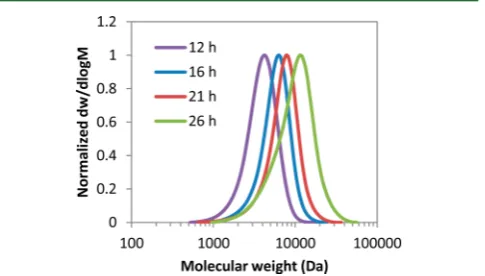
conversion of 25%. In order to increase monomer conversion, polymerizations were also carried out for 16, 21, and 26 h, where conversions reached 35, 49, and 69% with dispersity values of 1.20, 1.23, and 1.37 for each polymerization time, respectively (Table 1 and Figure 1). The low dispersity values obtained for the polymerization suggested that good polymer-ization control was achieved.
The observed number-average molar masses of the polymers by1H NMR spectroscopy,MnNMR, were obtained by integration
of the resonances from the VBr polymer backbone atδ= 4.70− 5.20 ppm and referenced with the characteristic resonance from the CH2protons from the xanthate group atδ= 4.50 ppm. The theoretical molar masses,Mntheo, were based on the monomer
conversions obtained by1H NMR spectroscopy analysis. Both
molar masses,MnNMRandMntheo, were found to show a good
correlation throughout the polymerization, which indicates that a good retention of the active xanthate group was maintained on the polymer chain-ends. These observations suggested that the compatibility between the CTA,1, and the monomer was appropriate toward the synthesis of well-defined and controlled
polymers of VBr. Further polymerizations were carried out using benzene as a solvent but no major changes were observed in polymerization control and the dispersities of the polymers obtained indicated that the polymerization could be performed either in bulk or in solution without affecting thefinal polymer.
Determination of the Reactivity Ratios of MDO and VBr.In order to synthesize functional and degradable polymers, the potential for effective copolymerization of VBr and MDO was investigated by the determination of their reactivity ratios. In our previous work, we showed the reactivity ratios of MDO and VAc in the presence of CTA1to be close to unity (rMDO=
1.031 andrVAc= 1.219), which result in a copolymer structure close to ideal (i.e., almost random).49To explore the behavior of the MDO/VBr copolymerization and prove the ideal structure of the copolymers, the reactivity ratios of these two monomers were studied using the Nonlinear Least Square (NLLS) method developed by Van Herk.54−56 Copolymeriza-tions with different monomer feeds were targeted such that MDO varied from 10 to 90 mol %. The molar fractions of the two monomers in the initial feed and in thefinal copolymers were obtained by 1H NMR spectroscopy analyses. The copolymerizations were quenched at low overall monomer conversions (<15%) in order to avoid the effects of compositional drift during the copolymerization. Using Contour, a program based on the NLLS method to fit the plot offA, initial mole fraction of monomer A [MA= MDO], versusFA, mole fraction of MA in thefinal copolymer (Figure
2), the reactivity ratios were calculated and obtained asrMDO= 0.964 andrVBr= 1.036. As in the case of MDO and VAc,49the
[image:5.625.325.568.208.346.2]reactivity ratios of MDO and VBr are close to unity, which indicates that the copolymers synthesized have a close to random structure. These values are also consistent with the observations that the conversions of MDO are slightly lower
Table 1. Characterization Data for the Homopolymerization of VBr for Different Polymerization Time Points
time (h)
VBr conv.a (%)
Mnb(SEC;
kDa)
Mn, theoc
(kDa)
Mn, NMRd
(kDa) ĐMb
12 25 3.5 5.1 5.0 1.19
16 35 5.2 6.7 5.9 1.20
21 49 6.3 9.4 8.3 1.23
26 69 8.1 13.3 10.7 1.37
aDetermined by1H NMR spectroscopy.bObtained by SEC analysis in
CHCl3.cTheoretical molar mass based on monomer conversion (1H
NMR spectroscopy). dObserved molar mass obtained by 1H NMR
spectroscopy end-group analysis.
Figure 1. Size exclusion chromatograms of poly(VBr) obtained by RAFT/MADIX polymerization for different reaction times, [VBr]0/
[AIBN]0/[1]0= 100:0.1:1, 60°C.
Biomacromolecules
DOI: 10.1021/acs.biomac.5b00476
BiomacromoleculesXXXX, XXX, XXX−XXX
than VBr over the course of the polymerization which indicates that MDO has a slightly lower reactivity. The proximity ofrMDO
andrVBrto unity also demonstrates that the use of vinyl acetate derivative monomers with MDO toward the synthesis of functional degradable polymers is a suitable technique to obtain polymers with a close to random incorporation of functional groups as well as an efficient incorporation of ester repeat units in the polymer backbone.
Copolymerization of VBr and MDO Using RAFT/ MADIX. To achieve the synthesis of well-defined and degradable copolymers of poly(MDO-co-VBr), an initial copolymerization with a low concentration of MDO was prepared such that [VBr]0/[MDO]0/[AIBN]0/[1]0 = 90:10:0.1:1, and was carried out at 60°C for 16 h in benzene (15 wt %; Scheme 2). From this initial experiment, well-defined and controlled poly(MDO-co-VBr) was synthesized as seen by the low dispersity value (ĐM= 1.54) and the good correlation betweenMntheoandMnNMR. The theoretical molar mass,Mntheo,
was based on conversions of both monomers and the observed molar mass,MnNMR, was obtained by integration of the protons
from the VBr and MDO polymer backbone atδ= 4.80−5.20 ppm and δ = 4.20 ppm, respectively, and referenced to the characteristic resonance of the CH2protons from the xanthate end-group atδ= 4.50 ppm. The monomer conversions of both VBr and MDO after 16 h displayed average values of 45 and 38% for VBr and MDO, respectively.
In order to study the kinetics of the MDO/VBr system, a detailed study of the copolymerization was conducted where samples were taken after 3, 6, 9, 16, and 24 h and analyzed by
1H NMR spectroscopy and SEC. The conditions used were the
same as above, however the concentration of MDO was increased such that [VBr]0/[MDO]0/[AIBN]0/[1]0 = 70:30:0.1:1. Poly(MDO-co-VBr) samples with well-controlled number-average molecular weights (Mn) and low dispersities
(ĐM= 1.15−1.59) were synthesized (Table 2). For thefirst 16 h of the polymerization, good control was maintained as a good
correlation between observed molar mass and theoretical molar mass was observed; beyond this polymerization time a broadening of the dispersity value was observed as well as a deviation of the values of MnNMR and M
ntheo. These
observations indicate a loss of the CTA end-group leading to termination reactions and broadening of the molecular weight distribution (Figure 3). During this study, the monomer
conversions were found to reach 41 and 25% for VBr and MDO, respectively, after 16 h where good control was maintained. However, after 24 h, the conversion reached a plateau of 73 and 41% for each monomer, respectively, and no further increase in the conversion was observed even for extended polymerization times. This observation can be explained as a consequence of the depletion of radicals
Figure 2.Plot offAvsFAfor the copolymerization of MDO [A] and
VBr [B] leading to reactivity ratios results ofrA= 0.964 andrB= 1.036
(error: 9.1%).
[image:6.625.79.278.62.206.2]Scheme 2. Synthesis of Poly(MDO-co-VBr) Copolymers Mediated by RAFT/MADIX Polymerization
Table 2. Characterization Data for the Copolymerization of MDO and VBr for Different Polymerization Time Points
time (h)
VBr conv.a
(%) MDO conv.a
(%)
polymer comp.a
(VBr/ MDO)
Mn, SECb
(kDa)
Mn, theoc
(kDa)
Mn, NMRd
(kDa) ĐMb
3 2 5 49:51 1.6 0.7 1.6 1.15
6 4 16 37:63 2.0 1.1 2.0 1.23
9 24 19 75:25 3.7 4.0 4.8 1.44
16 41 25 79:21 5.6 6.2 8.8 1.59
24 73 41 80:20 7.3 11.3 16.2 1.85
aDetermined by1H NMR spectroscopy.bObtained by SEC analysis in
CHCl3.cTheoretical molar mass based on monomer conversion (1H
NMR spectroscopy). dObserved molar mass obtained by 1H NMR
spectroscopy end-group analysis.
Figure 3. Size exclusion chromatograms of poly(MDO-co-VBr) obtained by RAFT/MADIX polymerization for different polymer-ization times, [VBr]0/[MDO]0/[AIBN]0/[1]0= 70:30:0.1:1, at 60°C.
Biomacromolecules Article
DOI: 10.1021/acs.biomac.5b00476
BiomacromoleculesXXXX, XXX, XXX−XXX
[image:6.625.334.546.359.498.2]generated by the initiator, AIBN at extended polymerization times.
To increase the degree of degradability of the targeted copolymers, the incorporation of ester repeat units in the copolymer backbone was altered by increasing the ratio of MDO in the monomer feed to 20, 30, 40, and 50 mol %. In all cases, control of the polymerizations was maintained as confirmed by the low dispersity values observed by SEC analysis (Table 3). Polymerization control was also proven by the correlation between the observed and theoretical molar masses. For the samples with a targeted feed of 10 to 30 mol % in MDO, the polymerizations were performed for 16 h, reaching 38−47% in conversion for each monomer. For the polymerization containing a higher amount of MDO, the polymerizations were undertaken for 20 h in order to reach reasonable conversions for both monomers. Nevertheless, it can be noted that to maintain a similar degree of control for the copolymers (ĐM < 1.60), the conversions of MDO must be
lower (≈25%) as the feed ratio of MDO is increased (40 and 50 mol % MDO).
Further analyses on the copolymers, poly(MDO-co-VBr), using 1H NMR spectroscopy revealed the presence of resonances at δ= 0.90 and 3.65 ppm, which have previously been assigned to the side-chain reactions that result from the 1,4- and 1,7-hydrogen transfer or backbiting during the rROP of MDO.28,30 The amount of branching was estimated to be around 10%, which is very similar to the value previously reported for the copolymerization of MDO and VAc using RAFT/MADIX.49 The degree of ring-opening of MDO was also investigated using 13C NMR spectroscopy to identify
whether any ring-closed MDO units were present in the copolymers caused by the possible side-reactions as previously reported.40,57 Analyses using13C NMR spectroscopy revealed
the presence of a small peak at δ = 100.0 ppm, which is characteristic of the acetal quaternary carbon commonly observed atδ= 100−110 ppm for ring-closed species observed during the rROP of MDO. The degree of ring-retained species in poly(MDO-co-VBr) was investigated using 1H NMR
spectroscopy and was estimated to be 9% based on the integration of the ring-opened species1H resonances atδ= 4.0 ppm and compared with the ring-retained species resonances at
δ= 3.65 ppm.35,41,57
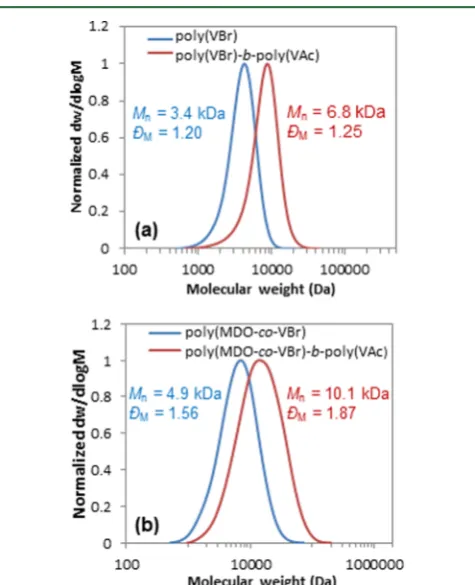
Chain growth experiments of the polymer, poly(VBr), and copolymer, poly(MDO-co-VBr), were conducted in order to test the“livingness”of the polymerization process as well as to confirm the retention of the CTA end-group. Extensions of poly(VBr) and poly(MDO-co-VBr) with vinyl acetate (VAc) were performed to create two new block copolymers, poly(VBr)-b-poly(VAc) and poly(MDO-co-VBr)-b-poly(VAc). In both cases, 1H NMR spectroscopy and SEC analyses
indicated the successful chain extension of the first polymer
with a complete shift of the molar mass distribution as well as the absence of shoulders observed by SEC analysis for both chain extensions (Figure 4).
Degradation Study of Poly(MDO-co-VBr).The degrad-ability of poly(MDO-co-VBr) was investigated by the hydrolysis of the copolymer samples in a solution of potassium hydroxide (KOH, 0.1 M) in methanol at 40°C. These conditions were successfully used for the degradation of poly(MDO-co-VAc) in our previous report and have been shown to be suitable accelerated degradation conditions for the hydrolytic degrada-tion of PCL samples.58In all cases, net decreases in the molar mass of the samples were observed by SEC analyses proving that degradation occurred as a consequence of the even incorporation of ester units in the polymer backbone. Furthermore, in order to investigate the extent of degradability, two copolymers with different compositions, poly(MDO0.10-co -VBr0.90)55 and poly(MDO0.26-co-VBr0.74)54, were subjected to
[image:7.625.63.560.85.164.2]the same hydrolysis conditions and SEC analyses were recorded at different time points (Figure 5). During the experiment, it
Table 3. Characterization Data for the Copolymerization of VBr and MDO for Different Initial Monomer Feeds
time (h)
initial monomer feed (VBr/ MDO)
polymer comp.a(VBr/
MDO)
VBraconv.
(%)
MDOaconv.
(%)
Mn, SECb
(kDa)
Mn, theoc
(kDa)
Mn, NMRd
(kDa) ĐMb
16 90:10 91:09 45 38 6.5 8.2 7.5 1.54
16 80:20 84:16 47 35 5.5 8.0 8.5 1.57
16 70:30 74:26 38 30 4.9 6.9 7.4 1.50
20 60:40 73:27 44 24 4.9 6.2 6.5 1.56
20 50:50 66:34 37 19 4.8 4.7 5.3 1.55
aDetermined by1H NMR spectroscopy.bObtained by SEC analysis in CHCl
3.cTheoretical molar mass based on monomer conversion (1H NMR
spectroscopy).dObserved molar mass obtained by1H NMR spectroscopy end-group analysis.
Figure 4. Size exclusion chromatograms of poly(VBr) and poly-(MDO-co-VBr) before and after extension with vinyl acetate to create the two block polymers: (a) poly(VBr)-b-poly(VAc) and (b) poly(MDO-co-VBr)-b-poly(VAc).
Biomacromolecules
DOI: 10.1021/acs.biomac.5b00476
BiomacromoleculesXXXX, XXX, XXX−XXX
[image:7.625.326.564.232.525.2]was observed that the degradation was faster in the case of the copolymer containing the larger amount of MDO in the polymer backbone: poly(MDO0.26-co-VBr0.74)54. For this sample, after only 30 min of hydrolysis the number-average molar mass, Mn (SEC), of the copolymer was significantly smaller and no polymer could be detected after 70 min. In the case of the copolymer with the smaller incorporation of MDO, poly(MDO0.10-co-VBr0.90)55, the degradation process was
longer, as more than 170 min were required to fully degrade the sample. These observations prove that the degradability of the copolymer can be easily tuned by changing the copolymer
composition and the amount of hydrolyzable ester repeat units in the polymer backbone.
Postpolymerization Modification Using Azidation and 1,3-Cycloaddition. Following the successful preparation of defined and controlled poly(VBr) and poly(MDO-co-VBr), their postpolymerization modification was first investigated using azidation in order to obtain a polymer containing azide pendent groups that could be used for further modification using “click” chemistry. The bromide pendent groups of the polymers were converted into azide groups using NaN3 in
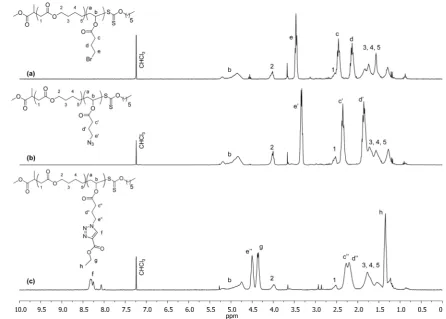
DMF for 48 h. In the case of both the homopolymer poly(VBr) and poly(MDO-co-VBr) copolymers, the successful conversion of the bromide groups to azide groups was proven by1H NMR spectroscopy analysis where a clear shift of the CH2-Br
characteristic peak (δ= 3.50 ppm) to the CH2-N3characteristic
peak (δ= 3.40 ppm; Figure 6a,b) was observed as well as the appearance of the azide peak at ν = 2094 cm−1 by FTIR spectroscopy. SEC analyses on the samples before and after azidation revealed no changes in the molar mass or the dispersity, proving that the modification had no deleterious effect on the polymer samples (Figure S11).
[image:8.625.78.281.64.217.2]The postpolymerization modification of the copolymers was further investigated using the 1,3-dipolar cycloaddition reaction of azides with electron deficient alkynes.59,60Using an electron withdrawing group adjacent to the alkyne, this addition can be mediated at relatively low temperatures without the need of a copper catalyst.59,61,62 The classical copper(I)-catalyzed al-kyne−azide cycloaddition (CuAAC) reaction was not used in this work in order to avoid the presence of residual Cu which
Figure 5. Molar mass changes occurring during the hydrolysis of poly(MDO0.10-co-VBr0.90)55and poly(MDO0.26-co-VBr0.74)54for diff
er-ent time points in a solution of KOH in methanol (0.1 M) at 40°C.
Figure 6.1H NMR spectra of the postpolymerization modification of poly(MDO-co-VBr) (a), after azidation with NaN
3(b), and after 1,3-dipolar
cycloaddition with ethyl propiolate (c); 400 MHz, CDCl3.
Biomacromolecules Article
DOI: 10.1021/acs.biomac.5b00476
BiomacromoleculesXXXX, XXX, XXX−XXX
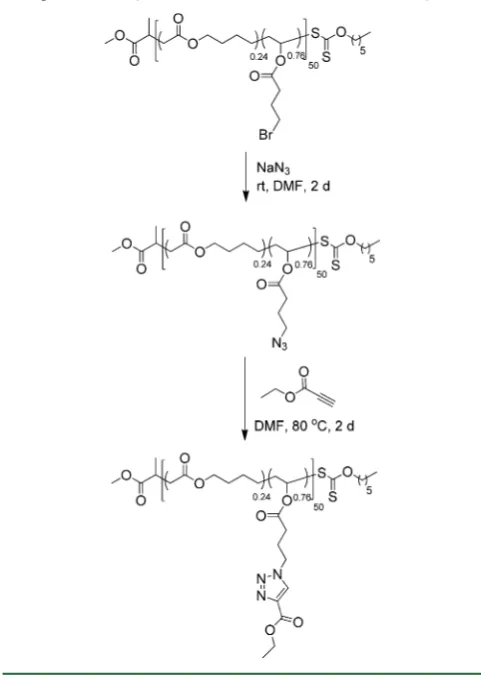
[image:8.625.85.532.407.726.2]can lead to toxicity in thefinal polymer. As an initial attempt, the equimolar reaction between ethyl propiolate and the copolymer, poly(MDO(0.24)-co-VN3(0.76))50, containing azide pendent groups was performed at 80°C in DMF for 2 days (Scheme 3). After recovering the polymer by precipitation in
hexane, the successful addition of ethyl propiolate on the copolymer was proven by 1H NMR spectroscopy where the appearance of the characteristic resonance atδ= 8.25 ppm that corresponds to the triazole proton was observed as well as the formation of two new resonances at δ = 1.20 and 4.35 ppm from the CH2and CH3of the additional ethyl propiolate group,
respectively. The change of chemical shift fromδ= 3.40 to 4.50 ppm of the CH2 adjacent to the azide after reaction was also
observed confirming the successful functionalization (Figure 6b,c). The full conversion of the reaction was proven by the total disappearance of the characteristic CH2-N3resonance atδ = 3.40 ppm. Furthermore, SEC analysis revealed an increase in molar mass with no increase in dispersity and retention of the monomodality of the distribution, which indicates that there was no degradation of the polymer after modification. One advantage of this new monomer is the versatility in the approaches that can be used to prepare the functional copolymers. Indeed, a similar approach could potentially be performed to directly modify the monomer, as recently highlighted by Drockenmuller and co-workers, where the use of azidation and cycloaddition prior to polymerization was performed in combination with the palladium-catalyzed vinyl
exchange reaction to efficiently form functional vinyl ester 1,2,3-triazolium monomers.63
The postpolymerization modification was further inves-tigated using short chain poly(ethylene glycol) (PEG, Mn =
550 Da, DP = 12), bearing an alkyne functional end-group. The equimolar reaction between PEG(alkyne) and poly(MDO(0.24) -co-VN3(0.76))36 was performed using similar conditions as before, in DMF at 80 °C for 24 h. After recovering the functional copolymer by precipitation and dialysis (for 3 days) in order to remove any residual short PEG polymer, the functionalized polymer was then analyzed. Both 1H NMR
spectroscopy and SEC analyses revealed the successful addition of the PEG alkyne to the copolymer, poly(MDO-co-VN3), evidenced by the shift of the molar mass distribution after the 1,3-dipolar cycloaddition reaction (Figure 7) and the
appearance of the triazole proton resonance atδ= 8.25 ppm, as well as the appearance of characteristic signals of the additional PEG repeat units atδ= 3.50 and 3.25 ppm (Figure S12). Further analyses revealed that 90% of the azide pendent groups of the copolymer were successfully functionalized, while some residual azide groups were still observed atδ= 3.40 ppm and ν = 2095 cm−1 using 1H NMR spectroscopy and FTIR spectroscopy, respectively (Figure S14). The successful addition of a small molecule and longer polymer chain via the 1,3-dipolar cycloaddition reaction on the azide pendent groups contained on the copolymer proves the great potential of using the new monomer, vinyl bromobutanoate, to synthesize novel poly(vinyl acetate) derivatives that are able to be further functionalized via postpolymerization modifi ca-tion.
To investigate the behavior of the graft-copolymer, experi-ments were carried out in order to identify the aqueous solubility and the degradability of the functionalized material. After the 1,3-dipolar cycloaddition reaction with the PEG alkyne, the graft-copolymer was found to be directly soluble in water which indicated that the solubility of the material was completely changed as a result of the hydrophilic incorporation coming from the additional PEG pendent groups. After dissolution in nanopure water (18 MΩ.cm−1) at a
concen-tration of 1 mg/mL, the graft-system was also found to form small self-assembled particles with a diameter,Dh, of 8 nm as observed by Dynamic Light Scattering (DLS) analysis (Figure S17). Further investigation using Static Light Scattering (SLS) confirmed the presence of spherical particles made of
Scheme 3. Azidation of Poly(MDO-co-VBr) and Postpolymerization Modification of Poly(MDO-co-VN3)
[image:9.625.59.300.167.508.2]Using the 1,3-Dipolar Cycloaddittion with Ethyl Propiolate
Figure 7.Size exclusion chromatogram of poly(MDO-co-VN3) before
and after cycloaddition reaction with PEG alkyne (SEC, CHCl3).
Biomacromolecules
DOI: 10.1021/acs.biomac.5b00476
BiomacromoleculesXXXX, XXX, XXX−XXX
aggregates of polymeric chains with an aggregation number,
Nagg, of 5 and a hydrodynamic radius, Rh, of 3.7 nm. The
degradability of the graft-copolymer was investigated using the same accelerated hydrolytic conditions used on the
poly(MDO-co-VBr) samples to explore the effect of the PEG addition and the new aqueous solubility. During the degradation study of these samples, it was observed that the graft-copolymers degraded rapidly, such that after 3 min in the basic methanolic solution at 37°C, disappearance of the main polymer peak on the SEC analyses and the appearance of lower molecular peaks at 200 and 1000 Da corresponding to degraded oligomers and remaining small PEG polymer chains was observed (Figure S18). Degradation experiments were also investigated in phosphate buffer solution (PBS) at pH = 7.4 at 37 °C in order to follow the process gradually. These studies revealed, as expected, that the degradation under these conditions was slower, with 7 days required to observe initial signs of degradation. Indeed, after 7 days, the appearance of small peaks at low molar mass was identified, of which the intensities increased after 11 and 15 days, revealing that the degradation of the graft copolymer was occurring under these conditions (Figure S19). These observations confirmed that the addition of hydrophilic functional groups via postpolymerization modification of the copolymer drastically affect the properties and behavior of the material herein reported highlighting the wide range of applications targeted for such functional degradable materials.
■
CONCLUSIONSIn summary, we report the synthesis of vinyl bromobutanoate, a novel vinyl acetate derivative monomer bearing a bromine pendent group in order to increase the functionality of the common polymer poly(VAc). The homopolymerization and copolymerization of VBr with MDO using the RAFT/MADIX polymerization technique lead to the formation of well-defined and controlled polymers as proven by SEC and 1H NMR
spectroscopy, containing functional pendent groups available for further modification. The ratio of MDO could be tuned to produce degradable polymer containing different degrees of ester repeat units as a way to increase the degradability of the targeted final material. The successful postpolymerization modification of the polymers was proven using azidation and cycloaddition reactions to deliver polymers with additional functionalities with no effect on the defined and controlled aspect of the process reported. These results illustrate the great potential in using the vinyl bromobutanoate monomer as a novel route toward the synthesis of functional and degradable polymers from cyclic ketene acetal monomers. The incorpo-ration of the bromine group opens an almost limitless possibility of functionalization on such copolymers to target a wider range of properties and applications.
■
ASSOCIATED CONTENT*
S Supporting Information1H NMR spectra, 13C NMR spectra, SEC traces, and FTIR
spectra with corresponding assignments for the polymers and copolymers prepared. The Supporting Information is available free of charge on the ACS Publications website at DOI: 10.1021/acs.biomac.5b00476.
■
AUTHOR INFORMATION Corresponding Authors*E-mail: [email protected].
*E-mail: [email protected].
Notes
The authors declare no competingfinancial interest.
■
ACKNOWLEDGMENTSThe University of Warwick and BP are thanked for cofunding a Ph.D. studentship to G.G.H. and the Royal Society and British academy are thanked for the award of a Newton International Fellowship to C.A.B. and Industry Fellowship to A.P.D. EPSRC and ERC are acknowledged for funding to support R.K.O. (Grant No.: 615142). NHMRC are thanked for the award of a C.J. Martin Early Career International Fellowship to C.A.B.
■
REFERENCES(1) Albertsson, A.-C.; Varma, I. K.Biomacromolecules2003,4, 1466. (2) Uhrich, K. E.; Cannizzaro, S. M.; Langer, R. S.; Shakesheff, K. M.
Chem. Rev.1999,99, 3181.
(3) Lecomte, P.; Jérôme, C.Adv. Polym. Sci.2012,245, 173. (4) Dove, A. P.Chem. Commun.2008, 6446.
(5) Dutta, S.; Hung, W.-C.; Huang, B.-H.; Lin, C.-C.Adv. Polym. Sci. 2012,245, 219.
(6) Labet, M.; Thielemans, W.Chem. Soc. Rev.2009,38, 3484. (7) Dechy-Cabaret, O.; Martin-Vaca, B.; Bourissou, D.Chem. Rev. 2004,104, 6147.
(8) Woodruff, M. A.; Hutmacher, D. W.Prog. Polym. Sci.2010,35, 1217.
(9) Seyednejad, H.; Ghassemi, A. H.; van Nostrum, C. F.; Vermonden, T.; Hennink, W. E.J. Controlled Release2011,152, 168. (10) Dash, T. K.; Konkimalla, V. B.J. Controlled Release2012,158, 15.
(11) Ulery, B. D.; Nair, L. S.; Laurencin, C. T.J. Polym. Sci., Polym. Phys.2011,49, 832.
(12) Yu, Y.; Zou, J.; Cheng, C.Polym. Chem.2014,5, 5854. (13) Pounder, R. J.; Dove, A. P.Polym. Chem.2010,1, 260. (14) Williams, C. K.Chem. Soc. Rev.2007,36, 1573.
(15) Jérôme, C.; Lecomte, P.Adv. Drug Delivery Rev.2008,60, 1056. (16) Riva, R.; Schmeits, S.; Stoffelbach, F.; Jerome, C.; Jerome, R.; Lecomte, P.Chem. Commun.2005, 5334.
(17) Riva, R.; Lussis, P.; Lenoir, S.; Jérôme, C.; Jeró ̂me, R.; Lecomte, P.Polymer2008,49, 2023.
(18) Carrot, G.; Hilborn, J. G.; Trollsås, M.; Hedrick, J. L.
Macromolecules1999,32, 5264.
(19) Korich, A. L.; Walker, A. R.; Hincke, C.; Stevens, C.; Iovine, P. M.J. Polym. Sci., Part A: Polym. Chem.2010,48, 5767.
(20) Hvilsted, S.Polym. Int.2012,61, 485.
(21) Jacquier, V.; Miola, C.; Llauro, M.-F.; Monnet, C.; Hamaide, T.
Macromol. Chem. Phys.1996,197, 1311.
(22) Campos, J. M.; Ribeiro, M. R.; Ribeiro, M. F.; Deffieux, A.; Peruch, F.Eur. Polym. J.2013,49, 4025.
(23) Li, G.; Lamberti, M.; Pappalardo, D.; Pellecchia, C. Macro-molecules2012,45, 8614.
(24) Wilson, J. A.; Hopkins, S. A.; Wright, P. M.; Dove, A. P.
Macromolecules2015,48, 950.
(25) Wurth, J. J.; Shastri, V. P.J. Polym. Sci., Part A: Polym. Chem. 2013,51, 3375.
(26) Liu, M.; Vladimirov, N.; Frechet, J. M. J.́ Macromolecules1999,
32, 6881.
(27) Bailey, W. J.; Ni, Z.; Wu, S. R.Macromolecules1982,15, 711. (28) Agarwal, S.Polym. J.2006,39, 163.
(29) Undin, J.; Illanes, T.; Finne-Wistrand, A.; Albertsson, A.-C.
Polym. Chem.2012,3, 1260.
(30) Jin, S.; Gonsalves, K. E.Macromolecules1997,30, 3104. (31) Bailey, W. J.; Endo, T.; Gapud, B.; Lin, Y.-N.; Ni, Z.; Pan, C.-Y.; Shaffer, S. E.; Wu, S.-R.; Yamazaki, N.; Yonezawa, K.J. Macromol. Sci., Part A: Pure Appl. Chem.1984,21, 979.
(32) Agarwal, S.Polym. Chem.2010,1, 953.
Biomacromolecules Article
DOI: 10.1021/acs.biomac.5b00476
BiomacromoleculesXXXX, XXX, XXX−XXX
(33) Roberts, G. E.; Coote, M. L.; Heuts, J. P. A.; Morris, L. M.; Davis, T. P.Macromolecules1999,32, 1332.
(34) Sun, L. F.; Zhuo, R. X.; Liu, Z. L.J. Polym. Sci., Part A: Polym. Chem.2003,41, 2898.
(35) Maji, S.; Mitschang, F.; Chen, L.; Jin, Q.; Wang, Y.; Agarwal, S.
Macromol. Chem. Phys.2012,213, 1643.
(36) Undin, J.; Finne-Wistrand, A.; Albertsson, A.-C. Biomacromo-lecules2014,15, 2800.
(37) Undin, J.; Finne-Wistrand, A.; Albertsson, A.-C. Biomacromo-lecules2013,14, 2095.
(38) Bailey, W. J.; Ni, Z.; Wu, S.-R. J. Polym. Sci., Part A: Polym. Chem.1982,20, 3021.
(39) Agarwal, S.; Kumar, R.; Kissel, T.; Reul, R.Polym. J.2009,41, 650.
(40) Maji, S.; Zheng, M.; Agarwal, S.Macromol. Chem. Phys.2011,
212, 2573.
(41) Agarwal, S.; Kumar, R.Macromol. Chem. Phys.2011,212, 603. (42) Wei, Y.; Connors, E. J.; Jia, X.; Wang, C.J. Polym. Sci., Part A: Polym. Chem.1998,36, 761.
(43) Chung, I. S.; Matyjaszewski, K.Macromolecules2003,36, 2995. (44) Huang, J.; Gil, R.; Matyjaszewski, K.Polymer2005,46, 11698. (45) d’Ayala, G. G.; Malinconico, M.; Laurienzo, P.; Tardy, A.; Guillaneuf, Y.; Lansalot, M.; D’Agosto, F.; Charleux, B.J. Polym. Sci., Part A: Polym. Chem.2014,52, 104.
(46) Delplace, V.; Tardy, A.; Harrisson, S.; Mura, S.; Gigmes, D.; Guillaneuf, Y.; Nicolas, J.Biomacromolecules2013,14, 3769.
(47) Delplace, V.; Harrisson, S.; Tardy, A.; Gigmes, D.; Guillaneuf, Y.; Nicolas, J.Macromol. Rapid Commun.2013,35, 484.
(48) Decker, C. G.; Maynard, H. D.Eur. Polym. J.2015,65, 305. (49) Hedir, G. G.; Bell, C. A.; Ieong, N. S.; Chapman, E.; Collins, I. R.; O’Reilly, R. K.; Dove, A. P.Macromolecules2014,47, 2847.
(50) Allaoua, I.; Goi, B. E.; Obadia, M. M.; Debuigne, A.; Detrembleur, C.; Drockenmuller, E.Polym. Chem.2014,5, 2973.
(51) Marvel, C. S.; DePierri, W. G.J. Polym. Sci.1958,27, 39. (52) Chênevert, R.; Pelchat, N.; Morin, P. Tetrahedron Asymmetry 2009,20, 1191.
(53) Liu, X.; Coutelier, O.; Harrisson, S.; Tassaing, T.; Marty, J.-D.; Destarac, M.ACS Macro Lett.2015,4, 89.
(54) Lu, A.; Smart, T. P.; Epps, T. H.; Longbottom, D. A.; O’Reilly, R. K.Macromolecules2011,44, 7233.
(55) Manders, B. G.; Smulders, W.; Aerdts, A. M.; van Herk, A. M.
Macromolecules1997,30, 322.
(56) Van Der Meer, R.; Linssen, H. N.; German, A. L.J. Polym. Sci., Part A: Polym. Chem.1978,16, 2915.
(57) Plikk, P.; Tyson, T.; Finne-Wistrand, A.; Albertsson, A.-C.J. Polym. Sci., Part A: Polym. Chem.2009,47, 4587.
(58) Lam, C. X. F.; Savalani, M. M.; Teoh, S.-H.; Hutmacher, D. W.
Biomed. Mater.2008,3, 034108.
(59) Lutz, J.-F.Angew. Chem., Int. Ed.2008,47, 2182.
(60) Becer, C. R.; Hoogenboom, R.; Schubert, U. S.Angew. Chem., Int. Ed.2009,48, 4900.
(61) Li, Z.; Seo, T. S.; Ju, J.Tetrahedron Lett.2004,45, 3143. (62) Truong, V. X.; Ablett, M. P.; Gilbert, H. T. J.; Bowen, J.; Richardson, S. M.; Hoyland, J. A.; Dove, A. P.Biomater. Sci.2014,2, 167.
(63) Obadia, M. M.; Colliat-Dangus, G.; Debuigne, A.; Serghei, A.; Detrembleur, C.; Drockenmuller, E.Chem. Commun.2015,51, 3332.
Biomacromolecules
DOI: 10.1021/acs.biomac.5b00476
BiomacromoleculesXXXX, XXX, XXX−XXX
![Figure 3. Size exclusion chromatograms of poly(MDO-co-VBr)obtained by RAFT/MADIX polymerization for different polymer-ization times, [VBr]0/[MDO]0/[AIBN]0/[1]0 = 70:30:0.1:1, at 60 °C.](https://thumb-us.123doks.com/thumbv2/123dok_us/9504955.455907/6.625.79.278.62.206/figure-exclusion-chromatograms-obtained-polymerization-dierent-polymer-ization.webp)