University of Warwick institutional repository: http://go.warwick.ac.uk/wrap
A Thesis Submitted for the Degree of PhD at the University of Warwick
http://go.warwick.ac.uk/wrap/66400
This thesis is made available online and is protected by original copyright.
Please scroll down to view the document itself.
Kinematic Fast Dynamo Problem
by
Polina Vytnova
A thesis submitted in partial fulfilment of the requirements
for the degree of
Doctor of Philosophy in Mathematics
Contents
Acknowledgements v
Declarations vi
Abstract vii
1 Introduction 1
1.1 A problem of magnetohydrodynamics . . . 1
1.1.1 The main result . . . 4
1.1.2 Discrete problem . . . 5
1.2 Brief history. . . 5
1.3 Provisional fluid flow . . . 8
1.4 Poincar´e map . . . 9
1.5 Principal obstacles and general strategy . . . 11
1.6 Outline . . . 16
2 A proof of the fast dynamo theorem 24 2.1 Basic constructions . . . 24
Contents
2.1.2 Norm in the space of vector fields. . . 25
2.1.3 Cones in vector fields onRn . . . . 26
2.2 Proof of the main result . . . 27
3 Fast dynamo on the real line 33 3.1 Notation . . . 33
3.1.1 The dynamical system . . . 35
3.2 Dynamo operator . . . 37
3.2.1 Generalised toy dynamo operators . . . 37
3.2.2 Canonical partition for the perturbationℓm ξ . . . 46
3.2.3 Approximatingℓmξ∗ by a generalised toy dynamo operator . . . 54
3.3 Invariant cone in Φ. . . 70
3.3.1 Discretization and the Weierstrass transform toolbox. . . 70
3.3.2 Constructing an invariant cone . . . 78
4 Fast dynamo on the real plane 95 4.1 Notation . . . 95
4.2 The dynamical system . . . 97
4.2.1 Action on vector fields . . . 97
4.2.2 The choice of the norm inX . . . . 99
4.2.3 The canonical partition . . . 101
4.3 Approximating matrix . . . 103
4.3.1 Properties of the matrixU U . . . 106
4.3.2 The operatorsWδAand WδPξ2∗ are close onX . . . 127
Contents
4.4 An invariant cone in X . . . 145
4.4.1 Discretization and the Weierstrass transform toolbox. . . 145
List of Figures
1.1 Dynamo manifold. . . 9
1.2 Induced map between Poincar´e sections . . . 22
1.3 Baker’s map and doubling map . . . 23
Acknowledgements
I would like to express my gratitude to my supervisor, Dr. O. Kozlovski for introducing the
Kinematic Fast Dynamo Problem to me, his attention and interest in the progress of this
work. I am also very grateful to all members of the Dynamical Systems and Ergodic Theory
research group at Warwick, first of all, to Prof. M. Pollicott conversations with whom have
greatly extended my mathematical knowledge. Finally, I would like to thank organizers of
conferences and workshops I have attended during the time of my studies for their hospitality
and inspirational atmosphere.
Last but not least, I am very thankful to Prof. I. Melbourne and Prof. D. Turaev for
agreeing to examine the Thesis, and valuable comments that helped to improve the present
exposition.
Declarations
I declare that the work in this thesis is, to the best of my knowledge, original and my own
work, except where otherwise indicated, cited, or commonly known. This work has not been
submitted for any other degree.
An original scheme of the fluid flow that is presented in Fig. 1.1 has been suggested by
Dr. Kozlovski. He also has helped me with technical results, which contained in
Abstract
In the present work we develop an approach to the classical kinematic fast dynamo problem
for flows [32] in the real 3-dimensional space. We suggest a fluid flow that may possibly
generate a magnetic field which energy grows exponentially fast with time in the present of
slow diffusivity. In order to verify the construction we study a discrete system and prove that
an analogous statement holds true for the Poincar´e map of the provisional flow and vector
fields in the plane.
1 Introduction
1.1 A problem of magnetohydrodynamics
The subject of magnetohydrodynamics is evolution and interaction of motions of an
electri-cally conducting fluid and an electromagnetic field. Typical examples of electrielectri-cally
conduct-ing fluids that dynamo theory is dealconduct-ing with are the liquid layer of the core of the Earth
or convection zones of stars, although we will be studying very simplified models. Dynamo
theory studies the mechanism of generation of magnetic fields in electrically conducting
flu-ids as a phenomenon of magnetohydrodynamics [25]. The classical kinematic fast dynamo
problem [32], [36] is dating back to 1970-s and concerns the evolution of a magnetic field in a
conducting fluid flow in the presence of small diffusion, or, in other words, when the magnetic
Reynolds number is large. The magnetic Reynolds number Rs is a dimensionless parameter
that is used to describe the relative balance of magnetic advection to magnetic diffusion. It
is proportional to the electric conductivity and the velocity of the fluid and to the length of
a characteristic fluid structure. The kinematic dynamo equations read
∂B
∂t = (B· ∇)v−(v· ∇)B+ε∆B
∇ ·v=∇ ·B = 0,
(1.1)
wherevis the known velocity field of the conducting fluid filling a certain compact domainM.
1.1 A PROBLEM OF MAGNETOHYDRODYNAMICS
field, andε= R1
s is a parameter corresponding to the speed of diffusion through the boundary
of M. The case of slow diffusion corresponds to an almost perfectly conducting fluid.
Definition 1. The action of the velocity field v on the magnetic field B described by the
system (1.1) is called dynamo action. A divergence-free C1 vector field v with compact
support is called akinematic fast dynamo if the magnetic field grows stronger exponentially
fast with time.
Dynamo action and chaotic motion turn out to be closely related. It has been shown by
Klapper and Young [19] that the growth rate of the magnetic field is bounded by topological
entropy of the fluid flow. Kozlovski [21] has shown that the growth rate is related to the
topological entropy, Lyapunov exponents, and topological pressure. The limit chaotic motion,
corresponding to the perfectly conducting liquid (ε= 0), causes the magnetic fieldBto inherit
the complexity of the Lagrangian chaos.
It turns out that in dynamo theory the magnetic field reflects closely the motions of the
fluid, just as the swirls of cream in a cup of coffee reveal the pattern of eddies stirred by
spoon. In other words, the changes of magnetic field keep the track of the movements of
the fluid, and one can reconstruct the geometry of the flow from the magnetic field. If we
consider a magnetic field as a collection of magnetic lines, the fast dynamo corresponds to
the growth of an average line length in a flow and thus stretching and folding properties of
the flow.
The Lorenz force causes a feedback action of the magnetic field on the velocity field.
When the magnetic field is small, one can neglect this action. Whence the full nonlinear
system of magnetohydrodynamics may be reduced [10] to the system (1.1) in the case of an
1.1 A PROBLEM OF MAGNETOHYDRODYNAMICS
The full pre-Maxwell system of magnetohydrodynamics may be written as
Ampere’s Law ∇ ×B =µJ, (1.2)
Faraday’s Law ∇ ×E =−∂B
∂t, (1.3)
Ohm’s Law J =σ(E+v×B). (1.4)
The magnetic field is divergence-free:
∇ ·B = 0. (1.5)
In the equations aboveB(¯x, t) is the magnetic field,E(¯x, t) is the electric field,J(¯x, t) is the
current,µis the magnetic permeability in the vacuum,σ is the electrical conductivity, andv
is the velocity field of the fluid.
We can substitute (1.4) into (1.2) and apply the curl operator to both sides. Then we get
the induction equation
∂B
∂t − ∇ ×(v×B)−ε∇
2B = 0, (1.6)
where
ε= 1
µσ = magnetic density.
We may expand
∇ ×(v×B) =B· ∇v−v· ∇B+ (∇ ·B)v−(∇ ·v)B,
and recall the incompressibility condition∇ ·v= 0. Together with (1.5) we get
∇ ×(v×B) = (B· ∇)v−(v· ∇)B.
Finally, we substitute it to (1.6) and obtain (1.1):
∂B
∂t = (B· ∇)v−(v· ∇)B+ε∆B = 0.
1.1 A PROBLEM OF MAGNETOHYDRODYNAMICS
Problem 1. Whether or not there exist a divergence-free velocity field v with a compact
support suppv = M such that the energy E(t) = kB(t)k2L1(M) of the magnetic field B(t) grows exponentially with time for some initial condition B(0) =B0 with suppB0 =M, and
for arbitrary small diffusivityε? In other words [1], does kinematic fast dynamo exist?
The exponential growth of the magnetic energy is equivalent to
lim
ε→0tlim→∞
1
t ln Z
Rd|
B(z, t, ε)|dz >0 (1.7)
The main interest is related to stationary velocity fields v in two- and three-dimensional
domains M.
Looking at the heat equation one may deduce [34] that the exponent of the Laplace operator
is acting on vector fields by convolution with the heat kernel:
(exp(ε∆)v)(z) =
Z
Rd
1
(√2πε)dexp
−|z−t| 2
2ε2
v(t)dt
1.1.1 The main result
We suggest a fluid flow on a 3-dimensional manifold immersed in R3, that may possibly
generate a magnetic field which energy grows exponentially fast with time in the present of
slow diffusivity; and therefore give a positive answer to a long standing Problem1. The flow
is chaotic and structurally stable. In order to verify the example we show that an analogous
statement holds true for the Poincar´e map of the provisional flow and vector fields in the
plane. The main result is the following
Theorem 9. There exists a volume preserving piecewise diffeomorphism F:R2 → R2 such
that for some vector fieldB0 inR2
lim
ε→0nlim→∞
1
nlnk(exp(ε∆)F∗)
nB
1.2 BRIEF HISTORY
The mapF may be realised as a Poincar´e map of an incompressible fluid flow filling a compact
domain inR3 (an immersed 3-dimensional manifold with a boundary).
1.1.2 Discrete problem
The Problem1has a discrete analogue, where the flow action is replaced by a diffeomorphism,
and dissipation is represented by action of exp(ε∆). The Kinematic Fast Dynamo problem
for diffeomorphisms has been stated by Arnold [1] in the following form.
Problem 2. Does there exist a volume-preserving diffeomorphismg:M →M of a compact
manifoldM such that the energy of the magnetic fieldBgrows exponentially with the number
of iterations of the map
B 7→exp(ε∆)(g∗B) (1.8)
for some initial vector field B0 and for arbitrary small diffusivity ε?
In other words,
lim
ε→0nlim→∞
1
nln Z
Rd|
(wε∗g∗)nB0(z)|dz >0, (1.9)
wherewε is the d-dimensional Gaussian density with isotropic varianceε:
wε(z)def= 1
(√2πε)dexp
−|z|
2
2ε2
; (1.10)
where g∗ is induced action on vector fields and ∗ stands for convolution. Nowadays the discrete analogue is a problem of particular interest itself and maps have become a popular
model for fast dynamos [6], [13], [14], [30].
1.2 Brief history
While the realistic dynamo problem is still open, the non-dissipative case, corresponding to
1.2 BRIEF HISTORY
that non-dissipative kinematic fast dynamos exist on all manifolds.
Theorem. On an arbitrary n-dimensional manifold any divergence-free vector field with a
stagnation point with a unique positive eigenvalue is a non-dissipative kinematic fast dynamo.
The case of realistic dynamo action ε > 0 is not so simple. There is numerical evidence
of dynamo action in helical flows [6], ABC flows [16], and M¨obius flows [31]. Yet, there is
no rigorous mathematical argument for these examples nor for flows in R3 in general. In
particular, there is no continuity of the spectrum of the corresponding operator as ε→0.
The only constructions known are discrete dynamos in two dimensional surfaces with
non-trivial first homology group H1(M,R).
Main features of these examples are coming from the cat map on the torus [3]. Consider
g:T2→T2, g:
x
y 7→
2 1
1 1
x
y mod 1.
The expanding direction at all points is given by eigenvector B0 = (1+
√
5
2 ) with
eigen-value λ = 3+2√5. Therefore, the constant magnetic field B ≡ B0 grows exponentially with
number of iterations of the mapg:
Bn= (g∗)nB0 =λnB0; kBnk=λnkB0k.
Added diffusion doesn’t spoil the example, since an average of a constant field is the same
constant field.
This example has been generalised in [24] to arbitrary diffeomorphisms of the torus. Later,
a more general result has been established [1].
Theorem. Let g:M → M be an area-preserving diffeomorphism of the two-dimensional
1.2 BRIEF HISTORY
induced linear operator g∗1 on the first homology group has an eigenvector λ with |λ| > 1. The dynamo growth rate is independent of ε:
lim
n→∞
1
nlnkBnk= ln|λ|
for almost any initial vector field B0. (HereBn+1 = exp(ε∆)g∗Bn.)
The argument exploits duality between vectors and one-forms on the surfaces and
commu-tativity between the Laplace-Beltrami operator and the exterior derivative. Therefore, it is
not possible to extend it to higher dimensions.
On the negative side, there are antidynamo theorems, specifying geometric properties of
the manifoldM where flows with fast dynamo action are impossible. A very early result [11]
states that “A steady magnetic field inR3that is symmetric with respect to rotations about a
given axis cannot be maintained by a steady velocity field that is also symmetric with respect
to rotations about the same axis”. This result has been generalised [22], [26] and it is now
understood that the symmetry of the magnetic field alone is not compatible with exponential
growth.
Theorem. A transitionally, helically, or axially symmetric magnetic field in R3 cannot be
maintained by a dissipative dynamo action.
Our goal is to construct a 3-dimensional flow, that will resolve Problem 1 positively. A
possible model is discussed below. In order to study the flow, we begin with Poincar´e map.
Theorem9(p.162) shows that the inequality (1.9) holds true withgchosen to be a simplified
Poincar´e map of the flow. Although simpler than the flow itself, the Poincar´e map is still
difficult to study. Therefore we begin with a simple one-dimensional map, which would be
a reduction of the Poincar´e map, and show in Theorem 6 (p. 94) that the inequality (1.9)
1.3 PROVISIONAL FLUID FLOW
1.3 Provisional fluid flow
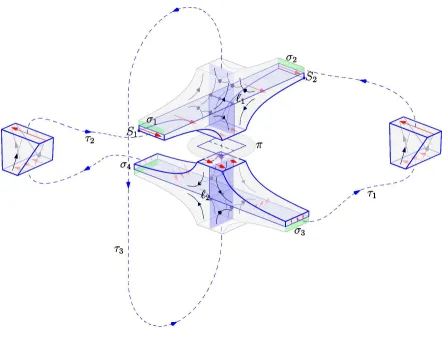
The following model for the fluid flow on a 3-dimensional manifold, displayed in Figure 1.1,
has been suggested by Dr. O. Kozlovski. Topologically, the manifold is equivalent to a solid
3-dimensional body whose boundary is a sphere with three handles. The vector field has two
lines of saddlesℓ1 andℓ2, which are orthogonal to each other and do not intersect. Light blue
two-dimensional surfaces consist of separatrices of the saddles. Blue dashed lines with arrows
represent solid tubesτ1,...,4 with cylindrical boundaries that connect two surfaces. Dark blue
arrows stand for the velocity field of the fluid flow, and red arrows is the stationary initial
induction field B0. We assume that the fluid flow is stationary outside of a neighbourhood
of the manifold and its velocity tends to zero rapidly near the boundary. Blue boundaries
mark “the dynamo manifold”, where the exponential growth of the initial induction field
takes place.
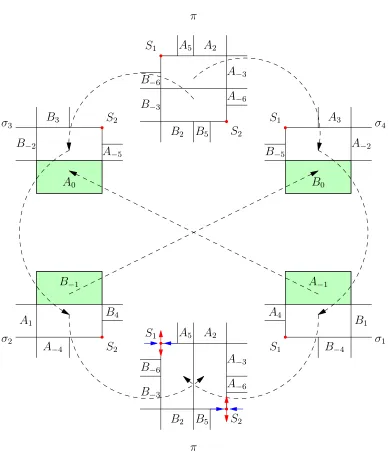
The induced mapping between the sections{π, σ1,...,4}, is shown in Figure1.2. In particular,
we see that any point that leaves the dynamo manifold due to diffusion is being attracted
to the unstable manifolds of the saddles S1 and S2. In addition, we see two heteroclinic
connections clearly. To complete the construction one has to define gluing between the green
surfaces σ1,...,4 by tubes, and to make sure that unstable separatrices of two periodic saddle
pointsS1 andS2 eventually enter the tubeτ3. This will guarantee that all trajectories, that
leave the manifold due to diffusion, either return back shortly, and the frozen into the fluid1
magnetic field doesn’t change much, or go into a long tubeτ3, which causes large return time.
An alternative would be to make unstable separatrices to be attracted to periodic cycles of
1We say that a vectorvfield is frozen into a moving fluid ifE+v×B= 0, which correspondsσ≫1 in the
Ohm’s law (1.4). In practice, it means that when a surface consisting of magnetic field lines is moved by
1.4 POINCAR´E MAP
Figure 1.1: Dynamo manifold with the fluid flow (blue) and magnetic induction field (red).
The labelsS1 and S2 mark periodic saddle points.
a huge period. This seems to be possible, although we are still working on the details.
We also would like to point out, that any small perturbation of the presented 3-dimensional
flow possess fast dynamo action as well. Therefore, once this example is verified, we will be
able to show that dynamo flows are generic.
1.4 Poincar´
e map
In order to study the flow, one can consider a global Poincar´e sectionπ, and the first return
mapF. The intersection between the plane π and the dynamo manifold has four connected
1.4 POINCAR´E MAP
“a square” which is shown in Figure 1.1. The restriction of the Poincar´e map onto the
square is representative for studying the flow action; and deserves a special consideration. In
particular, it is an unfolded1 Baker’s map and demonstrates chaotic properties. Since near
the intersection with the separatrices of the saddlesℓ2 the first return time is huge, a proper
2-dimensional model for the Poincar´e map would be a map with aZ-shaped hole, as shown
in Figure 1.3.
Outside of the square the first return map F has the following properties.
1. It is piecewise continuous and bijective.
2. It is area preserving.
3. The Euclidean norm of the differential is uniformly boundedkdFk ≤1 +µfor a small
µ >0.
4. The Hessian is small kd2Fk ≤µ
2 for a small µ2 >0.
In addition, we shall impose an artificial condition in order to guarantee that the map outside
of the unit square doesn’t “bend” too much. This condition in principle should be replaced
by a statement similar to Yomdin’s Lemma on volume growth [35].
Consequently, as a first step we may try to show that the unfolded Baker’s map itself is a
fast dynamo in the presence of slow diffusion through the boundary. This is the main result
of the present work (Theorem9 p.162).
1In literature two different maps are being referred to as “Baker’s map”. By unfolded we mean the one that
1.5 PRINCIPAL OBSTACLES AND GENERAL STRATEGY
1.5 Principal obstacles and general strategy
In the absence of diffusion (ε= 0) we may choose the initial magnetic fieldB0 to be collinear
with the stretching direction of the Baker’s map on the square and then transfer it out all
over the dynamo manifold using the fluid flow. The added diffusion makes the energy of the
vector field to dissipate through the boundary as a solution of the heat equation. Baker’s
maps were suggested as a model for kinematic fast dynamo long ago ([13], for example), and
a numerical evidence was found for the exponential growth of magnetic energy [12]. However,
there was no rigorous analytical argument in the presence of diffusion.
In order to be more specific, let us introduce a shorthand notation for the unit square
: ={(x, y)∈R2
| |x|<1, |y|<1}.
and consider the unfolded Baker’s map
P(x, y) =
x−1
2 ,2y+ 1
, ifx∈,−1< y <0,
x+1
2 ,2y−1
, ifx∈, 0< y <1,
F(x, y), if (x, y)∈R2\;
(1.11)
where F:R2 \ → R2\ is an area-preserving piecewise diffeomorphism with uniformly
bounded Jacobiank∂Fk<1 +µ(as the Euclidean norm of a linear operator) and such that
any point has not more thand≪M preimages with respect to FM for some large M. Our
goal is to show that there exists a vector fieldB0 such that
lim
ε→0nlim→∞
1
nln Z
R2
(exp(ε∆)P∗)nB0
>0. (1.12)
It is sufficient to construct two cones C1 and C2 in the space of essentially bounded vector
fields with finiteL1 norm such that for someδ >0 and any sufficiently largem
(exp(ε∆)P∗)m(C1)(C2(C1 and k(exp(ε∆)P∗)m |C1 k ≥(1 +δ)
1.5 PRINCIPAL OBSTACLES AND GENERAL STRATEGY
The argument is based on the following ideas.
Noise instead of diffusion. The idea to replace the diffusion by noise added to the system
has been used by Klapper and Young in [19]. One can introduce a “small perturbation” of
the original map
Pt: =P+t
and associate a composition of small perturbations to any sequence ¯t∈ℓ∞(R2) by
Pt¯m: =Ptm◦Ptm−1◦. . .◦Pt0.
Then by the Noise Lemma2.2.1withbt= 0, tm−1, . . . , t1:
(exp(ε∆)P∗)mv(z) =
Z
R2(n−1)
wε(t1)wε(t2). . . wε(tm−1)(exp(ε∆)Pbtm∗v)(z)dt1dt2. . .dtm−1,
(1.13)
wherewε is the two-dimensional Gaussian kernel with isotropic varianceε, defined by (1.10).
It follows that it is enough to construct a pair of cones C1 and C2 such that for arbitrary
sequence of small vectors bt
exp(ε∆)Pbtm
∗(C1)(C2 (C1 and kexp(ε∆)P
m
b
t∗ |C1 k ≥(1 +δ)
m
The choice of the norm. By definition, a cone is a convex subset which is invariant with
respect to multiplication by a non-negative real number. The cones we will be dealing with
have a general form
Cone (vk, αk) : ={dvk+w| kwk ≤d2−αkkvkk, d∈R+}.
We say that the cone Cone (v1, α1) is smaller than the cone Cone (v2, α2), if α1 > α2 > 0.
1.5 PRINCIPAL OBSTACLES AND GENERAL STRATEGY
In order to construct a pair of cones, it helps to choose the norm in a proper way. The
diffusion represented by convolution with the Gaussian kernel means that the energy of a
vector field that changes direction rapidly cannot grow very fast due to cancellations [14].
It is not unreasonable to suggest therefore that piecewise constant vector fields will grow
rapidly. Following this idea, we introduce a class G(m, δ) of partitions of the real plane with
the following properties.
1. The unit squarecontains at most 4m and at least 4m−1 elements of the partition; the
interior of an element of the partition does not intersect the boundary of the square.
2. Any element of the partition contains a square with side length m12m and is contained
in a square with side length 2m+1.
3. Any square with a side δ may be covered by at most Nδ = 22m+1δ2 elements of the
partition.
To any partition Ω of the class G(m, δ) we associate a weighted L1 norm on the space of
vector fields by (cf. Subsection4.2.2):
kvkΩ,L1
def
= X
ij
2−m
|πy(Ωij)|
Z
Ωij |v|,
whereπy represents orthogonal projection onto the expanding direction of the Baker’s map.
The supremum norm of a vector field v we denote by kvk∞def= sup|v|. Finally, on the space of essentially bounded vector fields with finiteL1norm, we introduce a new norm, combining
the two
kvkdef= maxkvkΩ,L1,2−
m/4sup |v|.
Canonical partitions. We would like to approximate the operator Pm
b
t∗ by a linear operator
1.5 PRINCIPAL OBSTACLES AND GENERAL STRATEGY
matrix. In order to do that we construct a pair of so calledcanonical partitions Ω1 and Ω2 of
the classG(m, δ), associated to a sequence of perturbationsbt(Subsection4.2.3) and introduce
two subspacesXΩ1 andXΩ2 of piecewise constant vector fields associated to partitions Ω1 and
Ω2, respectively. On every subspace of piecewise constant vector fields we choose a normalised
basis
n
χsΩij def= 1
|πx(Ωij)|
(1
0)χΩij; χ
u
Ωij def
= 1
|πx(Ωij)|
(0 1)χΩij
o
i,j∈Z, (1.14) where πx represents the orthogonal projection onto the contracting direction of the Baker’s
map. The construction of canonical partitions rely on the study of small perturbations of
the doubling map. It is easy to observe that the Baker’s map and the doubling map are
closely related, and the former is just an extension of the latter. The canonical partition for
the sequencebtis set to be a direct product of two canonical partitions associated to suitably
chosen perturbations of the doubling map.
The first approximation. Once two partitions are chosen, we define a linear operator
At:XΩ1 →XΩ2 by its matrix elements so that
Z Ω2
kl Pbtm
∗v=
Z Ω2
kl
Atv for all Ω2kl∈Ω2 and anyv ∈XΩ1.
The choice of partitions allows us to establish the following facts about the matrix of the
operatorAt in canonical bases (1.14).
1. There exists a small number 0 < γ1 < 0.01 such that sup|aklij| < 2γ1m.
(Proposi-tion 4.3.2).
2. There exists an 1516 < α < 1 such that for all |t| ≤ 2−mα we have a decomposition
At=Bt⊕ Ct. The matrix elements of the operator Bt satisfy (Proposition 4.3.1)
1.5 PRINCIPAL OBSTACLES AND GENERAL STRATEGY
and the matrix of the operatorCtis small
X
X
cklij≤100m(1 +µ)2m2−mα,
whereµ comes from the upper bound on the Jacobian ofF|R2\.
Using the inequalities above, we deduce that for all sufficiently small |¯t| ≤ 2−mα we have
(Lemma 4.3.19)
kAt− A0k ≤2(2
3
4+γ1−α)m;
where A0 corresponds to the zero sequence t = 0. Afterwards, we establish the following
facts
1. There exist two conesC1 ⊂XΩ1 and C2 ⊂XΩ2 such thatAt(C1)⊂C2 andC2 is much
smaller than C1 (Theorem8 p.141).
2. The operator Atis a good approximation to Pbt∗ (Corollary 2 of Proposition4.3.3):
kexp(δ∆)(Pbtm
∗ − At)νkΩ2 ≤2
2+(2+α)msup diam(Ω2
kl)kνkΩ1, where δ= 2−mα. (1.15)
The second approximation. The goal is to get rid of dependence of partitions Ω1 and Ω2
on ¯tand to show that for any partition Ω3 of the classG(m, δ) there exists a linear operator
D:X→XΩ3 such that for any δ= 2−mα and any |t| ≤δ the following properties hold true:
1. There exists a cone C3 ∈XΩ3, smaller than the cone C1, such that (Proposition 4.4.4):
Dexp(δ∆)At(C1)⊂C3.
2. The norm of the operator Dexp(δ∆)At grows exponentially with m: for any v ∈XΩ1
we have (Lemma4.4.4):
kDexp(δ∆)AtvkΩ3 ≥ 22m−2 3
1.6 OUTLINE
3. The operatorsDexp(δ∆)Atand exp(δ∆)Atare close. There exists a smallγ2>0 such
that for anyv∈XΩ1 we have (Lemma 4.4.1):
k(Dexp(δ∆)At−exp(δ∆)At)vkΩ3 ≤2(2−γ2)mkvkΩ1. (1.16)
Combining the first (1.15) and the second (1.16) approximations, we get an invariant
cone for the operator exp(δ∆)Pbt2m
∗ and derive from it an invariant cone for the operator
(exp(δ∆)P∗)2m.
It may seem at first sight that the examples chosen are too simple since they are linear.
However, it appears that they are sufficiently complicated to analyse and the same approach
is applicable to non-trivial perturbations, since most estimates are based on distortion
prop-erties and the distortion is easy to control for perturbations of hyperbolic maps.
1.6 Outline
The work presented has three chapters. In chapter2 “A proof of the fast dynamo theorem”
we give sufficient conditions (Invariant Cone Hypothesis1) for a piecewiseC2 transformation
ofRnto be a fast dynamo. In the following Chapters3and4we construct measure-preserving
piecewise-C2 transformations ℓ: R → R and T: R2 → R2, respectively, that satisfy the
Hypothesis. As mentioned above, the arguments in the two-dimensional case rely on some
parts of the analysis of the one-dimensional system.
We begin the Chapter 2 with a few general constructions; we give a definition to small
random perturbations (Subsection 2.1.1), introduce a norm in the space of vector fields, and
fix the type of cones we are interested in. Then we explain how to reduce the system with
diffusion to a system generated by a small random perturbation of a certain map. Finally,
1.6 OUTLINE
Hypothesis.
The Chapter 3 we start with a few definitions, that introduce the central elements of
the construction. In particular, we define a class of partitions G(m) of the real line with
a certain “uniform” property (Definition 4, p. 34); and a norm in the space of essentially
bounded integrable functions we will be using throughout (Definition3, p.26). In addition,
we introduce a transfer operator, that we will use to define an induced action of a piecewise
diffeomorphism on functions (Definition 5 p.35).
In Section 3.2.1 we consider a so-called toy dynamo operator between two linear spaces
A: X1 → X2 in the most abstract way, i.e. in terms of its matrix coefficients. We show
that for any toy dynamo operator there exist two cones C1 ⊂ X1 and C2 ⊂ X2 such that
A(C1)(C2; and C2 is much smaller than C1. This is the content of Theorem 3p. 45.
In Section 3.2 we show that a toy dynamo operator approximates a transfer operator,
induced by a large iteration mof a small random perturbation of the so-called dynamo map
(Subsection3.1). The dynamo map is an expanding map on the unit interval complemented
by reflection outside. More precisely, given 1< s2 <2< s1 <3, we define (3.3)
ℓ(x) =
s1x+s1−1, if −1< x < s21 −1;
s2x+ 1−s2, if s21 < x <1;
−x, otherwise;
and associate a small random perturbation to any sequence ξ ∈ ℓ∞(R). Essentially, the toy dynamo operator is given by the transition matrix between two partitions of the class
G(m) associated a small perturbation ℓmξ of the map ℓ. Namely, we see that aij = 1 if
ℓmξ (Ω1i)∩Ωj2 = Ω2j and ℓmξ |Ω1
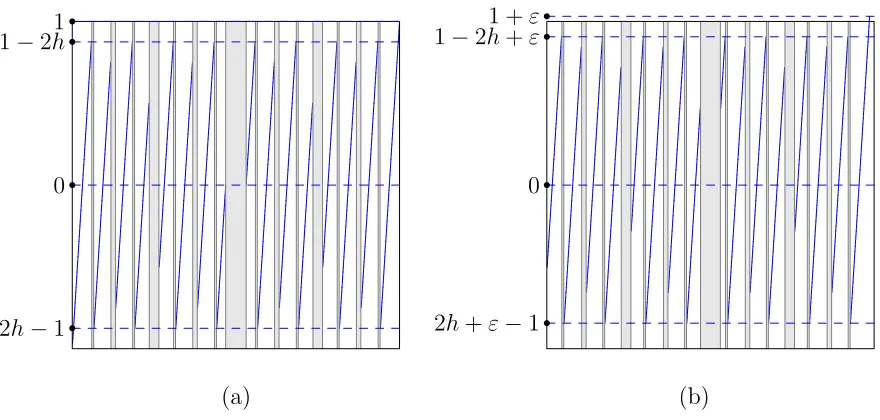
i is increasing. Figure 1.4 shows a few iterations of the map
without perturbation (ξ≡0) and with the largest possible perturbation (ξ ≡δ). We see that
1.6 OUTLINE
In Subsection 3.2.2we introduce a canonical partition Ωξ of the class G(m), associated to
a small perturbation ξ. The partition has the following property. For any interval I with
ℓkξ(I)⊂[−1,1] for all 0≤k < mthere exists an element of the partition Ωξi such thatI ⊆Ωξi.
In addition, the partition is “uniform”: any interval of the lengthδ contains not more than
Nδ elements of the partition.
In Subsection 3.2.3 we show that the operator ℓmξ∗ may be very well approximated (The-orem 4 on p. 62) by a toy dynamo operator T defined on the space of piecewise constant
functions associated to Ωξ. For any essentially bounded and absolutely integrable functionf,
k(ℓmξ∗− T) exp(δ∆)fk2 ≤ s3
1δ
21/2s 2
m
·mkfk1.
Here we can choose parameters s1,s2 of the map ℓ, and a constantα such that the
approxi-mation is good enough: namelykT k= 2m and
s31
21/2+αs2 <2.
In Section 3.3 we construct an invariant cone for the operator exp(δ∆)ℓmξ∗exp(δ∆) in the space of essentially bounded absolutely integrable functions. In order to do that, we
show that the image of the Weierstrass transform with Gaussian kernel with isotropic
vari-anceδ = 2−mα ≫sup|Ω1j|may be well approximated by step functions on a partition Ω1 of the class G(m). Namely, for any partition Ω2 of the classG(m) we have (Lemma3.3.2):
kDΩ1Wδf−Wδfk1≤
max(sup|Ω1
j|,sup|Ω2j|)
δ kfk2≤
1
sm2 δkfk2.
Based on this simple idea, we construct an invariant cone in the space of essentially bounded
integrable functions “around” the cone in the space of piecewise constant functions.
In chapter 4 we construct a transformation T: R2 → R2 that satisfies Invariant Cone
1.6 OUTLINE
on the square and complement it by a non-expanding area preserving map outside. The
argument runs in a similar way to the one-dimensional case; and according to the general
strategy described above in Subsection1.5.
In the beginning we fix notation related to mappings ofR2 and vector fields. In particular,
we define (4.3) the Gaussian kernel Wδ and the Weierstrass transform operator on vector
fields.
In Section 4.2, we define the dynamical system we will be working with. It is easy to see
that the energy of the vector fields that change direction rapidly does not grow exponentially
fast. We are going, as before, to replace diffusion by small random perturbations, and we
have almost no control on the map outside the square. Therefore we need to introduce a
delay in return time artificially. One of possible solutions is to use atower construction.
In Subsection4.2.1we define the phase spaceXto be atower ofM floors, which is a union
of the real planeR2 and M−1 copies of it with the central square cut off:
X def= {0} ×R2
∪ {1, . . . , M −1} ×(R2 \),
where = [−1,1]2. We also define a map F:X → X, to be, generally speaking, Baker’s
map on the squareand some area-preserving map transferring points outside of the square
to a different floor.
F(z, n)def=
(F0(z),0), ifn= 0 and z∈;
(Fn+1(z),(n+ 1)mod (M−1)), otherwise.
(4.5)
(See p. 97 for definition of the maps Fn, n = 1, . . . , M −1.) We also introduce small
per-turbationsFξ of the map F. Afterwards, we define the mapP:R2 →R2 we will be dealing
with as a large iteration of the map Fξ.
In Subsection 4.2.2, we introduce (4.11) a norm on the space of vector fields we will be
1.6 OUTLINE
case, but we “weight” L1 norm only in expanding direction. A linear operator we define to
be an action induced by Pξ2 in ordinary way (4.10).
In Subsection 4.2.3 we exploit similarities between Baker’s map, its inverse, and the
dou-bling map, and construct a canonical partition for the Baker’s map as a direct product of
two partitions for suitably chosen small random perturbations of the doubling map.
In Section 4.3 we introduce a subspace XΩ1 of piecewise constant vector fields associated
to the canonical partition Ω1. We define the basis on X
Ω1 to beVΩs1∪VΩu1, where
VΩs1
def
= n 1
|πx(Ω1ij)|
(1 0)χΩ1
ij o
i∈Z,j∈Z and V
u
Ω1
def
= n 1
|πx(Ω1ij)|
(0 1)χΩ1
ij o
i∈Z,j∈Z. The vectors that have only χΩs
ij components, are parallel to the contracting direction of the
Baker’s map and vectors that have only χΩu
ij components, are parallel to the expanding
di-rection of the Baker’s map. Using the operatorPξ∗, we define an associated linear operatorA
betweenXΩ1 and a suitable subspace of piecewise constant vector fieldsXΩ2 and such that
Z Ω2
kl
Pξ2∗ν =
Z Ω2
kl
Aν (4.16)
via its matrix elements. It is natural to write the operator A as a direct sum of four linear
operatorsA=SS⊕SU ⊕U S⊕U U, where
SS:hVΩs1i → hVΩs2i; SU:hVΩs1i → hVΩu2i; U S:hVΩu1i → hVΩs2i; U U:hVΩu1i → hVΩu2i.
The growth of the energy is guaranteed by the operator U U, and we will study it separately
in the next section. We conclude this section with construction of a pair of cones C1 ⊂XΩ1
and C2⊂XΩ2, such that A(C1)(C2 and the cone C1 is much smaller than C2.
In Subsection4.3.1we establish that the matrix of the operatorU U demonstrates properties
similar to the ones of “toy dynamo operator” we studied in the Chapter3. Namely, its central
part, corresponding to the elements from the unit square, has a plenty of 1’s, and the absolute
1.6 OUTLINE
In Subsection4.3.2we justify the choice of the operator A, and show that operators WδA
andWδPξ2 are close on the subspace of piecewise constant vector fieldsXΩ1. The estimations
are based on the fact thatδ is chosen so that
max(sup|πx(Ω2ij)|,sup|πy(Ω2ij)|)≪δ
and the construction of canonical partitions.
In Subsection 4.3.3 we construct a pair of cones for the operator A, the larger cone
C1 ⊂ XΩ1 and a much smaller cone A(C1) ⊂ C2 ⊂ XΩ2. We use the decomposition
A = SS ⊕SU ⊕U S ⊕U U, and exploit simplicity of the matrix U U along with upper
bounds on other operators.
The Subsection4.4.1repeats the Section3.3of the one-dimensional Chapter3with obvious
modifications adjusting the arguments to dimension two. In particular, the length of the
intervals of the partitions in the upper bounds is replaced by the diameter of the elements.
In Subsection 4.4.2we construct of an invariant cone for the operatorW δ
2mP 2
ξ∗W δ
1.6 OUTLINE
A4
A−1
B1
B−4 B−5
A3
A−2
B0 B−3
B−6
A5 A2
A−3 A−6
B5 B2 B−2
B3
A−5
A0
A1
B−1
B4
A−4
B−3 B−6
A5 A2
A−3 A−6
B5 B2
σ1 S1
σ4 S1
π
S1
S2
σ3 S2
σ2
S2
π S1
[image:31.595.134.523.140.592.2]S2
Figure 1.2: The mapping between the sections π, σ1,...,4, induced by the fluid flow;
Ak = Φ′(Ak−1), Bk = Φ′′(Bk−1). The points S1 and S2 are periodic saddles;
1.6 OUTLINE
x−1
2 ,2y+ 1
x+1
2 ,2y−1
[image:32.595.111.548.120.274.2](a) (b) (c)
Figure 1.3: (a) Unfolded Baker’s map, that appears as the first return map to the section π;
(b) Doubling map with a hole; and (c) a small perturbation of the doubling map
with a hole.
0 1
2h−1 1−2h
(a)
0 1 +ε
2h+ε−1 1−2h+ε
(b)
Figure 1.4: First four iterations of a small perturbation of the doubling map with a hole of
the widthh: (a) the case of the zero sequence; and (b) the case of the constant
[image:32.595.110.550.418.628.2]2 A proof of the fast dynamo theorem
In this Chapter we give a proof for the fast dynamo theorem for maps satisfying certain
hypothesis. Later, in the Chapter 3 we construct a one-dimensional map satisfying this
hypothesis and in the Chapter 4 we prove that its two-dimensional extension also satisfies
these conditions. The two-dimensional map may be realised as a Poincar´e map of a smooth
stationary vector field in R3.
2.1 Basic constructions
In this Section we introduce objects central for our investigations: small random perturbations
of a dynamical system and a norm in the space of vector fields. We also specify the type of
cones in the space vector fields we are interested in.
2.1.1 Small random perturbations
We construct a random dynamical system using skew-products. Let X be a real manifold
and letf:X→X be a transformation. We consider its extension
b
2.1 BASIC CONSTRUCTIONS
Let Σ⊂ℓ∞(Rn) be a shift-invariant subset of two-sided bounded sequences of vectors inRn.
We introduce a skew product over the Bernoulli shift
σ×fb: Σ×X →Σ×X (σ×fb)(ξ, z)def= (σ(ξ),fb(z, ξ(1))). (2.2)
The induced transformation on fibers we denote by
fξ:X →X, fξ(z)def= fb(z, ξ(1)). (2.3)
Its iterations are given by
fξk(z)def= fb(fξk−1(z), ξ(k)). (2.4)
Remark 1. The following identities follow from the definition of the mapfξ.
fξk=fξ(k)◦fξ(k−1)◦. . .◦fξ(1); (2.5)
fξ−k= (fξk)−1=fξ−(1)1 ◦fξ−(2)1 ◦. . .◦fξ−(k1); (2.6)
fξn−k=fξn◦fξ−k=fξ−k◦fξn=
fσnn−(kξ), ifn < k;
fσnk−(kξ), ifn > k.
(2.7)
Definition 2. We call the map fξ a random perturbation of the map f associated to the
sequence ξ∈Σ.
2.1.2 Norm in the space of vector fields
Piecewise constant vector fields are proved to be very useful to us. We define a norm in the
space of essentially bounded and absolutely integrable vector fields Φ, using partitions.
The norm we are about to introduce is related to the mapf. Since topological entropy is
an upper bound for the growth rate of the energy, the system has to be chaotic. We shall
2.1 BASIC CONSTRUCTIONS
We let πu to be projection along the unstable foliation onto the stable manifold. We denote
by λnu thenu-dimensional Lebeague measure on the unstable manifold.
Let us fix a large number m≫1. Its role will be clarified in the next Subsection.
Definition 3. A norm in the space of essentially bounded and absolutely integrable functions,
associated to a partition Ω(m) = ∞S
j=1
Ωj of Rn is given by
kfkΩ = max X
j∈Z
2−num λnu(πu(Ωj))
Z Ωj
|f(x)|dx,2−αmsup|f|; (2.8)
where the choice of α depends onn.
The first term we refer to as the weighted L1-norm and write
kfkΩ,L1: =
X
j∈Z
2−num λnu(πu(Ωj))
Z Ωj
|f(x)|dx,
it depends, of course, on the partition chosen.
We denote by ΦΩthe subspace of Φ, consisting of piecewise constant vector fields associated
to the partition Ω.
2.1.3 Cones in vector fields on Rn
We reserve a notation for a cone of the radiusr with the main axis v0 in the space ΦΩ:
Cone (v0, r,Ω)def=nη=dv0+ϕ|ϕ∈ΦΩ, Z
(f∗mϕ)v0 = 0;kϕkΩ ≤drkv0k o
. (2.9)
We extend the cone Cone (v0, r,Ω) to include general functions from the main space:
[
Cone (v0, r, ε,Ω)def= n
f =η+g,|η ∈Cone (v0, r,Ω),kgkΩ≤εkηkΩ o
. (2.10)
We say that the cone Cone[ v0, r1, ε1,Ω1 is smaller than the cone Cone[ v0, r2, ε2,Ω2 and write Cone[ v0, r1, ε1,Ω1 ≪ Cone[ v0, r2, ε2,Ω2, if r1 > r2 and ε1 > ε2; we do not assume
2.2 PROOF OF THE MAIN RESULT
2.2 Fast dynamo theorem
In this Section we set the hypothesis and give a proof of the fast dynamo theorem1.
The first step the Noise Lemma2.2.1, which suggests to replace the operator (exp(δ∆)f∗)n in our considerations with the operator exp(δ∆)fn
t∗ for some sequence t.
We begin with a simple observation that the exponent of the Laplacian operator1 inRn,
is the convolution with the Gaussian kernel, in particular
exp(δ∆)v=wδ∗v, wherewδ(x) =
1
√
2πδ exp − x2
2δ2
.
The latter operator is also known as the Weiertstrass transform Wδ(v) def= (wδ ∗ v); this
notation we use throughout.
The following statement is generally known, but we give a proof for completeness.
Lemma 2.2.1 (Noise Lemma). For any mapf:Rn→ Rn and for any vector field v in Rn
we have
Wδ
2f∗(Wδf∗)
m−1v(x) =Z
Rn(m−1)
wδ(t1)wδ(t2). . . wδ(tm−1)(Wδ
2f
m
0t∗v)(x)dt1dt2. . .dtm−1,
(2.11)
where 0t= (0, t1, t2, . . . , tm−1)∈Rm.
Proof. Observe that f−1(x−t) = f−1
t (x), because ft(x) = f(x) +t. By straightforward
2.2 PROOF OF THE MAIN RESULT
calculation,
Wδ
2f∗(Wδf∗)
m−1v(x) =W δ
2f∗(Wδf∗)
m−2W
δf∗v(x) =
=Wδ
2f∗(Wδf∗)
m−2Z
Rn
wδ(t)(f∗v)(x−t)dt=
=Wδ
2f∗(Wδf∗)
m−2Z
Rn
wδ(t1)(ft1∗v)(x)dt1 =. . .=
=Wδ
2
Z
Rn(m−1)
wδ(t1). . . wδ(tm−1)(f∗ft1∗. . . ftm−1∗v)(x)dt1. . .dtm−1=
=
Z
Rn(m−1)
wδ(t1). . . wδ(tm−1)(Wδ
2f
m
0t∗v)(x)dt1. . .dtm−1.
Corollary 1. For any mapf:Rn→Rn, any vector fieldv
0inRn, and for anyk=k0m≫m
Wδ
2f∗(Wδf∗)
k−1W δ
2v0(x) = =
Z
Rk−k0
wδ(t1)wδ(t2). . . wδ(tk−k0)
Wδ
2f
m
0t∗Wδ2
k0
v0(x)dt1dt2. . .dtk−k0. (2.12)
We shall put the following conditions on the map f.
Hypothesis 1 (Invariant Cone). There exist an m≫1, a partitionΩ(m), a vector field v0,
and four numbers r2(m) ≪ r1(m), ε2(m) ≪ ε1(m) ≪ 1 such that for any sequence ξ with
kξk∞≤δ
Wδ
2f
m
0t∗Wδ2: [
Cone (v0, r1, ε1,Ω)→Cone ([ v0, r2, ε2,Ω)⊂Cone ([ v0, r1, ε1,Ω) (2.13)
Moreover, there exists 0< γ <0.01 such that for any field v∈Cone ([ v0, r1, ε1,Ω)
2m−2kvkΩ ≤ kWδ
2f
m
0t∗Wδ2vkΩ ≤2
(1+γ)m
kvkΩ. (2.14)
We construct a map f:R → R satisfying this hypothesis in the Chapter 3 and a map
f:R2 →R2 satisfying this condition in the Chapter 4.
We choose δ = 2−mα, a partition Ω = Ω(m) = SΩ
j, the vector field v0 ≥0, and fix four
2.2 PROOF OF THE MAIN RESULT
Lemma 2.2.2. In the notations introduced above, for any v∈Cone ([ v0, r1, ε1,Ω)
Z
[−δ,δ]m−1 wδ
m(t1). . . w δ
m(tm−1)(W δ
2mf
m t∗W δ
2mv)dt1. . .dtm−1 ∈
[
Cone v0, e2r2, e2ε2,Ω.
(2.15)
Proof. By the Hypothesis assumption, we know that for any |t| ∈ [−δ, δ]m and any vector
fieldv ∈Cone ([ v0, r1, ε1,Ω)
W δ
2mf
m t∗W δ
2mv =dv0+ψt+gt∈
[
Cone (v0, r2, ε2,Ω),
whereψt∈ΦΩ,kψtkΩ ≤dr2kv0kΩ andkgtkΩ≤dε2kv0kΩ. Observe that Ω is independent on
t. Therefore,
Z
[−δ,δ]m−1 wδ
m(t1). . . w δ
m(tm−1)v0dt1. . .dtm−1 =
=v0 Z δ
−δ
wδ m(t)dt
m−1
=v0
1− 2
m m−1
≥e−2v0, (2.16)
form large enough. Sinceψt∈ΦΩ for any t∈[−δ, δ]m,
Z
[−δ,δ]m wδ
m(t1). . . wmδ (tm−1)ψtdt1. . .dtm−1 ∈ΦΩ,
and we calculate Ω-norm.
Z
[−δ,δ]m−1
wδ
m(t1). . . wmδ(tm−1)ψtdt1. . .dtm−1 Ω≤
≤X
j∈Z
2−num λnu(πu(Ωj))
Z
[−δ,δ]m−1 wδ
m(t1). . . w δ
m(tm−1) Z
Ωj
|ψt(x)|dx
dt1. . .dtm−1≤
≤sup
t k
ψtkΩ≤dr2kv0kΩ.
Similarly,
Z
[−δ,δ]m−1 wδ
m(t1). . . w δ
m(tm−1)gtdt1. . .dtm−1
2.2 PROOF OF THE MAIN RESULT
Observe that
Z 1
−1 Z
[−δ,δ]m−1
wδ
m(t1). . . w δ
m(tm−1)ψt(x)dt1. . .dtm−1dx=
=
Z
[−δ,δ]m−1 wδ
m(t1). . . w δ
m(tm−1)dt1. . .dtm−1· Z 1
−1
ψt(x)dx= 0.
Summing up, for any v∈Cone ([ v0, ε1, r1,Ω)
Z
[−δ,δ]m−1 wδ
m(t1). . . w δ
m(tm−1)W δ
2mf
m t∗W δ
2mvdt1. . .dtm−1 ∈
[
Cone v0, e2r2, e2ε2,Ω.
Lemma 2.2.3. In the notations introduced above, assume in addition that2γme−m≪ε
2(m).
Then
W δ
2mf∗(Wδf∗)
m−1W δ
2m:
[
Cone (v0, r1, ε1,Ω)→Cone[ v0, e2r2, e2ε2,Ω( [Cone (v0, r1, ε1,Ω) ;
Moreover, there exists 0< γ <0.01 such that for any field v∈Cone ([ v0, r1, ε1,Ω)
2m−5kvkΩ≤ kW δ
2mf∗(Wδf∗)
m−1W δ
2mvkΩ ≤2
(1+γ)mkvk
Ω
Proof. By Lemma2.2.1 for any v∈Cone (v0, r1,Ω)
W δ
2mf∗(W δ mf∗)
m−1W δ
2mv=
=
Z
Rm−1 wδ
m(t1). . . w δ
m(tm−1)(W δ
2mf
m t∗W δ
2mv)dt1dt2. . .dtm−1=
=Z
Rm−1\[−δ,δ]m−1 +
Z
[−δ,δ]m−1
mY−1
j=1 wδ
m(tj)(W δ
2mf
m t∗W δ
2mv)dt. (2.17)
By Lemma2.2.2we know that for anyv∈Cone ([ v0, r1, ε1,Ω)
Z
[−δ,δ]m−1
mY−1
j=1 wδ
m(tj)(W δ
2mf
m t∗W δ
2mv)dt∈
[
2.2 PROOF OF THE MAIN RESULT
We estimate the first term
Z
Rm−1\[−δ,δ]m−1
mY−1
j=1 wδ
m(tj)(W δ
2mf
m t∗W δ
2mv)dt
Ω ≤
≤X
j∈Z
2−num λnu(πu(Ωj))
Z
Rm−1\[−δ,δ]m−1
mY−1
j=1 wδ
m(tj) Z
Ωj W δ
2mf
m t∗W δ
2mv(x)
dxdt≤
≤sup
t k
W δ
2mf
m t∗W δ
2mvkΩ Z
Rm−1\[−δ,δ]m−1
mY−1
j=1 wδ
m(tj)dt.
We shall find an upper bound for the integral:
Z
Rm−1\[−δ,δ]m−1
mY−1
j=1 wδ
m(tj)dt≤ ≤2mZ
+∞
δ
wδ m(t)dt
m
+ 2m Z +∞
δ
Z
[−δ,δ]m−1
wδ
m(t1). . . w δ
m(tm−1)dt1. . .dtm−1 ≤ ≤2me−m2+ 2me−m.
We may also recall that there exists 0< γ < 0.01 such that for any v ∈Cone ([ v0, r1, ε1,Ω),
we have suptkW δ
2mf
m t∗W δ
2mvkΩ ≤2
(1+γ)mkvk
Ω. Therefore
sup
t k
W δ
2mf
m t∗W δ
2mvkΩ Z
Rm−1\[−δ,δ]m−1
mY−1
j=1 wδ
m(tj)dt≤2
(1+γ)m·2me−mkfk
Ω.
We need to verify 2(1+γ)m·2me−m ≪2m−5ε
2, which is equivalent to 2γm+6e−m≪ε2.
For the second inequality we recall the second condition of the Hypothesis
∀v∈Cone ([ v0, r1, ε1,Ω) :kW δ
2mf
m ξ∗W δ
2mvkΩ≥2
m−2kvk Ω. Then Z
[−δ,δ]m−1
mY−1
j=1 wδ
m(tj)(W2δmf
m t∗W δ
2mv)dt Ω≥
≥ inf
t∈[−δ,δ]mkW2δmf
m t∗W δ
2mvkΩ· Z
[−δ,δ]m−1
mY−1
j=1 wδ
m(tj)≥2
m−2e−2kvk
Ω. (2.18)
Taking into account
Z
Rm−1\[−δ,δ]m−1
mY−1
j=1 wδ
m(tj)(W2δmf
m t∗W δ
2mv)dt
Ω≤2
mε
2.2 PROOF OF THE MAIN RESULT
we get the result.
Theorem 1 (Fast dynamo theorem). Let f:Rn → Rn be a piecewise-C2 transformation
satisfying the Invariant Cone Hypothesis and an additional condition 2eγm ≪ ε2. Then there exists an essentially bounded vector field v, with absolutely integrable components such
that
lim
δ→0nlim→∞
1
nln
(exp(δ∆)f∗)nv
L1 >0,
Proof. It follows by straightforward calculation that WδWδ = W2δ for any number δ > 0.
The Theorem follows from Corollorary1 of Lemma2.2.1and Lemma2.2.3withv=W δ
2mv0.
3 Fast dynamo on the real line
This Chapter is dedicated to the construction of a transformation ℓ:R → R satisfying the
Invariant Cone Hypothesis1, p.28. In perspective, the operatorℓ∗corresponds to the induced action on vector fields on the unstable manifold of the Poincar´e map of the provisional flow.
The unstable manifold is one dimensional and the settings are the following. Vector fields
on a one-dimensional real manifold may be identified with functions R→R; and an induced
action on vector fields on R is given by a transfer operator (ℓ∗v)(y) = P
x∈ℓ−1(y)
dℓ(x)v(x),
whereℓ:R→R is a piecewise-differentiable function.
The main result is the following
Theorem 2 (Invariant cone). There exist a measure preserving piecewise-smooth
transfor-mationℓ:R→R, a cone C in the space Φof essentially bounded absolutely integrable vector
fields on R, and a norm k · k in Φ such that for an m ≫ 1 large enough and any sequence
kξk∞≤δ with δ= 2−mα for 1516 < α <1 we have
W δ
2mℓ
m ξ∗W δ
2m:C→C; ∀f ∈C:kW δ
2mℓ
m ξ∗W δ
2mfk ≥
1 4kℓ
m
∗ k · kfk. (3.1)
3.1 Notation
3.1 NOTATION
The following letters are reserved for constants: α, β, γ, γ1, κ, s1, s2. The admissible
range of values will be specified later.
Given a subsetI ⊂Rnwe denote by|I|its Lebesgue measure. We say that two setsI1 and
I2 are δ-close and write |I1−I2|< δifI1 belongs to theδ-neighbourhood ofI2 orI2 belongs
to theδ-neighbourhood of I1. Otherwise, we write |I1−I2|> δ. The indicator function of a
set I we denote by χI.
Let δij be the Dirac delta function:
δij =
1, ifi=j
0, otherwise.
The supremum norm of a sequence of real numbersξ ∈ℓ∞(R) we denote bykξk= sup
k∈N|
ξk|.
Whenever supremum or infimum are taken along the whole range of values, we omit the
range.
We write x≪y when xis exponentially small compared toy, namely, there exist a small
number 0< ε <1 such thatx <2−εmy.
Let δ= 2−mα be a small real number with 1516 < α <1.
Definition 4. We say that a collection of intervals Ω = {Ωj}j∈Z makes a partition of the
class G(m, δ, s1, s2), if SΩj =R, Ωi∩Ωj =∅ifi6=j, and the following conditions hold true.
1. The interval [−1,1] contains at least 2m−1 and at most 2m intervals of the partition,
and {±1}are the end points of some intervals of the partition.
2. The length of intervals Ωj is bounded away from zero and from infinity
1
msm
1 ≤ |
Ωj| ≤2
1 sm
1
+ 1
sm
2
3.1 NOTATION
3. Any intervalI ⊂R of the length|I|=δ contains not more than
Nδ = 2m+1δlogs12 = 2m(1−αlogs12)+1
intervals of the partition.
4. Any interval of the partition Ωj ⊂R\[−1−mδ,1 +mδ] has length|Ωj|= 2−m.
We writeG(m, δ, s1, s2) to indicate dependence onm,δ,s1, ands2; we will abuse notations
and omitm,δ,s1, ors2, when it leads to no confusion and the dependence is of no importance.
We number intervals of a partition Ω in the natural order, starting from Ω0 ∋0. We set
ΩNl to be the most left interval of Ω inside [−1,1], and ΩNr to be the most right interval of
Ω inside [−1,1].
Here we deal with essentially bounded absolutely integrable functions on the real line. We
refer to the space Φdef= L1(R)∩L∞(R) as the main space. “Any function” refers to a function
from the main space always.
Given a partition Ω = {Ωj}j∈Z of the class G, we denote the associated space of step functions by ΦΩ and address the basis {χΩj}j∈Z as the canonical basis of ΦΩ.
Definition 5. We associate a weighted transfer operator f∗, acting on the main space, to a mapf on the real line by1
(f∗φ)(x) : = X
y∈f−1(x)
sgn df(y)φ(y). (3.2)
3.1.1 The dynamical system
Here we define the system we will be studying. We have specified the phase space to be the
space of essentially bounded and absolutely intgrable vector fields on R. Now we define a 1Transfer operator is a bounded linear operator. In this case, it is chosen to be one dimensional analogue
of induced action on vector fields by area-preserving transformations. Transfer operators with negative
3.1 NOTATION
transformation and a norm. We also fix the type of cones we will be dealing with.
The transformation of Φ. Let s2 ≤2≤s1, be two real numbers such that logss12 =κ≪1.
and letδ = 2−mα be a small real number with 1516 ≤α <1. Consider the map ℓ:R→R
ℓ(x) =
s1x+s1−1, if −1< x < s21 −1;
s2x+ 1−s2, if s21 −1< x <1;
−x, otherwise.
(3.3)
and define its extension bℓ:R2 →Rby ℓb(x, y) =ℓ(x) +y. We associate a small perturbation ℓξ to any sequence ξ∈ℓ∞(R) and kξk∞≤δ.
The mapℓoutside the unit interval is not important to us and we chose a simple map that
changes direction of the vector field, to make it non-trivial. The exact form is not relevant
here. We associate a transfer operator to a mapℓm
ξ according to (3.2). We will be studying
the actionℓmξ∗: Φ→Φ.
Norm in the space of vector fields. Piecewise constant vector fields have proved to be
very useful to us. We define a norm in the space Φ of essentially bounded and absolutely
integrable vector fields on R, using partitions.
Definition 6. A norm in the space ΦΩ of essentially bounded and absolutely integrable
functions, associated to a partition Ω = ∞S
j=1
Ωj of R, is given by
kfkΩ = max X
j∈Z 2−m
|Ωj|
Z Ωj
|f(x)|dx,2−m/2sup|f|. (3.4)
The first term we refer to as the weighted L1-norm and write
kfkΩ,L1: =
X
j∈Z 2−m
|Ωj|
Z Ωj
|f(x)|dx,
3.2 DYNAMO OPERATOR
This definition agrees with general definition in Subsection 2.1.2withα = 1/2.
The subspace of Φ, consisting of piecewise constant vector fields associated to the
parti-tion Ω we denote by ΦΩ. Observe that for any step function φ = P
j∈Z
cjχΩj ∈ ΦΩ we have
that
kφkΩ = max
2−mX
j∈Z
|cj|,2−m/2sup|cj|
. (3.5)
Cones in vector fields on R. We reserve a notation for a cone of radius r with the main
axisχ[−1,1] in the space ΦΩ of piecewise constant functions, associated to a partition Ω:
Cone (r,Ω)def=nη =dχ[−1,1]+ϕ|ϕ= X
j∈Z
cjχΩj;
Nr X
j=Nl
cj = 0; kϕkΩ≤dr o
. (3.6)
We extend the cone Cone (r,Ω) to include general functions from the main space:
[
Cone (r, ε,Ω)def= nf =η+g,|η ∈Cone (r,Ω),kgkΩ ≤εkηkΩ o
. (3.7)
This definition agrees with general definition in Subsection 2.1.3.
3.2 Transfer operator as a dynamo operator
The plan is to choose suitable subspaces of Φ and approximate the operatorℓmξ∗by an operator with a simple matrix. The latter we call ageneralised toy dynamo operator.
Afterwards, we prove that there exists a map ℓ:R→R such that for any small
perturba-tion ℓmξ with kξk∞ ≤ δ we can find a generalised toy dynamo operator A: Φ→ Φ and two partitions Ω1 and Ω2 ofRsuch thatA: ΦΩ1 →ΦΩ2 and k(ℓmξ
∗− A)Wδk ≤2−γm(kℓmξ∗k+kAk)
for someγ >0.
3.2.1 Generalised toy dynamo operators
Here we give a definition and show that any generalised toy dynamo operator A possess a
3.2 DYNAMO OPERATOR
LetAbe a linear operator acting on the main space. Assume that there exists two partitions
Ω1, Ω2 of the class G such that A: ΦΩ1 → ΦΩ2. Here and below we denote by Nl1 and Nr1
the indices of the first and the last intervals of the partition Ω1 inside [−1,1], respectively;
and letN2
l and Nr2 be the indices of the first and the last intervals of the partition Ω2 inside
[−1,1], respectively. In other words, the sets Ω2i ×Ω1j with Nl2≤i≤Nr2, andNl1 ≤j ≤Nr1
make a partition of the unit square.
We define several sets of indices in order to describe the properties of the operator A
important to us. Let aij be coefficients of the matrix of A in the canonical bases of the
subspaces ΦΩ1 and ΦΩ2.
Accelerator:
Ar : =j∈ {Nl1, . . . , Nr1} |#{i∈ {Nl2, . . . , Nr2} |aij = 1} ≥2m−Nδ . (3.8)
Inflow diffusion:
Din: =(i, j)∈ {Nl2, . . . , Nr2} × {Nl1, . . . , Nr1} |aij 6= 1 . (3.9)
Outflow diffusion:
Dout: ={Nl2−mNδ, . . . , Nr2+mNδ} × {Nl1−mNδ, . . . , Nr1+mNδ}−
− {Nl2, . . . , Nr2} × {Nl1, . . . , Nr1}. (3.10)
Indifferent subspace:
Sp : =Z2\ {N2
l −mNδ, . . . , Nr2+mNδ} × {Nl1−mNδ, . . . , Nr1+mNδ}. (3.11)
We are interested in linear operators A such that the following conditions hold true for the
matrix coefficients in the canonical bases.