warwick.ac.uk/lib-publications
Original citation:Lukasik, Michal, Srijith, P. K, Vu, Duy, Bontcheva, Kalina, Zubiaga, Arkaitz and Cohn, Trevor (2016) Hawkes processes for continuous time sequence classification : an application to rumour stance classification in Twitter. In: 54th Annual Meeting of the Association for Computational Linguistics, Berlin, Germany, 7-12 Aug 2016. Published in: Proceedings of 54th Annual Meeting of the Association for Computational Linguistics pp. 393-398.
Permanent WRAP URL:
http://wrap.warwick.ac.uk/79701
Copyright and reuse:
The Warwick Research Archive Portal (WRAP) makes this work of researchers of the University of Warwick available open access under the following conditions.
This article is made available under the Attribution-NonCommercial-ShareAlike 3.0 Unported (CC BY-NC-SA 3.0) license and may be reused according to the conditions of the license. For more details see: https://creativecommons.org/licenses/by-nc-sa/3.0/
A note on versions:
The version presented in WRAP is the published version, or, version of record, and may be cited as it appears here.
Hawkes Processes for Continuous Time Sequence Classification:
an Application to Rumour Stance Classification in Twitter
Michal Lukasik,1P.K. Srijith,1Duy Vu,2
Kalina Bontcheva,1Arkaitz Zubiaga3 and Trevor Cohn2 1Department of Computer Science, The University of Sheffield
2Department of Computing and Information Systems, The University of Melbourne 3Department of Computer Science, The University of Warwick
{m.lukasik, pk.srijith, k.bontcheva}@shef.ac.uk
{duy.vu, t.cohn}@unimelb.edu.au [email protected]
Abstract
Classification of temporal textual data se-quences is a common task in various do-mains such as social media and the Web. In this paper we propose to use Hawkes Processes for classifying sequences of temporal textual data, which exploit both temporal and textual information. Our ex-periments on rumour stance classification on four Twitter datasets show the impor-tance of using the temporal information of tweets along with the textual content.
1 Introduction
Sequence classification tasks are often associated with temporal information, where the timestamp is available for each of the data instances. For instance, in sentiment classification of reviews in forums, opinions of users are associated with a timestamp, indicating the time at which they were posted. Similarly, in an event detection task in Twitter, tweets being posted on a con-tinuous basis need to be analysed and classi-fied in order to detect the occurrence of some event. Nevertheless, traditional sequence classi-fication approaches (Song et al., 2014; Gorrell and Bontcheva, 2016) ignore the time information in these textual data sequences. In this paper, we aim to consider the continuous time information along with the textual information for classifying sequences of temporal textual data. In particular, we consider the problem of rumour stance classi-fication in Twitter, where tweets provide temporal information associated with the textual tweet con-tent.
Rumours spread rapidly through social media, creating widespread chaos, increasing anxiety in society and in some cases even leading to riots. For instance, during an earthquake in Chile in
2010, rumours circulating on Twitter stated that a volcano had become active and there was a tsunami warning, which were later proven false. Denials and corrections of these viral pieces of in-formation might often come late and without the sufficient effect to prevent the harm that the ru-mours can produce (Lewandowsky et al., 2012). This posits the importance of carefully analysing tweets associated with rumours and the stance ex-pressed in them to prevent the spread of malicious rumours. Determining the stance of rumour tweets can in turn be effectively used for early detection of the spread of rumours, as well as for flagging ru-mours as being potentially false when a large num-ber of people are found to be countering them. The rumour stance classification task has been previ-ously defined as that in which a classifier needs to determine whether each of the tweets is support-ing, denyingorquestioninga rumour (Qazvinian et al., 2011). Here we add a fourth label, com-menting, which is assigned to tweets that do not add anything to the veracity of a rumour.
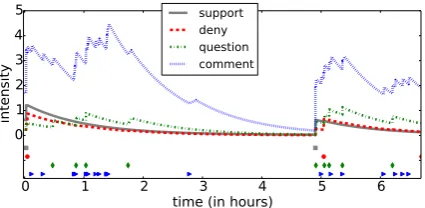
In this paper, we propose to use Hawkes Pro-cesses (Hawkes, 1971), commonly used for mod-elling information diffusion in social media (Yang and Zha, 2013; De et al., 2015), for the task of rumour stance classification. Hawkes Processes (HP) are a self-exciting temporal point process ideal for modelling the occurrence of tweets in Twitter (Zhao et al., 2015). The model assumes that the occurrence of a tweet will influence the rate at which future tweets will arrive. Figure 1 shows the behaviour of the intensity functions as-sociated with a multivariate Hawkes Process. Note the intensity spikes at the points of tweet occur-rences. In applications such as stance classifica-tion, different labels can influence one another. This can be modelled effectively using the mutu-ally exciting behaviour of Hawkes Processes. In the end, we demonstrate how the information
0 1 2 3 4 5 6 time (in hours)
01 2 3 4 5
intensity
[image:3.595.76.289.64.168.2]support deny question comment
Figure 1: Intensities of the Hawkes Process for an example Ferguson rumour. Tweet occurrences over time are denoted at the bottom of the figure by different symbols. Intensity for comments is high throughout the rumour lifespan.
nered from rumour dynamics can be beneficial to stance classification of tweets around rumours.
Little work has been done on stance classifica-tion of rumour tweets. Qazvinian et al. (2011) in-troduced a system for classifying rumour tweets and Lukasik et al. (2015a) considered this problem in a setting where the tweets associated with a new emerging rumour is the target for classification. Both works ignored the temporal information. On the other hand, research has been done on model-ing dynamics of rumour propagation (Lukasik et al., 2015b). Here, we show how using information about dynamics of rumour propagation is impor-tant to the problem of rumour stance classification. The novel contributions of this paper are: 1. De-veloping a Hawkes Process model for time sen-sitive sequence classification. 2. Demonstrating on real world data how temporal dynamics con-veys important information for stance classifica-tion. 3. Establishing the new state of the art method for rumour stance classification. 4. Broad-ening the set of labels considered in previous work to include a new labelcommenting.
Software used for experiments can be found
at https://github.com/mlukasik/
seqhawkes.
2 Problem definition
We consider a collection D of rumours, D = {R1,· · ·, R|D|}. Each rumour
Ri contains a set of tweets discussing it, Ri = {d1,· · ·, dni}. Each tweet is represented as a tuple dj = (tj,Wj, mj, yj), which includes the following information: tj is the posting time of the tweet, Wj is the text message, mj is the rumour category and yj is the label, yj ∈ Y = {supporting,denying,questioning,commenting}.
We define the stance classification task as that in which each tweet dj needs to be classified into one of the four categories, yj ∈ Y, which represents the stance of the tweetdj with respect to the rumourRiit belongs to.
We consider the Leave One Out (LOO) setting, introduced by Lukasik et al. (2015a), where for each rumour Ri ∈ D we construct the test set equal toRi and the training set equal toD\Ri. The final performance scores we report in the pa-per are averaged across all rumours. This repre-sents a realistic scenario where a classifier has to deal with a new, unseen rumour.
3 Data
We consider four Twitter rumour datasets with tweets annotated for stance (Zubiaga et al., 2016).1 The authors relied on a slightly different scheme for the annotation, given that they annotated tree-structured conversation threads where a source tweet initiates a rumour and a number of replies follow responding to it. Given this structure, the source tweet of a Twitter conversation is anno-tated as supporting, denying or underspecified, and each subsequent tweet is annotated asagreed,
disagreed,appeal for more information( question-ing) or commenting with respect to the source tweet. We convert these labels into our set of four including supporting, denying, questioning
and commenting, which extends the set of three labels used before in the literature (Qazvinian et al., 2011; Lukasik et al., 2015a) adding the new label commenting. To perform this conversion, we first remove rumours where the source tweet is annotated as underspecified, keeping the rest of source tweets as supporting or denying. For the subsequent tweets, we keep their label as is for the tweets that are questioning or comment-ing. To convert those tweets that agree or disagree into supportingordenying, we apply the follow-ing set of rules: (1) if a tweet agrees to a support-ing source tweet, we label it supporting, (2) if a tweet agrees to a denying source tweet, we label itdenying, (3) if a tweet disagrees to a supporting source tweet, we label itdenyingand (4) if a tweet disagrees to a denying tweet, we label it support-ing. The latter enables to infer stance with respect to the rumour from the original annotations that in-stead refer to agreement with respect to the source. 1While the authors annotated and released 9 datasets, here
we make use of 4 sufficiently large datasets.
Dataset Rumours Tweets Supporting Denying Questioning Commenting
Ottawa shooting 58 782 161 76 64 481
Ferguson riots 46 1017 161 82 94 680
Charlie Hebdo 74 1053 236 56 51 710
Sydney siege 71 1124 89 223 99 713
[image:4.595.311.527.626.710.2]Table 1: Statistics and distribution of labels for the four datasets used in our experiments. Each dataset consists of multiple rumours, and the rest of the columns offer the aggregated counts for all rumours within that dataset.
Figure 2 shows examples of tweets taken from the dataset along with our inferred annotations.
We summarise the statistics of the resulting dataset in Table 1. Note that the commenting la-bel accounts for the majority of the tweets.
4 Model
Hawkes Processes are a probabilistic framework for modelling self-exciting phenomena, which has been used for modelling memes and their spread across social networks (Yang and Zha, 2013). They have been used to model the generation of tweets over a continuous time domain (Zhao et al., 2015). The frequency of tweets generated by them is determined by an underlying intensity function which considers the influence from past tweets. The intensity function models the self-exciting na-ture by adding up the influence from past tweets. We use a multi-variate Hawkes process for mod-elling the mutually exciting phenomena between the tweet labels. In this section we describe how we apply the Hawkes Process framework for ru-mour stance classification.
Intensity Function In the intensity function
for-mulation, we assume that all previous tweets asso-ciated with a rumour influence the occurrence of a new tweet. This allows to use information on all the other tweets that have been posted about a rumour. We consider the intensity function to be summation of base intensity and the intensities as-sociated with all the previous tweets,
λy,m(t)=µy+
X
t`<t
I(m` =m)αy`,yκ(t−t`), (1)
where the first term represents the constant base intensity of generating labely. The second term represents the influence from the tweets that hap-pen prior to time of interest. The influence from each tweet decays over time and is modelled using an exponential decay term κ(t − t`) =
ωexp(−ω(t−t`)). The matrixαof size|Y|×|Y| encodes the degrees of influence between pairs of labels assigned to the tweets, e.g. aquestioning la-bel may influence the occurrence of arejecting la-bel in future tweets differently from how it would influence acommentinglabel.
Likelihood function The parameters governing
the intensity function are learnt by maximizing the likelihood of generating the tweets. The complete likelihood function is given by
L(t,y,m,W) = (2)
N
Y
n=1
p(Wn|yn)×
hYN
n=1
λyn,mn(tn)
i
×p(ET),
where the first term provides the likelihood of gen-erating text given the label and is modelled as a multinomial distribution conditioned on the label,
p(Wn|yn) = V
Y
v=1
βWnv
ynv , (3)
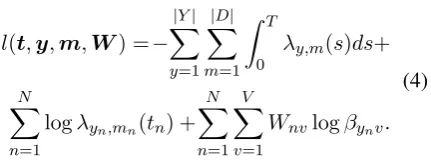
whereV is the vocabulary size andβis the matrix of size|Y| ×V specifying the language model for each label. The second term provides the likeli-hood of occurrence of tweets at times t1, . . . , tn and the third term provides the likelihood that no tweets happen in the interval [0, T] except at times t1, . . . , tn. We estimate the parameters of the model by maximizing the log-likelihood,
l(t,y,m,W) =−
|Y|
X
y=1
|D|
X
m=1
Z T
0 λy,m(s)ds+
N
X
n=1
logλyn,mn(tn) +
N
X
n=1
V
X
v=1
Wnvlogβynv. (4)
Rumour 1 - u1: We understand there are two gunmen and up to a dozen hostages inside the cafe under siege at Sydney.. ISIS flags remain on display #7News[supporting]
Rumour 1 - u2: @u1 sorry - how do you know it’s an ISIS flag? Can you actually confirm that?
[questioning]
Rumour 2 - u1: These are not timid colours; soldiers back guarding Tomb of Unknown Soldier
after today’s shooting #StandforCanada –PICTURE–[supporting]
Rumour 2 - u2:@u1 This photo was taken this morning, before the shooting.[denying]
Rumour 2 - u3:@u1 More on situation at Martin Place in Sydney, AU –LINK–[commenting]
Figure 2: Examples of rumour tweets associated with two different rumours.
Note that β is independent from the dynamics part, and a closed form solution after applying Laplacian smoothing takes form
βyv =
PN
n=1I(yn=y)Wnv+ 1
PN
n=1PVv=1I(yn=y)Wnv+V.
In one approach to µ andα optimization (HP Approx.) we approximate thelogterm in Equation (4) by taking theloginside the summation terms in Equation (1). This approximation leads to closed form updates forµandα,
µy =
PN
n=1I(yn=y)
T|D| ,
αij =
PN
n=1
Pn
l=1I(ml=mn)I(yl=i)I(yn=j)
PN
k=1I(yk=i)K(T −tk) ,
whereK(T −tk) = 1−exp(−ω(T−tk))arises from the integration ofκ(t−tk).
In a different approach (HP Grad.) we find pa-rameters using joint gradient based optimization overµand α, using derivatives of log-likelihood
dl
dµandddαl. In optimization, we operate in the log-space of the parameters in order to ensure posi-tivity, and employ L-BFGS approach to gradient search. Moreover, we initialize parameters with those found by theHP Approx. method.
Similar to Yang and Zha (2013), we fix the de-cay parameterω, in our case to0.1.
Prediction We predict the most likely label for
each test tweet as the label which maximises the likelihood of occurrence of the tweet from Equa-tion (2), or the approximated likelihood in case of
HP Approx.The likelihood considers both the tex-tual information and the temporal dynamics in pre-dicting the label for the tweet. The predicted labels are then considered while predicting the labels for next tweets in the test data. Thus, we follow a greedy sequence classification approach.
5 Experiments
We conduct experiments using the rumour datasets described in Table 1. We consider our Hawkes Process model described in Section 4 as well as a set of baseline and benchmark approaches.
5.1 Baselines
We compare our model against baselines:
Language Model considers only the textual
in-formation through multinomial distribution defined in Equation (3).
Majority vote classifier based on the training
la-bel distribution.
Naive Bayes models the text using a multinomial
likelihood and a prior over label frequen-cies (Manning et al., 2008).
Note that Multinomial, Majority vote and Naive Bayes approaches are special cases of our Hawkes Process model for classification, where a particu-lar subset of parameters is fixed to0.
5.2 Benchmark models
We compare our model against the following com-petitive benchmark models:
SVM Support Vector Machines with the cost co-efficient selected via nested cross-validation. GP Gaussian Processes have been shown by Lukasik et al. (2015a) to work well, partic-ularly in supervised settings where a multi-task learning kernel has been used to learn correlations across different rumours. Here we use a single task kernel (linear) as we con-sider the fully unsupervised setting.
CRF Conditional Random Field (Lafferty et al., 2001) over temporally ordered sequences us-ing both text and neighbourus-ing label features. The model is trained using`2penalized
log-likelihood where the regularisation
Ottawa Ferguson Charlie Hebdo Sydney Siege
Acc F1 Acc F1 Acc F1 Acc F1
[image:6.595.114.483.64.215.2]Majority vote 61.51 19.04 66.86 20.04 67.53 20.15 63.43 19.41 SVM 64.58 35.39 66.86 20.04 69.90 35.11 67.26 37.74 GP 62.28 42.41 64.31 32.90 70.66 44.09 65.04 42.24 Lang. model 53.20 42.66 49.56 34.35 63.44 42.84 51.60 41.51 NB 61.76 40.64 62.05 31.29 70.18 39.69 62.01 38.56 CRF 64.58 33.07 67.35 28.11 71.89 40.12 67.44 35.74 HP Approx. 67.77 32.29 68.44 25.99 72.93 32.56 68.59 32.49 HP Grad. 63.43 42.40 63.23 33.14 71.79 41.91 62.99 39.45
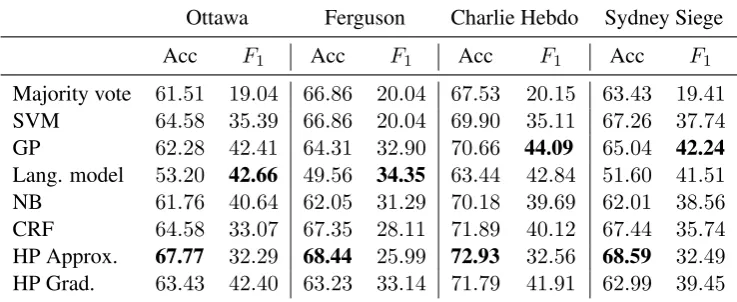
Table 2: Accuracy andF1 scores for different methods across datasets. HP Approx. is the best method
according to accuracy, whereas Language model and GP are both strong methods according toF1.
ters are chosen using cross-validation.
5.3 Results
The results are shown in Table 2. We report accu-racy (Acc) and macro average ofF1scores across
all labels (F1). Each metric is calculated over
combined sequences of labels from all rumours, thus conducting a micro average over rumours.
We can observe that in terms of accuracy, HP Approx.beats all other methods. Notice that Lan-guage model is the worst model for this metric. On the other hand, in terms of F1 score,
Lan-guage model and GP become the best methods, withHP Approx. method not performing as well anymore. Overall, different metrics yield very dif-ferent rankings of methods. Nevertheless, we can notice that HP Grad. outperforms NB under all metrics on all datasets. This is the case also for GP baseline, which turns out to be very competi-tive according toF1 score. As we mentioned
be-fore, HP can be viewed as a NB classifier with a time-dependent prior. This shows, that the tempo-ral dynamics based prior provided by HP is more helpful than the simple frequency based prior from NB according to all considered metrics.
In Figure 1 we show an illustration of the in-tensity function of the HP Grad. model for ru-mour #1 from the Ferguson dataset. Notice the self-exciting property, with spikes in the inten-sity functions for different labels at times when tweets occur. Moreover, spikes occur even when a tweet from a different label is posted, for ex-ample around 1 hour and 50 minutes into the ru-mour lifespan aquestioningtweet is posted which causes a spike in intensity forcommentingtweets. Another issue is the approximation used in HP
Approx. which might lead to violation of the Hawkes Process mutual-excitation property. In particular, we noticed that in some scenarios oc-currences of tweets cause decrease in the intensity value rather than spikes. However, the accuracy metric which has been used in previous work for this task (Lukasik et al., 2015a) yielded by this method turns out to be the best, although when measuring F1 the relative ordering changes with
the GP performing best (Lukasik et al., 2015a) closely followed by other techniques includingHP Grad.which is competitive on all datasets.
6 Conclusions
We proposed a novel model based on Hawkes Processes for sequence classification of stances in Twitter which takes into account temporal in-formation in addition to text. Using four Twit-ter datasets and experimenting on rumour stance classification of tweets, we have shown that HP is a competitive approach, which outperforms a range of strong benchmark methods by providing the multinomial language model with an informa-tive prior based on temporal dynamics. Our exper-iments posit the importance of making use of tem-poral information available in tweets, which along with the textual content provide valuable informa-tion for the model to perform well on the task.
Acknowledgments
The work was supported by the European Union under grant agreement No. 611233 PHEME. Cohn
References
Abir De, Isabel Valera, Niloy Ganguly, Sourang-shu Bhattacharya, and Manuel Gomez-Rodriguez. 2015. Modeling opinion dynamics in diffusion
net-works. CoRR, abs/1506.05474.
Genevieve Gorrell and Kalina Bontcheva. 2016. Clas-sifying twitter favorites: Like, bookmark, or thanks? Journal of the Association for Information Science and Technology, 67(1):17–25.
Alan G. Hawkes. 1971. Spectra of Some Self-Exciting
and Mutually Exciting Point Processes. Biometrika,
58(1):83–90.
John D. Lafferty, Andrew McCallum, and Fernando C. N. Pereira. 2001. Conditional Random Fields: Probabilistic Models for Segmenting and Labeling
Sequence Data. In Proc. of International
Confer-ence on Machine Learning (ICML), pages 282–289.
Stephan Lewandowsky, Ullrich KH Ecker, Colleen M Seifert, Norbert Schwarz, and John Cook. 2012. Misinformation and its correction continued
influ-ence and successful debiasing. Psychological
Sci-ence in the Public Interest, 13(3):106–131.
Michal Lukasik, Trevor Cohn, and Kalina Bontcheva. 2015a. Classifying Tweet Level Judgements of
Ru-mours in Social Media. InProc. of Empirical
Meth-ods in Natural Language Processing (EMNLP), pages 2590–2595.
Michal Lukasik, Trevor Cohn, and Kalina Bontcheva. 2015b. Point process modelling of rumour dynamics
in social media. In Proc. of the 53rd ACL, vol. 2,
pages 518–523.
Christopher D. Manning, Prabhakar Raghavan, and
Hinrich Sch¨utze. 2008. Introduction to Information
Retrieval. Cambridge University Press.
Vahed Qazvinian, Emily Rosengren, Dragomir R. Radev, and Qiaozhu Mei. 2011. Rumor has it:
Iden-tifying misinformation in microblogs. In Proc. of
Empirical Methods in Natural Language Processing (EMNLP), pages 1589–1599.
Ge Song, Yunming Ye, Xiaolin Du, Xiaohui Huang, and Shifu Bie. 2014. Short text classification: A
survey. Journal of Multimedia, 9(5).
Shuang-Hong Yang and Hongyuan Zha. 2013. Mix-ture of mutually exciting processes for viral
diffu-sion. In Proc. of International Conference on
Ma-chine Learning (ICML), volume 28, pages 1–9.
Qingyuan Zhao, Murat A. Erdogdu, Hera Y. He, Anand Rajaraman, and Jure Leskovec. 2015. Seismic: A self-exciting point process model for predicting
tweet popularity. In Proc. of International
Con-ference on Knowledge Discovery and Data Mining (KDD), pages 1513–1522.
Arkaitz Zubiaga, Maria Liakata, Rob Procter,
Geral-dine Wong Sak Hoi, and Peter Tolmie. 2016.
Analysing how people orient to and spread rumours in social media by looking at conversational threads. PLoS ONE, 11(3):1–29, 03.