University of Warwick institutional repository: http://go.warwick.ac.uk/wrap
A Thesis Submitted for the Degree of PhD at the University of Warwick
http://go.warwick.ac.uk/wrap/58426
This thesis is made available online and is protected by original copyright. Please scroll down to view the document itself.
Multipath Selection for
Resilient Network Routing
by
Nayyar Almas Kazmi
a thesis supervised by
Prof. J¨
urgen Branke & Prof. Arie M.C.A. Koster
and submitted for the degree of
Doctor of Philosophy
Warwick Business School
Abstract
In this dissertation we study the routing problem for multi-commodity survivable network flows, with splittable demands, and propose end-to-end path-based solutions where maximum link utilization is minimized, in order to improve resilience in existing telecommunication networks.
We develop mixed integer programming models, and demonstrate that, when the selection of disjoint paths is part of the optimization problem (rather than when k-shortest paths are pre-selected, as in earlier works), maximum link utilization is reduced and the overall network also balances out. We find that three paths are usually enough to reap the benefits of a multipath approach. A reduction in maximum link utilization also provides a margin by which demand values can grow without causing congestion.
We also prove that the disjoint multipath selection problem is NP-complete, even for the case of one node-pair. This warrants a recourse to effi-cient solution methods within ILP (such as decomposition), and to matheuris-tics. Our literature survey of applications of heuristic techniques, and those combining heuristics with exact methods, shows a research gap, which we at-tempt to bridge through a novel heuristic algorithm. The heuristic works well and, in several cases, yields better solutions than ILP (in a given time limit), or provides solutions for problems where ILP could not even find one valid solution in the given time limit.
Declarations
This thesis is my own work and has not been submitted for a degree at another university.
The following papers have been published on the basis of material pre-sented in Chapters 5, 6 and 7:
– N. A. Kazmi and A. M. C. A. Koster. An integer linear programming model for optimal self protection multi-path selection. In ICUMT’11, pages 1-7, 2011.
Contents
Abstract i
Declarations ii
List of Tables vii
List of Figures ix
Abbreviations xii
Chapter 1 Introduction 1
Chapter 2 Network Routing - An Overview 9
2.1 Circuit Switching vs Packet Switching . . . 10
2.2 Network Architecture . . . 12
2.2.1 Layering . . . 16
2.3 Routing Protocols . . . 19
2.3.1 Open Shortest Path First (OSPF) . . . 20
2.4 Delay and Link Utilization . . . 23
2.5 Summary . . . 24
Chapter 3 Understanding Resilience 25 3.1 Standardization . . . 26
3.2 Quantifying Resilience . . . 28
3.3 Protection Mechanisms . . . 32
3.3.1 Lower layer protection schemes . . . 33
3.3.2 Logical layer protection schemes . . . 35
3.3.3 Re-routing . . . 42
3.3.4 Comparative analysis . . . 43
3.4 Summary . . . 48
Chapter 4 Heuristic Routing 49 4.1 Heuristic Techniques . . . 50
4.1.1 Greedy Algorithms . . . 52
4.1.2 Local Search. . . 52
4.1.3 Greedy Randomized Adaptive Search procedure . . . . 53
4.1.4 Tabu Search (TS) . . . 54
4.1.5 Simulated Annealing (SA) . . . 55
4.1.6 Variable neighbourhood Search (VNS) . . . 56
4.1.7 Evolutionary Algorithms (EA) . . . 56
4.1.8 Ant Colony Optimization (ACO) . . . 57
4.2 Heuristics for Network Routing . . . 59
4.2.1 Evolutionary Algorithms for Network Routing . . . 60
4.2.2 ACO based heuristic solutions . . . 63
4.3 Hybrid Methods . . . 74
4.4 Summary . . . 79
Chapter 5 Solving Routing Problems with ILP 81 5.1 Single Path Allocation Problem . . . 82
5.1.1 Node-based Approach . . . 83
5.1.2 Path-based Approach . . . 85
5.2 Multipaths in Routing . . . 90
5.2.1 Multipath structures for network resilience . . . 90
5.2.2 Self-Protecting Multipaths (SPM) . . . 91
5.3 Path Selection for SPM . . . 93
5.3.1 Model description . . . 94
5.3.2 Complexity of the path selection problem. . . 96
5.3.3 Adding scenario-specific constraints . . . 102
5.3.4 Model improvements . . . 104
5.4 An alternative Path Selection Model . . . 105
5.5 Summary . . . 109
Chapter 6 Evaluation of the ILP Models 110 6.1 Path Generation . . . 111
6.1.1 Description of the algorithm . . . 114
6.2 Computational Experiments . . . 118
6.2.1 Testing the impact of path selection . . . 118
6.2.2 A comparison between E1 and E2 models . . . 136
6.2.3 A comparison of multipath and 1+1 methodology . . . 140
Chapter 7 Solution Methods for the Routing Problem 143
7.1 Hybrid Approach . . . 144
7.1.1 Description of the Heuristic Algorithm . . . 145
7.1.2 Experimental Results . . . 146
7.2 Column Generation . . . 151
7.3 CG Framework for Routing . . . 154
7.3.1 Dual formulation . . . 156
7.3.2 The pricing problem . . . 160
7.3.3 Solving the pricing problem . . . 162
7.4 Summary . . . 167
List of Tables
3.1 Effect of outages in terms of network availability. (Source [64]) 30
3.2 Restoration times and their impact on services. (Source [64]) 31
3.3 Framework for resilience . . . 41
4.1 List of heuristic and meta-heuristic methods . . . 52
4.2 Summary of meta-heuristic methods using the concept of Ants 65
6.1 Paths in a complete Graph . . . 112
6.2 Path generation process . . . 117
6.3 Network topologies, demands, and capacity per link . . . 120
6.4 Optimal/best congestion values and optimality gaps for
differ-ent combinations of number of disjoint paths and maximum
number of selected paths . . . 122
6.5 Number of paths used by different demands for germany17
in-stance . . . 125
6.7 Number of paths used by different demands for germany50
in-stance . . . 134
6.8 Best congestion values, dual bound, gap, and CPU times for 10
paths/demands and variable maximum number of selected paths135
6.9 Comparison of number variables and constraints in test instances138
6.10 Optimal/best congestion values and optimality gaps for
differ-ent combinations of number of paths and maximum number of
selected paths . . . 139
6.11 Solution statistics for di-yuaninstance . . . 141
7.1 Optimal/best congestion values and optimality gaps for
differ-ent combinations of number of paths and maximum number of
List of Figures
2.1 Functional View (Source: Pi´oro and Medhi [105]) . . . 14
2.2 Network representations . . . 15
2.3 A comparison of 7-layer OSI with 4-Layer Internet Model . . . 17
2.4 Hour-Glass Model . . . 20
3.1 Path-based protection schemes . . . 36
3.2 Shared Mesh Protection (SMP) . . . 37
3.3 P-cycles . . . 38
3.4 Self Protecting Multipath (SPM) scheme . . . 39
3.5 Disjoint path selection . . . 46
3.6 Classification of protection strategies . . . 47
5.1 Directed representation of an undirected link . . . 83
5.2 Representation of variables . . . 99
6.2 Nobel-eu network . . . 119
6.3 Europe28 network . . . 120
6.4 Maximum link utilization over all scenarios for germany17 with
|Pd|=3, β = 3 . . . 124
6.5 Maximum link utilization over all scenarios for germany17 with
|Pd|=4, β = 3 . . . 125
6.6 Maximum link utilization over all scenarios for germany17 with
|Pd|=5, β = 3 . . . 126 6.7 Maximum link utilization in different failure scenarios for
ger-many17 instance . . . 127
6.8 Maximum link utilization over all scenarios for europe28 with
|Pd|=3, β = 3 . . . 128
6.9 Maximum link utilization over all scenarios for europe28 with
|Pd|=4, β = 3 . . . 128
6.10 Maximum link utilization over all scenarios for europe28 with
|Pd|=5, β = 3 . . . 129
6.11 Maximum link utilization in different failure scenarios for
eu-rope28 instance . . . 130
6.12 Maximum link utilization over all scenarios for germany50 with
|Pd|=3, β = 3 . . . 131
6.13 Maximum link utilization over all scenarios for germany50 with
|Pd|=4, β = 3 . . . 132 6.14 Maximum link utilization over all scenarios for germany50 with
|Pd|=5, β = 3 . . . 133
6.15 Maximum link utilization in different failure scenarios for
6.16 Number of paths used per demand . . . 137
7.1 Framework of the hybrid approach . . . 148
7.2 Computational time Vs number of demands . . . 151
7.3 Branch and Price Framework for every B&B node . . . 153
Abbreviations
ABC Ant Based Control
ACO Ant Colony Optimization ADM Add Drop Multiplexer
APS Automatic Protection Switching AR Ants Routing
AS Asynchronous System
ASCII American Standard Code for Information Interchange ASGA Ant System Genetic Algorithm
ATM Asynchronous Transfer Mode B&B Branch and Bound
BGP Border Gateway Protocol
BLSR Bidirectional Line-Switched Ring BT British Telecom
CAF Cooperative Asymmetric Forward CDR Column Dependent Row Generation CEN European Committee for Standardization
Char/s Characters per second
CSMA Carrier Sense Multiple Access DGA Distributed Genetic Algorithm
DHCP Dynamic Host Configuration Protocol DNS Domain Name Space
DSL Digital Subscriber Line
DSP Demand-wise Shared Protection EA Evolutionary Algorithm
ECMP Equal Cost Multi-Path EGP Exterior Gateway Protocol
ENISA European Network and Information Security Agency ETSI European Telecommunications Standards Institute FRR Fast Re-Route
FTP File Transfer Protocol
GARA Genetic Adaptive Routing Algorithm GPP Global Path Protection
GRASP Greedy Randomized Adaptive Search Procedure GRM Genetic Routing Algorithm with migration HTML Hypertext Markup Language
HTTP Hyper Text Transfer Protocol
IEC International Electro-technical Commission IEEE Institute of Electronics and Electrical Engineers IEEE-SA IEEE Standards Association
IETF Internet Engineering Task Force IETF Internet Engineering Task Force IGP Inter-Gateway Protocol
IS-IS Intermediate System - Intermediate System ISO International Standards Organization ISOC Internet Society
ISP Internet Service Provider
ITU International telecommunications Union LDP label Distribution Protocol
LER Label Edge Router LP Linear Programming LSA Link State Advertisement LSP Label Switched Path
MACO Multiple Ant Colony Optimization Mb/s Mega bits per second
MILP Mixed Integer Linear Programming MPLS Multi-Protocol Label Switching MTBF Mean Time Between Failures MTTR Mean Time To Repair
NGN Next Generation Network NP Non Polynomial
OMP Optimized Multipath
OSI Open Systems Interconnection OSPF Open Shortest Path First p-cycle Protection Cycle
PSTN Public Switched Telephone Network QoS Quality of Service
RDP Remote Desktop Protocol RFC Request for Comments
RPP Regional Path Protection RSVP Resource Reservation Protocol RTP Real Time Transfer Protocol
RWA Routing and Wavelength Allocation SA Simulated Annealing
SAT Satisfiability Problem
SDH Synchronous digital Hierarchy SI Swarm Intelligence
SLA Service Level Agreement SMP Shared Mesh protection SMTP Simple Mail Transfer Protocol SMTP Simple Mail Transfer Protocol
SNMP Simple Network Management protocol SONET Synchronous Optical Networking SPF Shortest Path First
SPM Self-Protecting Multi-Path SPP Span Path Protection SRLG Shared Risk Link Group
SynthECA Synthetic Ecology of Chemical Agents TCP Transmission Control Protocol
TDMA Time Division Multiplexing TE Traffic Engineering
TFTP Trivial File Transfer Protocol
TS Tabu Search
TTL Time To Live
UDP User Datagram Protocol
VoIP Voice over Internet Protocol WDM Wavelength Division Multiplexing Wi-Fi Wireless Fidelity
WWW World Wide Web
1
Introduction
being placed on devising strategies to combat network failures. Governments as well as companies are making back-up plans to cope with any untoward event. A high level of availability of network is expected and required by governments, regulators, and companies while awarding contracts to network service providers. Penalties are imposed for service going below the agreed-upon level. Reliability in the network service provides a competitive edge over others, whilst even a slight disruption in the network’s operations may mean a loss of revenue in millions. A study conducted by Gartner Group revealed that, in 2004, losses of around $500 million could be attributed to network failures [64].
The survivability of the network is at risk from both intentional and unintentional faults. While sabotage is outside the scope of this thesis, link failure resulting from unintentional human errors, malfunctioning of a device or a fiber cut is the central concern. Fiber optic cable failure is one of the highest reported causes of a network outage [64] and, despite best efforts, such failures are inevitable. Consequently, we need strategies to minimize these errors and to detect them quickly and recover from them in a reasonable time. That is why self-protecting mechanisms - to provide resilience - are our prime focus.
In order to come up with a survivability strategy, a minimum require-ment is to have a bi-connected physical network. A bi-connected network is one in which there exist at least two disjoint paths between any two nodes.
network as a whole is quantified, are used. Different measures for the net-work performance thus used include netnet-work availability, netnet-work reliability, restorability and unavailability. Availability is one of the most commonly used measures. It comprises the cumulative availability of each of the network ele-ments. Most service level agreements specify the agreed-upon network avail-ability, of, say 80% of the time, and penalties are imposed if the service drops below this mark.
Protecting node failures is relatively straightforward as it is simply a question of providing an additional device as a back-up. However, the most challenging task is that of protection against link failure. Link failure is more difficult to detect. Protecting a link failure involves detecting a failure, estab-lishing a backup path to override the failed link, and switching to the backup path both by the sending node and the receiving node. In order to provide a good quality of service, a failure restoration must take place faster than the time it takes to reach the effect of failure to the end user. Using expensive transport technologies such as SONET, one can guarantee such failure recov-ery, but it is prohibitively expensive and inflexible for future expansions. On the other hand, if the restoration is left only to the routing protocols, costs do come down and we obtain flexibility in design but a quick recovery from failure is not guaranteed.
the service quality. Therefore, options whereby the back-up capacity can be shared have become more popular. A step further is to remove the classifi-cation between the primary and the backup capacities, and to utilize all the available capacity and mitigate failures by sharing the capacity. According to [64], path restoration strategies with sharing and stub release are “one of the most efficient class of survivable networks”.
In sharing the capacity among different paths, one of the strategies being looked at is demand splitting. It involves distributing the traffic over multiple paths, so that at any one given time, only a fraction of demand traffic is affected in case of a failure. This strategy distributes the impact of a failure. The idea of using multipaths is not new. For example, applications such as bit torrent, which are used these days extensively for downloading huge files (e.g., movies, songs, books) use more than one path for downloading. Conges-tion control on each path is handled independently. For Transmission Control Protocol (TCP), the Internet Engineering Task Force (IETF) has formed a working Group named TCP Multipath [1] to develop functionality that will enable existing TCP sessions to use multiple paths simultaneously. Their aim is to prepare mechanisms to deploy multipath capability in the existing net-working infrastructure, without making any significant changes. At network layer too, multipath capability is used. For example, the Equal Cost Multi-path (ECMP) mechanism within the Open Shortest Path First (OSPF) routing protocol splits demand on all of the available shortest paths.
The aim of our study is to look at the path selection problem for these mul-tipaths. The study focuses on protection mechanisms that use multipaths for traffic routing. The Self-Protecting Multipath (SPM) mechanisms proposed by Michael Menth of University of W¨urzburg (Germany) forms the starting point of this work.
When routing strategies are devised as part of network dimensioning, then the costs are to be optimized. But, generally, networks are designed for a failure-free situation, and then redundancy to ensure availability is added at the second stage. For an existing network infrastructure, the aim is to optimize the available resources. Considering that the networks already exist, with known infrastructure, the objective of this research is to study the issue of survivability and to examine different routing and re-routing mechanisms with a view to identifying theirresilience.
This research focuses on identifying those end-to-end paths that require less spare capacity and remain robust. We want to further identify such rout-ing plans that can operate in all srout-ingle link failures – thus ensurrout-ing the overall availability of the network to remain high.
utilization.
The main research questions we consider in this thesis are:
– How to formulate the problem for disjoint path selection that optimizes the worst case capacity utilization?
– What is the structure and complexity of the formulated problem?
– What solution methods should be adopted based on the explored char-acteristics of the problem?
The contributions of this research is towards:
– survey of exact and heuristic approaches to solve this problem,
– solving this complex problem through development of exact models and heuristic methods and
– exposition of the computational complexity of various optimization prob-lems under study.
The thesis is organized as follows:
used protocol in today’s Internet. Chapter 2 also discusses the concept of delay and discusses how it relates to minimizing the maximum link utilization.
Chapter 3 focuses on the topic of resilience. It looks at the quantification and management of resilience and provides an overview of the organizations responsible for managing the “resilience” aspect of a network. Here we also discuss the protection strategies that are either in use or are proposed in the literature, and provide an overview of their defining characteristics. We identify a research gap and explain our strategy to address it.
Chapter 4 looks at network routing from a completely different perspec-tive. It summarizes the heuristic methods that are used for routing. Nowa-days, when network sizes are increasing, very large and complex problems arise. Solving them in a exact manner is not always possible. The alternative is to use heuristics in some way. The study of heuristic methods thus provides us with an insight that can be utilized in thinking out of the box. In this Chapter we have reviewed not only the pure heuristic methods, but also the mixing of heuristics and exact methods. We provide examples of such mixing and discuss their pros and cons. The chapter serves as a necessary preclude to our development of a hybrid algorithm in Chapter 7.
In Chapter 5 , we present an overview of routing solutions based on mul-tipaths and then discuss the Self Protecting Multipath (SPM) routing model that forms the basis of our work. The Mixed Integer Linear Programming (MILP) models for the routing problem are presented and discussed in this Chapter and we also compare different models and discuss the complexity of our network routing problem.
Chap-ter 6, different experiments that we conducted in order to evaluate the perfor-mance of each model. We compare their perforperfor-mance with some benchmark instances available online.
2
Network Routing - An Overview
In this Chapter we describe the general characteristics of a network. We discuss the architecture of a network, its layout, organization, routing mechanisms and failure quantification. We also provide a brief overview of routing in OSPF and MPLS protocols, as these relate directly to our work.
The communication within a network is governed by the network’s ad-ministration policies. Many networks can be connected together to form a larger network. The connected networks normally form a hierarchical struc-ture, where backbone networks are connected to one another and other net-works hook onto this larger network. The most important example of such inter-networking is the Internet, which now has a global presence. It has gradually gained so much importance that today’s social and economic devel-opment hinges upon smooth and reliable functioning of the Internet (and thus networks in general). The dependence on the Internet is going to further in-crease with time. Increasingly more devices are going to be attached to it and more services will be delivered through it. Compared to 2010, it is estimated that in 2020, there will be about 10 times more users and about 50-100 times more traffic per user [83]. This will result in a total growth of traffic by a factor of 500-1000. To cater for this traffic, the throughput has to increase by at least a factor of 10. The other issues which are becoming more and more impor-tant in this context are climate-change. At present, 3% of world-wide energy is consumed by ICT infrastructure [83], and with the increase in the bulk of connected devices, energy consumption will become a serious consideration. All these factors make efficient management of networks (and Internet) more crucial. The need for a sensible, reliable and flexible network management can not be over-emphasized.
2.1
Circuit Switching vs Packet Switching
the development of modern-day telephony, which is based on the principle of circuit switching. All call requests go to a switching board, where each call is switched to a designated connection between caller and the recipient of the call. The connection stays available for the entire duration of the call. At the end of a call, the connection is removed and the released circuit/capacity becomes available to other callers. Since each caller has its own private, guaranteed, isolated (constant) data rate from end-to-end, circuit switching provides high quality un-interrupted service. In the past, each connection was an end-to-end physical wire. Later with the development of high capacity wires, it became possible to allocate many connections on the same physical links by allocating bandwidths to each call. Thus, instead of physical circuits, virtual circuits are assigned to each call. Public Switched Telephone Network (PSTN) is an example of a service based on circuit switching.
The drawback of circuit switching is that it requires management of circuits (states) at the beginning and end of each connection (call) to establish and close each circuit. Also, the allocated bandwidth for any connection must be able to carry the maximum traffic generated. However, since the network traffic is bursty in nature, it would mean that the traffic will reach its maximum only sporadically. Hence, the allocated bandwidth will remain unused for most of the time. Different applications using the network have different data rate requirements. The required data rate varies significantly from application to application. For example, for video streaming 6 Mb/s is required, while for typing only 1 char/sec would be enough. Allocation of fixed data rates makes circuit switching inefficient.
packet is a self-contained envelope and, when it reaches any switch/router, it is forwarded to the next hop. No connections are required to be established before starting the communication. Similarly, no post communication man-agement is involved. Each router maintains a Forwarding Table, which stores the next hop based on the destination address of any packet. Its main ad-vantage is that it uses link capacity efficiently. In case of failures of links or routers, alternative paths can be re-calculated and packets can be re-routed on those paths. Because of it flexibility of use, packet switching is used for data communication over the networks. The Internet communication is also based on the principle of packet-switching. One of the founding architects of the Internet, David Clark, gives an insight on this choice of packet-switching in his article [28]. There are two main reasons: firstly, the purpose of the In-ternet was to connect existing networks, most of which were packet-switched. Secondly, the type of services that were required (such as remote login), were also easily implementable through packet-switching. Hence, packet-switching became an integral part of the Internet communication system. Resultantly, most of today’s networks are packet switched.
We are also looking into the problem of routing for the packet switched networks. We explain below how these networks are organized and managed.
2.2
Network Architecture
main-tain the forwarding tables. These table have entries conmain-taining forwarding addresses corresponding to each destination. These tables are maintained by sharing information with each other. These tables are refreshed from time to time, to keep the network status information up to-date. The routers at the boundary of AS have the capability to accept and send packets from/to other ASs.
The traffic generated in an AS is transported on a physical network, called transport network. For example, in the UK, British Telecom (BT) has a large physical infrastructure, and leases the bandwidth to many ISPs. It is also possible for some network owners to install their own physical facilities. The transport network provider may send the traffic from multiple ISPs on the same network.
The demand for traffic network (or the logical network) is based on the users. It is a random process, as it not known when a user will initiate a request and how much traffic it will generate on any link. There needs to be a mechanism to estimate the traffic arrival rates. Transport network providers estimate traffic requirements based on extrapolated traffic demand and set up their services on semi-permanent basis accordingly. Changes are made only periodically, such as at the end or renewal of contracts.
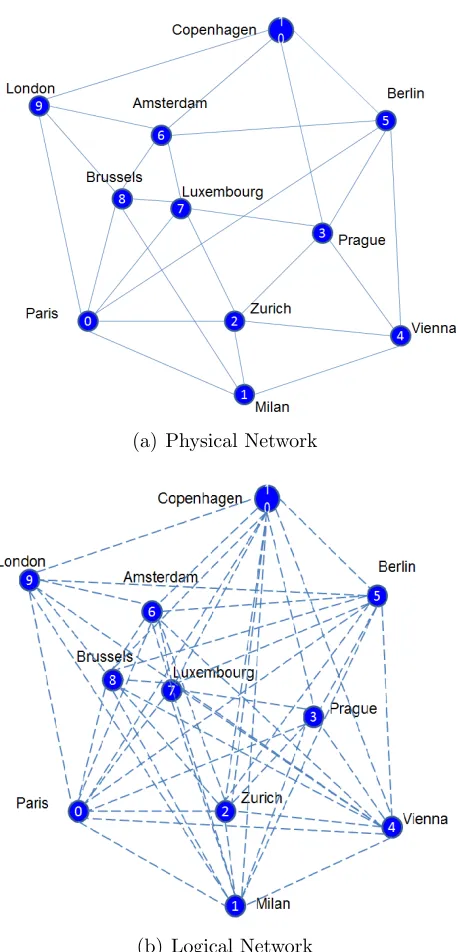
and traffic networks are inter-related. A link might appear to be a direct one between two nodes A and B in a logical network. But, in actual fact, a set of physical connections might be used to provide such a link. Figs. 2.2(a)
[image:32.612.140.491.315.599.2]and 2.2(b) show the physical and logical views of the same network. In order to provide resilience, it is important to understand this dependence between the two links, since a single failure at a physical level might translate into multiple logical link failures. Hence that the back-up paths must not use the same physical connection that are used by the primary paths.
(a) Physical Network
[image:33.612.208.438.159.635.2](b) Logical Network
2.2.1
Layering
The concept of layering is fundamental to network communications. Each layer works independently, encapsulating its internal details from other layers. Hence the complex task of network management is decomposed into manage-able independent units. There are two famous models for telecommunication networks. One is the OSI1 model which describes network as a 7-layer model.
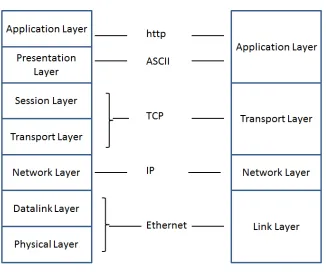
The second model, which was developed later, was a more concise 4-layer Inter-net model, in which layers of OSI model were merged and re-defined. Fig.2.3
shows the relationship between the two layering models. These layers are:
– Application layer
– Transport layer
– Network layer
– Link layer
Each layer is governed by a clearly defined protocol for that layer. These protocols facilitate the functions of each layer and encapsulate the internal processing details from other layers. The transmission takes place by dividing the data into smaller units. Each layer also has its own unit of transmission. The peer layers at the sender and receiver ends communicate with one another.
The actual request for communication is generated at the application layer. There are a number of protocols that run at the application layer2
1Open Systems Interconnection
Figure 2.3: A comparison of 7-layer OSI with 4-Layer Internet Model
At transport layer, the data received from the application layer is di-vided into segments and a header is annexed to each segment. At the receiving end, the transport layer is capable of reading the header and can re-assemble all the segments and then pass it on to the application layer. Depending on the communication needs, the transport layer may use Transmission Control Protocol (TCP) or User Datagram Protocol (UDP).
transport layer ensures that the segments are received in an orderly manner. It acknowledges the receipt of all the segments and also assembles them to forward them to the application layer.
UDP, on the other hand, is used when the speed of communication is important and reliability is not required3. In contrast with TCP, UDP is a
connection-less, unreliable service that does not check for congestion control or ordered delivery of data segments. As it provides a minimum service, it is much faster than the TCP and requires less capacity/bandwidth.
The data segments from transport layer are passed on to the network layer. At network layer, Internet Protocol(IP) is responsible for onward trans-mission. Here transport layer data segments are annexed with an IP header and these IP datagrams or packets are sent over the network through the Link Layer. IP is a connection-less service, and it sends packets hop-by-hop to the destination. At each hop the receiving router will send the packet to the next hop. Each router maintains a forwarding routing table for each possible destination. These routing tables are maintained by a periodic transfer to in-formation among neighbouring routers. IP is a best-effort service: i.e., it will send the packets to its destination, but if for any reason the packets cannot be forwarded, they are dropped. There can be multiple reasons for dropping the packet, such as congestion on the link, or time lapse for the packet.
The routers are capable of processing only one packet at a time. If more than one packet arrives at they same time, they are stored in a buffer and forwarded on a first-come-first-served basis. However, when the buffer is already full, the arriving packets are dropped. There can be another reason to drop the packet, that is, when a packet over-lives its life. Each packet has a
field called Time To Live (TTL). Before forwarding a packet, the router checks packet’s TTL. If TTL has not expired, the router decrements the TTL value for the packet before forwarding it to the destination. At present, IP version 4 is being used for packet formats and addressing. It uses a 32-bit addressing scheme. It is being replaced by IP version 6, which uses 128 bit addressing. The details of these schemes is beyond the scope of our work.
The routing between the source and the destination hosts is regulated by one of the routing protocols. For packet routing within an AS, an Inter Gateway Protocol (IGP) is used. OSPF and IS-IS are examples of IGP. When a packet leaves the AS, its routing is governed by the Exterior Gateway Protocol (EGP). The Border Gateway protocol (BGP) is the commonly used EGP over the Internet.
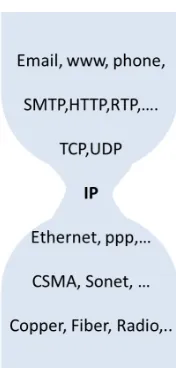
The IP is designed to isolate end-to-end protocols from the details of underlying networks. It is commonly presented as an hour-glass model. See Fig.2.4. IP can be used on top of any underlying transmission technology such as Ethernet, Wi-Fi, DSL etc, which come under the link layer category. Simi-larly, it is capable of handling transmission requests by any type of application or transport layer protocols.
2.3
Routing Protocols
Here we will discuss the characteristics of routing protocols relevant in the context of this study. We will discuss OSPF, which is the most widely used IGP4. We will also discuss MPLS mechanism that works with any kind of
Figure 2.4: Hour-Glass Model
transport technology and creates end-to-end circuits. It works on packet-switched networks, and is meant for reliable transmission. It is different from OSPF, and we will discuss and contrast their characteristics as well.
2.3.1
Open Shortest Path First (OSPF)
algorithm) from itself to all other destinations in the network and stores them in its routing table. The weights are arbitrary values assigned to links by the administrators. The protocol has a global view of the network at all times. These link state tables and routing tables are reconstructed each time a link’s state is changed. This makes OSPF processor and memory intensive. There may be periods when link state tables of different routers are in different states, or link state table and routing table of a router are not synchronized, making the network unstable. When there is a failure, the network is flooded with messages to update the change. Consequently, all the routers have to update their routing tables and shortest paths are re-calculated. If for any destination, there are multiple shortest paths available, then the flow can be equally split among them. This is called Equal Cost Multi-Path (ECMP) routing.
2.3.2
Multi-Protocol Label Switching (MPLS)
the strengths of MPLS is that it allows establishment of an LSP that passes through different transport mediums, e.g. ATM, Ethernet or Frame relay.
2.4
Delay and Link Utilization
The demand for traffic networks depends on their usage. All users generate traffic independently. The pattern of traffic generation is a random process. It cannot be described with normal or exponential distributions. It can be described as self-similar traffic whose distribution has a heavy tail.
In order to estimate the traffic, packet (exponential in size) arrival is assumed to follow a Poisson distribution and the well-known M/M/1 queuing model (see [105]). If average packet size is denoted as Sp and the capacity of a link as B bits/sec, then µp = average service rate = B/Sp packets per sec (pps). If the average arrival rate is denoted by λp, then
average delay = (µp−1λ p)
average link utilization ρ=λp µp
The average delay is non-linear in nature5. As the average arrival rate
optimization problem, while for the OSPF weight setting problem, Fortz and Thorup [53] have used a cost function based on link utilization, which penalizes more heavily when the link usage, with respect to its total capacity increases.
2.5
Summary
In this chapter we have given an overview of routing in networks. We have discussed how a network is organized and how different protocols operate. Since we are studying the routing problem at the network layer, we explained in detail the working of OSPF and MPLS, which operate on network layer. OSPF provides hop-based routing and has has limitations with respect to protection against failures. It is slow and its recovery process can cause congestion over the network. MPLS, on the other hand, provides path-based routing, which makes it faster and it supports traffic engineering features to provide resilient routing.
In this present work, we will focus on these path-based mechanisms and will study how the potential of these path-based structures can be exploited for a more balanced and resilient network. We will use the minimization of maximum link utilization as the objective of our optimization problem, which we have shown in this chapter is a measure to quantify delay. Minimizing the worst-case link utilization will result in maximizing the robustness of the network against unpredicted demand growth as well as reduce congestion and delay.
3
Understanding Resilience
In this Chapter we discuss the concept of resilience in greater detail and exam-ine the practical issues surrounding resilience. We also look at the quantifica-tion and standardizaquantifica-tion issues related to resilience. We provide an overview of protection and restoration strategies that are used to provide resilience.
3.1
Standardization
As explained in the previous Chapter, a network can be viewed as a collection of devices, protocols, procedures and algorithms. It is a layered structure. In order to successfully communicate between different layers and among different peer devices, all the involved components must, at each layer, speak/compre-hend the same language. The concept of layering helps in encapsulating the internal details of each layer. Thus, only relevant and sufficient information is visible at the other layers. This inter-communication requires standardization of all components (soft and hard) involved in a network.
A network spans, or talks to, other networks, across geographical regions in different administrative controls. Hence, any standardization must involve all countries around the world to agree and act according to the pre-defined standards. To facilitate this process, the International Telecommunications Union (ITU) was formed in 1934 1. ITU is now a UN specialized agency
for ICTs that allocates satellite, wireless communications and radio frequency spectrums, world-wide, for 193 member countries and 700 private entities in 12 regions. It sets a very wide range of standards, and “is at the heart of the ICT sector ... to create a seamless global communication system that is robust, reliable and constantly evolving.”2
The standards developed by ITU are for networking, voice and video compression, Internet access, transport protocols, and a large number of other aspects which are required for networking at local as well as international level. These standards are developed through study groups, focus groups and global 1It was actually formed in Paris in 1865 as International Telegraph Union, but converted to ITU in 1934.
meeting places. Their recommendations cover all types of networks such as dial-up, optical systems, Next Generation Network (NGN) and IP-networks.
There are a number of other standards development organizations, such as ISO, IEEE-SA (Standards Association) and IEC (International Electrotech-nical Commission) that work internationally and coordinate with regional or-ganizations. For European countries, the European Telecommunications Stan-dards Institute (ETSI) provides a quick forum for meeting. It has industry specific groups. For example, there are groups for Measurement and Ontology for Network Services, Information Security Indicators and Identity Manage-ment for Network Services.
The European Committee for Electro-technical Standardization (CEN-ELEC) is a voluntary standards organization and facilitates inter-European trade. It collaborates with International Electro-technical Commission (IEC). European Committee for Standardization (CEN) collaborates with Interna-tional Standards Organization (ISO).
is RFC 3031. IETF standardize all protocol layers from IP to application layer, which also include standards for services such as emailing and http. HTML and XML standards are not tackled by IETF. These are left to the WWW consortium.
3.2
Quantifying Resilience
The quantification of resilience has not been dealt with by any of the afore-mentioned forums. The European Network and Information Security Agency (ENISA) [44] points out that the word ”resilience” has been used loosely and the main challenge in understanding resilience is to accurately define it and devise matrices to measure it. There is a need to develop a standardized framework to measure and respond to the resilience issues.
Resilient and Survivable Networks (Resilinet) [127] is an umbrella project, initiated jointly by the University of Kansas (US) and the University of Lan-caster (UK), to develop resilient architecture for the future Internet. One of the outcomes of this project is a framework for the measurement of resilience and survivability. It defines resilience as an ability of the network to provide and maintain an acceptable level of service in the face of various faults and challenges to normal operation.
The term “network service” refers to all services that are provided through networking, such as VoIP, Location services, IP, frame relay and wi-fi. It may be noted here that services which only exploit the existing network structure, such as distance learning, web browsing etc are not network services; rather these are services based on networks.
is normally written in the Service Level Agreements (SLAs)3.
Another way to look at acceptability is through the impact of disruption in services. Three levels of service acceptability can be defined:
– acceptable: on or above target
– impaired: between minimum and target level
– unacceptable: below minimum required
In case of failures, a resilient service will be able to operate in sev-ered conditions, while a non-resilient service will quickly deteriorate into an unacceptable level.
One matrix to determine the network resilience is its availability. For backbone networks, availability expectation typically varies between 0.999 to 0.99999. Availability is measured in terms of all the components that are required for the operation of the network. The joint availability of all these components will give end-to-end availability of the network. The availability of each component is calculated by a well-known formula given below:
A = M T BFM T BF+M T T R
MTBF is the the mean time between failures and MTTR is the mean time to repair.
Table 3.1 shows the relationship between network availability and out-age time, i.e.: the time for which network is unavailable.
The mechanisms that can restore the network from failures need to be in place. Often a requirement of a single link restoration of 50 ms is quoted.
Table 3.1: Effect of outages in terms of network availability. (Source [64])
Availability Outage Time
0.9 (1 nine) 867.6 hours/year (36.53 days)/year 0.95 438.2 hours/year (18.26.53 days)/year 0.99 (2 nines) 87.66 hours/year (3.65 days)/year 0.995 43.83 hours/year (1.83 days)/year 0.999 (3 nines) 8.77 hours/year
0.9995 4.38 hours/year 0.9999 (4 nines) 52.60 minutes/year 0.99995 26.30 minutes/year 0.99999 (5 nines) 5.26 minutes/year 0.999995 2.63 minutes/year 0.999999 (6 nines) 0.53 minutes/year
It is the response time of SONET APS (Automatic Protection Switching), in which failures are detected in approximately 20ms, signaling takes place in 10 ms, another 10 ms are needed for transfer-delay. A spare time of 10 ms is added to cover the risk. However, with remote destinations, a restoration time of 50 ms is very hard to achieve. Thus the question arises, what is the acceptable level of restoration time? Table3.2shows the impact of restoration times on the services.
It is the responsibility of a network service provider to establish and maintain a service (at an acceptable level) for up to a maximum duration of time (as per agreed SLA such as 99.9 (3 nines), 99.999 (5 nines)). The service provider is required to anticipate and safeguard against possible threats and faults, such as:
– unintentional operational mistakes
Table 3.2: Restoration times and their impact on services. (Source [64])
Restoration Times Impact
less than 50 ms Recovers without major impact 50ms-200ms 5% voice bands disconnect 200ms - 2s Voice band call disconnect 2s - 10s Circuit switched services drops,
Private lines disconnect, Some data sessions time out 10s 5 min X.25packet disconnect,
Data session time out 5 min - 30 min Network congestion,
social/ business impacts more than 30 min Major social/business impacts
– malicious attacks on traffic
– hardware malfunctions
– Events such as weekends, Christmas, elections, which cause large varia-tions in the traffic volumes
– Other failures affecting service providers, which result in unavailability of infrastructure
There are various frameworks to capture the resilience of a network. They vary on the basis of their objective as well as their definition of scope of resilience. Survivability cannot be defined without knowing the system and threats and faults being considered. Hence, survivability is context-specific. For example, Jabbar [76] proposes a general framework where survivability strategy has two levels. His strategy is called D2R2+DR. D2R2 framework consists of defend, detect, remediate and repair strategies, while a longer term DR framework detects the causes of failures and refines the protection capa-bility of the network.
Zolfaghari and Kaudel [143] provided one of the earliest frameworks to measure survivability. Their work is on the quantification of the survivability performance of a network. They considered the causes of both random as well as the pre-planned failure scenarios (anticipated, planned-for) and proposed a multilayer survivability framework that defines the Control mechanisms, survivability needs and techniques for each layer. Using this framework, the survivability features of a network can be assessed and analysed.
Gruber [65] has also developed a qualitative framework to capture the resilience characteristics of a mechanism. An overview of resilience methods based on multipath structures is also presented by Menth et al. [89]. Their framework compares and evaluates different existing mechanisms for optical and packet-switched networks.
3.3
Protection Mechanisms
net-works. These lower layer protection schemes provide quick protection against pre-planned failures, but are inflexible towards changing situations. Higher layer protection, which is introduced at the network layer routing protocols, is much more flexible. In this section we discuss both types of protection schemes and compare their defining characteristics. It may be noted here that different protection schemes at different layers can be added simultaneously to provide a better resilient network.
3.3.1
Lower layer protection schemes
System/ transmission layer protection mechanisms require structures that are fixed and hard-wired. Once such mechanisms are in place, the operation be-comes straightforward, as the failure paths are pre-known. However, this is a static arrangement. Therefore, changing the routing strategy or adapting to a different demand pattern would not be easy, as the protection is dependent on network installations and reconfiguration. Also, these mechanisms protect the whole fibre, and services such as differentiated QoS for different applications/ users would not be possible. These mechanisms are termed as pure protection methods. ITU-T G.808.1 [5] defines four protection mechanisms for end-to-end protection for packet and circuit switched networks. These are: 1+1, 1:n, m:n, (1 : 1)n4.
1+1 Protection
In 1+1 Protection, a primary path is protected by a second path through a bridge. Both paths carry the traffic. The starting node (ingress node) sends 4From protection point of view, (1 : 1)n method is same as that of 1:n, but it is meant
traffic on both paths. The end node (egress node) will receive two copies of the flow. It will select one of the two copies. The selection is done on the basis of predetermined criteria such as arrival time, defect indication and quality of flow received. In case of a failure, only one of the two copies will arrive at the egress node. Hence this scheme provides fastest possible switching speed. Capacity requirement to provide protection is at least 100% more than the unprotected traffic, as it require two completely disjoint cables to be laid.
1:1 and 1:n Protection
m:n Protection
In order to improve the protection capability of the 1:n scheme, a group of n paths can be protected by m back-up paths. Hence, at any given time m paths can be protected simultaneously. Here m is generally less than n. When
n=m, this scheme provides same level of protection as that of 1:1 protection.
3.3.2
Logical layer protection schemes
The protection can be added in layers higher than the transmission layers. These schemes are sometimes also referred to as restoration schemes, in con-trast to the protection schemes implemented at the transmission layer. Such mechanisms are introduced through introduction of paths on demand, using the spare capacity available for this purpose. These restoration strategies can be to restore full path, one link or a group of links on a path.
The backup paths may have dedicated spare capacity, or they can share the backup capacity when the primary paths are disjoint (link /node or risk group). In order to enhance efficiency, when capacity is shared, then only single failures are guaranteed to be covered. ITU-T-Y.1720 describes mechanisms for protection switching for MPLS networks. These are 1+1, 1:1 and shared mesh and packet 1+1. 1+1 and 1:1 schemes are invariably the same as those described in the context of transmission layer protection, but at the logical level. Hence two separate paths are created, one to take the primary traffic and the second one acts as the backup path. The other two methods (shared mesh and packet 1+1) allow the capacity sharing in case of non-simultaneous failures. Shared mesh protection is an end-to-end path protection
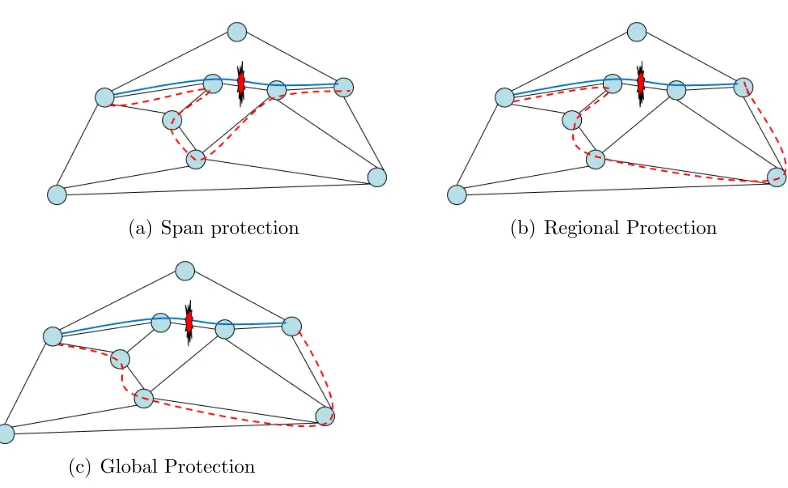
(a) Span protection (b) Regional Protection
[image:54.612.125.519.102.346.2](c) Global Protection
Figure 3.1: Path-based protection schemes
refers to converting the surviving capacity of the failed paths into capacity that is available for restoration purposes. Sharing of backup capacity with stub-release is of significant interest to the researchers, as it represents the “most efficient possible class of survivable networks”[64]. In the remaining part of this section we discuss different restoration schemes that make use of such sharing of capacity.
Span or Local Path Protection (SPP)
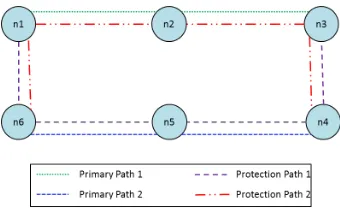
Figure 3.2: Shared Mesh Protection (SMP)
paths have loop backs. This mechanism can cover only link failures. Node failures cannot be protected. It is possible for many edges to share the same capacity.
Regional Path Protection (RPP)
When there is a risk of failure of few links on a path, a regional restoration strategy can be adopted. See Figure3.1(b).The failure signals have to be sent to the start and end nodes of the protected region. A switching to backup path is initiated. It requires less processing time as compared to global restoration, but more than the local restoration. The spare capacity requirement is more than that of global restoration and less than that of local restoration. It can provide both link and node failure protection.
Global Path Protection (GPP)
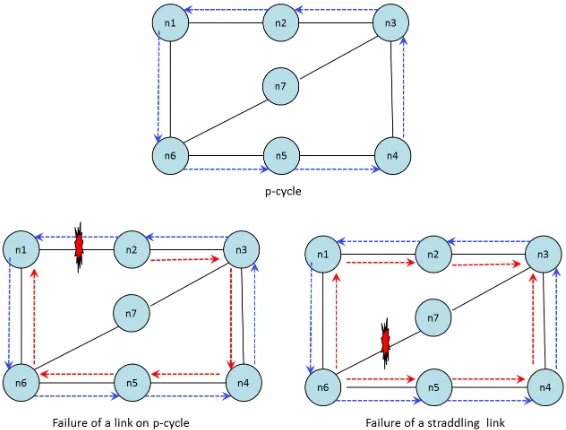
Figure 3.3: P-cycles
Shared Mesh Protection (SMP)
This approach is similar to 1:1 protection as each path is being protected by one backup path. It is also sometimes termed as shared-backup path pro-tection. In this scheme, the backup paths share the same capacity for various paths. This reduces the spare capacity needed to provide protection. Fig.3.2
shows an example of SMP with two primary and two back up paths. The backup path sharing is done by paths that are either link-disjoint or node-disjoint. If two paths share the same risk group, they can fail simultaneously. Therefore, they cannot share the same backup capacity.
Packet 1+1 Protection (P-1+1)
(a) Multiple Paths for a demand (b) Redistribution in case of fail-ure
Figure 3.4: Self Protecting Multipath (SPM) scheme
the first copy and discards the second one. In case of a conventional 1+1 protection scheme, there is one dedicated primary path and the other one is backup. In case of a failure, the egress node needs a notification of a failure and switches to the backup path. In Packet 1+1 scheme, the selection of an incoming packet is independent of previous selection. There is no switching involved. Each packet has its own sequence number embedded in it and is processed independently. Therefore there is no switching delay.
Demand-wise Shared Protection (DSP)
enough capacity for demand to flow. By dividing the demand into equal split-table units, the amount of spare capacity required is reduced. This capacity is shared only among paths for one demand. Signalling of failure has to be done to the demand source and destination. The source node will alter the load distribution on multipath. This strategy depends on the availability of node-disjoint paths.
Pre-configured protection cycles (p-cycles) A network when connected in the form of a ring, at the physical layer, is one of the efficient ways of provid-ing protection against failures. It is the typical design feature of SONET/SDH networks. Using SONET’s APS or unidirectional path-switched rings (UP-SRs), or Bidirectional line-switched ring (BLSR), in case of a failure the traf-fic is diverted on the protection ring in the opposite direction. There is no need of failure signalling. A similar concept, called p-cycle, is implemented at higher layers even in mesh networks (Grover [64]). It provides protection against on-cycle failures. It also provides alternative routing for straddling links5. Backup capacity is not dedicated to any demand, and can be shared. See Fig. 3.3. It uses multipaths only in the case of straddling links.
Self protecting Multipaths (SPM)
An end-to-end protection switching mechanism that uses disjoint multi-paths, called Self-protecting Multipath (SPM), was proposed by Menth et al. [88]. See Fig.3.4. It can be implemented as an explicit routing mechanism over MPLS. In SPM, traffic is transmitted on parallel disjoint paths according to a load balancing function. In case of a failure, traffic is directed to the remaining
functional multipaths using a different load balancing function. It has been argued that the SPM has a potential to provide protection against single node and link failures, with lesser capacity requirements than both OSPF rerouting and p-cycles (Menth et al. [90]).
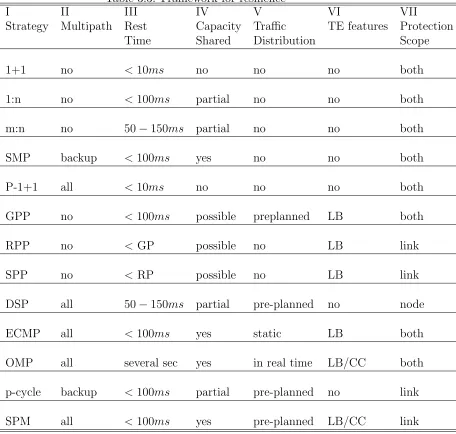
Table 3.3: Framework for resilience
I II III IV V VI VII
Strategy Multipath Rest Capacity Traffic TE features Protection
Time Shared Distribution Scope
1+1 no <10ms no no no both
1:n no <100ms partial no no both
m:n no 50−150ms partial no no both
SMP backup <100ms yes no no both
P-1+1 all <10ms no no no both
GPP no <100ms possible preplanned LB both
RPP no <GP possible no LB link
SPP no <RP possible no LB link
DSP all 50−150ms partial pre-planned no node
ECMP all <100ms yes static LB both
OMP all several sec yes in real time LB/CC both
p-cycle backup <100ms partial pre-planned no link
3.3.3
Re-routing
Re-routing is the recovery mechanism in which recovery paths are calculated dynamically, after the occurrence of a failure, as opposed to the protection switching, where paths are pre-known. OSPF uses re-routing strategy for failure recovery. Restoration paths are not pre-established. In case of a failure, the forwarding paths are re-calculated, which increases the recovery time. We briefly explain two relevant extensions to OSPF that make local decisions in case of failures.
Equal Cost Multipath (ECMP)
In OSPF Hello mechanism is very slow and the network may take up to several seconds to converge. Equal Cost Multi-Path (ECMP) [72] in OSPF is used to bifurcate traffic among two equi-cost shortest paths. This distribution may result in over-utilization of some links, while others remain under-utilized. ECMP is a way to allow nodes/routers to take local decisions. If there exist two equal cost shortest paths, then in case of a failure of one of them, the forwarding node can take a local decision to switch the traffic to the alternative active shortest path. However, finding a weight system that can be used to calculate the equal cost shortest paths is a very difficult problem. The node degree might also restrict the availability of two such paths. Because of these reasons ECMP feature, despite being available in most of the routers, is not very often used.
Optimized Multipath (OMP)
load distribution is based on the traffic on all the forward links. The problem with OMP is that it adapts very slowly to load changes in the network, and sometimes it may take hours [47,131].
3.3.4
Comparative analysis
A comparative analysis of all of the protection strategies discussed above is presented in Table 3.36. Column II of Table 3.3 shows whether a multipath
capability is possible in the failure protection strategy. Approximate restora-tion times are given in Column III. The capacity sharing feature, if available, is mentioned in Column IV. The traffic distribution on the multipaths can be either pre-planned or static. Column V shows this feature. For example, in the case of ECMP, a static traffic distribution is applied, as the traffic is always divided equally, while in the case of DSP, it is pre-planned. Column VI shows whether the scheme also offers other traffic engineering features such as load balancing (LB) or congestion control (CC). Finally, Column VII shows the scope of protection, which can be a link or a node or both.
Except for the Packet-1+1, all strategies mentioned here are path-based. Most of the strategies allow backup paths to share the same capacity, which results in efficient capacity utilization. In case of DSP, sharing is allowed only among paths of a single demand. This sharing results in reducing the additional capacity required to protect against failures. However, it also limits the number of paths that can be protected at any single time.
Stub-release, i.e. utilizing the surviving capacity of failed paths, is em-ployed in the case of SMP, GPP and SPM. In case of a failure, many strategies use demand splitting on multiple back-up paths. This splitting ensures efficient
spare capacity utilization. Strategies such as ECMP, OMP and SPM always employ demand splitting. However, other logical layer restoration schemes can also benefit from such splitting of demands. Splitting can give rise to the issue of re-ordering if one of the paths is much shorter than the other.
If demand splitting is used, then the distribution of traffic on the mul-tipaths is another issue to deal with. In case of ECMP, the distribution is static, as it always divides the traffic in equal parts. In most of the other strategies, a pre-planned traffic distribution is known to the routing nodes. In case of OMP, distribution is determined in real-time, which makes it ex-tremely slow. With the sharing of capacity and the use of traffic distribution, the protection strategies aim to provide traffic engineering features such as load balancing. Techniques such as SPM and OMP also provide some form of congestion control.
The path-based schemes are clearly the better options for survivability. The important characteristics that distinguish one routing strategy from the other are:
Sharing: If a backup path is dedicated to a specific primary path, sharing of capacity is not possible. However, if the same capacity can be allocated to different paths in different failure scenarios, sharing of resources from a common pool of spare capacity is possible. Almost all of the path-based approaches use sharing of capacity.
if we allow a redistribution of traffic in each failure scenario, that is, all the paths are allocated different loads, independent of other failure scenarios, then aglobal re-routing takes place.
Stub-release: When one of the links fails, it results in a failure of one or multiple paths for different demands. If in a failure scenario, the surviving capacity of the failed paths becomes available for routing, such mechanism is called stub-release, which can only be available in shared protection schemes. Failure-dependency: If the redistribution of traffic is allowed only for the paths that are affected by the failures, then, in the case of failure dependence, for each failure scenario a different traffic distribution is identified. Hence, arestricted reconfiguration of flows is determined for the paths that are affected by the failure. However, if a failure-independent strategy is adopted, then the affected flows are always restored in the same manner.
DSP uses fixed traffic distribution and shares the capacity only within one demand. So, it is a combination of shared and dedicated protection strate-gies. The stubs are released within the demand, and can only be re-used by other paths of the same demand. Diversification is used. But traffic re-distribution is fixed in different failure scenarios.
SPM, on the other hand, releases the stubs and allows the sharing of freed-up capacity among all demands. It also uses diversification of normal flows. In case of a failure, SPM has both variations, i.e. failure-dependent and independent restoration.
Figure 3.5: Disjoint path selection
a non-trivial problem. If a wrong path is selected, it can preclude the optimal paths. If a network has the structure which is shown in Fig. 3.5, with three equal-length paths, then there are two disjoint paths between the node-pair (A,D) – (A,E,C,D) and (A,B,F,D). However, if the path (A,B,C,D) is selected, then there are no alternative disjoint paths.
Orlowski and Pi´oro [103] discuss the path-based formulations for sur-vivable network design problems that use different combinations of the above described characteristics. They use sets of candidate paths for each node-pair. The design problems are aimed at minimizing the costs. Where path selection is required, (primary, backup) path-pairs for each demand and the fraction of load allocated to each of these path-pairs is determined. Gruber [65] has also used a similar strategy in his MILP for survivable design problem.
Figure 3.6: Classification of protection strategies
a very large number of path sets for each demand, i.e., for each primary path he defines one path set corresponding to each failure scenario. Hence he pre-determines a set of disjoint paths. We, on the other hand (as will be shown in greater detail in Chapter 5), use only one path set for each demand. The disjointness of the paths is ensured with the help of suitable constraints.
To the best of our knowledge, the path selection problem with load bal-ancing objective for multipath survivable routing has not been studied before; and in this thesis we will present novel formulations and heuristic algorithms for this complex problem.
3.4
Summary
In this chapter we have looked at the issue of resilience both from management and technical point of view. We have given a brief overview of organizations managing the standardization of networks, in general. We have also looked at how the survivability and resilience of a network are defined and quantified.
4
Heuristic Routing
ad-dition to the exact methods, we have developedhybrid methods (presented in Chapter 7), where we mix the exact and heuristic approaches. The adoption of thismatheuristic methodology has obliged us to trace its antecedents; and in order to place our hybrid algorithms within this new matheuristic frame-work, we consider it helpful to discuss the prior heuristic research that might be relevant to our own research agenda. Accordingly, in this chapter, we take cognizance of the current state of research in the area of applications of heuristics for network routing.
The use of heuristics in network routing is not new. Some research has been on-going since the 1990’s. The inherent adaptiveness of the heuristic methods make them a good candidate for providing solutions to the ever-changing nature of networks’ traffic.
4.1
Heuristic Techniques
Heuristics is a general term for methodologies that find good-enough (not nec-essarily optimal) solutions. Among these heuristic techniques, a new class of techniques is further categorized as meta-heuristic methods. Meta-heuristics refer to methods where improvement in solutions is arrived at through iter-ations (of heuristic or exact algorithms) and with a the view to avoid local optima and find very high quality solutions. Meta-heuristics can be applied to a wide set of different optimization problems [38].
to the partial solution. Alternatively, these algorithms can be based on local search. For these algorithms, an initial solution is a pre-requisite. Starting with an initial solution, these methods try to improve the objective value through local improvements. In local search algorithms, the concept of neighbourhood structure is used and the choice of these structures affects the performance of these algorithms. If a set of solutions for a problem is defined as S, then for every s ∈ S, N(S) is a set of solutions that can be reached by making local changes to s. It would require a single step in the algorithm to move from s to one of its neighbours.
The meta-heuristic methods generally use iterations of either construc-tive or local search approaches to find solutions. Sometimes neighbourhood moves are used as well to do the improving solutions. At each iteration, some of these methods work on a single solution, while others manipulate a set (called population) of solutions. The use of memory is another distinguishing charac-teristic. Some meta-heuristics memorize their experience in one iteration and use it to direct the future search, while the others do not store information at each iteration. In Table 4.1, a brief summary of heuristic and meta-heuristic methods discussed in this Section is provided. Table 4.1, Column III shows if the method is constructive (C) or local search(LS) based. Column IV shows if the method manipulates single (S) or population (P) of solutions at each itera-tion. Column V describes whether the method uses memory to direct its future search and lastly, column VI provides references to the original contributors of the technique.
of iterations without improvement, time elapsed, pre-determined deviation from known upper/lower bounds.
Table 4.1: List of heuristic and meta-heuristic methods
I II III IV V VI
Method Type C/LS S/P Memory Reference
Greedy Heuristic C S no [30]
Local Search Heuristic LS S no [6]
GRASP Meta-heuristic C P yes [110]
TS Meta-heuristic LS S yes [60]
SA Meta-heuristic LS S no [79]
VNS Meta-heuristic LS S no [91]
EA Meta-heuristic LS P no [62] ,[71]
ACO Meta-heuristic C P yes [39]
4.1.1
Greedy Algorithms
Greedy algorithms create a solution from scratch by selecting elements incre-mentally from a given candidate set. All elements are checked for selection in the partial solution. The most attractive element w.r.t. the greediness measure is selected. This algorithm terminates once a complete solution is generated. Since the algorithm does not make an extensive search, the quality of solution is often not good. But it is a good method to quickly create an initial solution, which can be used by other algorithms as a starting point.
4.1.2
Local Search
away. A move is defined as a small change in the elements of the solution, such as flipping of a bit in the solution string. During the neighbourhood search, if a better solution is found, it is picked as the next candidate solution, and its neighbours are searched. The search process continues until no further improvement in solution value is possible or the time lapses.
There are two strategies to select a new incumbent solution. The first-improving solution strategy searches the neighbourhood of a current solution only until a solution (if any) that improves the current solution is found. The second strategy is the best-improving solution strategy that searches for the best-so-far solution in the neighbourhood of the current solution. This strategy requires more computational time as compared to the first-improving strategy. The local search algorithm is prone to being trapped in local optima. A number of meta-heuristic methods (such as Tabu Search and Variable neigh-bourhood Search) that are based on local search, adopt different ways to avoid this problem.
4.1.3
Greedy Randomized Adaptive Search procedure
look for further improvements in the solution value. The local search stops when a local minimum is found in the neighbourhood.
This two-phase process is repeated for a pre-determined number of it-erations. In each iteration, if an improved solution is found, it is preserved.
![Figure 2.1: Functional View (Source: Pi´oro and Medhi [105])](https://thumb-us.123doks.com/thumbv2/123dok_us/9606826.463700/32.612.140.491.315.599/figure-functional-view-source-pi-oro-medhi.webp)
![Table 3.1: Effect of outages in terms of network availability. (Source [64])](https://thumb-us.123doks.com/thumbv2/123dok_us/9606826.463700/48.612.163.480.156.337/table-eect-outages-terms-network-availability-source.webp)
![Table 3.2: Restoration times and their impact on services. (Source [64])](https://thumb-us.123doks.com/thumbv2/123dok_us/9606826.463700/49.612.173.471.158.336/table-restoration-times-impact-services-source.webp)