Volume 2010, Article ID 423234,9pages doi:10.1155/2010/423234
Research Article
Joint Power Allocation for Multicast Systems with
Physical-Layer Network Coding
Chunguo Li,
1, 2Shiwen He,
1, 2Luxi Yang,
1, 2and Wei-Ping Zhu
31Key Laboratory of Underwater Acoustic Signal Processing of Ministry of Education, Southeast University, Nanjing 210096, China 2School of Information Science and Engineering, Southeast University, Nanjing 210096, China
3Department of Electrical and Computer Engineering, Concordia University, Montreal, QC, Canada H3G 1M8
Correspondence should be addressed to Luxi Yang,[email protected]
Received 31 December 2009; Accepted 7 June 2010
Academic Editor: Wen Chen
Copyright © 2010 Chunguo Li et al. This is an open access article distributed under the Creative Commons Attribution License, which permits unrestricted use, distribution, and reproduction in any medium, provided the original work is properly cited.
This paper addresses the joint power allocation issue in physical-layer network coding (PLNC) of multicast systems with two sources and two destinations communicating via a large number of distributed relays. By maximizing the achievable system rate, a constrained optimization problem is first formulated to jointly allocate powers for the source and relay terminals. Due to the nonconvex nature of the cost function, an iterative algorithm with guaranteed convergence is developed to solve the joint power allocation problem. As an alternative, an upper bound of the achievable rate is also derived to modify the original cost function in order to obtain a convex optimization solution. This approximation is shown to be asymptotically optimal in the sense of maximizing the achievable rate. It is confirmed through Monte Carlo simulations that the proposed joint power allocation schemes are superior to the existing schemes in terms of achievable rate and cumulative distribution function (CDF).
1. Introduction
Network coding (NC) was first proposed for wireline systems to improve the network’s achievable rate about ten years ago [1]. It was then shown in [2, 3] that by coding the data stream, rather than separated symbols, the NC can provide a higher achievable rate than the traditional Shannon information theory does. In order to apply the network coding in wireless communication, a lot of investigations have been conducted to improve the network’s achievable rate by making wireless channel coefficients similar to the wireline channel ones [4–8]. In [4–6], the idea of network coding is applied in the physical-layer of wireless networks, denoted by physical-layer network coding (PLNC), in order to enlarge the achievable rate. The PLNC is to jointly process multiple symbols without decoding them considering that the aim of the transmission is to tell the symbols to the destination rather than the relay [7–9]. Here, it is the data stream, instead of any separate symbol, that is tackled by NC. As such, NC improves the achievable rate from the data stream perspective.
For the physical-layer network coding, there are basically two types of NC, namely, the amplify-and-forward (AF) NC [10] and the decode-and-forward (DF) NC [11]. For the AF-NC, the mixed messages received by the relay are first amplified properly without requiring decoding, and then forwarded to the destinations. For the DF-NC, the relay first decodes these mixed messages to obtain all of the individual messages, and then mixes the separated messages in order to forward them to the destinations. In [12], the AF-NC and DF-AF-NC are compared by both theoretical analysis and simulations, drawing a conclusion that the AF-NC is superior to DF-NC in both transmission rate and link error probability. It is interesting to note that similar results are reported in [13].
consideration of AF-NC. A similar power allocation scheme is also proposed for the XOR-based NC [16]. However, the focus of the power allocation schemes is only on the single-cast instead of the multi-single-cast transmission model. In fact, the multi-cast system is widely used in wireless communications, where the physical-layer network coding can be applied since the nature of broadcast is available for PLNC in the multi-cast model.
As mentioned earlier in this paper, the core of the network coding is to properly combine or mix multiple messages without decoding them separately. Although the performances of network coding are very attractive from the information theory perspective, implementation of these performances incurs very high complexity [17]. In order to decrease the complexity of network coding in practical wireless communication systems, the lattice is introduced to realize the network coding [18].
The lattice is intrinsically a codebook similar to the traditional constellation modulation. There are basically five aspects to judge whether a lattice is good or not, including the packing feature, the covering feature, the mean squared error due to quantization, the error probability, and the closed property. Namely, a good lattice should be as compact as possible, and should be large enough to cover all of the elements; moreover, the quantization error and the error probability of the transmission in AWGN channels should be as small as possible; furthermore, any linear combination of two elements in the lattice should belong to this lattice [19,20].
To the authors’ best knowledge, most of the existing investigations focus on the multiple-access relay channels or unicast model rather than the multi-cast relay channel. There is only one published paper [21] that studies the power allocation problem for the multi-cast model with physical-layer network coding [21], where the system model is composed of two sources,Nrelays and two destinations. With the novel system model, an isolated precoder and a distributed precoder are designed to achieve the full relay diversity gain. However, power allocation is performed only for the sources while equal power is allocated for all relays. Considering the fact that the network’s achievable rate is jointly determined by all of the sources and relays, the performance of the whole system could be further improved if source and relay powers are jointly optimized. In this paper, the joint power allocation issue for both sources and relays will be investigated in order to maximize the network’s achievable rate. The difficulty lies in that the joint optimiza-tion problem is not convex with respect to (w.r.t.) the whole parameters, leading to a nonconvex optimization problem. The goal of this paper is to develop an iterative algorithm to tackle the nonconvex optimization problem for joint power allocation in the physical-layer network coding. The rest of the paper is organized as follows.Section 2presents the multi-cast system model and the joint power allocation-based mathematical model. Section 3 first establishes an optimization problem for the joint power allocation based on the criterion of achievable rate maximization. Then, it is disclosed that the proposed problem is not convex w.r.t. the whole parameters. By neglecting the noise power of
the second-hop channel under the medium to-high-SNR regimes, and replacing the original cost function with its bound, a convex problem w.r.t. the whole parameter set is obtained such that the convex optimization method can be used to solve the joint power allocation problem. Note that the high-SNR approximation is very accurate due to the very small power of the noise in the second-hop channel. As an alternative, we also design an iterative algorithm to solve the nonconvex problem by using the convex features of the original cost function w.r.t. part of the parameters. InSection 4, the lattice-based network coding that uses the joint power allocation schemes is studied.Section 5presents the simulation results, with comparison to the existing power allocation schemes, in terms of achievable rate and cumulative distribution function. Section 6 concludes the paper.
Notations. | · |denotes the absolute value; sum(·) means
the summation of a vector; (·)Tmeans a transpose; norm(·) is the Frobenius norm; CN(0, 1) denotes the complex Gaussian distribution with the zero mean and the unit covariance.
2. System Model
Consider a multi-cast system consisting of two sources, K
distributed relays and two destinations, where the physical-layer network coding (PLNC) is employed. Suppose that both sources want to transmit symbols to both destinations, while there is no direct link between S1 (or S2) and d2 (or d1) due to the pathloss and the large-scale fading as discussed in [21]. The system model is shown inFigure 1, where all of the relays are half-duplex and use the amplify-and-forward relaying protocol. Each source transmits a frame consisting ofKsymbols, which utilizeKtime slots and two subcarriers from both sources to both destinations. On each subcarrier, one symbol from S1 and another from S2 are transmitted to the relay on the first subcarrier; in the same time slot, both symbols are mixed by the same relay and then retransmitted to both destinations on the second subcarrier. Note that all of the relays are working in the round-robin way proposed in [21]; namely, only thekth relay works in thekth time slot.
The symbols of S1 and those of S2 are, respectively, denoted asx = (x1,x2,. . .,xK)T andy = (y1,y2,. . .,yK)T.
In thekth time slot, the symbol of S1,xk, and that of S2,yk,
are transmitted to thekth relay and both destinations on the first subcarrier. Thus, the symbol received by d1, d2 and the
kth relay can be, respectively, given by
t1,0=h1,0,k√akxk+n1,0,k, (1)
t2,0=h2,0,k
bkyk+n2,0,k, (2)
zk=h1,k√akxk+h2,k
bkyk+nk (k=1, 2,. . .,K), (3)
whereh1,0,k andh2,0,k are the direct link from S1 to d1 and
that from S2 to d2 in thekth time slot;ak andbk are the
kth symbol’s power coefficients for S1 and S2, respectively;
Source 1
Source 2
Destination 1
Destination 2
h1,1
h1,k
h1,K
h1,0
h2,1
h2,k
h2,K
h2,0 R1
Rk
RK
g1,1
gk,1
gK,1
g1,2
gk,2
gK,2
Figure1: The multi-cast system model.
coefficients from S1 and S2, respectively, to the kth relay in the kth time slot;n1,0,k andn2,0,k are the additive white
Gaussian noises (AWGNs) with the distributionCN(0, 1) at d1 and d2 in thekth time slot on the first subcarrier;nkis the
AWGN with the distributionCN(0, 1). Note that there is no direct link between S1 (S2) and d2 (d1) due to the path loss and large-scale fading as discussed in [21]. On the second subcarrier in the kth time slot, both sources remain silent [21], yet thekth relay amplifies the mixed symbols as
zk=
ckzk
=
ck
1+h1,k2ak+h2,k2bk
h1,k√akxk+h2,k
bkyk+nk
(4)
and then retransmitszkto both d1 and d2. Note thatckis the
power allocation coefficient of the retransmitted symbol for thekth relay. The amplifying power gainck in (4) from the
kth relay can be written as
ck ck
1 +h1,k2ak+h2,k2bk
. (5)
The symbol received at d1 from thekth relay in thekth time slot can be described as
tk,1=gk,1zk=gk,1
ck
h1,k√akxk+h2,k
bkyk+nk
+vk,1.
(6)
Similarly, that at d2 can be given by
tk,2=gk,2zk=gk,2
ck
h1,k√akxk+h2,k
bkyk+nk
+vk,2,
(7)
where gk,1 andgk,2are the channel coefficients for the kth relay to d1 and d2 on the second subcarrier, respectively. All of the channel coefficients are distributed withCN(0, 1).vk,1 andvk,2are the AWGNs at d1 and d2 on the second subcarrier with the distribution ofCN(0, 1).
By far, as shown in (1) and (2), both d1 and d2 have received two symbols during two subcarriers on thekth time slot. Since the direct link between S1 and d1 (or S2 and d2) is quite good, d1 and d2 can successfully detect the symbol of S1 and that of S2, respectively. By using the detectedxkandyk
as well as the interference subtraction method, the received symbols after the interference cancellation in (6) and (7) can be expressed as
tk,1=gk,1
ck
h2,k
bkyk+nk
+vk,1, (8)
tk,2=gk,2
ck
h1,k√akxk+nk +vk,2. (9)
Note that this subtraction is called asanalogue network coding
(ANC) [21, 22]. In (8) and (9), the power coefficients ak
andbkare optimized in [21] with a fixed value of the power
coefficient ck. In the subsequent sections, we will jointly
optimize all of the power coefficients, ak, bk, and ck to
maximize the achievable rate of the whole network. Assume that full channel state information (CSI) of the whole networks is available for every node, which is considered to be feasible in the slow-varying scenario.
3. Design of Joint Power Allocation Schemes
that is, difficult to solve, it is then modified to obtain a convex power allocation problem by using the high-SNR approx-imation. As an alternative, an iterative algorithm whose convergence is guaranteed is also developed to optimize the power coefficients of all sources and relays.
3.1. Problem Formulation. With (1), (5), and (8), d1 has
received the symbols from S1 and S2. Thus, the received rate for d1 can be expressed as
R1,k=log2 and S1, leading the received rate for d2 to
R2,k=log2
Note that the factor 1/2 for the two subcarriers has been neglected as in [23] since it has no impact on the joint power allocation. Thus, the averaged sum rate of both d1 and d2 over all of the time slots can be calculated as
R= 1
By maximizing the achievable rate (12), the joint power allocation problem can be established as
min
andPis the total power available for the whole system over the two subcarriers and theKtime slots. It is easy to verify that (13) is not convex with respect to (w.r.t.) the whole parameter (a;b;c). In what follows, we would like to modify the cost function (14) by deriving an upper bound of the network’s achievable rate to obtain a convex optimization problem.
3.2. Joint Power Allocation Using an Asymptotically Optimal
Upper Bound. By examining the cost function (14), it is
found that the nonconvexity only comes from the second and the fourth terms inf(a,b,c). If these two terms are modified into convex, f(a,b,c) would become convex w.r.t. (a;b;c), thus significantly simplifying the joint power allocation problem.
Using the approximation of the high signal-to-noise ratio (SNR), upper bound functions for the second term and that for the fourth term in (14) can be, respectively, obtained as
obtained as
Obviously, (16) is convex w.r.t. the whole optimization parameters (a;b;c). By replacing the original cost function in (13) with its lower bound (16), the modified joint power allocation problem can be expressed as
min
Here, the constrained minimization problem is convex since the Hessian matrix of flb(a,b,c) is always semidefinite positive and the constraint is also convex. Thus, many convex optimization methods such as the interior method and the Lagrangian multiplier method can be employed to solve (17). The complexity of solving (17) is very low since the existing convex optimization techniques are very efficient in computing the convex solution [24].
3.3. Design of Iterative Algorithm for Joint Optimal Power
Allocation. The joint power allocation problem (13) is not
convex w.r.t. the whole parameter, yet it could be convex w.r.t. part of the whole parameter set (a;b;c) when the other elements are fixed. By calculating the Hessian matrix of f(a,b,c), it can be shown that the original cost function (13) is convex w.r.t.cwith fixed (a;b) and convex w.r.t. (a;b) with fixedc. Therefore, the nonconvex joint power allocation problem can be solved by first optimizing the relays’ power coefficients c with fixed (a;b), and then optimizing the sources’ power coefficients (a;b) whilecis fixed. Moreover, each step in solving forcor (a;b) is convex [24]. Therefore, by solving the nonconvex problem iteratively, a solution for (a;b;c) can finally be attained. The iterative algorithm is summarized as follows
Algorithm 1(iterative optimization of the nonconvex
prob-lem (13)).
Step 1. Initialize (a0;b0) andc0; set the iteration indexn=0 and the termination conditionε; compute the initial value of the cost function in (13).
Step 2. Calculate the normalized power coefficients asan =
an/norm(an), bn =bn/norm(bn), andcn = cn/norm(cn).
the following convex problem by using the interior method of convex optimizations to obtaincn+1:
cn+1=argmin c f
(an,bn,c)
s.t.sum(an+bn+c)≤P, c≥0.
(20)
Step 4. With the fixed cn+1, solve the following convex
problem by optimizing a and b simultaneously with the interior method to attain (an+1;bn+1),
Convergence Analysis. The proposed algorithm iteratively
Source 1
Source 2
Destination 1
Destination 2
h1,1
h1,k
h1,K
h1,0
h2,1
h2,k
h2,K
h2,0 R1
Rk
RK
g1,1
gk,1
gK,1
g1,2
gk,2
gK,2 n1
nk
nK
S1
S2 D2
D1
R1
Rk
RK
Figure2: The system model for the lattice-based network coding.
nth iteration, the value of the cost function, denoted by
f2
n, achieves the minimum by optimizing with the fixed
(an;bn;cn) since the cost function of (18), shown in (19),
is convex w.r.t. ; in Step 3 of thenth iteration, the value of the cost function, denoted as f3
n, is further minimized by
optimizingc, leading to a smaller value of the cost function; that is, f3
n ≤ fn2; inStep 4of thenth iteration, the value of
the cost function in the last iteration is further minimized by optimizing (a;b), resulting in a smaller value as f4
n ≤ fn3. In
the (n+ 1)th iteration, we have f2
n+1 ≤ fn4, yielding fn2+1 ≤
f4
n ≤ fn3 ≤ fn2. Following a similar analysis, we finally have
the following inequalities:
f4
n+2≤ fn3+2≤ fn2+2≤ fn4+1≤fn3+1≤ fn2+1≤ fn4≤fn3≤ fn2,
(22)
indicating that the cost function decreases with each itera-tion. Meanwhile, the cost function is lower-bounded since the sum rate of the whole system is upper bounded. Consequently, the lower bounded function decreases as iterations go on, ensuring the convergence ofAlgorithm 1.
Optimality Analysis. By exploiting the convex feature of
the nonconvex cost function w.r.t. only a part of the optimization parameters, we have successfully designed an iterative algorithm to solve the nonconvex problem by using a convex optimization method, where the convergence of the iterative algorithm is ensured. Moreover, the solution obtained byAlgorithm 1for the problem (13) is guaranteed to be optimal, yet not necessarily globally optimal due to the nonconvexity of the joint power allocation problem. Namely, the solution realized by Algorithm 1 is at least one local optimum (possibly the global optimum).
4. Joint Power Allocation for the Lattice-Based
Physical-layer Network Coding
Since the lattice plays a very important role in the perfor-mance of network coding for the wireless communication, its construction method is of great importance to achieve the potential performance of network coding while having quite low complexity. The famous algorithm of Construction A has widely been employed to design the lattice [18]. Upon completing the design of lattice offline, the messages are modulated to this lattice online and then transmitted to all relays. With the mixed lattice codes at each relay, the relay amplifies the mixed lattice codes and then retransmits them to the destinations. Note that the mixed lattice codes received at each relay are still in the lattice due to the closed property of the lattice. At the destination, each message is demodulated by using the lattices. The detailed flow chart is presented inFigure 2.
0 5 10 15 20 25 30 35 40
10 15 20 25 30 35 40
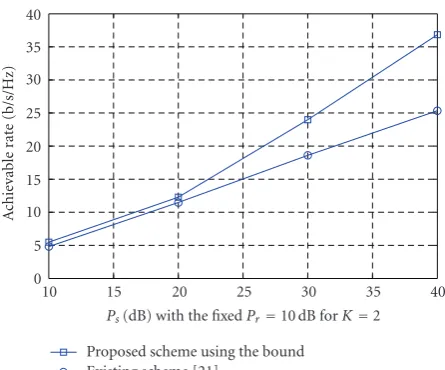
Ps(dB) with the fixedPr=10 dB forK=2
A
chie
vable
ra
te
(b/s/Hz)
Proposed scheme using the bound Existing scheme [21]
Figure3: Achievable rate comparison for the lattice-based physical-layer network coding whenK=2.
0 5 10 15 20 25 30 35
10 15 20 25 30 35 40
Pr(dB) with the fixedPs=10 dB
A
chie
vable
ra
te
(b/s/Hz)
Proposed scheme using the bound Existing scheme [21]
Proposed algorithm 1
Figure4: Achievable rate comparison at different values of subtotal power of relays whenK=4.
5. Simulation Results
In this section, simulation results are demonstrated to show the performances of the two proposed joint power allocation schemes in terms of the achievable rate and cumulative distributed function (CDF). In the simulations, all of the channel entries are i.i.d. complex Gaussian with zero mean and unit covariance, where all of the channel fading coefficients are independent from each other. The number of sources and that of destinations are set to 2, and that of the relays is set as K = 4 in all figures except for
K = 2 inFigure 3. The existing method proposed by [21] is also simulated in comparison with the proposed schemes. All of the curves are realized by the Monte Carlo numerical simulations, where the number of Monte Carlo simulations is set to 5000.
0 5 10 15 20 25 30 35
10 15 20 25 30 35 40
Ps(dB) with the fixedPr=10 dB
A
chie
vable
ra
te
(b/s/Hz)
Proposed scheme using the bound Existing scheme [21]
Proposed algorithm 1
Figure5: Achievable rate comparison at different values of subtotal power of sources whenK=4.
Figure 3presents the achievable rate as a function of the source power with the fixed relay power Pr = 10 dB and
K = 2. From this figure, we can see that the proposed power allocation scheme using the high-SNR approximation achieves a better achievable rate than the existing one [21] in the multi-cast system with the lattice-based physical-layer. Moreover, the gain increases with the growing value of SNR.
Figure 4presents the achievable rate versus the subtotal power of all relaysPr realized by the proposed two schemes
and the existing method. Note that the total power P
available for the whole system can be expressed as P =
Ps+Pr, wherePsandPrare, respectively, the subtotal power
of the sources and that of the relays. With the same total power for the whole system, the existing power allocation scheme [21] fixes the powers for all relays, and only allocates powers for sources. However, our proposed schemes jointly optimize the source and relay powers with the same total power available for the whole system. It is shown that the proposed schemes outperform the existing one with a large gain, which increases with the growing value of SNR. On the other hand, the existing scheme only optimizes the source power without consideration of the relay power, leading to a loss of achievable rate with the increase of the total power.Figure 5gives similar curves as a function ofPswith
fixed Pr = 10 dB. Obviously, the proposed two schemes
outperform the existing scheme, especially in the high-SNR regime.
Figure 6 presents the cumulative distribution function for two SNR regimes, where Case I means Ps = Pr =
15 dB and Case II denotes Ps = Pr = 20 dB. It is seen
0 0.1 0.2 0.3 0.4 0.5 0.6 0.7 0.8 0.9 1
0 5 10 15 20
Achievable rate (b/s/Hz)
CDF
The existing scheme [21] The proposed scheme using bound
Case I Case II
Figure6: CDF comparison for two cases whenK=4. Case I:Ps= Pr=15 dB and Case II:Ps=Pr=20 dB.
6. Conclusion
In this paper, we have studied the joint power allocation problem for multi-cast systems with physical-layer network coding-based on the maximization of the achievable rate. To deal with the nonconvex optimization problem, a high-SNR approximation is employed to modify the original cost function in order to obtain a convex minimization problem, where the approximation is shown to be asymptotically opti-mal at the high-SNR regime. As an alternative, an iterative algorithm has been developed by utilizing the convexity property of the cost function w.r.t. a part of the whole power coefficients. Considering the low complexity of the physical-layer network coding in the multi-cast system, the lattice-based network coding that uses the proposed joint power allocation schemes has been suggested. The simulation results have shown the effectiveness of the proposed schemes.
Acknowledgments
This work was partly supported by the National Basic Research Program of China (2007CB310603), NSFC (60672093, 60702029), Important National Science and Technology Specific Project (2009ZX03003-004), and National High Technology Project of China (2007AA01Z262).
References
[1] R. Ahlswede, N. Cai, S.-Y. R. Li, and R. W. Yeung, “Network information flow,”IEEE Transactions on Information Theory, vol. 46, no. 4, pp. 1204–1216, 2000.
[2] S.-Y. R. Li, R. W. Yeung, and N. Cai, “Linear network coding,” IEEE Transactions on Information Theory, vol. 49, no. 2, pp. 371–381, 2003.
[3] R. Dougherty, C. Freiling, and K. Zeger, “Insufficiency of linear coding in network information flow,”IEEE Transactions on Information Theory, vol. 51, no. 8, pp. 2745–2759, 2005. [4] S. Zhang, S. C. Liew, and P. P. Lam, “Physical-layer network
coding,” in Proceedings of the 12th Annual International Conference on Mobile Computing and Networking (MOBICOM ’06), pp. 358–365, ACM, September 2006.
[5] P. Popovski and H. Yomo, “Bi-directional amplification of throughput in a wireless multi-hop network,” inProceedins of the IEEE 63rd Vehicular Technology Conference (VTC ’06), pp. 588–593, May 2006.
[6] S. Zhang, S. C. Liew, and L. Lu, “Physical layer network coding schemes over finite and infinite fields,” inProceedings of IEEE Global Telecommunications Conference (Globecom ’08), pp. 1– 6, November 2008.
[7] S. Katti, S. Gollakota, and D. Katabi, “Embracing wireless interference: analog network coding,” in Proceedings of the Conference on Applications, Technologies, Architectures, and Protocols for Computer Communications (SIGCOMM ’07), pp. 397–408, August 2007.
[8] S. Zhang and S.-C. Liew, “Channel coding and decoding in a relay system operated with physical-layer network coding,” IEEE Journal on Selected Areas in Communications, vol. 27, no. 5, pp. 788–796, 2009.
[9] X. Li, T. Jiang, Q. Zhang, and L. Wang, “Binary linear multicast network coding on acyclic networks: principles and applications in wireless communication networks,”IEEE Journal on Selected Areas in Communications, vol. 27, no. 5, pp. 738–748, 2009.
[10] P. Popovski and H. Yomo, “Wireless network coding by amplify-and-forward for bi-directional traffic flows,” IEEE Communications Letters, vol. 11, no. 1, pp. 16–18, 2007. [11] S. Katti, H. Rahul, W. Hu, D. Katabi, M. M´edard, and
J. Crowcroft, “XORs in the air: practical wireless network coding,” in Proceedings of the Conference on Applications, Technologies, Architectures, and Protocols for Computer Com-munications (SIGCOMM ’06), pp. 243–254, September 2006. [12] M. Riemensberger, Y. E. Sagduyu, M. L. Honig, and W.
Utschick, “Comparison of analog and digital relay methods with network coding for wireless multicast,” in Proceedings of the IEEE International Conference on Communications (ICC ’09), June 2009.
[13] E. S. Lo and K. B. Letaief, “Network coding versus superpo-sition coding for two-way wireless communication,” in Pro-ceedings of the IEEE Wireless Communications and Networking Conference (WCNC ’09), April 2009.
[14] W. Shin, N. Lee, J. B. Lim, and C. Shin, “An optimal transmit power allocation for the two-way relay channel using physical-layer network coding,” inProceedings of the IEEE International Conference on Communications Workshops (ICC ’09), June 2009.
[15] H. Xu and B. Li, “XOR-assisted cooperative diversity in OFDMA wireless networks: optimization framework and approximation algorithms,” inProceedings of the 28th Con-ference on Computer Communications (INFOCOM ’09), pp. 2141–2149, IEEE, April 2009.
[16] Z. Lin and B. Vucetic, “Power and rate adaptation for wireless network coding with opportunistic scheduling,” inProceedings of the IEEE International Symposium on Information Theory (ISIT ’08), pp. 21–25, July 2008.
[18] U. Erez, S. Litsyn, and R. Zamir, “Lattices which are good for (almost) everything,” IEEE Transactions on Information Theory, vol. 51, no. 10, pp. 3401–3416, 2005.
[19] B. Nazer and M. Gastpar, “Compute-and-forward: harnessing interference with structured codes,” inProceedings of the IEEE International Symposium on Information Theory (ISIT ’08), pp. 772–776, July 2008.
[20] B. Nazer and M. Gastpar, “Compute-and-forward: har-nessing interference with structured codes,”http://arxiv.org/ pdf/0908.2119.
[21] J. Li and W. Chen, “Joint power allocation and precoding for network coding-based cooperative multicast systems,” IEEE Signal Processing Letters, vol. 15, pp. 817–820, 2008.
[22] R. Zhang, Y.-C. Liang, C. C. Chai, and S. Cui, “Optimal beamforming for two-way multi-antenna relay channel with analogue network coding,”IEEE Journal on Selected Areas in Communications, vol. 27, no. 5, pp. 699–712, 2009.
[23] X. Tang and Y. Hua, “Optimal design of non-regenerative MIMO wireless relays,”IEEE Transactions on Wireless Commu-nications, vol. 6, no. 4, pp. 1398–1406, 2007.
[24] S. Boyd and L. Vandenberghe, Convex Optimization, Cam-bridge University Press, CamCam-bridge, UK, 2004.
[25] I.-J. Baik and S.-Y. Chung, “Network coding for two-way relay channels using lattices,” in Proceedings of the IEEE International Conference on Communications (ICC ’08), pp. 3898–3902, May 2008.