Master Thesis
for the study programme MSc. Business Information Technology
D E V E L O P I N G A D E V O P S M AT U R I T Y M O D E L
j e r o e n m. r a d s ta a k
A validated model to evaluate the maturity of DevOps in organizations
Jeroen M. Radstaak: Developing a DevOps maturity model: A validated model to evaluate the maturity of DevOps in organizations
Master Thesis,University of Twente April2019
Author
Jeroen M. Radstaak(Study Programme: MSc. Business Information Technology) Study track: IT Management Innovation
Graduation Committee
Dr. M. Daneva (Faculty of EEMCS, University of Twente
S U M M A R Y
In the past decade, practitioners and scholars have tried to agree on a definition for DevOps. Most of these definitions describe DevOps as an Agile methodology that combines the whole product lifecycle. This mainly includes but is not limited to, development and operation teams. One of the goals of DevOps is to create an environment in which short iterations of product releases can happen without stability issues. This can be achieved in multiple ways, however, the approaches to DevOps are commonly divided into five key dimensions: Culture, Communi-cation and collaboration, Automation, Measurement, and Monitoring.
As the approaches to implementing DevOps can be vastly different is has been hard to establish a guideline for the implementation of such an environment. At the same time, many organizations struggle with implementing the soft aspects of DevOps and to convince other parties in the organization to get on board as well. Yet, collaboration and cooperation are needed for a successful DevOps implementation, especially regarding management support.
The goal of this study is to create a DevOps maturity model that will help in (1) guiding organizations to the required maturity level and in (2) demonstrating
to other parties in the organization what is needed for a thriving DevOps envi-ronment. The DevOps maturity model is created based on a literature review and qualitative interviews with experts, followed by validation through expert opinions and put to practice in case studies.
The literature review revealed that multiple DevOps maturity models exist, both in practice-driven sources and scientific literature. However, our evaluation of the published models indicates that the models are either too broad or in an uncommon format and therefore difficult to use. It was chosen to combine the models into a new artefact that combines the common CMMI model with the detailed capabilities that are needed for a DevOps environment, which are found in the literature. This results in the first version of the DevOps maturity model (V1).
The second source of input is a group of five experts in the field of DevOps that work in Vietnamese companies and that participated in the qualitative interview study included in this research. These interviewees have different positions and backgrounds in multiple organizations which allowed them to create varied input for those capabilities that are contributing to a thriving DevOps environment. This input is combined with the first version of the DevOps maturity model and results in the DevOps maturity model V2.
The second version of the model was subjected to a first evaluation by means of an interview with the same interviewees that provided input for the model. The model was thoroughly discussed, and changes were made after each interview to improve the clarity, readability, and completeness of the model. This resulted in the final iteration of the DevOps maturity model, V3.
capability. This model should help to understand where the organization, and more specifically each project stands in terms of DevOps maturity.
The model has been created in multiple iterations and the practical application of the model has become clear during the case studies. However, the model is, just like DevOps itself, open to continuous improvement. For example, research on which levels of DevOps maturity are most common and could be considered the industry standard.
Research has shown that organizations had difficulties adapting to the CMMI model, because of cost, time and other models that were already used by the organization. Therefore, recommendations on how to apply the DevOps maturity model efficiently and description of the benefits have been made, to ensure the acceptance of the DevOps maturity model.
The research in this master thesis also contributes to empirical research in (South)East-Asia on DevOps in general. Previous publications have shown that the existing DevOps research is very scarce in this region1
. Business cultures vary greatly across the world and it could be interesting to look closer at similarities and dif-ferences of the culture dimension. This comparison is currently hard to make as scientific literature on DevOps in (South)East-Asia is lacking.
This study has both scientific and practical implications:
• scientific: This study provides a new approach to DevOps maturity mod-els and contributes to a limited amount of scientific research on DevOps maturity.
• scientific: Empirical research in (South)East-Asia on DevOps, in general, is very limited. This study contributes and can be used as a comparison to other geographical areas.
• practical: A common model, CMMI, has been adapted to fit a DevOps ma-turity assessment and should be able to be adapted easily inside an organi-zation.
• practical: The model can be used to improve the knowledge on DevOps throughout the organization, by showing what is necessary to achieve dif-ferent maturity levels
Limitations of the study are traceable to the fact that our research only took place in one geographical area and this could limit the usefulness of the model to organizations in different locations. However, this impact is limited because the origin of the model comes from existing literature. Another key limitation is the limited information on the projects that were assessed in the case studies. The amount of information that could be shared by the participating organizations was mostly limited to the amount of people, age of the project and number of teams involved. This also limited the discussion of the results. Future research can be done by doing more empirical research on DevOps maturity to further improve upon the DevOps maturity model.
A C K N O W L E D G E M E N T S
This thesis is the conclusion to five and a half years of studying the business information technology BSc. And MSc. at the University of Twente. It has been an amazing time of personal growth, both inside and outside of the university. This thesis has taken me6 months to complete, however I would not have been
able to manage this without the help of other people.
First and foremost, my1st supervisor Maya Daneva. She tirelessly provided me
with feedback and support and nudged me into the right directions through-out this thesis adventure. Also, my 2nd supervisor, Jos van Hillegersberg,
pro-vided me with critical feedback that made this thesis into what is now in front of you.
I would also like to thank the organizations that have been supporting and willing to spend time doing interviews with me on multiple occasions. The enthusiasm during these interviews is what reminded me for being on the right track and that I was creating a useful tool that these people will be able to use. Also, special thanks goes out to the people that helped me get the connections with the right people at the right organizations.
C O N T E N T S
1 i n t r o d u c t i o n 1
1.1 Problem statement . . . 1 1.2 Thesis structure . . . 2
2 b a c k g r o u n d 3
2.1 Definitions of DevOps . . . 3 2.2 Maturity models . . . 5
3 r e s e a r c h d e s i g n 8
3.1 Research objective and questions . . . 8 3.2 Research Design . . . 9 3.3 Research methodology . . . 10
4 l i t e r at u r e r e v i e w 12
4.1 Literature review method . . . 12 4.2 DevOps maturity models from literature . . . 13 4.3 Discussion . . . 17 4.4 Using the Literature Sources to Propose the first version of our
maturity model V1 . . . 19 4.5 High-level representation of the DevOps maturity model V1 . . . . 23
5 e x p e r t i n t e r v i e w s 24
5.1 Interview set-up . . . 24 5.2 Data acquisition and analysis – Expert interview . . . 25 5.3 Validation round– Expert opinion . . . 33
6 c a s e s t u d i e s 37
6.1 Case study results . . . 39 6.2 Discussion of case study results: cross-case analysis . . . 48 6.3 Suggestions for improvement . . . 50
7 r e c o m m e n d at i o n s f o r o r g a n i z at i o n s’u s e o f t h e d e v o p s m a
-t u r i -t y m o d e l 51
7.1 How to apply the DevOps maturity model . . . 51 7.2 Limiting cost and time . . . 52 7.3 Business case for adopting to the DevOps maturity model . . . 52
8 d i s c u s s i o n 53
8.1 Design choices . . . 53 8.2 Limitations . . . 54 8.3 Contributions to research and practice . . . 56
9 c o n c l u s i o n a n d f u t u r e w o r k 58
9.3 Future work . . . 60
10 b i b l i o g r a p h y 61
A s t r u c t u r e d l i t e r at u r e r e v i e w 65
a.1 Search protocol . . . 65 a.2 Search results . . . 66 a.3 Summaries of the selected papers . . . 66
B c a pa b i l i t i e s ov e r v i e w l i t e r at u r e a n d i n t e r v i e w s 68
C d e v o p s m at u r i t y m o d e l s v e r s i o n 1,2,3 70
D e x p e r t i n t e r v i e w p r o t o c o l – d ata a c q u i s i t i o n 76
L I S T O F F I G U R E S
Figure2.1 CMMI process model [1] . . . 6
Figure3.1 The DSRM Process Model . . . 9
Figure3.2 Design science methodology in the context of this research 11 Figure4.1 Literature review filtering process . . . 12
Figure4.2 DevOps maturity model by Mohamed [43] . . . 13
Figure4.3 DevOps maturity levels for the element ‘building’ [47] . . 14
Figure4.4 DevOps focus area maturity model [2] . . . 16
Figure4.5 High-level maturity model V1: an overview . . . 23
Figure5.1 The coding process used in this thesis . . . 26
Figure5.2 Initial coding . . . 26
Figure5.3 Axial coding . . . 27
Figure5.4 DevOps cycle [3] . . . 29
Figure5.5 High-level maturity model V2: an overview . . . 32
Figure5.6 Maturity model intermediate updating process . . . 33
Figure5.7 High-level maturity model V3overview . . . 36
Figure6.1 DevOps maturity assessment results case1 . . . 40
Figure6.2 DevOps maturity assessment results case2 . . . 41
Figure6.3 DevOps maturity assessment results case3 . . . 42
Figure6.4 DevOps maturity assessment results case4 . . . 43
Figure6.5 DevOps maturity assessment results case5 . . . 44
Figure6.6 DevOps maturity assessment results case6 . . . 45
Figure6.7 DevOps maturity assessment results case7 . . . 46
Figure6.8 DevOps maturity assessment results case8 . . . 47
[image:8.595.171.482.76.444.2]L I S T O F TA B L E S
Table4.1 Comparison of literature on DevOps capabilities . . . 18
Table5.1 Overview of interviewees . . . 25
Table5.2 Capabilities emerging from interviews . . . 30
Table6.1 Overview of cases . . . 37
Table6.2 Overview of achieved DevOps benefits for each case . . . 38
Table6.3 Descriptive statistics of case studies . . . 48
Table A.1 Summary of the Search strategy . . . 65
Table A.2 Inclusion and exclusion criteria . . . 65
Table A.3 Search results in academic databases . . . 66
Table A.4 Search results search in grey literature . . . 66
Table A.5 Summary of selected papers for literature review . . . 67
Table B.1 Comparison of literature on DevOps capabilities . . . 68
A C R O N Y M S
AWS Amazon Web Services
CMMI Capability Maturity Model Integration IAC Infrastructure as Code
1
I N T R O D U C T I O NIn the past decade DevOps, a new approach in the agile software development movement combining development and operations, has gained popularity and is increasingly used in the software engineering community [4]. DevOps does not
only include the development teams, as for example scrum methodology does, but also includes the operations teams of the software product development. A need for this started to exist after development iterations were getting shorter and more automation of the operations side was needed to keep up with development. These operations include, but are not limited to, automated testing, deployment, and monitoring.
1.1 p r o b l e m s tat e m e n t
The approach to DevOps has strongly developed over the past decade into an approach which is now widely used in software engineering companies. This results in DevOps being an integral part of the delivery process of new software. It raises the question about the point of time at which DevOps is considered by a company to be fully implemented and the organizational characteristics that tell practitioners that the level of full implementation has in fact been reached. Ma-turity models have been used in software engineering to, for example, assess the capabilities (Capability Maturity Model) or the business intelligence in a company. A maturity model for DevOps could therefore be a useful metric to analyze the approach and techniques followed by any organization regarding DevOps. This results in the following research goal for this study:
Develop a suitable DevOps Maturity framework for assessing the maturity of a DevOps environment in any organization.
1.2. THESIS STRUCTURE
1.2 t h e s i s s t r u c t u r e
This master thesis adheres to the following structure:
• Chapter2provides the background for this research, first about DevOps in general and followed by background on maturity models.
• Chapter 3 describes the design of this research and the steps that will be taken to complete it
• Chapter4consists of the literature review that results in the first iteration of the DevOps maturity model
• Chapter 5 details the interview rounds with the experts. The first round to acquire more capabilities to add to the model and the second round for validation of the model, resulting in v2 and v3 of the DevOps maturity
model respectively.
• Chapter6describes the case studies that were performed and the results of the DevOps maturity assessment in relation to the model.
• Chapter7provides organizations insight in how to use the DevOps maturity model
2
B A C K G R O U N D2.1 d e f i n i t i o n s o f d e v o p s
The first usage of DevOps, a combination of development and operation, stems from a presentation during the2008Agile conference by Debois and Shafers [5].
Even though this is more than a decade ago it seems that research on DevOps is still in its infancy [6]. Previous literature reviews have shown that no set
def-inition of DevOps exists [7]–[9]. This section will provide more insight into how
recent studies have tried to define DevOps by going into more detail on the defi-nition.
Recent studies describe DevOps as vaguely defined and loosely used in the soft-ware engineering community [4]. DevOps has been described, among other
things, as a movement, philosophy, a practice or a culture. However, from the literature, it becomes clear that DevOps aims to decrease the time to production environments for changes made to the software [10] by facilitating a lean
con-nection between development, delivery, and operation [11]. This is supported by
practices like continuous testing and deployment [10]. What seems to be most
common in the interpretation of DevOps is, that it is a culture shift needed to-ward the collaboration between development, quality assurance, operations and any other team involved with delivering software [11], [12]
According to Humble and Molesky DevOps can be achieved through four main principles: culture, automation, measurement and sharing [12]. These principles
are also mentioned by Lwakatare et al. who also adds monitoring as well as collaboration and communication [13], [14]. Sharing is considered a part of the
collaboration and culture as well. Five of these dimensions, sharing excluded to prevent redundancy, will shortly be discussed in the following section.
2.1.1Collaboration and communication
The basic aspect of collaboration in DevOps is the implied collaboration between the Development and Operation side of software engineering. The literature re-search of2017by Ghantous and Gill researched this more in-depth and showed
that collaboration and communication is the most frequently mentioned concep-tual element to describe DevOps [9]. Lwakatare splits this up in two main
prac-tices [13]: “Increasing the scope of responsibilities" and “intensifying cooperation
and involvement in each other daily work."
2.1.2Automation
Automation is necessary to achieve the assumptions made by Humble in regards to DevOps: “achieving both frequent, reliable deployments and a stable produc-tion environment" [12]. This can be achieved by creating a continuous delivery
2.1. DEFINITIONS OF DEVOPS
and monitoring [15]. For example, automatic deployment is the ability to quickly
deploy new releases into a production environment [16]. This automation can be
supported by using an IT setup named infrastructure as code (IaC) [13].
The IaC concept is based on the idea that the entire infrastructure provision-ing should be maintained as code in a source code repository [15]. This means
that the infrastructure is only maintained by executable code which can create the same environment repeatably. This can prevent issues from lacking docu-mentation, mistakes made between environments and transitioning of employees [17].
2.1.3Culture
Transitioning to a new culture can be difficult, however, Shamow described the focus on change of culture in companies a necessity for adopting DevOps [18].
Some of those changes, as described by Shamow, are the importance for people inside the company to know the seriousness of bypassing the DevOps teams in crises, to not worry about specific tools and to provide full transparency between groups.
Lwakatare et al. describes the necessary DevOps culture as empathic, supportive and having good working environments between development and operations [13]. An important step is to be involved in each other’s work. This can be
achieved by rotating Developers inside the operation teams, both teams should have regular meetings with the other team and both should be responsible for production, which means that also developers should be on call for production issues [12].
To foster this culture it is important to hire the people that have the right knowl-edge of automation, by comparing the knowlknowl-edge, skills, and abilities of future employees to the capabilities needed for DevOps [19]. Organizations should give
employees trust in making the right decisions necessary for implementing au-tomation of the process by creating a culture of personal responsibility [20].
2.1.4Monitoring
Monitoring is multipurpose, it can be used to detect problems early on but also to prevent problems from arising. For example, by monitoring the physical ca-pabilities of the system (CPU, memory, hard disk space) with effective tools, this can prevent system crashes or applications getting too slow by adding enough resources before those issues occur. Also, monitoring can help developers to quickly recover from code failures or evaluate the code coverage for automatic tests [13].
2.1.5Measurement
2.2. MATURITY MODELS
For example, high-level business metrics can be the total revenue or end-to-end transactions per unit time. For the lower-end, it is important to use similar metrics for both teams as these key performance indicators influence people’s behavior, for example, the impact of product releases on the stability of the affected systems [12]. Using similar metrics ensures that both teams are trying to achieve the same
goal, a stable production environment.
2.2 m at u r i t y m o d e l s
In the past decades maturity assessments of processes have become a well-established practice as a successful means for improving software-intensive organizations [21]. The perceived benefits of maturity models resulted in the creation of a wide
range of software process capability and maturity models.
Most maturity models can be categorized as a fixed level maturity model or a fo-cus area maturity model [22]. The fixed maturity level model has a fixed number
of maturity levels, often following the maturity levels as defined in CMM [23]:1.
Initial, 2. Repeatable, 3. Defined, 4. Managed and 5. Optimized, with in each
maturity level a number of Key Process Areas (KPA). The fixed maturity level models can be divided into staged maturity models, in which all KPA need to be in place to achieve a certain maturity level, and continuous maturity models, allowing for a more gradual a varying improvement path by allowing KPAs to be scored at different levels [24]. Another type of maturity model consists of focus
areas that define levels of capabilities in various functional areas. Each focus area has a series of development steps for progressively mature capabilities and each focus area can have its own maturity level scale [25].
A procedure model for developing maturity models is described by Becker et al. [26]. Roughly it consists of multiple iterations of defining the problem and
relevance, comparing existing maturity models, maturity model development, followed by, gathering empirical evidence by evaluation in real-life situations. However, unfortunately, many maturity models miss the empirical evidence that could reveal the validity and usefulness of the models [27]. Resulting in
matu-rity models that have an unclear sense of quality because of the lack of structure during the development of the models. A maturity model for developing matu-rity models may be needed to further guide the development of future matumatu-rity models [24].
The Capability Maturity Model Integration (CMMI) model is an exception to most maturity models, as much empirical evidence on this model exists and the CMMI has been used as a framework for many other models. The value of applying maturity models, more specifically SW-CMM (predecessor of CMMI) and CMMI, in software development and maintenance environments has been shown by multiple researchers through empirical research [28]–[31]. The
CMMI-based process improvement resulted in better project performance and higher quality products through cost reduction, better scheduling of requirements, better quality products, higher customer satisfaction and higher return on investment as described by Goldenson and Gibson based on their research in35 organizations
2.2. MATURITY MODELS
The CMMI model and its adaptation will be further detailed in Section 2.2.1.
Also, in recent years the increased usage of Agile methodology has resulted in combinations between CMMI and agile, which is described in section2.2.2.
2.2.1CMMI model and its adaptations
As many maturity models are adapted from the CMMI framework it is neces-sary to take a closer look at this framework [21]. The CMMI emerged in the
start of 1990s in the area of software engineering to improve software
develop-ment processes to achieve higher quality and has since been used by hundreds of organizations worldwide [27]. The basics of the CMMI are high-level and
con-sists of five levels of maturity. Starting with ‘initial’, in which processes are still unpredictable, poorly controlled and processes are reactive. The second level is ‘managed’, processes are focused on projects and are still often reactive. Level3is
‘defined’ and the processes are now characterized for the organization and not re-active, but proactive. Next is level4‘quantitatively managed’ in which processes
are measured and controlled. Finally level5is ‘optimizing’, focusing on process
improvement [1]. These levels are shown visually in figure2.1.
2.2. MATURITY MODELS
2.2.2Agile and CMMI
The success of CMMI inspired several other maturity models in other domains, among others, also in software engineering focused on improve software devel-opment processes to achieve higher quality [27]. As DevOps is a new approach in
the agile software development movement, it is necessary to look at the influence of Agile on CMMI.
Early research questioned the combination of Agile and CMMI. Developers using CMMI were developing for large-scale, risk-averse and mission-critical systems, with high levels of management oversight and hierarchical governance. Whereas Agile methods focus on smaller, single-team development projects with volatile requirements. It, therefore, seems that both are on opposite ends of each other [34].
However, more recent literature shows that the combined approach of agile and maturity models brings potential benefits and combined with tool support it can help increase the success rate of these initiatives [35]. Selleri et al. confirms, in a
3
R E S E A R C H D E S I G NThis chapter describes the research objective and its supporting questions. Fur-thermore, the research approach will be described. The combination of these two will result in the final research methodology that will be followed step by step in this research
3.1 r e s e a r c h o b j e c t i v e a n d q u e s t i o n s
This research sets out to reach the following research objective (RO): RO. What is a suitable maturity framework that allows organizations
to assess and improve their DevOps environment?
In order to design an effective and comprehensive DevOps maturity model, it is necessary to research the design context. This prevents that everything must be made from scratch and that this research can be a continuation from existing research. The first sub-question (SQ) is defined accordingly.
SQ1. What models on maturity in DevOps exist and which are suitable to use for creating a comprehensive model applicable to all businesses working with DevOps?
The answers to SQ1will enable us to create a first iteration of the maturity model.
This maturity model will be used in SQ2. This question focuses on improving the
model further by gathering input from experts in the DevOps field. The reason that experts are interviewed is that the goal is to create a model that can be used in practice by organizations to assess their maturity and improve their DevOps environment.
SQ2. What do experts in the DevOps field see as the capabilities necessary for successful DevOps implementation?
The results of SQ2 will result in the second iteration of the DevOps maturity
model. This model will be validated by the same experts in the field to ensure that the model will fit the practical use that is envisioned.
SQ3. How do experts in the DevOps field evaluate the maturity model and what improvements should be done based on their responses?
The suggestions from SQ3 will result in version 3 and the final iteration of the
DevOps maturity model. This model will be applied in practice and that is what SQ4will focus on; testing the applicability of the DevOps maturity model.
SQ4. What is the DevOps maturity level of the organizations used for the case studies and how can this be explained?
SQ4 will result in maturity assessments of the projects in the organizations that
3.2. RESEARCH DESIGN
will be evaluated and suggested for further iterations of the DevOps maturity model.
SQ5. How did the DevOps maturity model perform in this case study and what improvements should be done based on these findings?
The result of answering all five sub-questions will be a comprehensive under-standing of the context of DevOps maturity models and the creation of a DevOps maturity model for assessing the maturity of DevOps in organizations and thus giving the means to satisfy the research objective. Finally, suggestions for further improvements to the maturity model will be given as input for future research that will build on this research.
3.2 r e s e a r c h d e s i g n
The design of the DevOps maturity model is structured according to the activities of the Design Science Research Methodology of Peffers et al. as shown in figure
3.1[37]
Figure3.1: The DSRM Process Model
Identify Problem and Motivate
Two problems can be identified to motivate this literature. First, in the problem statement in chapter1.1, it became clear that a need exists for a DevOps maturity
model. Secondly, a need exists for more empirical research on DevOps in general in (South)East-Asia, because culture is a core component of DevOps and the culture in organizations differ between geographical regions1
[38]. This possible
need for different development methodologies, because of cultural differences is confirmed by Alpar [39], who considers differences in culture to be a core issue
for high employee turnover (which relates to the capabilities of team organization and collaboration in DevOps) in IT outsourcing organizations in Vietnam.
3.3. RESEARCH METHODOLOGY
Define Objectives and Solution
A DevOps maturity model will be created to resolve the identified problems. The solution will consist of a literature review, expert interviews and expert validation for the creation of a DevOps maturity model.
Design and Development
The design of the model consists of three iterations. The first version will be created from the analysis of existing DevOps maturity models. The second ver-sion will follow from combining the first verver-sion with interviews with experts on DevOps. The third, and final, version will follow by validation through expert opinion. The experts will imagine how the model would interact with the prob-lem context and then predict the results. If these predictions are unsatisfactory, it would mean that the model must be redesigned.
Demonstration
The newly created DevOps maturity model is used in multiple case studies for measuring the maturity of the respective DevOps implementation. This will pro-vide insights into the applicability of the model.
Evaluation
The results of the case studies will be analyzed, and suggestions for changes and future research regarding the DevOps maturity model will be given.
Communication
The results of this study are communication in two manners; this research report and as results of the maturity assessment for each organization that participated in the case studies.
3.3 r e s e a r c h m e t h o d o l o g y
Combining the research objectives and questions with the research design leads to the model in figure3.2. This model is similar to the process model of Becker et al.
described in the Background section [26]. Data will be gathered through literature
review and expert opinion. The design of the DevOps maturity framework there-fore consists of three iterations. The first concept DevOps maturity framework is based on the literature review (SQ1). The second iteration will be with the
addi-tions resulting from the interviews with experts of the field (SQ2). These same
experts will participate in a second interview round and will be asked to validate the DevOps maturity model v2 (SQ3). This validation round will result in the
third and final iteration of the DevOps maturity model. This DevOps maturity model v3 will be applied in case studies to different projects (SQ4). The results
will be discussed, and possible alterations will be suggested for future research (SQ5). These steps will result in answering the RO. This empirical approach was
3.3. RESEARCH METHODOLOGY
4
L I T E R AT U R E R E V I E WAs described in the Methodology section it was chosen to start with a literature review on existing DevOps maturity models to create a comprehensive overview of the context of DevOps maturity models. This first part of this section starts with the details of the literature review. This is followed by the analysis and discussion of the various models.
4.1 l i t e r at u r e r e v i e w m e t h o d
A structured literature review, implementing the practices of Kitchenham [40],
was conducted to create a comprehensive overview of the existing DevOps ma-turity models from both research and practice. The databases used to retrieve scientific literature were Scopus, Web of Science, IEEE Xplore, ACM Digital Library, AIS Electronic library, Springer database and finally Google Scholar for exploratory purposes. For these databases the following search query was used:
“devops"AND (“CMMI"OR maturity OR“maturity model")
In order to assure the quality of literature only academic databases were used at first. However, this provided an unsatisfactory amount of results. Therefore, it was decided to also include “grey literature" (non-peer reviewed literature) in this research, which is especially important to do in the case of DevOps, because this field of research does not provide a substantial amount of literature [41]. A
multivocal literature review, in which “white literature" and “grey literature" is combined, does require special attention to the quality of the papers. Therefore, the guidelines of Garousi, Felderer and Mäntylä were used on deciding if the “grey literature" should be included [42].
4.2. DEVOPS MATURITY MODELS FROM LITERATURE
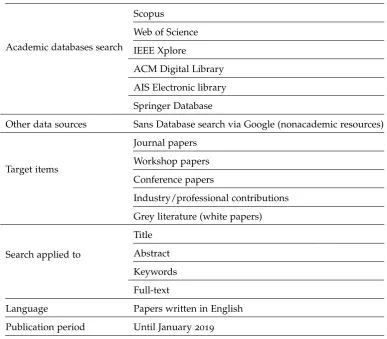
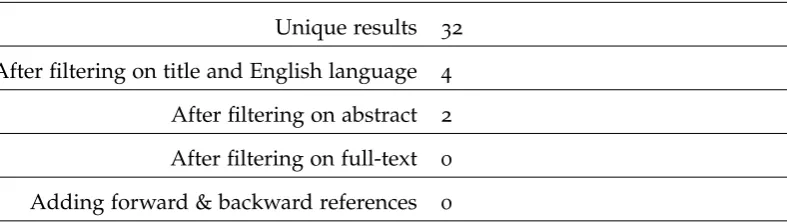
The process of finding suitable literature including the search terms, exclusions¸ inclusions and summaries of the papers are shown in Appendix A. Our initial search yielded 94 papers. Using the inclusion and exclusion criteria on the title
of the papers, 65 papers were excluded. Then, using the inclusion and
exclu-sion criteria on the abstracts of the remaining29 papers, we excluded further15
publications. The remaining papers then were14, which were read by using the
whole text and only 4 were selected. The forward and backward references of
these papers were checked for suitable literature. Five of those references were deemed suitable after a full-text screen and thus added to the selected literature. This brought the total of suitable research articles to nine. The gradual reduction of relevant papers is shown in Figure4.1.
4.2 d e v o p s m at u r i t y m o d e l s f r o m l i t e r at u r e
The selected literature provides several maturity models, and some of these will be discussed in this section.
The first model is inherited from an existing model created by Hewlett Packard; however, it does not become clear from the literature if this model has been vali-dated. Even though the validation of the model is unclear, it has been published in the Journal of Computer Engineering and been cited10times (February2019)
in recent literature. Therefore, it is chosen to describe this model as it can provide useful input for the creation of the DevOps maturity model in our research.
4.2. DEVOPS MATURITY MODELS FROM LITERATURE
The proposed model by Mohamed [43] is a CMMI inspired model that was
cre-ated by in 2015, shown in figure 4.1. In this model, each maturity level is set
against 4 dimensions: communication/collaboration, automation, governance,
and quality.
At the first level, there is only ad-hoc communication, no automation, uncon-trolled governance, and no quality standard. By improving these it is possible to shift to the next level. Eventually reaching level5, ‘optimized’. This stage has the
characteristics of, a collaboration between teams with a constructive communica-tion environment, optimized automacommunica-tion to maximize throughput, self-adapting governance and continuous quality improvement [43].
More CMMI inspired maturity models existing, some from academic sources [44],
but mainly as white papers by the companies Forester Consulting, IBM and In-foQ [45]–[48]. These models are adapted from CMMI, but all consist of similar
approaches and levels as the maturity model by Mohamed. Therefore, it is chosen to only describe one of the white paper models to avoid redundancy.
Eric Minick created a DevOps maturity model at IBM in February2014[47]. It is
unclear how this model was validated; however, it seems safe to assume that this model is used inside IBM and thus applied to a practical DevOps environment. The maturity model has four ‘essential elements’, building, deploying, testing and reporting. These four dimensions are divided into five different levels; base, beginner, intermediate, advanced and extreme. The base level is described as just doing enough “to be on the model" , whereas extreme is described as only being suitable for some teams but too expensive to achieve for most teams. Each of the elements has a level that is marked as the industry norm and one that is marked as a common target suitable for most teams. The industry norm and target of each essential element will be shortly described. An example of levels of the essential element ‘building’ is shown in figure4.2.
Figure4.3: DevOps maturity levels for the element ‘building’ [47]
4.2. DEVOPS MATURITY MODELS FROM LITERATURE
For deploying the base level is the industry norm and consists of deployment scripts. However, the advanced level is the target fitting most teams. In this level, the deployments are fully automated, including database deployment, deploy-ment onto some testing environdeploy-ments after passing quality gates. Also, interde-pendencies between deployments are mapped and considered.
The testing element has the industry norm at the base level with some test au-tomation and the target at intermediate. Intermediate considering testing means that some static analysis occurs and that automated functional tests run nightly. Finally, for reporting the beginner level, with a report visibility to the whole team and the latest reports always being accessible is the industry norm. The target is the advanced level which also takes trends between the reports into account.
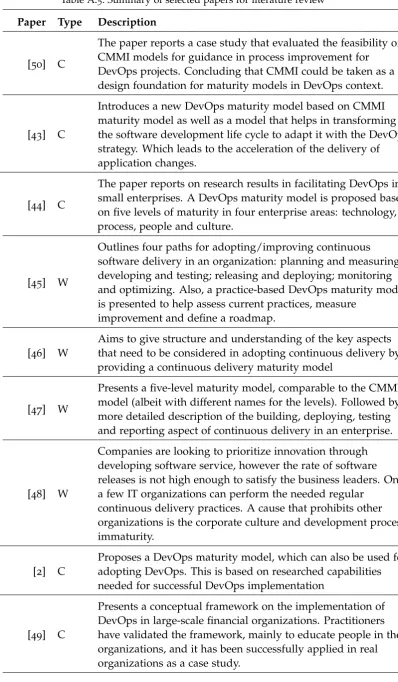
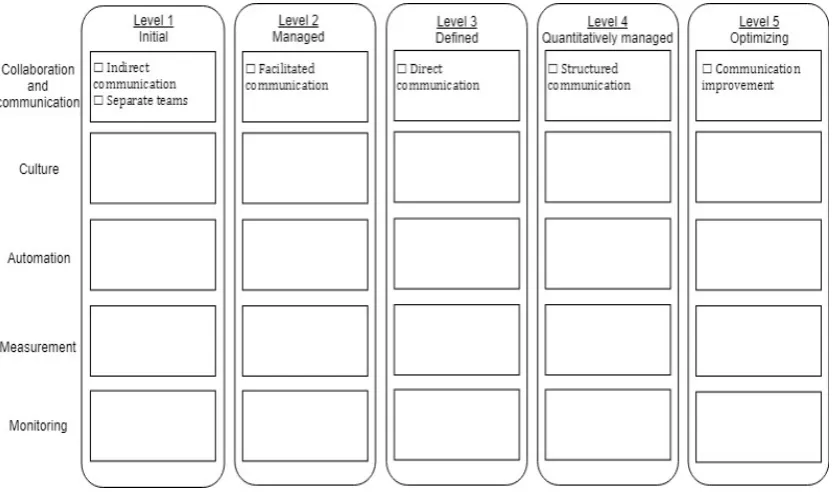
Another approach to a maturity model for measuring DevOps maturity, shown in figure4.3, was created by de Feijter et al. [2]. The model was created through
data collection, consisting of semi-structured interviews and literature review, validated through two rounds of expert opinions and applied in an exploratory case study.
This model aims to not only measure DevOps maturity but to also provide guid-ance in adopting it in software producing organizations. This model consists of ten levels instead of the five in CMMI models and is more detailed. It was cre-ated from a capability model describing the capabilities necessary for DevOps adoption. This model can be split into three sections:
• Culture and collaboration • Product, process and quality • Foundation
Each section has its own focus areas, which will be described by their extremes to prevent a lengthy description. For example, the lowest level of ‘communication’ is ‘indirect communication’, communication between teams is established via
4.2. DEVOPS MATURITY MODELS FROM LITERATURE
level is ‘external release heartbeat alignment’, that means that the release heart-beat is aligned with its dependent external stakeholders.
Figure4.4: DevOps focus area maturity model [2]
The next section starts with the ‘release heartbeat’, the lowest level is described as ‘requirements and incidents gathering and prioritization’, requirements and incidents are gathered and prioritized with stakeholders, the highest level is ‘re-lease heartbeat improvement’, with continuous improvement of the value stream by identifying and eliminating activities that do not add value and shortening of lead times and feedback moments with the customer. Next up is ‘branch and merge’, the first level is ‘version-controlled source code’ and the highest is ‘feature toggles’, in which functionality can be toggled in releases for customers.
4.3. DISCUSSION
being generated. The last focus area of this section is ‘incident handling’, ranging from ‘reactive incident handling’ to ‘automated root cause detection’, supported by analytics.
The final section starts with ‘configuration management’ ranging from ‘manual configuration management’, versions of used software are registered manually, to ‘version-controlled configuration management’, the versions of configurations are maintained in a version control. Followed by ‘architecture alignment’ con-sisting of the lowest level ‘software and technical architecture alignment’ and the highest level ‘continuous architecture evolvement’, with co-evolving of the soft-ware and technical architecture. The last focus area is ‘infrastructure’, its first level is ‘manually provisioned infrastructure’, provisioning all the infrastructure manually, and the last level, ‘managed platform services’, such as preconfigured platforms with possibility for automatic deployment of infrastructure. This con-cludes the description of the model by Feijter et al.
Finally, in the paper by Nagarajan and Overbeek [49] it is chosen to not create
a typical DevOps maturity model, but a framework with specific capabilities for large agile-based financial organizations. This framework was created by means of a literature review and practitioner interviews and validated through expert opinions. The framework differs from other maturity models, however, it still serves the same purpose as the other maturity models described, as it can be used to measure and achieve DevOps transformation goals.
4.3 d i s c u s s i o n
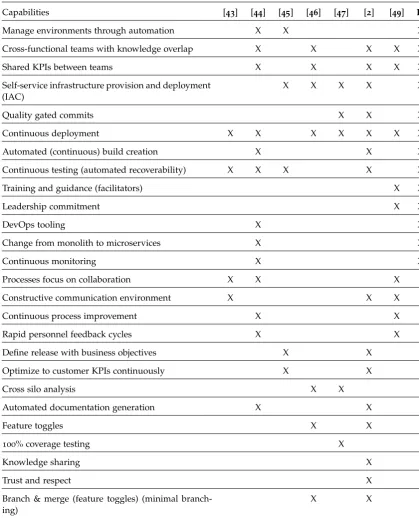
The models discussed in the previous sections approached DevOps maturity models differently. However, the definitions of the capabilities of each model have similarities. This can be seen in the comparison of the capabilities of the literature, which is shown in table4.1. All capabilities that were only mentioned
by one article were removed from the overview because those will not be used in the DevOps maturity model. This is done to prevent adding capabilities that are not sufficiently validated. However, if those excluded capabilities present itself in the upcoming design stages then they will be added to the next iteration of the maturity model. Also, some names or descriptions of capabilities differed only slightly and therefore have been grouped together under the most descriptive name. The full table, including the capabilities that were only mentioned once, is shown in Appendix B
The model that will follow from these capabilities is based on the seven pieces of literature, however, that does not necessarily mean that the list is complete. It is important to validate the model that follows from this literature review. In this case that will be done by expert interviews regarding the model as well as case studies on the applicability of the model. This should make the model more robust and useable in other organizations or situations.
4.3. DISCUSSION
needed for the highest level. It, therefore, depends on the organization what level of maturity is needed. As described by Minick: “Most organizations would be crazy to implement them, while a minority would be crazy to not implement them" [47].
Also, worth noting was a case study was carried out on a real-world project by Rong et al. to explore the feasibility of applying CMMI models to guide improve-ments for DevOps projects [50]. It was discovered that CMMI is not a direct fit
for DevOps projects. One of the issues found was with respect to the usability in conducting appraisals, as the CMMI model is not able to keep up with quick iterations in DevOps. Nevertheless, the CMMI framework could provide a good foundation for creating an extended version that would fit DevOps projects.
Table4.1: Comparison of literature on DevOps capabilities
Capabilities [43] [44] [45] [46] [47] [2] [49]
Constructive communication environment X X X
Manage environments through automation X X
Continuous process improvement X X
Create cross-functional teams with shared KPI and knowledge overlap X X X X
Allow rapid personnel feedback cycles X X
Processes focus on collaboration X X X
Define releases regarding business objectives X X
Self-service infrastructure provision and deployment (IAC) X X X X
Optimization to customer KPIs X X
Cross-silo analysis X X
Quality gated commits X X
Continuous deployment X X X X X X
Automated (continuous) build creation X X
Continuous testing (automated recoverability) X X X X
Automated documentation generation X X
Feature toggles X X
4.4. USING THE LITERATURE SOURCES TO PROPOSE THE FIRST VERSION OF OUR MATURITY MODEL V1
In the existing literature, it was quite often chosen to come up with their own definitions for the DevOps maturity levels. However, because of how widely known and used CMMI is, to use the standard CMMI maturity levels seems to be the best option.
4.4 u s i n g t h e l i t e r at u r e s o u r c e s t o p r o p o s e t h e f i r s t v e r s i o n o f o u r m at u r i t y m o d e l v 1
The previous sections provide enough material to create a first version of the DevOps maturity model. In this case, it was chosen to use the CMMI framework as a starting point, based on the arguments given in the discussion section. This framework will be combined with the capabilities found in the literature. The result of the first iteration of the DevOps maturity model is shown in Appendix C. The model is divided into the same sections as the dimensions of DevOps described in the background section: ‘Culture’, ‘Automation’, ‘Communication & collaboration’, ‘Measurement’ and ‘Monitoring’. In the following sections, the model will be described for each level structured by describing each dimension for the specific maturity. Similarly, to CMMI, our proposed model includes five levels.
4.4.1Initial
The initial level is where most organizations will be before they start implement-ing DevOps. This means that the teams are isolated and organized around one specific skill set. This leaves little place for feedback inside the organization. Many opportunities for process improvement exist as most processes are done manually.
No automation of the delivery process has taken place, environments are manu-ally provisioned, builds are done by build scripts and deployment happens man-ually. Documentation and saved configurations of projects or customers are non-existent.
The isolated teams result in indirect communication between them, which mainly happens via management of the teams. This results in poor communication, as information get lost in translation between the various people involved. The isolated teams also influence the collaboration between the teams, as this is only on an ad-hoc basis
Reporting on the teams happens on an irregular basis and are made manually. These reports can be on various subjects, for example, on the stability of a recent build or an overview of test results. However, the reports are just visible to the report runner and are not available to the rest of the team.
4.4. USING THE LITERATURE SOURCES TO PROPOSE THE FIRST VERSION OF OUR MATURITY MODEL V1
4.4.2Managed
The managed level is where organizations are consciously implementing DevOps and the foundation to build on is set. The teams are stable, however still inde-pendent as they have one backlog per team. The teams are structured to focus on short-term deliveries. The processes and methods are defined for the team itself and rapid feedback can be given in a safe environment, but again only in the team itself.
The delivery processes are now scheduled and the environment in which they are released is partly automated and organized into modules (OS, Database etc.). Builds can be made and stored automatically, however, versioning is still added manually. The deployment is mostly standardized and even partly automated. The documentation and configurations are up-to-date.
The communication and coordination are facilitated and actively managed to pro-vide an environment that motivates active collaboration in the teams.
Quality reports are now scheduled and created by the tools used in the process. The latest report is always accessible and visible to the whole team. The objectives for the software are linked to specific releases and the requirements are managed centrally.
A quality standard exists and is managed. This is achieved by doing systematic testing and specific requirement testing. After each build a test is performed as well and whenever the build is broken this is detected. The incidents resulted are gathered and prioritized together with the existing requirements.
4.4.3Defined
This level provides a stable environment and already has quite a few of the ca-pabilities that define DevOps implemented. The teams are structured around projects and processes are adapted to the collaboration between the teams. Feed-back on the collaborations between teams can be given rapidly.
The delivery process is standardized and automated. Builds can be triggered by, for example, a code check-in by a developer. The versioning is done auto-matically and because the builds are standardized, they can be deployed on all environments. The environments are automatically provisioned, and virtualiza-tion is done where applicable, this process is standard across all the environments (test, staging, prod etc.). A basic deployment pipeline is created for all environ-ments and, outside of production, it is possible to do the deployment automated, as well as most of the database changes that can occur with new build versions. Documentation and configurations are regularly validated.
4.4. USING THE LITERATURE SOURCES TO PROPOSE THE FIRST VERSION OF OUR MATURITY MODEL V1
The reports are visible across the teams and are created strategically. The report history is available for comparison and a dashboard can be created to visualize this across the portfolio.
Advanced systematic testing is performed and integrated into the process. The management centralized and automatically, whenever a change to the code is committed. These changes are gated, which means they are committed into the main branch with version control, in case something breaks it is easier to revert. The results are compared to quality metrics to measure performance. The moni-toring uses business and end-user context and the resources of environments to ensure stability.
4.4.4Measured
This level is when most capabilities of DevOps are implemented. The teams are structured around the whole product and not only a delivery or a project, thus giving more responsibility. The teams are cross-functional and have a knowledge overlap on the knowledge area of the other team. The processes and methods are adapted throughout the software delivery process in the organization. Feedback is given frequent and on all processes regarding software delivery.
The complete automation of a frequent delivery process is finished. The envi-ronments are automatically managed, and the architecture is fully composed of components. Automated build creation can be improved by parallel processing on multiple build machines. Build metrics are gathered to improve the build automation and the build is also automatically deployed into production. The database changes are fully automated. Deployment causes zero downtime. Fi-nally, the documents are updates based on the gathered experience and quality requirements.
The collaboration and communication are structured and in a constructive man-ner from peer-to-peer. Thus, no interference of management in communication between the people inside and outside the team. Collaboration is more inter-twined with the processes as well.
Regarding the measurement, the focus is more on collaboration-based processes to identify bottlenecks and inefficacies. This is supported by a trend analysis of the reports. Automation metrics exist to assess the progress against the set business goals for further improvement.
4.4. USING THE LITERATURE SOURCES TO PROPOSE THE FIRST VERSION OF OUR MATURITY MODEL V1
4.4.5Optimized
The final level is when all capabilities of DevOps are implemented and focuses on optimizing them. The teams are cross-functional, interdisciplinary and fo-cused on KPIs. To support this the team members have become multi-skilled and flexible. The process is continuously evaluated and improved upon.
The automation is optimized to maximize throughput of releases. The environ-ments are managed through IAC and all environment configurations are external-ized and versioned. Builds are continuously created as well as the deployments to all environments (including production). The software contains feature toggles to minimize impact of new features and release those whenever needed. Docu-mentation and configurations are automated generated at this level.
Communication and coordination are optimized according to the set metrics of the previous phase. This is further improved by community building to optimize the communication and collaboration.
Reports are created with an analysis of multiple departments (cross-silo). Re-leases are defined on specific business objectives and the KPIs are measured and optimized to increase customer value.
4.5. HIGH-LEVEL REPRESENTATION OF THE DEVOPS MATURITY MODEL V1
4.5 h i g h-l e v e l r e p r e s e n tat i o n o f t h e d e v o p s m at u r i t y m o d e l v 1
The maturity model described in the previous section is detailed, this can help companies get a better understanding of their DevOps maturity, but also is the size of two pages. To improve the understanding of the maturity model it is helpful to visualize it on a more high-level overview. This can be used to explain how the model is build up and how to interpret it. This results in the model of figure4.4
This model is shaped as a house, with DevOps being the roof, because the capabil-ities are the fundament for a thriving DevOps environment and thus, metaphor-ically, holding up the roof. The overarching connection between the capabilities and the DevOps environment in this model, are the maturity levels in this model, and thus in-between the roof and the rest of the house. In the literature review it has become clear that culture is an important fundament for supporting better communication & collaboration. But it also supports the measurement category, as reporting and requirement management must be supported by the process im-provement and feedback cycles stemming from the culture category. The monitor-ing and automation are stand-alone as implementmonitor-ing these does not necessarily need any of the other categories, however all categories are needed to provide the best DevOps environment.
5
E X P E R T I N T E R V I E W SThe goal of the DevOps maturity model is to be applicable in practical situations, therefore it is important to interview experts in the DevOps field on which capa-bilities they think that are necessary for successful implementation of DevOps in organization. This will be the first round in the expert interviews and will result in the second version of the DevOps maturity model
The DevOps maturity model and its capabilities must then be validated to ensure the credibility of the model. This is done by means of expert opinion in which the model will be subjected to experts in the DevOps field. They are asked to imagine how this model will interact with problem contexts imagined by them and then predict what effects they think this would have [51]. If these results
do not reflect the intended use of the model than it must be redesigned. This chapter will outline the process that was performed and the results that followed from it.
5.1 i n t e r v i e w s e t-u p
The interviews taken with the experts were all semi-structured [52], this means
that the interviewer adhered to an interview protocol but could divert if some-thing came up that had to be explored further. The interviews were done in two rounds. The first round comprised of questions about their experience with DevOps and associated capabilities that were needed in different DevOps stages. This data was used to create the DevOps maturity model v2. The second round,
performed on a later date, was an open discussion on the DevOps maturity model v2for validation purposes.
These interviews were held on-site at three different organizations with a total of five people with different backgrounds. The first three interviewees were people from the same company, but in three different roles, all with practical experience in DevOps. This company employs more than1000people and is an outsourcing
company in Vietnam. The fourth interviewee has both practical and theoretical background, with more than10years of work experience in information systems
and a PhD. in information system management. The third organization employs about600people and is also an outsourcing company in Vietnam. A summary of
the interviewees can be found in table5.1.
5.2. DATA ACQUISITION AND ANALYSIS – EXPERT INTERVIEW
Table5.1: Overview of interviewees
Name (acronym) Organization Role Experience in current role (years)
Interviewee A Organization A DevOps team manager 5
(Iv-A)
Interviewee B
Organization A DevOps architect 10 (Iv-B)
Interviewee C
Organization A DevOps engineer 3 (Iv-C)
Interviewee D
Organization B University lecturer 6 (Iv-D)
Interviewee E
Organization C DevOps engineer 4 (Iv-E)
5.2 d ata a c q u i s i t i o n a n d a na ly s i s – e x p e r t i n t e r v i e w
The interviews were taken to gather data on which capabilities are important for successful implementation of a DevOps environment inside an organization. The interview was started by gathering some general data, like the background and years of experience of the interviewee. The rest of the structure is comparable to the dimensions of DevOps described in chapter2. It was chosen to start with the
dimension of automation as this is a hard-skill which is well known in Vietnam. The rest of the conversation was split between the other dimensions. The full protocol followed for the interviews can be found in Appendix D.
5.2.1Analysis of interviews
Some of the interviews were recorded, however not all interviewees provided per-mission to record the interview. For these interviews it was crucial to maintain good notes during the interview and process the interviews right after they were held. The recorded interviews were manually transcribed, however the introduc-tion, ending and some in-between conversations were omitted, the rest of the transcript was verbatim. The interviews lasted between forty and sixty minutes per interviewee.
The interviews were analyzed by applying coding practices described by Saldana [53]. According to his book, the analysis can be split up into multiple coding
5.2. DATA ACQUISITION AND ANALYSIS – EXPERT INTERVIEW
a need for a second coding strategy to continue the foundation of the ‘Initial Coding’. This is where the second coding cycle comes into play, this cycle is described by Saldana [53] as finding the “bigger-picture" and as the latter stages
toward developing a grounded theory. In this cycle it is chosen to use ‘Axial Coding’, which is a method to develop broader conceptual categories based on the identified relationships between the codes created during the initial coding. These two coding cycles in the context of the interviews is graphically presented in figure5.1.
Figure5.1: The coding process used in this thesis
In the process of doing the initial coding, only the responses of the interviewees were considered and not the interviewer questions or comments. In those re-sponses it was important to search for processes, which are the participants ac-tions or words. For example: “I think these days it is important to teach students about collaboration in DevOps, because it is important that teams can work together in-terchangeably and know what is necessary to help each other function better." The codes given to this sentence are, ‘collaboration’, ‘team collaboration‘, ‘work interchange-ably’ and ‘improve others’. This example and another one is given in figure5.2.
Figure5.2: Initial coding
5.2. DATA ACQUISITION AND ANALYSIS – EXPERT INTERVIEW
the use of deductive coding described by Miles and Huberman [54]. However,
the coding was not restricted to the already discovered capabilities, because the goal is also to discover new capabilities.
After this was finished, the second cycle of coding was started: ‘Axial Coding’. During this process the codes were sorted and re-arranged to help the process of creating broader conceptual categories that cover multiple codes as was described in figure5.1. An example is the combination of the categories ‘thorough testing’,
‘automated build tests’ and ‘stable products’ discovered during Initial coding, into the capability ‘Testing’. This example, and others that followed from the coding in figure5.2, are shown in figure5.3
Figure5.3: Axial coding
5.2.2Results
The results will be described according to the structure that was used in the interview, starting with automation, followed by collaboration & communication, culture, measurement and finally monitoring.
Automation
The first capability that was constructed from the interview data was focused on a fully automated DevOps cycle. All the participants mentioned that DevOps is to be considered to not only be a fully automated build process, but also automated testing and automated deployment. Iv-A explained this as:
“The scrum methods in development was focused on continuous development, but DevOps is focused on combining continuous integration and continuous delivery" .
Iv-A continued that this does not only include the software product but also environment envisioning. Something that was currently invested in is the use of infrastructure as a code, by using various tools which can result in getting an environment ready with one click.
The second capability regarding DevOps came from Iv-C, who is busy managing DevOps tooling every day. Logically, Iv-C considered tooling to be very impor-tant to a successful DevOps process. Iv-B agreed on this, but also mentioned that tools are restricted to open-source because of limited funding for projects. For-tunately, many good open source tooling exists for DevOps. The one mentioned mostly was Jenkins for managing the continuous integration.
5.2. DATA ACQUISITION AND ANALYSIS – EXPERT INTERVIEW
“The life of both operations and development becomes much easier with microservices be-cause if something is unstable than the rest of the application can continue to work."
Collaboration&Communication
The interviewees were mainly focused on collaboration between teams. They described this as:
Iv-D: “Shorter development cycles require closer collaboration between the different teams, which is something we teach at the university. We also circulate the roles for the students, so that they will get familiar with this way of working" .
Iv-E: “The members of each team that takes part in DevOps will take a part in another team every now and then, this creates more understanding between the people"
This translates to the capability of having interdisciplinary employees that will be able to change roles and therefore better understand the needs of others.
Iv-B explains that collaboration is something they try to improve, but that this is harder to achieve because people can be “lazy" and just focused on their own work. Iv-C thinks that collaboration can be improved by sharing targets and goals, this will create less individualism and therefore more teamwork.
Iv-A describes communication for DevOps as:
“Direct communication is very important, the cycles in DevOps are so short, that com-munication between teams cannot lack behind" .
Resulting in the capability of direct communication and not having to go through the hierarchical layers.
Culture
The culture is not the first capability that came to mind when asking intervie-wees to describe DevOps. However, when asking specific questions about culture it was deemed very important by all interviewees, however, also to be the most difficult capability to achieve. Also, Iv-A and Iv-C had difficulty describing how the right culture could be established and what exactly the ideal culture for De-vOps implementation consists of.
Iv-B presented a print-out of a DevOps lifecycle model, that is shown in figure5.4,
to explain the need for a culture to foster a DevOps environment. Iv-B described it as:
5.2. DATA ACQUISITION AND ANALYSIS – EXPERT INTERVIEW
Figure5.4: DevOps cycle [3]
The capability that can be taken from the interviews is that the culture in teams and the organization should be very agile to foster a successful DevOps environ-ment.
Measurement
When the interviewees were asked questions about measurement in a DevOps environment, the main matter that was talked about is the reporting on automatic builds and tests. The tooling that is used in organization A can provide automatic reports on successful builds, code coverage of tests and successful unit testing among other things, as reported by Iv-A, Iv-B, Iv-C. According to Iv-B:
“The reports generated by the tools are used a lot and also other reports that are not automatically generated. These reports are enough in most situations, however, sometimes customers ask for more specific reports and we will create those. I think we can do much more, by trying to see trends for certain products or environments."
Iv-D explains that reporting is not something that is being taught at the university, due to time constraints and because it is not deemed as important as the other software developing aspects.
Iv-A states regarding reporting in DevOps that it is important to have reporting available, but that not everybody can interpret them correctly. For example, code coverage testing will not need to be100% and is almost impossible to achieve on
big applications. This should be used only as a rough number. A capability that is needed in this case would be to have trainers and/or facilitators.
Monitoring
The first response to monitoring by Iv-A is:
“Monitoring is very important throughout the whole process if there is a code conflict it should not be merged into the main code, if a build is failed an appropriate response has to be made, if the physical capabilities of the servers are overloaded something has to be done. Shortly, with monitoring a lot of melt-downs and other incidents can be prevented."
5.2. DATA ACQUISITION AND ANALYSIS – EXPERT INTERVIEW
The second capability that became clear was again voiced by all the interviewees, is the need for continuous testing. Iv-D states:
“Testing used to be the not sexy thing of programming, so my student would be very reluctant to test the code they wrote themselves and most of the time we do not have enough time to force them to do it. However, testing becomes a more important part of the curriculum, because the more complex systems get, the more important this will be."
Iv-A confirms this and states that continuous monitoring is not without continu-ous testing regarding DevOps.
All the findings that emerged during the interviews are summarized in table
5.2
Table5.2: Capabilities emerging from interviews
Capability Interviewee(s)
Fully automated DevOps cycle (build creation, testing,
deployment, environment provisioning) Iv-A, Iv-B, Iv-C, Iv-D
Need for open source tooling Iv-B, Iv-C
Microservices instead of monolith structure Iv-C
Reporting trend analysis Iv-B
Report visibility Iv-A
Cross-functional teams Iv-D, Iv-E
Having shared KPIs and knowledge overlap Iv-B, Iv-C
Direct communication Iv-A
Leadership commitment Iv-B
Quality gated commits Iv-A, Iv-C
continuous monitoring Iv-A, Iv-B, Iv-C, Iv-D
5.2.3Discussion
5.2. DATA ACQUISITION AND ANALYSIS – EXPERT INTERVIEW
when looking at literature, especially soft-aspects of DevOps are deemed impor-tant.
When questioning the interviewees about this, it became clear that the reason for the lacking information on the soft-aspects of DevOps is that not much is invested into soft-skills and that it is hard to convince the leadership to invest more. This can create friction in fostering a full-fledged DevOps environment.
Another interesting observation was the need for DevOps tooling. This capability is confirmed in the white-paper by Bahrs [45] and therefore added to the maturity
model. An interesting nuance given during the interviews is the need for open-source tooling, instead of closed-open-source. The reason that was given, is that the cost in outsourcing projects have a major impact on the overall profitability. This nuance is not added to the capability in the DevOps maturity model, as this seems to apply specifically to outsourced projects and the goal is that the model can be applied to any project.
What surprised us during the interviews is that all the interviewees mentioned, that Asia is always lacking behind Western countries in adapting to new method-ologies. Unfortunately, they were not able to give examples for why this is their opinion. Therefore, we will provide some speculative reasons. For example, if they lack behind in DevOps adoption then it could be due to the possible differ-ences in culture needed for implementation in (South)East-Asia. Or the DevOps implementation is different in (South)East-Asia, but they judge it through the Western idea of DevOps. However, during the interviews it did not actually seem that they lack behind. They could have many reasons for saying that they lack behind, while this is not correct. For example, the interviewees look up against Western society and think they are better in general. Or to seem humble towards the interviewer. The exact reason is unknown; however, the final version of the maturity model could be used to compare the Western and (South)East-Asian DevOps implementations to at least determine if they are lacking behind.
The interviews have not brought many additions or changes to the model, a reason could be that the DevOps philosophy is taught the same in these organi-zations as it is elsewhere. Nevertheless, many findings from literature have been confirmed, which provides additional assurance that these capabilities belong in the DevOps maturity model.
The findings presented in our results are added to the table that compared the literature on its capabilities. This gives a complete overview of all the mentioned capabilities in the literature and the interviews. This table can be found in Ap-pendix B. This overview confirms that none of the points mentioned in the in-terview had not already been mentioned in existing literature. However, some capabilities that were discarded, because they were only mentioned once in the literature have been mentioned in the interviews as well. Therefore, it is decided to add these capabilities to the maturity model. The capabilities are regarding De-vOps tooling, monolith to microservices architecture and continuous monitoring. This results in the DevOps maturity model v2, which can be viewed in Appendix
5.2. DATA ACQUISITION AND ANALYSIS – EXPERT INTERVIEW
These results also warrant changes to the high-level overview of the DevOps ma-turity model, which was first presented in figure4.4. However, we note that from
high-level perspective, the changes are minimal, as most changes took place in the details of the model and not in the overall capabilities or categories. The only change was the addition of DevOps tools as a capability to the Automation category as can be seen in figure5.5(see the 5th item in the box below
Automa-tion).