http://wrap.warwick.ac.uk
Original citation:
Pennycook, S. J. and Jarvis, S. A. (2012) Developing performance-portable molecular
dynamics kernels in Open CL. In: 3rd International Workshop on Performance Modeling,
Benchmarking and Simulation of High Performance Computing Systems, International
Conference for High Performance Computing, Networking, Storage and Analysis, Salt
Lake City, UT, 10-16 Nov 2012. Published in: 2012 SC Companion : High Performance
Computing, Networking, Storage and Analysis (SCC) pp. 386-395.
Permanent WRAP url:
http://wrap.warwick.ac.uk/56685
Copyright and reuse:
The Warwick Research Archive Portal (WRAP) makes this work by researchers of the
University of Warwick available open access under the following conditions. Copyright ©
and all moral rights to the version of the paper presented here belong to the individual
author(s) and/or other copyright owners. To the extent reasonable and practicable the
material made available in WRAP has been checked for eligibility before being made
available.
Copies of full items can be used for personal research or study, educational, or not-for
profit purposes without prior permission or charge. Provided that the authors, title and
full bibliographic details are credited, a hyperlink and/or URL is given for the original
metadata page and the content is not changed in any way.
Copyright statement:
“© 2012 IEEE. Personal use of this material is permitted. Permission from IEEE must be
obtained for all other uses, in any current or future media, including reprinting
/republishing this material for advertising or promotional purposes, creating new
collective works, for resale or redistribution to servers or lists, or reuse of any
copyrighted component of this work in other works.”
A note on versions:
The version presented here may differ from the published version or, version of record, if
you wish to cite this item you are advised to consult the publisher’s version. Please see
the ‘permanent WRAP url’ above for details on accessing the published version and note
that access may require a subscription.
Developing Performance-Portable Molecular Dynamics Kernels in OpenCL
S. J. Pennycook, S. A. Jarvis Department of Computer Science,
University of Warwick, Coventry, UK
e-mail: [email protected]
Abstract—This paper investigates the development of a molecular dynamics code that is highly portable between architectures. Using OpenCL, we develop an implementation of Sandia’s miniMD benchmark that achieves good levels of performance across a wide range of hardware: CPUs, discrete GPUs and integrated GPUs.
We demonstrate that the performance bottlenecks of miniMD’s short-range force calculation kernel are the same across these architectures, and detail a number of platform-agnostic optimisations that improve its performance by at least 2x on all hardware considered. Our complete code is shown to be 1.7x faster than the original miniMD, and at most 2x slower than implementations individually hand-tuned for a specific architecture.
Keywords-scientific computing; accelerator architectures; parallel programming; performance analysis; high perfor-mance computing
I. INTRODUCTION
In recent years, CPU alternatives have gained significant traction within the high-performance computing (HPC) in-dustry, and many of the world’s fastest supercomputers [1] currently employ hybrid system designs that pair traditional CPUs with discrete co-processors (e.g.Cell, FPGAs, GPUs, Intel Xeon Phi). Some vendors are already placing CPU and GPU cores on the same chip (AMD Fusion, Intel HD Graphics), while others are exploring this option (Nvidia Project Denver).
Optimising codes for each new hardware offering is clearly desirable, ensuring fair comparisons between them [2]–[5], and enabling HPC sites to switch between ven-dors. However, creating and maintaining highly optimised implementations for each platform is often not feasible – legacy production codes are too large to re-write using multiple programming languages/toolkits, and maximising performance on a new platform requires significant program-mer effort and expertise.
The Open Computing Language (OpenCL [6]) is a cross-vendor standard which ensures thefunctionalportability of codes across hardware, thereby eliminating the need for applications to be re-coded on a per-device basis. However, it makes no guarantees of performance portability – an OpenCL application may be highly tuned for a particular architecture, but exhibit very different performance on oth-ers.
This paper investigates the development of a “performance-portable” OpenCL implementation of Sandia’s miniMD benchmark [7], [8], which seeks to exhibit good levels of performance across multiple architectures. miniMD is a simplified version of the popular LAMMPS package [9], [10], intended for use in optimisation studies such as this one; due to its simplicity, potential optimisations can be explored much more rapidly than in the context of a production application.
Although this is not the first paper to address the issue of performance portability for OpenCL codes [11]–[15], it is the first (to our knowledge) to do so for molecular dynamics (MD). The use of co-processors in this domain has been shown in previous research to deliver significant speed-ups [16]–[22]. However, it remains to be seen if a single set of optimisations allows for efficient execution across CPUs, discrete GPUs, and integrated GPUs.
The contributions of this paper are as follows:
• We detail the development of a performance-portable
kernel for short-range force calculation, highlighting a number of important design decisions: the storage format of the neighbour list, the use of Newton’s third law (N3), and using vector types to improve both gather/scatter performance and SIMD efficiency.
• We report the performance of our kernel executing on a
wide range of hardware from multiple vendors, includ-ing: CPUs (Intel E3-1240; AMD A8-3850), discrete GPUs (Nvidia C1060, C2050, GTX 680; AMD FirePro V7800) and integrated GPUs (Intel HD4000; AMD HD6550D). Our optimisations improve performance by at least 2x across all architectures considered.
• We compare the performance of kernels auto-vectorised
by the Intel OpenCL compiler to hand-vectorised ker-nels, and identify issues in the compilers from both AMD and Intel that result in the generation of ineffi-cient assembly code for gather/scatter operations.
• Finally, we compare the performance of our complete application to the original miniMD, a hand-vectorised implementation using AVX instructions, and the CUDA kernel found within LAMMPS. Our OpenCL imple-mentation is 1.7x faster than the original, and at most 2x slower than highly-optimised “native” implementations. The remainder of this paper is structured as follows:
Sec-c
tion II presents a survey of related work; Section III in-troduces the OpenCL programming model; Section IV de-tails the development and optimisation of our performance-portable MD code; Section V compares the performance of our code with implementations highly optimised for a specific platform; Section VI discusses the implications of our results; and Section VII concludes the work.
II. RELATEDWORK
A. Performance Portability
In previous work [15], we investigated the performance portability of OpenCL kernels in the context of wavefront applications, demonstrating that the performance of OpenCL on CPUs can match that of a scalar, MPI-based imple-mentation. This work extends our approach to a new class of application (molecular dynamics), with a significantly different memory access pattern (gather-scatter), and focuses on the efficient utilisation of modern single-instruction-multiple-data (SIMD) hardware.
Others have examined the performance portability of OpenCL kernels from different domains [11]–[14]. In all cases, the authors conclude that “auto-tuning” (i.e. writing kernels in a parametrised fashion and determining optimal parameter values at runtime) is an appropriate method of achieving portability across hardware. This methodology is well-suited to OpenCL; library calls are provided for obtaining detailed hardware information, and kernels can be compiled with different parameter values at run time.
B. OpenCL and Molecular Dynamics
The most similar MD codes to the implementation presented here are the LAMMPSGPUpackage [18] and the MD
bench-mark from the Scalable HeterOgeneous Computing (SHOC) suite, both of which can be compiled to use OpenCL. They also both carry out a simple Lennard-Jones (LJ) simulation, although with different parameters and initial conditions.
SHOC is intended to be run across multiple architec-tures, but its input is sufficiently different from the default LAMMPS and miniMD simulations that its performance is not necessarily representative. Our OpenCL implementation does not build on either of these existing implementations – a serial, scalar baseline is more representative of a legacy application and will better enable us to identify the perfor-mance benefits of each individual optimisation.
III. OPENCL
The OpenCL standard [6] is maintained by the Khronos Group, but is contributed to by many vendors and institu-tions. At the time of writing, the language is supported on the majority of HPC hardware, although compilers are at dif-ferent stages of maturity. Owing to its similarity to Nvidia’s proprietary CUDA programming model, the mapping be-tween OpenCL and GPU hardware is quite straightforward; the best way to map OpenCL to CPU hardware is less clear.
OpenCL Device OpenCL Device
CPU GPU
Compute Unit/Processing Element Compute Unit
[image:3.612.348.526.69.177.2]Processing Element
Figure 1. Mapping between CPU/GPU hardware and OpenCL.
A. Programming Model
In OpenCL, a host CPU running C/C++ code uses library calls to communicate with and control one or more devices. Each device is made up of a number ofcompute units, which can be further sub-divided into processing elements.
Device functions are known as kernels and can be com-piled just-in-time (JIT) from source, or loaded from a cached binary if one exists for the current target platform. These kernels are executed in a single-program-multiple-data (SPMD) fashion by a one-, two- or three-dimensional set of work-items, which are grouped together intowork-groups.
Work-groups can be scheduled for execution on any avail-able compute unit and in any order, thus permitting OpenCL applications to scale to fit different hardware configurations. There is no method of global synchronisation during a kernel, but local synchronisation is possible between all work-items in a given work-group.
B. Hardware Mapping
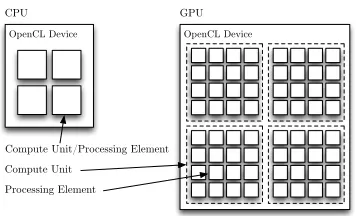
How the concepts of devices, compute units, processing elements, work-groups and work-items map to different architectures is decided by the OpenCL runtime, a library that is often provided by the hardware vendor (but can also be supplied by others [23], [24]). A typical mapping between CPU/GPU hardware and OpenCL is shown in Fig. 1.
Table I
HARDWARE AND SOFTWARE CONFIGURATION.
CPUs Integrated GPUs Discrete GPUs E3-1240 A8-3850 HD4000 HD6550D C1060 C2050 GTX680 V7800 Manufacturer Intel AMD Intel AMD Nvidia Nvidia Nvidia AMD
Compute Units 8 4 16 5 30 14 8 18
Proc. Elements 8 4 128 400 240 448 1536 1440 PeakaGFLOP/s 211 93 147 480 933 1288 3090 2016
Bandwidth (GB/s) 21 30 26 30 102 144 192 128
Powerb(Watts) 80 100 77 100 189 238 195 150
Host Compiler Intel 11.1.072
Host Flags-O3 -xHost -restrict -fno-alias -ipo MPI Library OpenMPI 1.4.3
Intel SDK Intel OpenCL 2012 AMD SDK AMD APP 2.7 NVIDIA SDK CUDA Toolkit 5.0
OpenCL Flags-cl-single-precision-constant -cl-mad-enable -cl-fast-relaxed-math
aPeak performance for single precision.
bTDP for “fused” architectures includes CPU and GPU power.
contains 16 stream cores of 5 simple processing elements each. Work-groups are scheduled to compute units, and processing elements execute work-items in 8-, 32- and 64-wide SIMD on Intel, Nvidia and AMD GPUs respectively. Since GPUs rely on a CPU host, communication with the host can impact application performance. Integrated GPUs can communicate with the host through shared memory, but all data to be used by discrete GPUs must be transferred explicitly to the device via PCI-Express (PCIe).
C. Experimental Setup
A detailed description of the hardware and software setup used in this paper is given in Table I. The only exceptions to this setup are: the HD4000, which can only be used as an OpenCL device under Windows; and the A8-3850 CPU (plus its integrated HD6550D GPU), which is hosted elsewhere. On these two systems, we use the Visual Studio 2010 C++ compiler and GCC respectively.
Although the Intel i7-3770 (Ivy Bridge) CPU attached to the HD4000 can also be used as an OpenCL device, we do not report on its performance. We instead report performance on an Intel Xeon E3-1240, a server part built on a closely related microarchitecture (Sandy Bridge).
In all experiments, we round the number of work-items up to a multiple of the hardware’s “preferred work-group size multiple”, as reported by the device, and allow the OpenCL runtime to choose the number of work-groups.
All performance figures are given as execution times in seconds, and all implementations make use of single precision floating-point arithmetic. We configure miniMD to simulate 256,000 atoms with a uniform density of 0.8442, using the default cut-off distance of 2.5, for 100 timesteps. Except where noted, all experiments pair hardware with the OpenCL SDK provided by the vendor.
IV. DEVELOPINGPERFORMANCE-PORTABLEKERNELS
The LJ simulation performed by miniMD can be broken down into four components. The calculation of short-range
1:for allatomsido
2: for allneighbourskdo
3: j = neighbour list for atom i[k]
4: delx = xi - pos[j+0]
5: dely = yi - pos[j+1]
6: delz = zi - pos[j+2]
7: rsq = (delx×delx) + (dely×dely) + (delz×delz)
8: if(rsq< Rc)then
9: sr2 = 1.0 / rsq
10: sr6 = sr2×sr2×sr2
11: f = sr6×(sr6 - 0.5)×sr2
12: fxi += f×delx
13: fyi += f×dely
14: fzi += f×delz
15: force[j+0] -= f×delx
16: force[j+1] -= f×dely
17: force[j+2] -= f×delz
18: end if
19: end for
20:end for
Figure 2. Scalar short-range force calculation.
forces is responsible for more than 80% of its runtime, and evaluates the force between all atoms separated by less than some “cut-off” distance (Rc). To avoid evaluating the distance between all pairs of atoms at each time step, the force compute makes use of a pre-computed “neighbour list” [25] for each atom. Building this list is the second-most expensive step, accounting for approximately 10% of execution time. The remaining time is split between: inter-node communication, which sees inter-nodes exchange position and force information for atoms near the boundary of their sub-volume; and the update of atom velocities and positions. In this section, we discuss the challenges of achieving high performance portability for all four components of the simulation. However, our optimisation efforts focus exclu-sively on short-range force calculation, since it accounts for such a high fraction of execution time. As we demonstrate in Section V, the other components of the simulation may become a significant bottleneck on some hardware; there is a clear need to investigate these issues further in future work.
A. Short-Range Force Calculation
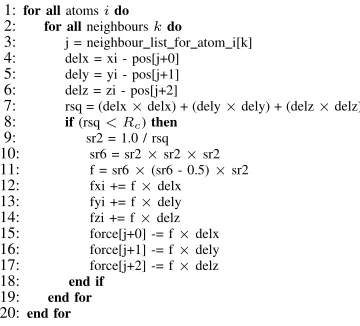
Fig. 2 shows pseudo-code for the scalar short-range force calculation loop in miniMD. Most of the work in this loop could potentially be executed in parallel; the positions of atoms are fixed during this operation, and thus the inter-atomic distance (and force) between all pairs of atoms in the system can be computed concurrently. A natural way to map this work to the OpenCL programming model is to assign one work-item to each atom.
[image:4.612.56.298.88.217.2]j0 ... j1 ... j2 ... j3 ...
j0 j1 j2 j3
Gather from Original Neighbour List
j0 j1 j2 j3 ...
j0 j1 j2 j3
Contiguous Load from Transposed Neighbour List
Figure 3. Effect of neighbour list transposition on memory access pattern. Each arrow represents a single load instruction.
Since OpenCL does not support global synchronisation between work-items, it is difficult to prevent such conflicts. Although many devices support atomic memory operations, on current-generation hardware they are too expensive to be used in an inner-loop such as this one [18]. We instead opt to not use N3, modifying the neighbour list build to store
(i, j)in the lists of bothiandj, and removing Lines 15–17 from the kernel. This removes the potential for conflicts, at the expense of twice as much computation.
1) Performance Bottlenecks: If contiguous work-items are mapped to SIMD execution units (as is the case on GPUs, and for auto-vectorised code on CPUs), then Lines 3– 6 have the biggest performance impact. Each of the memory accesses on these lines requires agatheroperation (i.e.they are “uncoalesced memory accesses”, in CUDA parlance). If work-items instead/also expose parallelism through the explicit use of vector types (as is the case on AMD GPUs and for non-vectorised code on CPUs), then the use of only scalar types results in significant SIMD inefficiency.
Improving the performance of this kernel on all of the architectures considered in this study thus depends upon achieving better utilisation of SIMD hardware. As we demonstrate in the remainder of this section, all hardware therefore benefits from the same set of optimisations.
2) Neighbour List Gather: If the neighbour list of each atom is stored in contiguous memory, any access to this list from work-items operating in SIMD requires a gather; with nneighbours per atom,W contiguous work-items read from memory with a stride ofn.
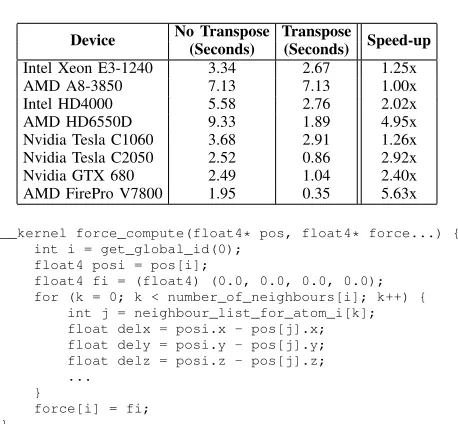
A much more efficient way to store the neighbour list is in transposed form (i.e. the 0th neighbour of W atoms, followed by the 1st neighbour, and so on). Where these W atoms have a different number of neighbours, we insert “dummy” neighbours, which are located at infinity and always fail the cut-off check. This is likely to give better performance than a completely transposed neighbour list (i.e. the 0th neighbour of all atoms, followed by the 1st neighbour, and so on) on architectures with caches.
Table II
PERFORMANCE IMPACT OF NEIGHBOUR LIST TRANSPOSITION.
Device No Transpose Transpose Speed-up (Seconds) (Seconds)
Intel Xeon E3-1240 3.34 2.67 1.25x
AMD A8-3850 7.13 7.13 1.00x
Intel HD4000 5.58 2.76 2.02x
AMD HD6550D 9.33 1.89 4.95x
Nvidia Tesla C1060 3.68 2.91 1.26x
Nvidia Tesla C2050 2.52 0.86 2.92x
Nvidia GTX 680 2.49 1.04 2.40x
AMD FirePro V7800 1.95 0.35 5.63x
__kernel force_compute(float4* pos, float4* force...) { int i = get_global_id(0);
float4 posi = pos[i];
float4 fi = (float4) (0.0, 0.0, 0.0, 0.0); for (k = 0; k < number_of_neighbours[i]; k++) {
int j = neighbour_list_for_atom_i[k]; float delx = posi.x - pos[j].x; float dely = posi.y - pos[j].y; float delz = posi.z - pos[j].z; ...
}
[image:5.612.76.280.75.213.2]force[i] = fi; }
Figure 4. OpenCL code-snippet for a kernel storing atom data infloat4s.
WhenW is set to the hardware’s SIMD width, all neigh-bour list accesses become a single load from contiguous memory locations (Fig. 3). We therefore setW to 1 for the AMD CPU; 8 for the Intel CPU and GPU; 32 for Nvidia GPUs; and 64 for AMD GPUs.
This transposition also enables the Intel SDK to auto-vectorise our kernel, which is only attempted when the compiler expects it to improve performance (based on some heuristic). We believe that the presence of a large number of gather operations caused the original kernel to fail this check, thus preventing auto-vectorisation.
Table II gives the execution times for the kernel with and without a transposed neighbour list. The A8-3850 is the only architecture not to see a speed-up, and this is due to it executing work-items in scalar; whenW is set to 1, the neighbour list layout is not changed. The cost of a gather operation increases with SIMD width, and we therefore see higher speed-ups on architectures with wider SIMD.
3) Position Gather: The loads on Lines 4–6 become
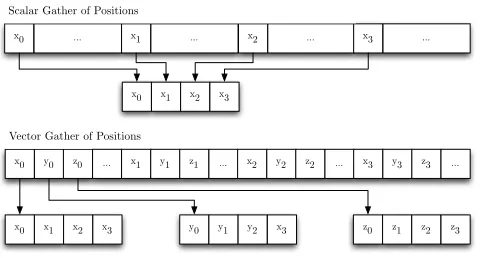
three gather operations; one for each of x, y and z. For W contiguous work-items, this equates to3W scalar loads, from up toW cache lines. Defining the position and force arrays using vector types (Fig. 4) serves as a hint to the compiler thatx,y andz are stored contiguously; for all of the hardware we consider, the full position of an atom can be loaded in a single memory access, and this hint permits the compiler to employ a more efficient gather (Fig. 5).
[image:5.612.323.552.87.299.2]x0 ... x1 ... x2 ... x3 ...
x0 x1 x2 x3
Scalar Gather of Positions
x0 y0 z0
x0 x1 x2 x3
Vector Gather of Positions
... x1 y1 z1 ... x2 y2 z2 ... x3 y3 z3 ...
[image:6.612.327.555.70.197.2]y0 y1 y2 x3 z0 z1 z2 z3
Figure 5. Effect of using vector types on memory access pattern.
Table III
PERFORMANCE IMPACT OF USING VECTOR TYPES.
Device Scalar Gather Vector Gather Speed-up (Seconds) (Seconds)
Intel Xeon E3-1240 2.67 2.00 1.33x
AMD A8-3850 7.13 8.62 0.83x
Intel HD4000 2.76 1.59 1.74x
AMD HD6550D 1.89 1.88 1.00x
Nvidia Tesla C1060 2.91 1.54 1.89x
Nvidia Tesla C2050 0.86 0.67 1.29x
Nvidia GTX 680 1.04 0.45 2.29x
AMD FirePro V7800 0.35 0.34 1.02x
As shown in Table III, most architectures benefit from this change, with only AMD hardware seeing little (or no) improvement. Performance is not significantly impacted on the HD6550D or V7800, suggesting that they are already able to hide the latency of these memory accesses. The A8-3850 experiences a slow-down of 1.2x, again because it does not execute work-items in SIMD. Although the SDK uses a vector load to gatherx,y andzas expected, the remainder of the kernel continues to use scalar arithmetic; therefore, each component of the loaded vector must be extracted into a scalar register, resulting in worse performance.
4) Explicit Vectorisation: After converting the position array to an array of float4 vectors, our next step is to convert the arithmetic to vector form (Fig. 6). This exposes intra-loop parallelism to the compiler, and leads to a more succinct (and arguably more readable) version of the kernel. Following this change, the Intel SDK no longer performs auto-vectorisation; rather than packing contiguous work-items into SIMD execution units, each of the explicit vector operations in the kernel is mapped directly to an SSE instruction. Since each work-item now runs independently, the neighbour list access is no longer a gather, and we disable the neighbour list transposition (by setting W to 1, as we did on the AMD CPU) to compensate.
The performance of this kernel on the E3-1240 is worse than those the compiler was able to auto-vectorise, due to SIMD inefficiencies: our explicit vectorisation only uses four of the eight SIMD execution units available in AVX (Fig. 7); and the majority of the arithmetic (the calculation
__kernel force_compute(float4* pos, float4* force...) { int i = get_global_id(0);
float4 posi = pos[i];
float4 fi = (float4) (0.0, 0.0, 0.0, 0.0); for (k = 0; k < number_of_neighbours[i]; k++) {
int j = neighbour_list_for_atom_i[w*k]; float4 del = posi - pos[j];
float rsq = dot(del, del); float sr2 = 1.0 / rsq; float sr6 = sr2 * sr2 * sr2; float f = sr6 * (sr6 - 0.5) * sr2; f = (rsq < cutoff) ? f : 0.0; fi += del * f;
}
[image:6.612.57.297.72.201.2]force[i] = fi; }
Figure 6. OpenCL code-snippet for a kernel using vector arithmetic.
x0 x1 x2 x3 x4 x5 x6 x7
y0 y1 y2 y3 y4 y5 y6 y7
z0 z1 z2 z3 z4 z5 z6 z7
x0 y0 z0 0 0 0 0 0
delx0 dely0 delz0 0 0 0 0 0
rsq0 rsq0 rsq0 rsq0 0 0 0 0 rsq0 rsq1 rsq2 rsq3 rsq4 rsq5 rsq6 rsq7
Explicit Vectorisation Implicit Vectorisation
= 1 Work-Item
Figure 7. Comparison of implicit and explicit vectorisation, for 8-wide SIMD.
of the force, based on rsq) remains scalar. On the A8-3850, performance is improved by 1.3x, since this is the first kernel for which the AMD SDK emits any vector instructions.
On the GPUs, the mapping of work-items to SIMD units is unchanged, and we make no changes to the neighbour list transposition. We would thus expect to see no performance impact; the compilers convert each of the vector operations in the kernel into a set of four scalar operations, and then combine contiguous work-items as before. However, we see slightly worse performance across all GPU hardware, due to our use of the dot product function to calculate rsq. This introduces two additional instructions per loop iteration; the compiler does not know that the last element of thefloat4
is 0, and so includes it in the dot-product.
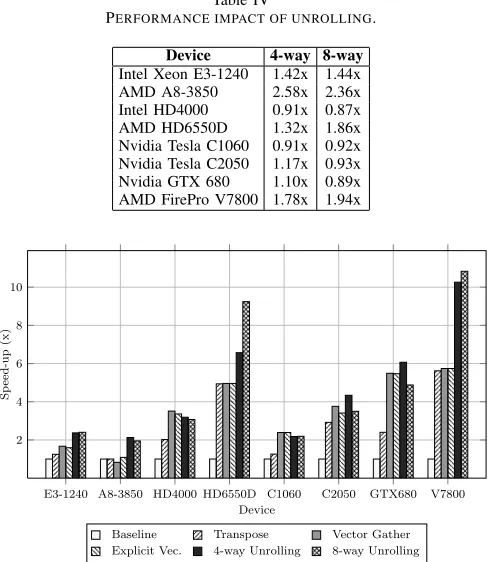
5) Loop Unrolling: Unrolling the loop over neighbours in our explicit vectorisation kernel, such that it computes the force betweeni and several neighbours simultaneously, allows us to regain lost SIMD efficiency. Theoretically, the compilers could employ such an optimisation themselves, but we found that this is not yet the case.
Table IV
PERFORMANCE IMPACT OF UNROLLING.
Device 4-way 8-way
Intel Xeon E3-1240 1.42x 1.44x
AMD A8-3850 2.58x 2.36x
Intel HD4000 0.91x 0.87x
AMD HD6550D 1.32x 1.86x
Nvidia Tesla C1060 0.91x 0.92x
Nvidia Tesla C2050 1.17x 0.93x
Nvidia GTX 680 1.10x 0.89x
AMD FirePro V7800 1.78x 1.94x
E3-1240 A8-3850 HD4000 HD6550D C1060 C2050 GTX680 V7800 2
4 6 8 10
Device
Sp
eed-up
(x)
Baseline Transpose Vector Gather
Explicit Vec. 4-way Unrolling 8-way Unrolling
Figure 8. Comparison of speed-ups for each approach on all architectures.
factors (4 and 8), relative to the previous best approach (i.e. vector gather, with scalar arithmetic). For 8-way unrolling, we usefloat8types, to explore the potential performance benefits of AVX instructions on CPUs; for 4-way unrolling, we usefloat4types. To handle the case where the number of loop iterations does not divide exactly by 4 or 8, we pad an atom’s neighbour list with dummy atoms.
Both CPUs benefit from 4-way unrolling, due to running all SIMD instructions at 100% efficiency. Unrolling also exposes more parallelism to the very-long-instruction-word (VLIW) architecture of AMD GPUs, which see a similar performance increase. The performance impact of unrolling on other architectures is inconsistent, and further investiga-tion into this matter is necessary.
8-way unrolling is more efficient than 4-way unrolling on the AMD GPUs, again because more parallelism is exposed to the underlying microarchitecture. It does not, however, lead to efficient utilisation of AVX on the E3-1240. Examination of the assembly generated by the Intel SDK (Appendix A) reveals that the compiler emits an inefficient instruction sequence for the AoS-to-SoA transpose; instead of using vectorshuffle instructions to permute the gathered AoS data, as it does when auto-vectorising the kernel, it uses scalar instructions to build the SoA data one element at a time. The A8-3850 also experiences a slow-down, but this is because it does not support AVX instructions.
6) Summary: The graph in Fig. 8 presents the total
performance improvement of our optimisations, relative to the original scalar baseline code. This performance improve-ment is cumulative, since each optimisation is built upon the previous version; the only exception to this is 8-way unrolling, which replaces 4-way unrolling. The speed-up of our best kernel (i.e.explicit vectorisation with unrolling) is consistently greater than 2x across all architectures.
Generally speaking, the GPUs see more benefit from the memory optimisations while the CPUs see more benefit from explicit vectorisation. This reflects both the simpler cores of GPUs (which are more sensitive to memory latencies, and are thus more impacted by the original memory access pattern) and the immaturity of OpenCL compilers for CPUs. AMD GPUs are the only architecture to benefit significantly from both types of optimisation (with a speed-up of≈11x). However, where a code change does not improve perfor-mance, it does not significantly degrade it. These results thus show that it is possible to accelerate OpenCL code without focusing on any particular microarchitecture, and demon-strates the performance portability of our optimisations.
B. Neighbour List Build
The core behaviour of the neighbour list build is very similar to that of force compute; each work-item computes the distance between an atom and a set of potential neighbours, and compares that distance to the cut-off. We optimise this using float4 vector types, as we did for force compute. However, instead of updating forces, each work-item ap-pends the indices of those atoms that pass the cut-off check to a list – an operation that does not map well to OpenCL. For serial code, where the lists for each atom are built one after the other, each index can be written to memory sequentially; further, if the amount of memory allocated for the neighbour list is too small, it can be reallocated. OpenCL does not support the allocation of device memory within kernels, and assigning one work-item per atom leads to all neighbour lists being built in parallel; the starting offset of each neighbour list must be known ahead of time. In our code, we allocate enough memory for each atom to store some maximum number of neighbours (derived from simulation parameters), and calculate the offsets accordingly.
C. Communication
the force acting on dependent atoms. Prior to force compute, each node sends the positions of its dependent atoms to neighbouring nodes (position communication); and, after the force compute, each node receives some force contribution from its neighbouring nodes (force communication).
Exchange and borders pose a similar challenge to OpenCL as the neighbour list build, since the number of atoms each work-item appends to the list (of atoms being exchanged or at the borders) is not known ahead of time. The packing and unpacking of messages for position and force commu-nication is much simpler, and the transfer of the packed messages can be hidden behind useful work; however, the current communication scheme used by miniMD imposes an ordering on the sending and receiving of these messages, which complicates matters.
Our current implementation does not implement any of these components in OpenCL. Instead, we make use of the default implementation provided by the original miniMD, with device-to-host and host-to-device transfers either side. This is likely to be a performance bottleneck for discrete GPUs, due to the latency and bandwidth of the PCIe bus. The performance of the code executing on CPUs and integrated GPUs will also be decreased, although to a lesser extent; our code does not make any distinction between devices, and each transfer results in a memcpyon these platforms. There is a clear need to port these components to OpenCL in future work – in addition to decreasing the amount of data transferred between host and device, the operations themselves would benefit from executing in parallel.
D. Other Components
The remaining components of the simulation are uninter-esting in a performance portability study. One kernel zeroes the forces of each atom (prior to the force compute); another updates atom positions, based on their current velocities; and the final kernel updates atom velocities based on the forces acting upon them. Representing these streaming operations in OpenCL such that their performance scales with memory bandwidth (as expected) is trivial.
V. COMPARISON WITHNATIVEIMPLEMENTATIONS
A performance-portable code is clearly more desirable if its performance is competitive with that of native implementa-tions. We therefore compare our OpenCL implementation to (a) the original miniMD, (b) a hand-vectorised implemen-tation using AVX instructions on the Intel Xeon, and (c) LAMMPSCUDA on the C1060 and C2050.
A. CPU Comparison
Table V compares the performance of our OpenCL imple-mentation of miniMD with the two native C++ implemen-tations, executing on the Intel E3-1240. In keeping with the rest of the paper, we present OpenCL results from the Intel SDK; we also present results from pairing the AMD
Table V
COMPARISON OFINTELCPUEXECUTION TIMES(IN SECONDS)
Implementation Force Neigh Comm Other Total Speed-up (Orig.) (AVX)
Original C++ 2.77 0.26 0.19 0.21 3.42 1.00x 0.35x
C++ with AVX 0.76 0.11 0.12 0.20 1.19 2.87x 1.00x
OpenCL (Intel) 1.41 0.60 0.25 0.17 2.43 1.41x 0.49x
OpenCL (AMD) 1.33 0.58 0.16 0.17 2.25 1.52x 0.53x
SDK with Intel hardware, as a means of comparing the two compilers. For both SDKs, we use the kernel with explicit vectorisation and 4-way unrolling.
The AMD SDK provides the fastest runtime for OpenCL, beating the Intel SDK by approximately 10%. This is also 1.5x faster than the original C++ version of miniMD, demonstrating that OpenCL is a suitable development tool for utilising the SIMD architectures of modern CPUs. How-ever, our OpenCL implementation is 2x slower than the heavily-optimised version of miniMD which we developed in previous work [26]. This code employs a number of novel SIMD and threading optimisations, which give it a significant advantage over OpenCL; its force compute and neighbour list build are 2x and 6x faster respectively.
The biggest remaining causes of poor performance in our OpenCL implementation are: firstly, that the AVX code generated by current OpenCL compilers is inefficient; and secondly, that both the original miniMD and our optimised AVX code make use of N3, and thus do half as much work during the force compute and neighbour list build. As discussed in Section IV, making use of N3 in OpenCL is difficult, due to restrictions in the programming model regarding work-item synchronisation.
A relatively new addition to the OpenCL standard is the ability to fission (i.e. split) a device into multiple sub-devices, and issue work to them separately. We can leverage the existing MPI parallelism in miniMD, combined with fission, to permit the use of N3 on CPUs; specifically, we can start 8 MPI ranks and assign one OpenCL sub-device to each. We consider this optimisation only because it does not impact performance portability – although we re-introduce the neighbour force updates (Lines 15–17, from Fig. 2), we guard them with a pragma (i.e.#ifdef N3), and the code changes necessary to support fission are minimal, affecting only the initial OpenCL setup code. Fission is not (currently) supported by GPUs, but Kepler’s ability to support multiple MPI tasks feeding work to the same GPU could be used to the same effect.
expen-Table VI
COMPARISON OFNVIDIAGPUEXECUTION TIMES(IN SECONDS)
Device Implementation Force Neigh Comm Other Total Speed-up
C1060 CUDA 0.67 0.35 0.06 0.09 1.18 1.00x
OpenCL 1.69 0.31 0.34 0.07 2.40 0.49x
C2050 CUDA 0.36 0.22 0.05 0.06 0.70 1.00x
OpenCL 0.58 0.12 0.28 0.05 1.03 0.68x
sive, possibly due to scheduling conflicts between the threads spawned by MPI and AMD’s OpenCL runtime.
B. GPU Comparison
Table VI compares the performance of our OpenCL im-plementation of miniMD (using the kernel with explicit vectorisation and 4-way unrolling) and LAMMPSCUDA.
For the complete application, our implementation is 2x slower than CUDA on the C1060, and 1.5x slower than CUDA on the C2050. A large portion of this difference can be attributed to the poor communication scheme used by our OpenCL code, which is almost 6x slower than that used by LAMMPSCUDA. The CUDA code executes all
communica-tion routines on the device and, since we are using a single node, is able to avoid all PCIe communication; our OpenCL code, on the other hand, executes all communication routines on the host.
For the force compute kernel alone, our OpenCL im-plementation is 2.5x and 1.6x slower than CUDA on the C1060 and C2050 respectively. This is partly due to doc-umented differences between Nvidia’s CUDA and OpenCL compilers [11], [12]; despite the programming models and languages being very similar, the CUDA compiler emits more efficient code. LAMMPSCUDA also makes use of
read-only texture memory, which is cached, to store atom positions. Support for texture memory could be added to our kernel and guarded with pragmas, enabled for GPUs in a similar way to how fission is enabled for CPUs – we intend to explore this option in future work.
VI. DISCUSSION
Many legacy scientific and engineering applications are not performance-optimal, achieving a very low percentage of peak FLOP/s even on a single node (i.e. before perfor-mance degradations due to less-than-perfect node scaling). Traditionally, application scientists have been reluctant to optimise codes for two reasons: (1) tuning for a specific platform reduces an HPC site’s ability to move between vendors; and (2) the ability to maintain code is seen as more important than achieving the best possible performance.
However, studies performed by both academia and indus-try have shown that sections of these codes are amenable to GPU acceleration – and that programmers are willing to spend time porting kernels to CUDA (or selecting appro-priate OpenACC [27] pragmas) in exchange for significant speed-ups. The results in this paper (specifically, that our
float8 fxjtmp = (f[j1].x, f[j2].x, f[j3].x, f[j4].x, f[j5].x, f[j6].x, f[j7].x, f[j8].x);
float8 fyjtmp = (f[j1].y, f[j2].y, f[j3].y, f[j4].y, f[j5].y, f[j6].y, f[j7].y, f[j8].y);
float8 fzjtmp = (f[j1].z, f[j2].z, f[j3].z, f[j4].z, f[j5].z, f[j6].z, f[j7].z, f[j8].z);
Figure 9. OpenCL code-snippet for gatheringx,yandzpositions in the kernel with 8-way unrolling.
OpenCL implementation is 1.7x faster than the original miniMD) suggest that, for HPC sites starting from a sub-optimal scalar baseline code, OpenCL offers an opportunity to explore the potential of new architectures while also improving performance on their existing hardware.
We feel it is unlikely that OpenCL codes will exceed the performance of heavily optimised native implementations, but there is hope that future compiler releases will de-crease the performance gap between them. The performance of scalar kernels should improve as the auto-vectorisation capabilities of Intel’s compiler mature; OpenCL is well-suited to expressing parallelism and vectorisation opportuni-ties, so these kernels may even out-perform auto-vectorised C and C++ codes. For kernels employing explicit vector types, the generation of inefficient instruction sequences for gather/scatter operations currently leads to poor per-formance, but this too could be improved. OpenCL lacks gather/scatter and transpose constructs for its vector types, and so we implement our gather of positions as shown in Figure 9; neither the AMD or Intel compiler recognises that this can be performed as an in-register AoS-to-SoA transpose, and we are currently investigating alternative ways of expressing this operation in OpenCL.
VII. CONCLUSIONS
In this paper, we report on the development of a performance-portable OpenCL implementation of Sandia’s miniMD benchmark. We show that the performance bot-tlenecks of the force compute kernel are the same across several architectures, and that the optimisations that we apply to the original scalar code improve performance by more than 2x across a wide range of hardware types from different vendors: CPUs and integrated GPUs from AMD and Intel; and discrete GPUs from AMD and Nvidia.
ACKNOWLEDGEMENTS
The authors thank Chris Hughes and Mikhail Smelyanskiy of Intel Corporation for their valuable comments and sug-gestions. Thanks also to Sandia National Laboratories for access to the Teller Testbed system; Teller is provided under the United States Department of Energy ASCR and NNSA Testbed Computing Program.
This research is supported in part by The Royal Society through their Industry Fellowship Scheme (IF090020/AM). Access to hardware is made possible through collabora-tion with the UK Atomic Weapons Establishment under grants CDK0660 (The Production of Predictive Performance Models for Future Computing Requirements) and CDK0724 (AWE Technical Outreach Programme).
CODEACCESS
Our port of miniMD is available for download from:
go.warwick.ac.uk/pcav/areas/hpc/download/minimd opencl
REFERENCES
[1] H. Meuer, E. Strohmaier, J. Dongarra, and H. Simon, “Top 500 Supercomputer Sites,” http://top500.org/, November 2011.
[2] R. Bordawekar, U. Bondhugula, and R. Rao, “Believe it or Not! Multi-core CPUs Can Match GPU Performance for FLOP-intensive Application!” IBM Research Division, Thomas J. Watson Research Center, Yorktown Heights, NY, Tech. Rep. RC24982, 2010.
[3] ——, “Can CPUs Match GPUs on Performance with Pro-ductivity?: Experiences with Optimizing a FLOP-intensive Application on CPUs and GPU,” IBM Research Division, Thomas J. Watson Research Center, Yorktown Heights, NY, Tech. Rep. RC25033, 2010.
[4] R. Vuduc, A. Chandramowlishwaran, J. Choi, M. E. Guney, and A. Shringarpure, “On the Limits of GPU Acceleration,” in Proceedings of the USENIX Workshop on Hot Topics in Parallelism, Berkeley, CA, 14-15 June 2010.
[5] V. W. Leeet al., “Debunking the 100X GPU vs. CPU Myth: An Evaluation of Throughput Computing on CPU and GPU,” inProceedings of the ACM/IEEE International Symposium on Computer Architecture, Saint-Malo, France, 21-23 June 2010, pp. 451–460.
[6] Khronos Group, “OpenCL 1.2 Specification,” http://www. khronos.org/registry/cl/specs/opencl-1.2.pdf, November 2011. [7] M. Heroux and R. Barrett, “Mantevo Project,” http://software.
sandia.gov/mantevo/, May 2011.
[8] M. A. Heroux et al., “Improving Performance via Mini-applications,” Sandia National Laboratories, Albuquerque, NM, Tech. Rep. SAND2009-5574, 2009.
[9] S. Plimptonet al., “LAMMPS Molecular Dynamics Simula-tor,” http://lammps.sandia.gov/, May 2011.
[10] S. Plimpton, “Fast Parallel Algorithms for Short-Range Molecular Dynamics,”Journal of Computational Physics, vol. 117, pp. 1–19, 1995.
[11] P. Du et al., “From CUDA to OpenCL: Towards a Performance-Portable Solution for Multi-platform GPU Pro-gramming,” Knoxville, TN, Tech. Rep. UT-CS-10-656, 2010.
[12] K. Komatsuet al., “Evaluating Performance and Portability of OpenCL Programs,” inProceedings of the Fifth International Workshop on Automatic Performance Tuning, June 2010. [13] R. Weber, A. Gothandaraman, R. J. Hinde, and G. D.
Peterson, “Comparing Hardware Accelerators in Scientific Applications: A Case Study,”IEEE Transactions on Parallel and Distributed Systems, vol. 22, no. 1, pp. 58–68, January 2011.
[14] S. Seo, G. Jo, and J. Lee, “Performance Characterization of the NAS Parallel Benchmarks in OpenCL,” inProceedings of the International Symposium on Workload Characterization, Austin, TX, 6–8 November 2011, pp. 137–148.
[15] S. J. Pennycooket al., “An Investigation of the Performance Portability of OpenCL,”Journal of Parallel and Distributed Computing, in press.
[16] S. Olivier, J. Prins, J. Derby, and K. Vu, “Porting the GROMACS Molecular Dynamics Code to the Cell Proces-sor,” in Proceedings of the IEEE International Parallel and Distributed Processing Symposium, Long Beach, CA, 26-30 March 2007.
[17] J. A. Anderson, C. D. Lorenz, and A. Travesset, “General Purpose Molecular Dynamics Simulations Fully Implemented on Graphics Processing Units,”Journal of Computer Physics, vol. 227, no. 10, pp. 5342–5359, 2008.
[18] W. M. Brown, P. Wang, S. J. Plimpton, and A. N. Tharrington, “Implementing Molecular Dynamics on Hybrid High Perfor-mance Computers – Short Range Forces,”Computer Physics Communications, vol. 182, pp. 898–911, 2011.
[19] C. R. Trott, “LAMMPScuda - A New GPU-Accelerated Molecular Dynamics Simulations Package and its Applica-tion to Ion-Conducting Glasses,” Ph.D. dissertaApplica-tion, Ilmenau University of Technology, 2011.
[20] D. Caseet al., “AMBER 11,” http://www.ambermd.org, May 2011.
[21] J. C. Phillips, J. E. Stone, and K. Schulten, “Adapting a Message-Driven Parallel Application to GPU-Accelerated Clusters,” in Proceedings of the International Conference for High Performance Computing, Networking, Storage and Analysis, Austin, TX, 15-21 November 2008, pp. 1–9. [22] M. J. Harvey, G. Giupponi, and G. D. Fabritiis, “ACEMD:
Accelerating Biomolecular Dynamics in the Microsecond Time Scale,”Journal of Chemical Theory and Computation, vol. 5, no. 6, pp. 1632–1639, 2009.
[23] J. Kimet al., “SnuCL: An OpenCL Framework for Hetero-geneous CPU/GPU Clusters,” inProceedings of the Interna-tional Conference on Supercomputing, Venice, Italy, 25–29 June 2012, pp. 341–352.
[24] R. Karrenberg and S. Hack, “Improving Performance of OpenCL on CPUs,” inProceedings of the International Con-ference on Compiler Construction, Tallinn, Estonia, March 2012, pp. 1–20.
[25] L. Verlet, “Computer “Experiments” on Classical Fluids. I. Thermodynamical Properties of Lennard-Jones Molecules,”
Physical Review, vol. 159, no. 1, pp. 98–103, 1967. [26] S. J. Pennycook, C. J. Hughes, M. Smelyanskiy, and S. A.
Jarvis, “Exploring SIMD for Molecular Dynamics, Using Intel Xeon and Xeon Phi Processors,” unpublished.
APPENDIX
ASSEMBLYGENERATED FORGATHEROPERATIONS
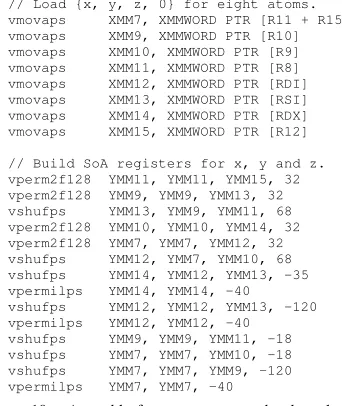
Figures 10 and 11 list the assembly generated by the Intel SDK for two of our kernels: the auto-vectorised vector gather kernel, and the kernel with explicit vectorisation and 8-way unrolling, respectively. The instructions have been re-ordered and grouped to improve readability, and any instructions not directly related to the gather of positions have been removed.
Both listings begin in the same way, loading the positions of eight neighbours into eight 128-bit (XMM) registers. These positions are stored in AoS format ({x, y, z,0}) and both pieces of assembly transpose the gathered positions into SoA format ({x, x, ...}, {y, y, ...} and {z, z, ...}), storing the result in three 256-bit (YMM) registers. During auto-vectorisation, the compiler recognises that this operation can be performed by an in-register AoS-to-SoA transpose, emitting a sequence of 14 shuffle and permute instructions. The sequence generated for our explicit vector kernel is significantly less efficient, containing 37 instructions.
Each of thevinsertpsinstructions in Fig. 11 extracts the x, y or z component from one XMM register (in AoS), and inserts it into another (in SoA). The result is six XMM registers, two for each of x, y and z, which are then combined into three YMM registers using three
vinsertf128s. These inserts together account for 21 of the 37 instructions.
Thevinsertpsinstruction has the capability to extract any 32-bit element from an XMM register, and we were therefore surprised to see that each of its uses here extracts the lowest 32 bits. This requires the generation of the 16 remaining instructions, to rearrange the XMM registers – each vpshufd instruction moves an atom’s y component to the lowest 32-bits of the register, and each vmovhlps
instruction does the same forz.
We believe that these behaviours are caused by a combi-nation of compiler immaturity and the way in which we have expressed the gather operation in OpenCL (Fig.9). Future compiler releases, or an alternative representation of the gather in code, may address these issues, leading to considerably better performance for this kernel on hardware supporting AVX instructions.
// Load {x, y, z, 0} for eight atoms. vmovaps XMM7, XMMWORD PTR [R11 + R15] vmovaps XMM9, XMMWORD PTR [R10] vmovaps XMM10, XMMWORD PTR [R9] vmovaps XMM11, XMMWORD PTR [R8] vmovaps XMM12, XMMWORD PTR [RDI] vmovaps XMM13, XMMWORD PTR [RSI] vmovaps XMM14, XMMWORD PTR [RDX] vmovaps XMM15, XMMWORD PTR [R12]
[image:11.612.357.528.73.276.2]// Build SoA registers for x, y and z. vperm2f128 YMM11, YMM11, YMM15, 32 vperm2f128 YMM9, YMM9, YMM13, 32 vshufps YMM13, YMM9, YMM11, 68 vperm2f128 YMM10, YMM10, YMM14, 32 vperm2f128 YMM7, YMM7, YMM12, 32 vshufps YMM12, YMM7, YMM10, 68 vshufps YMM14, YMM12, YMM13, -35 vpermilps YMM14, YMM14, -40 vshufps YMM12, YMM12, YMM13, -120 vpermilps YMM12, YMM12, -40 vshufps YMM9, YMM9, YMM11, -18 vshufps YMM7, YMM7, YMM10, -18 vshufps YMM7, YMM7, YMM9, -120 vpermilps YMM7, YMM7, -40
Figure 10. Assembly from our vector gather kernel.
// Load {x, y, z, 0} for eight atoms. vmovdqa XMM3, XMMWORD PTR [R9 + R13] vmovdqa XMM4, XMMWORD PTR [R9 + R13] vmovdqa XMM6, XMMWORD PTR [R9 + R13] vmovdqa XMM7, XMMWORD PTR [R9 + R13] vmovdqa XMM8, XMMWORD PTR [R9 + R13] vmovdqa XMM9, XMMWORD PTR [R9 + R13] vmovdqa XMM11, XMMWORD PTR [R9 + R13] vmovdqa XMM12, XMMWORD PTR [R9 + R13]
// Build SoA register for x component. vinsertps XMM5, XMM4, XMM3, 16 vinsertps XMM5, XMM5, XMM6, 32 vinsertps XMM5, XMM5, XMM7, 48 vinsertps XMM10, XMM9, XMM8, 16 vinsertps XMM10, XMM10, XMM11, 32 vinsertps XMM10, XMM10, XMM12, 48 vinsertf128 YMM5, YMM10, XMM5, 1
// Build SoA register for y component. vpshufd XMM13, XMM4, 1
vpshufd XMM14, XMM3, 1
vinsertps XMM13, XMM13, XMM14, 16 vpshufd XMM14, XMM6, 1
vinsertps XMM13, XMM13, XMM14, 32 vpshufd XMM14, XMM7, 1
vinsertps XMM13, XMM13, XMM14, 48 vpshufd XMM14, XMM9, 1
vpshufd XMM15, XMM8, 1
vinsertps XMM14, XMM14, XMM15, 16 vpshufd XMM15, XMM11, 1 vinsertps XMM14, XMM14, XMM15, 32 vpshufd XMM15, XMM12, 1 vinsertps XMM14, XMM14, XMM15, 48 vinsertf128 YMM13, YMM14, XMM13, 1
// Build SoA register for z component. vmovhlps XMM4, XMM4, XMM4
vmovhlps XMM3, XMM3, XMM3 vinsertps XMM3, XMM4, XMM3, 16 vmovhlps XMM4, XMM6, XMM6 vinsertps XMM3, XMM3, XMM4, 32 vmovhlps XMM4, XMM7, XMM7 vinsertps XMM3, XMM3, XMM4, 48 vmovhlps XMM4, XMM9, XMM9 vmovhlps XMM6, XMM8, XMM8 vinsertps XMM4, XMM4, XMM6, 16 vmovhlps XMM6, XMM11, XMM11 vinsertps XMM4, XMM4, XMM6, 32 vmovhlps XMM6, XMM12, XMM12 vinsertps XMM4, XMM4, XMM6, 48 vinsertf128 YMM3, YMM4, XMM3, 1